
Judge, 1915-04-17 · page 9 of 26
Judge — April 17, 1915 — page 9: what you’re looking at
What you’re looking at
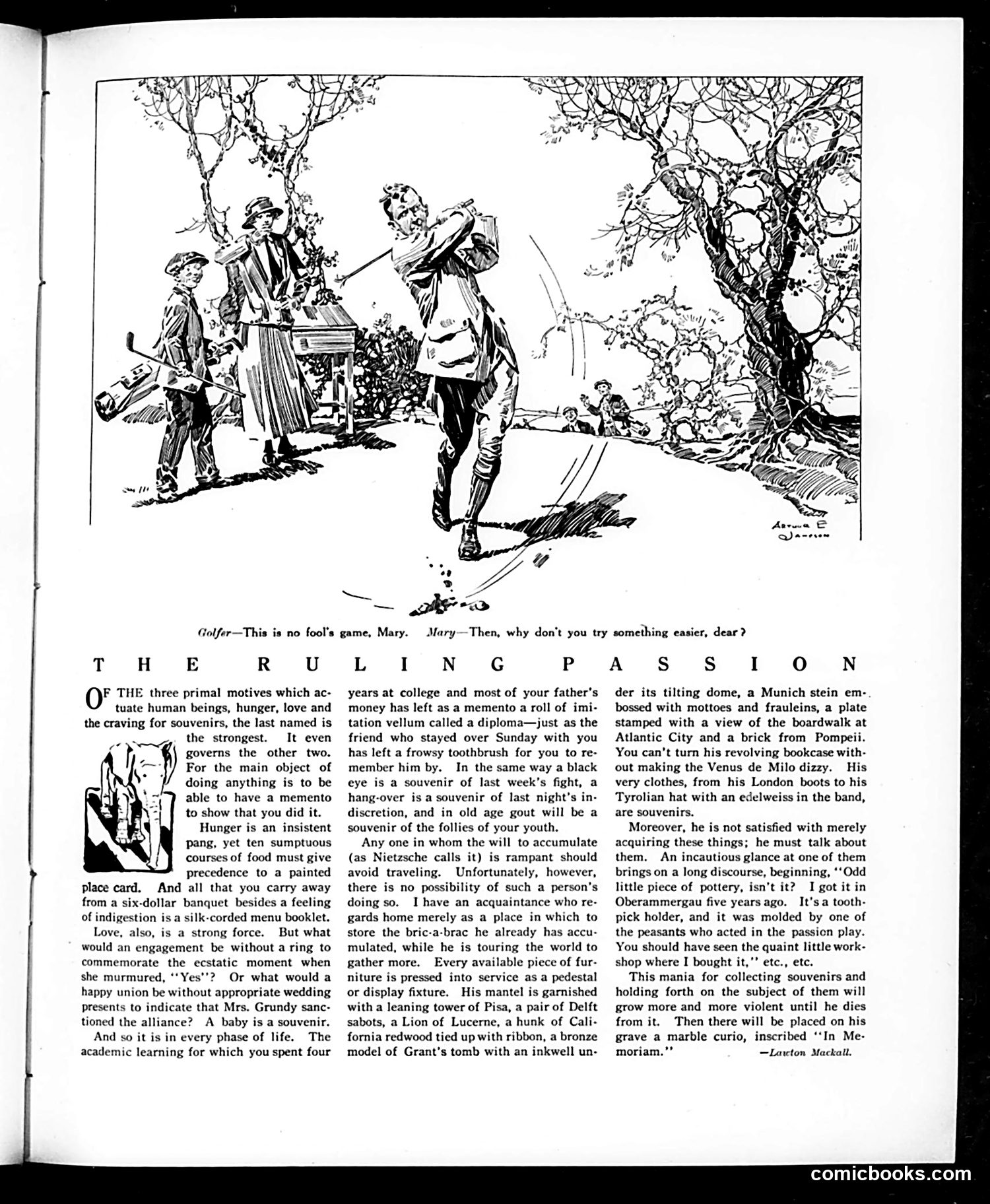
The cartoon shows a golfer and his wife, illustrating the article's satirical thesis: humans are primarily motivated by acquiring souvenirs rather than hunger or love. The wife's caption—"Then, why don't you try something easier, dear?"—humorously implies golf itself is difficult, not foolish as the husband claims. The accompanying essay (bylined Laxton Mackall) expands this theme, arguing that the compulsion to collect and display travel mementos governs modern behavior. The author mocks a specific acquaintance who obsessively gathers European trinkets (Pisa towers, Delft sabots, Pompeii bricks, Munich steins) and tediously narrates their origins. For modern readers: this satirizes early 20th-century tourism culture—the newly accessible leisure travel enabling middle/upper-class Americans to accumulate foreign souvenirs as status symbols. The piece criticizes both the acquisitiveness itself and the accompanying social obligation to hear endless anecdotes about purchases. It's gentle mockery of emerging consumer culture and tourist behavior.
📄 Transcribed text from this page (OCR, searchable)
Machine-transcribed from the original scan — historical spelling and the odd misread are preserved.
Golfer—This is no fool's game, Mary. T H E R U F THE three primal motives which ac- tuate human beings, hunger, love and the craving for souvenirs, the last named is the strongest. It even governs the other two. For the main object of doing anything is to be able to have a memento to show that you did it. Hunger is an insistent pang, yet ten sumptuous courses of food must give precedence to a painted place card. And all that you carry away from a six-dollar banquet besides a feeling of indigestion is a silk-corded menu booklet. Love, also, is a strong force. But what would an engagement be without a ring to commemorate the ecstatic moment when she murmured, ‘‘Yes'’? Or what would a happy union be without appropriate wedding presents to indicate that Mrs. Grundy sanc- tioned the alliance? A baby is a souvenir. And so it is in every phase of life. The academic learning for which you spent four L I N G P years at college and most of your father’s money has left as a memento a roll of imi- tation vellum called a diploma—just as the friend who stayed over Sunday with you has left a frowsy toothbrush for you to re- member him by. In the same way a black eye is a souvenir of last week's fight, a hang-over is a souvenir of last night's in- discretion, and in old age gout will be a souvenir of the follies of your youth. Any one in whom the will to accumulate (as Nietzsche calls it) is rampant should avoid traveling. Unfortunately, however, there is no possibility of such a person's doing so. I have an acquaintance who re- gards home merely as a place in which to store the bric-a-brac he already has accu- mulated, while he is touring the world to gather more. Every available piece of fur- niture is pressed into service as a pedestal or display fixture. His mantel is garnished with a leaning tower of Pisa, a pair of Delft sabots, a Lion of Lucerne, a hunk of Cali- fornia redwood tied up with ribbon, a bronze model of Grant's tomb with an inkwell un- Mary—Then, why don’t you try something easier, dear? A S S I O N der its tilting dome, a Munich stein em- bossed with mottoes and frauleins, a plate stamped with a view of the boardwalk at Atlantic City and a brick from Pompei You can’t turn his revolving bookcase with- out making the Venus de Milo dizzy. His very clothes, from his London boots to his Tyrolian hat with an edelweiss in the band, are souvenirs. Moreover, he is not satisfied with merely acquiring these things; he must talk about them. An incautious glance at one of them brings on a long discourse, beginning, ‘‘Odd little piece of pottery, isn’t it? I got it in Oberammergau five years ago. It's a tooth- pick holder, and it was molded by one of the peasants who acted in the passicn play. You should have seen the quaint little work- shop where I bought it,’’ etc., etc. This mania for collecting souvenirs and holding forth on the subject of them will grow more and more violent until he dies from it. Then there will be placed on his grave a marble curio, inscribed ‘‘In Me- moriam.’” Laxton Mackall, comicbooks.com