
Judge, 1915-04-17 · page 4 of 26
Judge — April 17, 1915 — page 4: what you’re looking at
What you’re looking at
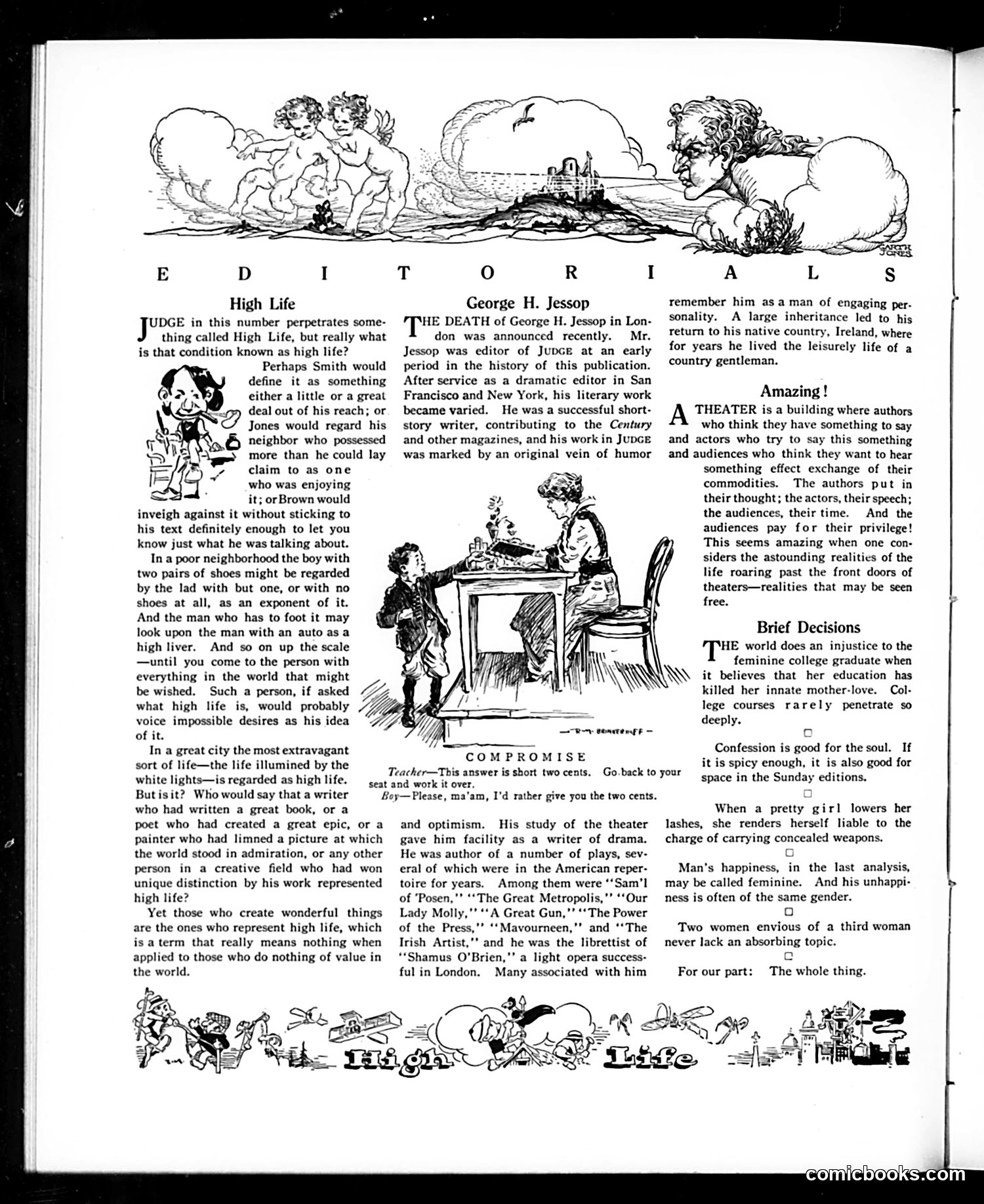
This page from **Judge** magazine contains three distinct pieces: 1. **"High Life"** (left): A satirical essay defining "high life" through class observation—from barefoot children to wealthy society figures. The accompanying caricature shows a smug, well-dressed man, likely representing pretentious upper-class affectation that Judge frequently mocked. 2. **"George H. Jessop"** (center): An obituary-style tribute to a deceased editor and playwright, noting his literary contributions and theatrical works. 3. **"Amazing!"** and **"Brief Decisions"** (right): Short satirical commentary on theater, education, gender relations, and social hypocrisy—typical Judge fare targeting contemporary manners and morals. The page's tone is characteristic of early 20th-century American satirical journalism: sophisticated mockery of class pretension and social contradictions.
📄 Transcribed text from this page (OCR, searchable)
Machine-transcribed from the original scan — historical spelling and the odd misread are preserved.
High Life UDGE in this number perpetrates some- thing called High Life, but really what is that condition known as high life? Perhaps Smith would define it as something either a little or a great deal out of his reach; or Jones would regard his 6 neighbor who possessed more than he could lay claim to as one who was enjoying it; or Brown would inveigh against it without sticking to his text definitely enough to let you know just what he was talking about. In a poor neighborhood the boy with two pairs of shoes might be regarded by the lad with but one, or with no shoes at all, as an exponent of it. And the man who has to foot it may look upon the man with an auto asa high liver. And so on up the scale —until you come to the person with everything in the world that might be wished. Such a person, if asked what high life is, would probably voice impossible desires as his idea of it. In a great city the most extravagant sort of life—the life illumined by the white lights—is regarded as high life. Butisit? Who would say that a writer who had written a great book, or a poet who had created a great epic, or a painter who had limned a picture at which the world stood in admiration, or any other person in a creative field who had won unique distinction by his work represented high life? Yet those who create wonderful things are the ones who represent high life, which is a term that really means nothing when applied to those who do nothing of value in the world. George H. Jessop HE DEATH of George H. Jessop in Lon- don was announced recently. Mr. Jessop was editor of JupGe at an early period in the history of this publication. After service as a dramatic editor in San Francisco and New York, his literary work became varied. He was a successful short- story writer, contributing to the Century and other magazines, and his work in JupcE was marked by an original vein of humor Py Bonet e nee — ————_—___ COMPROMISE Teacher—This answer is short two cents, seat and work it over. Boy—Please, ma'am, I'd rather give you the two cents. and optimism. His study of the theater gave him facility as a writer of drama. He was author of a number of plays, sev- eral of which were in the American reper- toire for years. Among them were ‘‘Sam'l of ‘Posen,"* ‘‘The Great Metropolis,’’ ‘Our Lady Molly,” ‘‘A Great Gun,’’ ‘‘ The Power of the Press,’’ ‘‘Mavourneen,’’ and ‘‘The Irish Artist,’"* and he was the librettist of ‘Shamus O'Brien,"’ a light opera success- ful in London. Many associated with him Go.back to your remember him as aman of engaging per- sonality. A large inheritance led to his return to his native country, Ireland, where for years he lived the leisurely life of a country gentleman. Amazing! THEATER is a building where authors who think they have something to say and actors who try to say this something and audiences who think they want to hear something effect exchange of their commodities. The authors put in their thought; the actors, their speech; the audiences, their time. And the audiences pay for their privilege! This seems amazing when one con- siders the astounding realities of the life roaring past the front doors of theaters—realities that may be seen free. Brief Decisions 'HE world does an injustice to the feminine college graduate when it believes that her education has killed her innate mother-love. Col- lege courses rarely penetrate so deeply. Confession is good for the soul. If it is spicy enough, it is also good for space in the Sunday editions. When a pretty girl lowers her lashes, she renders herself liable to the charge of carrying concealed weapons. [a] Man's happiness, in the last analysis, may be called feminine. And his unhappi- ness is often of the same gender. ie) Two women envious of a third woman never lack an absorbing topic. c For our part: The whole thing. ates