
A complete issue · 23 pages · 1911
Judge — September 30, 1911
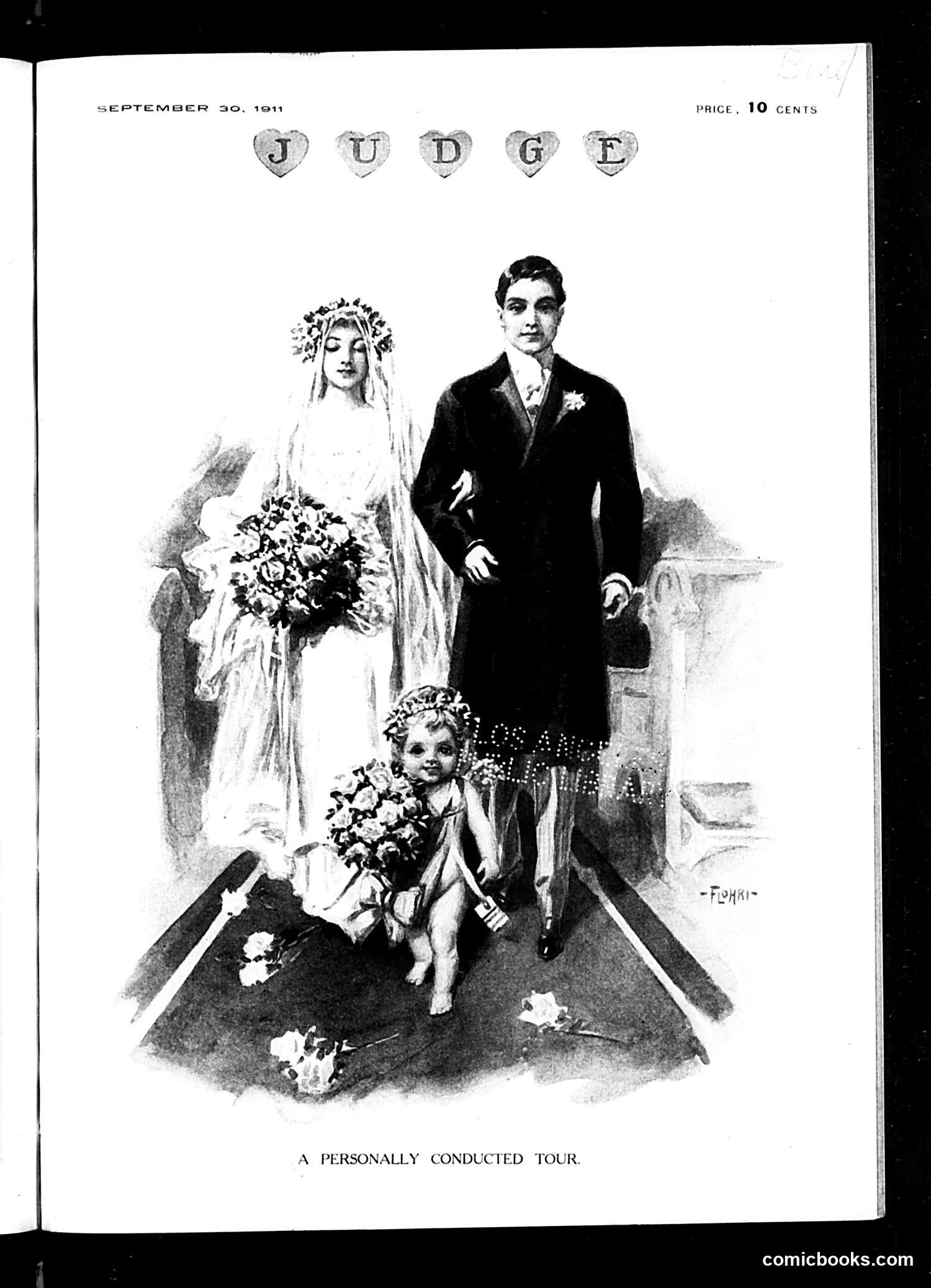
This page shows a wedding scene with the title "A PERSONALLY CONDUCTED TOUR," illustrated by an artist signed "FOHKI." The image depicts a bride in traditional white wedding dress with veil and flowers, a groom in formal black suit, and a small cherub or cupid figure leading the couple down an aisle. The satire appears to reference marriage as a guided "tour" or journey, with Cupid serving as the conductor/guide—a common romantic trope. The phrase "personally conducted" suggests ironic commentary on the inevitability or predetermined nature of matrimonial proceedings. Without additional context identifying the specific figures or contemporary events this references, the cartoon's precise satirical target remains unclear, though it likely comments on marriage customs or romantic conventions of the Edwardian era.
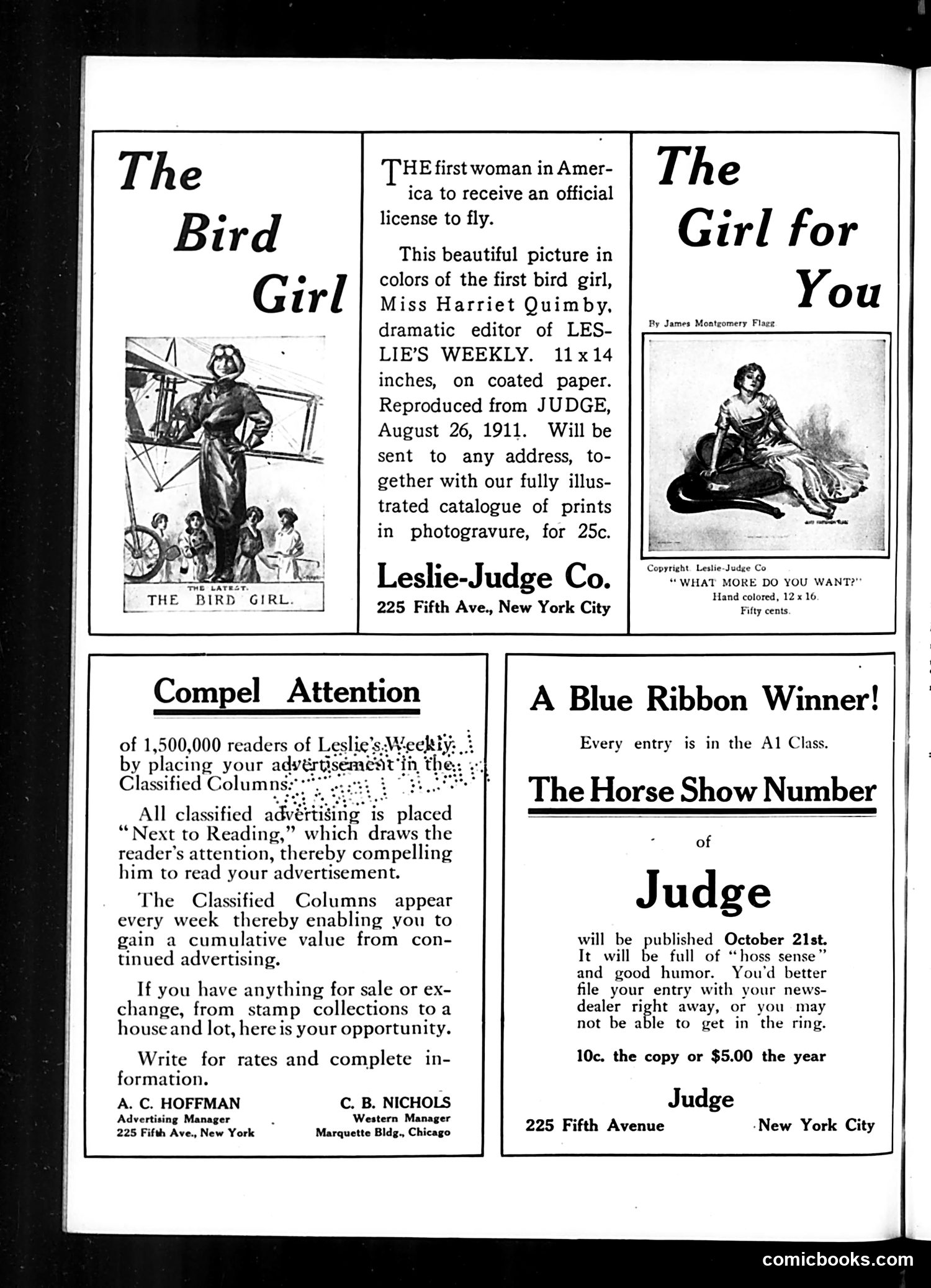
This page is primarily **advertising**, not editorial content or satire. It contains three main advertisements: 1. **"The Bird Girl"** (left): Promotes a print featuring Harriet Quimby, identified as "the first woman in America to receive an official license to fly." The image shows her in aviator gear with an early aircraft, appealing to public fascination with aviation pioneers. 2. **"The Girl for You"** (right): Another print advertisement by James Montgomery Flagg. 3. **Classified advertising pitch** (lower left) and **Judge magazine promotion** (lower right): Standard house ads. The historical interest here is Quimby herself—a genuine aviation pioneer whose achievement (1911) generated considerable public attention and merchandising. The page reflects early-20th-century enthusiasm for female aviation pioneers as celebrity subjects.
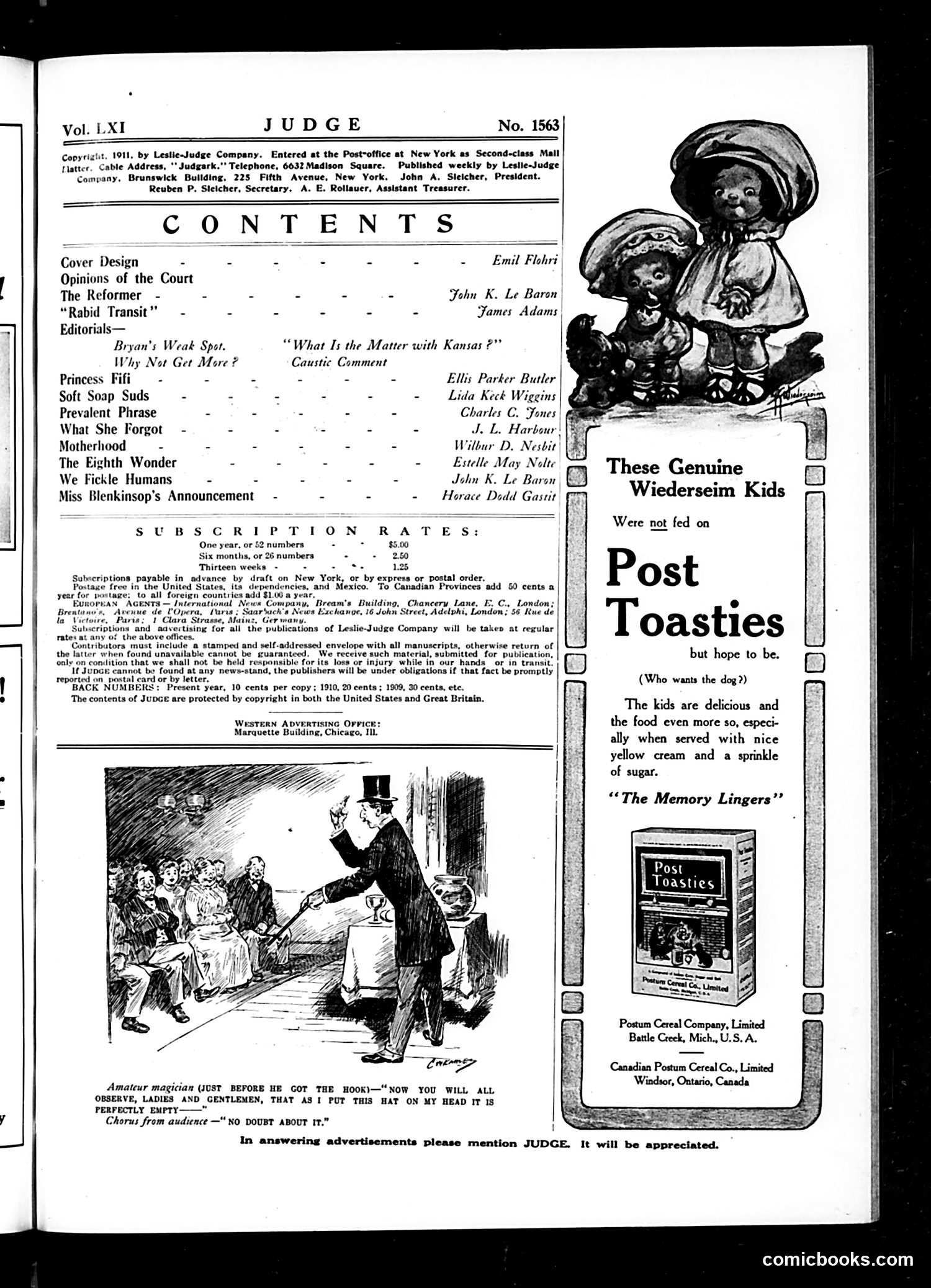
This page is primarily a **contents listing and advertisements** for Judge magazine (Vol. I, No. XI, 1911), with one small political cartoon. The cartoon depicts a **magician performing a trick**, claiming to put his hat on his head "perfectly empty." The audience responds "No doubt about it" — apparently a joke about the magician's empty-headedness or lack of intelligence. The caption suggests this is satirizing someone's foolishness, though **the specific target is unclear** from the image alone. The rest of the page lists article titles (including pieces on "Rapid Transit," reformers, and soap suds) and advertises **Post Toasties cereal**, featuring an illustration of children and the slogan "The Memory Lingers." Without additional context, the magician's identity and the specific political event being mocked cannot be determined from this page alone.
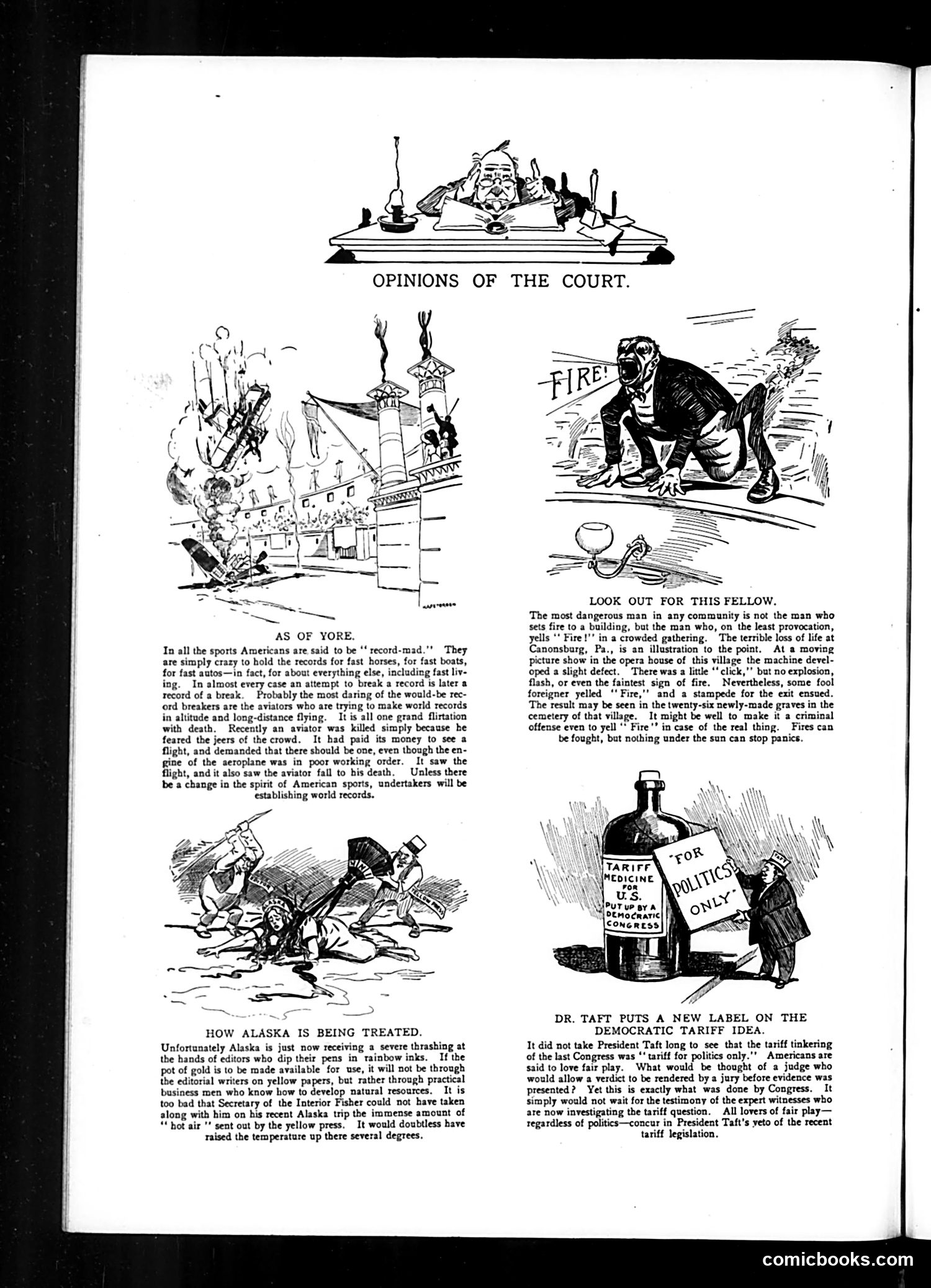
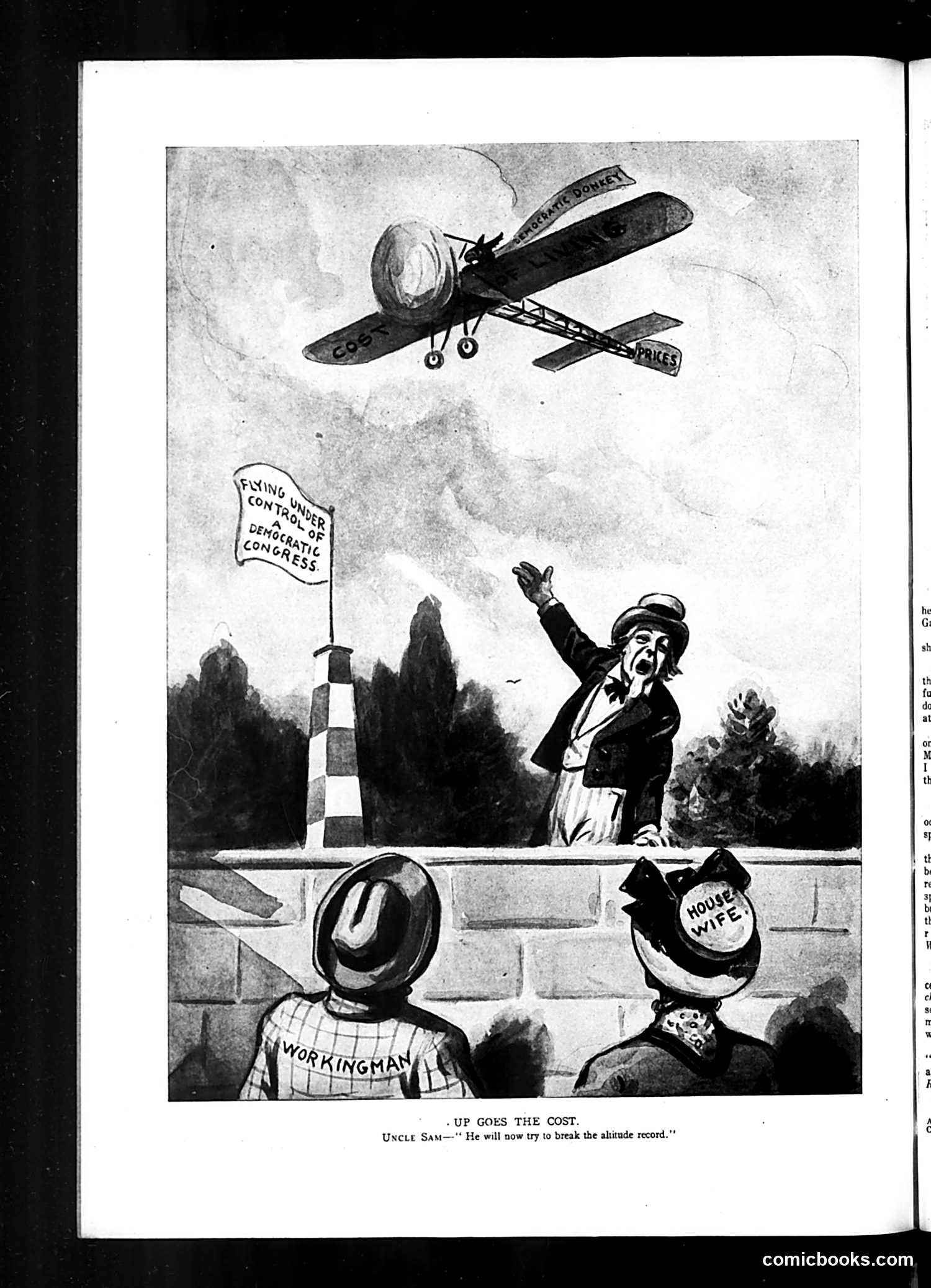
This page satirizes American obsession with record-breaking and danger. "As of Yore" mocks aviation stunts—despite crashes and deaths, aviators continue pursuing records. The cartoon implies this recklessness reflects broader American culture. "Look Out for This Fellow" depicts a man yelling "Fire!" in a crowded building, referencing the famous legal principle that falsely shouting fire is unprotected speech. The text criticizes someone in Canonsburg, PA, for doing exactly this, suggesting the legal principle offers no protection for dangerous panic-mongering. "How Alaska Is Being Treated" criticizes exploitation of Alaska's resources by politicians and industrialists. "Dr. Taft Puts a New Label on the Democratic Tariff Idea" attacks President Taft's tariff policies, suggesting he's disguising unpopular legislation under deceptive labeling.
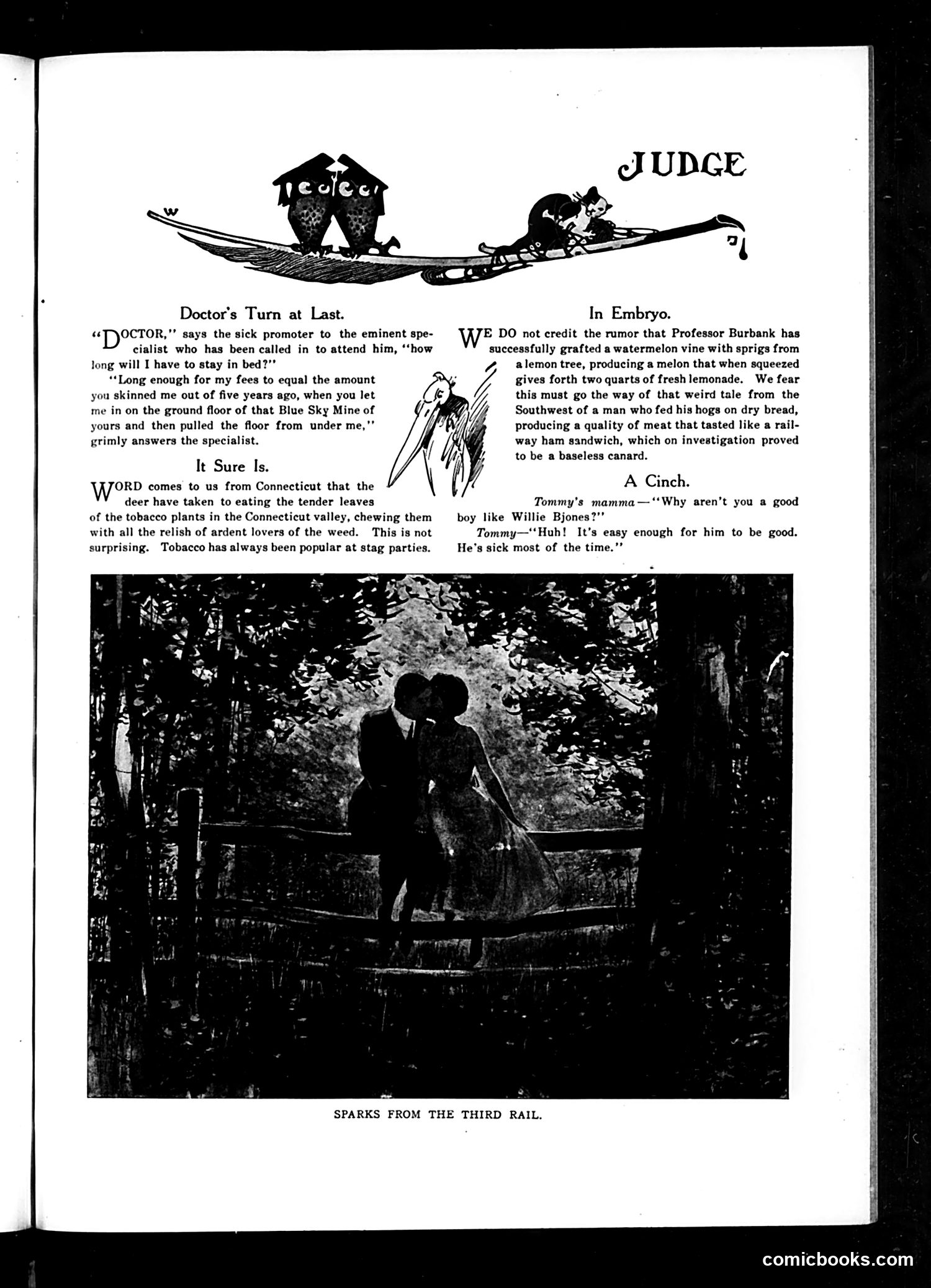
This page contains three brief humorous items rather than political cartoons: 1. **"Doctor's Turn at Last"** - A sick-promoter confronts a doctor about unpaid debts, using the doctor's own profession against him (asking how long he'll stay in bed). 2. **"It Sure Is"** - A Connecticut anecdote about deer eating tobacco plants, presented as a curious fact about regional wildlife and the crop's popularity. 3. **"In Embryo"** and **"A Cinch"** - Two brief jokes: one mocking a rumor about Professor Burbank's agricultural experiments (grafting lemon to melon); the other a child's witty response about why he won't be "good" like Willie Jones. The large photograph below titled **"Sparks from the Third Rail"** appears to be an unrelated illustration. These are light domestic humor pieces rather than political satire, typical of Judge's miscellaneous content sections.
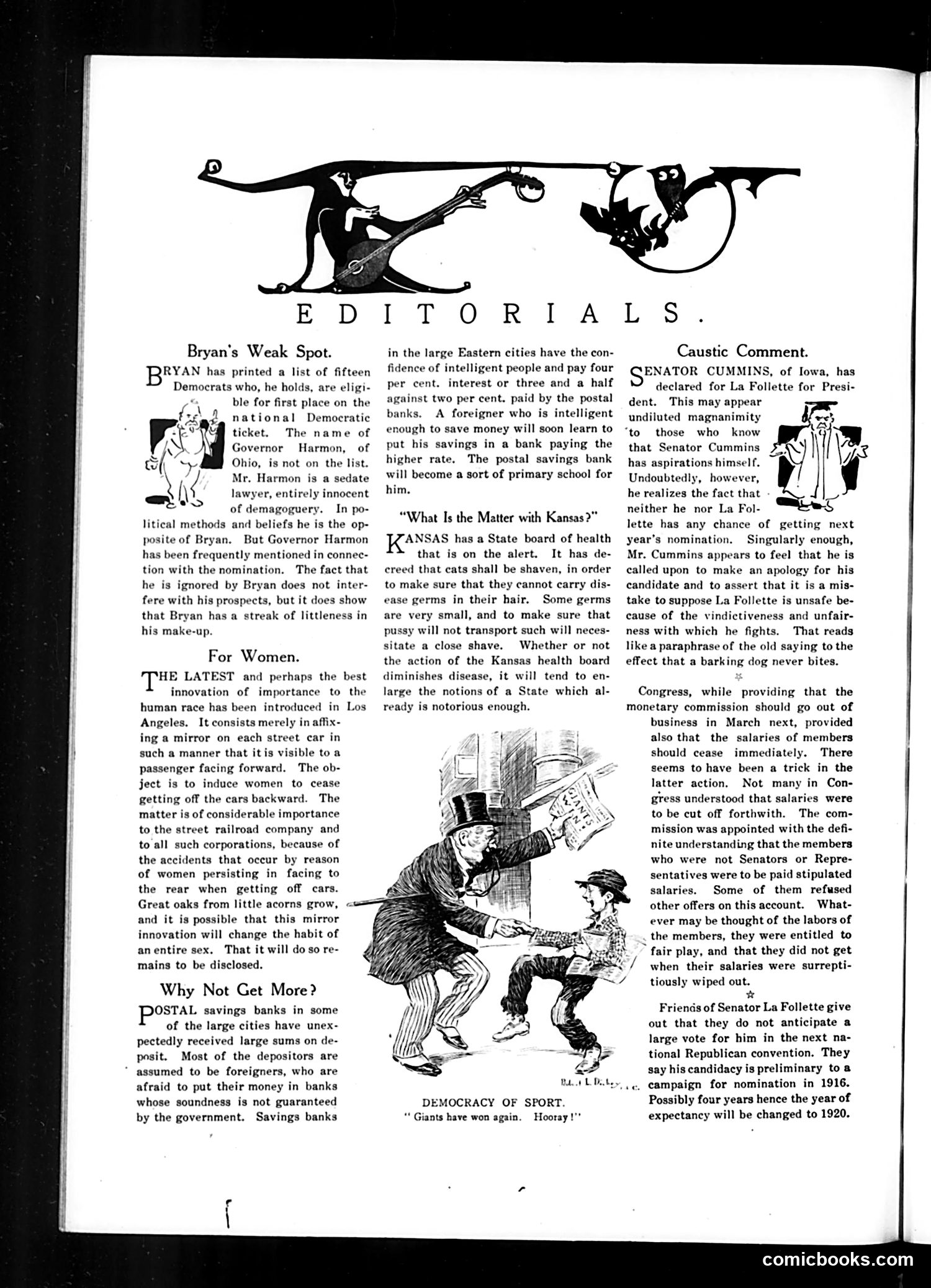
This page contains several short political editorials with accompanying cartoons satirizing early 1900s American politics and social issues. **"Bryan's Weak Spot"** criticizes William Jennings Bryan for excluding Ohio Governor James Harmon from his list of fifteen acceptable Democratic presidential nominees, suggesting Bryan's omission reveals petty jealousy toward a rival. **"For Women"** sardonically praises Los Angeles streetcars' new mirrors aimed at preventing women from exiting backward, suggesting women's behavior requires mechanical intervention. **"Why Not Get More?"** mocks the popularity of government postal savings banks among foreign immigrants, implying they're naive about higher-interest private banks. **"What Is the Matter with Kansas?"** ridicules Kansas's health board decree requiring cats be shaved to prevent disease transmission, mocking the state's reputation for eccentric regulations. The cartoons use caricature and visual exaggeration to mock their subjects—typical of Judge's satirical approach to contemporary politics and social reform efforts.
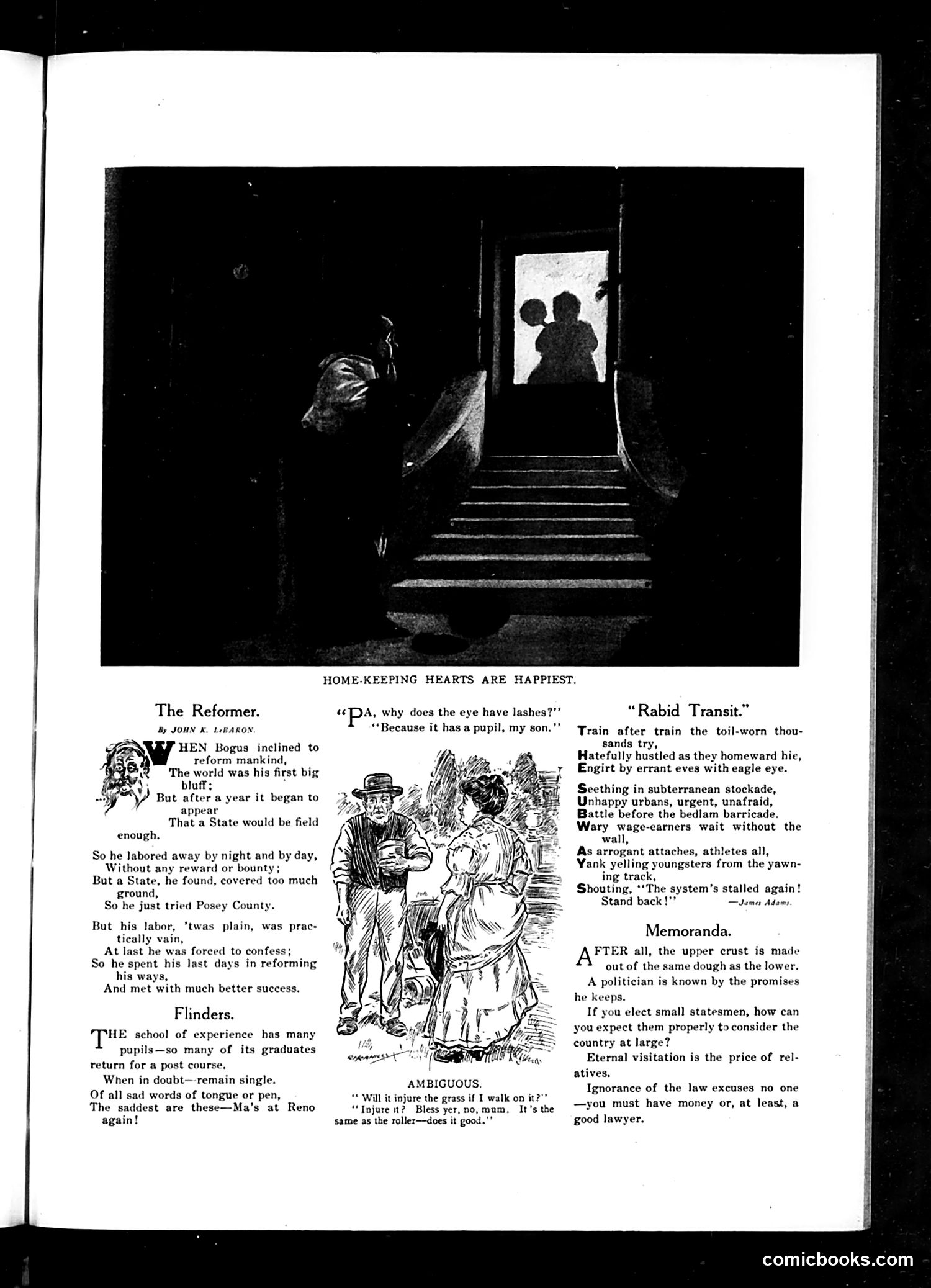
**The Reformer** satirizes idealistic reformers who fail at grand ambitions. A character named Bogus attempts to reform all mankind, then scales down to state level, then a county, finally succeeding only in reforming his own ways. The joke: genuine reform requires starting with oneself, not sweeping social change. **Flinders** mocks repeated failure and divorce culture. The repeated reference to "Ma's at Reno" (Nevada's divorce capital in this era) suggests a woman repeatedly returning to obtain divorces—the "post course" of the school of experience being remarriage failure. **Rabid Transit** criticizes overcrowded urban public transportation and aggressive transit workers. "Errant eyes with eagle eye" and "arrogant attaches" appear to reference overzealous conductors removing passengers from stalled trains. The **Memoranda** section offers cynical social commentary: politicians keep few promises, money matters more than law, and relatives are burdensome. All reflect early-20th-century urban frustrations and skepticism toward institutional reform.
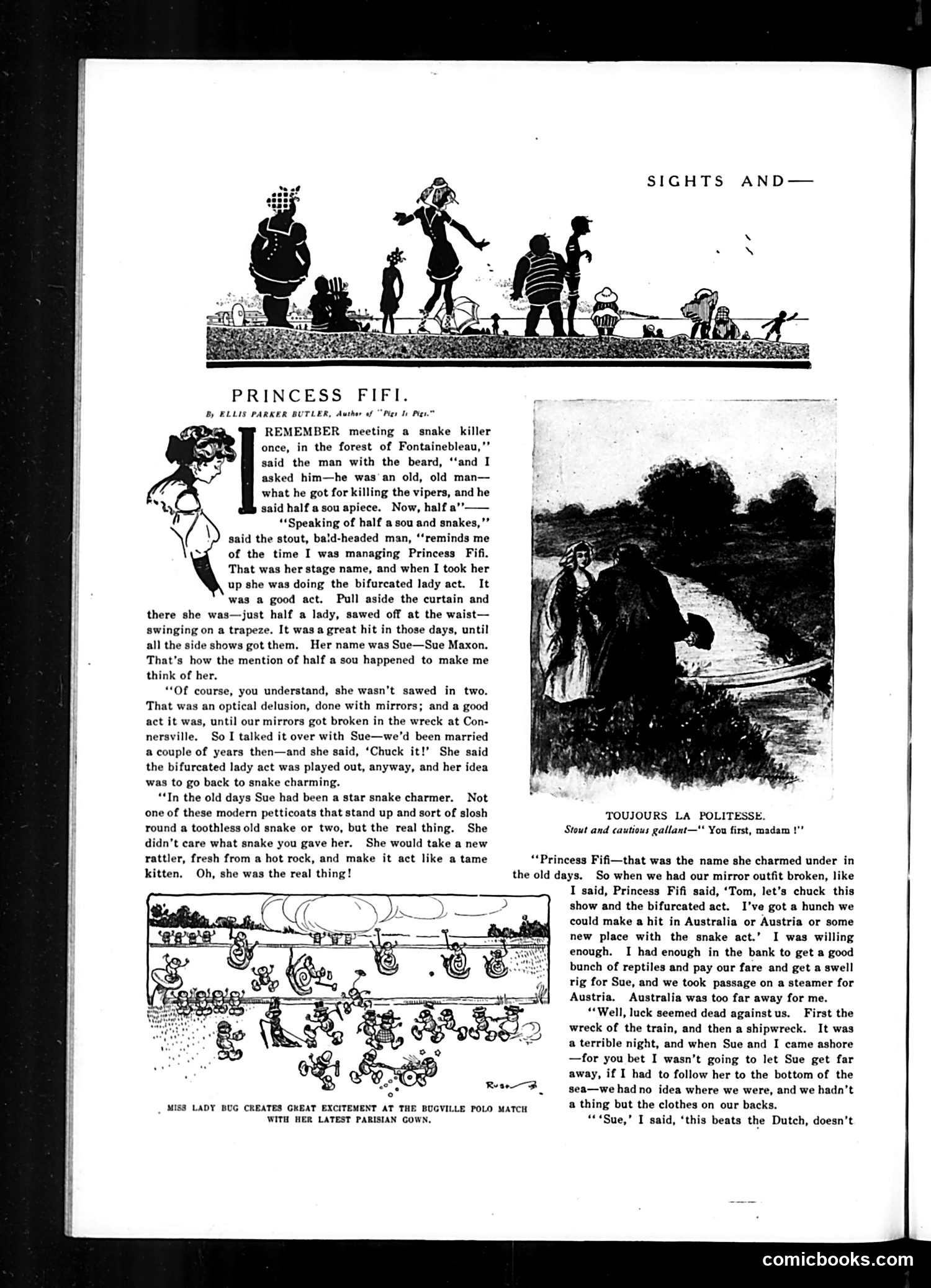
This page contains a short story by Ellis Parker Butler titled "Princess Fifi," illustrated with period line drawings. It's not primarily political satire but rather humorous entertainment fiction. The narrative follows a circus manager recounting his experience with a performer named Sue Maxon, who performed under the stage name "Princess Fifi." The story describes her act: an optical illusion where she appeared "sawed in half" at the waist on a trapeze—actually achieved through mirrors, not actual bifurcation. When their equipment broke, Sue proposed returning to her earlier specialty: snake charming. The humor derives from early-20th-century show business culture and the absurdity of the "bifurcated lady" act. A small cartoon at bottom titled "Toujours la Politesse" (Always Politeness) appears unrelated—showing two figures with one yielding to another. The story continues across the page, setting up a comedic adventure involving shipwreck and stranded performers.
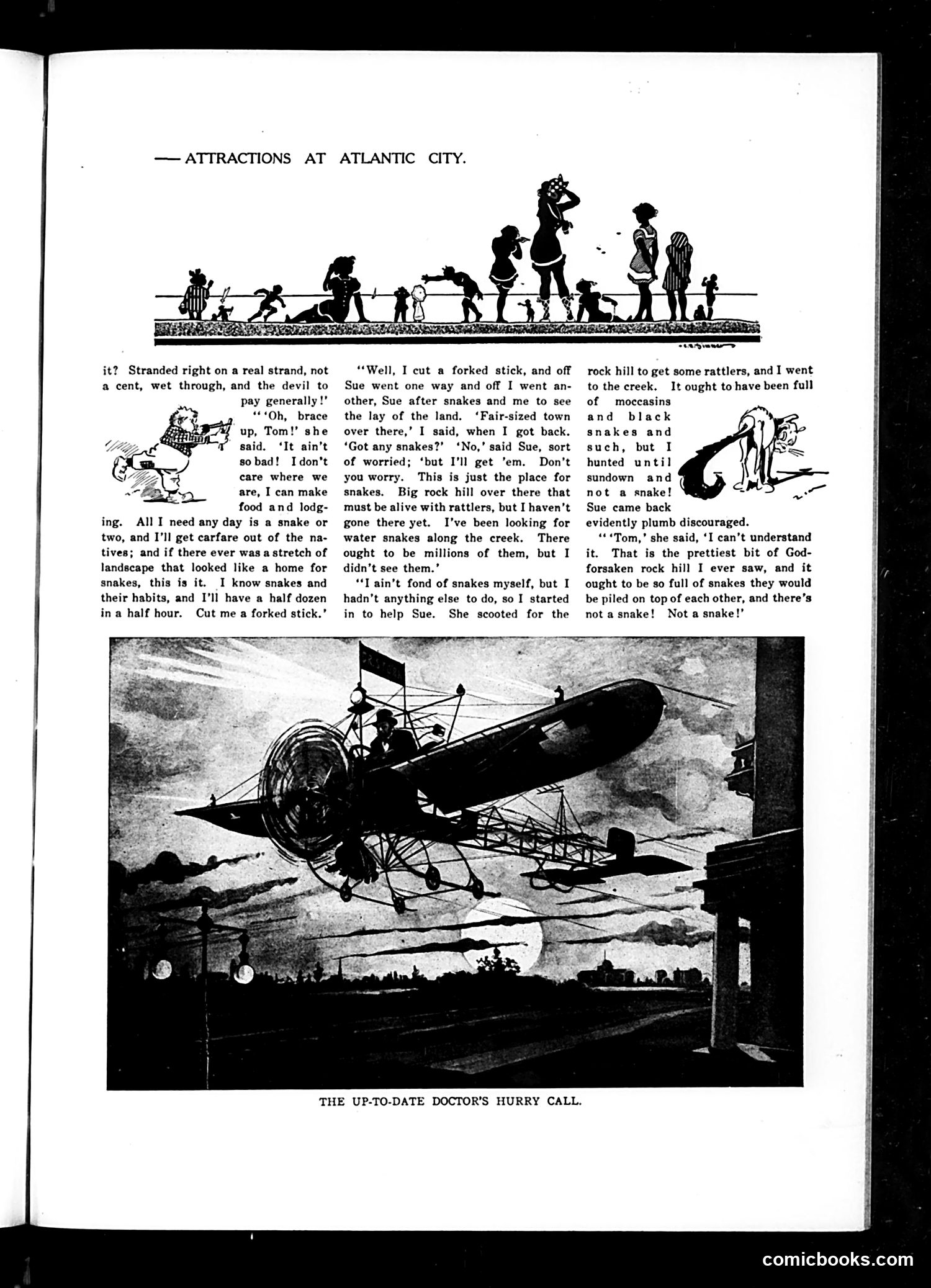
This page contains two separate pieces of satirical content: **Top section**: A humorous narrative about a stranded couple at Atlantic City. The wife, Sue, claims she can support them by catching snakes to sell to locals—a absurd scheme that mocks both her overconfidence and the idea that Atlantic City (a popular resort destination) would be full of profitable wildlife. The joke hinges on the ridiculous premise that snake-catching is a viable income strategy. **Bottom image**: "The Up-to-Date Doctor's Hurry Call" depicts an airplane—then a novel and experimental technology—being used for emergency medical transport. This satirizes the early 20th-century fascination with aviation as a solution to modern problems, humorously suggesting doctors now make house calls via aircraft rather than traditional means. Both pieces reflect period anxieties and obsessions: economic desperation and the transformative (sometimes absurdly optimistic) impact of new technology on American life.
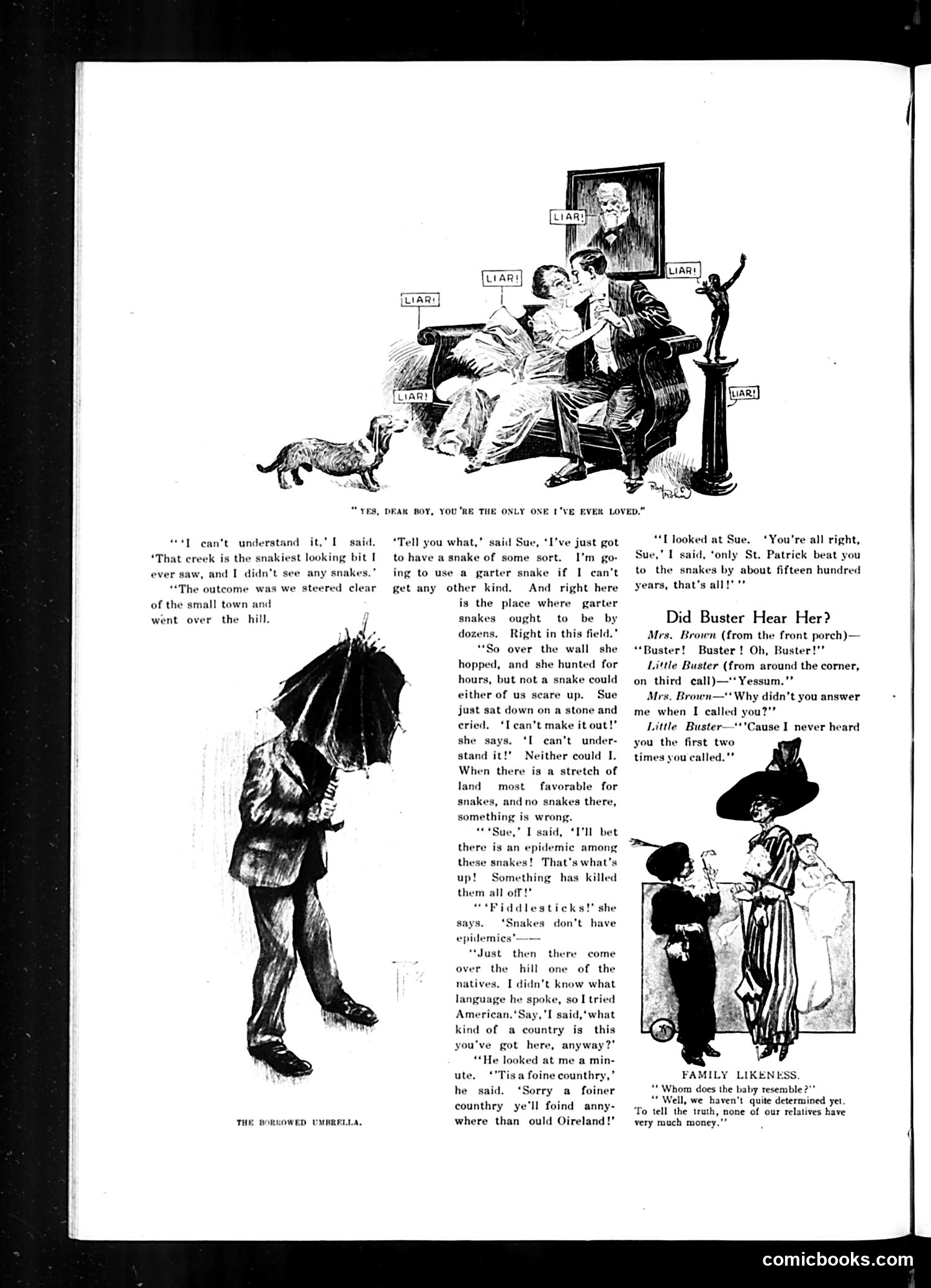
This page contains three separate satirical pieces: **"The Borrowed Umbrella"**: A narrative sketch (left) mocking a woman's obsession with snakes in Ireland. She's disappointed there are no snakes to find, leading to a joke about St. Patrick driving them out. An Irish immigrant's response—praising Ireland despite lacking snakes—satirizes immigrant nostalgia and Irish brogue speech. **"Did Buster Hear Her?"**: A domestic humor piece where a child claims not to have heard his mother calling multiple times, suggesting deliberate disobedience masked as inattention. This reflects common parent-child dynamics played for comedy. **"Family Likeness"**: A brief joke about a family debating which relative a newborn resembles, with the punchline revealing their primary concern is which relatives have money—satirizing mercenary family attitudes and the class-consciousness of the era. The page employs period stereotypes, particularly Irish immigrant caricatures, typical of Judge's satirical approach to American social observation.
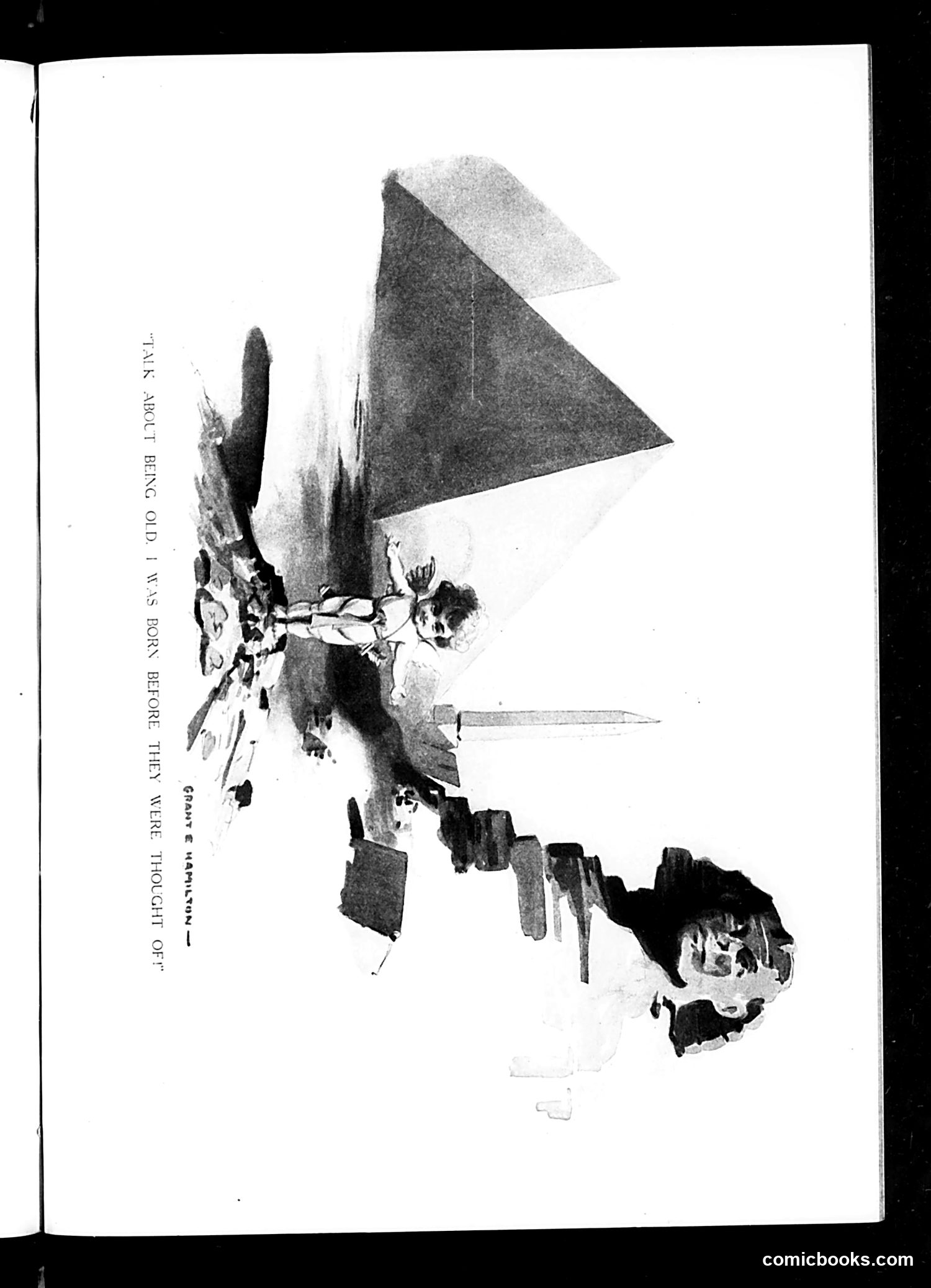
This appears to be a satirical cartoon from *Judge* magazine mocking elderly people's tendency to claim superiority based on their age. The image shows an old figure (likely representing an elderly person) boasting about their antiquity. The caption's humor relies on the classic "old person" trope: someone bragging that they predate modern inventions or conveniences. The phrase "I was born before they were thought of!" suggests the character claims such extreme age that they existed before basic innovations were even conceived. The cartoon satirizes how older generations use their age as a status marker or argument-winner in debates, implying that merely being ancient doesn't confer wisdom or validity. This reflects a broader *Judge* tradition of poking fun at generational attitudes and the absurdity of age-based authority claims.
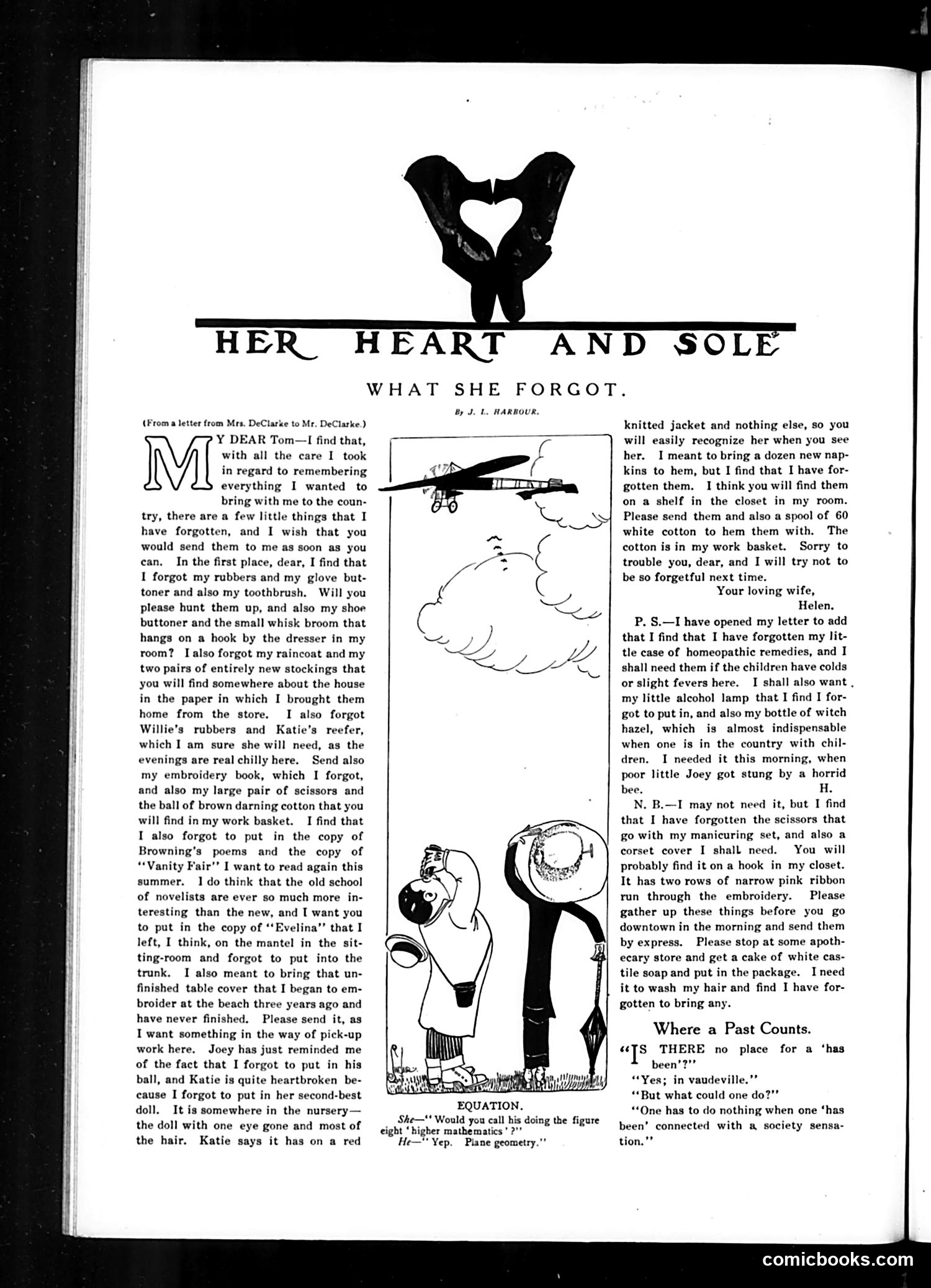
This page contains two separate pieces of humor: **Main Story: "What She Forgot"** — A satirical letter from Mrs. DeClarke to her husband, illustrating the stereotype of the scatterbrained, forgetful wife. She claims to have carefully prepared for a country trip but forgot numerous items—ranging from practical (rubbers, toothbrush) to sentimental (children's toys, books). The joke relies on the contradictory claim that she took "all the care" while forgetting nearly everything, escalating through multiple postscripts as she remembers more forgotten items. This mocks the conventional image of disorganized, frivolous women. **Bottom Cartoon: "Equation"** — A brief joke about a man doing figure-eights. The woman calls it "higher mathematics"; he corrects her to "plane geometry." The humor plays on mathematical terminology: "plane" (flat, two-dimensional) geometry versus "higher" mathematics, with the skating figure creating a flat pattern on ice. Both pieces employ mild, domestic humor typical of early 20th-century Judge magazine.
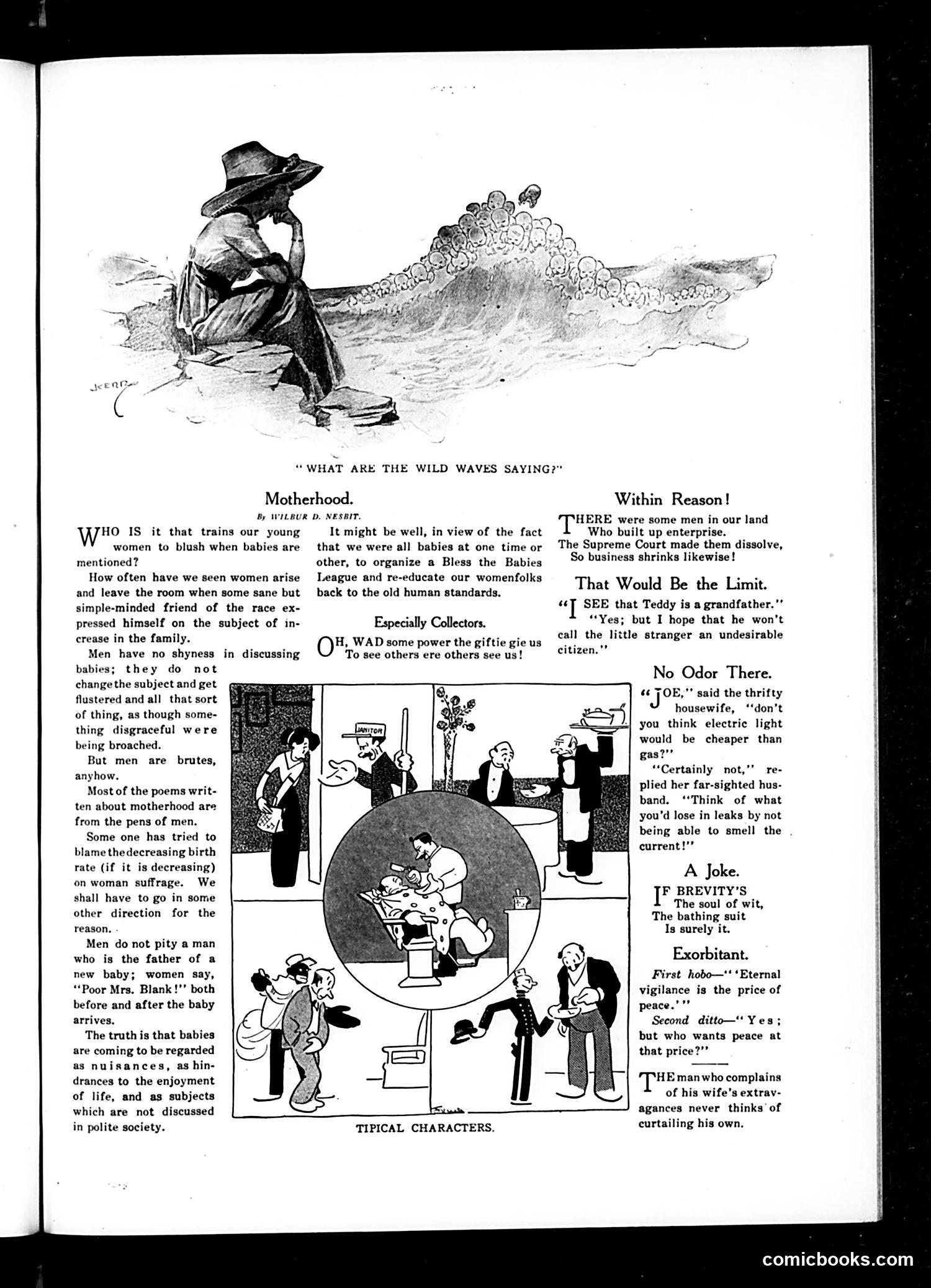
This Judge magazine page contains satirical commentary on early 20th-century American social issues: **Main Articles:** - **"Motherhood"** by Wilbur D. Nesbit criticizes Victorian prudishness about childbirth and babies. The essay argues that declining birth rates stem from society treating motherhood as shameful rather than celebrating it, and proposes a "Bless the Babies League" to restore respect for reproduction. - **"Within Reason!"** satirizes Theodore Roosevelt as a grandfather, joking he might call his grandchild an "undesirable citizen"—referencing Roosevelt's controversial 1911 coining of that term for socially undesirable immigrants. **Other Jokes** target: - Antitrust actions dissolving corporations - Electric lighting as a cheaper alternative to gas - Marital hypocrisy (wives criticized for extravagance while husbands overspend) The "Typical Characters" cartoon shows various domestic scenes illustrating these social tensions around family, business regulation, and household management—common Judge satirical targets reflecting Progressive Era concerns.
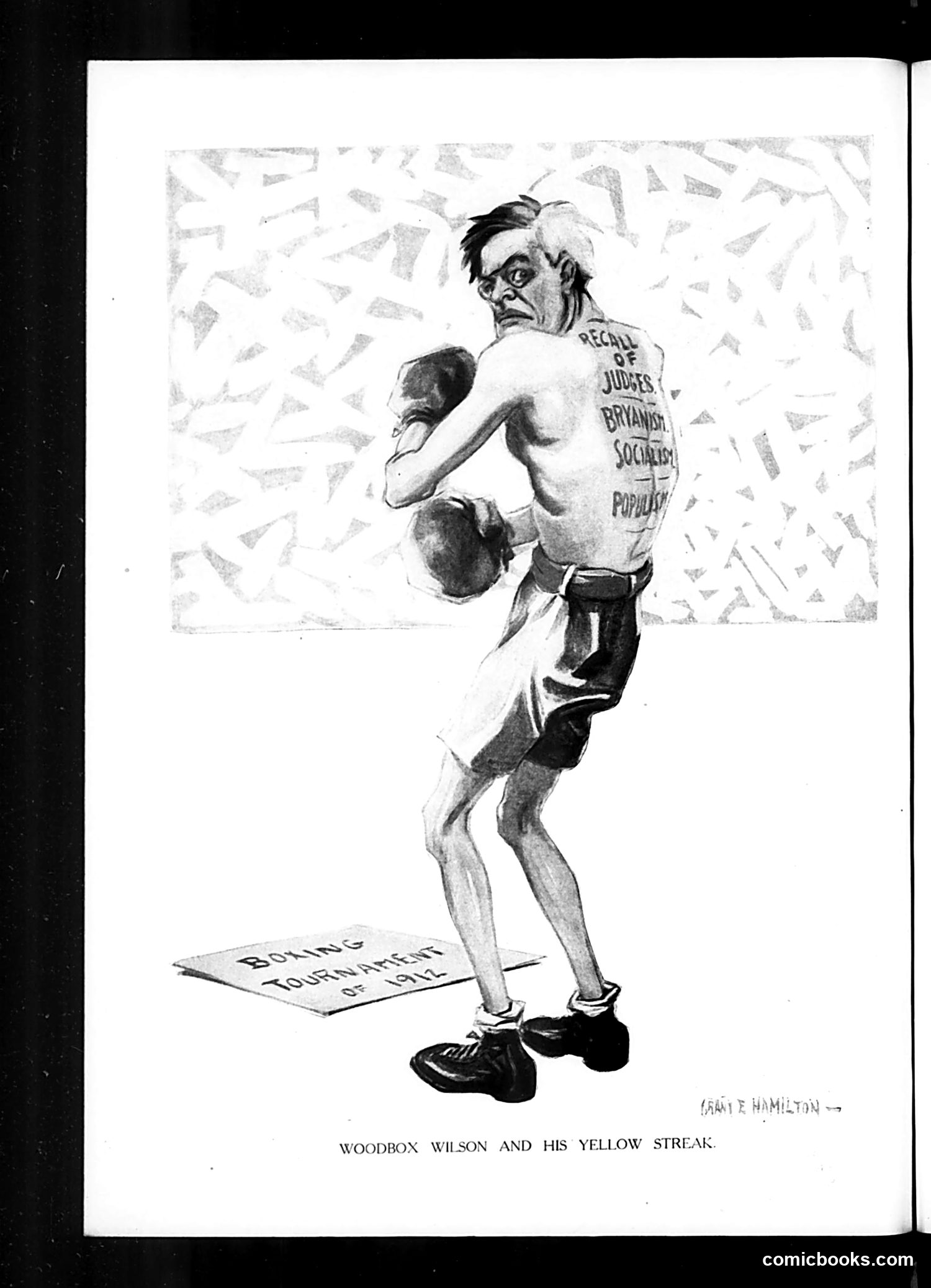
This is a political cartoon attacking President Woodrow Wilson, depicted as a boxer with a cowardly "yellow streak" (a period phrase meaning cowardice). The back of his body is labeled with phrases including "RECALL OF JUDGES," "BRITISH SOCIALISM," and "POPULISM"—apparently criticizing his policies or associations. The boxing tournament sign at his feet suggests a conflict or competition. The caricature exaggerates his features in the unflattering style typical of early 20th-century satirical cartooning. The cartoon's point: Wilson is portrayed as weak-willed and compromised by radical or foreign influences, rather than standing firm on principles. The artist is Grant E. Hamilton, a Judge cartoonist known for sharp political satire. The exact date is unclear from this image alone, but references suggest this critiques Wilson's presidency (1913-1921).
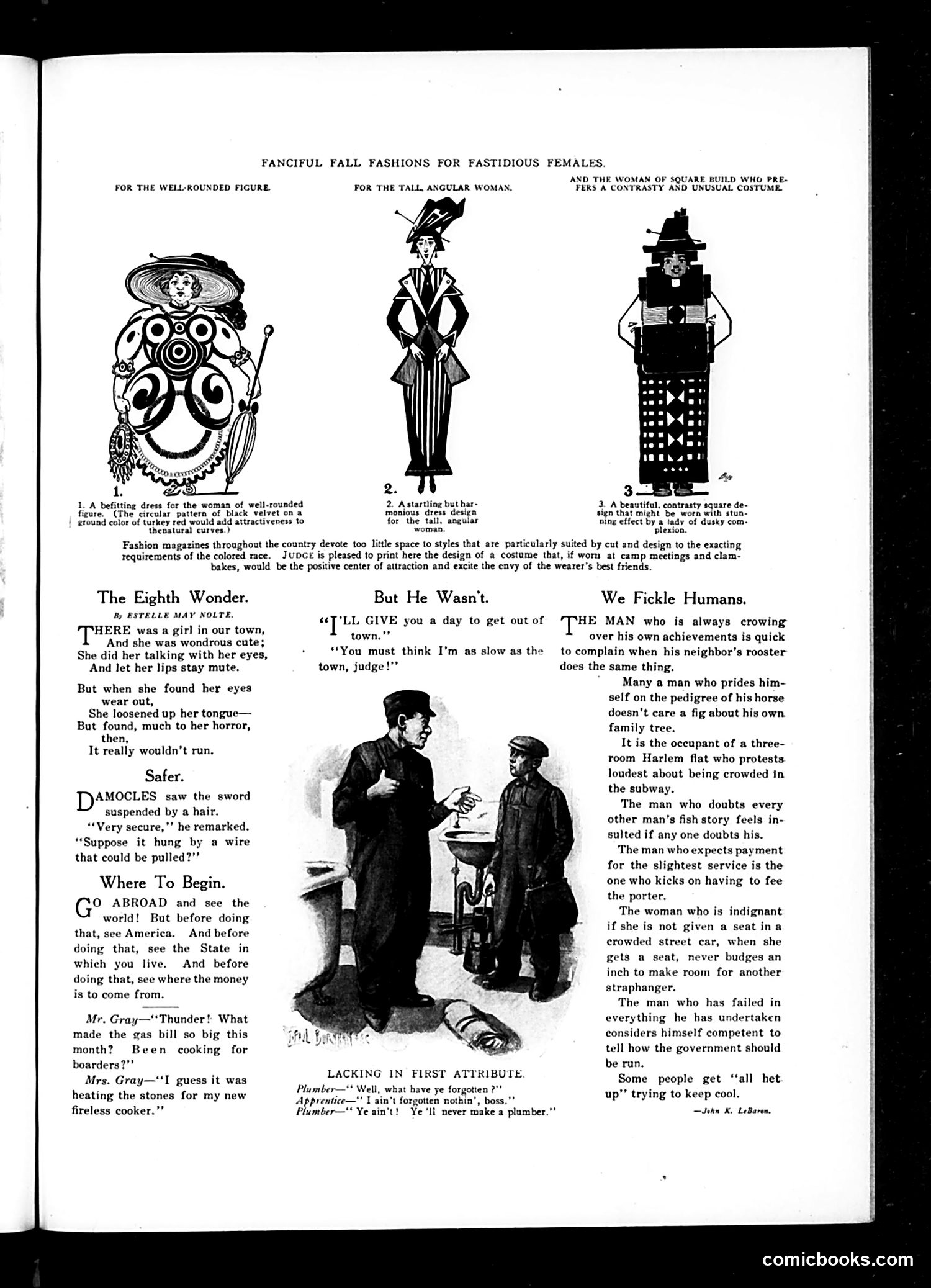
The top section presents three racist caricatures of women's fashion, with the third explicitly labeled for "a lady of dusky complexion." The outlandish geometric designs—particularly the blocky, exaggerated "square" costume—mock Black women's bodies through crude visual stereotyping. The text falsely claims fashion magazines neglect "the colored race," sarcastically suggesting Judge will "help" by publishing these insulting designs for "camp meetings and clambakes" (venues associated with Black social gatherings). This is explicitly racist satire that dehumanizes Black women by treating their bodies as comedy props requiring special, ridiculous fashion solutions. The "joke" relies entirely on racist caricature. The lower sections contain unrelated humor: short poems and anecdotes about human hypocrisy (complaining neighbors, pedigree obsession, subway complaints) and a workplace joke about a plumber's apprentice. These are conventional Judge magazine filler with no apparent connection to the fashion mockery above.
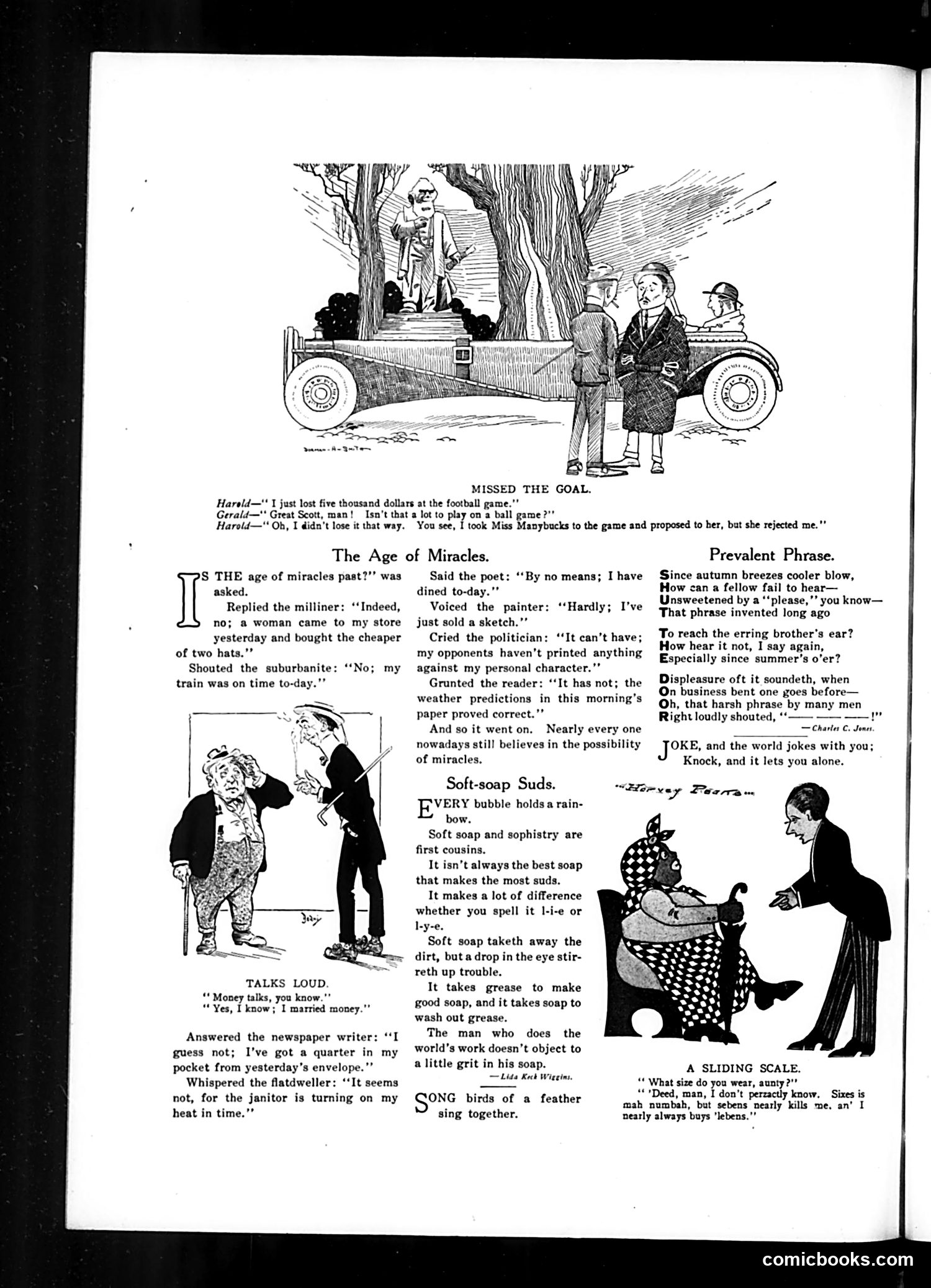
This page contains several brief satirical pieces typical of early 20th-century American humor: **"Missed the Goal"** jokes about a man losing money not through gambling, but by proposing to a wealthy woman ("Miss Manybucks") who rejected him—satirizing how courtship of the rich could be financially costly. **"The Age of Miracles"** is a series of short quips suggesting modern miracles still exist: a woman buying cheaper goods, trains running on time, finding money, getting heat from a janitor, eating well, selling art, and politicians not attacking character. The satire mocks everyday improbabilities treated as miraculous. **"Soft-soap Suds"** uses soap metaphorically to critique social hypocrisy—"soft soap" meaning flattery or deception, comparing it to sophistry and dishonesty. The remaining pieces ("Talks Loud," "Prevalent Phrase," "Joke," "A Sliding Scale") are brief witticisms about money, manners, humor, and shoe sizing—typical period humor without specific political reference. The cartoons illustrate these verbal jokes straightforwardly. This is general-interest satirical content rather than political commentary.
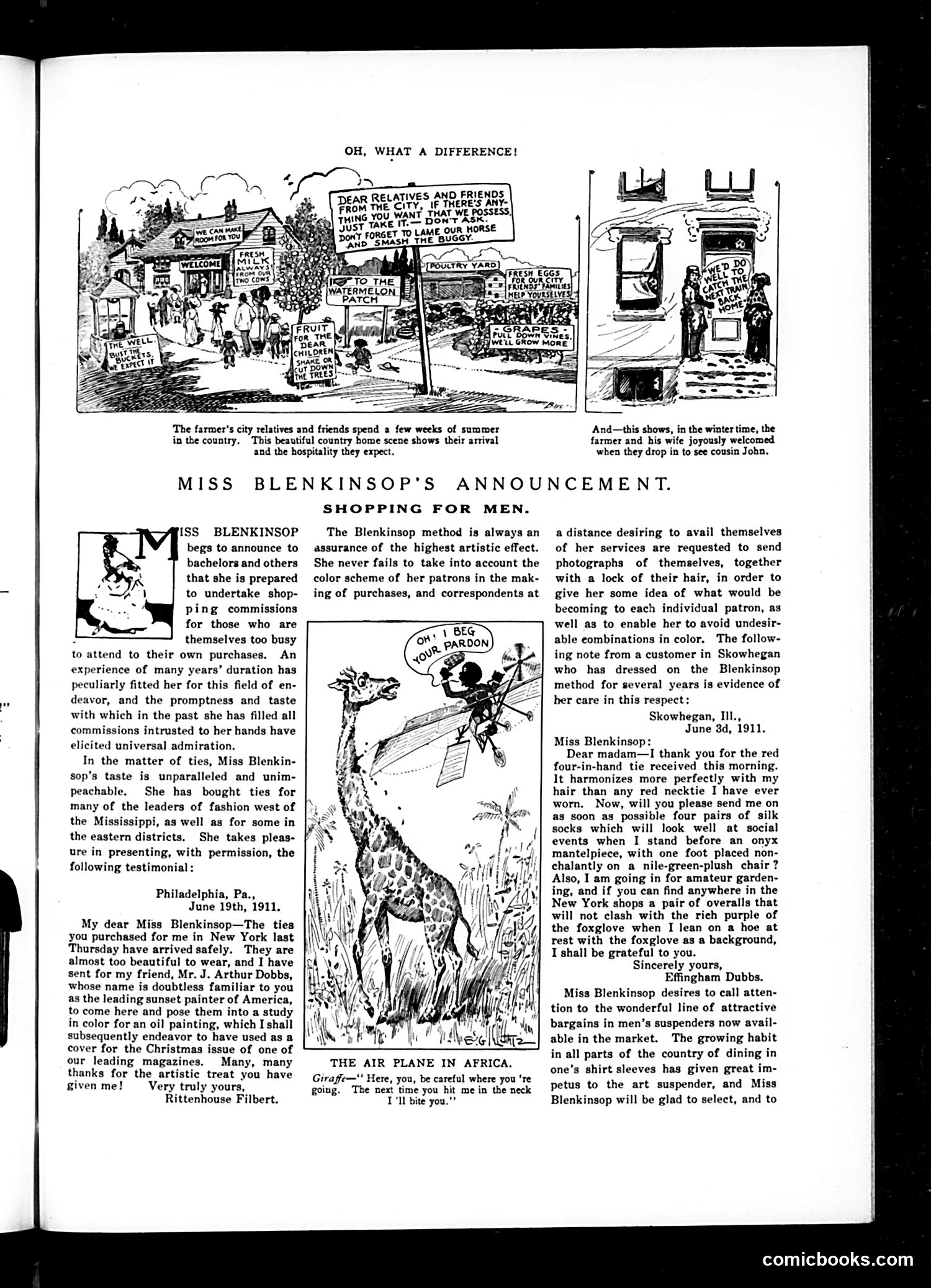
**Top Comic Strip ("Oh, What a Difference!"):** Satirizes the contrast between summer and winter farm visits. City relatives arrive in summer expecting rustic charm and hospitality; by winter, the farmer and his wife receive cousin John with noticeably less enthusiasm. The joke mocks how romantic notions of country life fade once guests overstay their welcome through cold months. **"Miss Blenkinsop's Announcement" (Main Feature):** A humorous advertisement for a shopping service where Miss Blenkinsop selects clothing for busy men. The satire targets wealthy male vanity and obsessive aesthetics: testimonials from absurdly precious clients describe ties as "almost too beautiful to wear" and request socks matching specific furniture and garden flowers. The humor lies in exaggerating the pretentious, color-coordinated masculinity of upper-class men who outsource even trivial purchasing decisions. **"The Air Plane in Africa" (Small Comic):** A giraffe warns an airplane pilot about hitting its neck, threatening to bite in retaliation. This reflects early 1910s fascination with aviation technology encountering African wildlife—treating the collision as a plausible hazard.
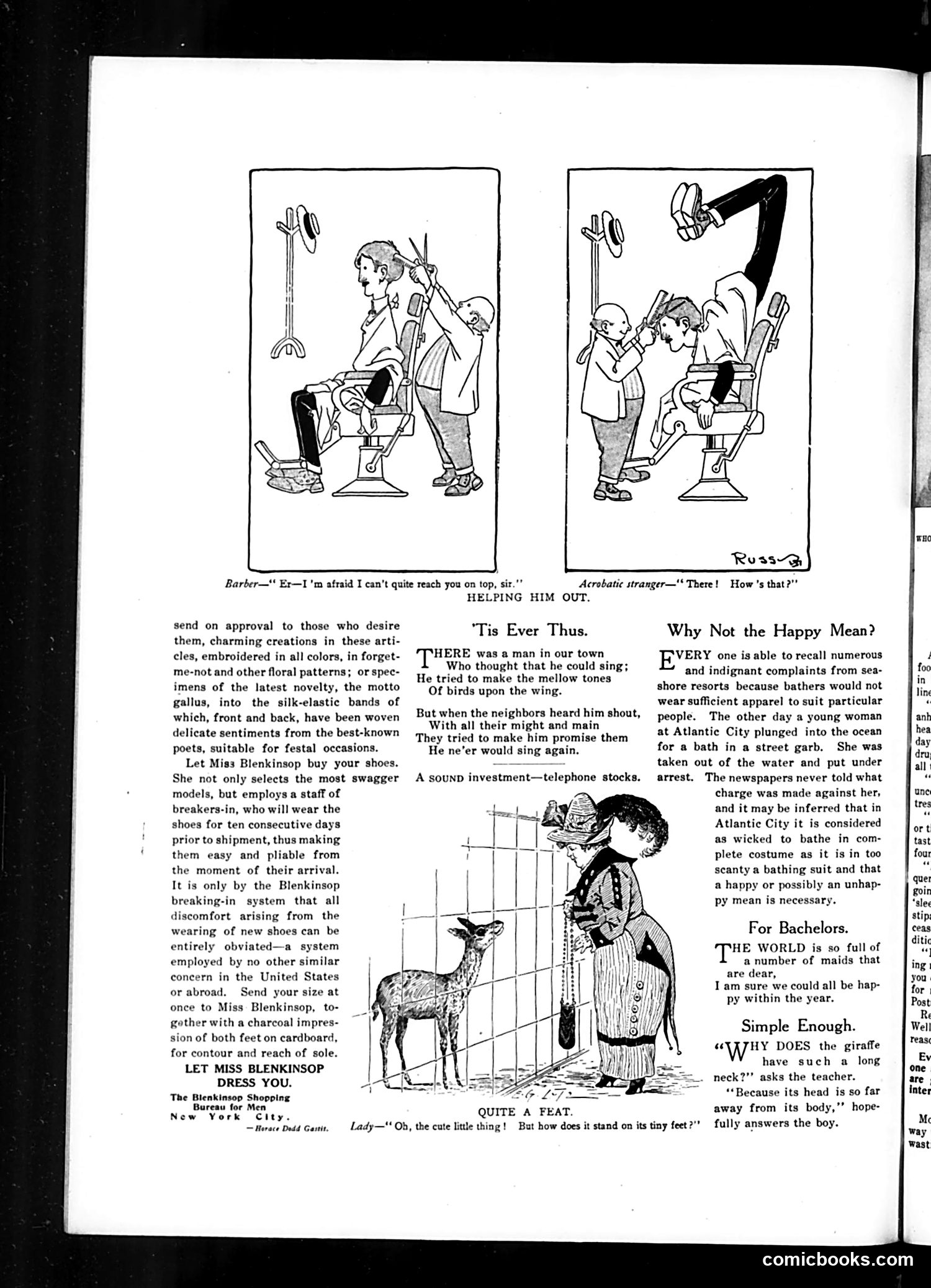
This page contains three satirical cartoons and advertisements typical of early 20th-century American humor: **"Helping Him Out"** (top): A barber struggles to reach a tall customer's hair, while assistants lift him higher—visual humor about an awkwardly tall client. **"'Tis Ever Thus"** (center): Mocks a tone-deaf singer whose neighbors desperately try to silence him. Social satire about amateur musicians inflicting bad performances on unwilling audiences. **"Why Not the Happy Mean?"** (right): Commentary on Atlantic City bathing suit propriety wars. A woman arrested for bathing fully clothed highlights the absurd, contradictory moral standards of the era—simultaneously criticized for wearing too much and too little beachwear. **"Quite a Feat"** (bottom): A giraffe illustration with a child's innocent logic joke about long necks and tiny feet—innocent wordplay humor. The page also includes vintage advertisements for Miss Blenkinsop's shopping services, typical of Judge's commercial content. The tone throughout is light social satire on contemporary manners and propriety.
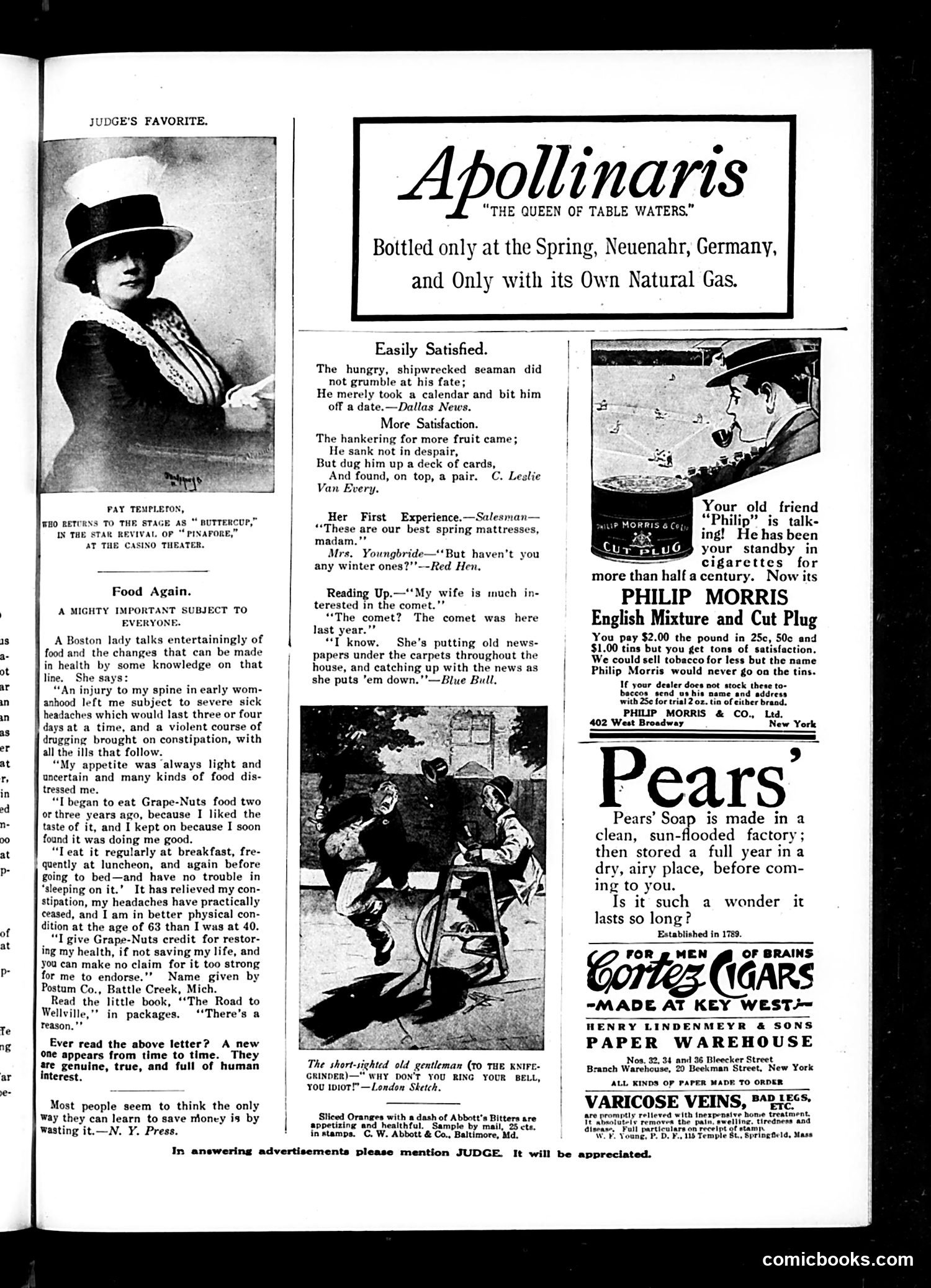
This page is primarily **advertising**, with minimal editorial content. The masthead feature "Judge's Favorite" showcases Apollinaris mineral water with a photograph of an elegantly dressed woman—likely a celebrity or socialite of the era, though she's unidentified here. The page contains humorous short jokes/quips (not political satire) about everyday situations: a shipwrecked sailor eating calendar dates, a wife interested in old comet news, etc. These are light domestic humor typical of the period. The bulk of the page consists of period product advertisements: Philip Morris cigarettes, Pears' soap, Grape-Nuts cereal, Cortes cigars, and various medicines. The Grape-Nuts ad notably includes a testimonial letter about health improvements—a common advertising format of that era. **No political content or satirical commentary is present.** This appears to be a straightforward advertising-heavy page from an early 20th-century magazine, mixing mild humor with commercial promotion.
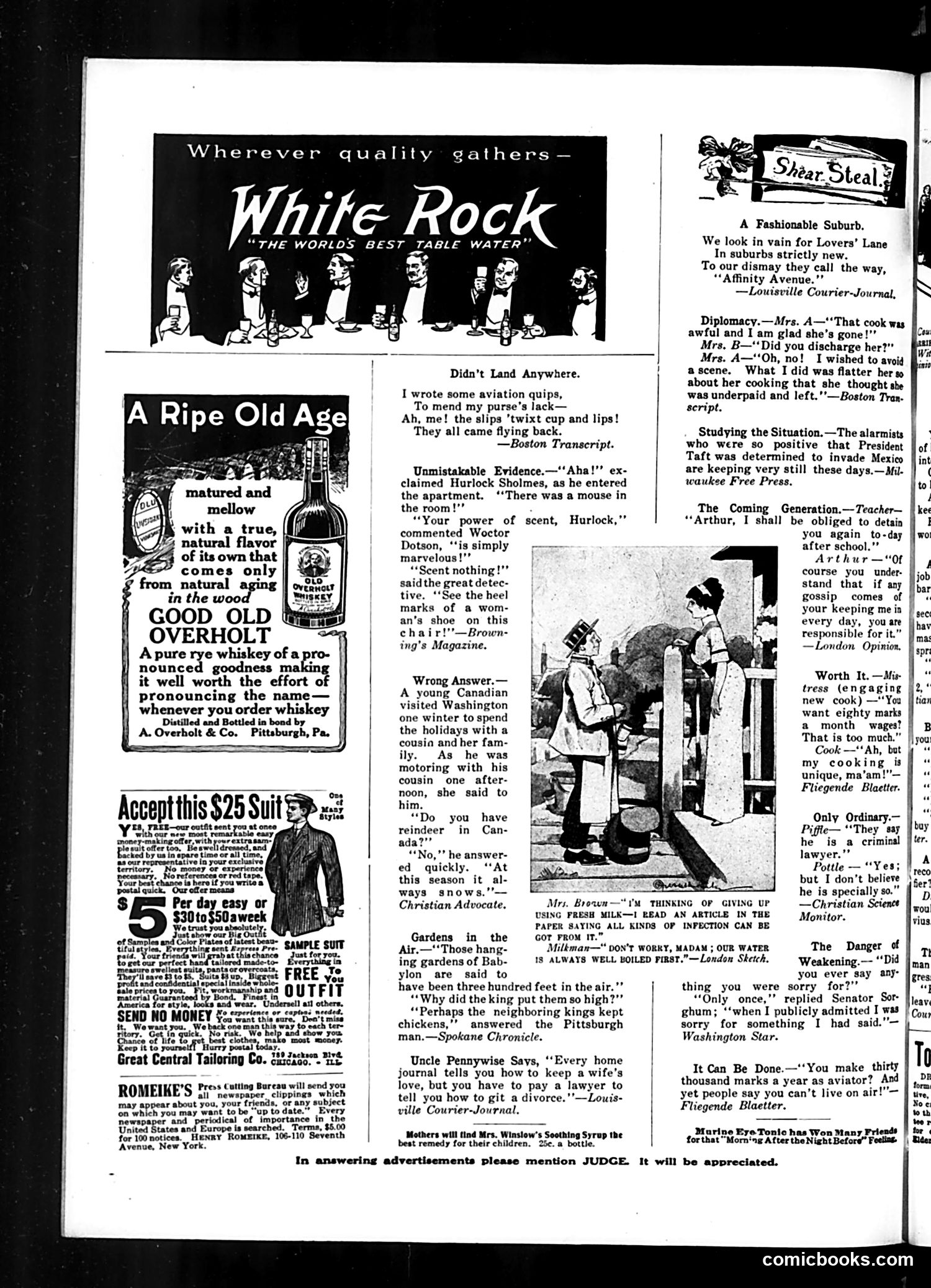
This is primarily an **advertising and humor page** from Judge magazine, circa 1910s. The dominant content includes: **Advertisements:** White Rock water, Good Old Overholt whiskey, a tailoring company offering "$5-10 a week" suits, and Romeike's press clipping service occupy substantial space. **Humor Columns:** The page features brief, topical jokes typical of Judge's satirical approach: - **Aviation quip rejection** mocks early aviation's popularity as literary subject matter - **Sherlock Holmes parody** ("Hurlock Sholmes") plays on detective fiction conventions - **Taft-Mexico reference** comments on contemporary political anxiety about potential military invasion - **Domestic humor** about cooking, divorce lawyers, and suburban naming conventions reflects early 20th-century American middle-class life - **Teacher-student exchange** jokes about education The cartoons are small, text-heavy, and designed for quick laughs rather than sustained political commentary. The overall tone reflects prewar American attitudes toward gender roles, servants, and domestic life.
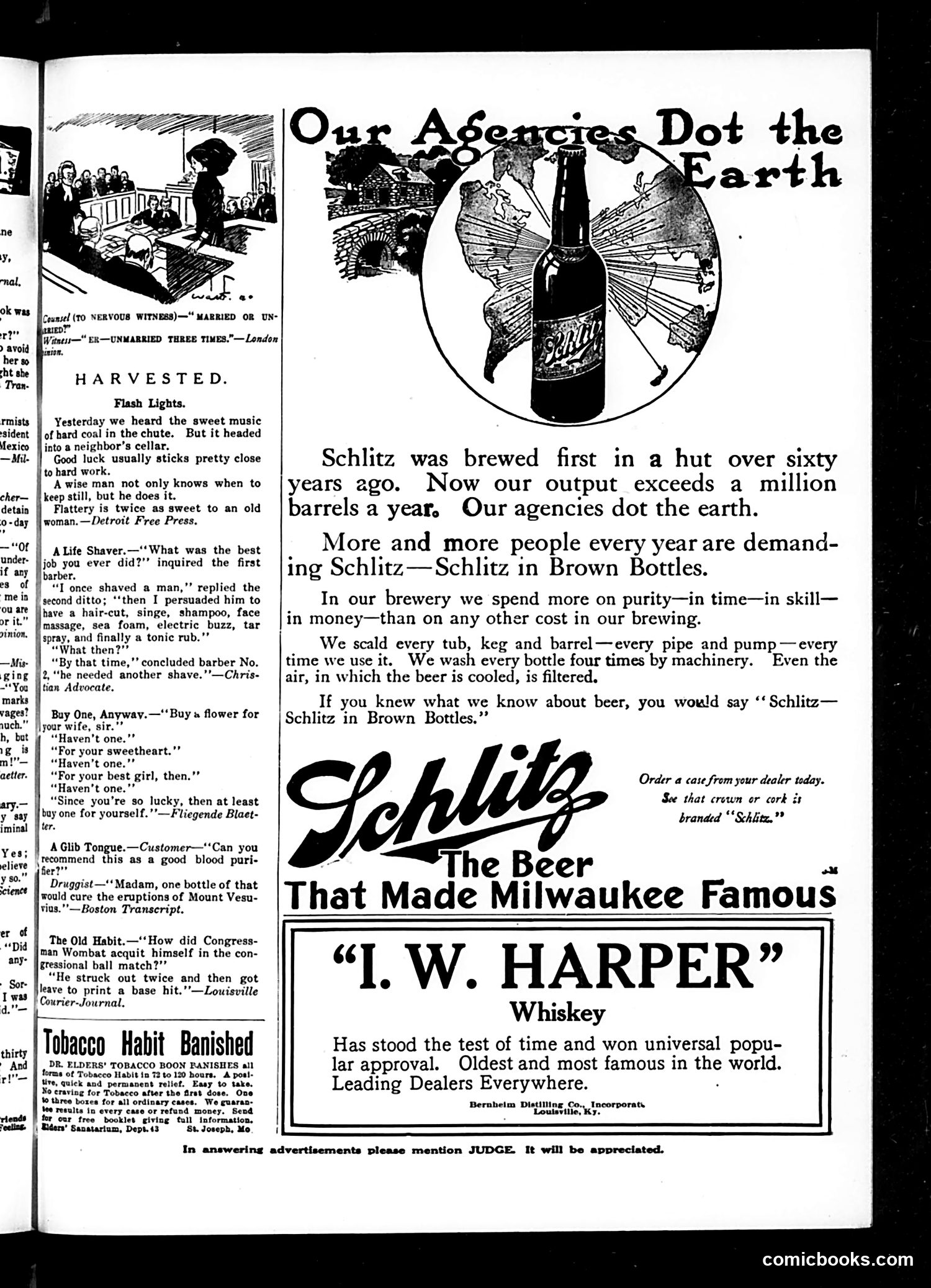
This page is primarily **advertising and light humor**, typical of Judge's format. The left column contains brief joke items ("Flash Lights") on varied topics—coal delivery mishaps, barber upselling, romantic misfortune—with no political content. These are generic, timeless gags. The dominant content is **two full-page advertisements**: Schlitz beer (emphasizing purity, sanitation, and brown bottles) and I.W. Harper whiskey (claiming historical prestige). A smaller tobacco-cessation product ad appears below. The single cartoon at top-left depicts what appears to be a **lawyer or court counselor questioning a nervous witness** about marital status, with the witness humorously claiming to be "unmarried three times" (implying multiple divorces). The joke relies on the legal absurdity of the phrase. **For modern readers**: This reflects pre-Prohibition advertising and period humor conventions. The Schlitz ad's emphasis on sanitation reflects early-20th-century marketing around food safety. The witness cartoon satirizes legal proceedings and marital instability, concerns of the era.
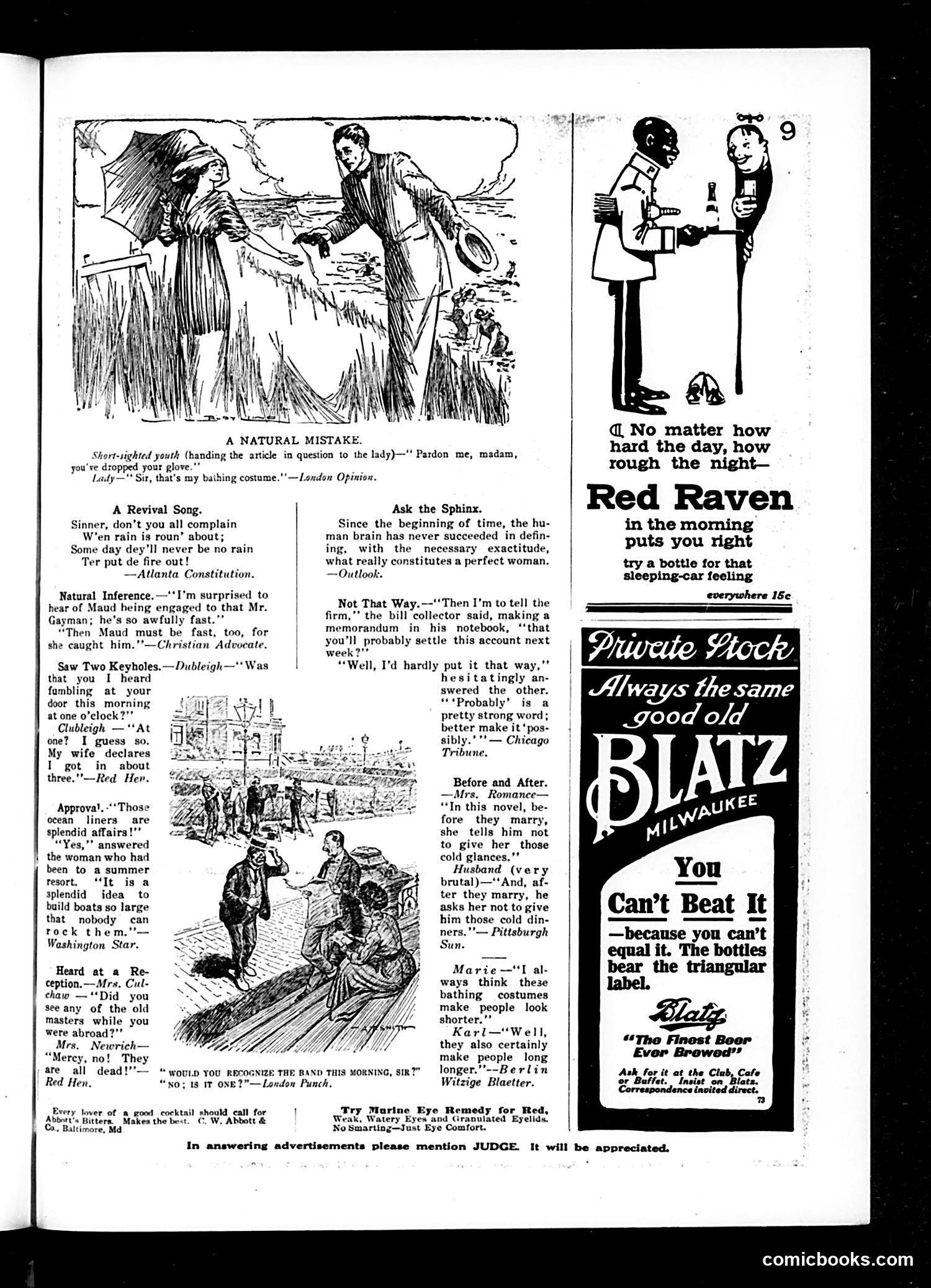
This page from *Judge* magazine contains multiple short humorous anecdotes and advertisements, typical of early 20th-century satirical publications. **The cartoons/jokes** mock social conventions and gender relations of the era. "A Natural Mistake" satirizes women's scanty bathing costumes—a youth mistakes one for a dropped glove, highlighting how revealing these garments were considered. Other brief jokes poke fun at fast-living youths, marital dynamics (wives' "cold glances" before marriage versus husbands' complaints after), and nouveau-riche pretension (a woman unaware that "old masters" were deceased artists, not living people). **The advertisements** promote beer (*Blatz*, *Red Raven*), bitters, and eye remedy—common products of the period. The satire targets social anxieties about modernity, changing gender roles, and class aspirations rather than specific political figures or events. The humor relies on wordplay and gentle mockery of everyday life.