
A complete issue · 16 pages · 1910
Judge — August 13, 1910
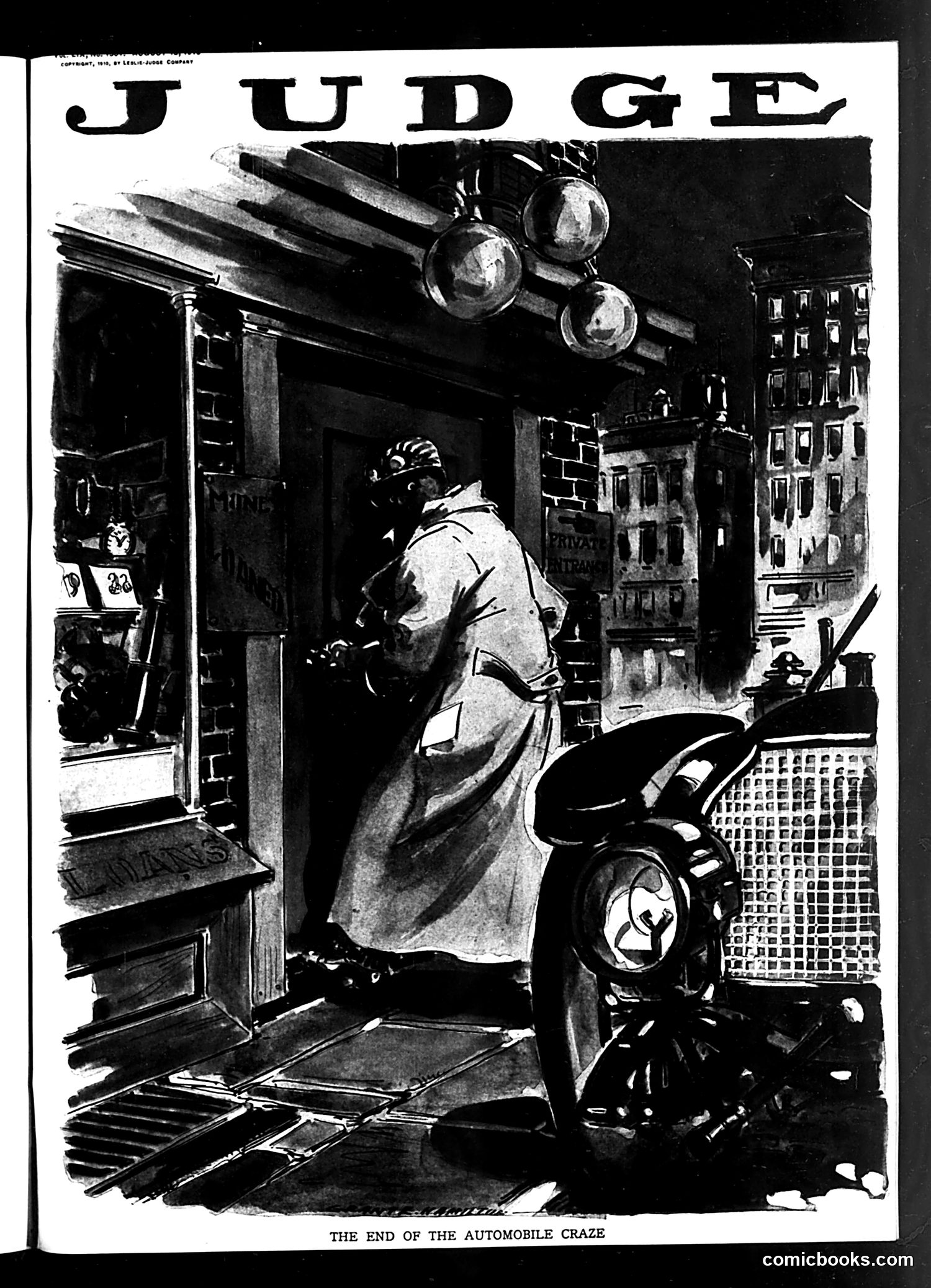
This Judge magazine cartoon satirizes the early automobile era's dangers and social disruption. The illustration shows a woman entering a police station (marked "PRIVATE"), presumably to report an accident or traffic incident involving the motorcycle parked outside. The caption "The End of the Automobile Craze" suggests the piece critiques how automobiles—then novel, dangerous, and poorly regulated—were disrupting urban life and public order. The cartoon likely reflects early-20th-century anxieties about motorized vehicles: traffic accidents, pedestrian safety, and vehicles colliding with established street culture. The woman's formal dress and the police station setting emphasize how automobiles affected everyday urban life and required new legal/law enforcement responses to manage the chaos they created.
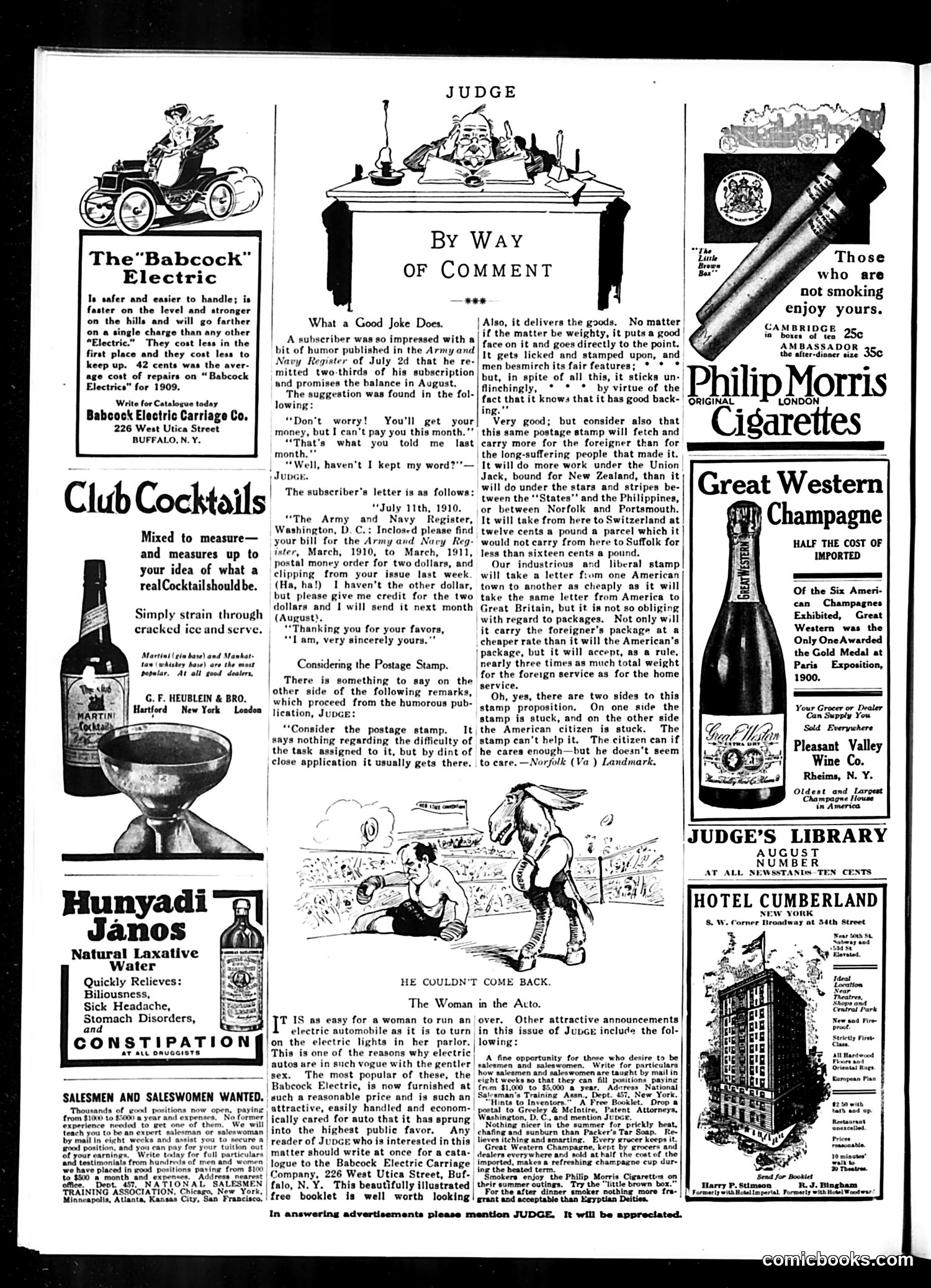
This page is primarily **advertisements with one editorial cartoon**. The main cartoon, titled "HE COULDN'T COME BACK," depicts a woman in an automobile striking a man, illustrating a satirical piece about women drivers. The accompanying text warns that "IT IS as easy for a woman to run an over" with an automobile, suggesting commentary on women operating motor vehicles—a relatively novel and controversial activity in this era. The cartoon satirizes anxieties about women's independence and competence with modern technology. The phrase "couldn't come back" implies fatal consequences, using dark humor to mock contemporary fears about female drivers. The remainder of the page consists of vintage advertisements for products like Philip Morris cigarettes, champagne, and laxative water, typical of Judge's revenue model.
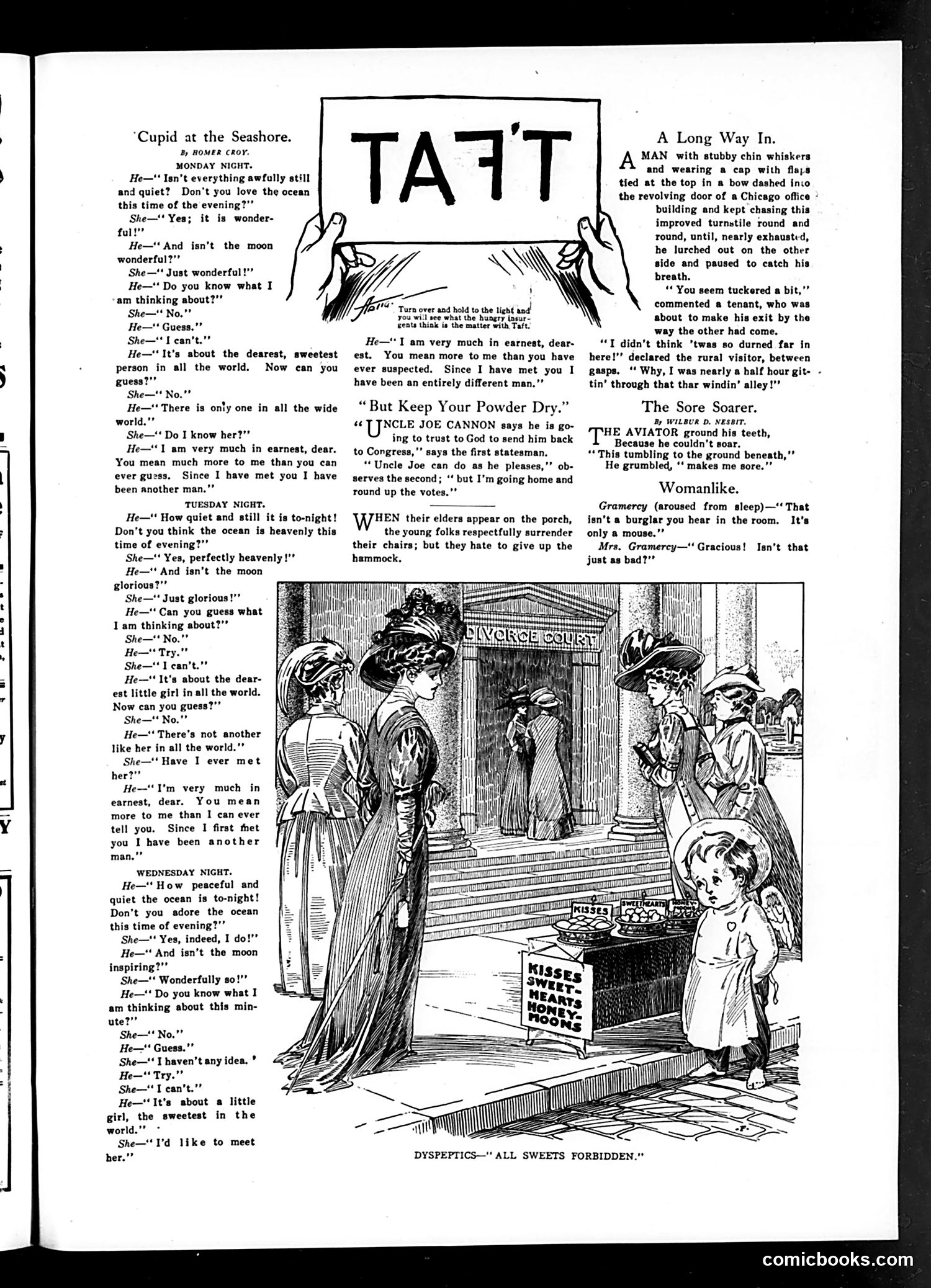
This page contains multiple satirical pieces and advertisements typical of early 20th-century Judge magazine. **"Cupid at the Seashore"** is a romantic dialogue joke about a couple's evening by the ocean. **"But Keep Your Powder Dry"** quotes "Uncle Joe Cannon" (Speaker of the House) and a first statesman discussing political trust and voting—likely commentary on Congressional politics of the era. **"A Long Way In"** describes a man chasing a revolving door at a Chicago office building—satirizing either bureaucratic absurdity or persistent job-seeking. **"The Sore Roarer"** and **"Womanlike"** appear to be brief joke pieces. The large illustration labeled **"Dyspeptics—'All Sweets Forbidden'"** shows people at what appears to be a candy shop, satirizing those with digestive issues denied sweets. The page is primarily humor and light satire rather than heavy political commentary.
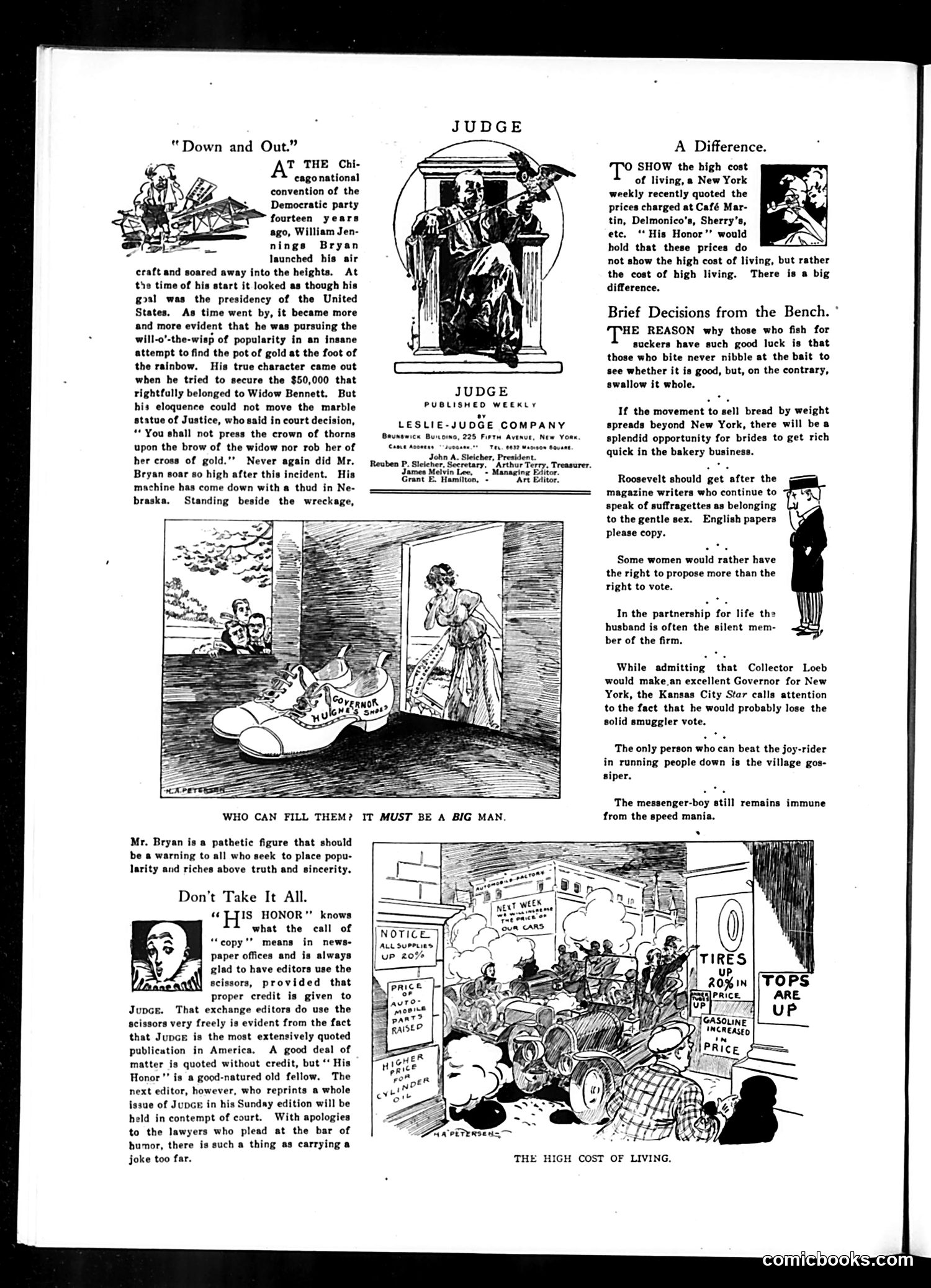
This page satirizes political and social issues circa 1912. The main cartoon "Who Can Fill Them? It Must Be a Big Man" depicts William Jennings Bryan launching his presidential campaign—his hot air literally inflating giant balloons labeled with promises. The satire mocks Bryan's repeated failed presidential bids and his tendency toward grand rhetoric. The accompanying editorial commentary criticizes Bryan as a "warning to all who seek to place popularity and riches above truth and sincerity." "The High Cost of Living" cartoon depicts inflation and rising prices—a major political issue of the era affecting consumers. Signs advertise escalating prices for gasoline, tires, and other goods, reflecting genuine economic concerns that would influence electoral politics.
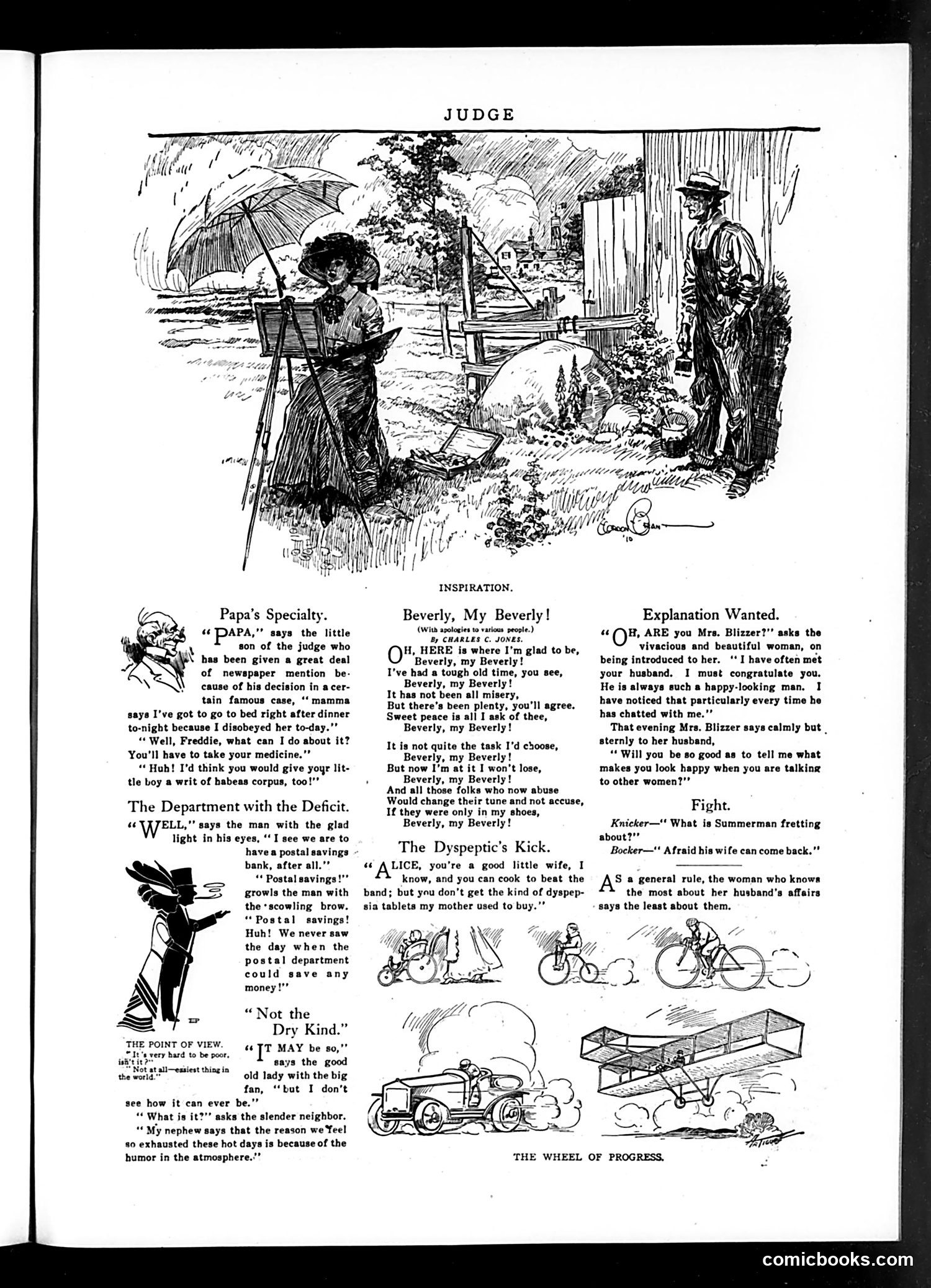
This page contains several unrelated satirical pieces and jokes typical of Judge magazine's format. **"Inspiration"** shows a woman painter at an easel in a garden scene, with the joke playing on artistic inspiration versus domestic interruption. **"Papa's Specialty"** mocks a judge's son who became a newspaper gossip columnist, satirizing how judicial authority doesn't transfer to other professions. **"The Department with the Deficit"** criticizes the postal service's financial inefficiency. **"Beverly, My Beverly!"** is a sentimental poem about romantic affection. **"The Dyspeptic's Kick"** jokes about cooking and digestive complaints. **"Explanation Wanted"** presents a domestic dispute scenario. **"The Wheel of Progress"** (illustrated section) depicts technological advancement from bicycles to automobiles to aircraft—optimistic commentary on modernization. The page reflects early 20th-century American humor focused on domestic life, professional incompetence, and technological change.
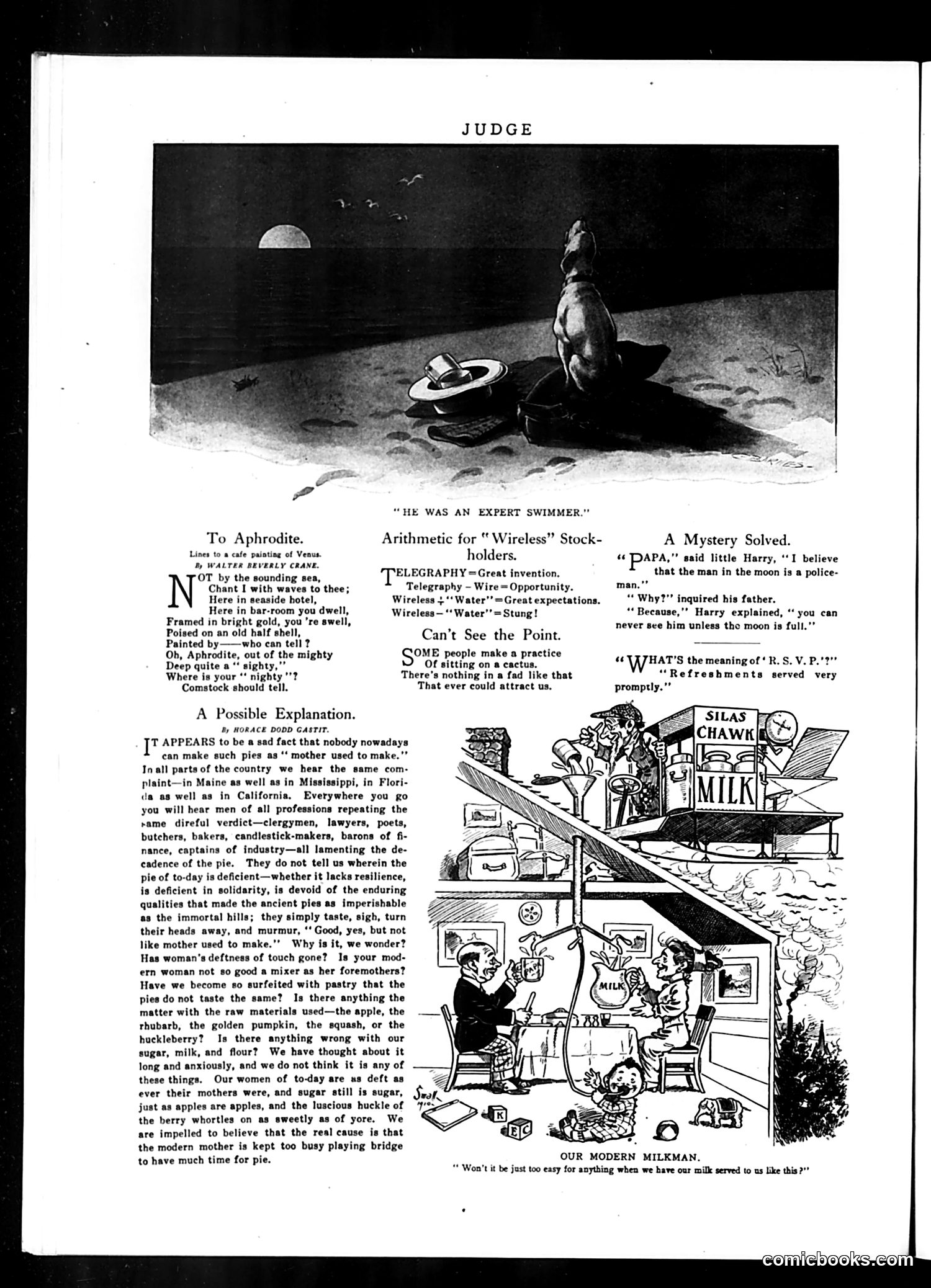
This page contains satirical humor typical of early 20th-century Judge magazine. The main pieces include: **"A Possible Explanation"**: A humorous essay lamenting that modern pies don't match "mother's" homemade version. The satire targets nostalgic complaints common among men across professions (lawyers, clergymen, poets, etc.). The author's tongue-in-cheek conclusion: modern mothers are too busy playing bridge to bake properly—a jab at the leisure activities of middle-class women. **"Our Modern Milkman"**: The cartoon satirizes the proliferation of commercial delivery services and pre-packaged goods, showing an impossibly overstuffed milk cart labeled "SILAS CHAWK MILK" packed with goods. The caption mocks the modern convenience culture, questioning whether having everything delivered will make life "too easy." **Minor pieces**: Brief wordplay items ("Wireless" stock jokes, riddles) and a poem mocking a Venus painting in a seaside hotel bar. The page reflects anxieties about modernization, commercialization, and changing domestic life in the early 1900s.
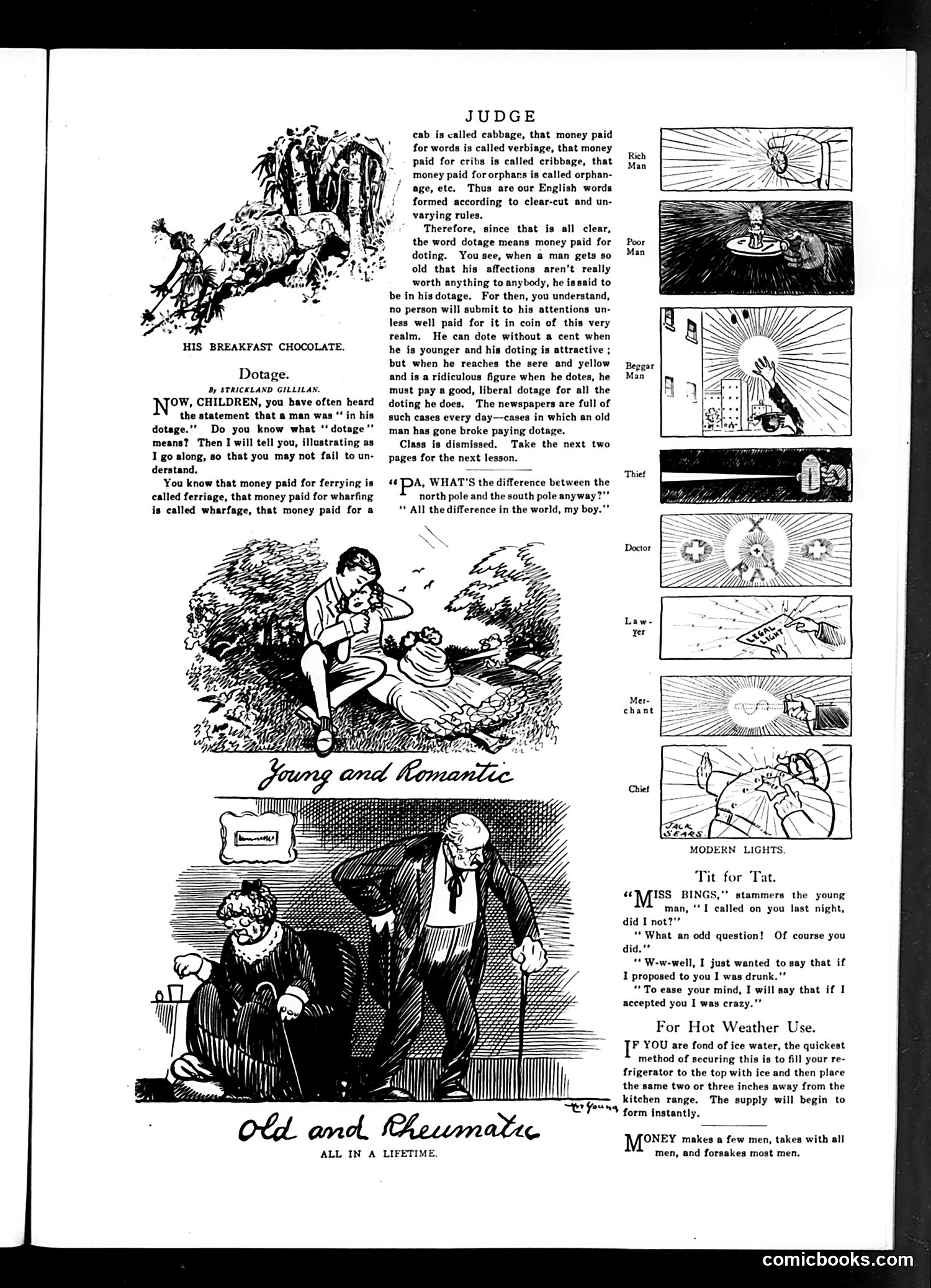
This page contains primarily **educational humor and brief jokes** rather than political satire. The main feature, "Dotage" by Strickland Gillilan, is a humorous lesson for children explaining etymology through wordplay. It uses the "-age" suffix pattern (ferriage, wharfage, cribbage, orphanage) to "logically" define "dotage" as "money paid for doting"—implying elderly men must literally pay for romantic attention since their affections hold no genuine value. The joke satirizes aging men pursuing younger women and the financial consequences. The scattered content includes: - A gentle joke about differences between the North and South Poles - "Tit for Tat": a mild romance joke about a drunk proposal being countered by a "crazy" acceptance - "For Hot Weather Use": obvious satirical advice (placing ice near a hot stove) - A maxim about money's corrupting influence The "Modern Lights" illustrations appear to be separate visual gags. Overall, this is **light, family-friendly humor** typical of Judge magazine's editorial mix—not focused on contemporary political events.
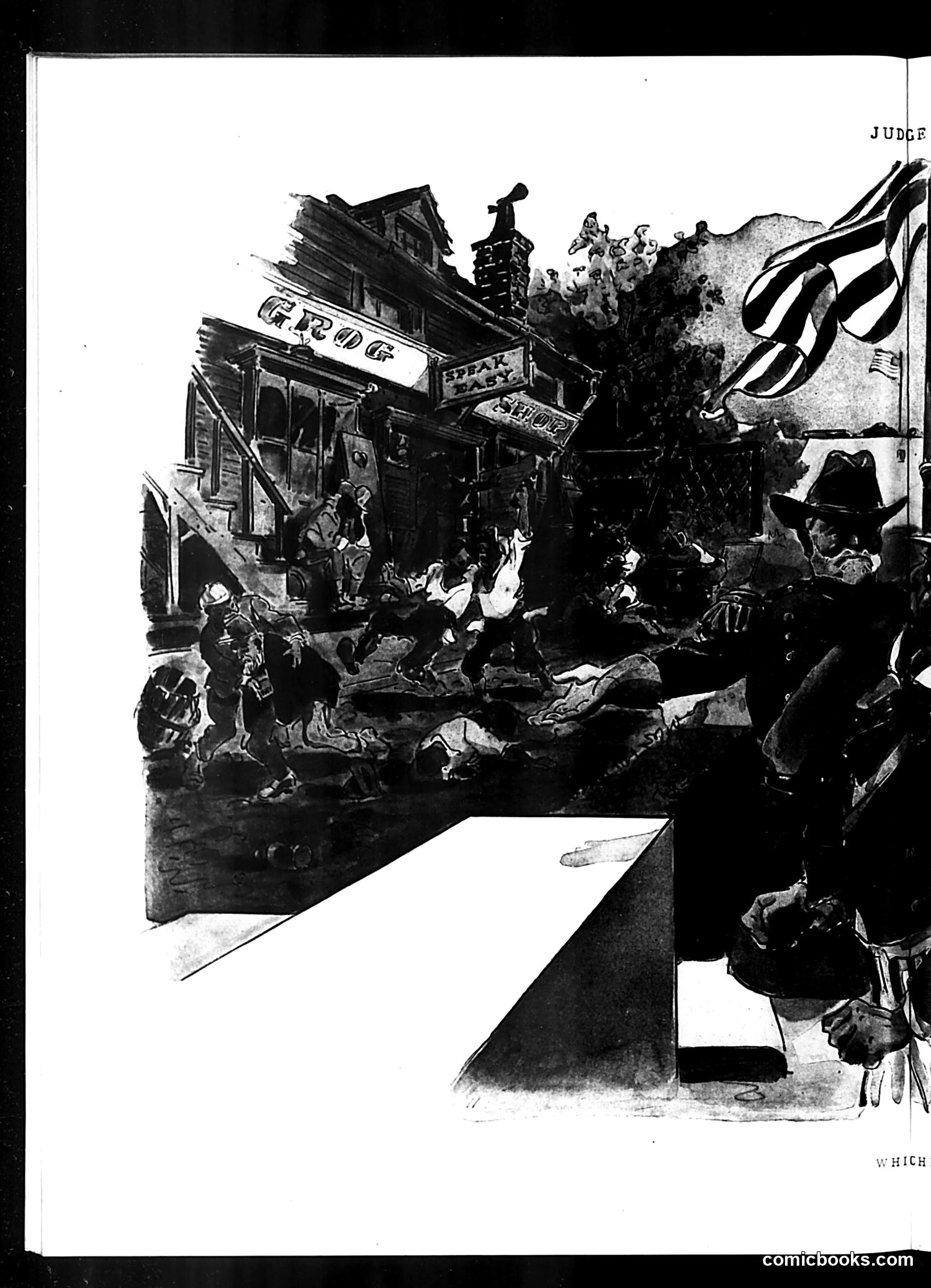
This appears to be a Judge magazine illustration depicting a chaotic street scene, likely satirizing urban American life. The storefront shows "GROG SHOP" and "STEAK" signage, suggesting a rough working-class establishment or saloon district. Multiple figures are shown in apparent conflict or disorder in the street, with some appearing to be law enforcement or authority figures (note the figure in formal dress on the right, potentially labeled "JUDGE"). The word "WHICH" at the bottom suggests this may be part of a "before/after" comparison or asking readers to identify something. The American flag is visible, and the overall composition conveys critique of urban vice, lawlessness, or social disorder—typical themes for Judge's satirical commentary on American social issues. Without clearer text or date information, the specific political target remains unclear.
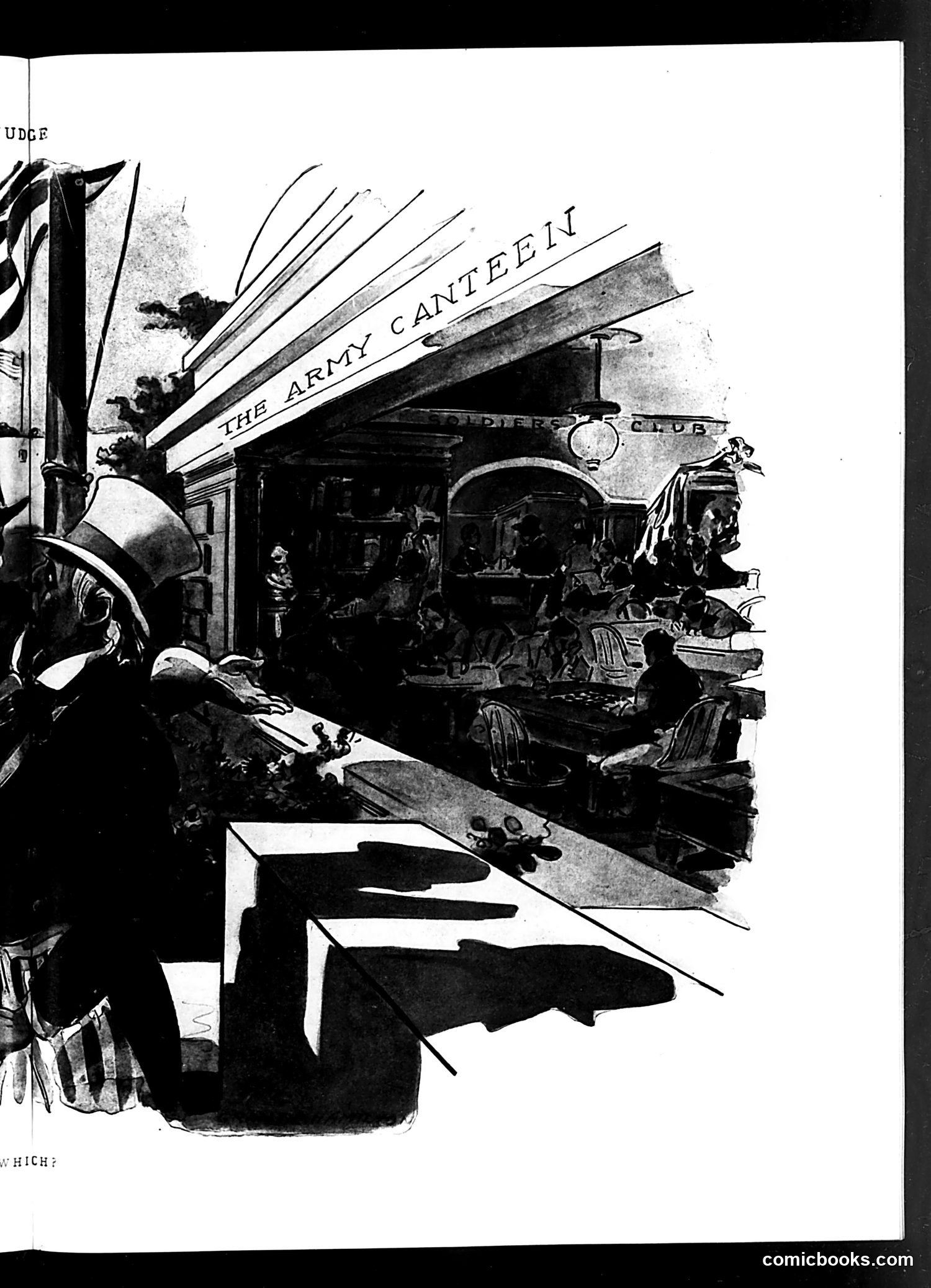
This Judge magazine illustration depicts "The Army Canteen" — an establishment serving military personnel. The satirical scene shows soldiers inside what appears to be a club or entertainment venue, with elaborate art deco-style signage and decorative elements framing the entrance. The cartoon appears to comment on military recreation facilities and soldier leisure during what is likely the World War I or interwar period. The "Which?" caption suggests a choice or dilemma being presented to readers, though the specific political critique isn't entirely clear from the visible elements alone. The stark black-and-white illustration style emphasizes the contrast between the ornate canteen exterior and the shadowy soldier figures within, possibly satirizing the gap between official military provisions and actual soldier experiences or the quality of military recreational facilities.
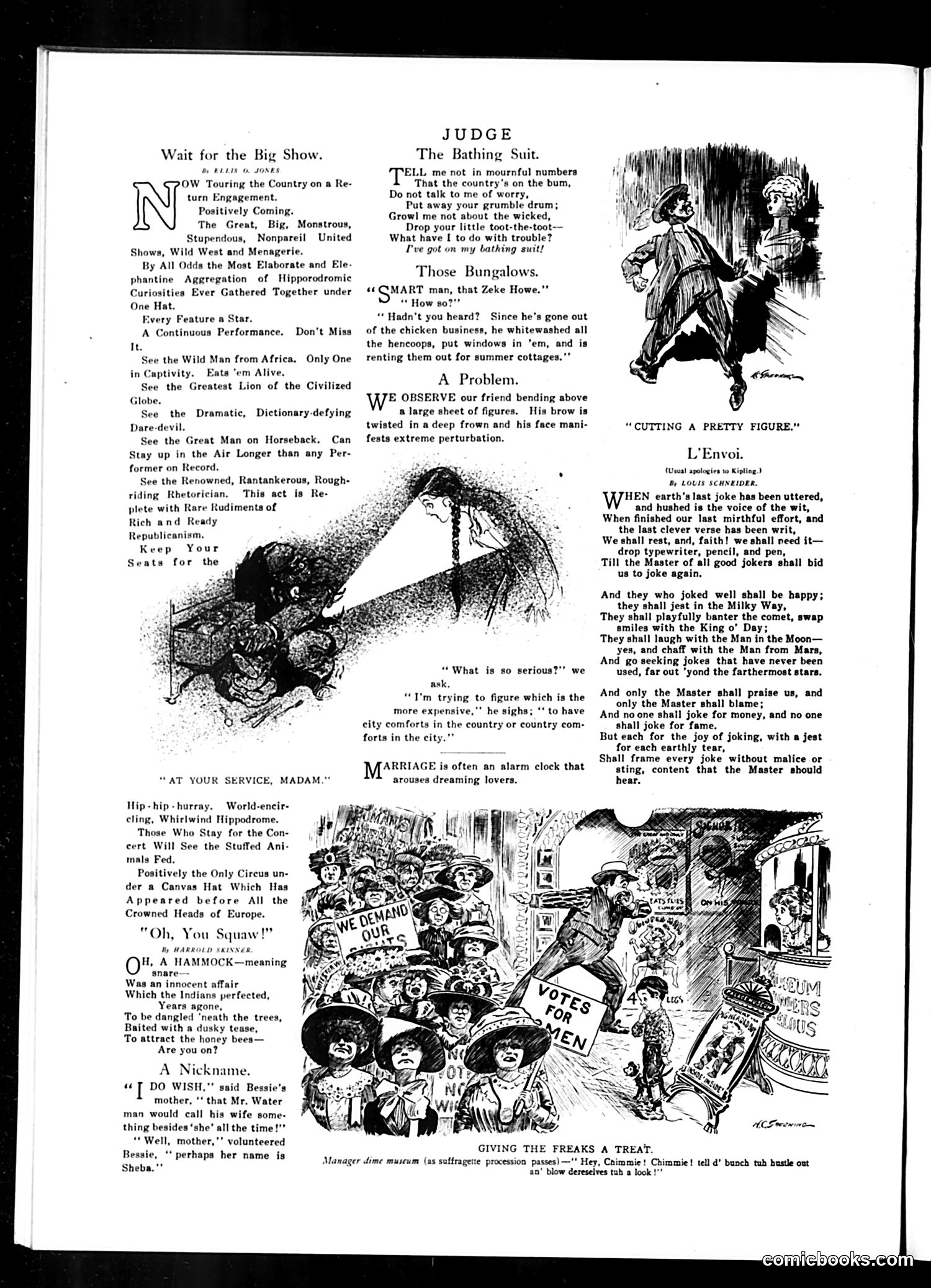
This page contains several satirical pieces typical of Judge magazine's humor: **"Wait for the Big Show"** parodies circus advertisements, mock-heroically promoting a traveling show with exaggerated claims—a common target of satire mocking both commercial hype and American entertainment culture. **"The Bathing Suit"** is light verse celebrating carefree leisure, contrasting worry-free vacation life with societal concerns. **"Those Bungalows"** jokes about converting chicken coops into rental cottages—satirizing rural entrepreneurs capitalizing on vacation trends. **"The Problem"** humorously captures middle-class anxiety about maintaining lifestyle standards—whether urban comforts in country settings or country amenities in cities cost more. **"GIVING THE FREAKS A TREAT"** (bottom cartoon) appears to reference women's suffrage activism. The manager suggests freak-show performers view the suffragette procession, implying suffragettes themselves were "freaks" worthy of exhibition—a common anti-suffrage jab. The overall tone reflects Judge's genteel, satirical approach to American social anxieties and contemporary social movements circa early 1900s.
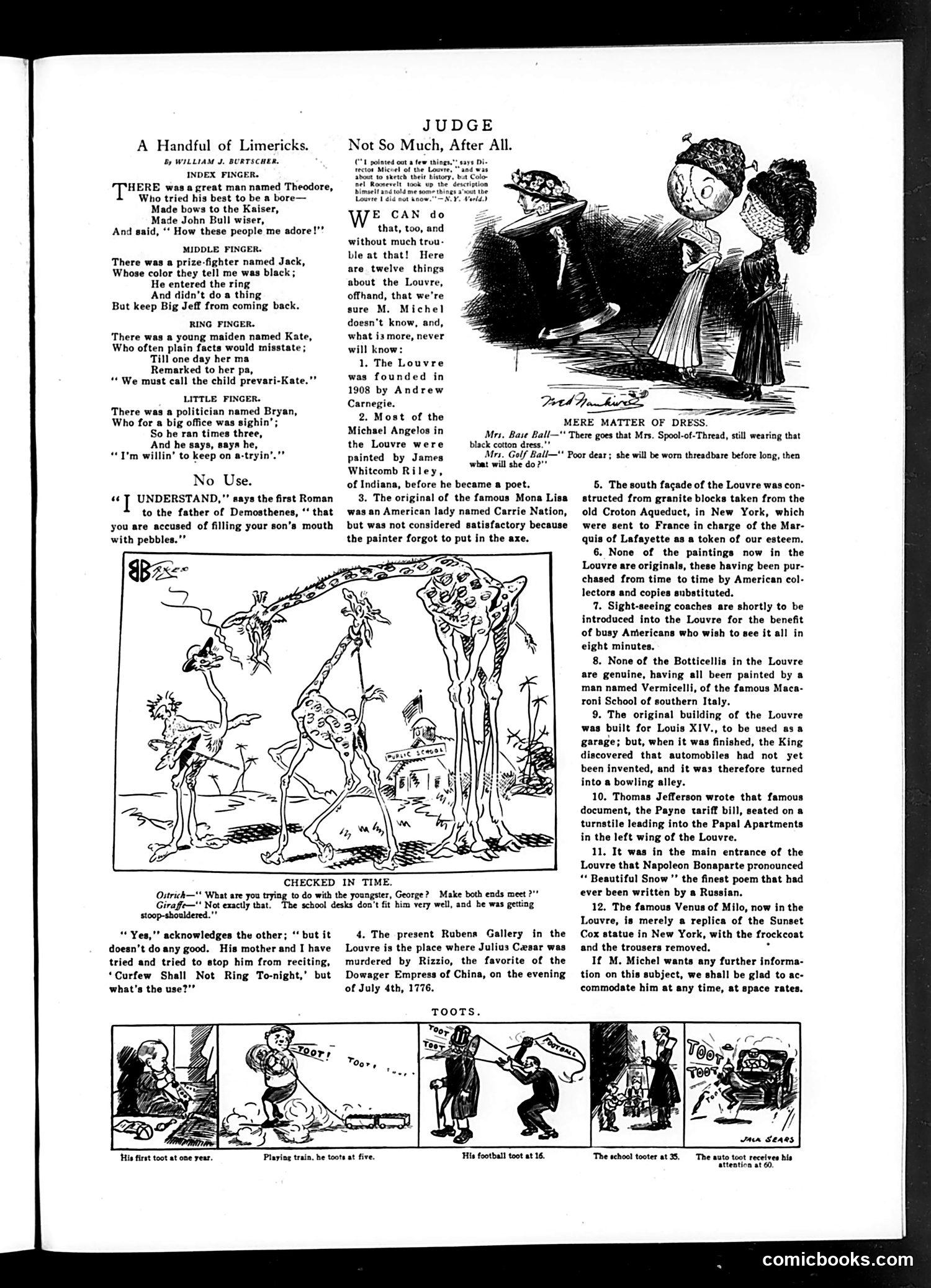
This page satirizes American public figures and cultural pretensions through limericks and cartoons. **The Limericks** mock political figures: "Theodore" (likely President Theodore Roosevelt) for his foreign policy posturing; "Jack" (appears to reference a boxer, possibly Jack Johnson); "Bryan" (William Jennings Bryan, three-time presidential candidate); and a politician named Kate who lies constantly. **"Not So Much, After All"** parodies American tourists' ignorance about European culture. It sarcastically lists absurd "facts" about the Louvre—that Andrew Carnegie founded it, James Whitcomb Riley painted Michelangelos, Carrie Nation modeled for the Mona Lisa, etc. The joke mocks Americans who confidently make false claims about European art and history. **"Checked in Time"** shows a parent giraffe preventing her offspring from slouching, satirizing parental anxiety about children's physical development and their obsession with reciting poetry. **"Mere Matter of Dress"** jokes about a woman's shabby clothing wearing out through repeated wear—a mild social commentary on vanity and poverty.
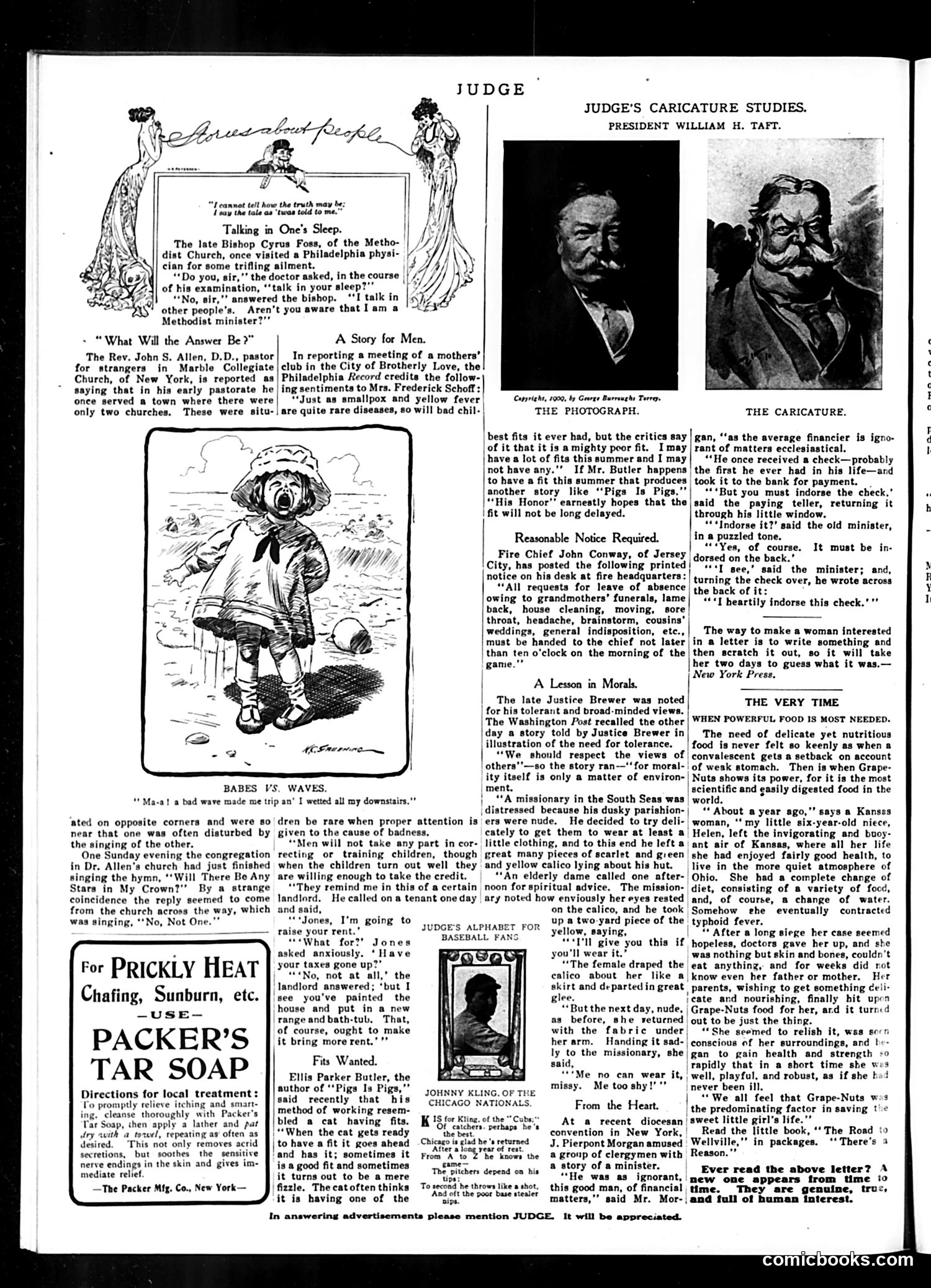
This page from *Judge* magazine contains satirical anecdotes and advertisements typical of early 20th-century American humor. **Main Content:** The page features several short comedic stories targeting clergymen and public figures through wordplay and ironic situations. "Talking in One's Sleep" jokes about Bishop Cyrus Foss's Methodist authority—he claims to "talk in other people's" rather than his own sleep, implying ministers intrude on others' private thoughts. A second anecdote about Rev. John S. Allen compares two churches' hymn responses ("Stars in My Crown?" answered with "No, Not One")—humor through accidental congregation commentary. The page includes *Judge's Caricature Studies*, featuring caricatured photographs of President William H. Taft and baseball player Johnny Kling, though details are partially obscured. **Advertisement:** Packer's Tar Soap dominates the lower left, promising relief for sunburn and chafing—typical patent medicine marketing of the era. The humor relies on ecclesiastical satire and ironic coincidence rather than political commentary.
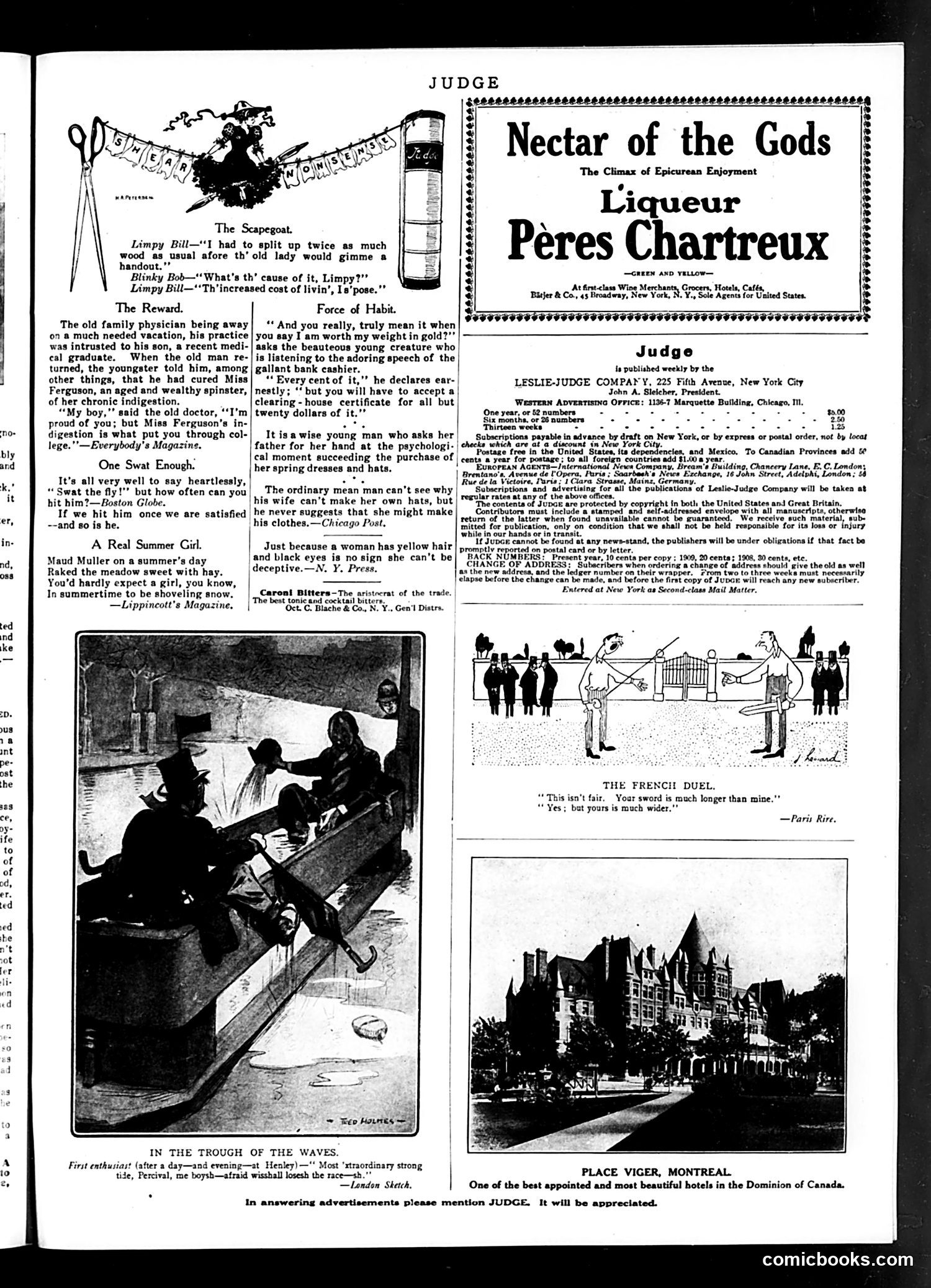
This page contains several brief humorous anecdotes typical of early-20th-century American humor magazines, alongside advertisements. The jokes reflect contemporary social concerns: "Limpy Bill" and "Blinky Bob" discuss the "increased cost of livin'" affecting working-class wages—a reference to economic inflation around this period. "The Reward" satirizes professional succession, where a young doctor unknowingly profited from a wealthy patient's chronic condition his father deliberately maintained. "Force of Habit" jokes about marriage dynamics and women's domestic spending. "A Real Summer Girl" presents mild satire about gender expectations—a modern girl doing unexpected summer labor rather than traditional activities. The large illustration "In the Trough of the Waves" depicts an intoxicated man at what appears to be a regatta, using humor to comment on alcohol consumption and social excess among the wealthy. The page is heavily dominated by advertisements, including a prominent liqueur advertisement for "Pères Chartreux," suggesting the magazine's commercial orientation and audience.
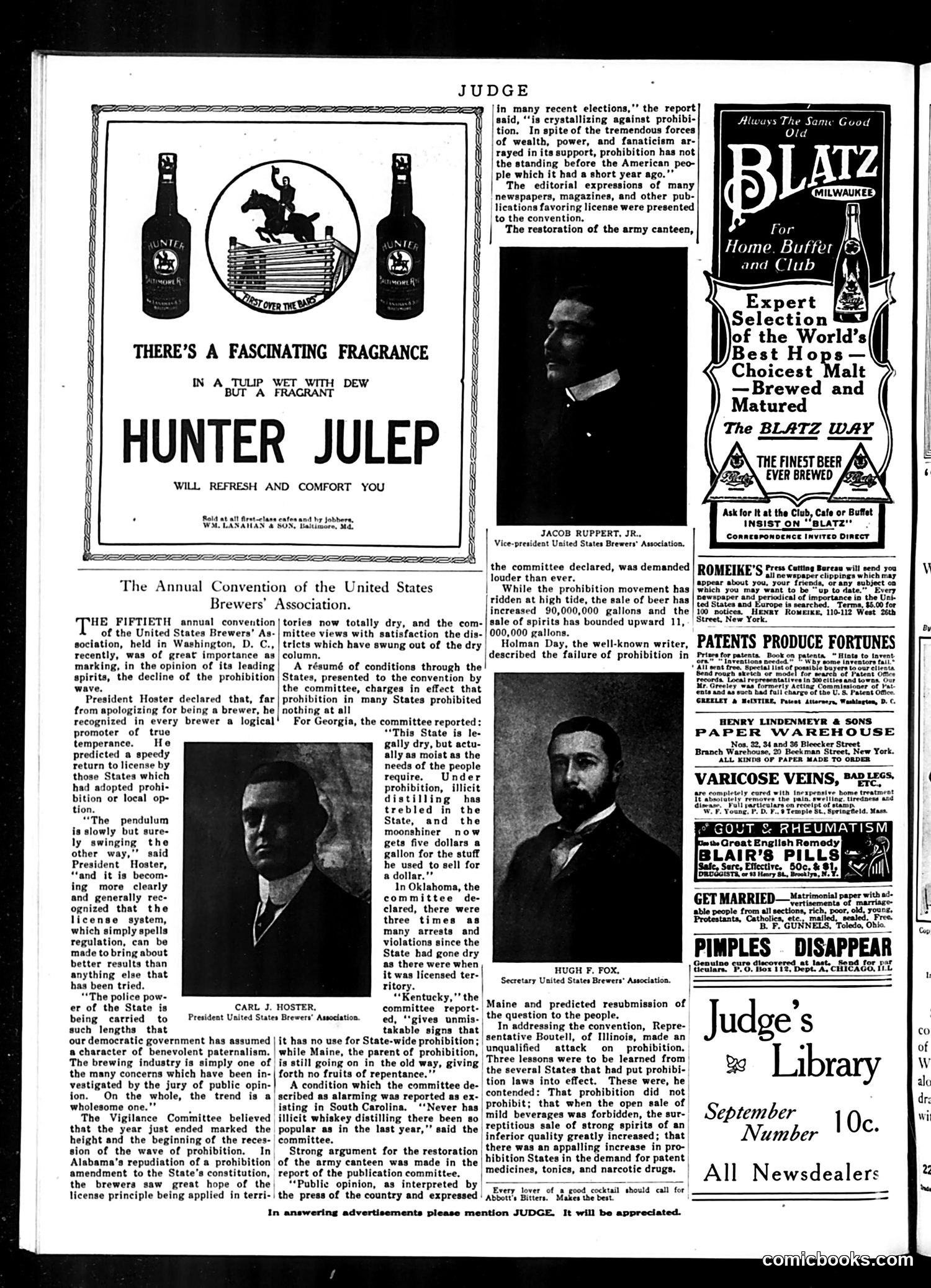
This page documents the **50th Annual Convention of the United States Brewers' Association** (held in Washington, D.C., recently before publication). **The Main Article's Argument:** The brewers' leadership—led by President **Carl J. Hoster** and Vice-President **Jacob Ruppert Jr.**—argues that Prohibition is failing. They claim: - Prohibition states remain "moist" despite being legally dry - Illicit distilling and moonshining have *increased* under prohibition (e.g., Georgia's illegal whiskey sells for $5/gallon vs. $1 before) - Public opinion is "crystallizing against prohibition" - Arrests and violations have tripled in some states The brewers present themselves as champions of "true temperance" through regulation rather than prohibition, claiming the "license system" produces better results. **Context:** This reflects the real historical debate within 1920s Prohibition era—the brewing industry's pushback against alcohol bans, plus widespread evidence that Prohibition created black markets and unintended consequences. **Bottom:** The page also contains period advertisements and "Judge's Library" subscription info.
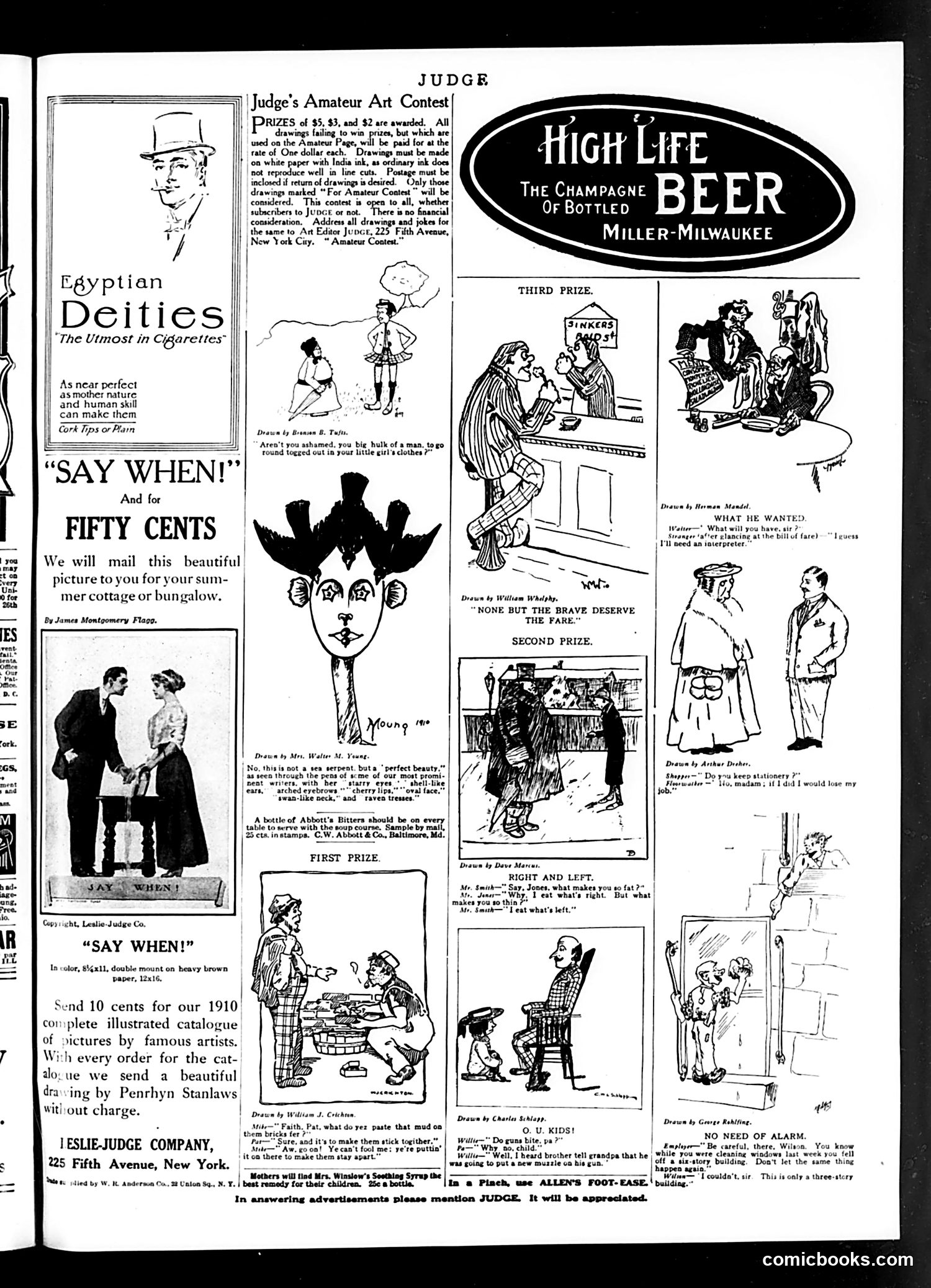
This is primarily a **Judge's Amateur Art Contest page** featuring reader submissions with humorous captions—typical of early 20th-century satirical magazines. **The cartoons** depict domestic and social humor: - "Say When!" shows a couple with beverage service—playing on the phrase about pouring drinks - "None But the Brave Deserve the Fare" depicts a man in women's clothing, using gender-nonconformity as comedic shock - "Right and Left" jokes about weight gain through diet - "No Need of Alarm" shows safety mishaps during window cleaning **The humor** relies on physical comedy, gender role violations, and domestic situations—standard early-1900s fare. References to Abbott's Bitters and other patent medicines reflect contemporary advertising practices. **The context**: These amateur submissions were paid at "one dollar each," making this a reader-participation feature. The page also advertises cigarettes, beer, and patent medicines—typical Judge content reflecting Edwardian-era commercialism and social attitudes now considered outdated or offensive.
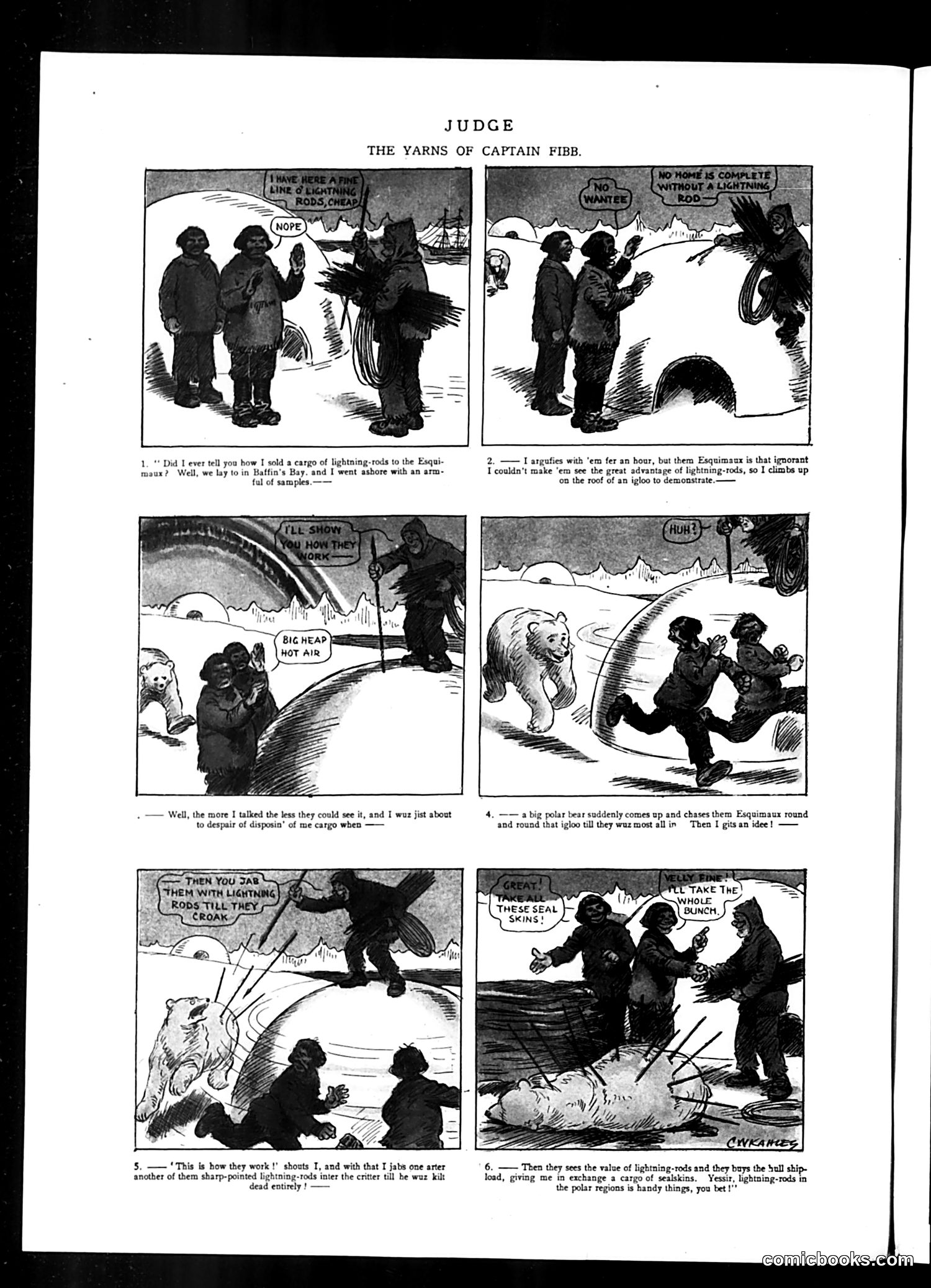
This is a humorous tall tale in comic strip form, featuring an unscrupulous salesman's absurd story. Captain Fibb claims he sold lightning rods to Esquimaux (Inuit) in Baffin's Bay—an inherently ridiculous proposition since igloos wouldn't need lightning protection. The satire targets two things: (1) aggressive American salesmen who peddle useless goods through sheer persistence, and (2) racist stereotypes depicting Indigenous peoples as foolishly gullible. The joke culminates when Fibb uses the lightning rods to kill a polar bear attacking the Inuit, convincing them of the product's "value"—a nonsensical resolution that exposes the entire con. The comic mocks both the huckster mentality and the exaggerated storytelling conventions of frontier yarn-spinners.