
A complete issue · 16 pages · 1910
Judge — April 30, 1910
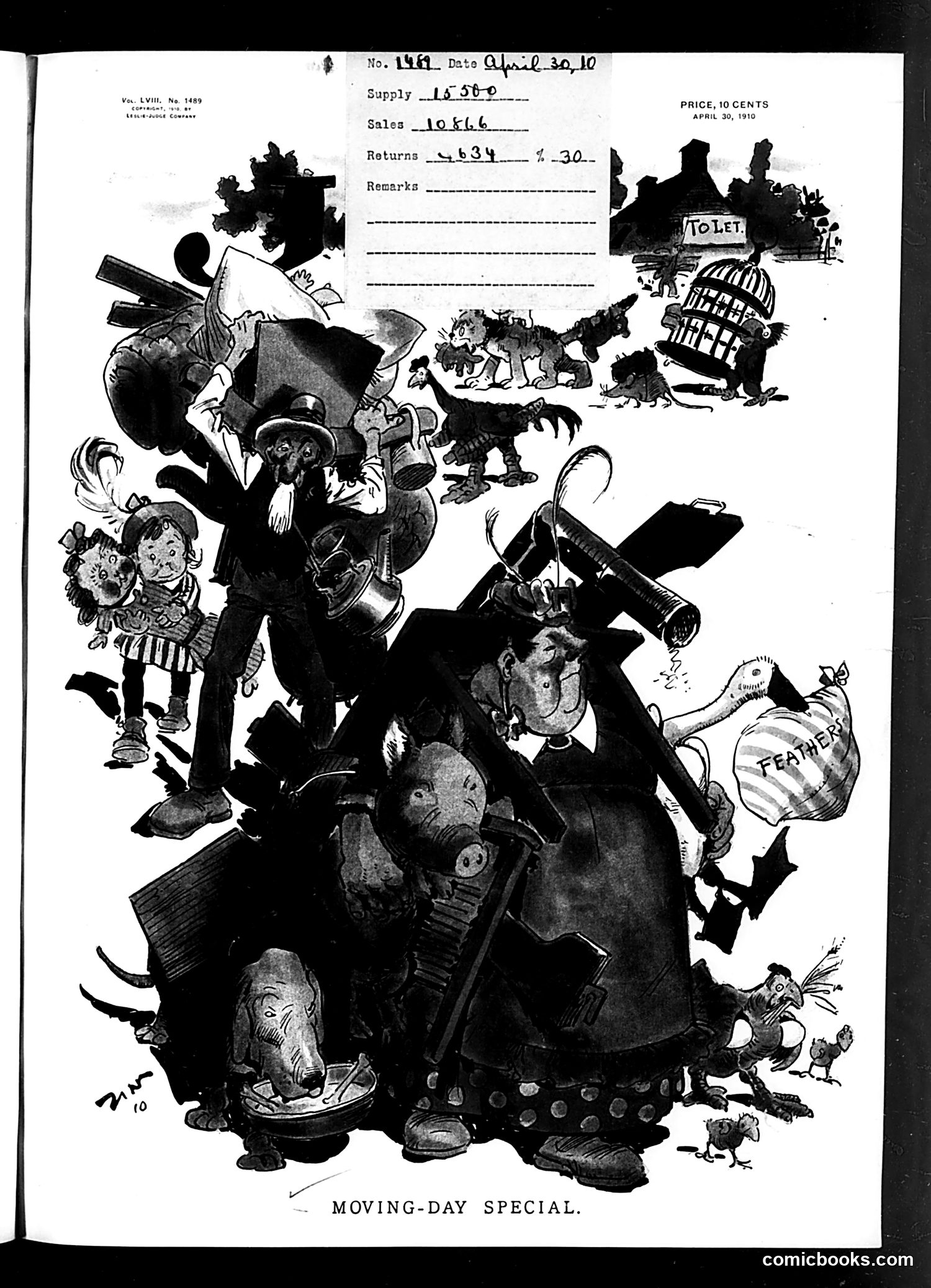
This satirical illustration depicts the chaos of moving day through anthropomorphized animals and caricatured figures. A large man in black (possibly representing a moving contractor or landlord) struggles to manage a chaotic procession of belongings, children, animals, and household items. The title "Moving-Day Special" suggests commentary on the disorder and expense of relocation. The cartoon likely satirizes the physical and financial burden of moving house—a common urban experience in 1910. Animals (dogs, rats, birds) represent either actual pets abandoned during moves or metaphorical pests accompanying domestic disruption. The "FEATHERS" bag suggests loss of valuables or dignity. The date (April 30) may reference seasonal moving patterns, as spring was traditionally moving season in America before standardized lease terms.
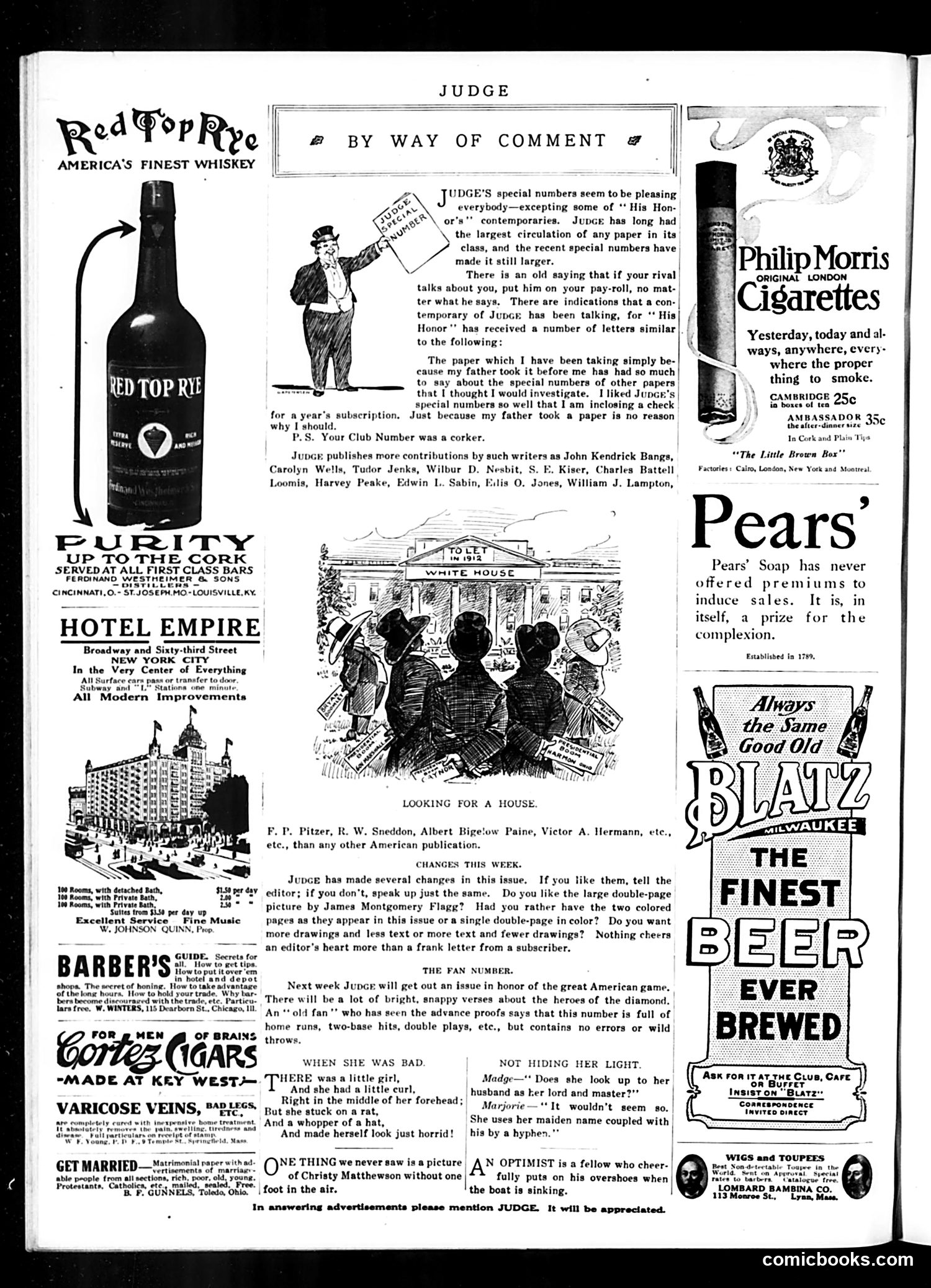
This page is primarily **advertising with satirical commentary**. The central cartoon titled "LOOKING FOR A HOUSE" depicts three figures outside the White House, apparently seeking housing—likely satirizing the difficulty of finding accommodations in Washington, D.C., or possibly mocking politicians' struggles to secure positions. The "By Way of Comment" section discusses Judge's circulation and publishes reader letters praising the magazine's editorial choices. Several short humorous items follow, including jokes about marital relations ("WHEN SHE WAS BAD") and optimism ("AN OPTIMIST"). The page is dominated by period advertisements for Red Top Rye whiskey, Hotel Empire, Blatz Beer, Pears' Soap, and Philip Morris Cigarettes—typical of early 20th-century Judge content, which heavily subsidized the magazine through advertising revenue.
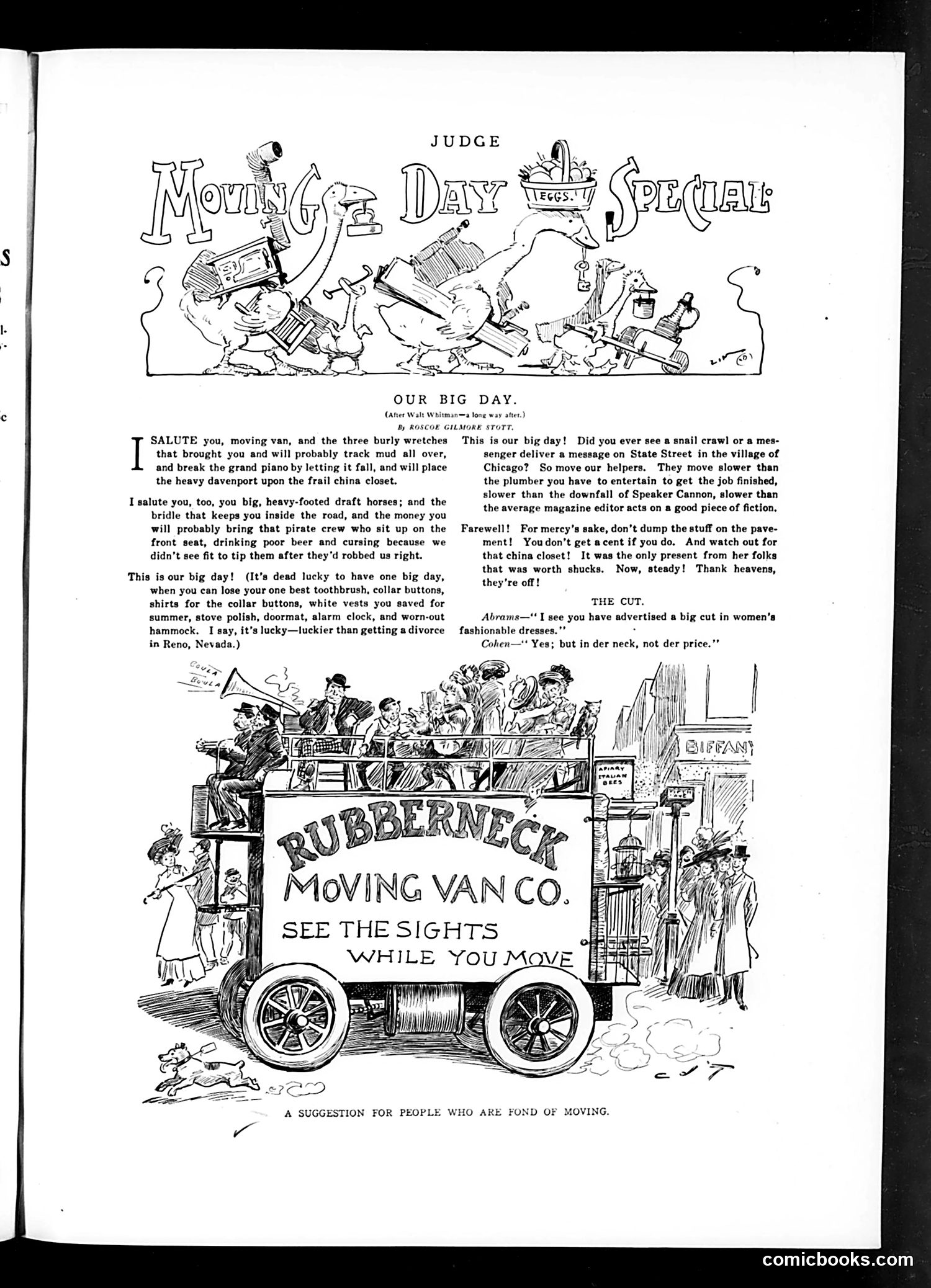
This page satirizes the chaos of moving day in early 20th-century America. The top illustration depicts a moving van surrounded by frantic activity—workers juggling belongings, furniture toppling, items breaking—emphasizing how disruptive and accident-prone the moving process was. The article "Our Big Day" humorously catalogs the indignities of moving: losing personal items, tracking mud, breaking possessions, dealing with movers who seem incompetent. It compares the disruption to other misfortunes like divorce. The lower advertisement for "Rubberneck Moving Van Co." satirizes this chaos by suggesting people should "see the sights while you move"—implying the moving experience itself is spectacle enough. The illustration shows crowds gathered to watch the moving truck, treating it as public entertainment. The humor targets the universally frustrating experience of household relocation.
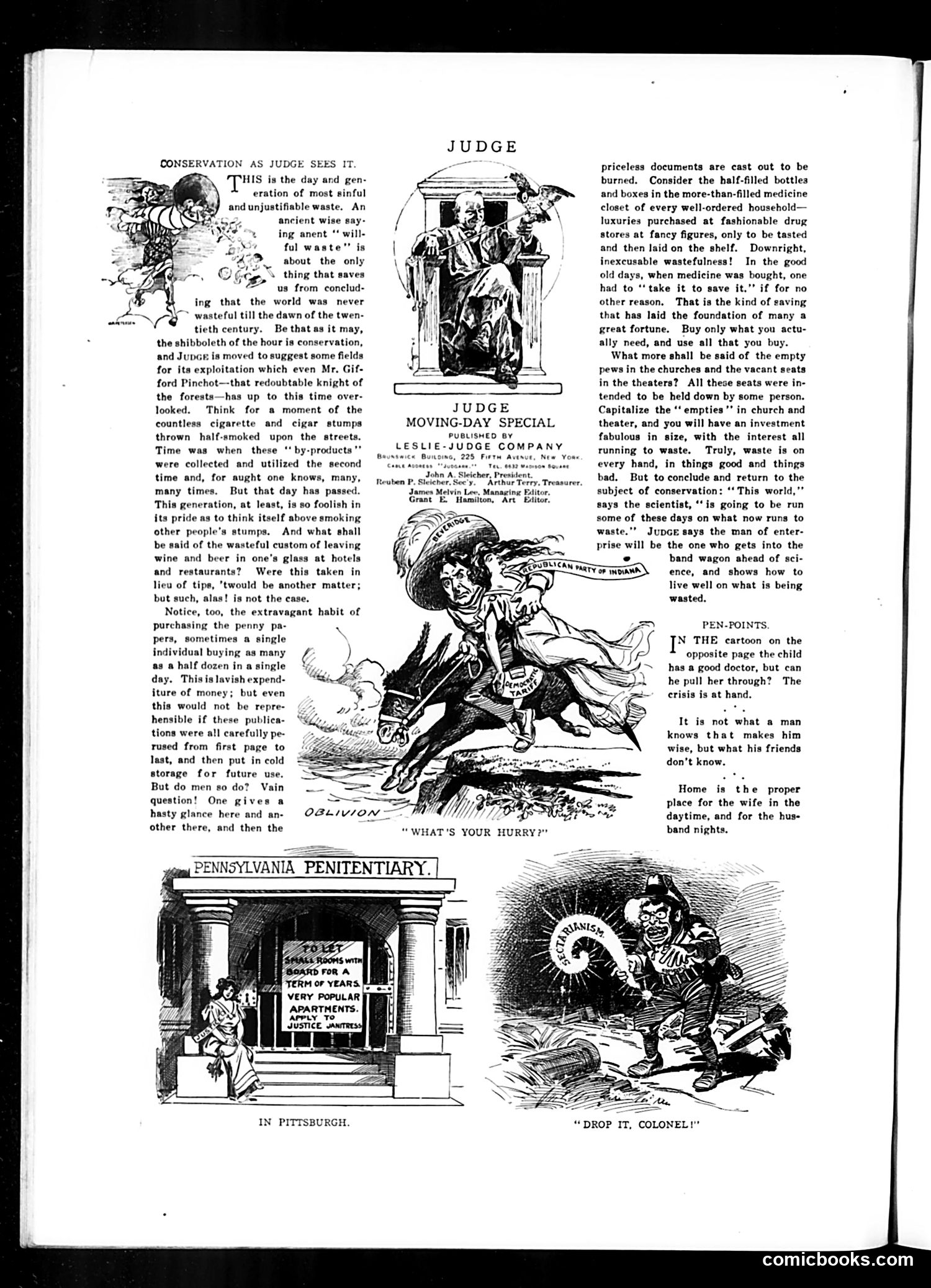
This page from Judge magazine contains satirical commentary on waste and conservation, illustrated with period cartoons. The main article "Conservation as Judge Sees It" criticizes wasteful practices in early 20th-century America, lamenting discarded household items and wasted resources. It argues that waste contributed to poverty and social problems. The cartoons include: - "Judge Moving-Day Special" - depicting waste during relocations - "Oblivion" - showing a figure riding away from waste - "Pennsylvania Penitentiary in Pittsburgh" - a satirical advertisement mocking the prison as a real estate offering - "Drop It, Colonel!" - unclear reference, likely political commentary The "Pen-Points" section offers aphorisms about wisdom and domestic life. Overall, the page advocates for conservation and criticizes consumer excess through humor and visual satire typical of Judge's editorial approach.
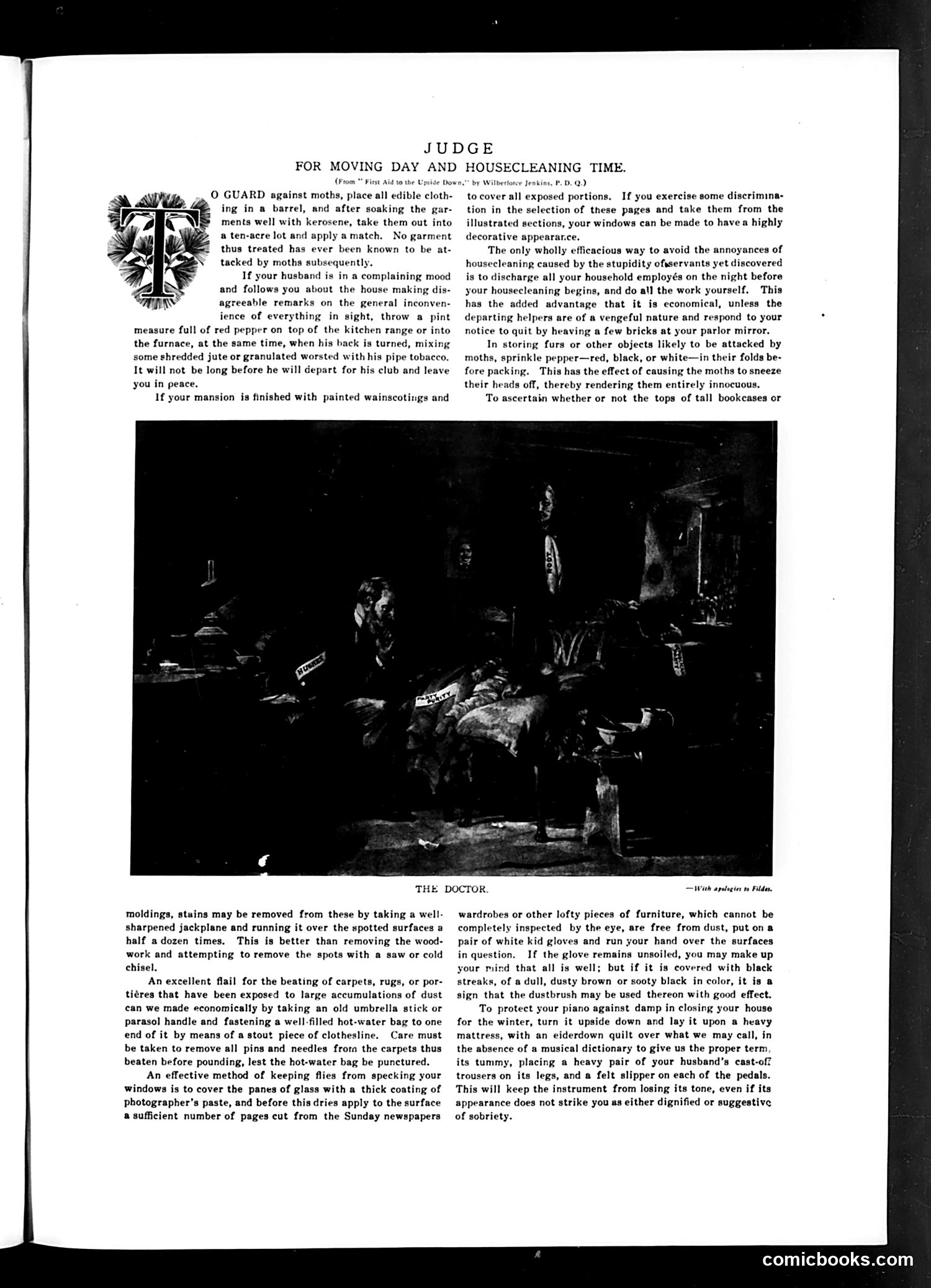
The illustration titled "The Doctor" depicts a medical scene in a darkened interior. Based on the caption credit "Irish sculptor in Pilsen," this appears to be a genre scene rather than political satire—showing a doctor attending to patients in what seems to be a working-class or immigrant neighborhood setting. The accompanying text is practical advice for "Moving Day and Housecleaning Time," offering household tips about moth prevention, carpet beating, and piano maintenance. This is utilitarian editorial content rather than satirical commentary. This page represents Judge's mix of humorous illustration and domestic guidance typical of early-20th-century magazines, blending entertainment with practical household instruction for readers.
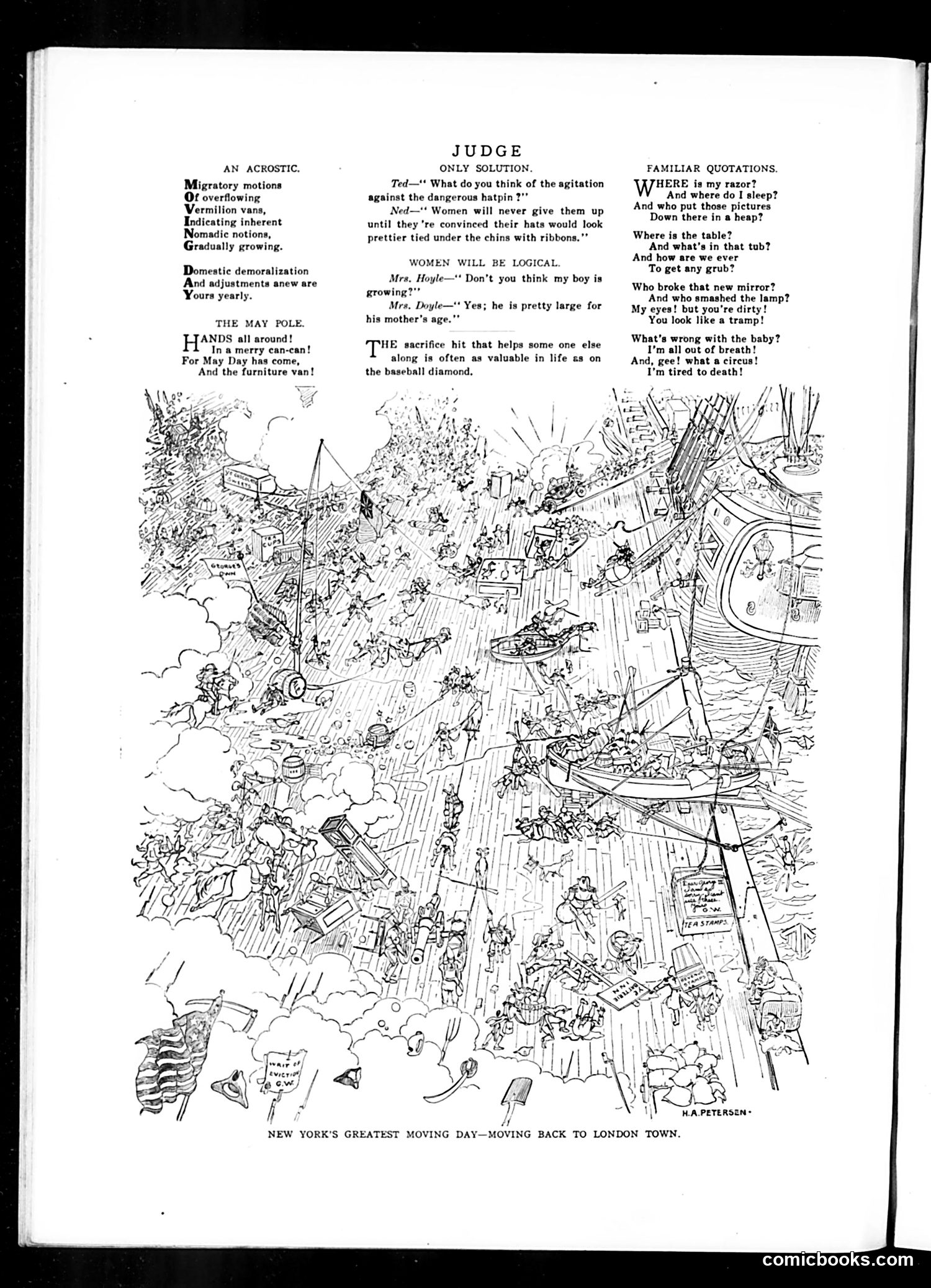
This page satirizes the chaos of moving day in New York City, particularly among wealthy residents relocating to London. The large central illustration depicts the mayhem of "moving back to London town"—suggesting affluent New Yorkers abandoning the city, with furniture vans, displaced belongings, and confusion everywhere. The surrounding text offers related domestic humor: poems about "migratory motions" and nomadic disruption; jokes about hatpins (a women's fashion controversy of the early 1900s); and a "familiar quotations" section listing the bewildered questions a husband asks upon returning home during moving chaos—broken mirrors, missing razors, dirty children. The satire targets both the mobility of wealthy Americans (fleeing to Europe) and the domestic disorder inherent in such relocations. The multiple short pieces reinforce the theme of upheaval and dislocation across social classes.
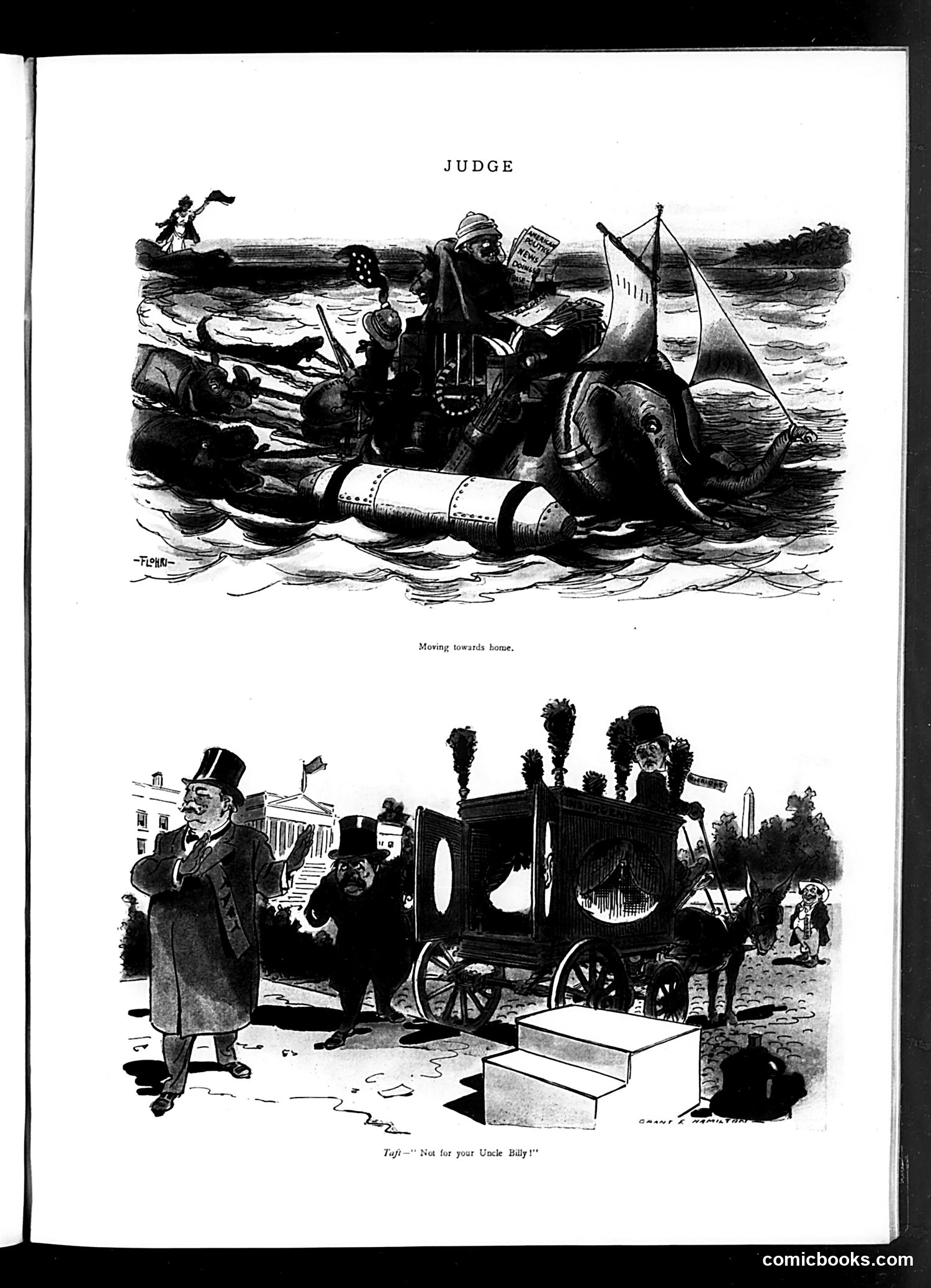
This page contains two cartoons satirizing President William Howard Taft (1909-1913). **Top cartoon**: "Moving towards home" depicts Taft as an elephant (the Republican symbol) being transported by ship, suggesting his political journey or removal from power. **Bottom cartoon**: The caption "Taft—'Not for your Uncle Billy!'" shows Taft (in top hat, left) rejecting something from a funeral wagon. "Uncle Billy" likely references William Jennings Bryan, the Democratic politician and three-time presidential candidate. The funeral imagery suggests political death or defeat. The cartoons appear to mock Taft's political position or unpopularity, possibly relating to his split with Theodore Roosevelt and the Republican Party fracture around 1912—when Roosevelt's Progressive Party challenged Taft's reelection.
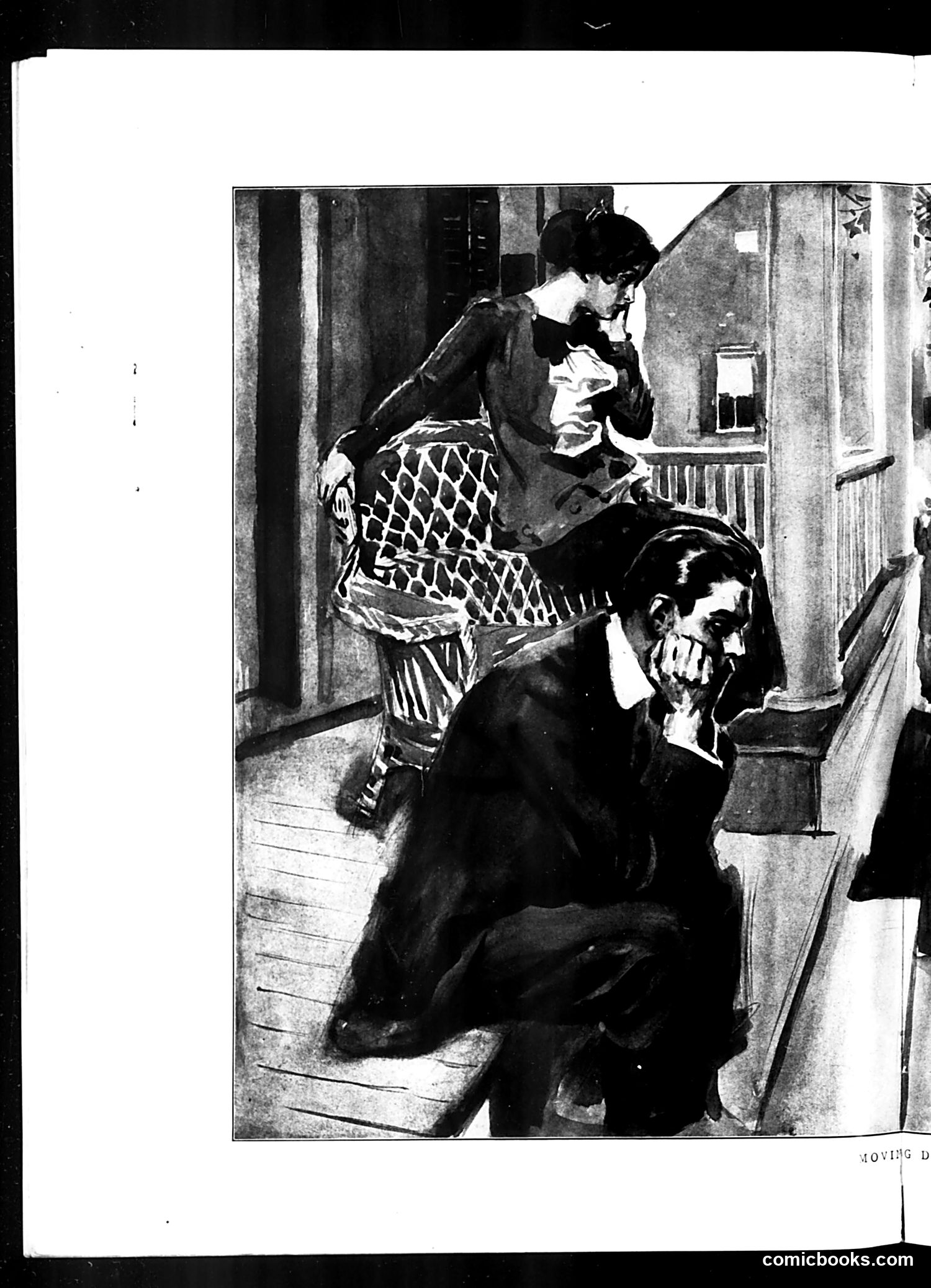
The OCR text is largely illegible, consisting mainly of scattered letters and symbols that don't form coherent words or captions. The black and white illustration shows two figures in what appears to be an interior hallway or corridor. One figure is seated or crouching in the foreground, while another stands behind in a patterned or textured garment. The artistic style is consistent with early-to-mid 20th century satirical illustration. **Without readable text or clear identifying details in the image itself** — such as labels, dialogue, distinctive facial features tied to known public figures, or visible publication date — I cannot reliably identify the specific political or social satire being depicted. The scene suggests some form of social commentary, but determining its precise target would require either legible captions or additional contextual information not available here.
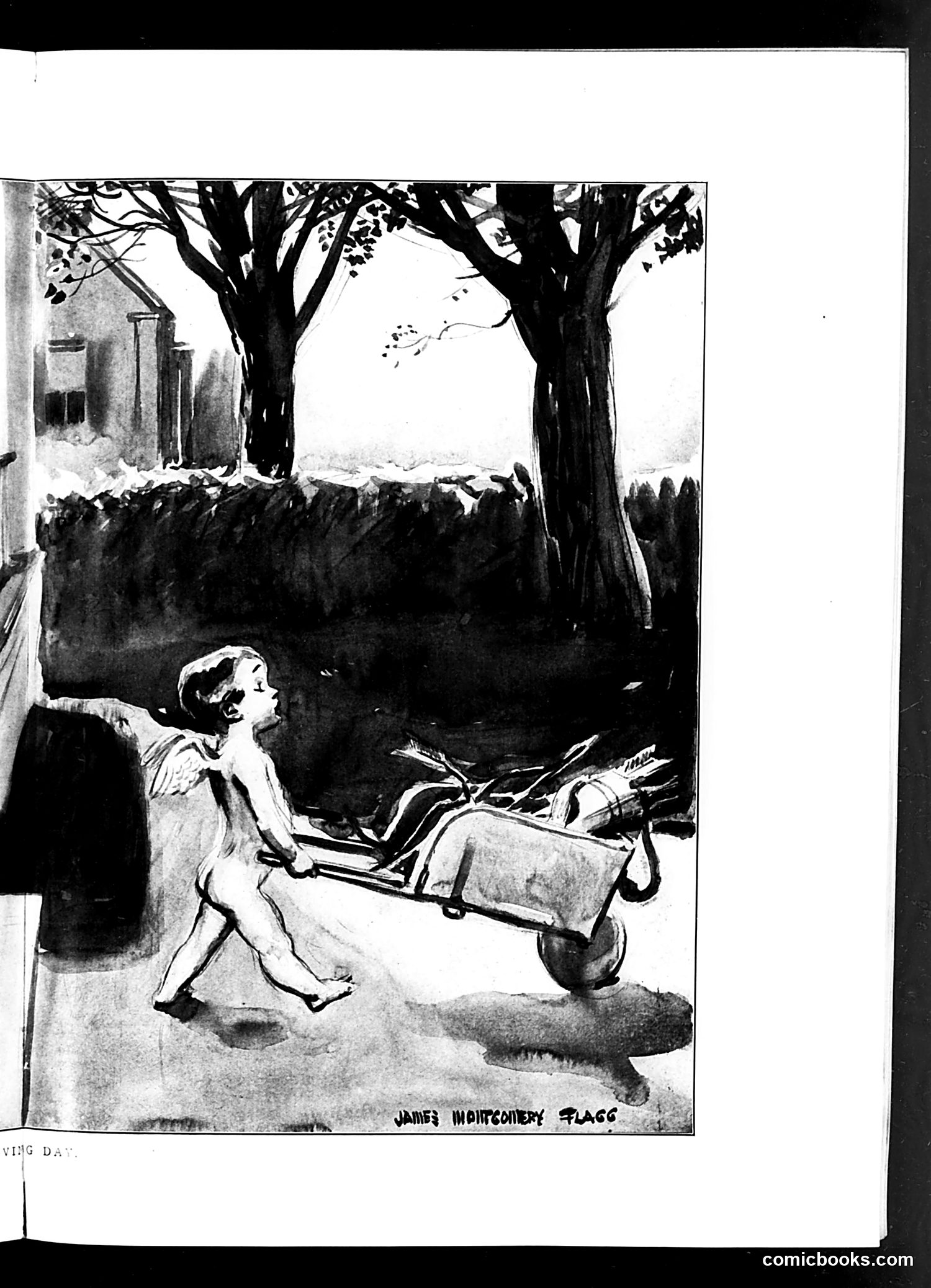
This cartoon by James Montgomery Flagg depicts a child pulling a wagon/cart loaded with what appears to be flags or flag materials through a street scene with bare trees and buildings in the background. The OCR text "Janey Wontcoinery FLAGS" is unclear, though it likely contains a proper name and references flags. Without being able to definitively identify the specific political or social context—whether this comments on patriotism, a flag manufacturing business, a particular event, or something else—I cannot confidently explain the satire's point to a modern reader. The style and presence in *Judge* magazine suggests social or political commentary typical of that era's satirical work, but the specific reference remains uncertain from the image alone.
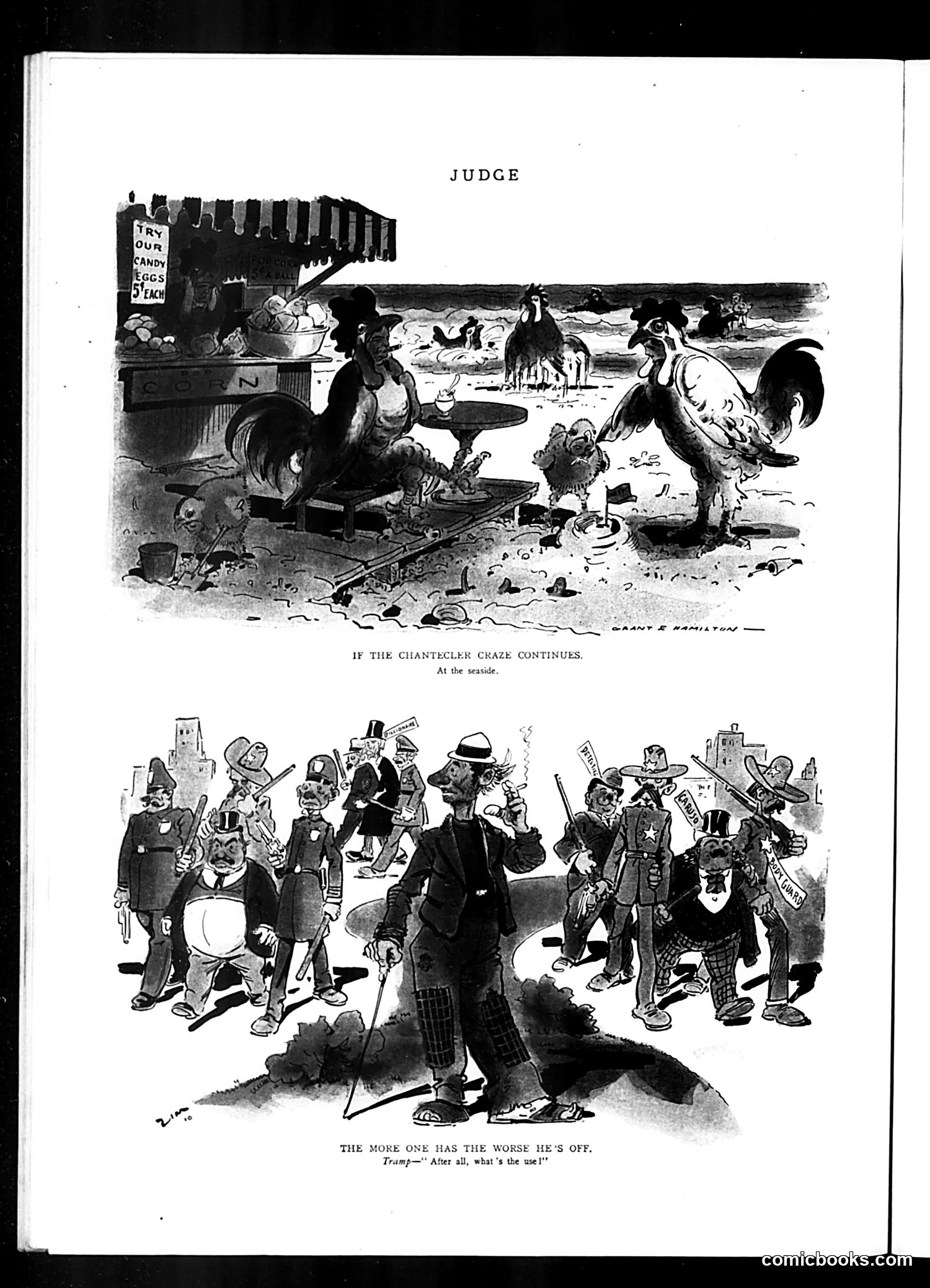
This page contains two satirical cartoons titled "Judge." **Top cartoon**: References "Chantecler," Edmond Rostand's 1910 play about a rooster. It satirizes the theatrical craze by imagining roosters and hens at a beach seaside resort, mimicking human vacation behavior—suggesting the play's popularity has reached absurd proportions in public culture. **Bottom cartoon**: Shows a well-dressed man surrounded by various figures (appearing to represent different professions or social types), with a tramp commenting that having more possessions or status makes one worse off. The satire critiques materialism and social climbing, suggesting that accumulating wealth and position creates more problems than solutions. The tramp paradoxically represents freedom through poverty. Both cartoons employ visual exaggeration typical of Judge magazine's social commentary.
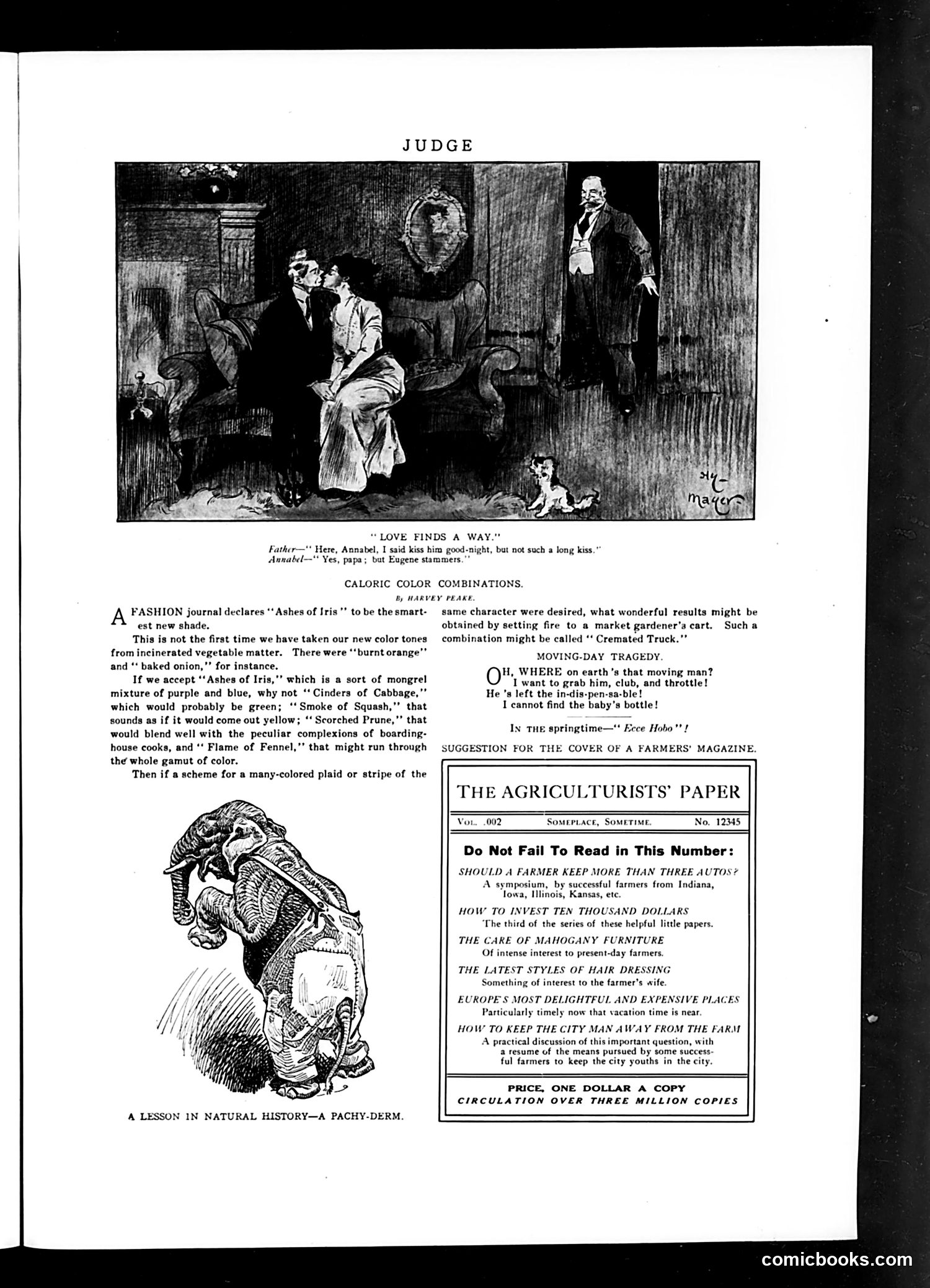
This page contains three distinct satirical pieces: **"Love Finds a Way"**: A domestic comedy sketch mocking courtship propriety. A father objects to his daughter's lengthy kiss goodnight with a suitor named Eugene, but she justifies it because Eugene stammers—implying the long kiss compensates for his speech impediment. **"Caloric Color Combinations"**: Harvey Peake satirizes fashion's absurd trend of naming colors after burnt vegetables ("Ashes of Iris," "Burnt Orange"). He ridicules this by suggesting increasingly ridiculous vegetable-based color names and mockingly proposes burning an entire market cart to create a plaid pattern called "Cremated Truck." **"The Agriculturists' Paper" (cover suggestion)**: A satirical fake magazine cover mocking wealthy farmers' pretensions. Article titles like "Should a Farmer Keep More Than Three Autos?" and "Europe's Most Delightful and Expensive Places" mock prosperous farmers adopting urban luxury lifestyles, contradicting traditional rural simplicity. The subtitle "How to Keep the City Man Away from the Farm" suggests ironic concern about losing agricultural workers to city attractions.
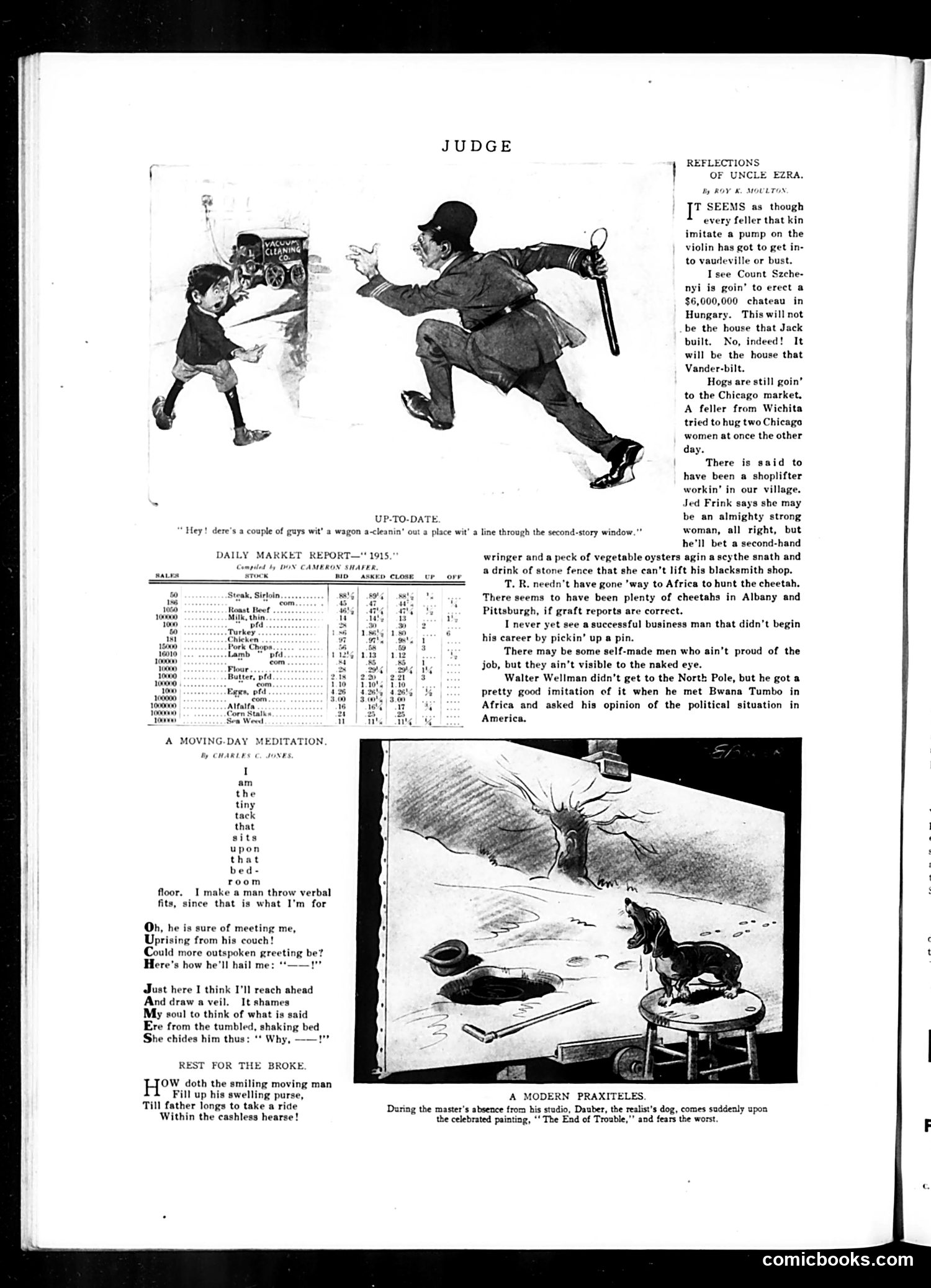
**"Up-to-Date" Cartoon:** Two figures—a child and an adult—are shown near a building. The caption's reference to "a couple of guys wit' a wagon a-cleanin' out a place wit' a line through the second-story window" satirizes moving day theft. The crude dialect suggests working-class commentary on burglary disguised as legitimate moving services—a common urban con during this era. **"Reflections of Uncle Ezra":** A rustic advice column using folksy dialect to mock contemporary figures. References include Count Széchenyi's Hungarian château (wealthy European aristocratic excess), Chicago hog markets (American industrial commerce), T.R.'s African safari (Theodore Roosevelt's 1909-1910 expedition), and Walter Wellman's Arctic expedition failure. The humor relies on rural simplicity commenting on cosmopolitan pretension. **"A Modern Praxiteles":** The caption references a dog destroying a painting titled "The End of Trouble" during the artist's absence—punning on both classical sculpture and modern art's fragility. The image appears to show studio chaos. These pieces represent Judge's typical satirical blend of social observation, wordplay, and gentle mockery of contemporary news and personalities.
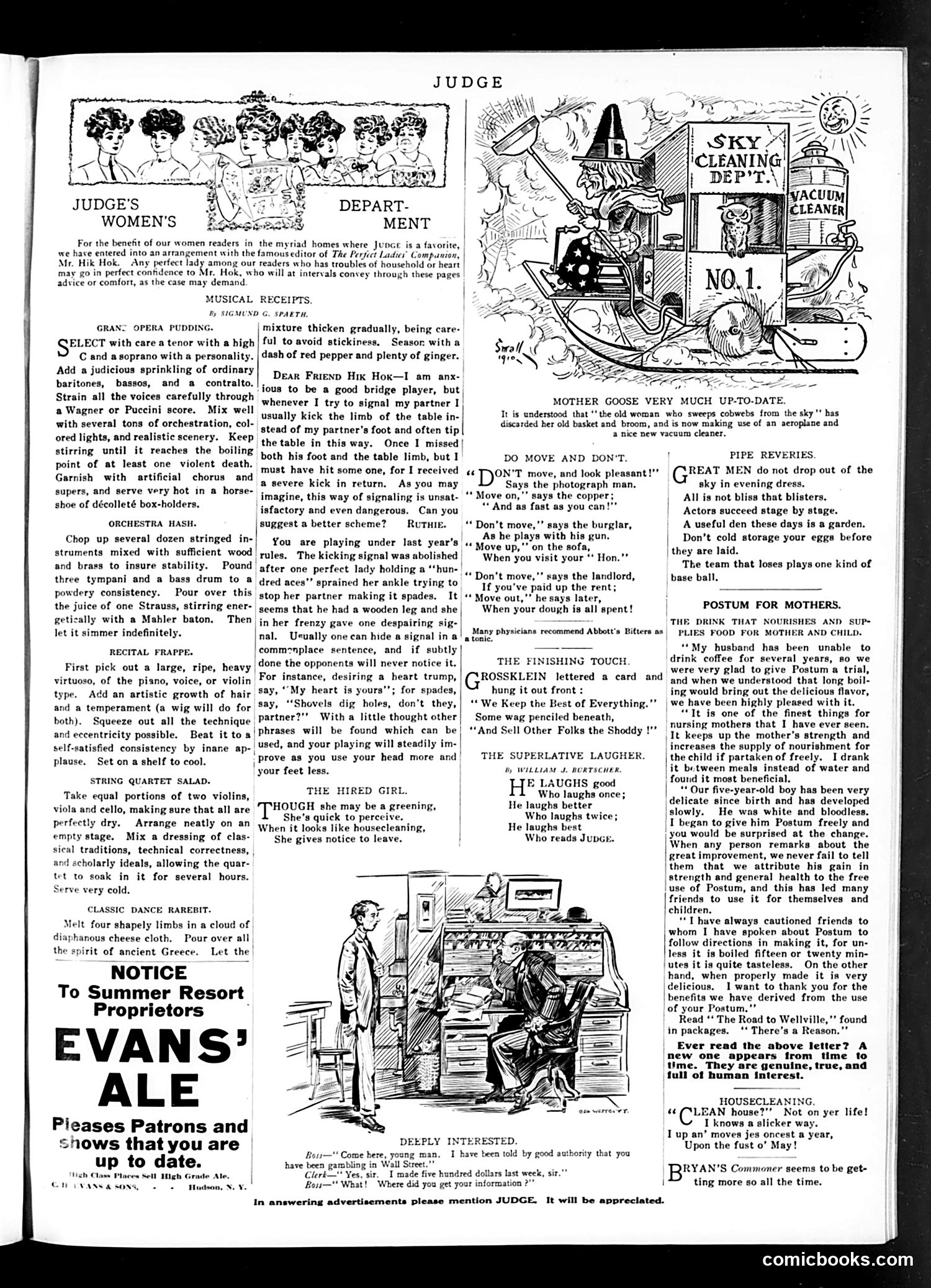
This page from *Judge* magazine contains satirical advice columns and humorous "recipes" lampooning high society entertainments and domestic concerns of the era. The main satire targets **opera and classical music culture**. The "Musical Receipts" mock pretentious concert performances by presenting them as cooking recipes—mixing "tenors," "sopranos," and "orchestration" as ingredients, with instructions to stir "until it reaches the boiling point of at least one violent death." This mocks opera's melodramatic conventions and the snobbery surrounding classical music appreciation. The **"Judge's Women's Department"** offers humorous advice on bridge-playing etiquette and domestic service, reflecting early 20th-century concerns about proper behavior and household management among middle and upper-class women. The cartoons and letters satirize the social anxieties of this period: women learning fashionable skills, the challenges of managing household staff ("The Hired Girl"), and the absurdity of strict social conventions around games like bridge. The overall tone gently ridicules the pretensions and anxieties of contemporary genteel society.
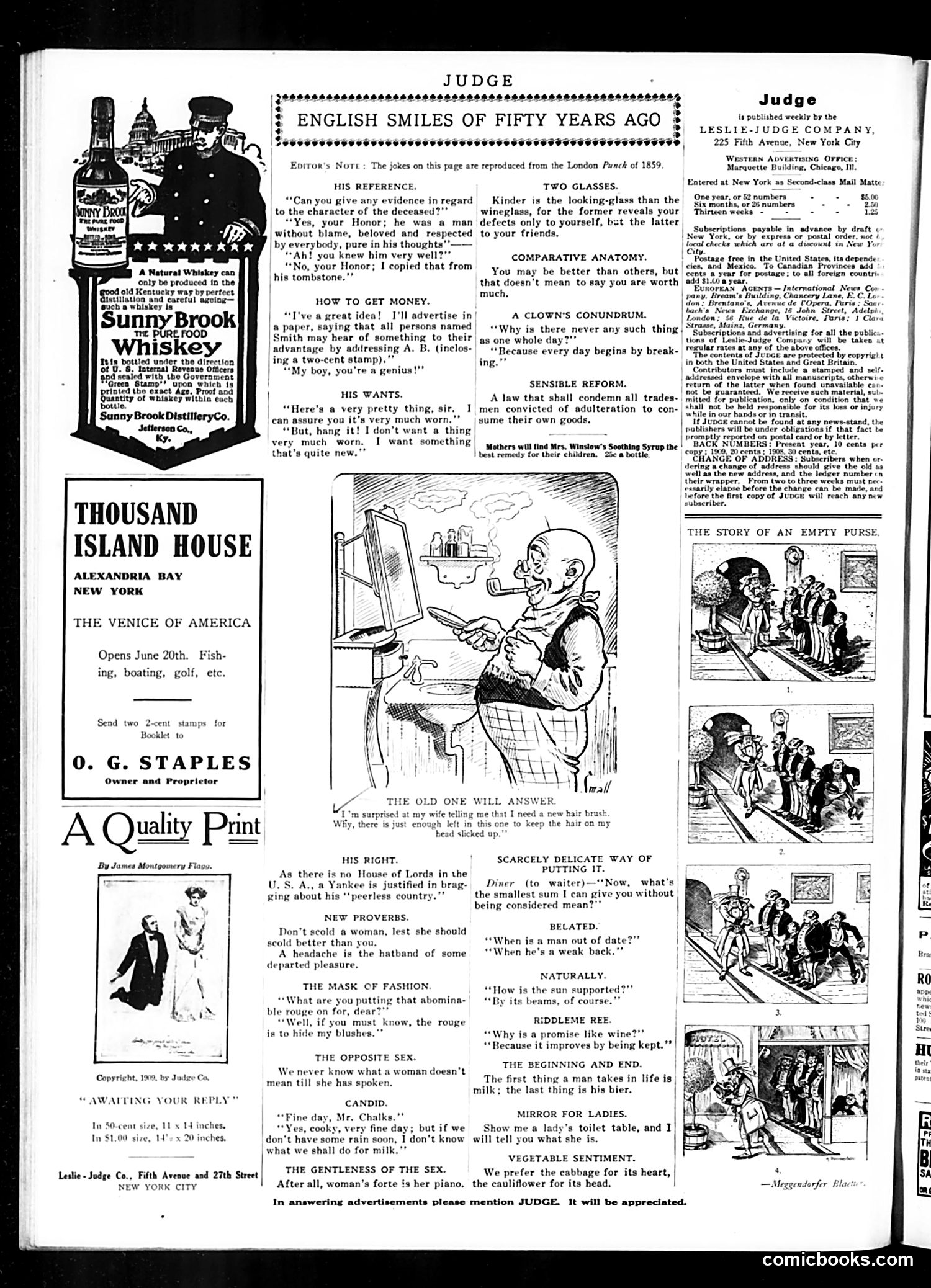
This page from Judge magazine primarily features **reprinted Victorian-era humor from London's Punch (1859)**, presented as "English Smiles of Fifty Years Ago." The jokes are brief, genteel witticisms typical of 19th-century satirical magazines. The central cartoon depicts a man at a mirror or window, surprised by his wife's comment about needing a new hairbrush—a domestic humor setup common to the era. The jokes mock social hypocrisy and pretension: a witness praising a dead man's character while admitting he copied it from the tombstone; a con scheme advertising for people named "Smith"; observations about how convex and concave glasses reveal defects differently; and a "sensible reform" suggesting adulterating tradesmen be forced to consume their own products. The page is largely **advertising and publication information** for Judge Company. The humor reflects Victorian sensibilities—focused on manners, domestic life, and gentle irony rather than sharp political satire. Modern readers would find it mild and somewhat obscure without historical context about 1850s-60s social conventions.
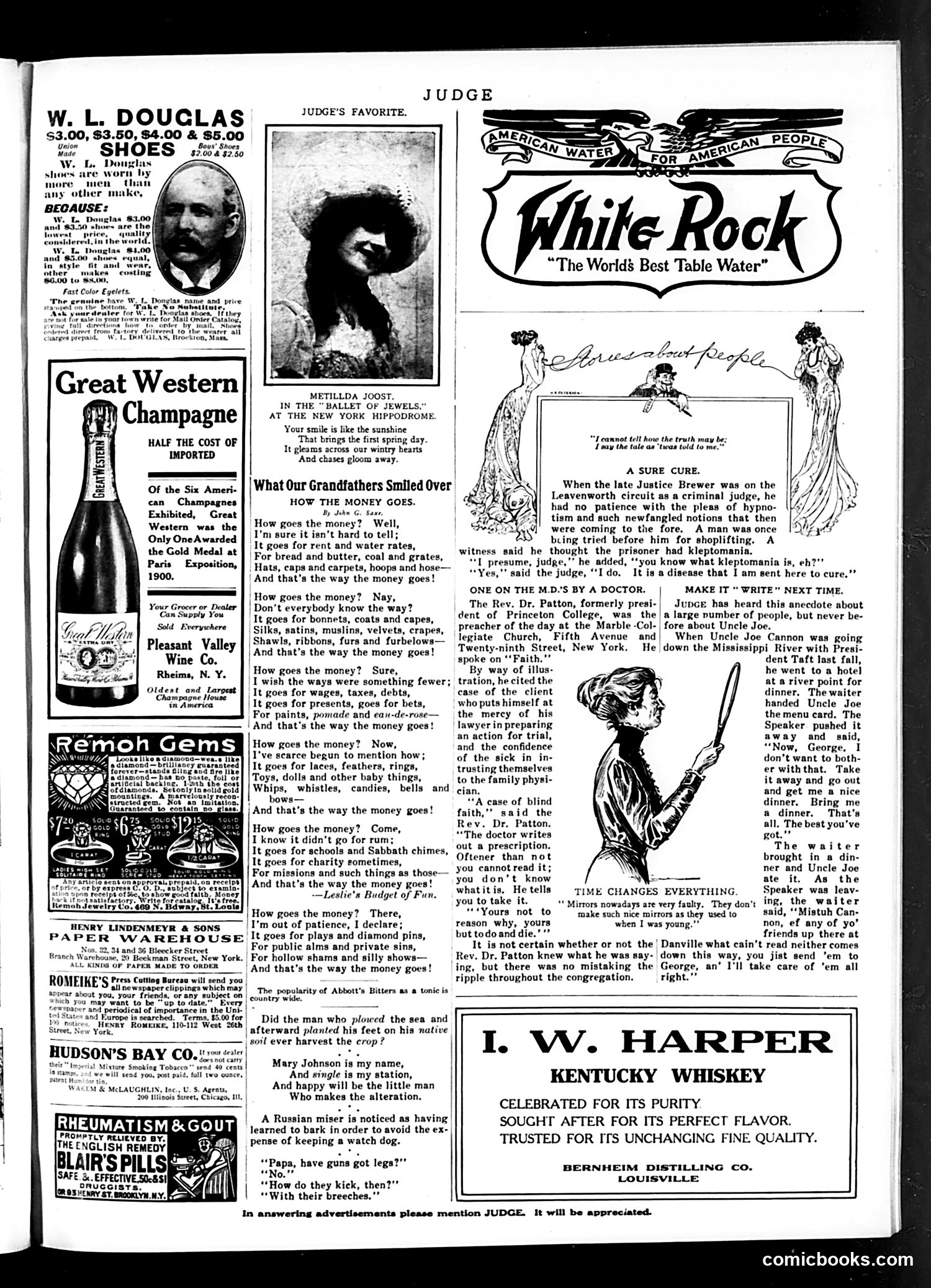
This page from *Judge* magazine is primarily **advertising with some humorous editorial content**, typical of early 1900s satirical publications. The cartoons include: **"What Our Grandfathers Smiled Over"** — a poem about how money was spent in an earlier era, contrasting simpler times with contemporary consumer culture. **"A Sure Cure"** — an anecdote about Justice Brewer using harsh punishment (sending a man to prison) as a "cure" for kleptomania, satirizing the era's confusion between crime and mental illness. **"One on the M.D.'s by a Doctor"** — mocking physicians' blind faith in prescriptions patients cannot read. **"Make It 'Write' Next Time"** — Uncle Joe Cannon (Speaker of the House) dismisses a waiter's menu, preferring simple food. This pokes fun at Cannon's plain tastes or perhaps his rough manner. The advertisements promote W.L. Douglas shoes, champagne, whiskey, and patent medicines—typical early-1900s products. The content reflects period anxieties about modernization, medical quackery, and changing social customs.
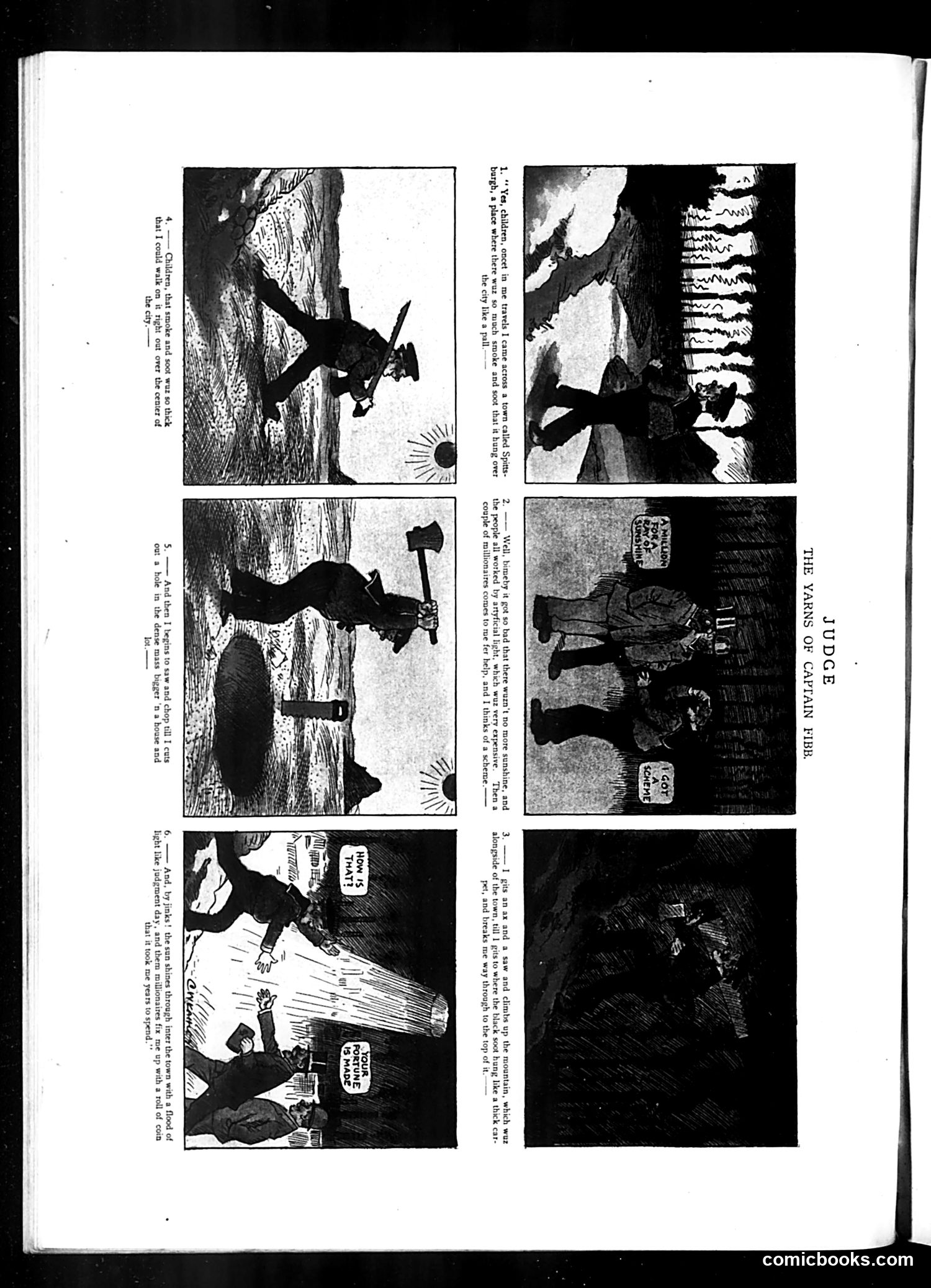
This is a tall-tale comic strip featuring an exaggerated character (Captain Fibb) recounting implausible adventures to children. The visible panels show the captain describing a grimy industrial town called "Spitts" where pollution is so thick he claims to walk on it like solid ground. The satire targets industrial-era air pollution—a real problem in American cities during the late 19th/early 20th century. By presenting the pollution as literally walkable, the cartoonist mocks both the absurd severity of the situation and perhaps public indifference to it. The "yarn" format (tall tale) emphasizes how outlandish these pollution levels actually were, making the comic's point through exaggeration rather than direct criticism.