
Judge, 1910-04-30 · page 4 of 16
Judge — April 30, 1910 — page 4: what you’re looking at
What you’re looking at
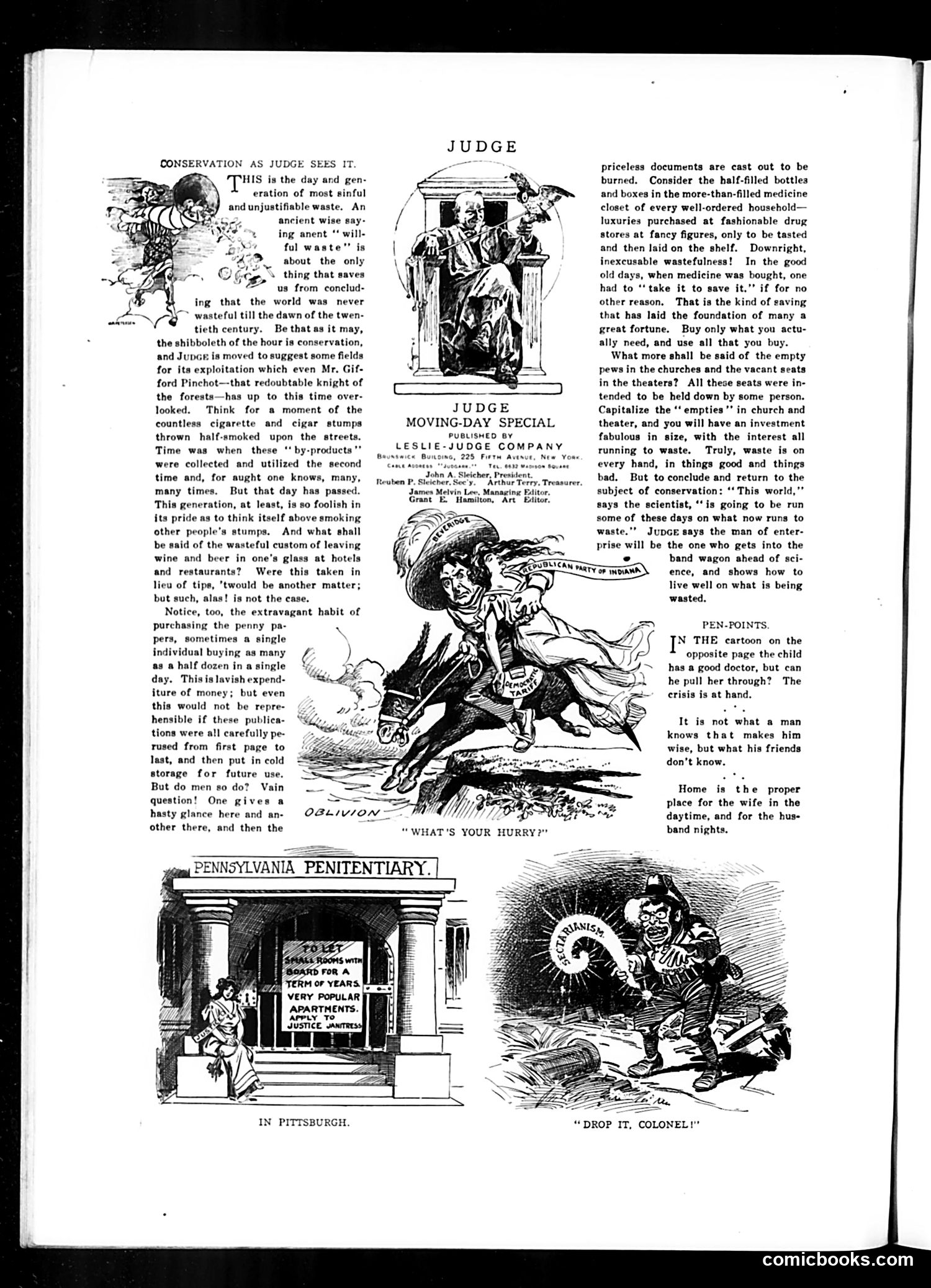
This page from Judge magazine contains satirical commentary on waste and conservation, illustrated with period cartoons. The main article "Conservation as Judge Sees It" criticizes wasteful practices in early 20th-century America, lamenting discarded household items and wasted resources. It argues that waste contributed to poverty and social problems. The cartoons include: - "Judge Moving-Day Special" - depicting waste during relocations - "Oblivion" - showing a figure riding away from waste - "Pennsylvania Penitentiary in Pittsburgh" - a satirical advertisement mocking the prison as a real estate offering - "Drop It, Colonel!" - unclear reference, likely political commentary The "Pen-Points" section offers aphorisms about wisdom and domestic life. Overall, the page advocates for conservation and criticizes consumer excess through humor and visual satire typical of Judge's editorial approach.
📄 Transcribed text from this page (OCR, searchable)
Machine-transcribed from the original scan — historical spelling and the odd misread are preserved.
CONSERVATION AS JUDGE SEES IT. J Ths is the day and gen- eration of most sinful and unjustifiable waste. An ancient wise say- ing anent ‘ will- ful waste"’ is about the only thing that saves us from conclud- ing that the world was never ‘> wasteful till the dawn of the twen- tieth century. Be that as it may, the shibboleth of the hour is conservation, and Jupce is moved to suggest some fields for its exploitation which even Mr. Gif- ford Pinchot—that redoubtable knight of the forests—has up to this time over- looked. Think for a moment of the countless cigarette and cigar stumps thrown half-smoked upon the streets. Time was when these ‘' by-products" were collected and utilized the second time and, for aught one knows, many, many times. But that day has passed. This generation, at least, is so foolish in its pride as to think itself above smoking other people’s stumps. And what shall be said of the wasteful custom of leaving wine and beer in one’s glass at hotels and restaurants? Were this taken in lieu of tips, "twould be another matter; but such, alas! is not the case. Notice, too, the extravagant habit of purchasing the penny pa- % pers, sometimes a single ’ individual buying as many / as a half dozen in a single day. This is lavish expend- iture of money; but even this would not be repre- hensible if these publica- tions were all carefully pe- rused from first page to last, and then put in cold storage for future use. But do men so do? Vain question! One gives a hasty glance here and an- other there, and then the MOVING-DAY SPECIAL PUBLISHED BY LESLIE-JUDGE COMPANY Baussmice But James Melvin Lee. Managing Editor. Grant E. Hamilton, Art) Editor. IN PITTSBURGH New Yous President. Arthur Terry. Treasurer, priceless documents are cast out to be burned. Consider the half-filled bottles and boxes in the more-than-filled medicine closet of every well-ordered household— luxuries purchased at fashionable drug stores at fancy figures, only to be tasted and then laid on the shelf. Downright, inexcusable wastefulness! In the good old days, when medicine was bought, one had to ‘‘take it to save it.’ if for no other reason, That is the kind of saving that has laid the foundation of many a great fortune. Buy only what you actu- ally need, and use all that you buy. What more shall be said of the empty pews in the churches and the vacant seats in the theaters? All these seats were in- tended to be held down by some person. Capitalize the ‘‘ empties’ in church and theater, and you will have an investment fabulous in size, with the interest all running to waste. Truly, waste is on every hand, in things good and things bad. But to conclude and return to the subject of conservation: ‘This world,’ says the scientist, “is going to be run some of these days on what now runs to waste."” JuDGE says the man of enter- will be the one who gets into the band wagon ahead of sci- ence, and shows how to live well on what is being wasted, PEN-POINTS. N THE cartoon on the opposite page the child has a good doctor, but can he pull her through? The crisis is at hand. It is not what a man knows that makes him wise, but what his friends don’t know. Home is the proper place for the wife in the daytime, and for the hus- band nights. “DROP IT, COLONEL!"" comicbooks.com