
A complete issue · 16 pages · 1910
Judge — March 19, 1910
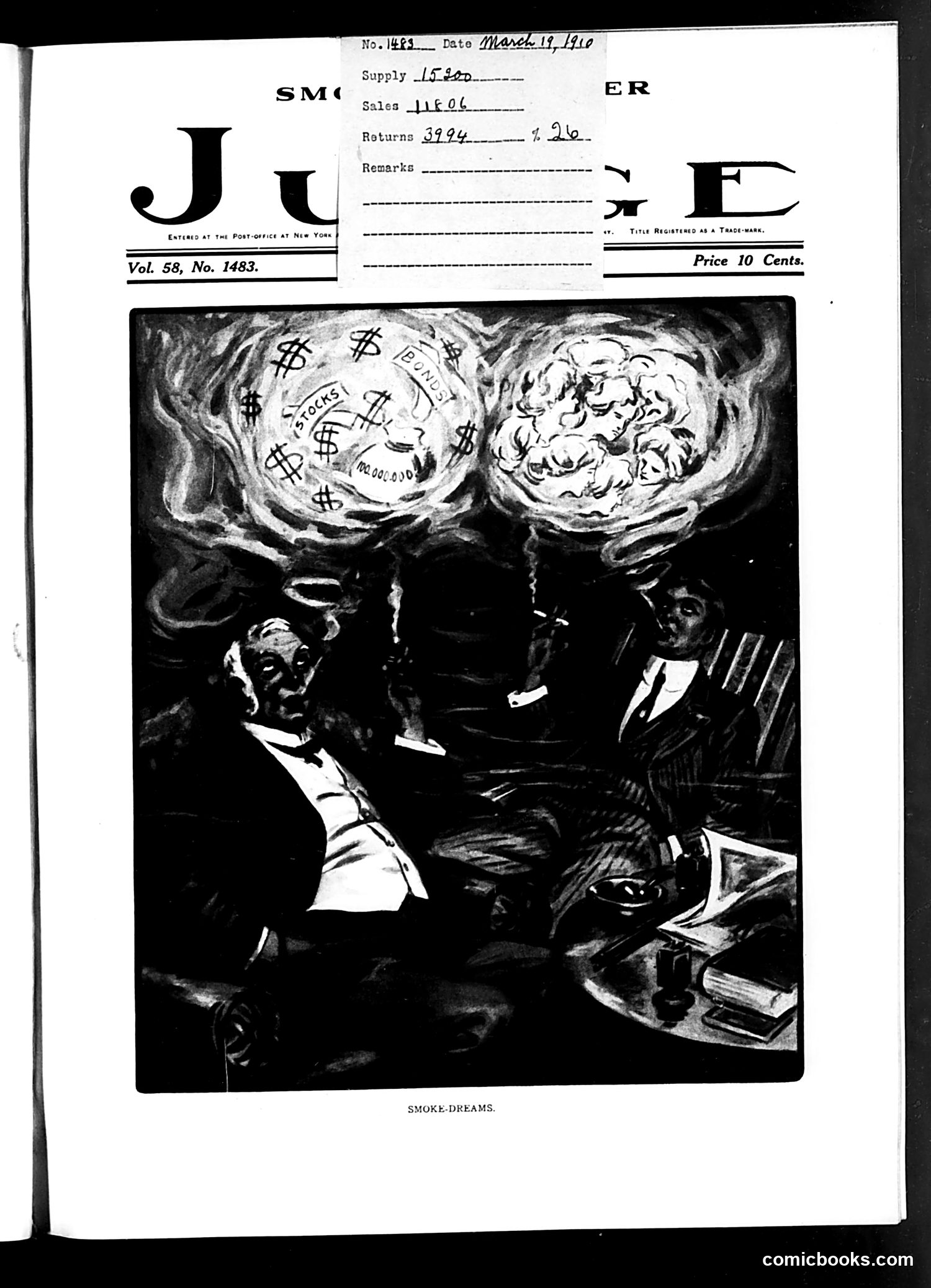
This political cartoon satirizes wealthy businessmen's financial fantasies. Two men in formal attire sit smoking, with elaborate thought-bubbles above their heads. The left figure's bubble contains dollar signs and stock symbols—depicting dreams of wealth accumulation. The right figure's bubble shows what appears to be elaborate schemes or manipulations. The title "Smoke-Dreams" suggests these are ephemeral, insubstantial fantasies—literally vanishing like smoke. The satire targets Gilded Age capitalists' obsession with money-making and stock speculation. The cartoon implies their grand financial schemes are mere illusions or wishful thinking, mocking the disconnect between their dreams and reality during an era marked by economic volatility and financial scandals.
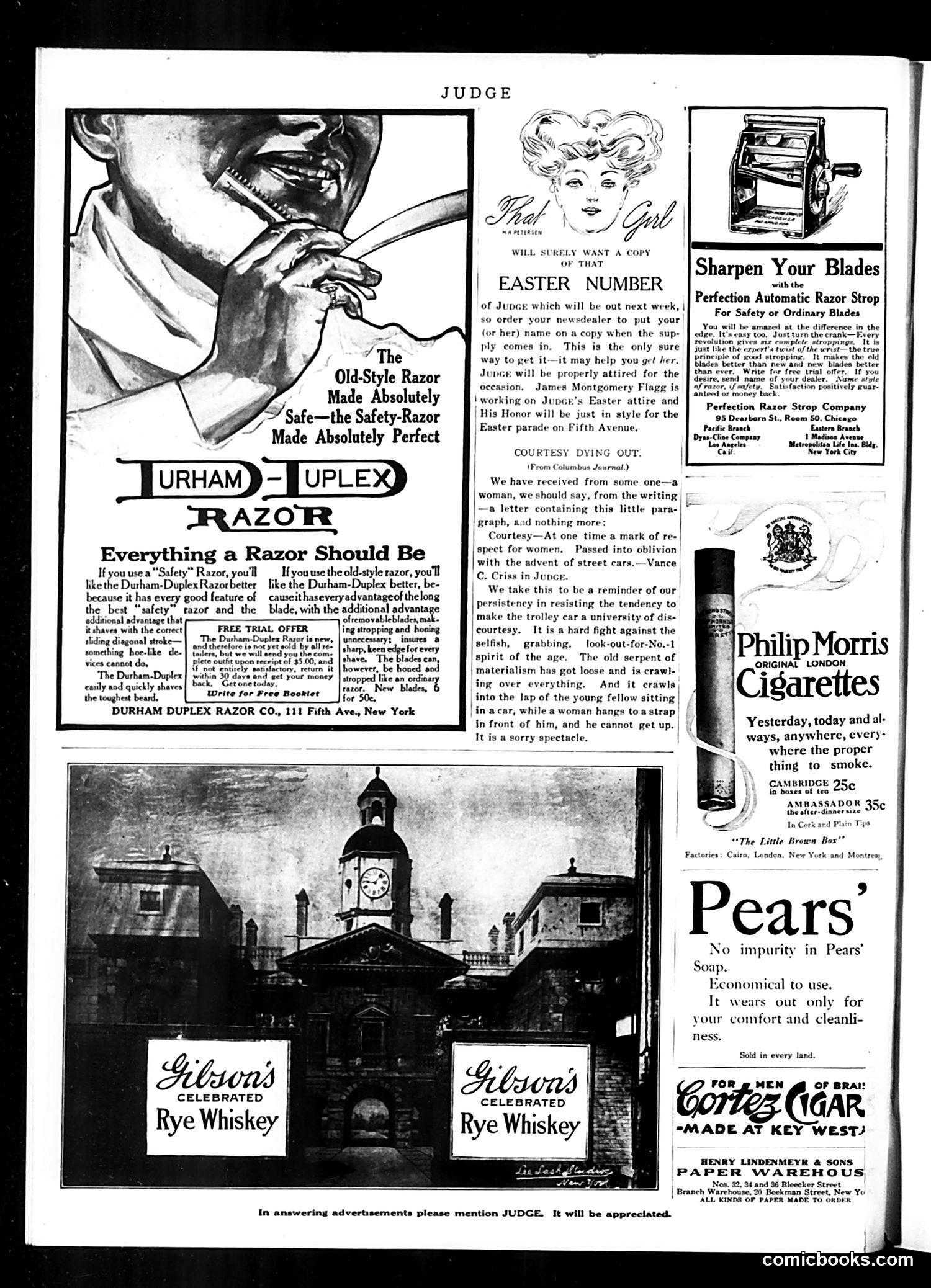
This page is primarily **advertising**, not political satire. It features commercial advertisements for consumer products popular in the early 20th century: - **Razor advertisements** (Durham-Duplex and Perfection brands) promoting safety razors versus old-style straight razors - **Philip Morris cigarettes** - **Pears' soap** emphasizing purity and economy - **Gibson's Rye Whiskey** - **Cortez cigars** The only editorial content appears to be brief notes titled "Courtesy Dying Out" and "The Old Spirit of Materialism," critiquing modern discourtesy and materialism—typical light social commentary for Judge magazine. The large building photograph (appears to be City Hall) serves as background for the whiskey advertisements. This is essentially a commercial page with minimal satirical content.
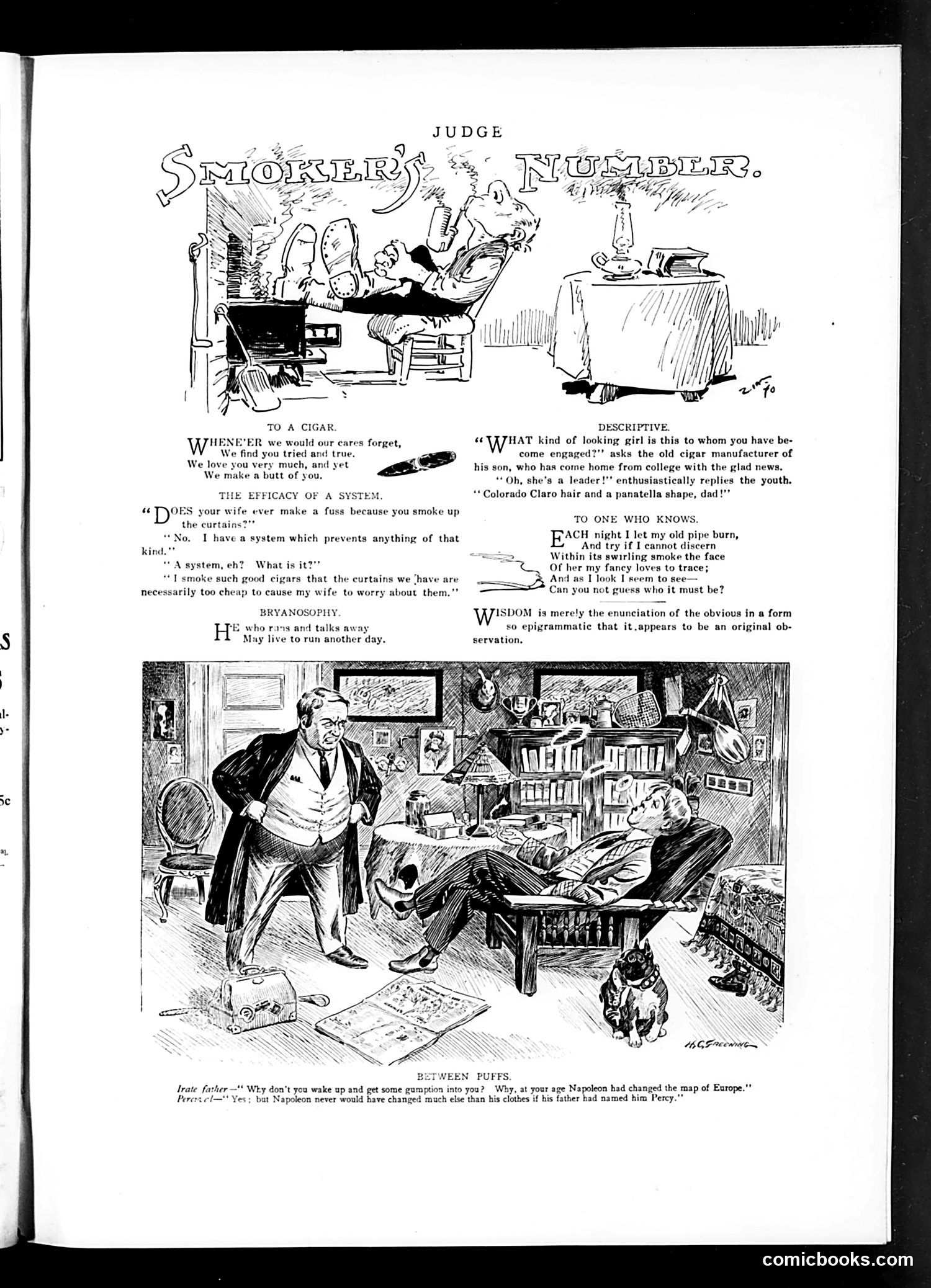
This page collects humorous short pieces about smoking and cigars, typical of Judge magazine's satirical format. **Top cartoons**: Sketch-based jokes about cigars and domestic life—a husband's system for preventing his wife's worry about cigar smoke by using cheap cigars that produce smoke "curtains," and riddles about identifying mystery women through pipe-smoking clues. **Main illustration ("Between Puffs")**: Shows two gentlemen in a study having a conversation between cigar puffs. The dialogue references Napoleon, appearing to be typical period banter comparing mundane domestic matters to historical events—a common Judge humor device. The overall page satirizes Victorian-era male smoking culture and the social pretensions surrounding it, using cigars as the vehicle for gentle mockery of bourgeois life and masculine conversation.
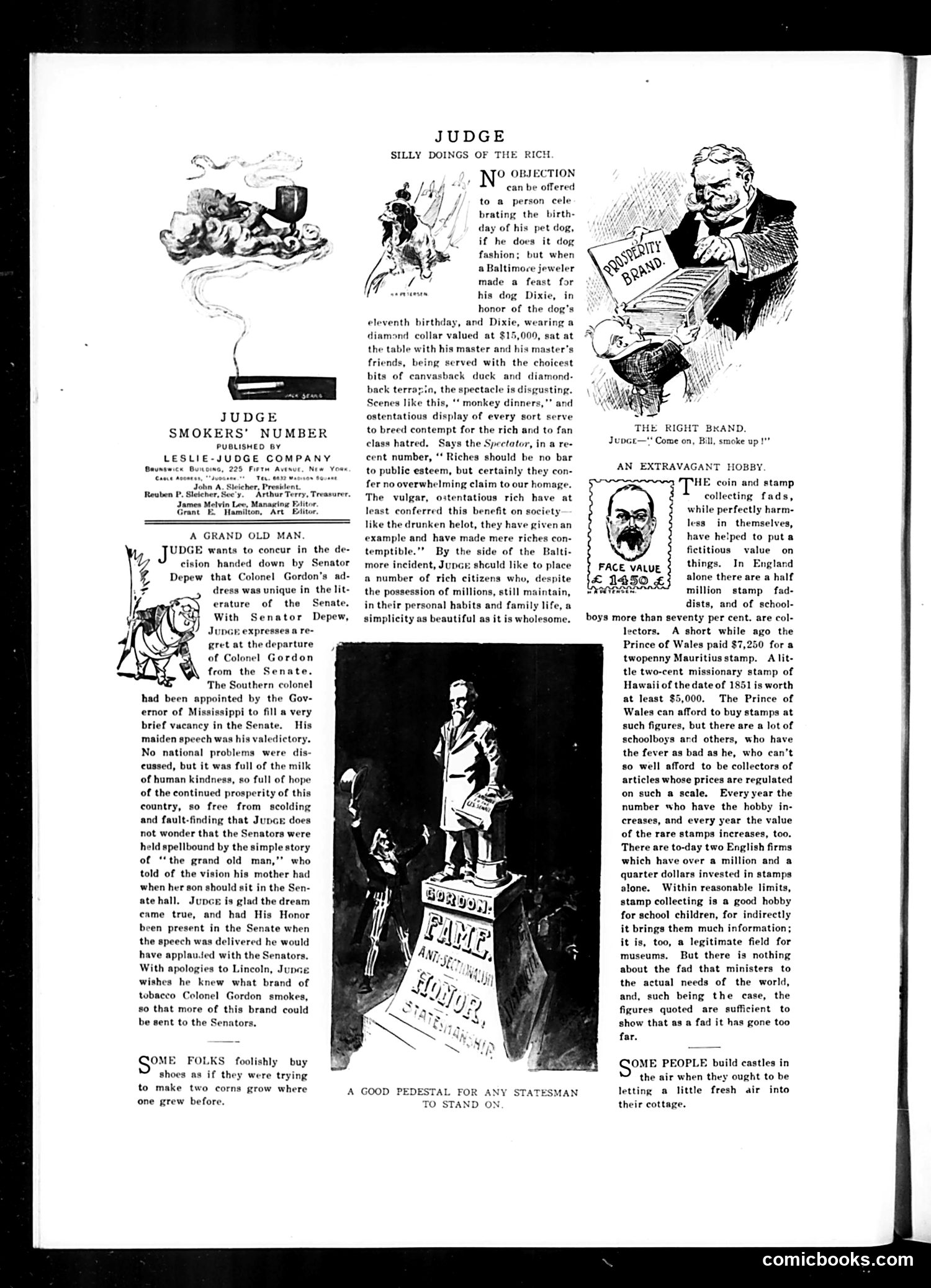
This satirical page critiques wealthy excess during the Gilded Age. The top cartoon mocks a Baltimore jeweler's $15,000 diamond dog collar for a pet's birthday party—a symbol of conspicuous consumption. The accompanying text argues such ostentation breeds class resentment, suggesting rich citizens should maintain simplicity instead. "A Grand Old Man" praises Senator Depew's Senate departure, contrasting his dignified exit with typical political self-interest. "A Good Pedestal for Any Statesman" depicts a figure (identity unclear from image alone) standing on stacked campaign materials, satirizing politicians' reliance on promotional machinery. The "Extravagant Hobby" section criticizes wealthy stamp collectors spending thousands on rare stamps—another example of frivolous rich-person pursuits the magazine intended to ridicule.
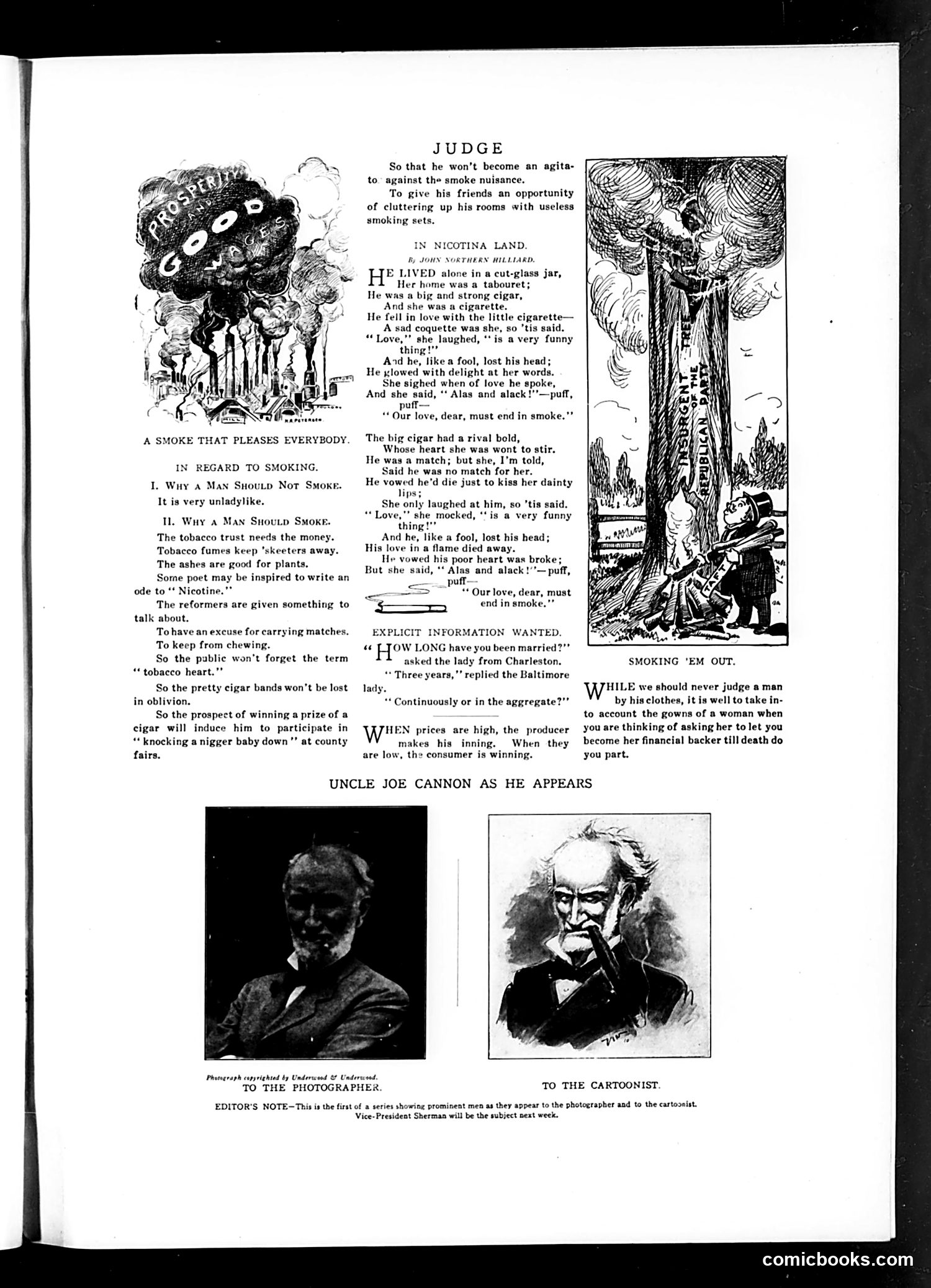
This page from *Judge* magazine satirizes anti-smoking attitudes through multiple pieces: **"In Nicotina Land"** is a humorous poem about a cigar falling in love with a cigarette, ending in smoke—a metaphor mocking romantic notions around smoking. **"A Smoke That Pleases Everybody"** lists reasons men should/shouldn't smoke, presenting contradictory arguments about tobacco's economic value, health effects, and social acceptability—satirizing inconsistent public debate on smoking. **"Smoking 'Em Out"** cartoon (right) depicts a woman smoking a man out of his own home, likely mocking women's expanding social roles and changing domestic dynamics in the early 20th century. The page concludes with photographs and sketches of "Uncle Joe Cannon," a prominent figure, though the specific political point remains unclear without additional context.
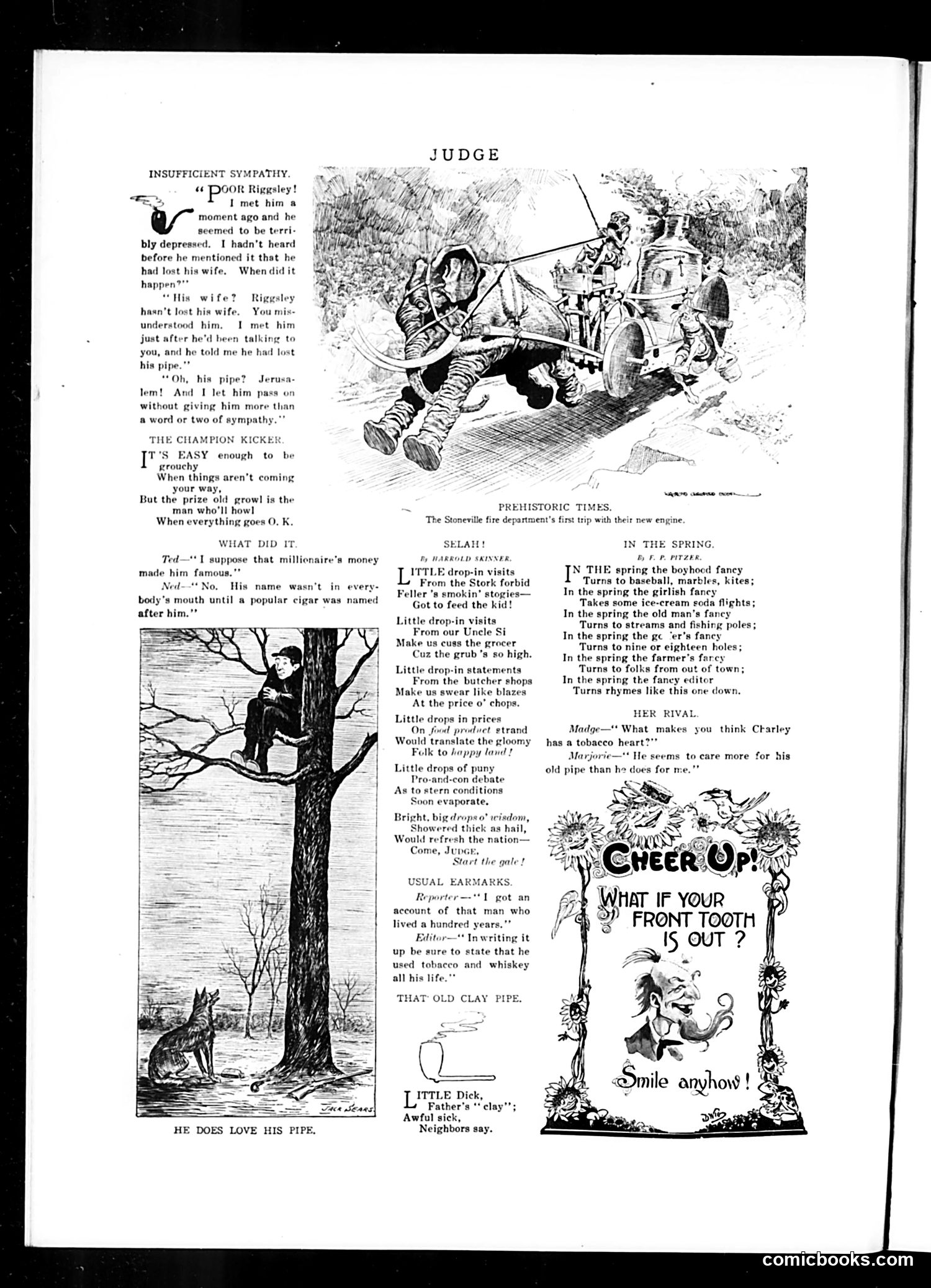
This page contains several short humorous pieces typical of early 20th-century satirical magazines: **"Insufficient Sympathy"** jokes about misplaced concern—a man assumes his acquaintance lost his wife when he's actually lost his pipe, which clearly matters more to him. **"The Champion Kicker"** mocks people who complain regardless of circumstances—they'll grouse when things go wrong OR right. **"What Did It"** suggests a millionaire became famous not through money itself, but because a popular cigar was named after him. **"Prehistoric Times"** captioned illustration shows early firefighters with their new engine in comically primitive conditions. **"Selah!"** and **"In the Spring"** are light verse pieces about daily complaints (rising food prices, seasonal habits). The remaining items are brief jokes about pipes, tobacco, and romantic rivalry. The overall tone emphasizes American consumer concerns, class humor, and domestic life—typical Judge magazine fare without obvious political content.
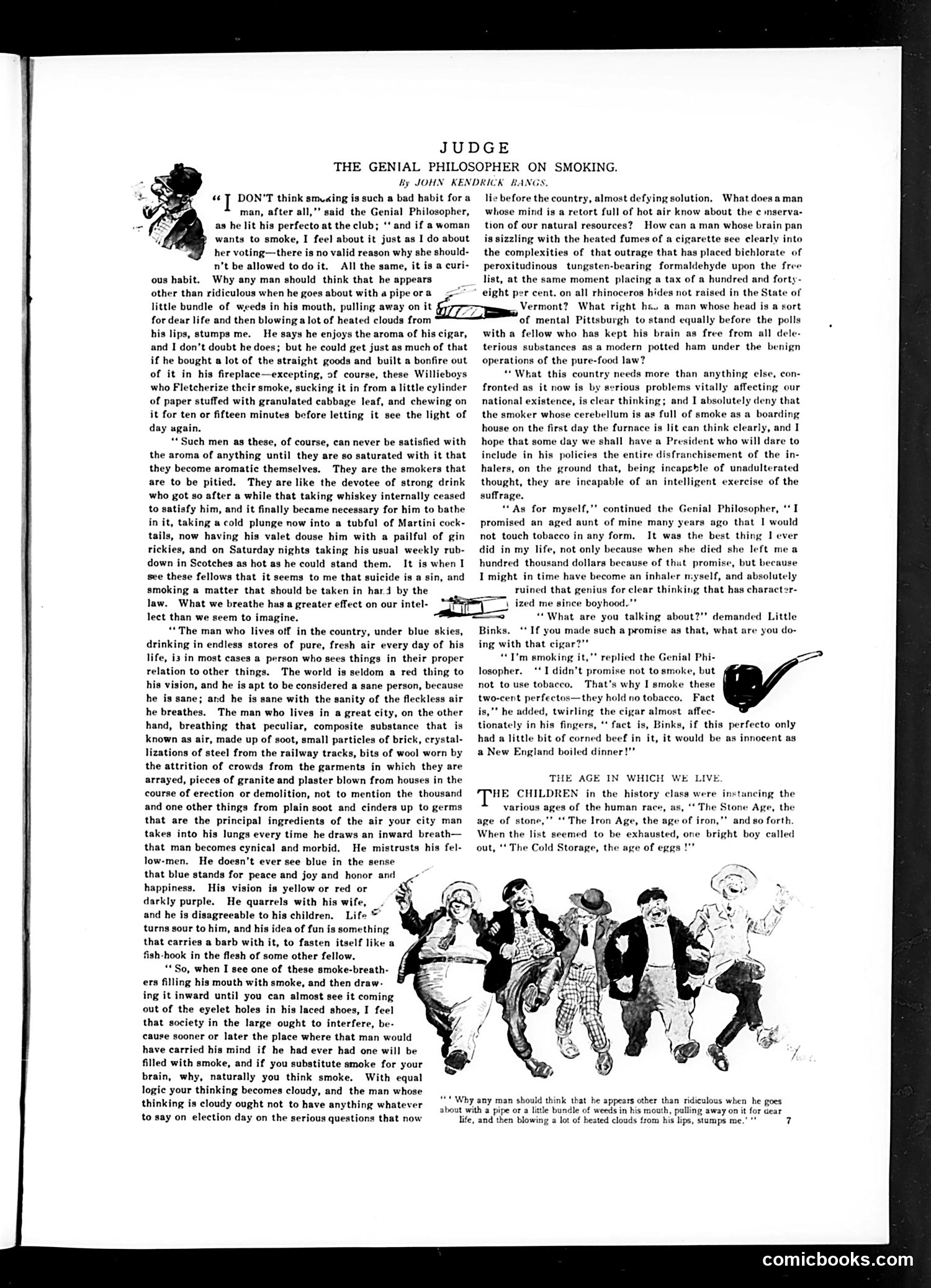
This satirical article by John Kendrick Bangs mocks smoking through the persona of "the Genial Philosopher," a recurring character presenting contradictory arguments. The philosopher claims smoking isn't harmful while simultaneously describing smokers as ridiculous. He ridicules extreme practitioners—particularly those who practice "Fletcherizing" (chewing smoke thoroughly, referencing contemporary fad diets). The satire's main targets are urban pollution and its supposed psychological effects. The philosopher argues that city dwellers breathing contaminated air (soot, brick particles, steel) become cynical and morally degraded compared to rural inhabitants breathing pure air. This reflects turn-of-century anxiety about industrialization and urbanization. The illustration shows a group of dated figures, likely representing different "ages" or types of society members—the caption references "The Age in Which We Live," suggesting commentary on modern civilization's character. The humor operates on the philosopher's obvious hypocrisy while critiquing both smoking habits and urban environmental decay.
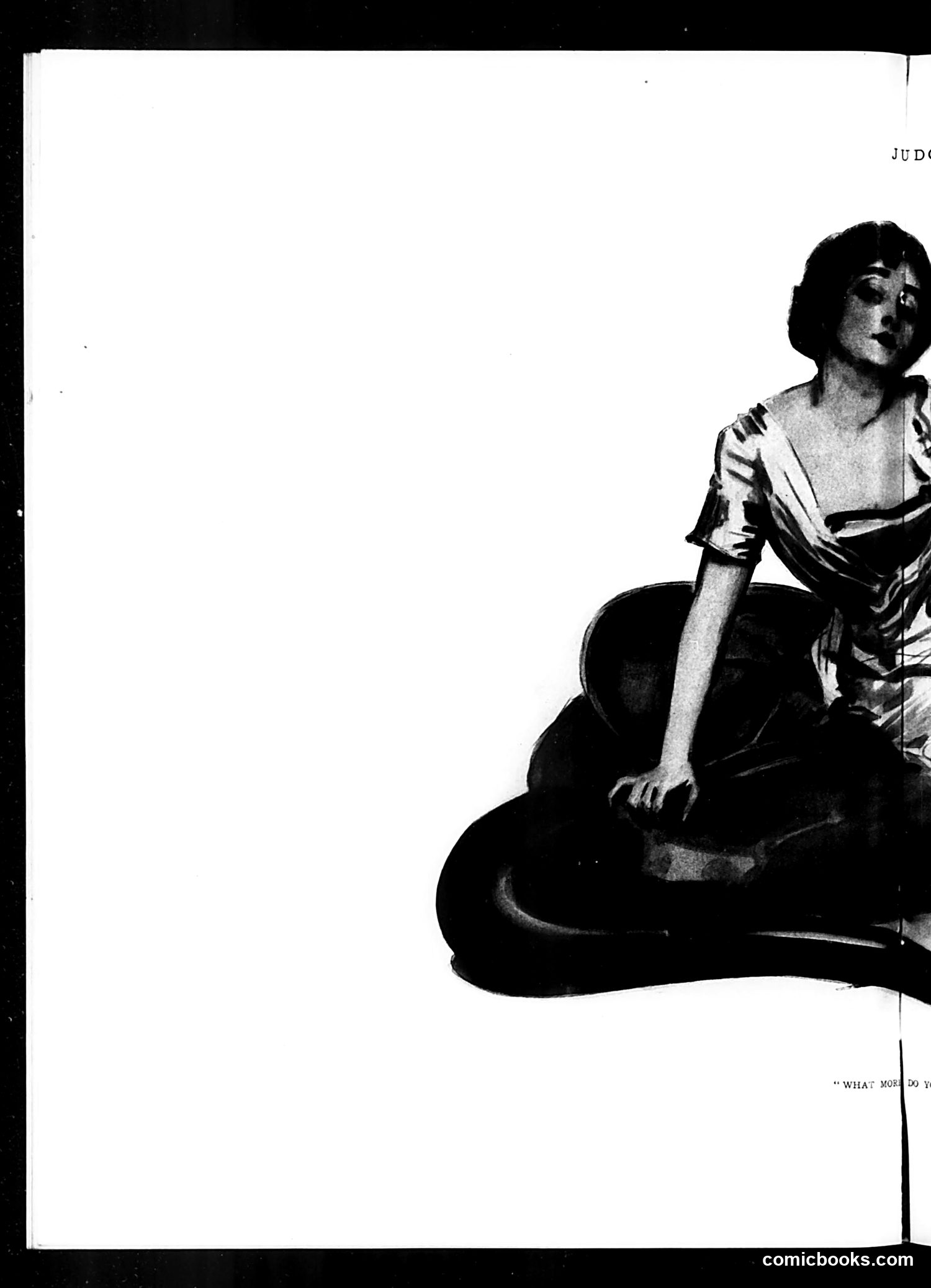
I can see this is a black and white photograph from Judge magazine showing a woman in period dress (appears to be early 20th century based on the styling) seated and gazing upward in a theatrical pose. The partial text visible reads "WHAT MOR DO Y[?]" which is cut off. However, I cannot definitively identify the specific figure, the complete caption, or the cartoon's particular satirical target from the image and fragmentary text alone. Without the full caption or additional context, I cannot accurately explain what political or social commentary this was meant to convey. To properly interpret this cartoon's meaning for modern readers, I would need the complete text and more information about its publication date.
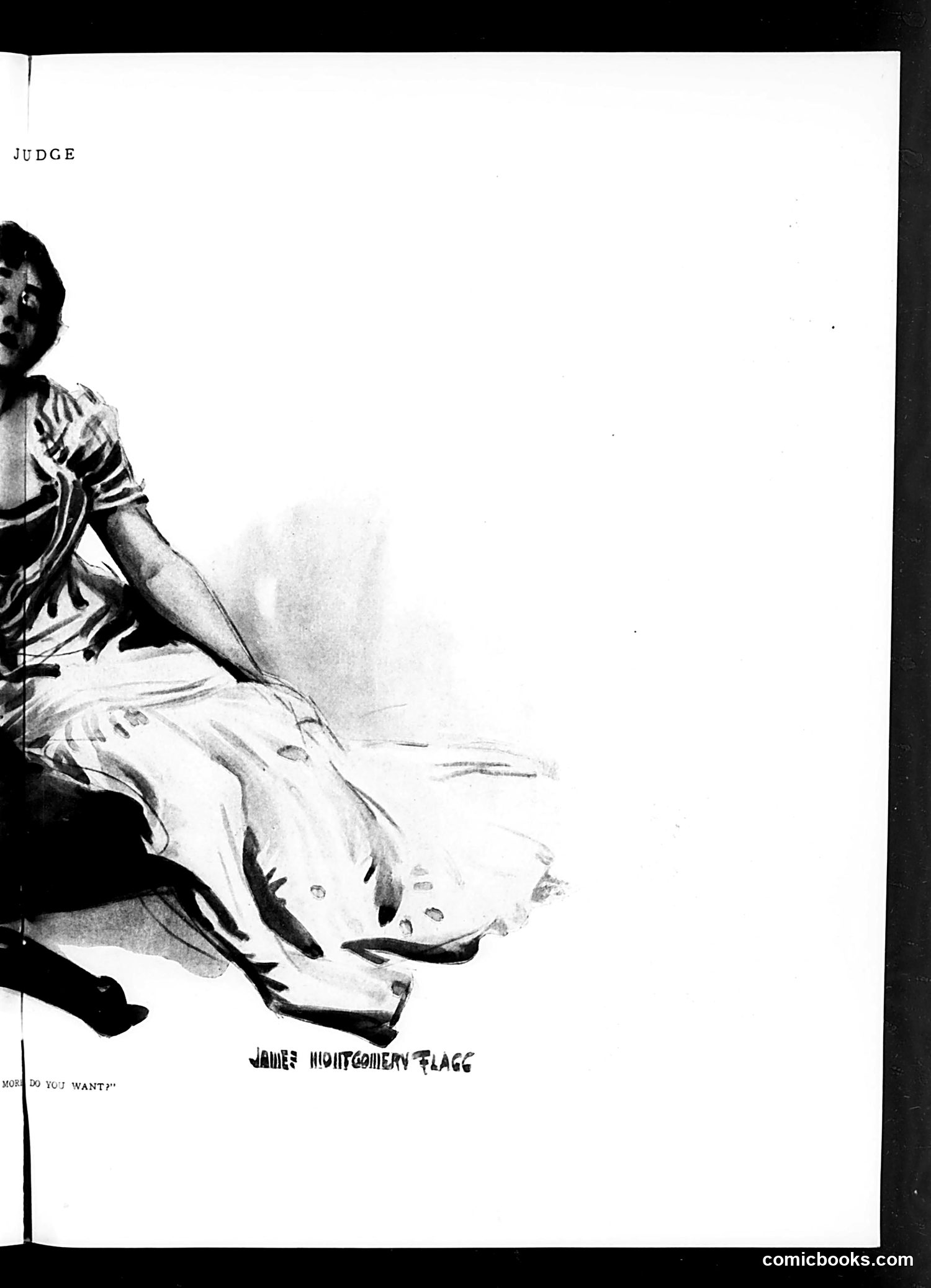
This appears to be a title or section page from **Judge** magazine featuring an illustration by James Montgomery Flagg, a prominent American illustrator of the early 20th century. The image shows a seated woman in an elegant dress with patterned fabric, drawn in Flagg's characteristic style. The OCR text "moRq DO YOU WANT?" (likely "MORE DO YOU WANT?") suggests this may be satirizing female materialism or consumer desires—a common Judge magazine theme during the Progressive Era. Without a visible date or caption, the exact satirical target remains unclear, though it likely critiques either wealth-seeking behavior, consumerism, or women's social ambitions—typical subjects of Flagg's work for Judge during the 1910s-1920s.
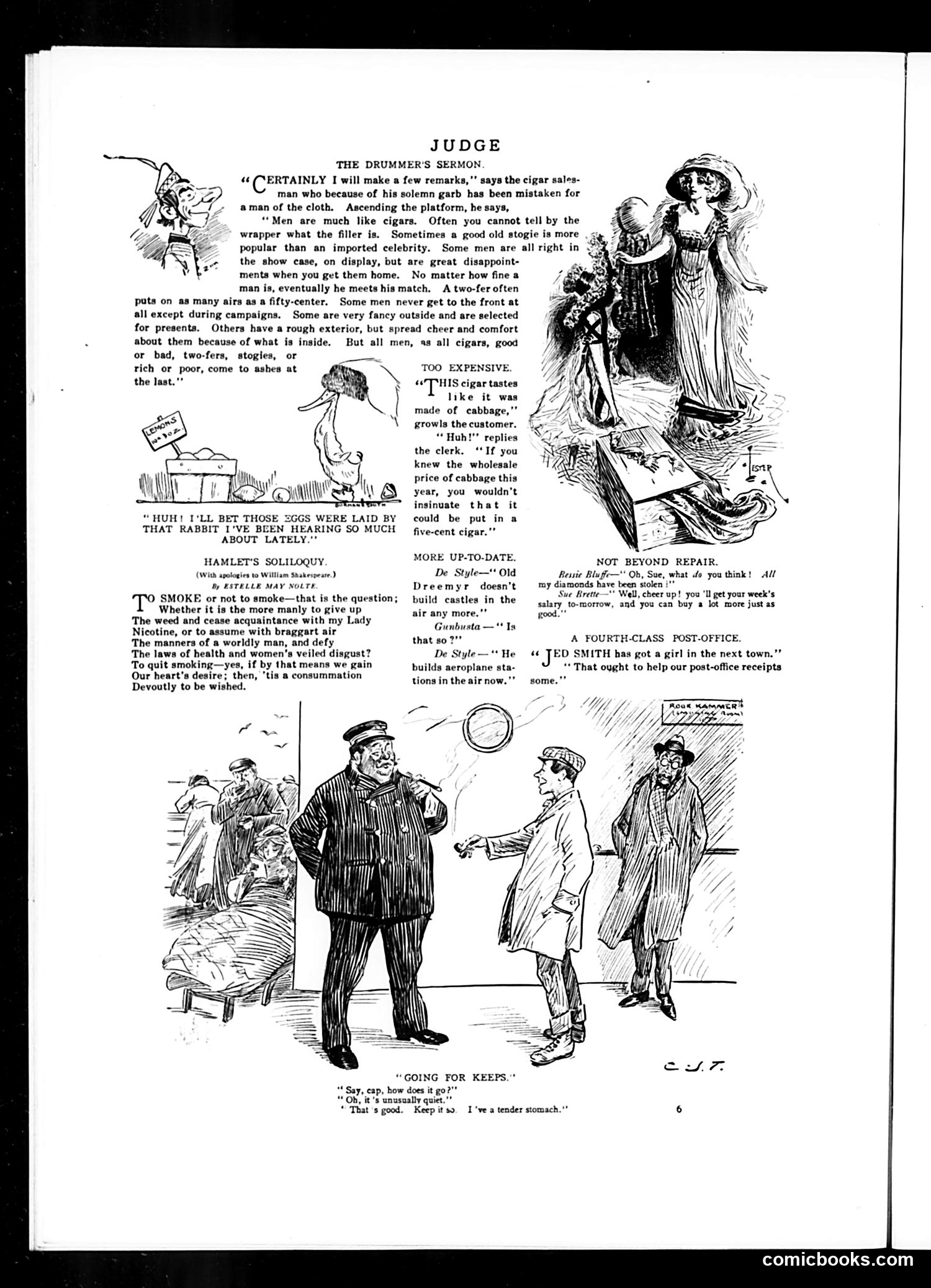
This page from the satirical magazine **Judge** contains several unrelated humor pieces typical of early 20th-century American comedy: **"The Drummer's Sermon"**: A traveling cigar salesman is mistaken for a clergyman and delivers a mock-philosophical sermon comparing men to cigars—both come in various qualities regardless of exterior appearance, and ultimately "come to ashes at the last." The humor lies in the irreverent comparison and the salesman's confidence in his own wisdom. **Other sketches** include: - A complaint about cheap cigars made of cabbage - A parody of Hamlet's soliloquy about smoking - Brief comic dialogues about diamonds, post-office receipts, and keeping quiet The page reflects **turn-of-the-century American humor**: working-class characters (salesmen, clerks), cynical observations about commerce and marriage, and irreverent treatment of highbrow literature. The satire targets consumerism and social pretension rather than specific political figures or events.
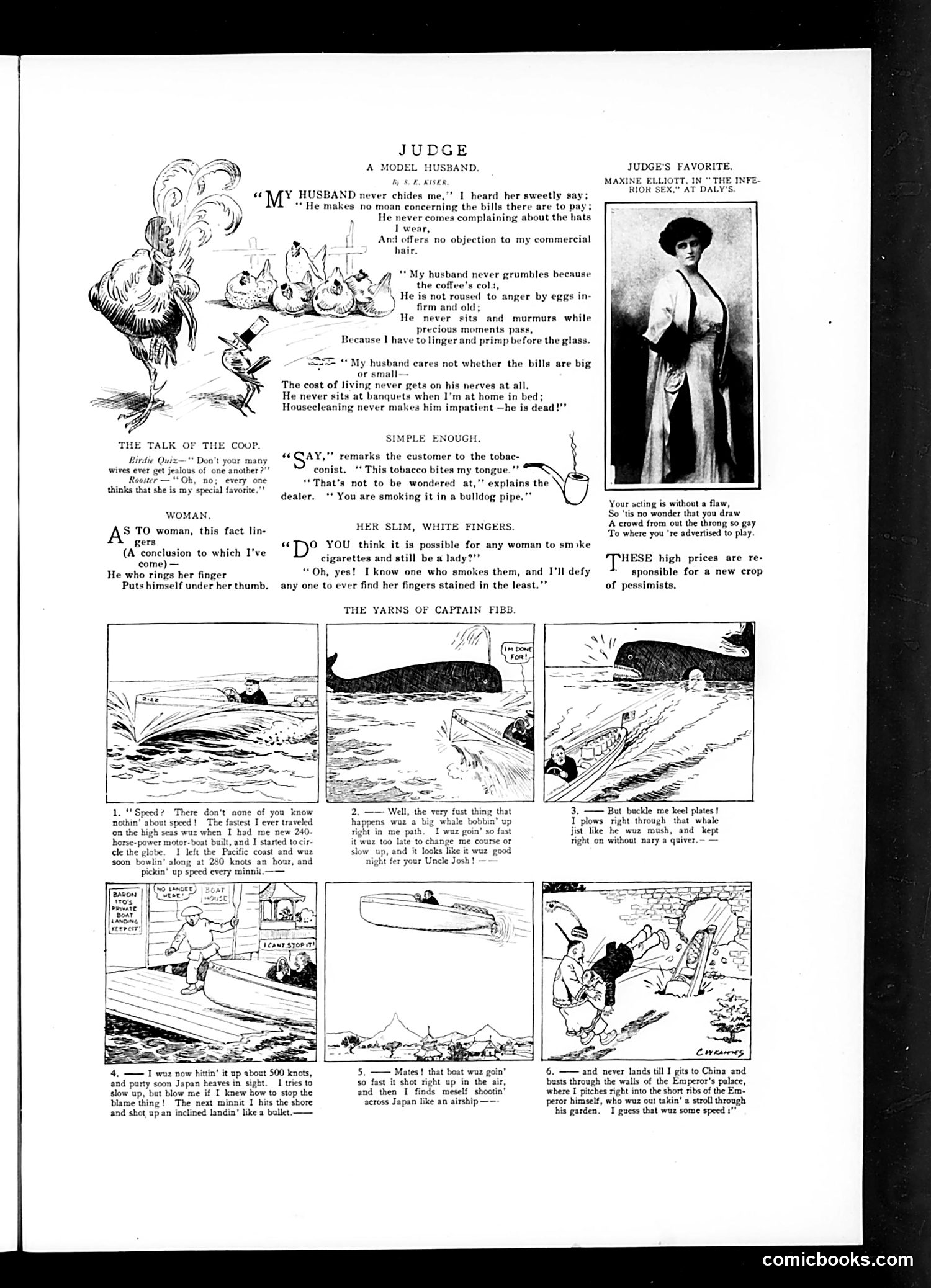
This 1910s *Judge* page contains multiple satirical pieces about gender roles and social behavior: **"A Model Husband"** mocks the idealized domestic husband through ironic praise—the wife lists his virtues (never complaining about bills, cold coffee, her primping), only to reveal the punchline: "he is dead!" The satire critiques unrealistic expectations of male patience and domestic contentment. **"Her Slim, White Fingers"** jokes about women smoking cigarettes—then-scandalous behavior. A tobacconist claims a lady customer smokes without staining her fingers, framed as impressive despite the obvious absurdity, mocking both women's new social freedoms and male skepticism about female propriety. **"The Yarns of Captain Fibb"** is a tall-tale comic strip where an exaggerated fisherman describes absurd maritime adventures, parodying adventure fiction and masculine braggadocio. The page reflects early-20th-century anxieties about shifting gender roles: women's increasing independence (smoking, attending entertainment), changing marriage dynamics, and competing masculine ideals.
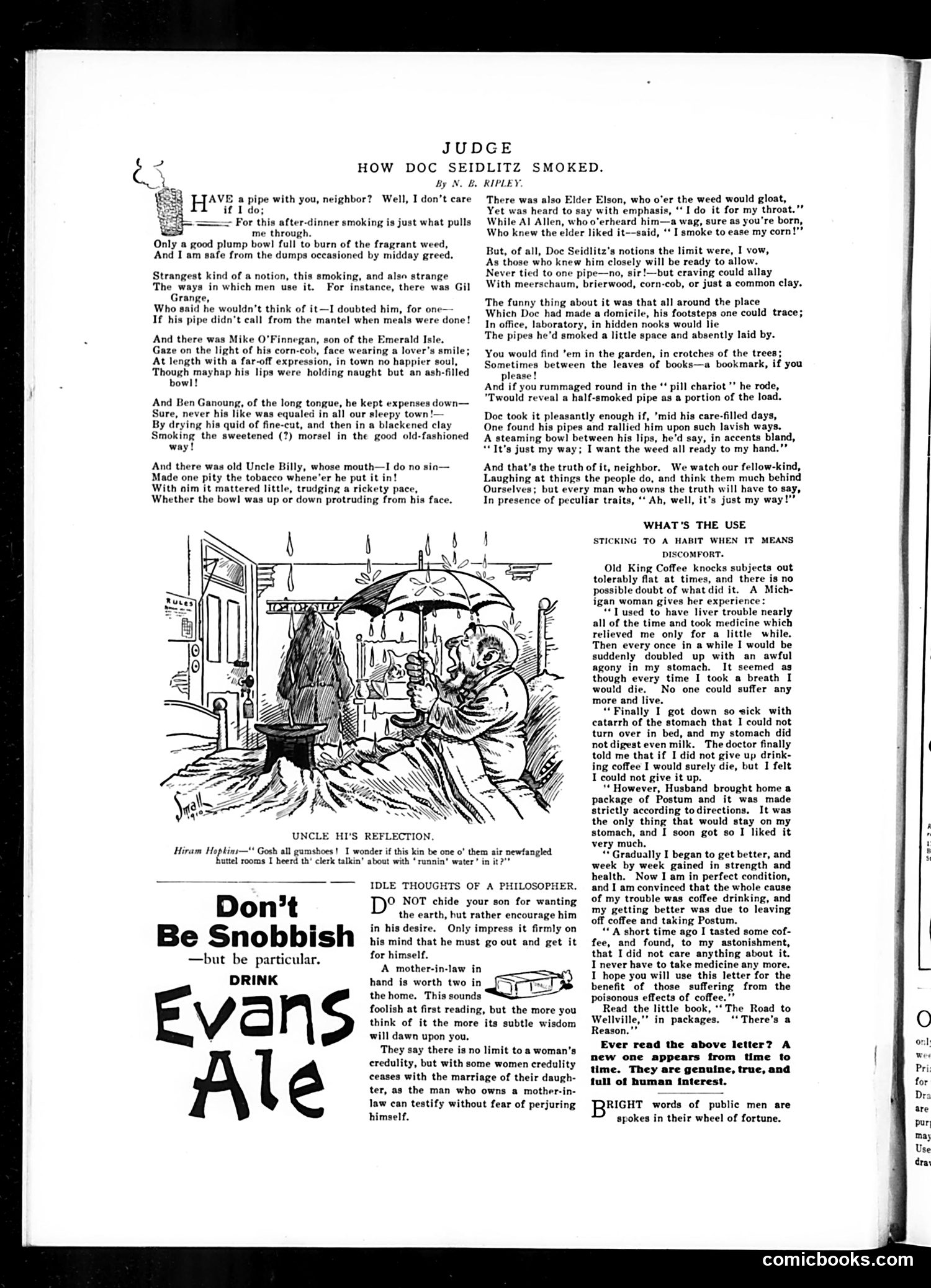
This page from *Judge* magazine contains a humorous poem about "Doc Seidlitz" and his peculiar smoking habits. The satire targets not a specific politician but rather a character type—the absentminded professional who leaves pipes scattered everywhere: in trees, between book pages, and around his property. The poem catalogs various townsfolk's smoking quirks (Gil Grange, Mike O'Finnegan, Uncle Billy, Elder Elson, Al Allen), building to Doc as the most absurdly forgetful. The moral, stated at the end, is that everyone has their own "peculiar traits"—we shouldn't judge others' habits harshly since we all have our own quirks. The accompanying illustration shows a domestic interior scene, likely depicting one of these characters. A separate advertisement for Evans Ale appears below, unrelated to the main content. The piece is gentle social satire about human nature rather than political commentary.
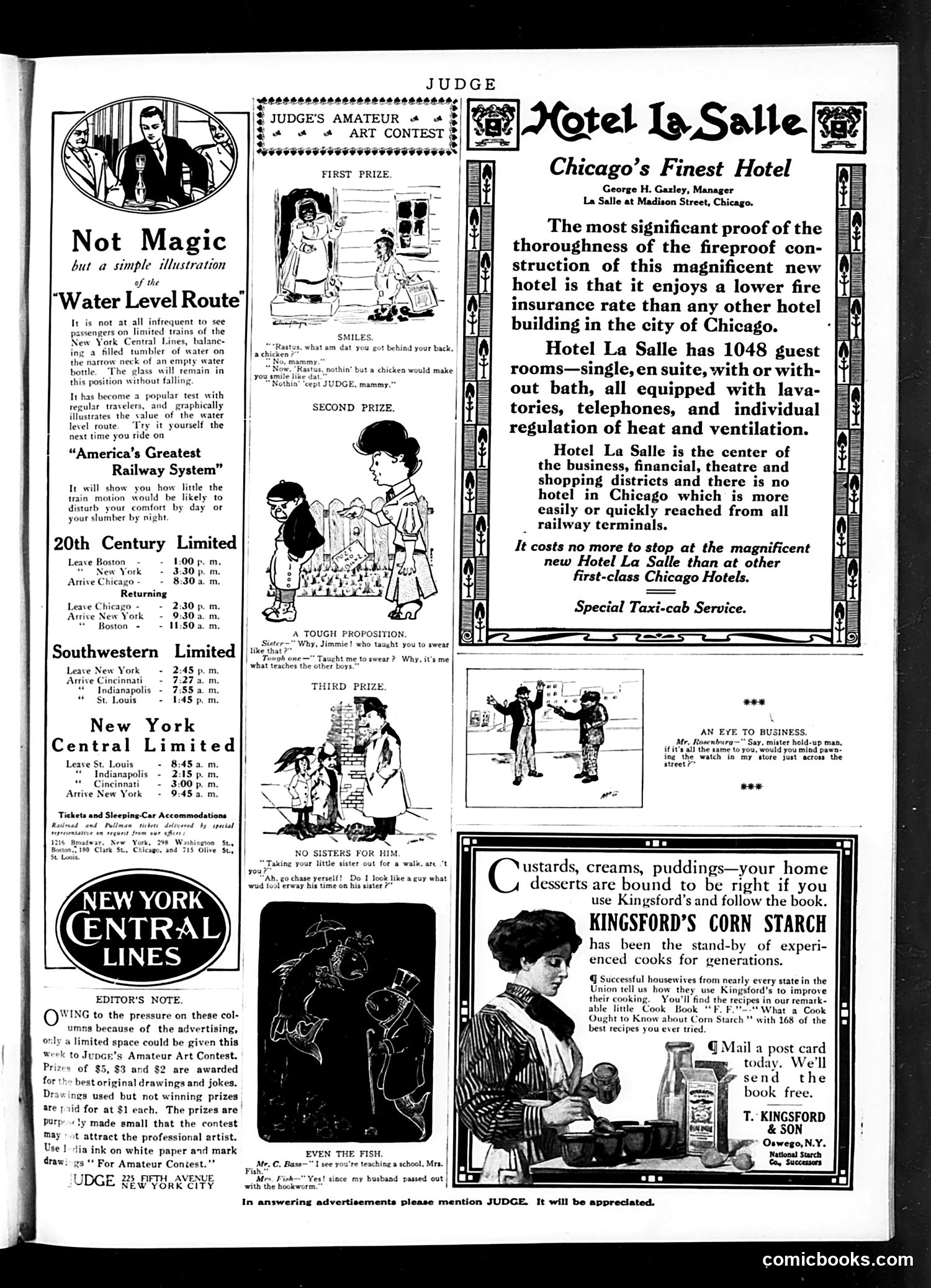
This page primarily features **Judge's Amateur Art Contest**, displaying three prize-winning cartoon submissions on humorous topics. The **First Prize cartoon** illustrates the "Water Level Route"—a railroad marketing claim that the New York Central's smooth track allows passengers to balance a water glass without spilling, demonstrating minimal vibration and superior comfort. The **Second Prize cartoon** depicts a child's mischief: a mother asks her son who taught him to swear; he replies that his older sister did, calling it "teaching." The **Third Prize cartoon** shows a young boy rejecting an invitation to walk with his little sister, sarcastically asking if he "looks like a guy" who'd waste time on family obligations. The page also contains **period advertisements** for Chicago's Hotel La Salle, railroad services (20th Century Limited, Southwestern Limited, New York Central Limited), Kingsford's Corn Starch, and humorous business vignettes about a holdup man and a widow teaching school after her husband's death from hookworm. The satire targets everyday social dynamics—parental concerns about children's behavior and gender expectations of the era.
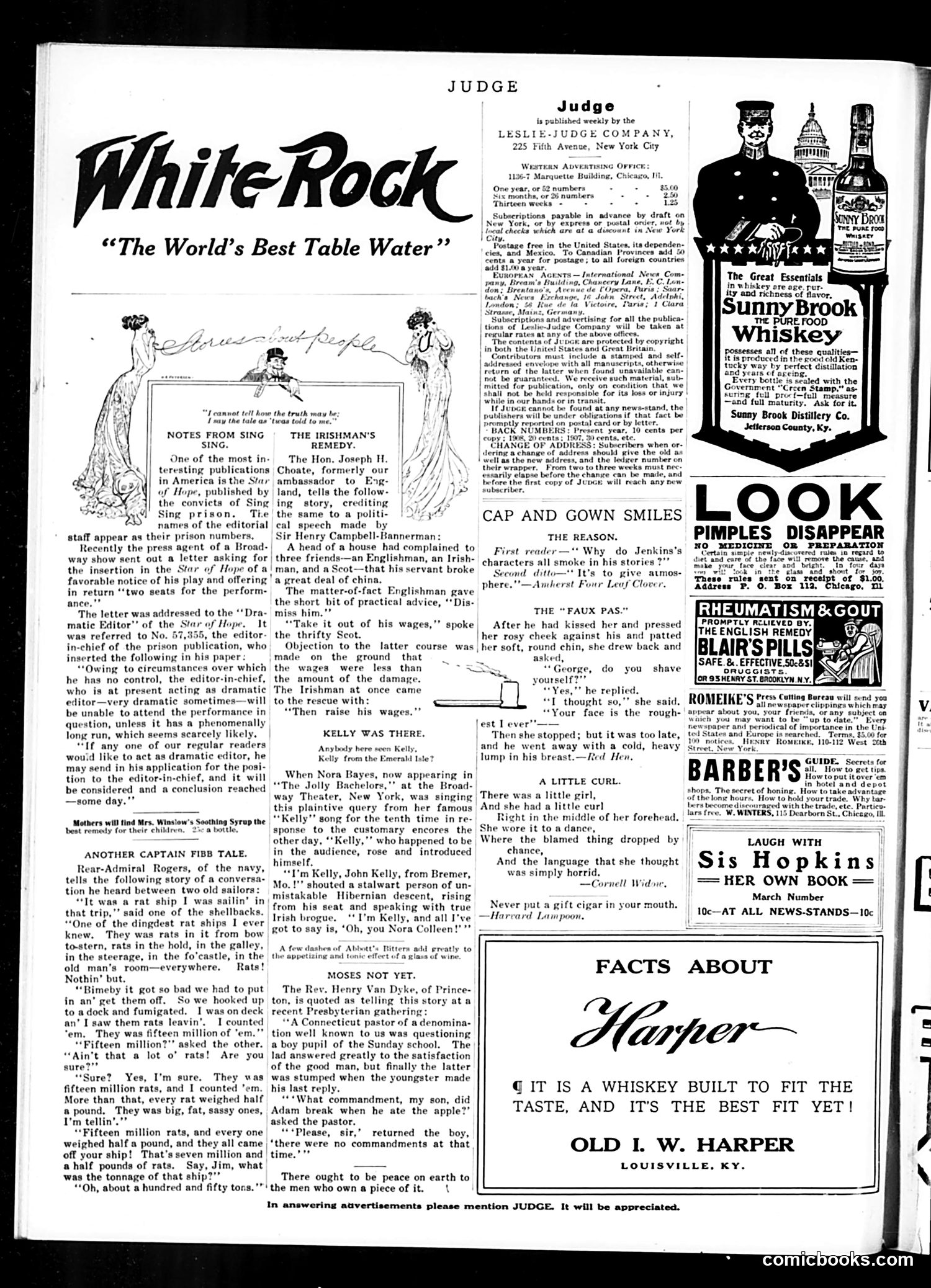
This page from *Judge* magazine contains several humorous pieces typical of early 20th-century American satire: **"Notes from Sing Sing"** mocks the pretension of a Broadway theater's publicity attempt. A theater press agent solicits a favorable review from the prison newspaper *Star of Hope*, offering free tickets. The editor-in-chief sarcastically declines, suggesting the dramatic editor is too busy—a joke about the absurdity of treating a prison publication like a legitimate theater critic. **"Another Captain Fibb Tale"** is a tall-tale about a ship infested with rats. The humor lies in the obvious mathematical impossibility: 15 million rats weighing half a pound each would total 7.5 million pounds—far exceeding a 150-ton ship's capacity. It's slapstick exaggeration for comedic effect. **"The Irishman's Remedy"** presents ethnic humor typical of the era, with an Irish character solving a servant-breakage problem by suggesting wage increases rather than practical solutions—playing on stereotypes. The remaining pieces use similar light, comedic approaches to everyday situations, alongside period advertisements for whiskey and other products.
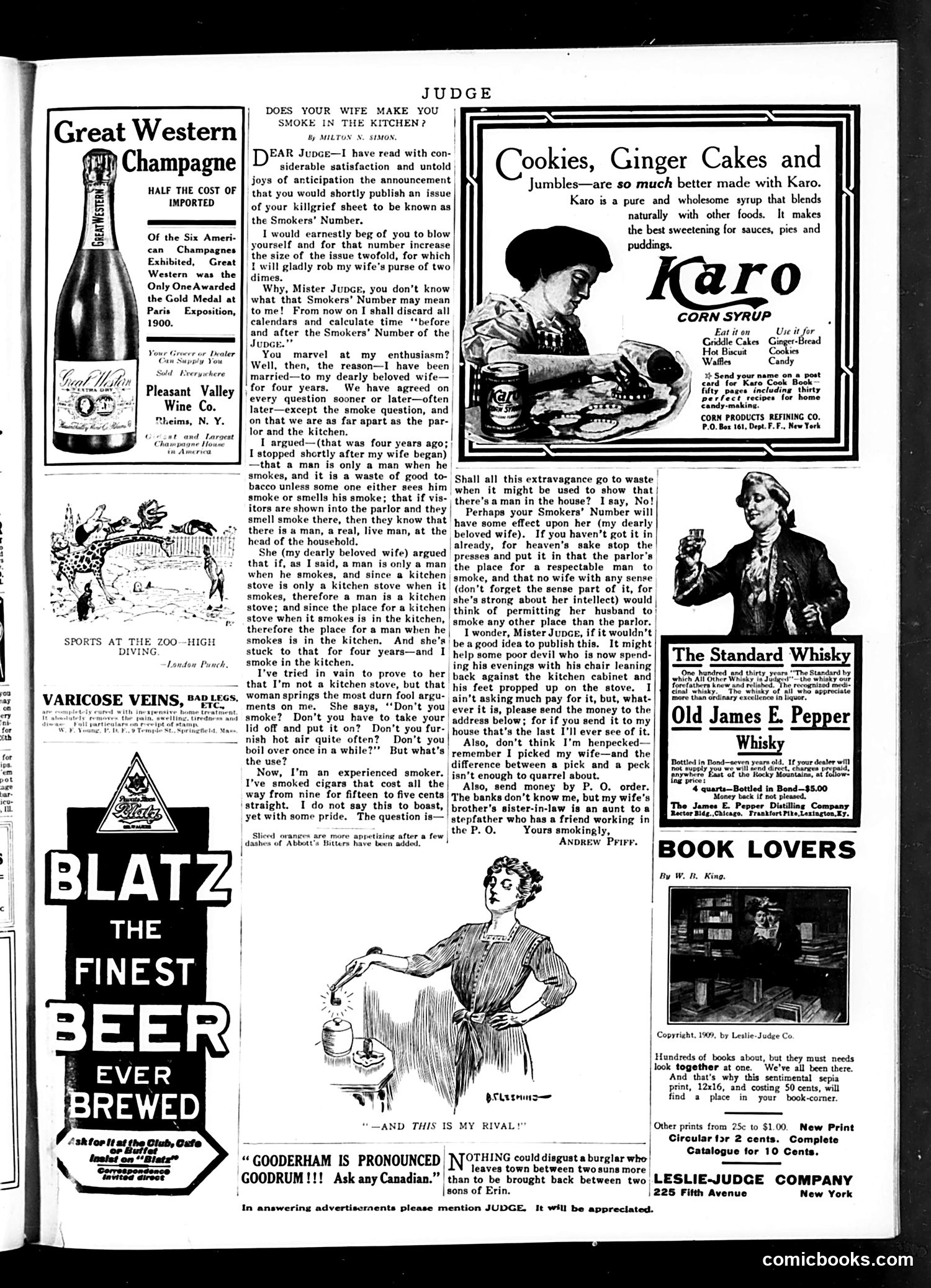
This page is primarily **advertisements and humorous letters to the editor**, not political cartoons. The main content is a letter from "Milton N. Simon" addressing "Judge" about a domestic dispute: his wife banishes him to the kitchen when he smokes. He argues a man smoking demonstrates masculinity and respectability; she counters that if men are "only men when smoking" and kitchen stoves smoke in kitchens, then men are kitchen stoves and belong there too. It's a domestic comedy exploiting early-20th-century gender roles—wives controlling household behavior, men's smoking as a masculine assertion. The cartoons are minor: "Sports at the Zoo—High Diving" is a small illustration; another shows a woman saying "AND THIS IS MY RIVAL!" (presumably about smoking/kitchen stoves). The rest is **product advertising**: champagne, beer (Blatz), whisky, corn syrup (Karo), and books, typical of Judge's commercial content. No significant political satire appears on this page.
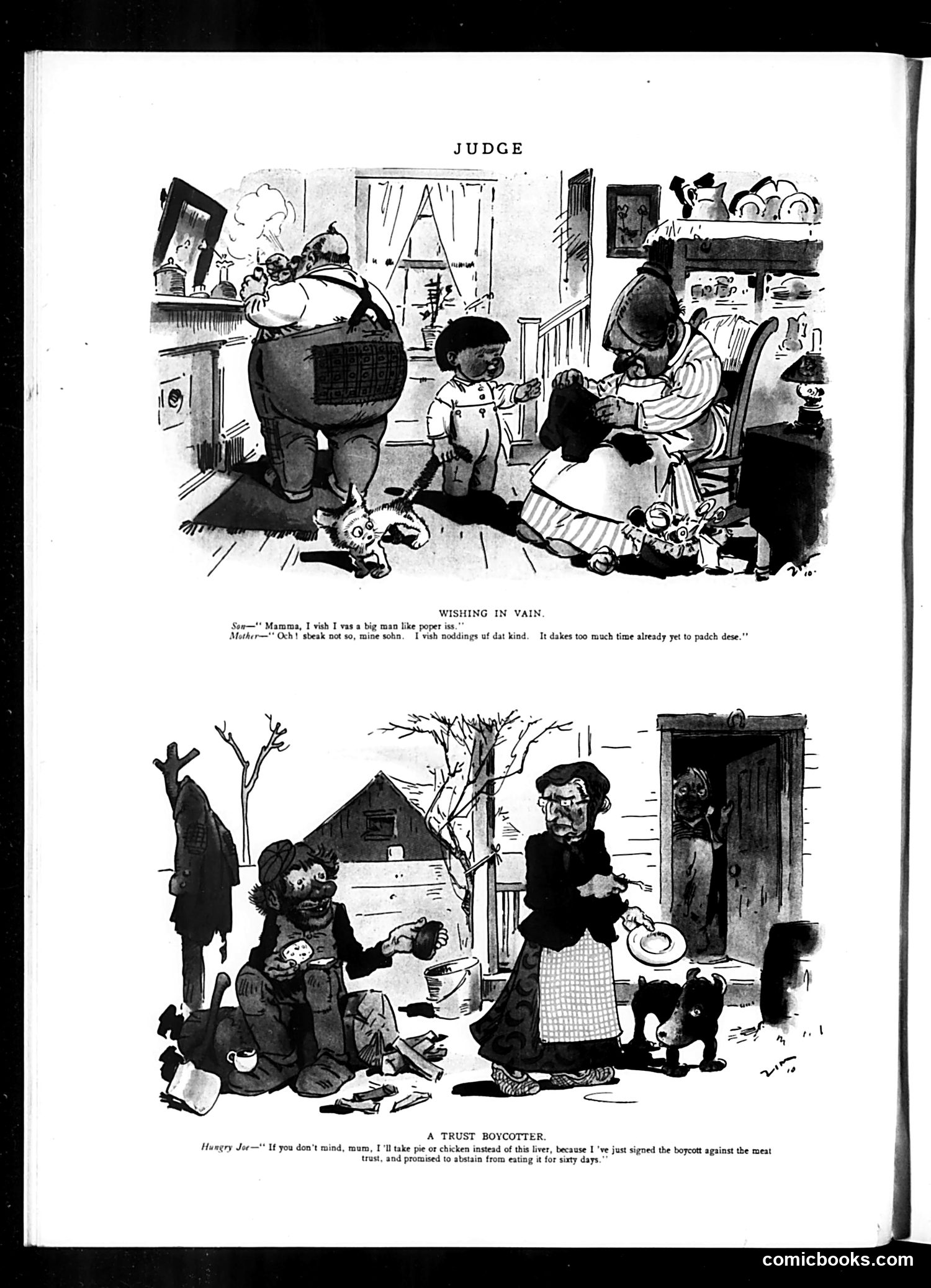
This page contains two satirical cartoons mocking contemporary social movements and immigrant life in early 20th-century America. **"Wishing in Vain"** depicts an Irish immigrant mother dismissing her son's aspiration to become a "big man like papa," claiming she already has too many clothes to patch. The heavy Irish dialect and domestic poverty satirize immigrant working-class struggles. **"A Trust Boycotter"** ridicules the anti-trust movement and consumer boycotts against monopolies (particularly the meat trust). A poor man named "Hungry Joe" claims he's boycotting meat for moral/political reasons, yet his obvious desperation for food undercuts the sincerity of his principled stance. The cartoon suggests such boycotts are impractical luxury positions unavailable to the genuinely hungry. Both use exaggerated caricature and dialect to mock—immigrant aspirations and progressive reform movements, respectively—suggesting Judge's skepticism toward both groups.