
Judge, 1910-03-19 · page 7 of 16
Judge — March 19, 1910 — page 7: what you’re looking at
What you’re looking at
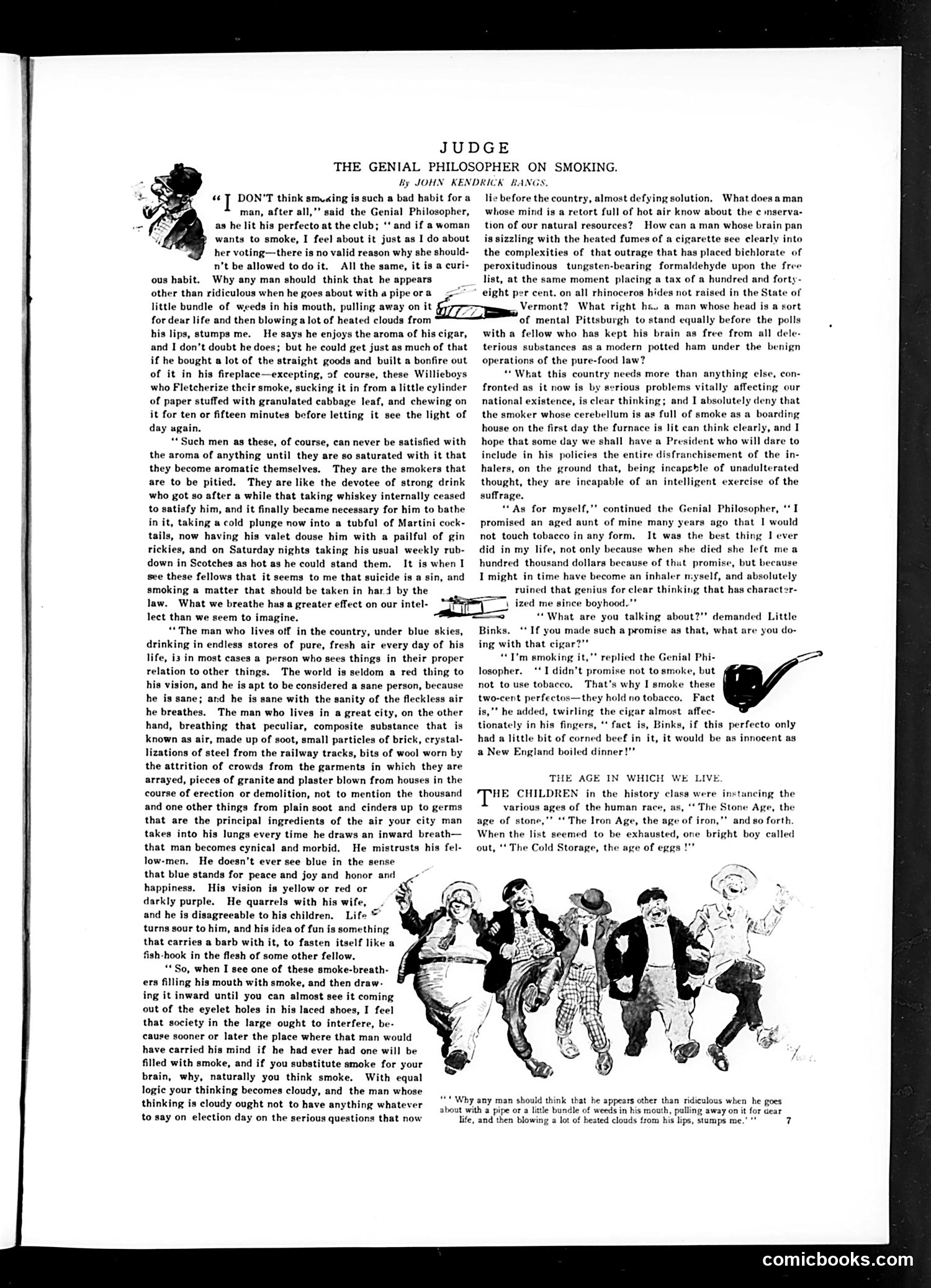
This satirical article by John Kendrick Bangs mocks smoking through the persona of "the Genial Philosopher," a recurring character presenting contradictory arguments. The philosopher claims smoking isn't harmful while simultaneously describing smokers as ridiculous. He ridicules extreme practitioners—particularly those who practice "Fletcherizing" (chewing smoke thoroughly, referencing contemporary fad diets). The satire's main targets are urban pollution and its supposed psychological effects. The philosopher argues that city dwellers breathing contaminated air (soot, brick particles, steel) become cynical and morally degraded compared to rural inhabitants breathing pure air. This reflects turn-of-century anxiety about industrialization and urbanization. The illustration shows a group of dated figures, likely representing different "ages" or types of society members—the caption references "The Age in Which We Live," suggesting commentary on modern civilization's character. The humor operates on the philosopher's obvious hypocrisy while critiquing both smoking habits and urban environmental decay.
📄 Transcribed text from this page (OCR, searchable)
Machine-transcribed from the original scan — historical spelling and the odd misread are preserved.
JUDGE THE GENIAL PHILOSOPHER ON SMOKING. By JOHN KEN, ¢ J DON’T think sm.cing is such a bad habit for a man, after all,”” said the Genial Philosopher, as he lit his perfecto at the club; ‘and if a woman wants to smoke, I feel about it just as I do about her voting—there is no valid reason why she should n't be allowed todo it. All the same, it is a curi- ous habit. Why any man should think that he appears other than ridiculous when he goes about with a pipe or a little bundle of weeds in his mouth, pulling away on it for dear life and then blowing a lot of heated clouds from his lips, stumps me. He says he enjoys the aroma of his cigar, and I don’t doubt he does; but he could get just as much of thut if he bought a lot of the straight goods and built a bonfire out of it in his fireplace—excepting, of course, these Willieboys who Fletcherize their smoke, sucking it in from a little cylinder of paper stuffed with granulated cabbage leaf, and chewing on it for ten or fifteen minutes before letting it see the light of day again. “*Such men as these, of course, can never be satisfied with the aroma of anything until they are so saturated with it that they become aromatic themselves. They are the smokers that are to be pitied. They are like the devotee of strong drink who got so after a while that taking whiskey internally ceased to satisfy him, and it finally became necessary for him to bathe in it, taking a cold plunge now into a tubful of Martini cock- now having his valet douse him with a pailful of gin tickies, and on Saturday nights taking his usual weekly rub- down in Scotches as hot as he could stand them. It is when I see these fellows that it seems to me that suicide is a sin, and smoking a matter that should be taken in hard by the law. What we breathe has a greater effect on our intel- lect than we seem to imagine. The man who lives off in the country, under blue skies, drinking in endless stores of pure, fresh air every day of his life, i3 in most cases a person who sees things in their proper relation to other things. The world is seldom a red thing to his vision, and he is apt to be considered a sane person, because he is sane; and he is sane with the sanity of the fleckless air he breathes. The man who lives in a great city, on the other hand, breathing that peculiar, composite substance that is known as air, made up of soot, small particles of brick, crystal- lizations of steel from the railway tracks, bits of wool worn by the attrition of crowds from the garments in which they are arrayed, pieces of granite and plaster blown from houses in the course of erection or demolition, not to mention the thousand and one other things from plain soot and cinders up to germs that are the principal ingredients of the air your city man takes into his lungs every time he draws an inward breath— that man becomes cynical and morbid. He mistrusts his fel- low-men. He doesn’t ever see blue in the sense that blue stands for peace and joy and honor and happiness. His vision is yellow or red or darkly purple. He quarrels with his wife, and he is disagreeable to his children. Life © turns sour to him, and his idea of fun is something that carries a barb with it, to fasten itself like a fish-hook in the flesh of some other fellow. ‘*So, when I see one of these smoke-breath- ers filling his mouth with smoke, and then draw- ing it inward until you can almost see it coming out of the eyelet holes in his laced shoes, I feel that society in the large ought to interfere, be- cause sooner or later the place where that man would have carried his mind if he had ever had one will be filled with smoke, and if you substitute smoke for your brain, why, naturally you think smoke. With equal logic your thinking becomes cloudy, and the man whose thinking is cloudy ought not to have anything whatever to say on election day on the serious questions that now about DRICK BANGS. lie before the country, almost defying solution, What does aman whose mind is a retort full of hot air know about the ¢ nserva- tion of our natural resources? How can a man whose brain pan is sizzling with the heated fumes of a cigarette see clearly into the complexities of that outrage that has placed bichlorate of peroxitudinous tungsten-bearing formaldehyde upon the free list, at the same moment placing a tax of a hundred and fort; eight cent. on all rhinoceros hides not raised in the State of Vermont? What right he. a man whose head is a sort ‘of mental Pittsburgh to stand equally before the polls with a fellow who has kept his brain as free from all dele- terious substances as a modern potted ham under the benign operations of the pure-food law? “What this country needs more than anything else, con- fronted as it now is by serious problems vitally affecting our national existence, ng; and I absolutely deny that the smoker whose cerebellum is as full of smoke as a boarding house on the first day the furnace is lit can think clearly, and I hope that some day we shall have a President who will dare to include in his policies the entire disfranchisement of the in- halers, on the ground that, being incapshle of unadulterated thought, they are incapable of an intelligent exercise of the suffrage. ** As for myself,”’ continued the Genial Philosopher, ‘I promised an aged aunt of mine many years ago that 1 would not touch tobacco in any form, It was the best thing I ever did in my life, not only because when she died she left mea hundred thousand dollars because of that promise, but because I might in time have become an inhaler myself, and absolutely ruined that genius for clear thinking that has character- | ized me since boyhood."” — “*What are you talking about?" demanded Little Binks. ‘* If you made such a promise as that, what are you do- ing with that cigar?” “I'm smoking it,’’ replied the Genial Phi- losopher. ‘* I didn’t promise not to smoke, but not to use tobacco, That's why I smoke these two-cent perfectos—they hold no tobacco, Fact is,’ he added, twirling the cigar almost affe tionately in his finger: Binks, if this perfecto only had a little bit of corned beef in it, it would be as innocent as a New England boiled dinner!"" THE AGE IN WHICH WE LIVE. HE CHILDREN in the history class were instuncing the various ages of the human race, as, ‘The Stone Age, the age of stone,"” “The Iron Age, the age of iron,” and go forth. When the list seemed to be exhausted, one bright boy called out, ‘ The Cold Storage, the age of eggs !"° “\* Why any man should think that he appears other than ridiculous when he goes t with a pipe or a little bundle of weeds in his mouth, pulling away on it for dear life, and then blowing a lot of heated clouds from his lips, stumps me." "” comicbooks.com