
A complete issue · 16 pages · 1910
Judge — February 5, 1910
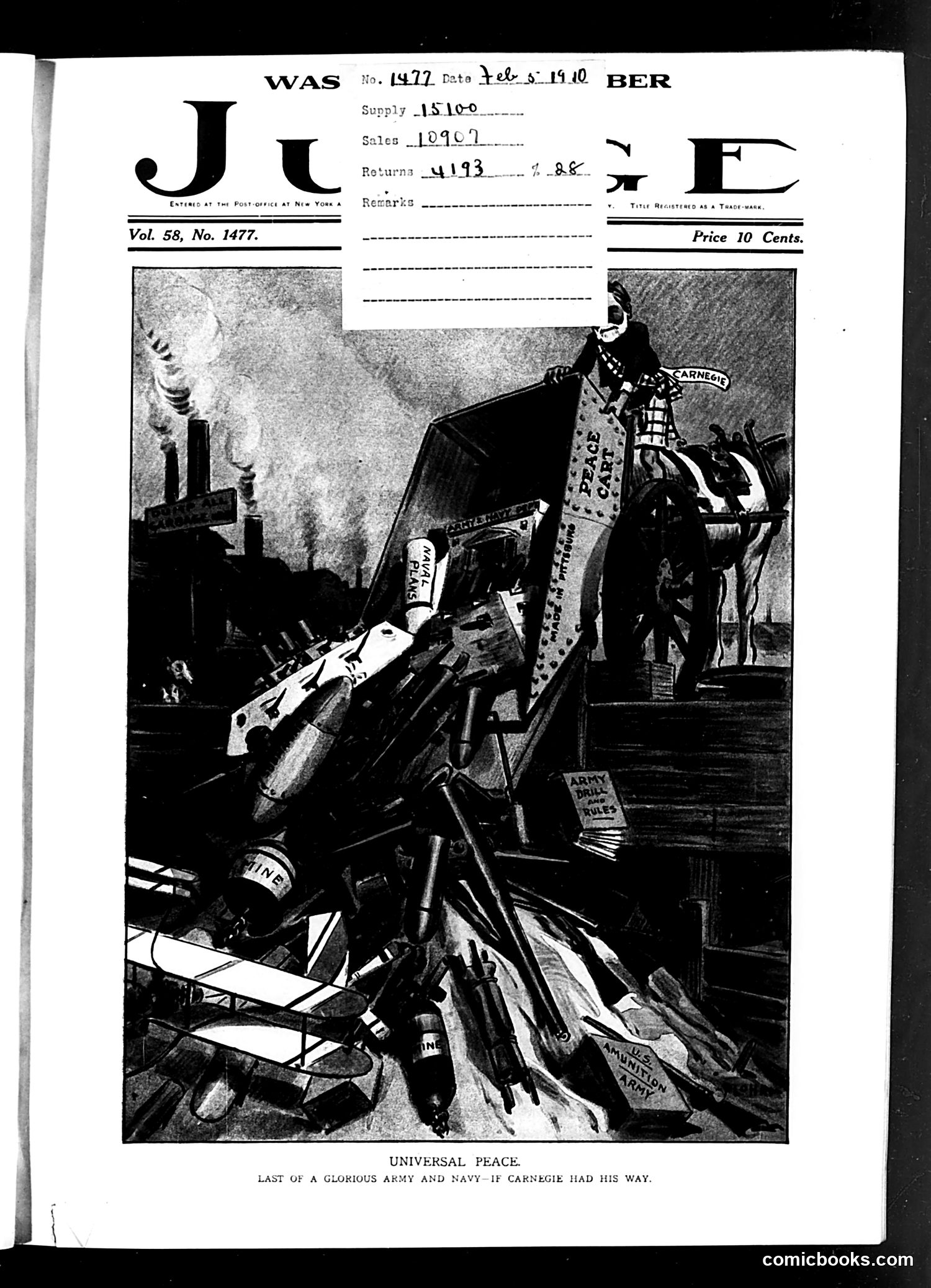
This 1910 political cartoon satirizes Andrew Carnegie's pacifist ideology through dark humor. The image shows military weaponry—cannons, rifles, and military equipment—piled as a monument or funeral pyre, with Carnegie (identifiable by the label "CARNEGIE" on the figure) depicted as a wealthy industrialist overseeing this scene. The caption reads: "UNIVERSAL PEACE. LAST OF A GLORIOUS ARMY AND NAVY—IF CARNEGIE HAD HIS WAY." The satire mocks Carnegie's well-documented advocacy for peace and disarmament by suggesting his pacifist vision would result in the complete elimination of America's military. Judge presents this as absurd and dangerous, using the imagery of weapons reduced to scrap to ridicule Carnegie's progressive peace movement. The cartoon reflects conservative opposition to early 20th-century pacifism.
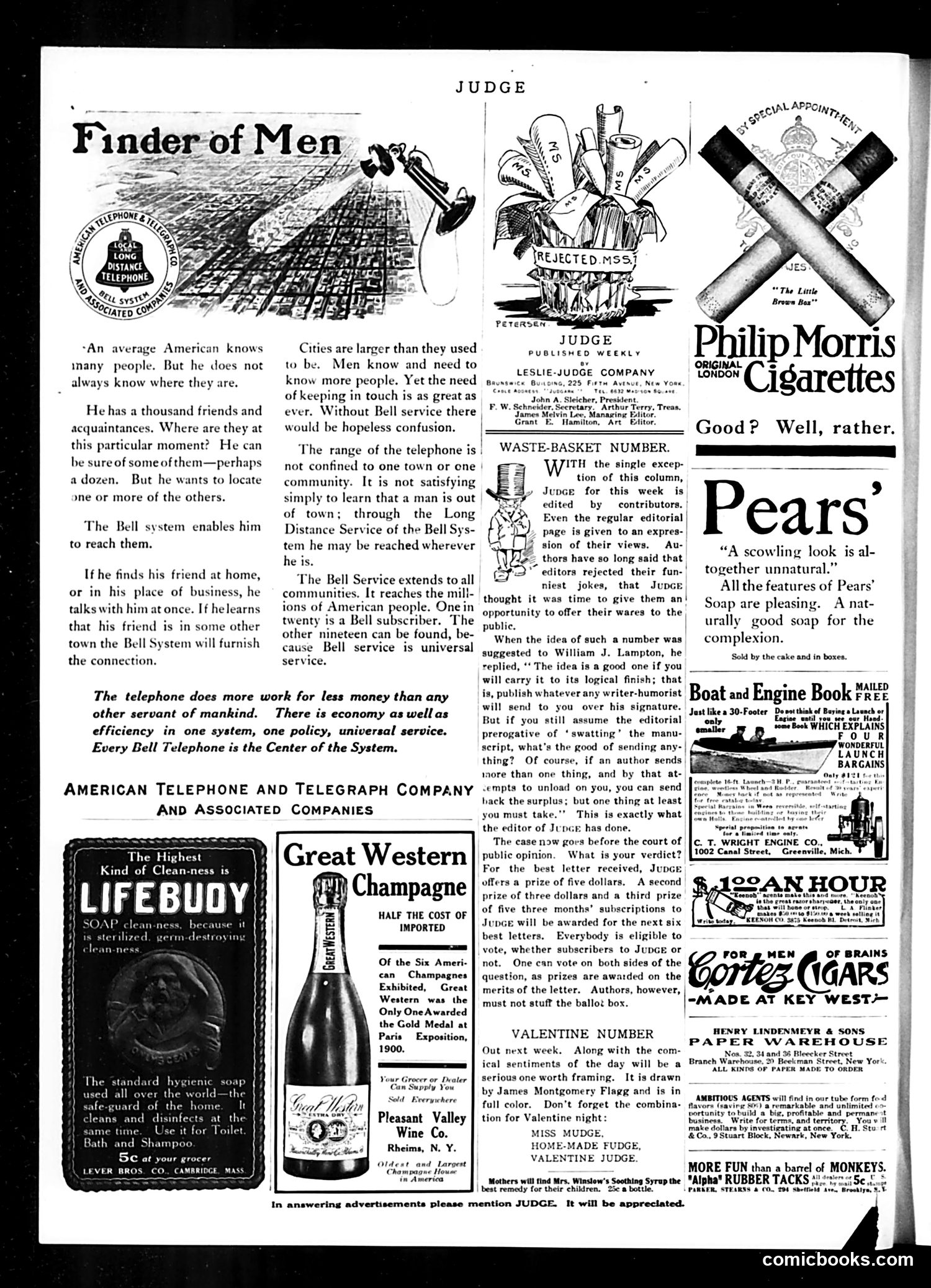
This page is primarily **advertising content** with one small editorial cartoon. The main "Judge" cartoon shows a figure labeled "REJECTED MSS" (rejected manuscripts) being examined by a stern-faced character labeled "JUDGE," surrounded by editorial tools. The satire appears to mock the magazine's editorial process—suggesting that Judge's editors harshly reject submissions. The cartoon plays on the magazine's name as both a publication title and a literal judge figure, making a visual pun about editorial gatekeeping. The surrounding advertisements (Philip Morris cigarettes, Pears' soap, Lifebuoy soap, champagne) suggest this is a wealthy readership aimed at. The page contains no identifiable political figures or references—it's largely commercial in nature with light editorial satire about publishing itself.
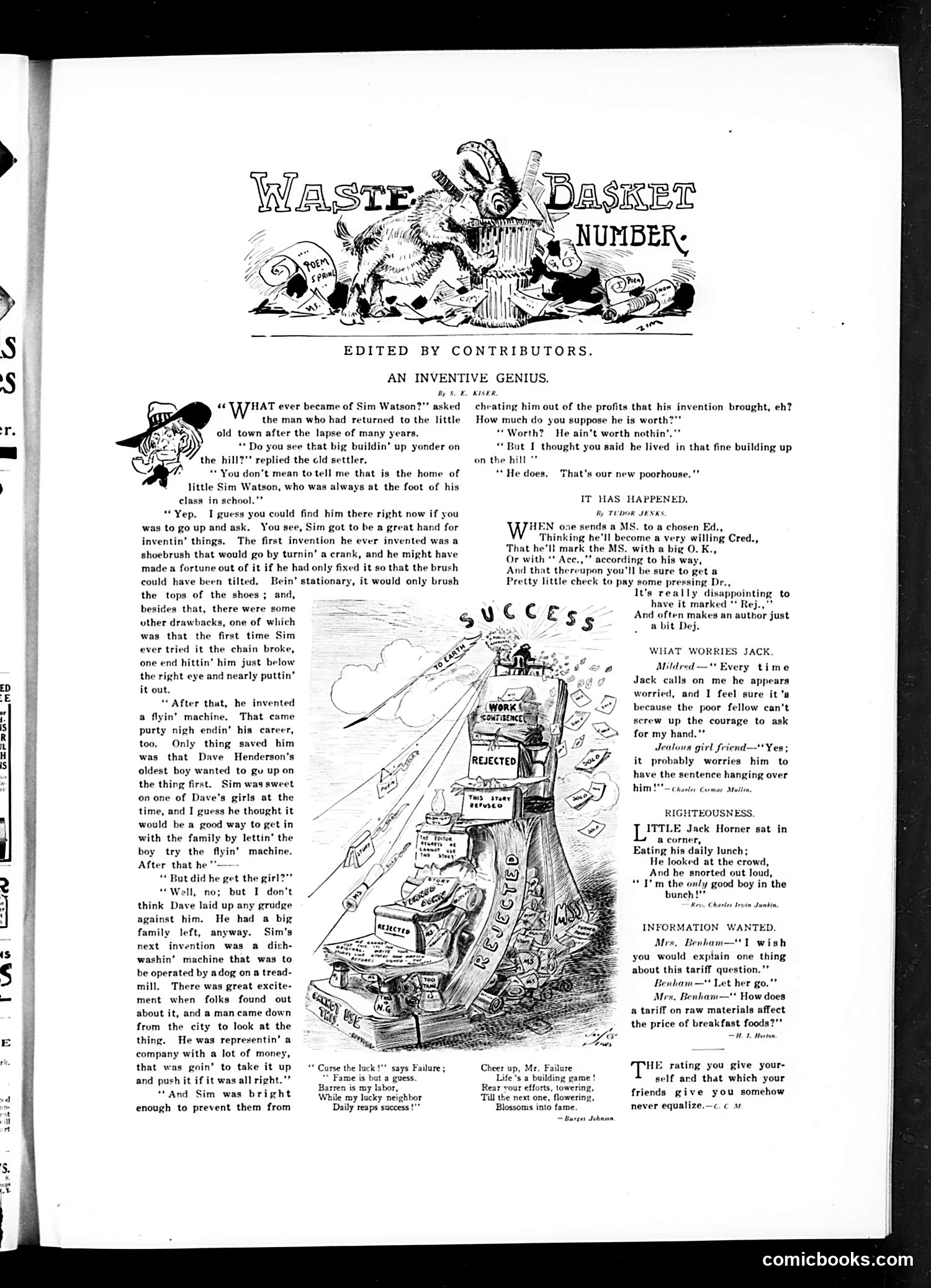
This satirical piece mocks a struggling inventor named Sim Watson. The text describes his failed attempts at innovation—his first invention (a brush for shoe-tops) never sold, and subsequent failures included a chain-breaking device and an eye-patching contraption. The large central cartoon depicts a complex contraption labeled "Success," illustrated as an elaborate, chaotic machine filled with rejected and failed attempts—visualizing how innovation often requires enduring repeated failures before achieving results. The accompanying short pieces ("It Has Happened," "What Worries Jack," "Righteousness," "Information Wanted") appear to be separate satirical vignettes mocking various social situations and human foibles common to the era. The overall page satirizes both failed entrepreneurship and the absurdity of human ambition.
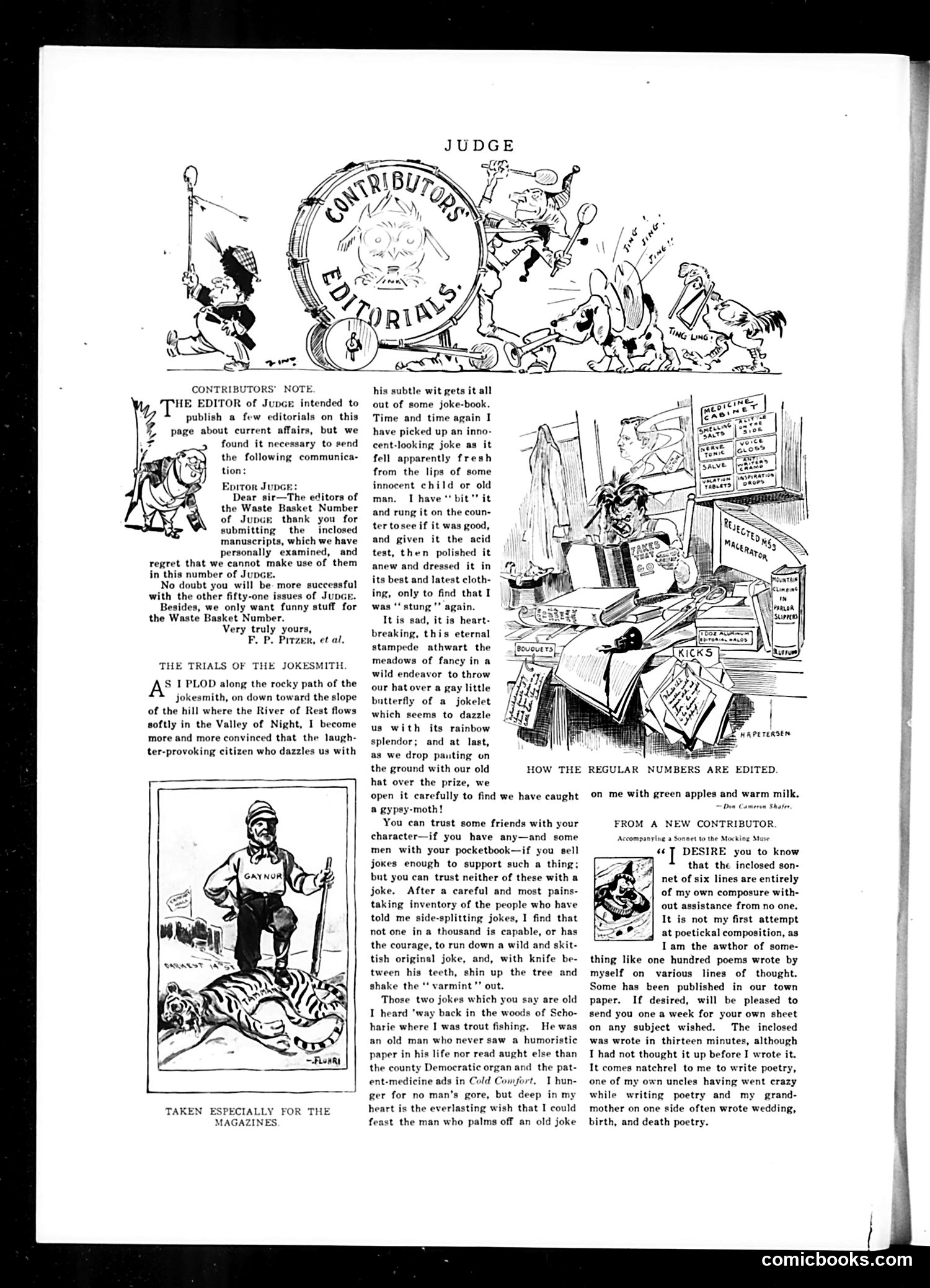
This page contains editorial notes and humor columns rather than political cartoons. The main content includes: **"Contributors' Note"**: The editor addresses manuscript submissions, humorously complaining that contributors keep sending the same tired jokes repeatedly. The editor describes finding a joke that appeared "fresh from the lips of some innocent child or old man," only to discover it was already published and worn out. **"The Trials of the Jokesmith"**: A longer humorous essay about the difficulty of finding original jokes. The author laments that most people who tell jokes are simply recycling old material, and he struggles to find genuinely new, original humor worth publishing. The page illustrates the magazine's behind-the-scenes challenges with contributor quality and joke originality—a meta-commentary on producing satirical content.
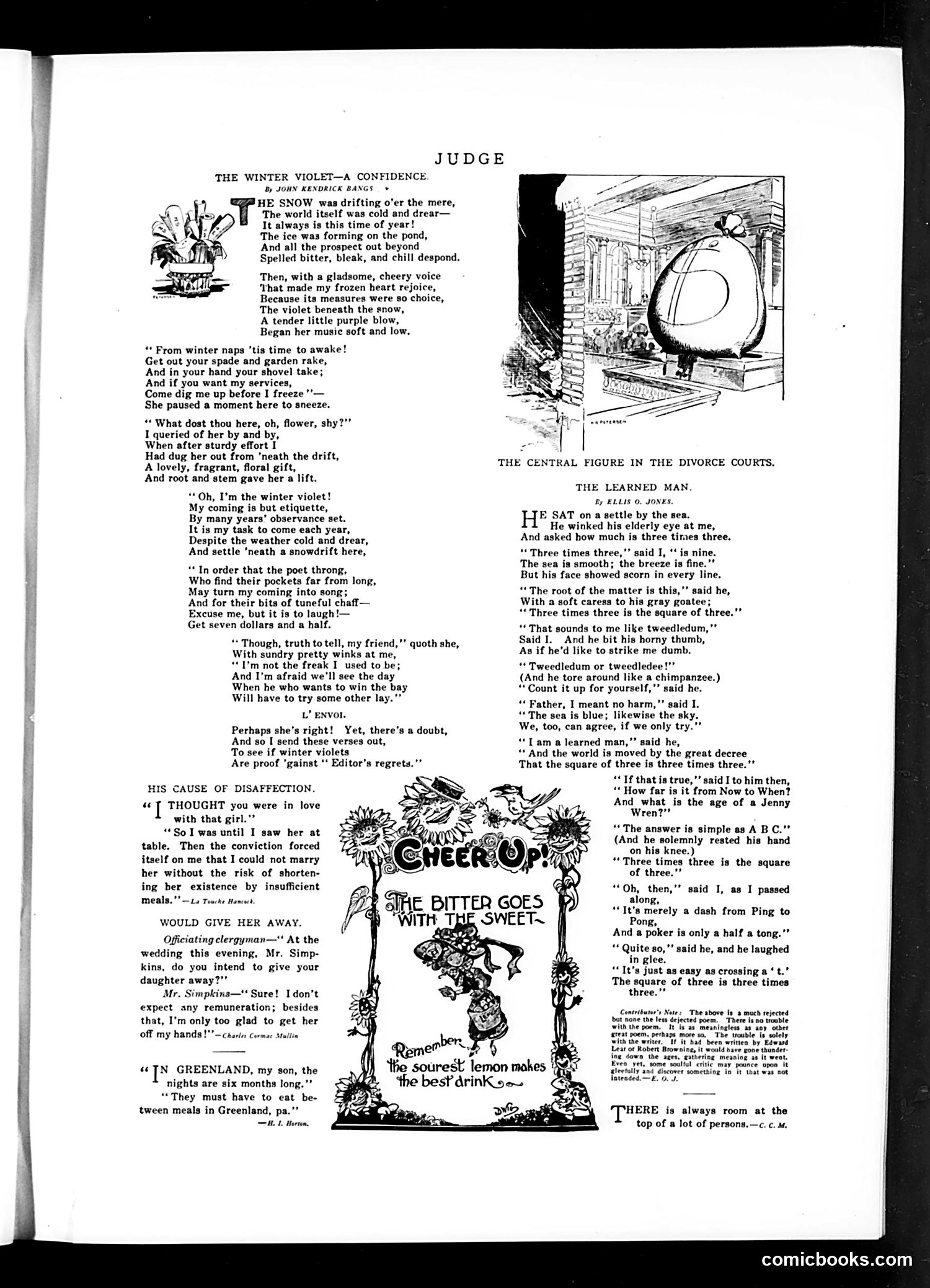
This page contains several distinct humor pieces rather than a unified political cartoon: **"The Winter Violet"** (top left): A poem about a violet surviving winter, paired with a domestic illustration. **"The Central Figure in the Divorce Courts"** (top right): Shows a large spherical object in a house interior—likely satirizing how divorce proceedings center on dividing marital property rather than addressing the actual human relationships involved. **"The Learned Man"** (middle right): A dialogue joke about a man explaining that "three times three" equals various nonsensical definitions, mocking pedantic over-intellectualism. **Other segments** include brief humorous quotes and advertisements, typical of Judge's mixed-content format. The overall page appears to be general-audience humor rather than focused political satire, emphasizing domestic situations and wordplay common to early 20th-century magazines.
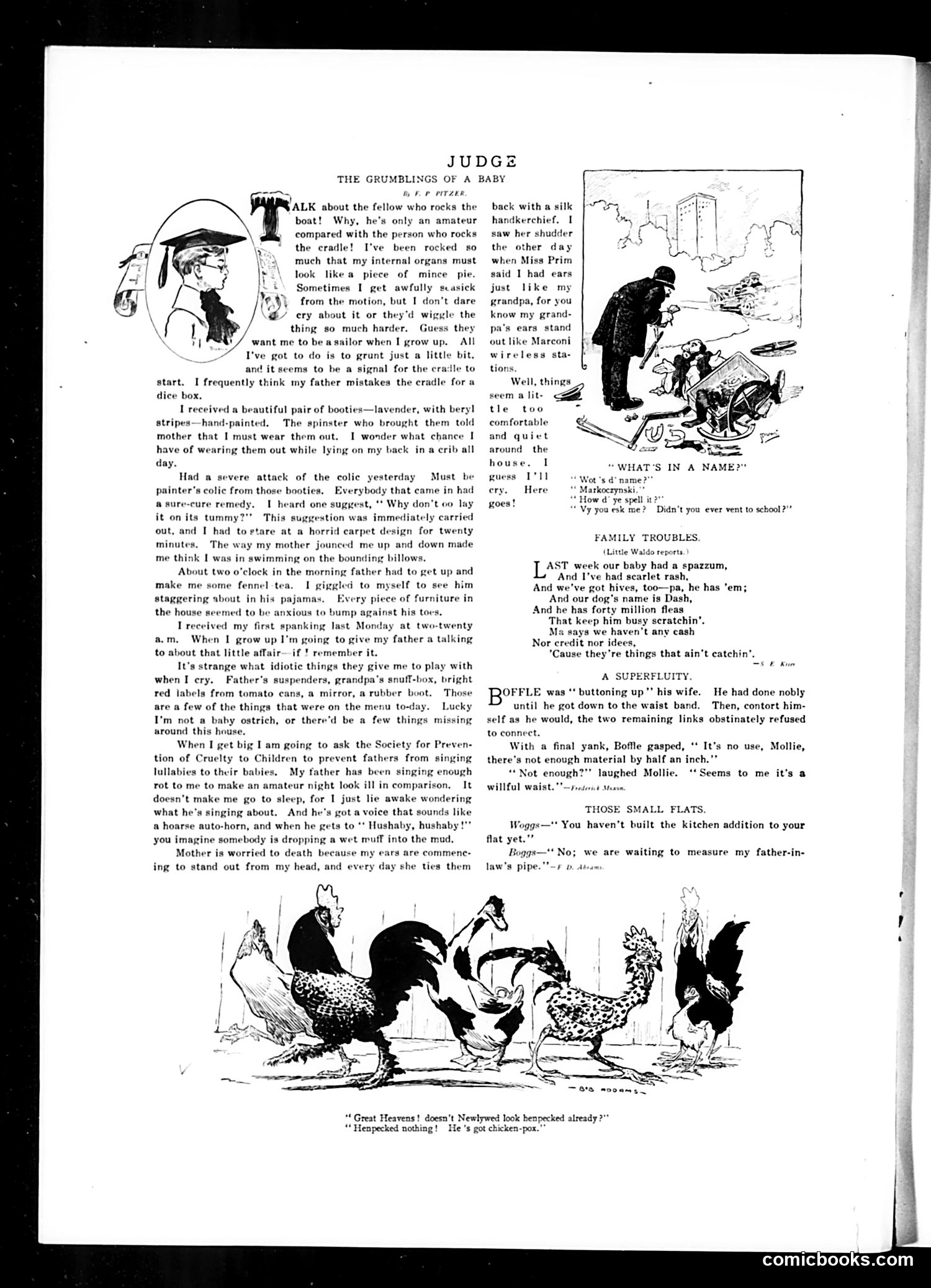
This page contains humorous domestic sketches satirizing early 20th-century American family life—specifically the complaints of a baby, childhood ailments, and marital mishaps. **"The Grumblings of a Baby"** presents a baby's first-person complaints about parental care: being rocked excessively (causing seasickness), receiving impractical gifts (decorative booties), suffering colic remedies, and enduring his father's terrible singing voice. The satire mocks both parental incompetence and infant vulnerability. The baby's threat to report his father to the "Society for Prevention of Cruelty to Children" humorously inverts the era's emerging child-welfare concerns. **"Family Troubles"** catalogs contagious childhood diseases (spazzum, scarlet rash, hives) alongside poverty and a flea-ridden dog—a comedic portrait of working-class domestic chaos. **"A Superfluity"** jokes about marital awkwardness: a husband "Boffle" struggles to button his wife's dress, with their remaining buttons refusing to connect—a mild innuendo about intimate moments. The bottom illustration shows roosters, likely accompanying a separate joke about henpecked husbands. These sketches offer lighthearted domestic humor typical of Judge's satirical approach to middle-class life.
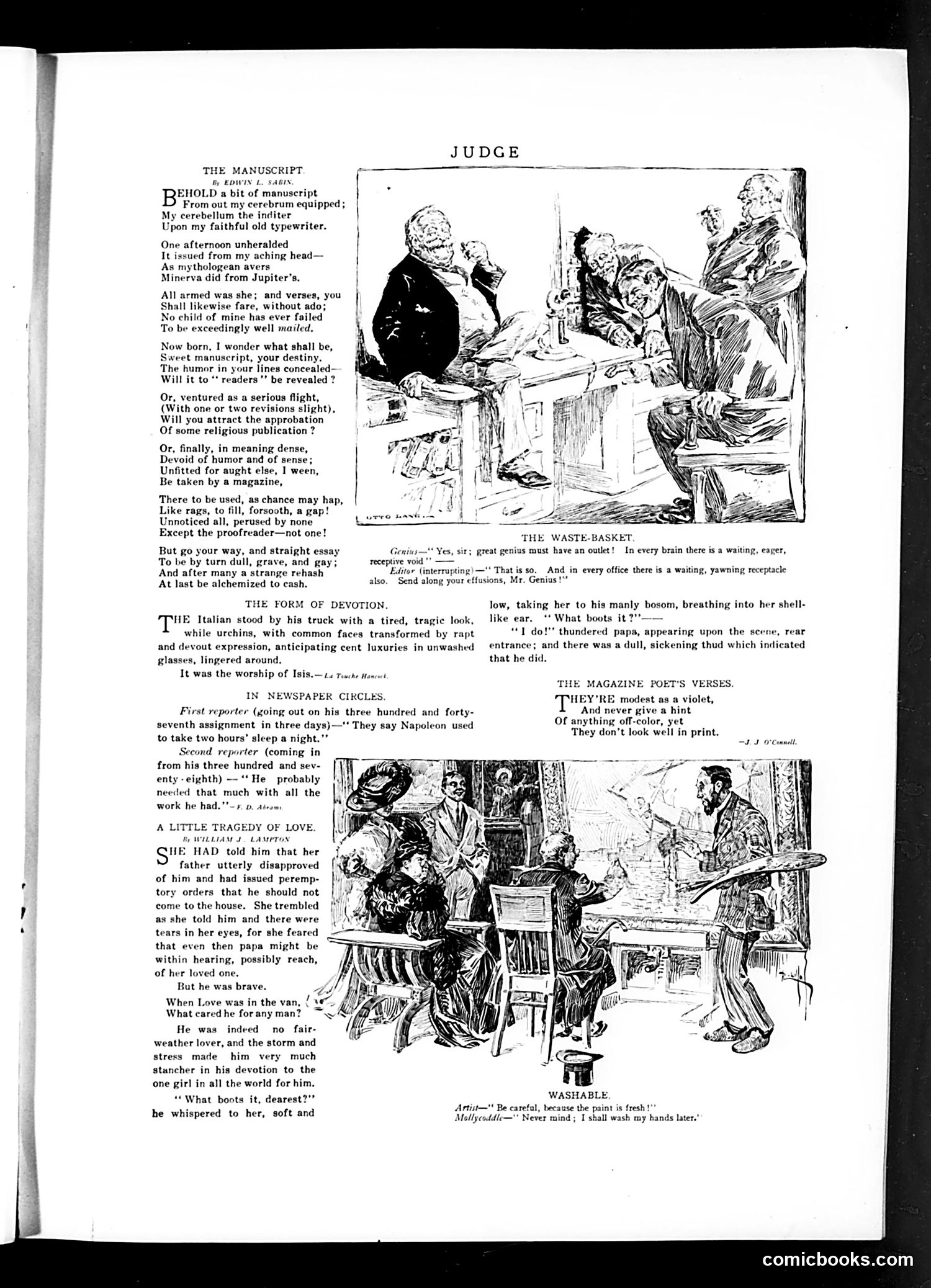
This page collects satirical pieces mocking the literary and publishing world of early 20th-century America. **"The Manuscript"** jokes about a writer's hopeful naïveté—imagining his work might be published in prestigious magazines, religious publications, or serious journals, when realistically it will either be rejected entirely or used as filler ("like rags to fill a gap"), read only by proofreaders. **"Newspaper Circles"** mocks overworked reporters, joking that even Napoleon couldn't manage journalism's exhausting schedule. **"A Little Tragedy of Love"** parodies sentimental romance stories—a brave lover endures parental disapproval until the father arrives and (implied) beats him senseless. **"The Waste-Basket"** directly satirizes submission culture: editors acknowledge that every office receives "genius" manuscripts they must discard into literal waste baskets. **"The Magazine Poet's Verses"** ridicules prudish magazine poetry that's so bland and inoffensive it's unmarketable. The overall theme: American publishing gatekeepers receiving countless mediocre submissions from hopeful but delusional writers.
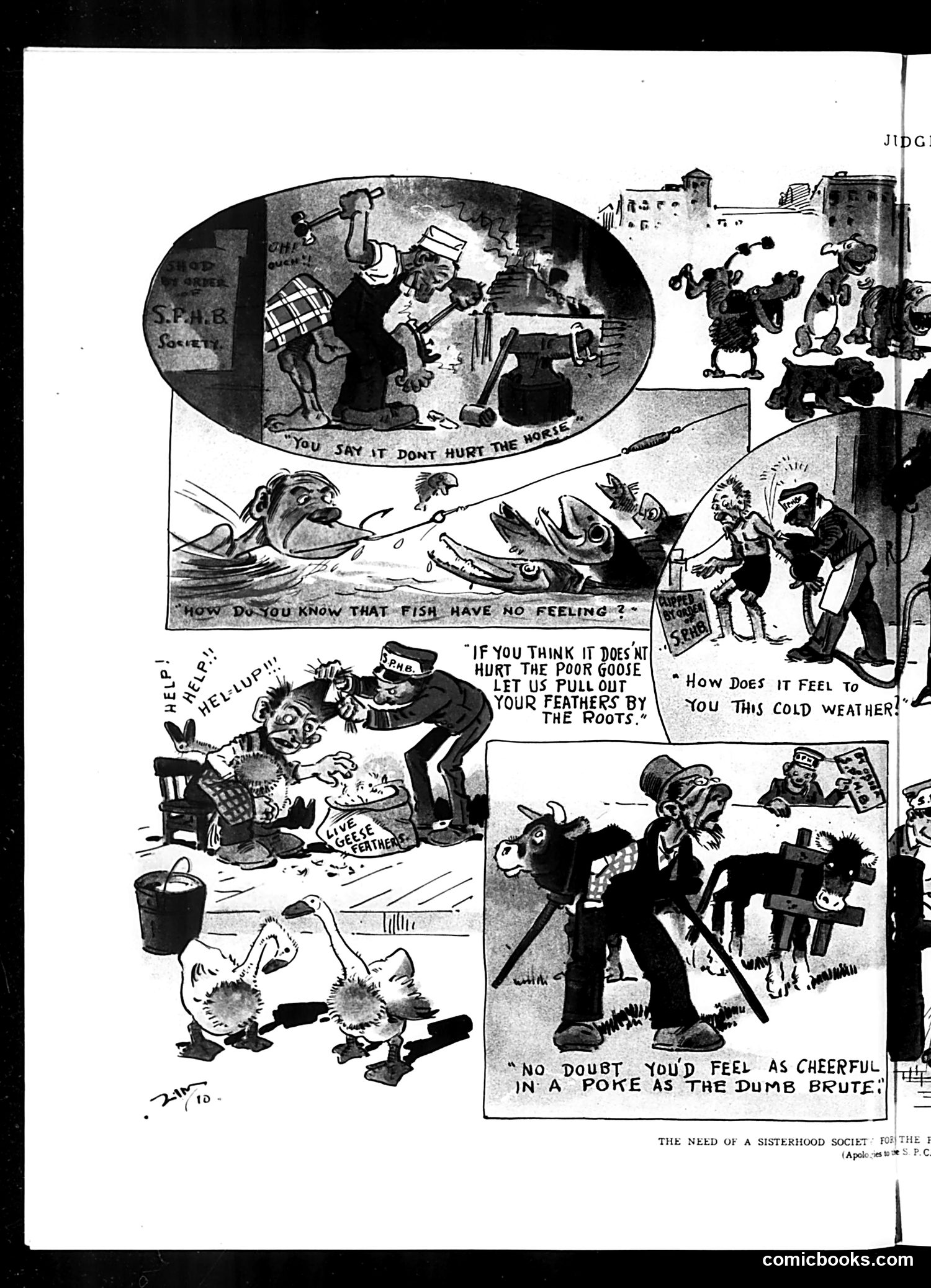
This satirical cartoon critiques animal cruelty, likely advocating for animal protection legislation or organized animal welfare societies. The central joke uses ironic dialogue: characters argue that animals (fish, horses, geese) don't feel pain, then demonstrate obvious suffering—pulling feathers, harsh treatment in cold weather, and physical abuse. The absurdity highlights how people rationalize mistreatment of animals despite visible evidence of their distress. The "sisterhood society" reference (likely to women's organizations of the era) suggests that formal advocacy groups are needed to protect animals from casual brutality. The cartoon mocks both the illogical denial of animal suffering and society's indifference to it. The caricatured figures appear to be working-class men engaging in common practices (plucking geese, rough handling of horses) that the cartoon presents as indefensible cruelty. The satire's point: claiming animals lack feeling is obviously false and morally convenient.
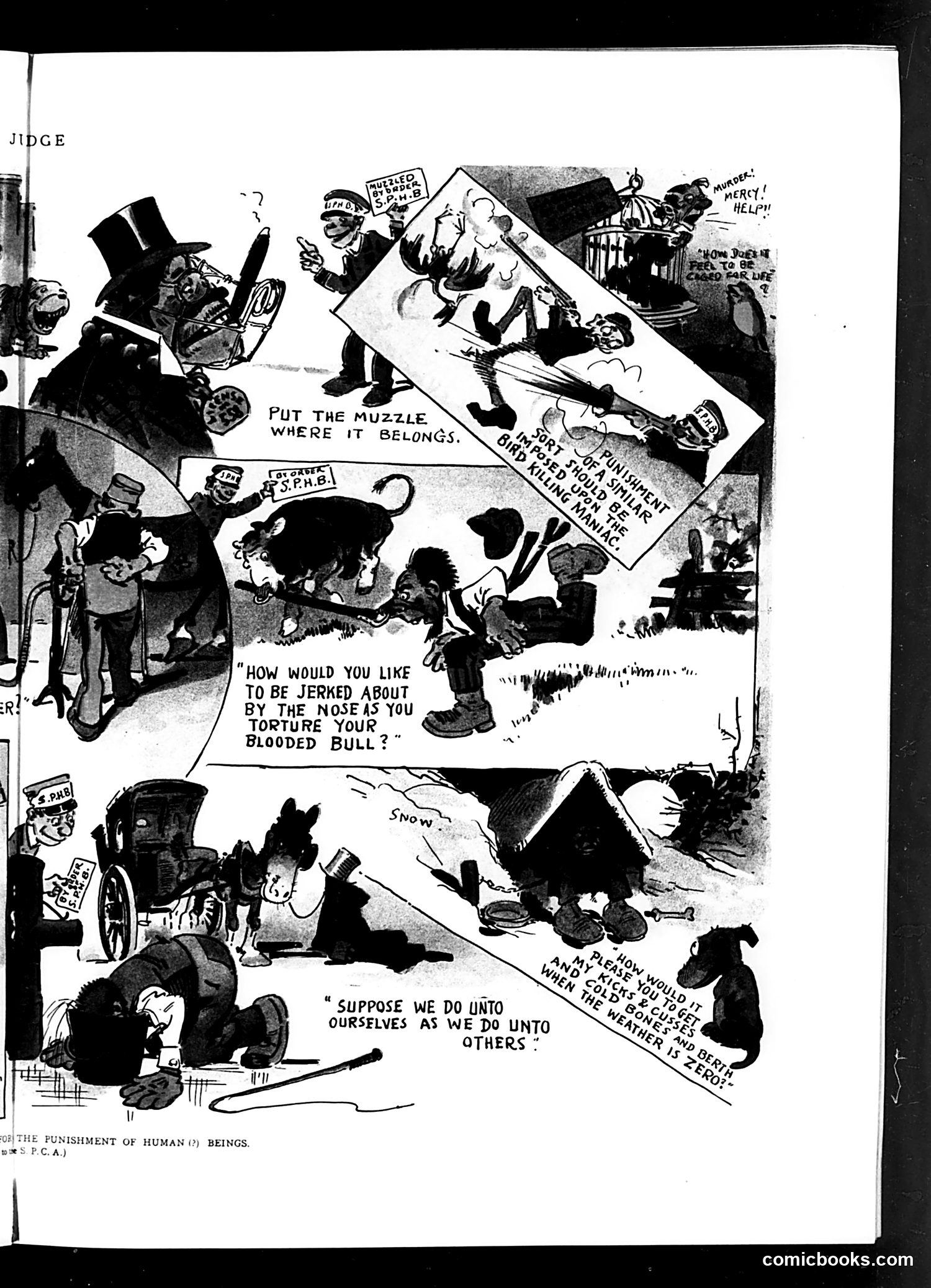
This Judge cartoon advocates for animal welfare, specifically criticizing cruel treatment of animals. The central image shows a man being jerked by the nose—mirroring how he tortures a bull. The satire invokes the Golden Rule ("Do unto others as you would have them do unto you"), suggesting that if humans experienced the same abuse they inflict on animals, they'd understand the cruelty. The S.P.C.A. (Society for the Prevention of Cruelty to Animals) reference indicates this reflects early 20th-century animal-rights activism. Various panels depict different forms of animal torture—nose-jerking, dragging, beating—with the "muzzle" headline suggesting restraint of human cruelty rather than animal behavior. The cartoon uses moral inversion to shame viewers into reconsidering how they treat animals.
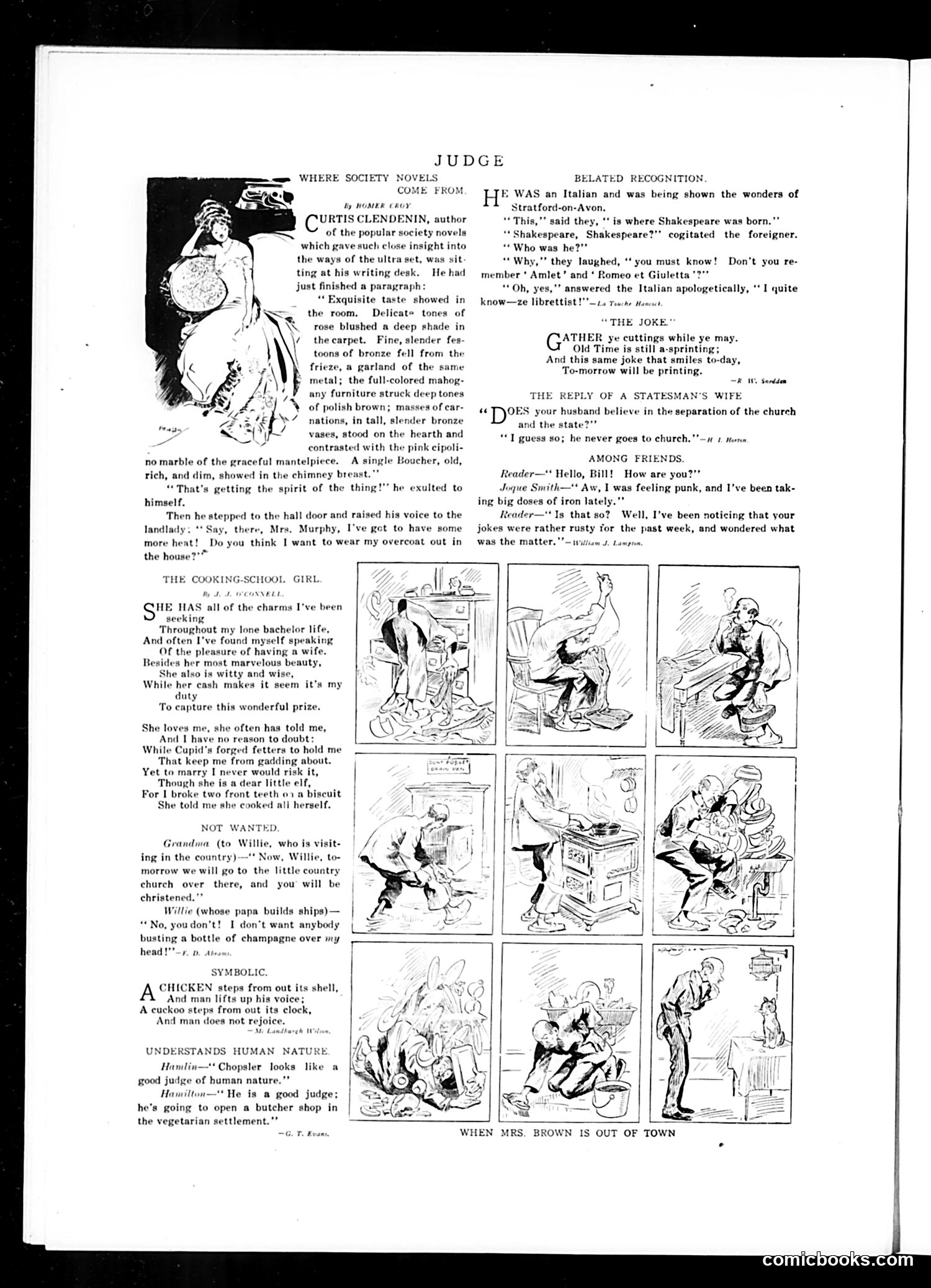
This page contains multiple short humorous pieces typical of early 20th-century American satirical magazines: **"Where Society Novels Come From"** mocks pretentious society fiction writers. Author Curtis Clendenin labors over ornate descriptions of wealthy interiors, then demands heat from his landlady—exposing the gap between the refined world he writes about and his actual shabby circumstances. **"Belated Recognition"** jokes that an Italian visitor to Shakespeare's birthplace knows him only as a librettist (opera writer), not as the playwright himself—suggesting Shakespeare's fame was filtered through operatic adaptations like Verdi's versions of his works. The remaining items are brief one-liners satirizing marriage, clergymen's hypocrisy, social pretension, and human nature—typical Judge formula humor targeting middle-class readers' everyday experiences and anxieties. The comic strip "When Mrs. Brown Is Out of Town" (bottom right) shows domestic chaos, likely depicting a husband's misadventures without his wife's supervision—a common theme of the era.
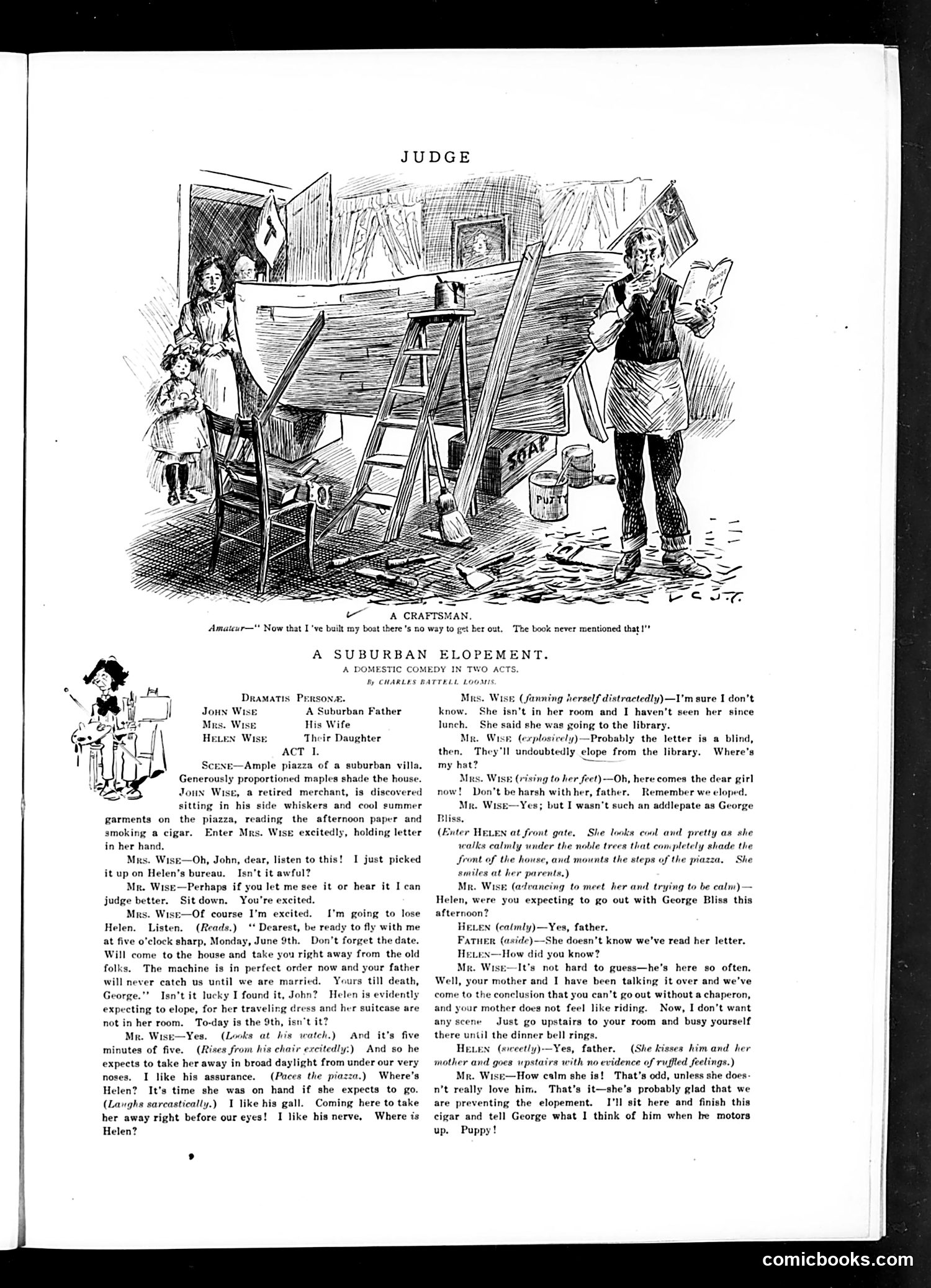
This page contains two satirical pieces about suburban life and romance. **Top Cartoon ("Judge"):** A craftsman complains he's built a boat on a patio with no way to remove it—mocking do-it-yourself incompetence and poorly-written instruction manuals. **Main Feature ("A Suburban Elopement"):** A domestic comedy script satirizing suburban parents and young love. The plot: John and Mrs. Wise discover their daughter Helen's elopement letter from boyfriend George Bliss, scheduled for 5 PM. The humor lies in the parents' overwrought panic—the father brandishes his hat, the mother faints theatrically—versus Helen's calm, proper acceptance when confronted. The satire targets both the melodramatic parents and the would-be elopers' naïveté. The piece gently mocks suburban manners, parental authority, and romantic convention in early 20th-century middle-class America.
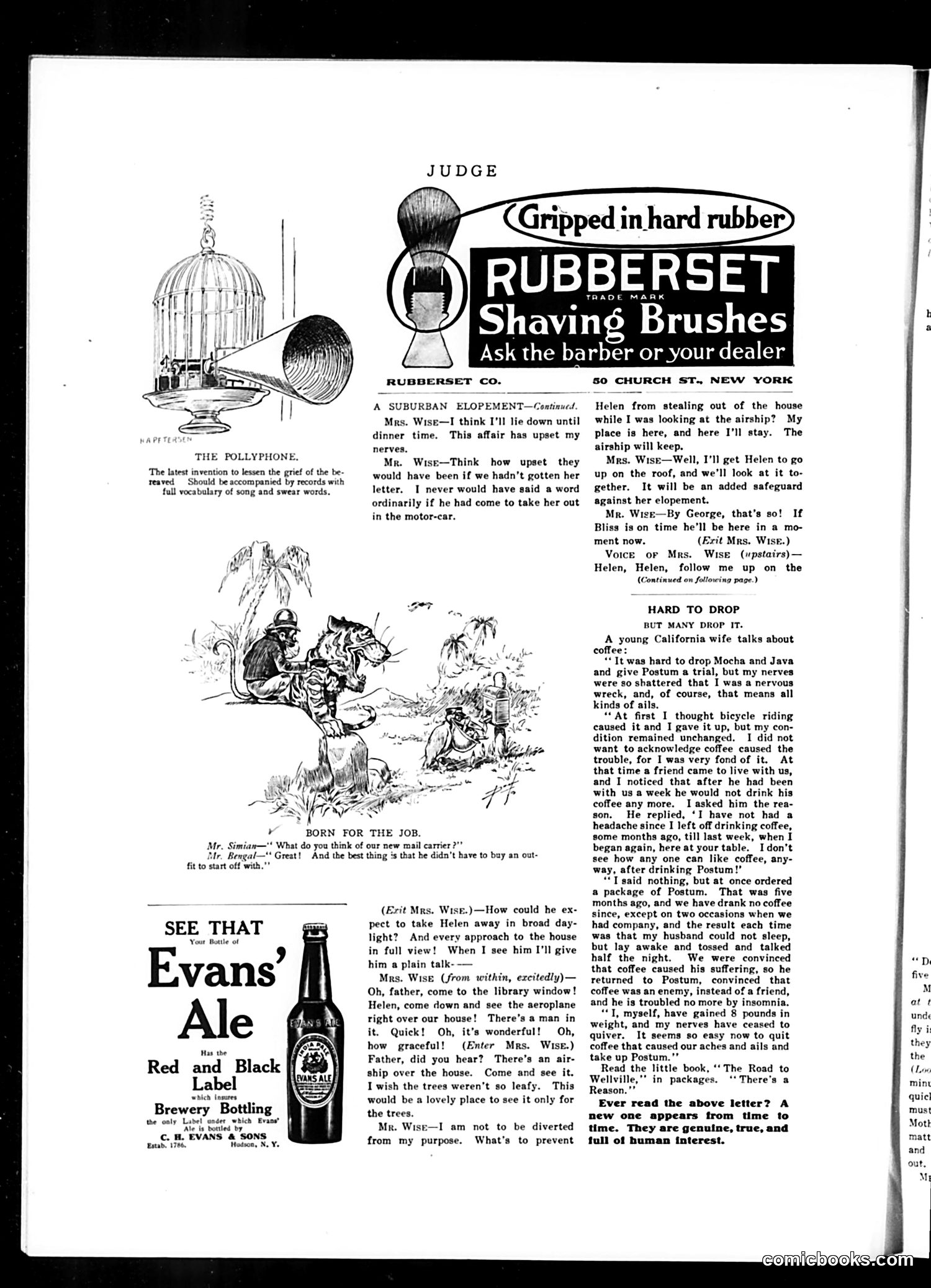
This page contains multiple elements typical of early-20th-century Judge magazine: satirical cartoons, humorous fiction, and advertisements. **"The Pollyphone" cartoon** satirizes a fictional mechanical device marketed to the bereaved—essentially mocking both technological overreach and grief commercialization. The joke suggests the device needs "records with full vocabulary of song and swear words," implying people oscillate between sentimentality and profanity while mourning. **"A Suburban Elopement"** is a continuing serialized domestic comedy about parents anxious over their daughter Helen's romantic prospects, distracted by an airship passing overhead—contemporary satire reflecting early aviation's novelty and distraction. **"Born for the Job"** makes a brief visual gag about a new mail carrier (depicted as a monkey/primate), suggesting he's naturally suited to the work through crude racial/evolutionary humor typical of the era. The advertisements for Rubberset brushes, Evans' Ale, and Postum coffee represent period marketing. The Postum ad notably uses testimonial copy promoting coffee-cessation for health—reflecting contemporary anxieties about caffeine's effects.
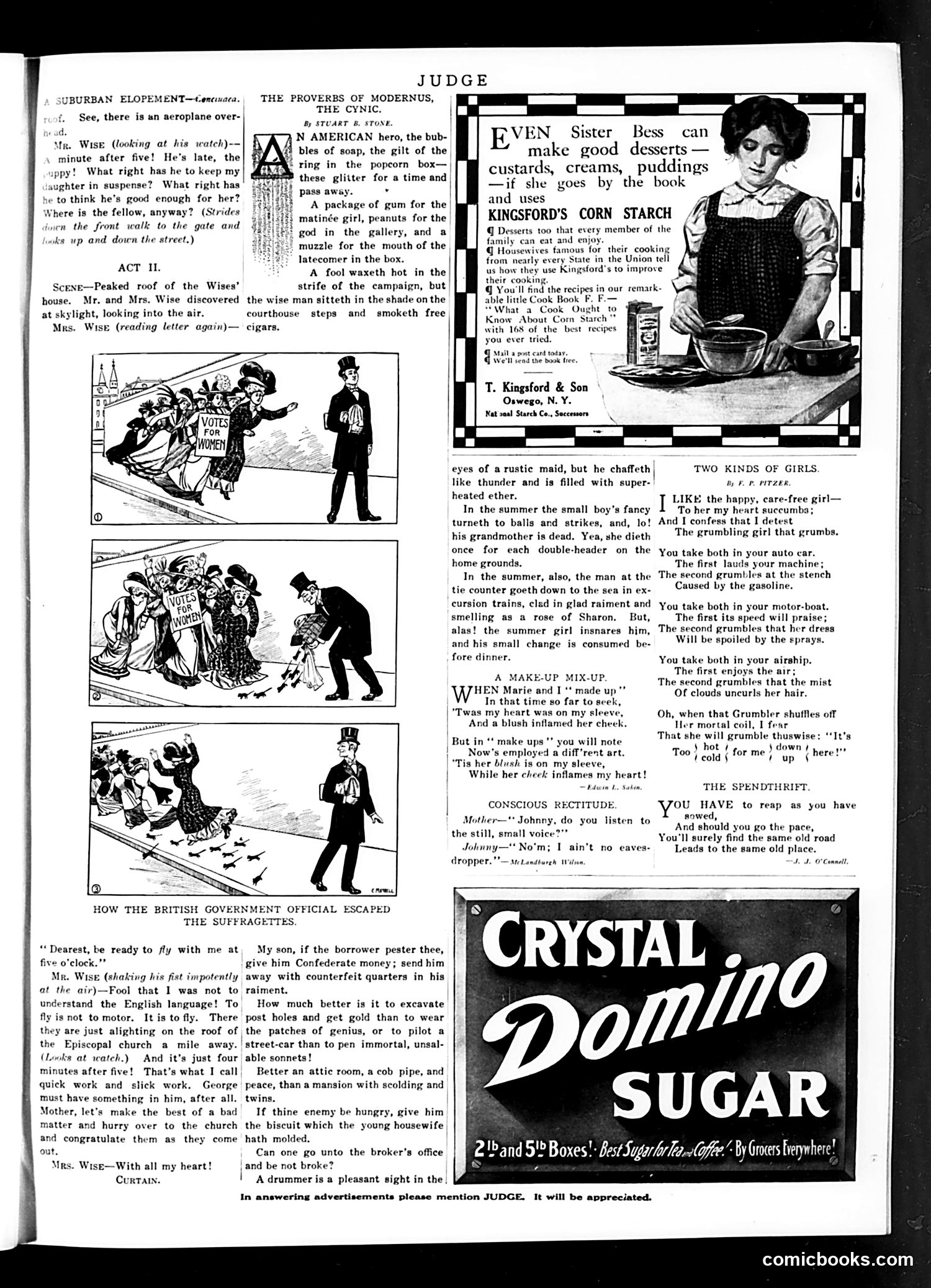
This page contains three distinct elements: **"Suburban Elopement" Comic Strip (top):** A three-panel story depicting a father waiting anxiously for his daughter's suitor, who arrives by airplane rather than automobile—a contemporary joke about newfangled aviation technology. The humor centers on the father's confusion that "to fly" means literal flight, not motoring. **"How the British Government Official Escaped the Suffragettes" (bottom left):** A brief humorous anecdote about a British official using an airplane to evade suffragette activists demanding voting rights. This references the early 1900s British women's suffrage movement, where protesters were known for confrontational tactics. **Text & Advertisements (right):** Includes satirical aphorisms by "Stuart B. Stone" mocking modern American materialism, poetry about romantic rekindling, and period advertisements for Kingsford's corn starch and Crystal Domino sugar. The page overall reflects early 1910s preoccupations: aviation novelty, women's political activism, and consumer product marketing through lifestyle imagery.
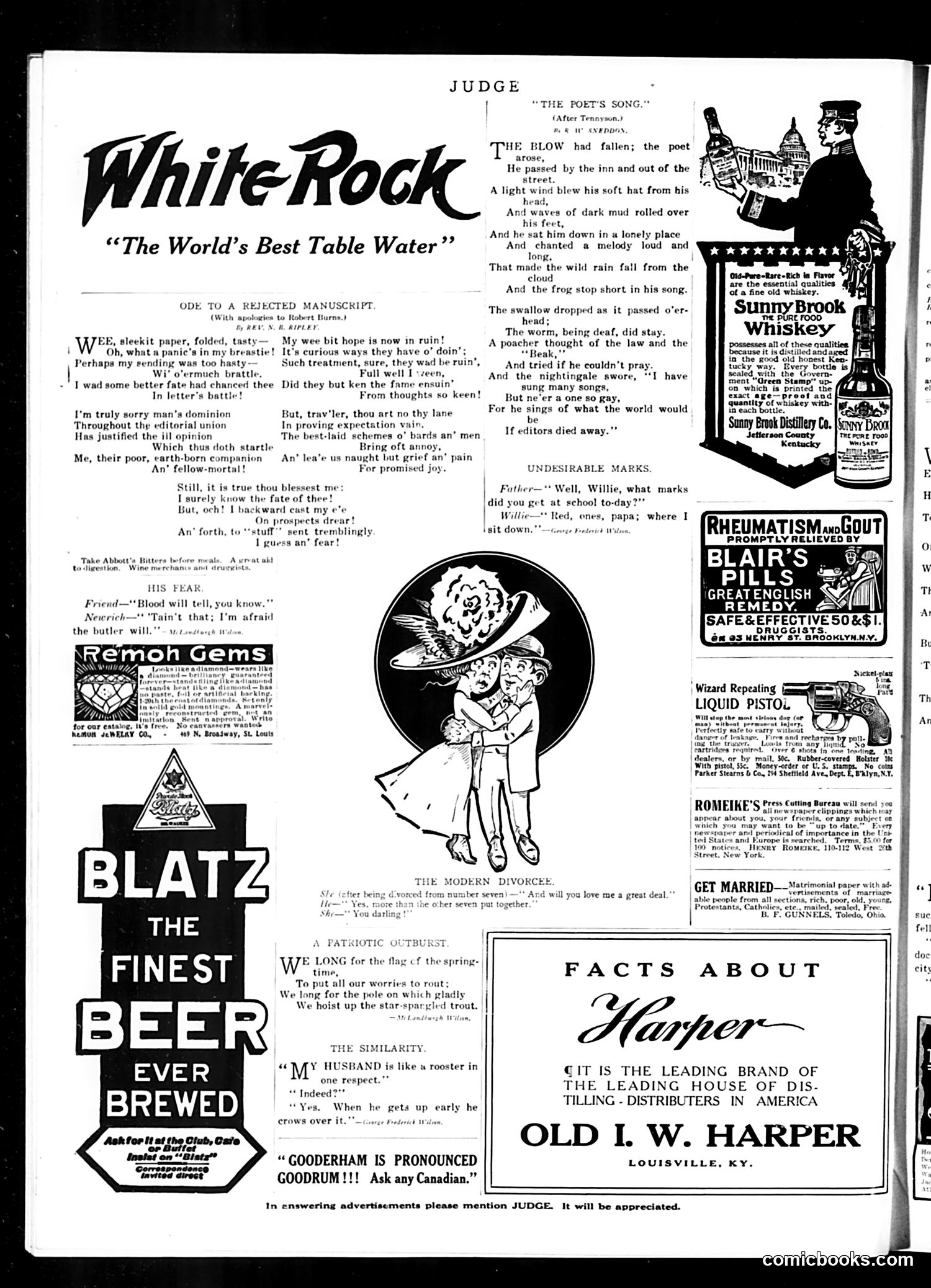
This page from *Judge* magazine contains primarily **poetry and advertisements** rather than political cartoons with topical satire. The poetry includes humorous parodies: "The Poet's Song" (mocking Tennyson) depicts a rejected poet dramatically lamenting in the rain, and "Ode to a Rejected Manuscript" mimics Robert Burns's dialect while sympathizing with a rejected writer's frustration with editors. Two brief jokes appear: "His Fear" plays on class anxiety—a newly wealthy person worries the butler will expose their humble origins. "The Modern Divorcee" and "The Similarity" offer mild domestic humor about marriage. The **bulk of the page is advertisements** for whiskey (Sunny Brook, Old I.W. Harper), patent medicines (Blair's Pills for rheumatism), and novelty items (Remoh Gems, a liquid pistol toy). The content reflects *Judge's* typical mix of light verse, social observation about manners, and commercial promotions rather than sharp political commentary.
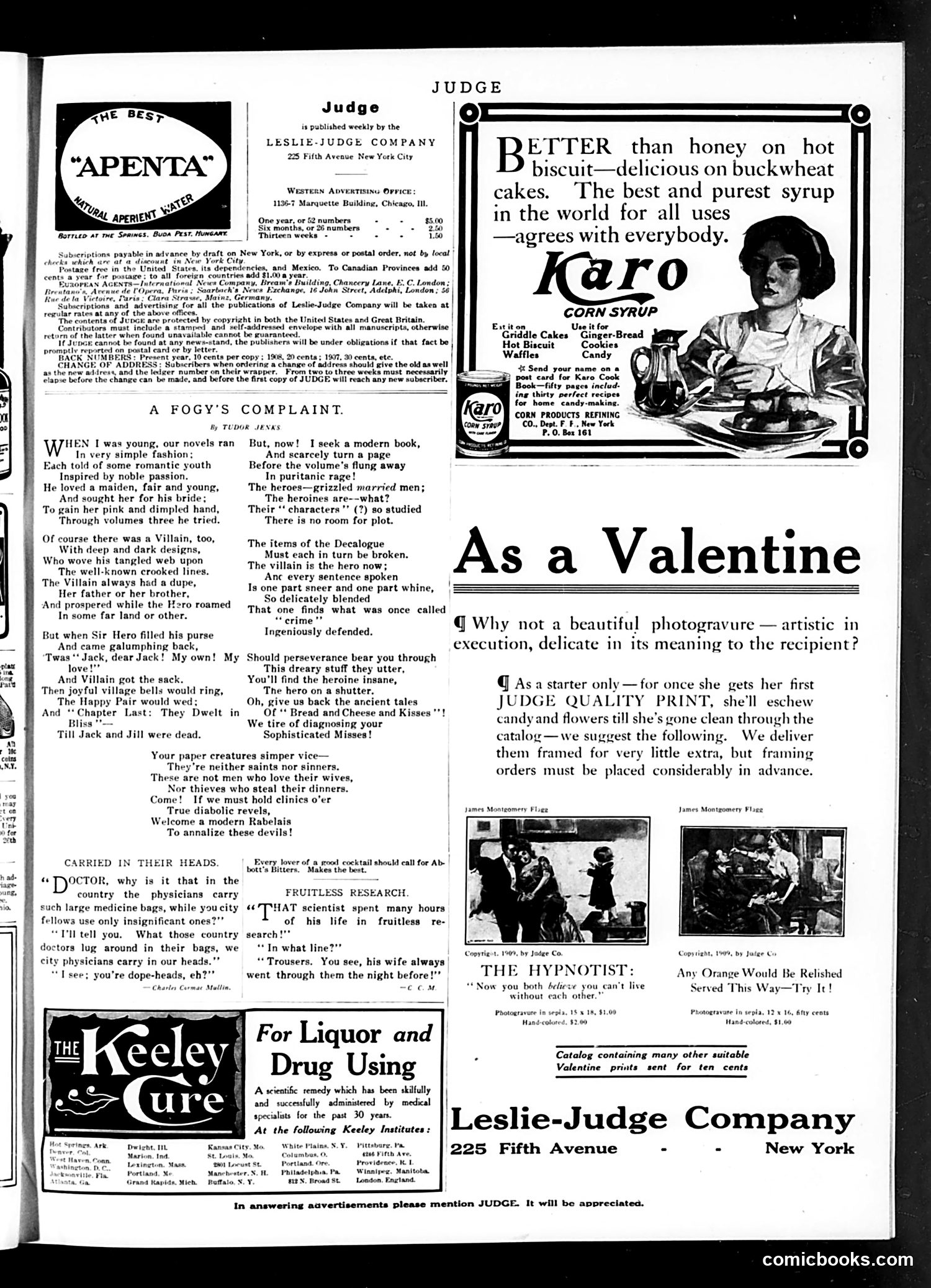
This page is primarily **advertising and light satirical content** rather than political cartooning. The main satirical piece is "A Fogy's Complaint" by Tudor Jenks—a humorous lament about modern literature. An elderly reader complains that old novels featured simple romantic plots with clear heroes, villains, and happy endings. Modern books (circa 1908), by contrast, feature morally ambiguous characters, psychological complexity, and focus on analyzing vice rather than telling coherent stories. The fogy yearns for classic tales of "Bread and Cheese and Kisses" instead of contemporary "Sophisticated Misses." The page otherwise consists of **product advertisements**: Apenta natural aperient water, Karo corn syrup, The Keeley Cure (a treatment institute for alcohol/drug addiction), and Leslie-Judge Company's Valentine photogravures. A brief joke called "Carried in Their Heads" uses the pun that country doctors carry medicine bags while city doctors supposedly carry their knowledge in their heads. The satire targets **changing literary tastes and modernist complexity**, not politics.
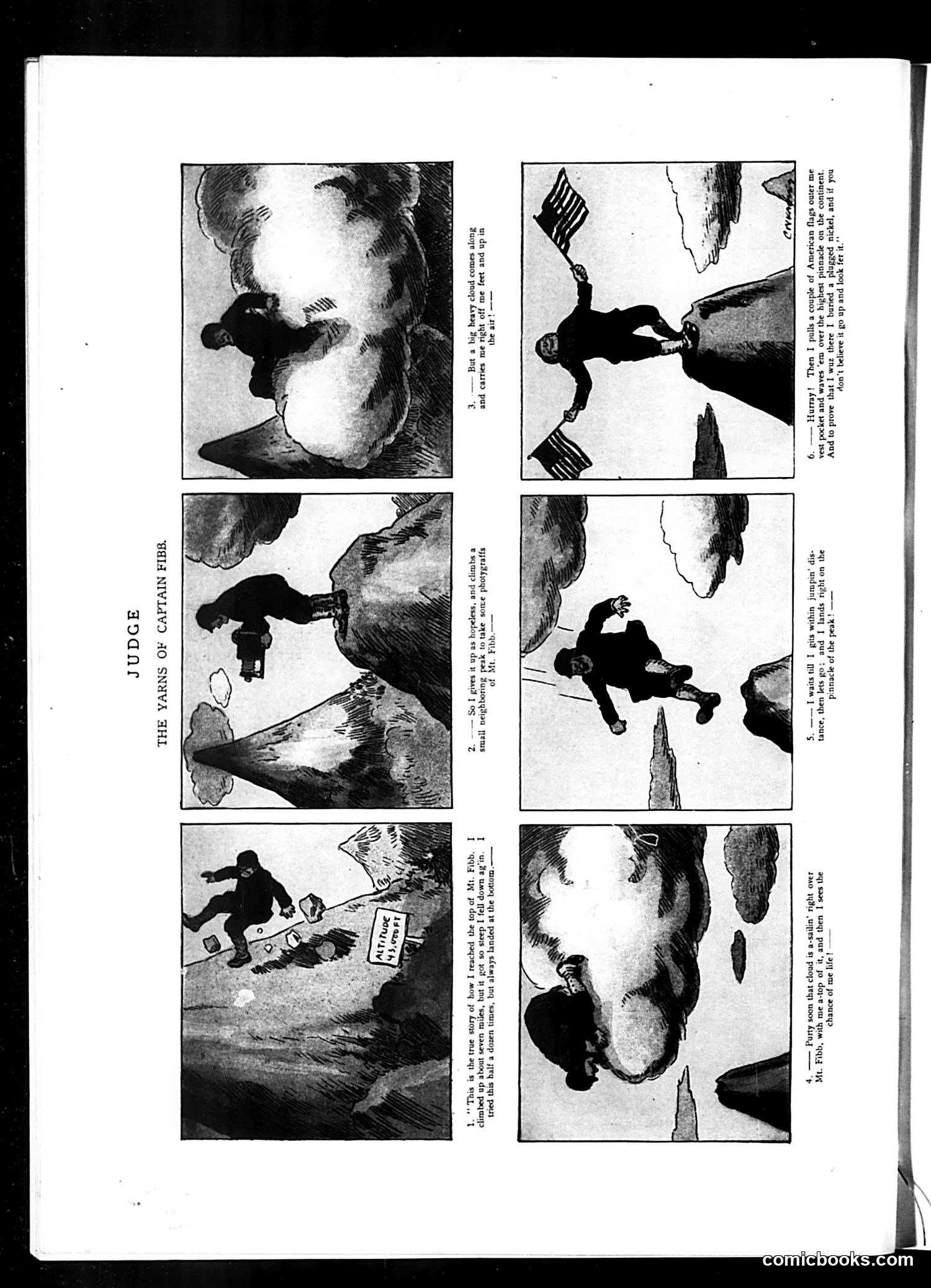
This page presents a political cartoon sequence (the OCR is severely corrupted, making exact captions difficult to read). The silhouetted figures and their positioning suggest a narrative commentary on political or military leadership during a critical period. The title references "Captain" and "years," likely satirizing a political or military figure's tenure. The images show what appears to be a progression—possibly depicting leadership decisions, their consequences, or public reception. The flags visible in some panels suggest international or diplomatic contexts. Without clearer text or date information, the specific figure and historical moment remain unclear, but the format—a sequential visual narrative with commentary—was Judge magazine's typical method for political satire. The progression from image to image implies judgment about how events unfolded or how a leader's actions were perceived over time. **I cannot confidently identify the specific figure or historical event without legible captions.**