A complete issue · 16 pages · 1909
Judge — December 11, 1909
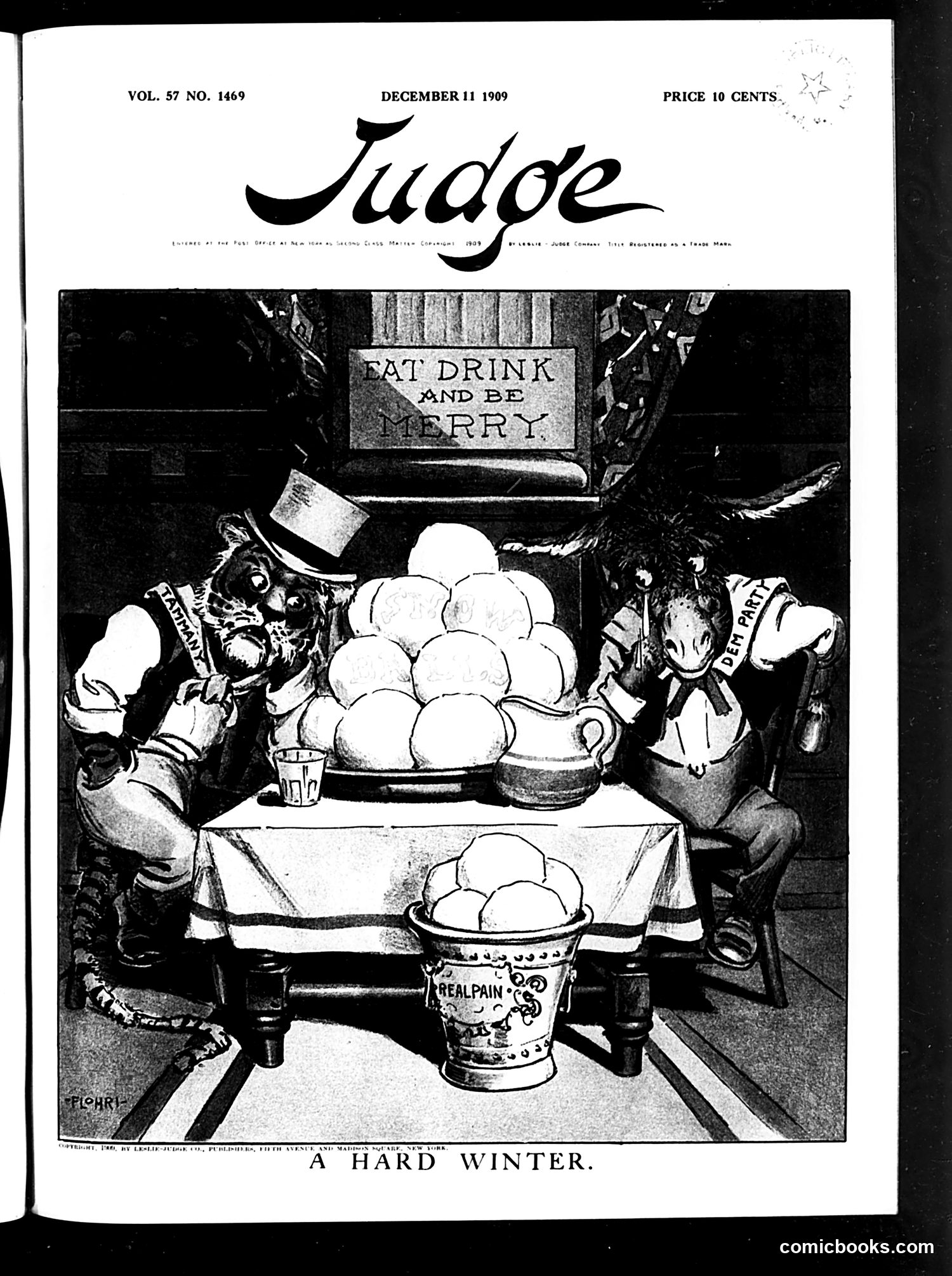
This satirical cartoon titled "A Hard Winter" depicts two anthropomorphic animals (appearing to be rats or similar creatures) in formal attire seated at a table laden with eggs. A sign reads "Eat Drink and Be Merry." A container labeled "Realpain" sits below. The satire likely comments on economic hardship or scarcity during winter—the ironic contrast between the cheerful directive to "eat drink and be merry" and the depicted reality of survival on basic provisions (eggs). The "Realpain" label suggests actual suffering beneath forced merriment. Without additional context, the specific political figures or events referenced remain unclear, though the cartoon clearly mocks either government policy responses to winter conditions or the public's circumstances during this period.
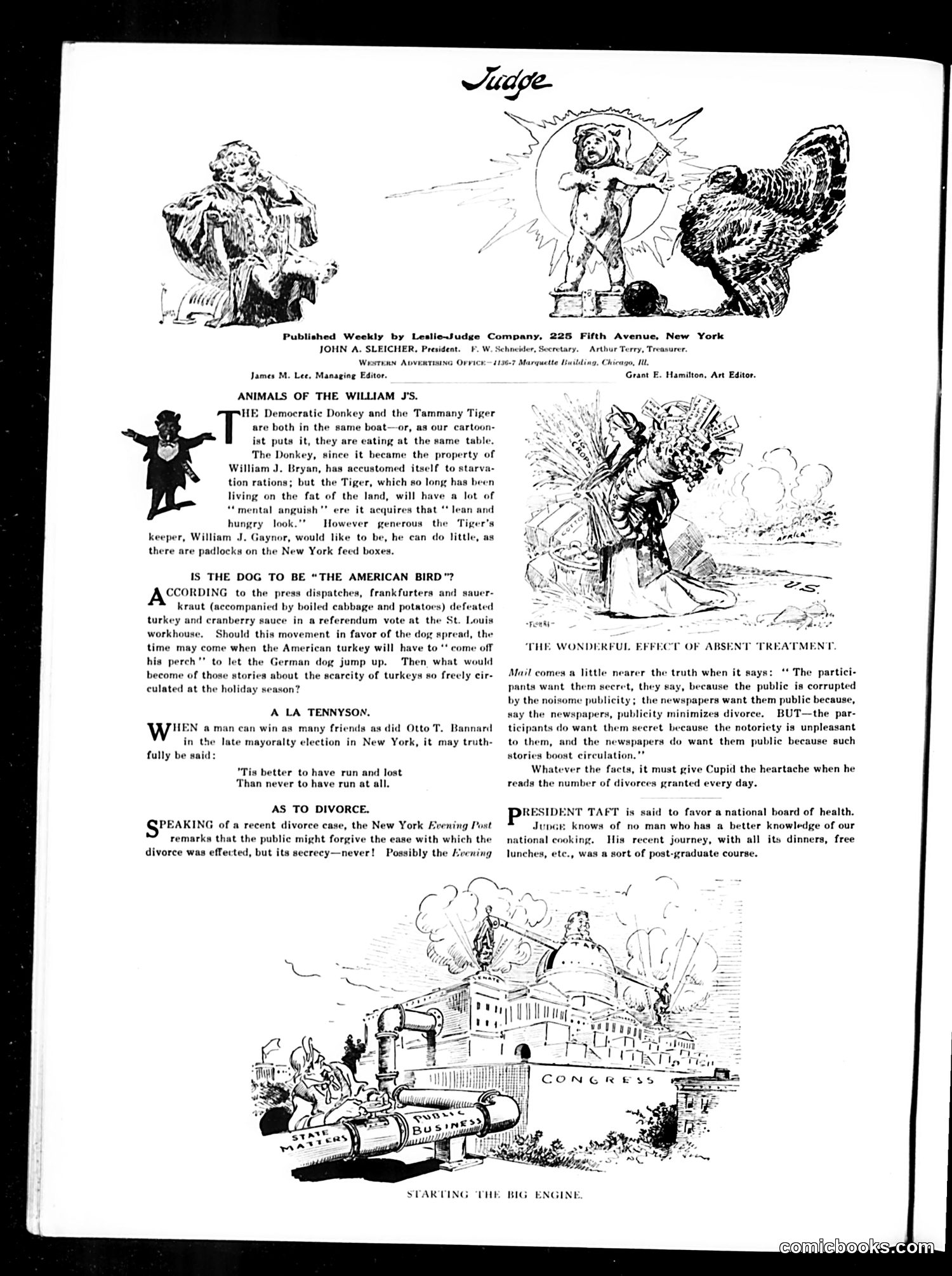
This satirical page contains several editorial cartoons and commentary from the early 20th century: **"Animals of the William J.s"** discusses a Democratic donkey and Tammany Tiger both competing for resources, suggesting political rivalry between William J. Bryan (Democratic leader) and Tammany Hall (New York political machine). **"Is the Dog to Be 'The American Bird'?"** mocks a referendum where working-class voters chose hot dogs over turkey, satirizing both populist democracy and food preferences. **"Starting the Big Engine"** (bottom cartoon) depicts Congress as machinery being activated to stimulate business and the economy. The cartoons employ anthropomorphized animals and mechanical metaphors to critique political power structures, voter behavior, and governmental economic policies in early-1900s America.
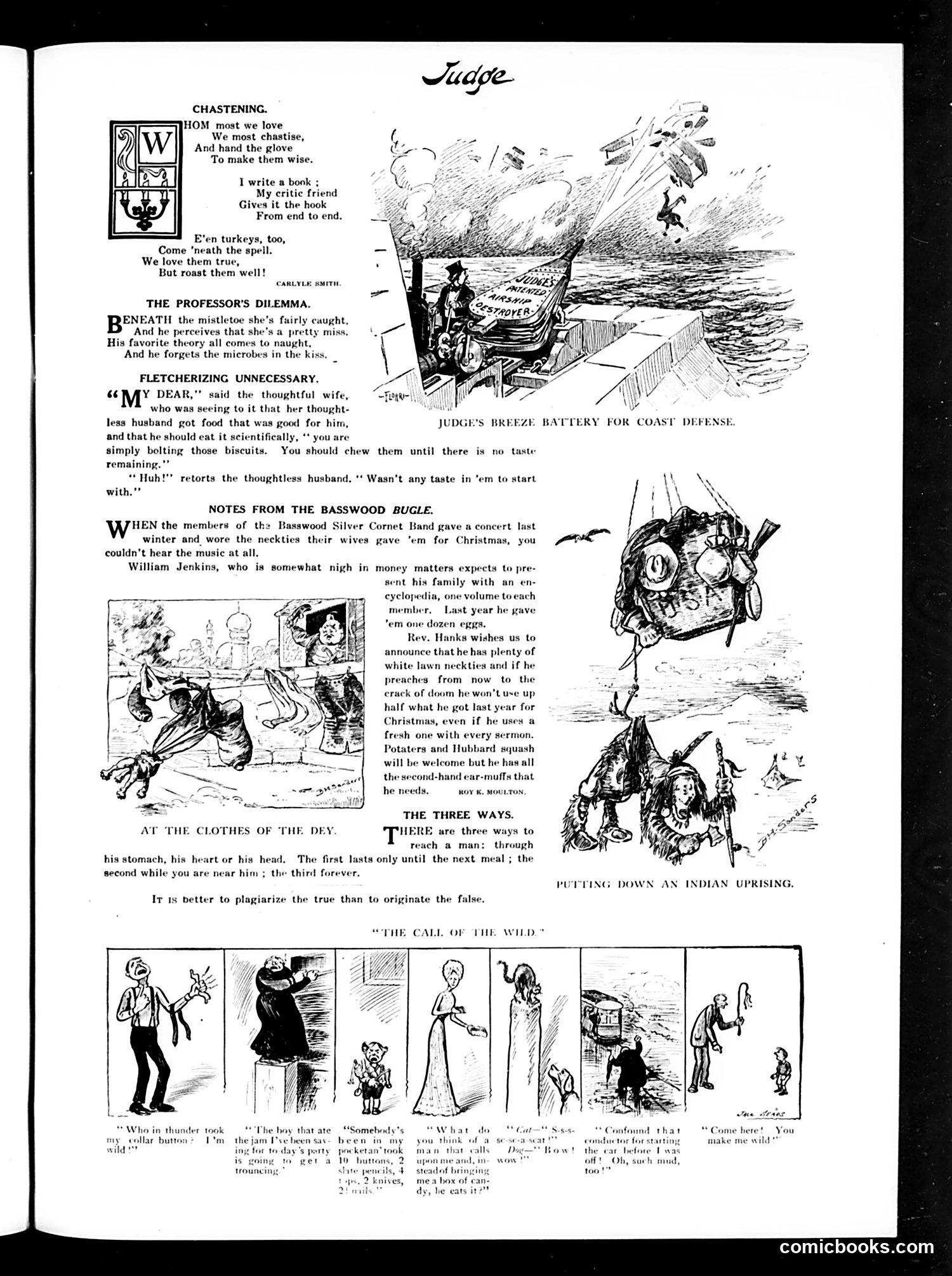
This page contains several distinct satirical pieces: **"Judge's Breeze Battery for Coast Defense"** depicts a large cannon or military apparatus, likely satirizing contemporary coastal defense preparations, possibly related to WWI-era concerns. **"Putting Down an Indian Uprising"** shows a chaotic scene, probably mocking either current colonial conflicts or romanticized Wild West narratives popular in that era. **"The Call of the Wild"** is a comic strip series showing various scenarios with captions like "Who in thunder took my collar button?" and "Come here! You make me wild!" These appear to be humorous domestic mishaps rather than political commentary. The page also includes poetry sections ("Chastening," "The Professor's Dilemma") and a "Notes from the Basswood Bugle" section with social humor about church donations and holiday gifts. The content is primarily comedic rather than overtly political.
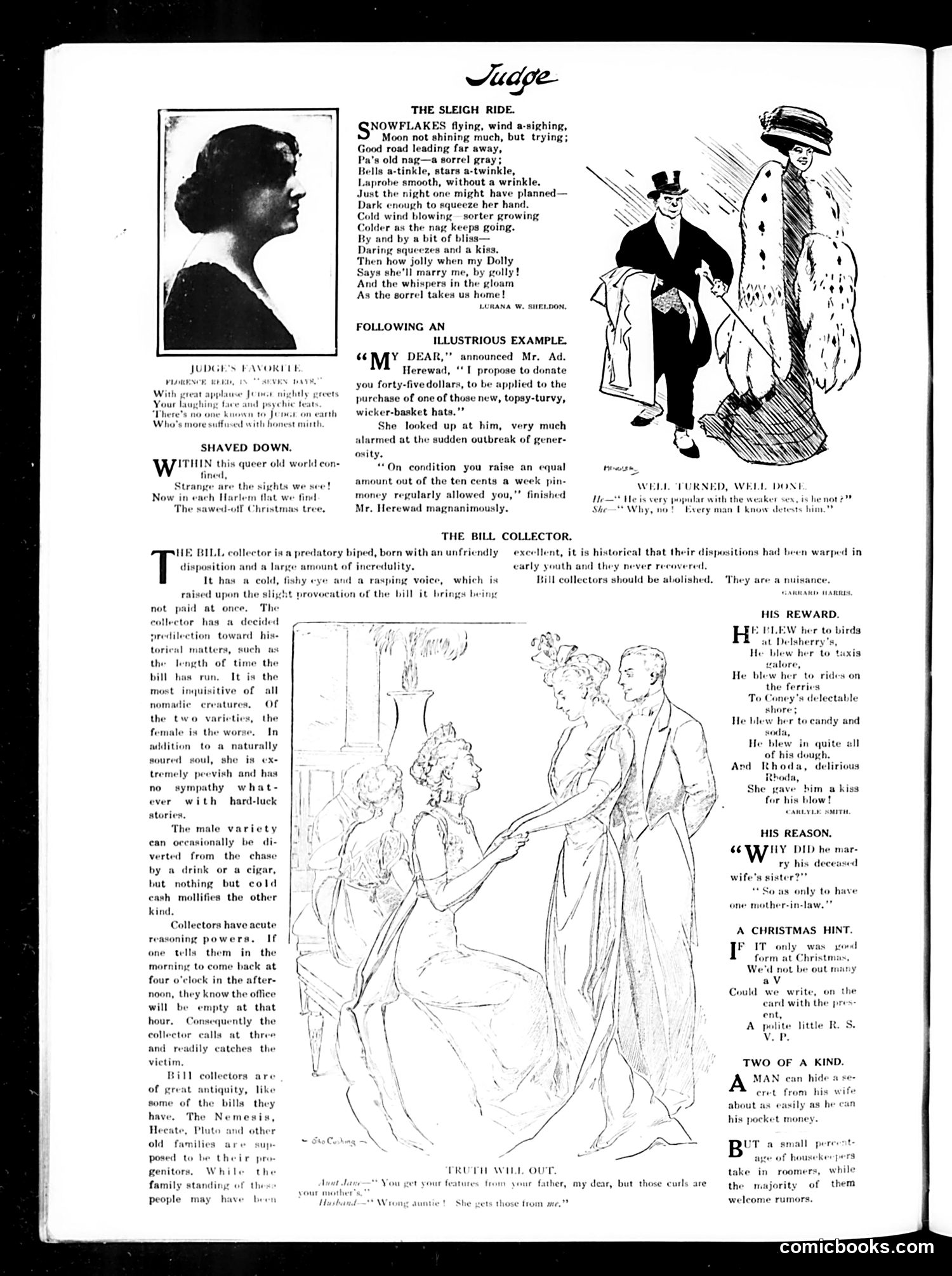
This page contains several unrelated satirical pieces and light humor rather than a coherent political cartoon. **"The Sleigh Ride"** is a romantic poem about winter courtship, illustrated with a couple in a sleigh. **"Following an Illustrious Example"** depicts a man offering to donate "ten dollars" to purchase a fashionable hat for a woman—satirizing male vanity or perhaps mocking charitable pretense disguised as generosity. **"The Bill Collector"** is an extended commentary on debt collectors as inherently disagreeable characters, describing their unpleasant disposition and predatory nature—a timeless social complaint. The remaining sections are brief humorous verses on various domestic and romantic topics, typical of Judge's light satirical content for general audiences.
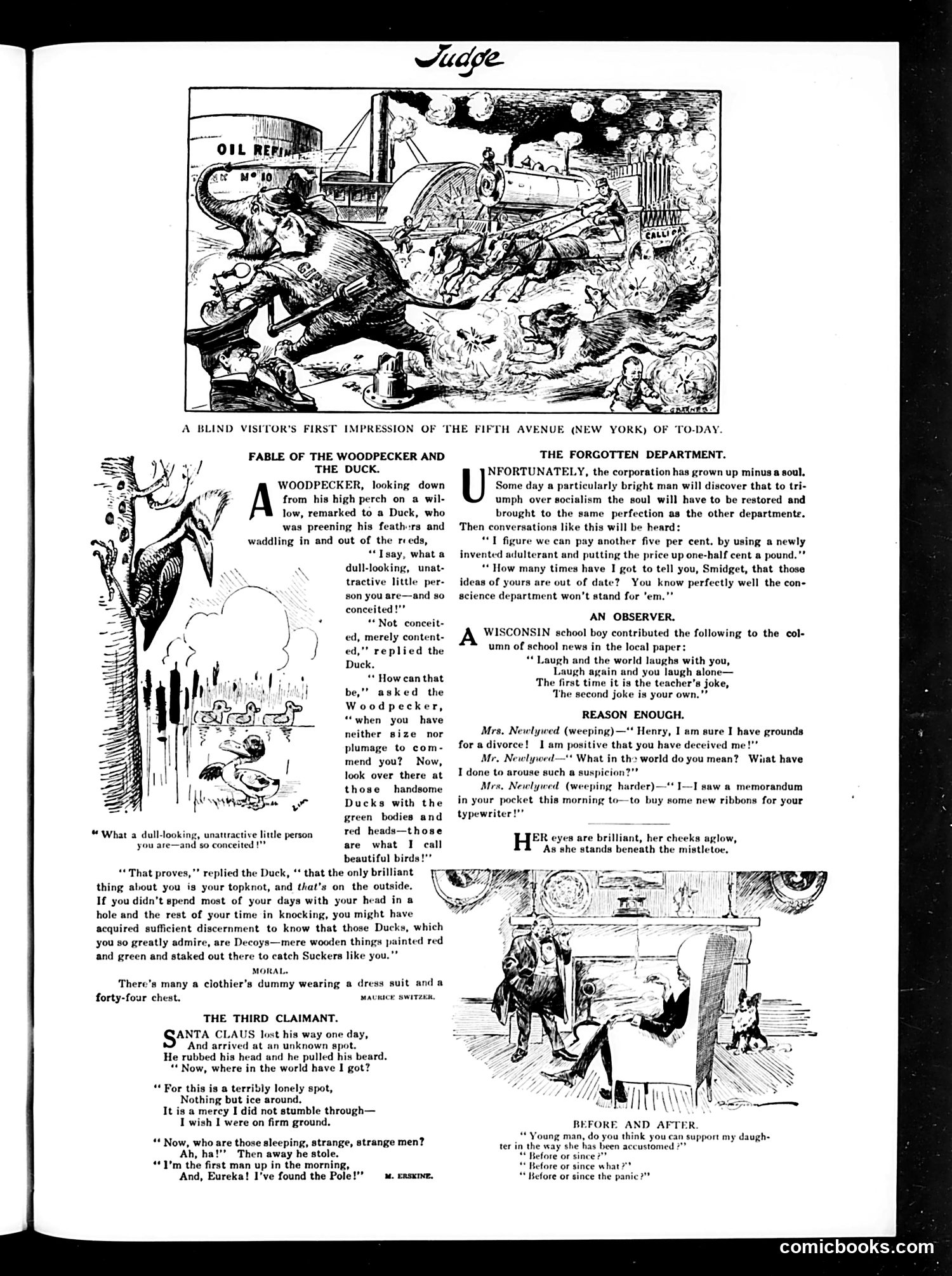
The top cartoon, titled "A Blind Visitor's First Impression of the Fifth Avenue (New York) of To-Day," depicts a chaotic street scene with industrial machinery, factories, and violent action. The satire critiques the transformation of Fifth Avenue—traditionally an elite residential neighborhood—into an industrial district. The "blind visitor" device allows the artist to defamiliarize the scene, suggesting that even sightless observers would recognize the dramatic and unwelcome change. The page contains several short humorous pieces below, including "Fable of the Woodpecker and the Duck" (a moral tale) and other anecdotes like "The Forgotten Department" and "The Third Claimant." These are typical Judge filler content—light social satire and observational humor rather than focused political commentary.
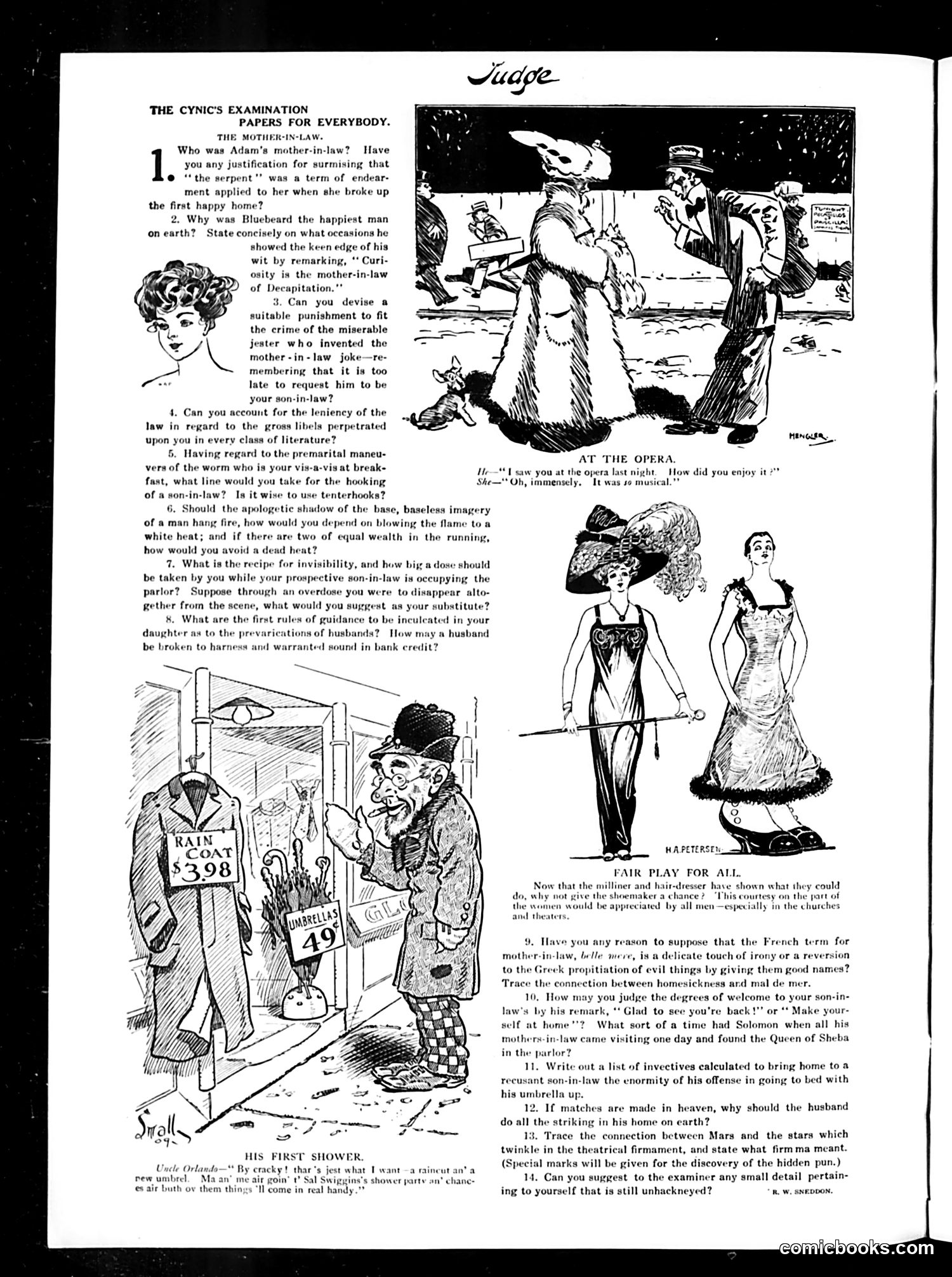
This page satirizes the mother-in-law through mock examination questions—a popular comic device of the era. The joke targets the "mother-in-law" as a universal figure of marital discord and domestic frustration. The questions employ cynical humor: asking why Adam's serpent-temptress was "really" his mother-in-law, why Bluebeard seemed happy (implying murder solved his problem), and whether the original mother-in-law joke inventor deserves punishment worse than death. Questions escalate absurdly—comparing mothers-in-law to cosmic forces, asking husbands to account for their "striking" (hitting?) at home. The accompanying cartoons show domestic scenes: a "first shower" (unclear reference), and "fair play for all" depicting women at the opera and in fashionable dress. The satire reflects early 20th-century anxiety about marriage, family hierarchy, and women's roles—treating the mother-in-law as comedy's favorite scapegoat for domestic unhappiness, particularly marital conflict.
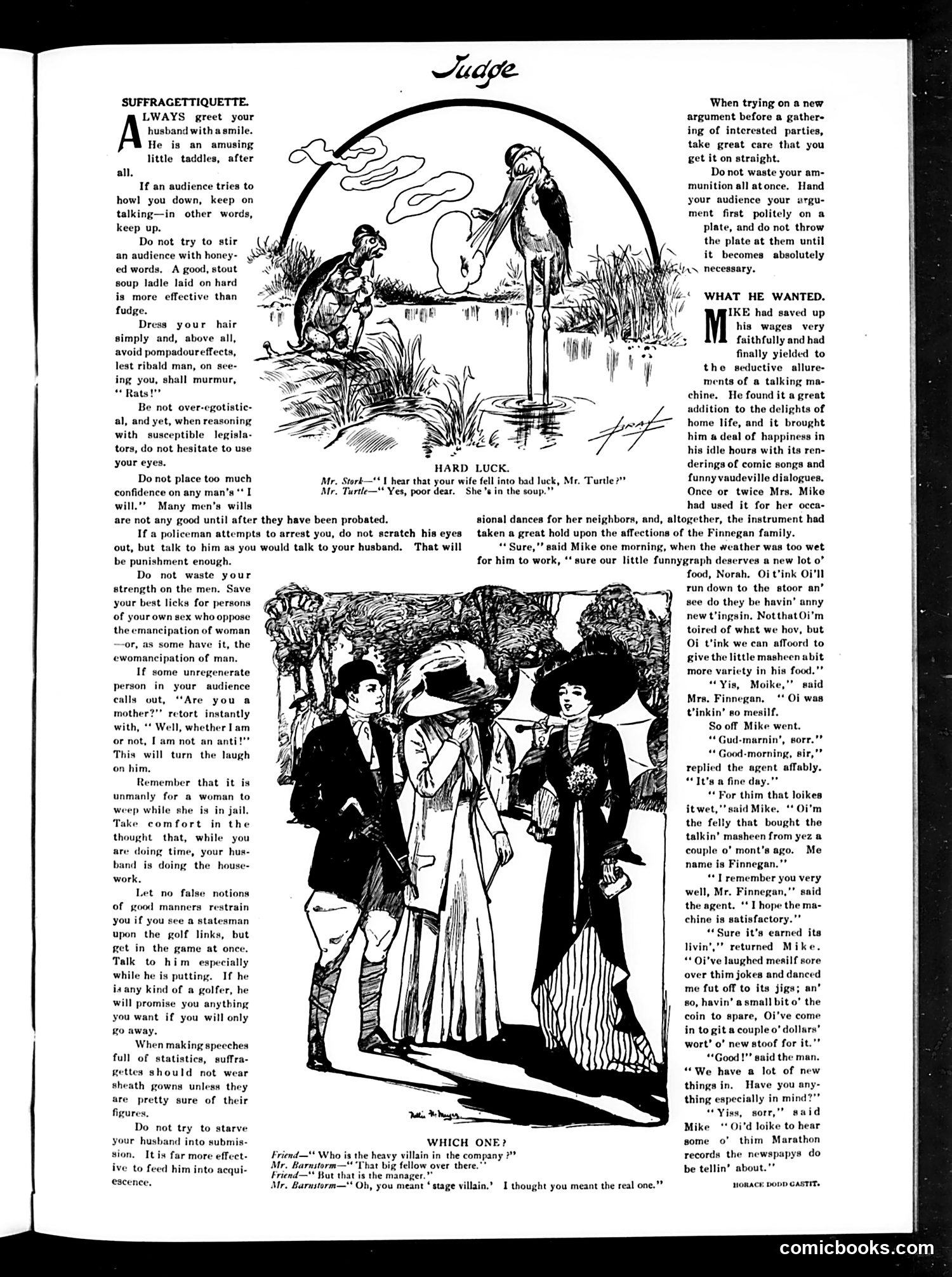
This page from *Judge* magazine contains anti-suffrage satire disguised as advice. The left column mock-seriously addresses women's suffrage activists ("suffragettes"), offering ostensibly helpful tips that actually ridicule their methods—suggesting they use "soup ladles" on audiences, manipulate legislators with their eyes, and interrupt golfers mid-putt. The satire implies suffragettes are aggressive, irrational, and unfeminine. The cartoons below present unrelated domestic humor: one shows a turtle's wife falling in soup (visual pun on "in the soup" = in trouble), and another depicts an Irish immigrant named Mike buying phonograph records for his family's talking machine. The Irish dialect humor and the working-class domestic scenario were typical period comic fare, separate from the suffrage satire above.
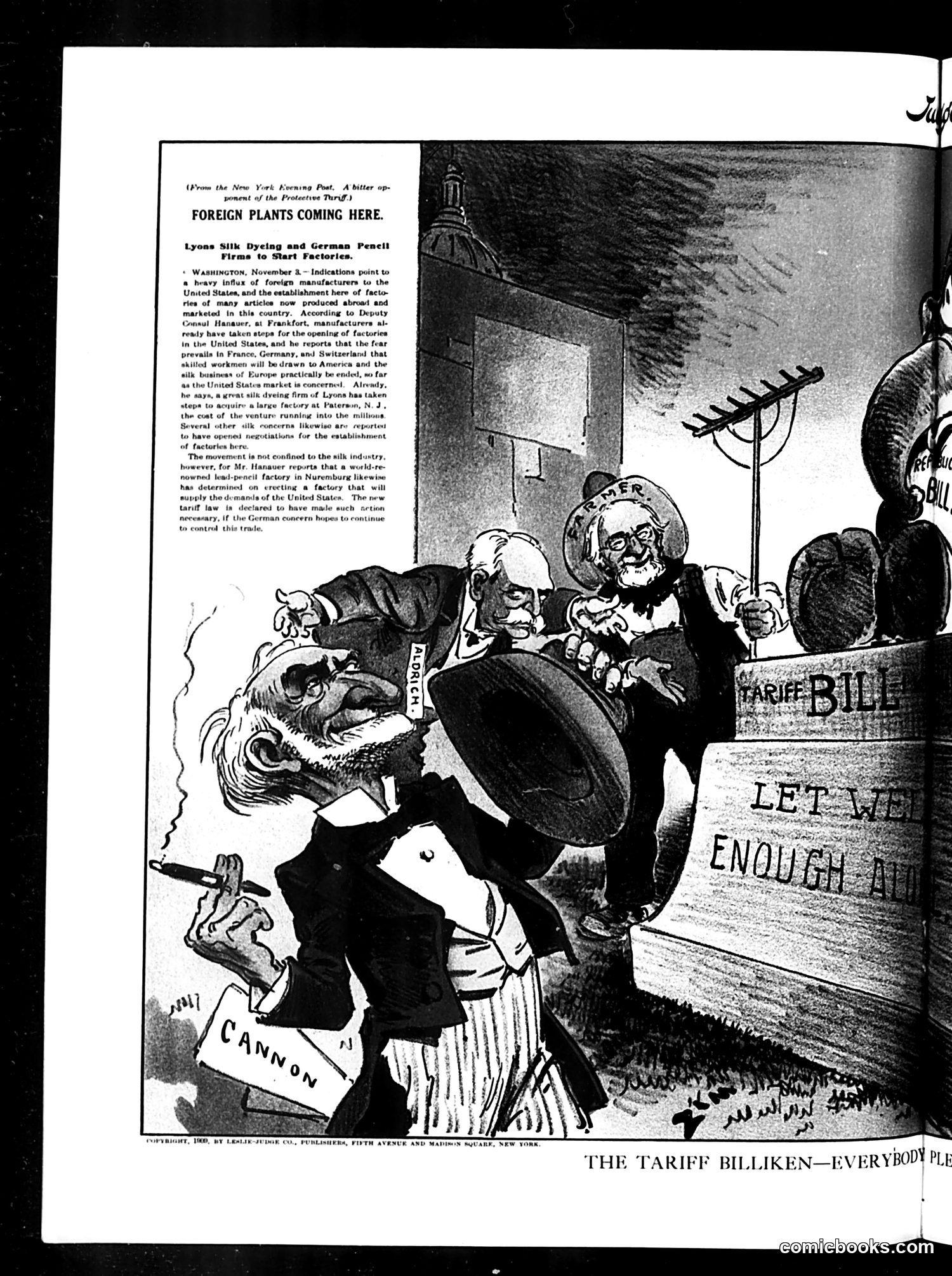
This cartoon satirizes the **Protective Tariff** debate of early 20th-century American politics. The image depicts foreign manufacturers (represented as menacing figures labeled with "CANNON" and other identifiers) attempting to enter the United States, carrying goods and battering down a barrier marked "TARIFF BILL" and "LET HE[R] ENOUGH ALONE." The accompanying article reports that foreign silk-dyeing and pencil firms plan to establish U.S. factories—news that *pro-tariff* advocates warned against. The cartoon's grotesque caricatures of foreigners suggest the threat posed by foreign competition. **The satire's point**: The cartoon mocks anti-tariff sentiment, arguing that protective tariffs are necessary to keep foreign manufacturers out. The figure labeled "CANNON" likely references Joseph Cannon, a prominent tariff opponent. For modern readers: this reflects historical debates over whether tariffs protect American workers and industry or merely increase consumer costs.
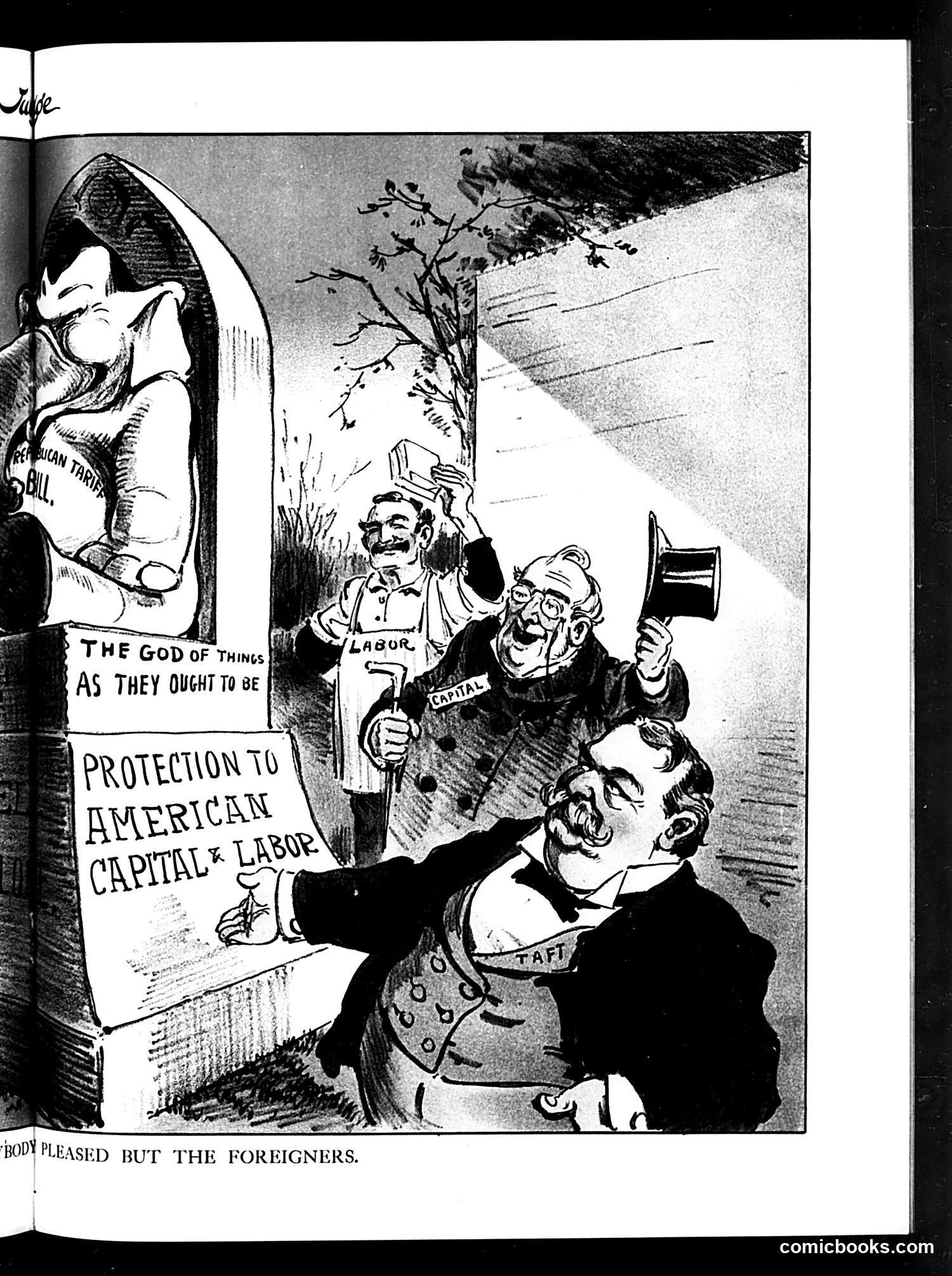
This Judge magazine cartoon satirizes American protectionist trade policy, likely from the early 1900s. The left panel shows an idol labeled "The God of Things As They Ought to Be," with a plaque reading "Protection to American Capital & Labor." Three caricatured figures (appearing to represent American political or business interests) worship before this idol. One wears a "Labor" shirt, another is labeled "Capital," and a third—labeled "Taft"—holds a hat, suggesting President William Howard Taft. The caption "Nobody Pleased But the Foreigners" indicates satire: the cartoon mocks how American protectionist policies supposedly benefited domestic interests while actually harming foreign trade partners. The dead tree in the background symbolizes economic decline resulting from these policies. The cartoon criticizes the contradiction between protectionism's stated goals and its actual effects.
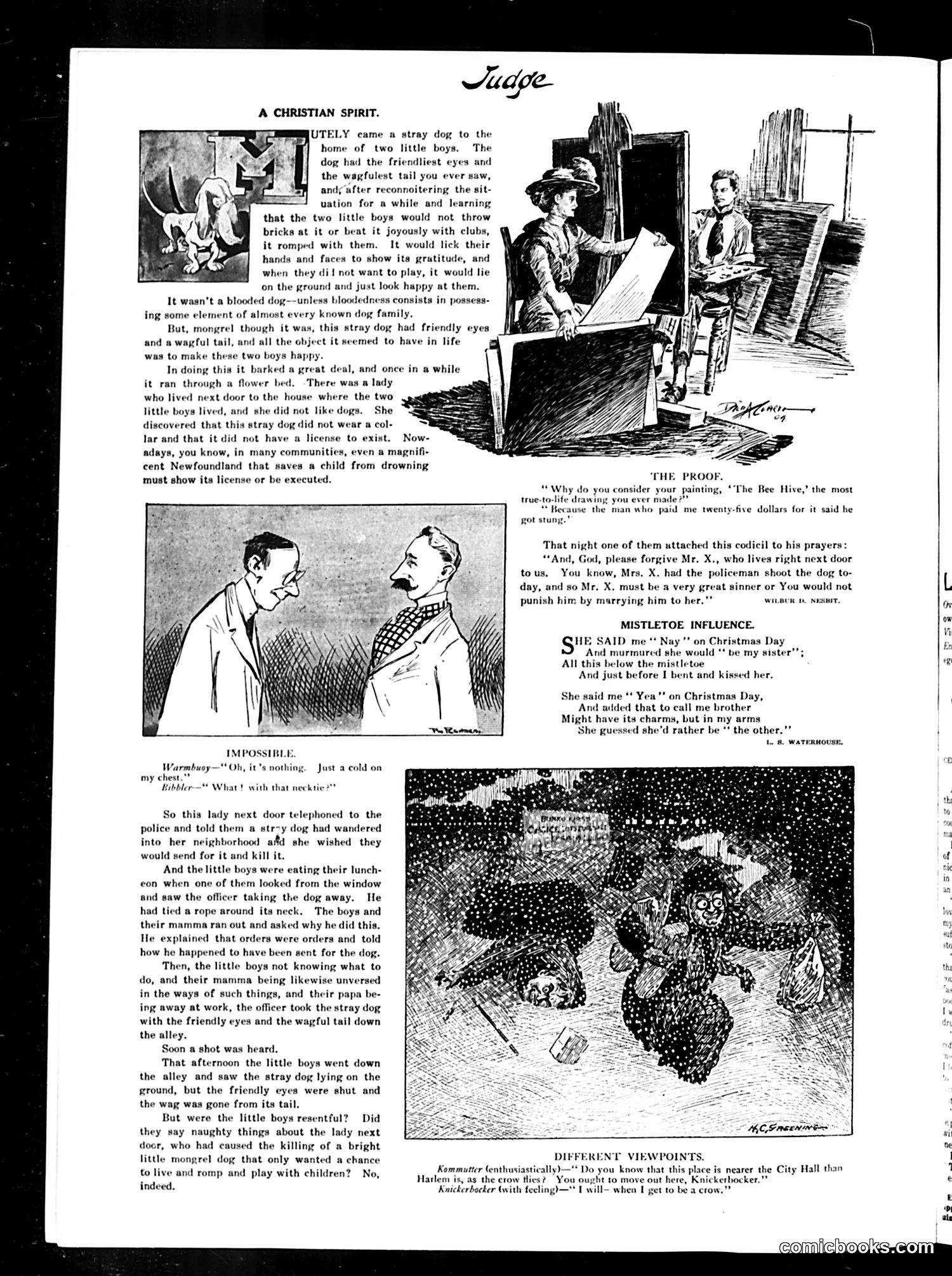
This page contains multiple short stories and cartoons critiquing hypocrisy and cruelty in American society. **"A Christian Spirit"** tells of a stray dog befriended by two boys, killed after a neighbor reports it unlicensed to police. The satire attacks rigid enforcement of dog-licensing laws that destroy harmless animals, while the boys' prayer forgiving their neighbor's cruelty ironically highlights Christian mercy being absent from "civilized" adults. **"The Proof"** mocks artistic pretension—a painter claims his work is "true-to-life" because a buyer paid for it, equating market value with artistic merit. **"Mistletoe Influence"** presents a woman's Christmas Day switcheroo: rejecting marriage but accepting intimacy under mistletoe, suggesting female agency and playful moral flexibility around Victorian courtship rules. **"Impossible"** is a brief joke about a man's terrible necktie being worse than his cold. Overall, the page satirizes urban regulation, artistic fakery, and social hypocrisy through lighthearted narrative and dialogue.
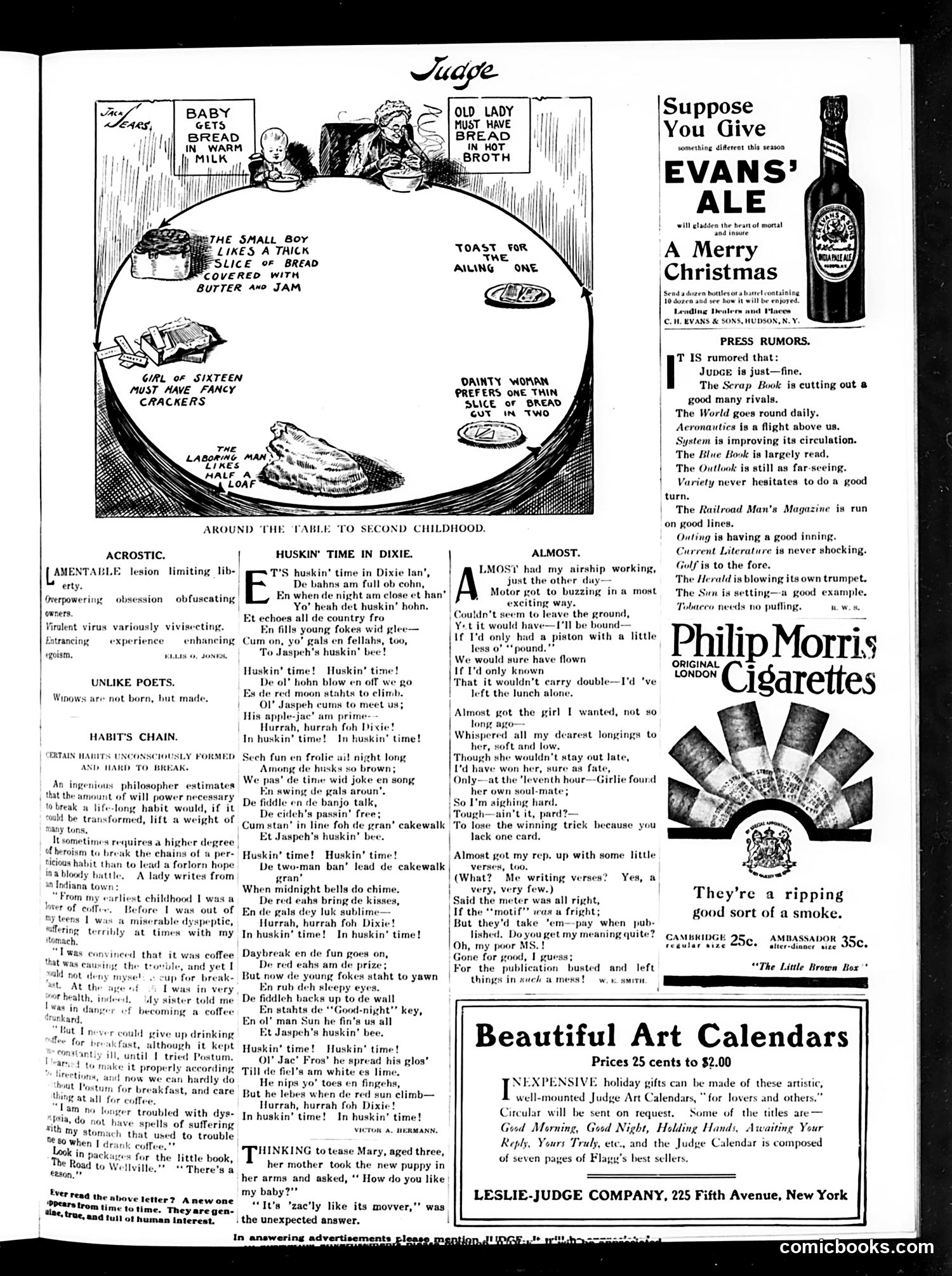
This page from the satirical magazine *Judge* uses humor to comment on social class and gender through dining customs. The main cartoon, "Around the Table to Second Childhood," depicts a dinner table where different family members have vastly different appetites based on age and gender—revealing period attitudes about propriety and consumption. The boy eats hearty (bread, butter, jam), the teenager wants "fancy crackers," the old lady prefers broth, and the "dainty woman" eats sparingly. This satirizes Victorian-era conventions where women, particularly unmarried women, were expected to eat delicately as a sign of gentility and femininity. The accompanying verse "Huskin' Time in Dixie" presents romanticized plantation life using dialect, typical of early 20th-century popular entertainment's treatment of the rural South. The page also includes humorous anecdotes and advertisements typical of *Judge's* format—light social commentary mixed with commercial content.
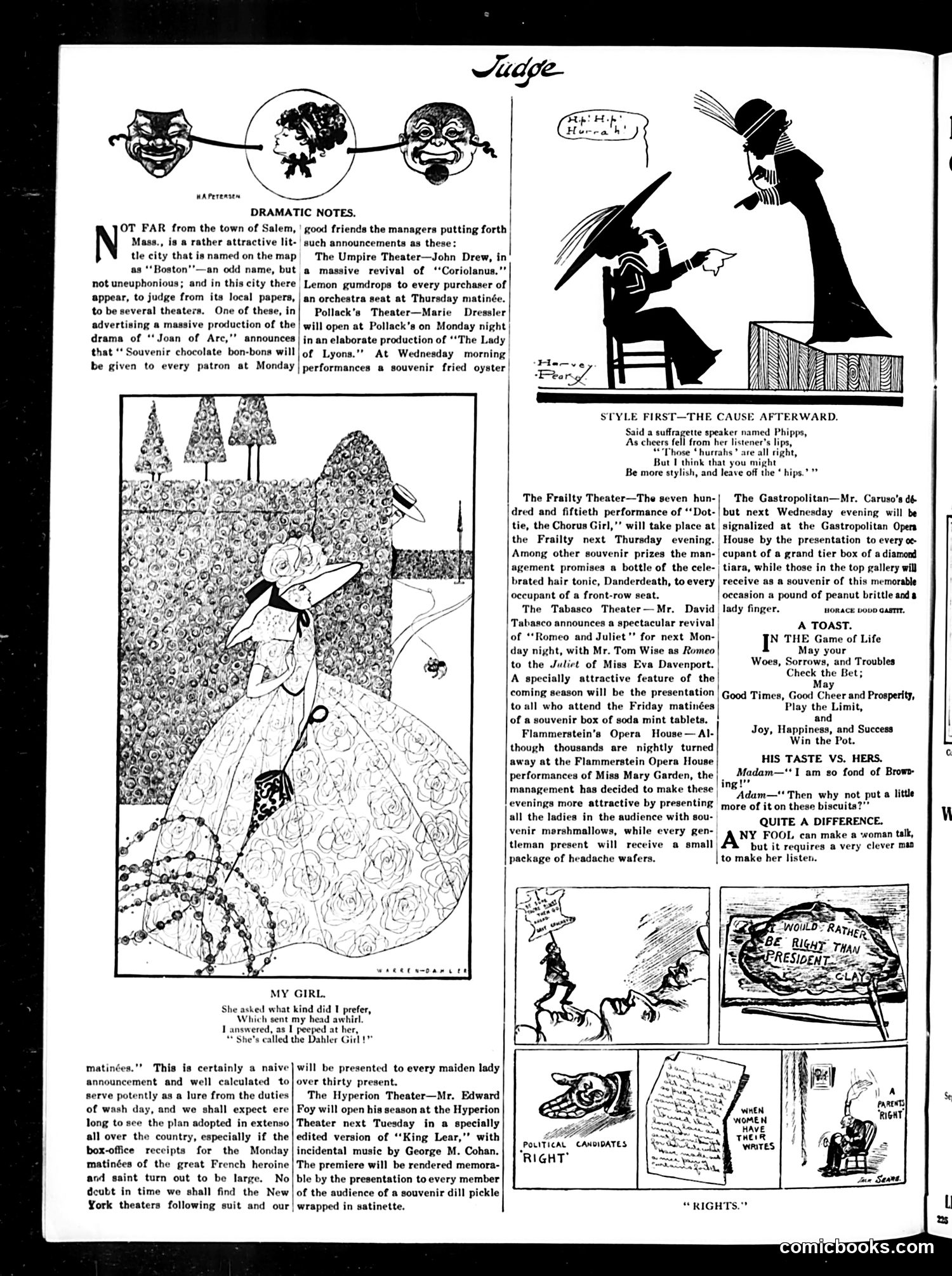
This page satirizes early 1900s theater marketing practices, specifically the absurd "souvenir giveaway" competitions between venues. Theater managers, desperate to attract audiences (particularly women and matinée-goers), offered increasingly ridiculous premiums: lemon drops, fried oysters, dill pickles, hair tonic, marshmallows, and even diamond tiaras. Judge's humor targets two things: first, the desperation of theater owners willing to debase legitimate dramatic productions (like *Joan of Arc* or *King Lear*) with carnival-like gimmicks; second, the implication that audiences—especially women—could be lured from household duties with cheap prizes rather than artistic merit. The cartoons supplement this critique with jokes about suffragettes and gender relations, typical of Judge's satirical approach. The satire works because it exposes how commercial theater prioritized spectacle and consumer goods over dramatic substance.
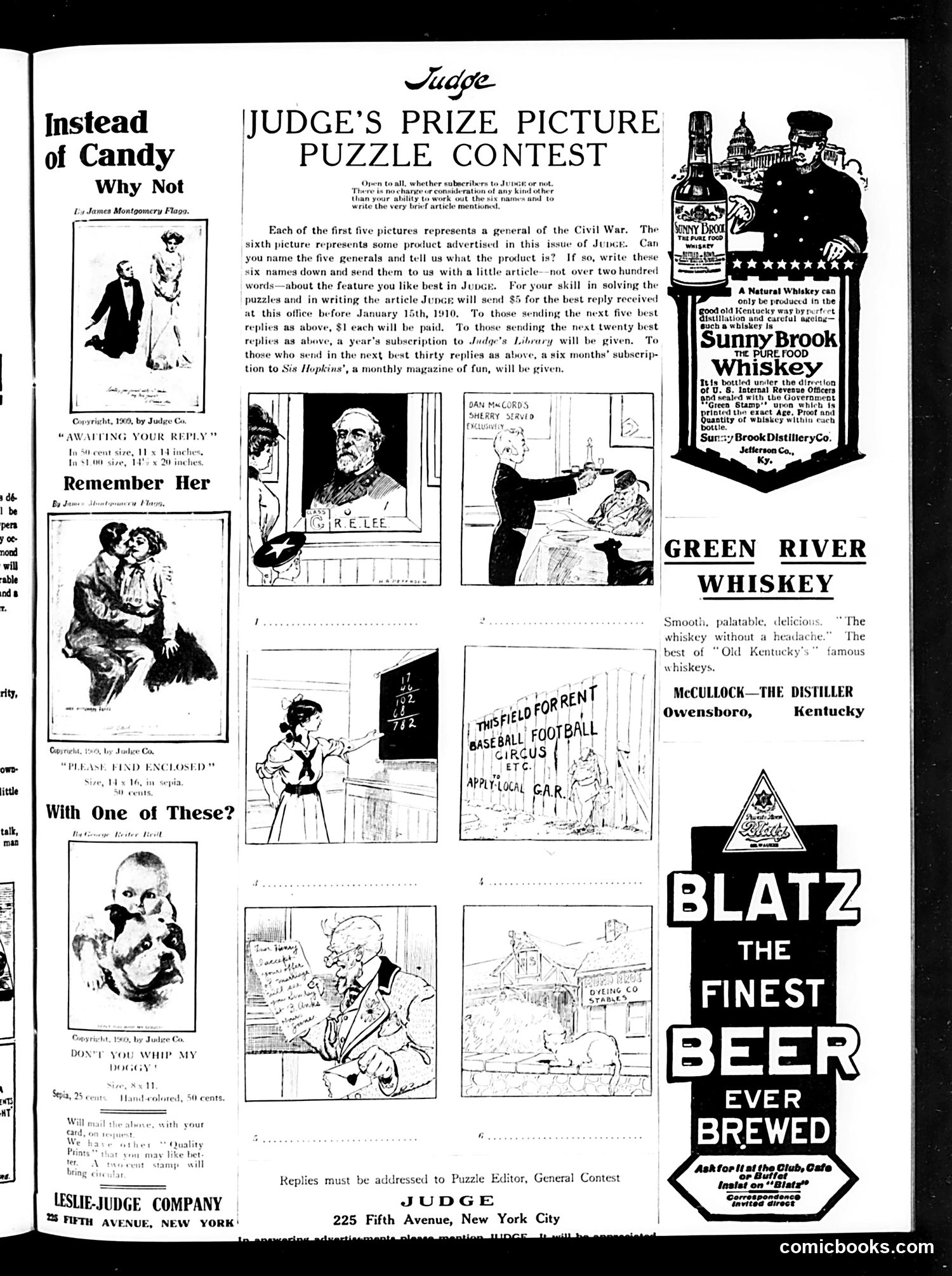
This page features **Judge's Prize Picture Puzzle Contest**, a competition where readers identify five Civil War generals depicted in sketches, plus one advertised product. The contest offers cash prizes ($5 for winners) and magazine subscriptions as rewards. The six sketches appear to show historical military figures and a product advertisement, though specific identifications aren't clearly labeled in the visible portion. One sketch is labeled "R.E. LEE" (Robert E. Lee). The page is heavily interspersed with **period alcohol advertisements**—Sunny Brook Whiskey, Green River Whiskey, and Blatz Beer—which were common in early 1900s magazines. These ads appear alongside humorous sidebar cartoons by James Montgomery Flagg on unrelated domestic topics ("Instead of Candy," "Remember Her," "With One of These?"). This reflects how Judge magazine sustained itself: combining satirical content with lucrative advertising, particularly liquor brands that would face restrictions after Prohibition (1920-1933).
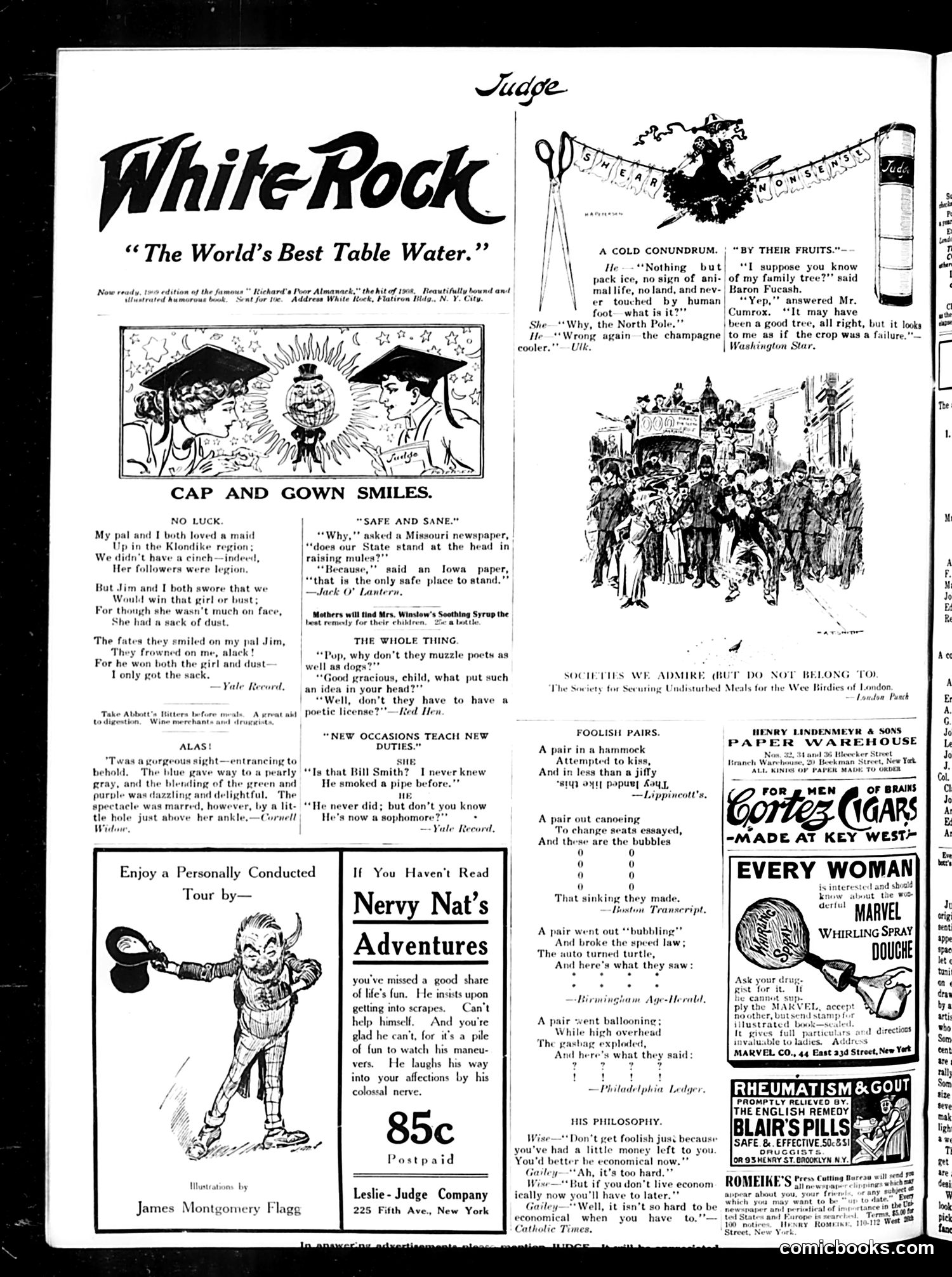
This page from Judge (circa 1908-1909, based on references) is primarily **advertising and light humor**, not political satire. The main content includes: **"Cap and Gown Smiles"** — Several short, genteel jokes about college life and romance, typical of the era's humor magazines. References to Yale and Cornell suggest an educated, upper-class audience. **Advertisements** dominate: White Rock table water (with a small cartoon), Nervy Nat's Adventures (a book), Cortez Cigars, Marvel douche product, and Blair's Pills. These ads reveal period consumer culture and—notably—the Marvel ad suggests contraception/feminine hygiene products marketed obliquely to women. **Minor cartoons** include wordplay jokes about poets needing "licenses," champagne-induced confusion, and canoe mishaps. A "Society for Securing Undisturbed Meals for Wee Birdies" gently mocks sentimental animal-protection movements. **No significant political figures or events** are caricatured. The page reflects genteel, commercial American culture of the Progressive Era rather than hard-hitting satire.
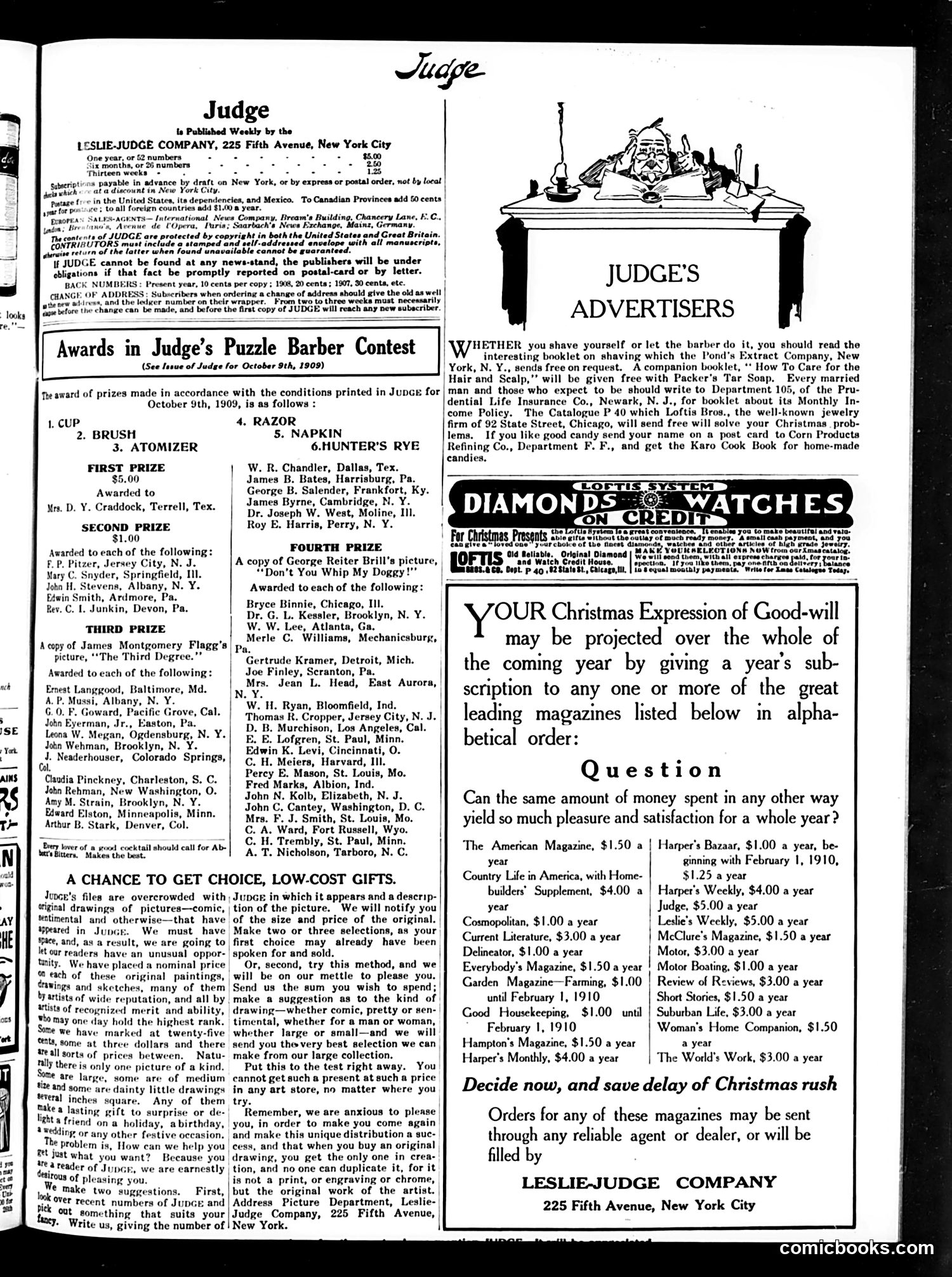
This page is primarily an advertisement section and contest results from *Judge* magazine (October 1909). The top portion announces winners of a "Puzzle Barber Contest" with various prizes including cash and reproductions of illustrations (notably James Montgomery Flagg's "The Third Degree"). The main feature is a magazine subscription offer promoting gift subscriptions to various popular magazines as Christmas presents. The ads suggest such subscriptions provide better value than other luxury purchases—positioning magazines as culturally refined gifts. The illustrated header shows a cartoonish figure surrounded by grooming items, relating to the barber contest theme. The page has little overt political satire; it's primarily commercial content typical of early 20th-century periodical marketing, though the emphasis on magazines as "good-will" expressions reflects broader contemporary values about self-improvement and respectable leisure reading.