
Judge, 1909-12-11 · page 6 of 16
Judge — December 11, 1909 — page 6: what you’re looking at
What you’re looking at
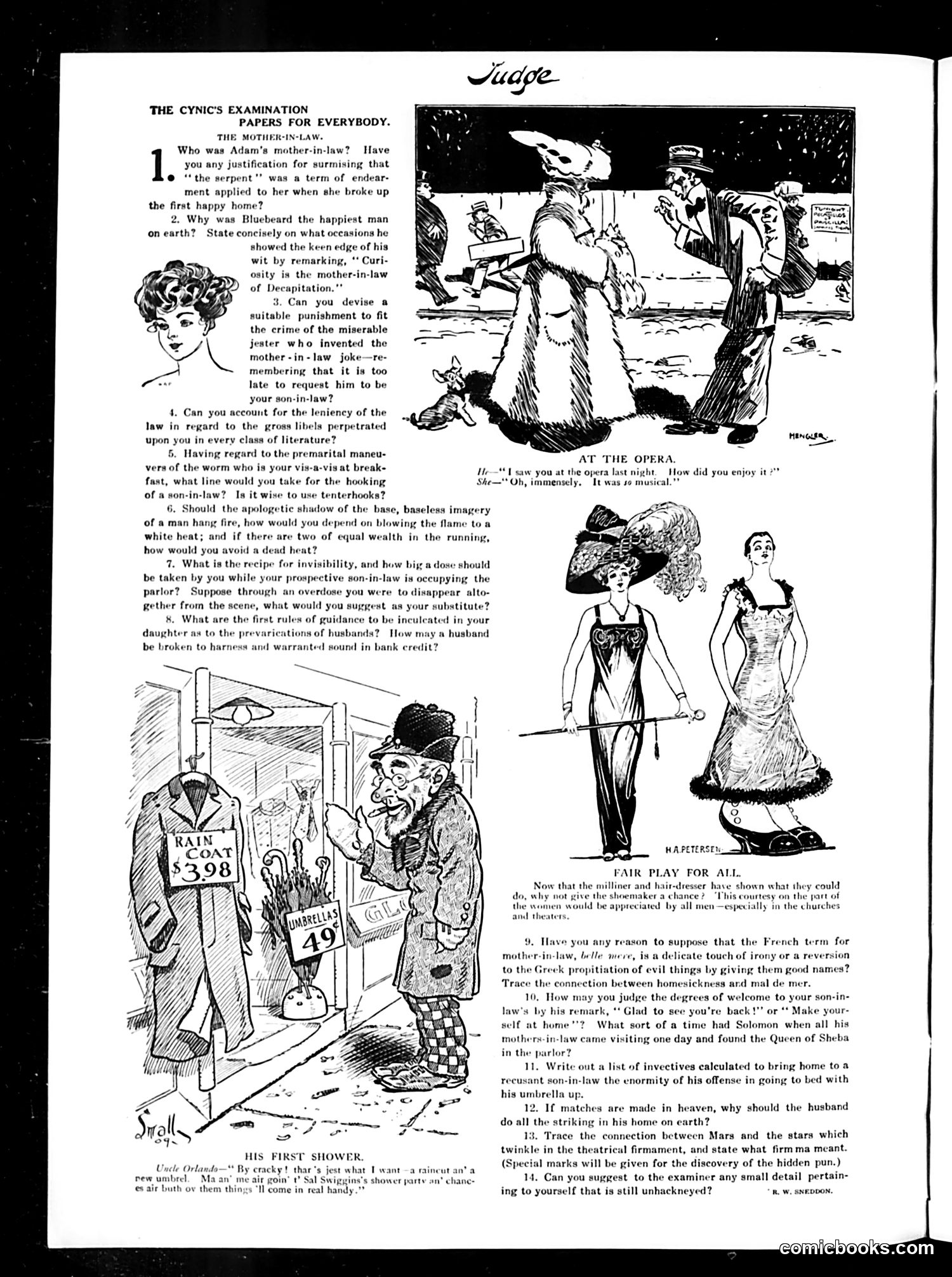
This page satirizes the mother-in-law through mock examination questions—a popular comic device of the era. The joke targets the "mother-in-law" as a universal figure of marital discord and domestic frustration. The questions employ cynical humor: asking why Adam's serpent-temptress was "really" his mother-in-law, why Bluebeard seemed happy (implying murder solved his problem), and whether the original mother-in-law joke inventor deserves punishment worse than death. Questions escalate absurdly—comparing mothers-in-law to cosmic forces, asking husbands to account for their "striking" (hitting?) at home. The accompanying cartoons show domestic scenes: a "first shower" (unclear reference), and "fair play for all" depicting women at the opera and in fashionable dress. The satire reflects early 20th-century anxiety about marriage, family hierarchy, and women's roles—treating the mother-in-law as comedy's favorite scapegoat for domestic unhappiness, particularly marital conflict.
📄 Transcribed text from this page (OCR, searchable)
Machine-transcribed from the original scan — historical spelling and the odd misread are preserved.
THE CYNIC’S EXAMINATION PAPERS FOR EVERYBODY. THE MOTHER-IN-LAW. Who was Adam's mother-in-law? Have 1 you any justification for surmising that @ ‘the serpent" was a term of endear- ment applied to her when she broke up the first happy home? 2. Why was Bluebeard the happiest man on earth? State concisely on what occasions he showed the keen edge of his wit by remarking, ‘* Curi- osity is the mother-in-law of Decapitatio 3. Can you devise a suitable punishment to fit the crime of the miserable jester who invented the mother-in-law joke—re- membering that it is too late to request him to be your son-in-law? 4. Can you account for the leniency of the law in regard to the gross libels perpetrated upon you in every class of literature? 5. Having regard to the premarital maneu- vers of the worm who is your vis-a-vis at break- fast, what line would you or the hooking of a son-in-law? Is it wise to use tenterhooks? Should the apologetic shadow of the base, baseless ima; sf fire, how would you depend on blowing the flame t © are two of equal th in the running, a dead h ipe for of a man white heat; and if thi how would you avo 7. What is the r be taken by you while your pros; parlor? Suppose through an overdose you we: gether from the scene, what would you suggest , What are the first ru daughter as to the prevari big a dose should w is occupying the ¢ to disappear alto- 8 your substitute? leated in your a husband 8 of guidance to be inc tions of husbands? How n OqN SHOW “ By cracky! thar’s j Ma an’ me air goin’ t? Sal Uncle Orlando new umbrel es air buth ov them things “I come in real h: AT THE OPERA. I saw you at the opera last night. How did you enjoy it *” *Oh, immensely, It was so musical.” HAPETERSEN. IR PLAY FOR ALL. Now that rand hairdresser have shown what they ¢ do, why not give the shoem: en would be apprecia and theaters pn to suppose that th: © touch of irony « ng. them good names? Have you any rea rein-law, belle mer ck propitiation of the connection between homesicknes 10, How mi: the degrees of welcome to you law's by his ret ad to see you're back!" or ‘* Make your- self at home’” mothers-in-law came visiting one day and found the Queen of Sheba in the parlor? 11, Write out a list of invectives calculated to bring home to a recusant son-in-law the enormity of his offense in going to bed with his umbrella up. If ches are made in heaven, why should the husband do all the stri arth? 13. Trace ’n Mars and the stars which twinkle in the theatri firmament, and state what firmma meant. (Special marks will be given for the discovery of the hidden pun.) 14. Can you suggest to the examiner any small detail pertain- ing to yourself that is still unhackneyed? RW, SNEDDON. ¢ in his home on the connection betw