
A complete issue · 16 pages · 1909
Judge — October 16, 1909
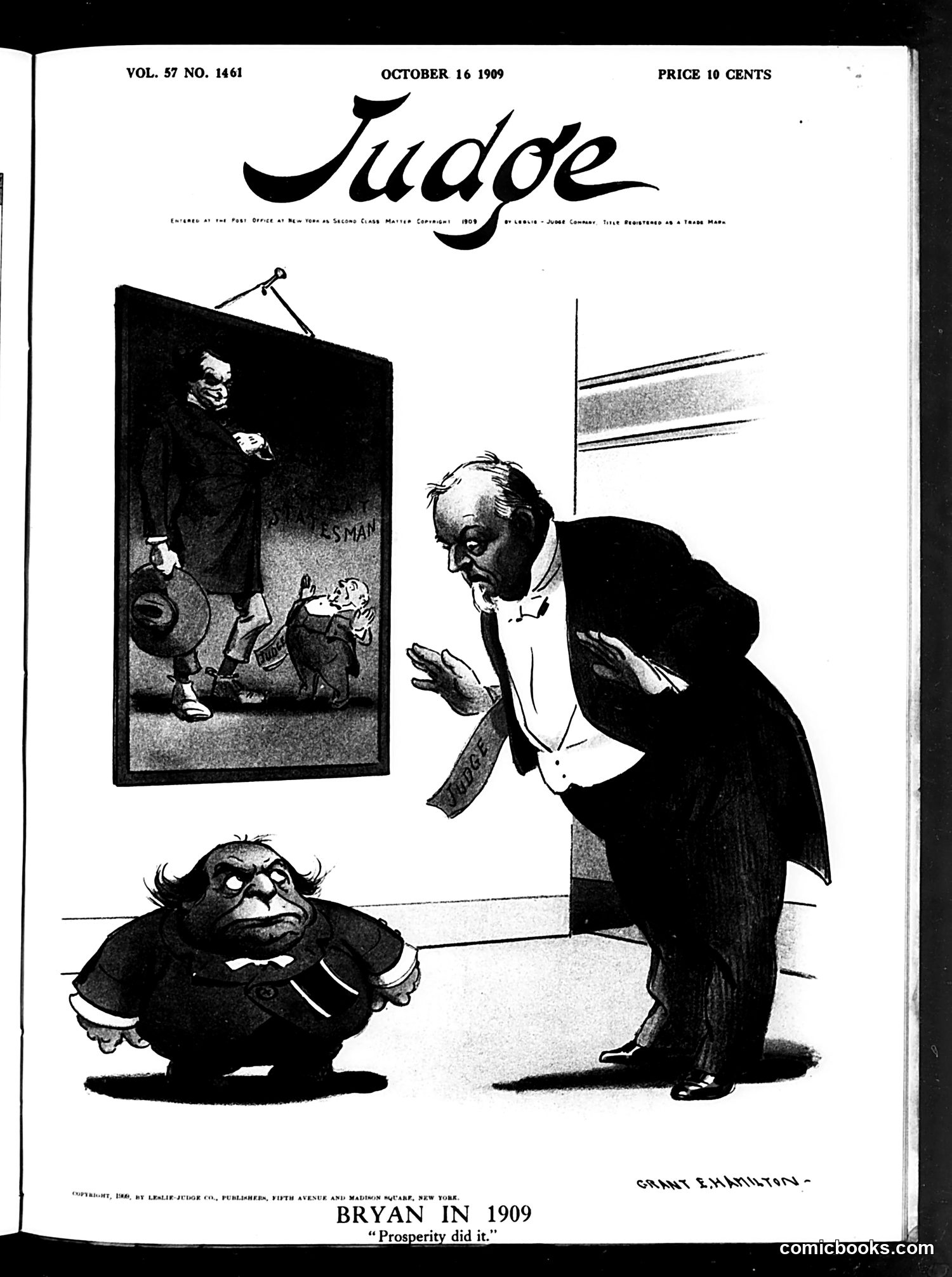
This Judge magazine cover satirizes William Jennings Bryan, the three-time Democratic presidential candidate. The cartoon depicts Bryan as a grotesque, imp-like creature confronting a well-dressed gentleman (likely representing prosperity or Republican economic policies). The framed scene above shows what appears to be poverty or hardship ("SMAIH" visible in the frame), contrasting with the prosperous figure before Bryan. The caption's message is ironic: Bryan's repeated electoral defeats are attributed to "prosperity"—suggesting that Americans voted against his populist/progressive agenda because economic conditions improved, particularly under Republican leadership. The deformed caricature of Bryan emphasizes Judge's contempt for him and his political positions.
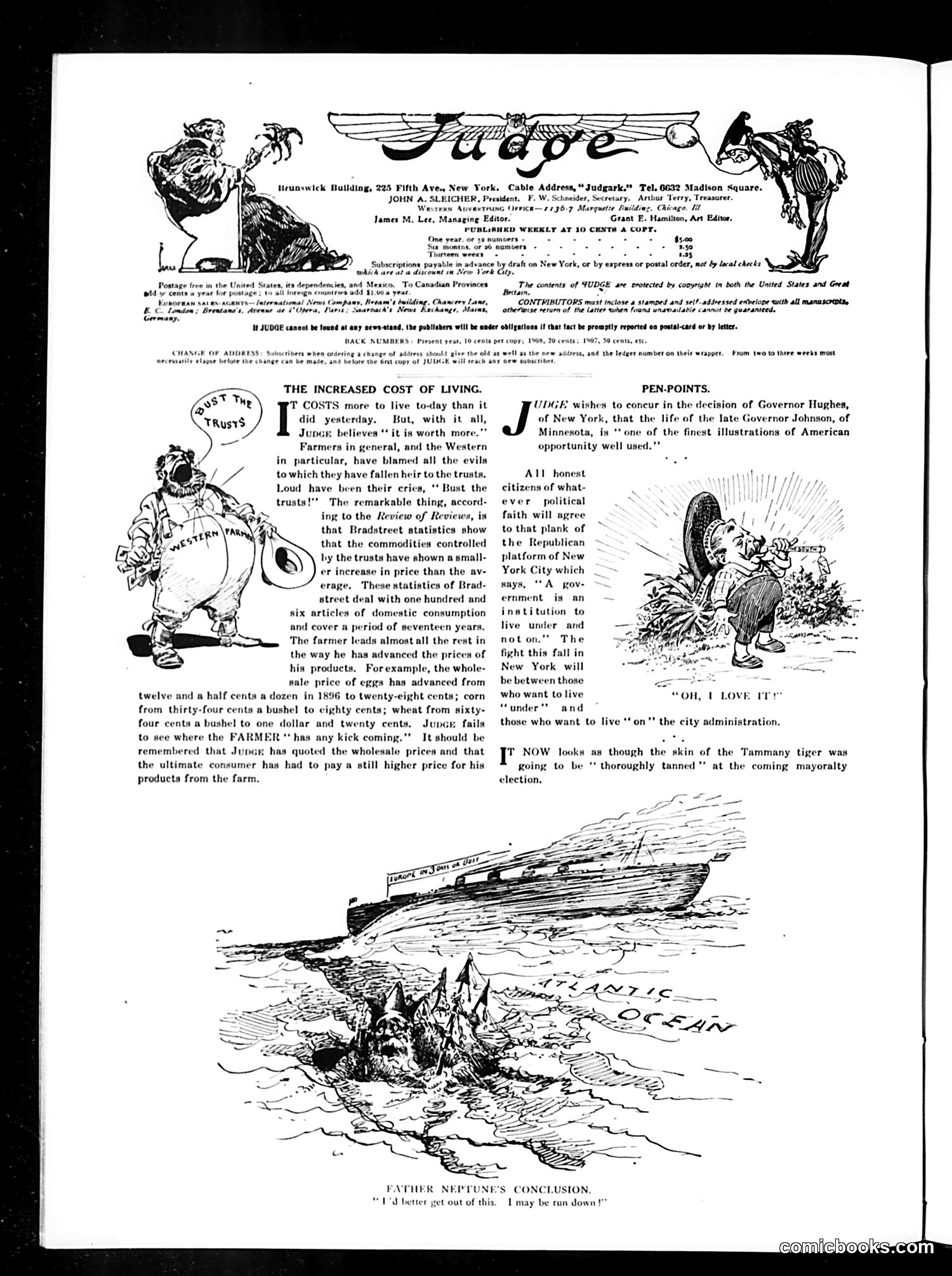
This page satirizes the **rising cost of living**, a major political issue of the era. The left cartoon depicts a Western farmer complaining to "the Trusts" about inflated prices—eggs, corn, and wheat have all increased dramatically over 17 years. Judge argues that while the farmer blames trusts, **statistics show the trust-controlled commodities actually saw *less* price inflation than uncontrolled ones**, suggesting farmers blame the wrong culprit. The right column, "Pen-Points," discusses **Governor Hughes of New York** and the upcoming mayoralty election in New York City, debating whether city government should operate "under" the Republican platform or "on" it—a play on words about governmental philosophy. The bottom illustration appears unrelated: a ship and sea creature, captioned "Father Neptune's Conclusion: 'I'd better get out of this. I may be run down!'"—likely commenting on maritime or shipping concerns.
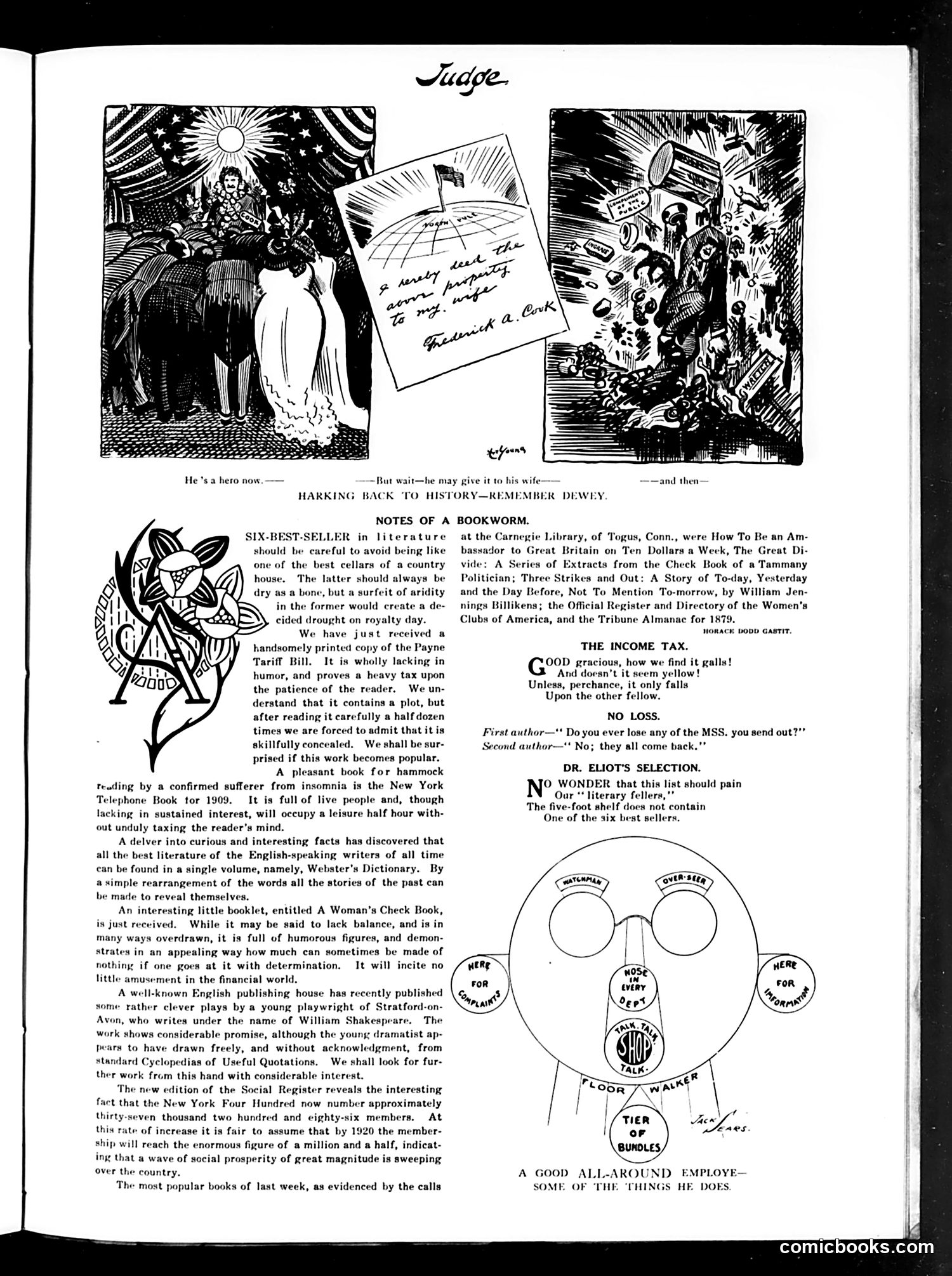
The top three panels appear to satirize American political/diplomatic ambitions. The left panel shows an ornate throne room scene suggesting imperial grandeur. The center panel contains a handwritten note referencing "harking back to history—remember Dewey," likely referring to Commodore George Dewey's 1898 naval victory in the Philippines. The right panel depicts chaotic machinery or industrial excess, possibly critiquing American expansionism or military adventurism. The remaining content comprises book reviews and miscellaneous notes rather than political cartoons. "Notes of a Bookworm" discusses literary works and Webster's Dictionary. Small satirical items mock an income tax and lack of loss in publishing. A diagram labeled "Dr. Eliot's Selection" appears to be a humorous organizational chart. The overall page mixes editorial satire with cultural commentary typical of Judge's format.
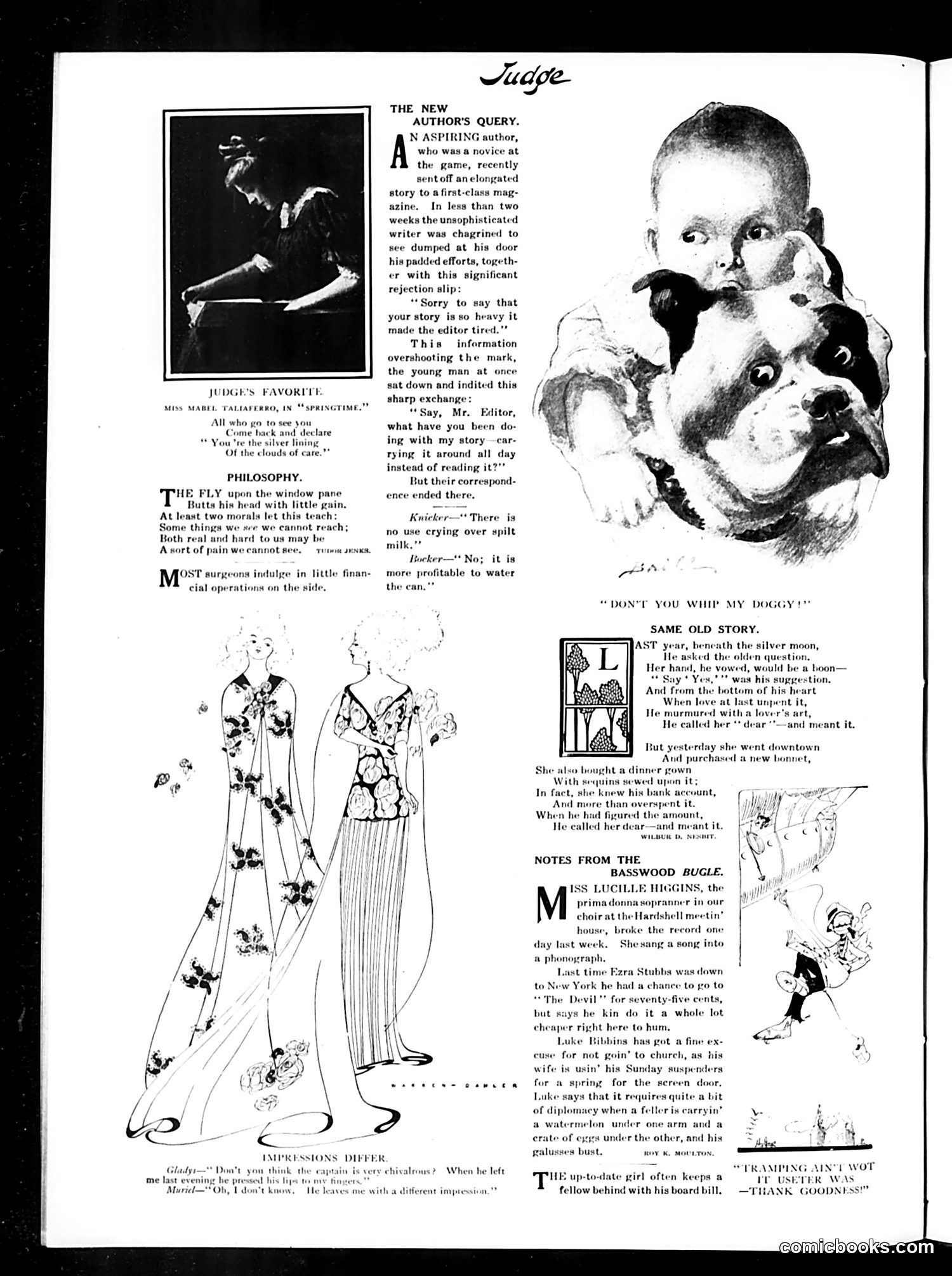
This page contains several humorous sketches and satirical pieces rather than a single political cartoon: **"The New Author's Query"** mocks an aspiring writer whose story was rejected for being "too heavy," prompting him to demand the editor justify wasting his time. The satire targets pretentious amateur writers. **"Philosophy"** offers brief witticisms about life's hardships, appearing to be general social commentary rather than political satire. **"Most surgeons indulge in little financial operations on the side"** is a cynical jab at doctors' profit motives. The fashion illustration labeled **"Impressions Differ"** shows two women's dresses, with a joke about different perceptions of the same outfit. **"Same Old Story"** is a poem about romantic disappointment and financial miscalculation in courtship—domestic humor typical of Judge's era. **"Notes from the Basswood Bugle"** offers small-town gossip items, satirizing rural life and small-town characters.
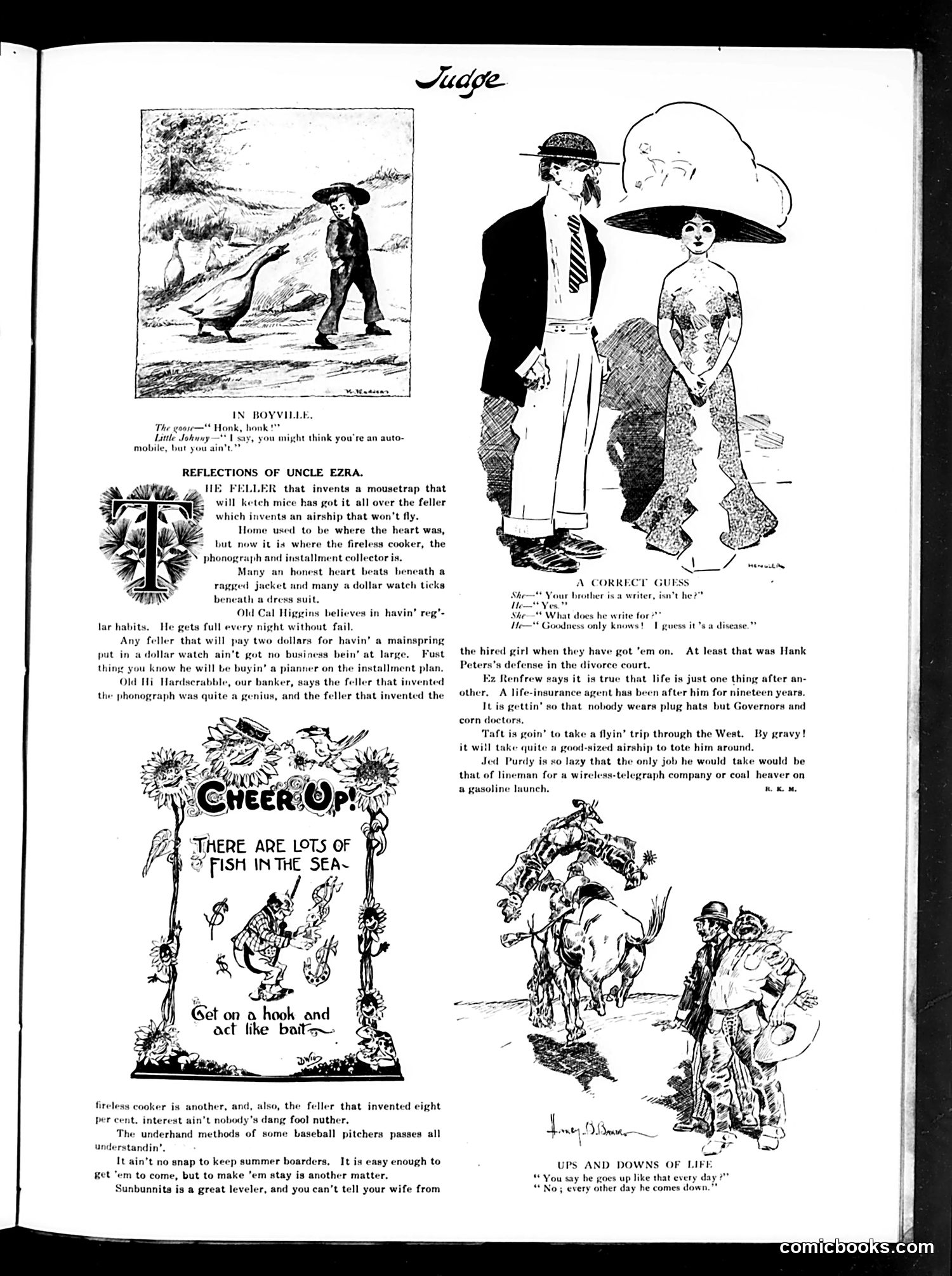
This page contains several satirical pieces mocking early 20th-century American life: **"In Boyville"** depicts a boy mistaking an automobile for a "automole" — satirizing the novelty and confusion surrounding early automobiles. **"Reflections of Uncle Ezra"** offers humorous observations about inventions (mousetraps, fireless cookers, photograph collectors) and human nature, concluding with commentary on life insurance and lazy people. The tone is curmudgeonly rural wisdom. **"A Correct Guess"** shows fashionably dressed figures, likely satirizing contemporary fashion or social pretension. **"Ups and Downs of Life"** depicts cowboys/horsemen, playing on the contrast between daily ups and downs. Overall, the page reflects Judge's satirical approach to modern innovations, social habits, and fashion through humor accessible to early 1900s readers.
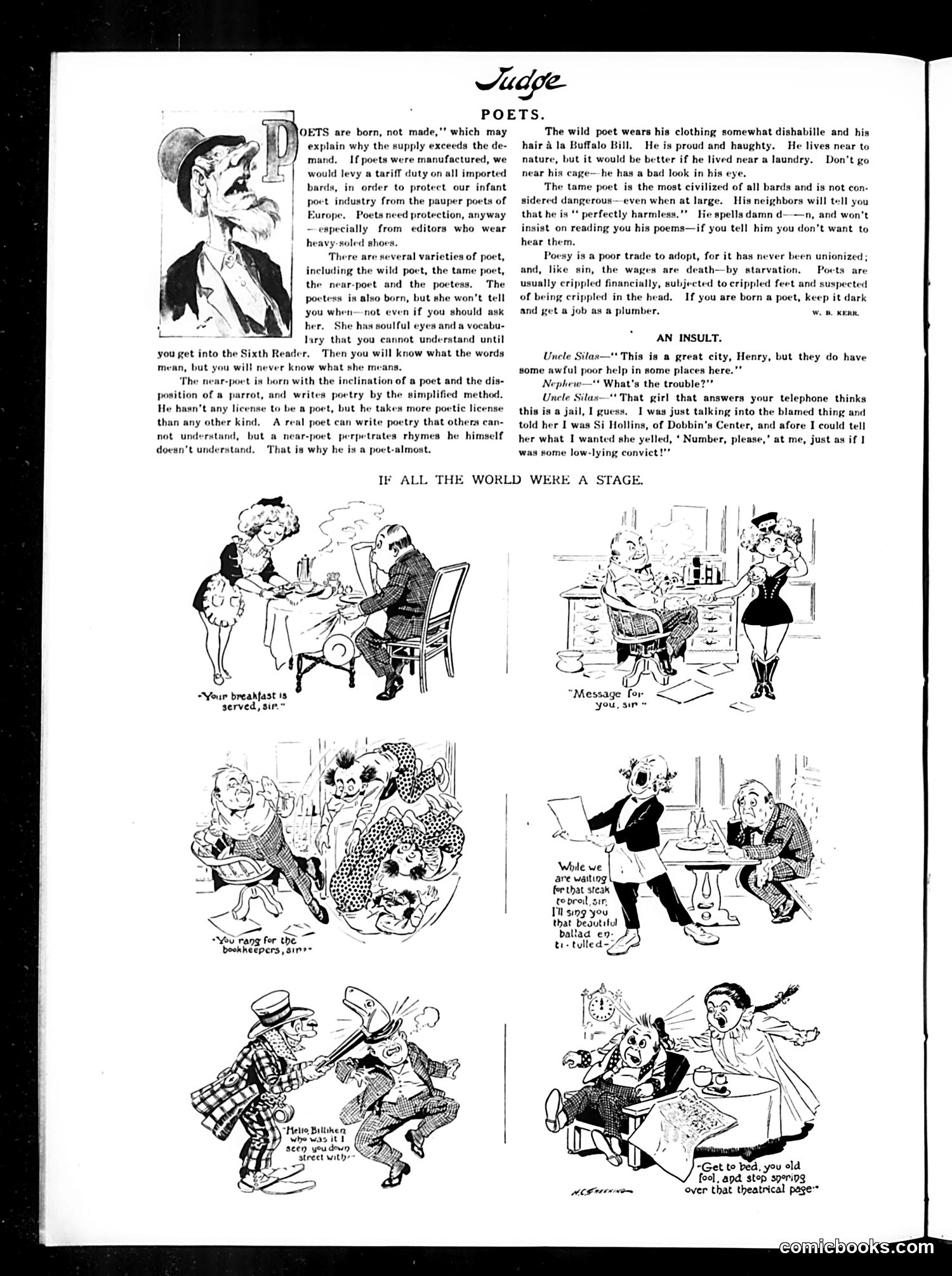
This page satirizes **poets and the theatrical world** through humor and social commentary. The main essay mocks various "types" of poets—wild, tame, near-poets, and poetesses—depicting them as impractical, financially doomed, and often incomprehensible. The satire suggests poetry is an unmarketable profession; one should "get a job as a plumber" instead. The tone ridicules both poets' pretensions and the public's indifference to them. **"An Insult"** depicts a country visitor (Uncle Silas) offended by a telephone operator's curt professionalism, illustrating rural attitudes toward modern urban service workers. **"If All the World Were a Stage"** is a comic series showing everyday situations reimagined as theatrical performances—servants delivering breakfast dramatically, a barber shop scene, restaurant patrons awaiting food, and couples arguing. The joke plays on theatrical melodrama applied to mundane daily life, likely poking fun at both theatrical excess and ordinary people's self-importance. Overall, the page blends literary criticism with gentle social satire targeting artistic pretension and class differences.
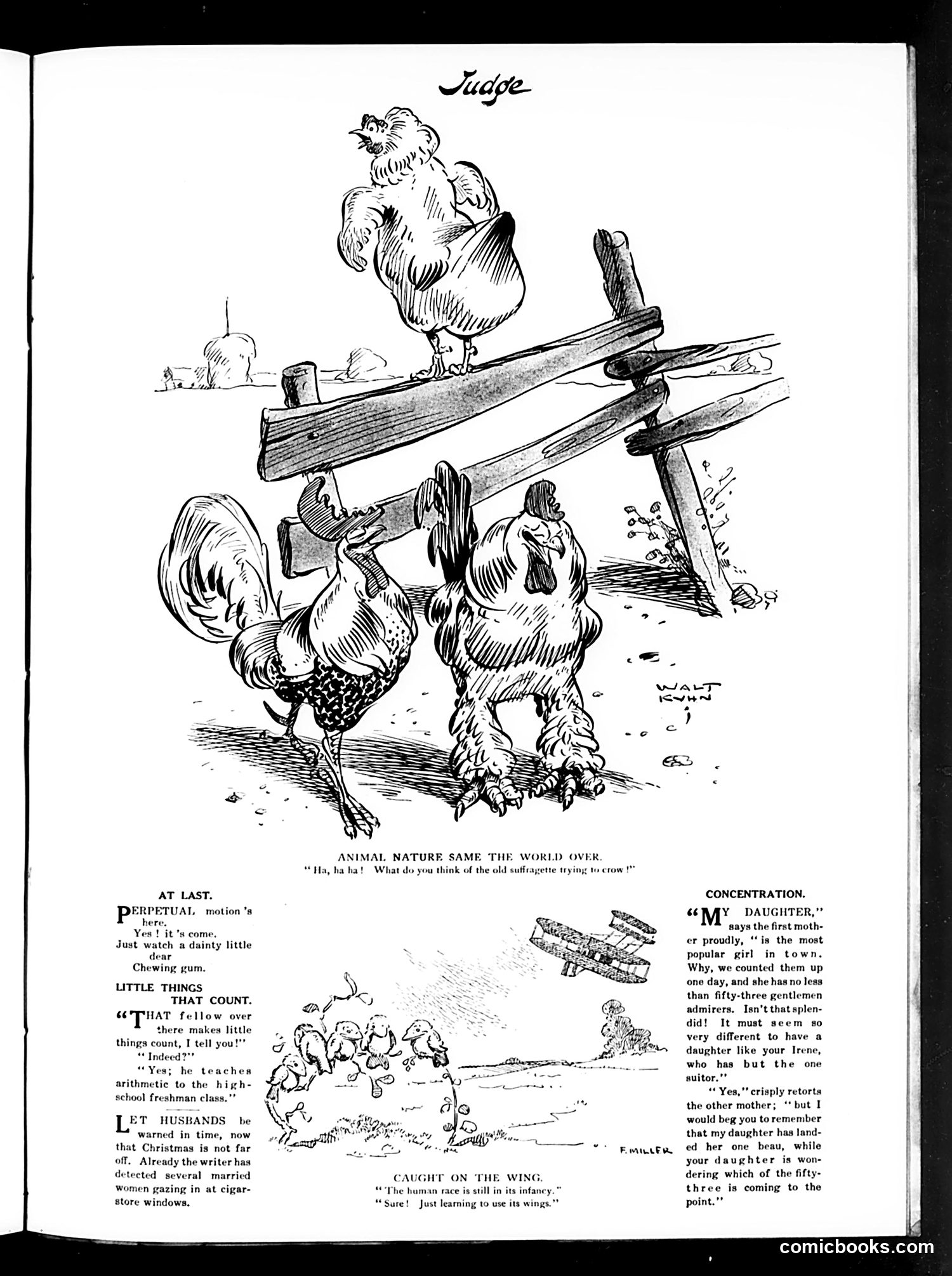
This page contains multiple satirical shorts typical of early-20th-century American humor magazines: **Main Cartoon (top):** Shows chickens mocking a rooster attempting to crow, labeled "Animal Nature Same the World Over." The caption references "the old suffragette trying to crow"—a gendered insult equating women's suffrage advocates with animals making unseemly noise. This reflects anti-suffrage sentiment common before women gained voting rights. **Text Pieces:** Include gentle social commentary on perpetual motion (chewing gum), arithmetic education, Christmas shopping temptations for wives, and matchmaking anxieties. **"Concentration" section (right):** A mother-daughter dialogue mocking another mother's pride in her daughter's fifty-three admirers, suggesting quantity of suitors means nothing without an actual commitment ("landing" a beau). This reflects early-1900s courtship anxieties and competitive social status among women. The overall tone blends light domestic humor with period-specific social critiques.
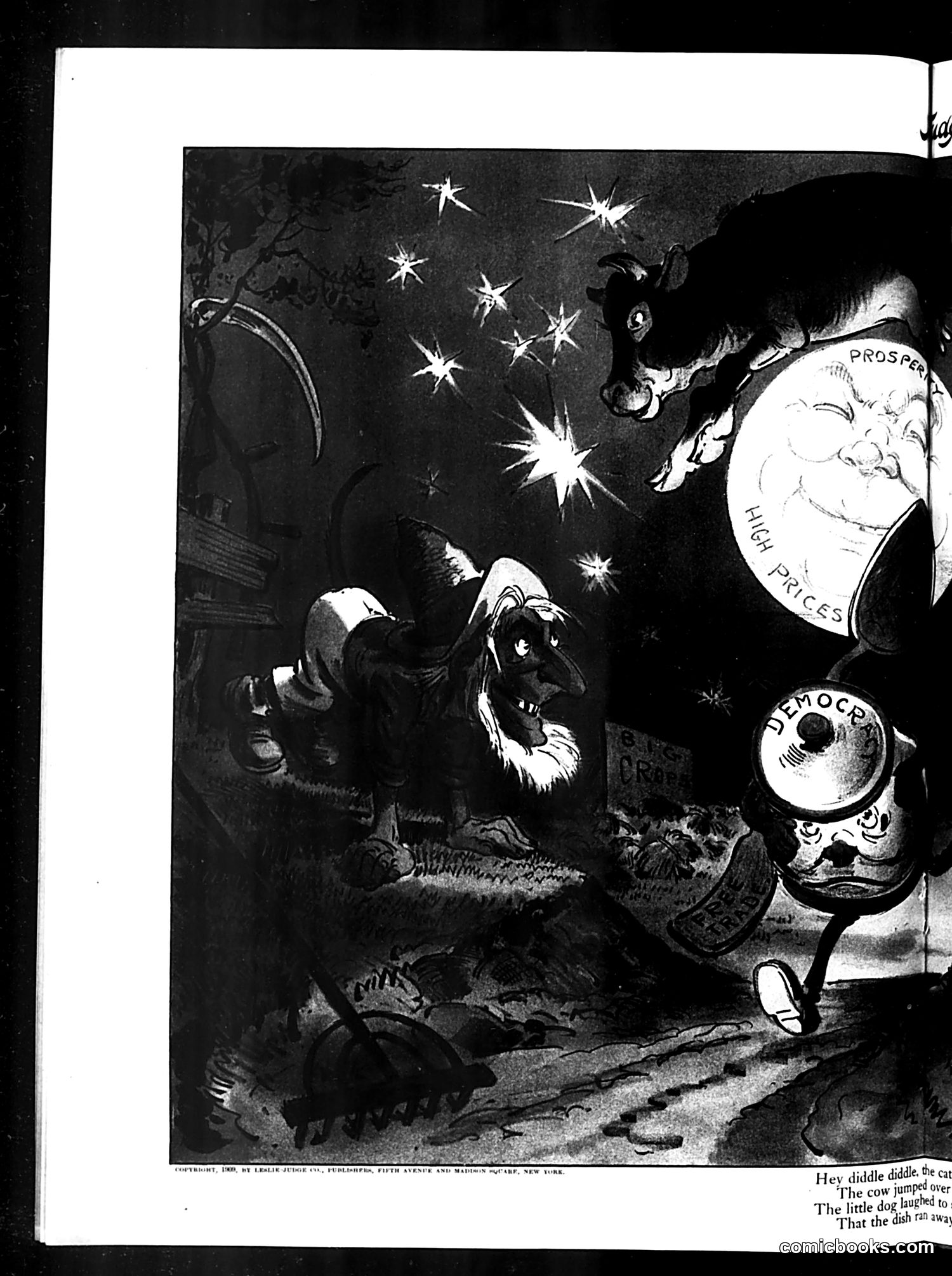
This appears to be an illustration of the nursery rhyme "Hey Diddle Diddle," rendered as a satirical cartoon. The image shows anthropomorphized figures labeled "PROSPERITY," "HIGH PRICES," and "DEMOCRACY" arranged around a central scene with a cow and other characters from the rhyme. The satire likely critiques economic conditions of the era—possibly referencing inflation ("high prices"), prosperity claims by the administration, and democratic principles. The nursery rhyme's absurdist humor (cow jumping over the moon, dish running away with spoon) serves as a metaphor for the perceived illogic or falsehood of political rhetoric about economic conditions. Without the publication date clearly visible, the specific political moment remains uncertain, though this appears to be early 20th-century American political commentary using familiar cultural references to mock economic policy or political messaging.
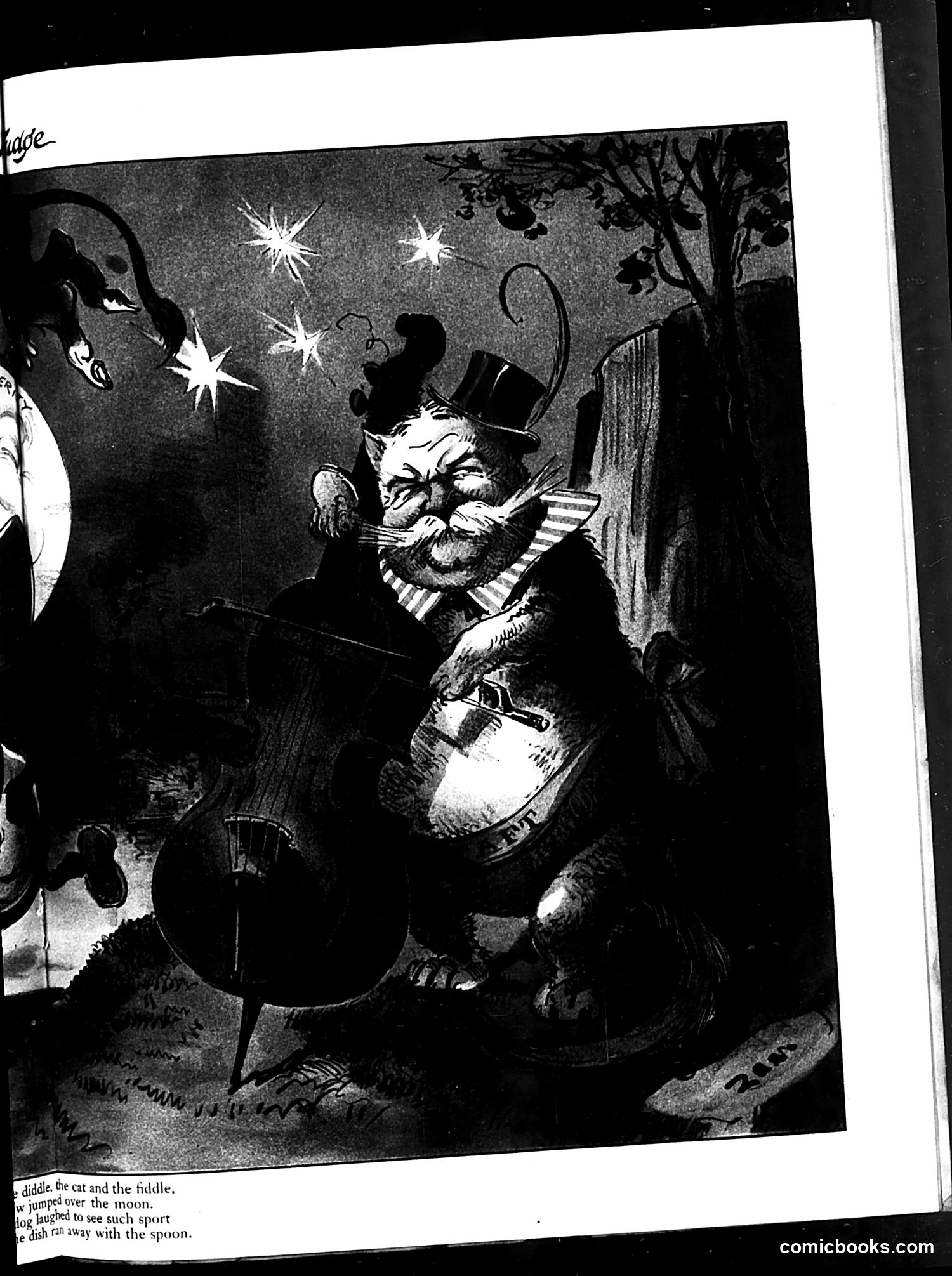
This is a visual interpretation of the nursery rhyme "Hey Diddle Diddle." The illustration depicts an anthropomorphic cat character dressed in formal attire (top hat, striped collar) playing a fiddle, with stars above suggesting the "jumped over the moon" imagery. A cow appears in the background, and various other characters witness the absurdist scene. Judge magazine used such whimsical illustrations to entertain readers, though this particular image appears primarily illustrative rather than explicitly satirical. The exaggerated, grotesque style of the cat character and the surreal nighttime setting with magical stars create the fantastical tone appropriate for adapting the nonsensical children's verse into visual form. Without additional context or visible political commentary, this seems a straightforward—if darkly rendered—adaptation of familiar nursery rhyme material.
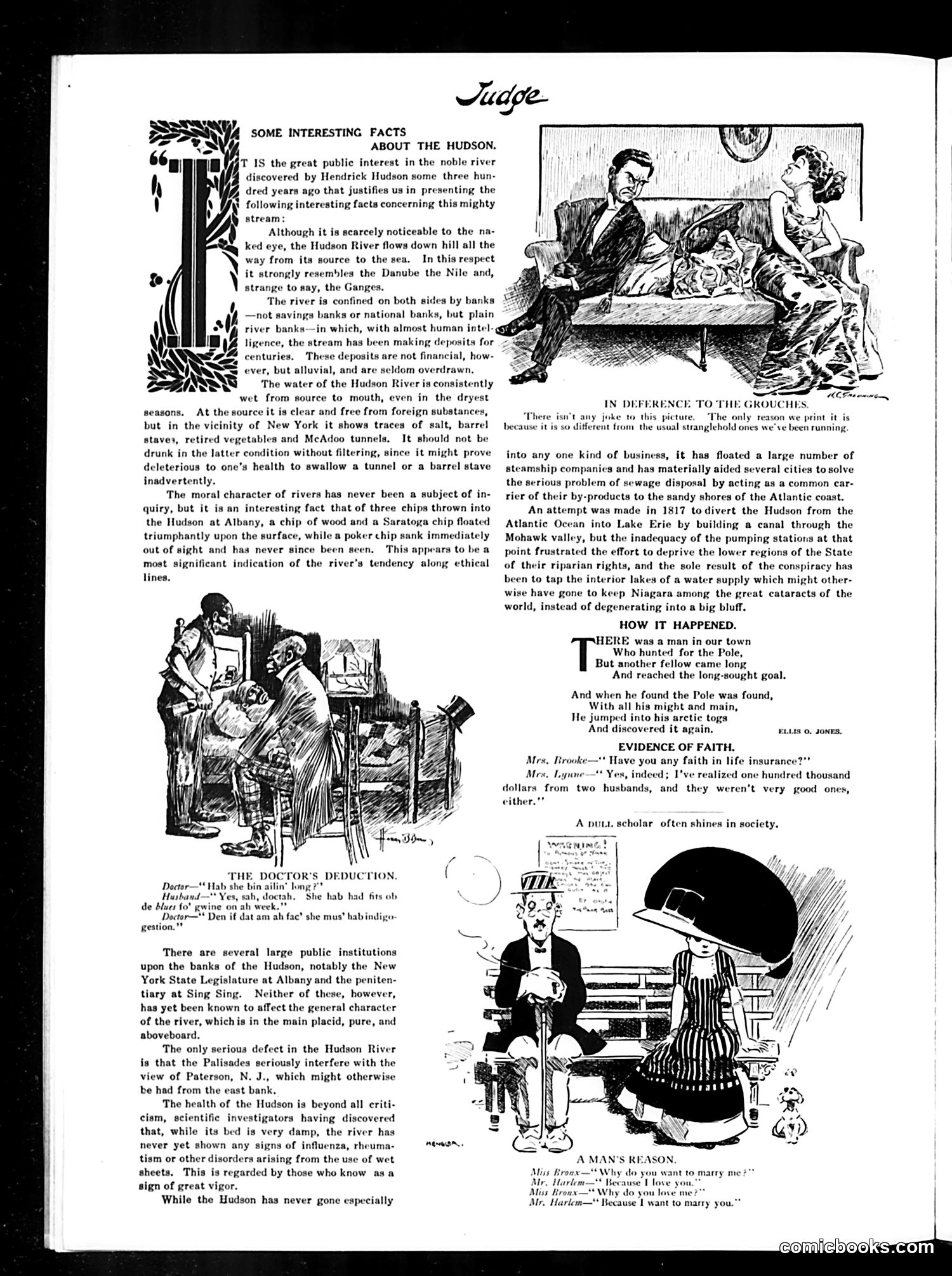
This page features **mock-serious pseudo-scientific commentary on the Hudson River**, presented as "interesting facts." The humor relies on deliberate absurdity: the text treats the river like a financial institution (puns on "banks," "deposits," "overdrawn"), includes nonsensical observations (poker chips sinking while wood chips float as moral commentary), and makes deliberately stupid deductions (a doctor concluding a woman has indigestion based on river pollution). The cartoons illustrate separate social humor: "The Doctor's Deduction" depicts medical incompetence; "A Man's Reason" presents a domestic scenario where a man explains loving his wife because he wants to marry her—circular logic played for comedy. The page also references the **1817 canal attempt** to divert the Hudson toward Lake Erie, touching on real infrastructure debates. Overall, this is genteel satirical humor typical of early-20th-century Judge magazine—wordplay and absurdist observations rather than sharp political critique.
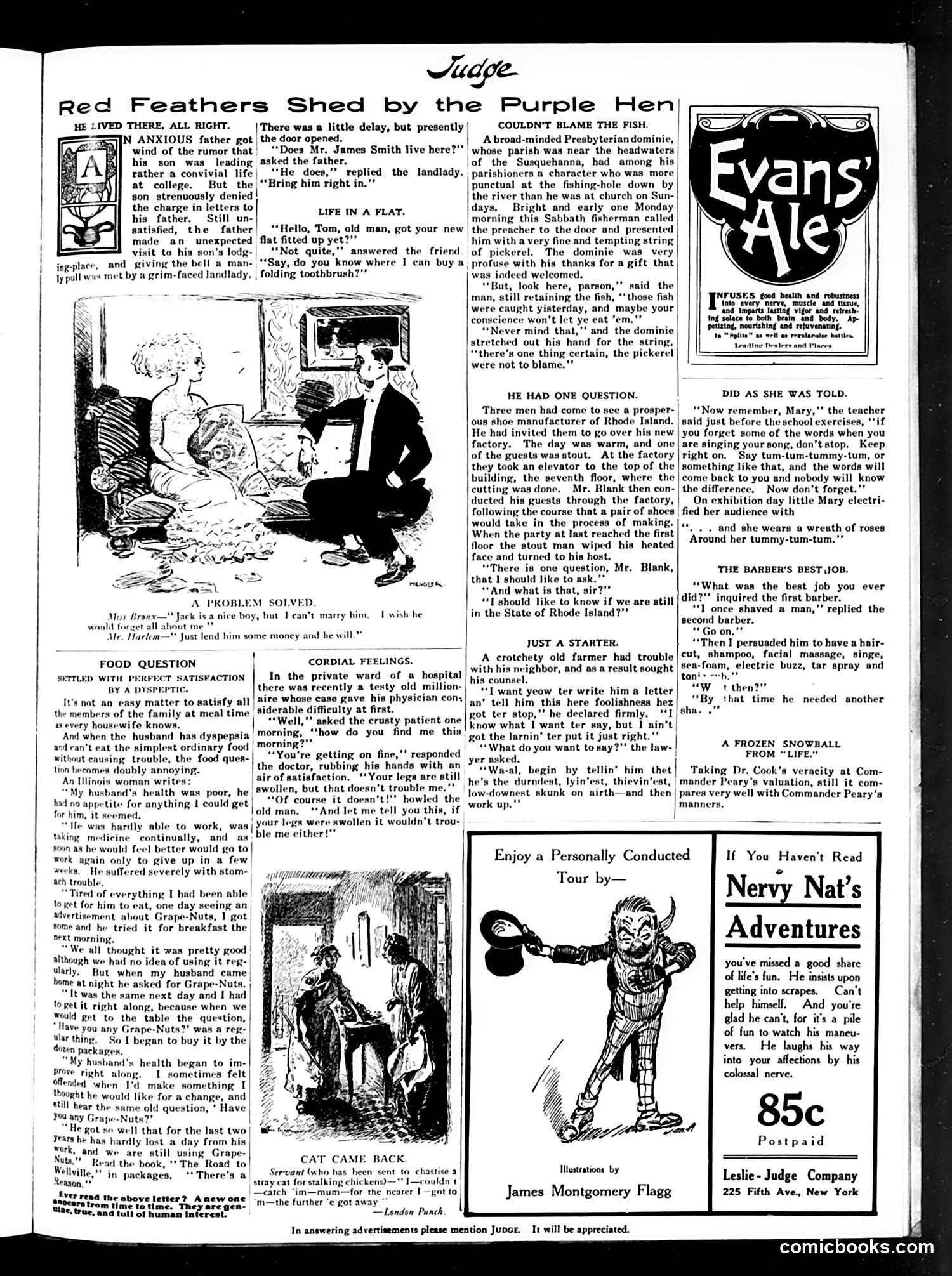
This page from Judge magazine contains several short humorous stories and advertisements typical of early 20th-century American satirical journalism. **Main Content:** The featured stories are gentle domestic comedies with no apparent political content. "Red Feathers Shed by the Purple Hen" includes anecdotes about a father visiting his son at college, a husband inquiring about folding toothbrushes, and a Presbyterian minister receiving fish from a fishing-obsessed parishioner. These rely on simple situational humor rather than social commentary. **Notable Element:** A prominent Grape-Nuts cereal advertisement frames a testimonial letter from an Illinois woman crediting the product with curing her husband's dyspepsia and stomach troubles. This reflects early 20th-century advertising's direct health claims (later restricted by the FDA). **Secondary Content:** Brief quips about romance and a barber's services, plus an advertisement for "Nervy Nat's Adventures" at 85 cents. The page exemplifies Judge as a magazine blending light humor with commercial advertising rather than political satire.
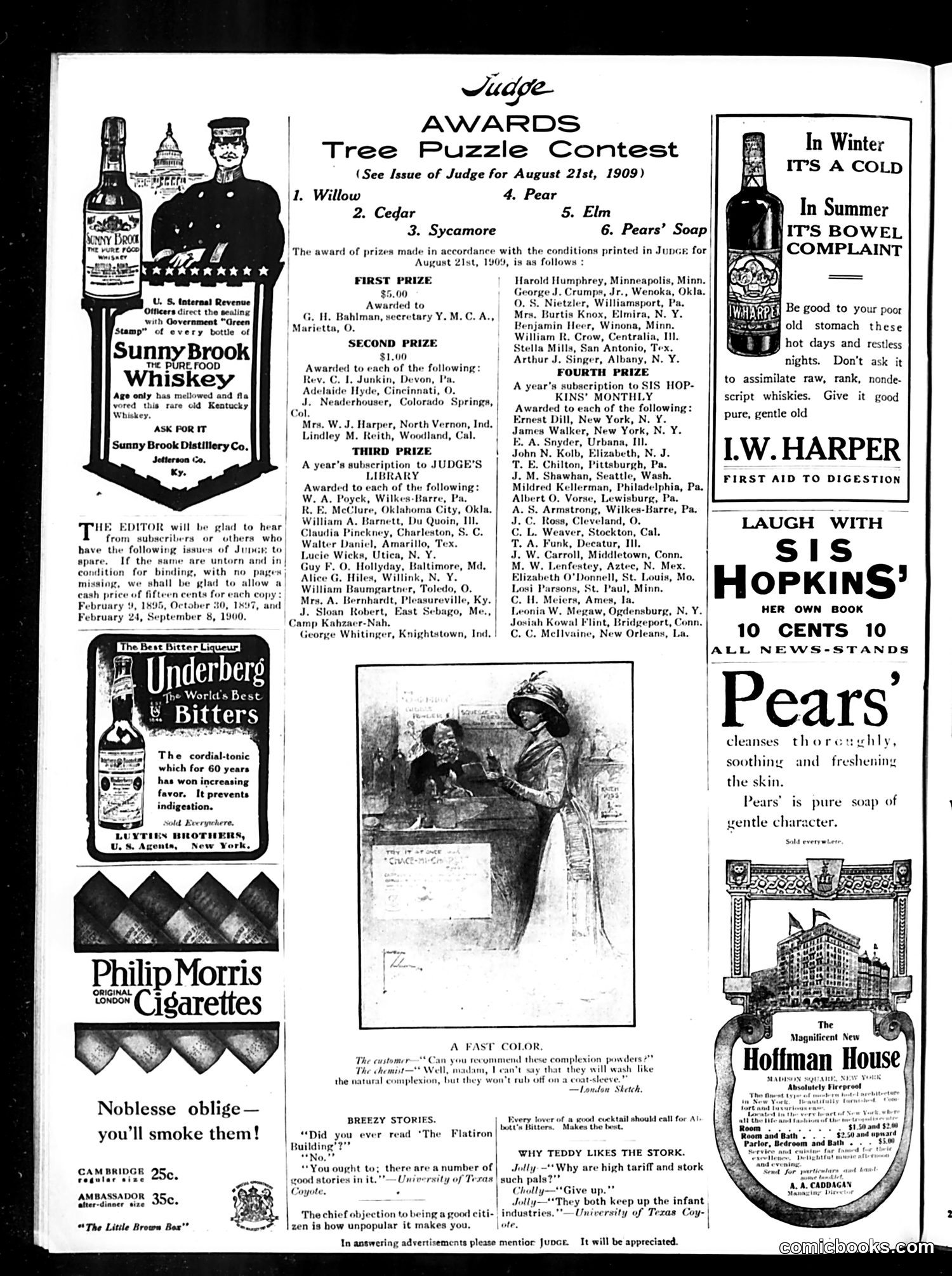
This page is primarily **advertising and contest results**, not political satire. The central content announces winners of Judge's "Tree Puzzle Contest" from August 1909, listing names and prizes ($5, $1, subscriptions). The cartoons and humor are minimal and marginal: **Bottom section** contains two brief "Breezy Stories" jokes—one about the unpopularity of living near the Flatiron Building (a then-famous NYC structure), another about "Teddy" (President Theodore Roosevelt) and the stork, making a pun: tariffs and storks both "keep up the infant industries." **Surrounding advertisements** promote liquor (Sunny Brook Whiskey, I.W. Harper, Underberg Bitters), cigarettes (Philip Morris), soap (Pears'), and other products—typical of Judge's revenue model. The **center illustration** labeled "A Fast Color" depicts a customer/chemist exchange about complexion powders, mildly satirizing beauty product claims. Overall, this is a **filler page** combining contest results with period advertising rather than substantive satirical content.
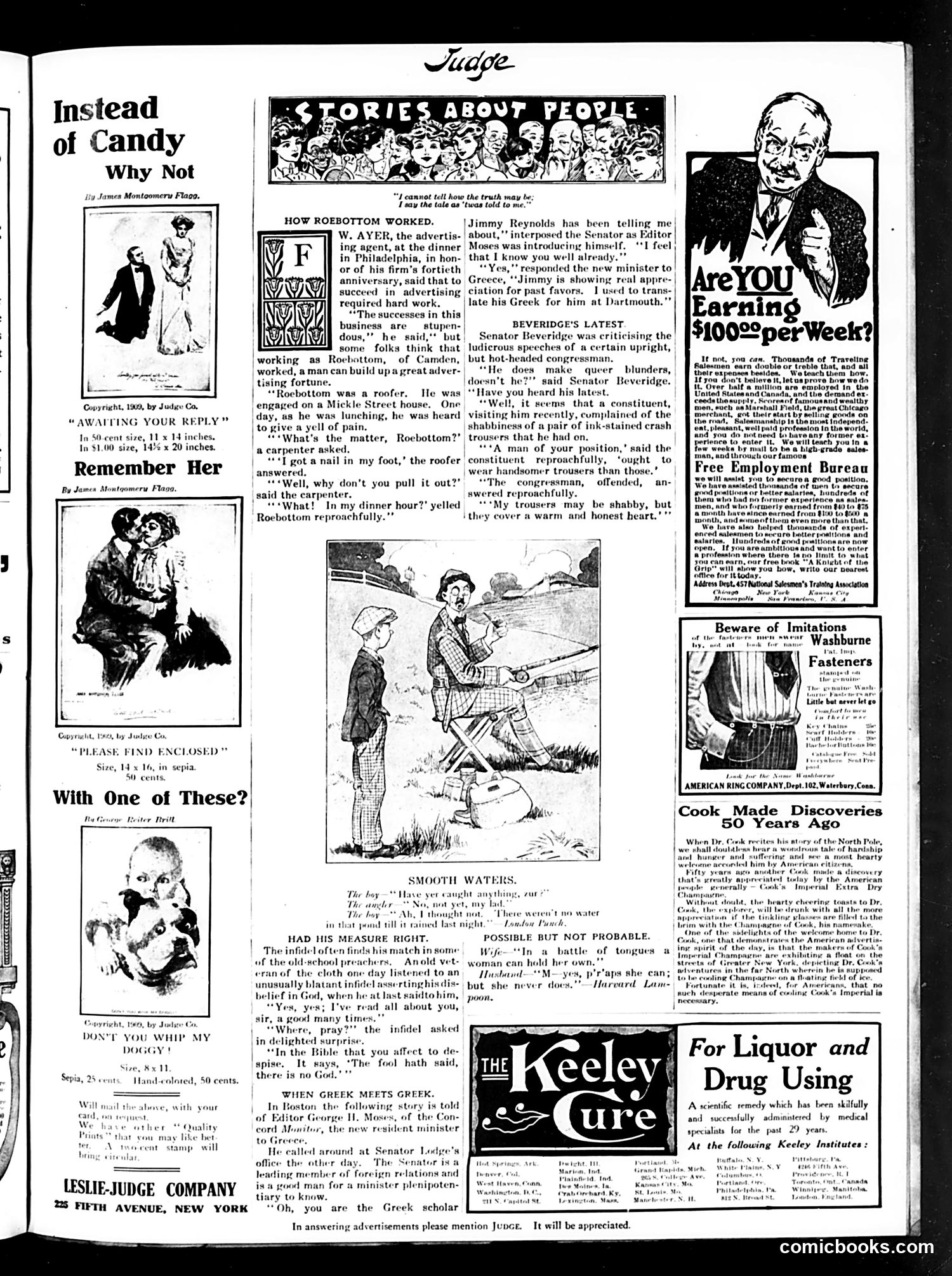
This is primarily an **advertising and humor page** from Judge magazine (circa 1909). The main content consists of short humorous anecdotes by James Montgomery Flagg rather than political cartoons. The central stories mock business and social pretension: - **"How Roebottom Worked"**: Satirizes a roofer's absurd prioritization—refusing to remove a nail from his foot during lunch hour, valuing his meal break over pain relief. It's commentary on misplaced work ethics. - **"Beveridge's Latest"**: Senator Beveridge ridicules a congressman's shabby appearance, who defensively responds his trousers have an "honest heart"—mocking both snobbish dress-consciousness and hollow moral posturing. - **Minor quips** about Greek scholars, fishing, and marital dynamics offer gentle social observation. The **surrounding advertisements** dominate—promoting employment agencies, fasteners, a "Keeley Cure" for alcohol/drug addiction, and cooking discoveries. These ads reflect period concerns: employment, manufacturing, and substance abuse treatment. The cartoons are slight character sketches illustrating the anecdotes rather than pointed political satire.
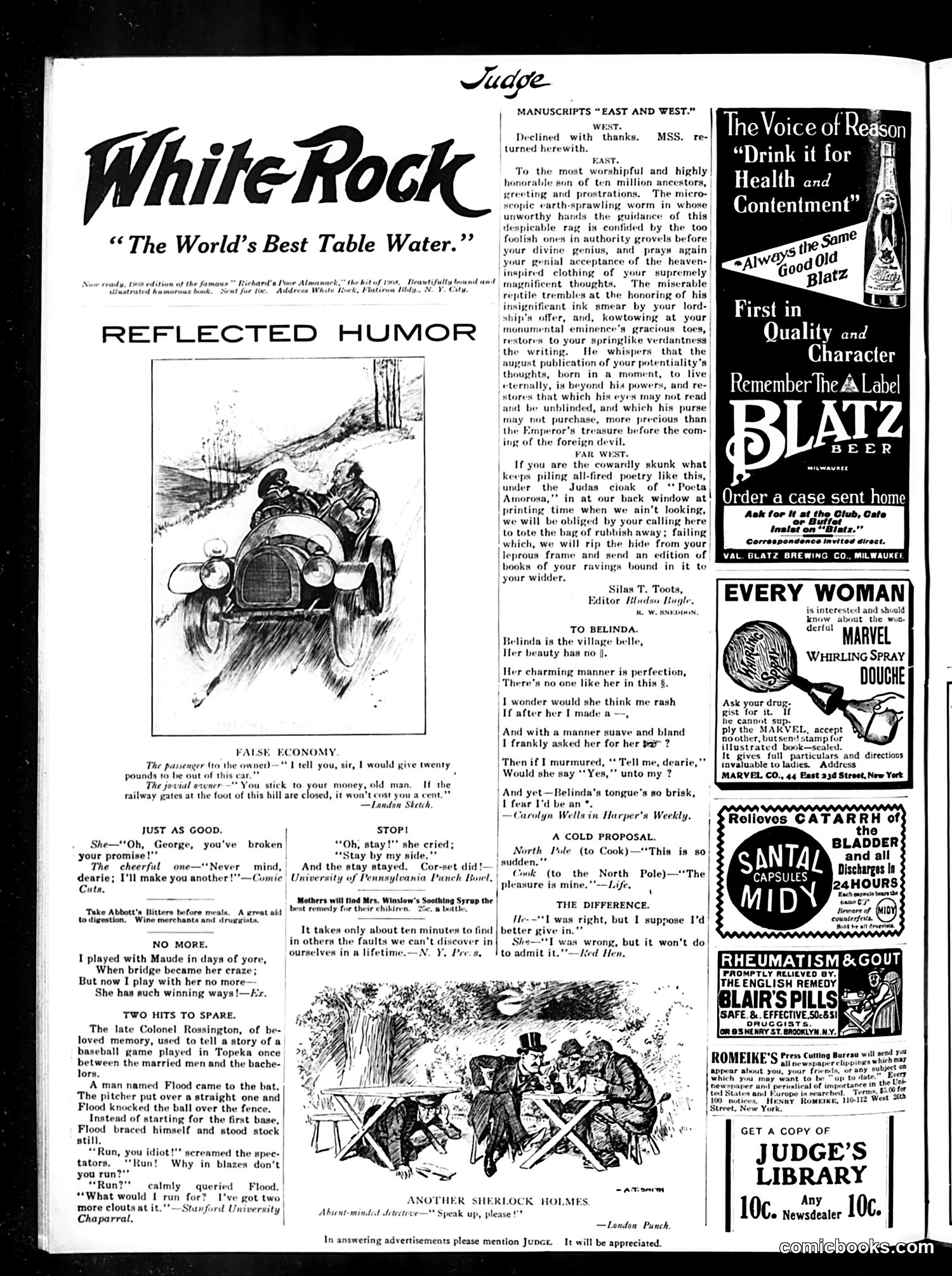
This page from *Judge* magazine contains primarily **humorous anecdotes and jokes** rather than political cartoons. The content reflects early 20th-century American humor conventions. **Main visual element:** A sketch titled "Reflected Humor" showing two men in an early automobile, illustrating a joke about penny-pinching—a passenger offers to pay twenty pounds to exit the vehicle, but the owner refuses, noting the railway gate is closed so it won't cost him anything. **Notable content:** - "FALSE ECONOMY" and "JUST AS GOOD" sections present domestic humor about miserly husbands and broken promises - "TWO HITS TO SPARE" recounts a baseball anecdote about a confused player - "TO BELINDA" is a poem with missing final words (represented by dashes), a common *Judge* format playing on readers' expectations **Advertising dominates the right column:** Blatz Beer, health products (Lair's Remedy, Santa Midy capsules), and Judge's own library offering. The page demonstrates *Judge*'s formula: light social satire about everyday situations—money, romance, misunderstandings—rather than hard political commentary.
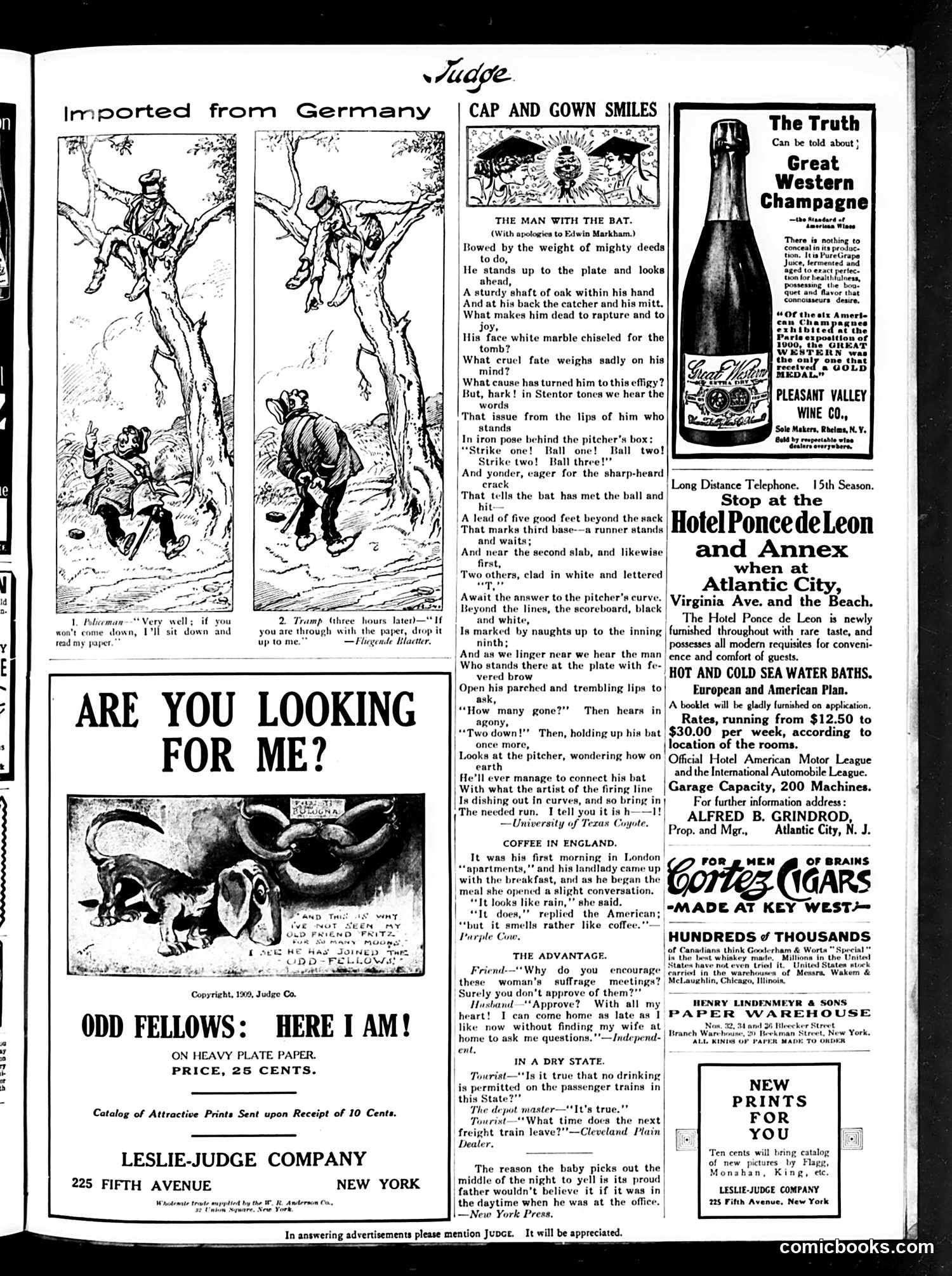
This page from Judge magazine (copyright 1909) is primarily **advertising with some satirical content**. The main cartoon, "The Man with the Bat," parodies Edwin Markham's famous poem "The Man with the Hoe" (about rural labor). Here, it applies that dignified, weighty tone to baseball—a humorous deflation showing a batter frozen by anxiety over the umpire's calls ("Strike one! Ball one!"). The joke mocks the melodrama surrounding what should be entertainment. **Other content** includes German-imported cartoons, short humorous anecdotes about miscommunications (a policeman misunderstood, an American mistaking English "coffee" for something else), and a joke about women's suffrage letting husbands avoid wives' questions. The page is **dominated by advertisements** for Western Champagne, the Hotel Ponce de Leon in Atlantic City, Cortes Cigars, and the Leslie-Judge Company's prints—typical of Judge's revenue model. The humor is gentle, wordplay-based satire reflecting early 1900s American attitudes.
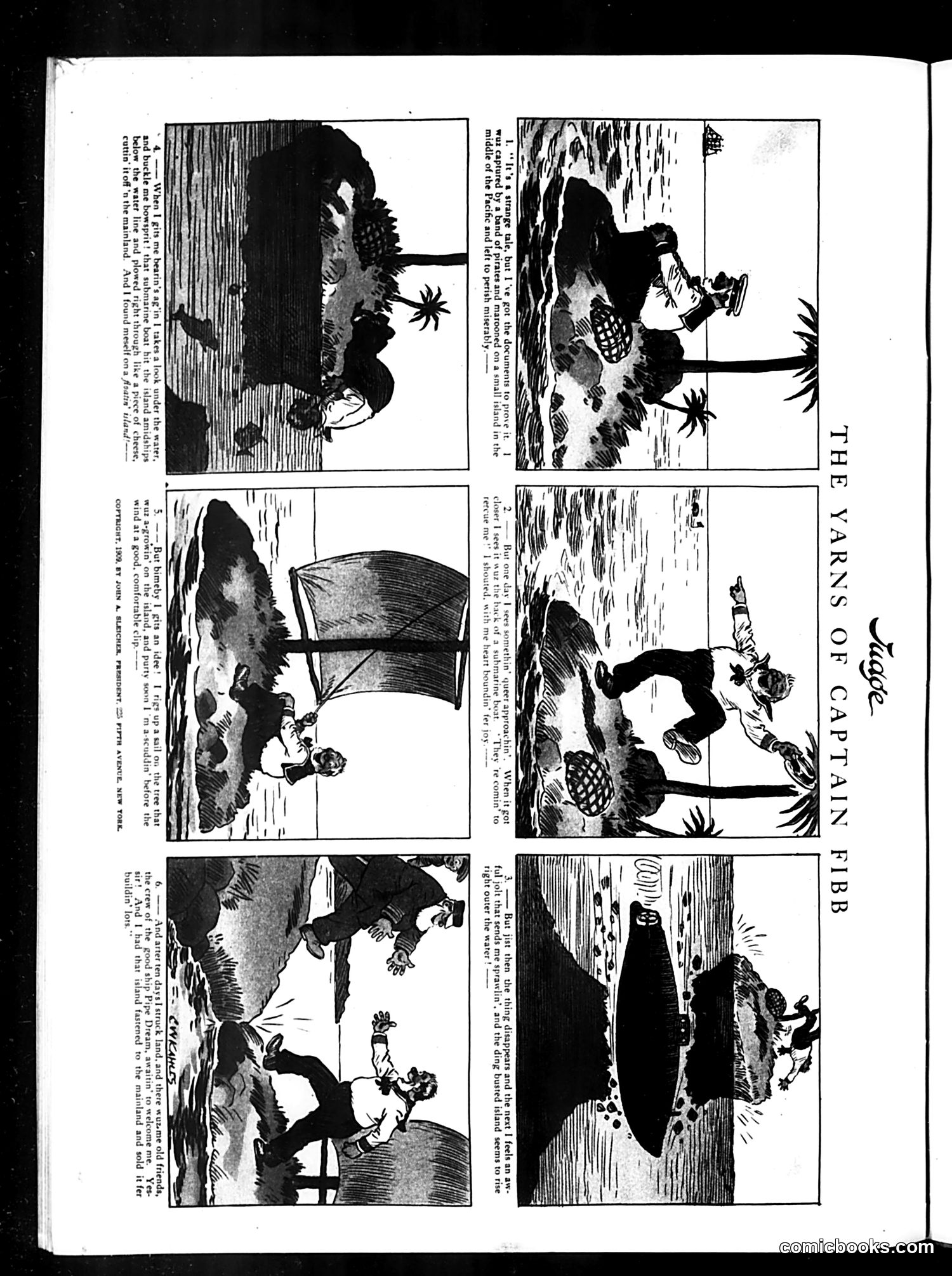
This appears to be a sequential comic strip following a character called "Captain Fibb" through various adventures. The six panels show the captain in different scenarios—appearing to interact with tropical or maritime settings, handling flags, and encountering various situations. Without clearer text visibility, the specific satirical target remains unclear, but Judge magazine typically mocked political figures, social pretensions, and current events. The "Captain" title suggests possible mockery of military authority or fraudulent claims to status. The comic's narrative arc and the character's name hint at satire regarding dishonesty or exaggeration, though the exact historical reference or person being caricatured cannot be definitively determined from the image alone.