
Judge, 1909-10-16 · page 10 of 16
Judge — October 16, 1909 — page 10: what you’re looking at
What you’re looking at
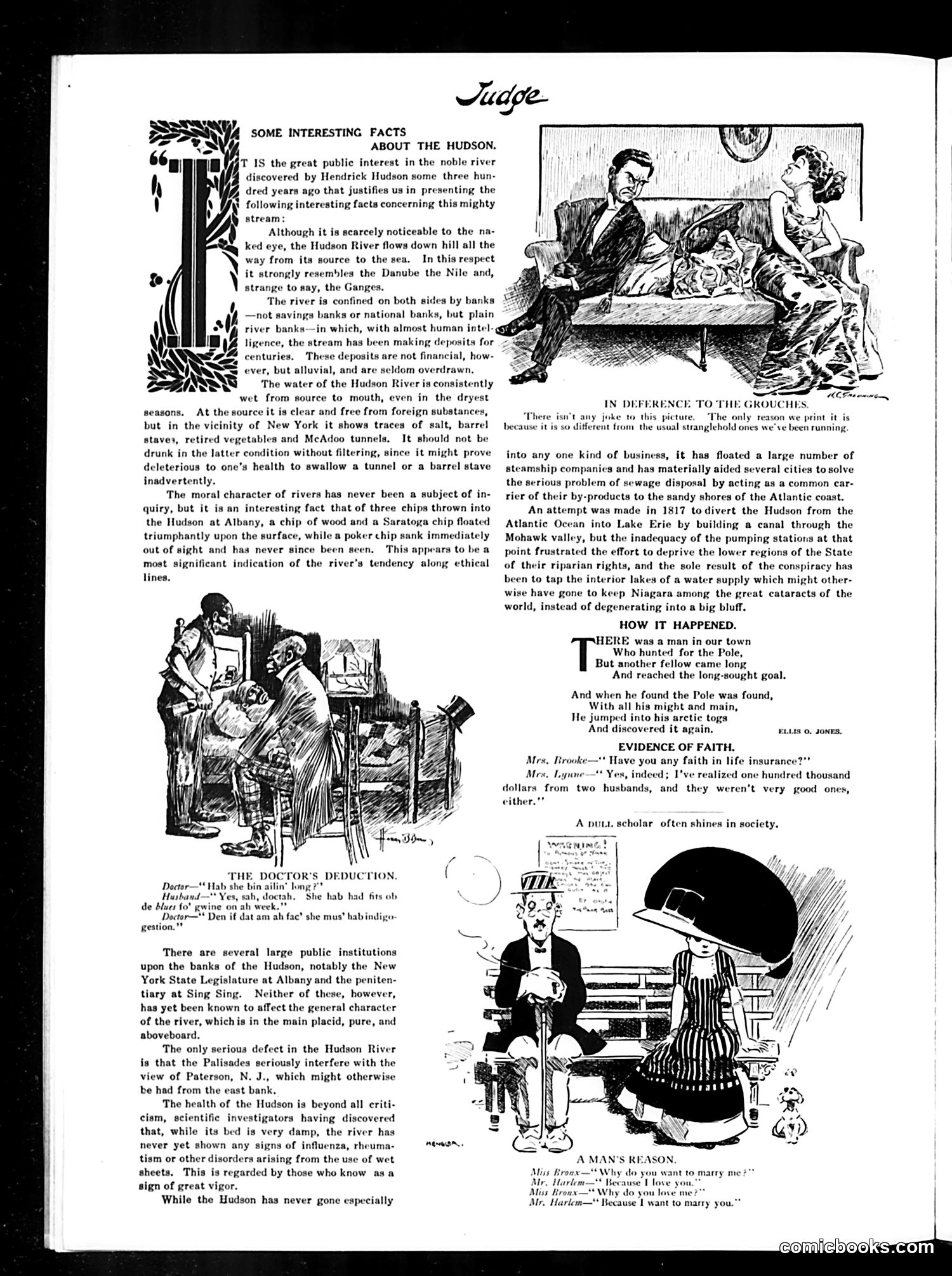
This page features **mock-serious pseudo-scientific commentary on the Hudson River**, presented as "interesting facts." The humor relies on deliberate absurdity: the text treats the river like a financial institution (puns on "banks," "deposits," "overdrawn"), includes nonsensical observations (poker chips sinking while wood chips float as moral commentary), and makes deliberately stupid deductions (a doctor concluding a woman has indigestion based on river pollution). The cartoons illustrate separate social humor: "The Doctor's Deduction" depicts medical incompetence; "A Man's Reason" presents a domestic scenario where a man explains loving his wife because he wants to marry her—circular logic played for comedy. The page also references the **1817 canal attempt** to divert the Hudson toward Lake Erie, touching on real infrastructure debates. Overall, this is genteel satirical humor typical of early-20th-century Judge magazine—wordplay and absurdist observations rather than sharp political critique.
📄 Transcribed text from this page (OCR, searchable)
Machine-transcribed from the original scan — historical spelling and the odd misread are preserved.
SOME INTERESTING FACTS ABOUT THE HUDSON. T IS the great public interest in the noble river discovered by Hendrick Hudson some three hun- dred years ago that justifies us in presenting the following interesting facts concerning this mighty stream: Although it is scarcely noticeable to the na- ked eye, the Hudson River flows down hill all the way from its source to the sea. In this respect it strongly resembles the Danube the Nile and, strange to say, the Ganges. The river is confined on both sides by banks —not savings banks or national banks, but plain river banks—in which, with almost human inte! ligence, the stream has been making deposits for centuries, ‘These deposits are not financial, how- ever, but alluvial, and are seldom overdrawn, \ I Nae SS The water of the Hudson River is consistently b\ i re ys wet from source to mouth, even in the dryest seasons. At the source it is clear and free from foreign substances, but in the vicinity of New York it shows traces of salt, barrel staves, retired vegetables and McAdoo tunnels. It should not be drunk in the latter condition without filtering, since it might prove deleterious to one’s health to swallow a tunnel or a barrel stave inadvertently. The moral character of rivers has never been a subject of in- quiry, but it isan interesting fact that of three chips thrown into the Hudson at Albany, a chip of wood and a Saratoga chip floated triumphantly upon the surface, while a poker chip sank immediately out of sight and has never since been seen. This app , most significant indication of the river's tendency alor lines. N LEY ‘THE DOCTOR'S DEDUCTION. jin’ I Doctor—** Den if dat am ah fac’ she mus’ hab indie gestion.” There are several large public institutions upon the banks of the Hudson, notably the New York State Legislature at Albany and the p tiary at Sing Sing. Neither of these, how has yet been known to affect the general character of the river, which is in the main placid, pure, and aboveboard. The only serious defect in the Hudson River is that the Palisades seriously interfere with the view of Paterson, N. J., which might otherwise be had from the east bank. The health of the Hudson is beyond all criti- cism, scientific in igators having discovered that, while its bed is very damp, the river has never yet shown any signs of influenza, rheuma- tism or other disorders arising from the use of wet sheets. This is regarded by those who know as a sign of great vigor. While the Hudson has never gone especially nee. ‘0 THE GROUCHE: p ly reason we print the usual stranglehold ones we've been rui isn’t any is so ditfe into any one kind of business, it has floated a large number of steamship companies and has materially aided several cities to solve the serious problem of sewage disposal by acting as a common car- rier of their by-products to the sandy shores of the Atlantic coast. An attempt was made in 1817 todivert the Hudson from the Atlantic Ocean into Lake Erie by building a canal through the Mohawk valley, but the inadequacy of the pumping stations at that point frustrated the effort to deprive the lower regions of th of their riparian rights, and the sole result of the conspi been to tap the interior lakes of a water supply which might other- wise have gone to keep Niagara among the great cataracts of the world, instead of degenerating into a big bluff. HOW IT HAPPENED. HERE was a man in our town Who hunted for the Pole, But another fellow came long And reached the long-sought goal. And when he found the Pole was found, With all his might and main, He jumped into his arctic togs And discovered it again, rus 0, sons. EVIDENCE OF FAITH. Mrs. Brooke—* Have you any faith in life insurance?” Mrs. Lynne—" Yes, indeed; I've realized one hundred thousand dollars from two husbands, and they weren't very good ones, cither.”” A puta. scholar often shines in society. want to marry me ?"* use I love you." Why do you love m Mr. Harlem—* Because I want to marry you."*