
Judge, 1909-10-16 · page 6 of 16
Judge — October 16, 1909 — page 6: what you’re looking at
What you’re looking at
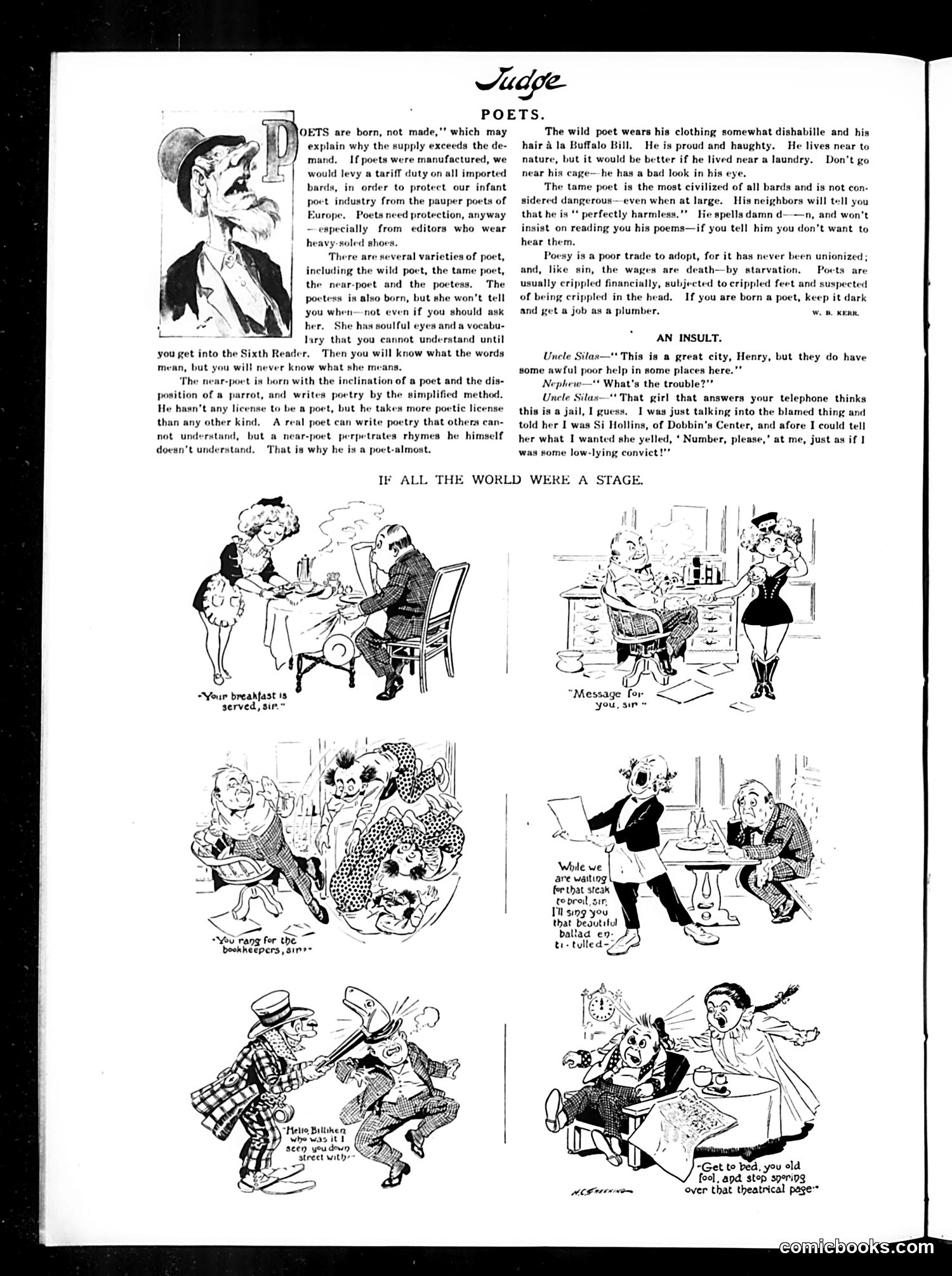
This page satirizes **poets and the theatrical world** through humor and social commentary. The main essay mocks various "types" of poets—wild, tame, near-poets, and poetesses—depicting them as impractical, financially doomed, and often incomprehensible. The satire suggests poetry is an unmarketable profession; one should "get a job as a plumber" instead. The tone ridicules both poets' pretensions and the public's indifference to them. **"An Insult"** depicts a country visitor (Uncle Silas) offended by a telephone operator's curt professionalism, illustrating rural attitudes toward modern urban service workers. **"If All the World Were a Stage"** is a comic series showing everyday situations reimagined as theatrical performances—servants delivering breakfast dramatically, a barber shop scene, restaurant patrons awaiting food, and couples arguing. The joke plays on theatrical melodrama applied to mundane daily life, likely poking fun at both theatrical excess and ordinary people's self-importance. Overall, the page blends literary criticism with gentle social satire targeting artistic pretension and class differences.
📄 Transcribed text from this page (OCR, searchable)
Machine-transcribed from the original scan — historical spelling and the odd misread are preserved.
uadge POETS. |OETS are born, not made,” which may explain why the supply exceeds the de- mand. If poets were manufactured, we would levy a tariff duty on all imported bards, in order to protect our infant poet industry from the pauper poets of pe. Poets need protection, anyway especially from editors who wear heavy-soled shoes. There are several varieties of poet, including the wild poet, the tame poet, the near-poet and the poetess, The poetess is also born, but she won't tell you when—not even if you should ask her. She has soulful eyes and a vocabu- lary that you cannot understand until you get into the Sixth Reader. Then you will know what the words mean, but will never know what she means. ‘The near-poet is born with the inclination of a poet and the dis- position of a parrot, and writes poetry by the simplified method, He hasn't any license to be a poet, but he takes more poetic licens than any other kind. A real poet can write poetry that others c: not understand, but a near-poet perpetrates rhymes he himself doesn’t understand, That is why he is a poet-almost. The wild poet wears his clothing somewhat dishabille and his hair A la Buffalo Bill. He is proud and haughty. He lives near to nature, but it would be better if he lived near a laundry. Don’t go near his cage—he has a bad look in his ¢: The tame poet is the most civilized of all bards and is not con- even when at large. His neighbors will tell you spells damn d——n, and won't you tell him you don’t want to sidered dangerous he is “ perfectly harmless."” ist on reading you his poems—i hear them. Poesy is a poor trade to adopt, for it has never been unionized ; are death—by starvation, Poets e cted to cri feet and suspected If you are born a poet, keep it dark we KEK, and, like sin, the way usually crippled financially, of being crippled in the head. and get a job as a plumber. subj AN INSULT. Uncle Silas— This is a great city, Henry, but they do have some awful poor help in some places here. Nephew—* What's the troubl Uncle Silas—* That girl that answers your telephone thinks this is a jail, I guess, 1 was just talking into the blamed thing and told her I w: Hollins, of Dobbin’s Center, and afore I could tell her what I wanted she yelled, ‘ Number, please,’ at me, just as if | was some low-lying convi Ik ALL THE WORLD WERE A STAGE. “Your breakfast is served, sir.” ao > <> + You rang fer the pekheeperssaine “Helio Bilihen, whe was it seen you down street with u “Message for While we are waiting for that steak toprol, sir, Tit sing you that beautiful ballad en- tr-tulled- Get te bed, you old fool, apd step spring ‘over that theatrical page* MOG