
A complete issue · 16 pages · 1909
Judge — September 4, 1909
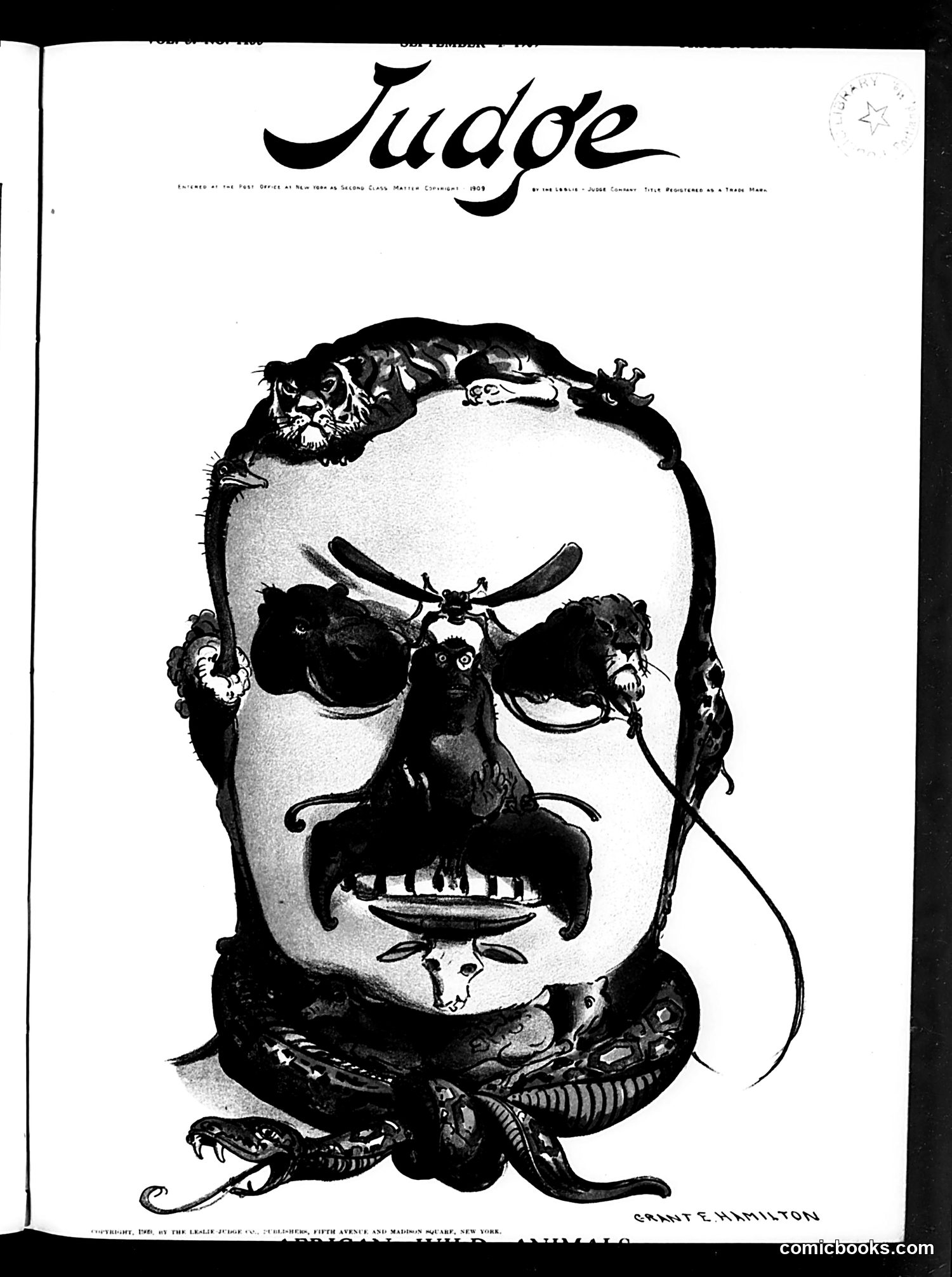
This is a surreal political caricature by Grant E. Hamilton depicting a grotesque face composed entirely of animals and creatures. The image appears to be satirical commentary on a political figure or public personality of the era, using animal imagery—snakes, rats, insects, and other creatures—to suggest moral corruption, untrustworthiness, or bestial behavior. The style is characteristic of 19th-century American political cartooning, where caricature exaggeration and composite imagery conveyed harsh judgment. The animals packed into the facial features likely symbolize vices or undesirable traits the cartoonist associated with the subject. However, without additional context or publication date visible in this image, I cannot definitively identify which specific political figure is targeted or what particular scandal or controversy prompted this attack.
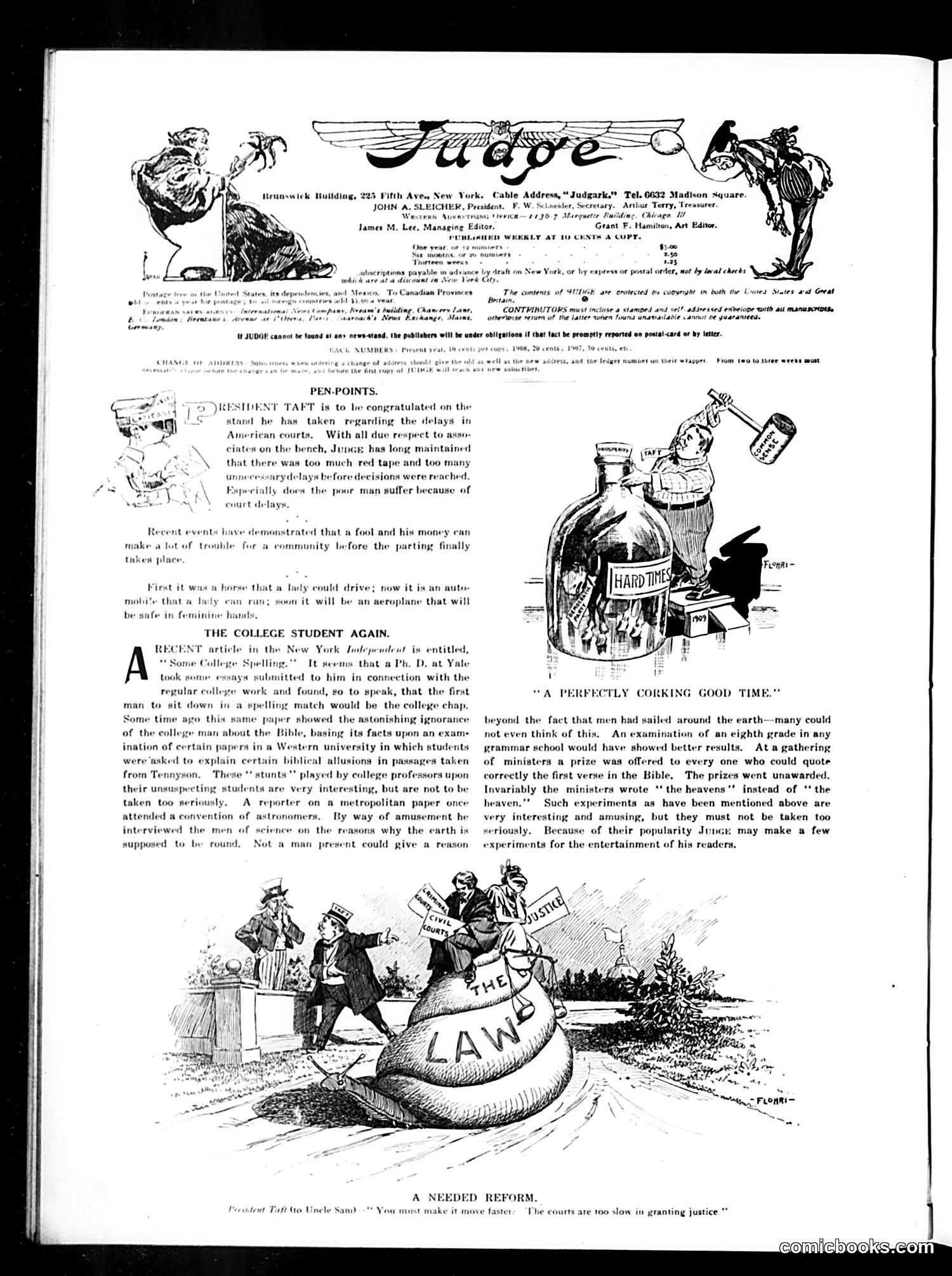
This page contains three distinct pieces of social commentary: **"Pen-Points"** section discusses President Taft's reputation regarding court delays, suggesting fools and money cause community trouble before "parting finally takes place." It references evolving technology (horses, autos, aeroplanes) as metaphors for societal change. **"The College Student Again"** critiques a Yale student's essay submissions on biblical topics, mocking college ignorance. The anecdote about ministers misquoting "the heavens" instead of "the heaven" satirizes educated men's incompetence. **"A Needed Reform"** (bottom cartoon) depicts "The Law" as an overweight, sluggish figure while Uncle Sam demands faster court proceedings. The caption states courts are "too slow in granting justice"—a clear indictment of America's judicial system's inefficiency during this era.
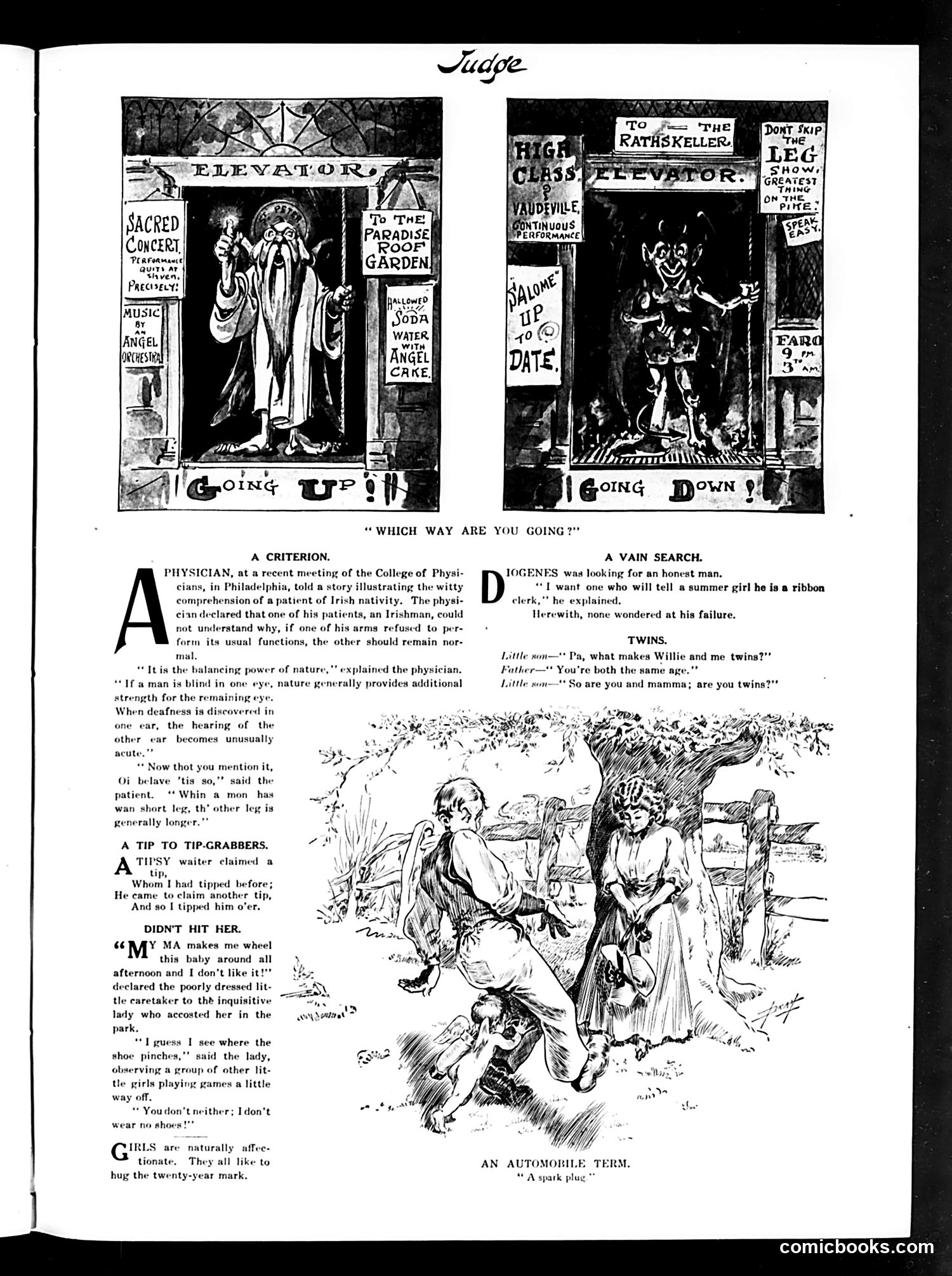
The page features two elevator advertisements as its main visual content, positioned as contrasting "Going Up" (showing angelic/heavenly scenes) versus "Going Down" (showing demonic/hellish scenes). This is a straightforward commercial juxtaposition using religious imagery for contrast. Below are several brief humorous anecdotes and jokes unrelated to politics: - "Which Way Are You Going?" - a physician's story about Irish patients - "A Vain Search" - Diogenes seeking an honest man - "Twins" - a dialogue about identical children - "A Tip to Tip-Grabbers" - commentary on tipping culture - "Didn't Hit Her" - a joke about a taxi driver - "Girls" - brief commentary on young women - "An Automobile Term" - a pun about "spark plug" This appears to be a general humor/joke page with no apparent political satire or significant social commentary.
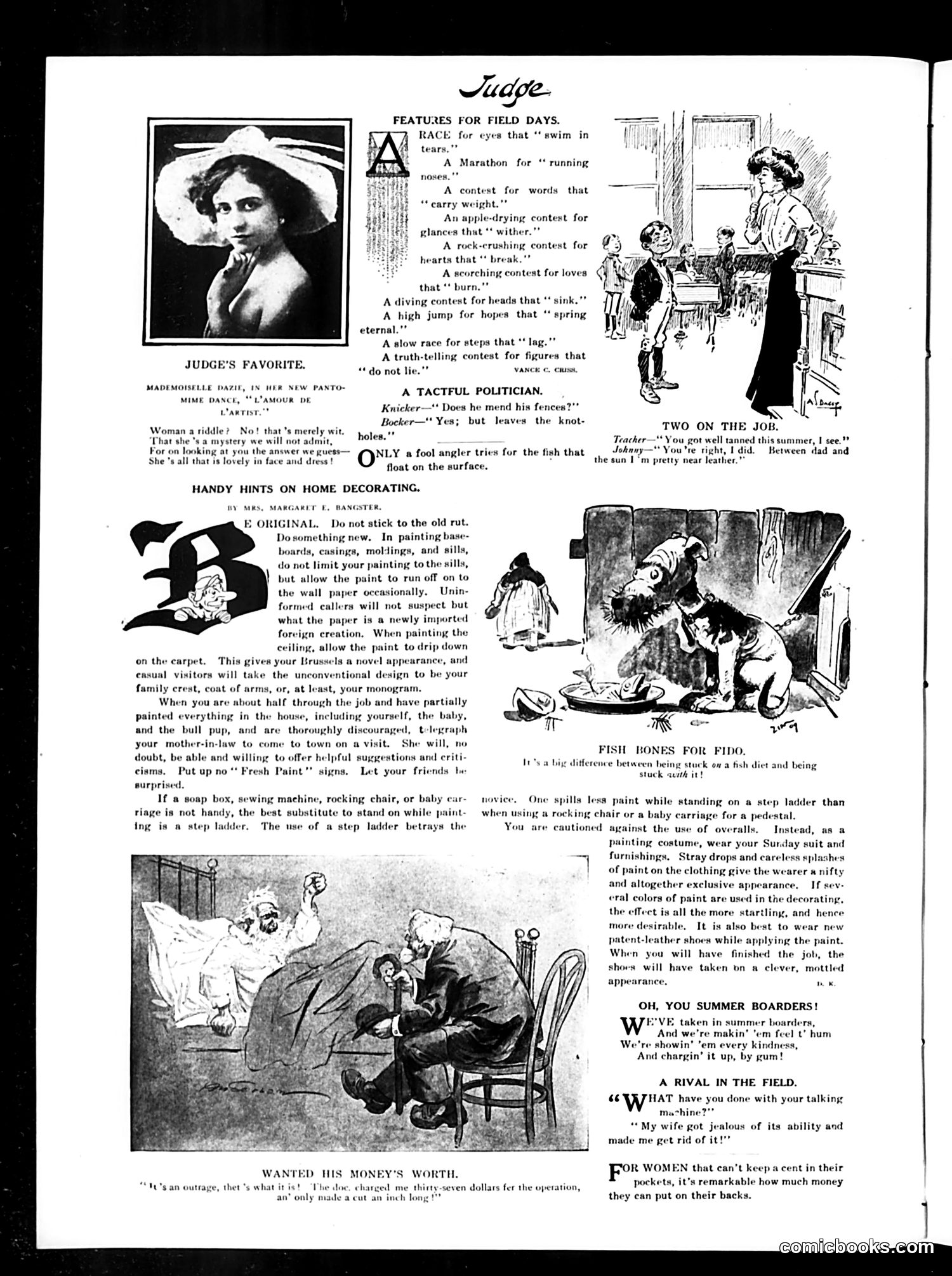
This page contains several unrelated satirical pieces and jokes typical of early Judge magazine format rather than a coherent political cartoon. The top section features "Features for Field Days"—humorous competitive contest ideas (races for "running noses," contests for "hearts that break," etc.). "A Tactful Politician" presents a brief joke about fence-mending. "Handy Hints on Home Decorating" offers interior design advice, satirizing trendy decorating practices. Other sections include jokes about fishing, summer boarders, and women's finances—standard domestic humor of the era. The illustrations show everyday scenes: a woman decorating, people painting, and social situations. These appear to be general-audience humor pieces rather than political satire, reflecting Judge's mix of domestic comedy and light social observation typical of early 20th-century American magazines.
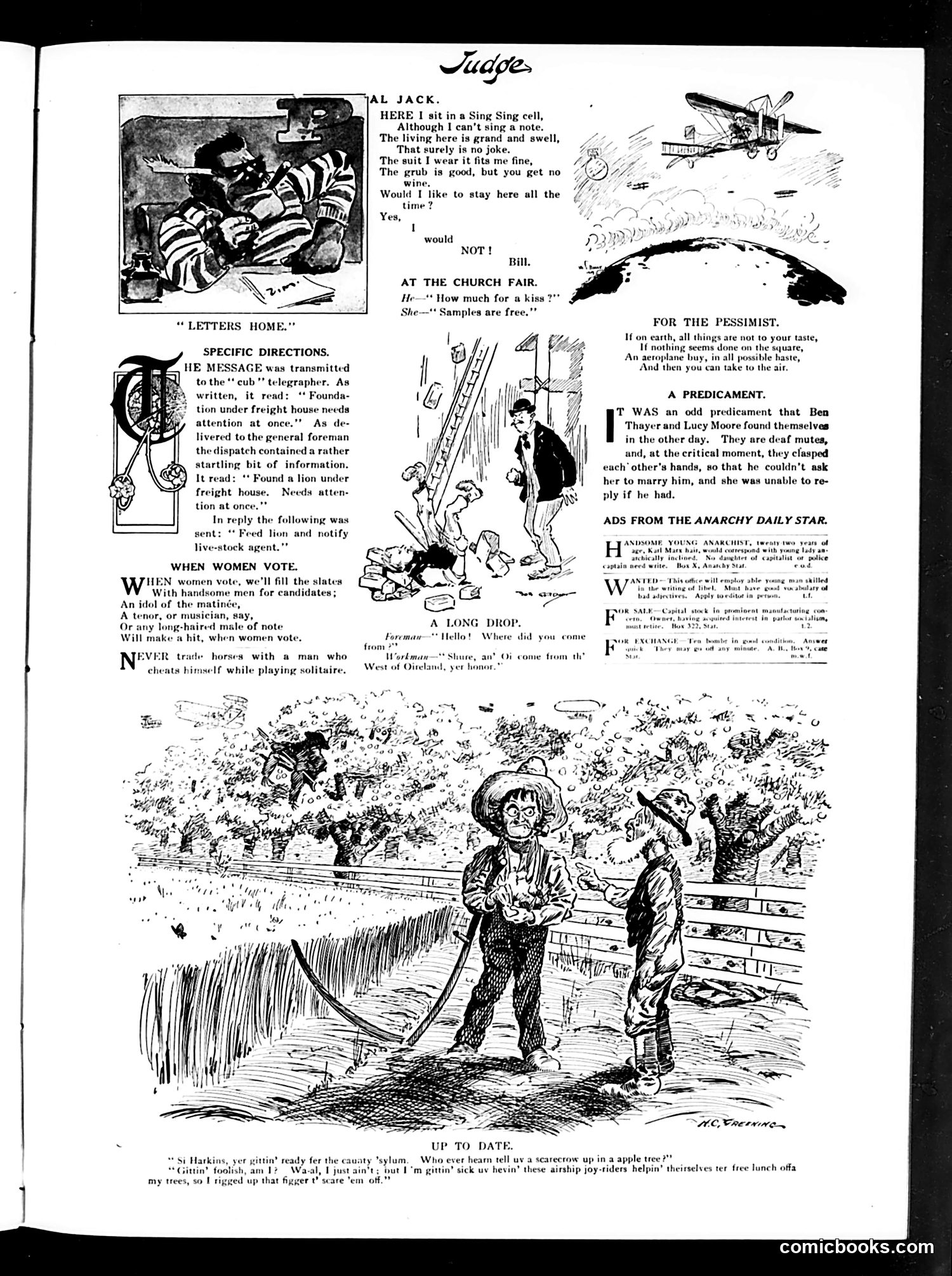
This satirical page contains several unrelated humor pieces typical of Judge magazine's format: **"Letters Home"** mocks overly formal military telegrams with comedic misinterpretations. **"When Women Vote"** presents anti-suffrage humor, suggesting women voters would be frivolous or easily manipulated by male candidates' appearances rather than policy. **"A Long Drop"** shows a rural scene where a farmer discusses scarecrows with a child—likely playing on rural dialect for comedic effect. **Various short jokes** address contemporary topics: church bazaars, aviation, pessimism, and classified ads. The page's satirical targets reflect early 20th-century anxieties: women's suffrage, class differences, and modernization (airplanes). Most humor relies on stereotypes and wordplay rather than sophisticated political commentary. No specific historical figures or dated events are clearly identifiable.
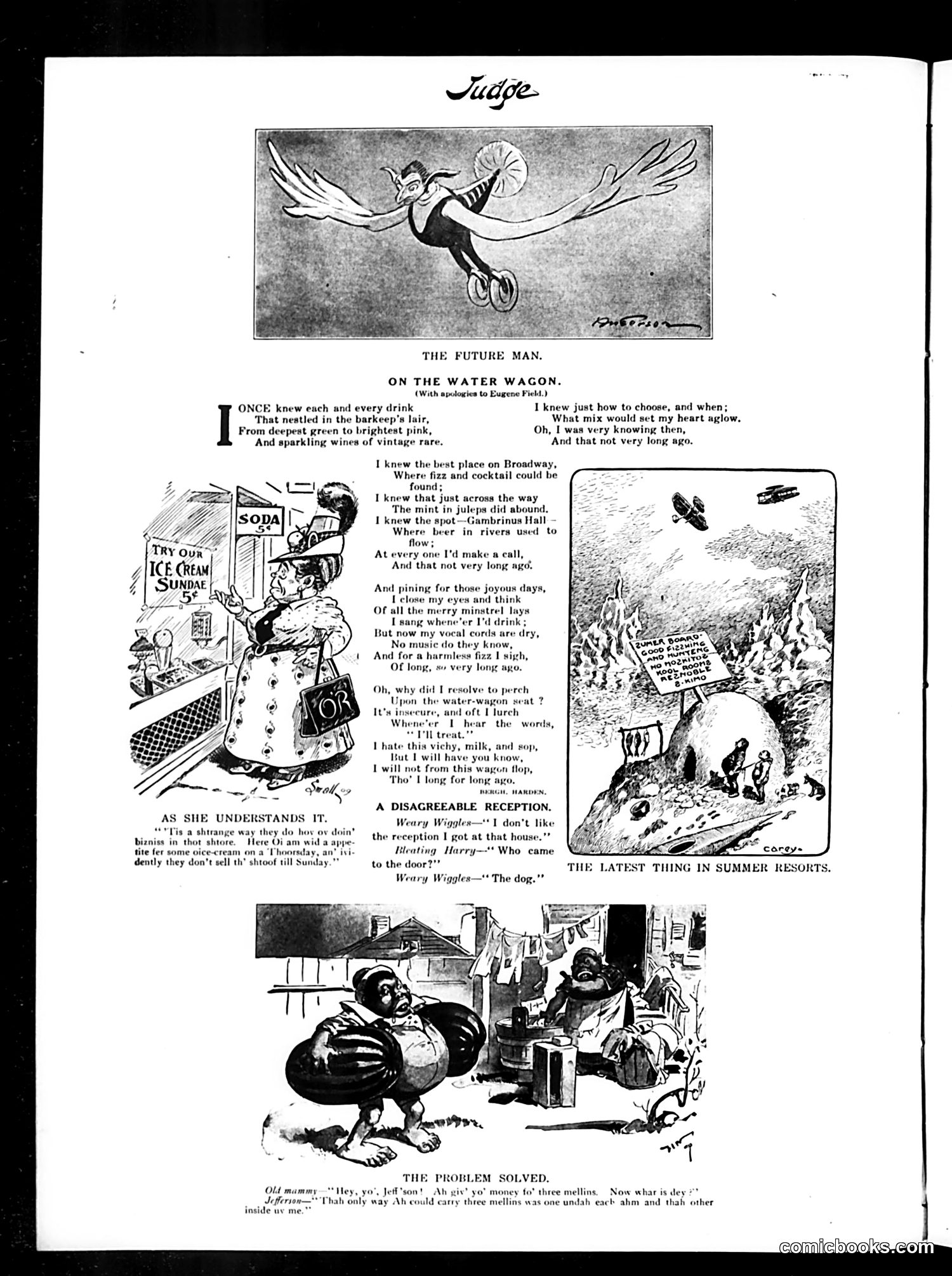
This page contains three satirical pieces reflecting early 20th-century American social concerns: **"On the Water Wagon"** (top): A poetic lament by someone who has quit drinking. The narrator nostalgically recalls his expertise in bars, cocktails, and beverages across New York City, but now abstains. The satire targets the temperance movement and reformed drinkers, mocking both his former excess and current self-denial. The piece parodies Eugene Field's sentimental poetry style. **"As She Understands It" and "A Disagreeable Reception"** (middle/bottom): Brief joke dialogues. The first satirizes Irish immigrant speech patterns and misunderstandings about American store hours. The second makes light of a dog refusing entry to a visitor. **"The Latest Thing in Summer Resorts"** (right): Depicts people at a beach resort with a sign—appears to mock new or absurd vacation trends. The page exemplifies Judge's focus on urban American life, immigrant communities, drinking culture, and social pretensions through ethnic humor and satirical verse popular in that era.
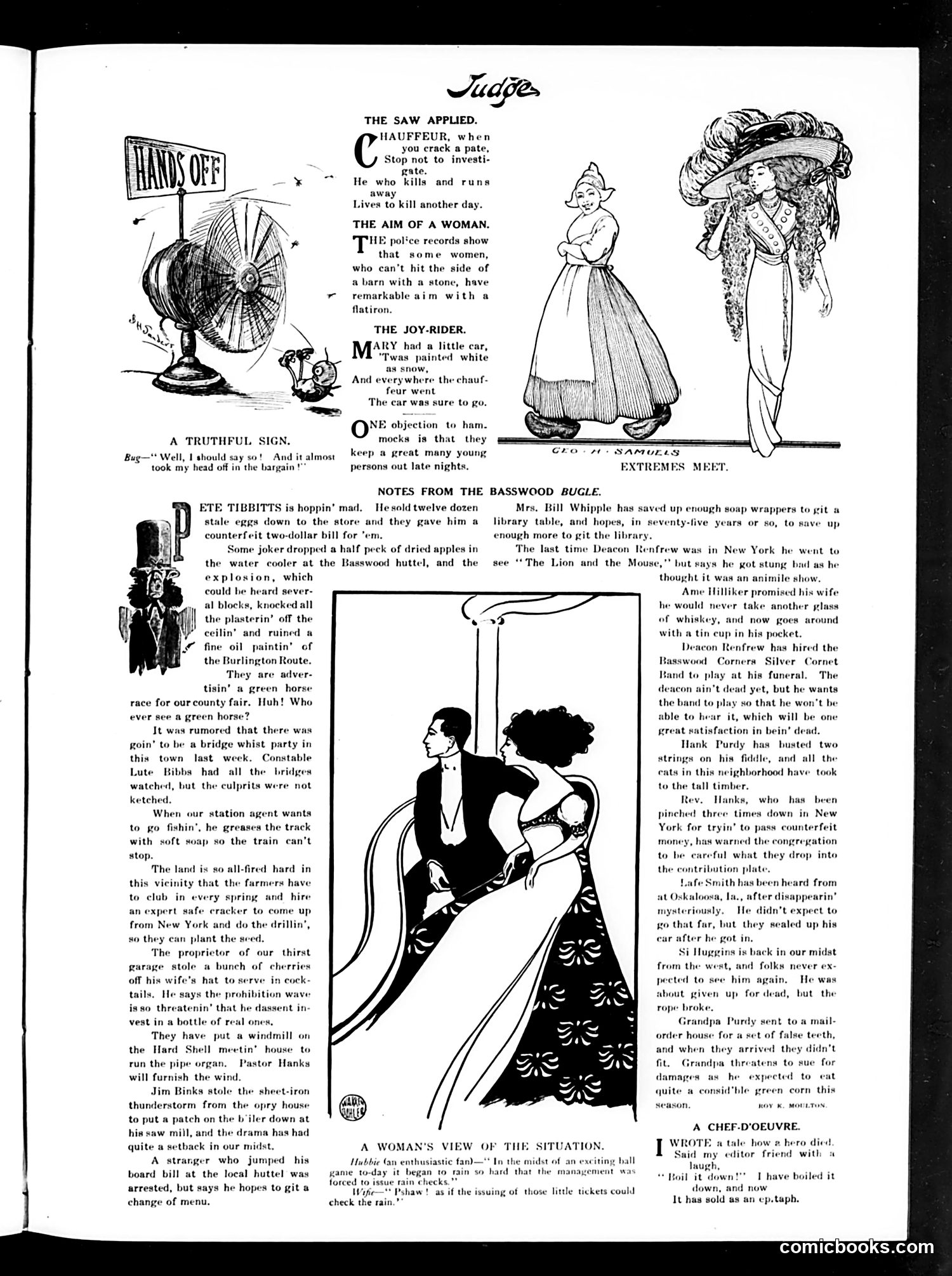
This page from the satirical magazine *Judge* contains multiple short humorous pieces mocking early 1900s American life: **Top cartoons** satirize contemporary social problems: dangerous chauffeurs and joy-riders (new automobile hazards), women's poor aim with weapons but accuracy with household items like flatirons, and young people kept out late by dance halls. **"Notes from the Basswood Bugle"** is a recurring rural humor column mocking small-town life through invented anecdotes—counterfeit schemes, bridge whist parties, a station agent greasing tracks to stop trains, farmers hiring "expert safe crackers" annually. The humor depends on exaggerated rural stereotypes and small-town absurdities. **"A Woman's View of the Situation"** depicts a couple at an evening ball; the wife complains rain drowns out the music—ironic since she'll appreciate not hearing it after death. The overall tone is lighthearted mockery of emerging automobile culture, rural life, and domestic situations, typical of *Judge's* early-20th-century satirical approach.
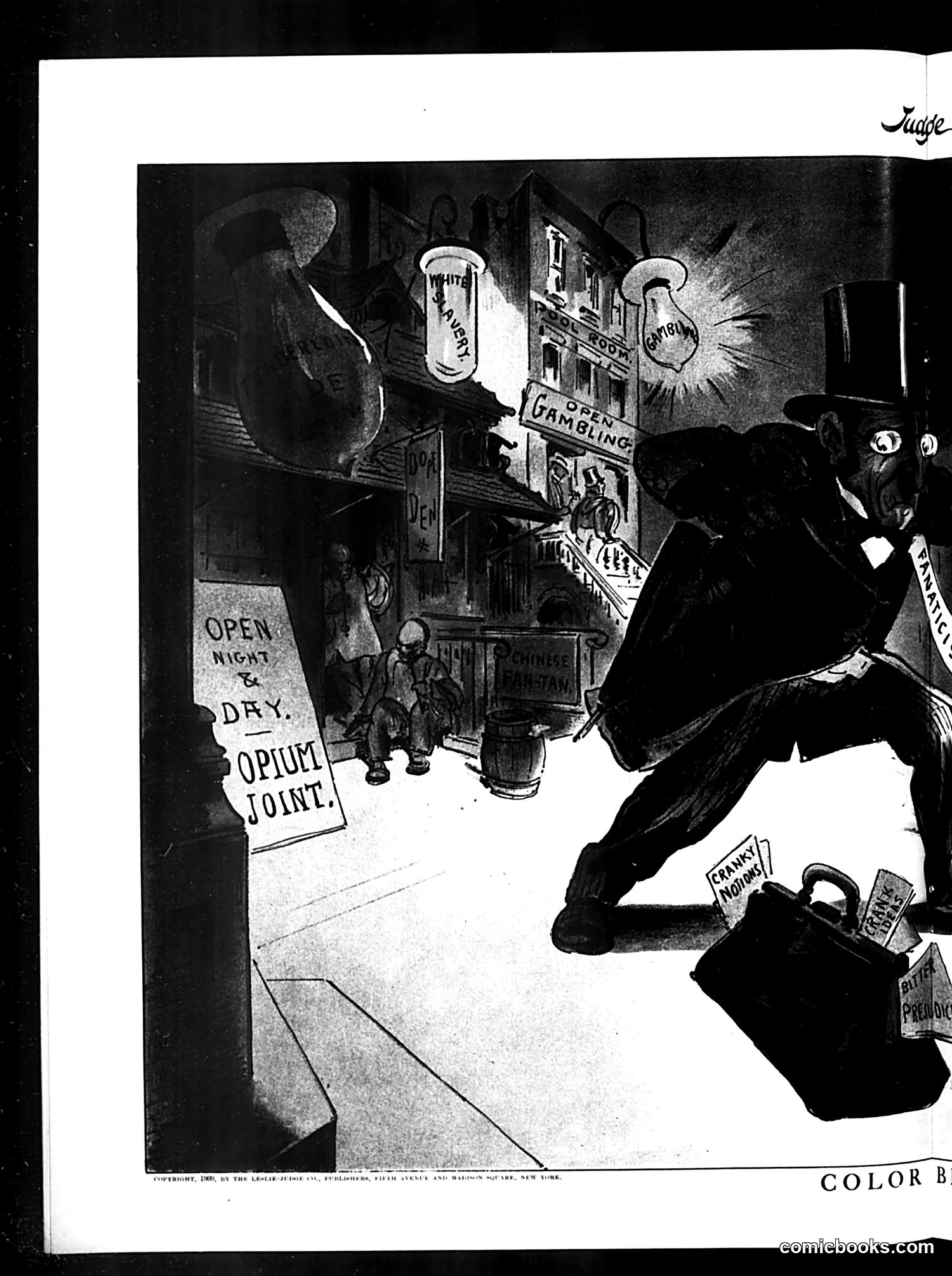
This appears to be a satirical cartoon from Judge magazine depicting a street scene in what seems to be a Chinatown district. The visible signage reads "OPEN NIGHT & DAY," "OPIUM JOINT," "OPEN GAMBLING," and "CHINESE RESTAURANT," suggesting this is social commentary on vice establishments in urban Chinese-American neighborhoods. The cartoon shows a well-dressed figure (likely representing law enforcement or a authority figure) appearing to sneak or tiptoe past these establishments, while carrying what looks like contraband or evidence. The satire appears to critique either the tolerance of illegal activities in such neighborhoods or the selective enforcement of laws. The exaggerated, caricatured style is typical of period Judge magazine commentary on urban social issues and ethnic communities.
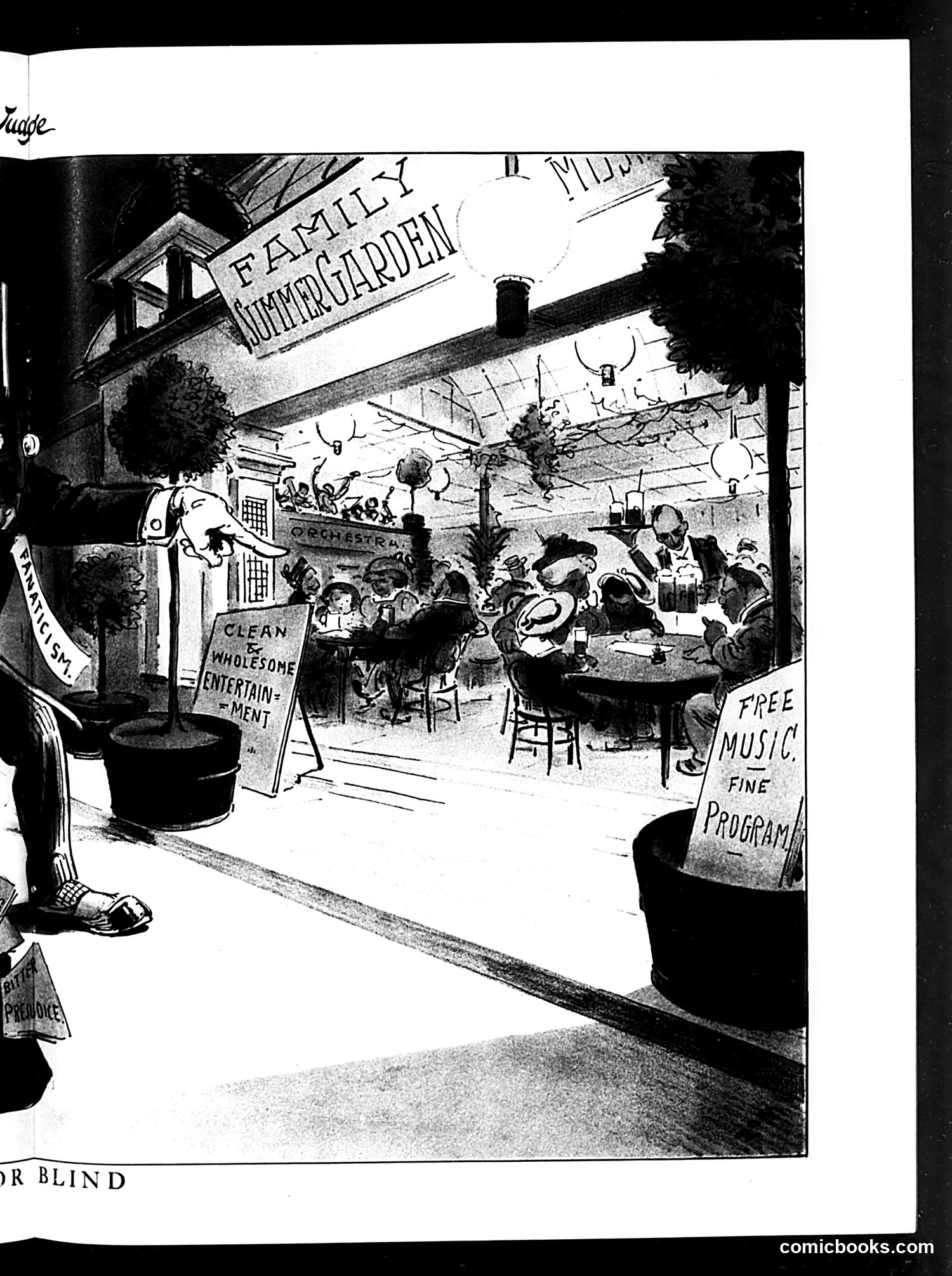
This appears to be a satirical illustration of a "Family Amusement Garden" venue. The cartoon depicts an indoor entertainment space with an orchestra, dining tables, potted plants, and hanging decorations. Signs visible read "CLEAN WHOLESOME ENTERTAINMENT," "FREE MUSIC, FINE PROGRAM," and "FAMILY AMUSEMENT GARDEN." The satire likely critiques the disconnect between such venues' advertised respectability and their actual character—a common Judge magazine theme mocking hypocritical public presentations. The crowded, somewhat chaotic scene may suggest the entertainment is less refined than promised, or that the "family-friendly" claims mask commercialized vice. Without a visible date or clearer context, the specific target remains unclear, though this format typical of early-20th-century American satirical commentary on commercialized leisure.
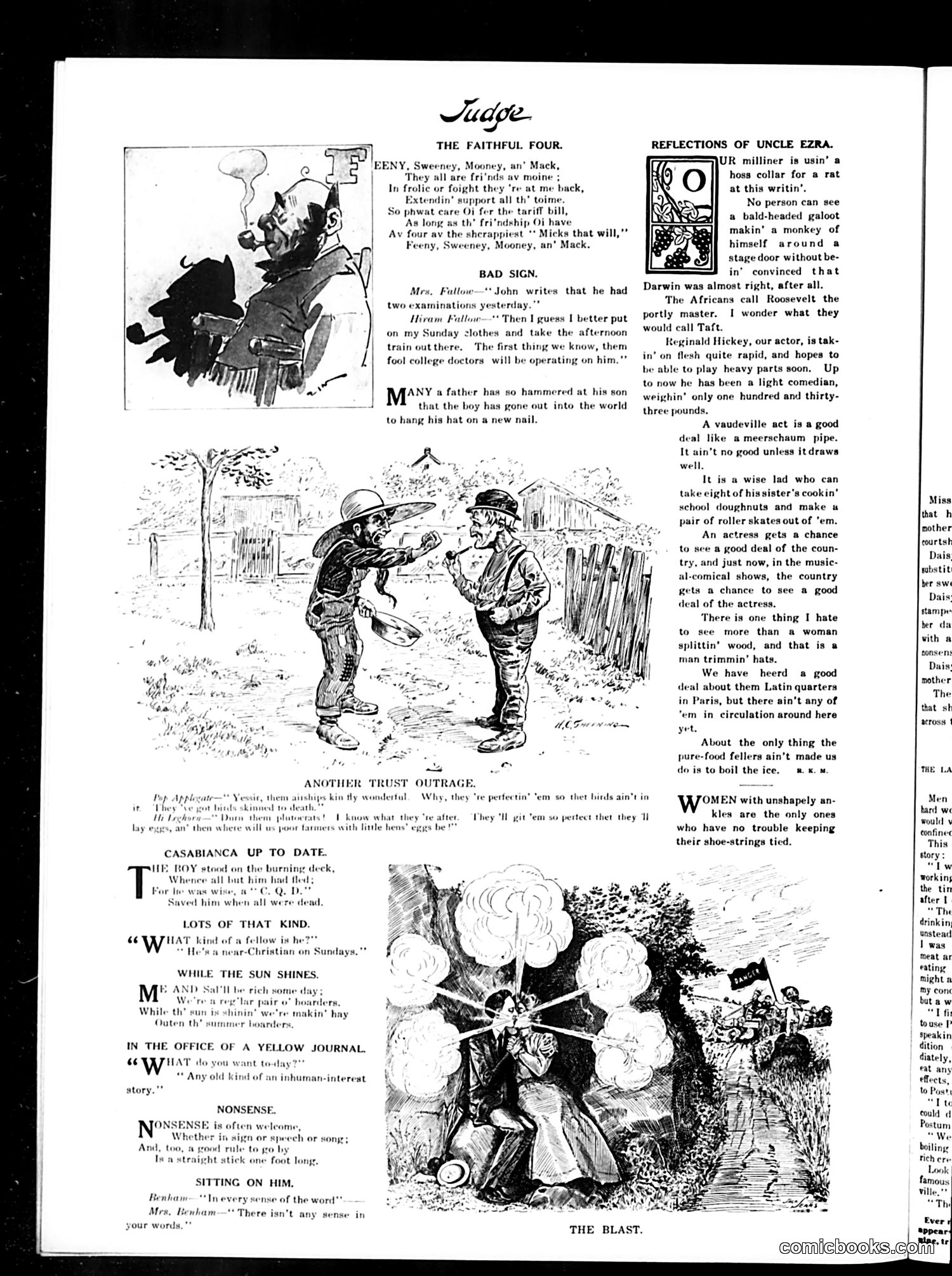
This page contains multiple short satirical pieces typical of Judge's format: **"The Faithful Four"** mocks Irish-American political loyalists ("Micks") who support their representatives regardless of actual policy positions—they'll back their friends "as long as th' friendship" exists, indifferent to tariff disputes. **"Another Trust Outrage"** satirizes agricultural monopolies, with farmers discussing how trusts are perfecting equipment so birds can't interfere with crops—absurdist commentary on corporate control. **"Casabianca Up to Date"** parodies romantic Victorian poetry with mundane modern life. **"Uncle Ezra's Reflections"** contains folksy commentary: Roosevelt versus Taft comparisons, observations about actresses touring the country, and jabs at women's fashion (untidy ankles). **"Yellow Journal"** mocks sensationalist newspapers seeking "inhuman-interest" stories rather than real news. The overall tone satirizes political corruption, corporate excess, immigrant stereotypes, and media irresponsibility—common Judge targets of the Progressive Era.
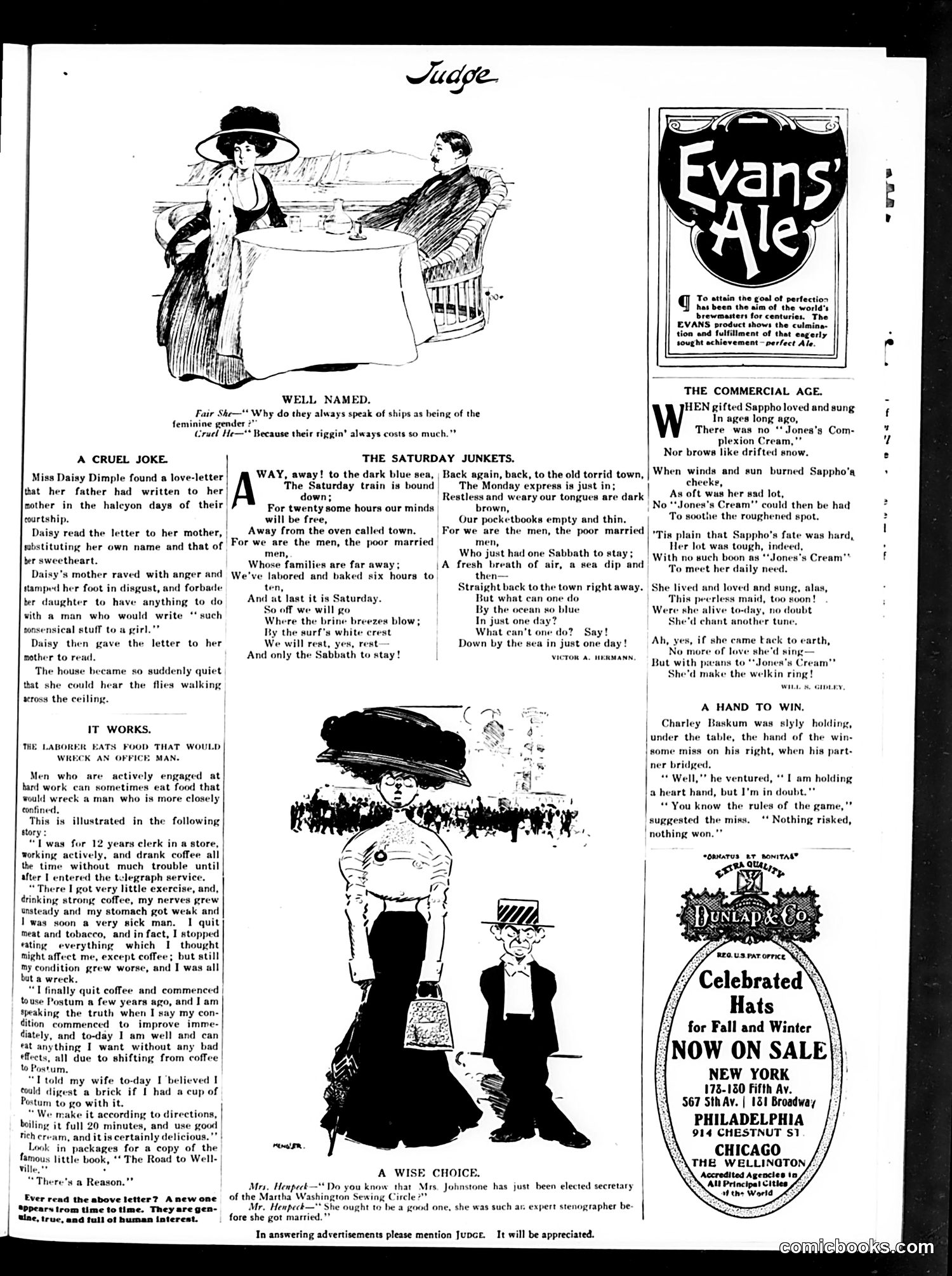
This page contains several short humorous pieces typical of early 20th-century Judge magazine: **"A Cruel Joke"** depicts a young woman (Daisy Dimple) reading her father's old romantic letter to her mother aloud, substituting her own name. When her scandalized mother later reads the original letter, the household goes silent—the joke being that the mother realizes her husband's romantic language wasn't unique or special. **"The Saturday Junkets"** is a poem about working-class married men's brief weekend escape to the seaside, longing for freedom from their wives and domestic responsibilities before returning Monday to town and routine. **"A Wise Choice"** presents a brief exchange where a woman notes another woman became secretary of a sewing circle; the man remarks she should be good at it since she was an expert stenographer before marriage—implying wives lose their professional skills. The advertisements include Evans' Ale and Dunlap hats. The overall tone reflects period attitudes toward marriage (husbands seeking escape), women's post-marriage domesticity, and working-class leisure.
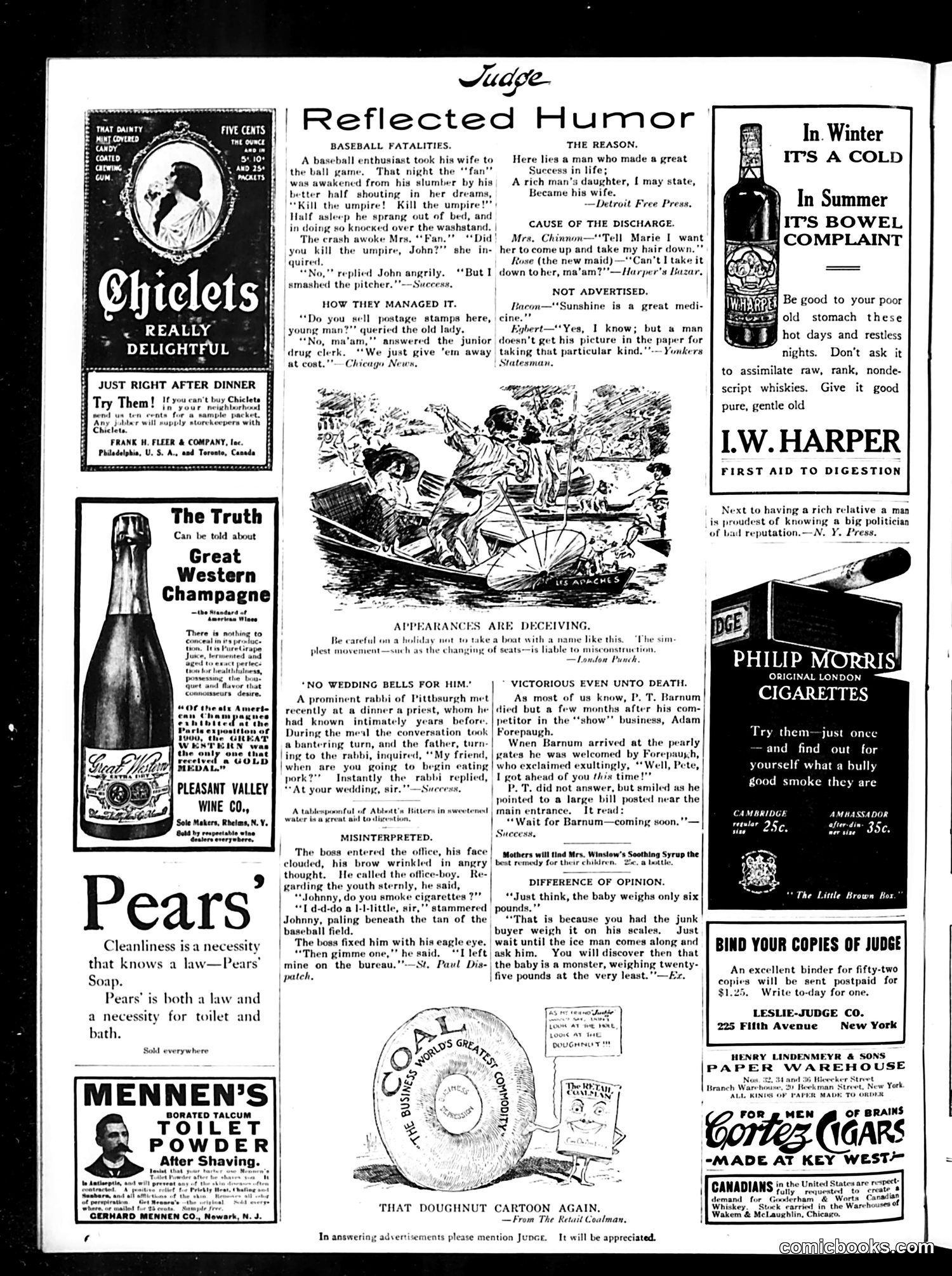
This page is primarily **advertising with interspersed jokes and humorous anecdotes**, not political cartoons. The main content is a doughnut cartoon (captioned "APPEARANCES ARE DECEIVING") depicting a man unwittingly taking a boat with unstable seating—a visual pun on the doughnut shape. The humor pieces are lighthearted social satire typical of early 20th-century periodicals: a baseball fan's wife shouting "Kill the umpire!" in her sleep; a rabbi's witty comeback about attending a non-believer's wedding; a confused boss mishearing an employee. These gentle jokes mock everyday foibles—marital dynamics, religious stereotypes, workplace miscommunication. The surrounding advertisements (Pears Soap, L.W. Harper whiskey, Philip Morris cigarettes) are standard period marketing. This appears to be a humor/advertising-focused page rather than serious political commentary.
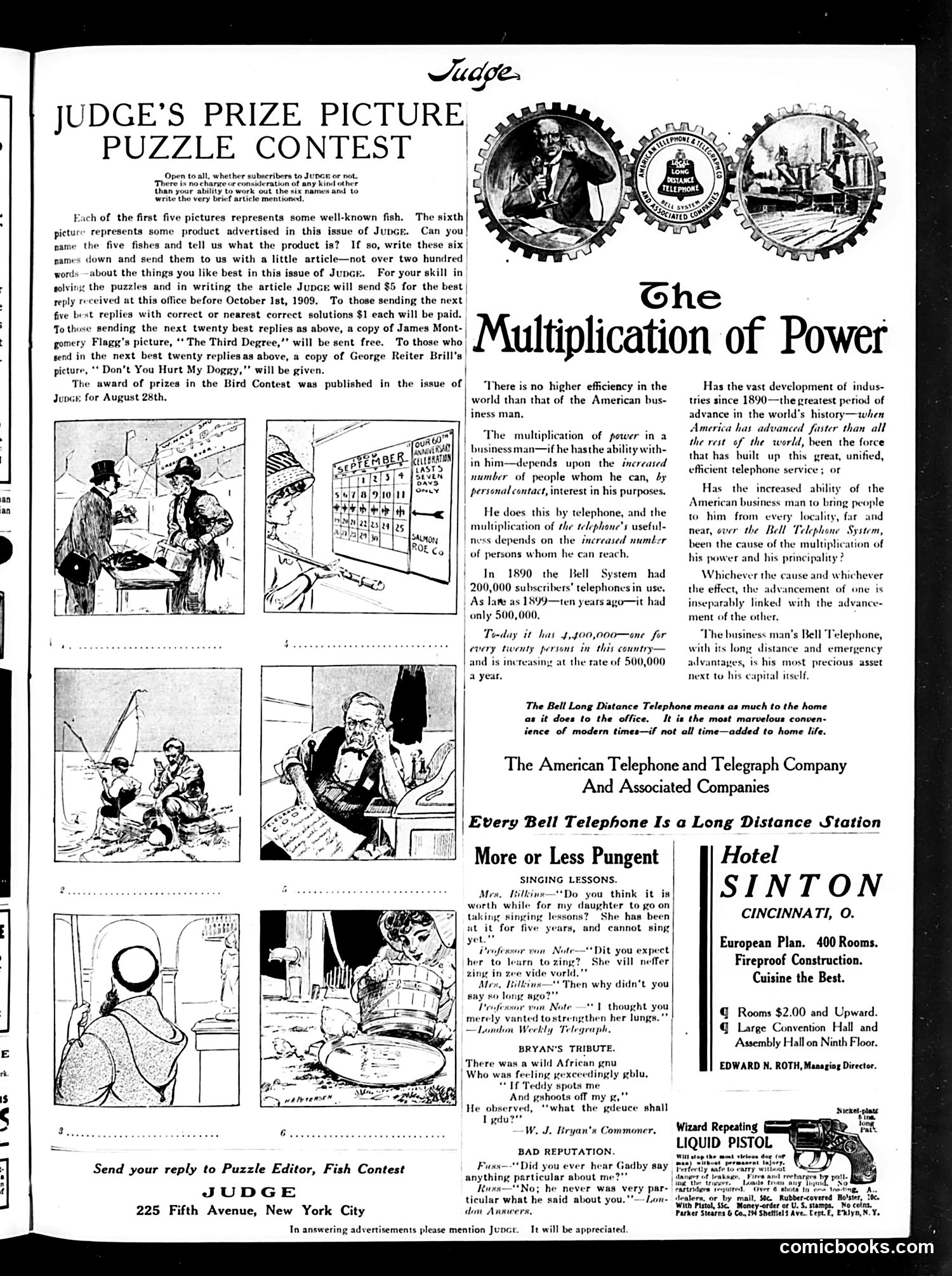
This page is primarily a **puzzle contest advertisement** with supplementary content. The six numbered cartoon panels depict various fish and products for readers to identify and name as part of Judge's 1909 contest (offering $5 for the best entry). The page's main feature is a large **advertisement for Bell Telephone** disguised as editorial content under the heading "The Multiplication of Power." This promotion argues that American business efficiency since 1890 depends on the telephone system's expansion—from 200,000 subscribers in 1890 to 4.4 million by 1909. The ad presents the telephone as essential to business success, framing it as a "precious asset next to capital itself." The bottom section contains **brief humorous anecdotes** ("More or Less Pungent"), including jokes about singing lessons and references to President Theodore Roosevelt ("Teddy"). **Hotel Sinton advertisement** and other commercial notices fill remaining space. The page reflects early 20th-century American optimism about technological progress and corporate power.
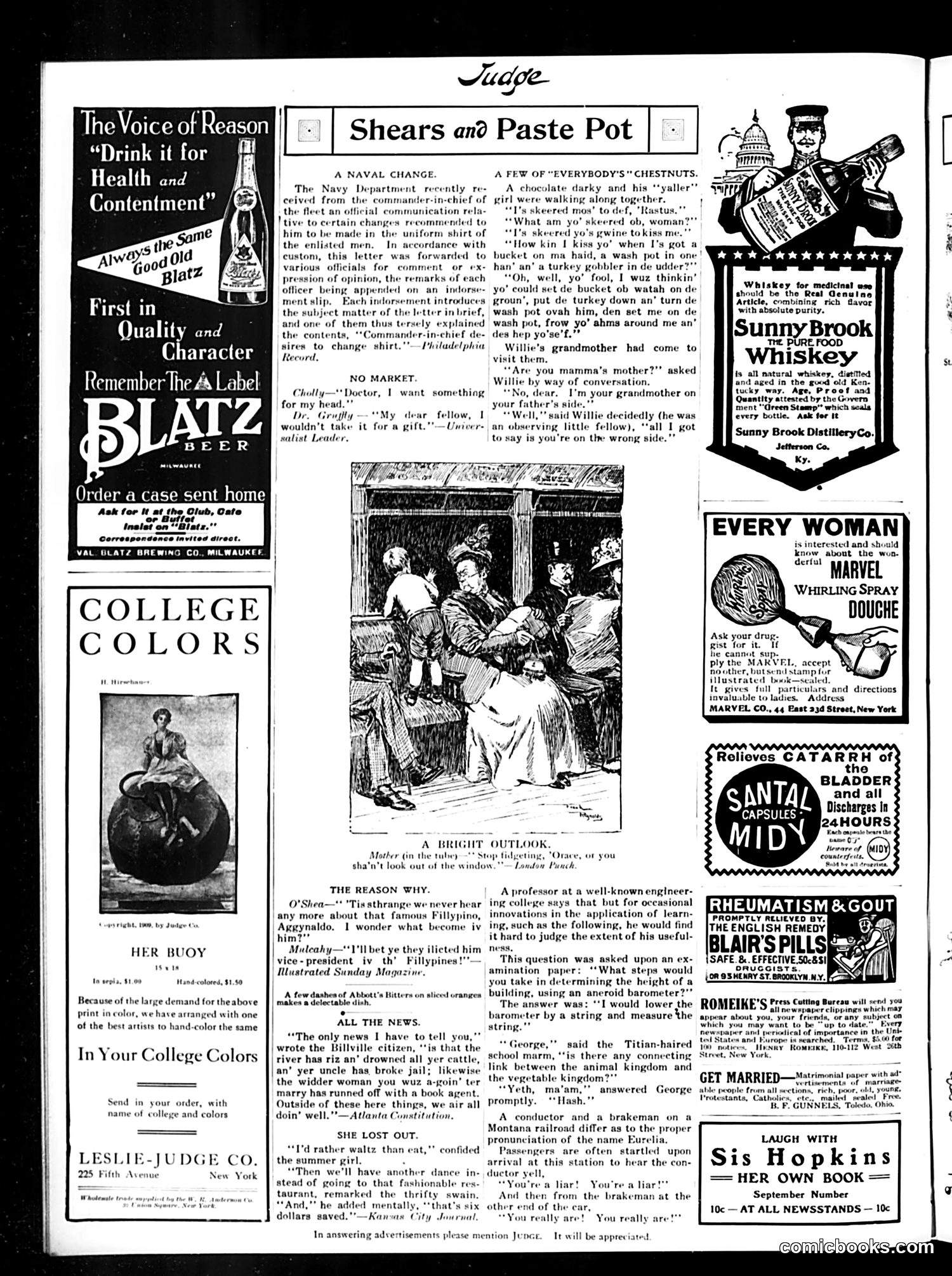
This page is primarily **advertisements and humor columns** rather than political cartoons. The main content includes: **Central Cartoon**: "A Bright Outlook" depicts a domestic scene where a mother warns children not to look out the window while she's bathing, suggesting voyeuristic humor typical of the era. **Humor Pieces**: Short jokes addressing contemporary topics: - A naval uniform change sparks bureaucratic confusion - A doctor refuses to help a drunk man ("no market") - References to Filipino independence (Aguinaldo/Fillipines) as political fodder - A woman prioritizes dancing over eating, losing her suitor **Context**: This appears to be early 1900s Judge magazine, when Filipino insurgency was a current U.S. political issue and "Billville" rural humor was popular. The tone is lighthearted satire of everyday life rather than sharp political critique. The page is dominated by **patent medicine and product advertisements** (Blatz Beer, college colors, whiskey, douches), reflecting the magazine's commercial nature.
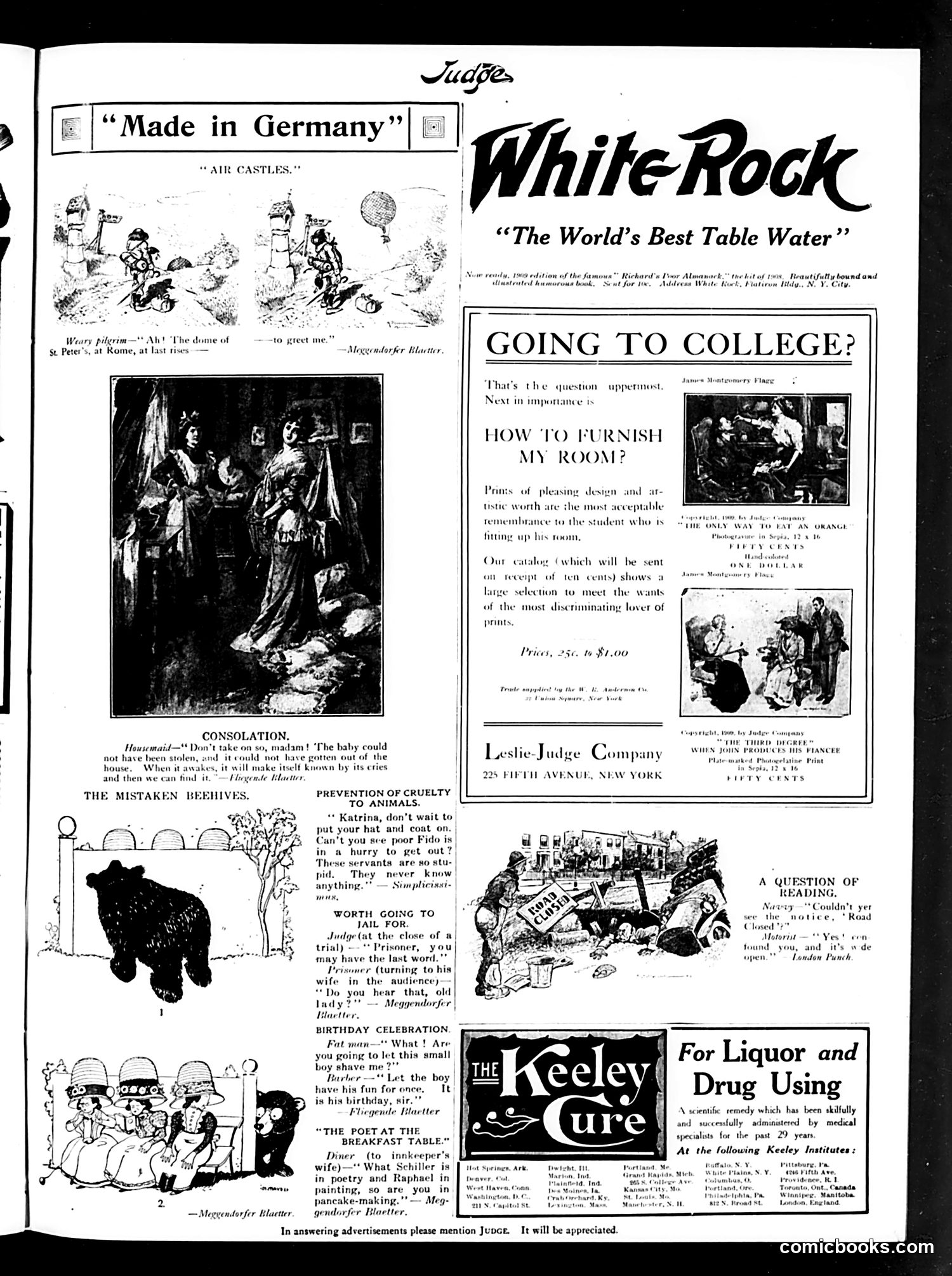
This is primarily an **advertising page** from Judge magazine, with small satirical cartoons interspersed. The main advertisements include **White Rock table water** (claiming to be "The World's Best") and **Leslie-Judge Company** prints for college dorm decoration. The cartoons are brief, humorous vignettes: - **"The Mistaken Beehives"** and **"Prevention of Cruelty to Animals"** mock both overly sentimental animal protection and servant stupidity—a servant fails to understand a dog urgently needs the bathroom. - **"Worth Going to Jail For"** jokes about a prisoner's wife misunderstanding legal proceedings as romantic. - **"Birthday Celebration"** depicts absurd servant logic: allowing a boy to shave a man as a birthday "treat." - **"The Poet at the Breakfast Table"** compares a cook's pancakes to great art. These cartoons, reprinted from European sources (Fliegende Blätter, Meggendorfer Blätter), reflect early 20th-century class humor mocking servants' incompetence and genteel anxieties about propriety.
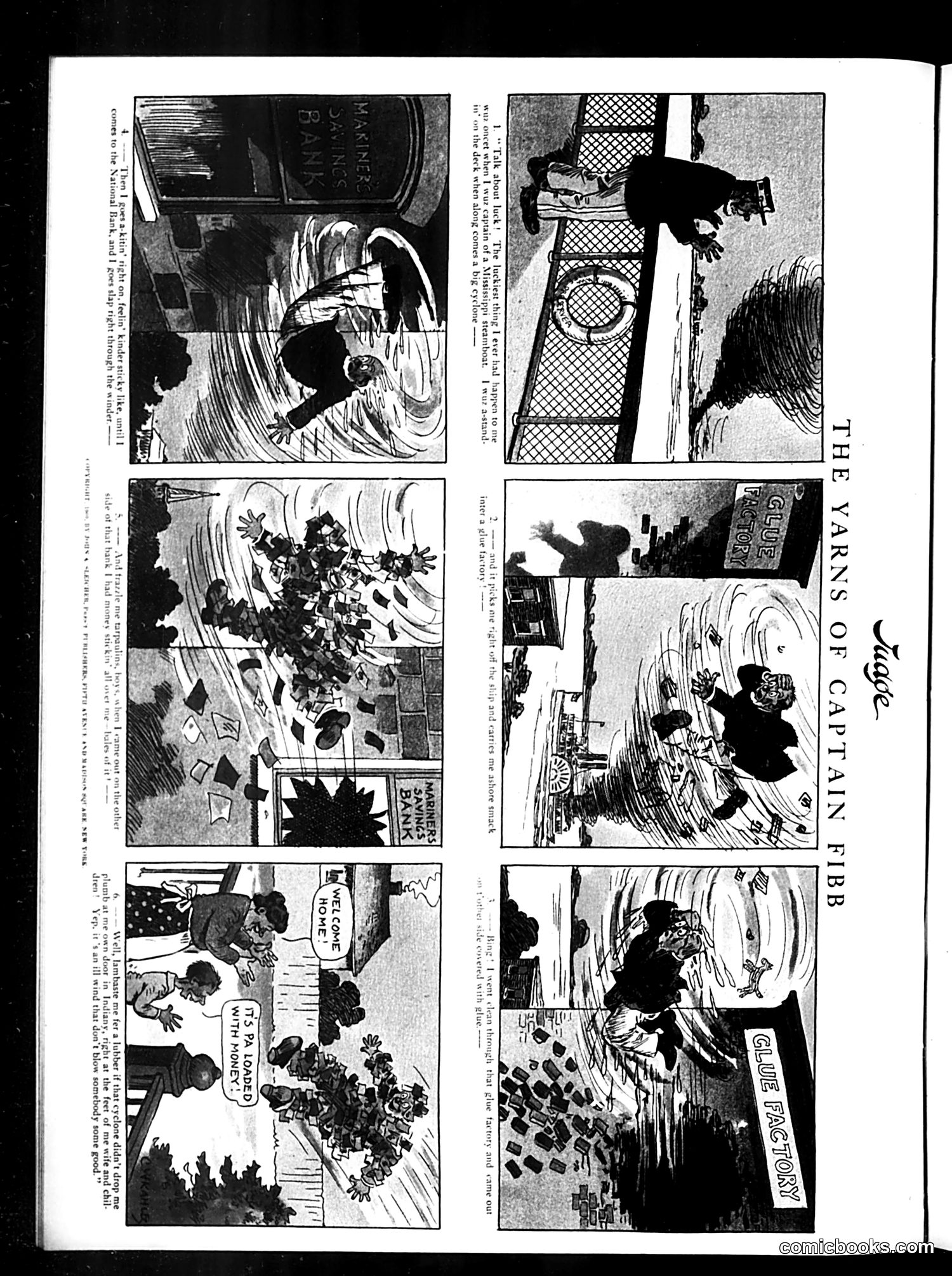
This appears to be a multi-panel comic strip titled "The Yarns of Captain Fibb" from Judge magazine. The OCR text is too corrupted to read the specific dialogue or narrative details. From the visual panels, the strip depicts what appears to be a seafaring character (Captain Fibb) in various situations involving ships, water, and dramatic action sequences. The art style is typical of early-to-mid 20th century comic illustration, with dynamic linework suggesting movement and chaos. Without legible text, the specific satirical point is unclear, though the title suggests the humor involves tall tales or exaggerated stories told by this captain character. Judge was known for both political satire and humorous fiction, so this could be either social commentary through a seafaring narrative or simply comedic entertainment based on sailor folklore tropes.