
Judge, 1909-09-04 · page 11 of 16
Judge — September 4, 1909 — page 11: what you’re looking at
What you’re looking at
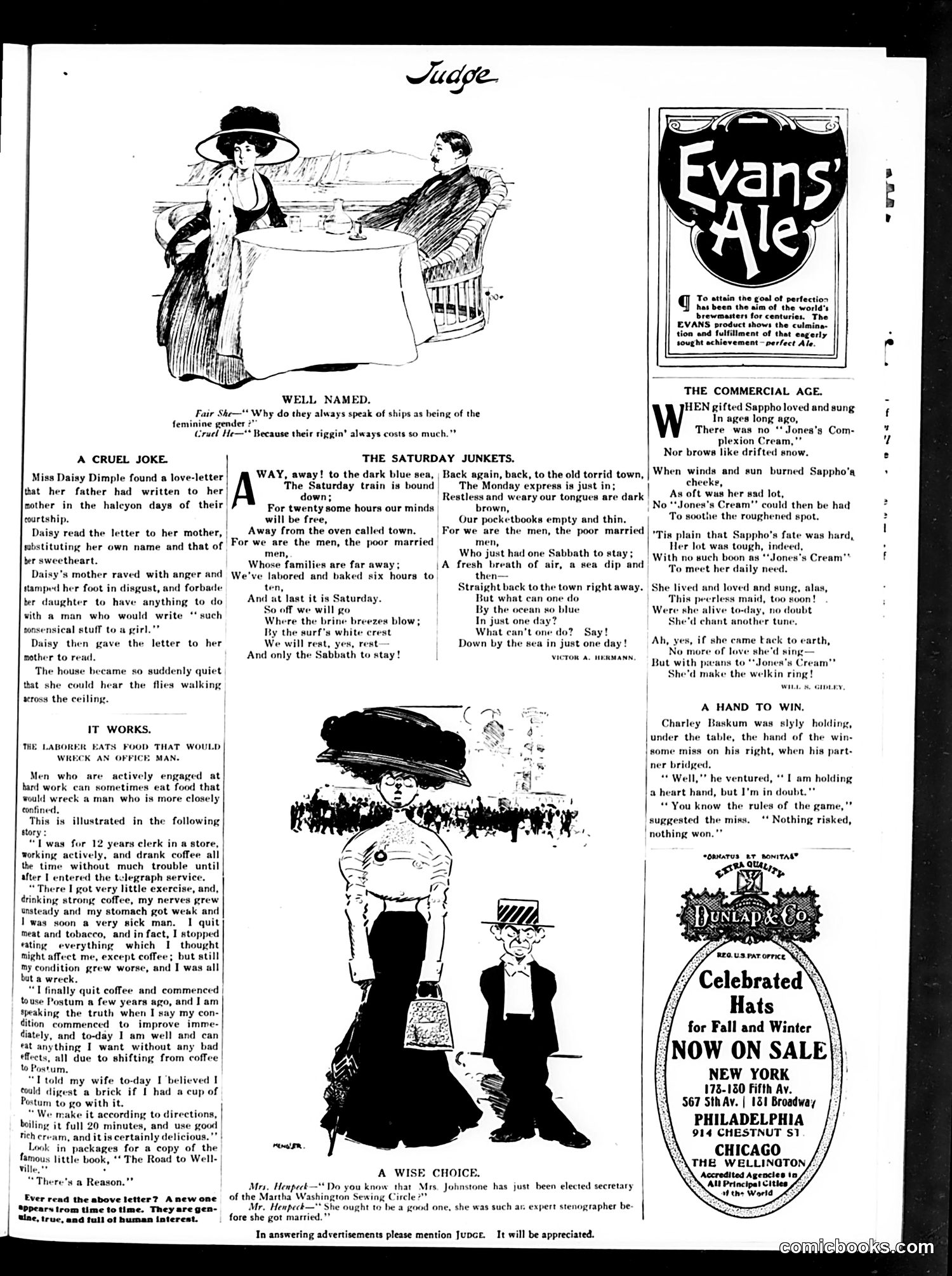
This page contains several short humorous pieces typical of early 20th-century Judge magazine: **"A Cruel Joke"** depicts a young woman (Daisy Dimple) reading her father's old romantic letter to her mother aloud, substituting her own name. When her scandalized mother later reads the original letter, the household goes silent—the joke being that the mother realizes her husband's romantic language wasn't unique or special. **"The Saturday Junkets"** is a poem about working-class married men's brief weekend escape to the seaside, longing for freedom from their wives and domestic responsibilities before returning Monday to town and routine. **"A Wise Choice"** presents a brief exchange where a woman notes another woman became secretary of a sewing circle; the man remarks she should be good at it since she was an expert stenographer before marriage—implying wives lose their professional skills. The advertisements include Evans' Ale and Dunlap hats. The overall tone reflects period attitudes toward marriage (husbands seeking escape), women's post-marriage domesticity, and working-class leisure.
📄 Transcribed text from this page (OCR, searchable)
Machine-transcribed from the original scan — historical spelling and the odd misread are preserved.
A CRUEL JOKE. Miss Daisy Dimple found a love-letter | that her father had written to her! mother in the halcyon days of their courtship. | Daisy read the letter to her mother, mbstituting her own name and that of ber sweetheart. Daisy’: ttamped her foot in disgust, and forbade ter daughter to have anything to do vith a man who would write ‘such sonsensical stuff to a girl."” Daisy then gave the letter to her nother to read. The house became so suddenly quiet that she could hear the flies walking wross the ceiling. IT WORKS. THE LABORER EATS FOOD THAT WOULD WRECK AN OFFICE MAN. ly engaged at at food that ' more closely Men who are acti tant work can someti would wreck a man who confined, This is illustrated in the following story : “'L was for 12 years clerk in a store, | working actively, and drank coffee all| the time without much trouble until after L entered the telegraph service. “There | got very little exercise, and, ¢rinking strong coffee, my nerves grew unsteady and my stomach got wesk and Iwas soon a very sick man. I quit meat and tobacco, and in fact, I stopped tating everything which I thought night affect me, except coffee; but still my cond ion _grew worse, and I was all ally quit coffee and commenced stum a few years ago, and Iam speaking the truth when I say my con- ition commenced to improve imme- diately, and to-day 1 am well and can ata S 5 FS ¢ é 8 < Fd ® 2 g & all due to shifting from coffee tum, “Ttold my wife to-day I believed | could digest a brick if f had a cup of Postum to go with it. according, to directions, boiling it full 20 minutes, and use good Tich cream, and it is certainly delicious." | Look in packages for a copy of th {anous little book, ‘* The Road to Well- Ville, . There's a Reason."” Ever read the above letter? Anew one pe e. They are gen- juman interest. For we are the men, the poor married m mother raved with anger and We've labored and baked six hours to WELL NAMED. Fair Ske—* Why do they always speak of ships as being of the feminine gender ? Cruel He—"* Because their riggin’ always costs so much.”” THE SATURDAY JUNKETS. The Monday express is just Restless and weary our tongues a brown, Our pocketbooks empty and thin. The Saturday train is bound down; For twenty some hours our minds will be free, Away from the oven called town. A WAY, away! to the dark blue sea, | Back again, back, to the old torrid town, Who just had one Sabbath to stay; |A fresh b then— men, Whose families are far away ; ten, And ut last it is Saturday. But what can one do uW By the ocean xo blue In just on What can't on Down by the se jo? Say! in just one day! VICTOR A. HERMANN, Ry the surf’s whi We will rest, yes, rest And only the Sabbath to stay! A WISE CHOICE. Mrs, Henpeck—" Do you know that Mrs. Johnstone has just_been elected secretary of the Martha Washington Sewing Circle ** Mr. Henpeck—* She ought to be a g fore she got married.” one, she was such ar: expert stenographer be- In answering advertisements please mention Jupce. It will be appreciated. | dark For we are the men, the poor married eagerly sought achievement —perfect Ale. THE COMMERCIAL AGE. HEN gifted Sappho loved and sung W Th ages long ago, There was no ‘Jot plexion C Nor brows like drif When winds and sun burned Sappho'a cheeke, As oft was her sad lot, No ‘*Jones’s Cream" could then b To soothe the roughened spot. had "Tis plain that Sappho’s fate was hard, ath of air, a sea dip and Straight back to the town right away. | Her lot was tough, inde With no such boon as "Jones's Cream’? To meet her daily ne She | T 4 and loved and sung, alas, 8 peerless maid, too soon! v she ali no doubt. “'d chant another tune, Ah, yes, if she came tack to earth, No more of love she'd sing— But with pivans to “Jones's € She'd make the welkin ring! | wit x A HAND TO WIN. Charley Baskum was slyly holdi junder the table, the hand of the win- |some miss on his right, when his part- | ner bridged. “* Well,”’ he ventured, ** | am holding a heart hand, but I'm in doubt."" “You know the rules of the game,"’ “ Nothing risked, suggested the miss. ‘nothing won." sonmaTus RY RoNITAS? aus, Celebrated Hats for Fall and Winter NOW ON SALE| NEW YORK 178-180 Fifth Av. 567 Sth Av. | 181 Broadway PHILADELPHIA 914 CHESTNUT $1 CHICAGO THE WELLINGTON/ Accredited Agencies 1a, All Principal Citles / Hthe World 45