
A complete issue · 21 pages · 1909
Judge — June 26, 1909
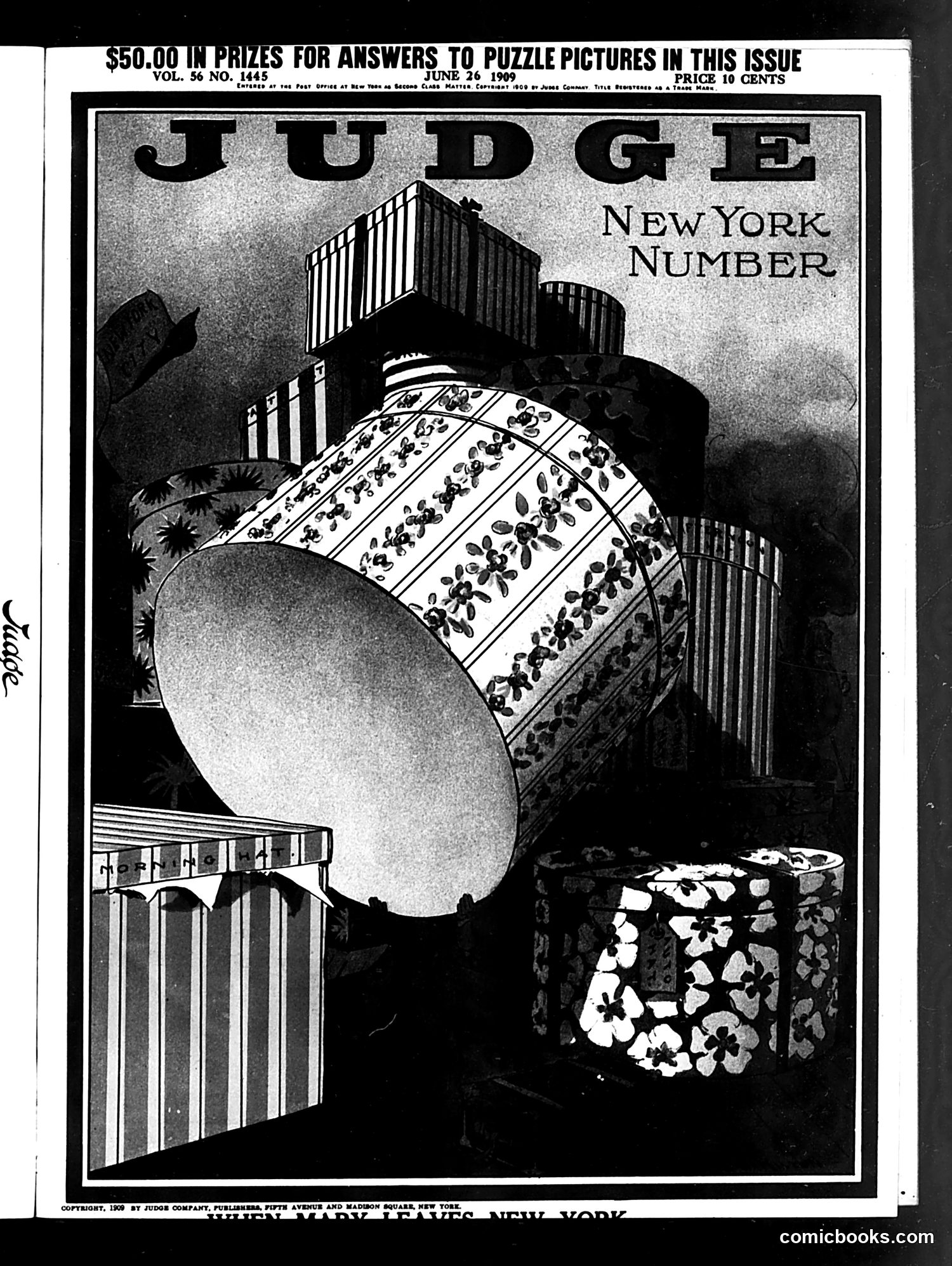
This is the cover of Judge magazine's "New York Number" from June 26, 1909. The central image depicts a massive cylindrical structure—appearing to be a drum or barrel with decorative patterns—tilting precariously over a cityscape. The structure seems to represent something being tipped or overturned, suggesting instability or chaos threatening New York. Without clearer context about the specific events of June 1909, the exact target of satire is unclear. However, the dramatic tipping imagery likely comments on a contemporary New York crisis—possibly financial, political, or infrastructural. The composition emphasizes danger and imbalance affecting the city below. The decorative barrel's ornate bands suggest wealth or commerce being upended. This appears designed as attention-grabbing satirical commentary on a major issue confronting New York at that moment.
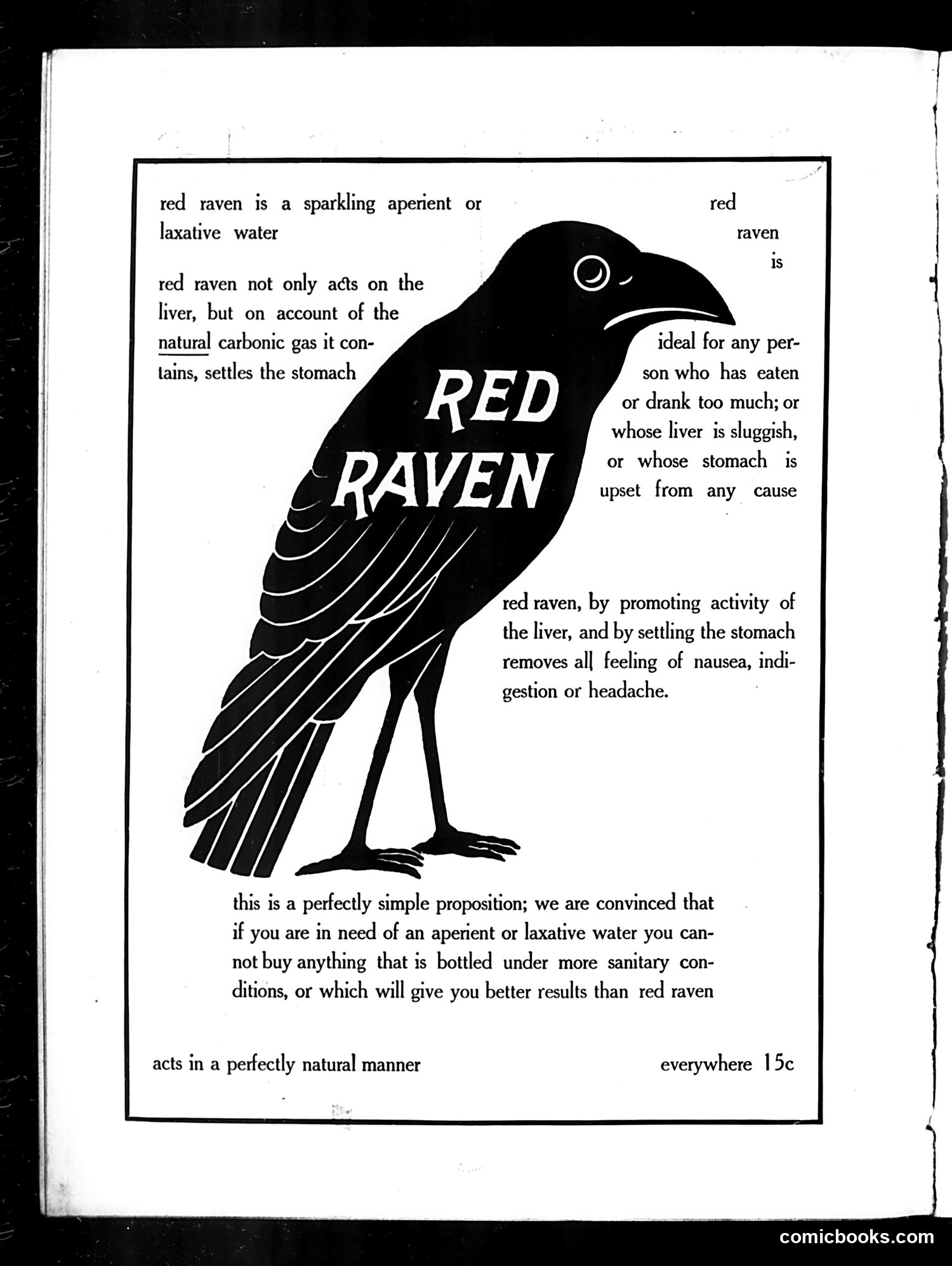
This is a straightforward product advertisement, not political satire. "Red Raven" is a sparkling aperient (laxative) water marketed as a digestive aid. The illustration shows a stylized black raven with the product name prominently displayed on its body. The ad claims Red Raven benefits those with sluggish livers, upset stomachs, or digestive discomfort by promoting liver activity and settling the stomach. It promises to relieve nausea, indigestion, and headaches through "natural" action. The raven mascot likely plays on the product name, while the detailed claims reflect early 20th-century patent medicine marketing—before modern FDA regulations required substantiation of health claims. The price of 15 cents appears at bottom right.
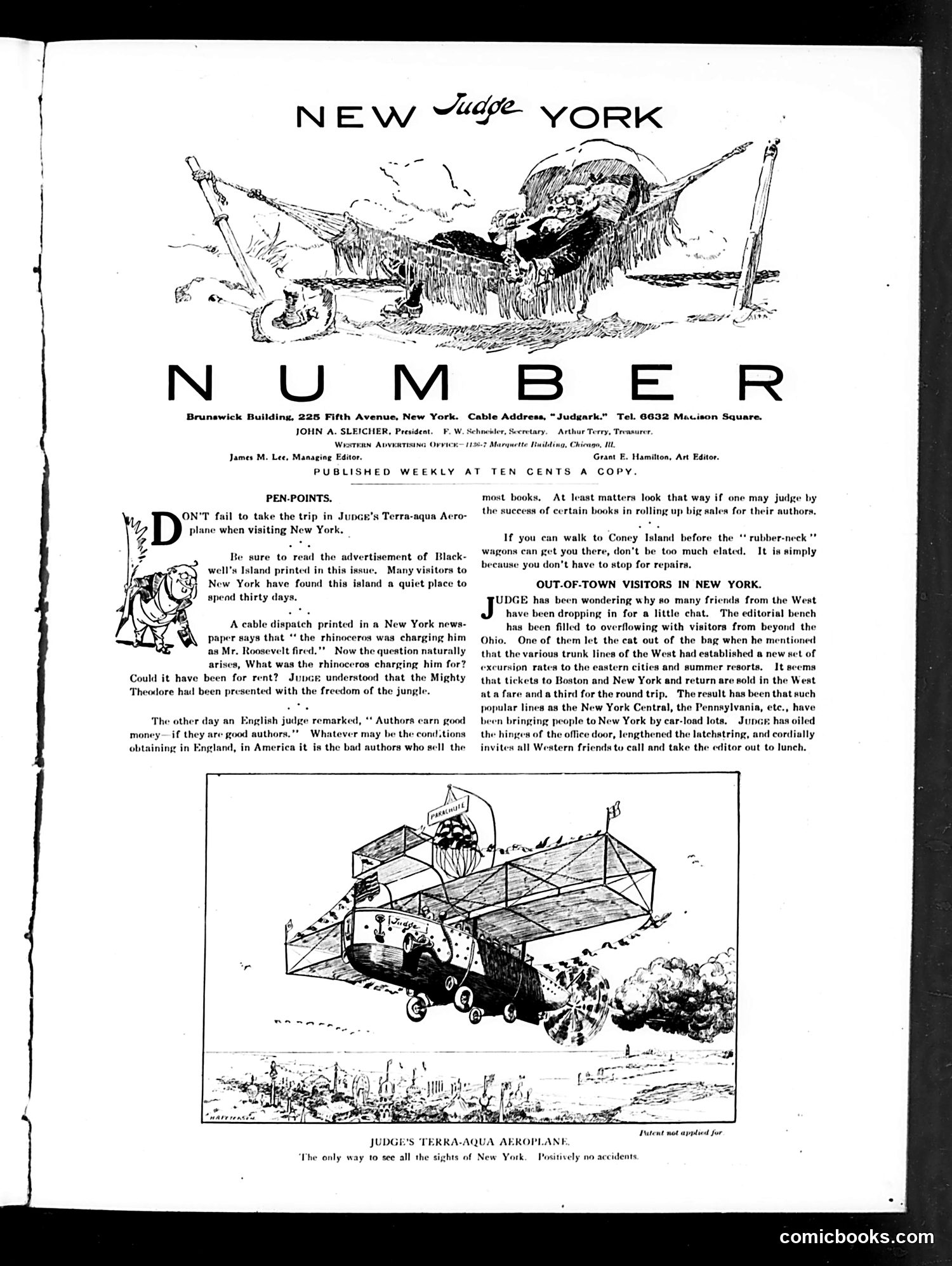
This is primarily a promotional/editorial page for Judge magazine itself, rather than political satire. The top illustration shows a disheveled figure relaxing, advertising Judge's "Terra aqua Aeroplane" feature. The main cartoon depicts an early aircraft (labeled "Judge's Terra-Aqua Aeroplane") flying over New York City, captioned "The only way to see all the sights of New York—Positively no accidents." The page discusses tourism to New York and mentions Roosevelt firing someone over a "Rhinoceros charging" incident, though the specific context remains unclear. The editorial content promotes Judge's travel content and satirizes Western visitors overwhelming New York's attractions. The aeroplane cartoon appears to humorously suggest that aerial viewing is necessary to escape New York's crowded tourist experience.
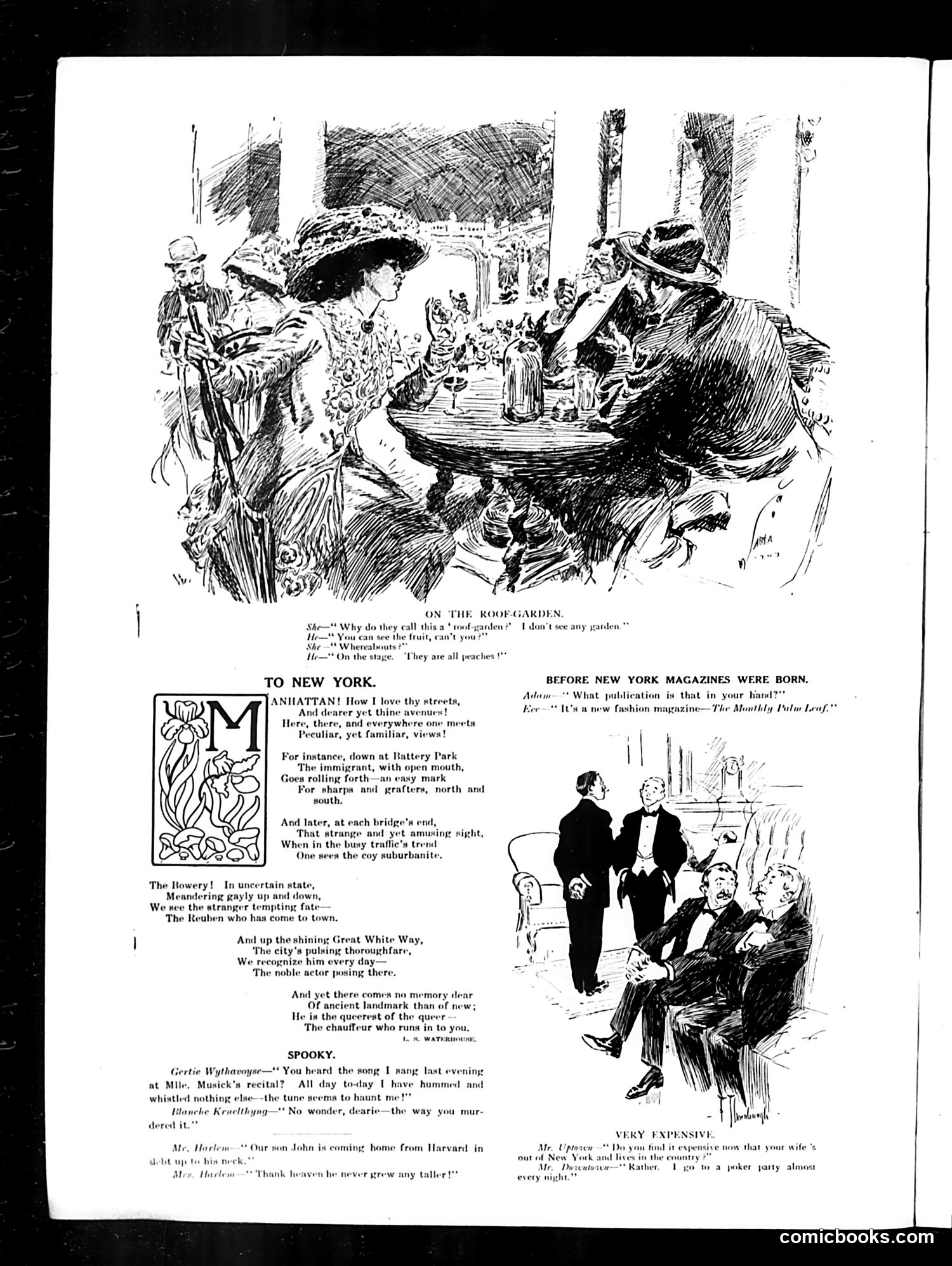
**Top Cartoon:** A scene at what appears to be a theater or garden venue satirizes confusion about produce. The dialogue mocks someone calling it a "roof garden" while claiming to see no garden—only peaches on stage. This likely references a specific New York establishment (possibly a rooftop theater) where the naming or marketing didn't match reality. **Poetry Section:** "To New York" is a nostalgic poem celebrating Manhattan's streets, parks, and landmarks (Battery Park, Great White Way). It contrasts romantic imagery of the city with a darker closing line about quieter, queer characters—likely social commentary on urban life's less glamorous aspects. **Lower Cartoons:** Brief humorous exchanges about singing haunting tunes and expensive social activities (poker parties). These appear to be genteel domestic humor typical of the era.
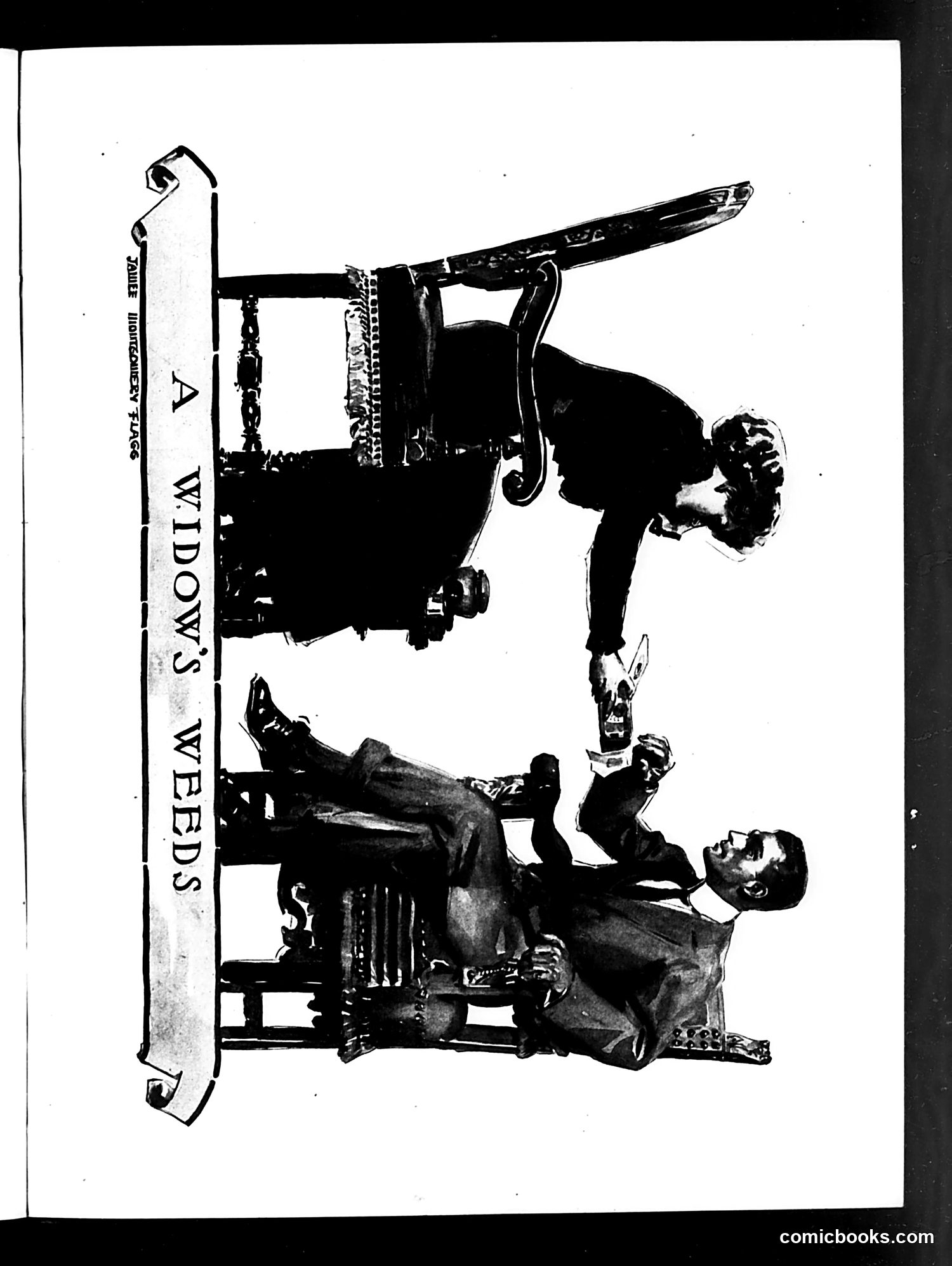
This appears to be a Judge magazine cartoon titled "A WIDOW'S WEEDS" (visible on the left margin). The image is rotated 90 degrees, showing two figures with an ornate piece of machinery or equipment between them. The satire likely references a wealthy widow inheriting industrial equipment or property, playing on the double meaning of "weeds" (mourning clothes versus unwanted plants/complications). The elaborate mechanical apparatus suggests industrial wealth or business complications arising from inheritance. However, without clearer text or additional context identifying the specific figures or the date of publication, I cannot definitively identify which historical widow or industrial situation this cartoon satirizes. The ornate Victorian styling suggests late 19th or early 20th-century American politics or business.
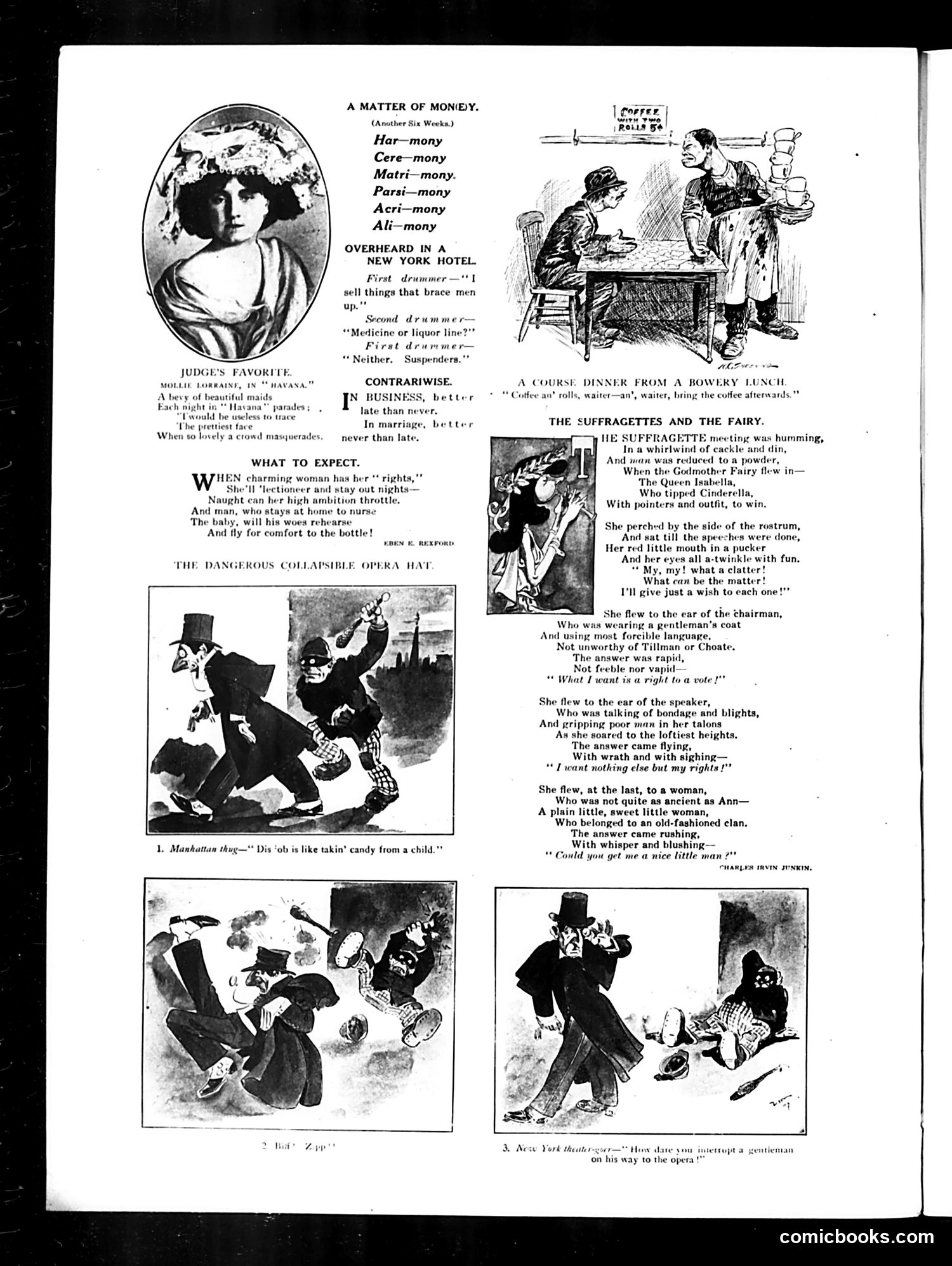
This page satirizes contemporary social anxieties about women's suffrage and changing gender roles. **"The Suffragettes and the Fairy"** is the central long poem. It depicts a fairy godmother visiting a women's suffrage rally, granting wishes to three women: a suffragette demanding voting rights ("a right to a vote"), another seeking equal legal standing, and finally a traditional woman who merely wants "a nice little man"—the joke being that despite feminist organizing, conventional domestic desires remain. **"The Dangerous Collapsible Opera Hat"** cartoons illustrate slapstick consequences of women's increased public participation—they're too physically present in shared spaces (theaters, opera houses), causing literal chaos. The page's recurring theme (reinforced by "A Matter of Money" wordplay on "alimony" and "harmony") conflates female independence with financial burden and marital discord. The satire targets both suffragettes as disruptive and traditional women as hopelessly domestic, mocking the era's gender confusion while normalizing male anxiety about women's expanded roles.
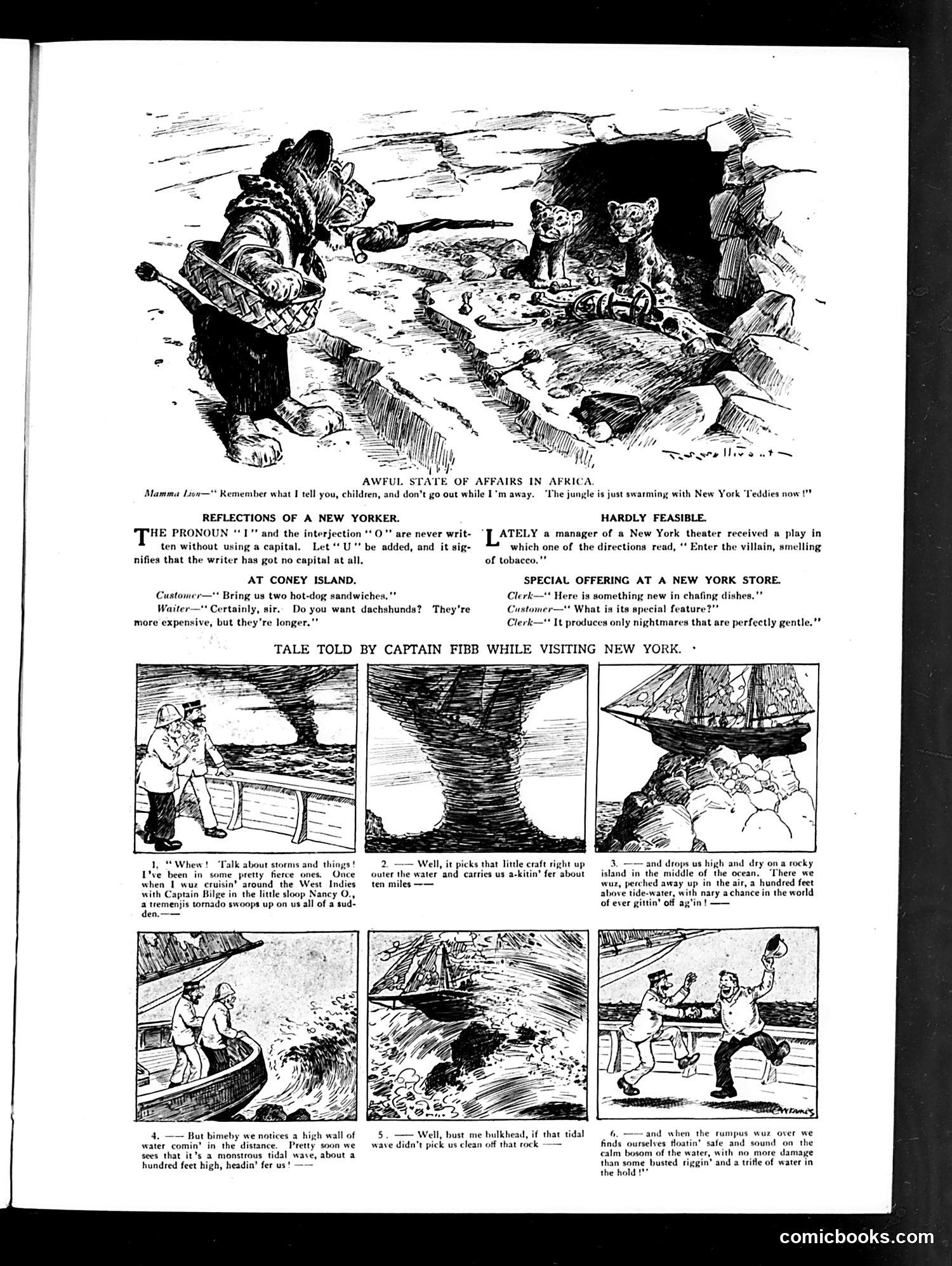
This Judge magazine page contains several unrelated satirical pieces mocking New York life and conventions: **Top section:** Brief jokes about capitalization, hot dogs at Coney Island (punning "dachshunds" as actual sausage dogs), African wildlife endangered by rowdy New York tourists ("eddies"—slang for hoodlums), theatrical realism, and an absurd chafing dish that produces "gentle nightmares." **Main comic:** "Captain Fibb's Tale" is a tall tale about a ship crew caught in a tornado, deposited on a rocky island, then rescued by a massive tidal wave—all delivered in exaggerated sailor dialect. The humor lies in the increasingly implausible chain of events and the captain's casual acceptance of miraculous survival, typical of 19th-century seafaring folklore satire. The satire targets urban pretension, tourist behavior abroad, theatrical conventions, and the enduring appeal of impossible adventure stories. The cartoons assume reader familiarity with these cultural touchstones.
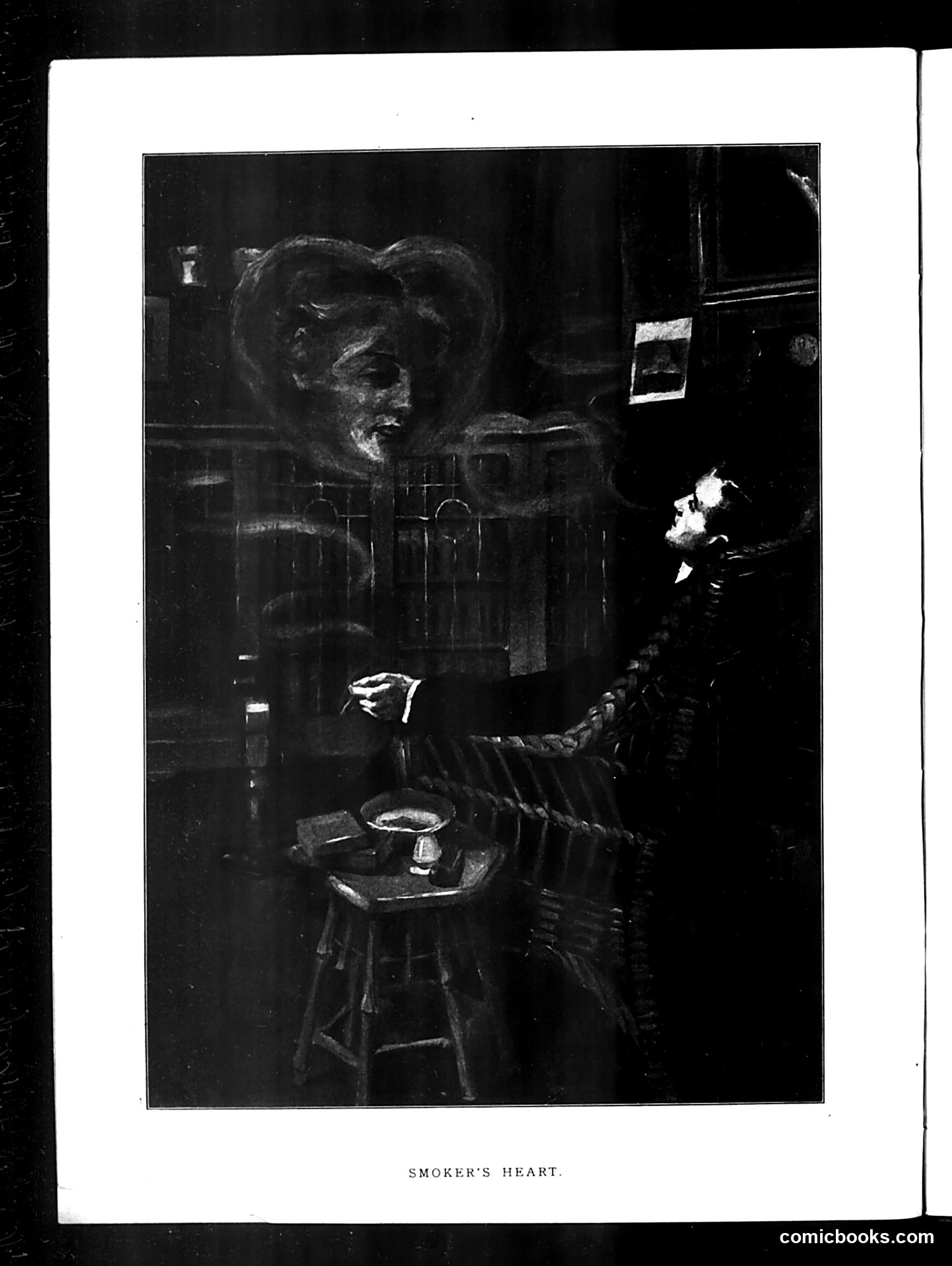
This satirical illustration from *Judge* magazine depicts a dark, somewhat grotesque scene titled "Smoker's Heart." The image shows a figure in period dress holding what appears to be a pipe or smoking implement, standing before a large heart-shaped form dominating the composition. The heart's interior contains shadowy architectural elements—possibly buildings or structures—rendered in an expressionistic style. The satire appears to critique smoking and its effects on human health, specifically the heart. By visualizing the smoker's heart as a dark, complex, possibly corrupted interior space, the cartoon suggests that smoking damages this vital organ in ways invisible to the naked eye. This represents early health-consciousness messaging about tobacco's dangers, presented through *Judge*'s characteristic mordant visual wit.
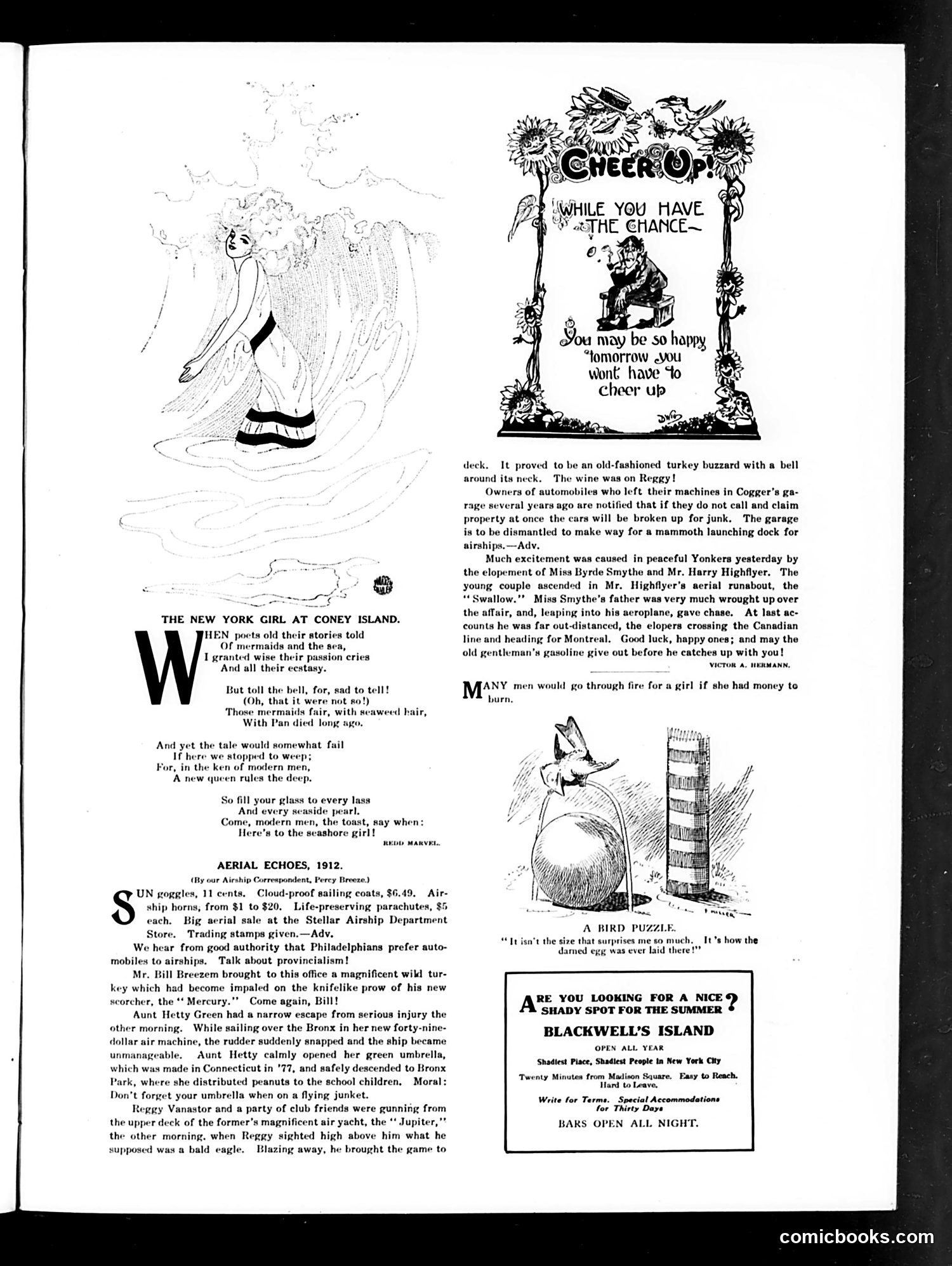
This page from *Judge* magazine contains satirical pieces mocking early 1910s American culture: **Main Poem:** "The New York Girl at Coney Island" nostalgically contrasts mythological mermaids with modern women at the popular beach resort, suggesting contemporary "seashore girls" lack the romance of classical legends. The toast celebrates these modern women as replacements. **"Aerial Echoes, 1912":** A humorous column about the aviation craze of the era, featuring absurd anecdotes—wealthy figures like Aunt Hetty Green (a real, famously eccentric millionaire) using experimental airships; an elopement by aeroplane; accidental hunting of turkey buzzards instead of eagles. It satirizes both the novelty of aviation technology and the wealthy's reckless adoption of dangerous new inventions. **Advertisement:** Blackwell's Island (a real New York institution housing poorhouses and asylums) is darkly promoted as a "summer spot"—gallows humor mocking its actual function as a dumping ground for society's poor. The overall tone reflects *Judge*'s satirical stance toward technological progress and upper-class excess.
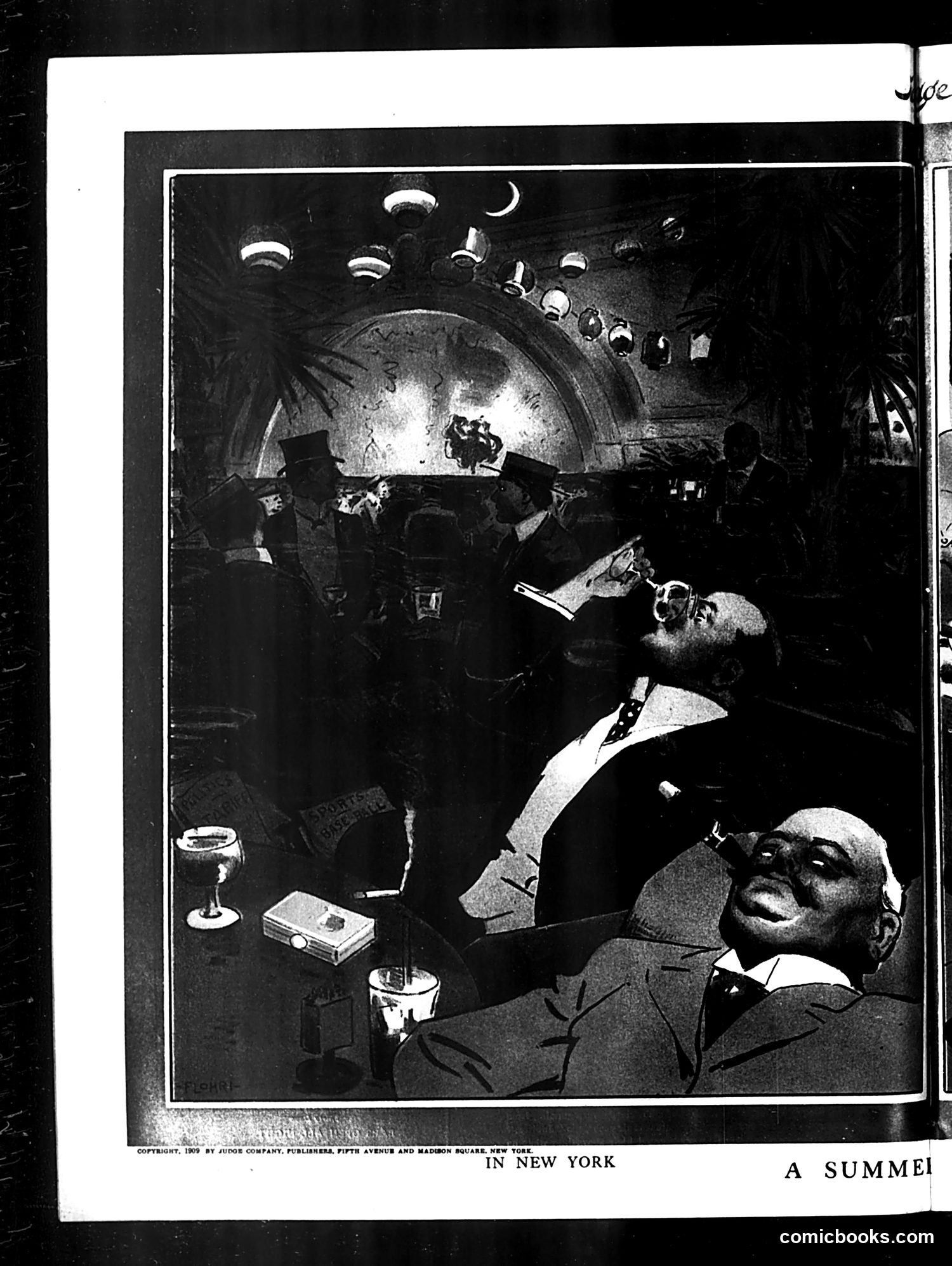
This appears to be a section title or advertisement page for Judge magazine, copyrighted 1903 by the Judge Company (publishers located at Fifth Avenue and Madison Square, New York). The image shows what seems to be a theatrical or nightclub scene set in New York. Men in formal attire (top hats, evening wear) are depicted in an ornate interior with a large moon backdrop and decorative lighting. One man in the foreground looks upward, holding what appears to be a cigar or cigarette. The styling suggests wealthy patrons in an exclusive venue. The page appears designed as a section divider or promotional material rather than a standalone cartoon with specific satirical commentary. Without additional OCR text or clearer identifying details, the exact social or political satire being referenced remains unclear.
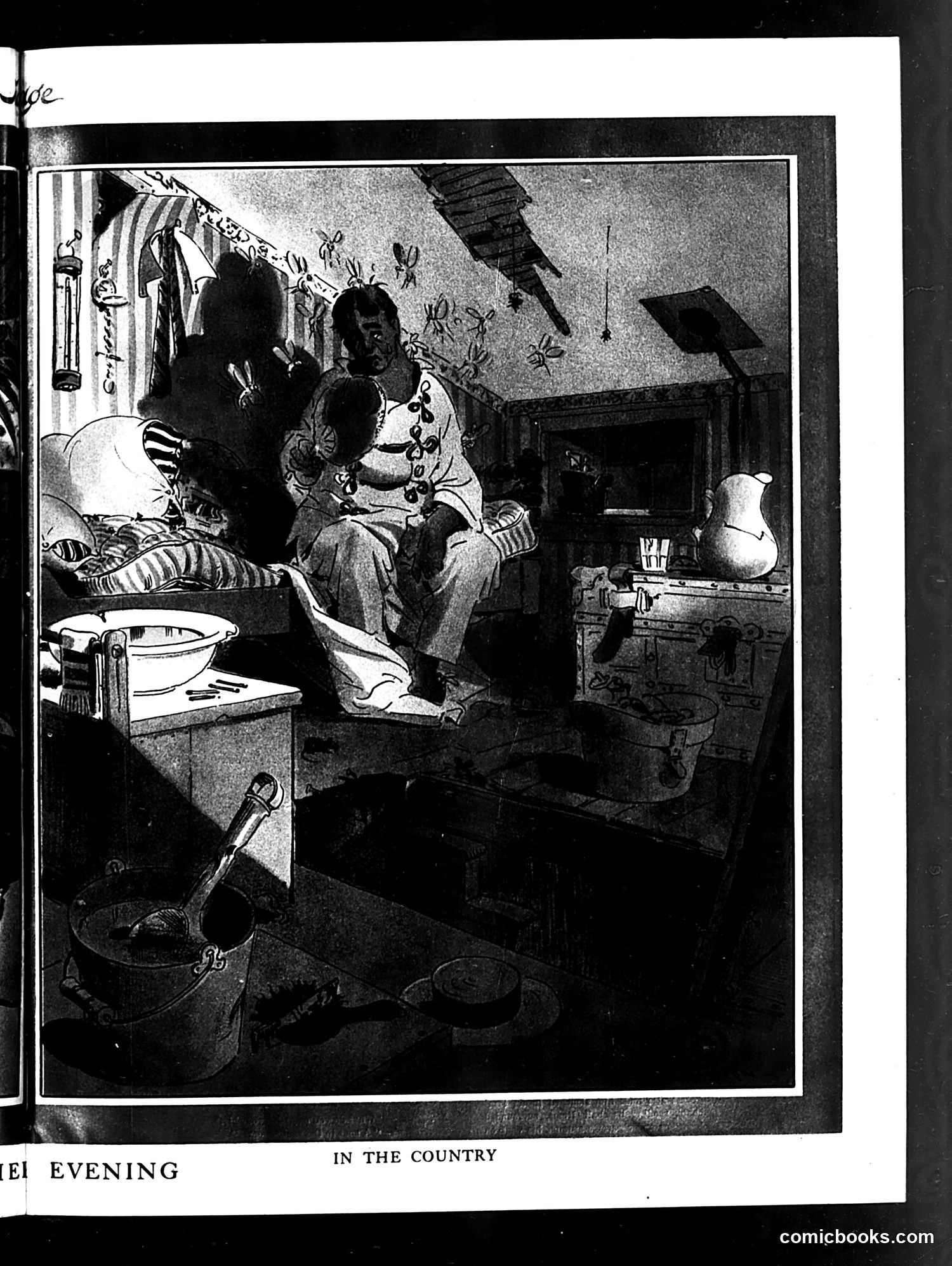
This illustration depicts a domestic scene titled "In the Country," showing what appears to be a family gathered in a modest rural or working-class home. The composition suggests leisure time, with figures seated together in an intimate interior space. Various household items are visible—cooking vessels, furniture, and domestic goods scattered about. Without additional OCR text or caption identifying specific figures or satirical targets, the precise political or social commentary remains unclear from the image alone. The scene appears to comment on rural or working-class domestic life, possibly satirizing living conditions, family dynamics, or social customs of the era. Judge magazine typically employed such domestic scenes for gentle social satire of contemporary American life and manners.
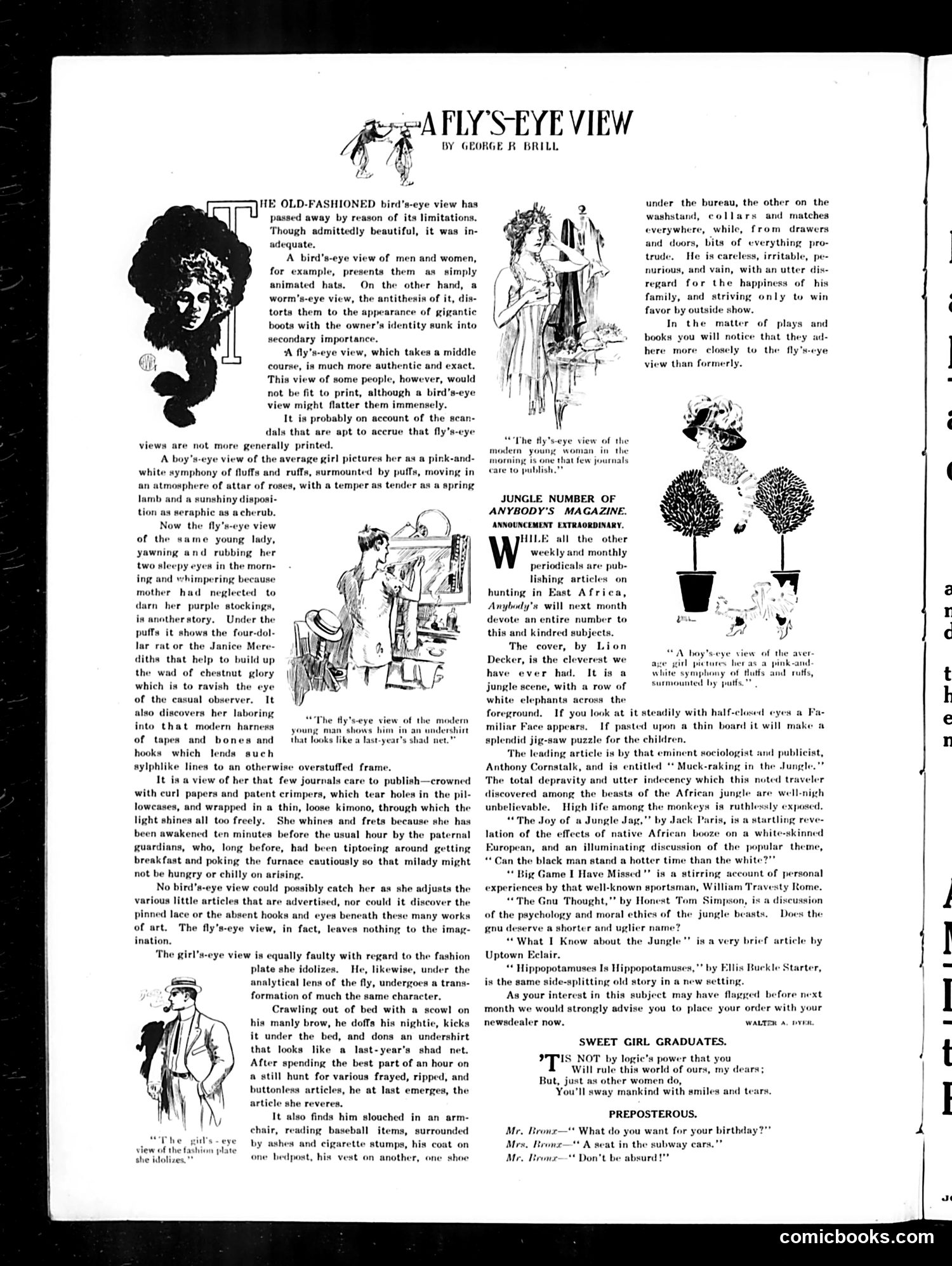
This humorous essay contrasts different perspectives on human appearance and behavior. Brill argues that the traditional "bird's-eye view" (idealized, distant perspective) is inadequate, while a "worm's-eye view" (ground level) distorts reality. He proposes a "fly's-eye view" as the honest middle ground. The satire targets romantic idealization: boys imagine girls as ethereal "pink-and-white symphony of fluffs and ruffs," but a fly's perspective reveals the unglamorous morning reality—tangled hair, wrinkled clothes, irritability, and curlers. Similarly, girls idealize fashionable men, but the fly's view shows slovenly morning behavior: unwashed appearances, rumpled clothes, scattered grooming articles. The illustrations accompanying the text visually demonstrate these contrasts between idealized and realistic portrayals. The piece satirizes both gender's self-deception about attraction and the gap between public presentation and private reality—a recurring theme in early 20th-century American humor magazines.
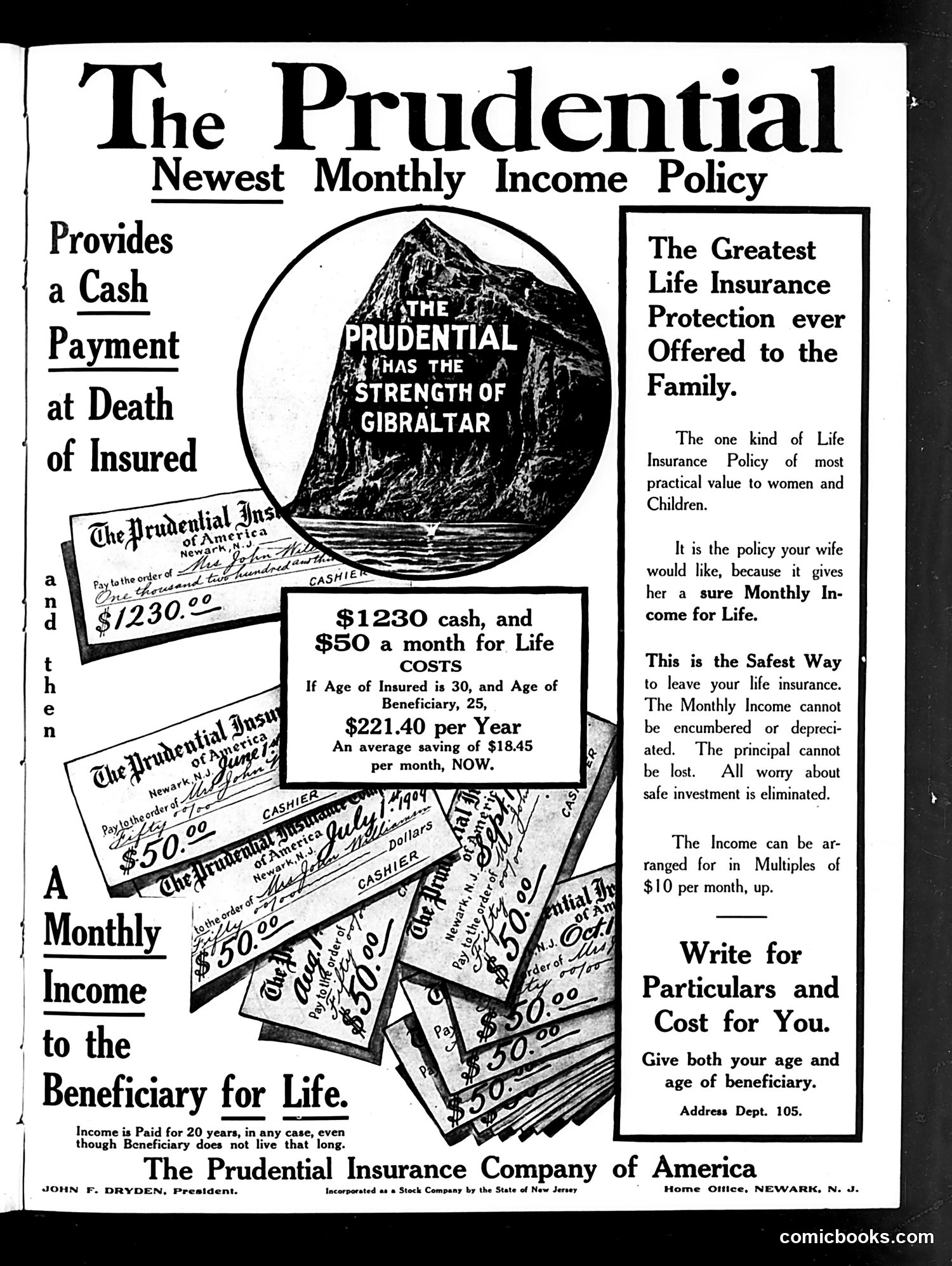
This is **not a cartoon or satire**—it's a straightforward insurance advertisement from The Prudential Insurance Company of America. The page promotes their "Monthly Income Policy," a life insurance product designed to provide financial security for families after the policyholder's death. The advertisement features: - **The Rock of Gibraltar imagery**: Prudential's famous corporate symbol, representing strength and stability - **Specific financial example**: A 30-year-old insured with a 25-year-old beneficiary receives $1,230 cash at death plus $50/month for life, costing $221.40 annually - **Target audience**: Explicitly women and children, reflecting early-20th-century assumptions that husbands/fathers were primary breadwinners - **Key selling point**: The monthly income cannot be lost or mismanaged—addressing contemporary concerns about widows' financial vulnerability The layout uses stacked checks/documents to visualize ongoing payments. This represents standard insurance marketing of the era, emphasizing family protection and security rather than satirical commentary.
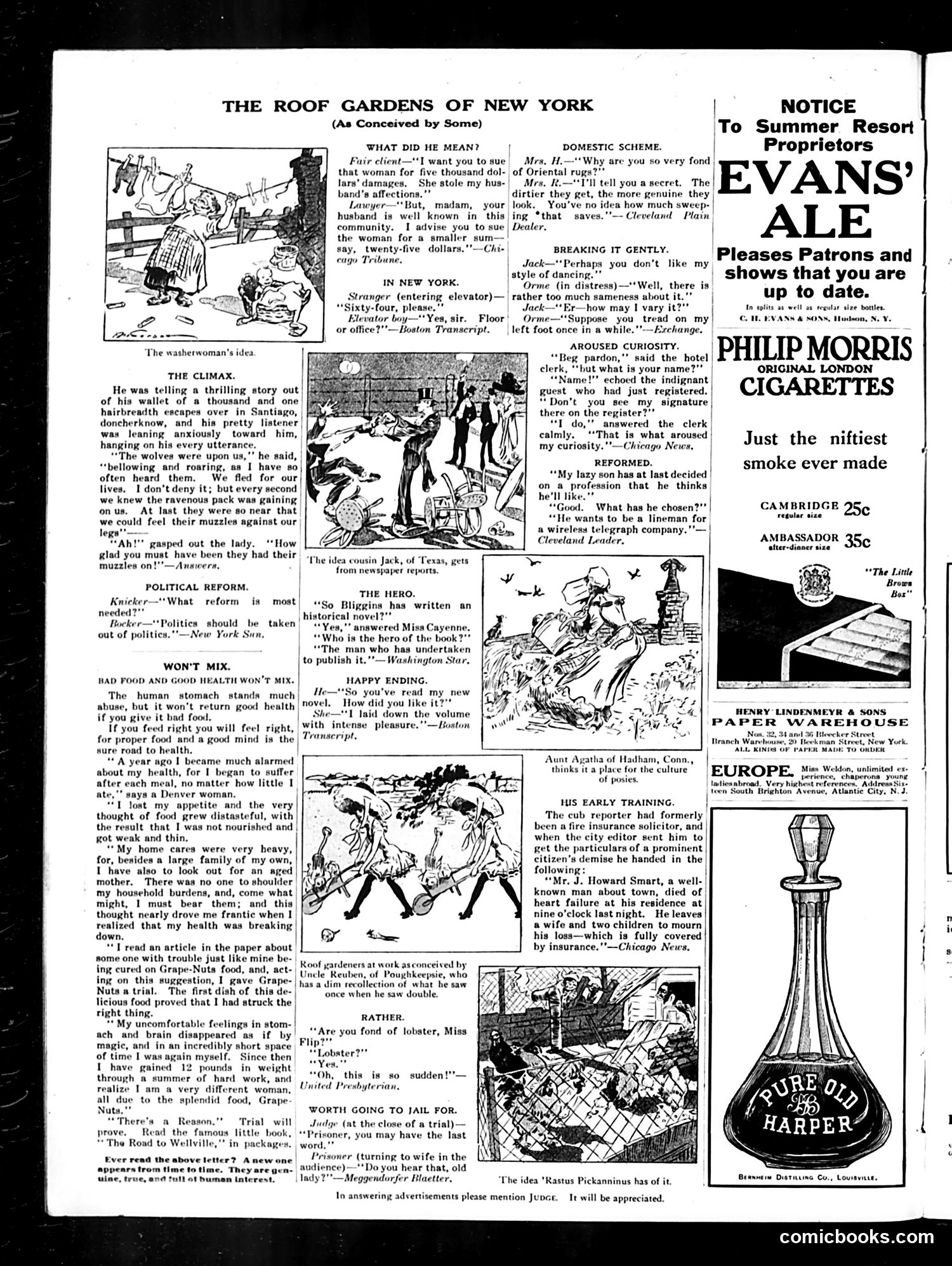
This page from *Judge* magazine contains multiple short satirical pieces typical of early 20th-century American humor: **"The Roof Gardens of New York"** depicts a washerwoman's naive imagining of wealthy people's rooftop spaces—she envisions them as actual gardens with plants and soil, revealing class-based misunderstanding. **"The Climax"** jokes about a man's exaggerated war story: he claims wolves chased him, and a woman naively responds "How glad you must have been they had their muzzles on!"—missing his point entirely through literal-minded listening. Other brief satirical pieces mock: - Lawyers advising clients to sue for smaller damages when husbands are "well-known" (implying infidelity is expected) - Publishing dishonest books - Poor digestion from bad food - Lazy sons becoming telegraph linemen The page is primarily **advertising** (Evans' Ale, Philip Morris Cigarettes, Harper's whiskey) interspersed with humor. The jokes rely on period assumptions about marriage, class distinctions, and social pretension rather than specific political references.
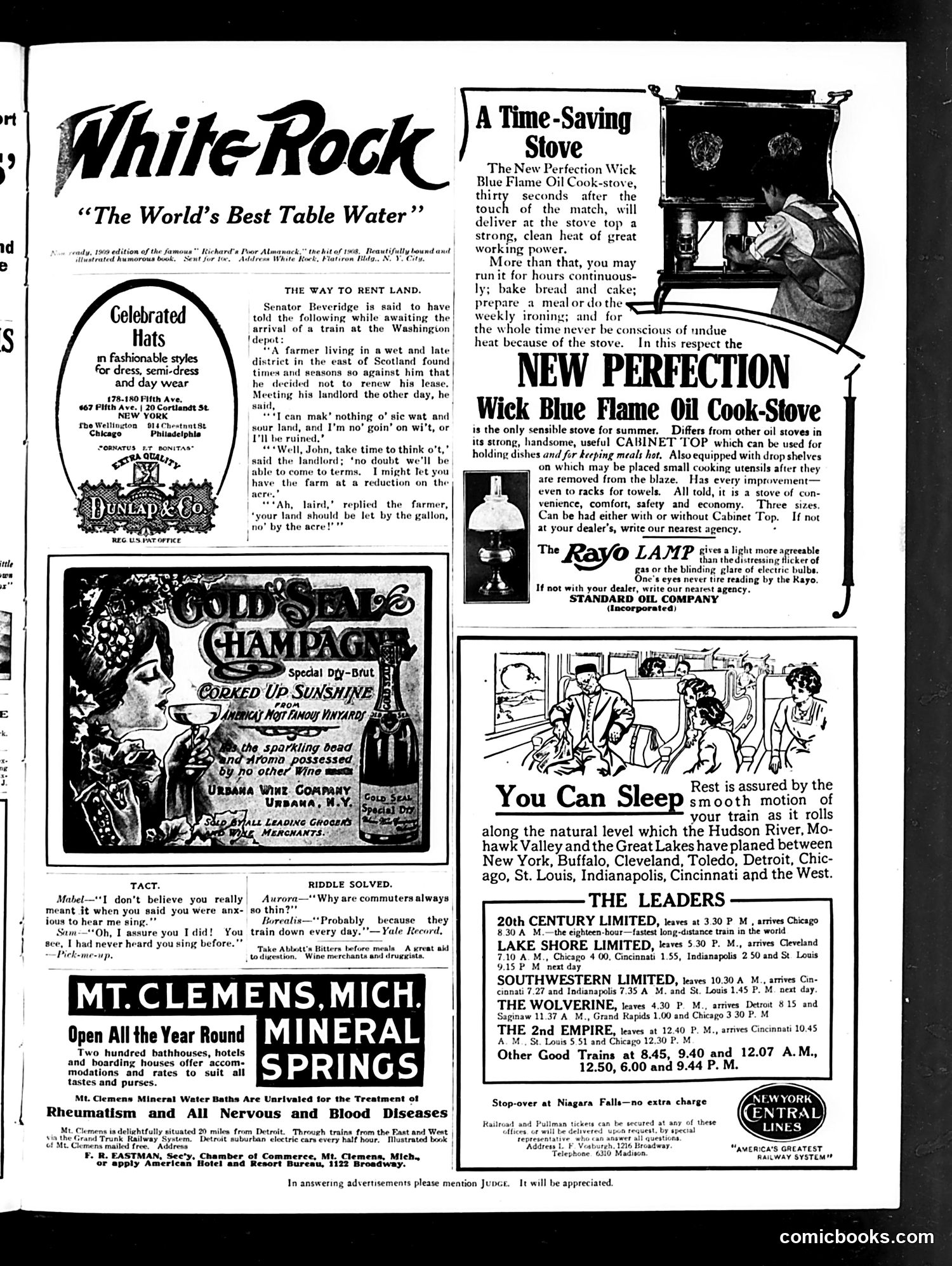
This page is primarily **advertising** rather than satirical content. The dominant features are product advertisements for various goods and services typical of the early 1900s. The small satirical content includes brief jokes: - **"Tact"**: A conversation joke about a woman who claimed she wanted to hear a man sing, but he doubts her sincerity - **"Riddle Solved"**: A commuter joke explaining why train passengers are thin—they ride trains daily, implying discomfort or poor digestion The page features ads for White Rock water, oil cook-stoves, champagne, hats, mineral springs, and importantly, **New York Central railroad lines** advertising various trains with departure times and routes across the eastern United States. The railroad advertising emphasizes smooth, comfortable travel along natural waterways (Hudson River, Great Lakes), appealing to leisure travelers of this era. This reflects early 20th-century American advertising priorities: domestic travel, household appliances, and patent medicines were major commercial interests during Judge's publication period.
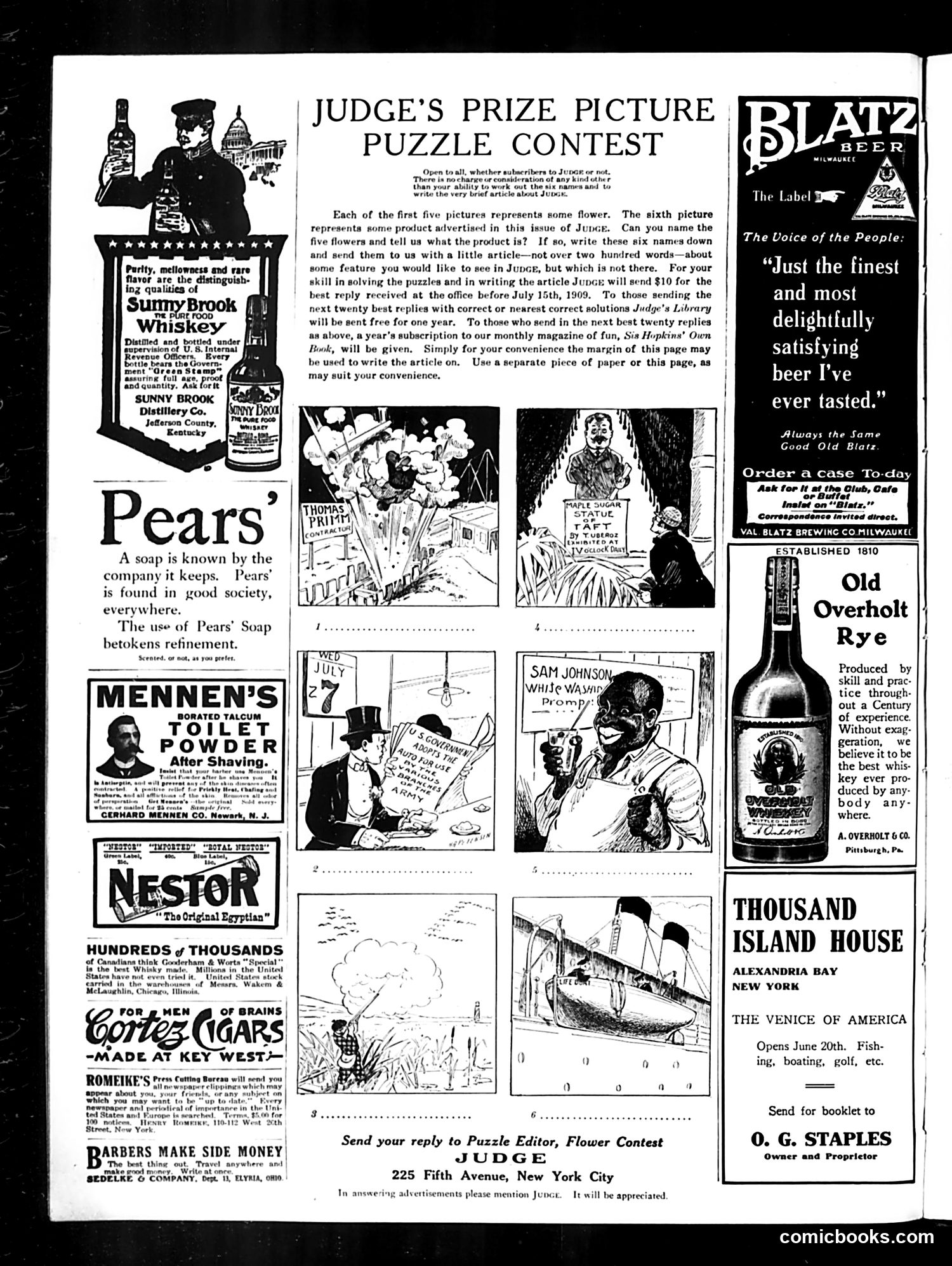
This is primarily an **advertising and contest page** rather than political satire. The page features Judge's "Prize Picture Puzzle Contest," where readers must identify six products advertised as flowers in the cartoon panels (numbered 1-6). The six illustrated panels show various commercial products disguised as or associated with flowers—likely whiskey, soap, cigars, and other consumer goods typical of early 1900s advertising. Readers who correctly identified all products and submitted a 200-word article about desired Judge magazine content competed for prizes: $10 for best entries, free annual subscriptions, or gift books. The surrounding advertisements (Sunny Brook whiskey, Pears' Soap, Mennen's talc powder, Nestor products) reinforce the commercial nature of the page. This represents early **advertiser-supported magazine culture**, where contests encouraged reader engagement while promoting branded products—a common strategy in American magazines circa 1909.
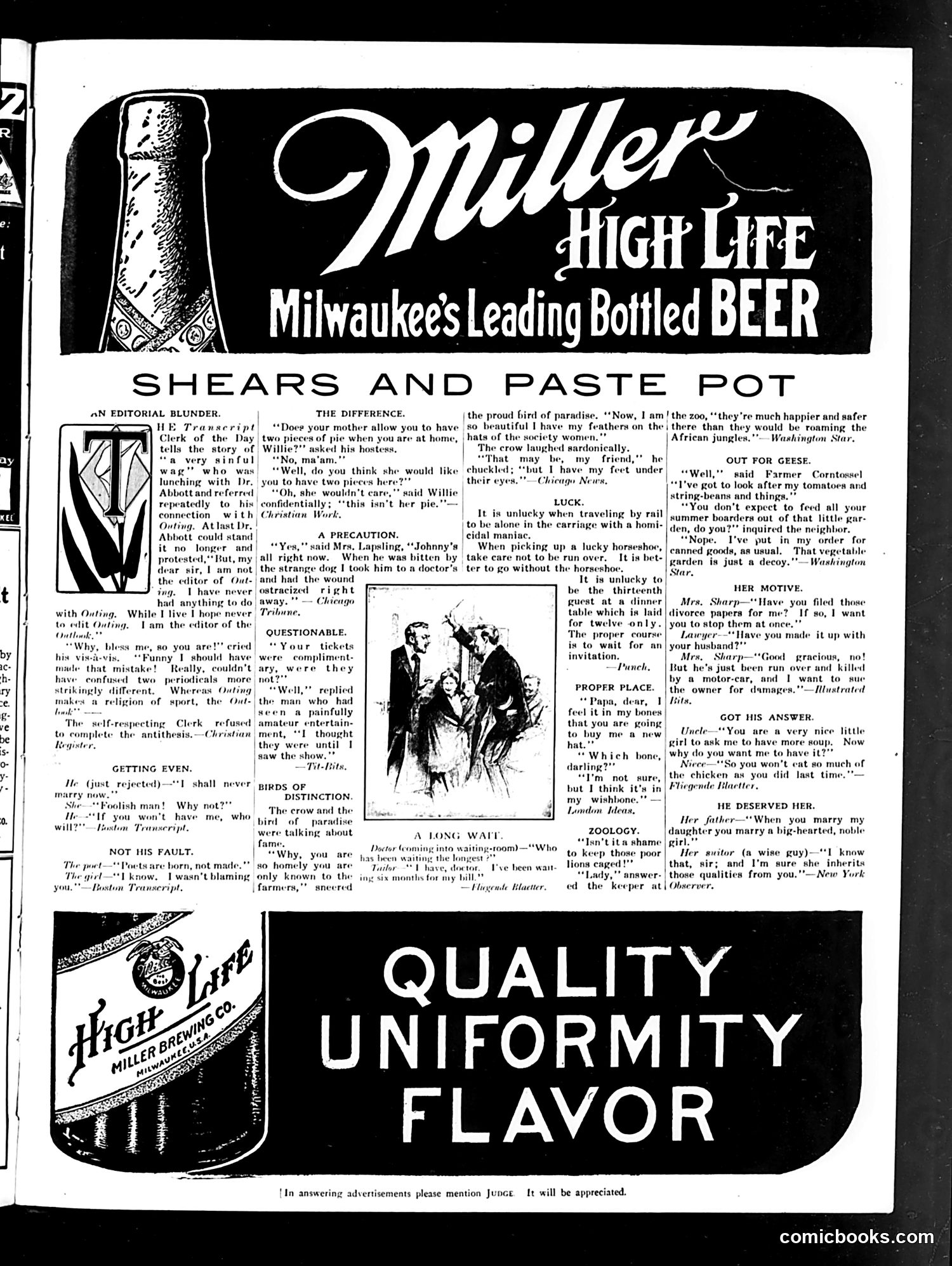
This page is primarily **advertising** for Miller High Life beer, with the beer company's logo and tagline "Quality Uniformity Flavor" prominently displayed at the bottom. The upper portion contains an "**Editorial Blunder**" section—a recurring Judge humor feature showcasing brief satirical anecdotes and jokes. These are mostly **wordplay and domestic humor** typical of early 20th-century magazines: - A boy admits to eating pie at home (joke about honesty) - A woman forbids her son from keeping a lucky horseshoe (practical safety humor) - Marital quarrels about divorce papers and motor-cars - Uncle-niece banter about eating chicken The cartoon illustration (center) shows what appears to be a social gathering or dinner scene, supporting the domestic humor theme. **The satire is gentle and apolitical**—focused on everyday situations, human quirks, and wordplay rather than political commentary. There are **no identifiable political figures or social commentary** visible. This is essentially a humor magazine section accompanying commercial advertising.
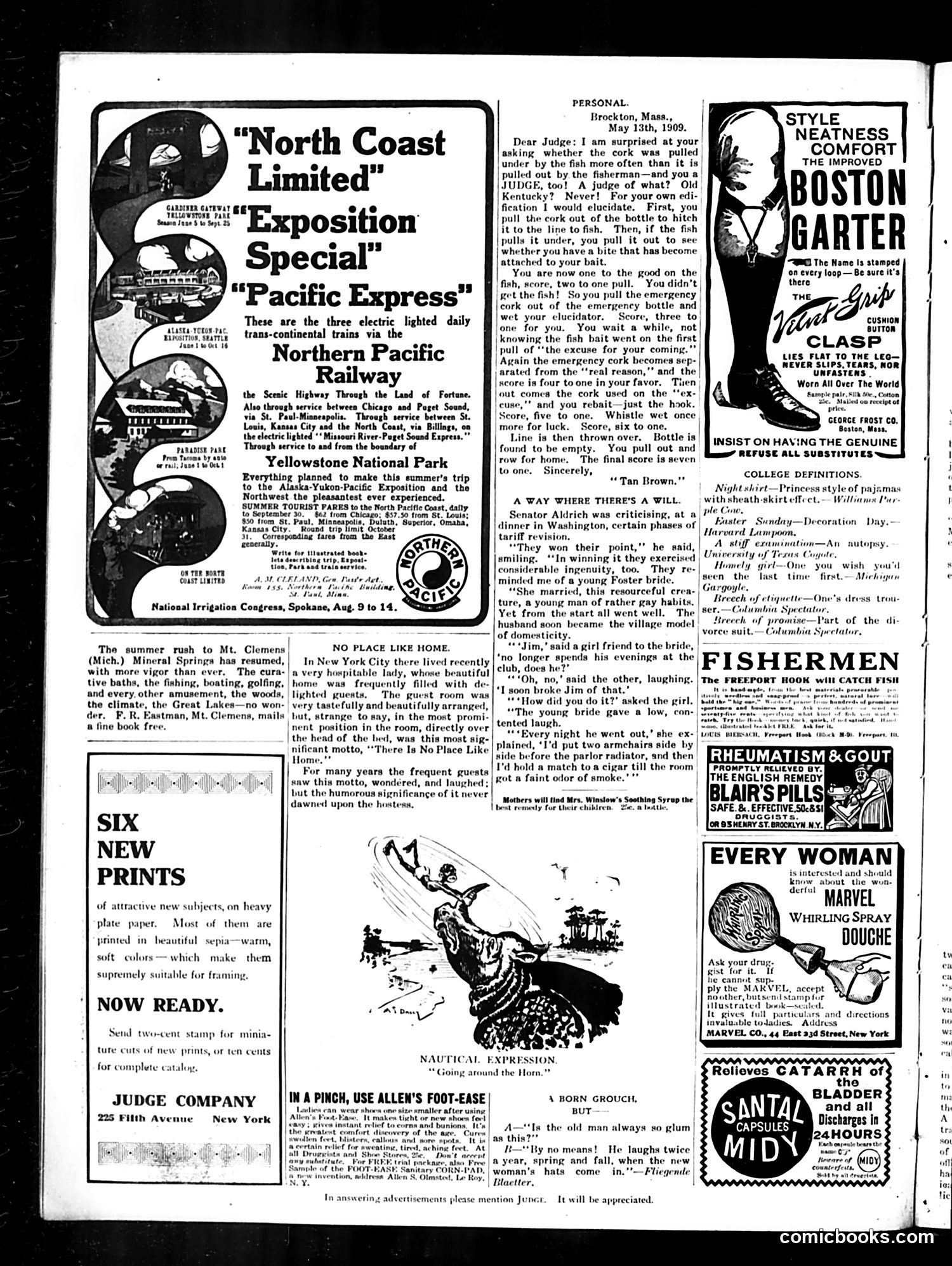
This page is primarily **advertising and light humor**—typical of Judge magazine's format. The main content includes: 1. **Railroad advertisements** (Northern Pacific Railway) promoting tourist travel to Mt. Clemens mineral springs and Yellowstone, exploiting the era's "health spa" tourism trend. 2. **"No Place Like Home"** — A mild domestic humor piece about a wealthy New York hostess who ironically displays a "No Place Like Home" motto prominently in her guest bedroom, unaware guests find it humorous (suggesting her home is so grand guests never want to leave). 3. **"A Way Where There's a Will"** — A newlywed joke: a bride reforms her carousing husband by strategically placing armchairs by the radiator so he stays home—playing on contemporary anxieties about marital fidelity and gender dynamics. 4. **Personal letter about fishing** — A humorous reader response debating cork-and-bait fishing technique, written in mock-serious tone. The remaining content is **vintage patent medicine and product advertising** (Boston Garter, Blair's Pills, Marvel Douche, etc.), typical of early 1900s publications.
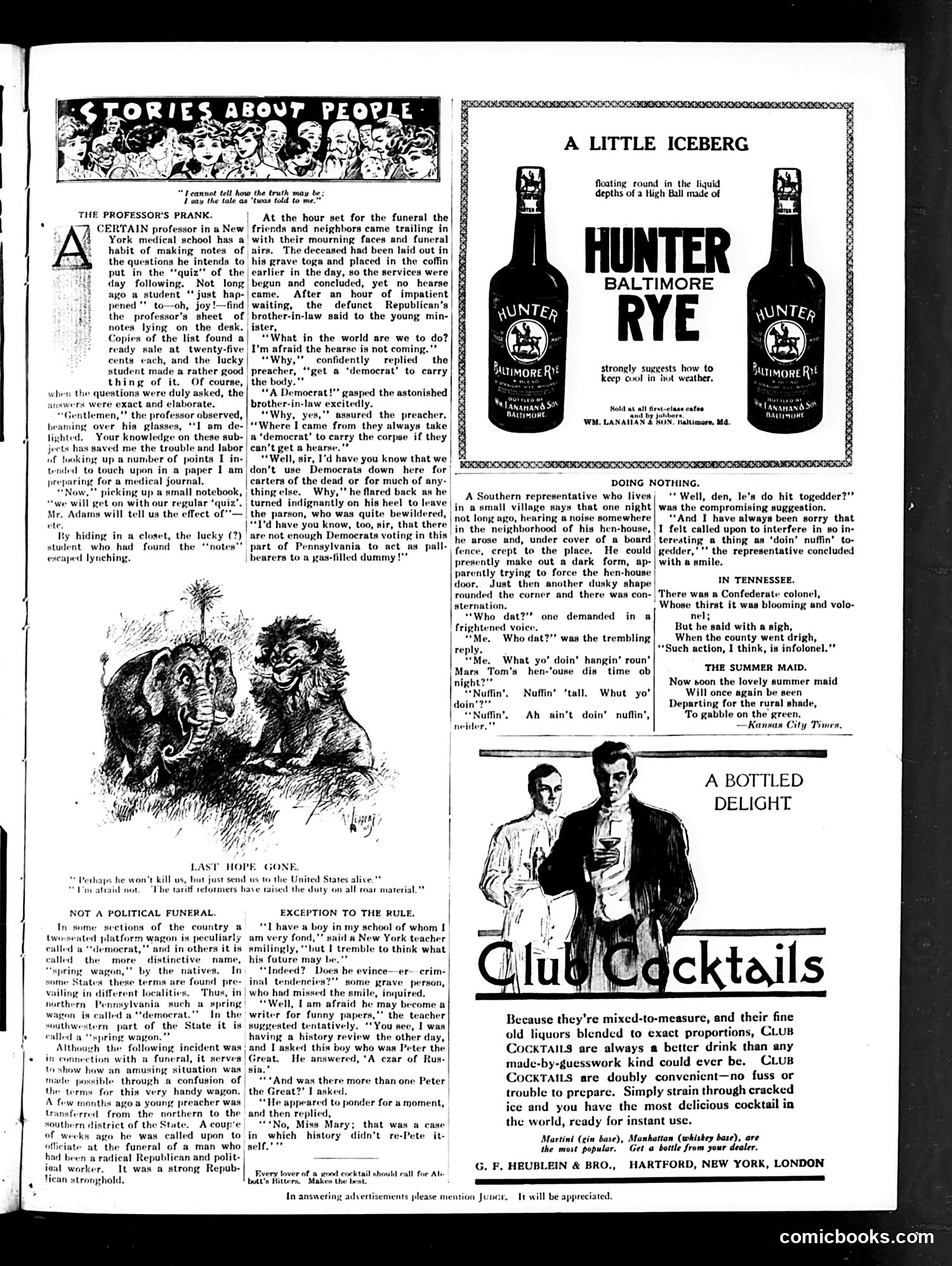
This page contains three distinct satirical pieces: **"The Professor's Prank"** (left): A humorous anecdote about a medical school professor whose quiz notes are stolen and sold by students. The joke concludes when the professor, discovering this, congratulates the student for thorough preparation—turning the tables on the cheaters through sarcasm. **"Doing Nothing"** (center): A dialogue between two Black men caught stealing from a henhouse. When confronted, they deny "doing nothing," which the narrator finds amusingly dishonest—likely satirizing either Black stereotypes or general human hypocrisy about crime. **Regional humor pieces** (right): Brief anecdotes from Tennessee and elsewhere depicting rural/Southern characters, using dialect humor typical of period publications. These mock rural colloquialisms and unsophisticated behavior. The page also includes **advertising** for Hunter Baltimore Rye whiskey and Club Cocktails, standard for Judge magazine's commercial content. The satire reflects early-20th-century attitudes; modern readers should recognize the ethnic stereotyping and dialect humor as historically contextual, not endorsed perspectives.
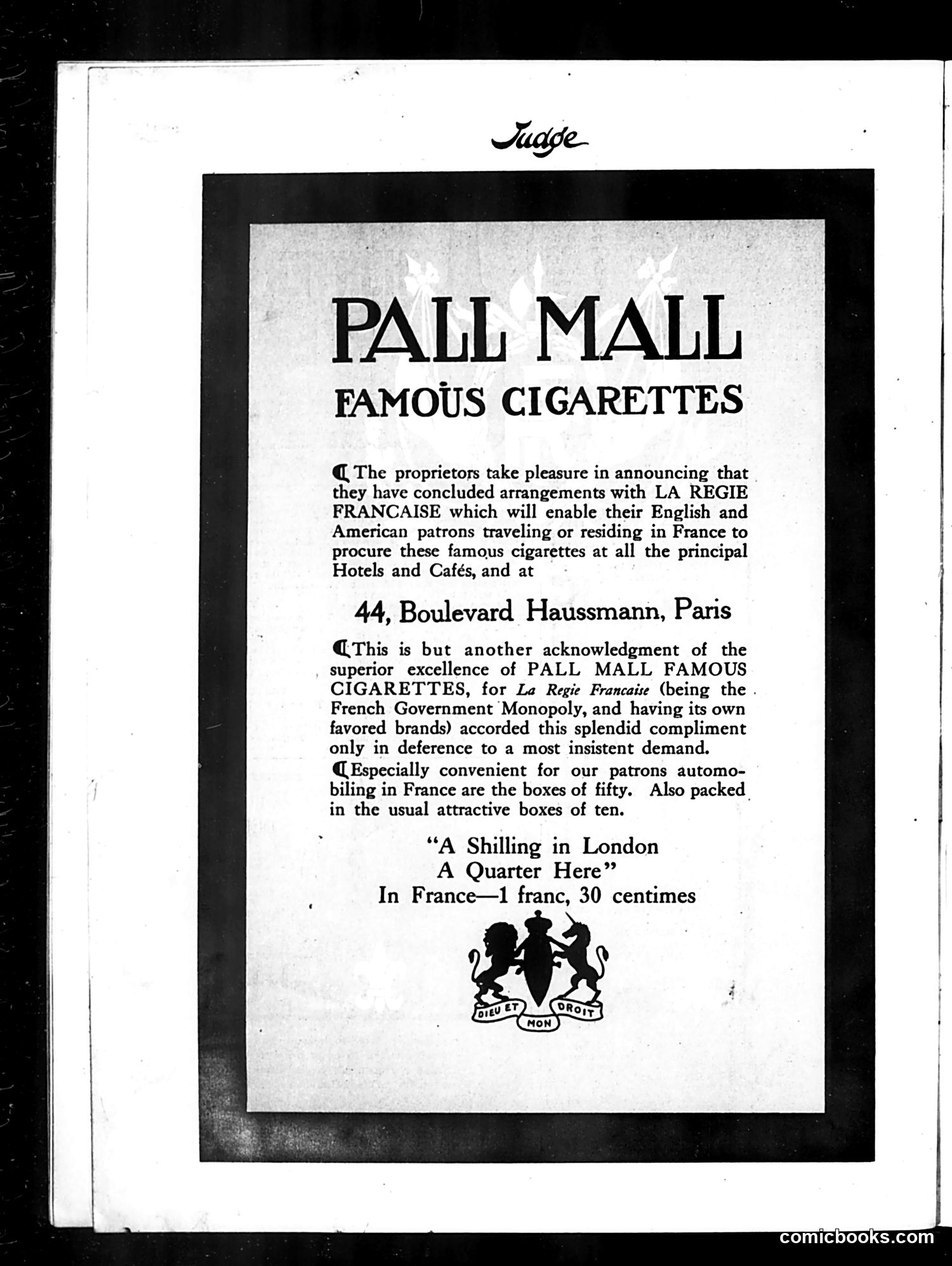
This is a full-page advertisement, not a political cartoon. It announces that Pall Mall cigarettes—an American/British brand—has secured distribution rights through La Régie Française, the French government tobacco monopoly, making them available at Paris hotels and cafés. The ad's implicit boast is that La Régie Française, which controlled its own favored brands, agreed to this arrangement only due to "insistent demand"—meaning Pall Mall's superior quality forced the French monopoly's hand. This frames commercial success as a kind of prestige victory. Pricing is listed for London, America, and France (1 franc, 30 centimes), suggesting the magazine's international readership of affluent travelers. The heraldic coat of arms adds legitimacy. For modern readers: this represents early 20th-century luxury cigarette marketing targeting wealthy English and American expatriates in France.

I can see this is a page from *Judge* magazine (as indicated by the watermark), but the page itself appears to be blank or nearly blank with only scattered dots and marks visible. There is no discernible cartoon, illustration, text content, or advertising that I can identify with confidence. Without visible cartoon imagery or readable OCR text content on this particular page, I cannot reliably explain what political or social satire it may have contained, identify any figures or caricatures, or provide historical context for a modern reader. If you have a different page from this *Judge* issue with more visible content, I'd be happy to analyze that instead.