
A complete issue · 16 pages · 1909
Judge — June 19, 1909
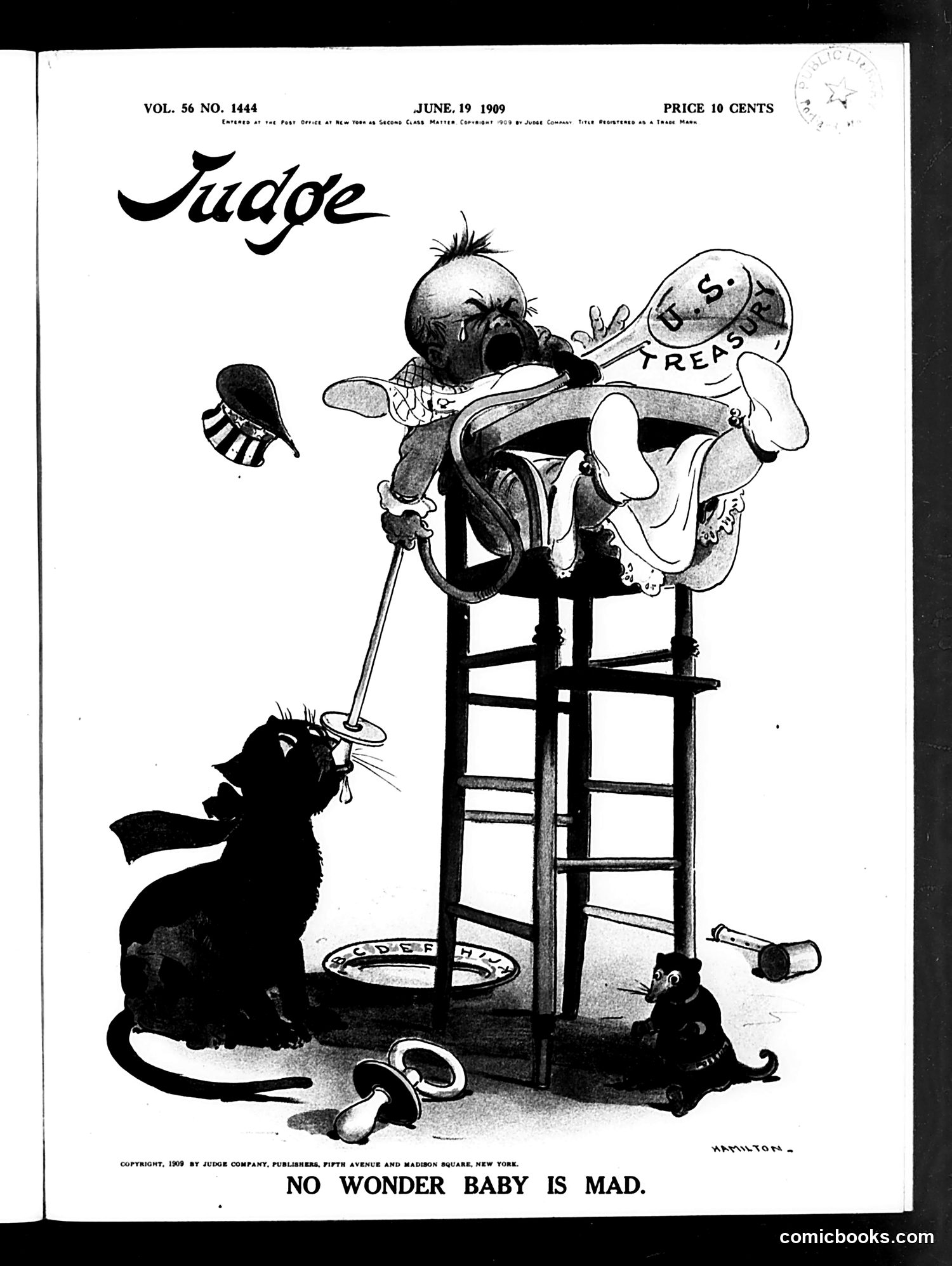
This satirical cartoon depicts a chaotic nursery scene where an infant sits atop a tall chair surrounded by animals (cats and rats) engaged in destructive behavior. The baby holds a U.S. Treasury bag labeled "U.S. TREASURY," while various creatures knock over items and create mayhem below. The title "No Wonder Baby Is Mad" suggests the cartoon critiques governmental mismanagement or financial chaos during the Theodore Roosevelt/William Howard Taft era. The infant likely represents either the nation or its economy, while the animals may symbolize corrupt politicians or financial speculators ransacking the treasury. The cartoon satirizes how governmental instability and corruption directly harm the nation's wellbeing, much like unsupervised animals would upset an infant left in their care.
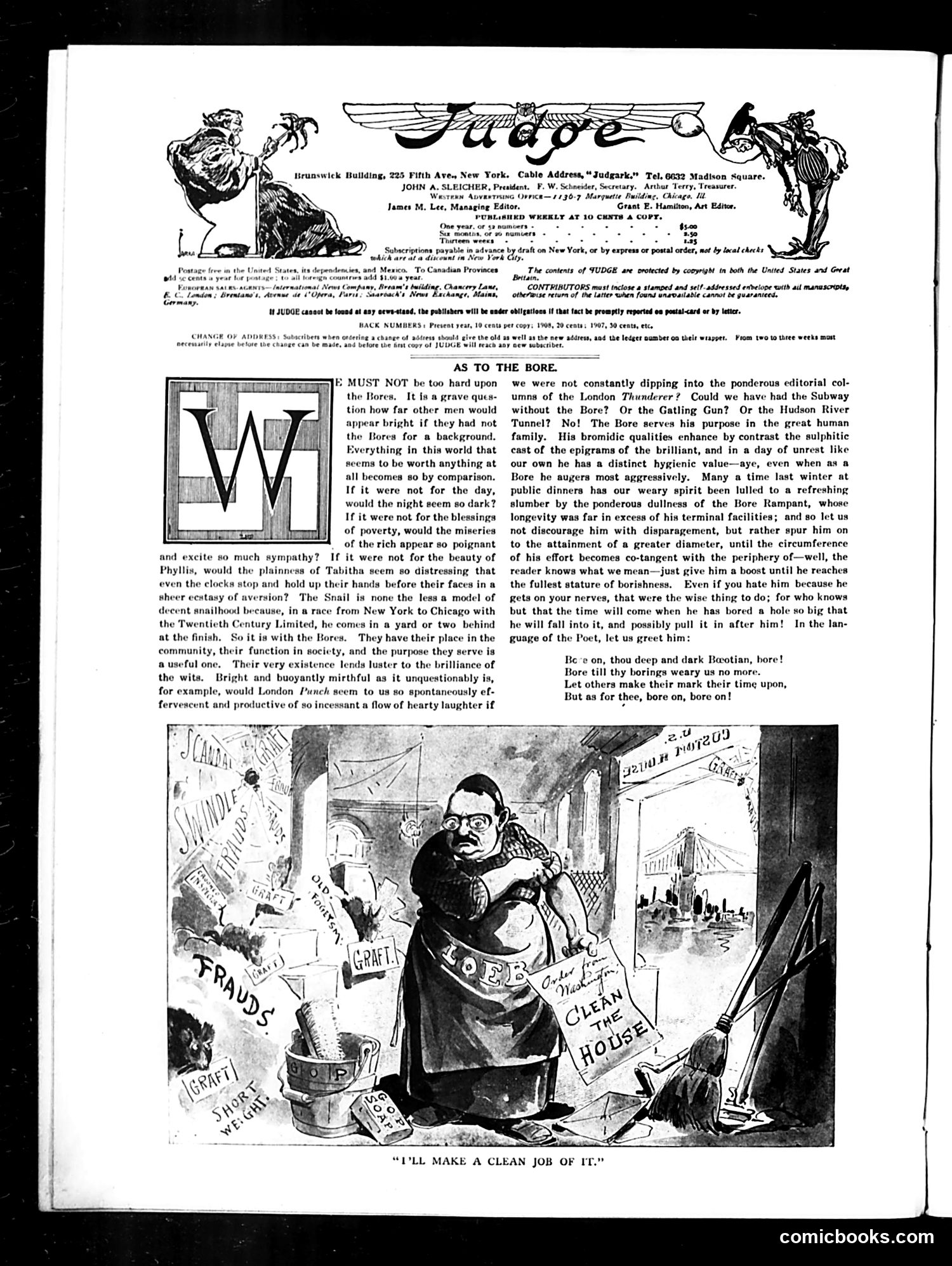
The main cartoon, titled "I'll Make a Clean Job of It," depicts a figure labeled "TAMMANY" (New York's Democratic political machine) as a charlatan or con artist surrounded by cleaning supplies, holding a broom. The figure is surrounded by labels referencing various scandals: "FRAUDS," "GRAFT," "AIRCRAFT," and "CLEAN THE HOUSE!" The accompanying essay "AS TO THE BORE" discusses the Bore (likely the Hudson River Bore—a tidal phenomenon) as a metaphor for persistent, unavoidable nuisances in urban life. The text compares it to subway tunnels and other infrastructure that define city existence. The satire targets Tammany Hall's corruption, suggesting its promises of reform ("clean job") are hollow bluster, mocking the organization's ability to whitewash systemic graft.
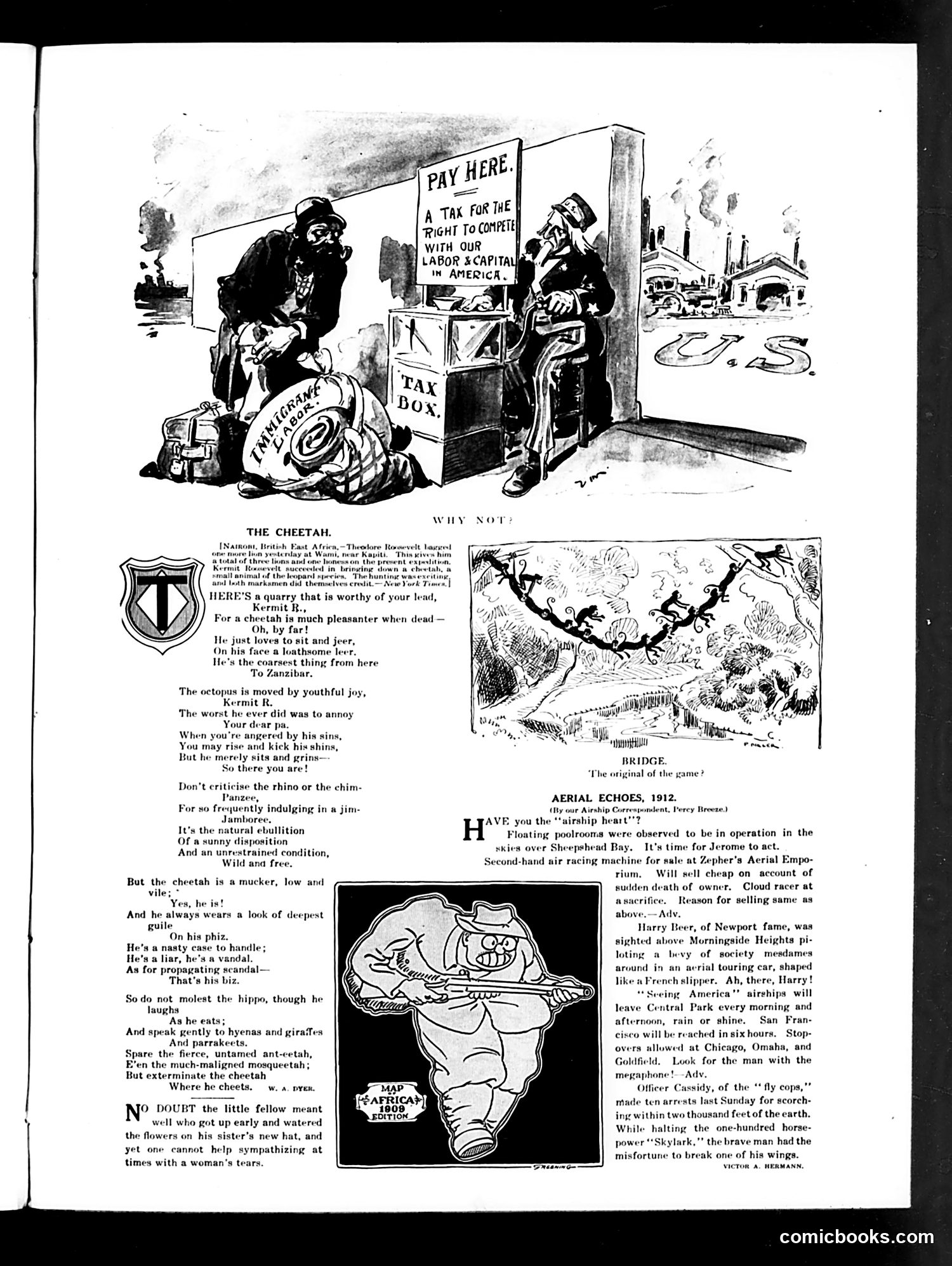
**"Why Not?" (Top Cartoon)** This satirical cartoon depicts an immigrant or foreigner (labeled "PENNILESS") at a "TAX BOX" paying "a tax for the right to confetti with our labor & capital in America." The figure collector appears to be an American capitalist extracting payment from newcomers. The satire critiques exploitative taxation or fees imposed on immigrants seeking economic opportunity—suggesting that America charges foreigners for the "privilege" of working and participating in its economy. Industrial smokestacks in the background emphasize capitalist America. **"The Cheetah" (Poem)** A humorous poem mocking the cheetah as an undesirable animal—vain, treacherous, and prone to annoying behavior. It's presented as satirical animal commentary rather than political allegory. The page also contains other unrelated content including "Bridge" and "Aerial Echoes, 1912."
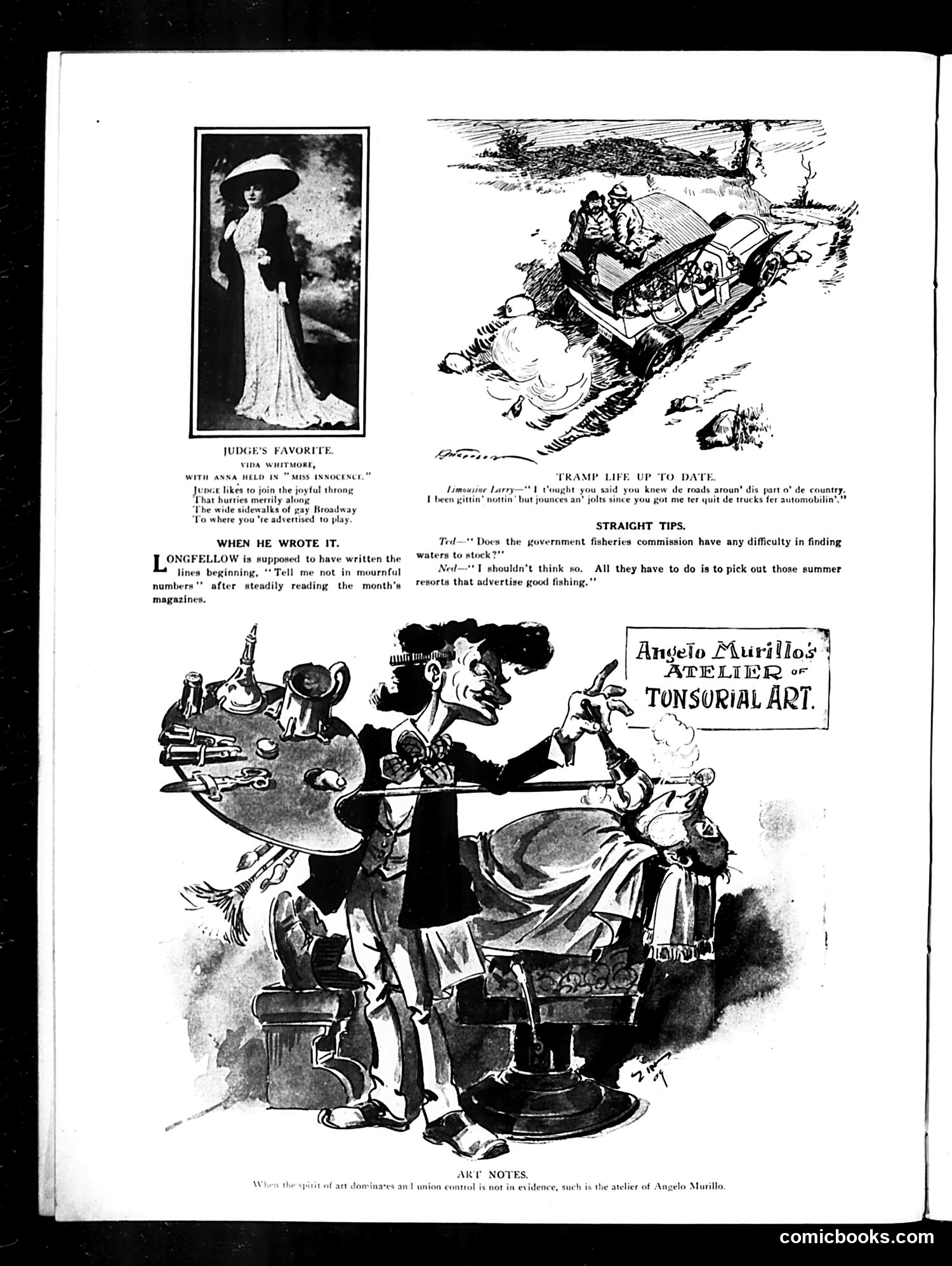
This page contains **three separate satirical pieces**: 1. **"Judge's Favorite"**: A photograph and caption praising an actress named Anna Held in "Miss Innocence," noting the show's theatrical success. 2. **"Tramp Life Up to Date"**: A cartoon mocking hobos' adoption of automobiles, showing vagrants in a car. The dialogue jokes that tramps now "pound on automobile tires for automobiles" instead of traditional begging. 3. **"Straight Dope"**: A brief dialogue satirizing government fish commissions, suggesting they simply advertise fishing resorts rather than genuinely managing fish stocks. 4. **"Angelo Murillos' Atelier of Tonsorial Art"**: A decorative illustration advertising barbershop services, with an "Art Notes" section below. The page primarily targets **modernization's comedic contradictions** and satirizes **government bureaucratic inefficiency**.
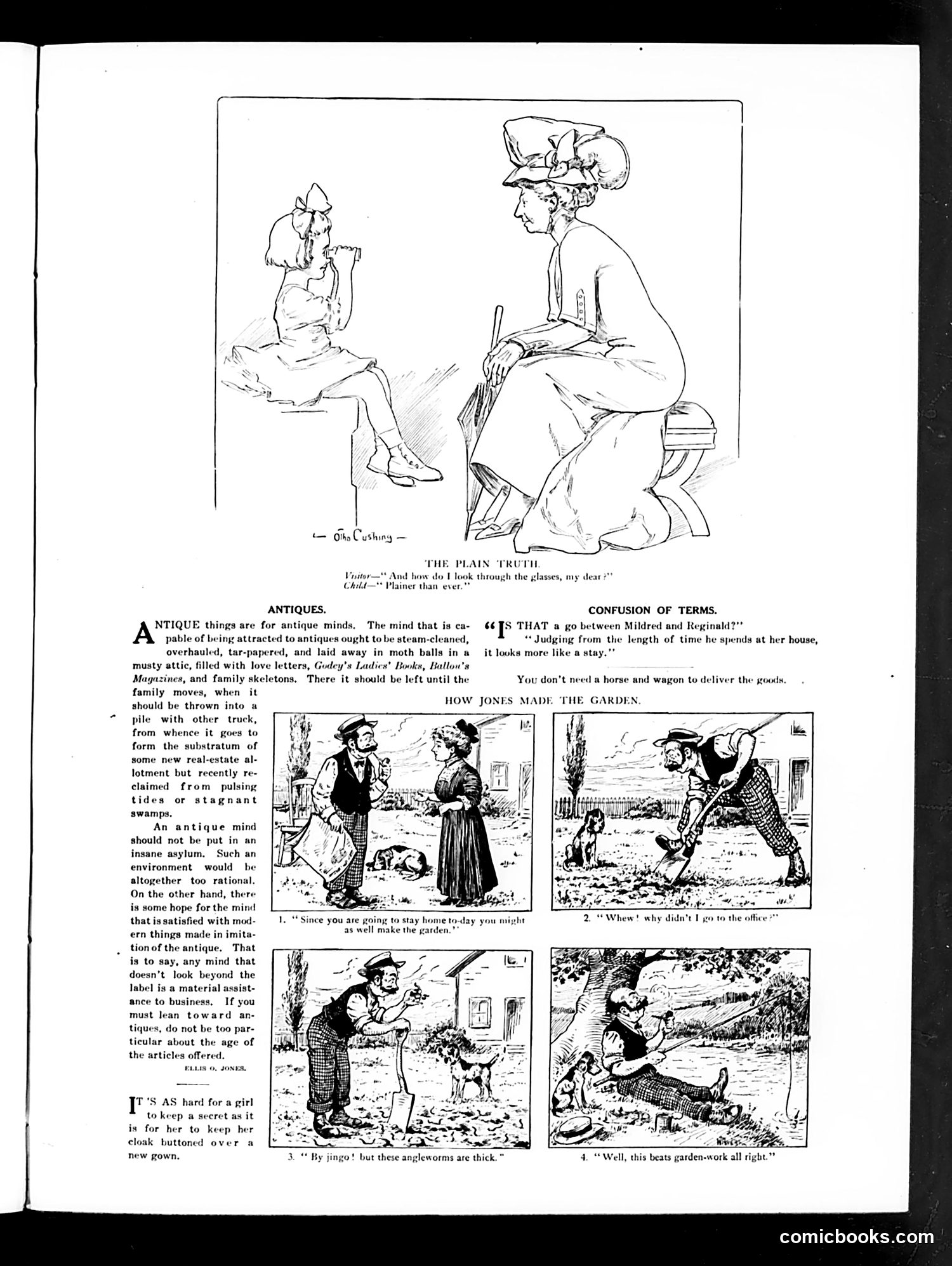
This page contains three distinct satirical pieces: **"The Plains Truth"** (top): A sketch mocking an adult's poor eyesight, with a child asking why the adult looks "through the glasses" rather than at them—a joke about misusing spectacles. **"Antiques" and "Confusion of Terms"** (left/middle): Short humorous columns about collecting antique furniture and the ambiguous distinction between "Mildred" and "Reginald." **"How Jones Made the Garden"** (bottom): A four-panel comic strip showing a man's comical misadventure attempting gardening. He initially plans to create a garden, but the sequence suggests his efforts go badly awry, ending with him apparently injured or defeated—a physical-comedy joke about amateur gardening incompetence. The humor relies on situational comedy and visual slapstick rather than topical political satire.
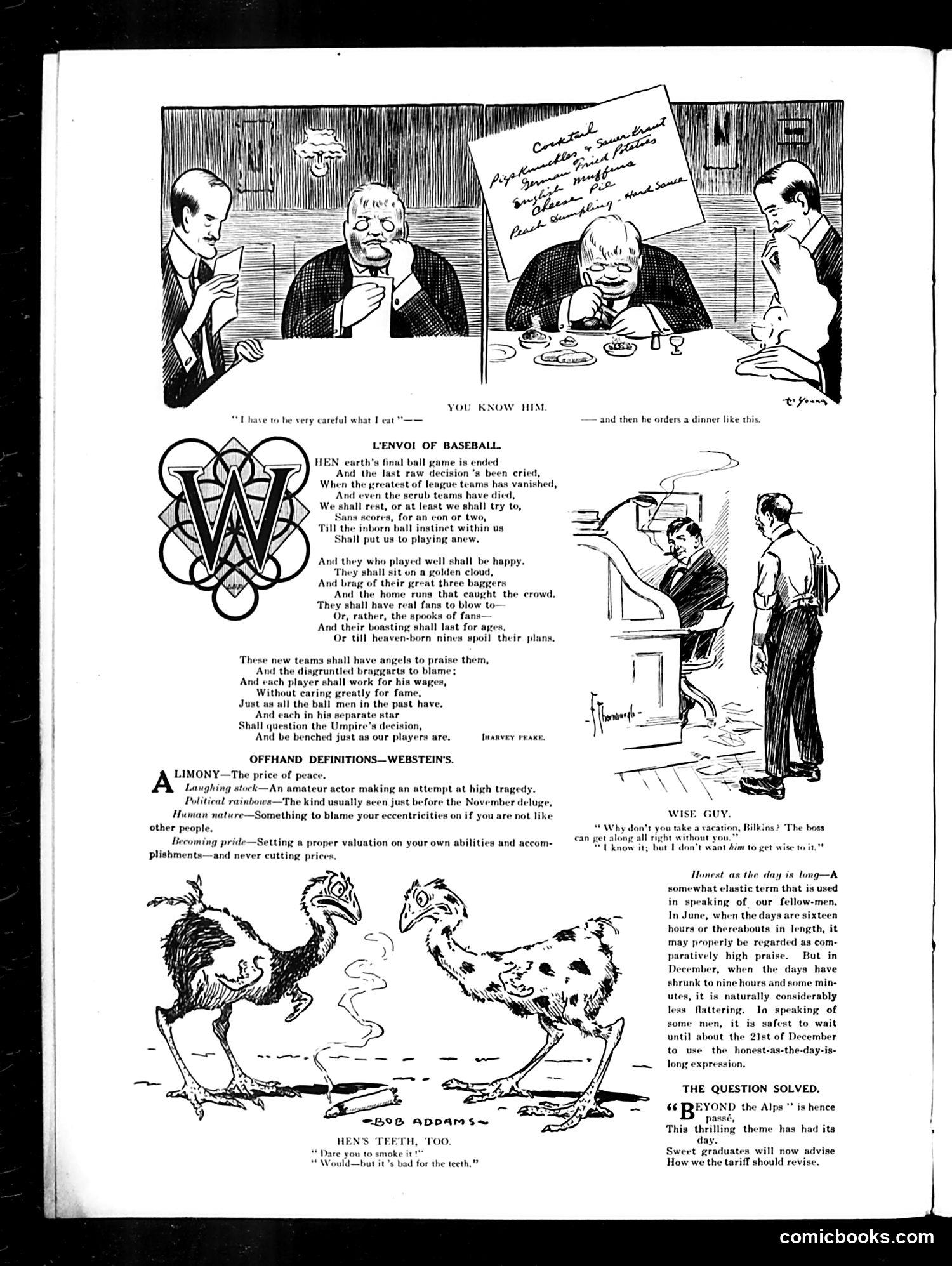
This page from *Judge* magazine contains several satirical pieces mocking early 20th-century American life. **Top cartoon ("You Know Him"):** Depicts a man carefully reading restaurant menu while dining companions watch. The satire targets someone obsessively cautious about food—likely a hypochondriac or someone of modest means pretending to refinement. The irony: despite his caution, he orders an elaborate, expensive dinner. **"Envoy of Baseball":** A sentimental poem imagining baseball continuing in the afterlife, reflecting baseball's cultural importance to Americans at this time. **"Offhand Definitions":** Mock dictionary entries satirizing contemporary concepts—"Limony" (paying for peace/alimony), "Human nature" (excusing bad behavior), "Honest as the day is long" (elastically defined by season). **Bottom cartoon:** Two roosters debating smoking, playing on the phrase "hen's teeth" (impossibly rare). Gentle humor about animal behavior. The overall tone reflects *Judge's* characteristic witty commentary on American social pretensions, gender relations, and popular culture of the era.
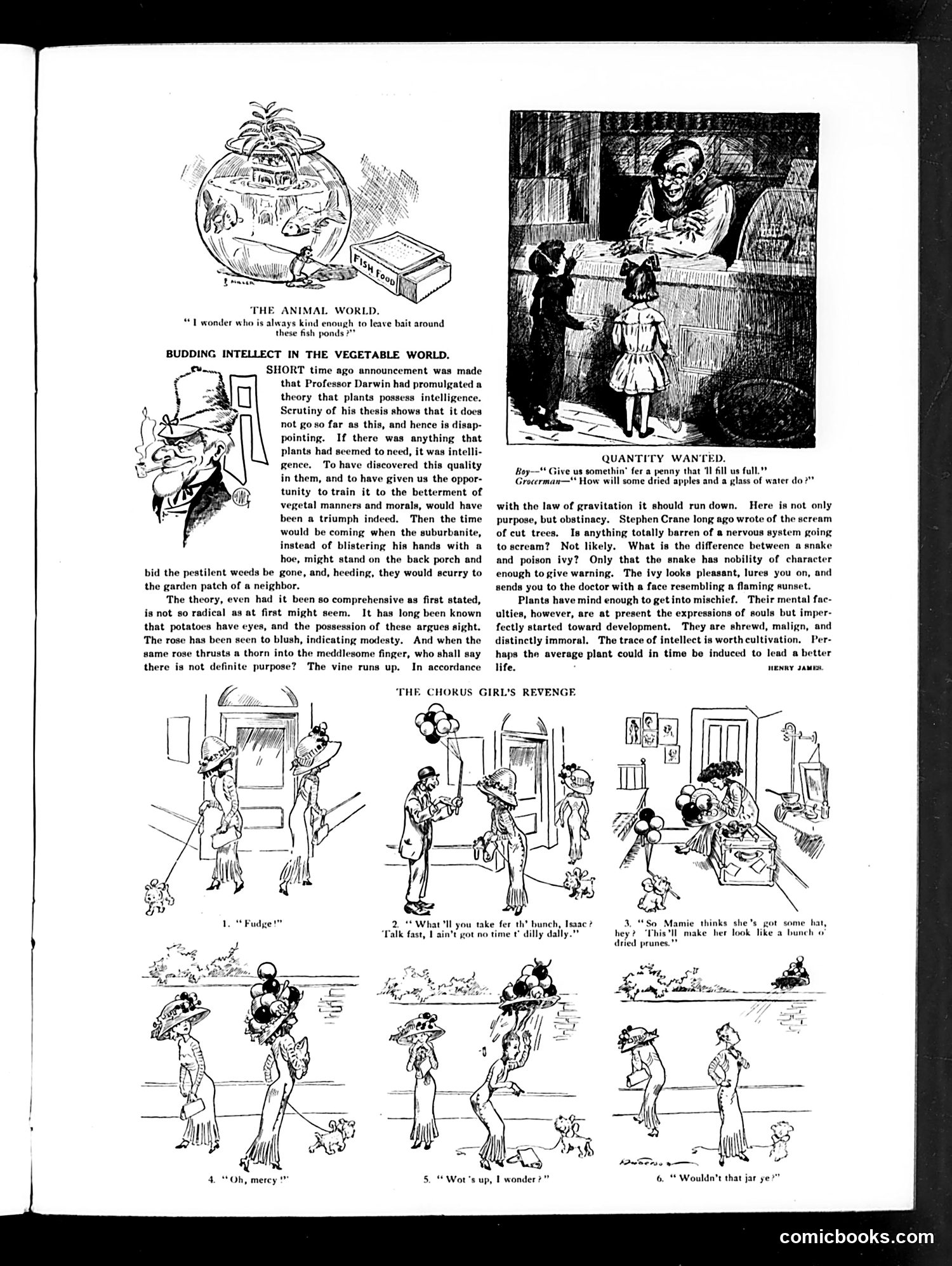
This satirical essay mocks Darwin's theory that plants possess intelligence. The author pretends to take the idea seriously, then ridicules it by citing supposed "evidence"—potatoes having eyes, roses blushing, vines defying gravity, and cut trees screaming. The humor lies in the absurd extrapolation: if plants were truly intelligent, suburban homeowners could simply command weeds to leave their gardens. The piece suggests plants, if sentient, would be morally corrupt—the poison ivy "lures you on" treacherously while snakes at least warn of danger. The essay concludes that plants show "traces of intellect" worth "cultivation," implying they might improve morally with training—a tongue-in-cheek jab at both Darwin's evolutionary theory and Victorian faith in moral improvement. The other cartoons on the page are unrelated humor: fish wondering who leaves bait, and a "Chorus Girl's Revenge" comic strip.
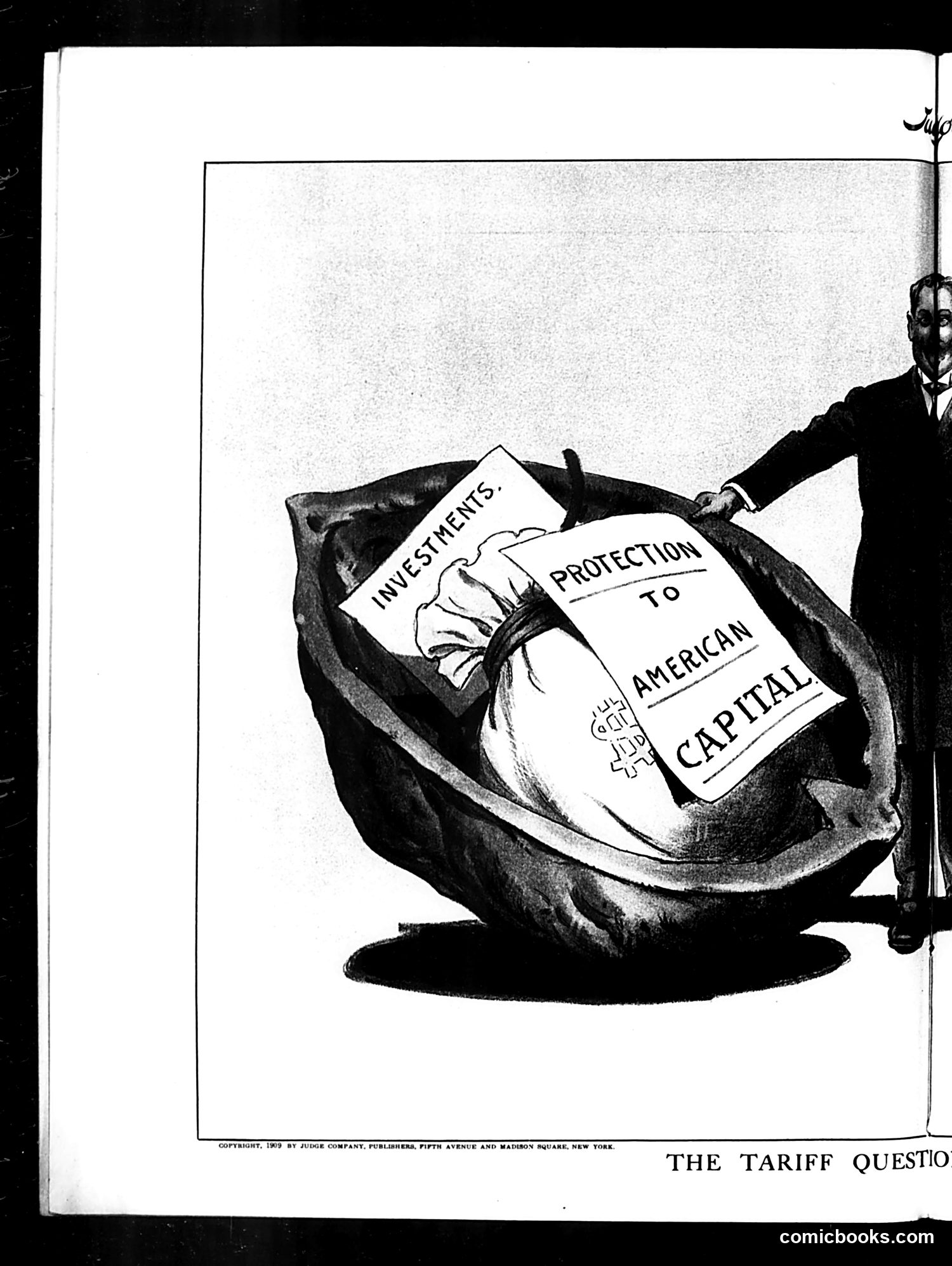
This editorial cartoon satirizes American tariff policy debates. A well-dressed man (likely a politician or businessman) holds open a large basket or bag labeled "INVESTMENTS" and "PROTECTION TO AMERICAN CAPITAL," displaying its contents to the viewer. The satire suggests that tariff protections—policies imposing taxes on imported goods—primarily benefited wealthy investors and capitalists rather than ordinary Americans, despite being justified as protecting "American" interests broadly. The cartoon implies a disconnect between the stated purpose (protecting America) and the actual beneficiaries (the wealthy elite). The image criticizes how tariff arguments masked policies that disproportionately enriched a privileged class while claiming to serve the nation's interests. This reflects early 20th-century debates about economic inequality and whose interests tariffs actually served.
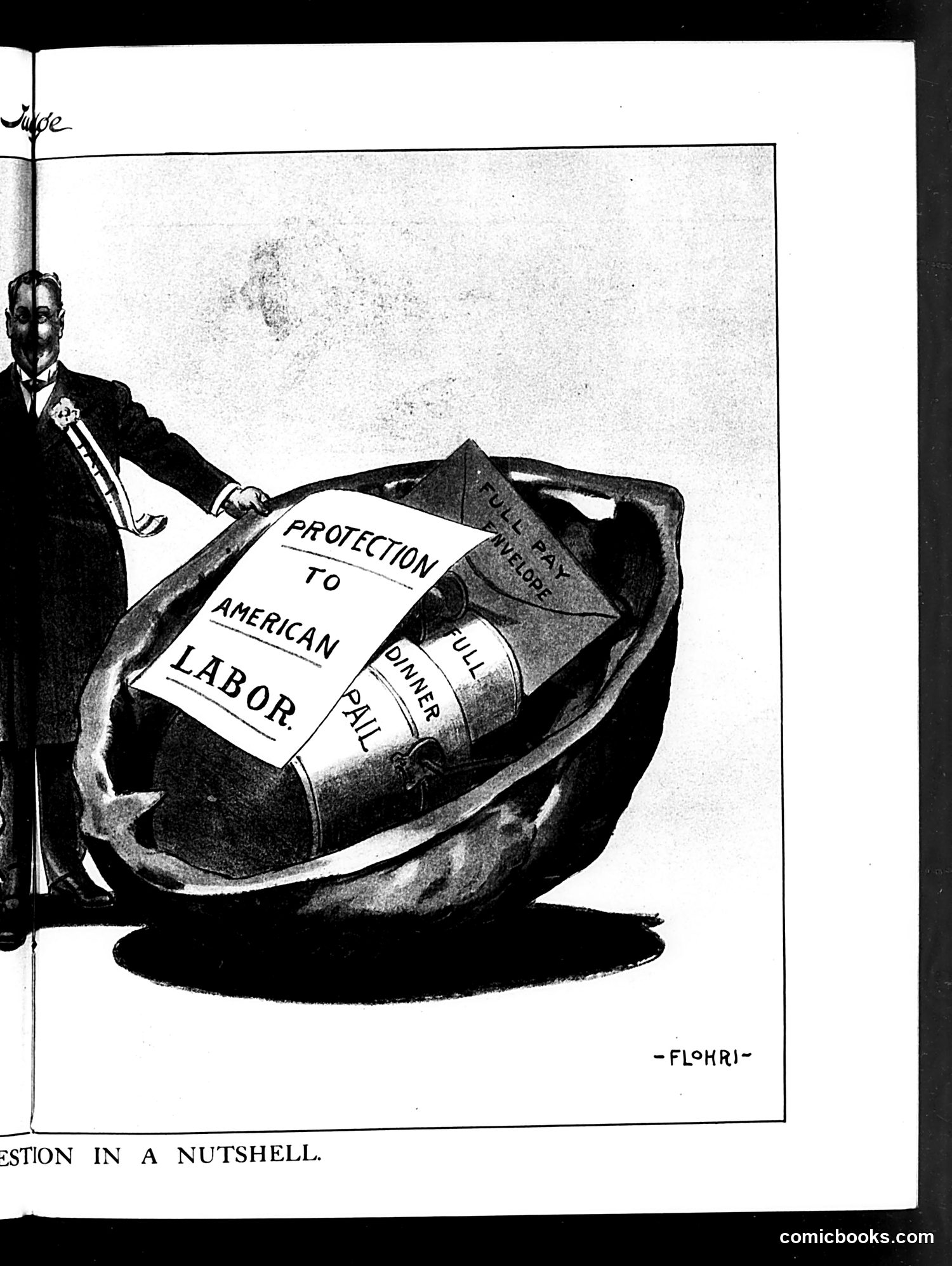
This political cartoon by Flohri satirizes protectionist trade policy. A well-dressed judge or politician holds open a large nutshell containing what appears to be a bomb or explosive labeled "Protection to American Labor," with additional text reading "Full Dinner Pail" (a campaign slogan). The imagery suggests that protectionist measures—intended to safeguard American workers and provide prosperity—are actually dangerous, potentially destructive policies wrapped in appealing rhetoric. The cartoon critiques how protective tariffs are marketed to the public as beneficial, when the cartoonist views them as threatening. The "nutshell" device condenses the entire protectionist debate into one dangerous image, implying the policy's true nature contradicts its promises.
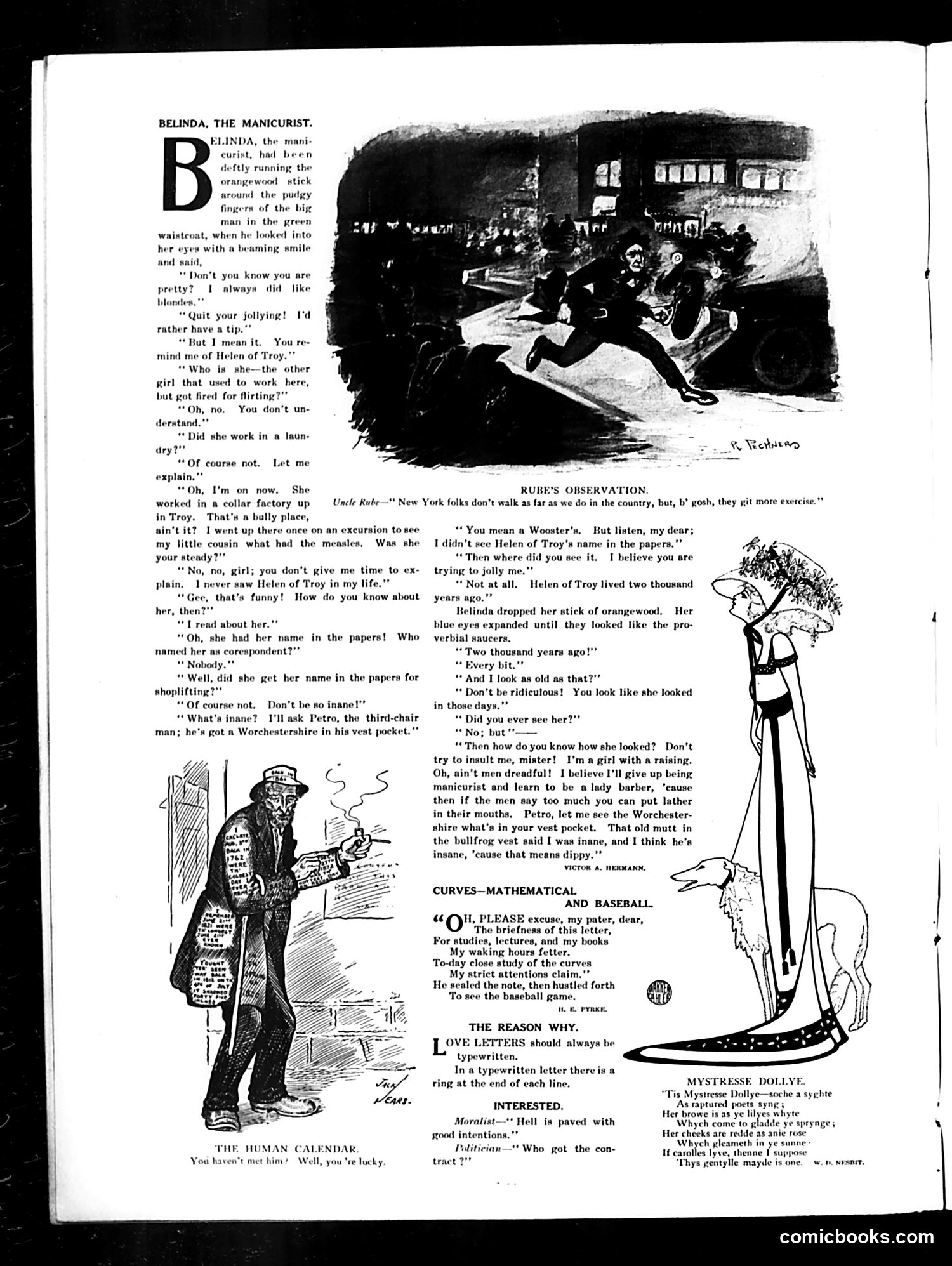
This page from *Judge* magazine contains three separate humorous pieces: **"Belinda, the Manicurist"** satirizes class pretension and male condescension. A working-class manicurist rebuffs a man's flattery by preferring tips to compliments. When he compares her to Helen of Troy (ancient Greek mythology), she confuses it with a contemporary scandal involving a woman named Helen of Troy who worked in a Troy, New York collar factory and was named in a divorce case. The joke mocks both her ignorance of classical literature and his assumption that flattery would impress her. **"Rube's Observation"** is a brief quip contrasting rural and urban life—New Yorkers exercise more because they walk less distance, so they compensate. **The remaining pieces** are short comic verses about mathematical curves and baseball, love letters, and moral platitudes—typical *Judge* filler content. The satire targets working-class characters, gender dynamics, and urban/rural contrasts typical of early 20th-century American humor.
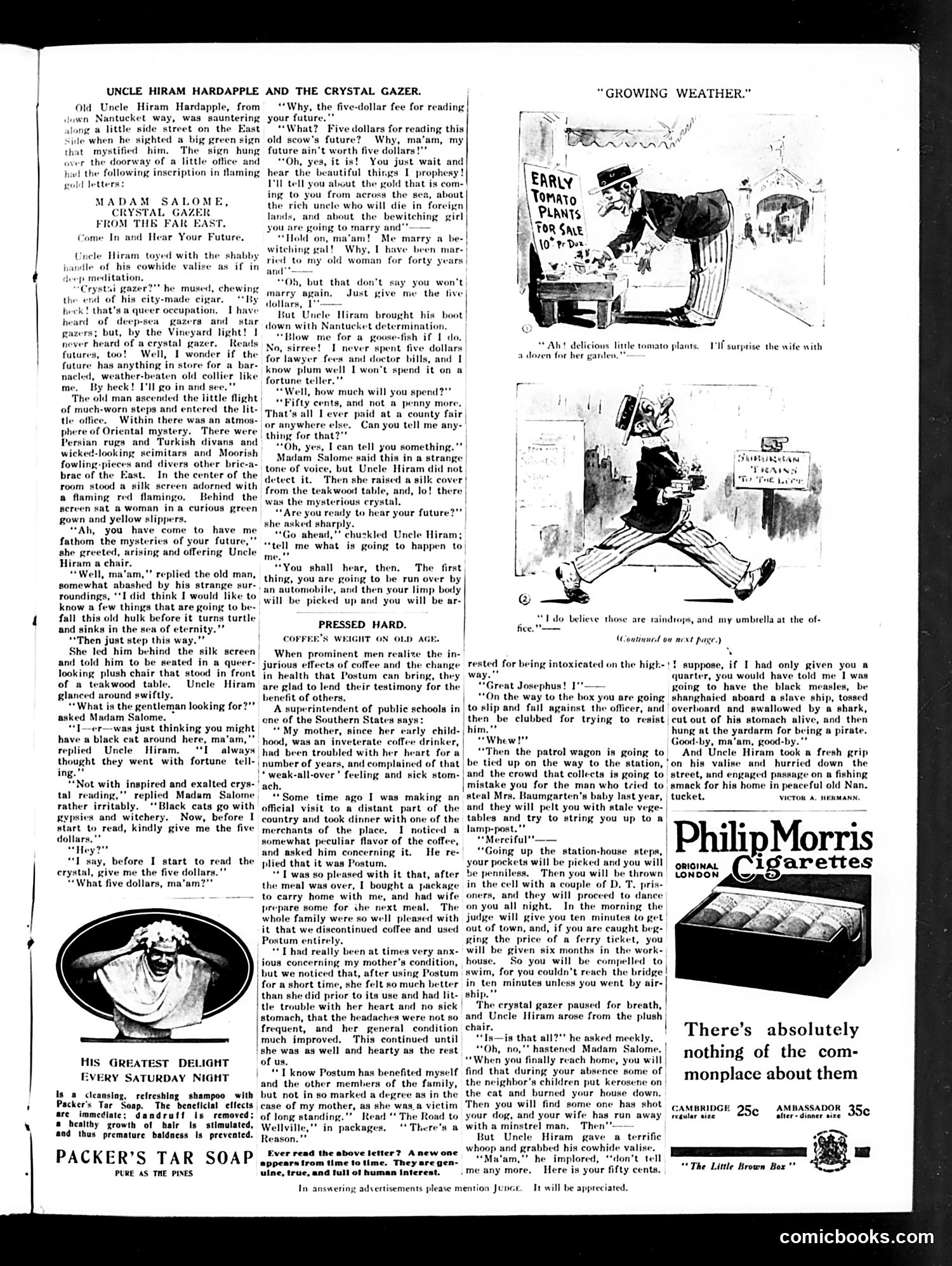
This is a humorous short story illustrated with satirical drawings, not primarily a political cartoon. The narrative mocks both a credulous fortune-teller and a skeptical rural visitor. **The Setup:** Uncle Hiram, an old Nantucket sailor, enters a fortune-teller's parlor decorated with exotic Eastern props (silk screens, Turkish divans, scimitars). "Madam Salome," the fortune-teller, attempts to charge him five dollars. **The Satire:** Hiram represents the practical, working-class American who finds the whole enterprise absurd—he's willing to pay only fifty cents, the price of a county fair fortune. Madam Salome represents the charlatan exploiting urban mysticism and pseudo-Oriental aesthetics to fleece gullible customers. The humor lies in Hiram's blunt refusal to pay the premium price and his incredulity at the profession itself. **The Point:** The cartoon satirizes both the proliferation of fortune-telling schemes in early 20th-century America and the common-sense resistance of ordinary people to such obvious fraud. It's fundamentally about class and credulity—mocking both the con artist and the foolishness of believers.
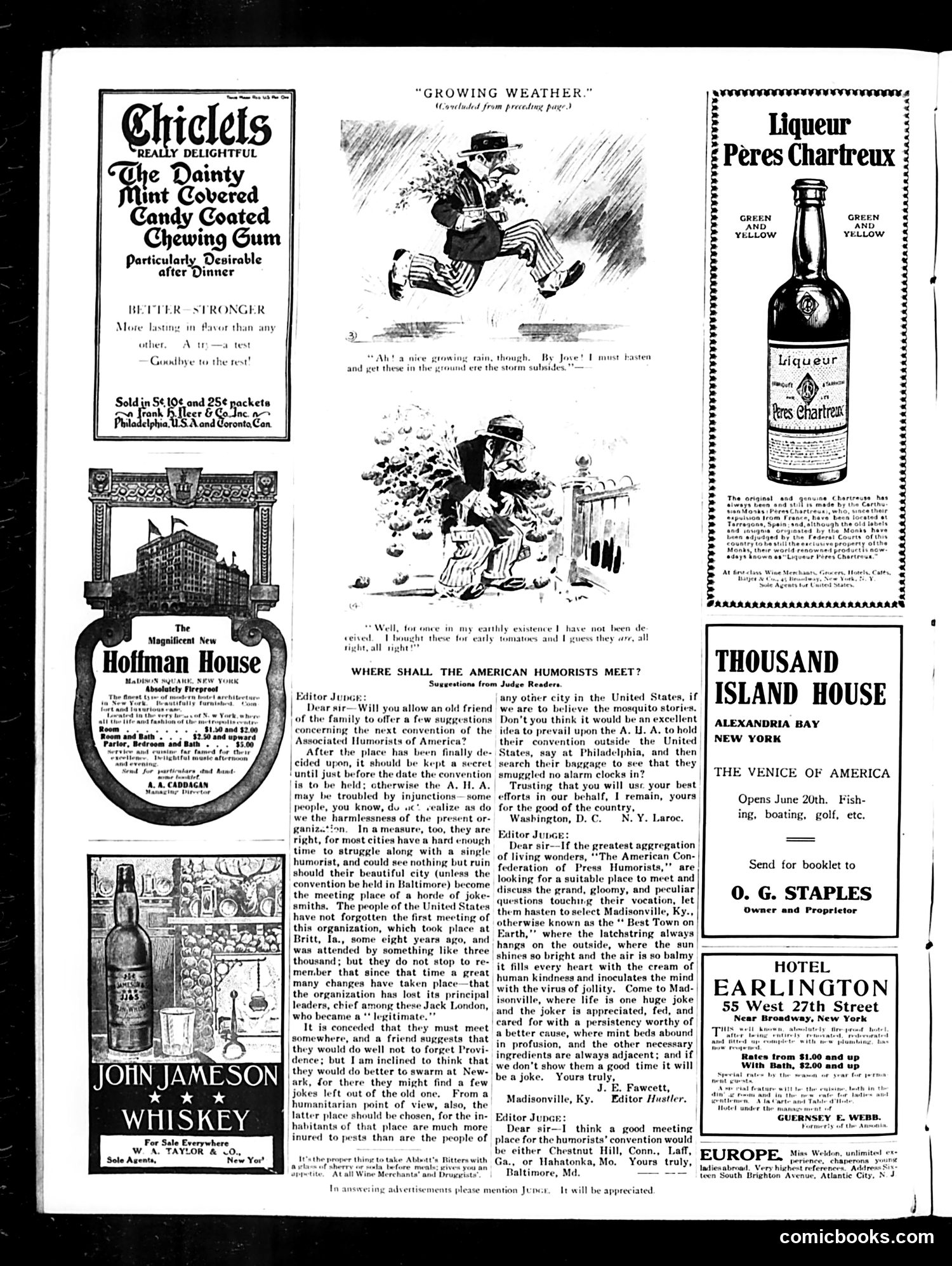
This page consists primarily of **advertisements** interspersed with editorial content about humorists' conventions. The central illustrated content shows a man running through rain with the caption about getting tomatoes before a storm—this appears to be a humorous vignette rather than political satire. The main editorial section titled "Where Shall the American Humorists Meet?" is a lighthearted reader-suggestion forum debating where the "Associated Humorists of America" should hold their next convention. Readers propose cities like Jacksonville and Madisonville, Kentucky, joking that humorists need places with abundant humor and relaxation rather than cities that already have "a single humorist" struggling to survive. This reflects **early 1900s American humor culture**—when humorist conventions were apparently real events worth discussing. The satire mocks both aspiring comedians and small-town pride. The rest is **commercial advertising**: Chiclets gum, whiskey, hotels, and liqueur—typical of Judge magazine's revenue model.
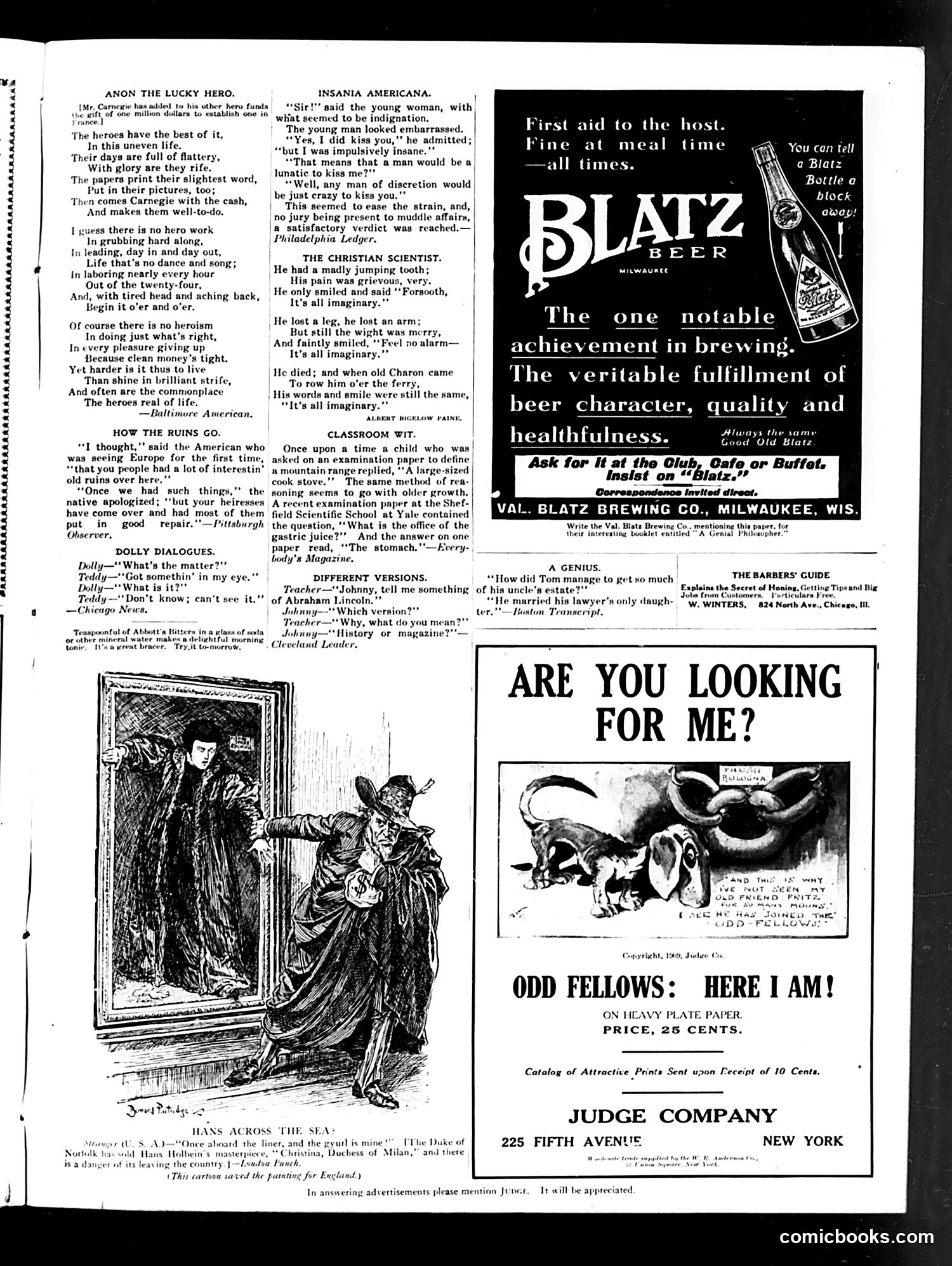
This page from *Judge* contains several brief satirical pieces and advertisements typical of early 20th-century American humor magazines. **Main Content:** - **"Anon the Lucky Hero"**: A poem mocking Andrew Carnegie's practice of donating to charitable causes while his workers labor in poor conditions—satirizing the gap between philanthropic gestures and actual worker welfare. - **"Insania Americana"**: A romantic vignette where a young man excuses his impulsive kiss as momentary insanity, with the woman accepting this explanation. It's light social satire on courtship conventions and how men justified forward behavior. - **"How the Ruins Go"**: A joke about American heiresses buying and "restoring" European historical ruins—mocking wealthy Americans as cultural vandals abroad. - **Classroom Wit & Dolly Dialogues**: Simple wordplay and domestic humor typical of the era. The page is primarily advertising-heavy, featuring a large **Blatz Beer advertisement** emphasizing quality and health benefits—standard marketing claims of the prohibition-era period.
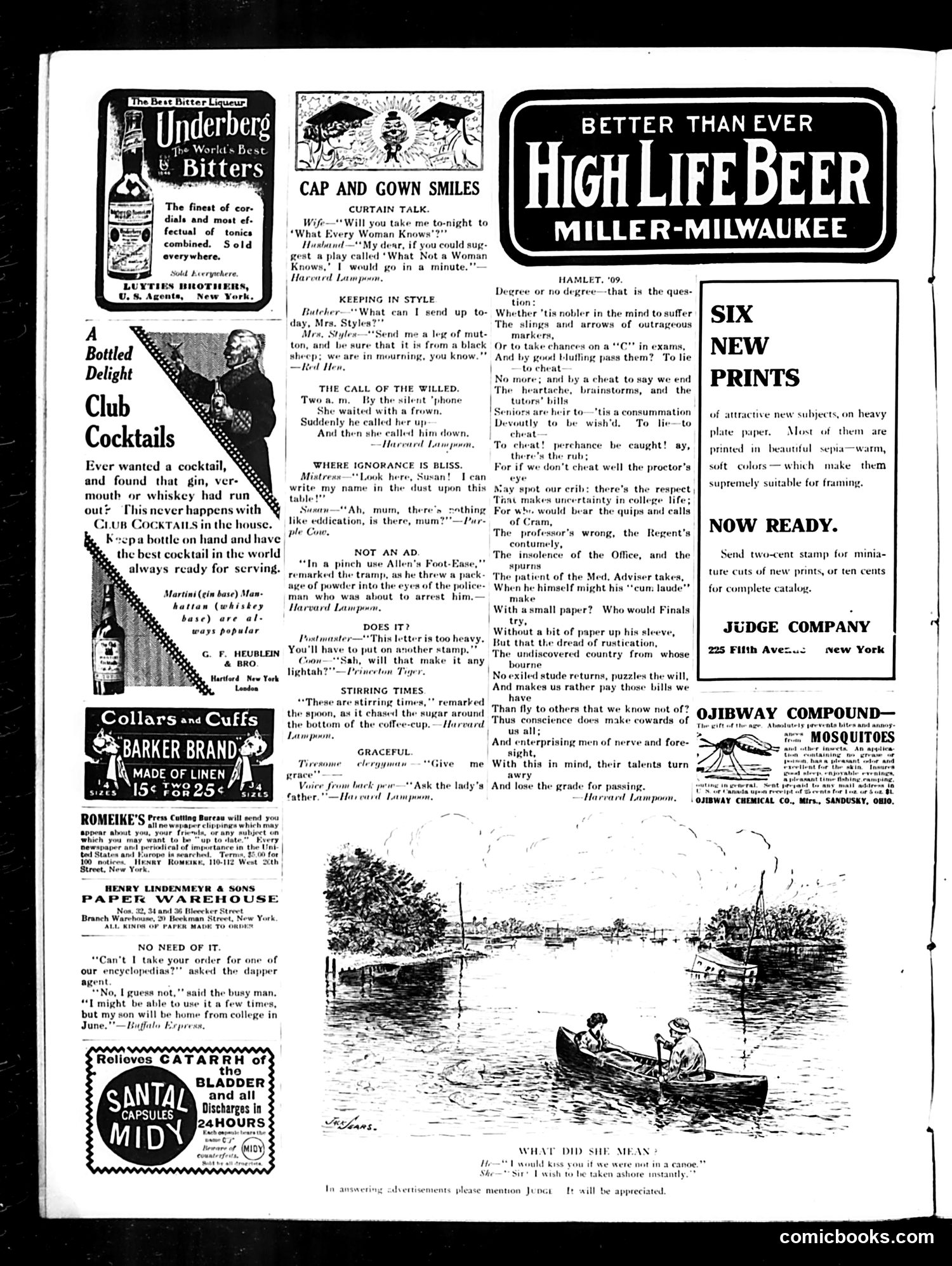
This page consists primarily of **humorous prose vignettes and advertisements** rather than political cartoons. The content satirizes early 20th-century American social conventions and academic life. The main satirical pieces mock: - **Gender relations**: "What Every Woman Knows" jokes about wives' expectations and marital dynamics - **Academic pretension**: Multiple pieces reference Harvard and college life—cheating on exams, student anxieties about grades and "rustication" (expulsion), professors' authority - **Class consciousness**: References to servants, butchers, and social hierarchies ("mourning" etiquette) - **Literary allusions**: Parodies of Shakespeare's *Hamlet* appear throughout, suggesting educated readers would recognize the mock-philosophical treatment of college worries as "to be or not to be" dilemmas The humor targets **educated, middle-to-upper-class audiences** familiar with Harvard references and Shakespeare. There's no specific political messaging—rather, it's gentle satire of domestic life, academic pretension, and romantic complications typical of Judge's era content. Advertisements for beer, collars, and patent medicines fill the margins.
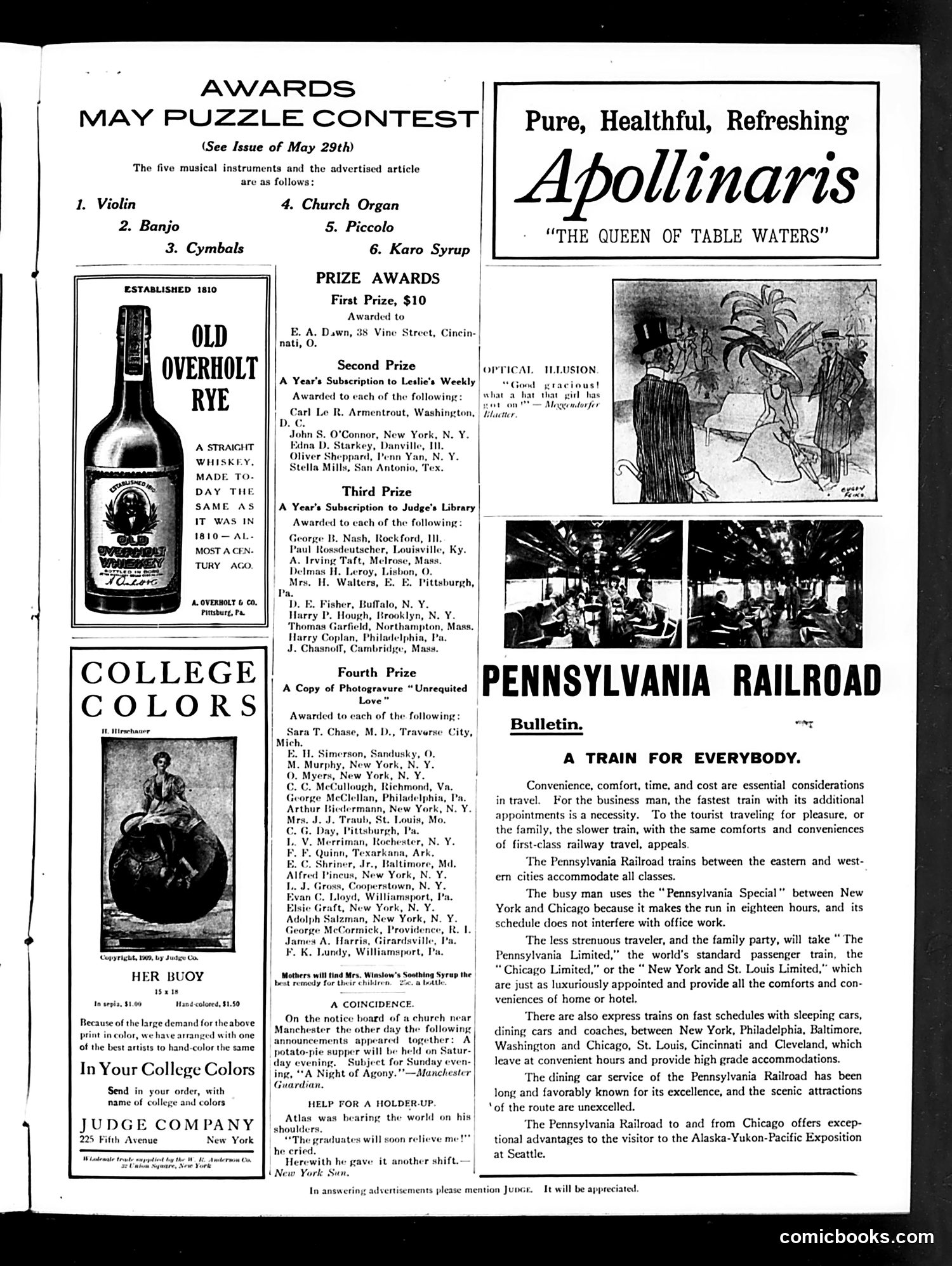
This page is primarily **advertising and contest results**, not political satire. It announces winners of Judge's May puzzle contest (identifying five musical instruments and an advertised product). The page contains several product advertisements: Old Overholt Rye whiskey, College Colors prints, Apollinaris mineral water, and Pennsylvania Railroad service. There's one small cartoon labeled "Optical Illusion" showing a woman startled by what appears to be a hat or head popping up—a mild visual gag about perception. A brief joke section includes "A Coincidence" (about church notices appearing together absurdly) and "Help for a Holder-Up" (a pun on Atlas the Titan, with "holder-up" meaning both burden-carrier and robber). The page represents typical Judge content: mix of light humor, advertisements, and contest administration rather than pointed political commentary.
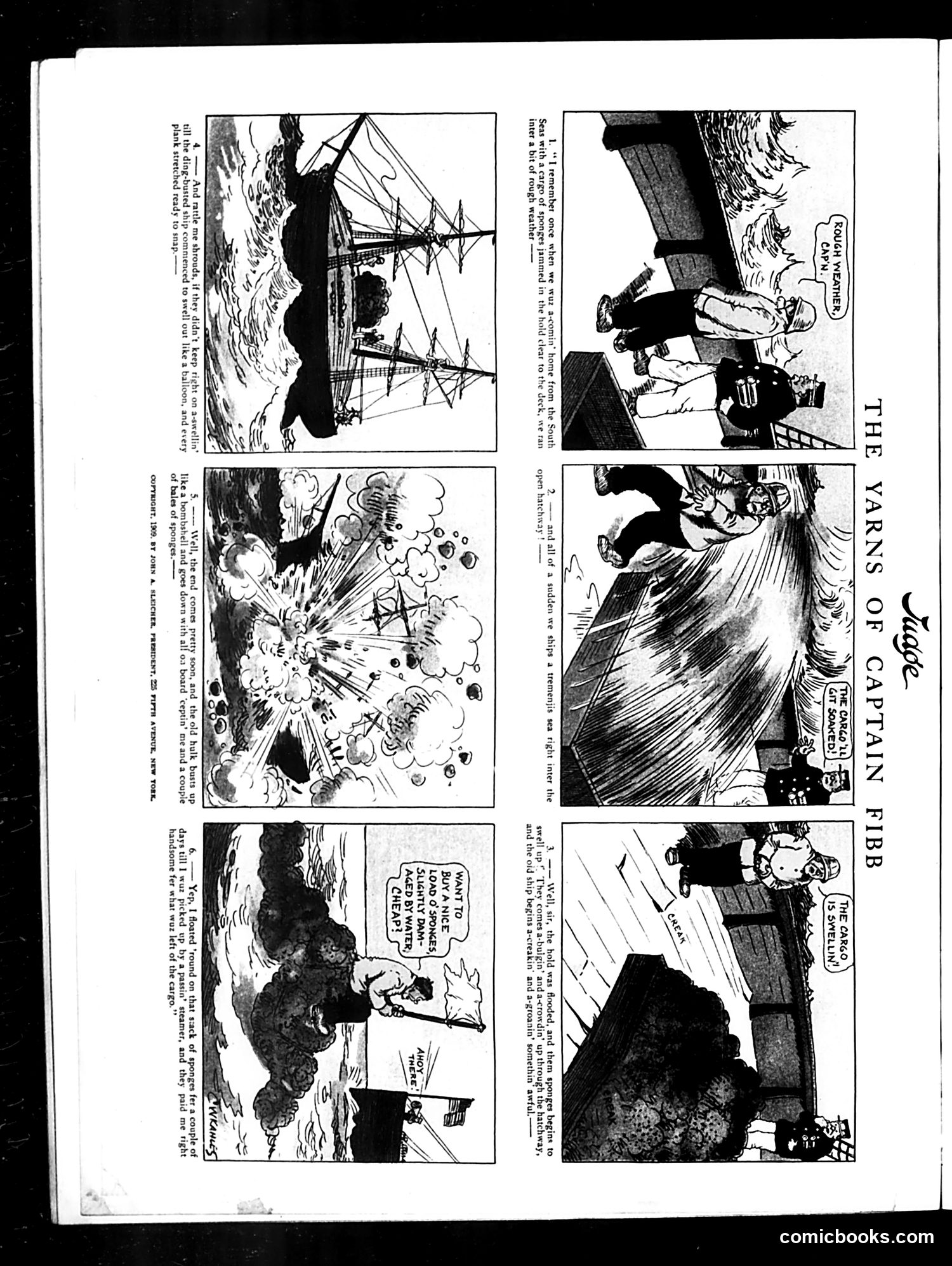
This is a multi-panel comic strip featuring an old sailor character recounting tall tales. The visible panels show Captain Fibb describing a sea voyage with a cargo of sponges during a storm. The ship is depicted being tossed about in rough seas, with exaggerated, dramatic illustrations of the vessel groaning and straining. The humor appears to be in the genre of "tall tales"—wildly exaggerated maritime adventures told by colorful old seafarers. The character's colloquial speech ("old ship feakin' and a-groanin'") and the absurdly overwrought depictions of the storm suggest this is satirizing or humorously playing with the storytelling tradition of boastful ship captains embellishing their experiences. This appears to be entertainment/humorous fiction rather than political satire, typical of Judge magazine's lighter content.