
Judge, 1909-06-19 · page 7 of 16
Judge — June 19, 1909 — page 7: what you’re looking at
What you’re looking at
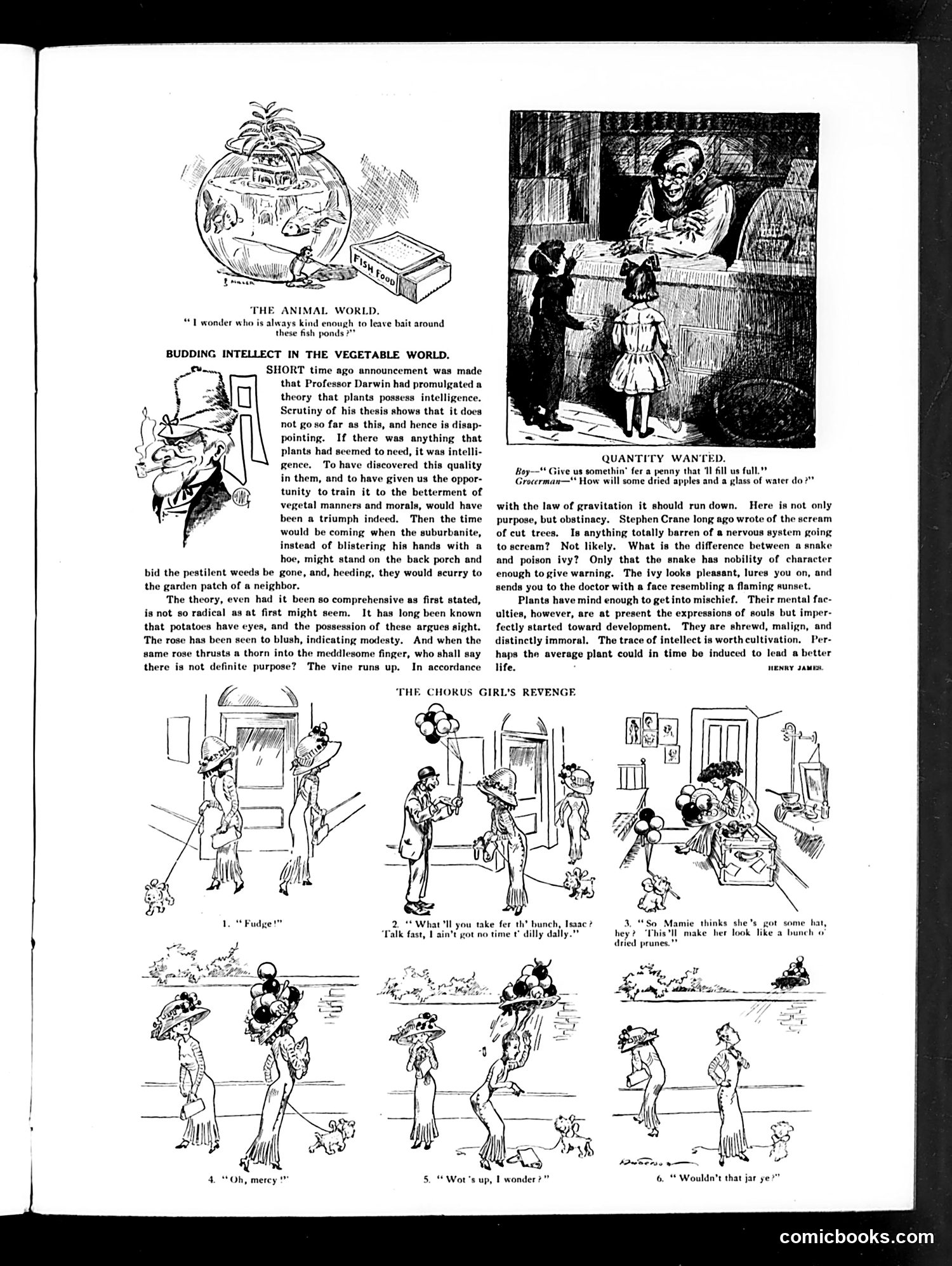
This satirical essay mocks Darwin's theory that plants possess intelligence. The author pretends to take the idea seriously, then ridicules it by citing supposed "evidence"—potatoes having eyes, roses blushing, vines defying gravity, and cut trees screaming. The humor lies in the absurd extrapolation: if plants were truly intelligent, suburban homeowners could simply command weeds to leave their gardens. The piece suggests plants, if sentient, would be morally corrupt—the poison ivy "lures you on" treacherously while snakes at least warn of danger. The essay concludes that plants show "traces of intellect" worth "cultivation," implying they might improve morally with training—a tongue-in-cheek jab at both Darwin's evolutionary theory and Victorian faith in moral improvement. The other cartoons on the page are unrelated humor: fish wondering who leaves bait, and a "Chorus Girl's Revenge" comic strip.
📄 Transcribed text from this page (OCR, searchable)
Machine-transcribed from the original scan — historical spelling and the odd misread are preserved.
THE ANIMAL WORLD, “TL wonder who is always kind enough to leave bait around these fish ponds ?”* BUDDING INTELLECT IN THE VEGETABLE WORLD. SHORT time ago announcement was made that Professor Darwin had promulgated a theory that plants possess intelligence. Scrutiny of his thesis shows that it does not go so far as this, and hence is disap- pointing. If there was anything that plants had seemed to need, it was intelli- gence. To have discovered this quality in them, and to have given us the oppor- tunity to train it to the betterment of vegetal manners and morals, would have been a triumph indeed. Then the time would be coming when the suburbanite, instead of blistering his hands with a hoe, ht stand on the back porch and bid the pestilent weeds be gone, and, heeding, they would scurry to the garden patch of a neighbor. ‘The theory, even had it been so comprehensive as first stated, is not so radical as at first might seem. It has long been known that potatoes have eyes, and the possession of these argues sight. The rose has been seen to blush, indicating modesty. And when the same rose thrusts a thorn into the meddlesome finger, who shall say there is not definite purpose? The vine runs up. In accordance QUANTITY WANTED. Boy—** Give us somethin’ fer a penny that ‘I fill us full.” Grocerman—" How will some dried apples and a glass of water do?” with the law of gravitation it should run down, Here is not only purpose, but obstinacy. Stephen Crane long ago wrote of the scream of cut trees, Is anything totally barren of a nervous system going to scream? Not likely. What is the difference between a snake and poison ivy? Only that the snake has nobility of character enough to give warning. The ivy looks pleasant, lures you on, and sends you to the doctor with a face resembling a flaming sunset. Plants have mind enough to get into mischief. ‘Their mental fac- ulties, however, are at present the expressions of souls but imper- fectly started toward development. They are shrewd, malign, and distinctly immoral. The trace of intellect is worth cultivation. Per- haps the average plant could in time be induced to lead a better life. Nenny sans ‘THE CHORUS GIRL'S REVENGE ‘ di mie thinks she's got so Fudge!” make her look like a bi 2. ** What'll you take fer th’ bunch, Isaac ? “Falk fast, [ain't got no time t' dilly dally."” 4. Oh, mercy 5. Wot's up, I wonder?” 6, “ Wouldn't that jar ye?” comicbooks.com