
A complete issue · 16 pages · 1909
Judge — May 8, 1909
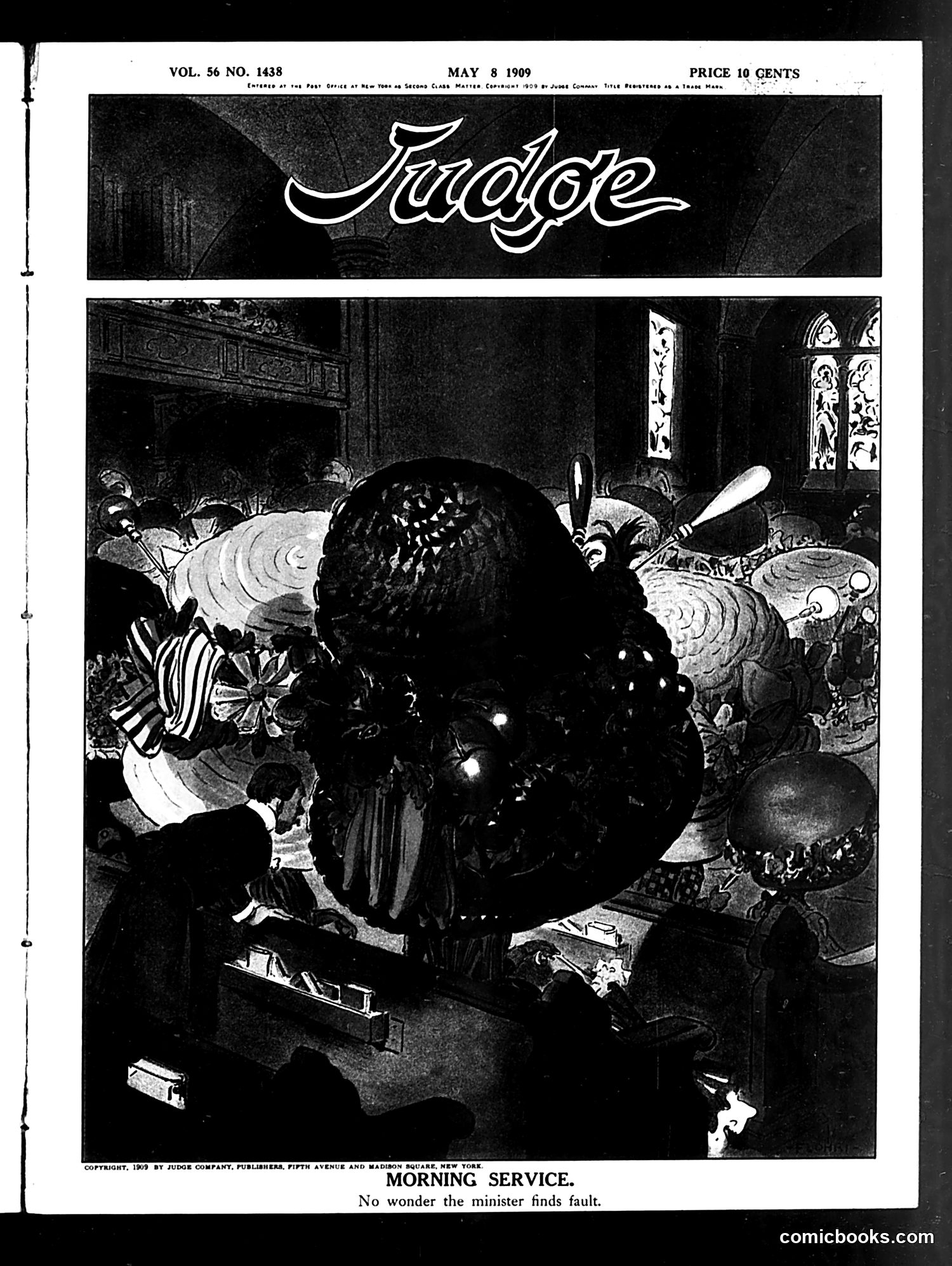
This cartoon satirizes a church service disrupted by chaos. The caption reads "No wonder the minister finds fault," suggesting the minister (visible at the pulpit in background) has legitimate complaints about his congregation's behavior. The cartoon depicts a "morning service" where parishioners are engaged in disruptive activities—some appear to be fighting, arguing, or creating general disorder. The religious setting (visible stained-glass windows, church architecture) contrasts sharply with the undignified conduct occurring within it. The satire critiques either the behavior of churchgoers who fail to maintain proper decorum during worship, or perhaps broader social disorder being compared to religious irreverence. The joke hinges on the ironic disconnect between a sacred space and profane behavior.
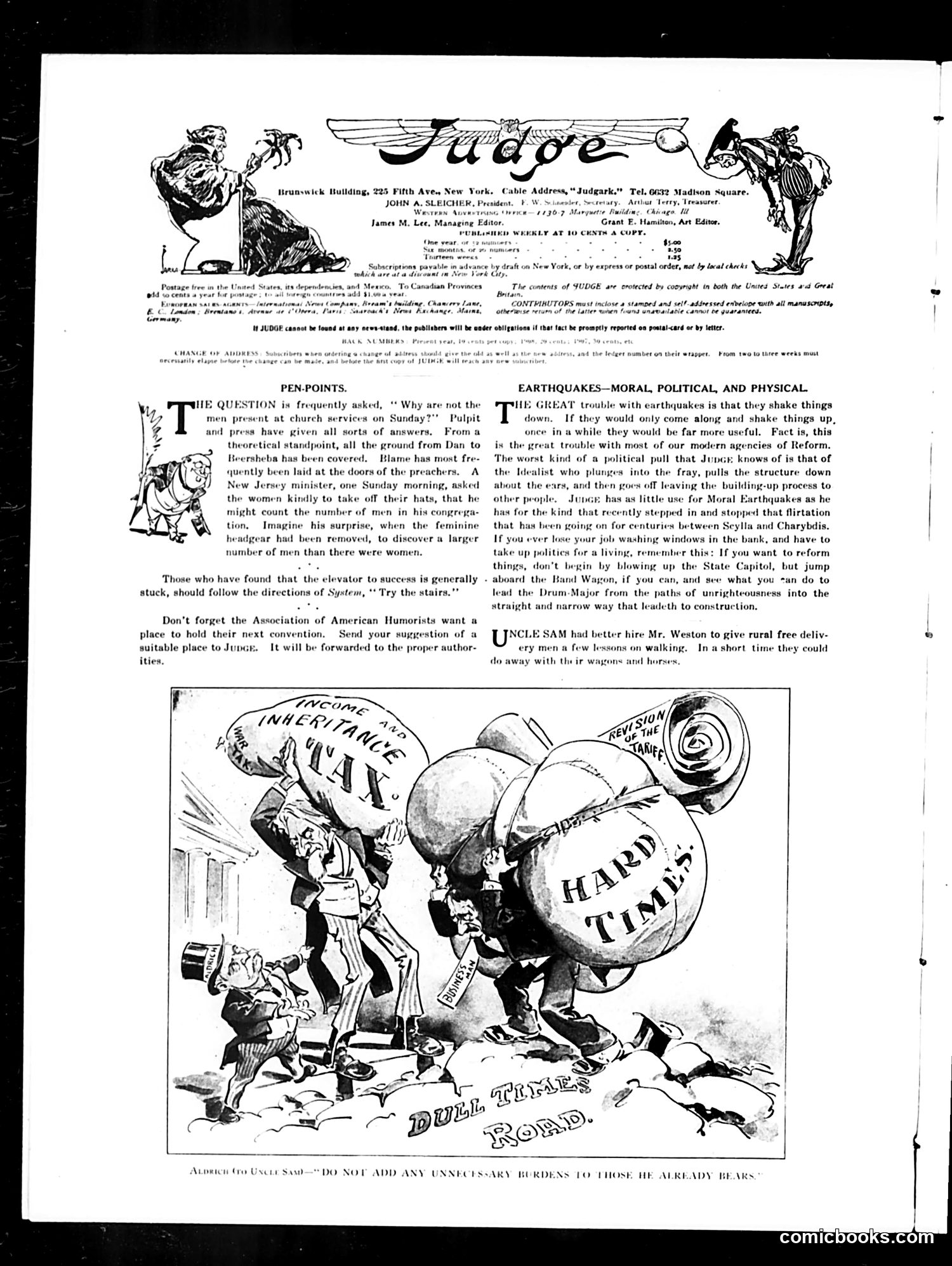
The main cartoon depicts figures struggling under heavy burdens labeled "INCOME TAX," "HARD TIMES," and "PENSION" on what appears to be "DULL TIMES ROAD." The caption reads: "Advice to Uncle Sam—'Do Not Add Any Unnecessary Burdens to Those He Already Bears.'" This satirizes economic hardship during what appears to be a recession or depression era. The cartoon argues against additional government burdens—likely referencing proposed taxes or social programs—when ordinary Americans already struggle with income taxes, economic hardship, and pension obligations. The visual metaphor of figures crushed beneath overlapping weights effectively conveys the argument that taxpayers face cumulative financial strain. Without dating information visible, the exact historical moment remains unclear, though the income tax reference suggests early-to-mid 20th century.
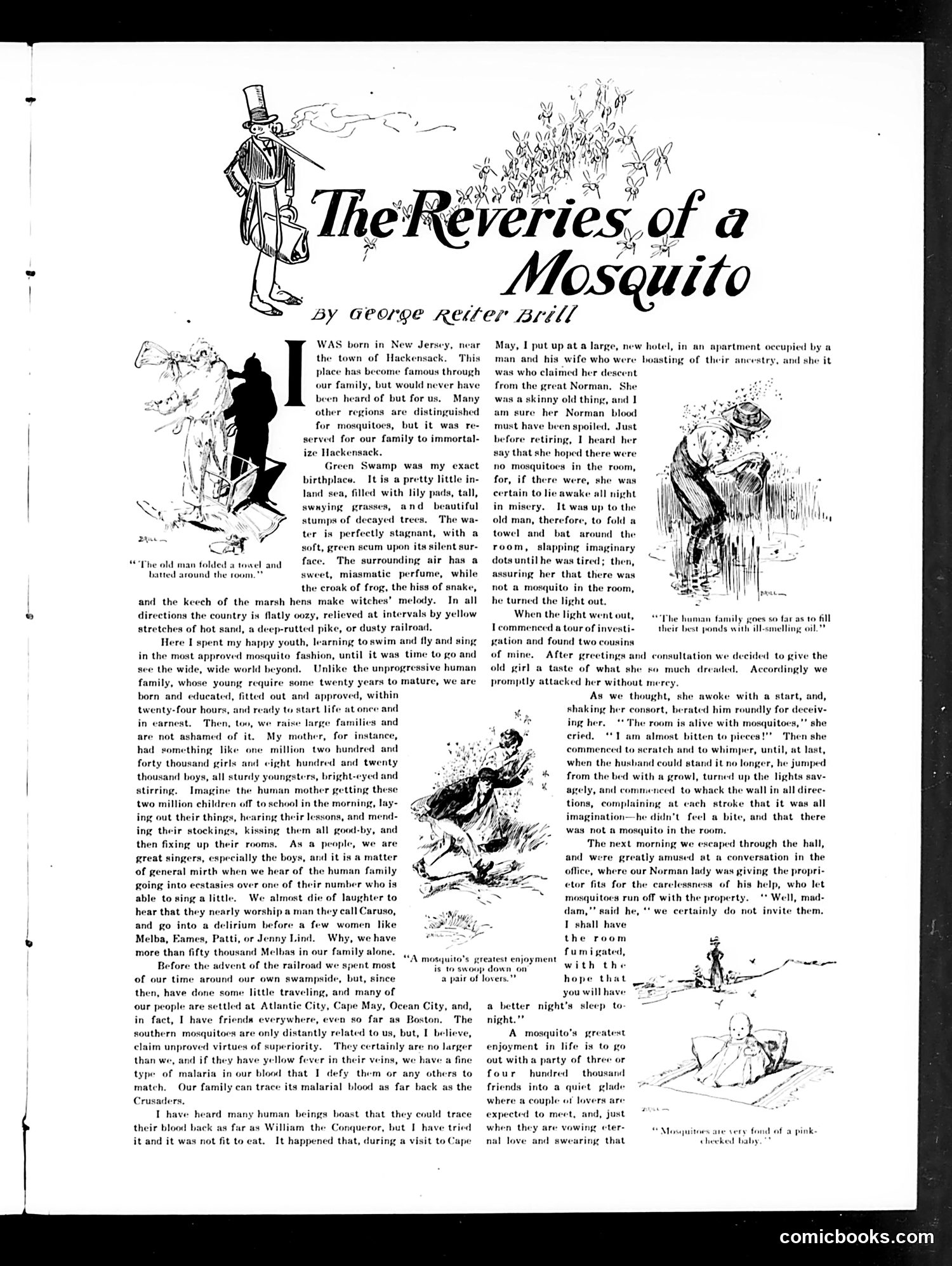
This is a humorous short story with illustrations, not political satire. The narrative follows a mosquito's perspective and appears to be a comedic tale about the insect's experiences around humans—particularly involving a couple at a hotel. The story uses the mosquito as an anthropomorphic narrator, allowing Brill to satirize human behavior and domestic life through an insect's observations. The illustrations show the mosquito interacting with people in various situations (batting at it, trying to kill it), creating visual comedy. The piece is primarily entertainment-focused rather than topical political commentary, using witty writing and pen-and-ink drawings typical of Judge magazine's lighter content from this era.
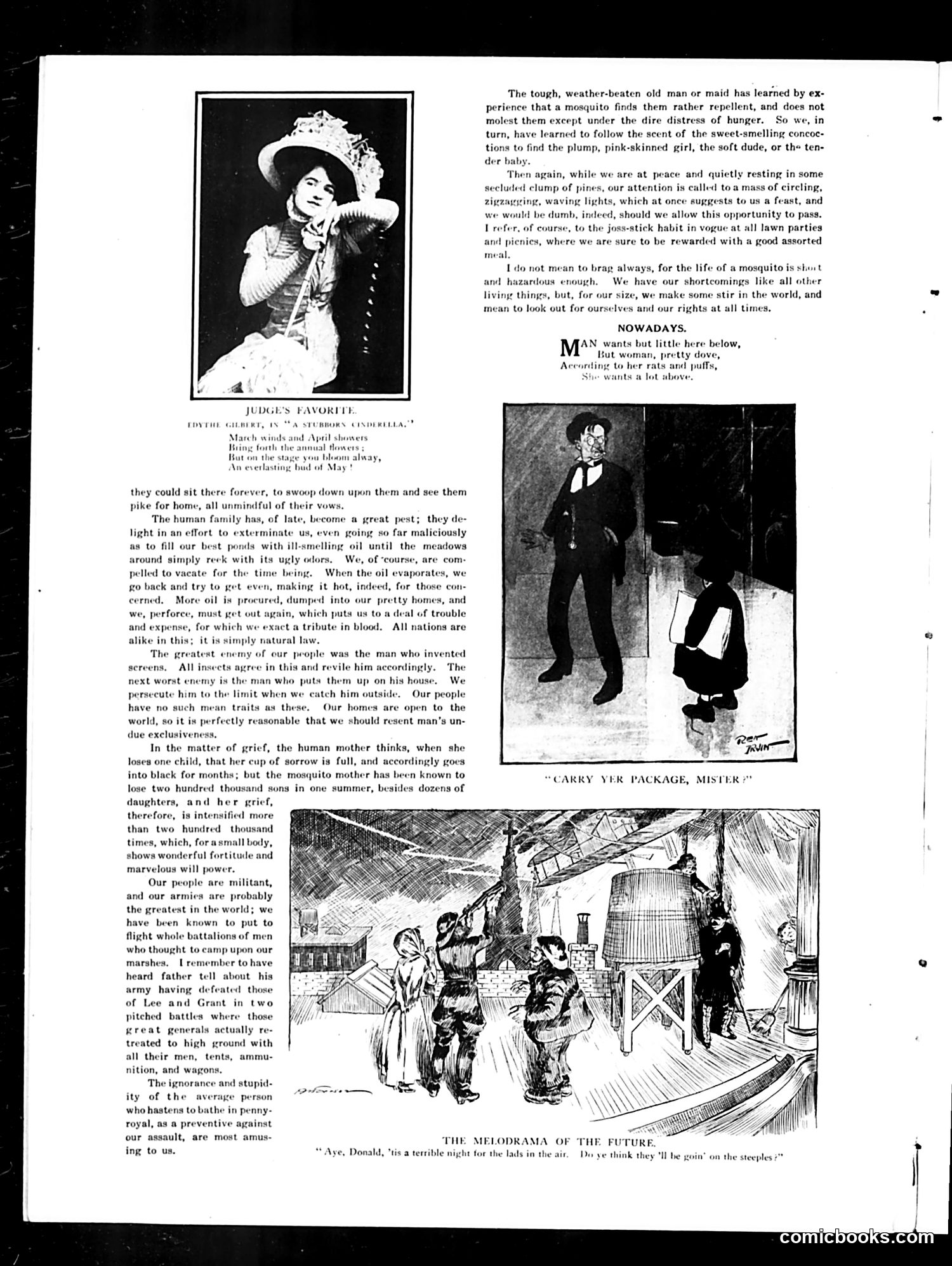
This page combines editorial commentary on mosquitoes with social satire. The top portrait labeled "Judge's Favorite" shows an actress (likely Ethel Gilbert in "A Stubborn Cinderella"), accompanying verse about theatrical life. The middle illustration, captioned "Carry Yer Package, Mister?" depicts what appears to be street vendors or delivery workers, satirizing urban commerce or labor practices. The bottom cartoon, "The Melodrama of the Future," shows figures on what seems to be a building's exterior, with dialogue about "terrible night for the bats in the air" and someone "gone" on the steeples. This likely satirizes theatrical melodrama tropes or contemporary anxieties about urban environments—possibly referencing early aviation fears or immigrant experiences in crowded cities. The overall page mixes entertainment criticism with social commentary typical of Judge's satirical approach.
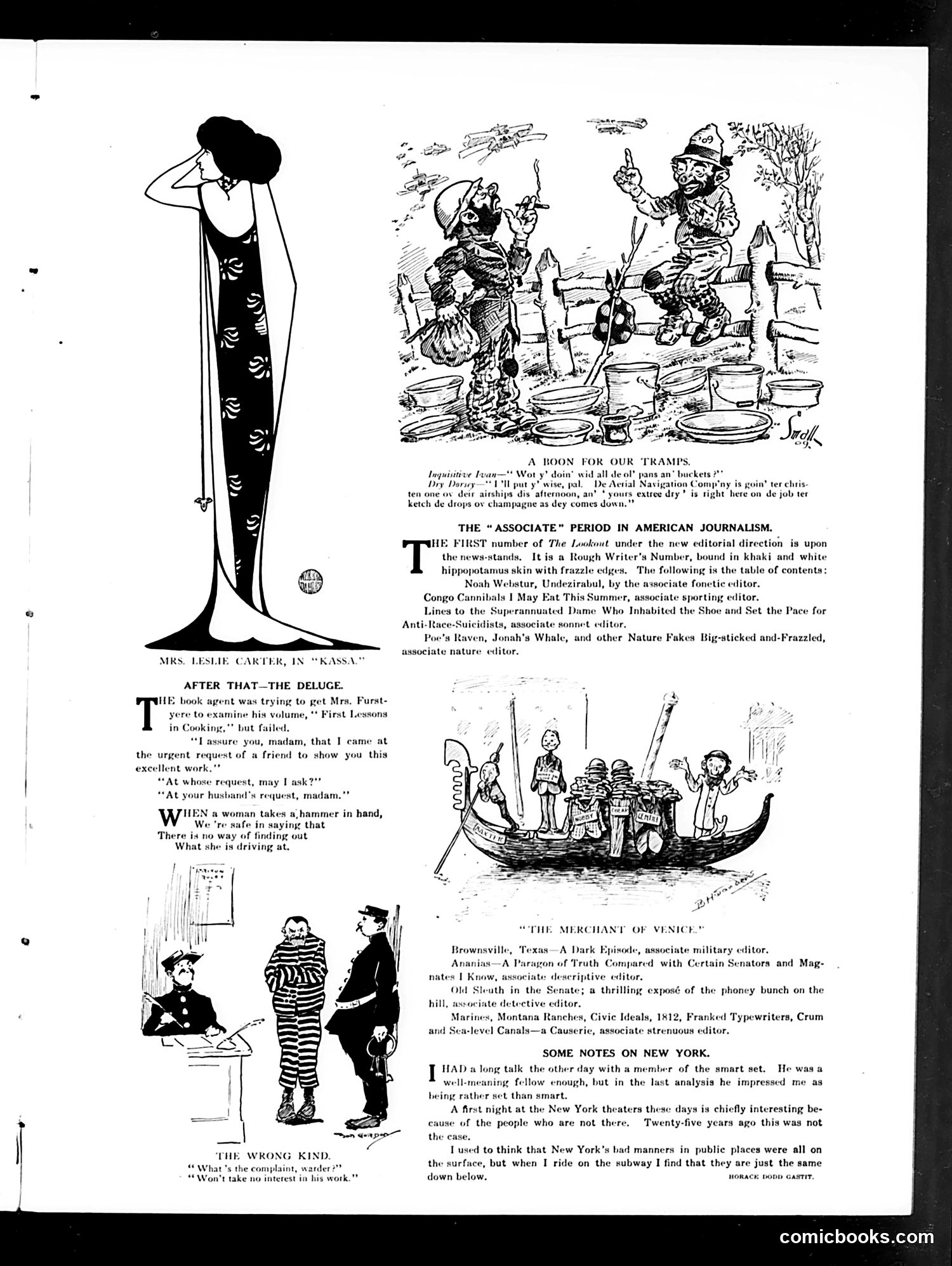
This page contains several satirical cartoons and text pieces typical of Judge's editorial humor: **"A Boon for Our Tramps"** (top right): Depicts hobos in a camp, likely satirizing contemporary attitudes toward vagrant populations during an economic period when tramping was common. **"After That—The Deluge"** (left): A short humorous piece about a woman requesting a cooking lesson, playing on domestic stereotypes. **"The Wrong Kind"** (bottom): Shows a figure at what appears to be a complaint desk—satirizing bureaucratic indifference or misunderstanding. **"Some Notes on New York"** (bottom right): Commentary on New York City theater audiences and social behavior, suggesting changes in public manners over 25 years. The page also features fashion illustration ("Mrs. Leslie Carter in 'Kassa'") and announces *Judge*'s new editorial direction, indicating this is a transitional issue introducing new contributing editors and content focus areas.
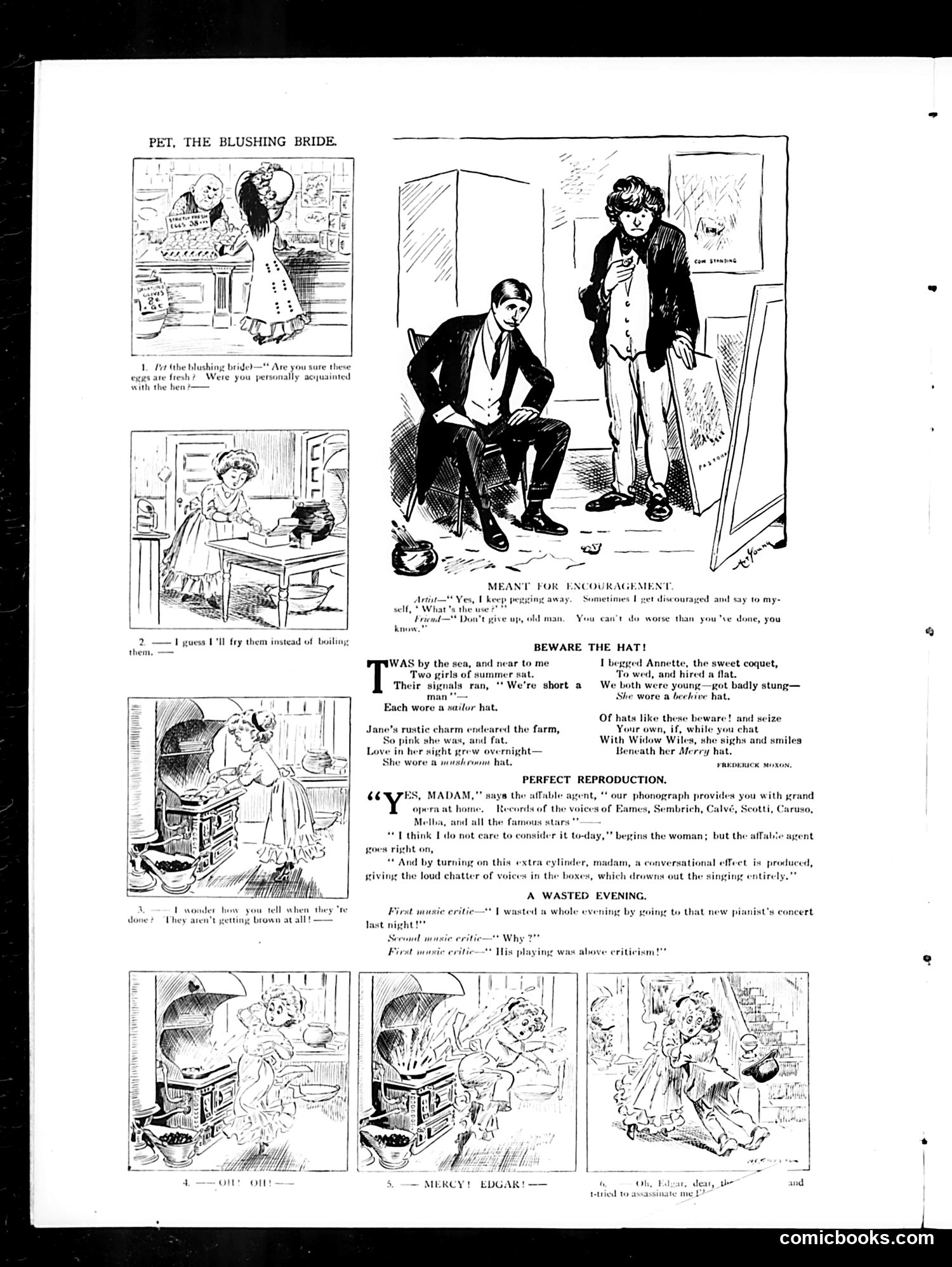
This page contains several unrelated satirical pieces typical of *Judge* magazine's format: **"Pet, the Blushing Bride"** (top left): Domestic humor about newlyweds and cooking mishaps—likely poking fun at inexperienced housewives. **"Beware the Hat!"** (center): A poem satirizing women's fashion, specifically the sailor hat trend. The verse mocks young women wearing identical fashionable hats, suggesting they're thoughtlessly following trends. **"Perfect Reproduction"** (middle right): Satirizes phonograph technology and concert recording, suggesting the device's quality is so poor that voices drown out the music entirely—a joke about early phonograph limitations. **"A Wasted Evening"** (bottom): Musical humor: a critic attended a pianist's concert and wasted the evening because the playing was "above criticism"—meaning so bad it transcended normal critique. The bottom panels appear to show slapstick domestic comedy, though the OCR is unclear. Overall, this page reflects early 20th-century concerns: emerging technology, women's fashion trends, and domestic life.
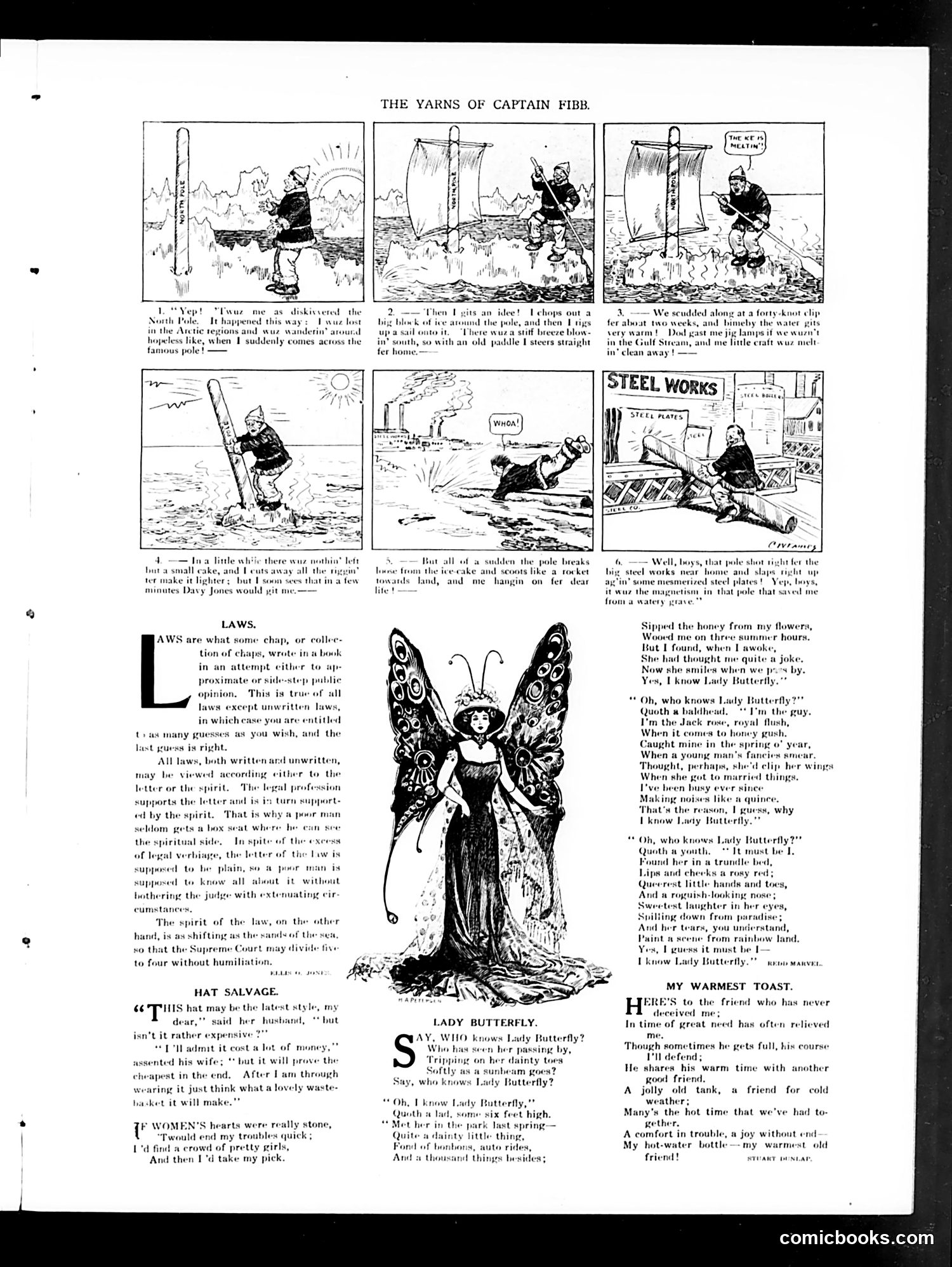
This page from *Judge* contains multiple distinct pieces: **Top Comics:** "The Yarns of Captain Fibb" depicts a tall-tale sailor spinning exaggerated adventure stories—discovering the North Pole, encounters with ice blocks and paddle-steering. The humor relies on obviously absurd fabrications, a stock character type of the era. **"Laws" Essay:** A philosophical discussion contrasting written versus unwritten law, arguing poor people suffer because legal professionals emphasize the letter over the spirit of law—a mild social critique about legal inequality. **"Lady Butterfly" Poem:** A romantic verse where multiple male suitors claim to "know" the mysterious Lady Butterfly, each with different romantic encounters. It's light, flirtatious verse with no clear political reference. **"Hat Salvage" & "My Warmest Toast":** Miscellaneous humorous pieces—domestic comedy about a wife's expensive hat, and sentimental praise for a hot-water bottle as a friend. The page is primarily entertainment without specific political satire, mixing sailor yarns, legal commentary, and romantic verse typical of early 20th-century satirical magazines.
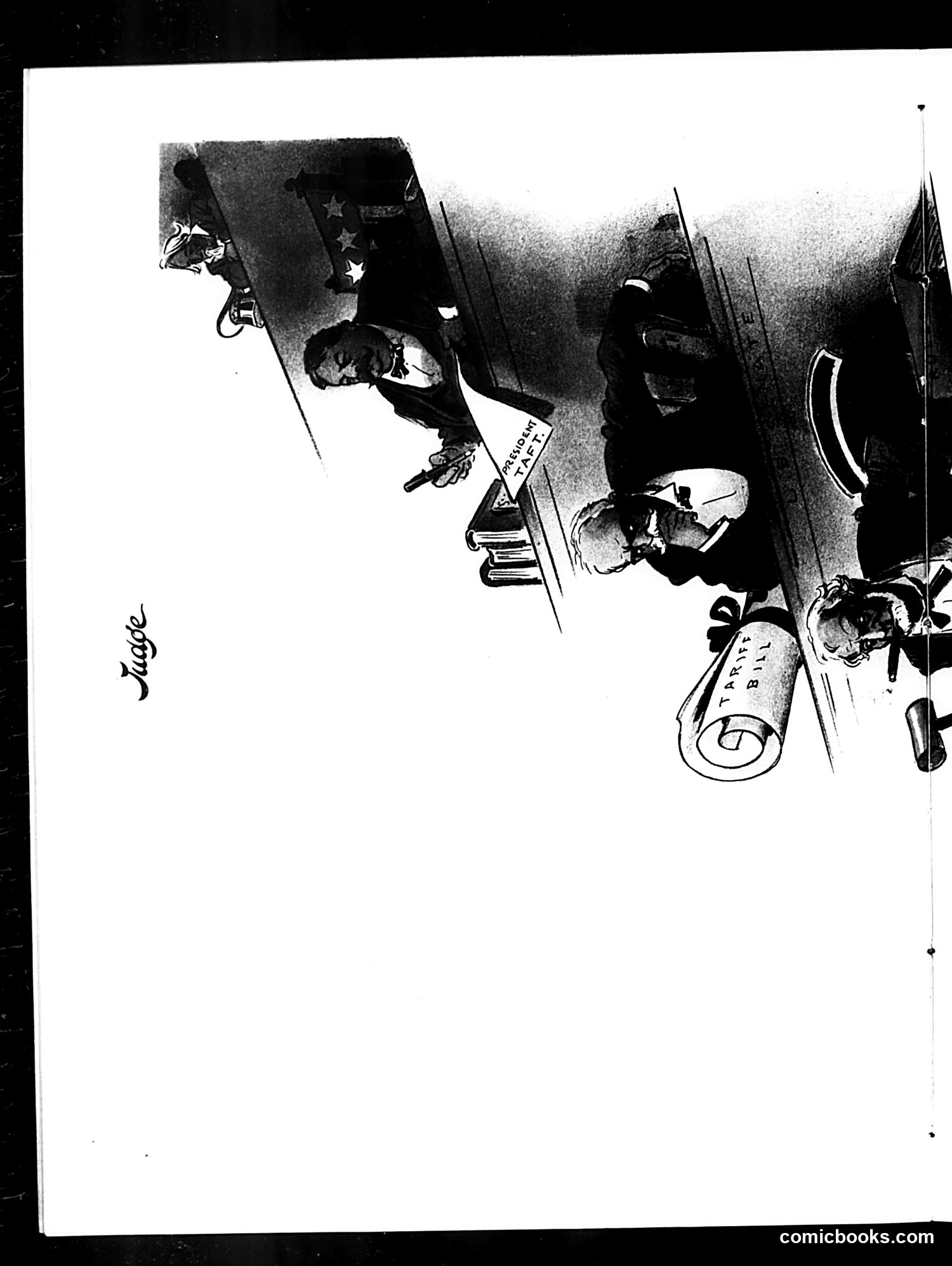
The OCR text is largely illegible and provides no meaningful content. The black and white cartoon image, shown upside-down, depicts what appears to be a satirical political scene with multiple figures in period dress (possibly late 19th or early 20th century) gathered around flags and formal regalia. The figures seem to be engaged in some kind of ceremonial or political activity. However, without legible text identifying the specific figures, events, or political references being satirized, I cannot reliably explain what this cartoon means to a modern reader. The image quality and orientation make definitive identification impossible. To properly analyze this Judge magazine content, a clearer, correctly-oriented image with readable accompanying text would be necessary.
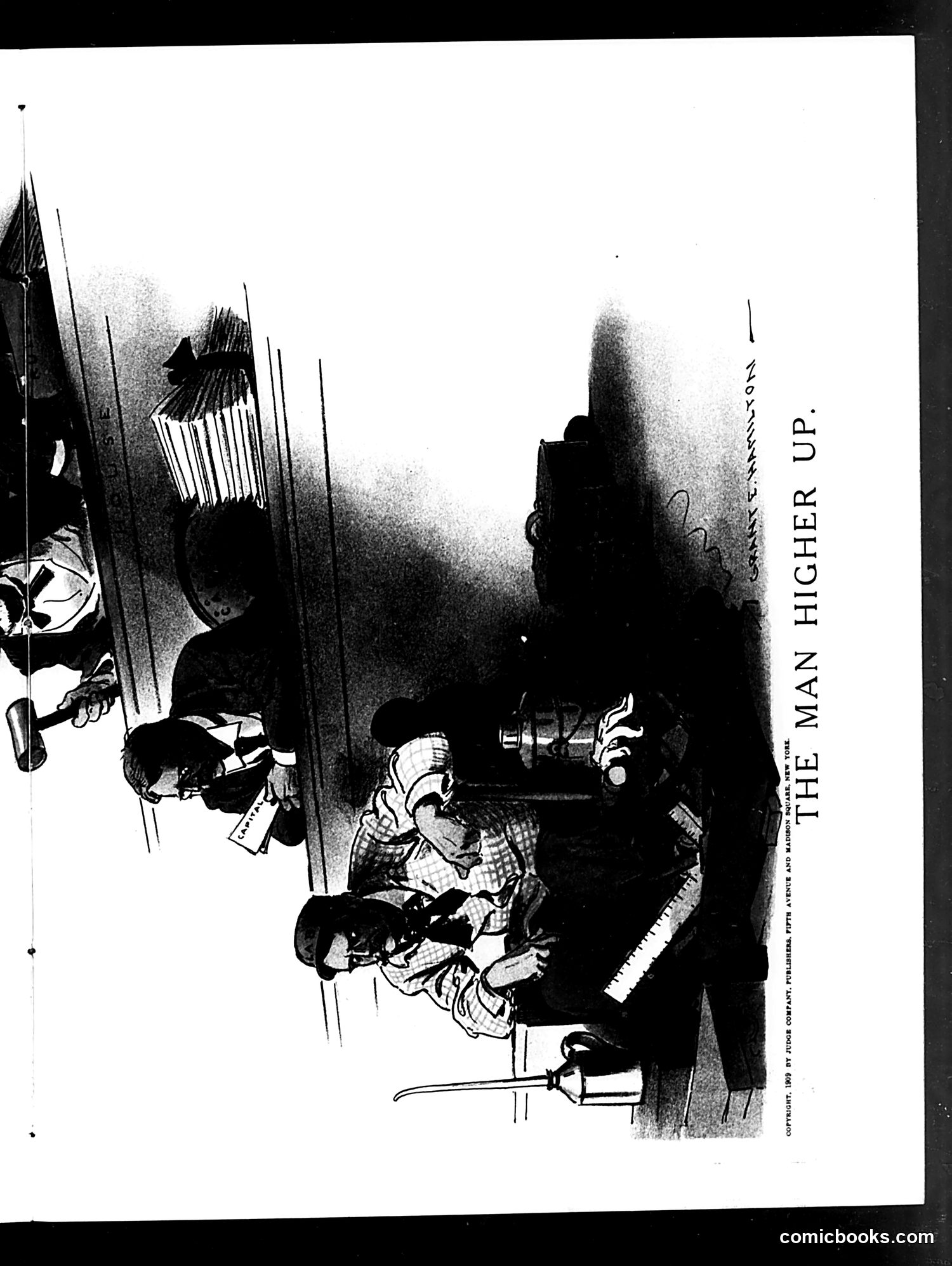
I can see this is a political cartoon from *Judge* magazine, but the OCR text is heavily corrupted and illegible, making it impossible to read the caption or any accompanying text. From the image alone, I can observe: a satirical cartoon showing figures in what appears to be a formal or official setting. The art style is characteristic of early-to-mid 20th century editorial cartooning. However, without legible text identifying the figures, the specific political/social context, or the cartoon's title, I cannot reliably identify who is being caricatured or what event or policy is being satirized. To properly explain this cartoon's meaning to a modern reader, I would need either clearer OCR text or additional context about the publication date and issue.
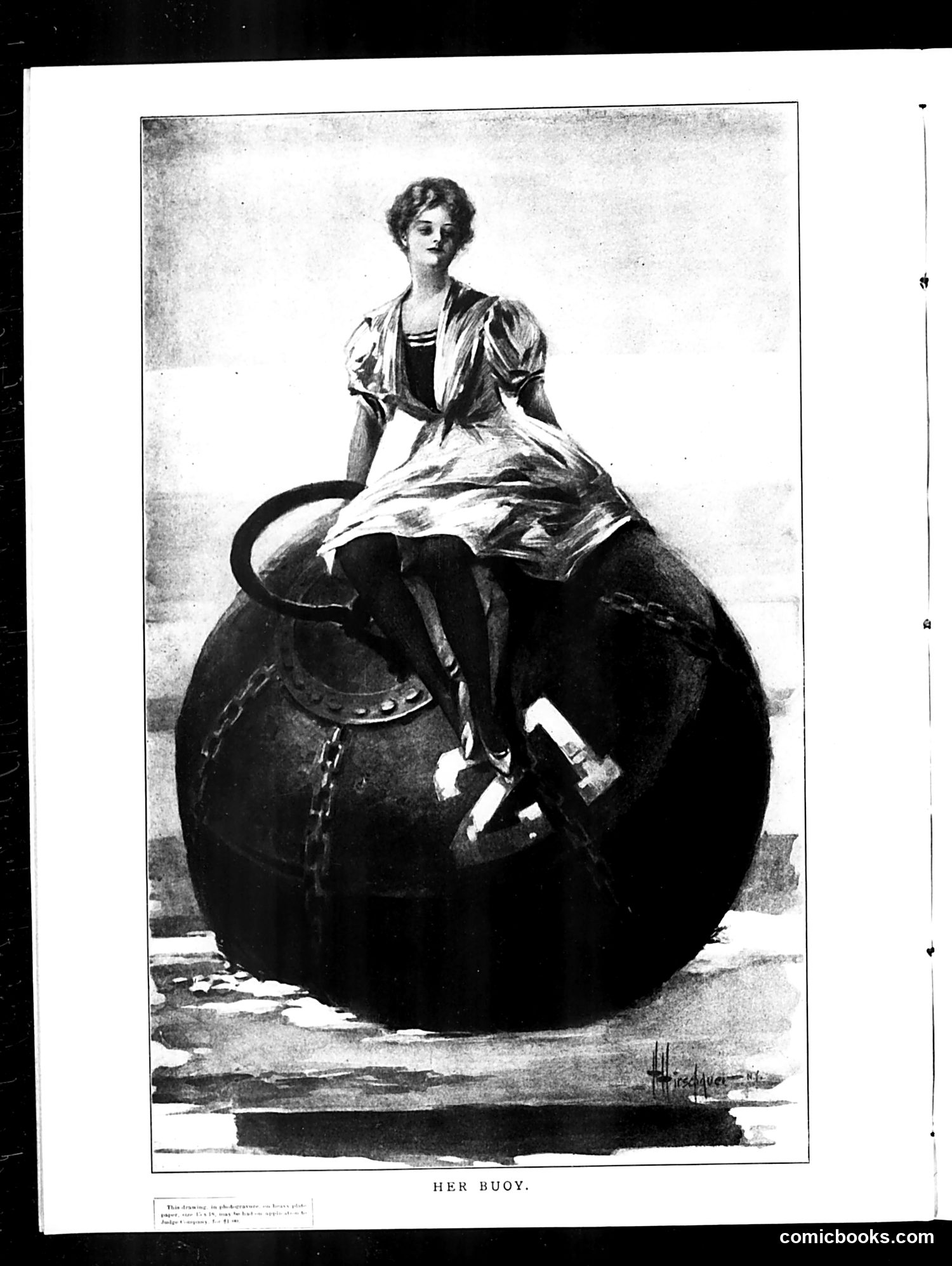
This Judge cartoon employs a visual pun on the words "buoy" (nautical float) and "boy" (male child). The illustration depicts a well-dressed woman seated atop a large, dark spherical buoy as if it were a support or anchor in her life. The satire likely comments on women's social or economic dependence—the woman is literally "buoyed up" by what appears to be a masculine element (the buoy/boy), suggesting she relies on men for stability or support. Given Judge's era of social commentary, this could satirize either contemporary attitudes about women's dependency or, conversely, critique such expectations. The elegant artistic style and the woman's composed posture suggest this addresses upper-class or genteel society specifically.
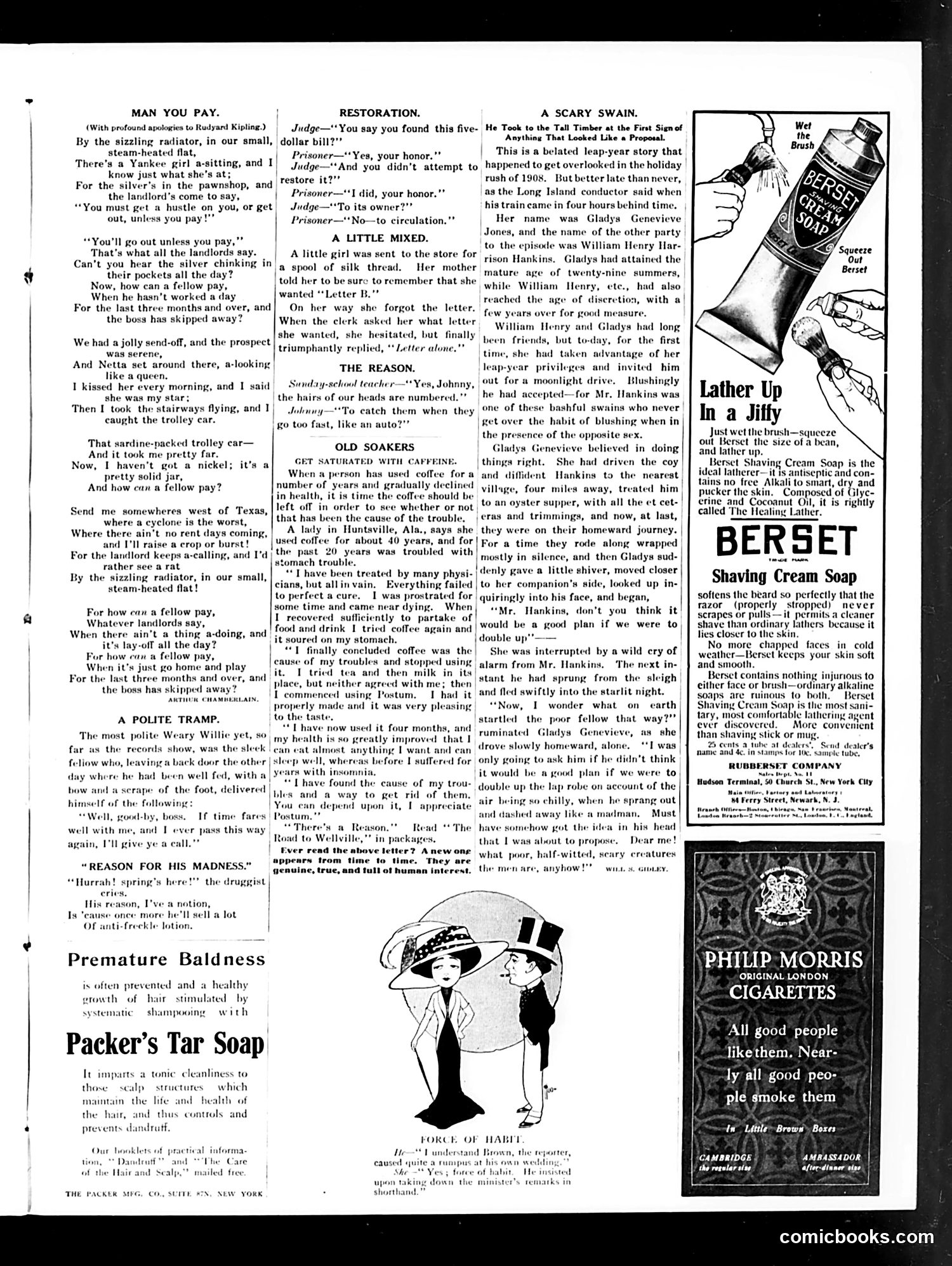
This is a **satirical humor page** from an early 20th-century American magazine featuring multiple jokes and verses targeting contemporary social issues. **"Man You Pay"** parodies Kipling's "Gunga Din," depicting an unemployed working-class man's desperation. His boss has "skipped away" (absconded), leaving him unable to pay rent—a common hardship during economic downturns. The satire mocks both the landlord's relentless demands and the worker's helpless situation. **"A Little Mixed"** is a simple children's misunderstanding joke—a girl forgets her mother's written request for thread, and her confusion produces comic results. **"A Scary Swain"** is a leap-year dating story (when women traditionally propose). William Henry Hankins panics at signs of matrimonial intent and flees—mocking male anxiety about commitment. The advertisements (Berset shaving cream, Packer's Tar Soap, Philip Morris cigarettes) are period product promotions claiming health benefits—claims that would face modern scrutiny. The overall tone reflects pre-WWI American humor: working-class struggle, domestic comedy, and social anxieties about courtship.
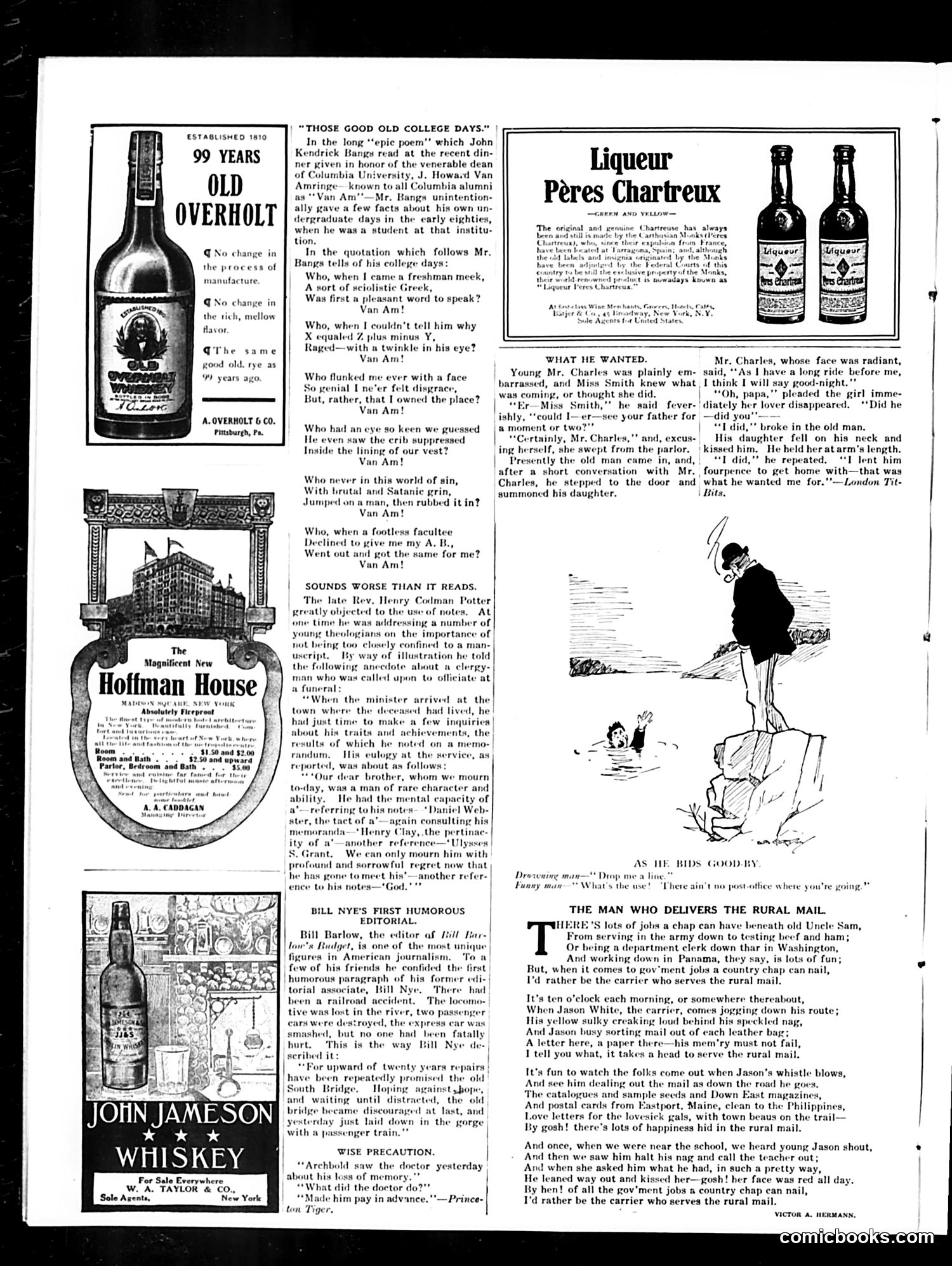
This page combines advertisements with humorous content typical of Judge magazine's satirical style. **Advertisements:** The left side features liquor ads (Overholt rye whiskey, Hoffman House hotel, John Jameson whiskey) — common Judge advertising that targeted wealthy male readers. **Main Content — "Those Good Old College Days":** A poem by John Kendrick Bangs celebrating "Van Am" (a Columbia University dean), using repetitive structure to humorously catalog the professor's memorable qualities — his genial nature, sharp eye for cheating students, and ability to help struggling scholars. **"Bill Nye's First Humorous Editorial":** References Bill Barlow as editor of *Bill Nye's Budget*, noting Nye's prominence in American humor journalism and describing an early editorial about a railroad accident. **Short Comic Pieces:** Include mild domestic humor (a young man seeking permission to marry, a father who lent money instead) and sight gags about drowning. The page reflects Judge's focus on genteel, intellectual humor for educated readers rather than slapstick — celebrating academic life and clever wordplay.
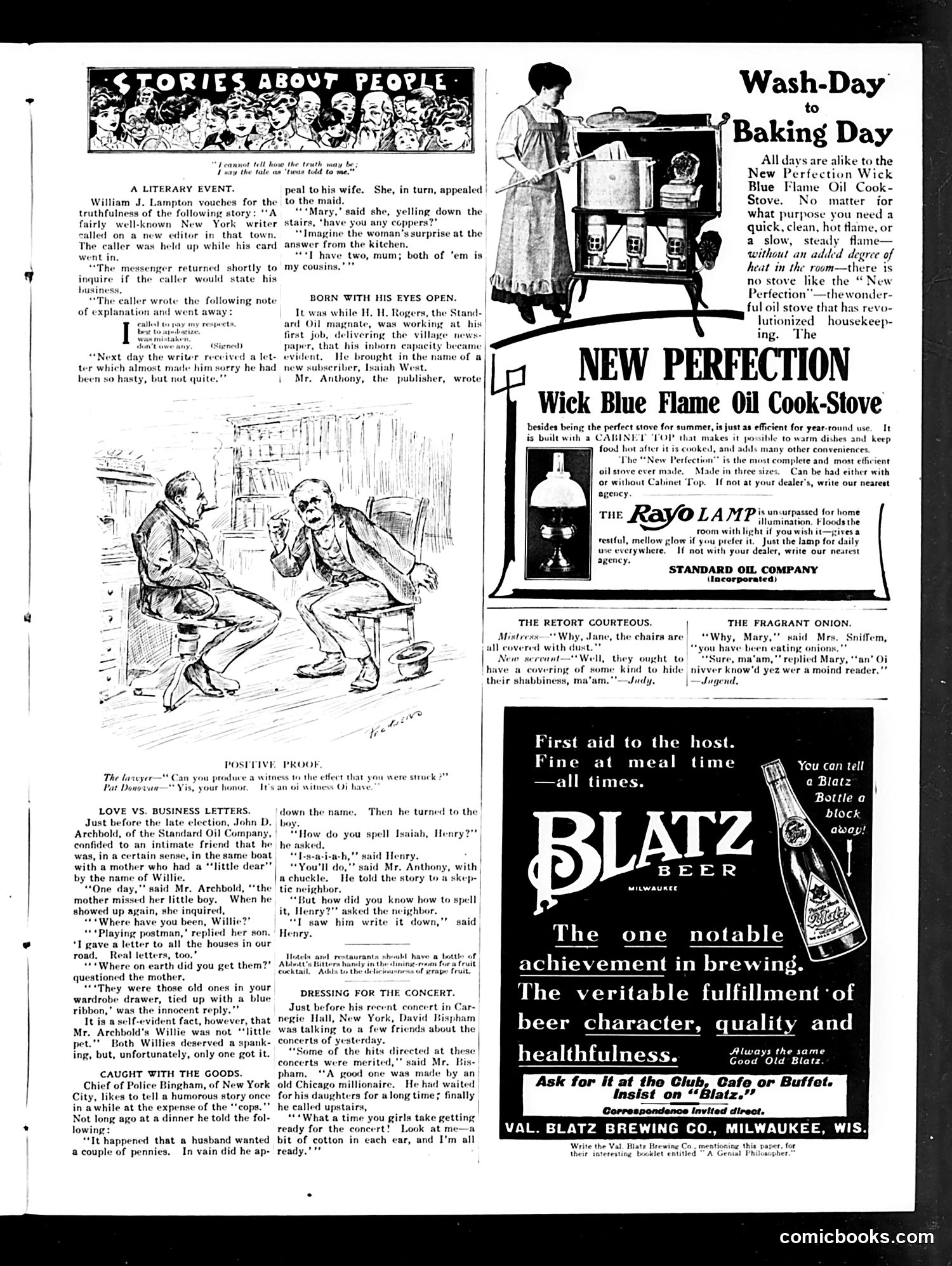
This page from Judge magazine contains several humorous short stories and anecdotes rather than a single political cartoon: **"A Literary Event"** mocks a pretentious editor who keeps a visiting writer waiting, then sends a dismissive note. **"Born With His Eyes Open"** references Standard Oil Company's business practices, suggesting corrupt or opportunistic behavior (the "inborn capacity" to bring in subscribers dishonestly). **"Caught With the Goods"** is a brief joke about a child distributing old love letters found in his mother's drawer, implying marital infidelity or carelessness. **"Love vs. Business Letters"** presents similar themes about children mishandling correspondence. The page is primarily **advertising-heavy**, featuring prominent ads for the New Perfection Oil Cook-Stove, Rayo Lamp (Standard Oil Company products), and Blatz Beer. The humor reflects turn-of-century American domestic life and mild social satire rather than serious political commentary.
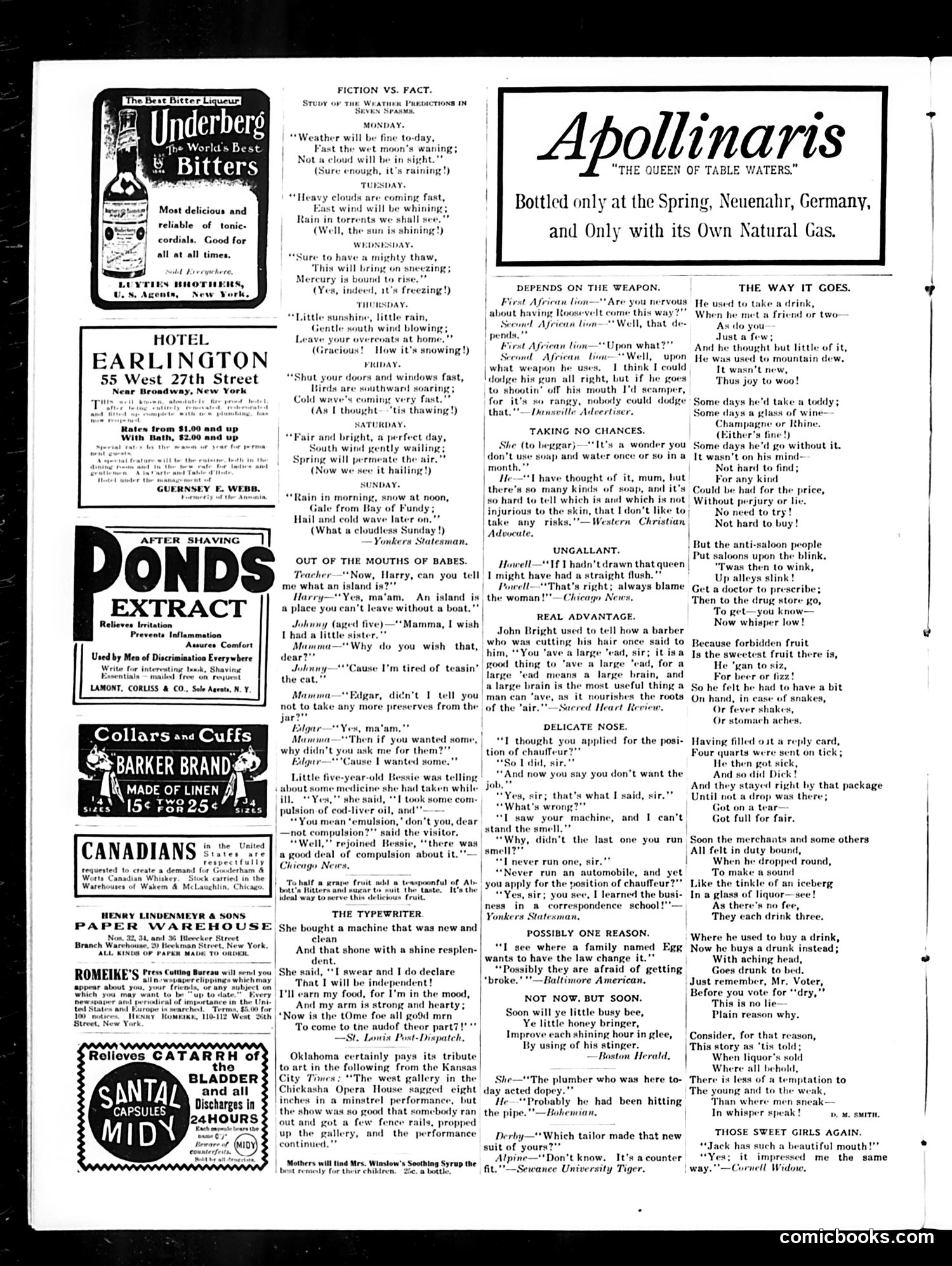
This page from *Judge* is primarily **advertisements and filler content** rather than political satire. The main section, "FICTION VS. FACT," presents weather predictions supposedly made by various sources (appearing to mock unreliable forecasters) alongside what actually happened—a gentle satire on pseudoscience and false expertise common in the era. The small dialogues scattered throughout appear to be humorous anecdotes rather than political commentary. References to "Roosevelt" and African lions suggest turn-of-the-century American context, though the specific satirical point is unclear from this excerpt. The page is dominated by **period advertising**—Underberg Bitters, Hotel Earlington, Donds Extract, Barker Brand Collars, and Santal Capsules—typical of *Judge*'s revenue model. These advertisements are the page's primary content, making it representative of how satirical magazines relied on commercial sponsorship to survive.
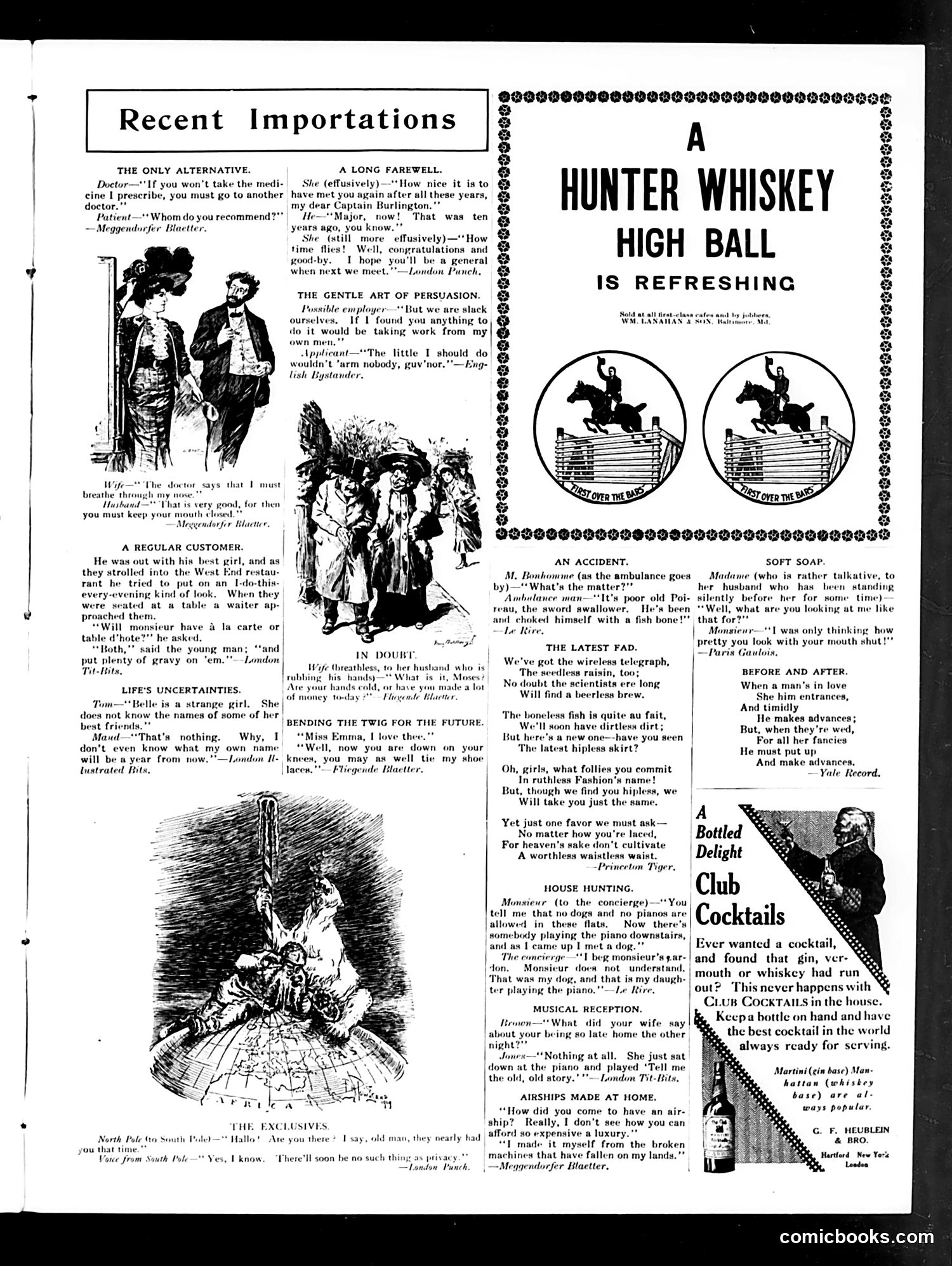
This is a **humor magazine page** (circa early 1900s) mixing short jokes with advertisements. The cartoons and jokes satirize everyday social situations: a doctor's ultimatum, a soldier's farewell to a captain, job-seeking desperation, a restaurant patron's pretentiousness, and marital dynamics. The humor relies on **class and gender stereotypes** typical of the era—working-class characters speaking in exaggerated dialect, nagging wives, and social climbers. References like "wireless telegraph" mark this as early wireless-era satire. The **advertisements** (Hunter Whiskey, Club Cocktails) are period-typical, promoting alcohol without modern health disclaimers. The recurring theme: **social awkwardness and failed pretension**. Characters attempting to appear sophisticated or navigate social expectations are undercut by practical reality or their own limitations. The cartoons' crude line-drawings and the magazine's overall tone reflect Edwardian-era satirical journalism aimed at a middle-class audience amused by lower-class mishaps and domestic comedy.
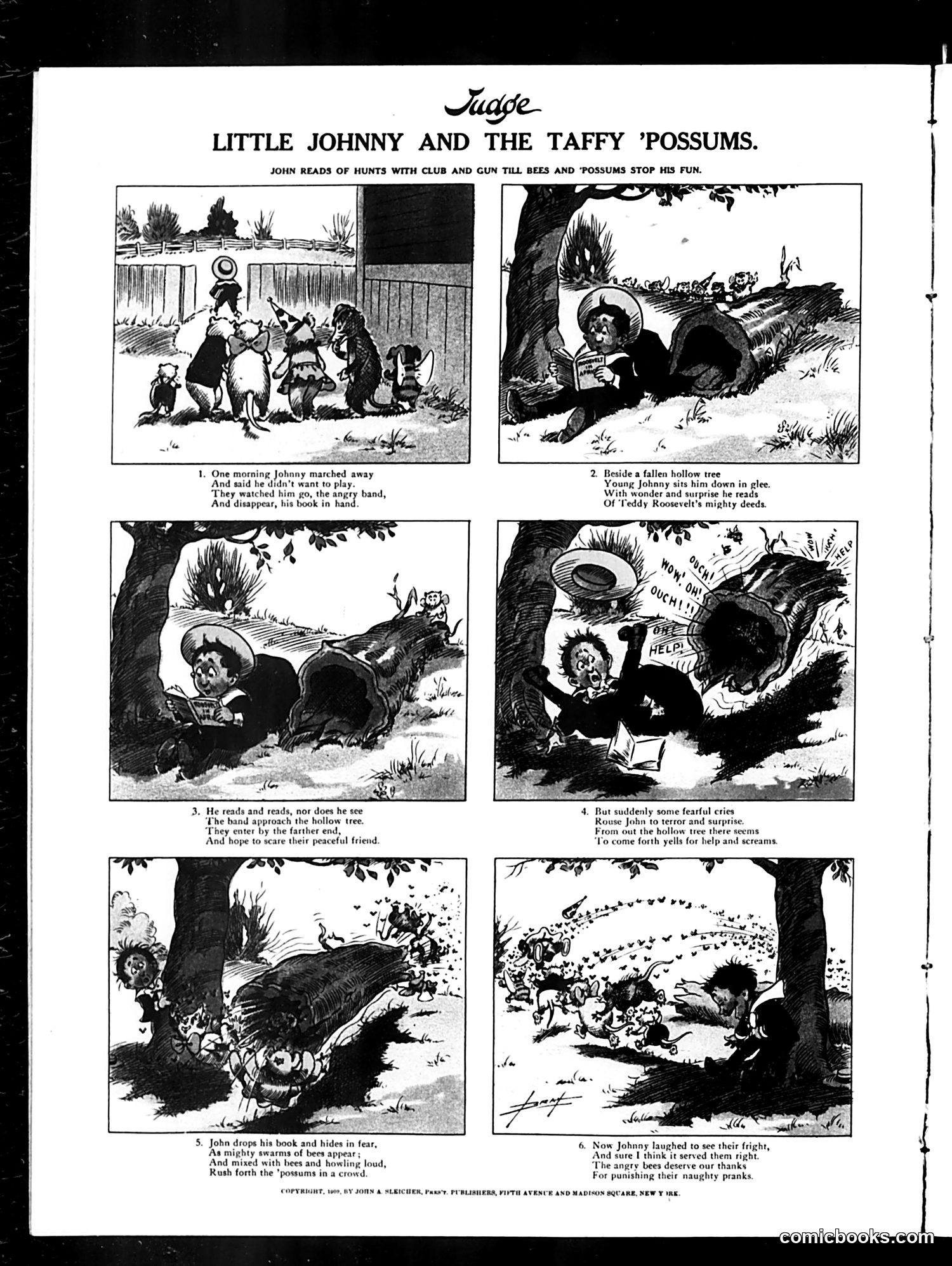
This is a children's comic strip moral tale, not political satire. Young Johnny abandons his friends to read about President Theodore Roosevelt's hunting exploits. While engrossed in tales of "Teddy Roosevelt's mighty deeds," his playmates attempt to prank him by releasing possums and bees from a hollow tree to scare him. The joke backfires: the animals frighten the pranksters instead. The strip's moral—that Johnny's reading material about Roosevelt's adventures distracted him from friendship, but ultimately the bullies received comeuppance—reflects early 1900s values: respect for TR's outdoorsman image, and belief that mischief-makers deserve punishment. The "taffy possums" reference likely means the pranksters attempted a candy-related trick. The strip uses Roosevelt's popularity to add humor and patriotic flavor to a conventional children's "pranks backfire" narrative.