
A complete issue · 16 pages · 1909
Judge — May 1, 1909
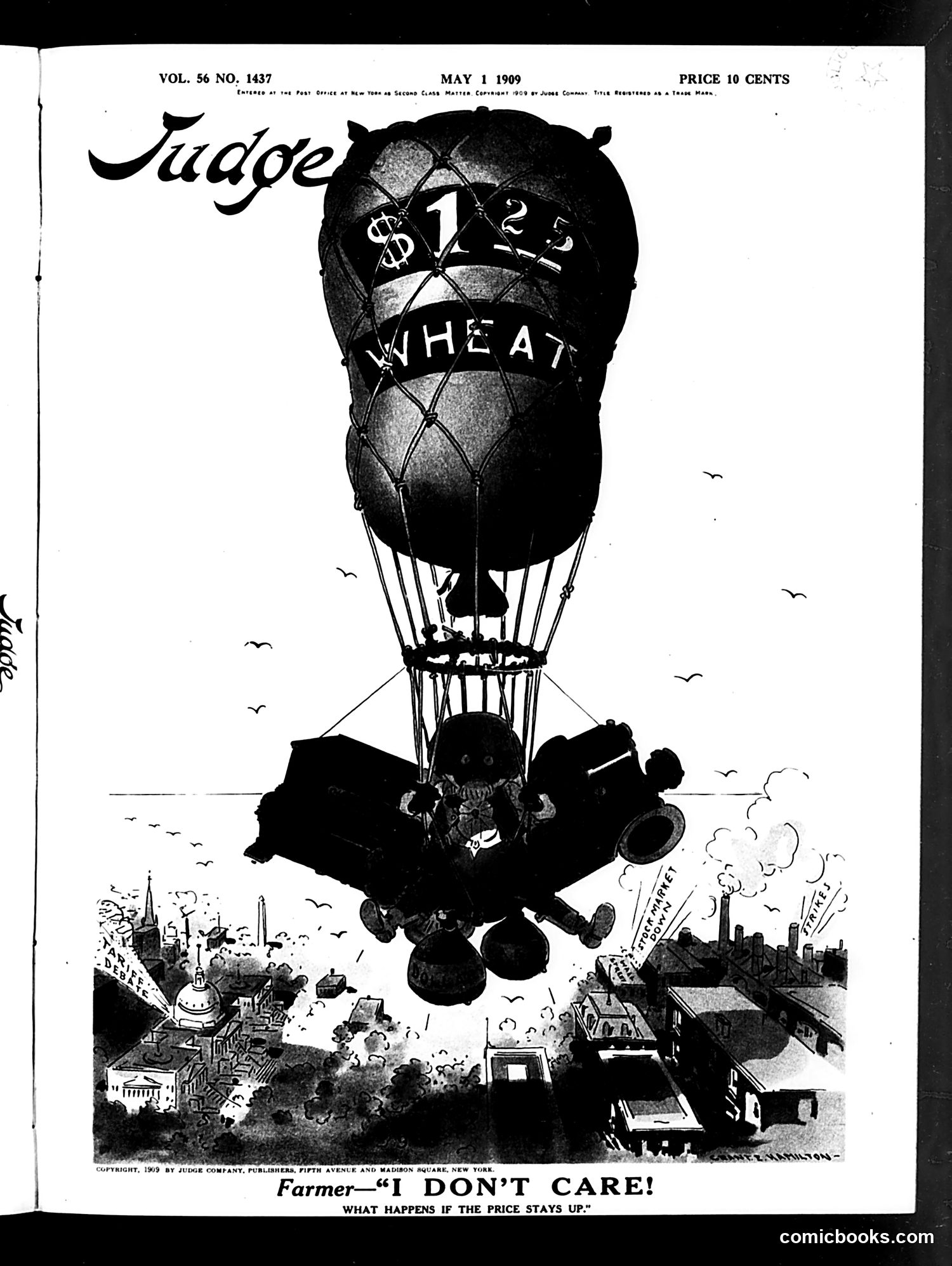
This political cartoon satirizes rising wheat prices and their impact on farmers. A hot air balloon labeled "$1.25 WHEAT" floats above a landscape featuring Washington D.C. landmarks (the Capitol dome visible at left) and industrial cityscape. The balloon drops bombs or explosive packages onto the terrain below. The caption attributes the sentiment to a "Farmer" who declares "I DON'T CARE! WHAT HAPPENS IF THE PRICE STAYS UP." The satire criticizes what appears to be farmer indifference to speculation-driven commodity price inflation, suggesting that unsustainable wheat price increases—represented as a precarious, bomb-dropping balloon—could destabilize the broader economy and urban centers. The cartoon warns that farmers' short-term profit interests might endanger the nation's economic stability.
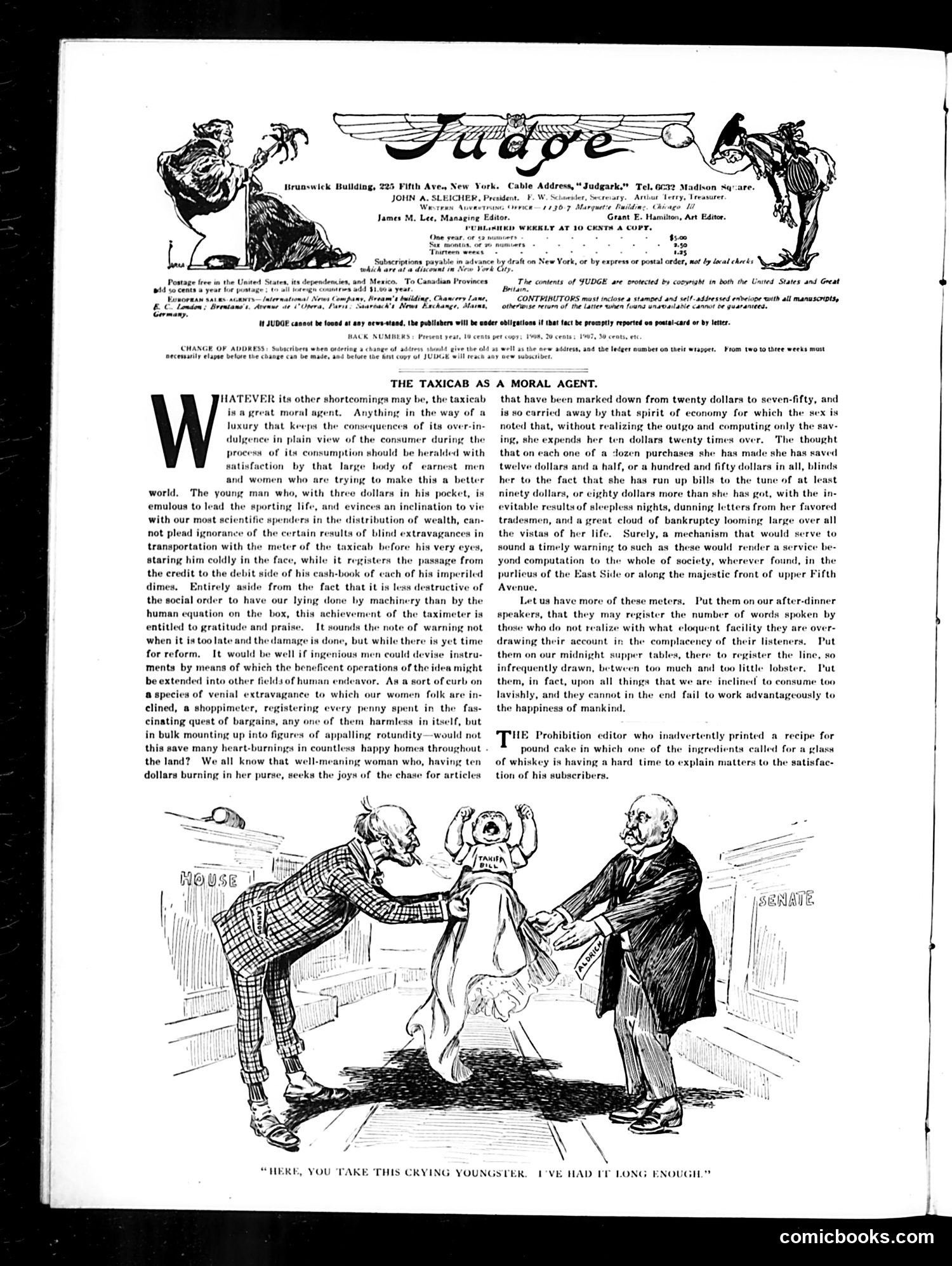
The main article "THE TAXICAB AS A MORAL AGENT" argues that taxicabs—then a new luxury service—encourage wasteful spending, particularly among women. The author warns that women spending ten dollars on cab rides accumulate enormous debts, suggesting taxicabs undermine moral character and family finances. The accompanying political cartoon depicts two figures (labeled "HOUSE" and "SENATE") fighting over a baby labeled "TRUTH," with the caption "HERE, YOU TAKE THIS CRYING YOUNGSTER. I'VE HAD IT LONG ENOUGH." This satirizes Congressional gridlock and partisan blame-shifting, suggesting neither branch of government wants responsibility for addressing truthfulness in legislation—likely referencing a specific contemporary political controversy (unclear which).
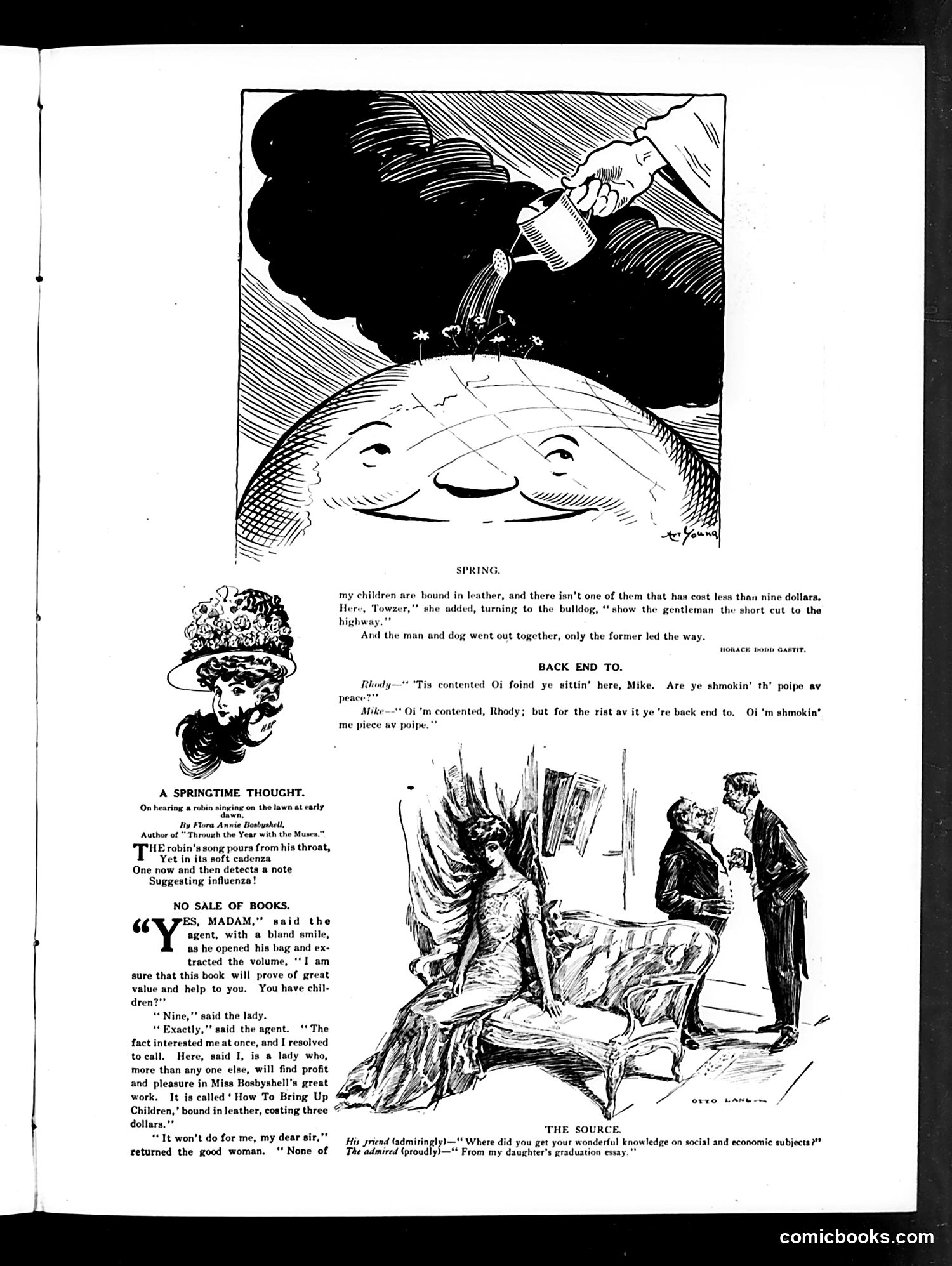
**Top Cartoon ("SPRING"):** Shows a cherubic Earth figure receiving rainfall, likely celebrating spring's arrival and renewal. The smiling personification is straightforward seasonal humor. **"Back End To" dialogue:** Two characters (Rhody and Mike) discuss being "back end to" regarding police pay, suggesting working-class frustration with low wages or poor treatment. **"A Springtime Thought":** A brief poem about a robin's song detecting influenza—appears to be light seasonal verse, possibly referencing early-1900s concern about influenza. **"No Sale of Books":** This section satirizes a book agent's sales pitch to a wealthy woman about a children's volume. The joke centers on the agent's failed attempt—the woman rejects his expensive leather-bound book, finding it unsuitable despite his flattery. **"The Source":** Social commentary on where educated people derive knowledge, with apparent skepticism about formal education sources.
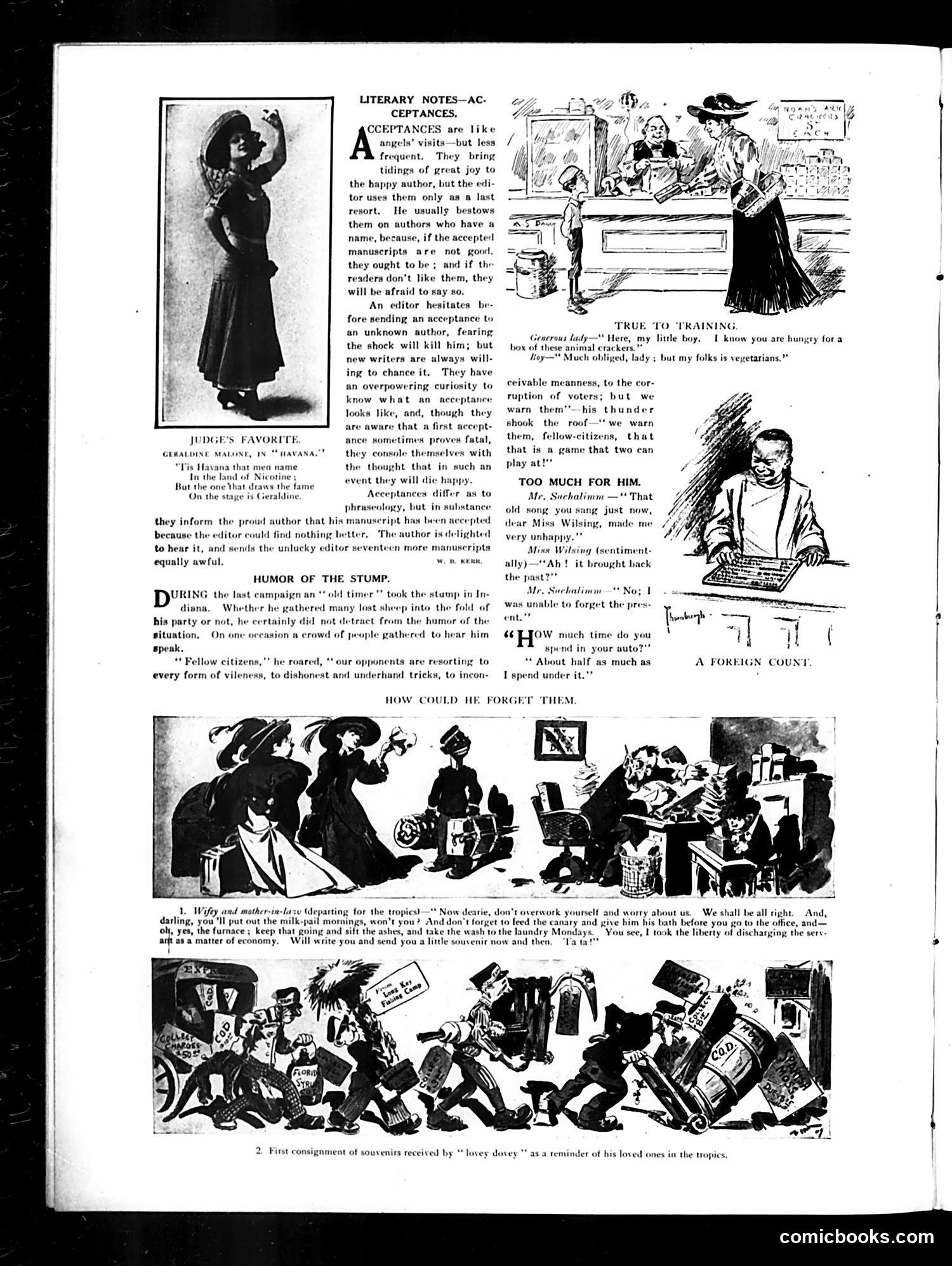
This page contains literary commentary and several satirical cartoons about early 20th-century social life. **"Literary Notes—Acceptances"** discusses how editors receive unsolicited manuscripts from unknown authors, noting acceptances bring joy but are rare, and rejection can devastate writers. **"Humor of the Stump"** references political campaign rhetoric, with a quote about opponents "resorting to every form of vileness." The cartoons below depict domestic scenes: one shows a wife reassuring her husband about finances before he leaves for the office, and another illustrates the accumulated souvenirs and clutter a traveler brings back from tropical vacations—suggesting satirical commentary on consumer culture and domestic management of the period. The overall tone mocks literary pretension, political dishonesty, and bourgeois accumulation.
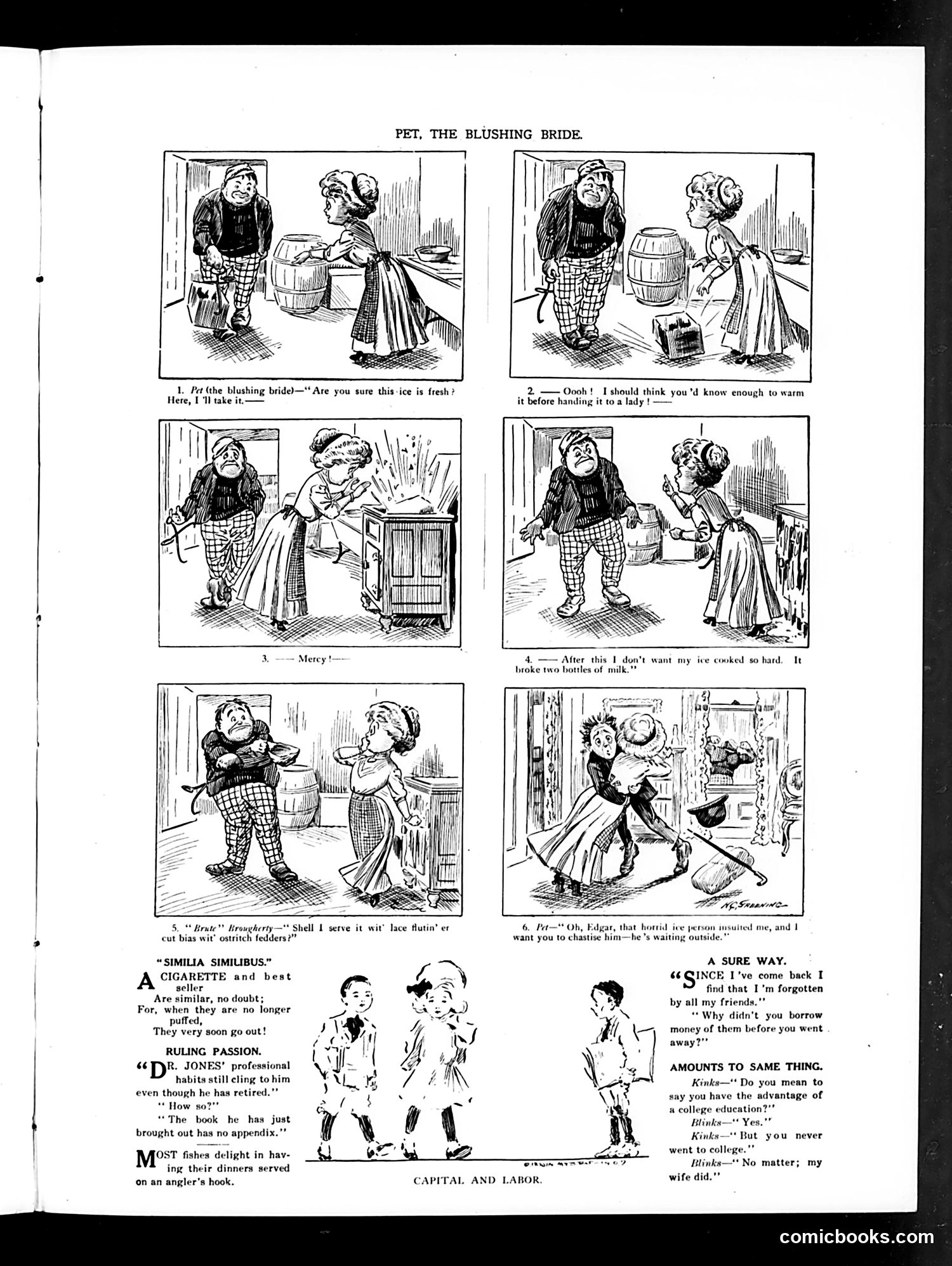
This six-panel comic strip satirizes a newlywed couple's domestic mishaps. A man sells his bride ice, which she discovers is not fresh. She responds with indignation about serving spoiled ice at her wedding reception. The humor escalates through increasingly chaotic scenes—the man breaks milk bottles, and eventually the bride chases him with a broom, suggesting marital discord. The satire mocks both newlyweds: the groom's incompetence and penny-pinching (selling ice rather than buying quality goods), and the bride's explosive temper over domestic failures. The title "Pet, the Blushing Bride" ironically undercuts romantic ideals—instead of demure femininity, she's violent and domineering. The bottom sections contain unrelated jokes about bachelors and education, typical of Judge's miscellaneous humor format.
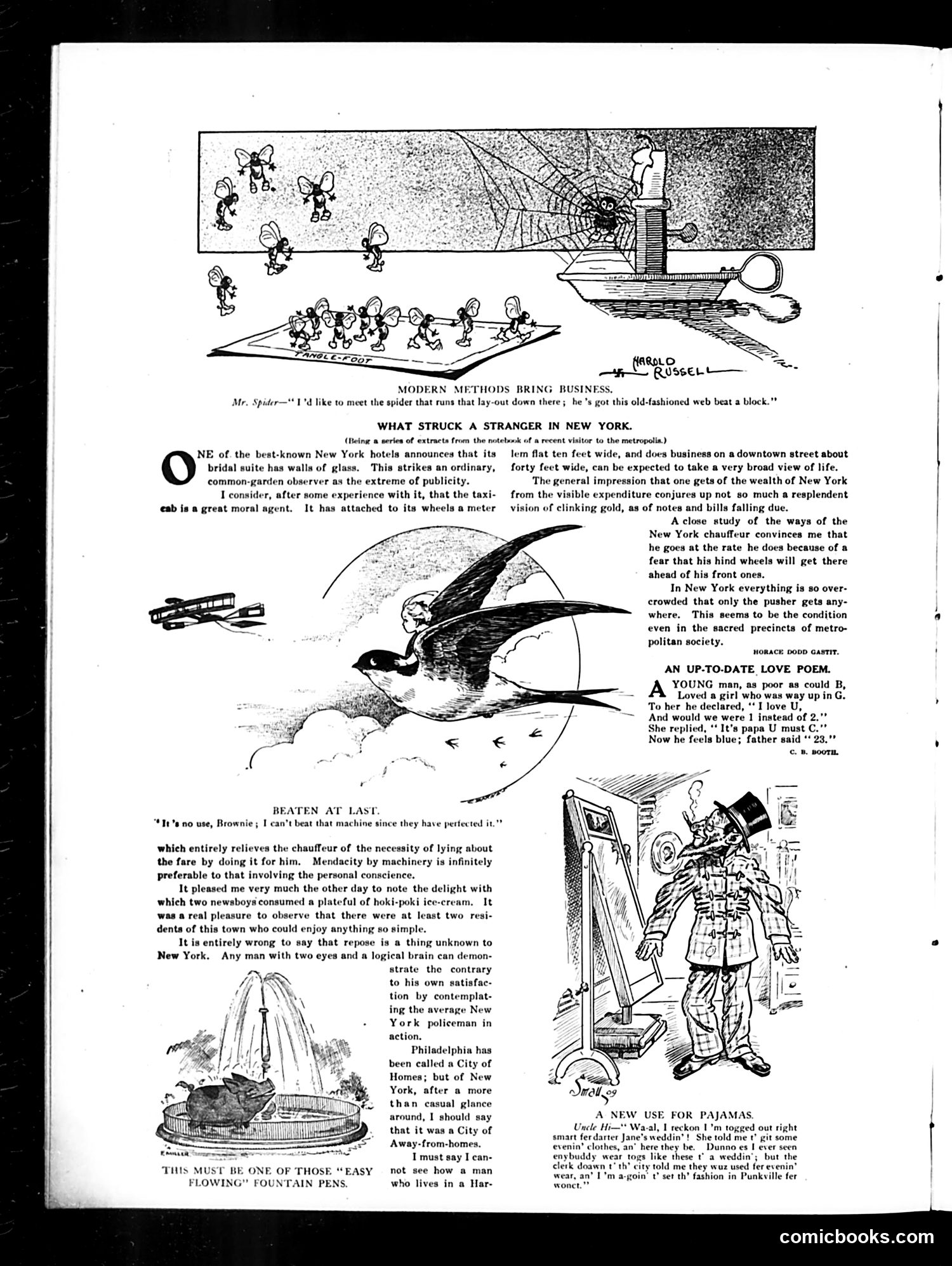
This page from *Judge* magazine contains several satirical observations about early 1900s New York City life: **"Modern Methods Bring Business"** (top): A spider admires a competitor's "layout" that's more efficient than traditional webs—metaphor for how New York's aggressive business culture outpaces old methods. **"What Struck a Stranger in New York"**: A visitor's notebook observations satirizing NYC excess and peculiarities: glass-walled hotel rooms (extreme publicity), taxi meters as "moral agents" (replacing dishonest haggling), overcrowding that rewards pushiness, and well-dressed but perpetually harried policemen. The critique targets superficial wealth amid financial strain. **"An Up-to-Date Love Poem"**: Wordplay joke using letters/numbers instead of words—satirizing modern commercial jargon infiltrating romance. **"A New Use for Pajamas"**: Rural character mistakes pajamas for evening wear, humorously highlighting the cultural gap between cosmopolitan New York and rural America. The overall tone: affectionate mockery of New York's frenetic, materialistic character and class divisions.
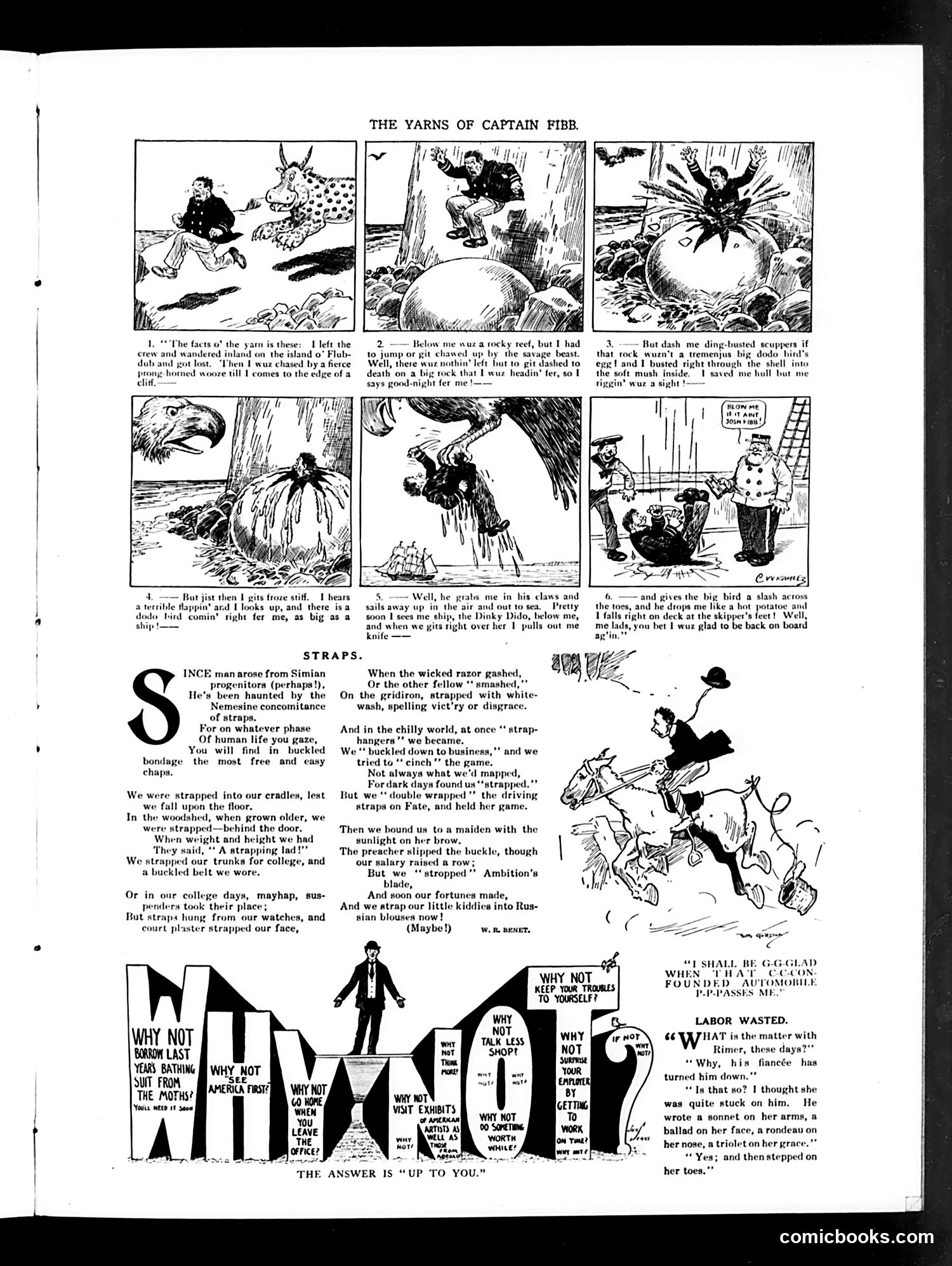
**Top section**: A tall-tale comic strip featuring an exaggerated sea captain narrating absurd adventures—escaping a horned beast by landing in a giant dodo bird egg, being grabbed by an eagle, and slashing the bird's toe to escape. This is pure comedic fiction mocking the genre of implausible sailor yarns popular in period entertainment. **"Straps" poem**: A humorous meditation on how straps and buckles have constrained human life from infancy (cradles) through adulthood (belts, suspenders, garters), using the metaphor of restraint to comment on life's inevitable bonds and obligations. The tone is whimsical rather than political. **Bottom cartoons**: Vintage advice/humor panels offering comedic suggestions ("borrow last year's bathing suit") and philosophical quips about keeping troubles private. The "Labor Wasted" section jokes about a poet lover whose romantic verses couldn't save his relationship—his fiancée ended it after he stepped on her toes, suggesting actions matter more than words. The page is primarily humorous entertainment rather than political satire.
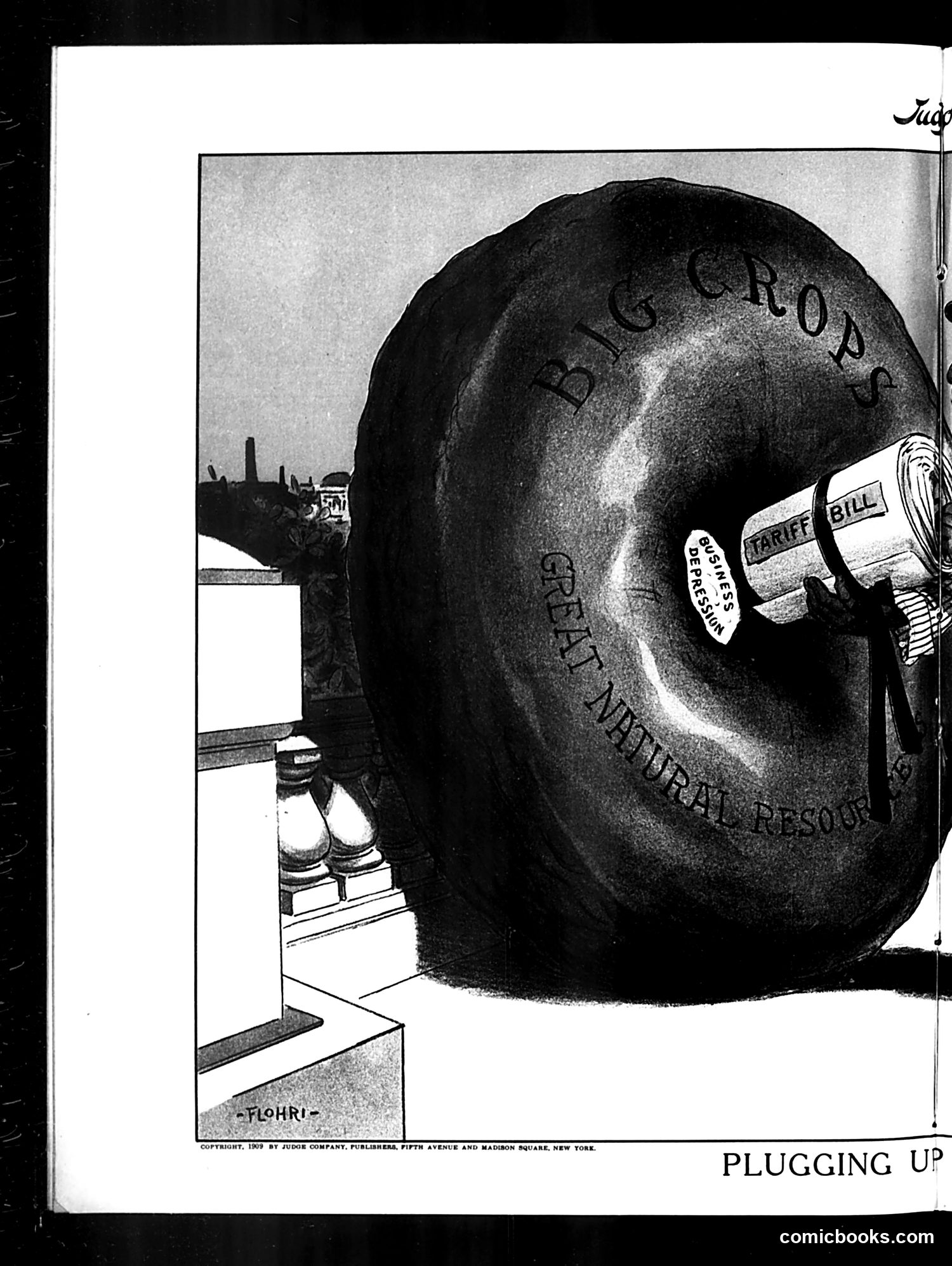
This political cartoon depicts a massive tire labeled "BIGG CROPS" being inflated with a "TARIFF BILL." The tire sits prominently in the foreground while an industrial cityscape appears in the background, suggesting American manufacturing and commerce. The satire critiques protective tariffs as artificial inflation of agricultural prices. The cartoonist suggests that tariff legislation artificially "pumps up" crop values rather than allowing natural market forces to operate. This reflects early 20th-century debates between protectionists (who favored tariffs to shield American farmers and industry) and free-trade advocates who viewed tariffs as artificial price manipulation. The Flohri signature indicates the cartoonist's identity. The imagery implies tariff policy produces inflated, unsustainable economic conditions—a bubble waiting to burst.
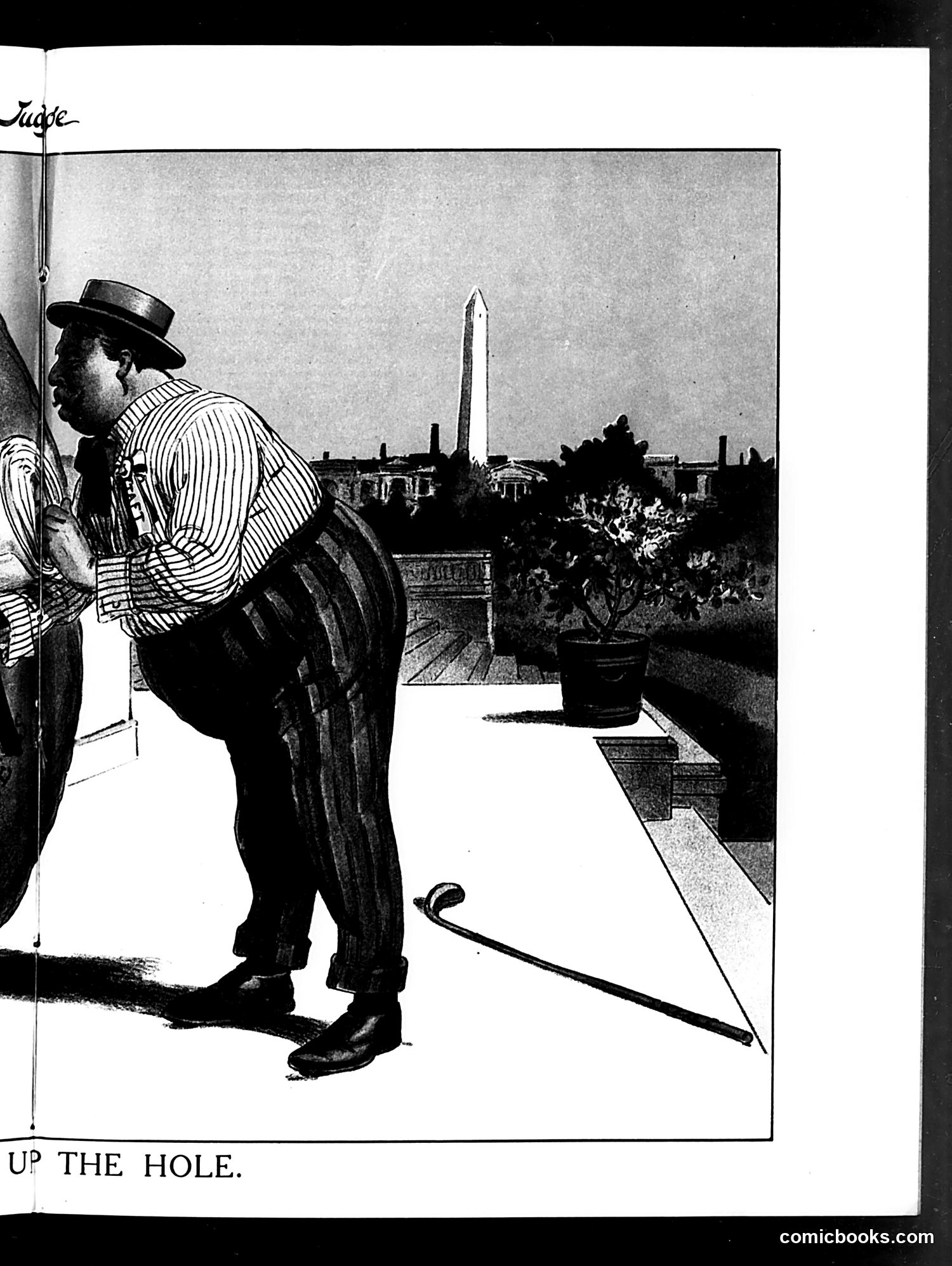
This is a political cartoon titled "UP THE HOLE" from *Judge* magazine. It depicts a rotund, well-dressed man in a pinstriped suit and bowler hat, bending over with a cane, peering down into what appears to be a hole on a rooftop or terrace. The Washington Monument is visible in the background, establishing the setting as Washington, D.C. The cartoon appears to satirize a political figure or corrupt official literally investigating or being implicated in some scandal or financial impropriety—the "hole" likely represents either embezzlement, misappropriation of funds, or another form of corruption. The phrase "up the hole" suggests money or resources going missing or being hidden. Without the publication date, the specific figure remains unclear, but the imagery targets governmental corruption and financial misconduct.
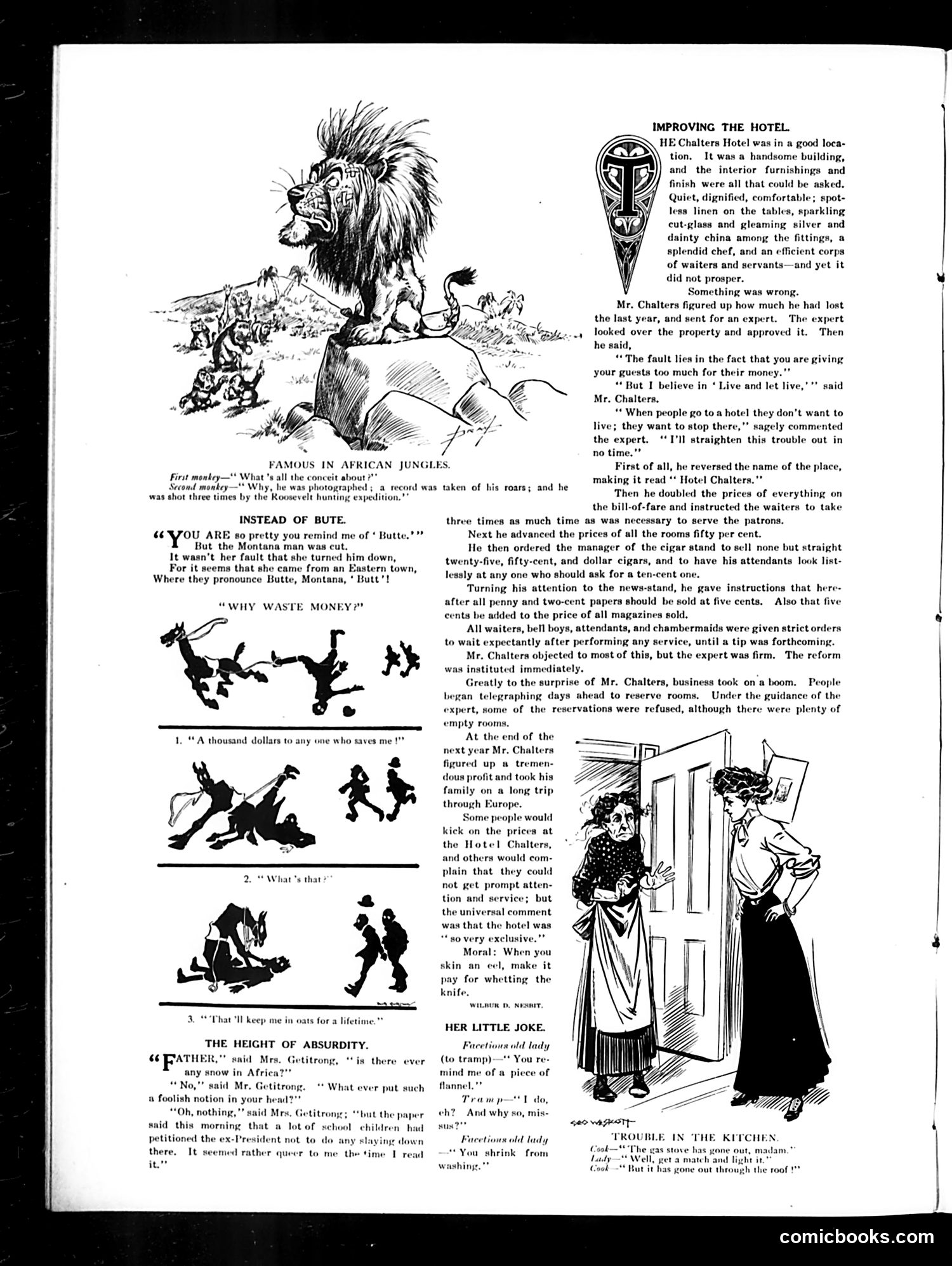
This page contains several unrelated humorous pieces typical of Judge's satirical format: **Main Story: "Improving the Hotel"** depicts a business consultant who paradoxically rescues a failing luxury hotel by *raising* prices and *worsening* service—making guests wait longer, selling only expensive cigars, charging five cents for penny papers. The joke critiques American consumer psychology: people assume expensive = exclusive and desirable. The consultant exploits snobbishness rather than improving actual hospitality. Mr. Chalters profits enormously, validating the counterintuitive strategy. **Smaller jokes** include: - "Instead of Butte": A pronunciation gag about Montana - "The Height of Absurdity": A woman misunderstands "Africa" as having snow because schoolchildren petitioned "the ex-President" (likely Theodore Roosevelt, referenced in the monkey cartoon) not to hunt there - "Her Little Joke": A tramp's appearance reminds an old lady of flannel The cartoons are simple line drawings illustrating these punchlines. The overall message critiques both consumer materialism and business ethics.
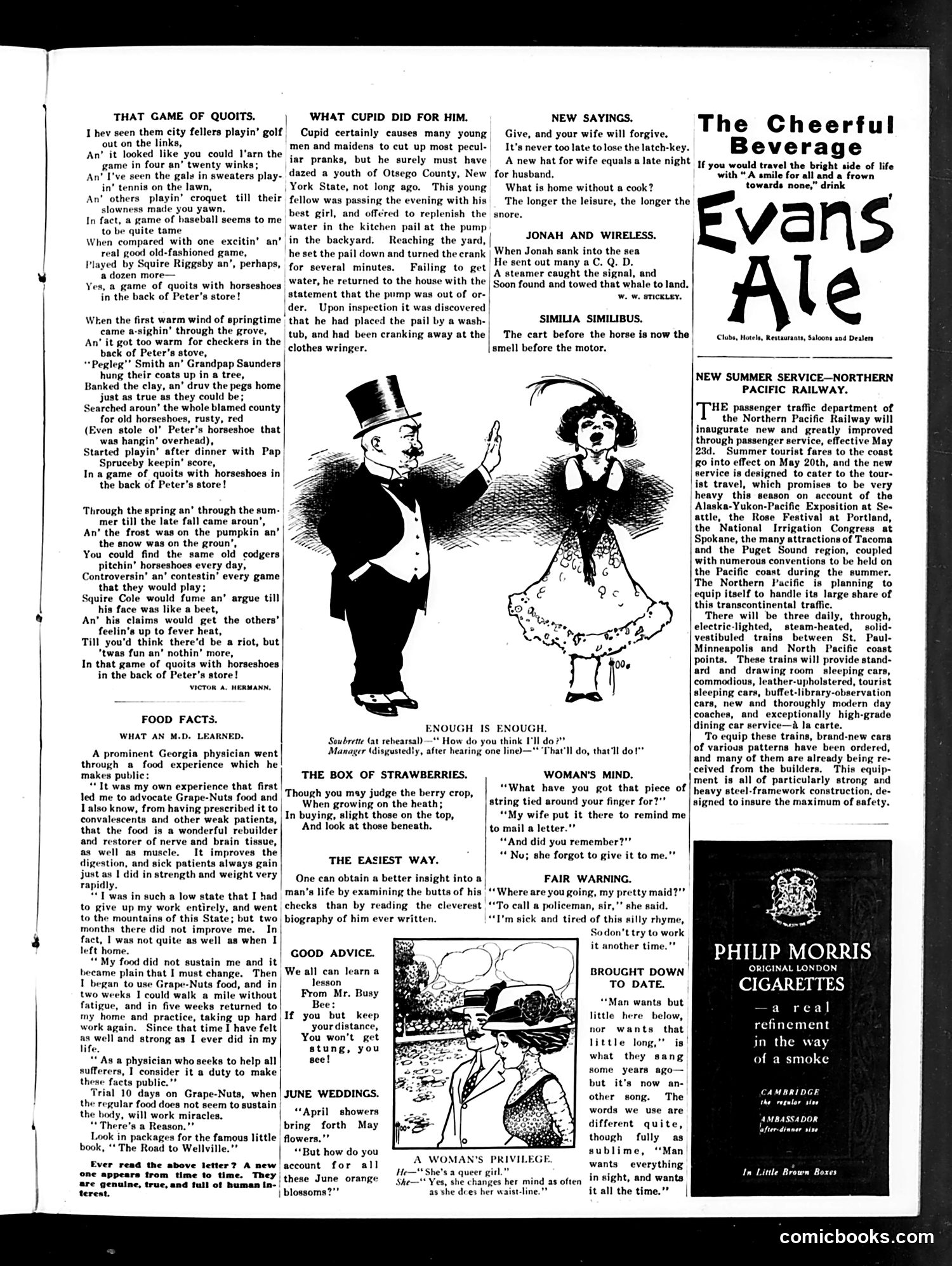
This page from Judge magazine (early 1900s) contains primarily **humorous verse and advertisements** rather than political cartoons. The main content is "That Game of Quoits," a nostalgic rural poem by Victor A. Hermann celebrating old-fashioned horseshoe pitching among country men (Squire Cole, Pegleg Smith, Grandpap Saunders) at a general store, contrasted with modern city sports like golf and tennis. The satire gently mocks urbanization and changing leisure activities. The illustrations are lighthearted social humor: one shows a man and woman with the caption about Cupid's effects on youth; another depicts a rural scene. Much space is devoted to a **Grape-Nuts cereal advertisement** (disguised as a physician's testimonial—a common early-1900s marketing tactic). There are also ads for **Evans Ale** and **Philip Morris cigarettes**, reflecting period consumer culture. The "New Sayings" section offers brief domestic jokes about marriage. Overall, this is a typical Judge issue blending rural nostalgia with modern advertising.
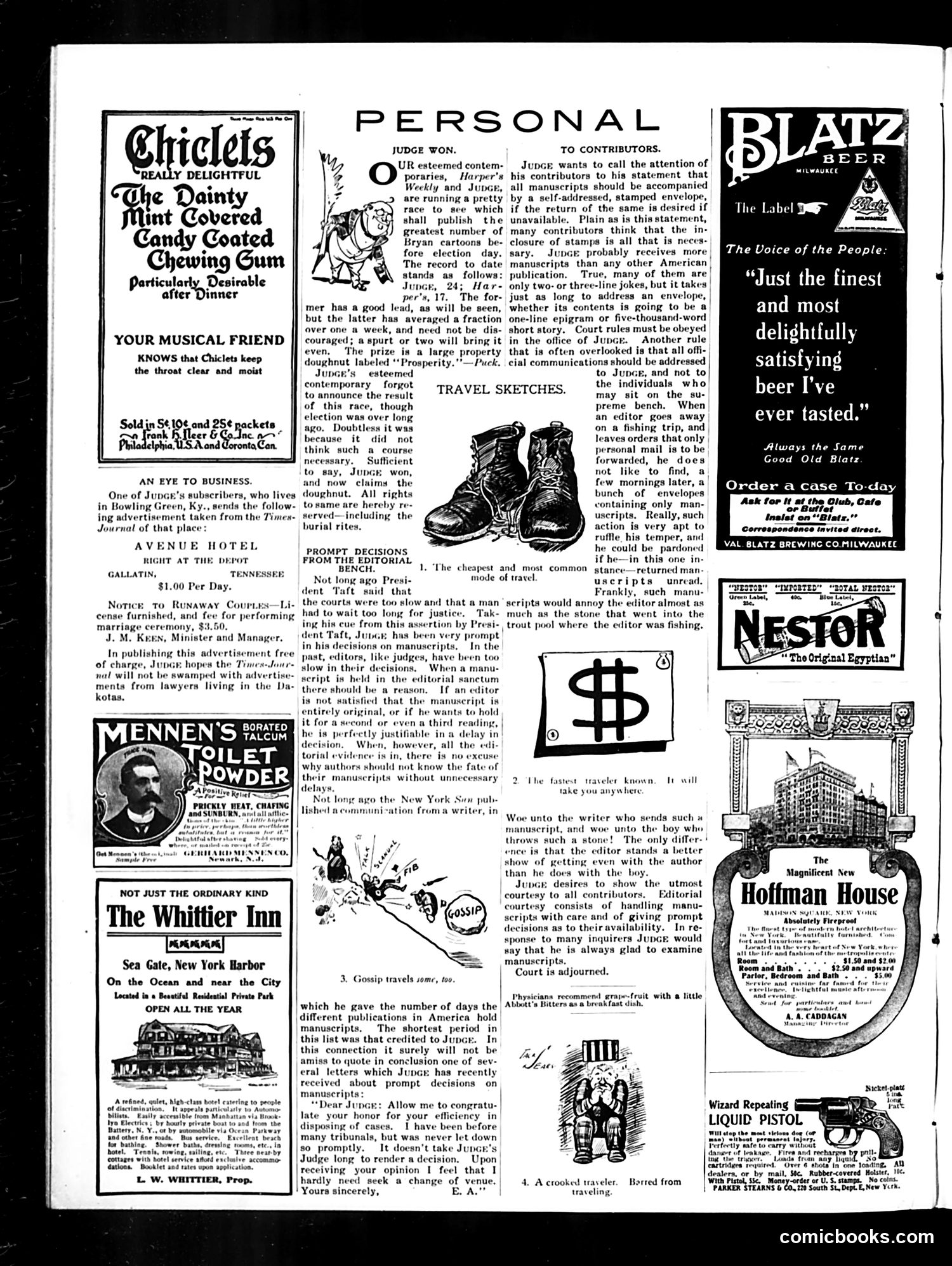
This page primarily features **advertisements and editorial commentary** rather than political cartoons. The main content includes: **"Judge Won"** section: A humorous note about Judge magazine's competition with Harper's Weekly to publish the most William Jennings Bryan cartoons before an election. Judge claims victory with 24 cartoons versus Harper's 17, joking they've won a "doughnut labeled 'Prosperity.'" This references the 1896 or 1900 presidential race when Bryan was the Democratic candidate—the doughnut being satirical commentary on prosperity debates. **"Prompt Decisions from the Editorial Bench"**: Editorial guidance to contributors about manuscript submission procedures, parodying President Taft's complaints about slow courts. The humor lies in treating Judge's editorial decisions with mock-judicial solemnity. The bulk of the page comprises period advertisements (Chiclets gum, Mennen's talcum powder, hotels, etc.), typical of early 20th-century magazine formatting. There are small illustrative sketches accompanying the travel and gossip sections, but no significant political satire is evident.
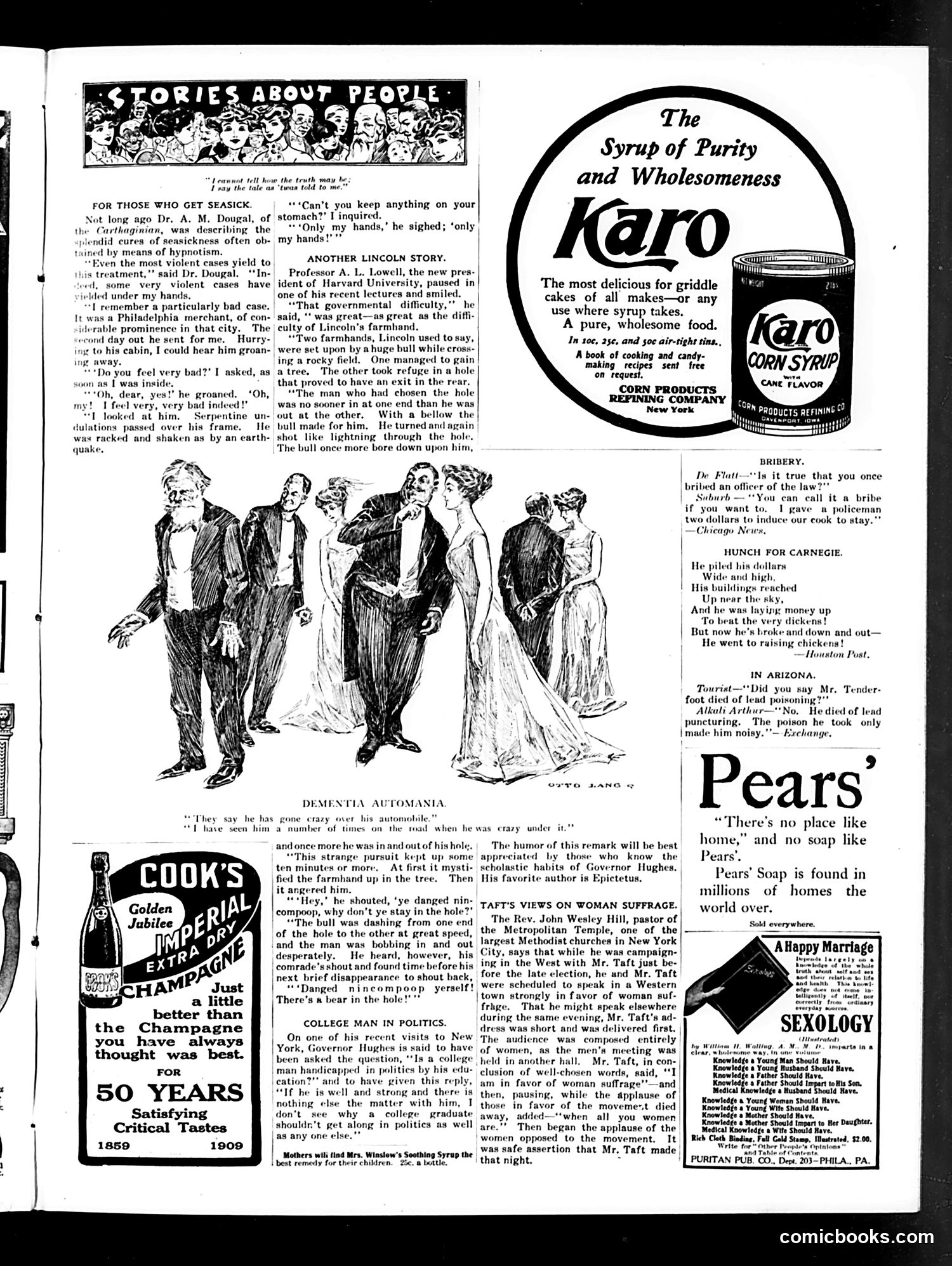
This page from Judge magazine (circa 1909, based on the Cook's Champagne ad dating to "50 YEARS" from 1859-1909) contains humorous anecdotes and advertisements typical of the era's satirical press. **Main Content:** The "Dementia Automania" cartoon illustrates the era's fascination and anxiety about automobiles—depicting well-dressed people with the caption suggesting automobile obsession as a form of madness ("crazy over his automobile"). **Notable Stories:** - A Lincoln anecdote about a farmhand and a bull—reflecting the popular practice of attributing folk wisdom to Lincoln - A Harvard president's tale about governmental difficulty - Discussion of whether college-educated men are effective in politics **Key Social References:** - Woman suffrage debate (Taft's equivocal stance is mocked) - Seasickness remedies via hypnotism - Early automobile culture as comedic subject **Advertisements** include patent medicines (Mrs. Winslow's Soothing Syrup), syrup products, and books on sexuality—typical of Judge's revenue model mixing satire with commercial pitches to middle-class readers.
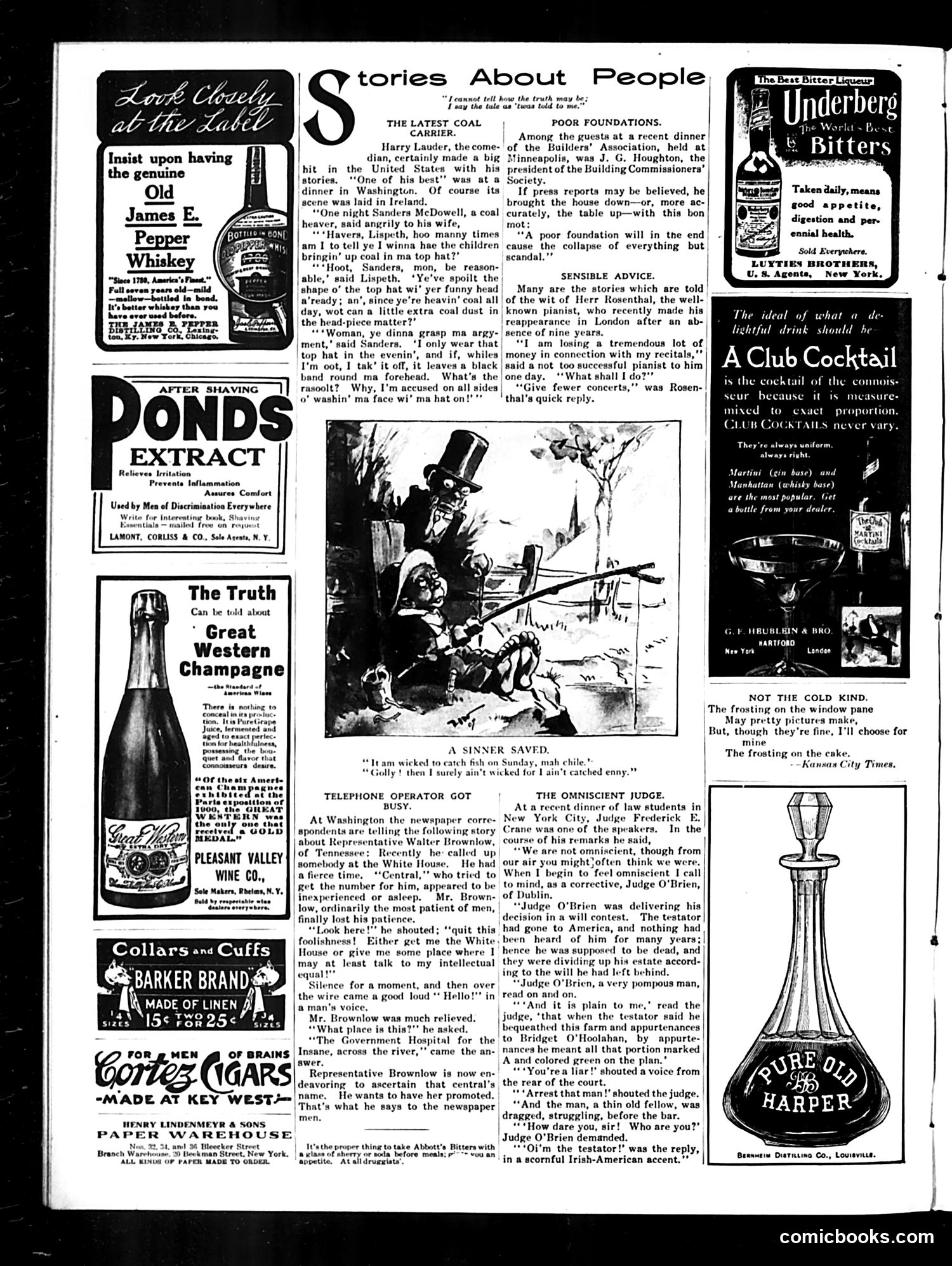
This page from *Judge* magazine contains several humorous anecdotes and advertisements typical of early 20th-century American satirical publishing. **Main Content:** The "Stories About People" section presents three jokes: 1. **Harry Lauder anecdote**: A Scottish comedian's story about a coal miner complaining his wife lets children put coal dust in his top hat, which leaves a black ring on his forehead when removed—making him appear accused of something scandalous. 2. **J.G. Houghton's quip**: A building commissioner's joke that poor foundations cause everything to collapse except scandal itself—a commentary on institutional corruption. 3. **Pianist Rosenthal's advice**: When asked how to stop losing money on recitals, he quips "Give fewer concerts"—mocking unsuccessful performers. 4. **Representative Brownlow's mishap**: A telephone operator at the White House connects him to an insane asylum instead, leading him to praise her for finally finding someone matching his "intellectual equal"—satire on government incompetence. **Advertisements** for whiskey, champagne, cigars, and patent medicines fill the margins, typical of the era's publication model.
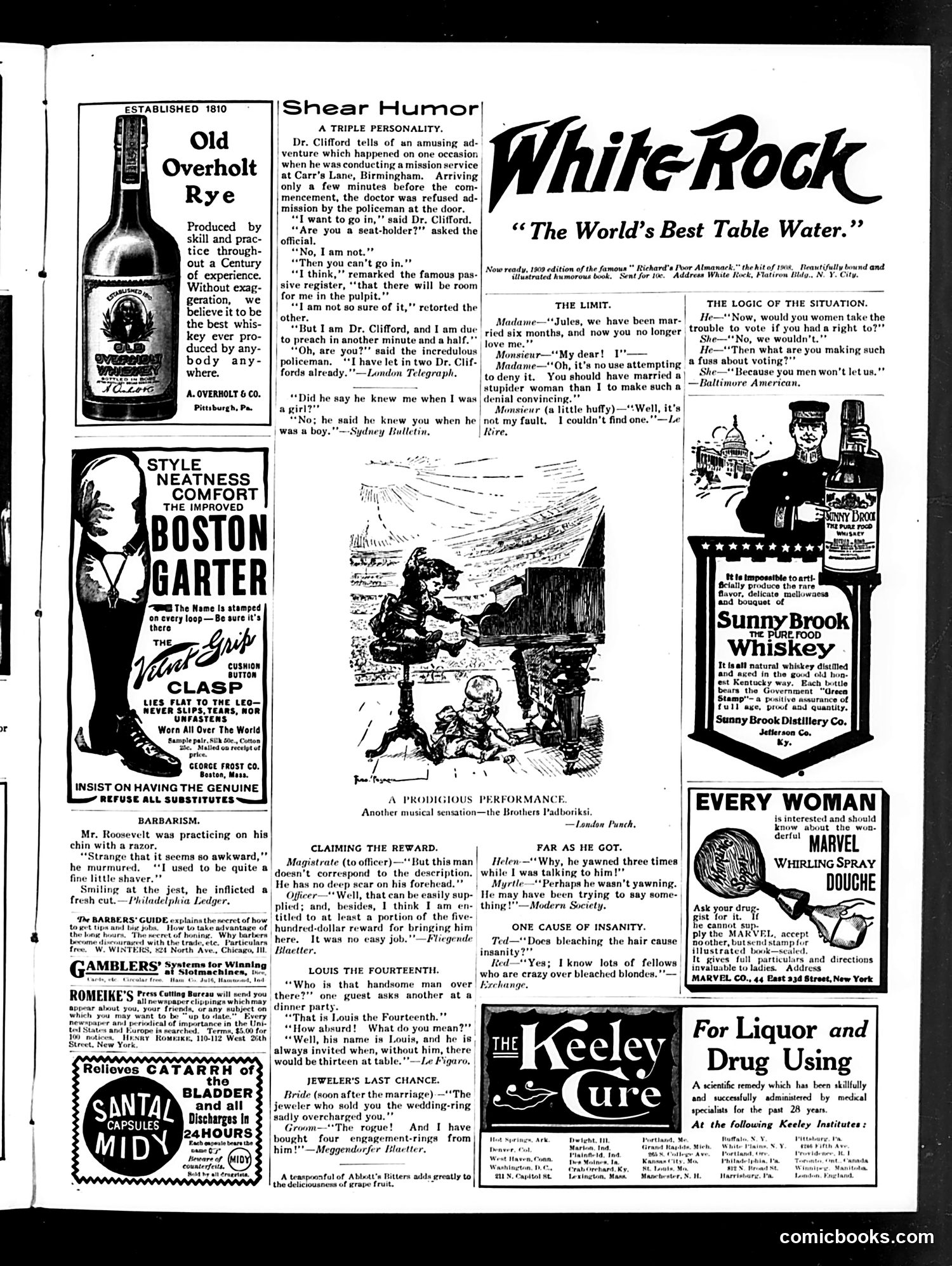
This is primarily an **advertising page** with scattered humorous anecdotes rather than political cartoons. The content reflects early 20th-century American consumer culture and genteel humor. **Key advertisements:** - Old Overholt Rye whiskey, Boston Garter (men's suspenders), Sunny Brook Whiskey, White Rock mineral water, and Marvel Douche spray—typical products targeting affluent readers. **The humor pieces** are lighthearted social jokes: - Roosevelt practicing with a razor (topical reference to President Theodore Roosevelt) - Anecdotes about marriage, religious services, and social awkwardness - A joke about bleached hair causing insanity (reflecting period attitudes toward women's cosmetic practices) **Overall tone:** The page reflects *safe, middle-class sensibilities*—no sharp political satire. The humor targets minor social embarrassments and marital complications rather than serious critique. The advertising dominates, suggesting Judge's primary function was reaching wealthy male consumers.
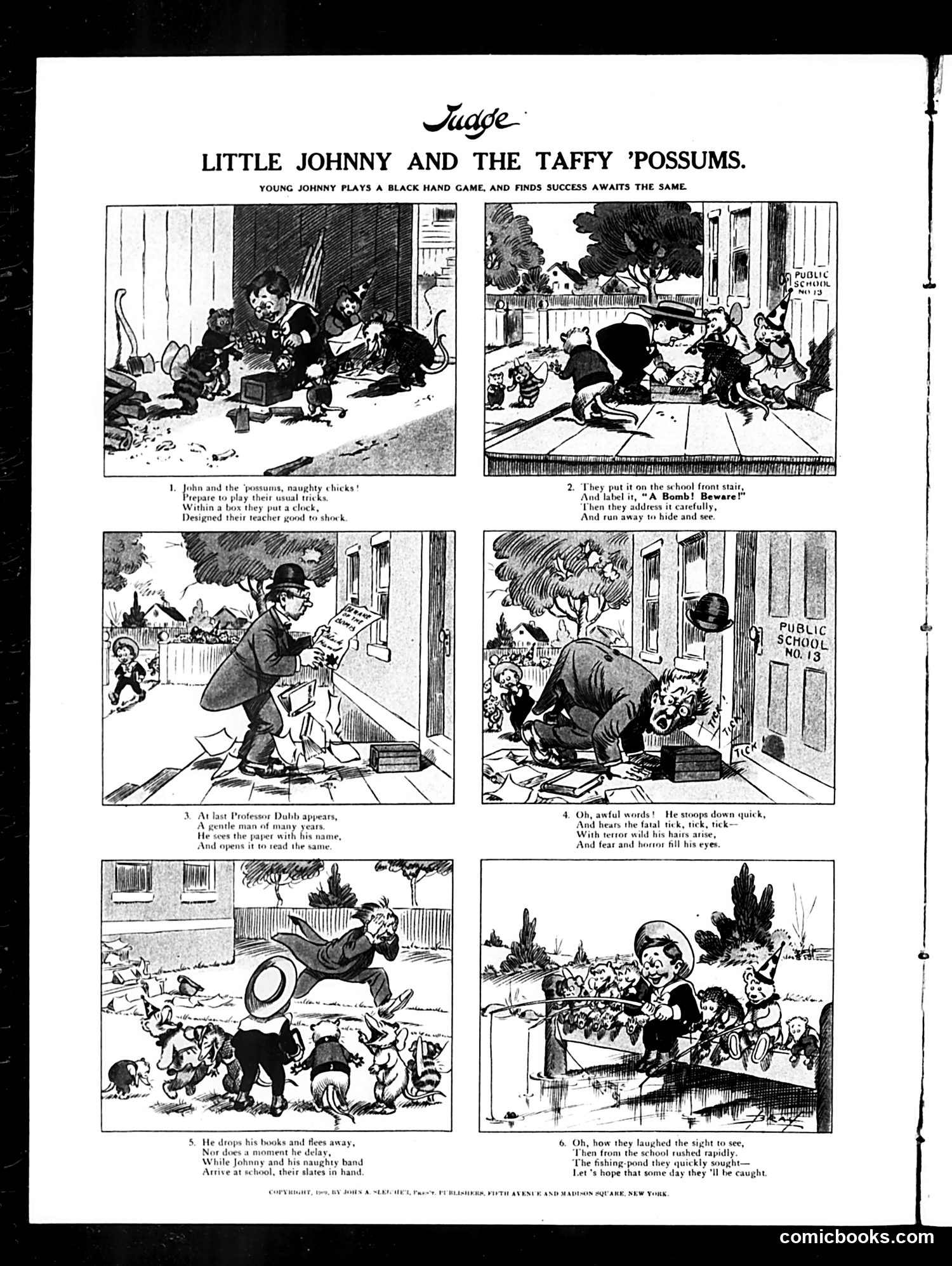
This is a six-panel comic story titled "Little Johnny and the Taffy 'Possums." Johnny and other children discover possums and play pranks involving them—placing a "bomb" (likely a firecracker) on a school front step labeled "A Bomb! Beware!" The comic follows Johnny's mischievous antics with the animals, escalating through various scenes including encounters with a professor and teacher. The humor centers on childhood pranks and animal antics typical of early 20th-century comic strips. The "Black Hand Game" reference in the subtitle appears to invoke contemporary criminal extortion schemes, though the actual story involves innocent childhood mischief rather than serious crime—the joke being a playful exaggeration. The comic is straightforward children's entertainment with no apparent deeper political satire.