A complete issue · 16 pages · 1909
Judge — March 20, 1909
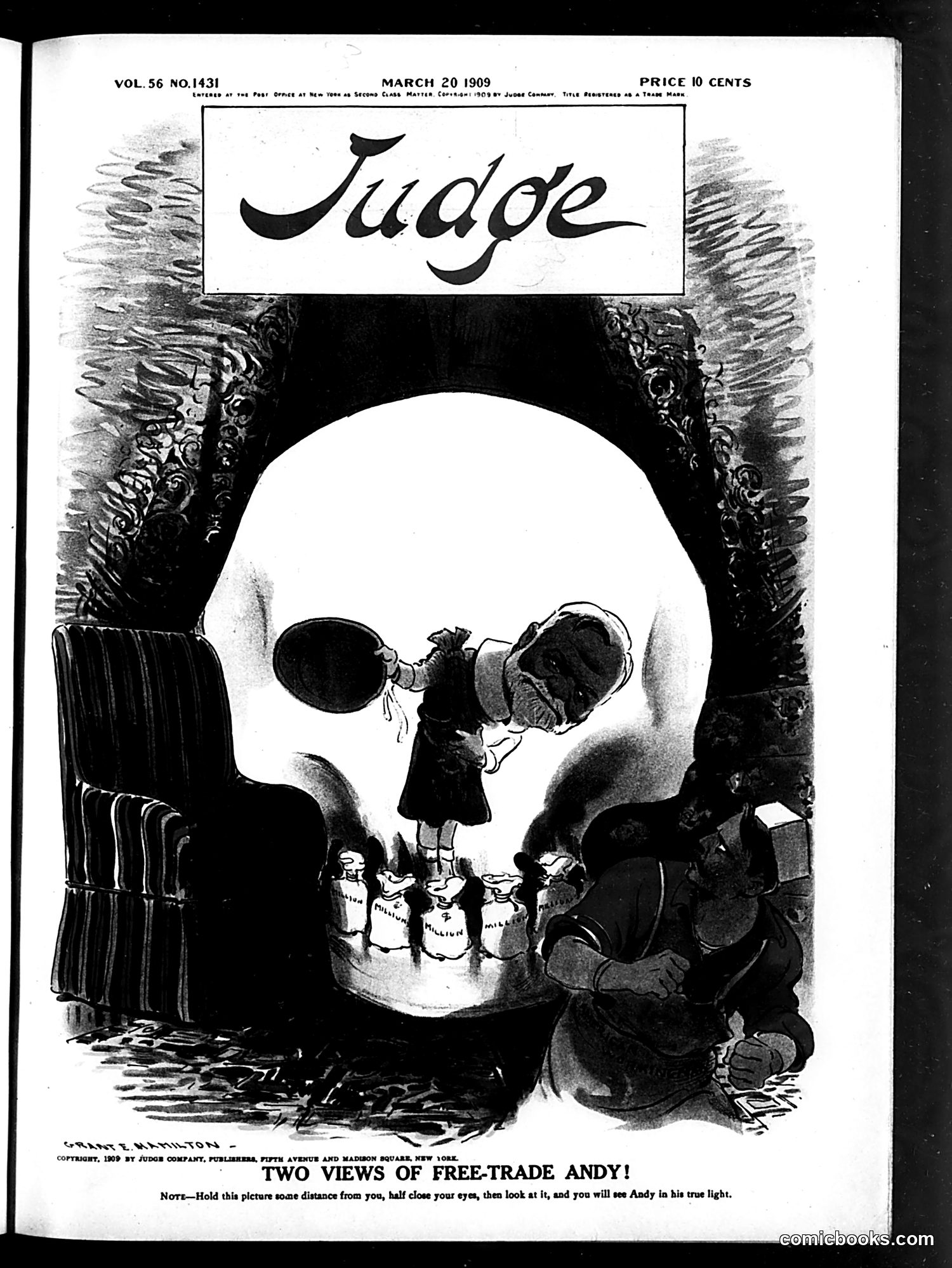
This 1909 Judge magazine cover satirizes **free-trade policy** through a skull optical illusion. The cartoon plays on perspective: viewed from a distance, the image shows a skull; up close (as the note instructs), it depicts a figure labeled "Andy" operating bellows or pumps amid bottles, likely representing industrial/economic activity. The satire targets someone nicknamed "Free-Trade Andy"—probably a political figure advocating free trade. The skull imagery suggests the cartoonist considers free-trade policy **deadly or destructive** to American interests, while the dual perspective mocks how proponents and critics see the same policy completely differently. This reflects the era's fierce trade-policy debates.
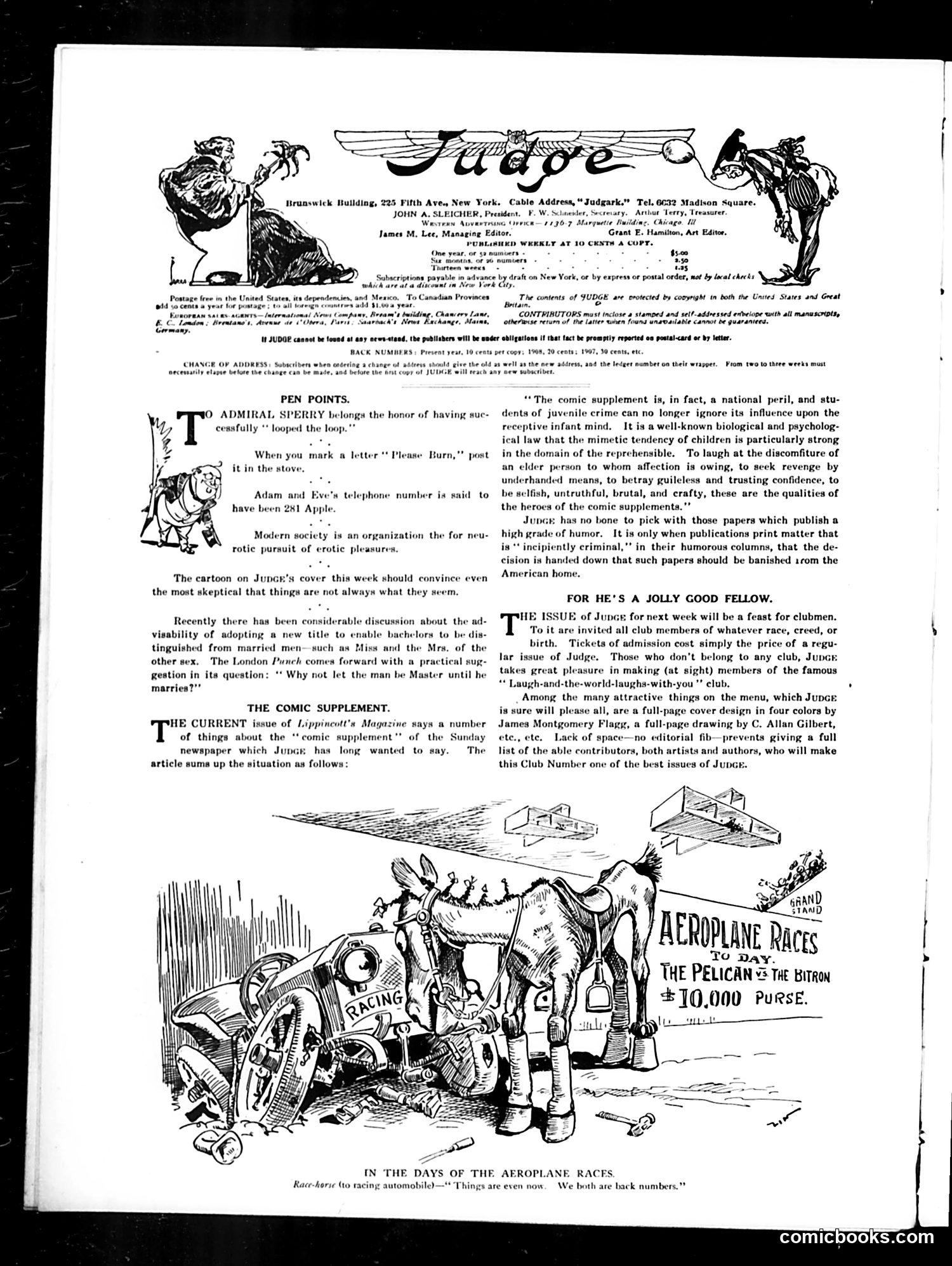
This page is primarily **editorial content and notices** rather than political satire. The main cartoon depicts anthropomorphized animals (a pelican and bison) in a comedic scenario labeled "AEROPLANE RACES TO DAY—THE PELICAN & THE BISON—$10,000 PURSE." The joke appears to reference early aviation competitions (aeroplane races were newsworthy events in the 1910s), with the animals humorously racing instead of aircraft. The caption "In the days of the aeroplane races / Racehorses racing automobiles—'Things are even now. We both are back numbers'" suggests satire about technological obsolescence—older racing forms (horses, automobiles) being displaced by newer aviation technology. The page also includes "Pen Points" editorial commentary and a club notice, indicating this is a mixed editorial/content page rather than primarily satirical cartooning.
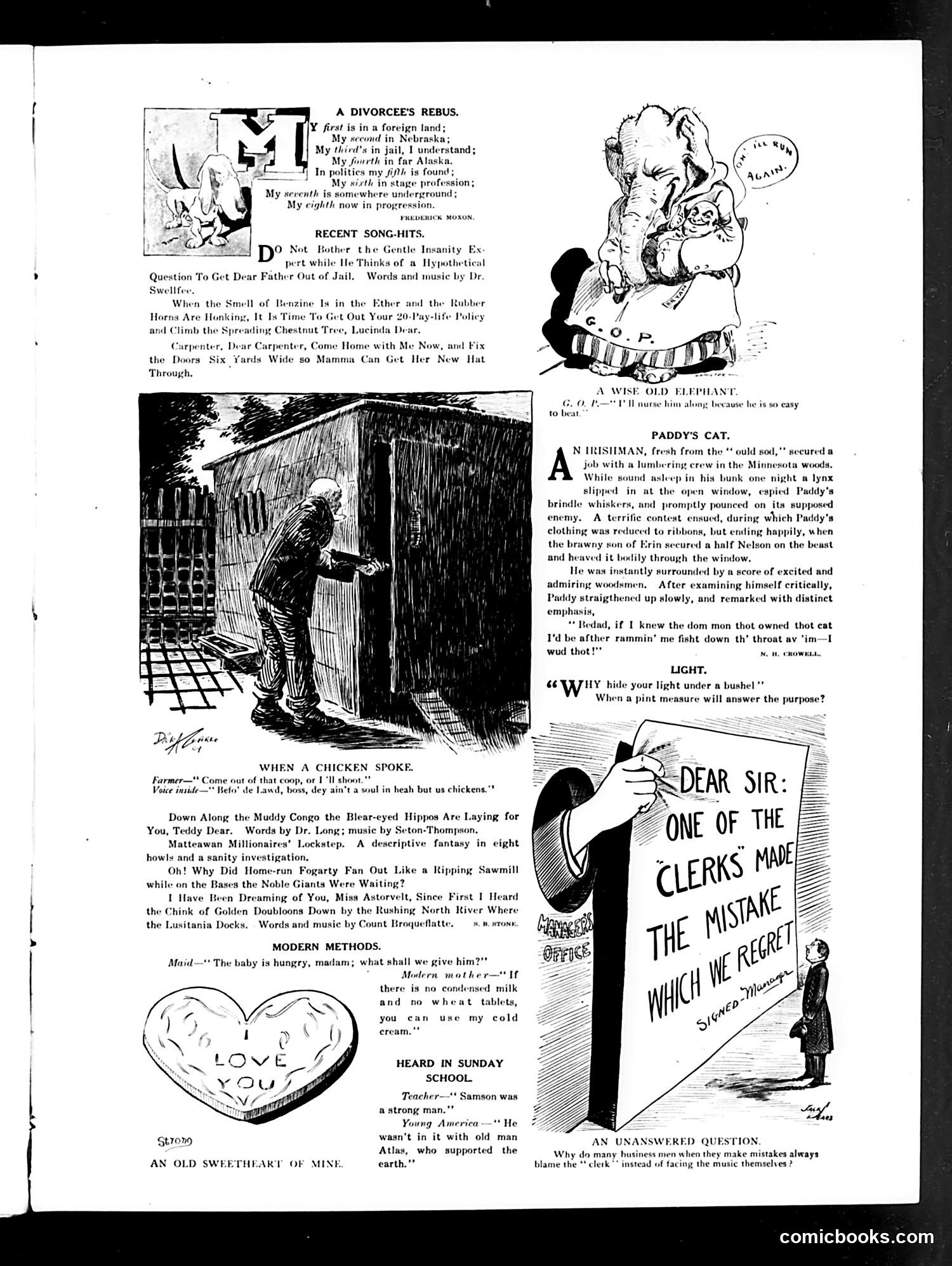
This page from Judge magazine contains **mostly humor pieces and light social commentary** rather than hard political satire. **Key content:** - **"A Divorces Rebus"**: A wordplay joke about divorce using visual riddles (first line "in a foreign land," etc.) - **"Paddy's Cat"**: A humorous anecdote about an Irishman ("Paddy") whose cat fights a lynx, played for ethnic comedy typical of the era - **"When a Chicken Spoke"**: A light joke featuring a farmer and talking chicken - **Song-hit listings and modern methods sections** offer period advertising/culture references - **"An Unanswered Question"** cartoon satirizes business culture—blaming clerks rather than examining management failures The page reflects **turn-of-century humor: ethnic stereotypes, puns, and mild social observation** rather than pointed political critique.
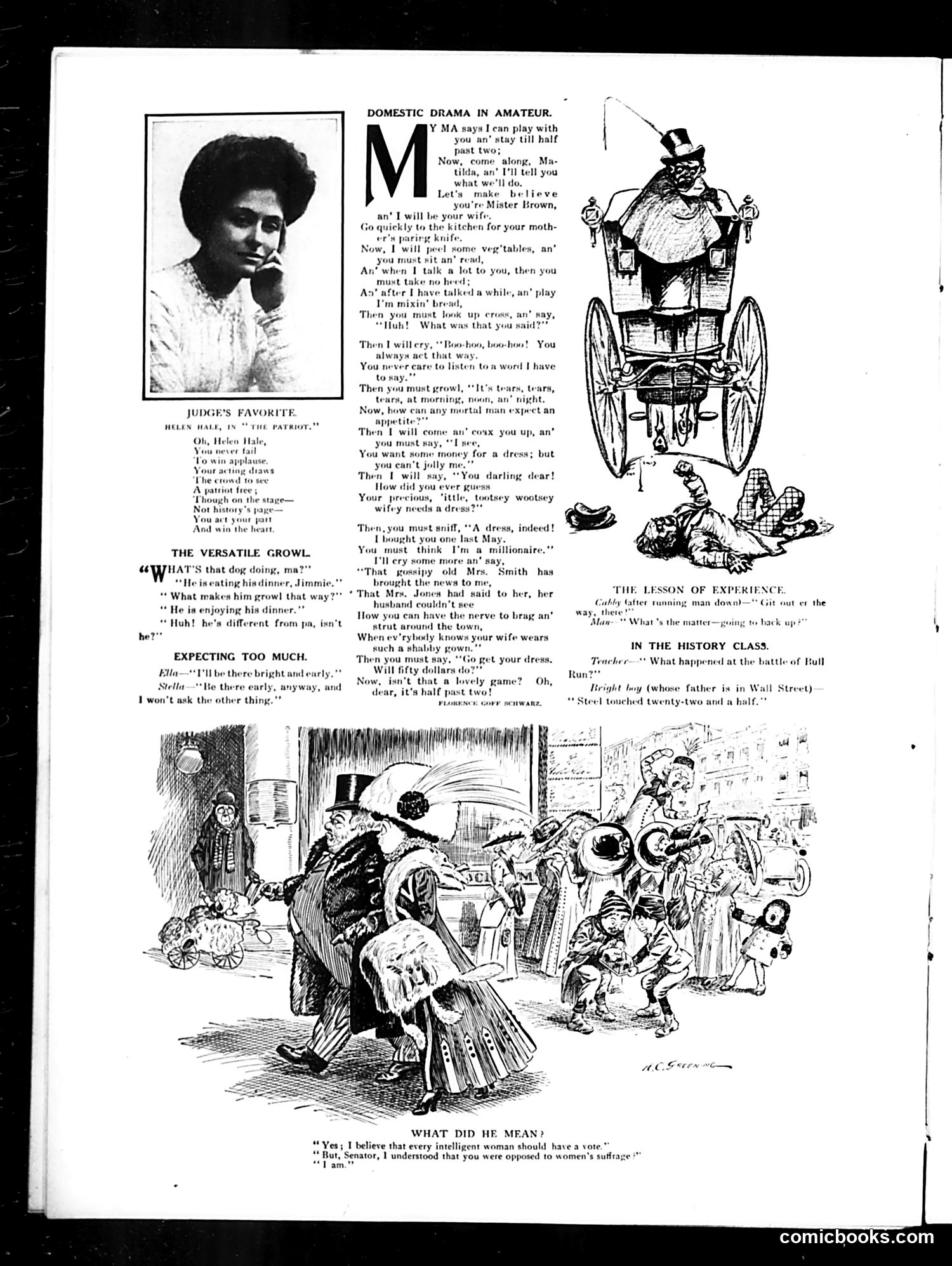
This page contains several satirical sketches and humorous pieces typical of early 20th-century American humor magazine content. **"Judge's Favorite"** features Helen Hall in "The Patriot"—likely a theatrical reference. **"The Versatile Growl"** presents a domestic comedy about a husband questioning his wife's activities and expenses. **"What Did He Mean?"** appears to reference women's suffrage, with a senator discussing voting rights for women—a contemporary political debate of the early 1900s. The illustrated sketches satirize domestic life and gender relations. The "History Class" and "Lesson of Experience" sections offer brief comic observations on marriage and relationships. The overall page reflects Judge's focus on domestic humor, social commentary on gender roles, and contemporary political issues like women's suffrage, presented through caricature and exaggerated domestic scenarios typical of the era's satirical entertainment.
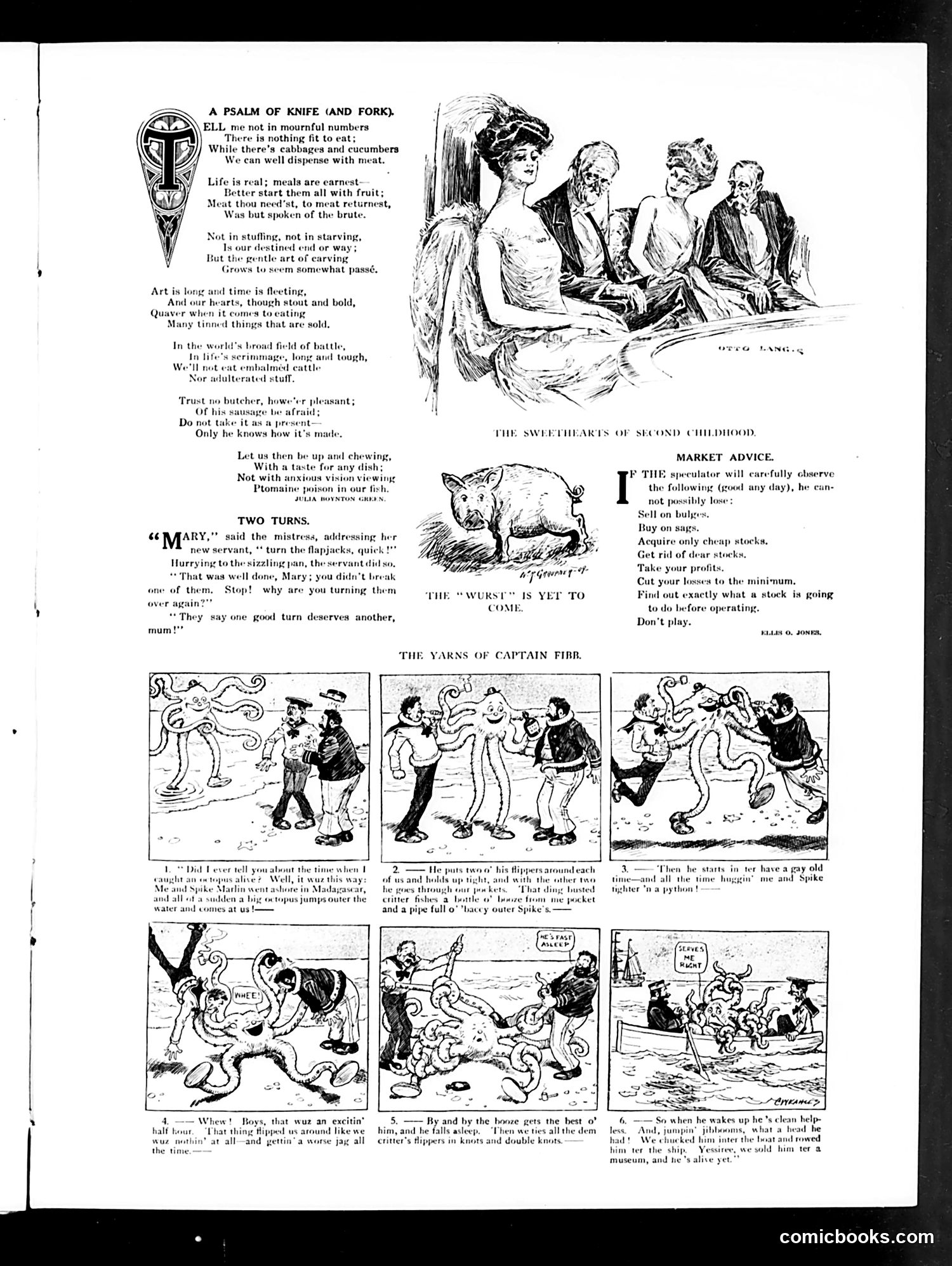
This page contains mixed content: a poem titled "A Psalm of Knife (and Fork)" celebrating meat-eating and carving skills as art, followed by humor and illustrated stories. **"The Sweethearts of Second Childhood"** shows wealthy or upper-class people dining, likely satirizing affected dining manners or romance among the aged. **"The Yarns of Captain Fibb"** is a comic strip featuring a seafaring character and an octopus. The narrative appears to involve tall tales and exaggerated maritime adventures, with Captain Fibb spinning implausible stories to listeners. The humor derives from obvious fabrications and the octopus's involvement in absurd scenarios. **"Market Advice"** provides investment guidance, likely satirizing stock market speculation or financial tips. The overall tone reflects Judge's typical satirical approach to contemporary American social pretensions and leisure-class behaviors.
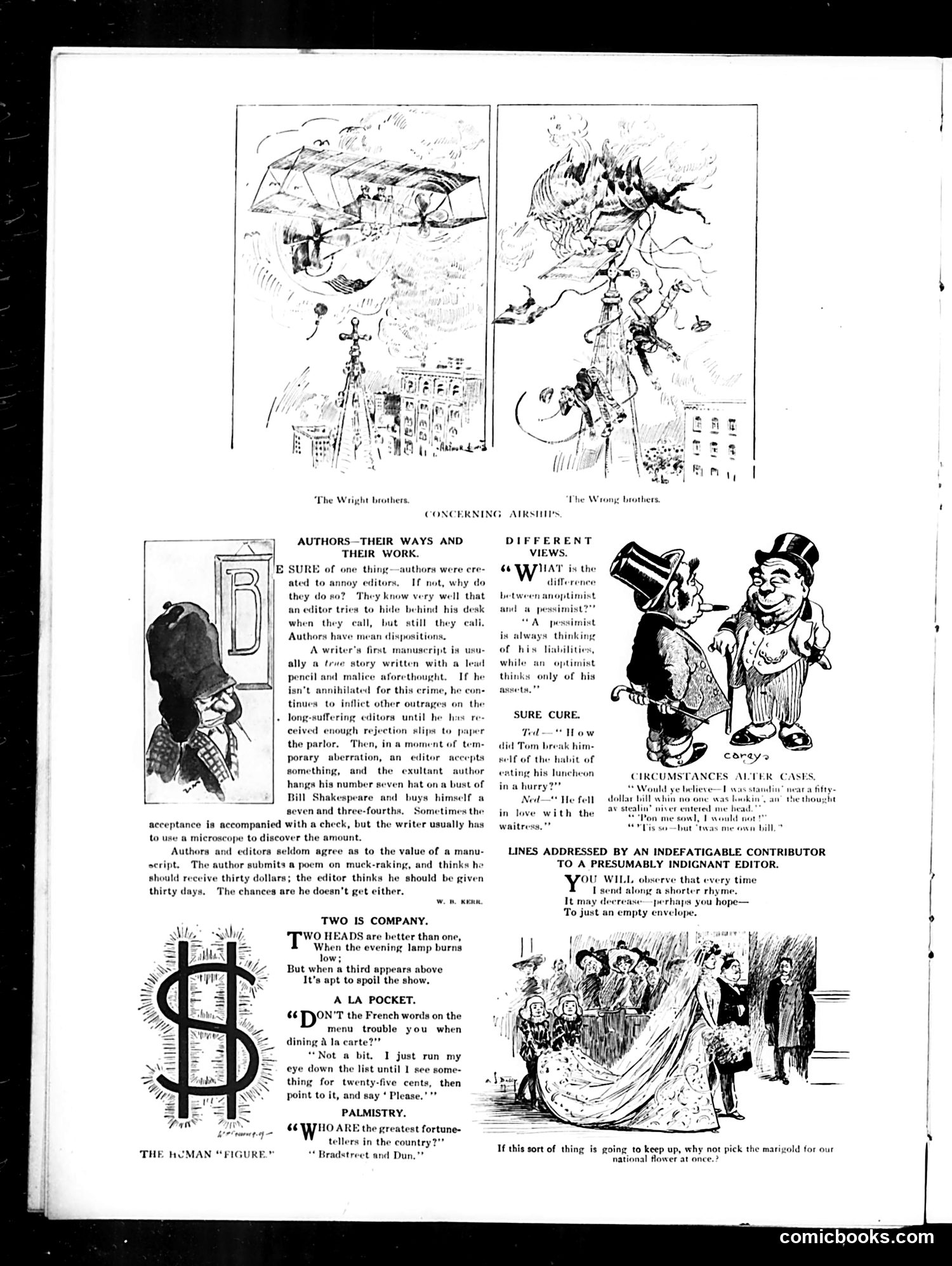
This page from *Judge* collects several unrelated satirical pieces typical of the magazine's format. **Top cartoons**: "The Wright Brothers Concerning Airships" presents two contrasting aerial disaster scenes labeled "The Wright Brothers" and "The Wrong Brothers"—satirizing the famous aviators' experiments through exaggerated catastrophe imagery. **Middle sections**: Humorous commentary on **authors and editors**—a recurring *Judge* topic—depicting their contentious relationship over manuscript payments and rejections. The "optimist vs. pessimist" dialogue and various vignettes mock both parties' pretensions. **Lower content**: Brief jokes and puns on unrelated topics: romantic complications ("Two Is Company"), French restaurant menus ("À la Pocket"), and fortune-telling companies Bradstreet and Dun. The final marigold quip appears to reference some topical debate about national symbols (unclear without more context). The page exemplifies *Judge*'s miscellaneous humor format—mixing visual satire with wordplay targeting recognizable American types: pompous authors, exasperated editors, and social pretenders.
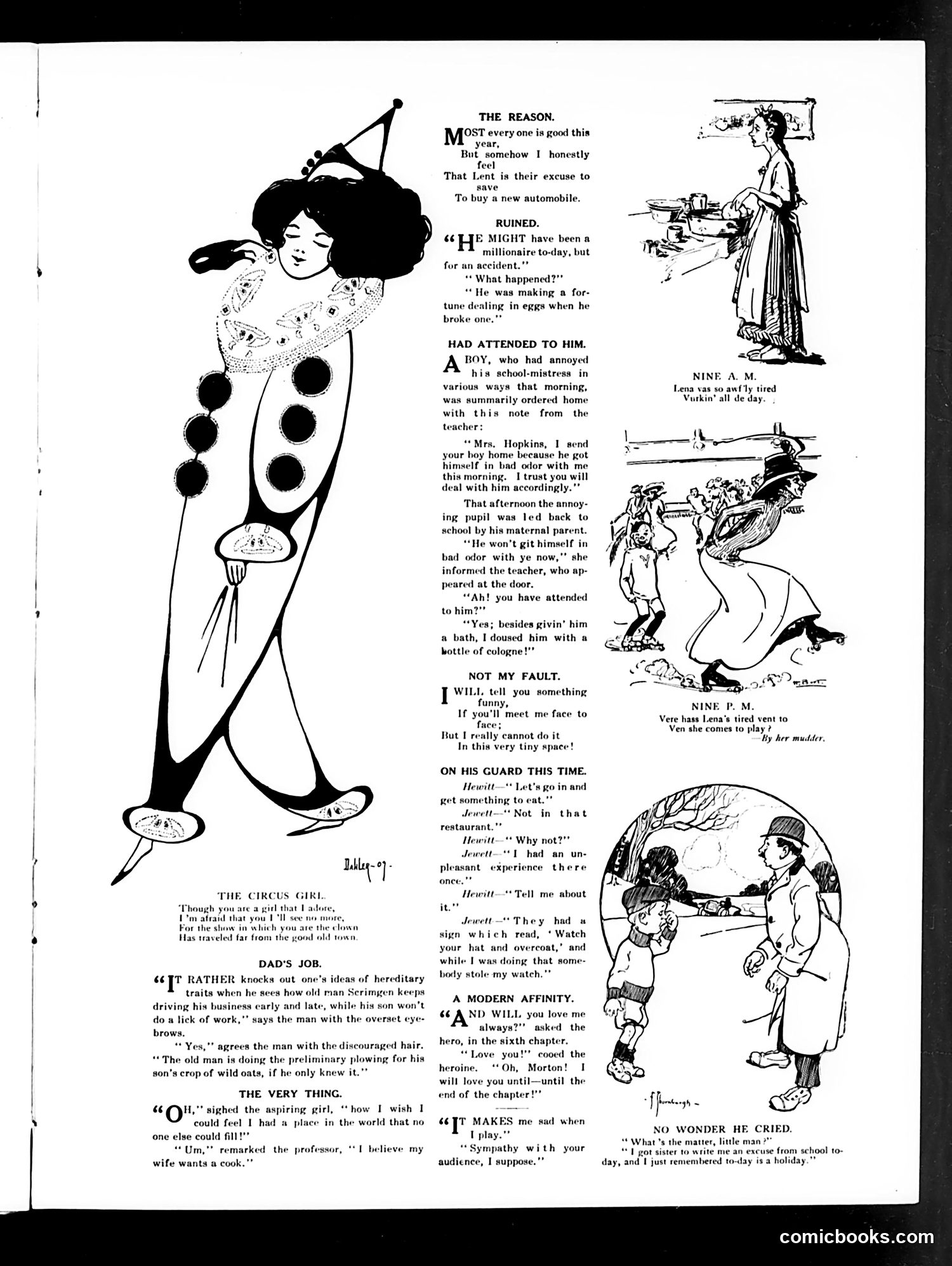
This page collects brief satirical vignettes typical of early 20th-century American humor magazines. **Key satirical themes:** - **"The Reason"**: Mocks wealthy people claiming religious observance (Lenten sacrifice) as excuse to save money for luxury purchases like automobiles—suggesting hypocrisy about materialism. - **"Dad's Job"**: Criticizes wealthy fathers who indulge sons' vices ("wild oats"), doing preliminary damage that ruins them. - **"The Very Thing"**: A professor's quip that an aspiring young woman's "irreplaceable" role is as his wife's cook—biting commentary on women's limited opportunities. - **"Had Attended to Him"**: Rural mother "fixes" misbehaving boy with cologne bath—satirizing class differences and unconventional discipline. - **"A Modern Affinity"**: Mocks sentimental romance novels where heroines promise eternal love with convenient plot-based limitations. Minor items include comic observations about carelessness, misplaced vigilance, and children's behavior. The overall tone targets pretense, materialism, and social conventions of the era.
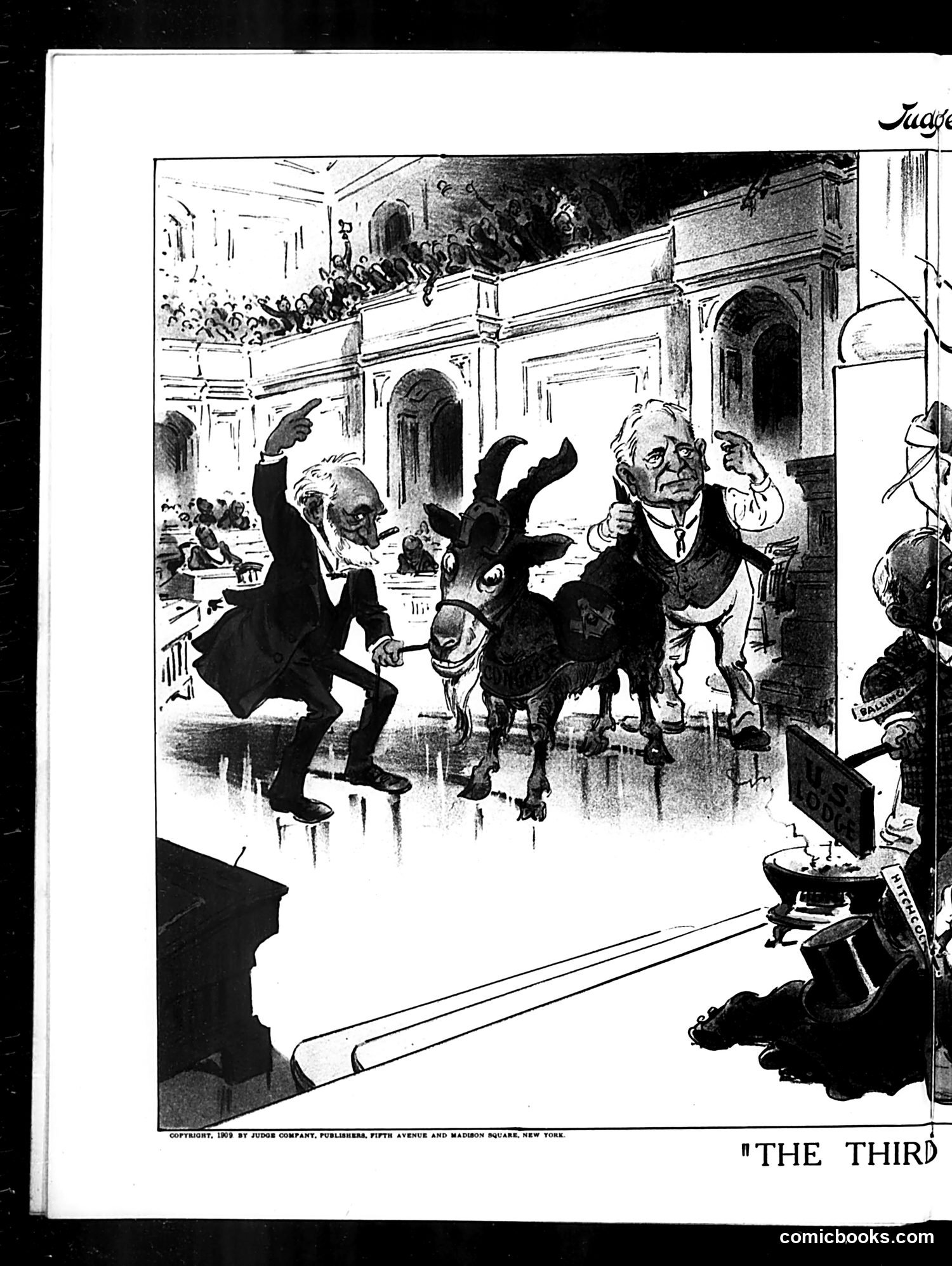
This satirical cartoon appears to depict a formal governmental or judicial proceeding. Two distinguished older gentlemen in formal dress are shown in animated, exaggerated poses—one pointing upward dramatically, the other gesturing expressively—while two goats stand between them in what seems to be a grand hall with galleries above containing spectators. The title "THE THIRD" suggests this may reference a third party, option, or candidate. The presence of goats in an otherwise formal, serious setting is the cartoon's primary joke—likely satirizing the perceived foolishness or absurdity of whatever political situation or choice is being mocked. Without additional context about Judge magazine's publication date, the specific historical event referenced remains unclear, though the formal setting and animated gestures suggest political commentary on governance or elections.
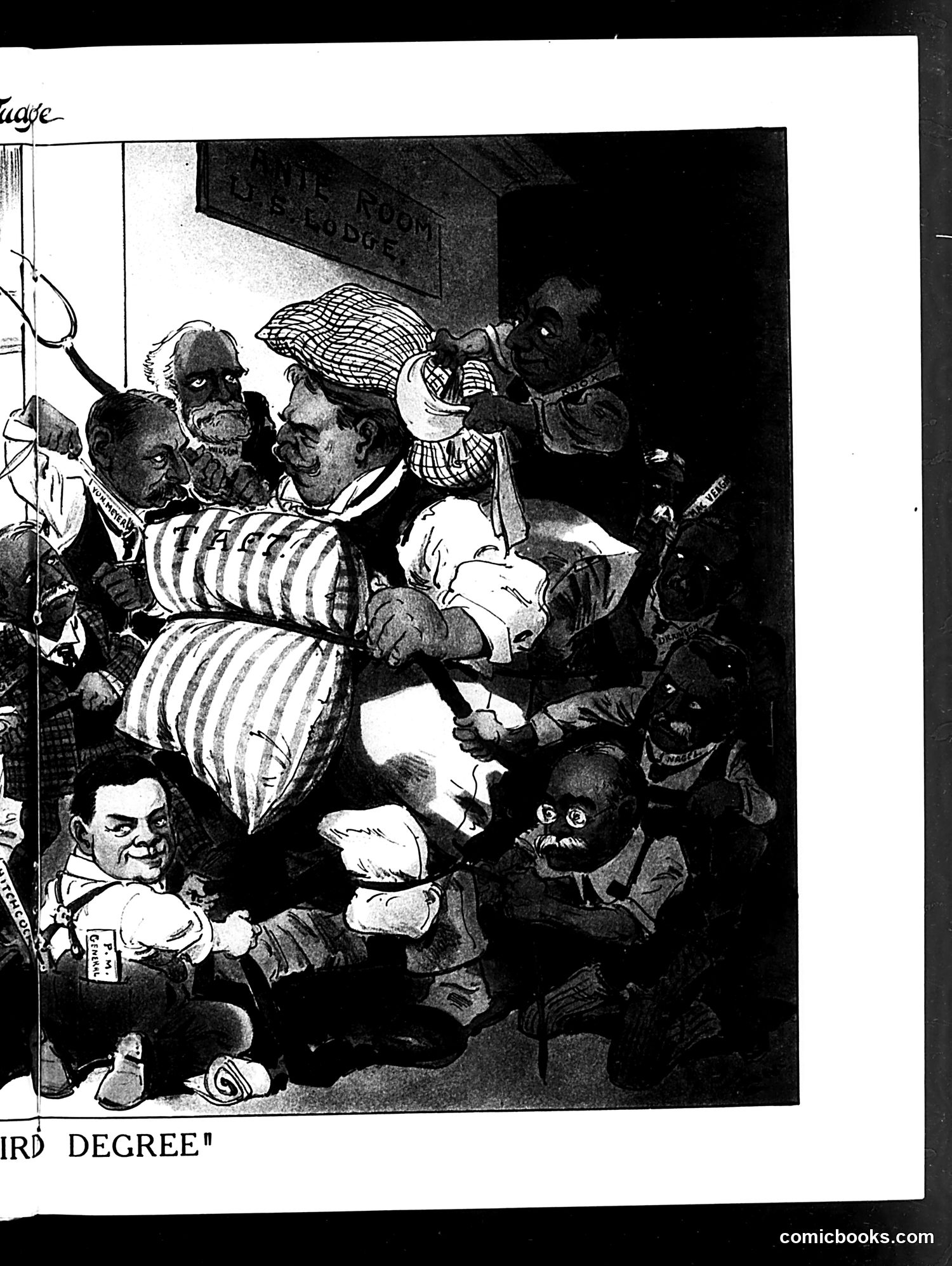
This appears to be a satirical cartoon titled "IRD DEGREE" (likely "THIRD DEGREE," with the first letter unclear in the OCR). The image depicts what looks like an interrogation or comedic confrontation scene, with multiple figures—some appearing caricatured with exaggerated features—surrounding a central figure in white clothing who is being questioned or accosted. The "third degree" refers to intense interrogation tactics. Without additional context about the publication date or clearer identification of the specific figures, I cannot definitively identify which politicians or public figures are being satirized. The cartoon appears to mock some form of aggressive questioning or investigation, likely commenting on contemporary political or social controversy, but the specific target remains unclear from this image alone.
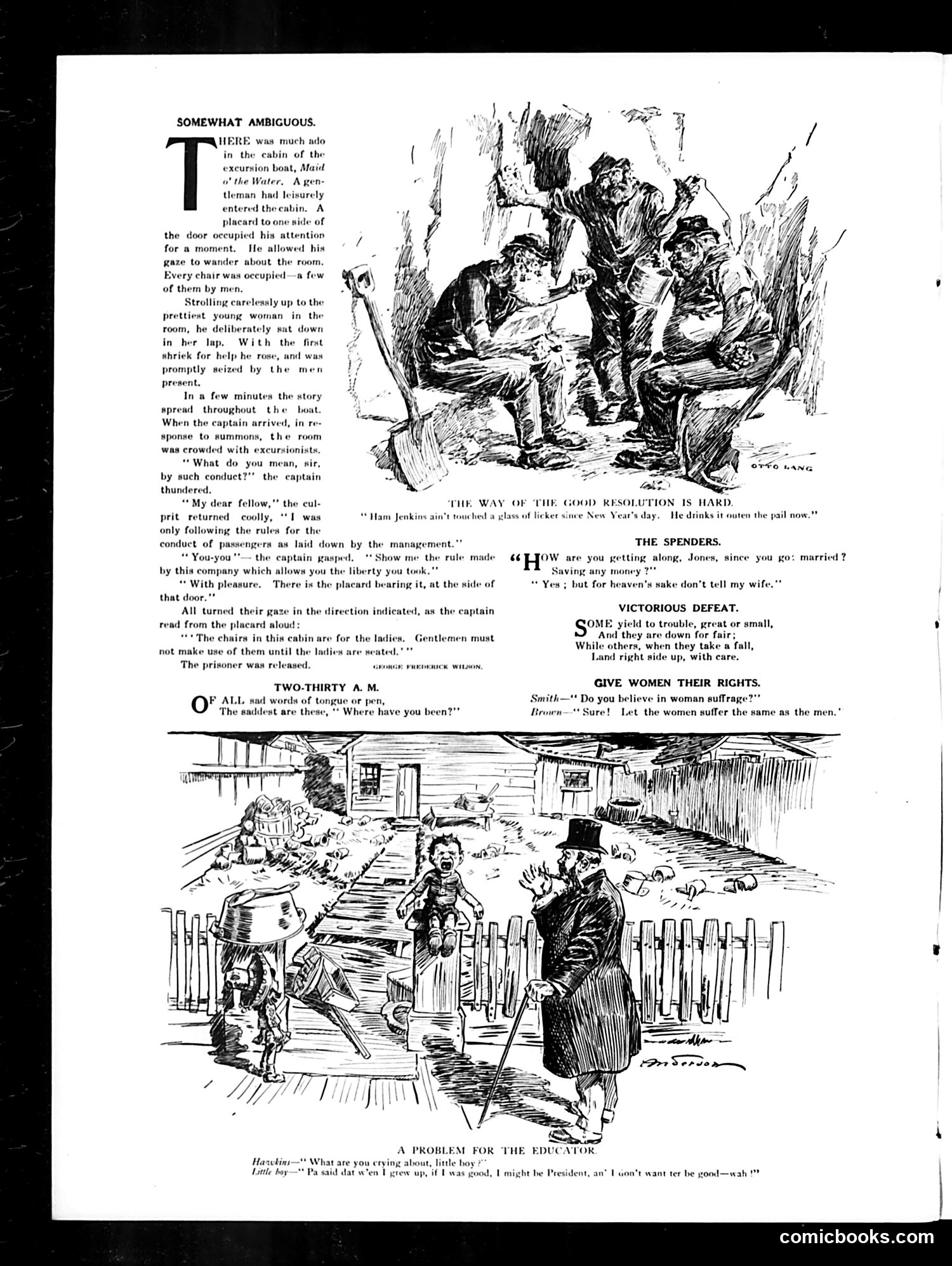
This page contains several short satirical pieces typical of early 20th-century American humor: **"Somewhat Ambiguous"** mocks ambiguous rules and literal interpretation. A man sits in a young woman's lap on an excursion boat, then defends himself by citing the posted rule: "Gentlemen must not make use of them until the ladies are seated." He interpreted this to mean chairs were unavailable, so he used her lap instead—technically following (absurd) logic while violating social decorum. **"Two-Thirty A.M."** and other brief pieces satirize drinking culture and marital finances of the era. **"Give Women Their Rights"** presents an anti-suffrage joke: when asked if he believes in women's suffrage, "Brown" says women should "suffer the same as men"—implying voting is suffering, a common anti-suffrage argument. The cartoons and text use exaggeration and wordplay to mock social conventions, rule-following gone wrong, drinking habits, and contemporary debates over women's rights—all characteristic of Judge's satirical approach to American society.
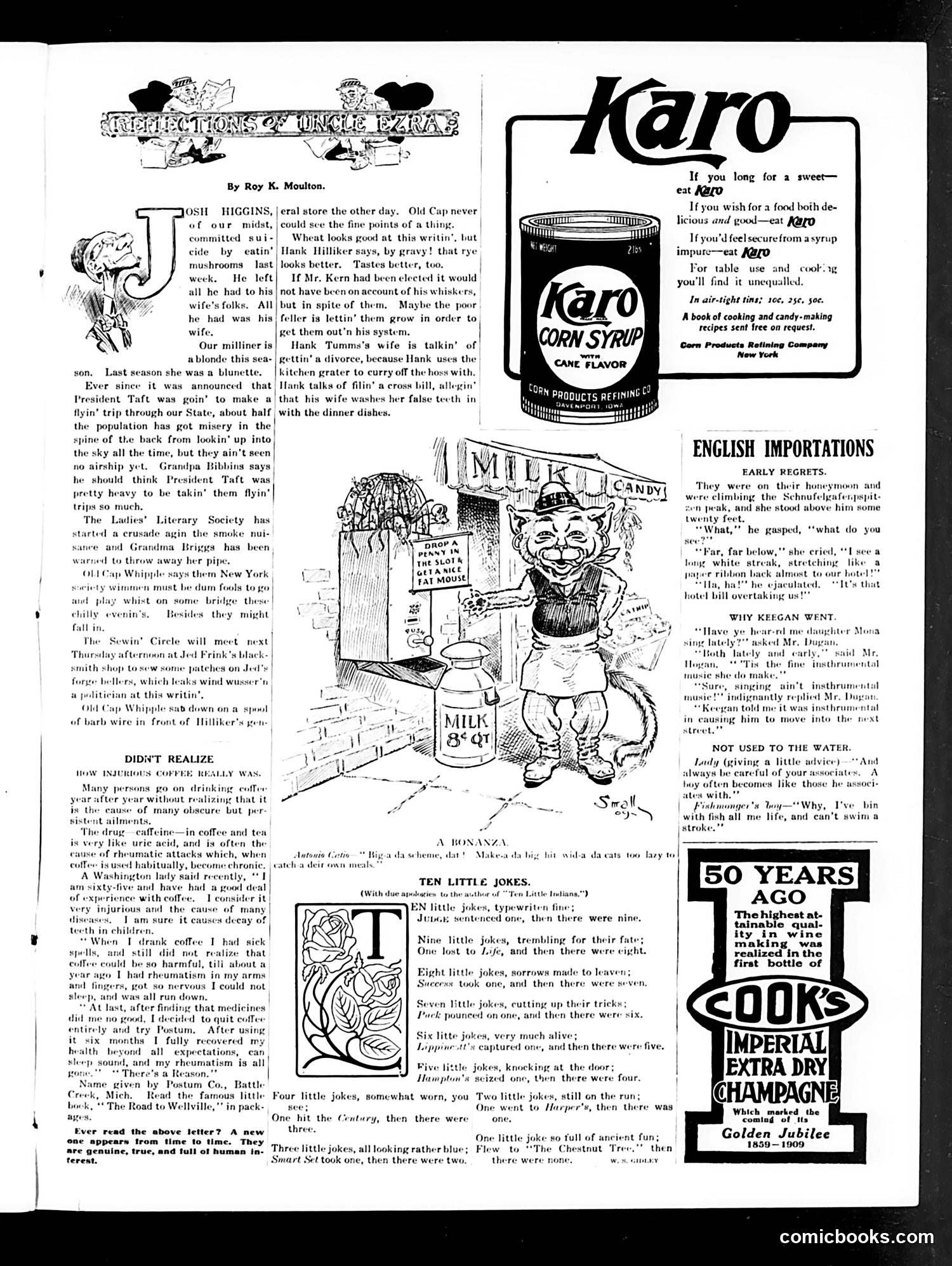
This page contains humor and advertisements from an early 20th-century American satirical magazine. **Main Content:** The lead article, "Injections of Uncle Ezra's" by Roy K. Moulton, is rural gossip-column humor featuring small-town characters like "Hank Hilliker" and "Old Cap." The jokes target contemporary figures—President Taft's planned flying trips (early 1900s novelty) and someone named "Mr. Kern" (possibly a local politician). The humor is gentle small-town satire: wives washing false teeth, village social clubs, and rural concerns about modern technology. **Sidebars include:** - "Ten Little Jokes" (parody of "Ten Little Indians") - "English Importations" (light anecdotes about tourists) - Period advertising for Karo corn syrup and Cook's champagne **For modern readers:** This reflects a pre-WWI America fascinated by emerging technology (airships), still predominantly rural-minded, and comfortable with casual period stereotypes. The humor relies on recognizable local types rather than political scandal.
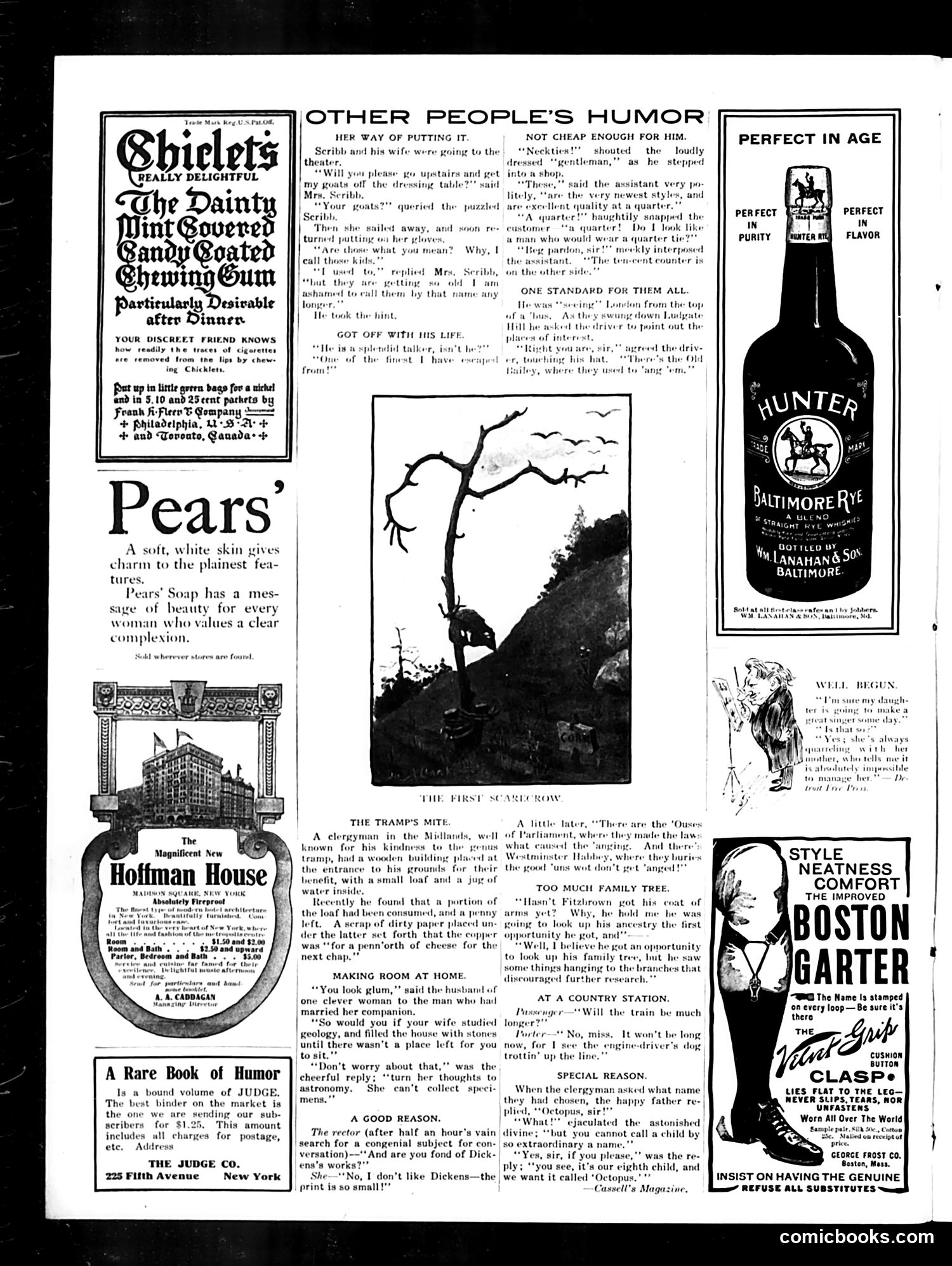
This page is primarily **advertisements and humor filler** typical of early 20th-century satirical magazines. The main illustrated cartoon, "The First Scarecrow," shows a figure on a bare tree branch—a simple visual gag about scarecrows, without apparent political content. The text sections labeled "Other People's Humor" are brief comedic anecdotes, including: - A marital joke about a wife calling her children "goats" - A tramp leaving a penny with a loaf of bread he's eaten - Domestic humor about wives pursuing geology or astronomy - A rector struggling in conversation **The satire is entirely domestic and domestic-life focused**—no identifiable political figures or events. The page mostly showcases **period advertising** (Chiclets gum, Pears' Soap, the Hoffman House hotel, Boston Garters) alongside light miscellaneous humor meant to fill space between more substantial editorial content. This reflects Judge's format: a mix of advertisements funding the publication, with brief jokes and illustrations providing entertainment value to readers.
This Judge magazine page is primarily **advertising and humor columns**, not political cartoons. The content consists of: **"Jokes from Contemporaries"**: Brief humorous exchanges reprinted from other publications, covering domestic situations (marriages, relationships) and absurdist scenarios (an alligator swallowing a man). These rely on period comedic conventions—wordplay, unexpected punchlines, and observations about courtship and marriage. **"The Change"**: A poem lamenting the end of Theodore Roosevelt's presidency, referencing his "strenuous life," "big stick" diplomacy, and aggressive congressional rhetoric. It humorously suggests post-Roosevelt Washington will be duller. **Advertisements**: Old Overholt Rye whiskey and a Guy de Maupassant book collection dominate the page visually. The humor is largely apolitical—mostly domestic comedy with one Roosevelt-era reference. Without specific dates visible, the exact year is unclear, but the Roosevelt reference suggests early 1900s.
This page is primarily **advertising with light humor content**. The central section contains brief joke vignettes titled "Cap and Gown Humor," likely referencing college life and young men's social interactions. The jokes focus on **courtship and social awkwardness**: one depicts a young man from the "woolly West" attempting to impress a Parisian-dressed woman on a Boston streetcar; another shows competitive "fussers" (suitors) competing for a girl's attention; a third describes a youth being "squelched" while courting. **The satirical point**: These represent genteel mockery of young men's romantic fumbling and class-consciousness of the era—the contrast between Western informality and Eastern sophistication, the competitive posturing of multiple suitors, and social mortification when romantic advances fail. The surrounding advertisements (Sunny Brook Whiskey, Mosler Safes, Philip Morris Cigarettes) represent typical Judge magazine content mixing commercial sponsorship with satirical humor aimed at educated, affluent readers.
This page from **Judge** (circa 1909) consists primarily of **short humorous anecdotes** rather than political cartoons. The content reflects early-20th-century satirical humor targeting common domestic and social situations. Key pieces include jokes about: - **German attitudes toward money and propriety** (the fiancée's dowry dilemma; the "shopgirl" deception) - **Marriage dynamics** (husbands denying wives allowances; widowers assessing new wives by wealth) - **Class and gender relations** (the pretty girl's disguise to avoid male attention; the professor's interest in investigating "microbes in kisses") - **Parental concerns** (the child's practical question about his new stepmother's finances) The page is dominated by **advertising** for products (White Rock water, Easter prints, design services, and Keepwell remedy). The humor is genteel and conventional—aimed at middle-class readers amused by marital sparring, social pretense, and the foibles of "modern" life. The frequent attribution to German publications (*Fliegende Blätter*, *Meggendorfer Blätter*) suggests imported European humor was popular with American readers.