
Judge, 1909-03-20 · page 7 of 16
Judge — March 20, 1909 — page 7: what you’re looking at
What you’re looking at
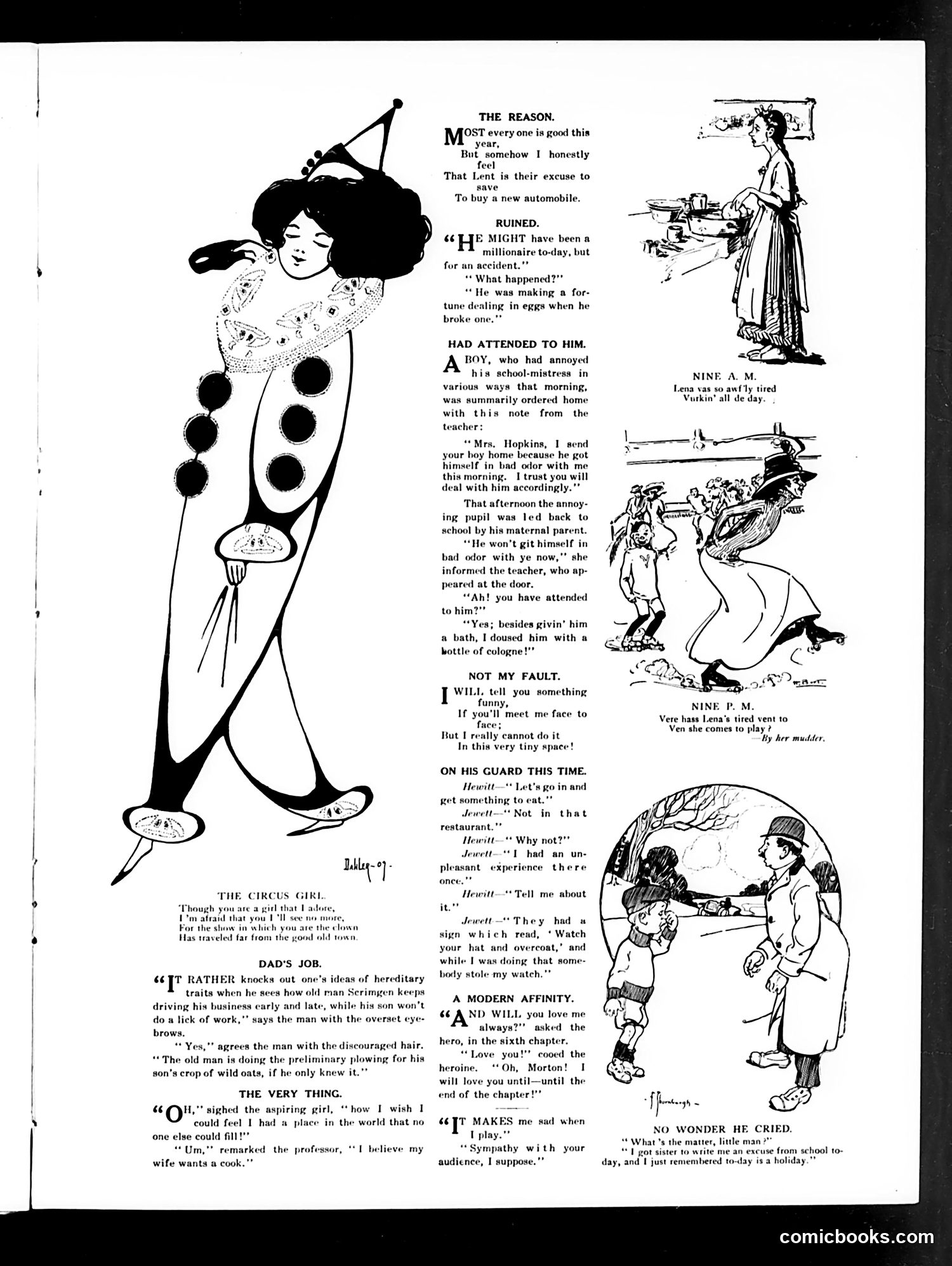
This page collects brief satirical vignettes typical of early 20th-century American humor magazines. **Key satirical themes:** - **"The Reason"**: Mocks wealthy people claiming religious observance (Lenten sacrifice) as excuse to save money for luxury purchases like automobiles—suggesting hypocrisy about materialism. - **"Dad's Job"**: Criticizes wealthy fathers who indulge sons' vices ("wild oats"), doing preliminary damage that ruins them. - **"The Very Thing"**: A professor's quip that an aspiring young woman's "irreplaceable" role is as his wife's cook—biting commentary on women's limited opportunities. - **"Had Attended to Him"**: Rural mother "fixes" misbehaving boy with cologne bath—satirizing class differences and unconventional discipline. - **"A Modern Affinity"**: Mocks sentimental romance novels where heroines promise eternal love with convenient plot-based limitations. Minor items include comic observations about carelessness, misplaced vigilance, and children's behavior. The overall tone targets pretense, materialism, and social conventions of the era.
📄 Transcribed text from this page (OCR, searchable)
Machine-transcribed from the original scan — historical spelling and the odd misread are preserved.
° THE CIRCUS GIRL. “Though you are a gitl that E I'm afraid that you Ell see For the show in whieh y Has traveled far from the the clown ad old town DAD'S JOB. 66 JT RATHER knocks out one’s ideas of hereditary traits when he sees how old man Scrimgen keeps: 3 carly says the man with the o driving his busi do a lick of work, brows. “ Yes,"’ agrees the man with the discouraged hair. “The old man is doing the preliminary plowing for his son's crop of wild oats, if he only knew it.”” THE VERY THING. 66 Q)H," sighed the aspiring girl, “how I wish I could feel 1 had a place in the world that no one else could fill!”” “Um,” remarked the profes wife wants a cook." sor, “1 believe my THE REASON. Mot every one is good this year, But somehow I honestly feel That Lent is their excuse to save To buy a new automobile. RUINED. 66 LJE MIGHT have been a H millionaire to-day, but for an accident.” “What happened?”* “He was making a for- tune dealing in eggs when he broke one.” HAD ATTENDED TO HIM. A BOY, who had annoyed his school-mistress in various ways that morning, was summarily ordered home with this note from the teacher: “Mrs, Hopkins, 1 send your hoy home because he got himself in bad odor with me this morning. I trust you will deal with him accordingly. ‘That afternoon the annoy- ing pupil was led back to school by his maternal parent. “He won't git himself in bad odor with ye now," she informed the teacher, who ap- peared at the door. “Ah! you have attended to him?” “Yea; besides givin’ him a bath, I doused him with a bottle of cologne!”* NOT MY FAULT. WILL tell you something funny, If you'll meet me face to face; But I really cannot do it In this very tiny space! ON HIS GUARD THIS TIME. Hewitt—" Let's go in and get something to eat.” dewett—" Not in that restaurant. Hewitt" Why not?" Jewett "1 had an un- pleasant experience there once."" Hewitt" Tell me about yi Jewett" They had a sign which read, * Watch your hat and overcoat,’ and while I was doing that some- body stole my wateh."? A MODERN AFFINITY. 66 AND WILL you love me always?” asked the hero, in the sixth chapter. “Love you!" cooed the heroine. ‘Oh, Morton! I will love you until—until the A end of the chap’ me sad when T pla ympathy with your audience, I suppose.” “What 's the matter, little man?” “TL got sister tov day, and I just remembere NINE A. M. Lena vas so awf ly tired tkin’ all de day. NINE P. M. Vere hass Lena’s tired vent to Ven she comes to play ? Ry her mudder, NO WONDER HE CRIED. ¢ from school to- oliday."” to-day is a comicbooks.com