
A complete issue · 16 pages · 1909
Judge — February 20, 1909
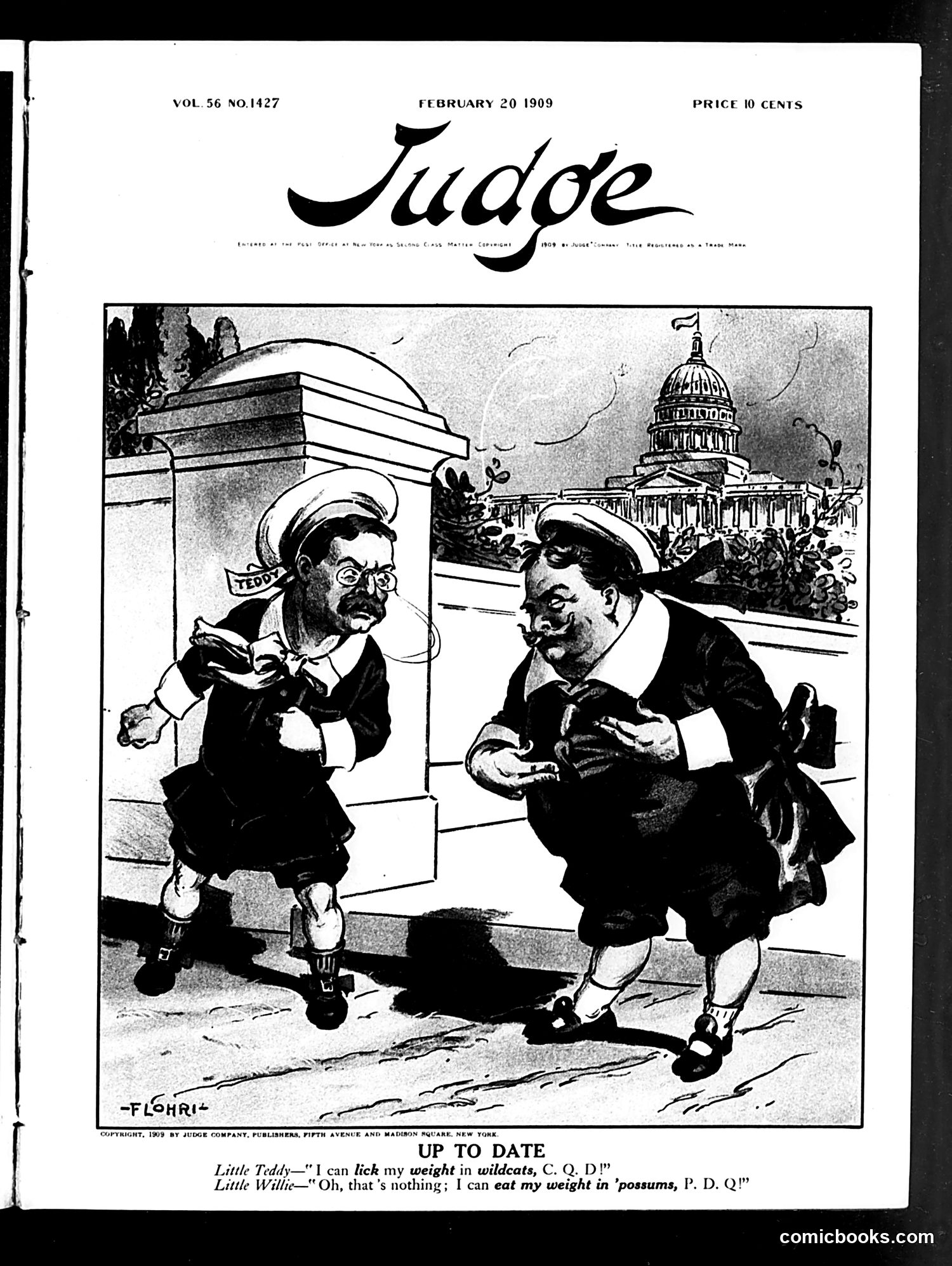
This satirical cartoon depicts two rotund, caricatured figures labeled "Little Teddy" and "Little Willie" in conversation before the U.S. Capitol building. The figures appear to represent political leaders, likely Theodore Roosevelt and a European counterpart (possibly Kaiser Wilhelm II, given the "Willie" reference). The satire concerns military strength and power projection. "Teddy" boasts he can "lick [his] weight in wildcats" (defeat opponents), while "Willie" counters that he can "eat [his] weight in 'possums"—a crude comparison suggesting America's confidence versus European military capabilities. The joke plays on contemporary debates about American naval power and international standing during the Roosevelt presidency.
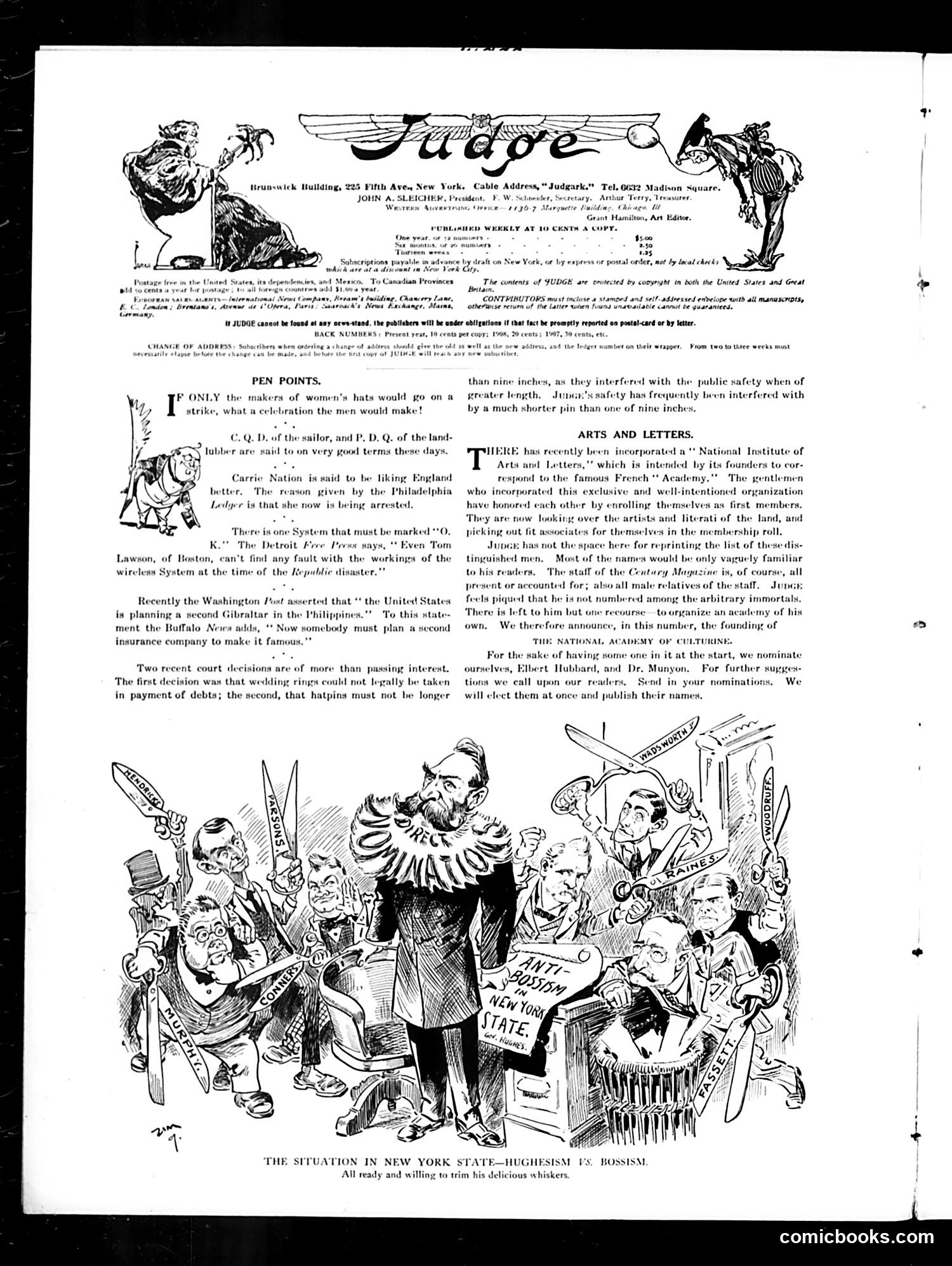
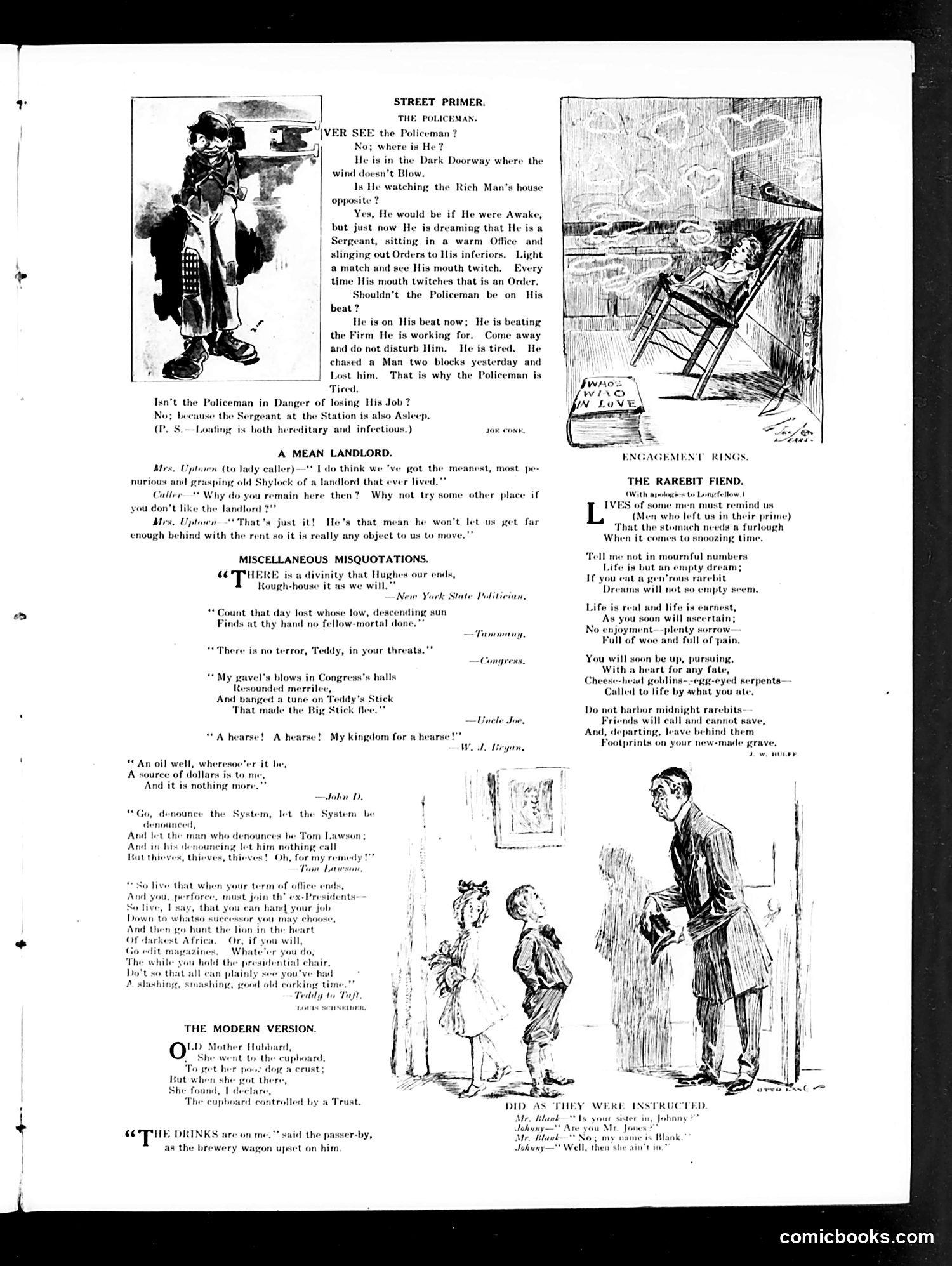
This page contains several satirical pieces targeting early 20th-century social issues: **"The Policeman"** mocks a sleeping officer neglecting duty while supposedly patrolling a wealthy neighborhood. The satire suggests police corruption or incompetence—the officer dreams of being a "Sergeant" while shirking actual work. **"A Mean Landlord"** depicts landlord-tenant conflict, with a landlord refusing to maintain properties while extracting high rent. **"Engagement Rings"** and **"The Rarebit Fiend"** appear to be lighter social commentary on marriage and relationships. The page also includes **miscellaneous quotations** critiquing Congress, the political system, and Tom Lawson (likely referencing contemporary reform debates). **"The Modern Version"** parodies "Mother Hubbard," updating the nursery rhyme to satirize trusts controlling consumer goods. Overall, the page reflects Progressive-era criticism of institutional corruption, labor exploitation, and monopolistic business practices.
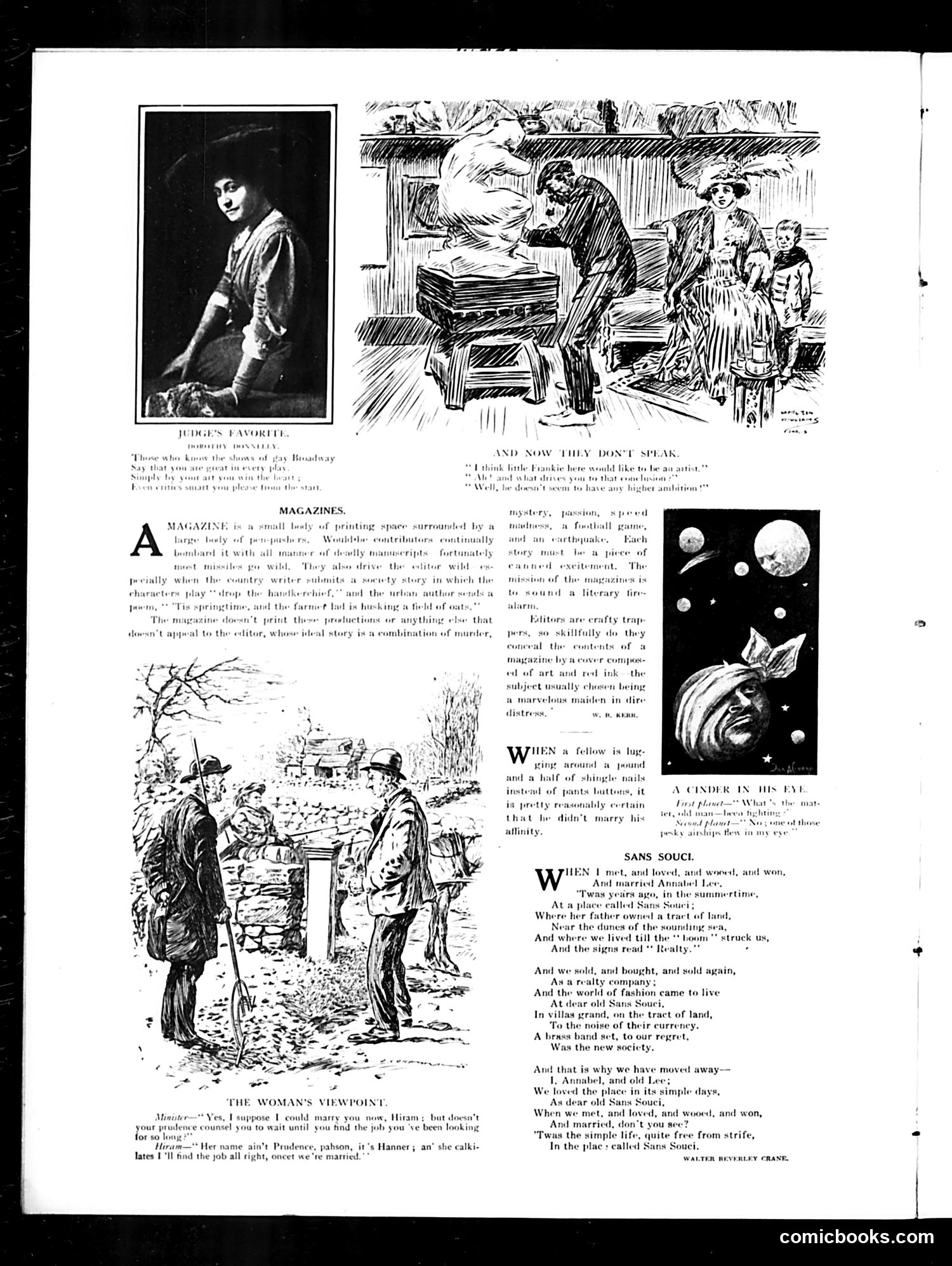
This page contains literary and humorous content rather than political satire. The main features include: **"Judge's Favorite"** — A portrait photograph (top left) of an unnamed woman, likely a celebrity or society figure popular with the magazine's readers. **"And Now They Don't Speak"** — A domestic comedy sketch showing a couple in tension, with dialogue suggesting marital discord over finances or household matters. **"Magazines"** — An essay discussing how magazines function as a medium for serialized fiction, edited content, and illustrated stories. It explains editorial practices of the era. **"Sans Souci"** — A poem by Walter Beverley Crane about marriage and rural life, reflecting nostalgic themes common to early 20th-century literature. The page emphasizes entertainment and social commentary through humor and verse rather than political critique.
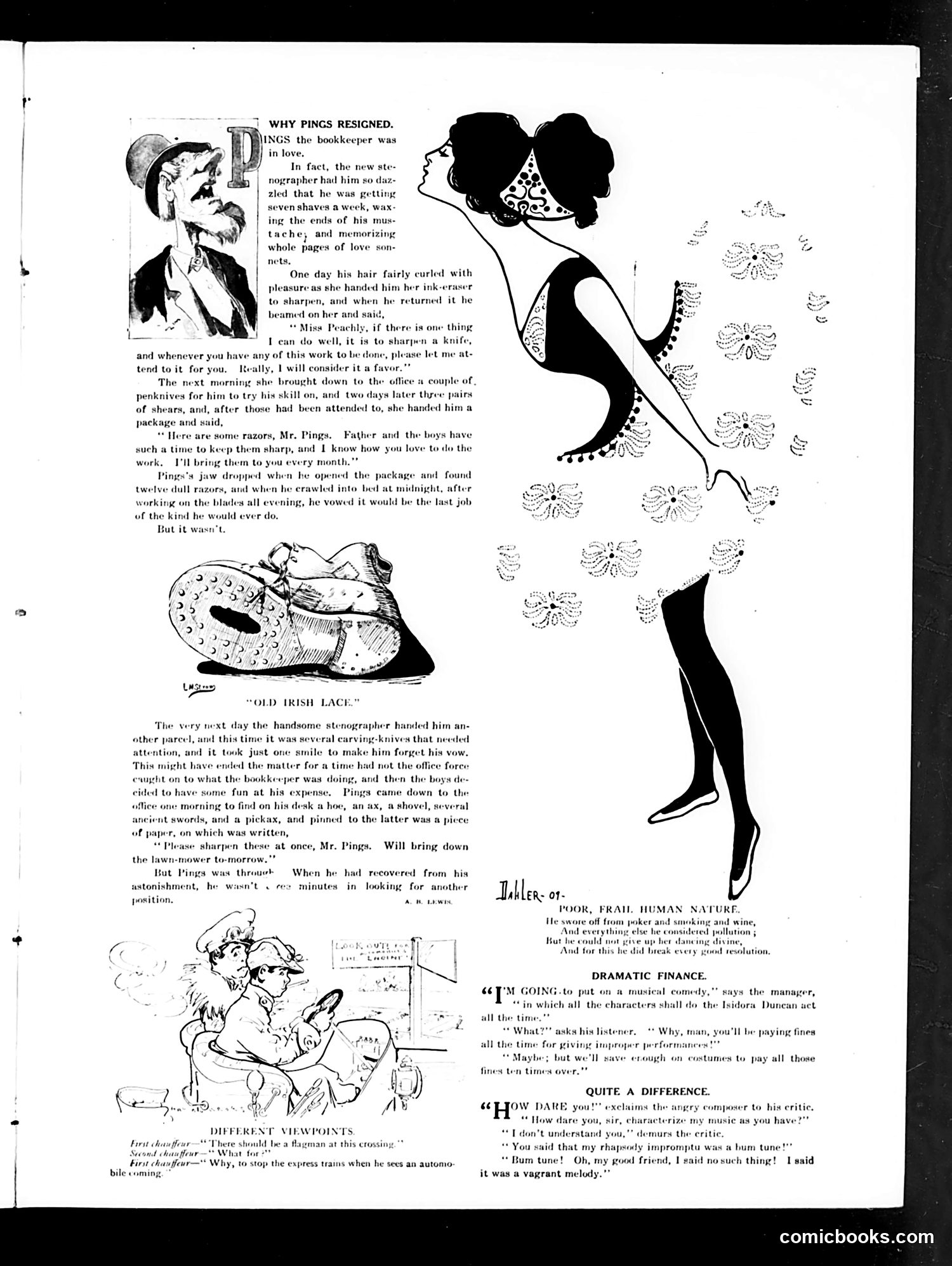
This page contains three separate humorous pieces from Judge magazine: 1. **"Why Pings Resigned"**: A story about a bookkeeper in love who receives beauty treatments (shaves, manicures) from his girlfriend, then resigns after she gifts him razor-sharpening supplies—the joke being he's henpecked and the razors are a mockery. 2. **"Hiller of Poor, Frail Human Nature"**: A short philosophical piece about human weakness and good intentions. 3. **"Dramatic Finance"** and **"Quite a Difference"**: Brief dialogue jokes about musical comedy performers and a composer-critic dispute over musical taste. The page combines domestic comedy (the Pings story mocking male domestication) with theatrical humor. No specific political figures are caricatured; instead, these are generic social satires targeting everyday folly—relationships, vanity, and artistic pretension—typical of Judge's middle-class audience humor.
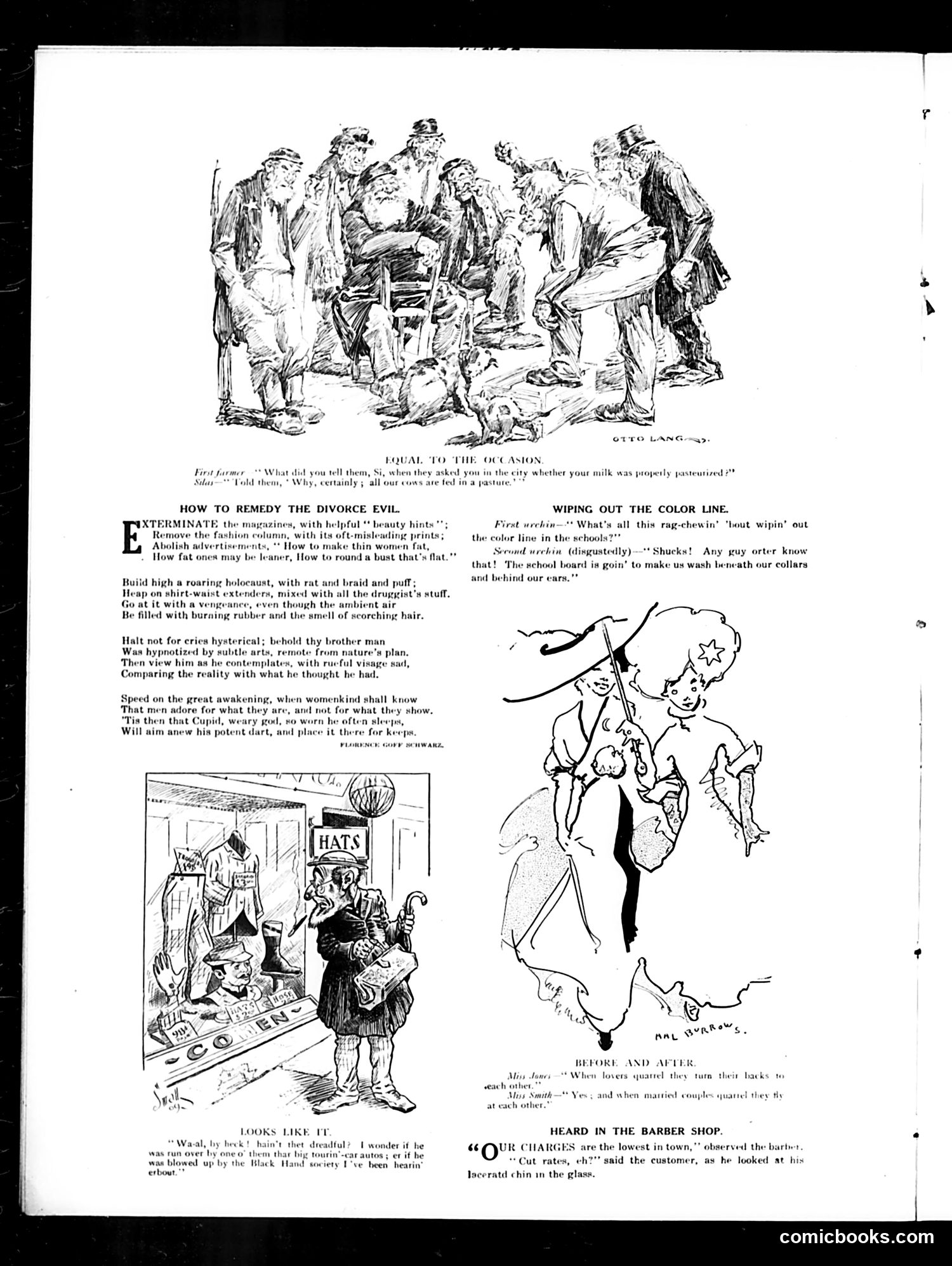
This page contains multiple satirical pieces typical of early 20th-century American humor: **"Equal to the Occasion"** mocks rural farmers' deception about food safety—a farmer claims his milk is "properly pasteurized" when actually all cows are kept in pasture, exploiting urban consumers' ignorance. **"How to Remedy the Divorce Evil"** satirizes women's fashion and beauty practices (corsets, padding, extensions) as deceptive, suggesting men would stop divorcing if women showed their "natural" selves. This reflects period anxieties about women's appearance manipulation. **"Wiping Out the Color Line"** presents child characters dismissing school board efforts to end racial segregation by joking that "wiping out the color line" literally means forcing students to wash behind their ears and under collars—wordplay mocking civil rights initiatives as trivial hygiene concerns. The remaining pieces are light comedic sketches about barber shops and marital dynamics. The page reflects Progressive Era social commentary mixed with casual racism and sexism typical of the era's mainstream satire.
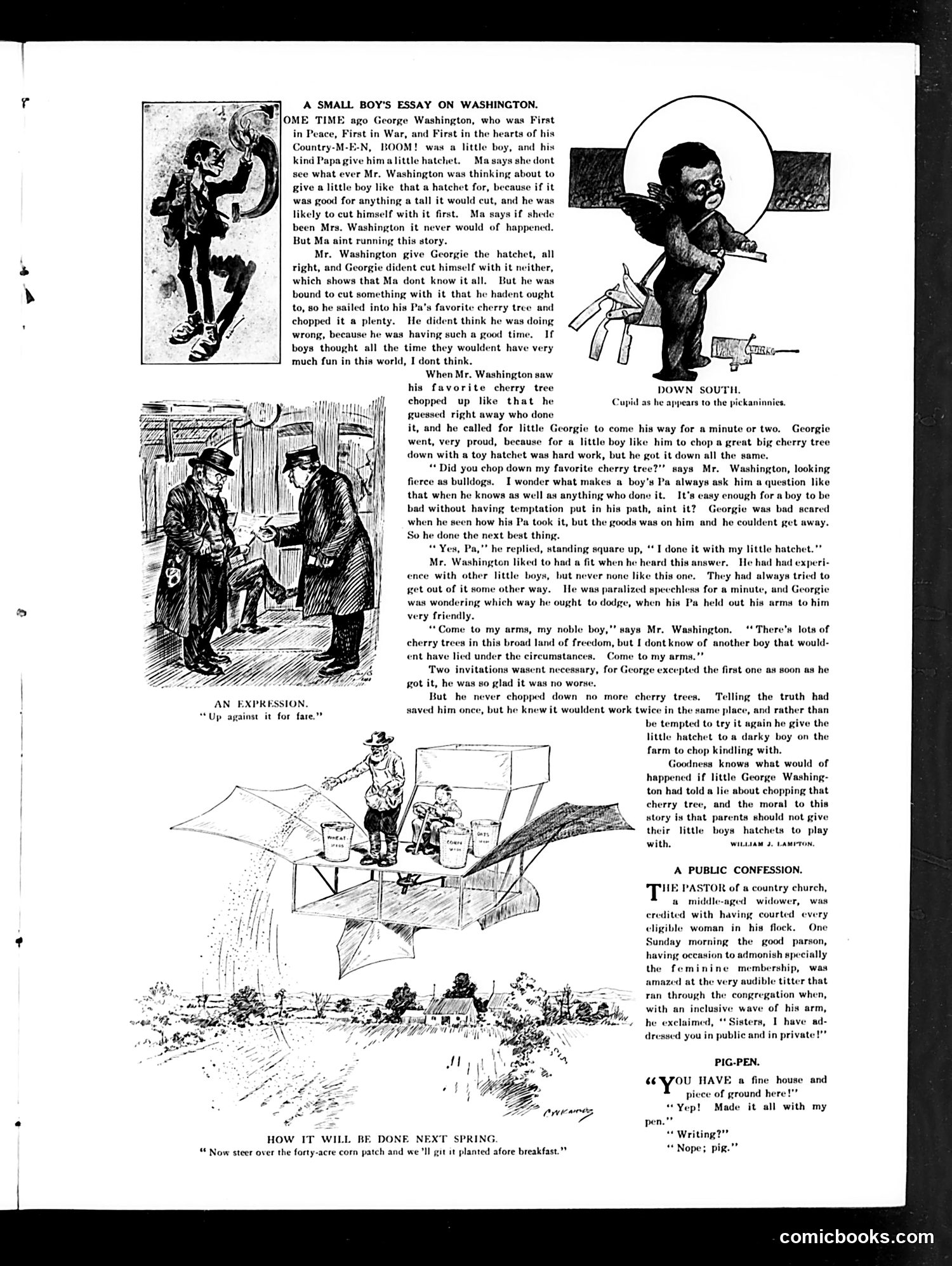
This page contains three distinct pieces, primarily satirical commentary on American society circa early 1900s. **"A Small Boy's Essay on Washington"** is a humorous retelling of the famous (apocryphal) cherry tree story. The satire mocks both the Washington legend and parenting—the narrator questions why any father would give a child a weapon-like hatchet, and concludes the moral isn't about honesty but that "parents should not give their little boys hatchets to play with." The story is written in a deliberately childlike voice with grammatical errors for comedic effect. **"An Expression"** cartoon depicts two working-class men discussing moral standards. **"A Public Confession"** satirizes a country preacher who had courted every eligible woman in his congregation. When he publicly admonishes the women's behavior, they tittering audibly—his hypocrisy is exposed. The "Pig-Pen" fragment at bottom appears incomplete. The page mixes gentle moral humor with social observation about American rural and small-town life.
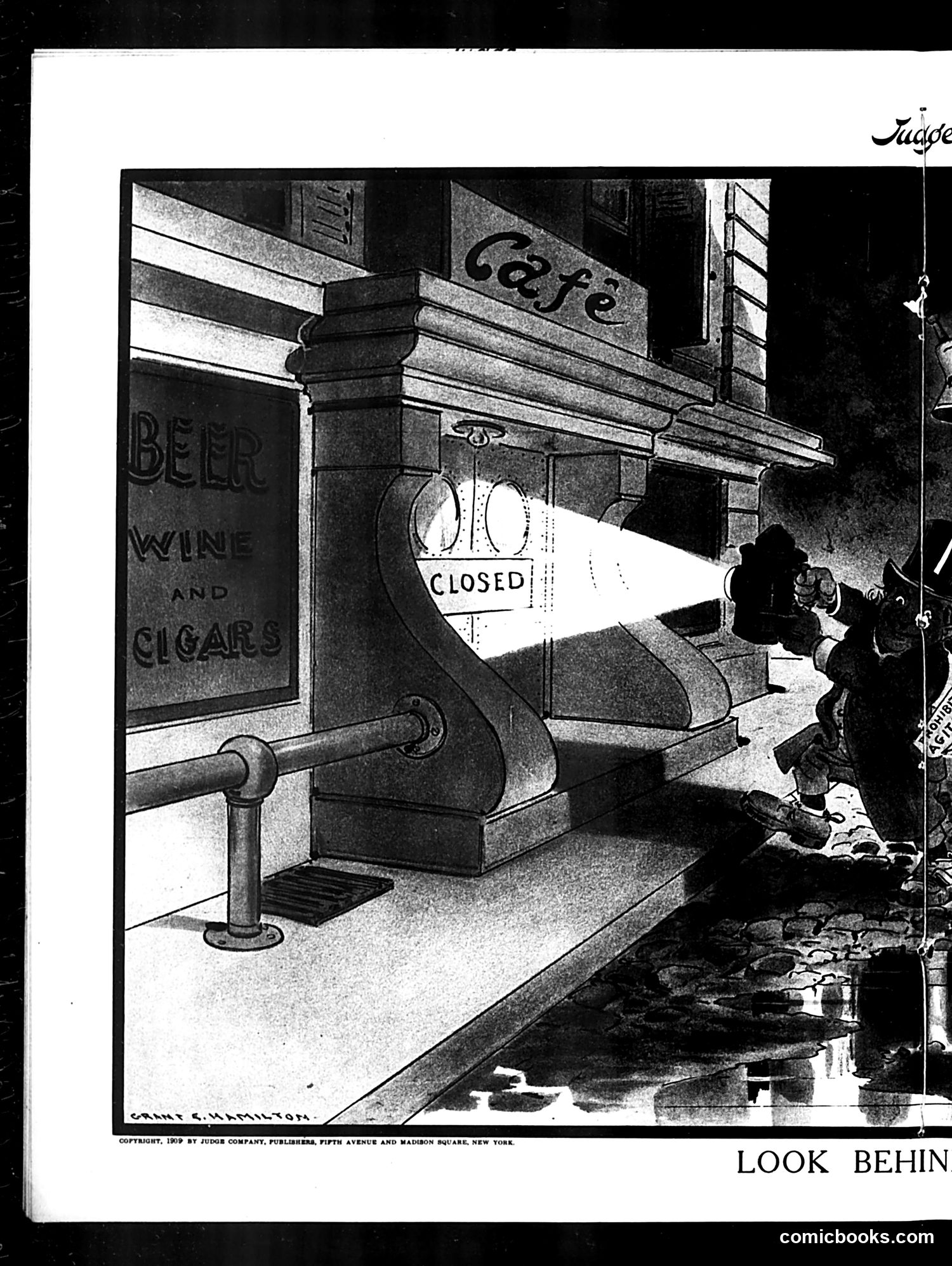
This Judge magazine cartoon satirizes Prohibition's impact on businesses. The storefront advertises "BEER, WINE AND CIGARS" but displays a prominent "CLOSED" sign. A figure peers through the window with a flashlight, suggesting people were reduced to looking for illicit establishments during alcohol prohibition. The joke targets the hypocrisy and unintended consequences of Prohibition: legitimate businesses shuttered while demand for alcohol persisted, driving commerce underground. The "look behind" likely refers to finding speakeasies or illegal operations hidden from public view. The cartoon critiques how Prohibition created a black market rather than eliminating drinking, making enforcement difficult and economic activity invisible. This reflects contemporary debate about Prohibition's practical failures before the constitutional amendment's 1920 passage.
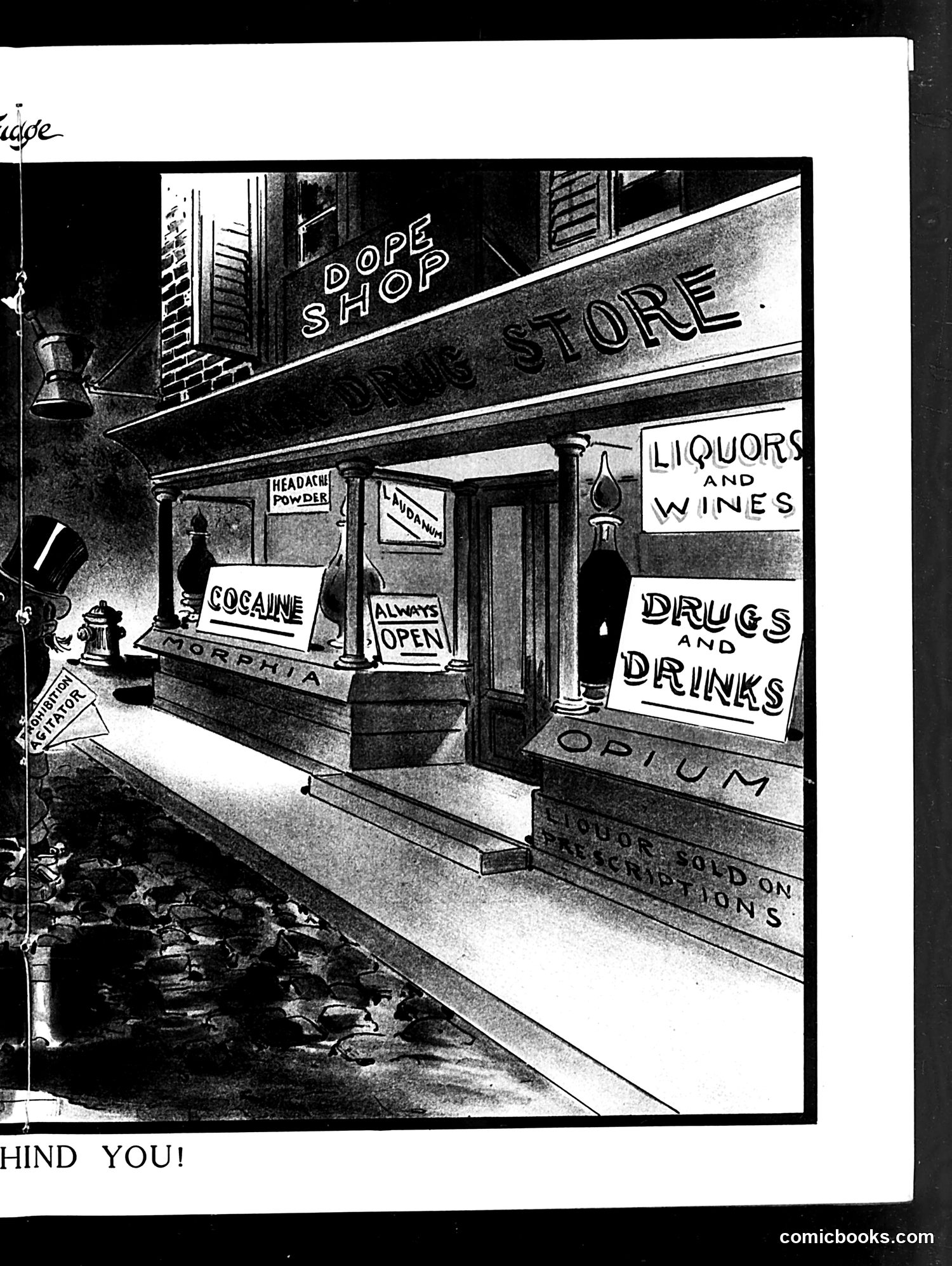
This appears to be a Prohibition-era satirical illustration from *Judge* magazine. The cartoon depicts a storefront labeled "Dope Shop" openly advertising illegal substances: cocaine, headache powder, morphia, and "liquors and wines." Signs reading "Always Open" and "Drugs and Drinks" mock the transparent illegality of the operation. The satire targets how Prohibition-era drug dealers operated openly despite laws supposedly banning such commerce. The storefront's brazen advertising suggests law enforcement's ineffectiveness or complicity. The phrase "Hind You!" (visible at bottom) may be a caption completing the joke, though it's partially unclear. This commentary reflects public frustration with Prohibition's failure to eliminate illegal drug and alcohol sales during the 1920s-1930s.
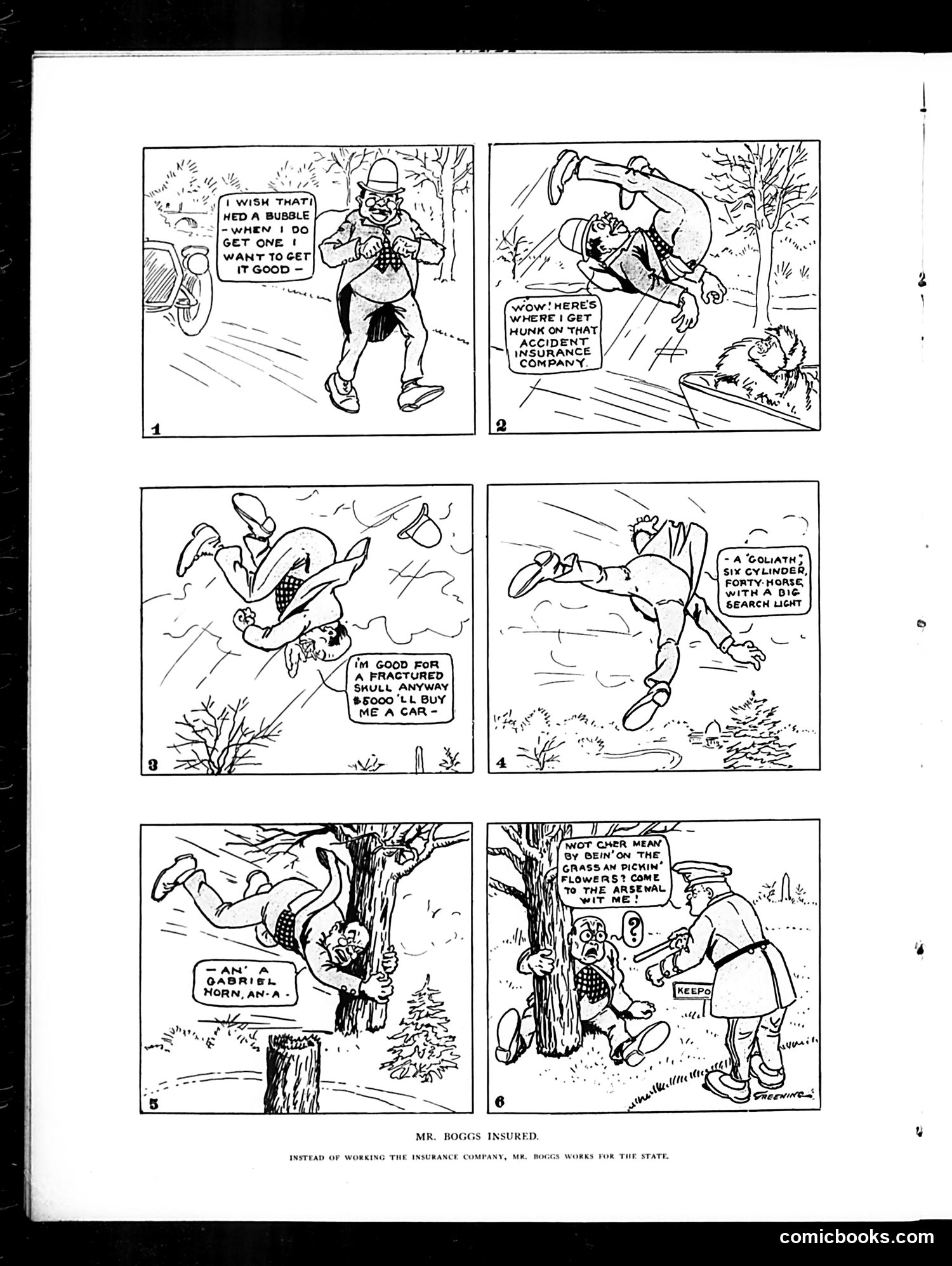
This comic satirizes workers' compensation insurance fraud. Mr. Boggs, apparently a state employee, deliberately injures himself to collect insurance payouts—first seeking "a bubble" when wanting money, then contriving accidents (a fractured skull, claiming six-cylinder forty-horse power). The final panel shows a park keeper catching him on the grass picking flowers instead of working, exposing his scheme. The caption's punchline—that instead of the insurance company supporting him, "Mr. Boggs works for the state"—suggests he's defrauding public/state insurance by feigning injuries. The satire targets both corrupt workers and the vulnerability of government insurance systems to exploitation.
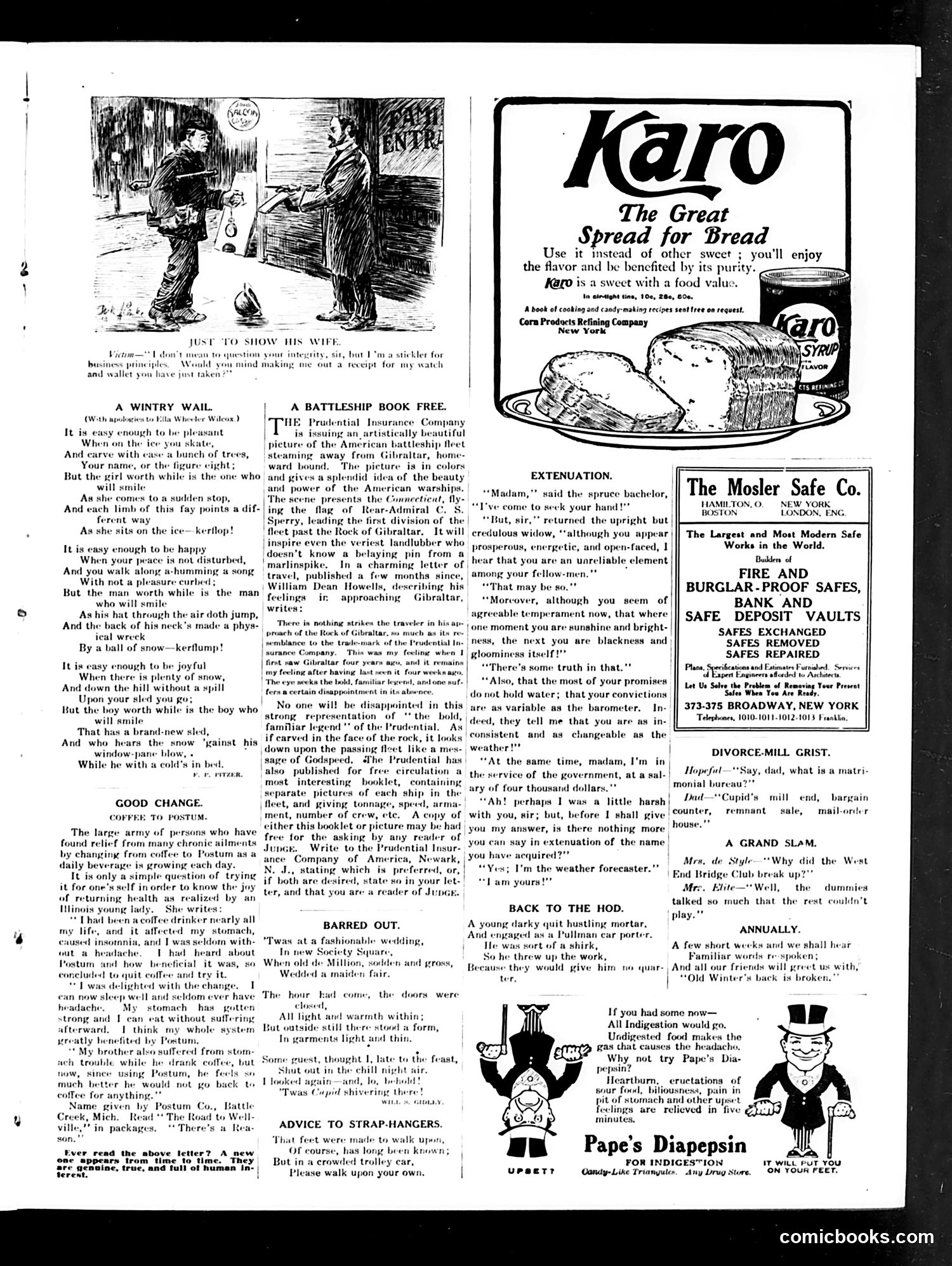
This page contains multiple humorous pieces typical of Judge's satirical style: **Main Cartoon ("To Show His Wife")**: A man encounters another on the street with a receipt for a lost wallet. The humor plays on the mundane—he's making excuses about business principles to justify keeping it rather than returning it, which his wife presumably won't believe. **Poetry Sections**: "A Wintry Wail" and other verses use slapstick humor about slipping on ice and mishaps—celebrating the man who maintains dignity despite physical comedy, a common Victorian/Edwardian theme. **Advertisements**: The page is heavily advertising-focused, featuring Karo syrup, Postum (a coffee substitute), The Mosler Safe Company, and Pape's Diapepsin (digestive medicine)—reflecting early 1900s commercial interests. **Miscellaneous Humorous Pieces**: Include social commentary like "Barred Out" (about wedding crashers) and "Advice to Strap-Hangers" (urban transit etiquette). The overall tone emphasizes genteel, mild humor rather than sharp political satire, reflecting Judge's shift toward consumer-oriented entertainment during the early 20th century.
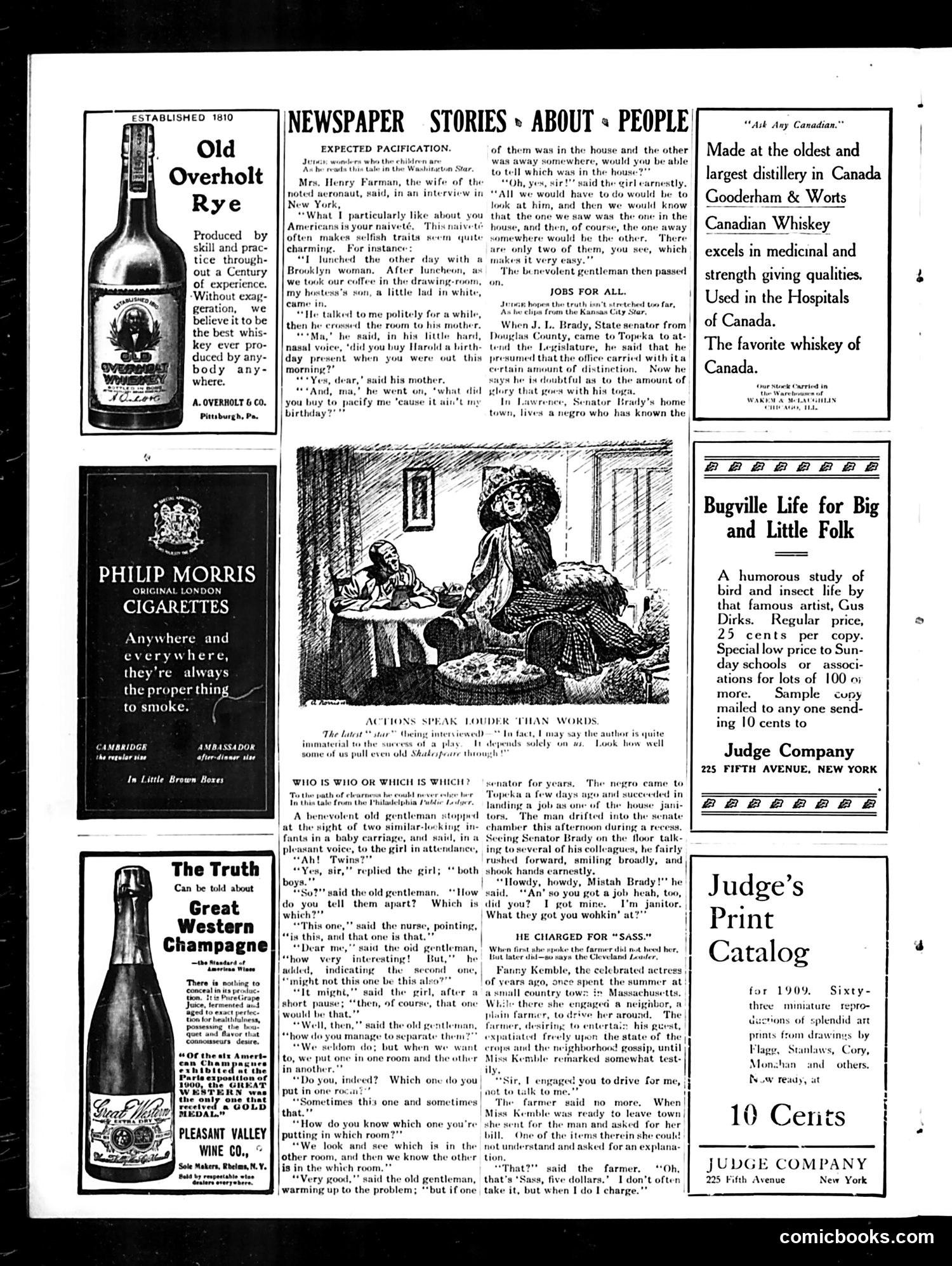
This page is primarily **advertising and filler content** rather than political satire. The dominant elements are ads for whiskey (Old Overholt Rye, Gooderham & Worts), cigarettes (Philip Morris), wine, and books. The main illustrated content—"Actions Speak Louder Than Words"—depicts a humorous domestic anecdote: an elderly gentleman visiting a senator's home tries to distinguish between two similar-looking young women by having them sit in different rooms, then identifying them by process of elimination. The humor relies on the absurdity of his method and innocent confusion. A second story, "He Charged for 'Sass,'" humorously recounts a farmer paying an actress (Fanny Kemble) a bill that includes a charge for "sass" (impertinent remarks), which he questions—she responds that she charged him because he engaged her to drive him around. Neither piece contains identifiable political commentary or social satire. They're gentle, conventional humor typical of Judge's lighter content aimed at general entertainment rather than social critique.
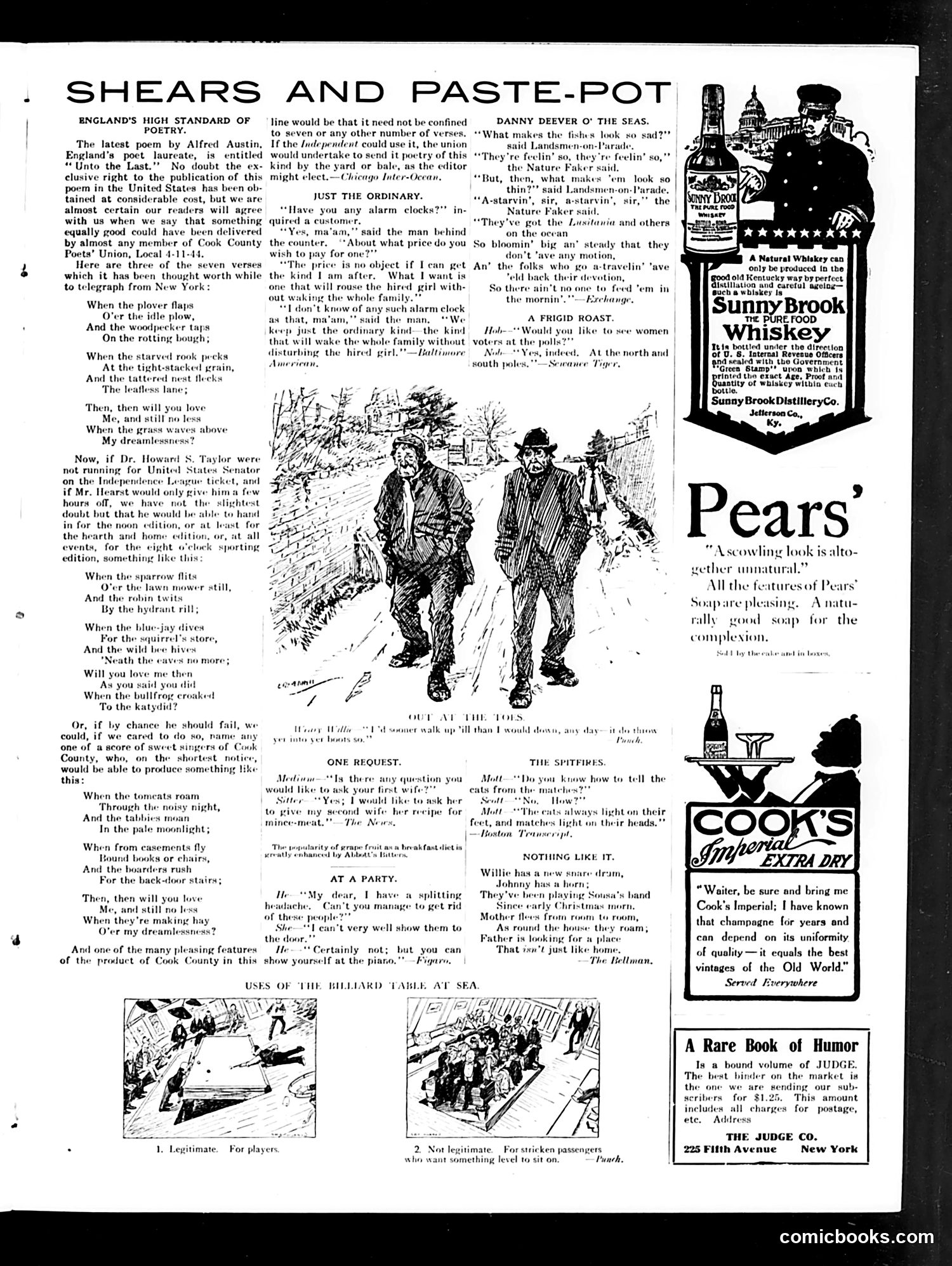
This page mocks **Alfred Austin**, England's poet laureate, whose recent poem "Unto the Last" was published in American newspapers. Judge ridicules Austin's work as mediocre, claiming that members of the fictional "Cook County Poets' Union, Local 4-11-44" could write equally good verse. The satire works by presenting three parodies of Austin's sentimental nature poetry (about plovers, rooks, and sparrows). The joke is that Austin's flowery, melancholic style—seemingly profound—is actually formulaic and uninspired, easily replicated by common poets from Chicago. This is **nationalist satire**: American writers mocking English cultural pretension. The reference to "Hearst" (likely William Randolph Hearst) suggests the poem's American newspaper syndication was itself seen as a commercial stunt rather than artistic merit. The remaining page content consists of unrelated humor pieces and period advertisements (Sunny Brook Whiskey, Pears' Soap, Cook's Imperial).
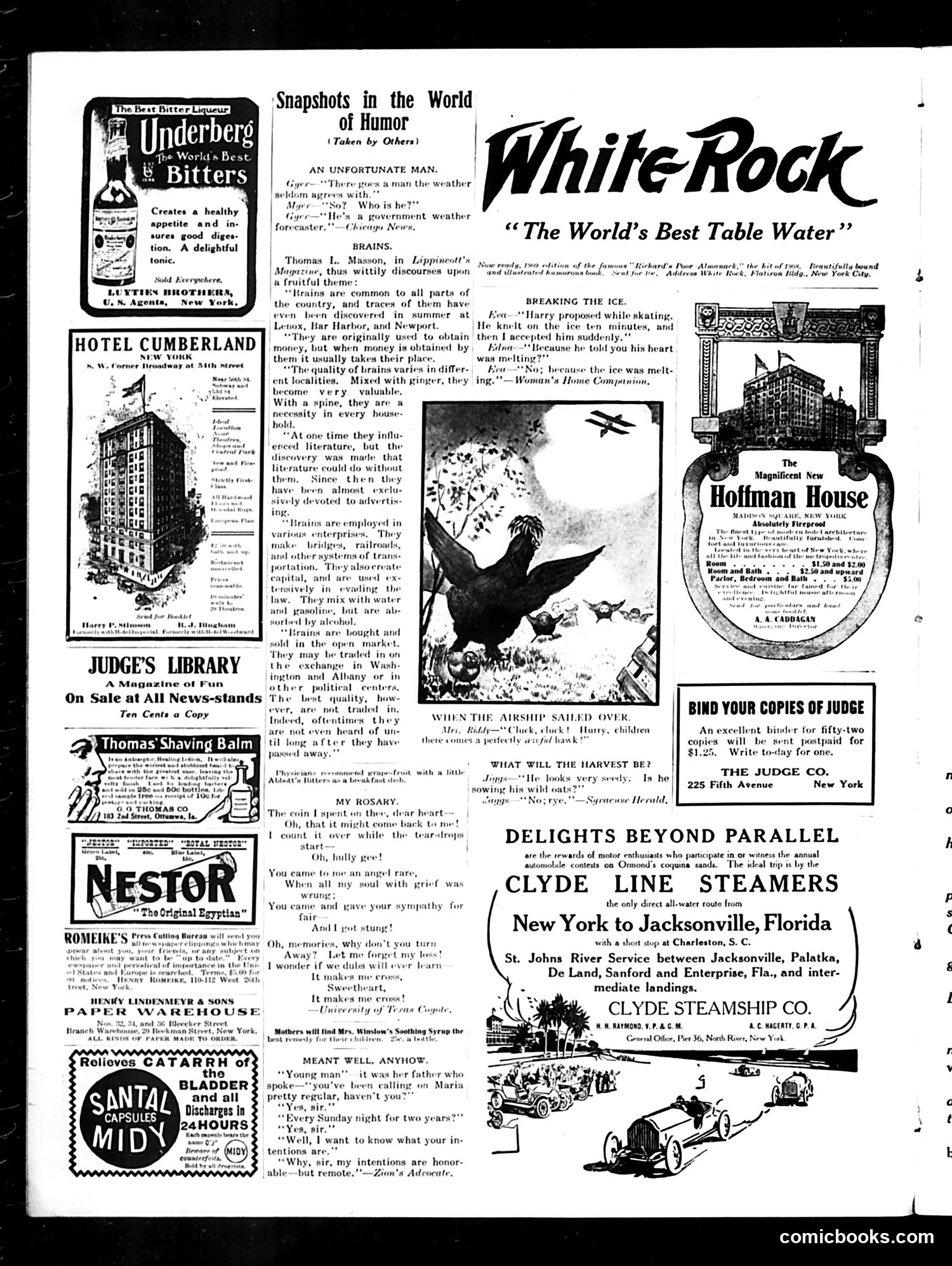
This page is primarily **advertising with scattered humor content**, typical of Judge magazine's format. The humor pieces are brief, untitled jokes: - **"AN UNFORTUNATE MAN"**: A weather forecaster who never agrees with anyone—the joke being that his professional disagreement with reality makes him unpopular socially. - **"BRAINS"**: A satirical piece mocking the practical applications of brains, suggesting they're useful mainly for obtaining money and are employed in "various enterprises" but ultimately lead to advertising oneself. It's social commentary on commercialism. - **"BREAKING THE ICE"**: A pun-based joke about a marriage proposal on ice—the woman accepts because the ice is literally melting beneath him. - **"WHAT WILL THE HARVEST BE?"**: A rural pun comparing a shabby man "sowing wild oats" (youthful indiscretion) to literal farming. The page is dominated by **period advertisements** for hotels, bitters, steamships, and other goods—standard Judge content. No major political figures or events are referenced; these are generic social humor and wordplay typical of early 20th-century American magazines.
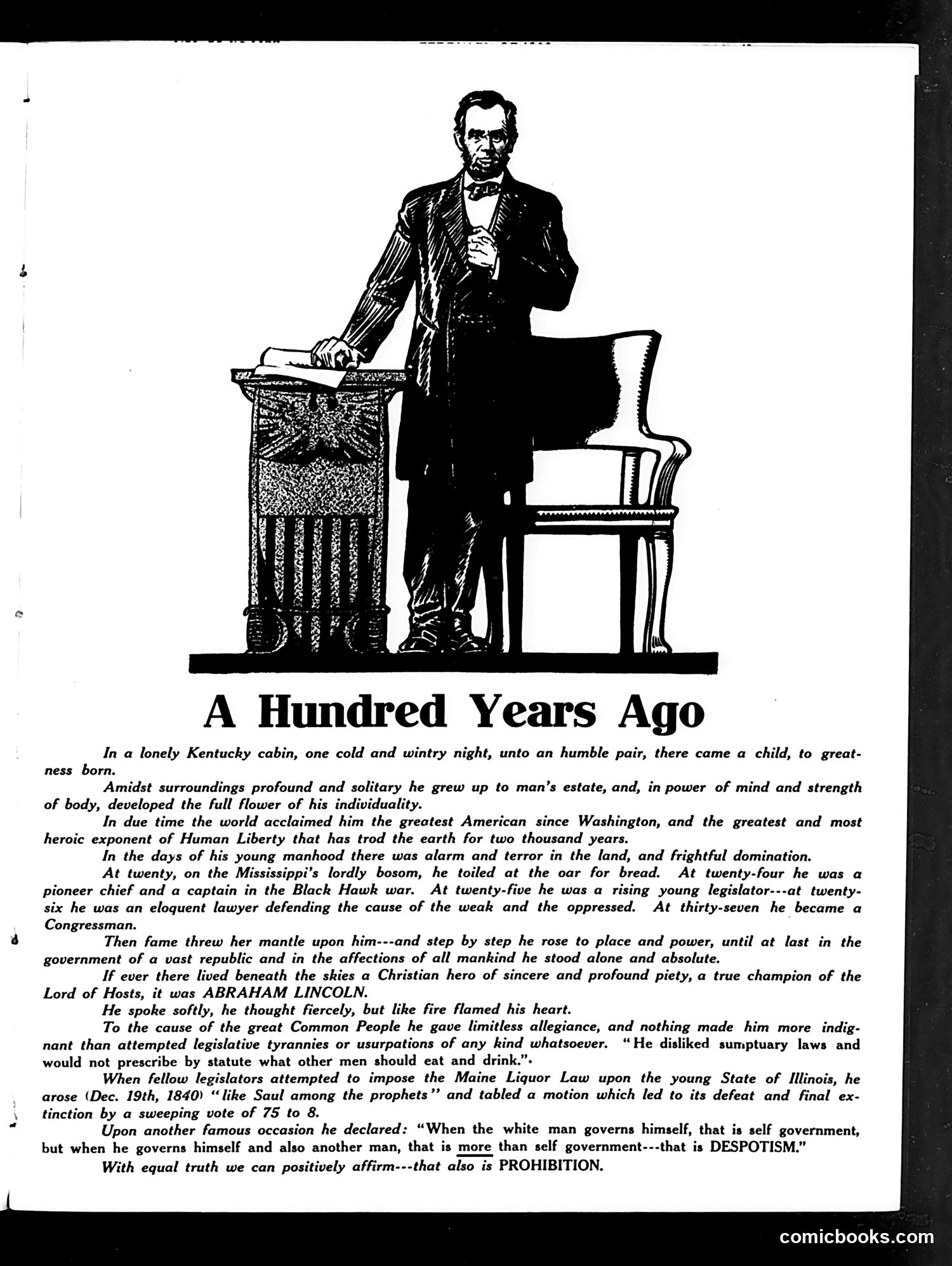
This commemorative piece celebrates Abraham Lincoln's centennial birth (100 years prior to publication). The engraving shows Lincoln at a lectern, positioned as a statesman and orator. The text glorifies Lincoln's life trajectory from Kentucky poverty to presidency, emphasizing his defense of "the weak and the oppressed" and his opposition to governmental overreach. The final section reveals the satire's actual purpose: it's an anti-Prohibition argument. By quoting Lincoln's famous 1840 declaration against government controlling citizens' behavior ("that is DESPOTISM"), the piece uses Lincoln's authority to argue that Prohibition laws—specifically the Maine Liquor Law—constitute tyranny. The conclusion equates Prohibition with despotism, using Lincoln's legacy as rhetorical ammunition against temperance legislation that was gaining momentum in early 20th-century America.
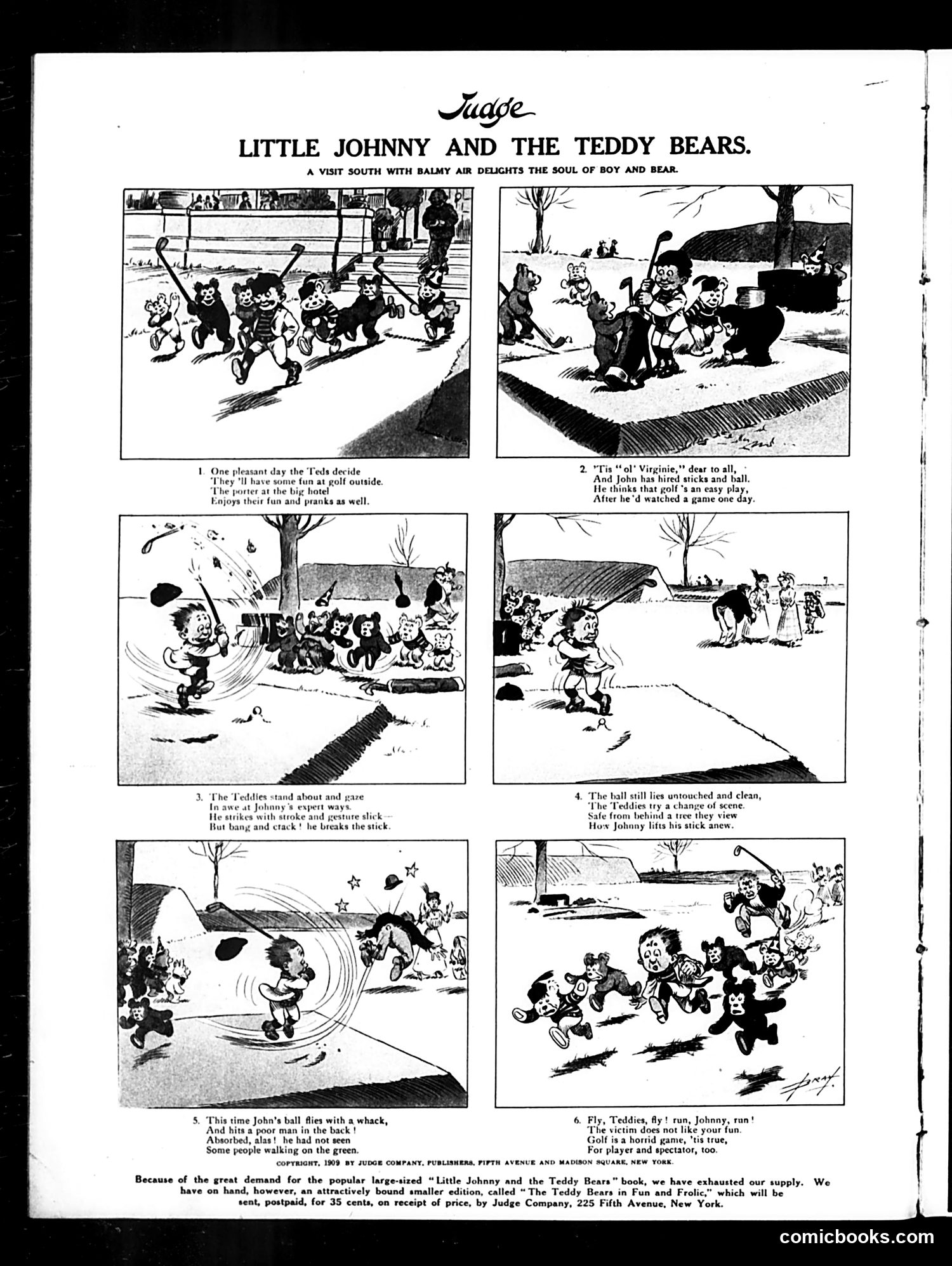
This is a humorous comic strip featuring "Little Johnny" (a popular character of the era) and anthropomorphic teddy bears attempting to play golf. The narrative follows their misadventures: Johnny, having watched golf once, confidently joins the bears for a round. His inexperience leads to comedic chaos—he breaks his stick on a wild swing, fails to hit the ball cleanly, and eventually strikes a bystander, sending everyone fleeing in panic. The joke is straightforward slapstick: overconfidence in an unfamiliar sport produces disaster. The strip also subtly mocks golf itself as a "horrid game" for both players and spectators. The "Teddy Bears" reference reflects the *Teddy Bear craze* following President Theodore Roosevelt's 1902 hunting trip, when stuffed bears became wildly popular toys. This comic served both as entertainment and as advertising for the larger "Little Johnny and the Teddy Bears" book series.