
A complete issue · 16 pages · 1908
Judge — November 14, 1908
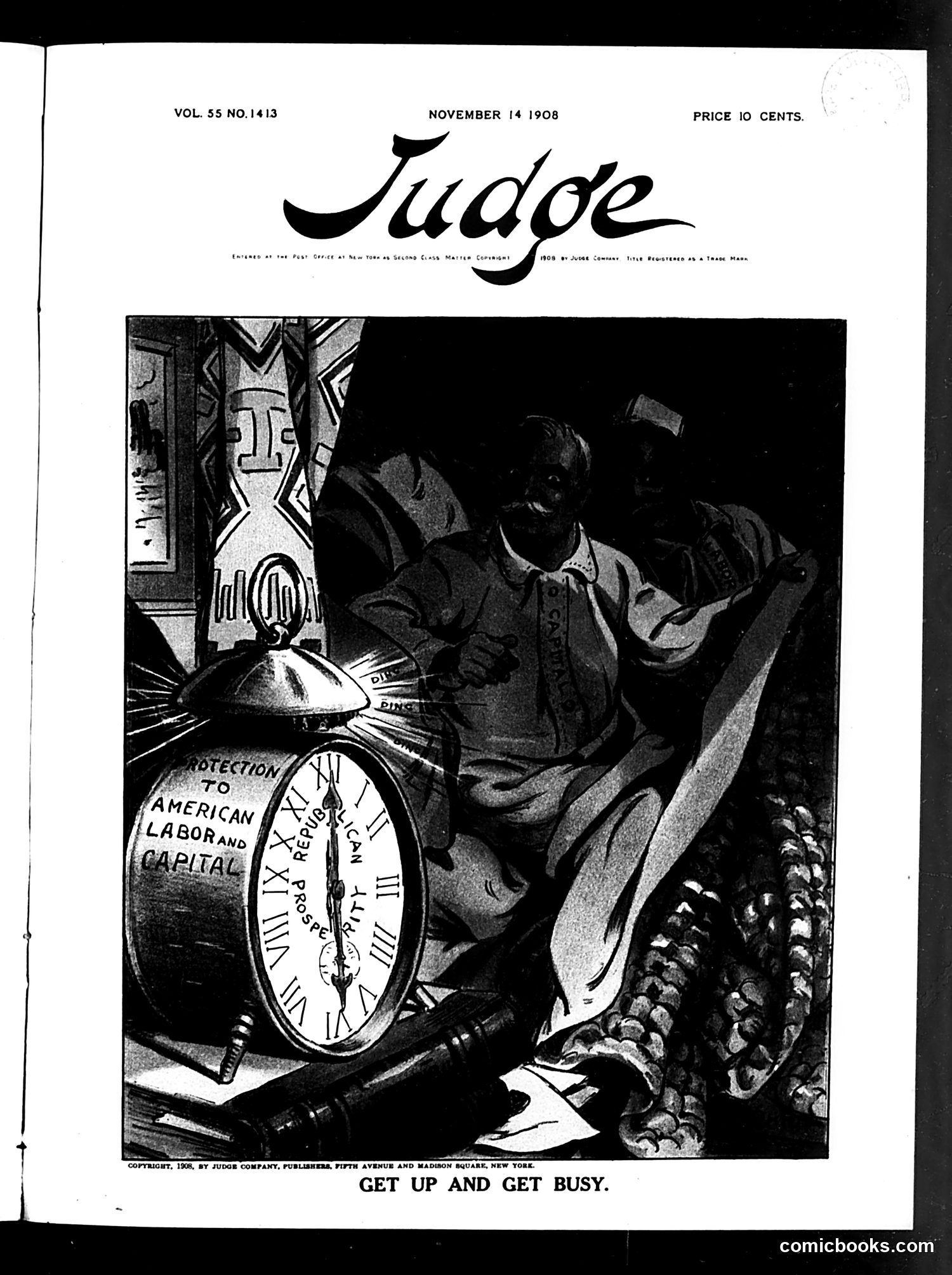
This political cartoon satirizes labor unrest and workplace safety concerns in early 1900s America. The central image shows a bomb labeled "PROTECTION TO AMERICAN LABOR AND CAPITAL"—a reference to protectionist trade policies. Workers are depicted actively defusing or working with this explosive device, suggesting that such protectionist measures are themselves dangerous to American workers and industry. The title "GET UP AND GET BUSY" urges action. The imagery implies that protective tariffs and labor policies, while claimed to benefit workers, actually pose risks. This likely reflects 1908 debates over whether trade protection genuinely served labor's interests or merely enriched capitalists while endangering workers. The cartoon critiques the disconnect between political rhetoric and workers' actual circumstances.
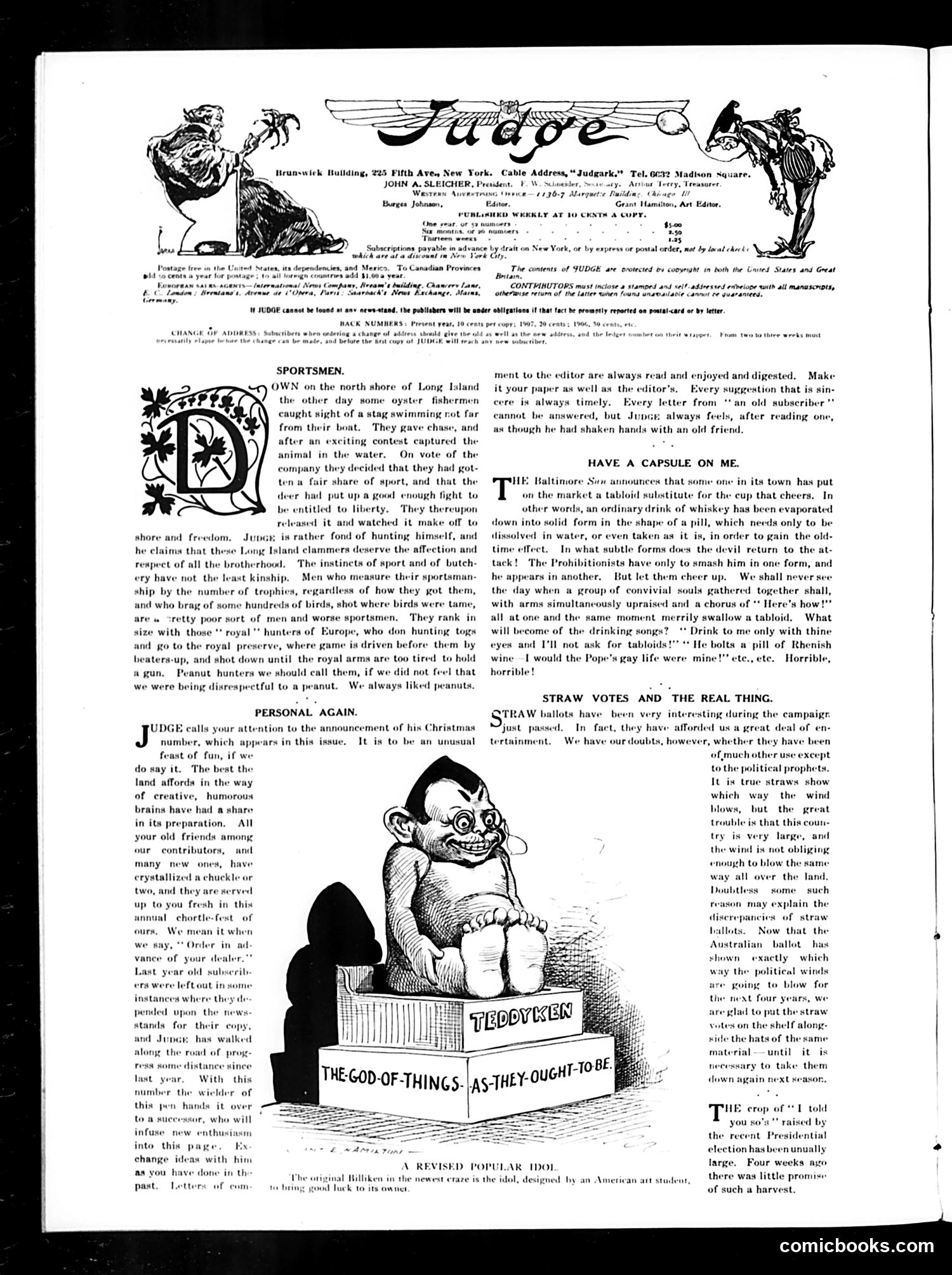
This page contains three satirical pieces. The central cartoon, "A Revised Popular Idol," depicts a grotesque figure labeled "Teddykins" sitting atop a pedestal inscribed "The God-of-Things-As-They-Ought-To-Be." This appears to mock Theodore Roosevelt through exaggeration and unflattering caricature, suggesting criticism of his idealistic rhetoric or policy positions. The surrounding articles—"Sportsmen," "Personal Again," "Have a Capsule on Me," and "Straw Votes and the Real Thing"—offer social commentary on contemporary issues including hunting practices, Prohibition's effects, and election polling methods. The satire targets both political figures and social trends of the early 20th century, using crude caricature and humor typical of Judge's editorial approach.
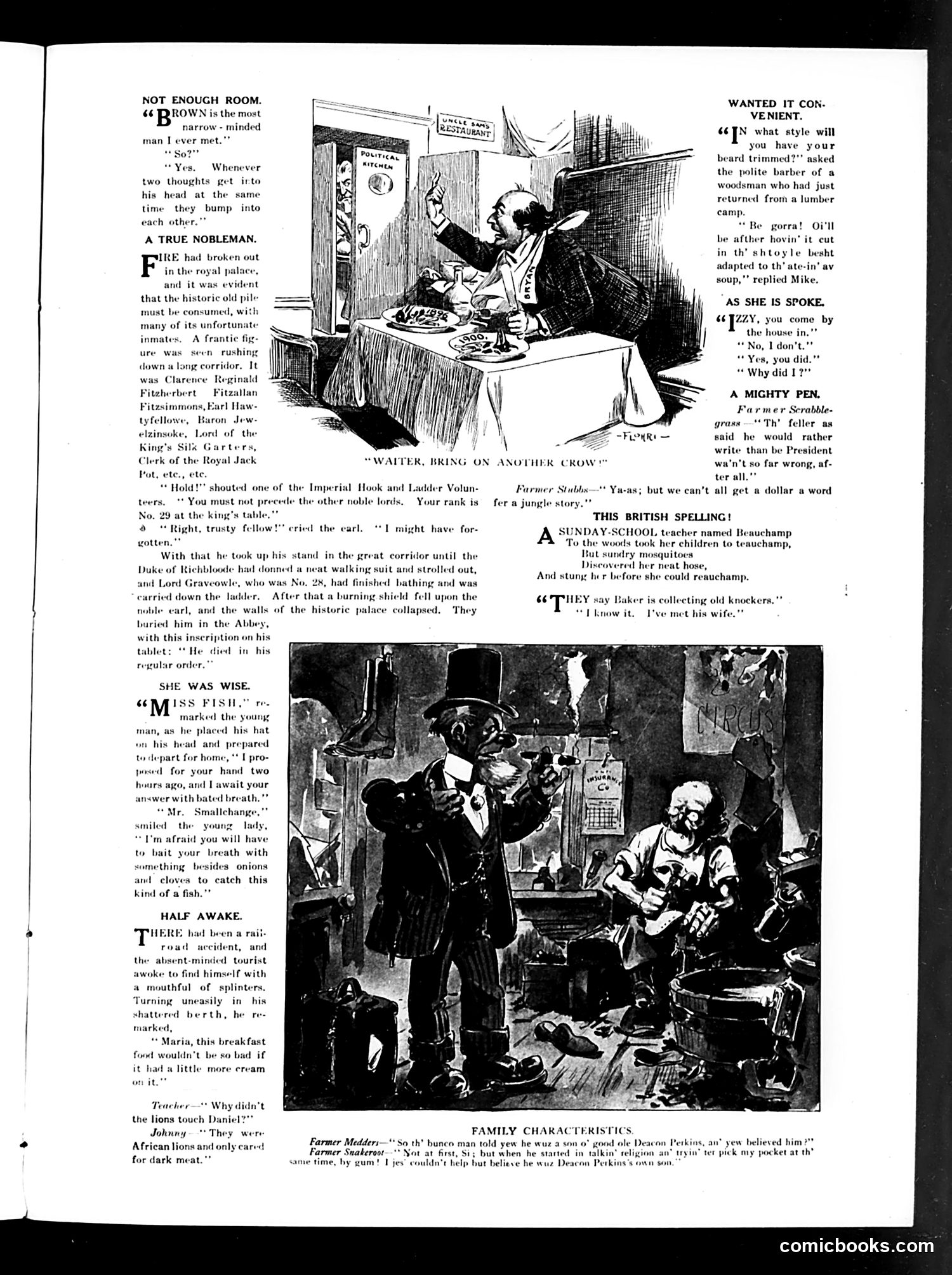
This page contains multiple short humorous pieces rather than unified political cartoons. The top sketch "Water, Bring On Another Crow" depicts a dining scene satirizing poor restaurant service or food quality. The "Family Characteristics" photograph at bottom shows what appears to be a domestic scene with multiple figures, accompanied by dialogue about a man named Deacon Perkins and questions about his character—suggesting satire of social pretension or hypocrisy. Other brief pieces scattered throughout—"Not Enough Room," "She Was Wise," "Half Awake," "This British Spelling," and "A Mighty Pen"—are standalone jokes about social situations, marital relations, and contemporary issues like spelling reform. The page functions as a humor miscellany rather than focused political commentary, typical of Judge's format mixing visual and textual satire on everyday American life.
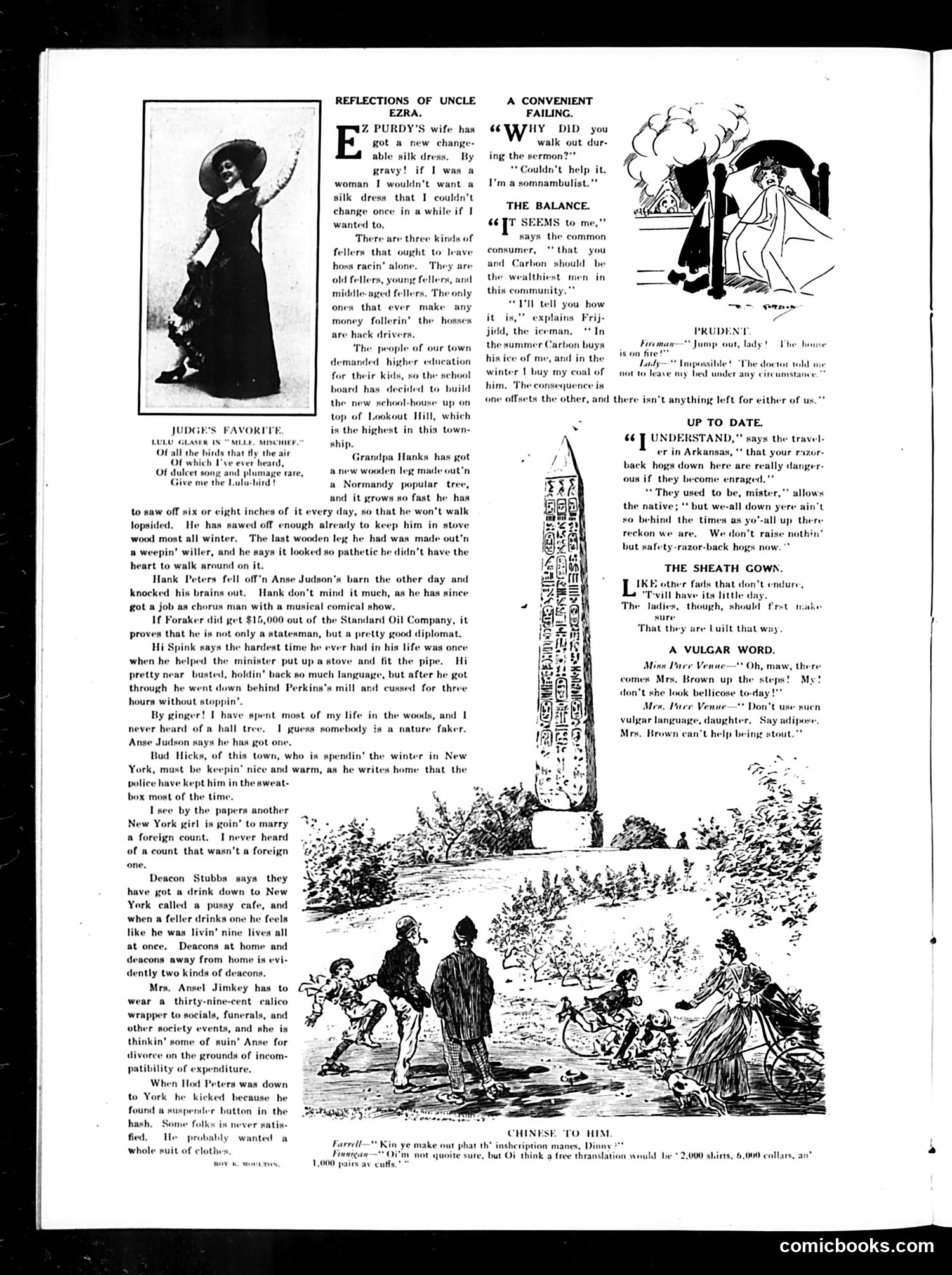
This page contains multiple humor columns mocking small-town American life and character types. "Reflections of Uncle Ezra" critiques pretentious behavior—specifically a woman wanting a changeable silk dress, which Uncle Ezra views as wasteful vanity. "Judge's Favorite" presents humorous anecdotes about local eccentrics: a girl named Lulu who can't walk straight, Hank Peters with his oversized woodshed, and various other colorful townspeople. The bottom illustration labeled "Chinese to Him" depicts a conversation about Chinese garments, appearing to joke about cultural misunderstanding or the exotic nature of foreign dress to American audiences. Overall, the page satirizes rural/small-town pretension, eccentricity, and cultural unfamiliarity in early 20th-century America through folksy humor and character sketches.
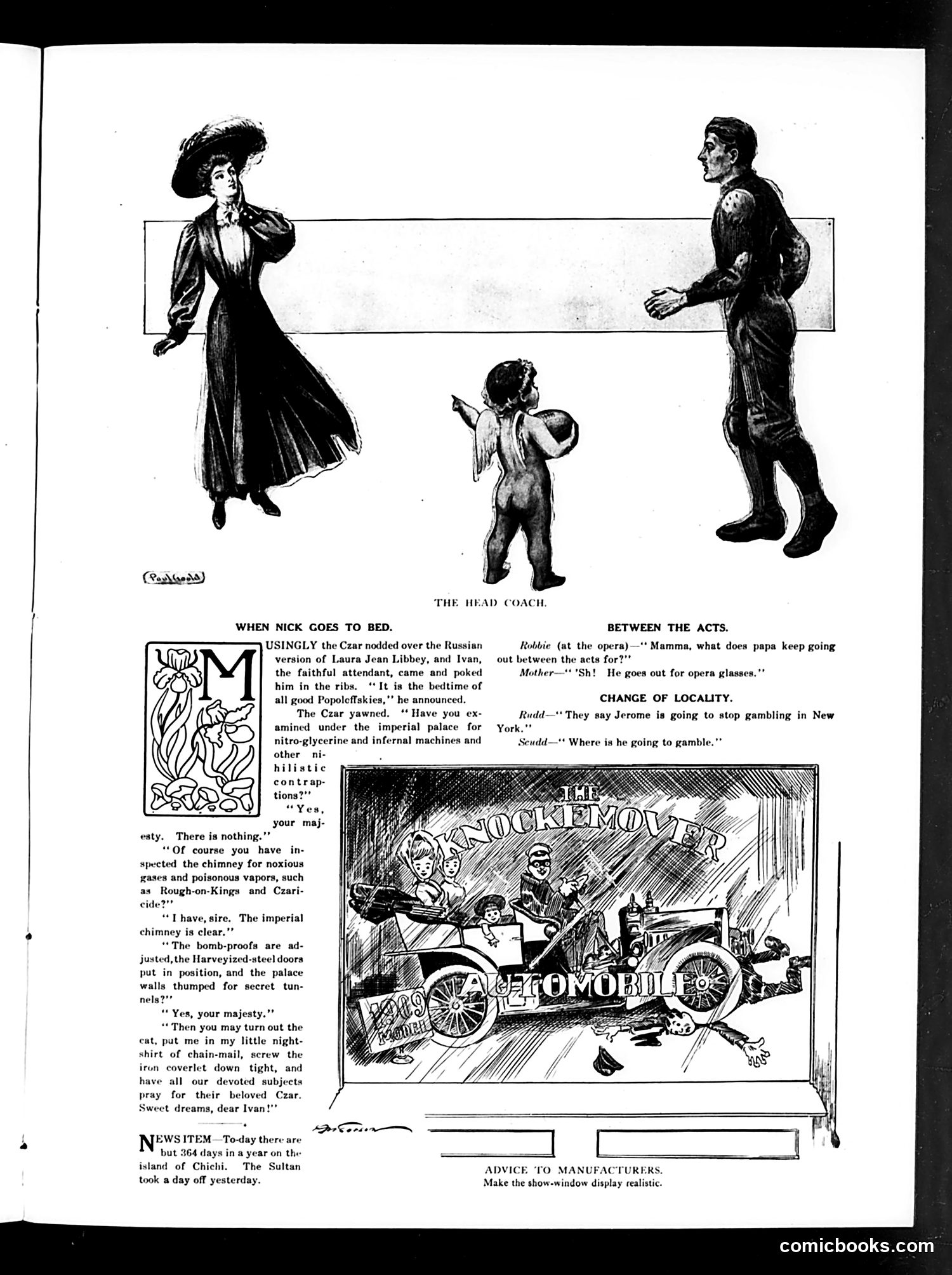
The page contains theatrical humor referencing "When Nick Goes to Bed," a play satirizing Russian politics. The top illustration shows a romantic triangle—a woman, cherub figure (Cupid), and man—labeled "The Head Coach," playing on romantic/marital comedy tropes. The middle dialogue jokes about opera attendance and gambling, typical vaudeville humor of the period. The large central cartoon depicts "The Knockout Automobile," a motorcar crash scene with exaggerated violence, mocking early automobile safety (or lack thereof). This reflects contemporary anxiety about new automotive technology. The bottom section includes a news item about Chichi, an island with limited daylight, and advice to manufacturers about realistic window displays. Overall, this page blends theatrical satire, romance comedy, and period commentary on emerging technology.
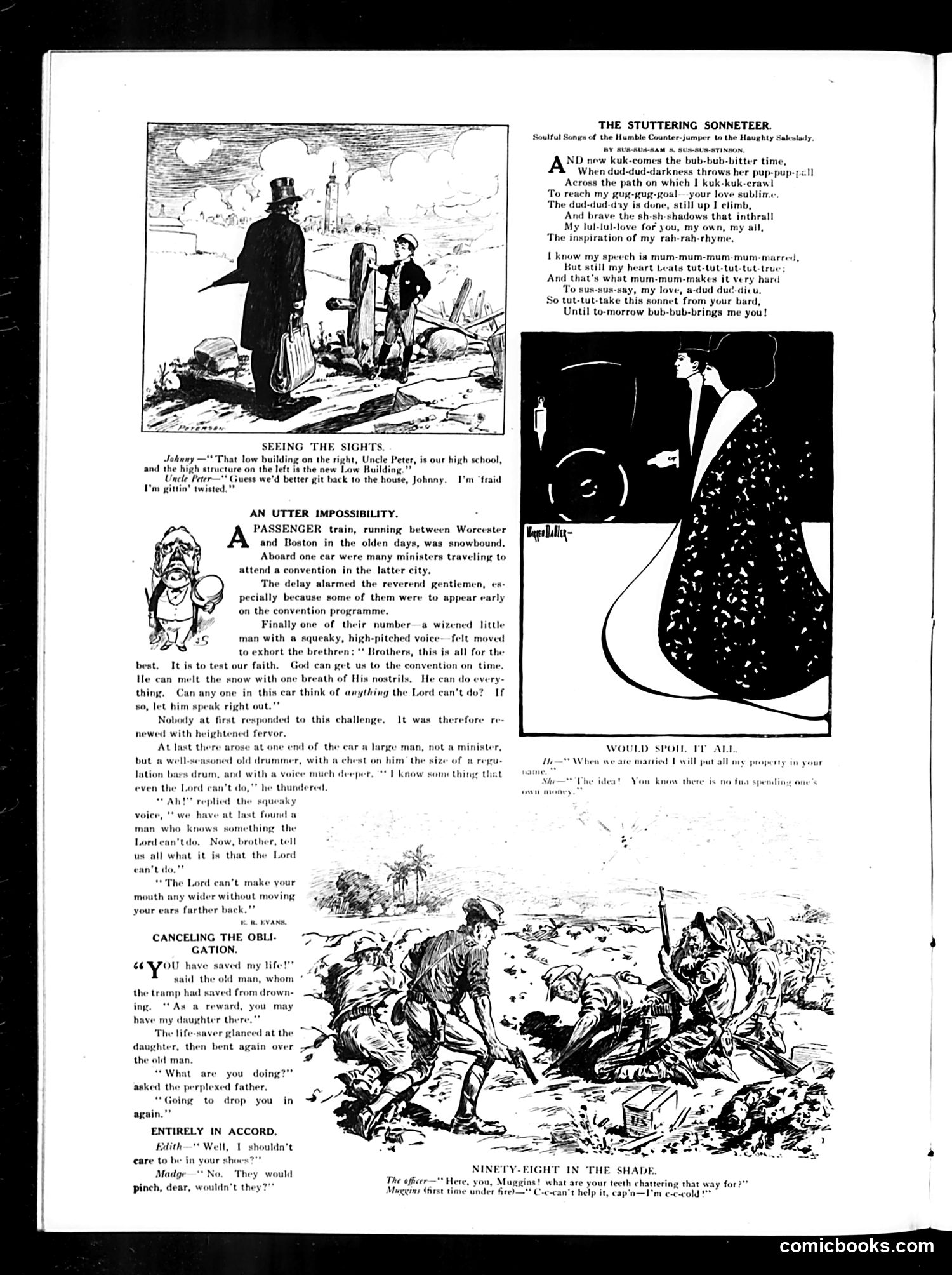
This page from *Judge* magazine contains several satirical pieces mocking human vanity and hypocrisy: **"The Stuttering Sonneteer"** ridicules an overly romantic working-class man ("counter-jumper"/shop clerk) who composes grandiose poetry despite a severe stammer—satirizing pretentious attempts at genteel culture by the lower classes. **"An Utter Impossibility"** mocks ministers on a snowbound train. When one challenges others to name something God cannot do, a drummer claims God cannot widen a man's mouth without moving his ears back—humbling the clergy's presumption. **"Canceling the Obligation"** shows a man attempting to drown his daughter (the life he "saved") to repay the tramp who rescued him from drowning—absurdist humor about financial obligation taken to ridiculous extremes. **"Ninety-Eight in the Shade"** shows soldiers trembling with cold despite heat, unable to stop chattering teeth—likely mocking nervous soldiers' inability to control their bodies under fire. All pieces employ exaggeration and social commentary typical of early 20th-century satirical humor.
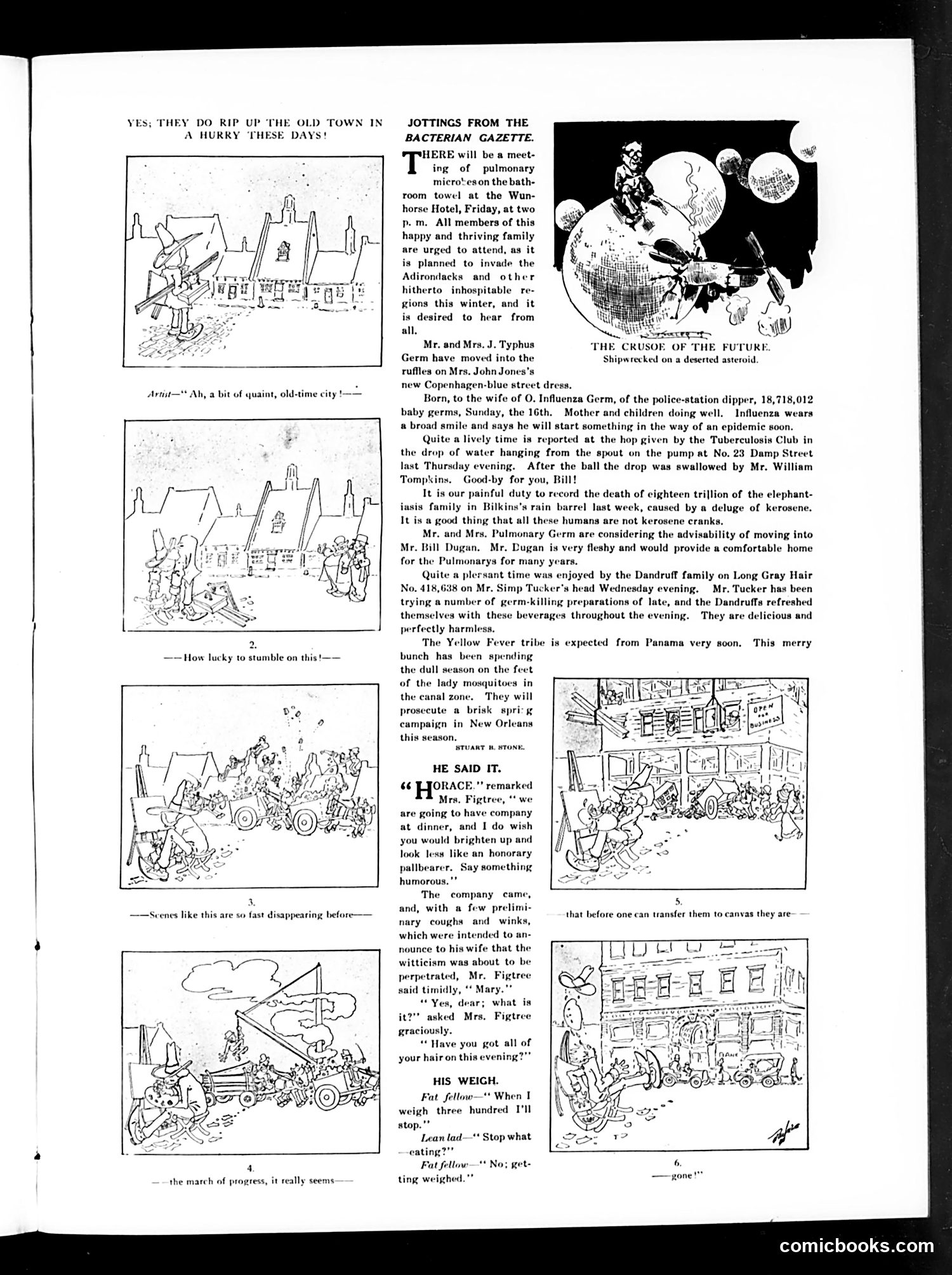
This page from *Judge* magazine contains humorous cartoons about urban life and social situations rather than political satire. The main content includes: **"The Crusoe of the Future"** — A cartoon depicting someone stranded on a deserted asteroid, satirizing modern civilization's trajectory. **"He Said It"** — A comic sequence about a dinner guest (Horace) making awkward remarks to his hostess Mrs. Figtree. The humor derives from social embarrassment: he comments on her appearance and weight, prompting increasingly uncomfortable exchanges. The joke targets polite society's tension between candid observation and social courtesy. **"Jottings from the Bacterian Gazette"** — Satirical notices about society events involving the "Germ" family and disease-related humor, reflecting early-20th-century fascination with bacteriology and germ theory. The cartoons mock domestic etiquette and social pretension through wordplay and visual comedy.
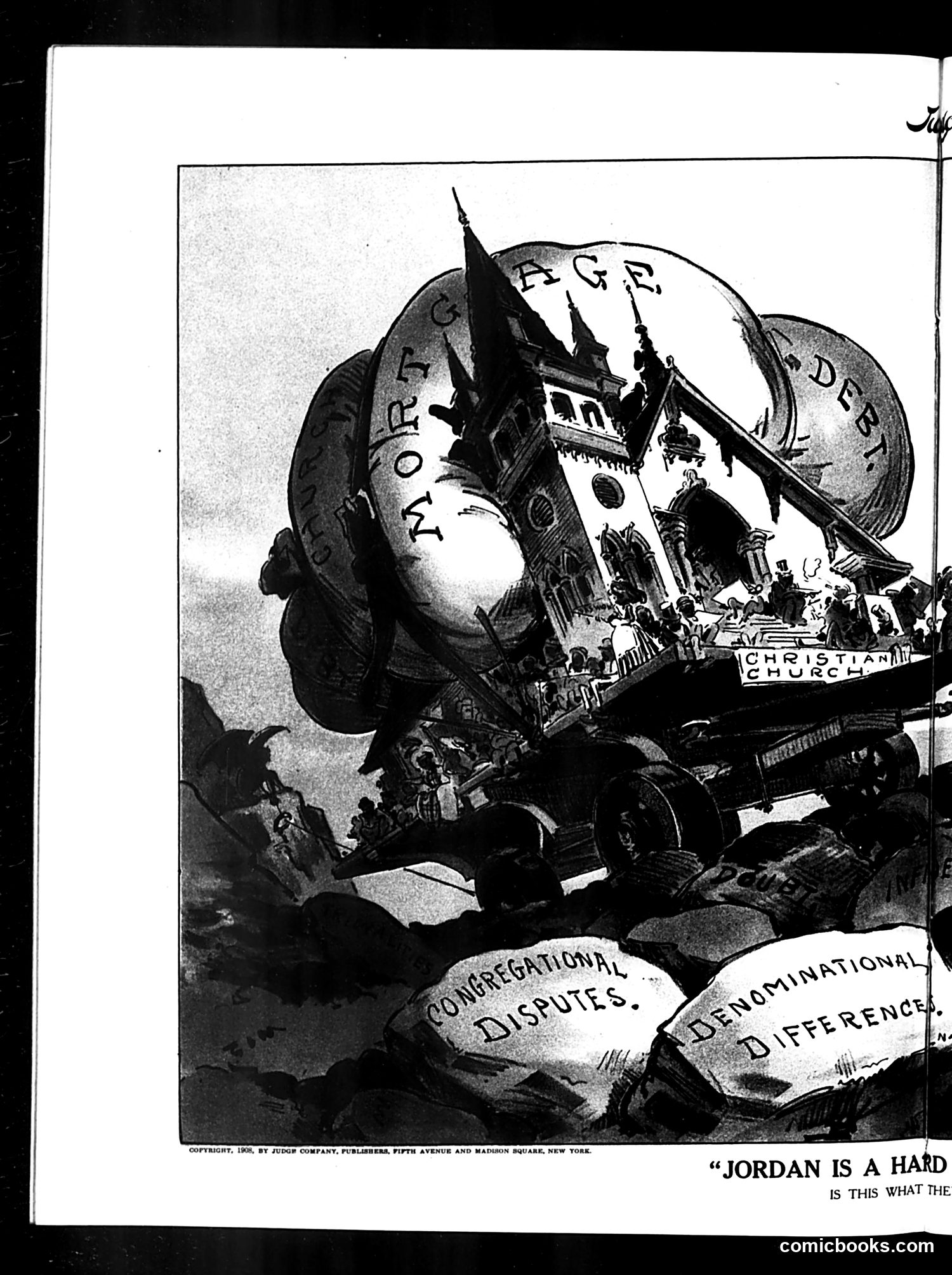
This 1908 Judge magazine cartoon critiques religious conflict in America. Two large globes labeled "FOR" and "DENOMINATIONAL DIFFERENCE" crush a Christian church beneath them, with "CONGREGATIONAL DISPUTES" also depicted as destructive weight. The image suggests that Christian denominations' internal conflicts are literally destroying the church itself. The fragmented religious landscape—represented by competing spheres of influence—undermines institutional Christianity's strength and unity. The caption's incomplete text ("JORDAN IS A HARD / IS THIS WHAT THE") appears to reference a spiritual concept, possibly the biblical River Jordan as a metaphor for difficulty or division within faith communities. The satire targets early 20th-century American religious sectarianism and denominational competition, arguing that theological disputes weakened organized Christianity's social influence during a period of increasing secularization and immigration-driven religious diversity.
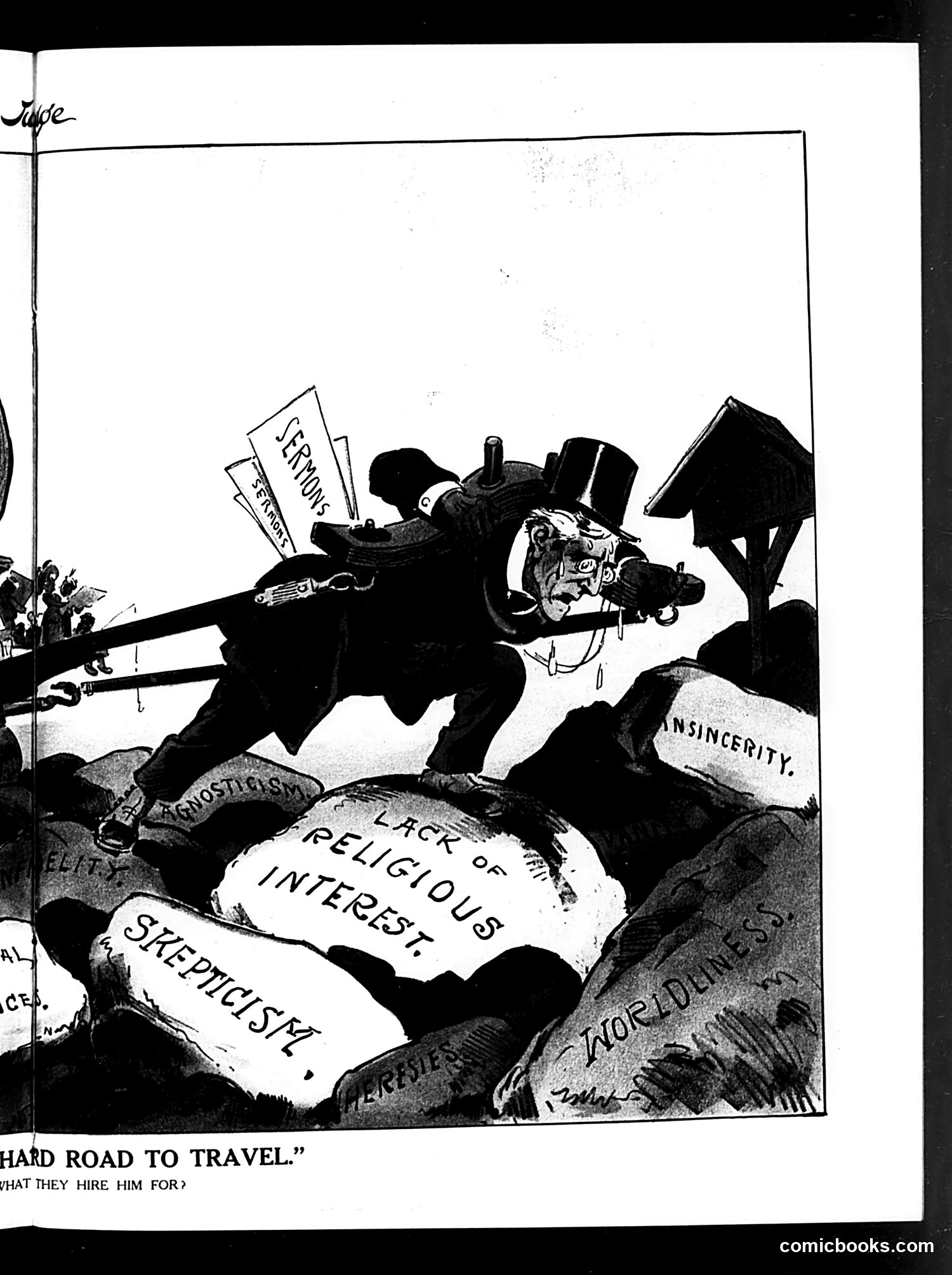
This appears to be a Gilded Age satirical cartoon depicting a well-dressed politician or businessman struggling to navigate obstacles labeled "LACK OF RELIGIOUS INTEREST," "SKEPTICISM," "INSINCERITY," and other social ills. The figure carries papers marked "SERMONS" while traversing treacherous terrain. The cartoon satirizes hypocrisy in public figures—suggesting that those hired to provide moral or religious leadership face a difficult path when confronted with widespread public skepticism and lack of genuine faith. The contrast between the figure's formal attire and dignified position versus the rocky, obstacle-filled ground beneath him emphasizes the gap between pretense and reality. The caption's question "WHAT THEY HIRE HIM FOR?" suggests ironic commentary on why such leaders are employed despite these fundamental challenges.
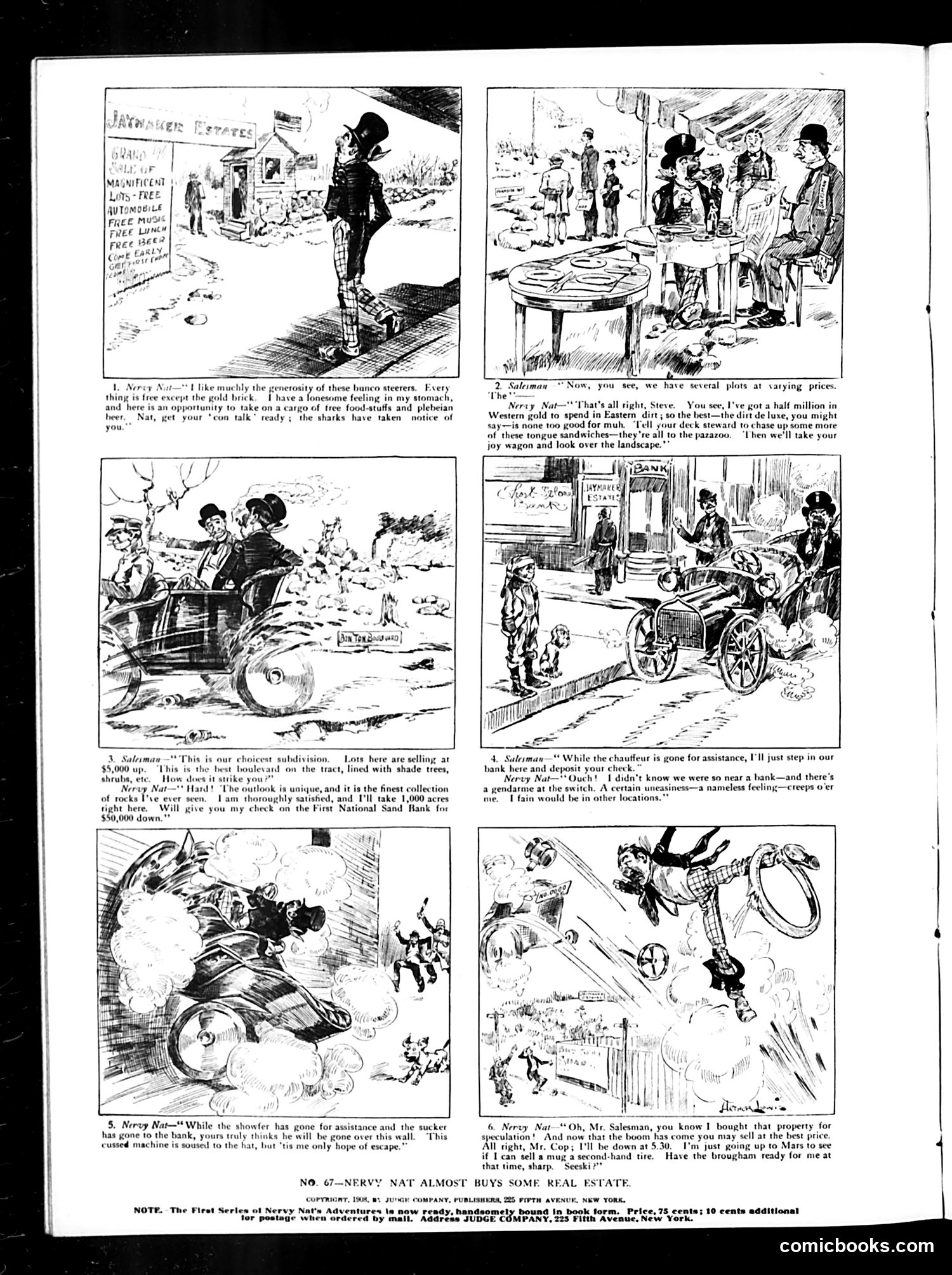
This 1904 *Judge* comic strip satirizes real estate fraud and con artists preying on wealthy but naive speculators. "Nervy Nat," a wealthy Western investor with "half a million in Western gold," is targeted by a slick salesman ("Steve") hawking worthless land plots at inflated prices. The salesman uses high-pressure tactics—claiming exclusivity, mentioning a "gendarme at the switch" (suggesting legitimacy)—to separate Nat from his money. The satire mocks both the gullible buyer and the smooth-talking hustler. By the final panels, Nat discovers the fraud but escapes via motorcycle while the salesman pursues him, suggesting the con's exposure. The strip reflects the early 1900s land-boom era when speculators rushed to invest in undeveloped property, making them easy marks for unscrupulous promoters.
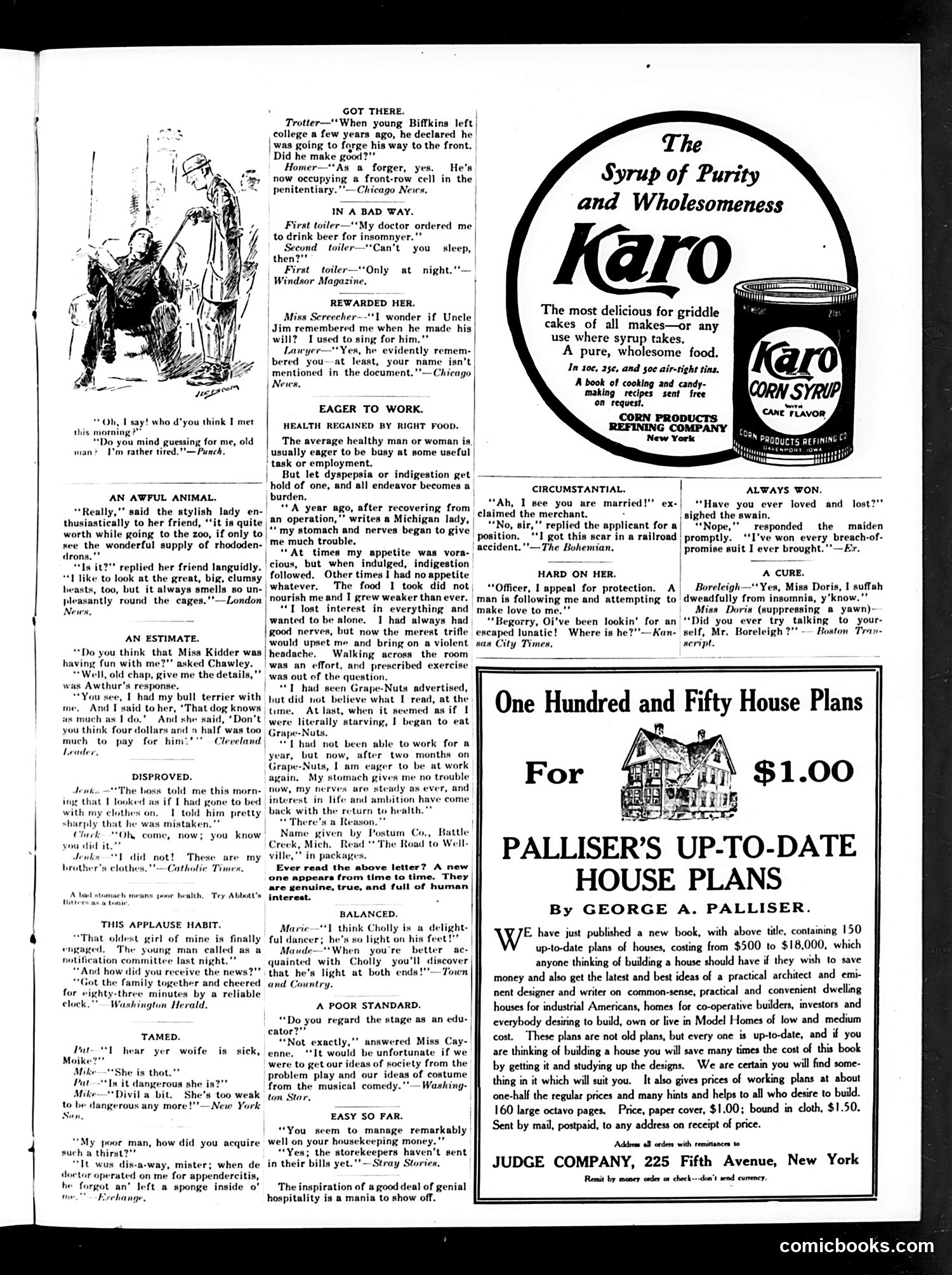
This page from *Judge* magazine contains mostly brief comedic anecdotes and advertisements, typical of early 20th-century American humor publications. The cartoons/jokes mock various social situations: a woman complaining about zoo animals smelling bad; a man embarrassed when his date suggests he paid too much for his dog; workplace banter about sleeping in clothes; and ethnic-stereotyped dialect humor (Irish and immigrant characters). The longest piece features a woman's testimonial about recovering her health through eating Grape-Nuts cereal after stomach troubles—a common advertising format of the era that mimics genuine testimonials. The page advertises "Karo" corn syrup and house plans for $1.00, reflecting consumer goods marketed to middle-class readers. The humor relies on wordplay, misunderstandings, and social embarrassment rather than political content. There are no identifiable political figures or events referenced.
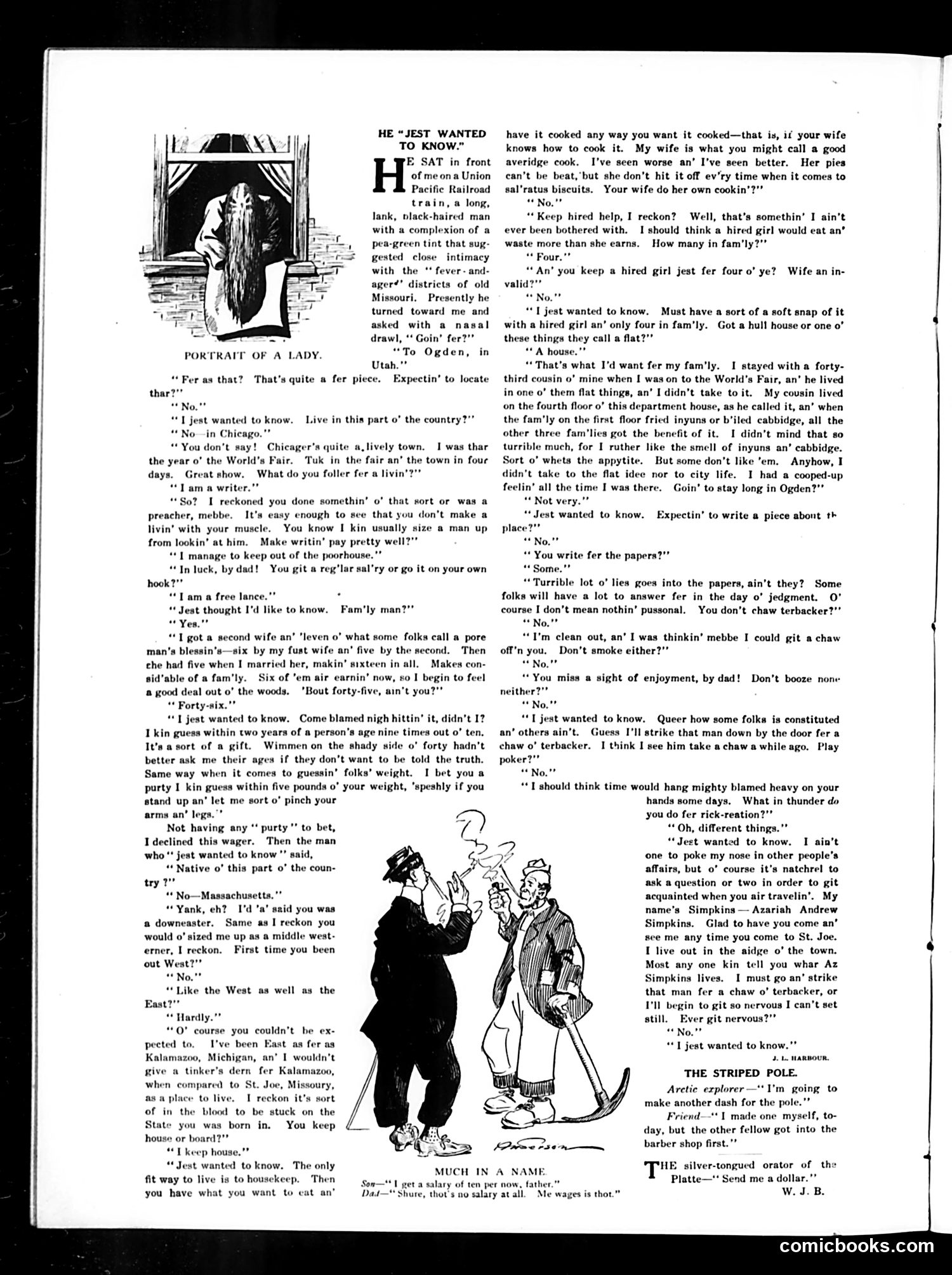
This page contains a humorous dialogue story titled "He 'Jest Wanted to Know,'" depicting a stereotypical character—a gaunt, sallow-complexioned man from rural Missouri—engaging a writer in an increasingly intrusive conversation on a Union Pacific train bound for Utah. The satire targets the American trait of nosiness disguised as folksy friendliness. The Missouri man relentlessly interrogates the writer about his profession, family size (sixteen children), marital status, income, cooking preferences, and housing arrangements, all while affecting casual small-talk. His dialect ("fer," "fam'ly," "sal'ratus") and manner parody rural, working-class obtrusiveness. The cartoon illustration shows this character gesturing to companions, reinforcing the comic type. The satire's point: American directness and personal questioning, particularly among certain regional/class groups, could seem absurdly forward to more reserved sensibilities. The page also includes brief humorous sketches like "Portrait of a Lady" and "The Striped Pole," maintaining Judge's typical miscellaneous humor format.
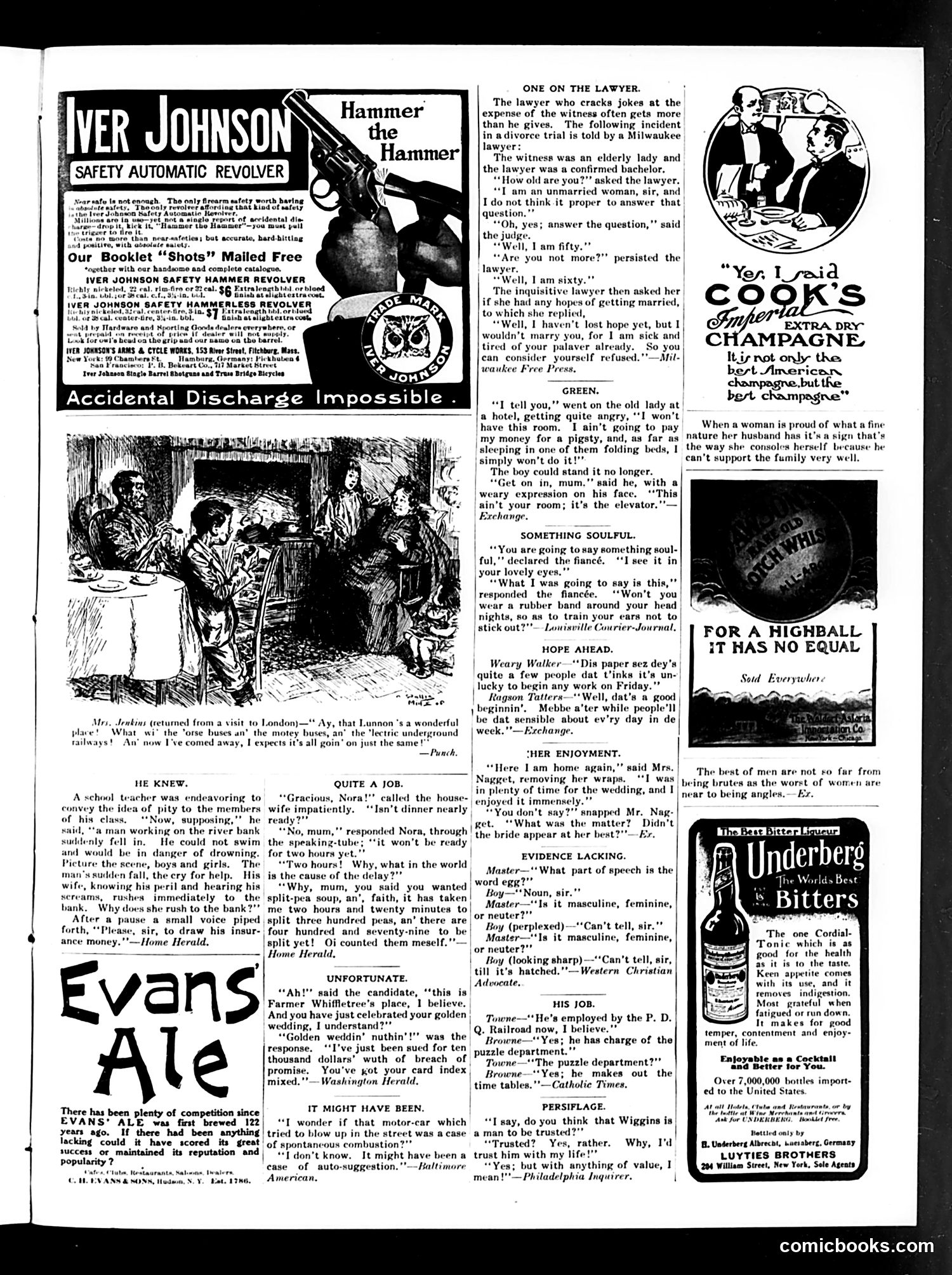
This is primarily an **advertising and humor miscellany page** from Judge magazine, containing jokes, brief comic scenarios, and advertisements rather than a single coherent political cartoon. **Key Content:** The advertisements dominate—notably the Iver Johnson revolver ("Hammer the Hammer"), Evans' Ale, Cook's Champagne, and Underberg Bitters. These reflect early 20th-century consumer culture. **The humor pieces** are typical Judge fare: brief anecdotes mocking lawyers, romantic couples, laborers, and household situations. Examples include an elderly woman rebuffing a bachelor lawyer's proposal, a fiancé asking his partner to wear a rubber band around his ears at night, and various workplace misunderstandings. **The social satire** is gentle and class-conscious—poking fun at pretension, miscommunication between social classes ("Weary Walker," an apparent vagrant), and domestic friction. **Notable:** The page reflects early-1900s attitudes toward gender roles, class hierarchy, and courtship conventions—largely conservative humor for middle-class audiences. Without visible dates or bylines in the OCR, precise dating is unclear, but the typography and advertising styles suggest approximately 1900-1920s.
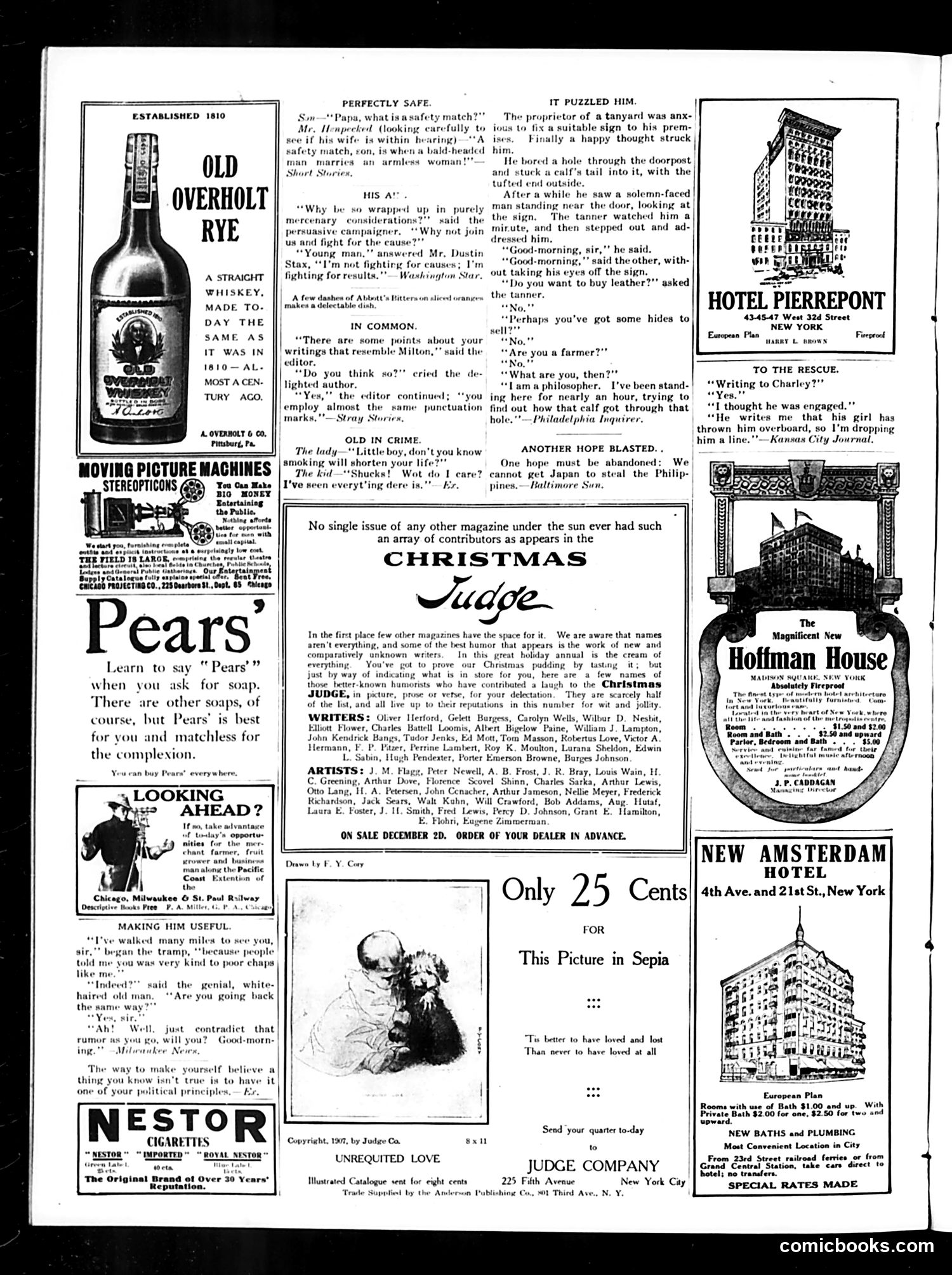
This is primarily an **advertising and miscellaneous content page** from Judge magazine, with several short humorous pieces scattered among ads. The main satirical content includes brief jokes: - **"Perfectly Safe"**: A crude domestic joke about a man installing a calf's tail through a door to demonstrate to his wife that "armless women" can pass through safely—absurdist humor mocking marital dynamics. - **"It Puzzled Him"**: A tanyard owner puts up a sign with a calf's tail sticking through a hole. A philosopher stands puzzling over it for an hour, unable to determine how the calf passed through—gentle absurdist humor about overthinking. - **"In Common"**: An editor tells a writer their punctuation resembles another author's, suggesting unoriginality. - **"Another Hope Blasted"**: A one-liner satirizing American imperial ambitions in the Philippines, joking that America hoped Japan would steal them (avoiding American responsibility). The page otherwise contains advertisements for whiskey, soap, hotels, and cigarettes typical of early 1900s Judge magazine layout. The Christmas Judge issue announcement dominates the center, listing contributors.
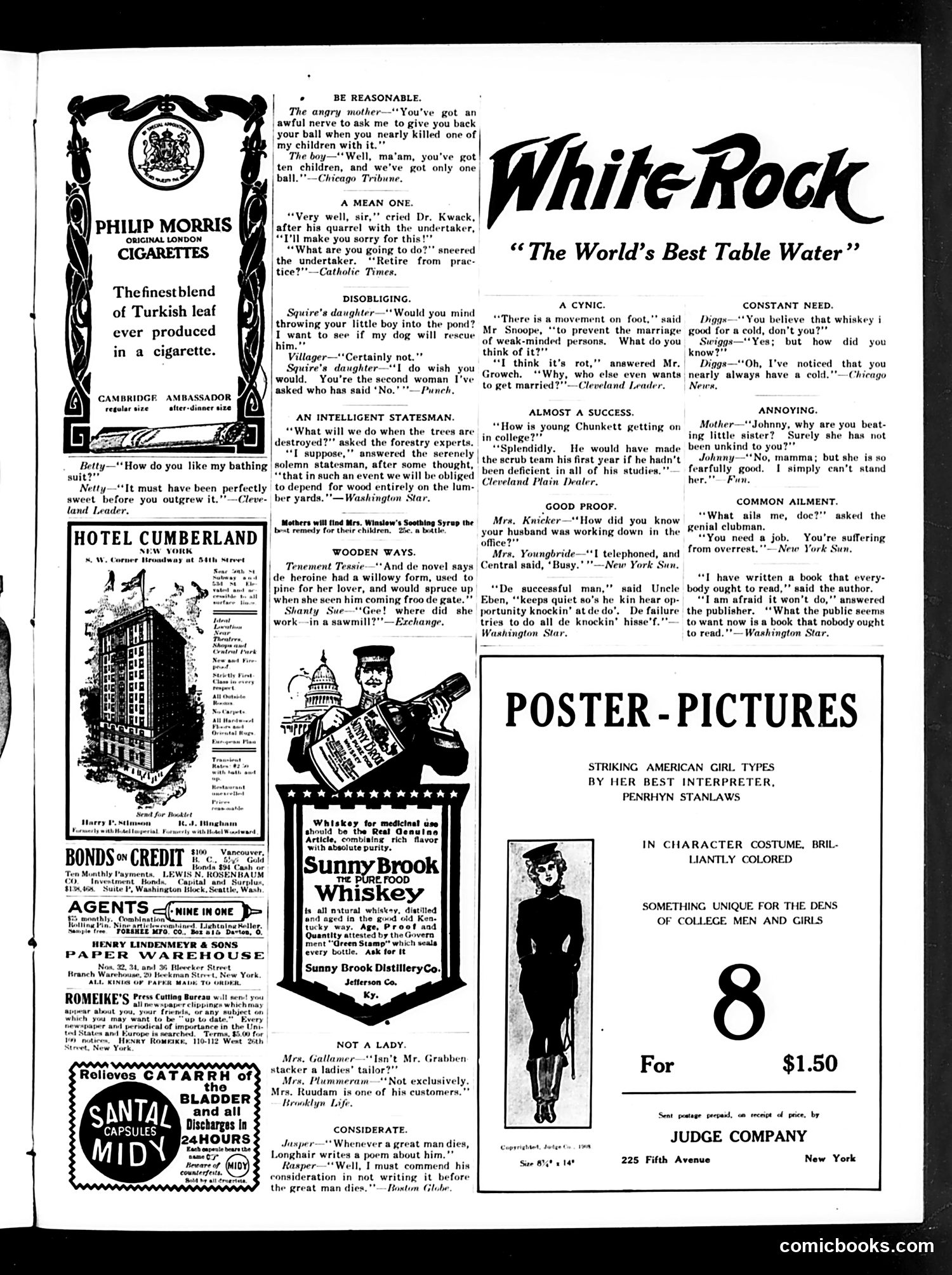
This page is primarily **advertising and humor vignettes** rather than political cartoons. The content consists of: **Advertisements:** Philip Morris cigarettes, Hotel Cumberland, Bonds on Credit, Henry Lindenmeyer paper warehouse, Santal capsules, and Sunny Brook whiskey dominate the layout. **Short Jokes/Vignettes:** The page includes numerous brief humorous anecdotes on everyday domestic and social topics—a boy defending throwing a ball that nearly injured a child, a woman confronting a tailor about her husband's infidelity, a statesman's foolish response to forestry concerns. These reflect early 20th-century middle-class preoccupations: parenting, marital suspicion, and general human folly. **Poster-Pictures Advertisement:** The bottom section advertises eight colored poster-pictures of "striking American girl types" by actress Penrhyn Stanlaws for $1.50, marketed as "something unique for the dens of college men and girls." The page reflects Judge's satirical focus on social manners and domestic humor rather than explicit political commentary.
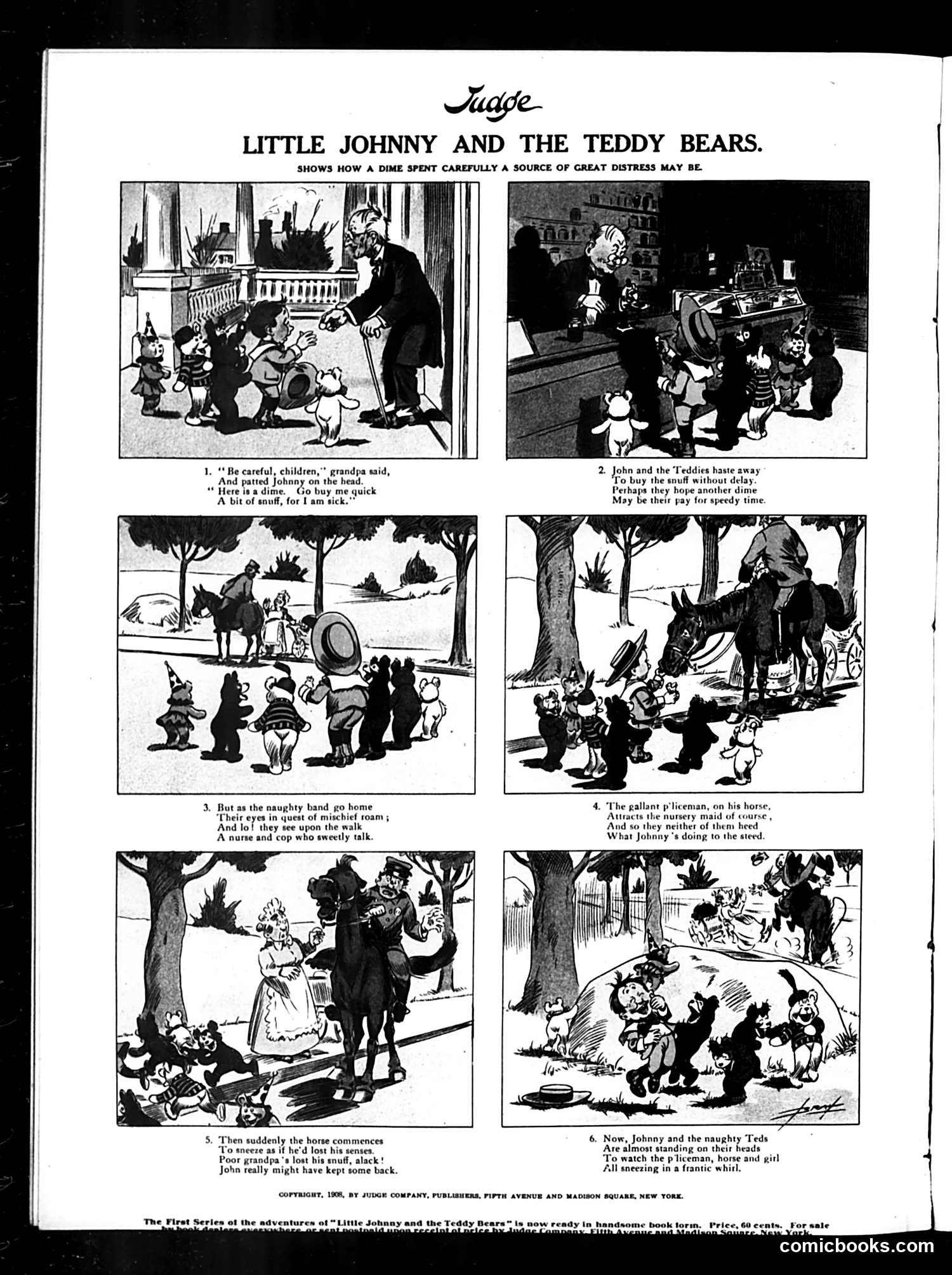
This is a humorous children's comic strip showing cause-and-effect mischief. Grandfather gives Johnny a dime to buy snuff (powdered tobacco for sniffing), but Johnny and his teddy bear companions get distracted by a policeman flirting with a nursery maid. While they're distracted, Johnny uses grandfather's snuff to make a horse sneeze uncontrollably—a prank that backfires when the horse scatters the snuff everywhere in "a frantic whirl." The joke plays on Victorian morality: a small amount of money carelessly managed becomes "a source of great distress." The teddy bears themselves appear to be stuffed toys or child characters (popular items after Theodore Roosevelt's association with them). The strip warns children about the consequences of distraction and mischief, delivered through slapstick humor rather than stern lecturing.