
A complete issue · 16 pages · 1908
Judge — November 7, 1908
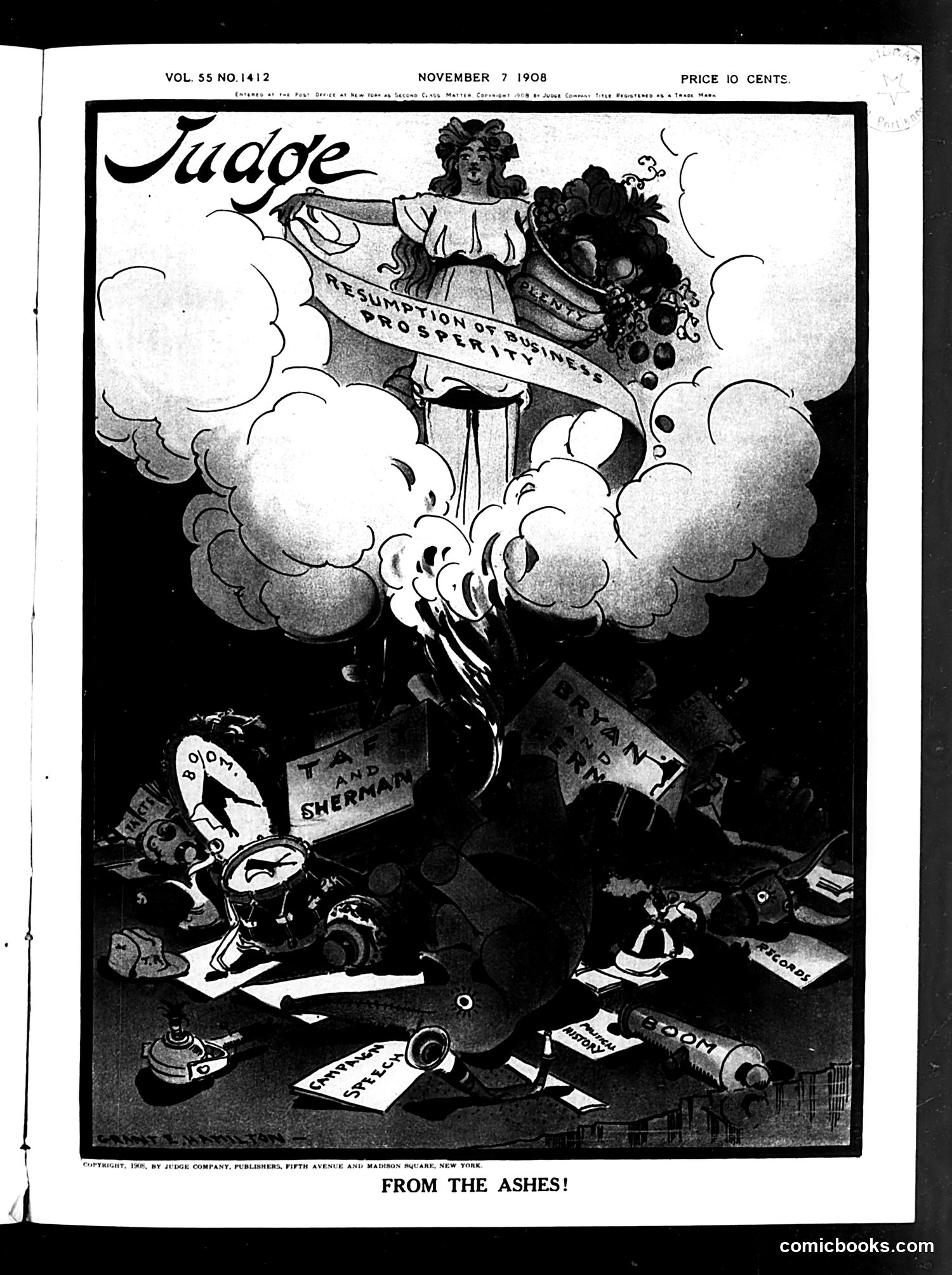
This editorial cartoon depicts **Lady Justice** (allegorical female figure) rising from clouds above destruction, holding a banner reading "RESUMPTION OF BUSINESS AND PROSPERITY." Below her lie ruins labeled with names including "SHERMAN" and what appears to be financial institutions or businesses, scattered among debris and wreckage. The cartoon evidently celebrates recovery from a **financial crisis** (likely the Panic of 1907). The title "From the Ashes!" suggests prosperity rebounding after economic collapse. Lady Justice presiding over the ruins implies that legal/regulatory intervention or natural market correction has restored order and business confidence. The specific names visible in the wreckage likely reference financial figures or institutions central to the crisis, though OCR limitations prevent certain identification of all labels.
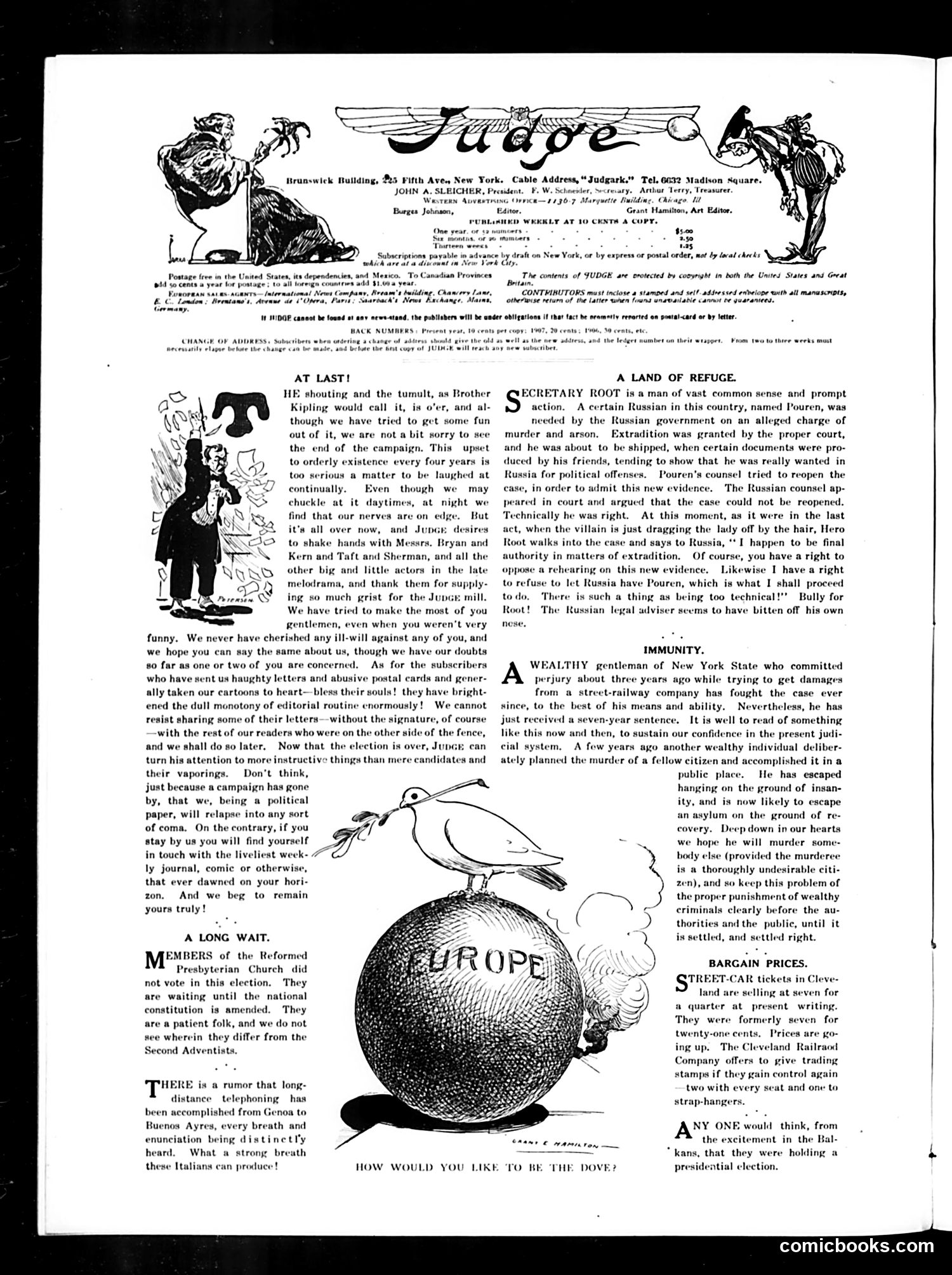
This page contains editorial commentary and satirical illustrations typical of Judge's political humor. The main cartoon shows a dove perched on a globe labeled "EUROPE," satirizing European political instability—likely commenting on post-WWI tensions or ongoing international conflicts. The text sections critique various subjects: "AT LAST!" mocks political candidates' campaign rhetoric; "A LAND OF REFUGE" discusses an alleged Russian murder case and extradition issues; "IMMUNITY" describes a wealthy New York businessman who escaped justice for planned murder through legal technicalities; and "A LONG WAIT" references Reformed Presbyterian Church constitutional amendments. The tone is caustic, attacking corruption, judicial failures, and political hypocrisy. "BARGAIN PRICES" makes light of Cleveland streetcar fare reductions, while the final item jokes about Balkans political turmoil resembling American elections.
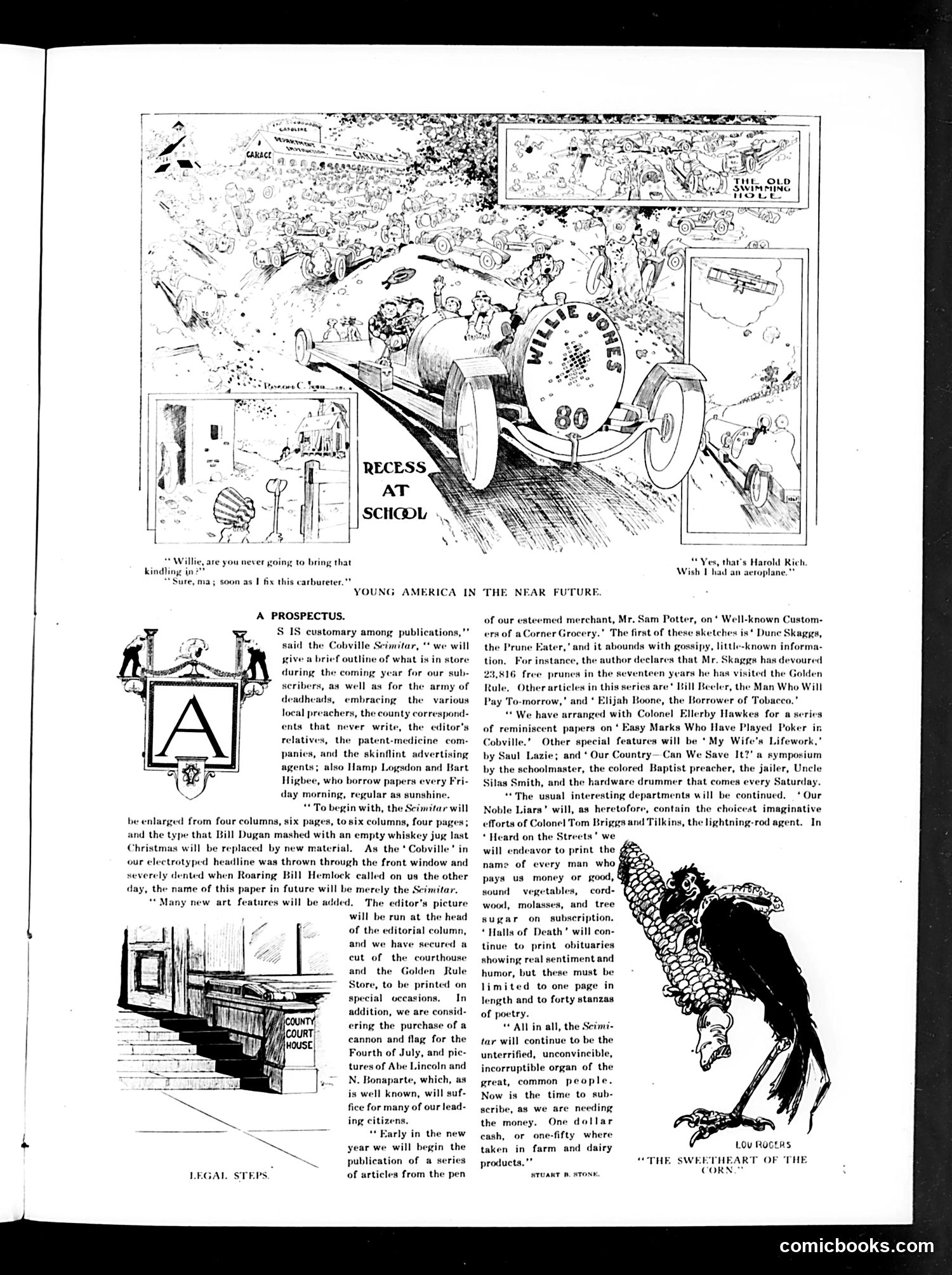
The main cartoon depicts "Young America in the Near Future" with a large spherical vehicle labeled "Middle Bees" numbered 80, suggesting futuristic transportation. Children observe this contraption during "Recess at School," with dialogue indicating wonder about advanced technology ("I wish I had an airplane"). The accompanying text announces the *Colville Seminar's* upcoming expansion—increasing from four to six columns and pages. It notes new features will include the editor's picture, articles on local grocers and the Golden Rule Store, courthouse sketches, and various columns. The lower illustration labeled "Legal Steps" shows what appears to be a courthouse or government building, likely referencing civic/legal matters relevant to the magazine's readership. The overall page blends futuristic satire with magazine promotion and local civic commentary typical of early 20th-century American humor publications.
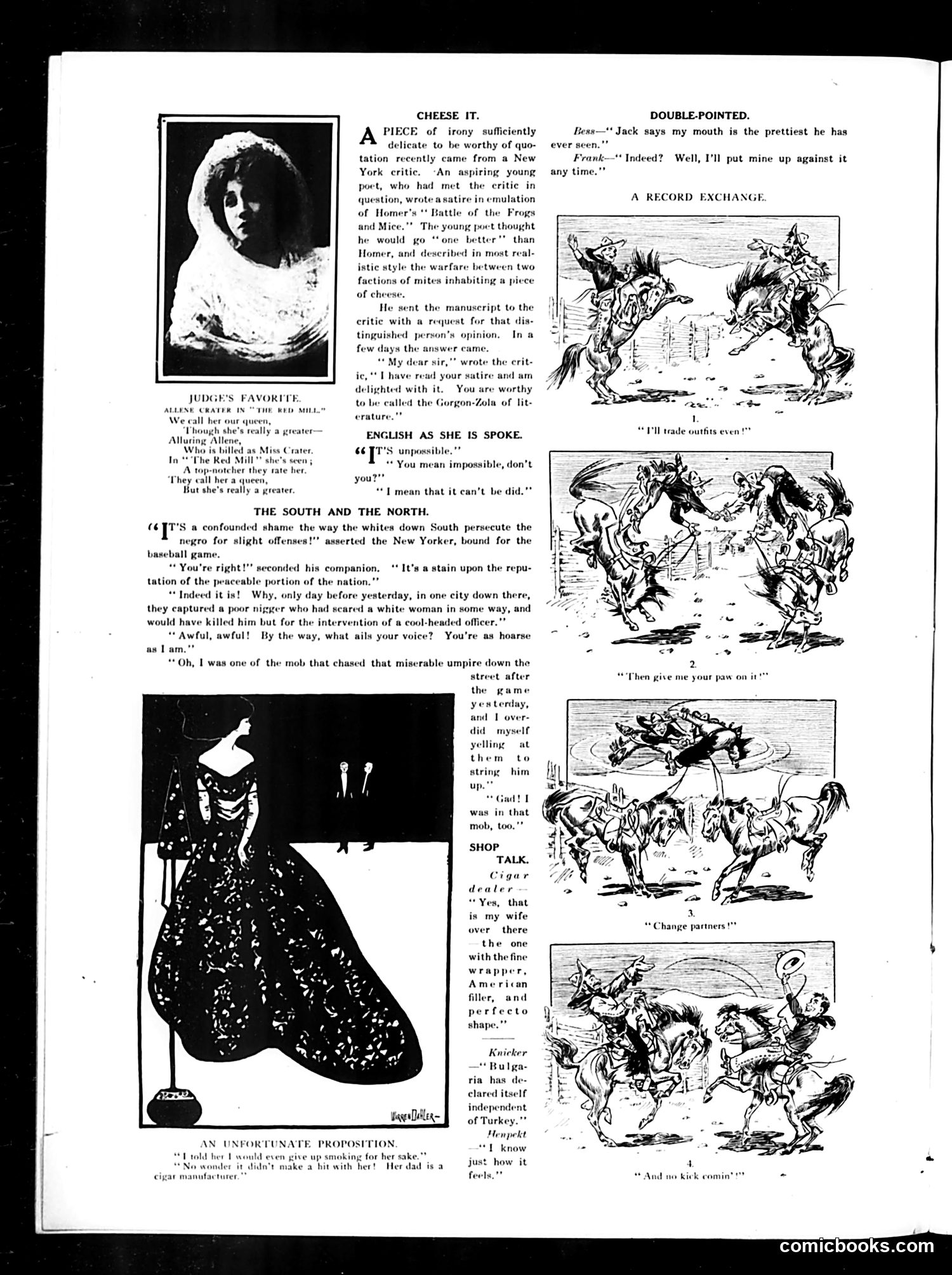
This page contains several satirical pieces and illustrations typical of early 20th-century Judge magazine content. **"Cheese It"** mocks a pretentious young poet who sent a satirical manuscript to a New York critic, comparing his work unfavorably to Homer. The critic's dismissive response—calling it the "Gorgon-Zolla of literature"—satirizes literary pretension. **"The South and the North"** presents dialogue about racial violence, with a New Yorker and Southerner debating lynching and mob justice. The satire appears to critique both Northern smugness and Southern violence. **"A Record Exchange"** shows comic illustrations of horses being traded/swapped, with humorous captions about the exchange. **"Shop Talk"** features a cigar dealer discussing his wife in crude terms, satirizing commercialism and masculine banter. The page is primarily humorous commentary on American social issues and personalities of the era.
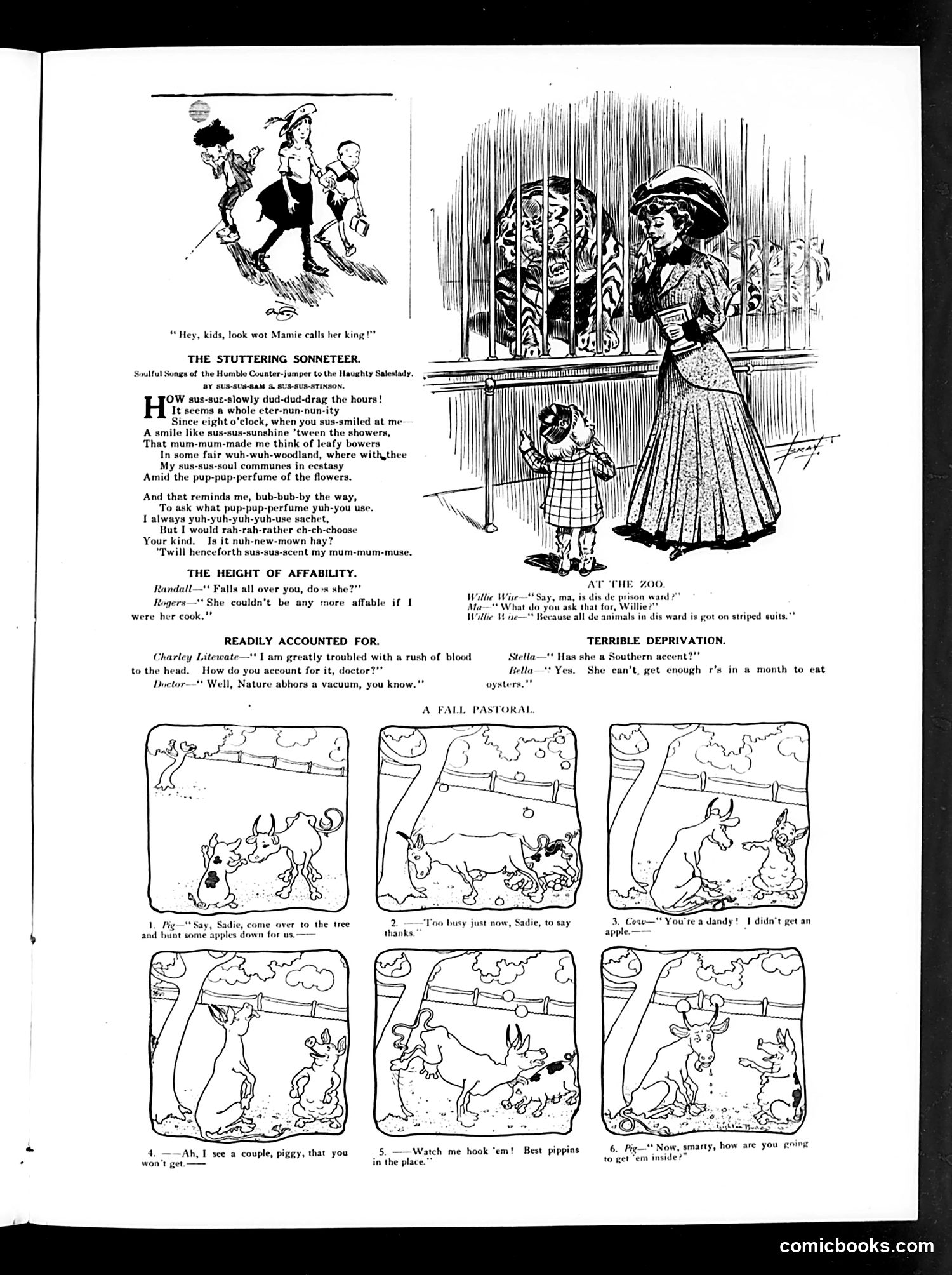
This page contains several distinct pieces of humor: **Top sections** feature poems and satirical sketches about domestic life and social etiquette—typical Judge fare mocking Victorian-era manners and child-rearing. "The Stuttering Soubrettee" and "The Height of Affability" appear to be social commentary on theatrical performers and their pretensions. **"At the Zoo"** depicts a woman and child at what appears to be a zoo enclosure, with dialogue about prison wards and animal behavior—likely satire about social class or animal-like behavior in human society. **"A Fall Pastoral"** is a six-panel comic strip showing goats and farm animals, with dialogue suggesting slapstick humor about rural life and animal mischief. The overall content represents typical early-20th-century American satirical humor focused on social observation and domestic situations.
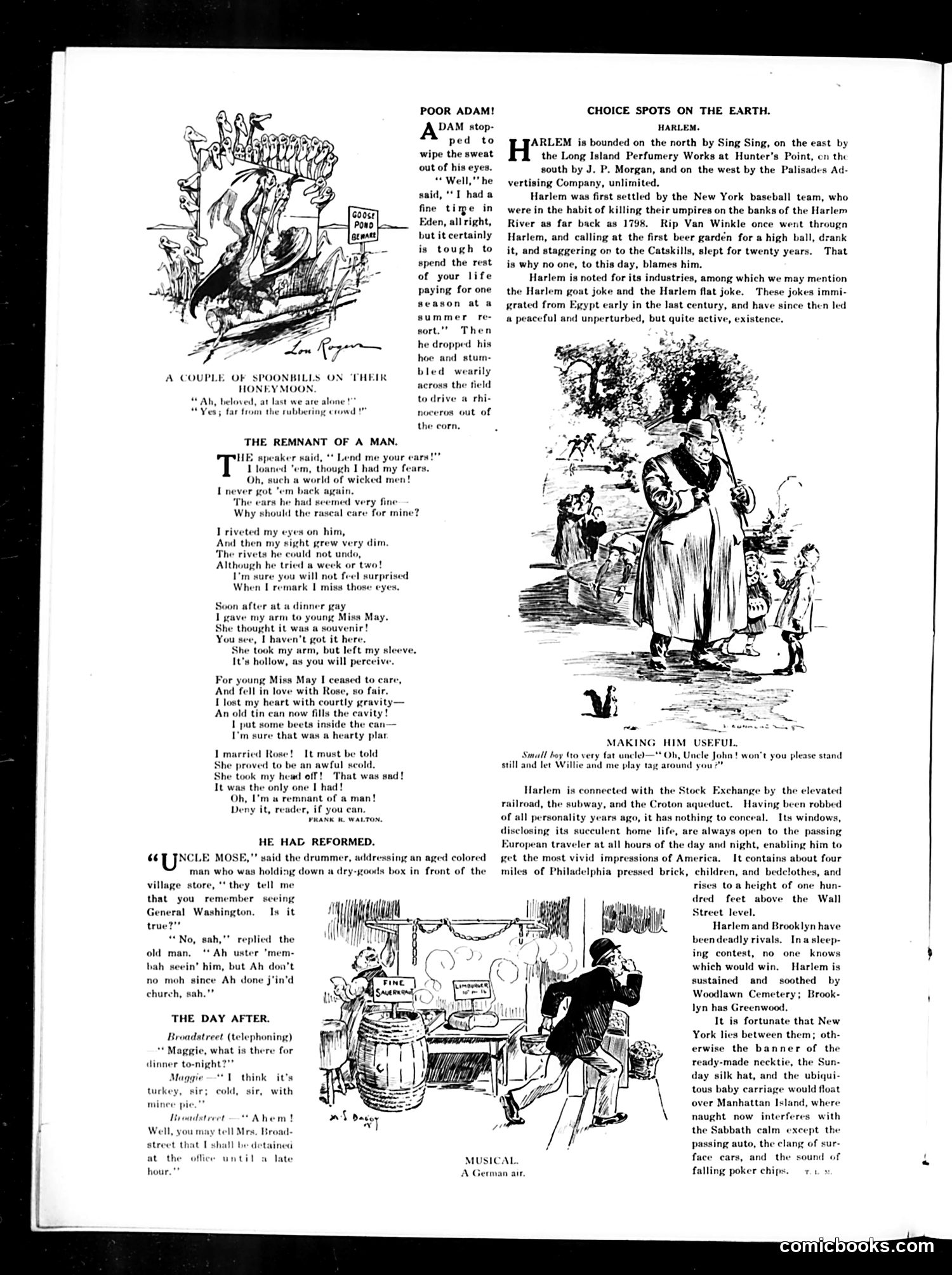
This page contains multiple satirical pieces. The main feature is a humorous description of Harlem as a neighborhood, mocking it through absurdist exaggeration: it's "bounded" by Sing Sing prison to the north and J.P. Morgan (the wealthy banker) to the south. The text jokes about Harlem's supposed "industries"—the "Harlem goat joke" and "Harlem flat joke"—references to ethnic humor stereotypes circulating at the time. The other content includes poems and illustrations about romantic misadventure ("The Remnant of a Man") and a sketch titled "Making Him Useful" showing a child asking an overweight uncle to stand still for a game. The overall tone reflects *Judge* magazine's satirical approach: mocking urban neighborhoods, ethnic groups, and social pretension through exaggerated wordplay and visual gags typical of early 20th-century American humor.
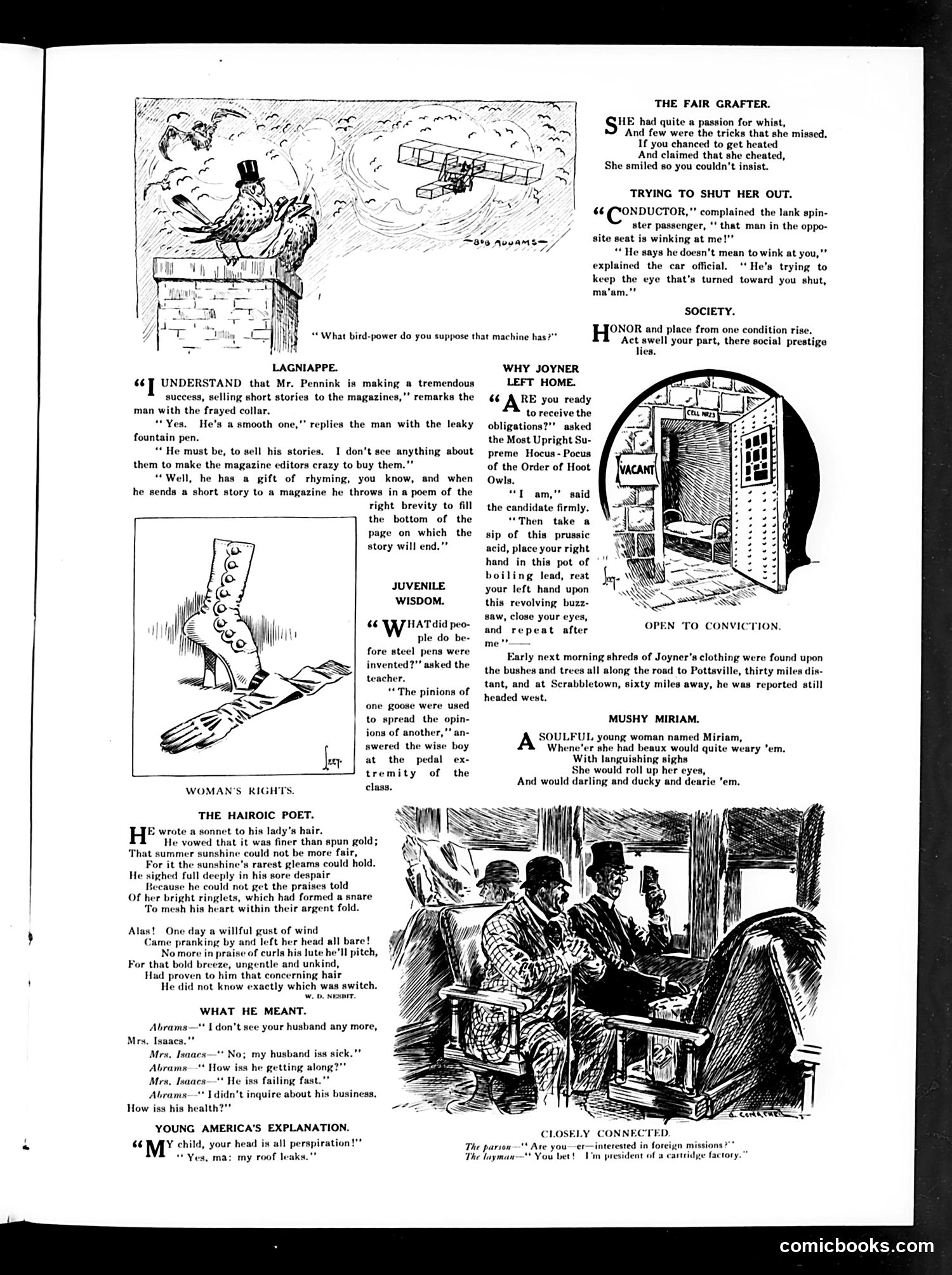
This page from *Judge* magazine contains multiple satirical sketches typical of early 20th-century American humor: **"The Fair Grafter"** mocks a woman who cheats at cards/games but uses charm to deflect accusations. "Grafter" refers to con artists. **"Trying to Shut Her Out"** jokes about a man winking involuntarily—the conductor claims he's trying to close a wayward eye, not flirt. **"Why Joyner Left Home"** depicts a fraternal initiation ritual (Order of Hoot Owls) with absurd, dangerous "obligations" involving prussic acid and buzz saws—satirizing secret societies' theatrical hazing. **"The Hairic Poet"** ridicules romantic poets by describing one who praised his lover's hair extensively, only to discover it was a hairpiece/switch blown away by wind. Other items mock: pretentious magazine writers, children's logic, and a minister interested in cartridge manufacturing (guns) rather than genuine missionary work. The humor relies on wordplay, irony, and social commentary about class pretension and institutional absurdity.
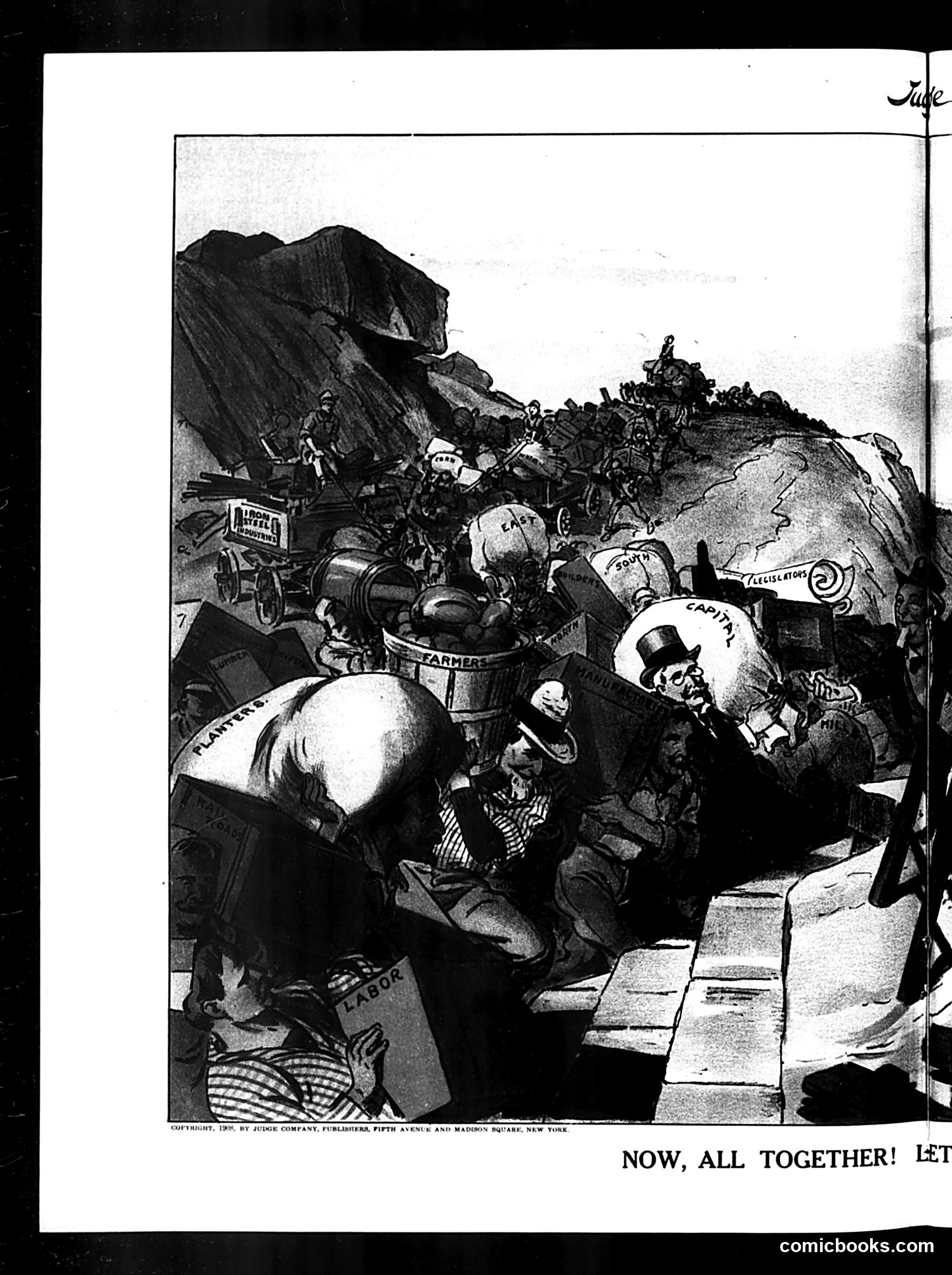
This Judge magazine cartoon satirizes labor and capital tensions during the Progressive Era. The image depicts a chaotic scene with various social classes and groups (identifiable by labels like "FARMER," "LABOR," and "CAPITAL") seemingly coordinated by a figure in a top hat—likely representing either a politician or wealthy industrialist attempting to unite disparate economic interests. The title "NOW, ALL TOGETHER!" suggests ironic commentary on forced unity or coordination among naturally opposed groups. The rocky terrain and tumultuous composition emphasize the difficulty and artificiality of such collaboration. The cartoon critiques either political rhetoric promising class harmony or capitalist attempts to manage labor unrest during a period of significant industrial conflict and reform movements.
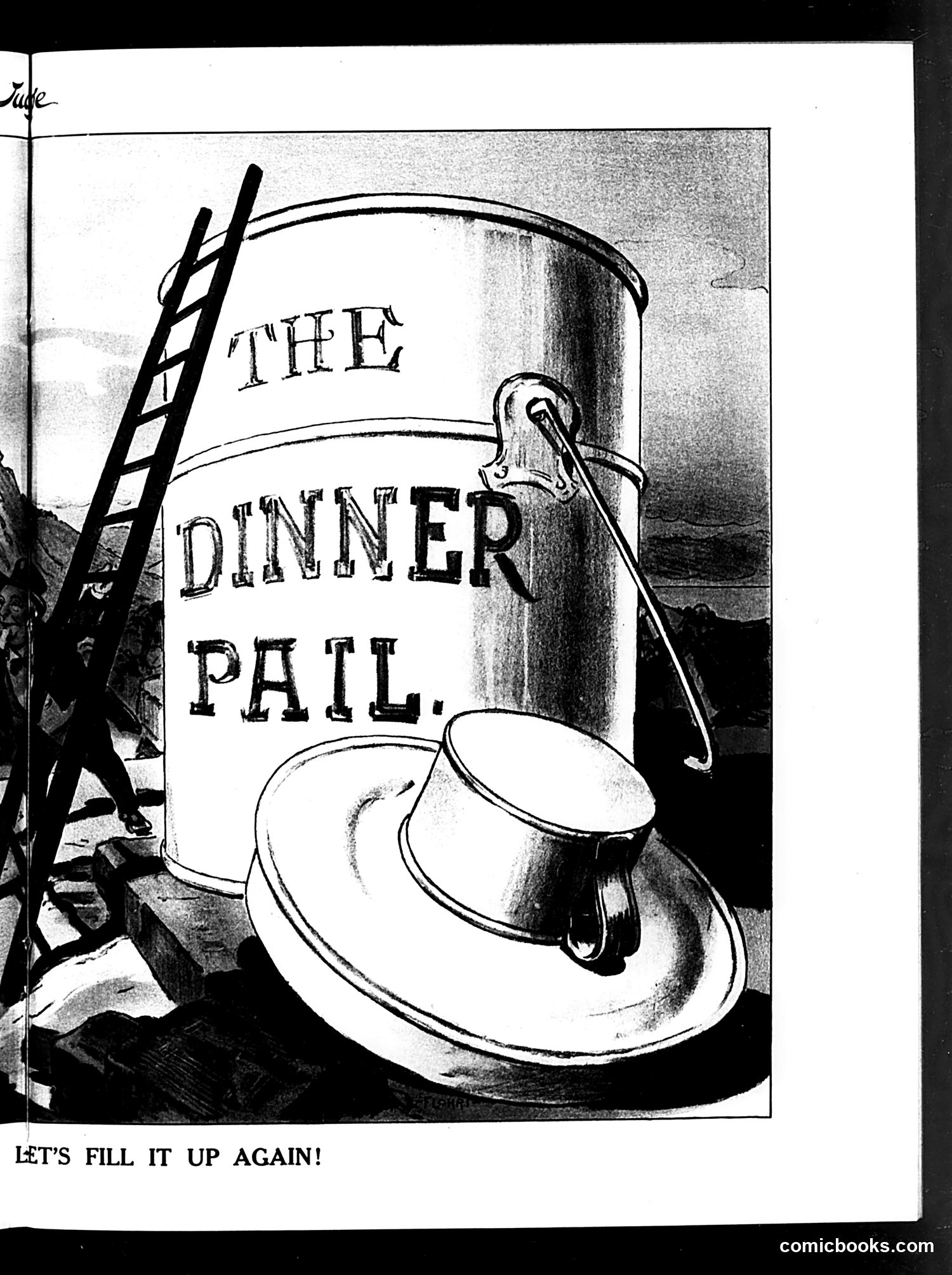
This appears to be a political cartoon from Judge magazine referencing "The Dinner Pail"—a symbolic phrase used in American politics, particularly during the McKinley era (early 1900s), representing workers' prosperity and full employment. The cartoon shows a large industrial pot labeled "THE DINNER PAIL" with a ladle, accompanied by a plate below. The caption "LET'S FILL IT UP AGAIN!" suggests an appeal to voters about maintaining or restoring economic prosperity and worker welfare. The ladder leaning against the pot indicates effort or aspiration to achieve full prosperity. This likely comments on economic conditions during a particular election cycle, using the dinner pail as shorthand for working-class economic security—a key political messaging theme of the era.
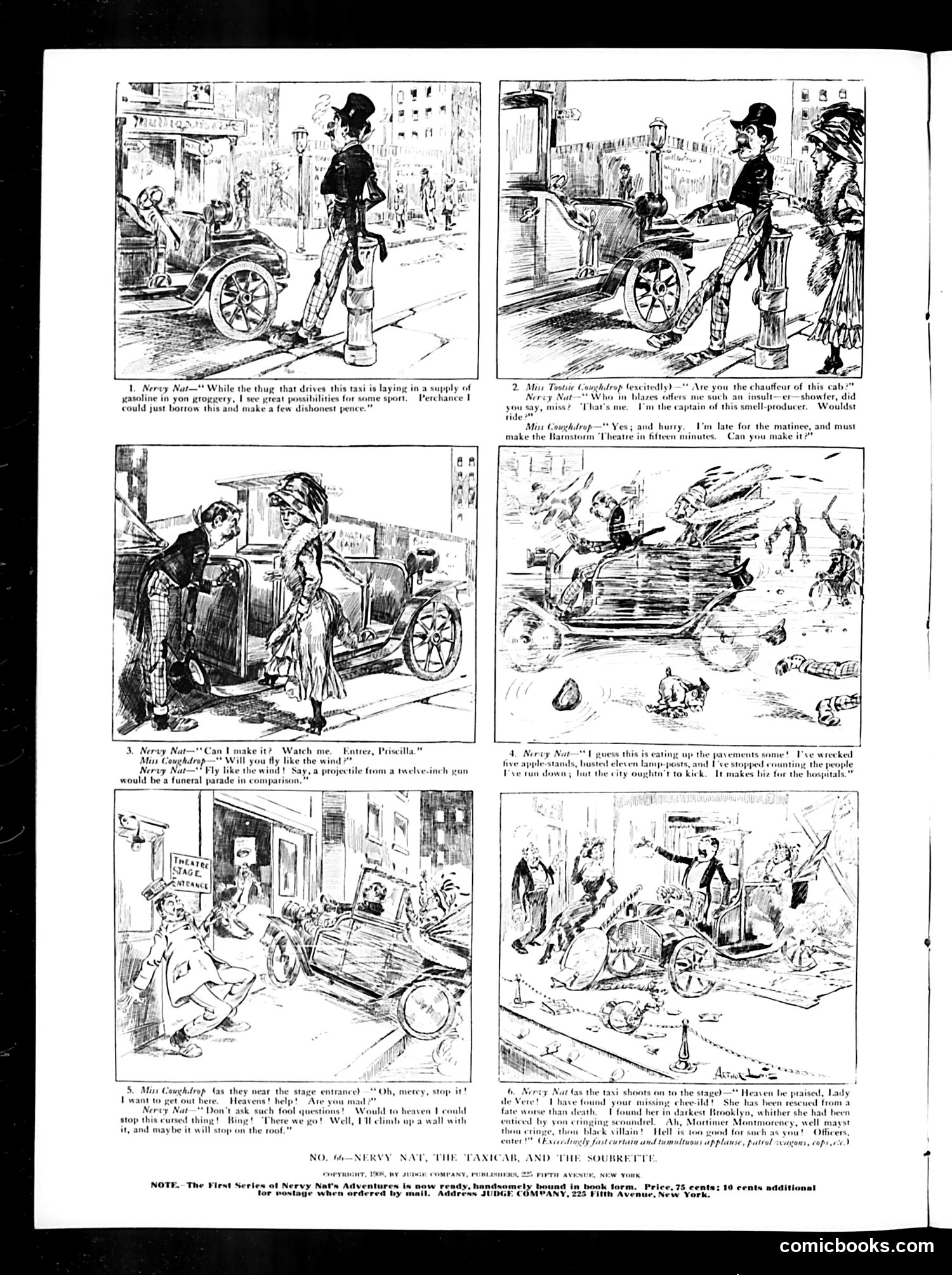
This is a six-panel comic strip starring "Nervy Nat," an apparently working-class character who drives a taxi. The humor centers on his brash interactions with a "soubrette" (a theatrical actress or chorus girl). The plot follows Nat attempting to impress or proposition the woman by offering his taxi and boasting about its speed and capabilities. She rebuffs his advances with indignation. The comedy escalates through increasingly chaotic scenes—culminating in a spectacular crash sequence in the final panels where the taxi destroys property and scatters pedestrians. The satire targets early 20th-century taxi culture, working-class male presumption toward women performers, and reckless driving. "Nervy Nat" embodies the brazen, persistent suitor willing to cause public chaos for romantic attention. The woman's consistent rejections and the destructive consequences form the joke's moral structure: his nerve deserves comeuppance.
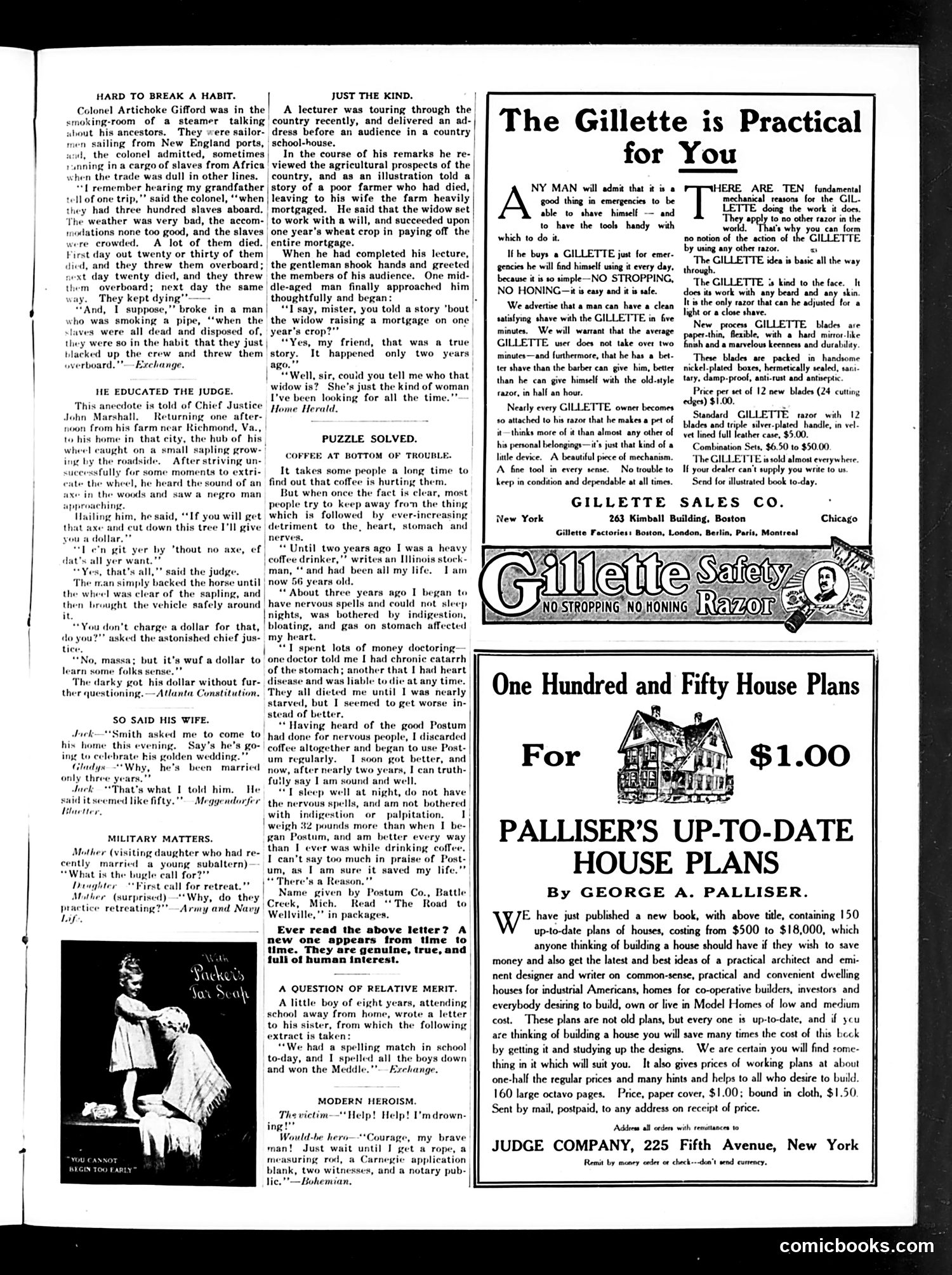
This page is primarily **advertising and filler content**, not political satire. The dominant feature is a large **Gillette Safety Razor advertisement** highlighting ten mechanical advantages of the product and testimonials about its ease of use. The left column contains three separate humorous anecdotes: 1. **"Hard to Break a Habit"** – A darkly comic story about Colonel Artichoke Gifford recounting a slave-trading voyage where crew members died regularly; a listener jokes the colonel eventually replaced dead slaves with the crew. 2. **"Just the Kind"** – A lecturer's story about a widow paying off her mortgage becomes the setup for a punchline about finding a thrifty wife. 3. **"He Educated the Judge"** – An anecdote about Chief Justice John Marshall (incomplete in this excerpt). The page's satirical content is minimal and relatively mild. The slave-trading anecdote uses dark humor typical of 19th-century magazines, but appears to mock the casual callousness of the narrator rather than endorse slavery. The page is primarily a **commercial product promotion** disguised as editorial content.
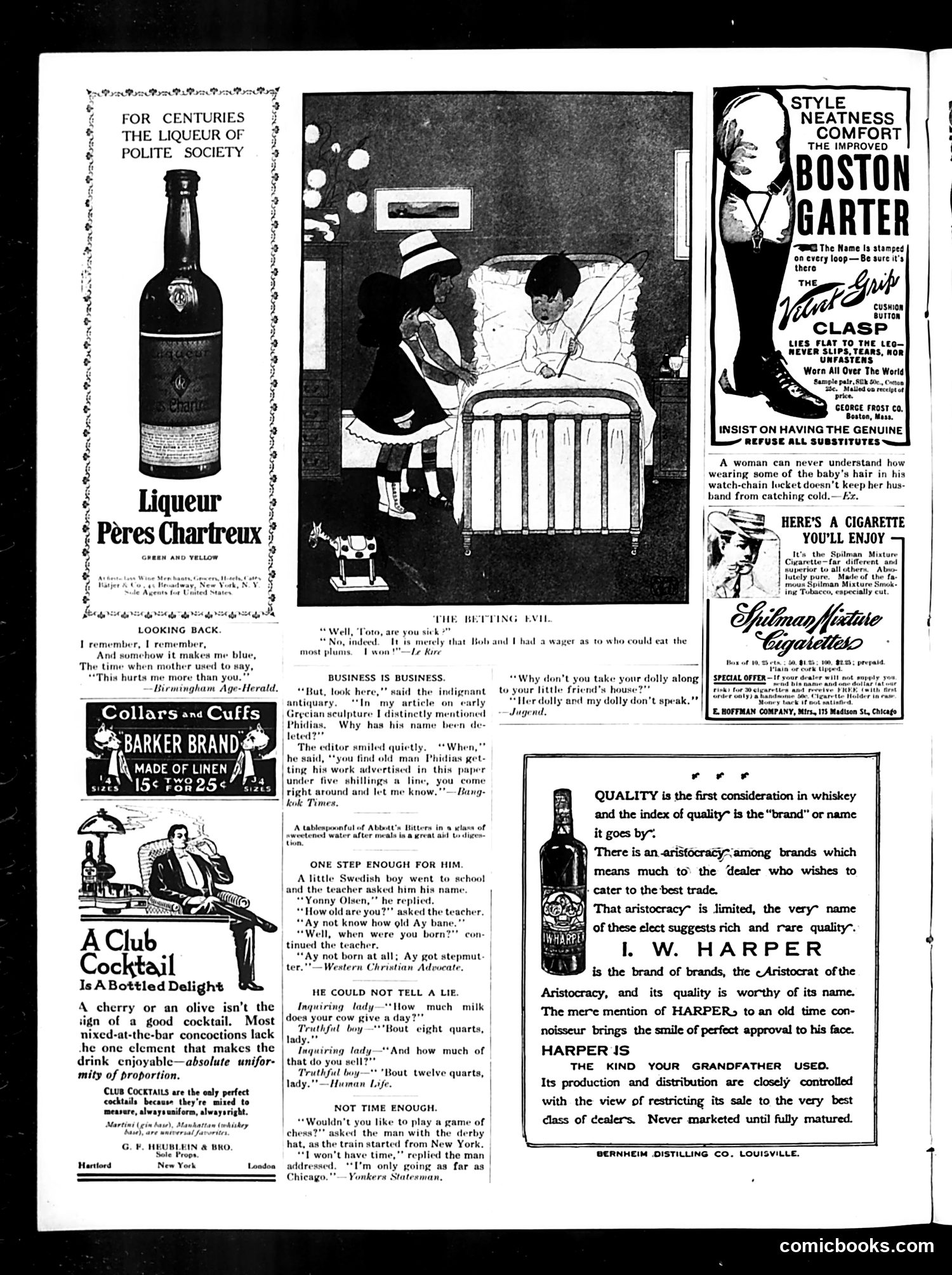
This page is primarily **advertising**, with several short humorous anecdotes interspersed. The main cartoon—titled "The Betting Evil"—depicts a man in a hat visiting a bedridden woman, illustrating a joke about wagering: the man claims he and "Bob" bet on who could eat the most plums, with the implication that overindulgence caused his companion's illness. The page contains multiple brief joke-stories in the "filler" tradition, mostly playing on: - **Literal-mindedness** (a Swedish boy misunderstanding "when were you born") - **Irish/ethnic humor** (stereotypical speech patterns) - **Class commentary** (an antiquary annoyed at seeing "Phidias" advertised cheaply) The advertisements promote liqueurs, collars, cocktails, garters, cigarettes, and whiskey—all targeting upper-class male readers. The overall tone reflects early 20th-century genteel humor and commercial culture aimed at affluent audiences.
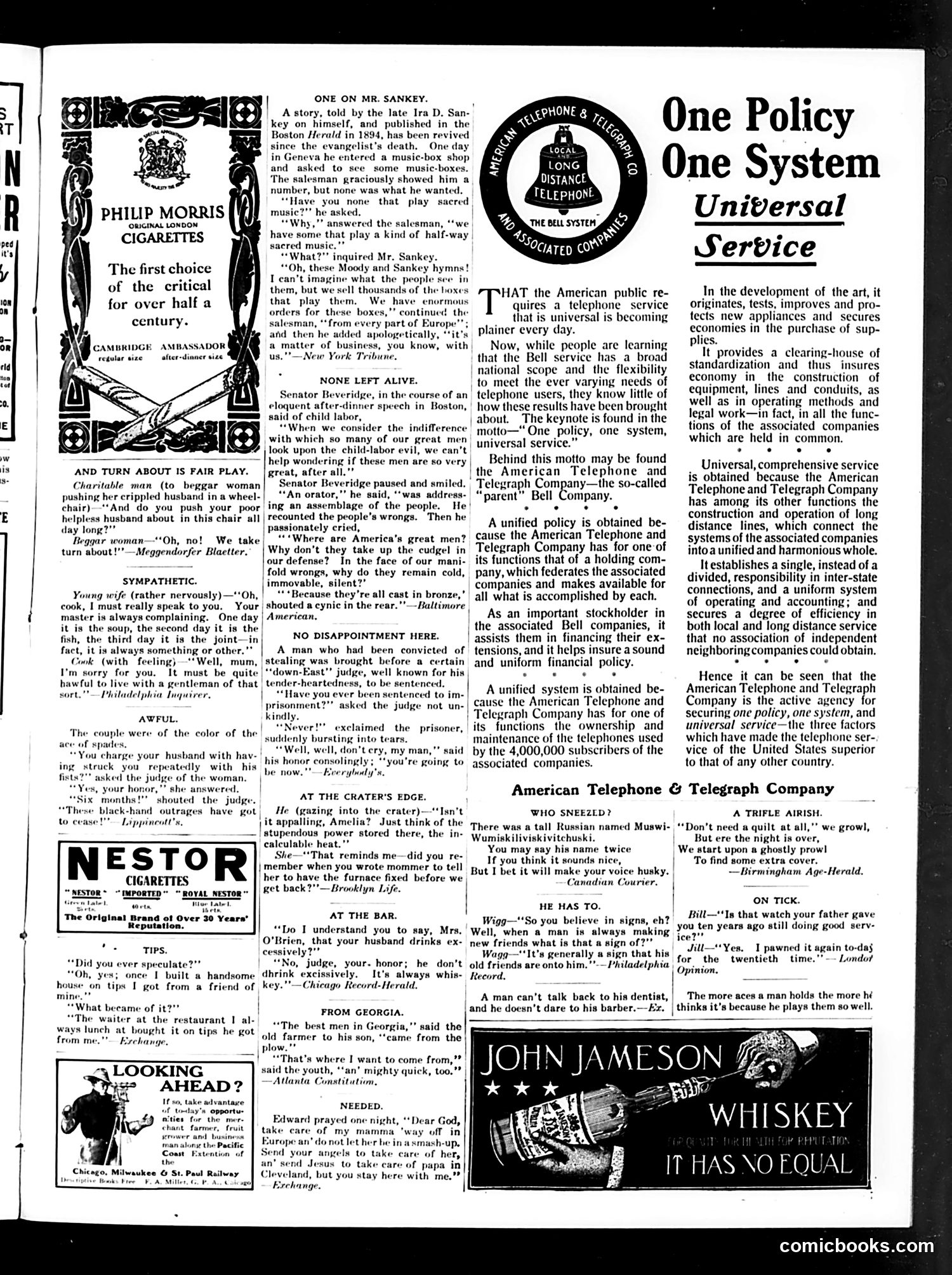
This page contains brief satirical anecdotes and advertisements rather than political cartoons. The humor targets everyday social situations and hypocrisy: **"One on Mr. Sankey"** mocks evangelist Ira D. Sankey—a real historical figure—for seeking music boxes playing his own hymns, illustrating vanity. **"None Left Alive"** satirizes absent reformers: Senator Beveridge denounces child labor while noting great men never respond to social wrongs. A heckler quips they're "all cast in bronze"—dead statues—suggesting reform advocates are ineffectual ghosts. **Other anecdotes** ridicule marital dynamics, class pretension, and Irish stereotypes (the whiskey joke). The advertisements promote Philip Morris cigarettes and John Jameson whiskey as luxury products for "critical" consumers—standard early 20th-century marketing. **Context for modern readers:** These pieces reflect Progressive Era concerns about child labor and reform while perpetuating ethnic stereotypes common to the period. The humor assumes readers share class-based prejudices.
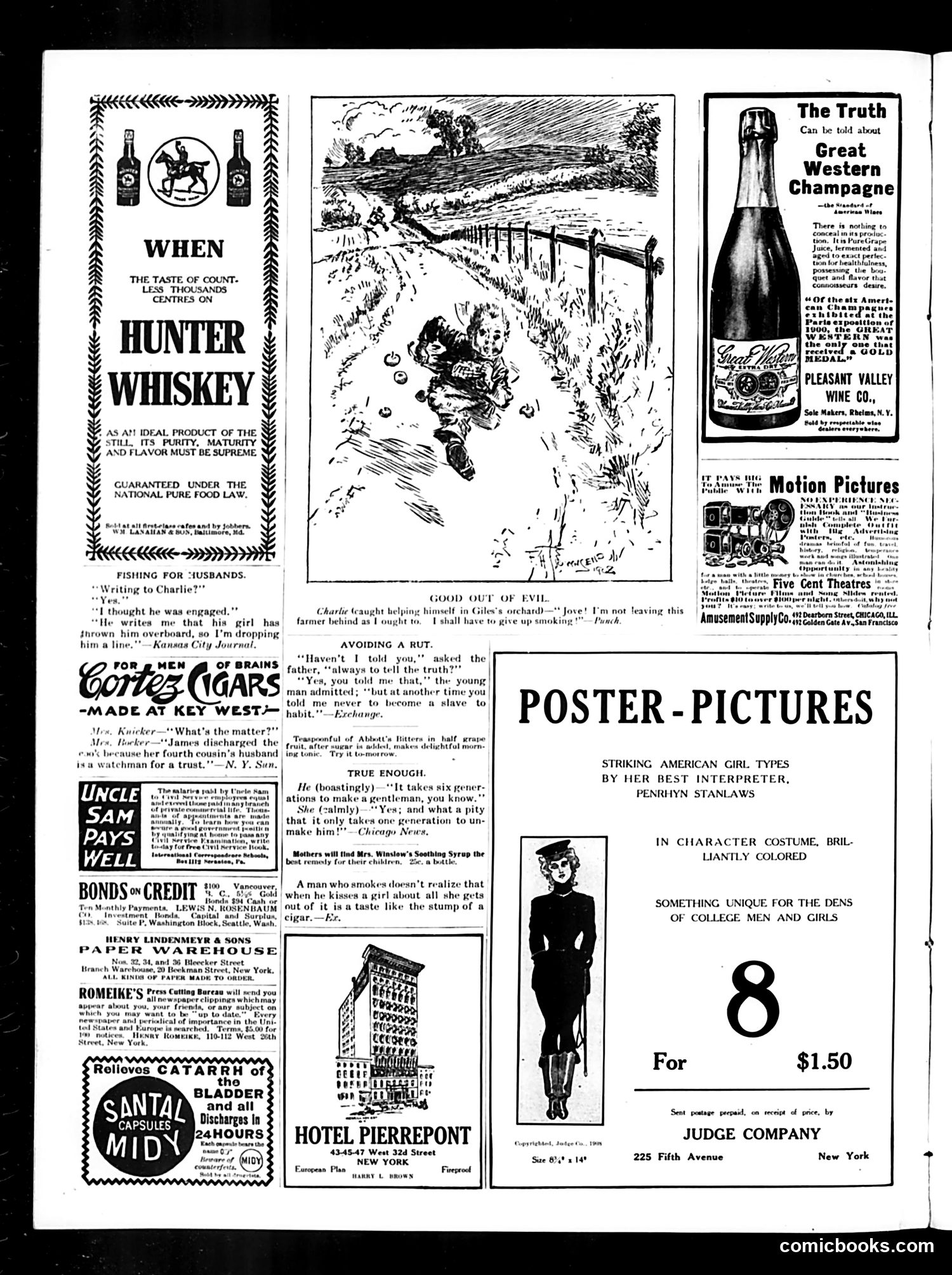
This page is primarily **advertising with brief comic vignettes**. The main content consists of: **Central Cartoon ("Good Out of Evil")**: A boy is caught stealing fruit from a farmer's orchard. The joke plays on unexpected consequences—the farmer allows him to continue if he avoids smoking, suggesting that preventing the boy's smoking habit is a greater good than stopping the theft. **Surrounding Comic Snippets**: Brief one-liner jokes about dating and marriage ("Fishing for Husbands"), moral lessons about honesty, and observations about masculine behavior. These reflect early 20th-century social attitudes regarding courtship, matrimony, and gender roles. **Advertisements**: The page heavily promotes period products—Hunter Whiskey (emphasizing purity under food laws), Cortez cigars, Hotel Pierrepont, and Penrhyn Stanlaws poster-pictures. A prominent ad for "Great Western Champagne" appears upper right. The tone is genteel and moralistic, typical of Judge's satirical yet conservative approach to American society during this era.
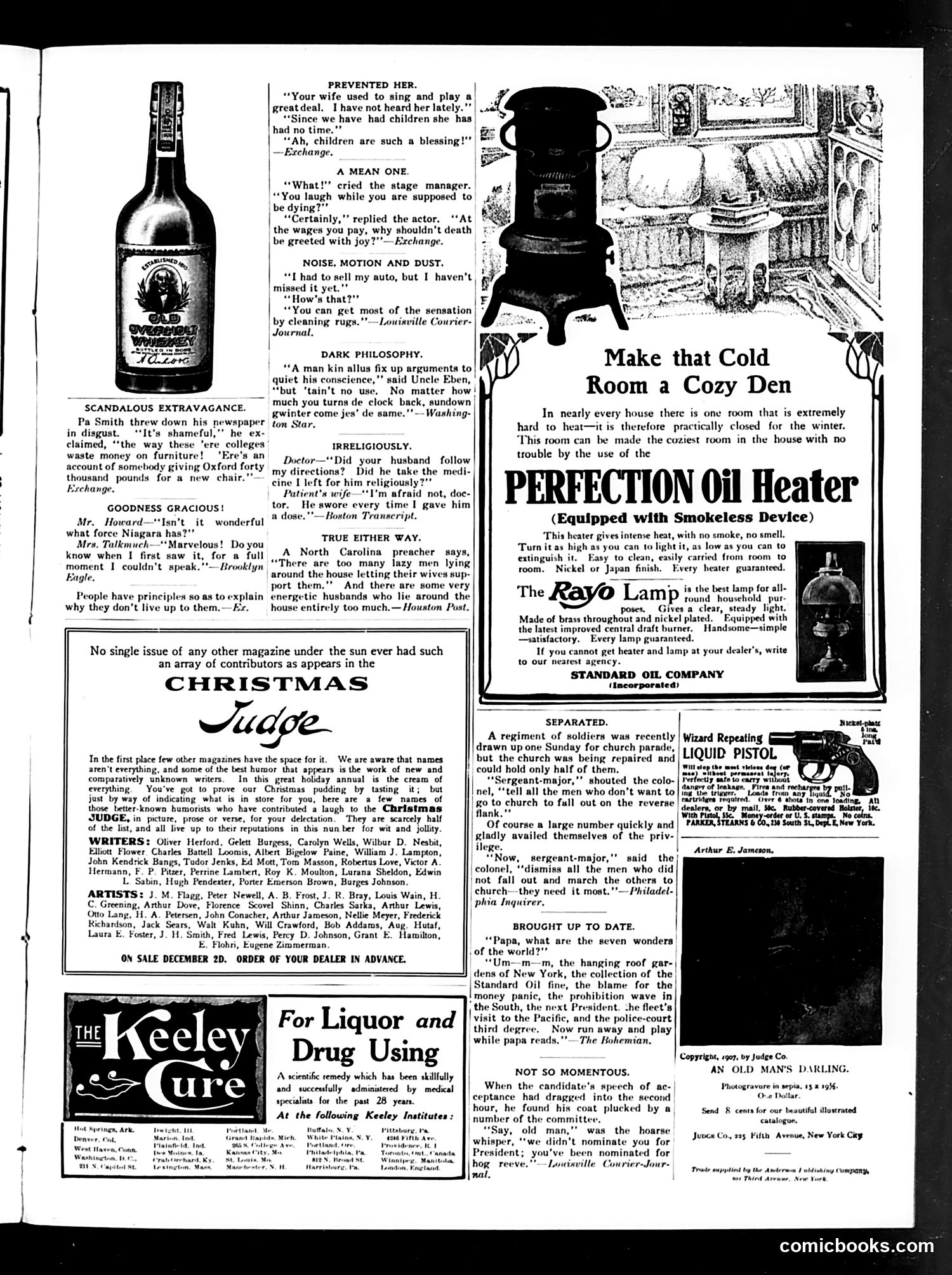
This page contains brief satirical anecdotes typical of Judge's humor, along with period advertisements. The jokes target domestic life and social pretensions: **"Prevented Her"** mocks the excuse that motherhood prevents women from pursuing arts/music. **"A Mean One"** satirizes an actor who finds death scenes funny because his low wages make even stage death preferable to his real life—dark humor about theatrical working conditions. **"Noise, Motion and Dust"** jokes that selling one's automobile but cleaning rugs provides equivalent sensations—poking fun at the nouveau riche fascination with automobiles. **"Dark Philosophy"** features "Uncle Eben" (a stock rural character type) philosophizing that you can't outrun fate. The remaining anecdotes satirize marital dynamics, medical advice-giving, and military discipline. The advertisements for heating devices and patent medicines are typical of the era. The content reflects early 1900s middle-class American anxieties about technology, marriage, and social status.
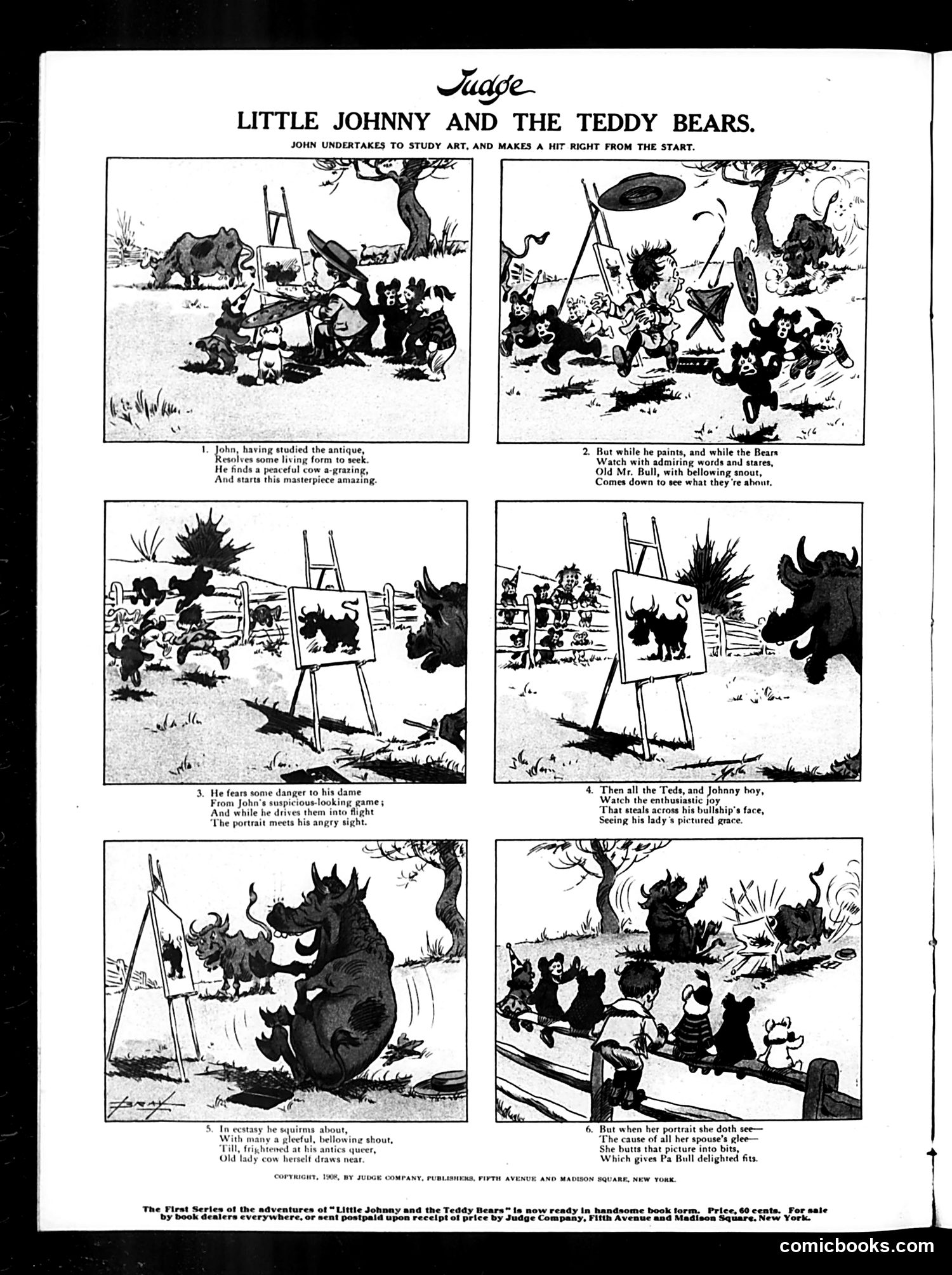
This is a humorous six-panel comic strip from Judge magazine (copyright 1900) featuring a recurring character, Little Johnny, and anthropomorphic "Teddy Bears" (likely named after President Theodore Roosevelt, whose popularity made teddy bears a cultural phenomenon around 1900). The plot: Johnny studies art and sketches a grazing cow. The Teddy Bears admire his work enthusiastically. A bull arrives, sees the portrait of a cow, and becomes delighted—apparently recognizing his mate. However, when the cow herself sees her portrait, she's outraged and destroys it, much to the bull's amusement. The joke relies on slapstick animal humor typical of early 1900s comics: the irony that while the male bull finds the portrait charming, the female subject rejects it. This plays on period attitudes about vanity and gender roles, presented through silly animal antics for lighthearted effect.