
A complete issue · 16 pages · 1908
Judge — October 31, 1908
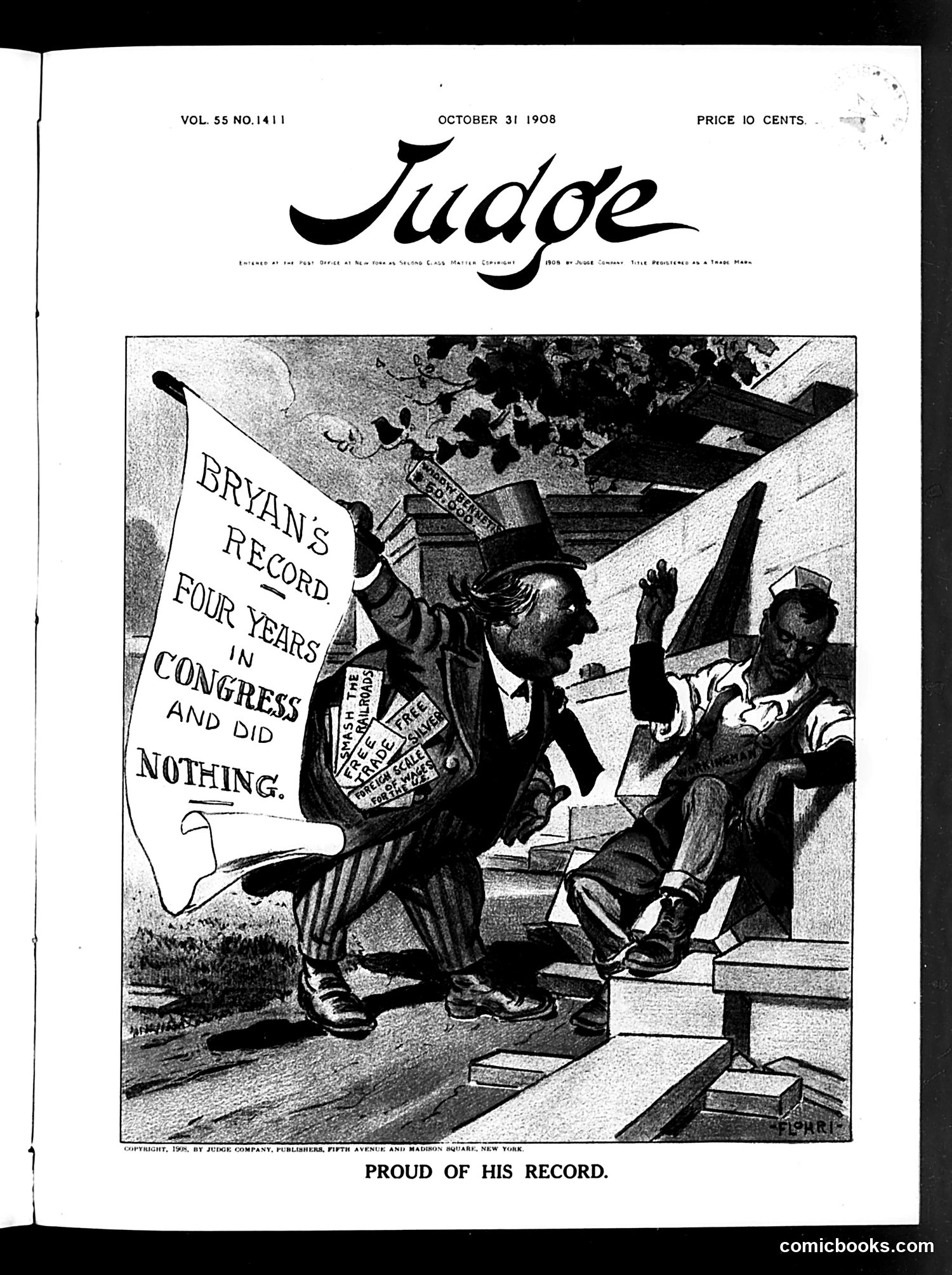
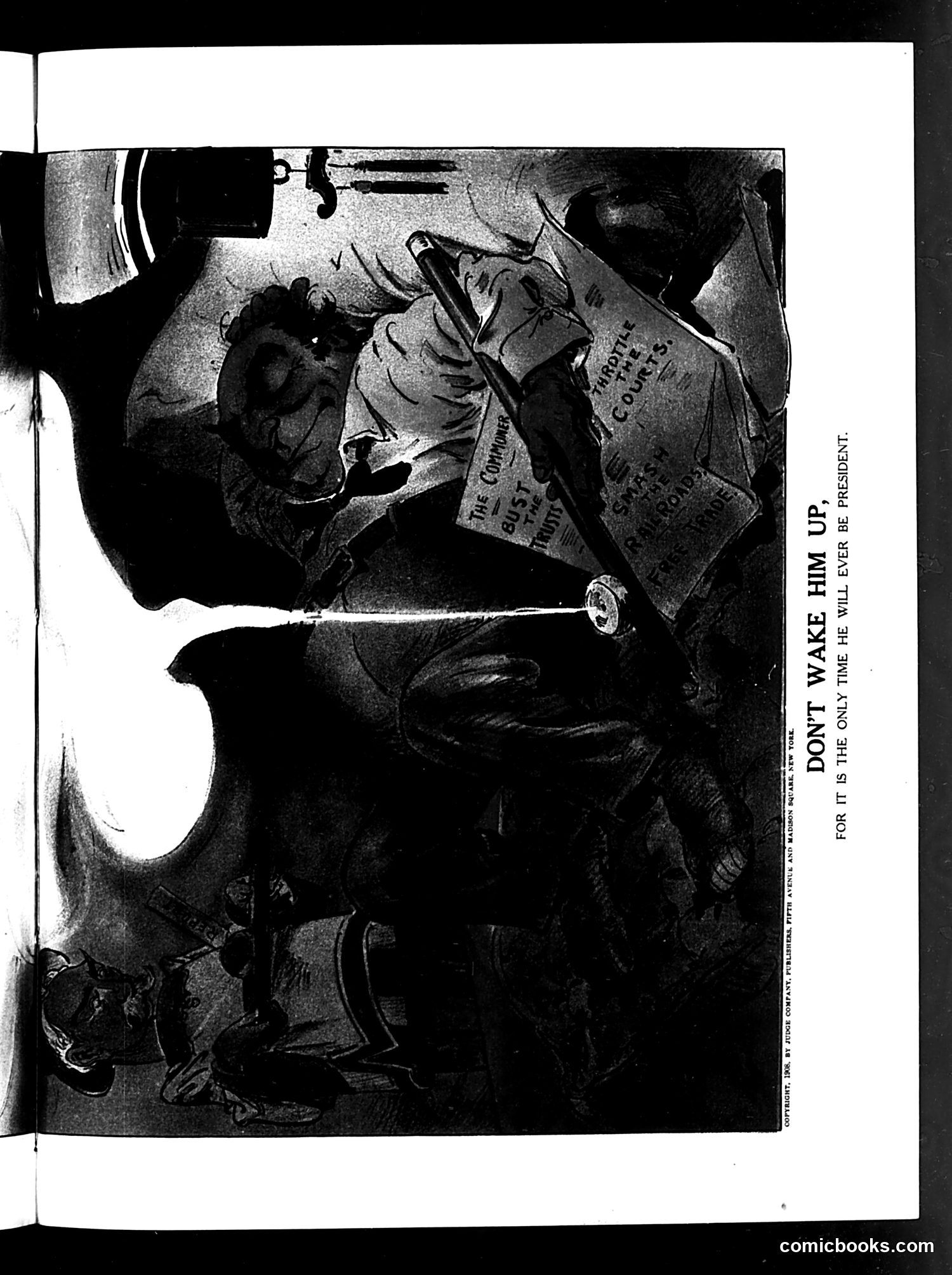
This 1908 *Judge* cartoon satirizes William Jennings Bryan's political career. The central figure, identified by the banner as Bryan, proudly displays his record: "Four Years in Congress and Did Nothing." The cartoon mocks Bryan's legislative ineffectiveness during his House service (1891-1895), contrasting his self-satisfaction with his actual accomplishments. The other figures appear to represent the public or political observers, seemingly unimpressed or skeptical of his boasts. The satire suggests Bryan's political prominence rested on rhetoric rather than substantive legislative achievement—a common criticism leveled against him during his presidential campaigns (1896, 1900, 1908). The cartoon's title ironically undercuts Bryan's apparent pride in an objectively negligible record.
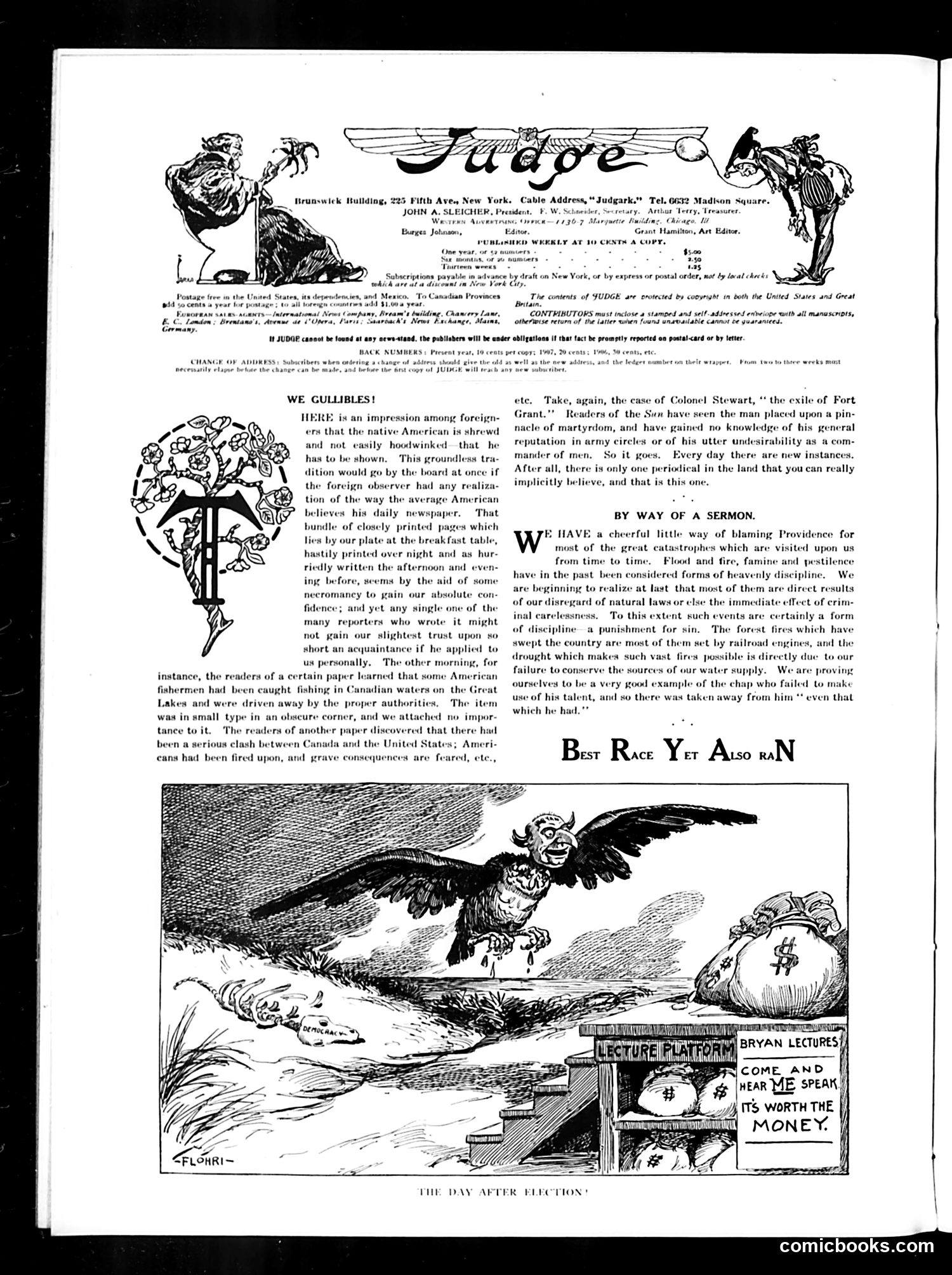
This page contains two distinct pieces: **"We Gullibles!"** - An editorial criticizing American newspapers for credulously reporting unverified foreign stories, particularly regarding "native" populations and sensational incidents. The author argues newspapers print dubious tales without fact-checking, citing examples of Canadian and American readers being misled by false reports about international incidents. **"By Way of a Sermon"** - A moral commentary blaming Providence for natural disasters, but argues such events are actually consequences of human negligence—poor forestry practices and water management. The piece sarcastically suggests we should accept these as divine punishment rather than acknowledge our own carelessness. **"Best Race Yet Also Rain"** - A cartoon (artist signed "Cesare") depicts a vulture at a lecture platform advertising Bryan Lectures, satirizing William Jennings Bryan's paid speaking circuit. The image appears critical of commercializing political speechmaking.
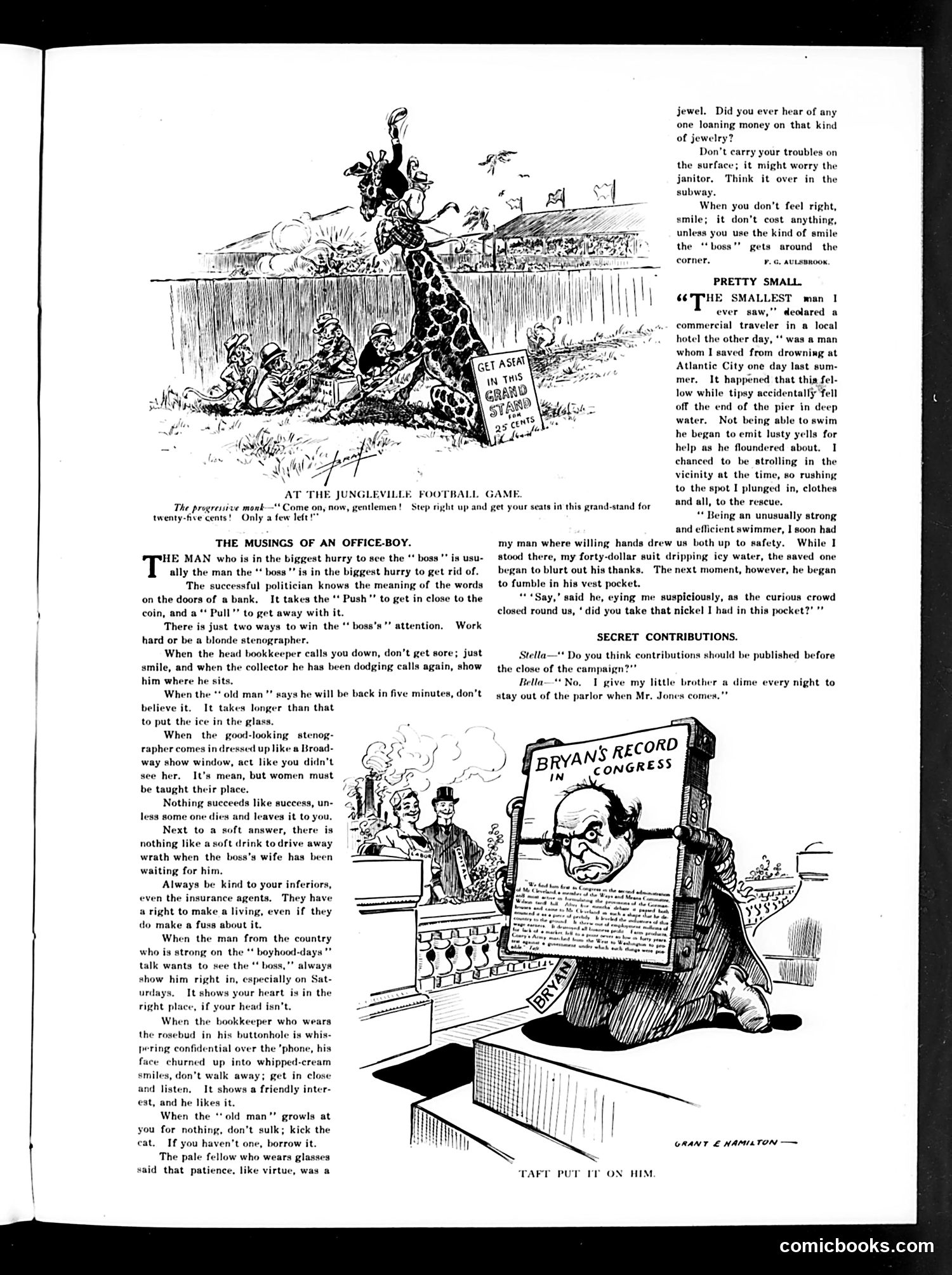
The cartoon titled "Taft Put It On Him" depicts a caricatured figure holding "Bryan's Record in Congress," likely referencing William Jennings Bryan. The figure appears distressed or burdened by the document. This satirizes the 1908 presidential campaign, where Republican William Howard Taft's supporters attacked Democratic candidate Bryan's congressional voting record. The cartoon suggests Taft's campaign strategically weaponized Bryan's legislative history against him—"putting it on him" as a political burden. The grotesque facial caricature emphasizes the severity of the attack. The artist (Grant E. Hamilton, per signature) mocks this campaign tactic as unfair or overly aggressive political theater, typical of Judge magazine's satirical approach to election-year politics.
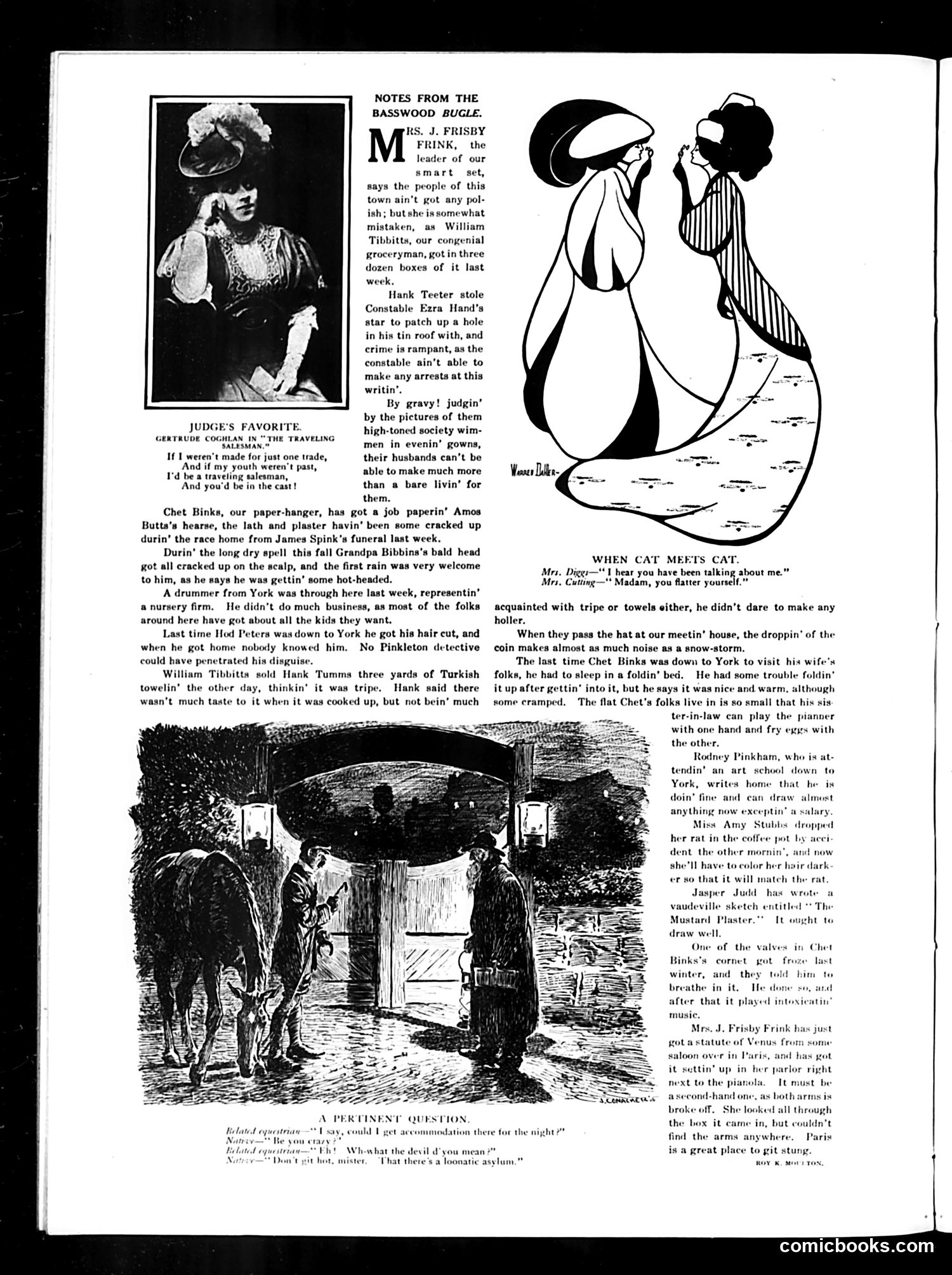
This page from *Judge* magazine contains gossipy social commentary titled "Notes from the Basswood Bugle." The content satirizes small-town life through anecdotes about local characters—a grocer with polished boxes, a constable unable to make arrests, stolen tin roofs, and funeral attendance. The cartoon "When Cat Meets Cat" (top right) depicts two fashionably-dressed women encountering each other, likely satirizing high-society pretension and artificial politeness between rivals. "Pertinent Question" (bottom) shows two men at what appears to be a lodging house, with dialogue about accommodations—probably mocking either poverty conditions or questionable establishments. The overall tone mocks rural/small-town American society, its scandals, and social hierarchies through humor and light ridicule typical of early 20th-century satirical magazines.
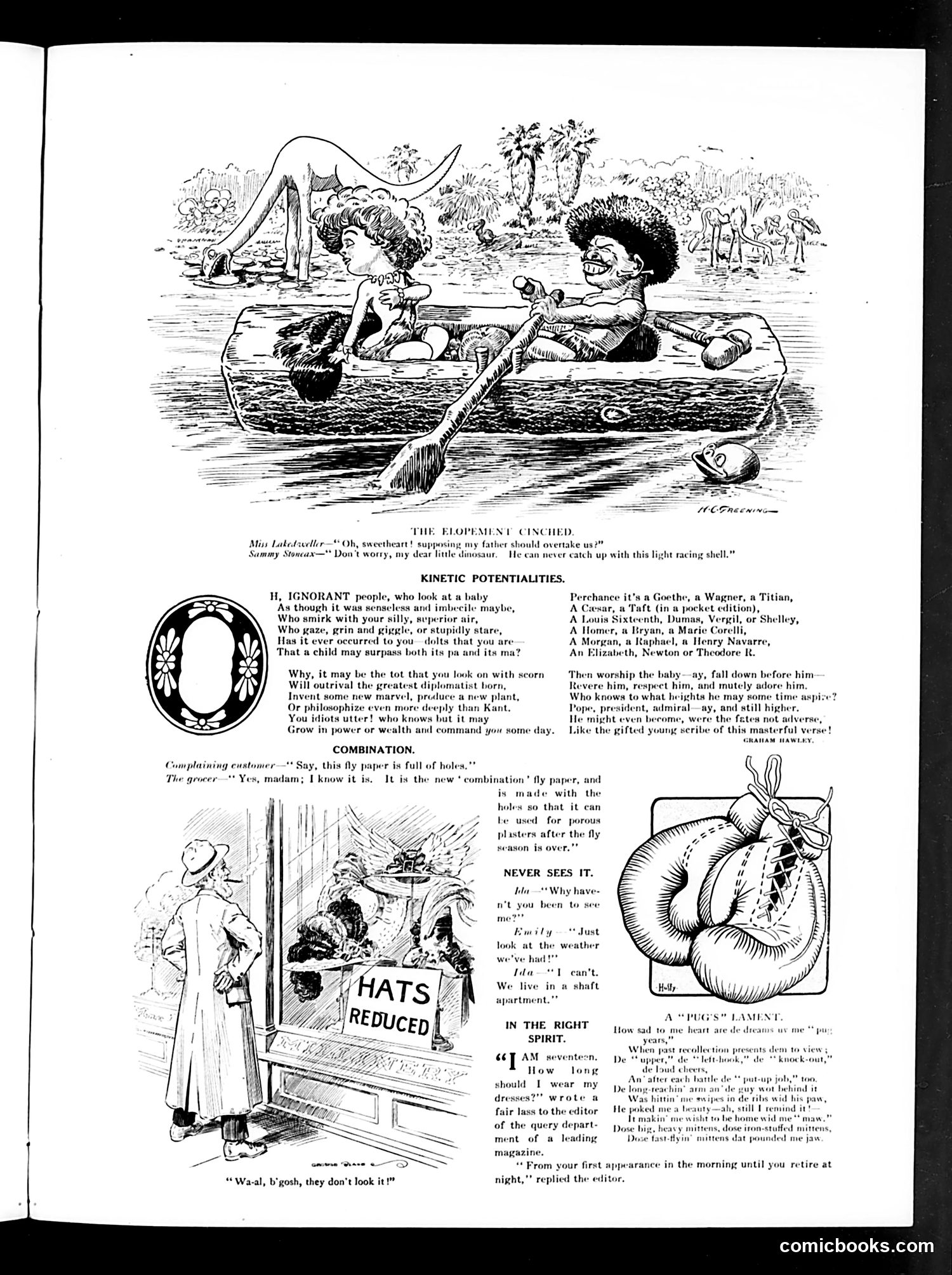
**Main Cartoon (Top):** A couple in a boat represents an elopement scenario. The caption quotes a girl reassuring her suitor that her father won't overtake them in his "light racing shell" (a fast rowboat). The joke plays on the father's sporting prowess being rendered useless by the couple's head start. **"Kinetic Potentialities":** A poem mocking ignorant people who judge babies' futures based on appearance, suggesting a child might grow up to be famous historical figures or leaders. It's social satire about class assumptions and inherited status. **"Hats Reduced":** A store-window sketch satirizing fashion, with a woman claiming she "won't look at it"—likely commenting on women's contradictory shopping behavior. The page blends romantic comedy with social commentary typical of Judge magazine's humor.
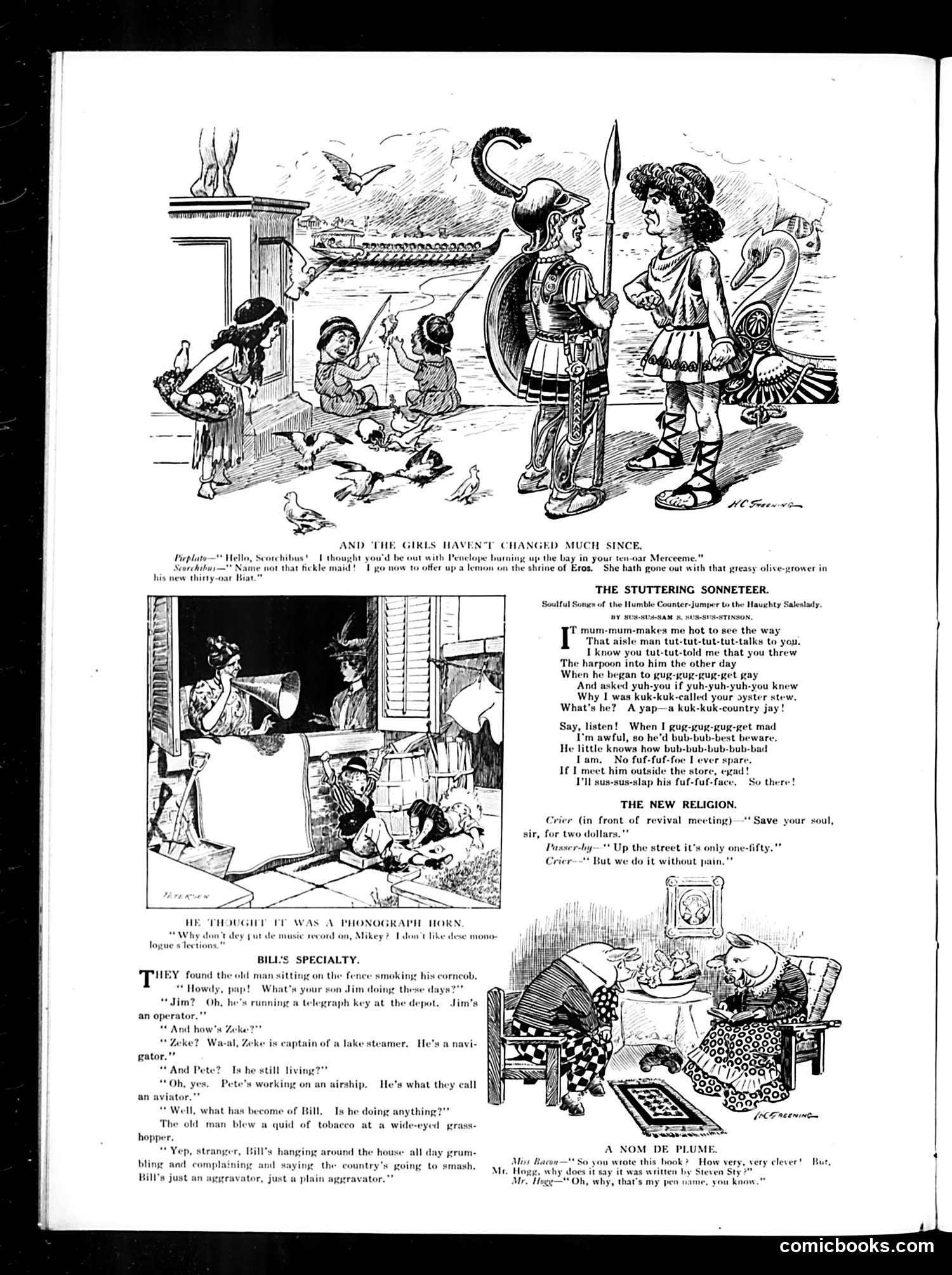
This page contains multiple satirical sketches typical of early 20th-century American humor: **Top cartoon**: A classical/mythological scene mocking romantic pretension. A man in Roman dress complains to "Scorchibus" that a woman has rejected him for "a greasy olive-grower"—satirizing how wealthy suitors lose romantic rivals to unsuitable competitors, and poking fun at classical affectation in courtship language. **"The Stuttering Sonneteer"**: Parodies overwrought romantic poetry by a jealous man who stammers badly while attempting passionate verse—mocking both affected literary expression and insecure masculinity. **"The New Religion"**: Satirizes commercialization of religion; a revival preacher literally selling salvation ("two dollars") while competitors undercut prices, treating spiritual salvation as consumer goods. **Bottom sketches**: Include jokes about outdated technology (phonograph horn confusion), casual rural conversations about economic hardship (friends scattered in low-wage jobs), and a pun about "pen names." The overall tone reflects Judge's satirical approach: mocking pretension, commercialism, and social affectation through exaggerated character types.
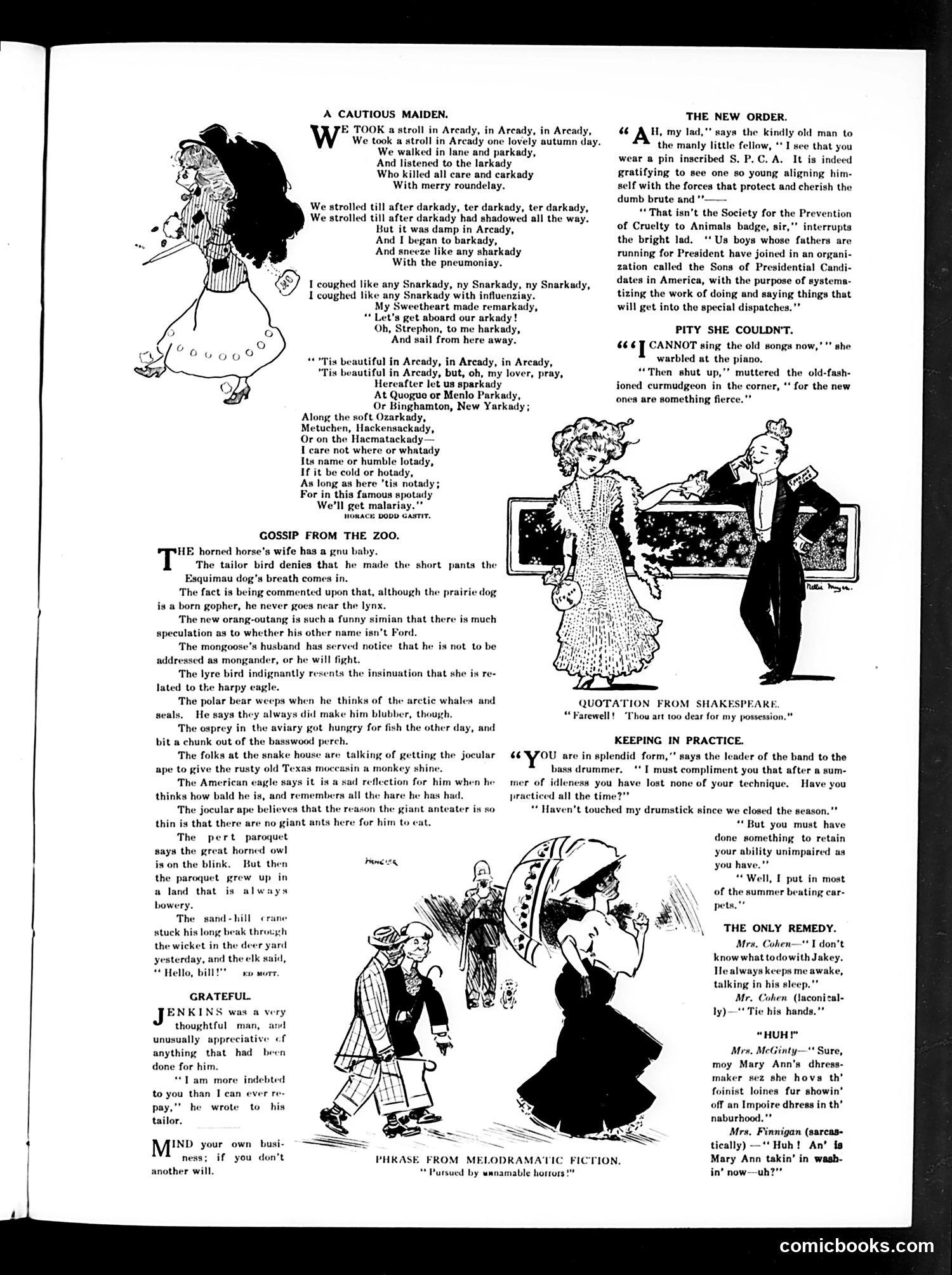
This page contains three distinct humorous pieces: **"A Cautious Maiden"** satirizes romantic conventions through a poem where a couple's pastoral romance is interrupted by the woman catching a cold. She insists they relocate to various American towns (Quogue, Metuchen, Hackensack) to avoid "malaria"—mocking both the period's exaggerated disease anxieties and women's tendency toward cautious practicality in courtship. **"Gossip from the Zoo"** offers animal puns and anthropomorphic humor typical of early 20th-century comedy—wordplay like the "horned horse's wife" having a "gnu baby" and jokes about the mongoose being called "mongander." **"The New Order"** appears to reference contemporary politics, though unclear which presidential election. A boy wears a pin for "Sons of Presidential Candidates in America," suggesting satire of how political ambitions infiltrate even children's organizations. The overall tone reflects Judge's satirical approach to American social pretensions, romantic conventions, and political culture circa early 1900s.
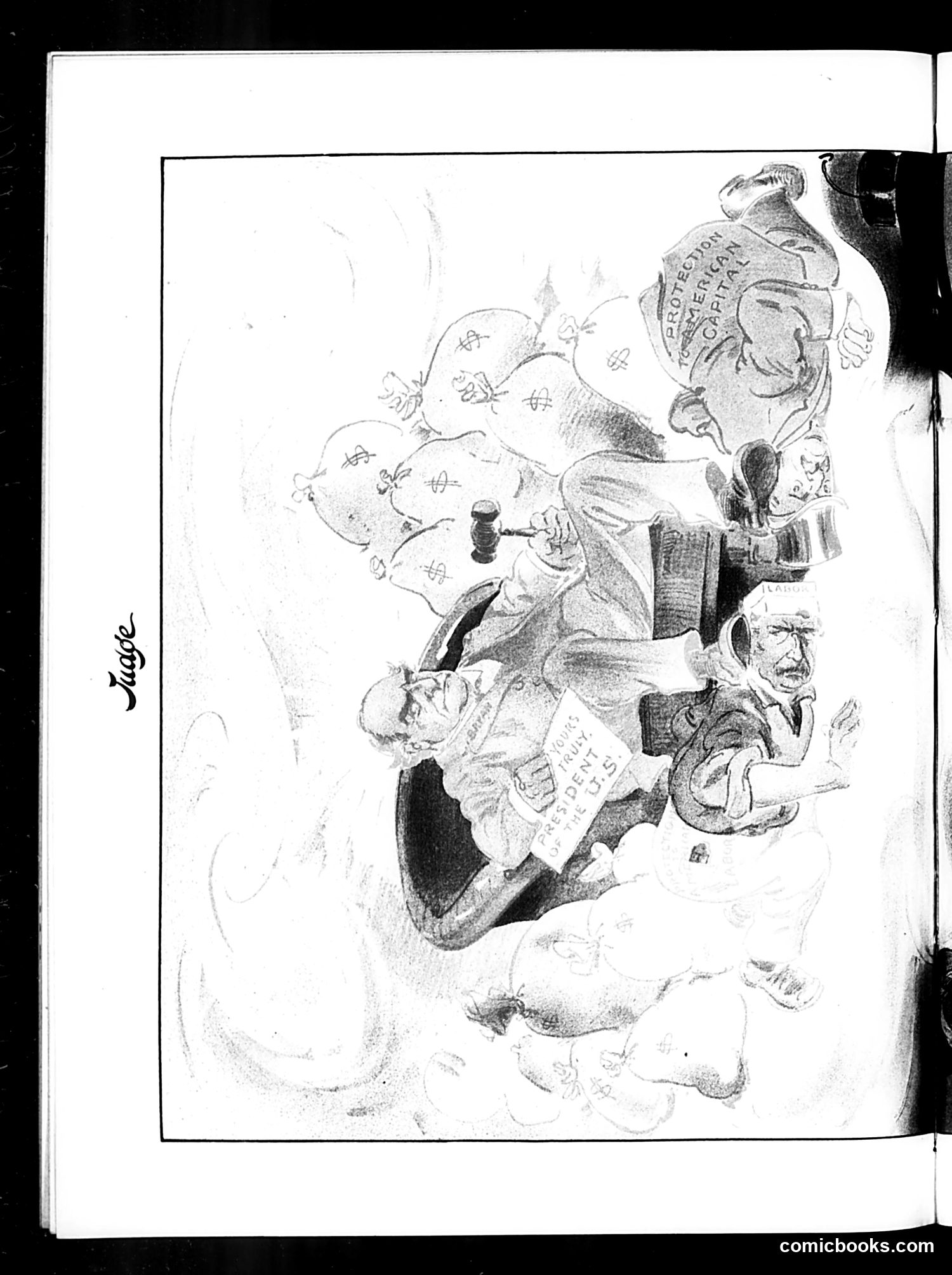
This is a satirical cartoon from *Judge* magazine titled "Judge" (visible on the left margin). The image depicts a large, menacing figure juggling or manipulating several round objects (appearing to be balloons or spheres marked with symbols). Below, two smaller caricatured figures observe the scene. The cartoon appears to be political satire, likely depicting manipulation or control of multiple interests or issues by a powerful figure. The round objects may represent various political concerns or constituencies being kept "in the air" simultaneously. However, without clearer visibility of labels, dates, or identifying marks on the objects and figures, I cannot definitively identify the specific political figures or issues being referenced. The style and print quality suggest this is from the late 19th or early 20th century, but exact context remains unclear from the image alone.
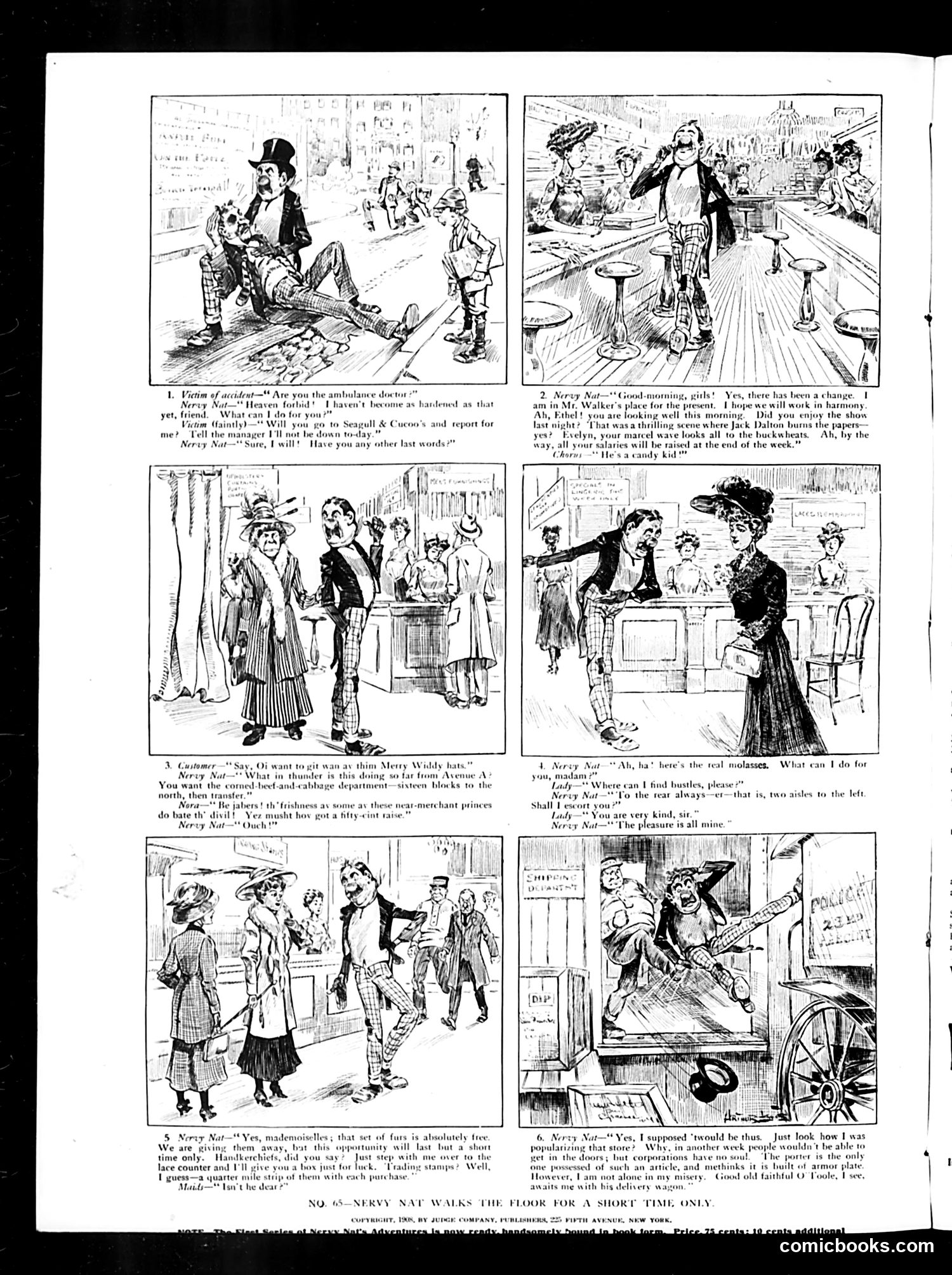
This six-panel comic strip satirizes retail customer service and department store operations in early 20th-century America. The protagonist "Nervy Nat" (a recurring character in Judge magazine) appears to be a scheming retail worker navigating various absurd customer complaints and store situations. The satire targets: 1. **Unreasonable customer demands** – customers complaining about merchandise quality and seeking impossible refunds 2. **Department store inefficiency** – confusion about store layout, bustles, molasses inventory 3. **Worker exploitation** – Nat's struggle to manage demanding customers while following store procedures 4. **Consumer culture** – the absurdity of commercial transactions and customer entitlement The humor relies on exaggerated dialect and physical comedy typical of the era. The title suggests Nat's employment is temporary—he won't last long in this chaotic retail environment. The strip mocks both customer behavior and retail management without clear political messaging.
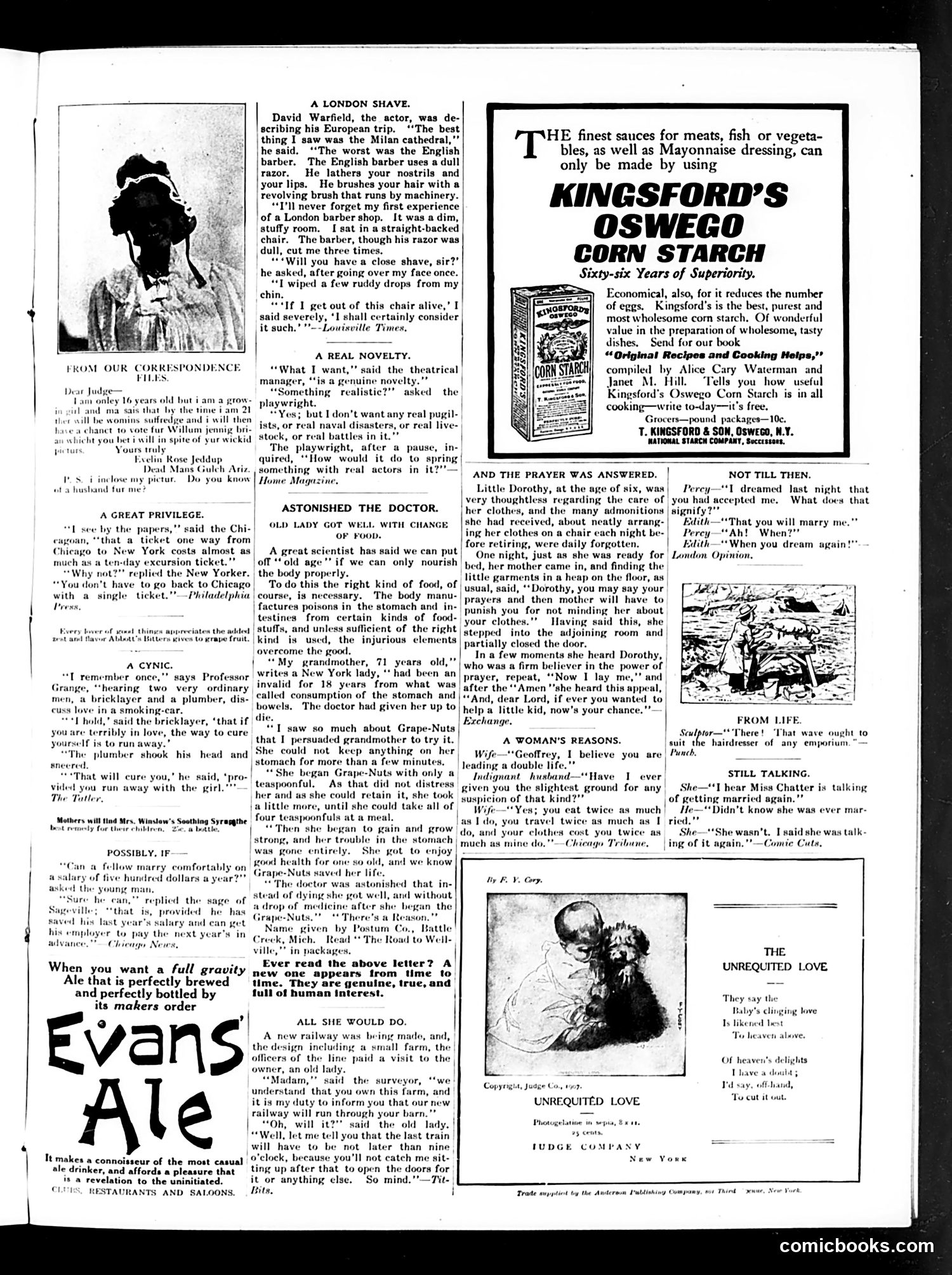
This page from Judge magazine contains several humorous anecdotes and advertisements typical of early 20th-century American humor: **"A London Shave"**: Actor David Warfield recounts a comedic experience at an English barber shop, poking fun at British barbers' incompetence—their dull razors, poor technique (lathering nostrils and lips), and mechanical hair-brushing apparatus. The humor targets British customs for American audiences. **"A Real Novelty"**: A theatrical manager seeks "genuine novelty" for a play, rejecting realistic elements like actual boxers or naval disasters—satirizing the absurdity of theatrical producers wanting reality while avoiding authentic performers. **Other sections** include health testimonials for Grape-Nuts cereal, Evans Ale advertisements, and various brief humorous observations about American life (privilege of single-ticket travel, cynical observations about romance). The page reflects turn-of-the-century American attitudes: mild mockery of foreign (British) culture, trust in commercial products as cure-alls, and gentle domestic humor. No specific political figures or events appear to be targeted.
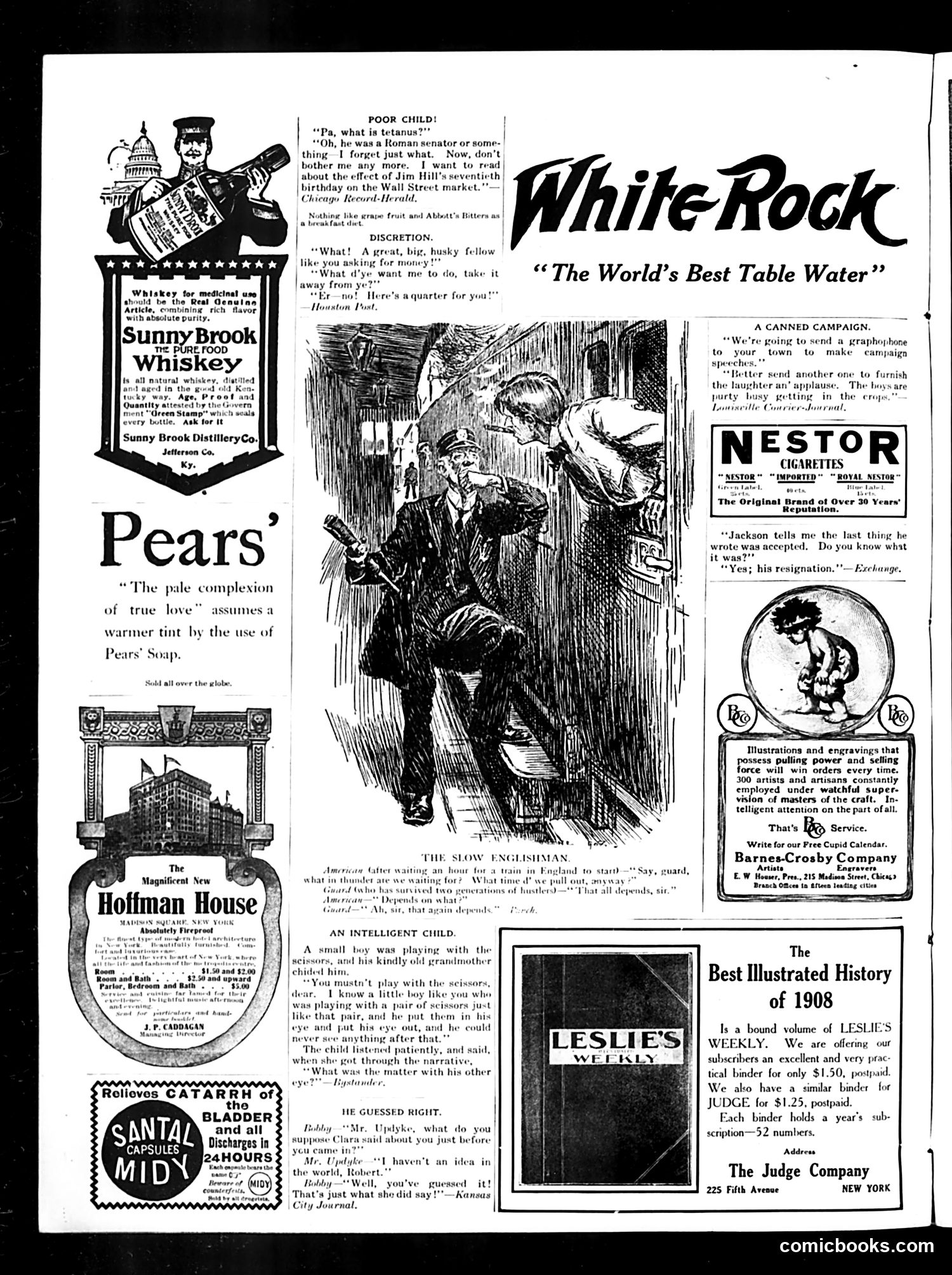
This page contains multiple brief humorous anecdotes typical of Judge's satirical format, alongside period advertisements. **The main cartoon** ("The Slow Englishman") depicts a comedic cultural stereotype: an English railway guard so fastidious about protocol that he delays the train's departure, embodying the satirical portrayal of British formality as absurdly inefficient. **The joke anecdotes** mock: - Parental ignorance (a father confusing the historical figure Tetanus with current events) - Child logic ("An Intelligent Child"): a grandmother's cautionary tale about scissors backfires when the child logically asks why the boy didn't use his other eye - Male obtuseness ("He Guessed Right"): a man's clueless guess about what his fiancée said **The advertisements** (Sunny Brook Whiskey, Pears' Soap, White Rock Water, Nestor Cigarettes) are typical period marketing, sometimes incorporating gentle humor. The page reflects Judge's approach: light social satire targeting Victorian-era middle-class pretensions, gender dynamics, and national stereotypes rather than serious political critique.
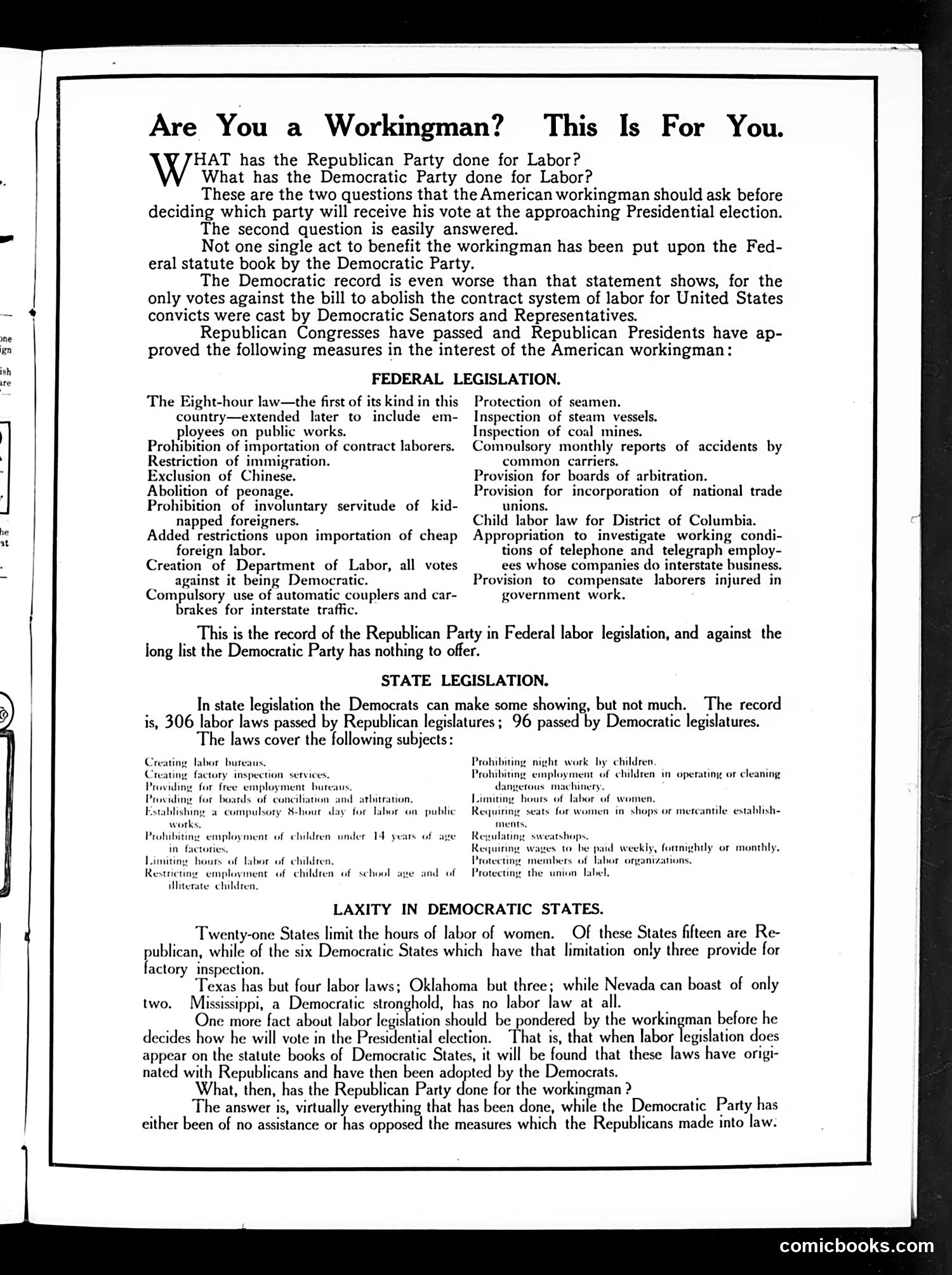
This is a **partisan Republican campaign advertisement** disguised as comparative analysis, addressed to working-class voters during a Presidential election year (likely early 1900s, based on references to Chinese exclusion and peonage abolition). **The argument:** Republicans claim credit for virtually all federal labor protections (eight-hour workday, child labor restrictions, mine safety inspections, immigration limits), while Democrats allegedly contributed nothing. The text contrasts Republican federal achievements (lengthy list) against Democratic failures. **The rhetorical trick:** While acknowledging Democrats passed more state-level labor laws (306 Republican vs. 96 Democratic), the advertisement dismisses this by claiming Democratic states enforce protections poorly. Examples cited: Texas, Oklahoma, Mississippi lack adequate laws. **What's missing:** The page provides no context for *why* each party supported specific measures, nor acknowledges regional/historical factors. It's pure advocacy—not objective analysis—designed to persuade working-class readers to vote Republican based on legislative records alone. The satire magazine *Judge* was using its platform for explicit partisan messaging.
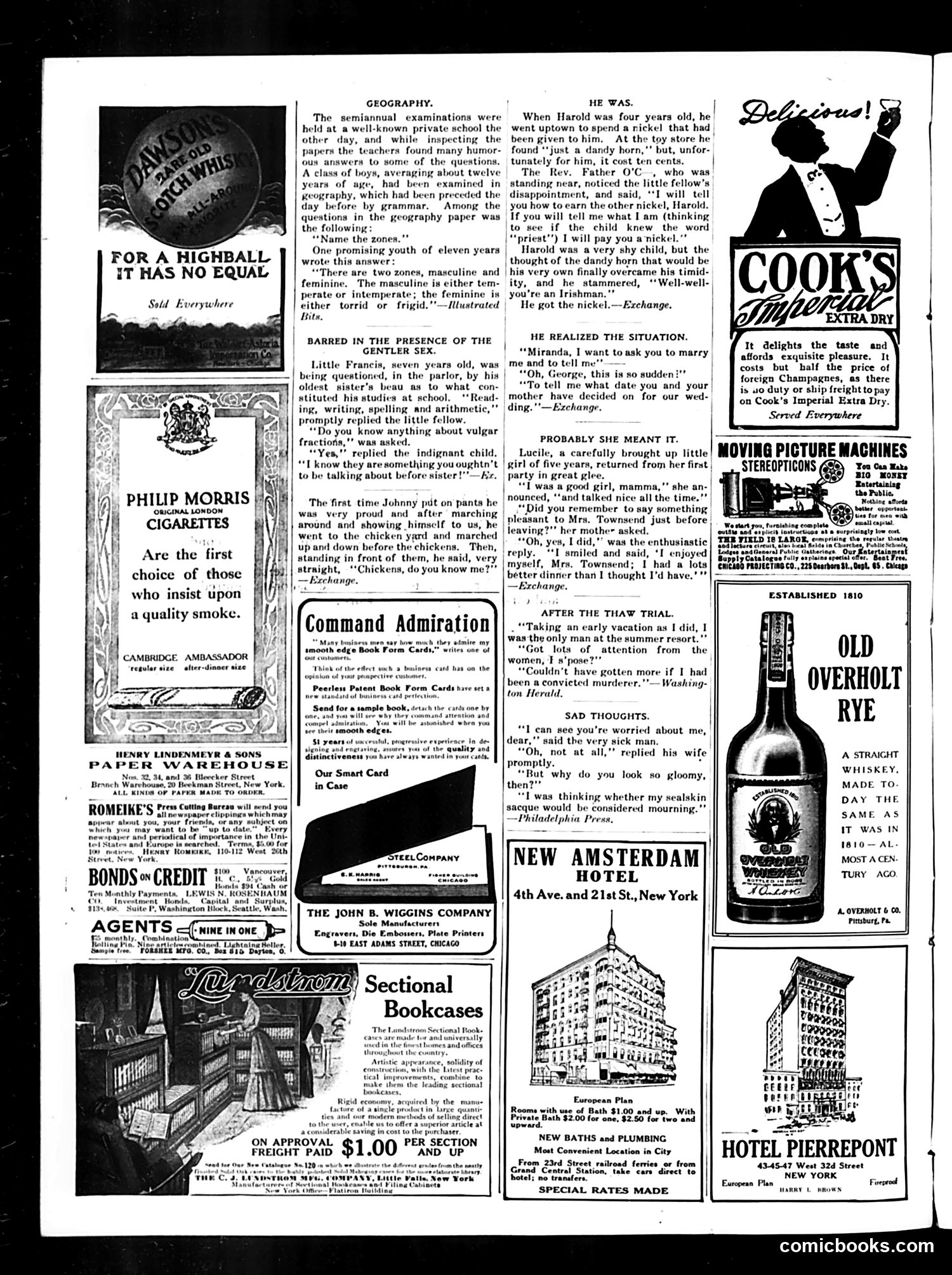
This page is primarily **humorous anecdotes and advertising** rather than political satire. The content consists of brief, comedic stories about children and wordplay, typical of Judge's humor section. The notable items: **"Geography"** - A schoolboy's answer confuses grammatical gender (masculine/feminine) with geographic zones (torrid/frigid), playing on the recent grammar lesson. **"Barred in the Presence of the Gentler Sex"** - A child innocently says "vulgar fractions" are improper to discuss before his sister, treating a math term as indecent language. **Other anecdotes** involve children's innocent misstatements: a boy asks chickens "do you know me?" in new pants; a child calls a priest an "Irishman" to earn money; a widow after the Thaw trial worries her sealskin coat won't look mourning enough. The humor relies on **children's literal interpretations, misheard words, and social awkwardness** — standard early-20th-century magazine fare. The page is otherwise dominated by product advertisements (cigarettes, hotels, bookcases, whiskey).
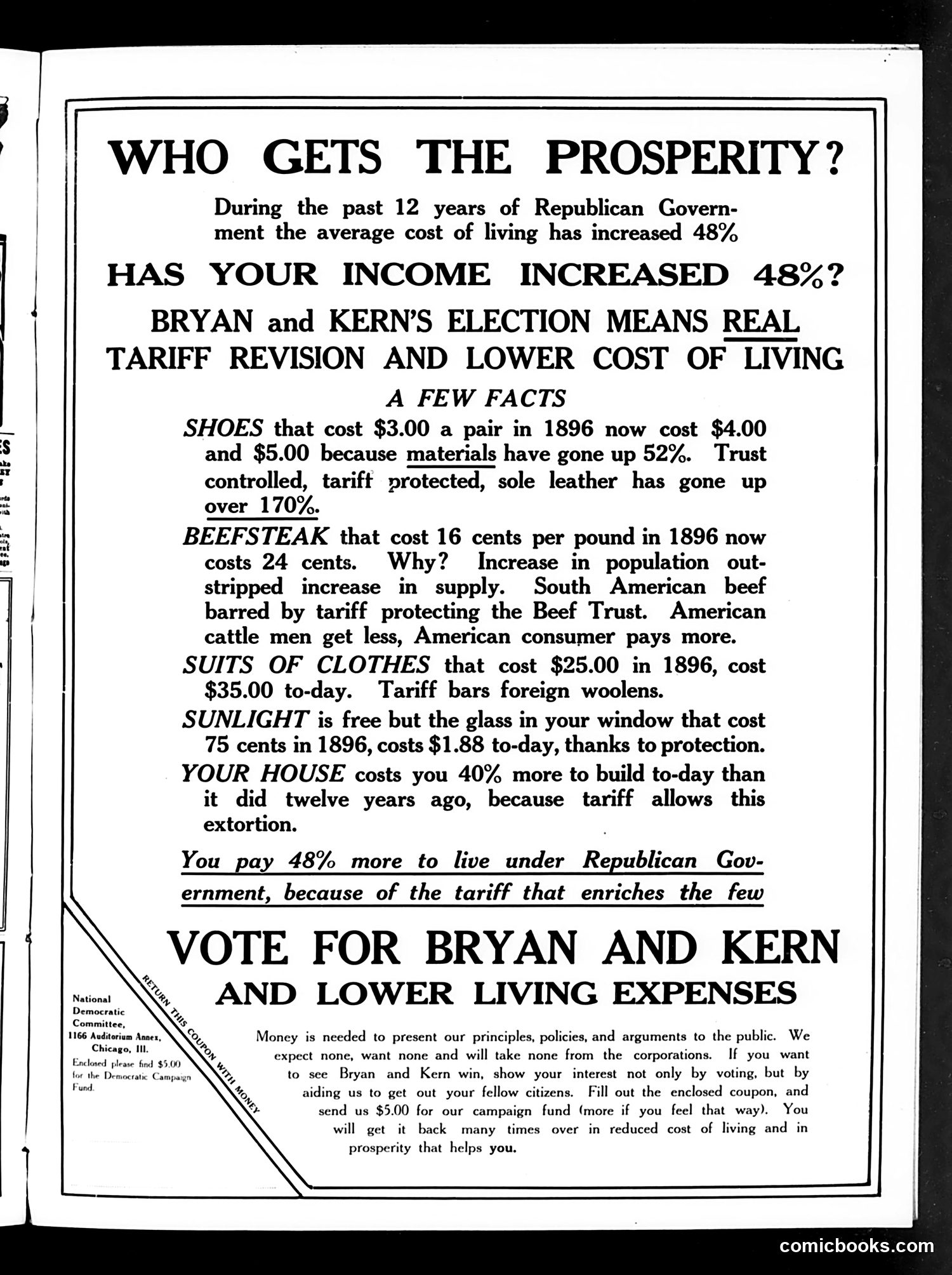
This is a Democratic campaign advertisement for William Jennings Bryan and James Sherman Kern's 1908 presidential bid. It attacks Republican tariff policy, arguing that twelve years of GOP rule have raised the cost of living 48% while workers' wages haven't kept pace. The ad uses specific price comparisons to demonstrate inflation: shoes ($3→$5), beef (16¢→24¢ per pound), clothing ($25→$35), and building materials. It blames protective tariffs that benefit wealthy industrialists and "trusts" (monopolies) while harming ordinary consumers through higher prices for imported materials and protected goods. The Democrats promise "tariff revision and lower cost of living" under Bryan-Kern. The fundraising appeal at bottom solicits $5 donations, claiming the savings from lower living costs will repay supporters many times over—essentially a promise that lower prices will benefit voters more than their campaign contribution costs.
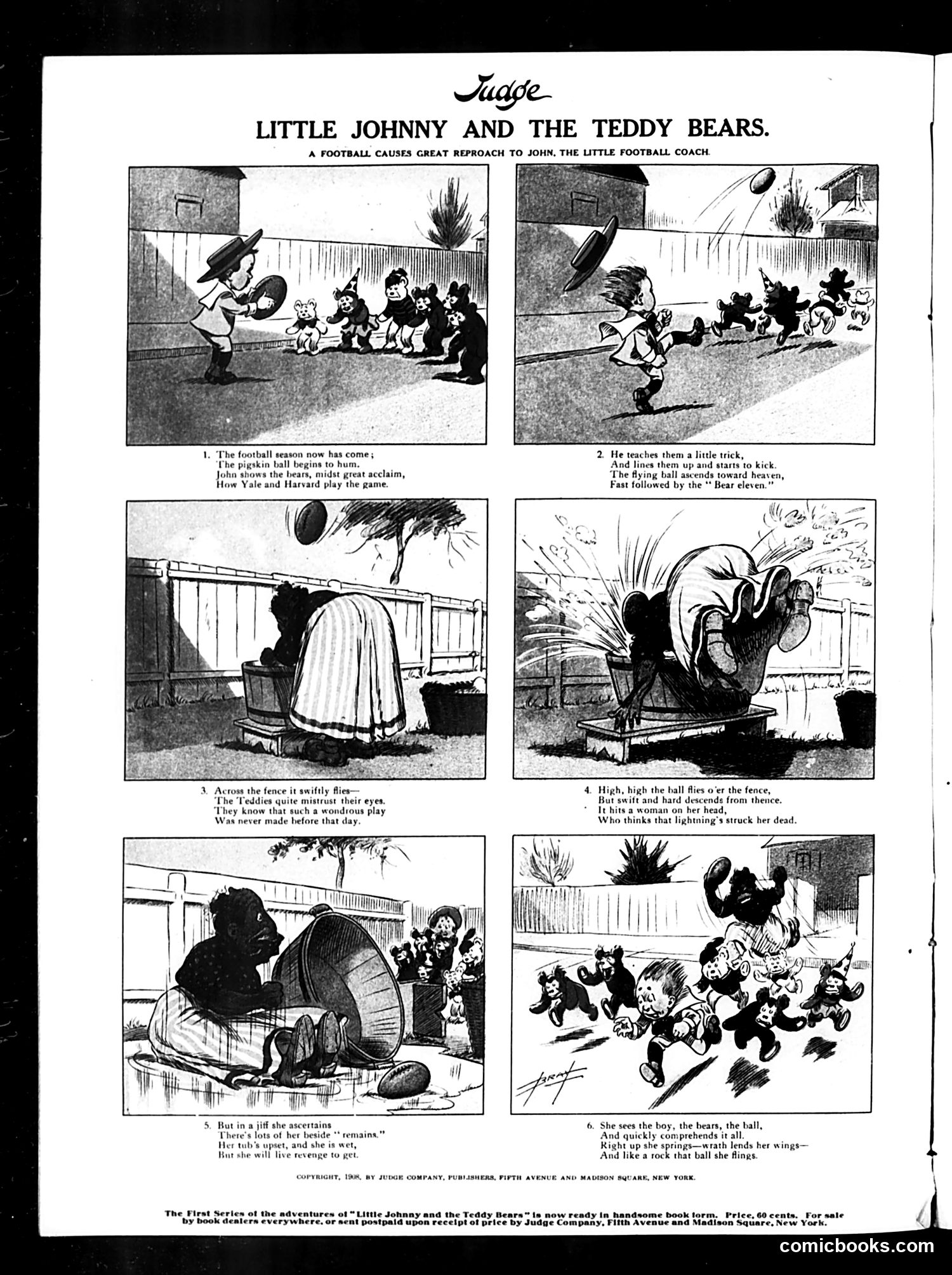
This is a comic strip satirizing "Little Johnny," a popular mischievous character of the era, and "Teddy Bears"—toys named after President Theodore Roosevelt, who famously spared a bear's life in 1902, making them a national craze. The joke: Little Johnny coaches his teddy bears like a football team, teaching them to kick a ball. The ball flies over a fence and strikes a woman on the head. She chases the children in revenge with characteristic early-1900s slapstick humor. The satire targets the obsession with football (Yale and Harvard are mentioned) and the "Teddy Bear" fad simultaneously—mocking both adult enthusiasm for college sports and the commercialized toy craze. The woman's exaggerated reaction ("lightning struck her dead") amplifies the comedic violence typical of Judge magazine's satirical approach. This appears to be promotional material advertising the strip's book collection.