
Judge, 1908-10-31 · page 13 of 16
Judge — October 31, 1908 — page 13: what you’re looking at
What you’re looking at
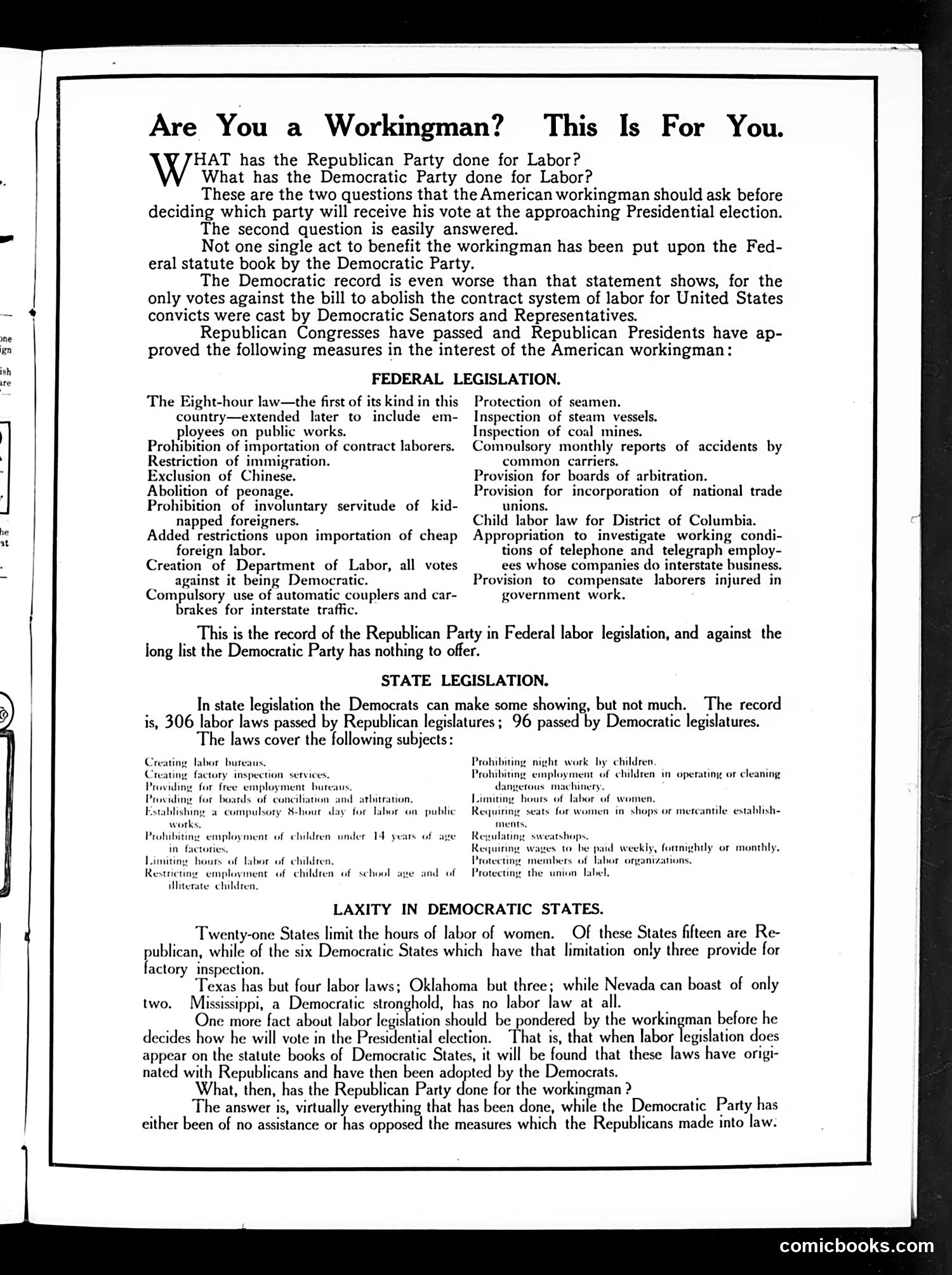
This is a **partisan Republican campaign advertisement** disguised as comparative analysis, addressed to working-class voters during a Presidential election year (likely early 1900s, based on references to Chinese exclusion and peonage abolition). **The argument:** Republicans claim credit for virtually all federal labor protections (eight-hour workday, child labor restrictions, mine safety inspections, immigration limits), while Democrats allegedly contributed nothing. The text contrasts Republican federal achievements (lengthy list) against Democratic failures. **The rhetorical trick:** While acknowledging Democrats passed more state-level labor laws (306 Republican vs. 96 Democratic), the advertisement dismisses this by claiming Democratic states enforce protections poorly. Examples cited: Texas, Oklahoma, Mississippi lack adequate laws. **What's missing:** The page provides no context for *why* each party supported specific measures, nor acknowledges regional/historical factors. It's pure advocacy—not objective analysis—designed to persuade working-class readers to vote Republican based on legislative records alone. The satire magazine *Judge* was using its platform for explicit partisan messaging.
📄 Transcribed text from this page (OCR, searchable)
Machine-transcribed from the original scan — historical spelling and the odd misread are preserved.
me ign ish ire he at Are You a Workingman? This Is For You. HAT has the Republican Party done for Labor? What has the Democratic Party done for Labor? These are the two questions that the American workingman should ask before deciding which party will receive his vote at the approaching Presidential election. The second question is easily answered. Not one single act to benefit the workingman has been put upon the Fed- eral statute book by the Democratic Party. The Democratic record is even worse than that statement shows, for the only votes against the bill to abolish the contract system of labor for United States convicts were cast by Democratic Senators and Representatives. Republican Congresses have passed and Republican Presidents have ap- proved the following measures in the interest of the American workingman: FEDERAL LEGISLATION. The Eight-hour law—the first of its kind in this country—extended later to include em- ployees on public works. Prohibition of importation of contract laborers. Restriction of immigration. Exclusion of Chinese. Abolition of peonage. Prohibition of involuntary servitude of kid- napped foreigners. Added restrictions upon importation of cheap foreign labor. Creation of Department of Labor, all votes against it being Democratic. Compulsory use of automatic couplers and car- brakes for interstate traffic. Protection of seamen. Inspection of steam vessels. Inspection of coal mines. Compulsory monthly reports of accidents by common carriers. Provision for boards of arbitration. Provision for incorporation of national trade unions. Child labor law for District of Columbia. Appropriation to investigate working condi- tions of telephone and telegraph employ- ees whose companies do interstate business. Provision to compensate laborers injured in government work. This is the record of the Republican Party in Federal labor legislation, and against the long list the Democratic Party has nothing to offer. STATE LEGISLATION. In state legislation the Democrats can make some showing, but not much. The record is, 306 labor laws passed by Republican legislatures ; 96 passed by Democratic legislatures. The laws cover the following subjects: labor bureaus. tory inspection services, or free employment bureaus. for boards of conciliation and atbitration, a compulsory 8-hour day for labor on public works. Prohibiting employment of children under 14 years of age ries, hours of Libor of children. Restricting employment of children of school aye and of literate children, Prohibiting night work by children Prohibiting employment of children in operating or cleaning dangerous: machinery. Limiting hours of labor of women, Requiring seats for women in shops or mercantile establish- ments, Regulating sweatshops. Requiring wages to be paid weekly, fortnightly or monthly. Protecting. members of labor organizations, Protecting the union label, LAXITY IN DEMOCRATIC STATES. Twenty-one States limit the hours of labor of women. Of these States fifteen are Re- publican, while of the six Democratic States which have that limitation only three provide for factory inspection. Texas has but four labor laws; Oklahoma but three; while Nevada can boast of only two. Mississippi, a Democratic stronghold, has no labor law at all. One more fact about labor legubinen should be pondered by the workingman before he decides how he will vote in the Presidential election. That is, that when labor Tepslation does appear on the statute books of Democratic States, it will be found that these laws have origi- nated with Republicans and have then been adopted by the Democrats. What, then, has the Republican Party done for the workingman ? The answer is, virtually everything that has been done, while the Democratic Party has either been of no assistance or has opposed the measures which the Republicans made into law. comicbooks.com