
A complete issue · 24 pages · 1908
Judge — October 24, 1908
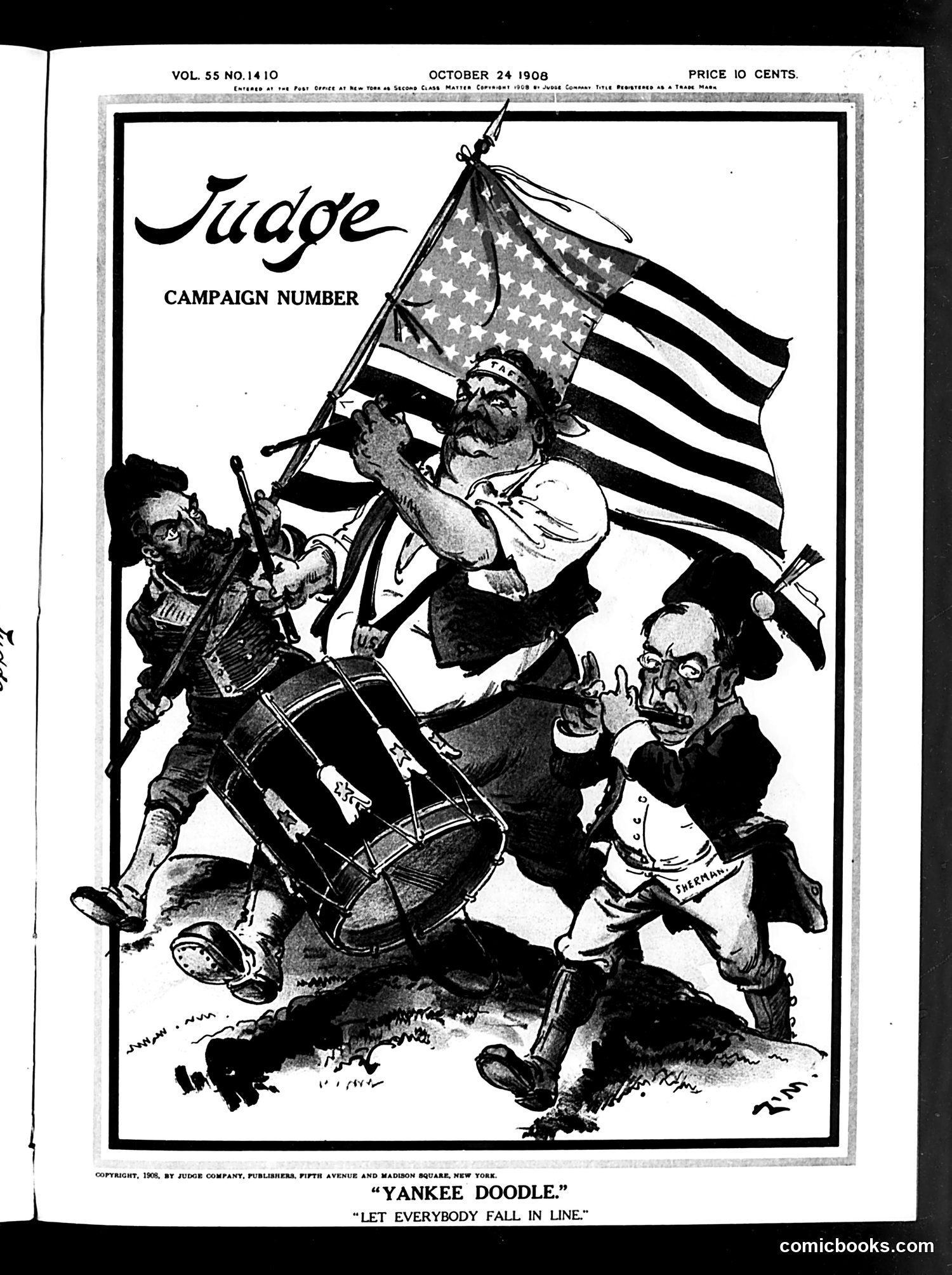
This is the cover of Judge magazine from October 24, 1908, labeled "Campaign Number" — published during the U.S. presidential election season. The cartoon titled "Yankee Doodle" depicts three caricatured figures (likely representing political candidates or parties) struggling over an American flag with the motto "Let Everybody Fall in Line." The exaggerated facial features and chaotic composition suggest satirical commentary on the competitive 1908 election, possibly mocking how political factions fought for control while claiming patriotic authority. The central figure beating a drum and waving the flag appears to dominate, while others compete below. This likely critiques the divisive nature of electoral politics and the ironic contradiction between demands for unity ("fall in line") and actual partisan conflict.
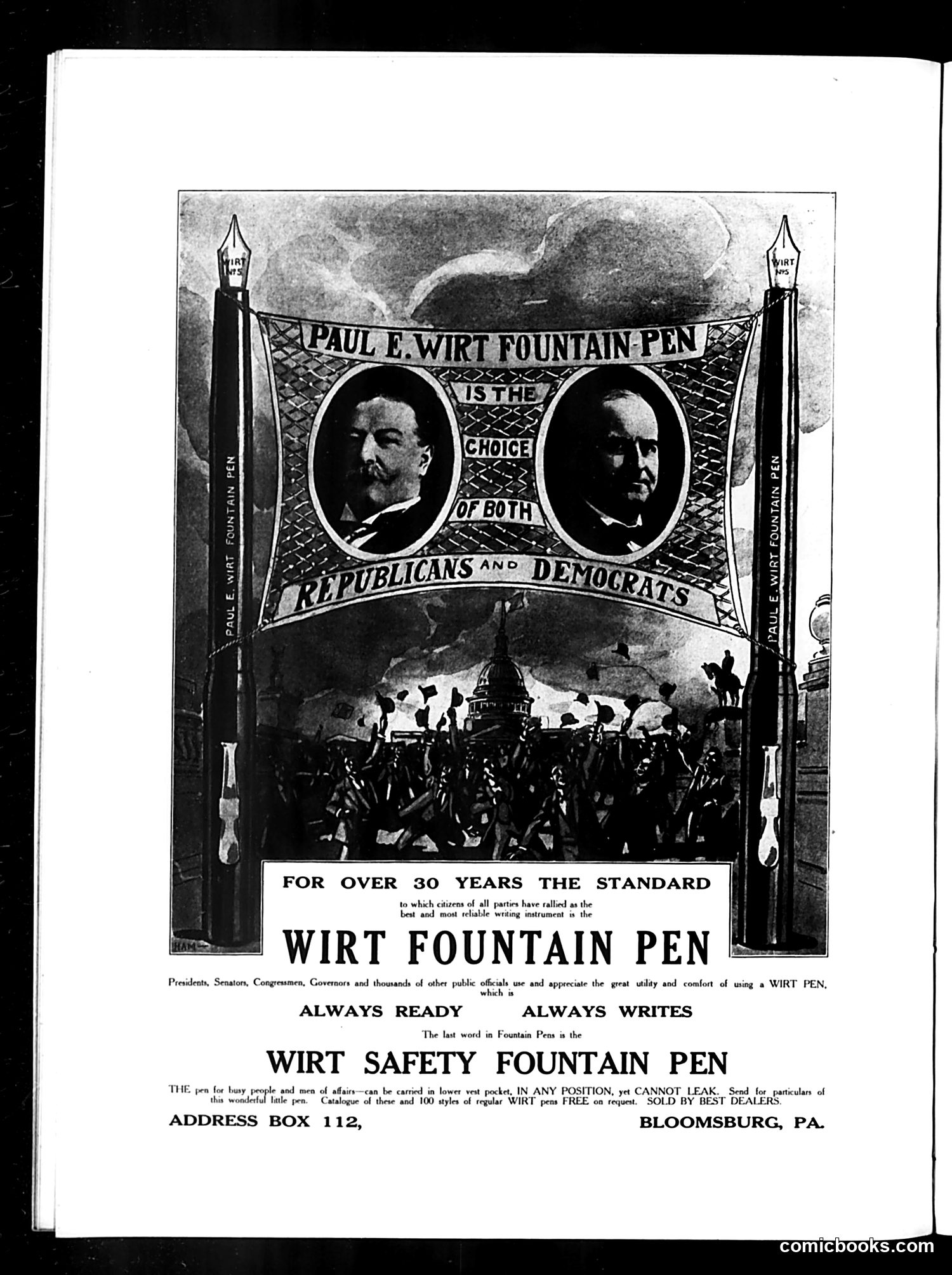
This page is primarily a **Wirt Fountain Pen advertisement**, not political satire. The ad appropriates political imagery for commercial purposes. The banner reads "PAUL E. WIRT FOUNTAIN PEN IS THE CHOICE OF BOTH REPUBLICANS AND DEMOCRATS," with two oval portraits of men flanking this text. The advertisement claims the Wirt pen has been "the standard" for over 30 years and is "always ready, always writes." Below, it promotes the "WIRT SAFETY FOUNTAIN PEN," emphasizing it cannot leak even when carried in a pocket in "any position." The political reference is generic—appealing to both parties suggests universal American appeal rather than endorsing specific figures. The imagery of a Capitol building and crowd below reinforces themes of broad democratic endorsement, using patriotic iconography to sell a commercial product.
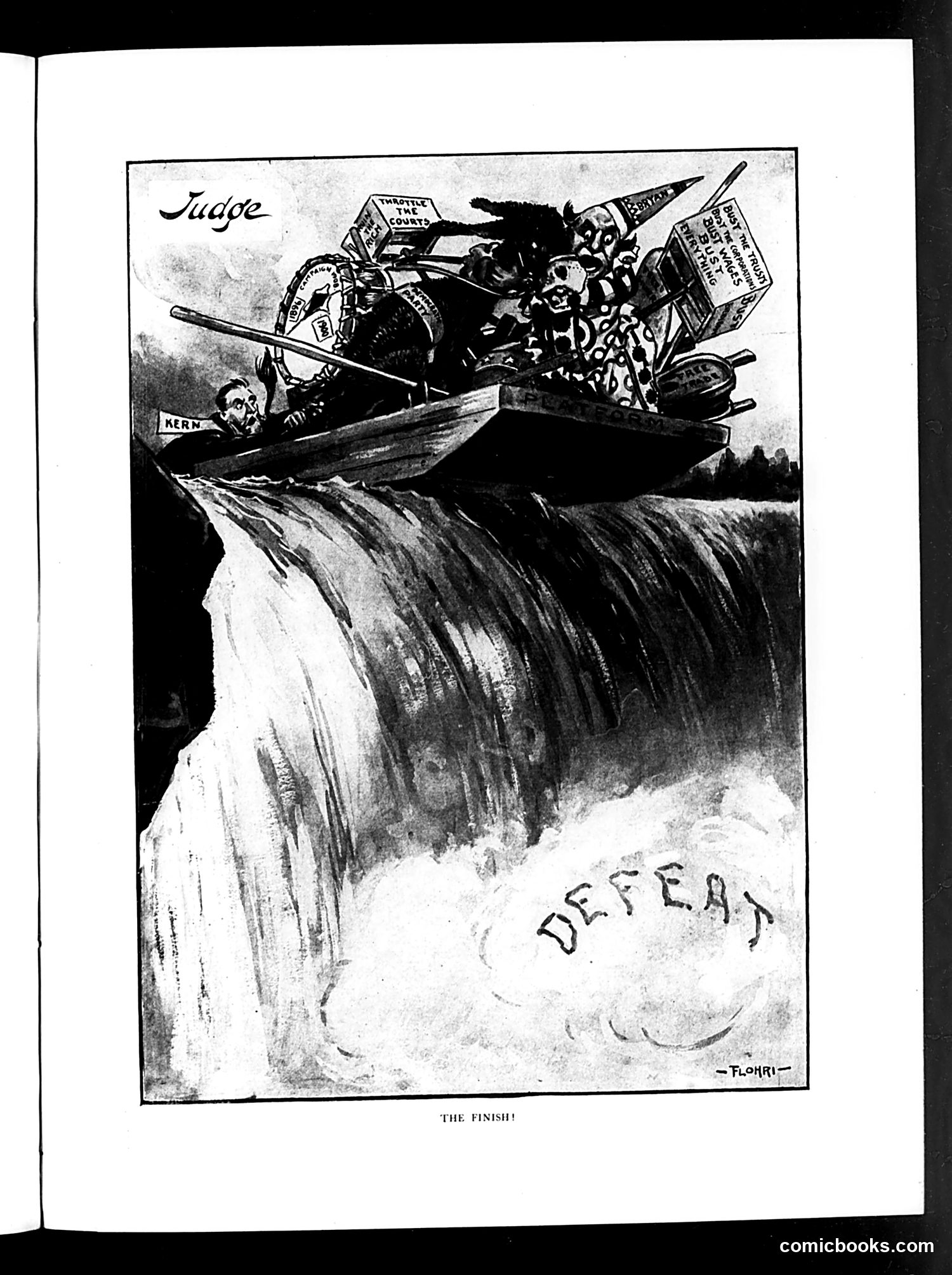
This political cartoon depicts a figure labeled "Judge" observing a boat labeled "Defeat" going over a waterfall. The boat carries numerous passengers representing what appears to be political opponents or failed policies, laden with signs and documents suggesting bureaucratic baggage or mismanagement. The cartoon's title "The Finish!" suggests the end of something—likely a political administration, movement, or policy initiative. The waterfall represents inevitable doom or catastrophic failure. The artist (signed "Florri") uses the classical political cartoon device of depicting defeat as a fatal plunge. Without clearer dating or caption context, the specific political event or figures involved remain unclear, though this represents typical Judge magazine satire targeting political incompetence or unpopular initiatives through dramatic visual metaphor.
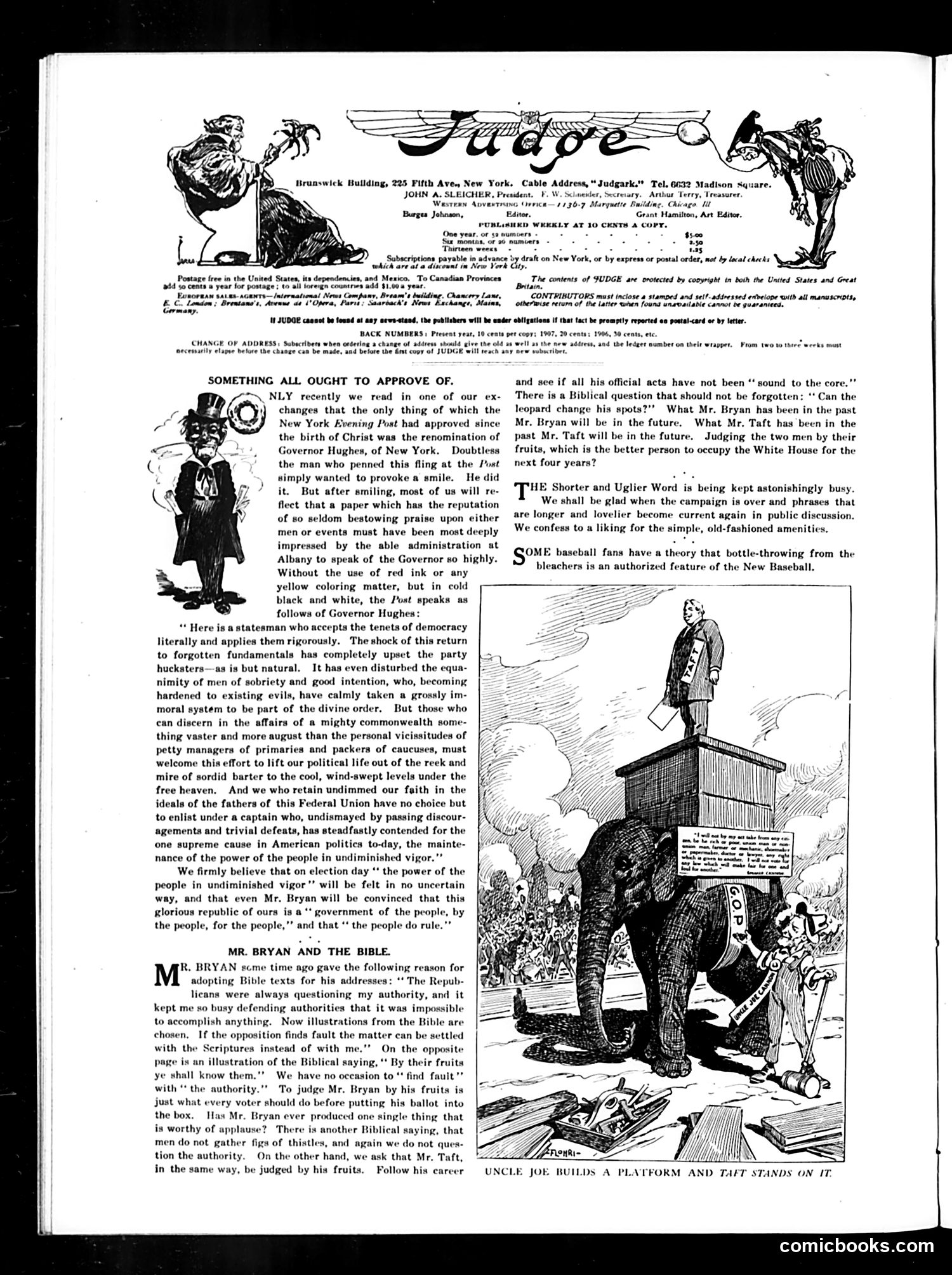
This page from Judge magazine contains political commentary criticizing William Jennings Bryan, a prominent Democratic politician and three-time presidential candidate. The article "MR. BRYAN AND THE BIBLE" debates Bryan's use of biblical quotations in political speeches, with the author arguing that Bryan selectively interprets scripture to support his positions while avoiding passages that might contradict them. The main cartoon, titled "UNCLE JOE BUILDS A PLATFORM AND TAFT STANDS ON IT," appears to reference Joseph Cannon (Speaker of the House) and William Howard Taft, depicting political maneuvering during what seems to be a presidential succession or campaign period. The satire criticizes Bryan's rhetorical methods and attacks Democratic political authority generally, characteristic of Judge's Republican-leaning editorial stance.
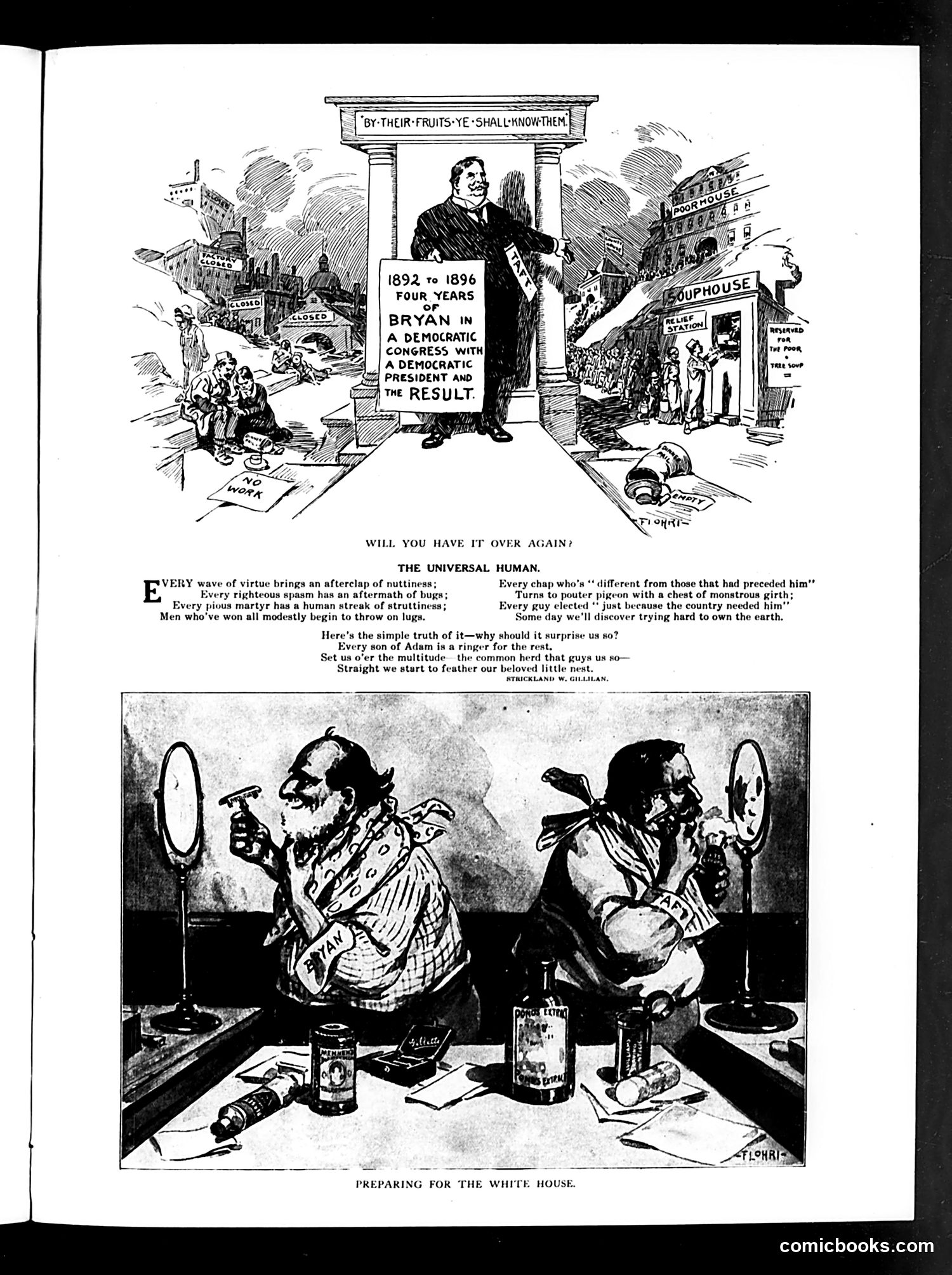
**Top Cartoon:** Depicts William Jennings Bryan (1892-1896) standing under a classical arch inscribed "By Their Fruits Ye Shall Know Them." The cartoon criticizes Bryan's four years leading the Democratic Party with a Democratic president, showing poverty and hardship on both sides ("No Work," "Soup House"). The question "Will You Have It Over Again?" sarcastically asks voters whether they want to repeat this period. **Bottom Cartoon:** "Preparing for the White House" shows two figures at mirrors applying cosmetics and grooming, suggesting candidates are merely preparing appearances rather than substantive preparations for office—a commentary on superficial campaign politics. Both cartoons critique Democratic leadership and electoral choices through visual metaphor and satire.
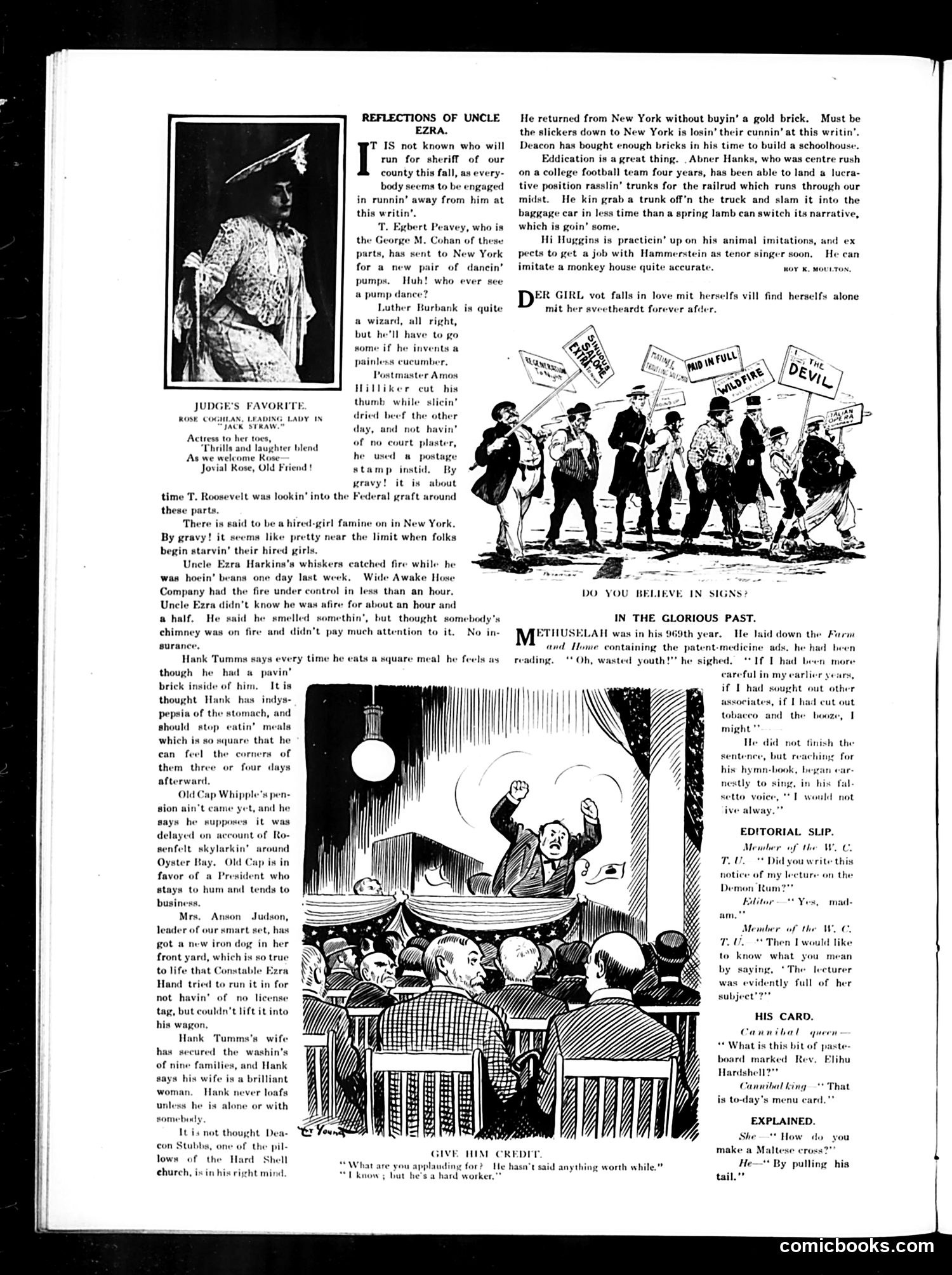
This page from the satirical magazine *Judge* consists primarily of "Reflections of Uncle Ezra"—humorous rural vignettes written in dialect. The content mocks small-town life and characters through exaggerated anecdotes. Key satirical targets include: **Political reference**: Theodore Roosevelt ("Rosenfelt") is mocked for "skylarkin' around Oyster Bay" while supposed to investigate federal graft. **Social satire**: The pieces ridicule rural incompetence and naiveté—a man whose whiskers catch fire but doesn't notice for an hour; townsfolk repeatedly swindled buying "gold bricks" in New York; attempts at sophistication (dance pumps, an iron dog as yard decoration). **Temperance humor**: A section titled "In the Glorious Past" features "Methuselah" regretting wasted youth, ending with incomplete regret about the "booze" and "loose." The cartoons reinforce these rural stereotypes visually. The page reflects *Judge's* editorial stance: mocking rural Americans as simple, gullible, and absurd, while poking at political figures like Roosevelt.
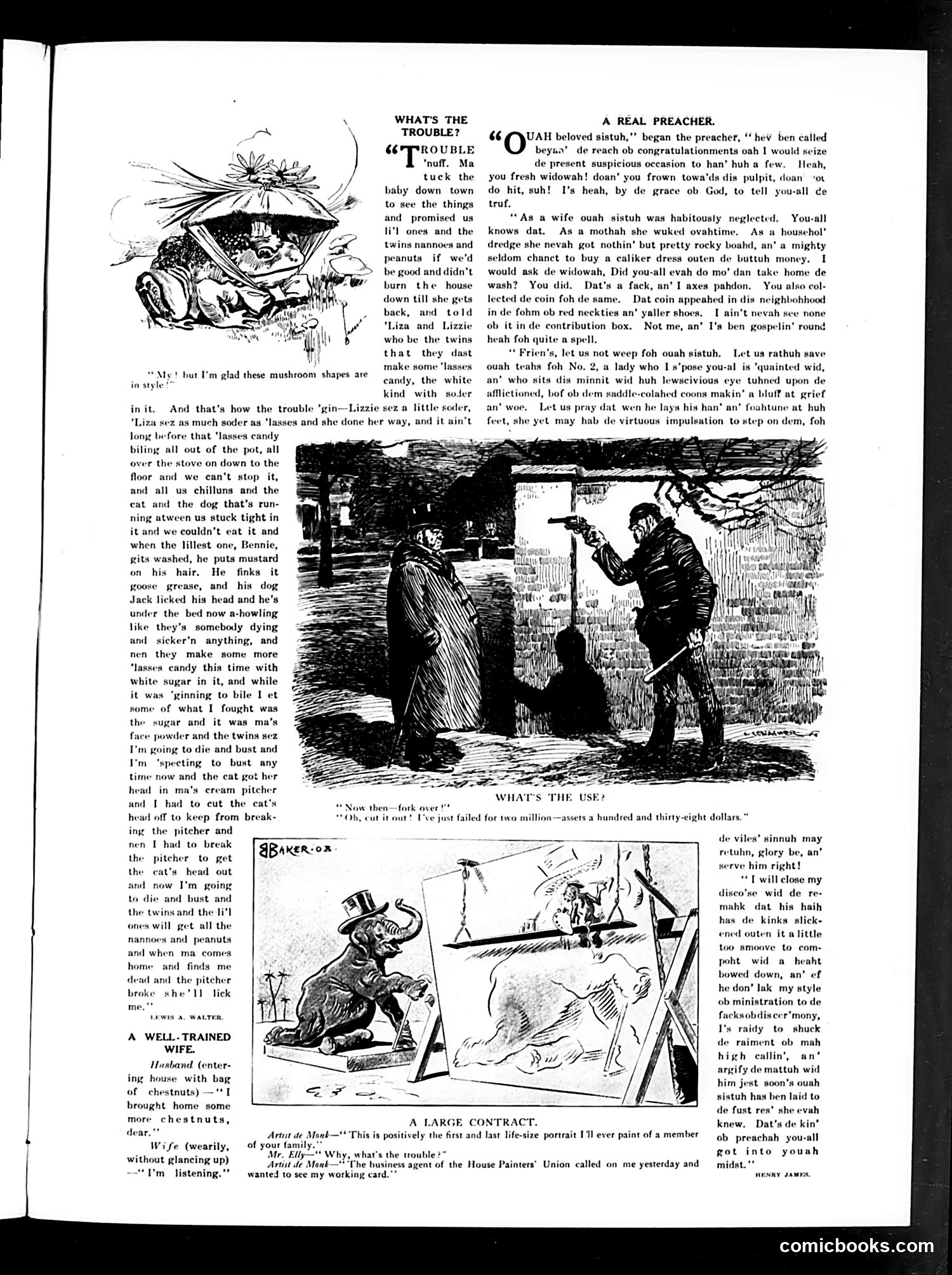
This page from *Judge* contains three separate satirical pieces: 1. **"What's the Trouble?"** — A dialect-heavy humorous story about a domestic disaster: a mother leaves children to make molasses candy, which boils over catastrophically, coating everything and everyone. The humor relies on exaggerated chaos and the child narrator's deadpan acceptance of impending doom. 2. **"A Well-Trained Wife"** — A brief comic sketch mocking domestic submission. A husband enters with chestnuts; the wife, apparently exhausted, barely acknowledges him while "listening." 3. **"A Real Preacher"** — A satirical sermon by a Black preacher at a widow's funeral. The satire targets the preacher's hypocrisy: he lectures the widower about neglecting the deceased wife while implying the widower spent money on another woman ("yaller shoes," "red neckties") rather than contributing to the church. These pieces employ period-typical racial dialect and stereotypes throughout, reflecting *Judge*'s satirical approach to working-class and African American subjects.
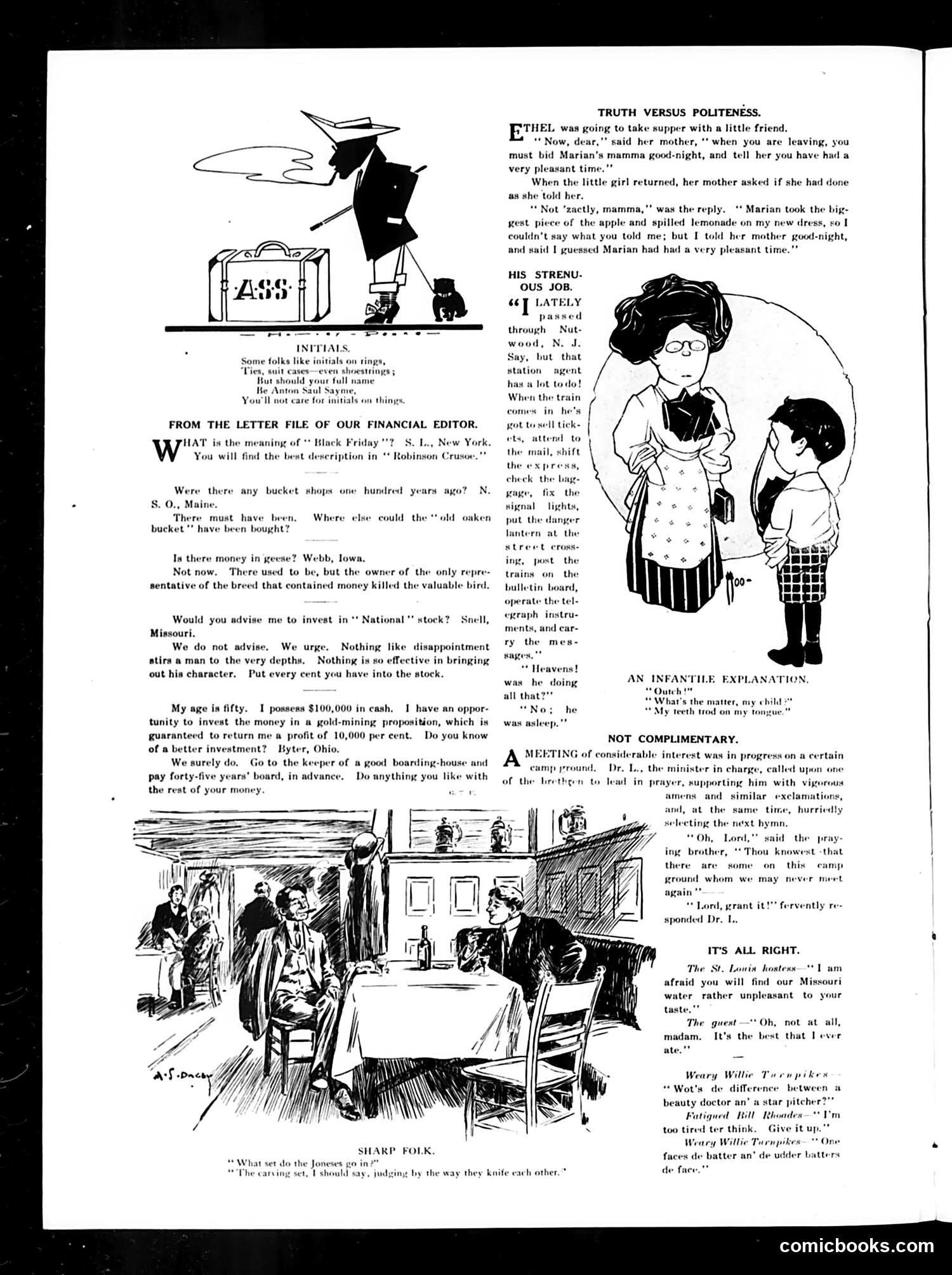
This page contains several brief satirical pieces typical of early 20th-century humor magazines: **"Truth Versus Politeness"** mocks social etiquette by showing a child who, instructed to tell her hostess she had a pleasant time, instead tells the truth—that the hostess's daughter misbehaved. The joke: rigid politeness rules clash with honesty. **"His Strenuous Job"** likely satirizes the then-popular phrase "strenuous life" (associated with Theodore Roosevelt) by describing a railroad station agent's mundane duties in grandiose terms. **The Financial Editor section** contains humorous fake letters offering absurd investment advice, satirizing get-rich-quick schemes and financial speculation common in the era. **"Sharp Folk"** jokes that the Joneses are known for their "carving set"—a pun implying they "carve each other up" verbally, suggesting marital discord. The page reflects early 1900s preoccupations: social propriety, financial schemes, and domestic life, presented through brief, punchy jokes rather than elaborate narratives.
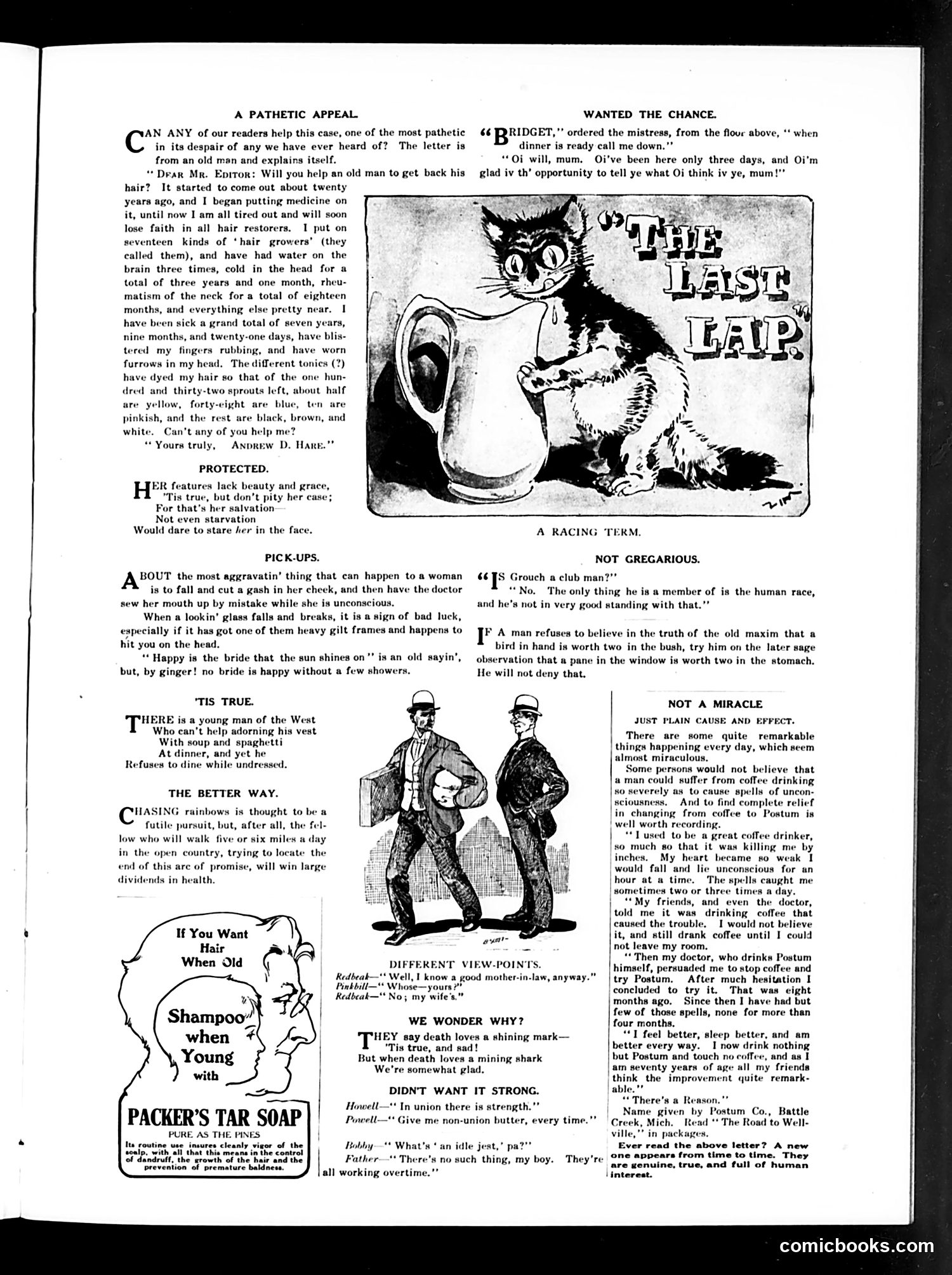
This page is a mixed collection of brief satirical pieces and advertisements typical of Judge magazine. **Key content:** The lead item, "A Pathetic Appeal," mocks a man's desperate 20-year quest for hair restoration using numerous ineffective remedies—a satire on the prevalence of fraudulent patent medicine advertising. His hair has turned multiple colors and he's suffered ailments from the treatments. "The Better Way" gently ridicules men chasing rainbows (pursuing futile goals) while suggesting outdoor walks offer better health returns—typical self-improvement humor. The scattered short jokes target predictable targets: vanity (women's appearance), superstitions (broken mirrors), marital discord, and social pretense (the grouch club member). **Advertising:** Packer's Tar Soap dominates the lower left, claiming to cure baldness and dandruff. **The illustrations** show a cat in a pitcher ("The Last Lap") and two men in conversation—generic cartoon style supporting the brief jokes above them. The page reflects early 20th-century American anxieties about aging, appearance, and the booming snake-oil medicine industry.
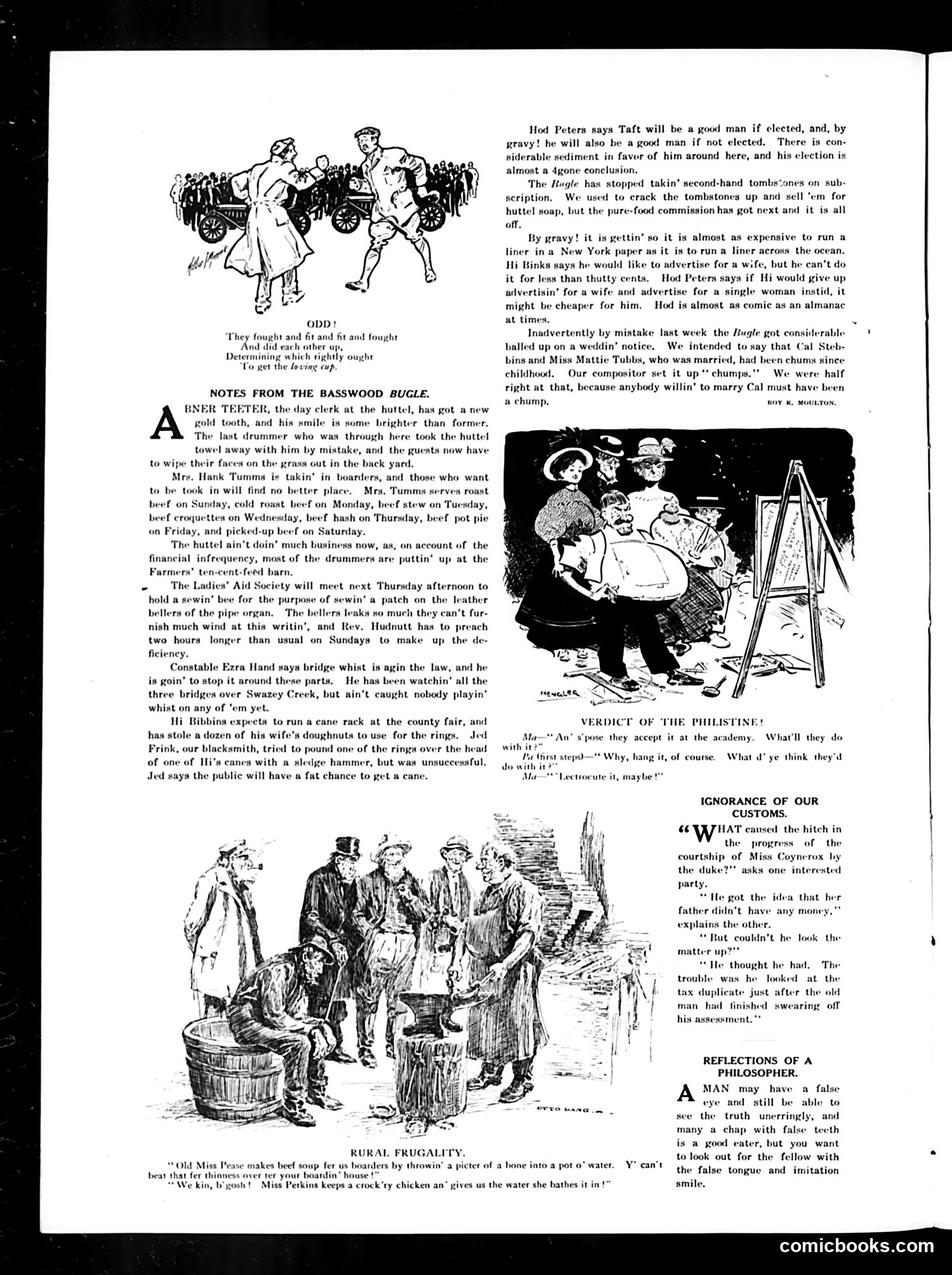
This page from Judge magazine contains satirical rural humor presented as "Notes from the Basswood Bugle," a fictional small-town newspaper. The satire targets rustic American village life and its peculiarities. Key satirical targets include: **Rural incompetence and penny-pinching:** Mrs. Tumms serves the same beef dish repeatedly (Sunday roast, Monday cold roast, Tuesday stew, etc.); Miss Pea makes "soup" by dropping a bone in water; Hi Bibbins steals his wife's doughnuts to use as carnival prizes—too hard to actually work. **Small-town absurdities:** The constable polices bridge whist (card games), a harmless pastime; the Ladies' Aid patches a leaky organ; a compositor's error transforms "chums" to "chumps" in a wedding notice. **Political reference:** Mentions of Taft (likely William Howard Taft) suggest an election period, presented with rural indifference ("good man if elected...or if not elected"). The humor relies on dialect, malapropisms, and depicting rural Americans as comically impoverished, incompetent, and narrow-minded—typical of urban magazines' condescension toward rural America in this era.
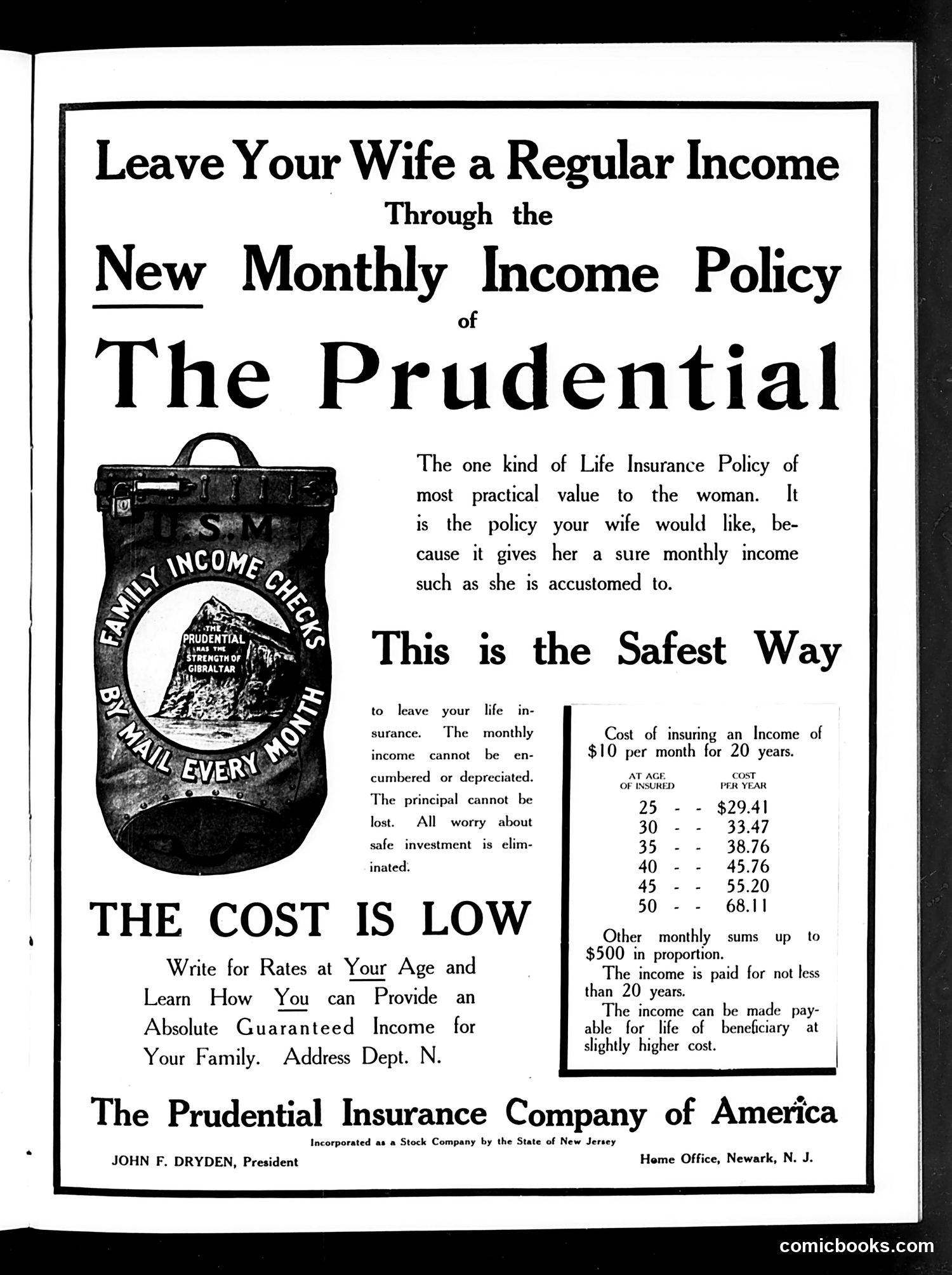
This is primarily **advertising**, not satire or political commentary. The Prudential Insurance Company promotes their "Monthly Income Policy" for life insurance. The pitch targets **wives as financial dependents**: the advertisement assumes a male breadwinner and frames life insurance as providing his widow with guaranteed monthly income—"such as she is accustomed to." This reflects early 20th-century gender economics where women rarely controlled finances independently. The "Family Income Checks" imagery (a bag labeled to dispense payments) emphasizes the policy's practical appeal: monthly payments cannot be "encumbered or depreciated" and protect the principal. Pricing scales by age are provided. **For modern readers**: This reveals historical assumptions—that wives needed their husbands' insurance provisions and were incapable of managing lump-sum investments themselves. The paternalistic language ("the policy your wife would like") seems condescending today but reflected contemporary attitudes about women's financial roles and capabilities.
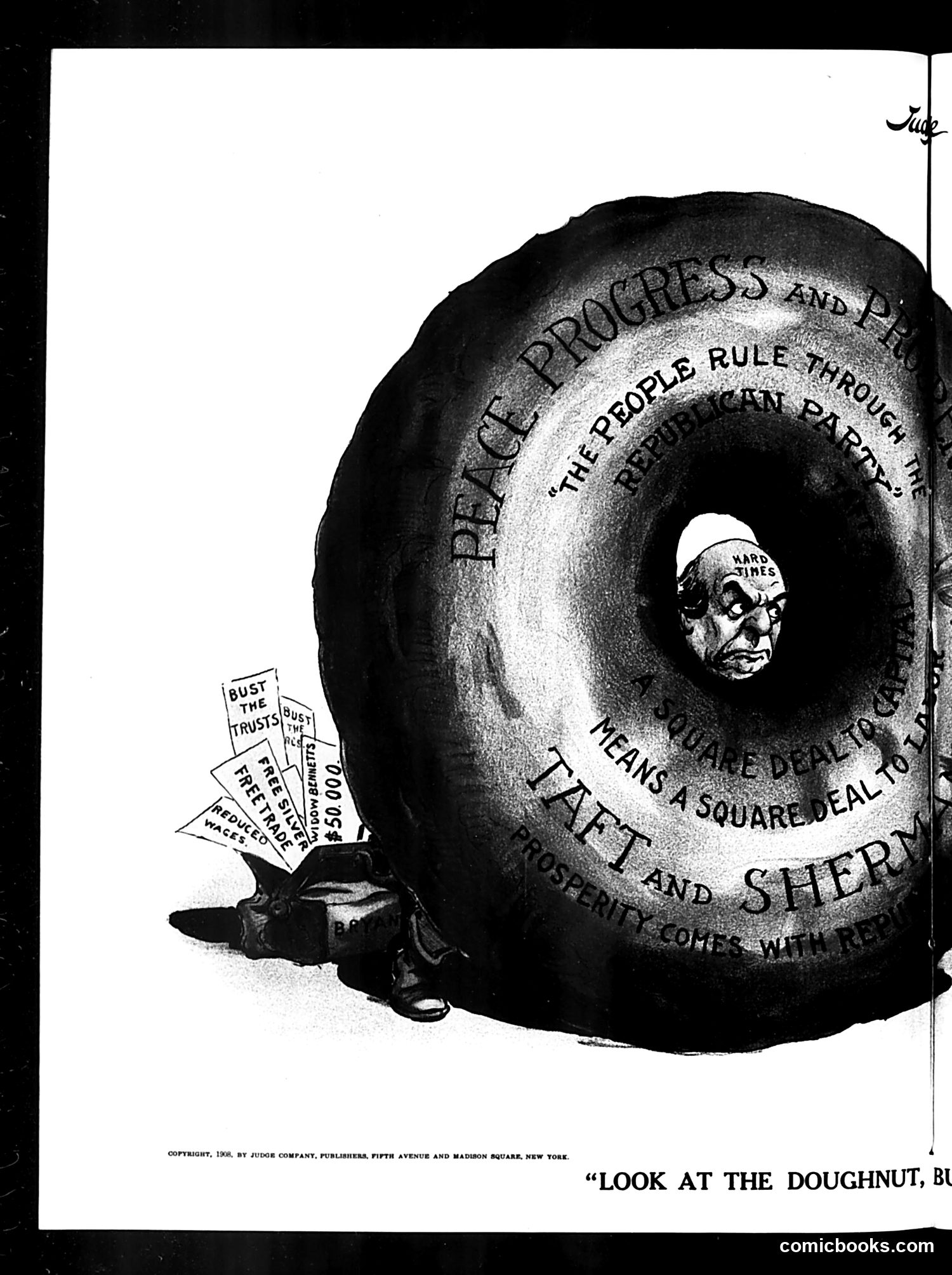
This 1908 Judge magazine cartoon uses a doughnut as metaphor for political corruption. A small figure labeled "BUST THE TRUSTS" sits outside an enormous ring inscribed with references to monopolistic practices: "THE PEOPLE RULE THROUGH REPUBLICAN PARTY," "MEANS A SQUARE DEAL," and other phrases suggesting promised reform. The satire critiques the gap between anti-trust rhetoric and reality. Despite politicians' claims about busting trusts and ensuring fair dealing, the massive doughnut—representing actual corporate power and corruption—dwarfs the reformer. The figure's diminutive size emphasizes how hollow such political promises appear against entrenched economic interests. The cartoon likely references Theodore Roosevelt's trust-busting campaign, suggesting skepticism about whether rhetoric translated into meaningful action against monopolies.
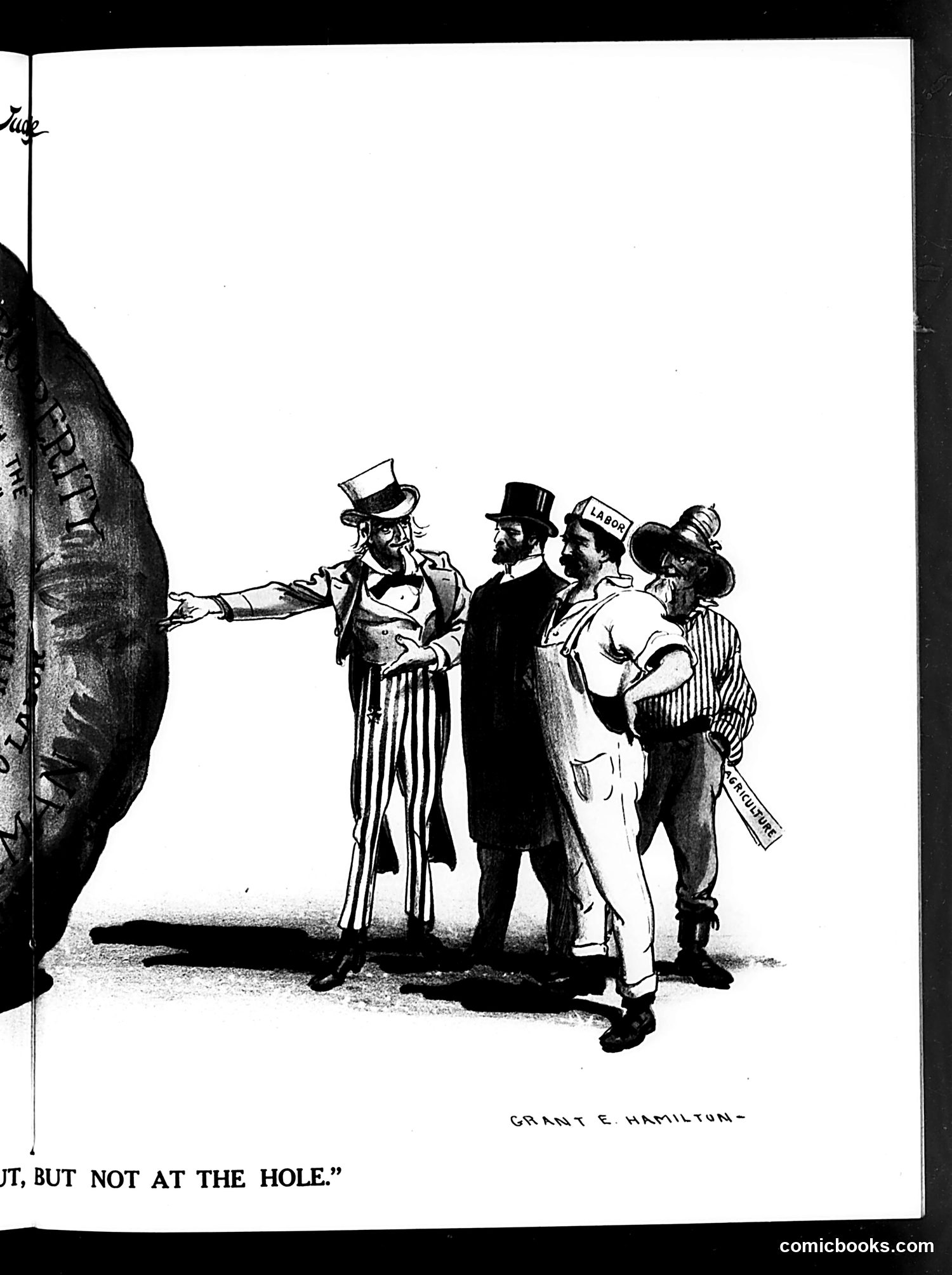
This appears to be a satirical cartoon featuring **Grant E. Hamilton** (credited at bottom), likely from the late 19th century based on the style and clothing depicted. The cartoon shows a figure in Uncle Sam attire (striped pants, top hat) pointing at a large dark shape on the left—possibly representing a political problem or scandal. He's addressing several men in formal dress and work clothes, with visible labels including "LABOR." The caption "BUT NOT AT THE HOLE" suggests the satire concerns *where* a solution should be applied—likely criticizing government policy toward labor disputes or economic issues. The cartoon implies the administration is addressing symptoms rather than root causes of labor/economic problems. Without more context about the specific historical moment, the exact political critique remains somewhat unclear.
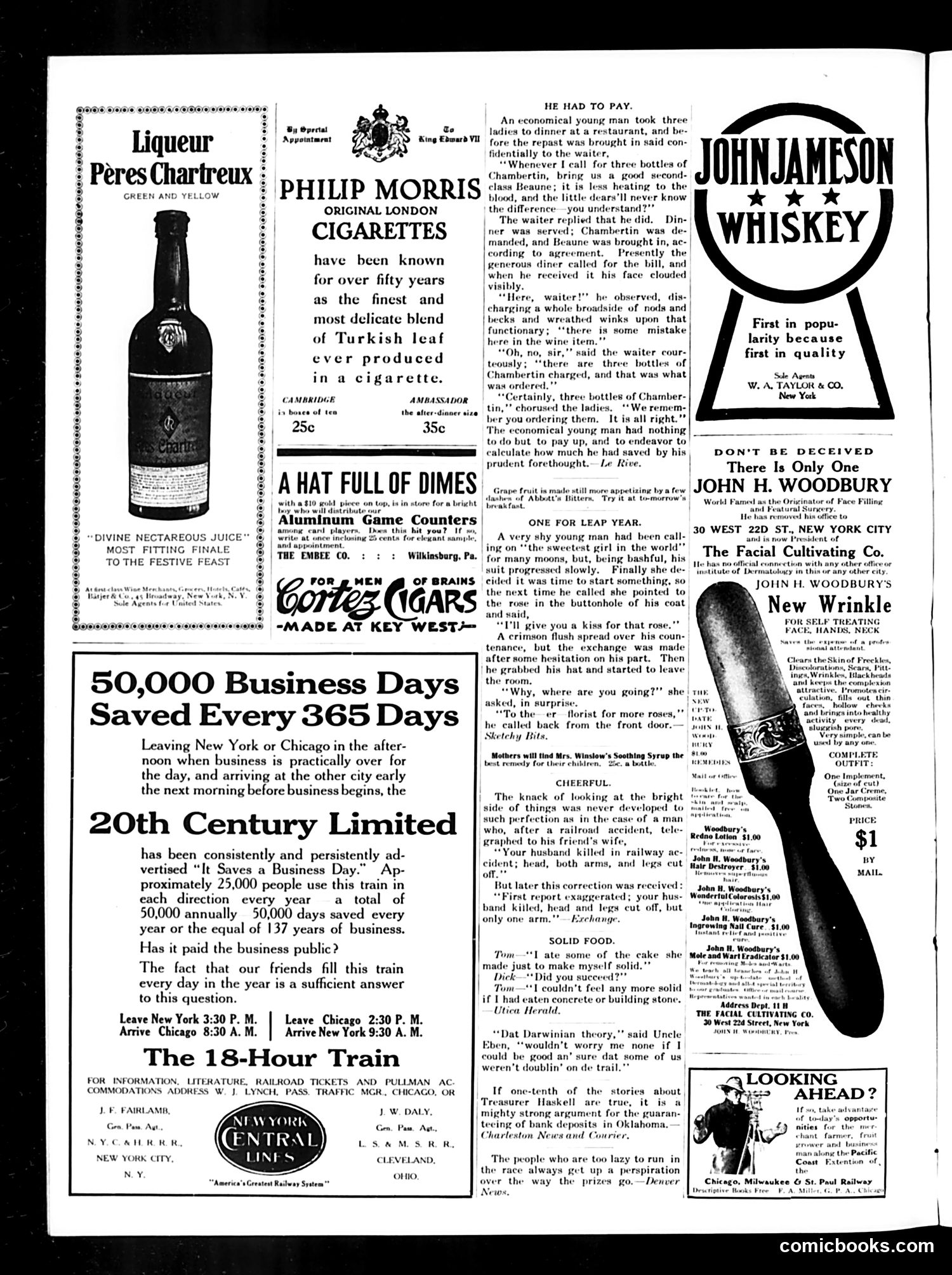
This page is primarily **advertising**, not political satire. It contains multiple commercial advertisements for liquor, cigarettes, whiskey, and other products typical of early 20th-century magazines. The only narrative content consists of three brief **humorous anecdotes**: 1. "He Had to Pay" - A cheapskate tries to fool a waiter by ordering cheap wine while claiming it's expensive; the ladies catch him in the deception. 2. "One for Leap Year" - A shy suitor is tricked into buying expensive roses by a girl's offer of kisses. 3. "Solid Food" - A man eats cake to "make himself solid" (improve his standing) with someone. These are light, domestic humor pieces—no political figures or social commentary. They mock foolish men and celebrate clever women outwitting them. The advertisements (John Jameson Whiskey, Philip Morris cigarettes, the 20th Century Limited train) reflect consumer culture of the era. This appears to be a standard early 1900s magazine page mixing advertising revenue with light entertainment.
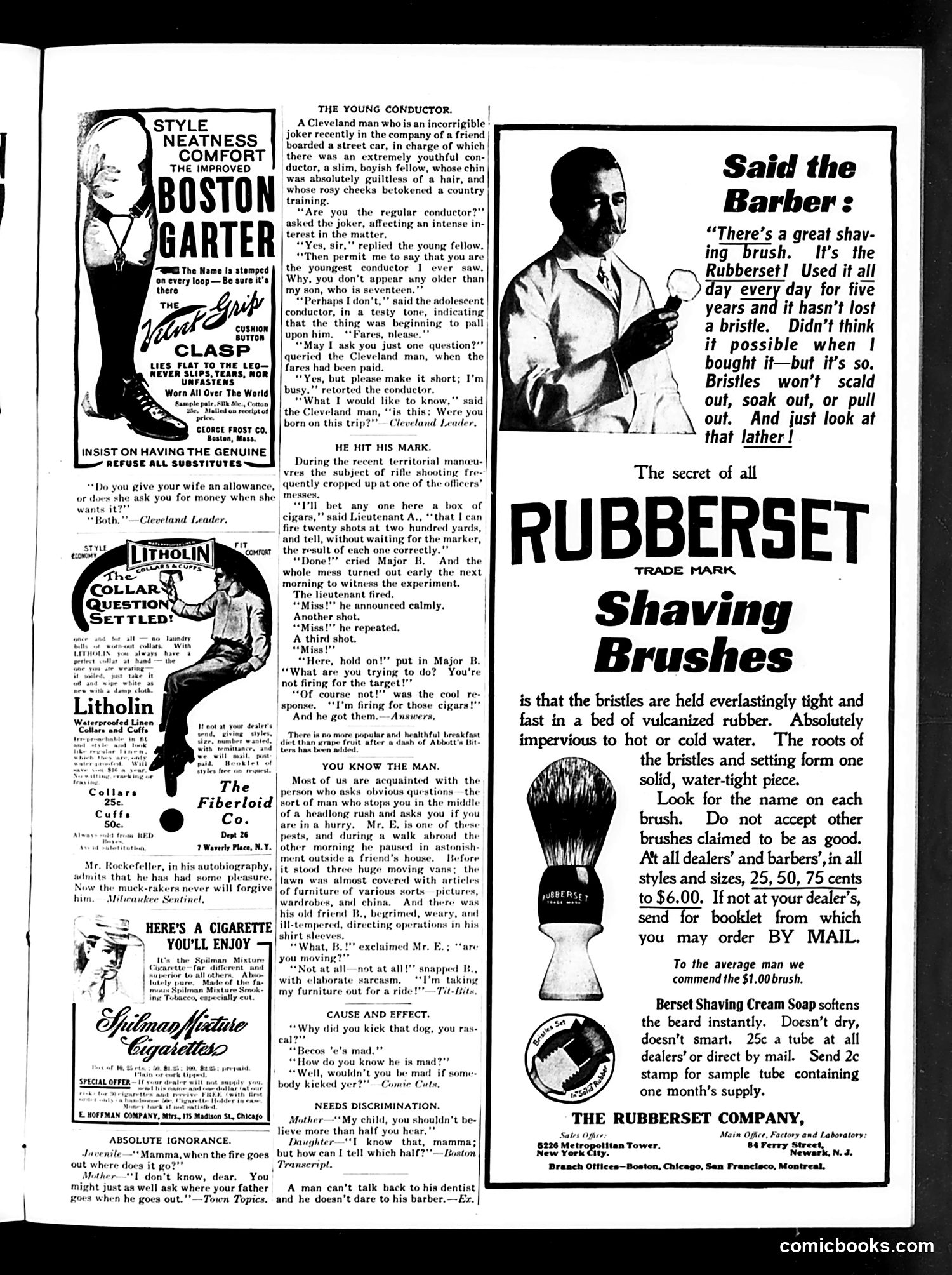
This page contains several short humorous anecdotes typical of Judge magazine's satirical style, rather than political cartoons. **"The Young Conductor"** mocks a streetcar conductor by having a joker repeatedly ask if he's the "regular" conductor, implying he looks too young for the job. The joke plays on the conductor's obvious irritation at being mistaken for a substitute or inexperienced worker. **"The Fiberloid Co." anecdote** satirizes a man who asks painfully obvious questions—the type who interrupts conversations with stupid inquiries, exemplified by asking a friend's wife about her husband's whereabouts when he's clearly just stepped out. **Other brief jokes** target similar social types: someone who kicks dogs without reason, marital dynamics about allowances, and military incompetence (a lieutenant firing wildly at practice). The page is primarily **advertising**, featuring prominent promotions for Boston Garter, Litholin products, Shirtman cigarettes, and extensive copy for Rubberset shaving brushes. The humor serves as filler between advertisements in this commercial publication.
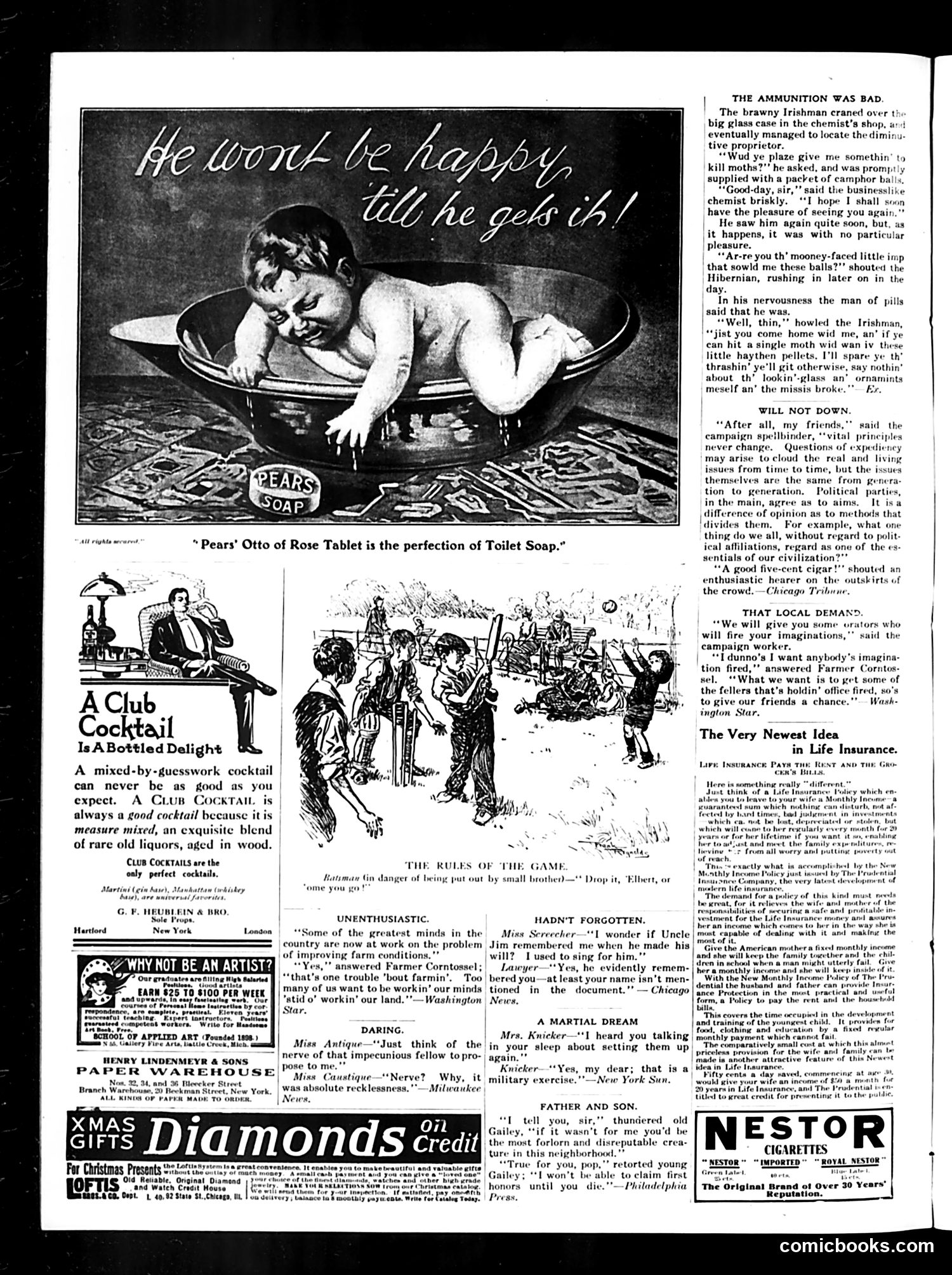
This page contains several brief satirical pieces typical of early 20th-century Judge magazine: **"The Ammunition Was Bad"** depicts an Irish immigrant ("Hibernian") who purchased ineffective moth-killing pellets from a chemist and returns angry—a simple ethnic humor sketch playing on Irish dialect for comedic effect. **"Will Not Down"** mocks political campaign speeches where candidates speak grandly about "vital principles" while a heckler shouts that what voters actually want is a cheap cigar—satirizing the gap between political rhetoric and ordinary citizens' modest concerns. **"That Local Dema[gogery]"** continues this theme: a campaign worker promises to "fire imaginations," but a farmer replies they'd rather have corrupt officials removed so "our friends" get those jobs—satirizing machine politics and self-interested reform. The remaining pieces are brief joke items on unrelated topics (insurance, cocktails, romance). Overall, the page reflects Judge's focus on lampooning political speeches, ethnic stereotypes, and urban social dynamics of the era.
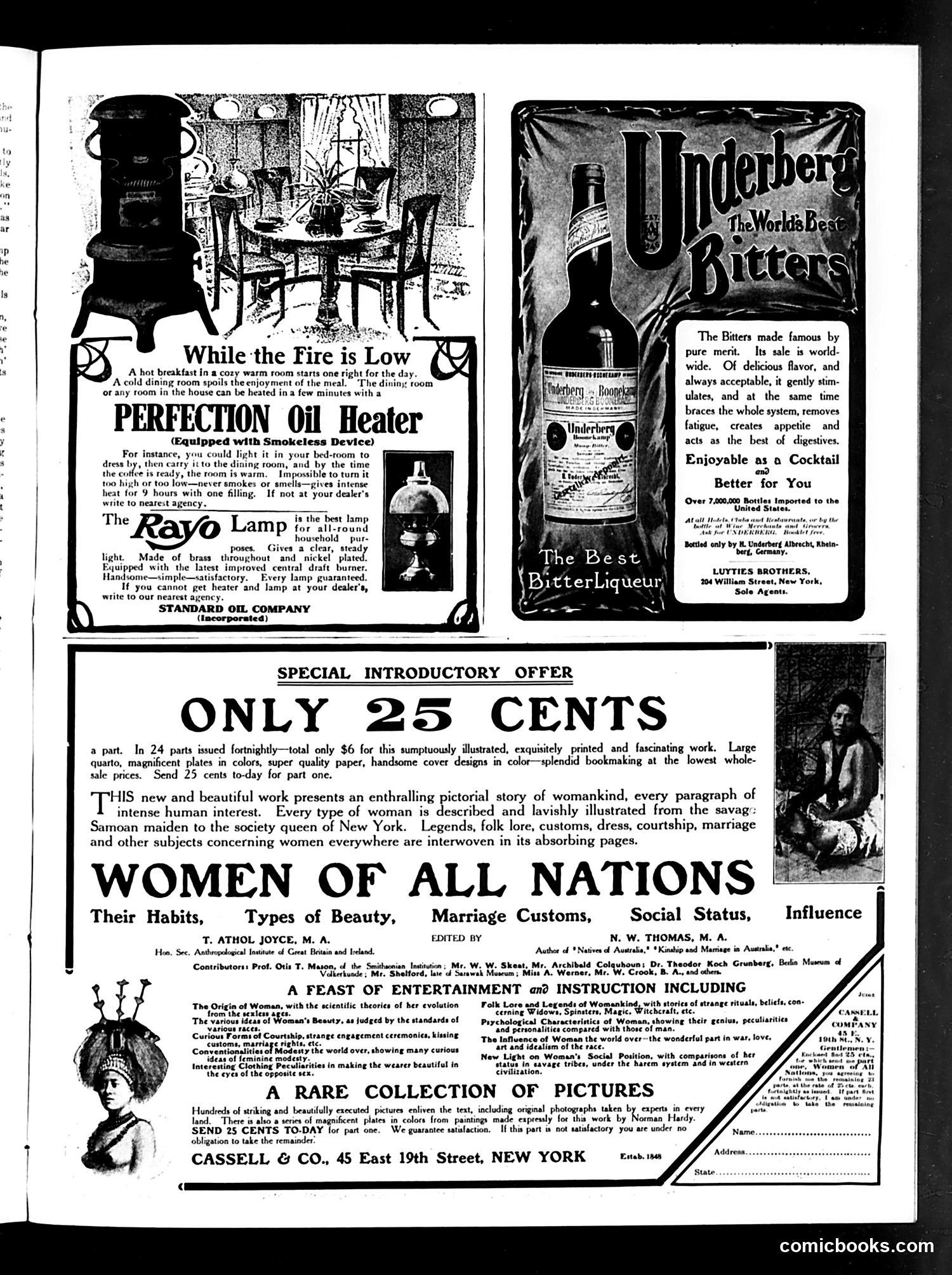
This page is primarily **advertising**, not satirical content. It contains three distinct advertisements: 1. **Perfection Oil Heater** (top left): Promotes a portable home heating device, emphasizing convenience and safety for warming various rooms. 2. **Underberg Bitters** (top right): Advertises a digestive liqueur, claiming it aids digestion, removes fatigue, and is "enjoyable as a cocktail"—typical patent-medicine-era marketing. 3. **Women of All Nations** (center/bottom): Promotes an illustrated 24-part series about women worldwide, from "savage Samoan maiden to the society queen of New York," covering customs, beauty standards, and social habits. The anthropological framing reflects early-20th-century attitudes toward non-Western cultures. There is **no political cartoon or satire** on this page. These are straightforward period advertisements reflecting common commercial and cultural interests of the era.
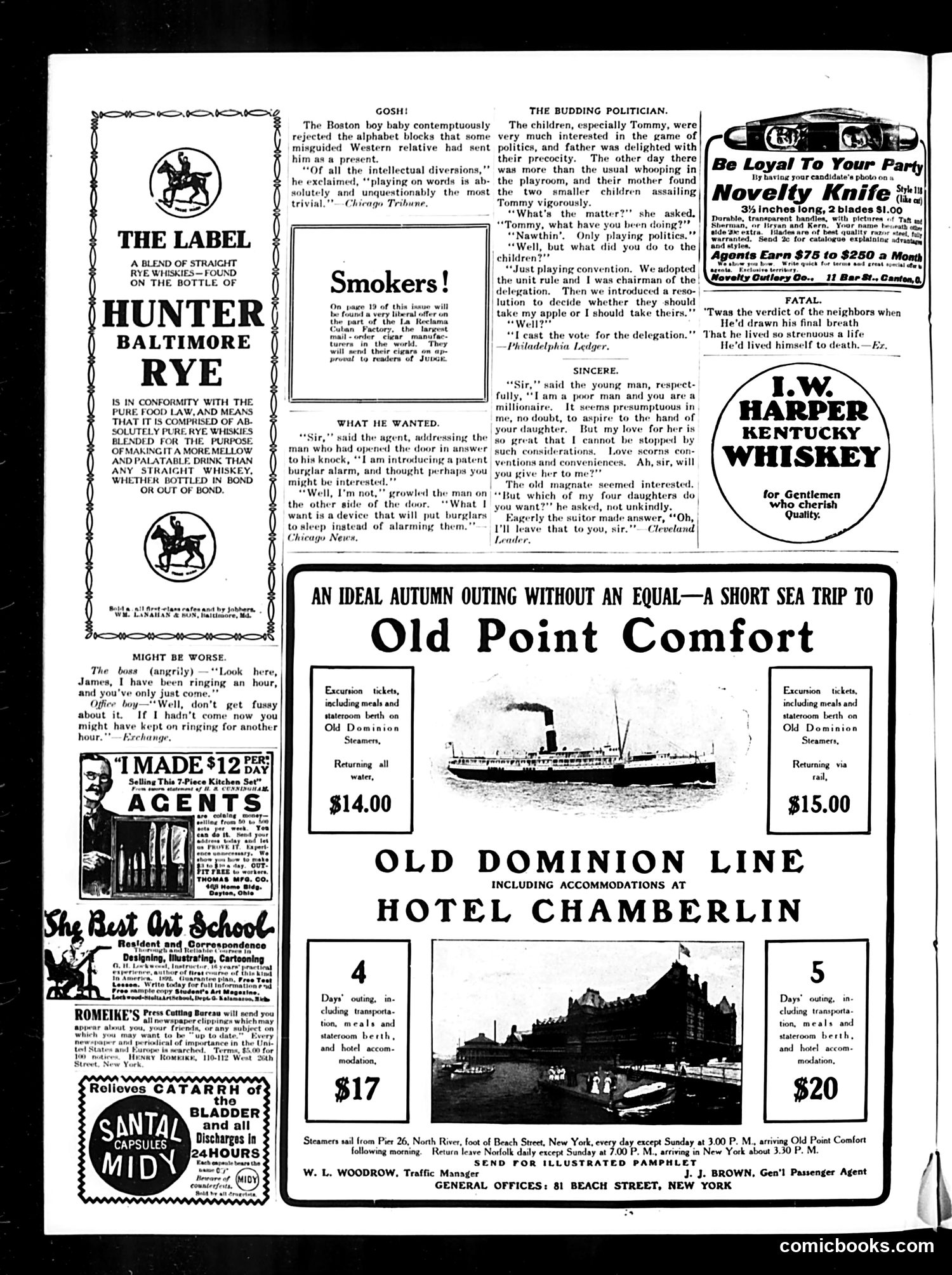
This cartoon satirizes Boston's intellectual pretension. A wealthy Boston boy dismisses alphabet blocks as "trivial," claiming word-games are the pinnacle of intellectual pursuit. The joke's irony: he then demonstrates vapid thinking by teaching his siblings "politics" through a mock convention—reducing serious civic engagement to childish rule-mongering and apple-stealing negotiations. The satire targets two audiences: wealthy Bostonians' affected superiority and politicians' meaningless procedural games (the "unit rule," delegations). The children's violent "whooping" playing politics mocks how Americans treat elections—as entertainment rather than substantive governance. The *Chicago Tribune* attribution suggests this critiques both eastern elitism and American political immaturity broadly, suggesting even children instinctively understand politics as mere theater and self-interest rather than principle.
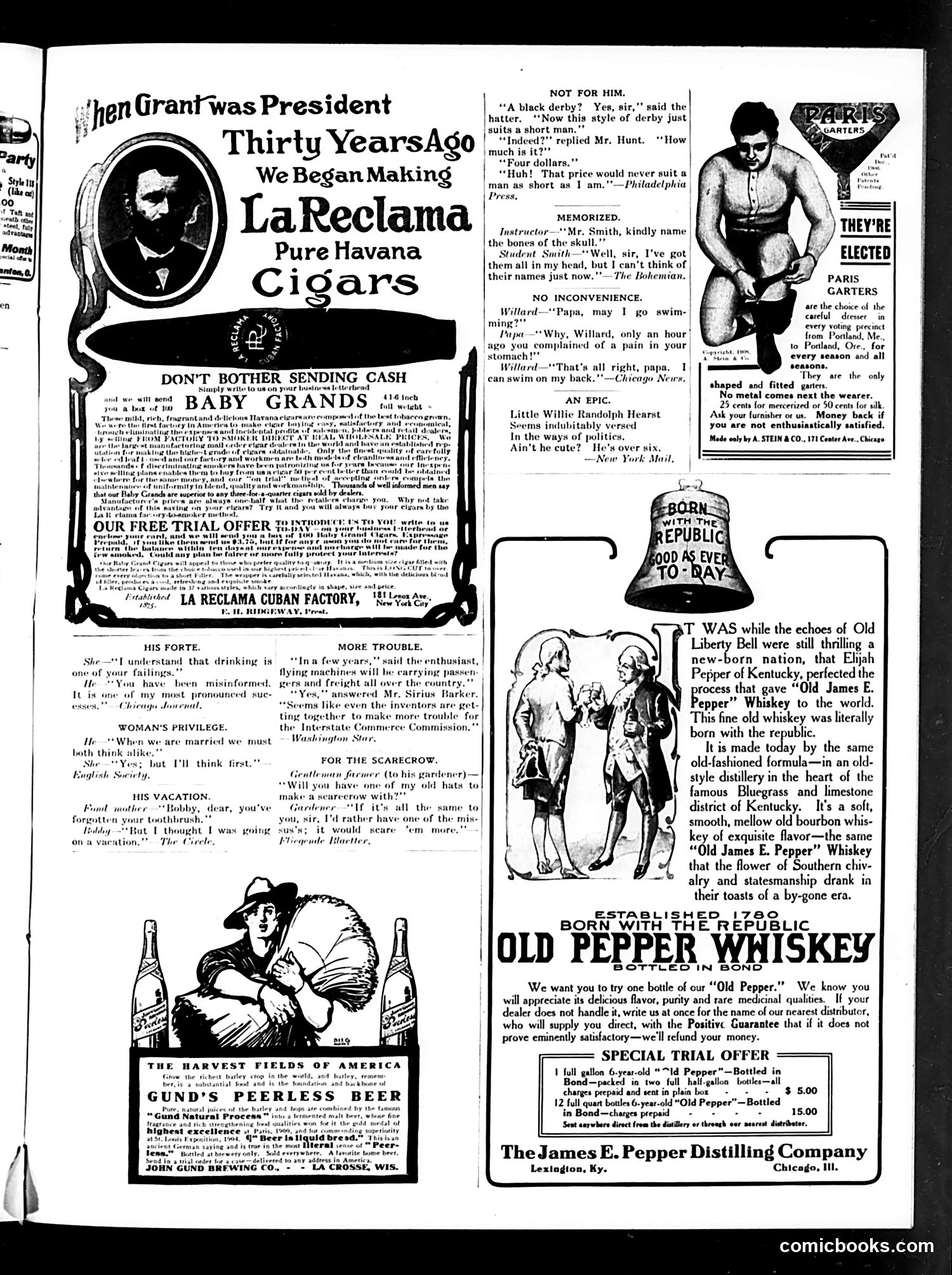
This page combines humor pieces with period advertisements. The satirical content includes: **"Little Willie Randolph Hearst"** — A mocking verse about William Randolph Hearst, the powerful newspaper publisher, suggesting his involvement in politics. The "epic" format parodies grandiose journalism while implying Hearst wielded excessive political influence. **Domestic humor sketches** — Several brief jokes satirizing gender relations ("Woman's Privilege"), class pretension, and marital dynamics typical of early 20th-century satirical magazines. **Advertisement satire** — The La Reclama Cigars ad humorously promises to send "Baby Grands" cigars without requiring cash upfront, targeting readers' desire for credit purchasing. **Product advertisements** — Old Pepper Whiskey and Gund's Peerless Beer ads exploit patriotic imagery, claiming their products date to America's founding, a common marketing strategy of the era. The page reflects Judge's target audience: educated, affluent men interested in political gossip, business, and humor at others' expense.
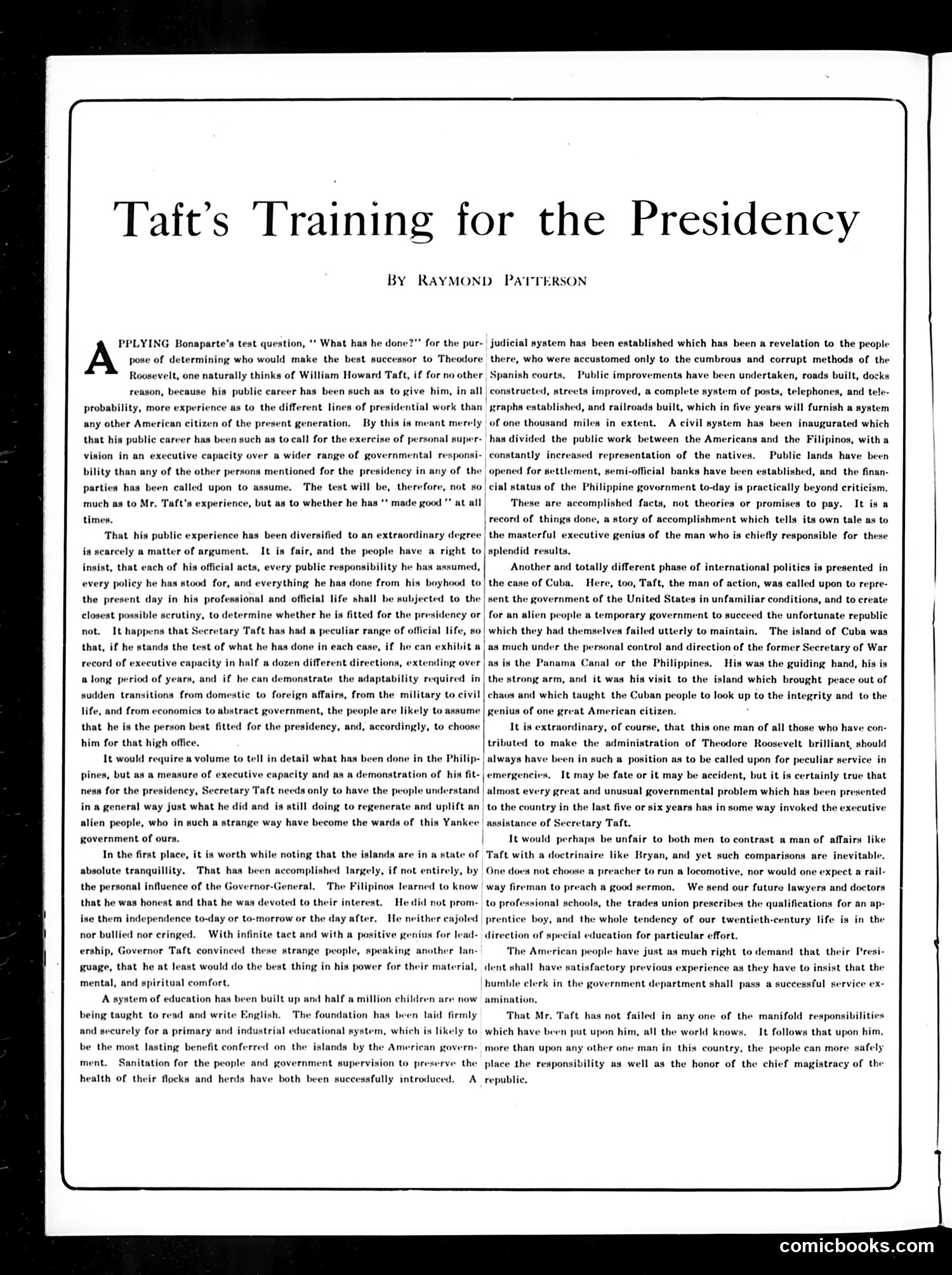
This is a **promotional essay**, not a satirical cartoon, from Judge magazine endorsing William Howard Taft as Theodore Roosevelt's successor. Written by Raymond Patterson, the piece argues Taft is uniquely qualified for the 1908 presidency based on his diverse executive experience. The article emphasizes Taft's record as **Governor-General of the Philippines** (1900-1903) as proof of his capabilities—highlighting his establishment of schools, courts, sanitation systems, and roads while maintaining peace among the Filipino population. Patterson presents this as evidence of Taft's administrative genius and moral character. The framing reflects early 1900s American imperialism: the Philippines are depicted as "wards" requiring benevolent American governance. Taft is praised for his "infinite tact" and honest devotion rather than coercion. This represents Judge's **conservative Republican position** supporting Roosevelt's chosen heir, before the later split between Roosevelt and Taft that defined 1912 politics.
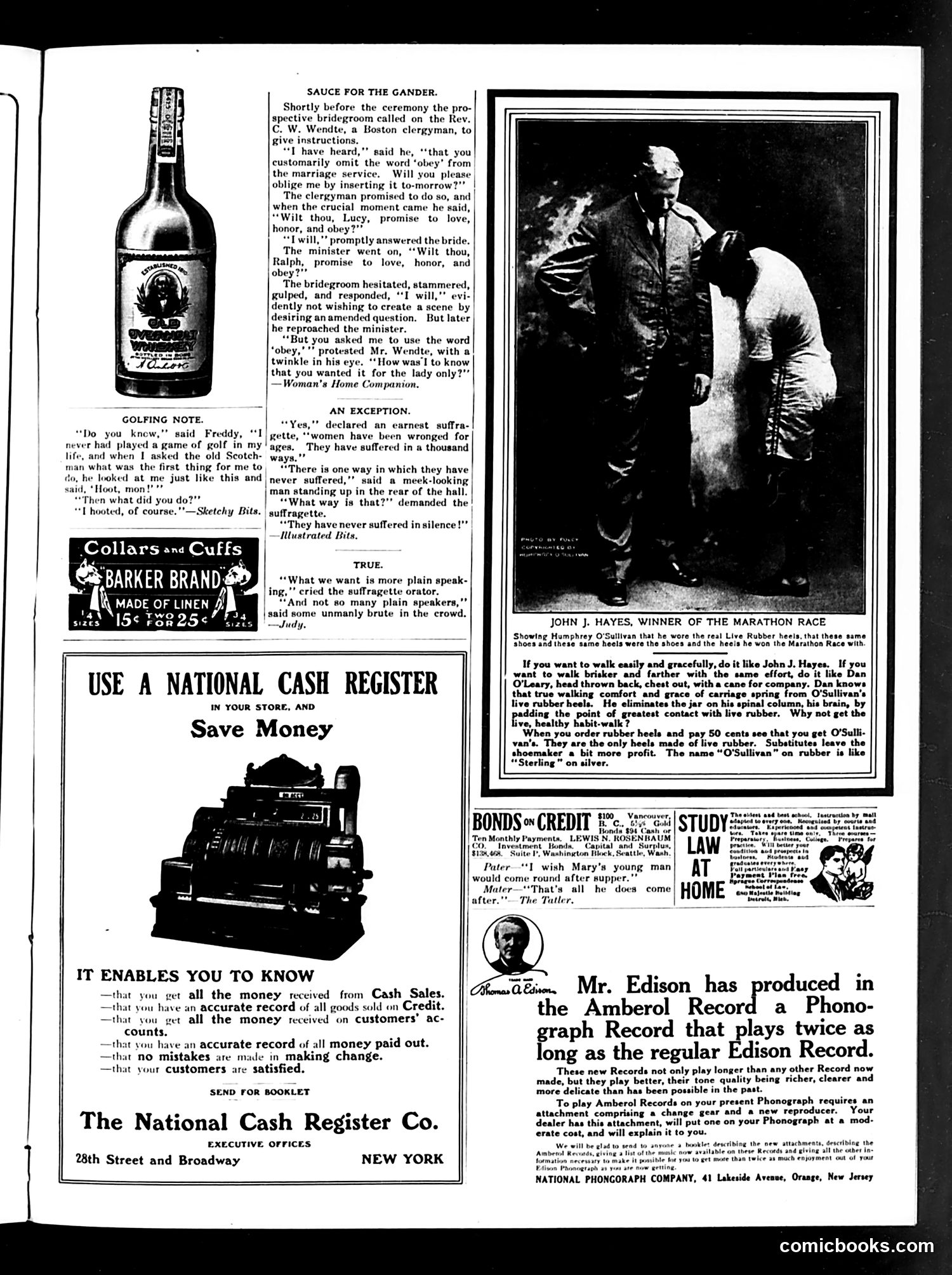
This page contains several satirical pieces mocking contemporary social issues, primarily **women's suffrage and evolving gender roles**: The main cartoon "Sauce for the Gander" satirizes the suffrage movement. It depicts a clergyman who agrees to insert "obey" into a wedding vow—traditionally required only of brides. When he asks the groom to promise obedience too, the bridegroom hesitates, revealing the hypocrisy: men demanding women's submission while refusing reciprocal obligation. The joke highlights the absurdity of unequal marriage vows. A companion piece mocks a suffragette claiming women have "suffered in a thousand ways," with a heckler retorting they've "never suffered in silence"—a crude jab at female activists' vocal advocacy. The third joke criticizes suffragettes' demand for "plain speaking," with a male voice sarcastically suggesting women speakers aren't plain-spoken *enough*. These pieces reflect **Judge's anti-suffrage stance**, portraying women's rights advocates as shrill and hypocritical rather than engaging their substantive arguments.
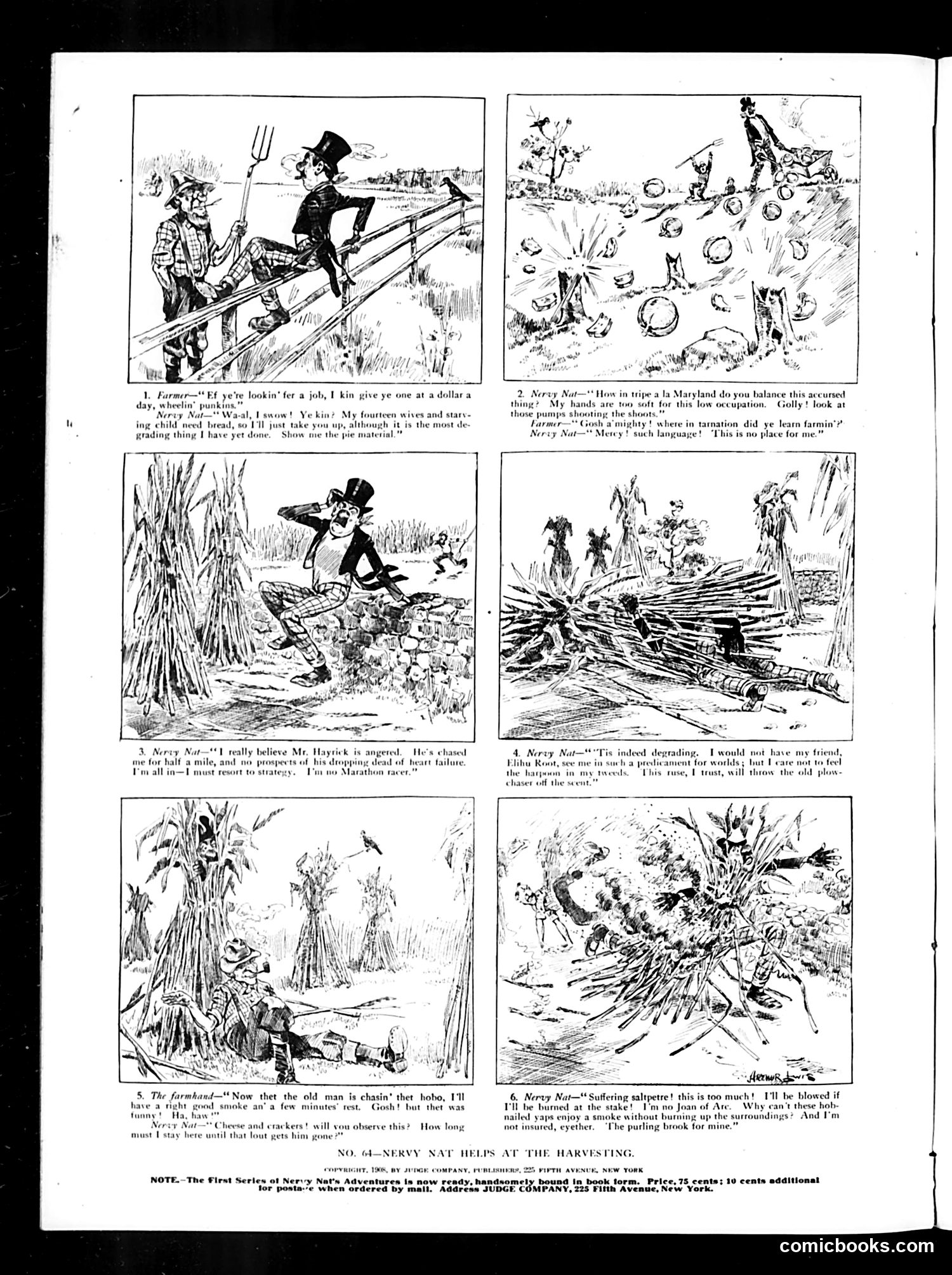
This is a six-panel comic strip featuring "Nervy Nat," a recurring character in Judge magazine. The humor centers on a homeless vagrant (the "hobo") attempting farm work during harvest season, despite his obvious incompetence and refined pretensions. The satire targets class pretense: Nat poses as a gentleman farmer (wearing a top hat while doing manual labor) but lacks any actual farming skill. The farmer's exasperation—"Where in tarnation did ye learn farmin'?"—mocks Nat's absurd incompetence. The humor also plays on the tramp's delusions; he romanticizes rest and nature ("The purling brook for mine") while creating chaos through explosions and destruction. The strip satirizes both the pretentious hobo and rural labor itself, reflecting early 20th-century American attitudes toward vagrants and agricultural work as sources of comedic spectacle.
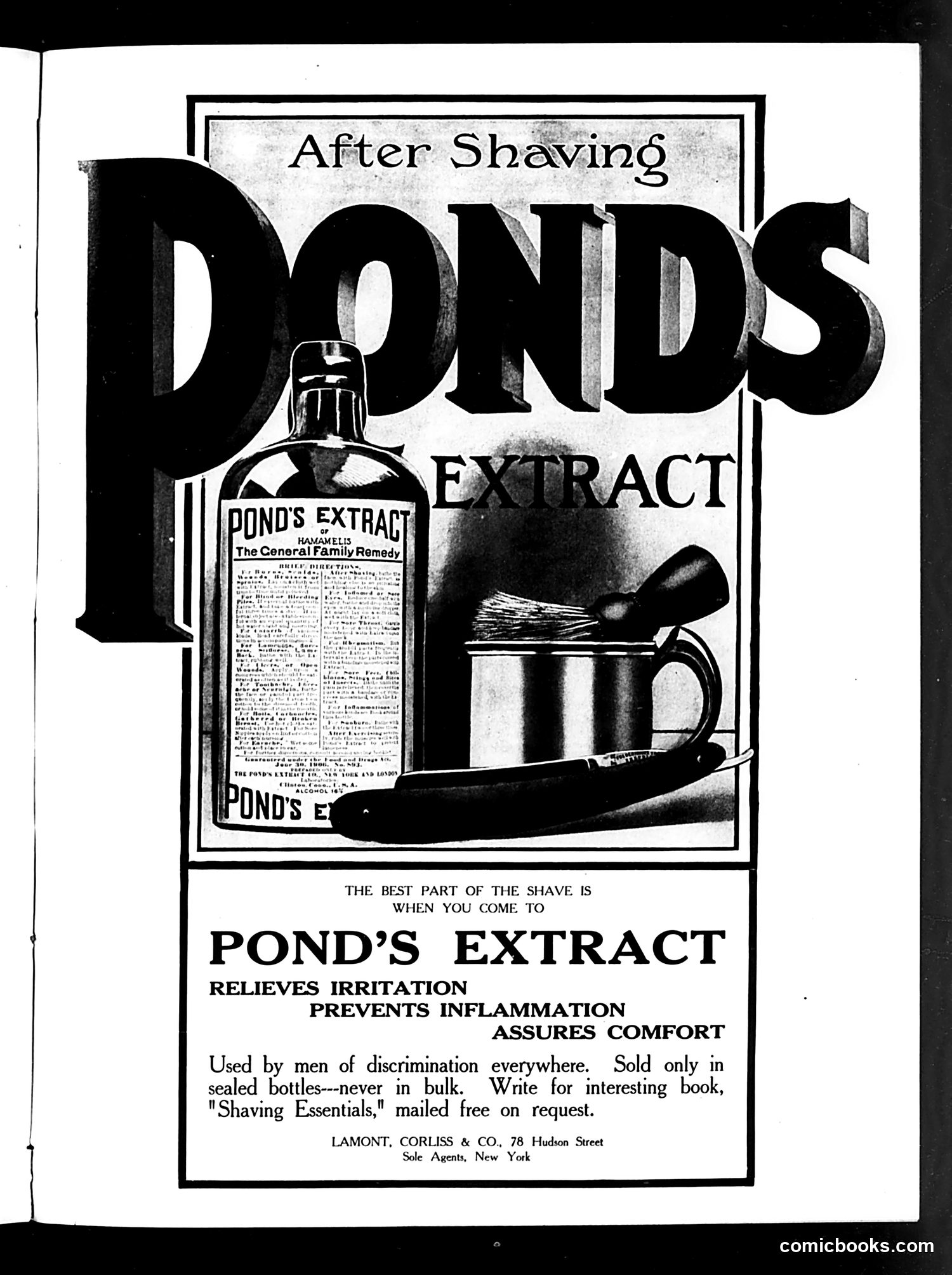
This page is a **product advertisement**, not political satire. It promotes Pond's Extract, a popular aftershave product from the early 20th century, marketed to affluent men ("men of discrimination"). The ad uses a gentlemanly aesthetic—depicting shaving implements and a mug—to sell the extract as a remedy for post-shave irritation. The tagline "The best part of the shave is when you come to Pond's Extract" emphasizes relief and comfort as the product's primary benefit. Pond's Extract was a genuine medicinal product of the era, widely advertised in magazines like *Judge*. The emphasis on "sealed bottles" suggests authenticity and quality control—common marketing reassurances for patent medicines of this period. This represents typical commercial advertising in satirical magazines, which generated revenue through such placements rather than purely comedic content.
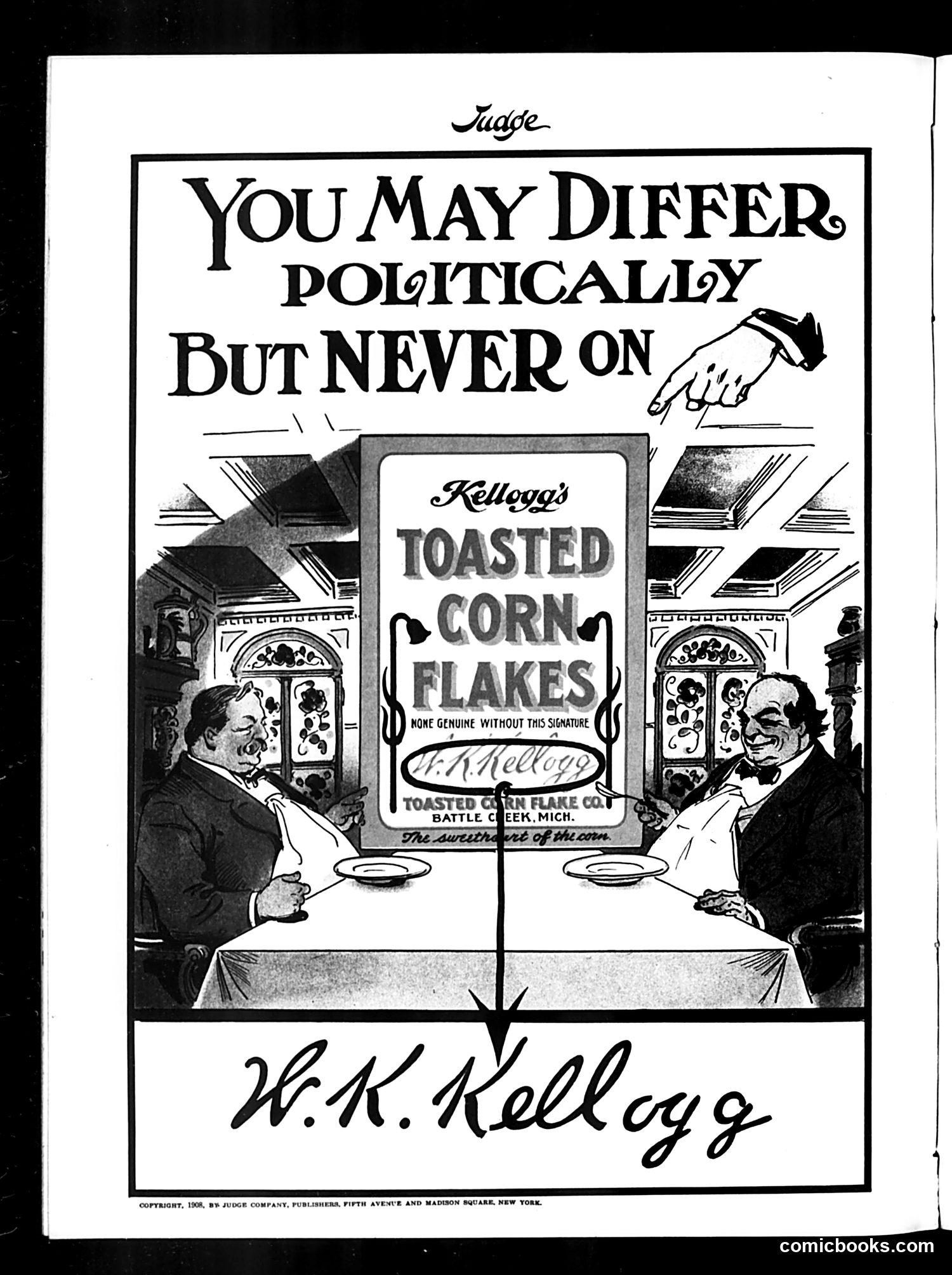
This is a **Kellogg's Toasted Corn Flakes advertisement** disguised as political satire. Two caricatured men sit across from each other at a dining table, each with a bowl of cereal before a large Kellogg's box between them. The headline claims "You may differ politically but never on" the product. The satire suggests that despite serious political disagreements—represented by these two opposing figures—Americans universally agree on breakfast cereal quality. It's a humorous claim that consumer products transcend partisan division. The hand inserting a ballot above reinforces the political context, implying that even political opponents share common commercial values. This exemplifies early 20th-century advertising's strategy of positioning products as unifying American experiences.