
A complete issue · 16 pages · 1908
Judge — October 17, 1908
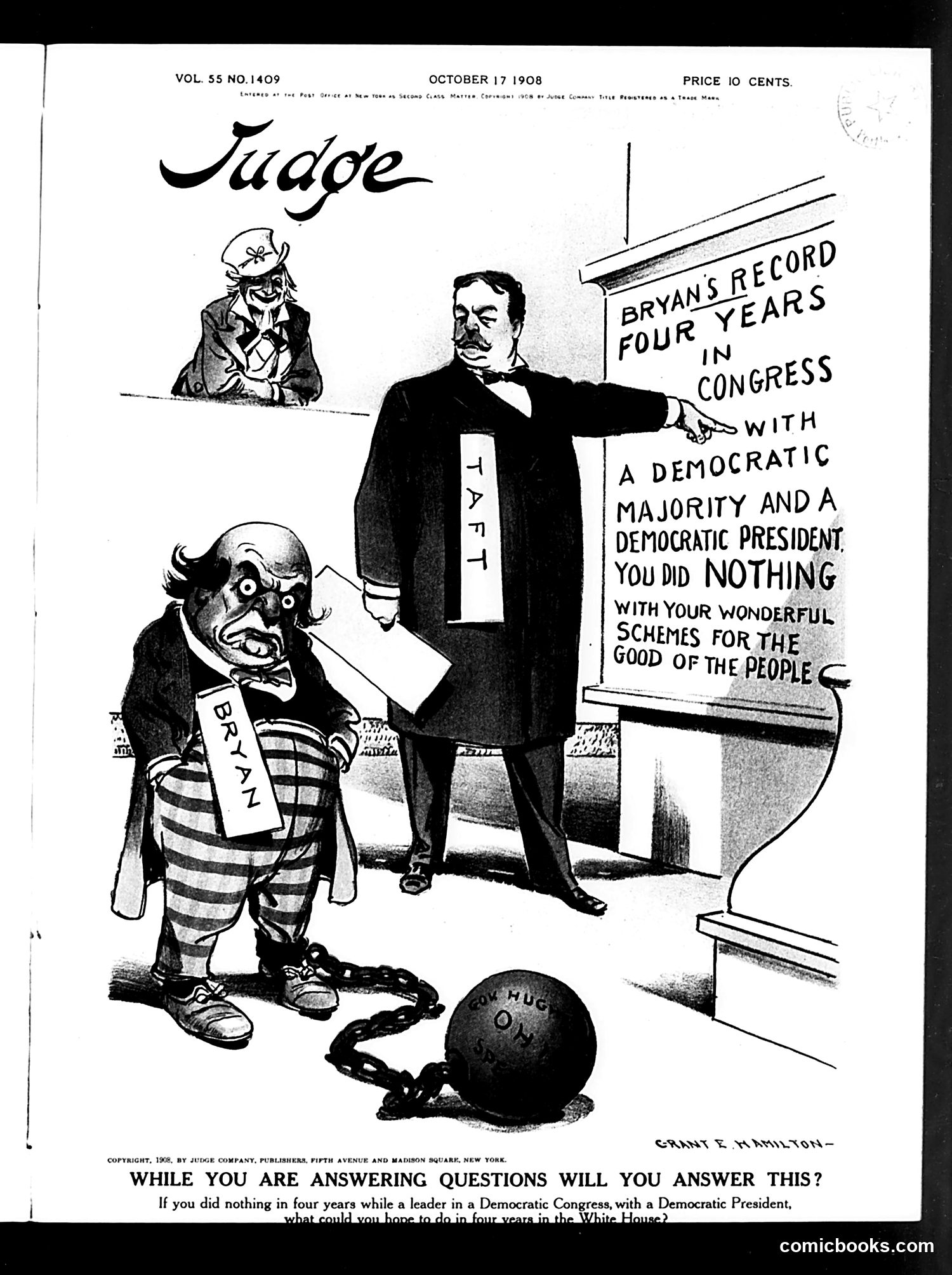
This cartoon attacks William Jennings Bryan's 1908 presidential campaign. The central figure pointing at a record labeled "Bryan's Record: Four Years in Congress" represents the cartoonist's criticism. The chained figure labeled "Bryan" in prison stripes symbolizes Bryan as politically imprisoned by his past ineffectiveness. The allegorical "Judge" figure at top left observes the scene. The cartoon's message, stated below, challenges Bryan: despite having a Democratic Congress and President for four years, he accomplished nothing—so what could he achieve as President himself? The ball-and-chain imagery emphasizes that Bryan's record is an inescapable burden to his candidacy. This is partisan Republican attack advertising disguised as satire.
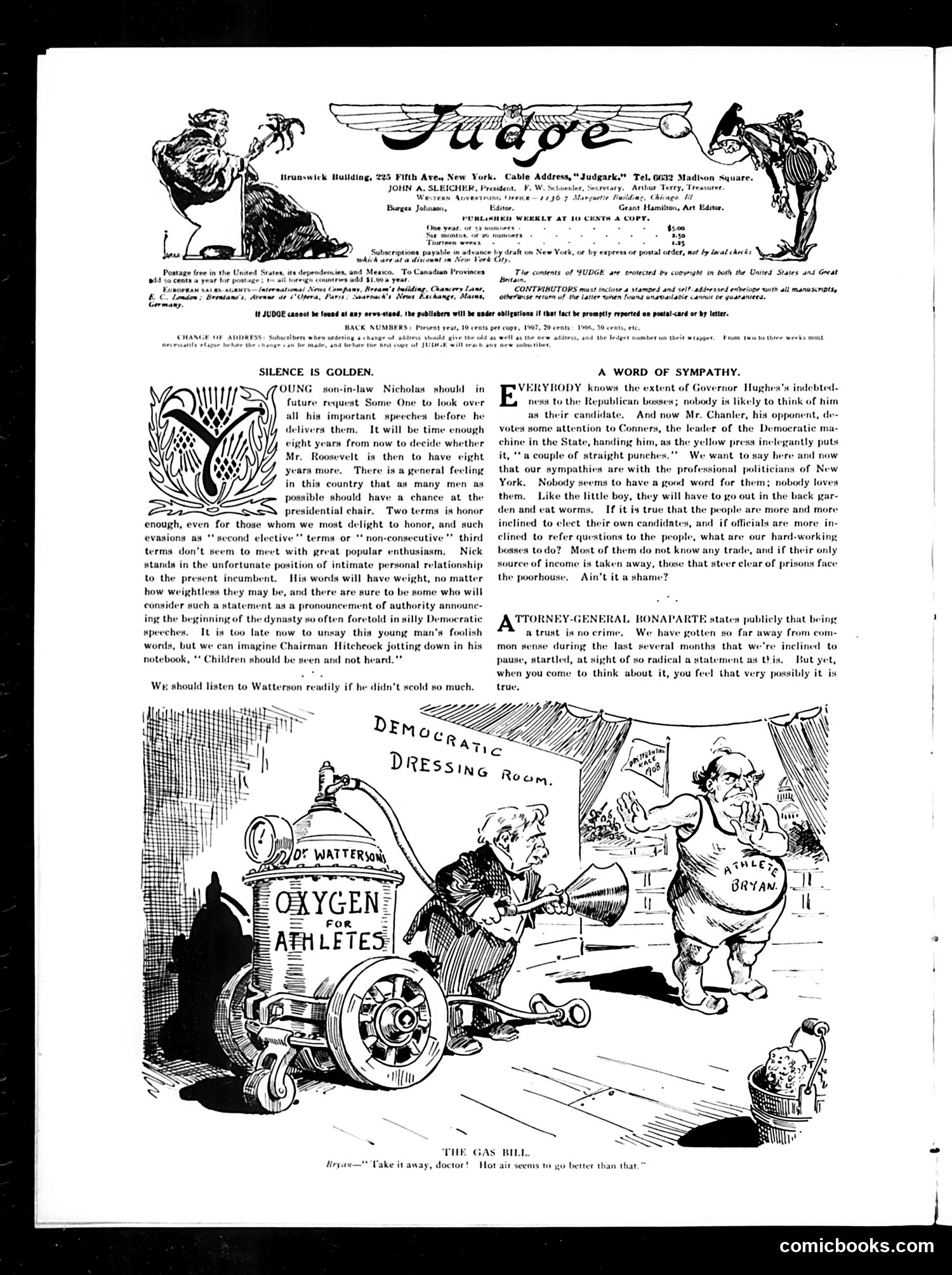
The main cartoon, titled "The Gas Bill," depicts the "Democratic Dressing Room" where a figure labeled "De Wattterson" operates an "Oxygen for Athletes" apparatus—a tank supplying oxygen to what appears to be a bloated Democratic politician labeled "Bryan." The satire mocks William Jennings Bryan and the Democratic Party as physically exhausted and requiring artificial support to remain viable. The accompanying text discusses Republican Governor Hughes's political prospects and critiques Democratic leadership, suggesting the party lacks vitality. The "oxygen" metaphor suggests Democrats are gasping and need artificial life support to compete electorally. The cartoons employ physical caricature and mechanical metaphor to mock Democratic vigor during what appears to be an early 20th-century election cycle.
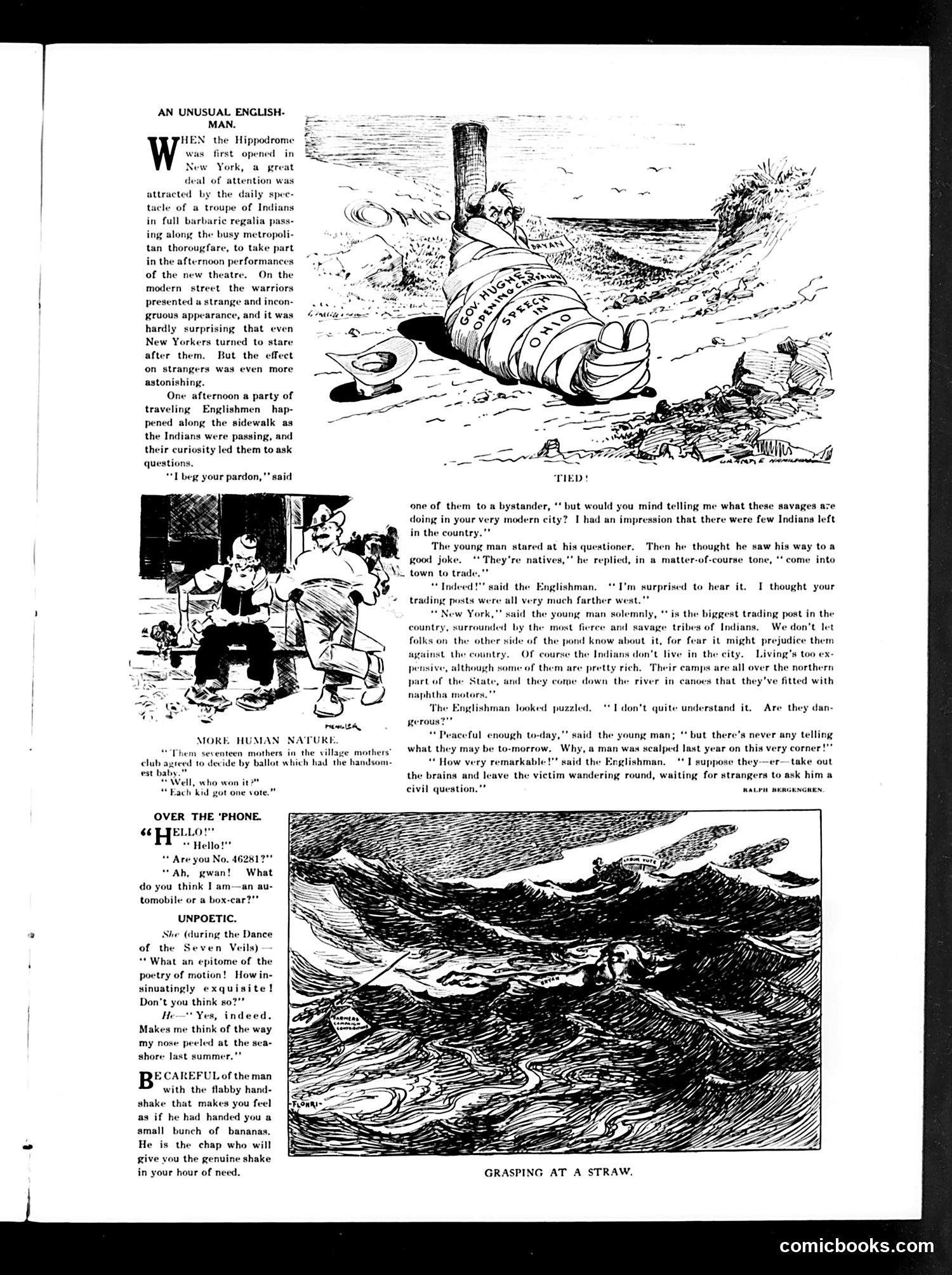
This satire depicts an English traveler encountering Native Americans near New York City. The Englishman expresses shock that Indigenous peoples still exist in the modern city, having assumed they were confined to remote territories. The joke mocks the Englishman's ignorance: he's astonished to learn Native Americans actually live and trade in the area, arriving by motorized canoes. His naive assumptions about their confinement to "the other side of the pond" and remote regions reveal his outdated, dismissive attitudes. The accompanying humor pieces ("More Human Nature," "Over the 'Phone," "Unpoetic," and "Grasping at a Straw") are brief comedic vignettes unrelated to the main story, typical of Judge magazine's format mixing longer satirical narratives with shorter jokes and observations about daily life.
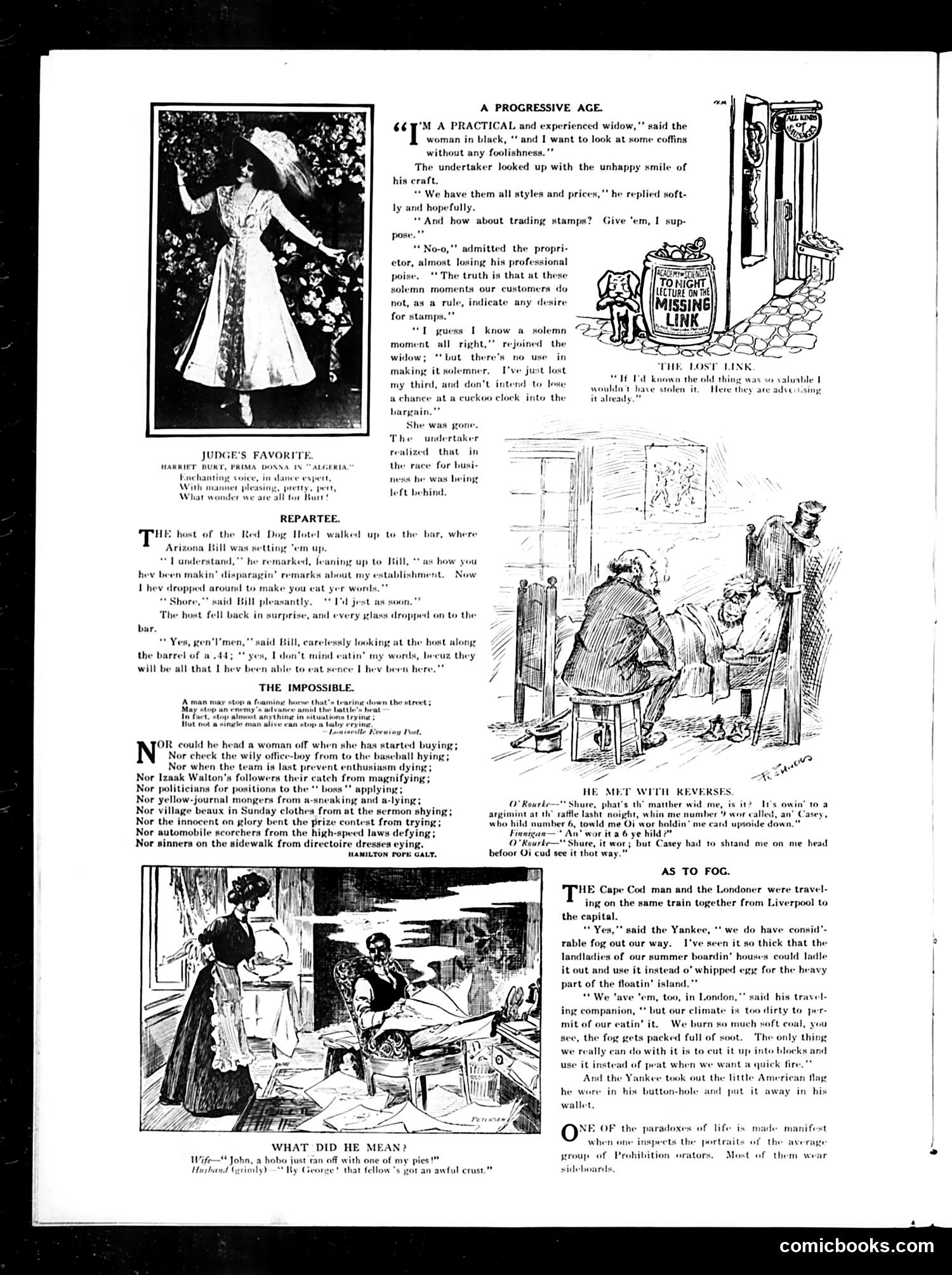
This page contains several satirical stories and illustrations typical of early 20th-century Judge magazine humor. **"Judge's Favorite"** features a photograph of an elegant woman in a long dress, captioned as depicting a character from literature named "Algeria." **"Repartee"** is a short joke about a hotel dispute over broken glassware and payment. **"The Impossible"** is a poem listing things that cannot occur, including politicians losing positions and "sinners on the sidewalk from directoire dresses crying." **"He Met With Reverses"** and **"What Did He Mean?"** are illustrated jokes about misunderstandings. **"As to Fog"** discusses climate differences between America and England, with humor about London fog. The final section discusses "Prohibition orators" and their characteristic sideburns—likely satirizing temperance movement activists popular in early 20th-century America.
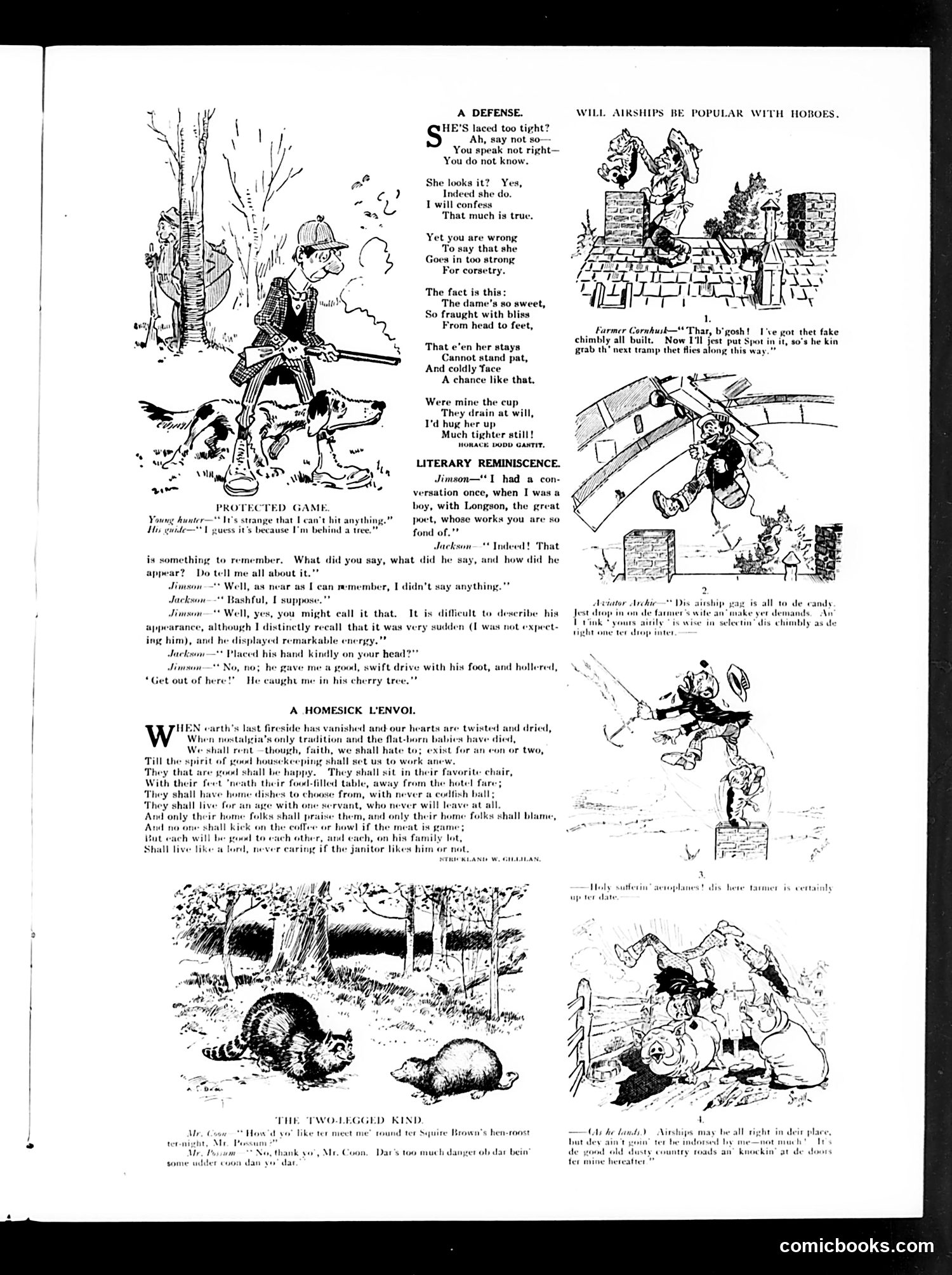
This page contains several unrelated satirical pieces typical of Judge magazine's format: **"A Defense"** mocks a woman accused of being "too tight" (stingy) - she defensively claims her frugality stems from being "fraught with bliss," unable to stand or move properly. The satire targets women's excessive corseting and the contradiction between fashionable physical constraint and economic stinginess. **"Protected Game"** jokes about hunting laws through a dialogue about a man trapped in a tree. **"A Homesick L'Envoi"** is sentimental verse about traditional homemaking. **"The Two-Legged Kind"** features animals discussing humans, using animal perspective for social commentary. The cartoons satirize period concerns: women's fashion, class pretensions, domesticity, and human behavior viewed critically through animal observation. Specific political figures aren't clearly identifiable here.
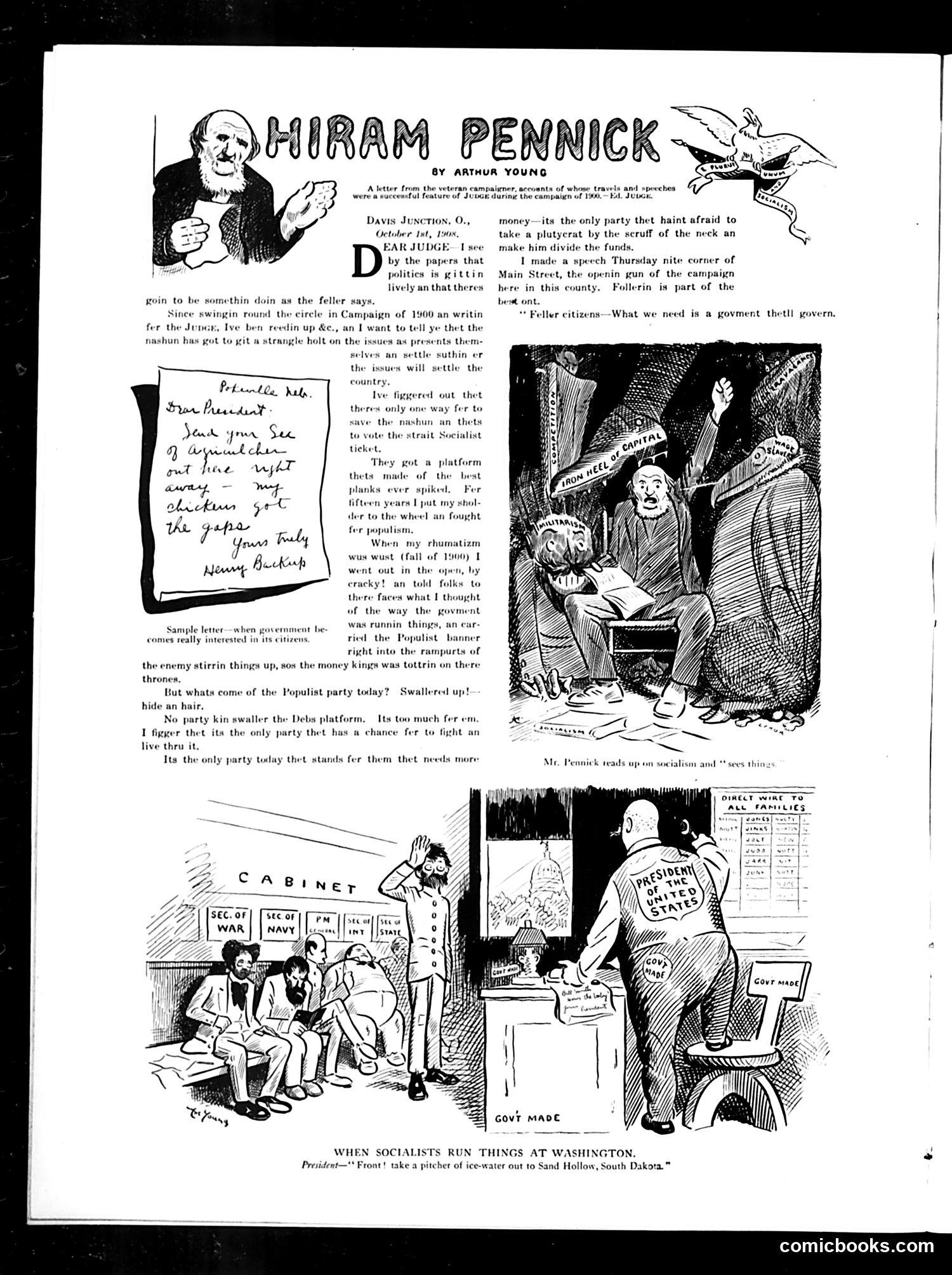
This cartoon satirizes American socialism and the Socialist Party's 1908 presidential campaign, likely featuring Eugene V. Debs as the socialist candidate. **The main narrative** follows "Hiram Pennick," a rural populist who previously championed the Populist Party (which collapsed around 1900). He now advocates for the Socialist Party as the only force capable of challenging entrenched money and political power. The letter mocks populist rhetoric and rural dialect. **The political satire** ridicules socialists by depicting them as naive idealists. The bottom cartoon shows a hypothetical socialist administration where the President wastes government resources on trivial tasks (sending ice water to South Dakota), suggesting socialists are incompetent administrators unfit to govern. **The joke**: While Pennick praises socialism's principled platform, the cartoon implies it would be disastrous in actual practice—implying socialist ideology sounds good in theory but fails in execution.
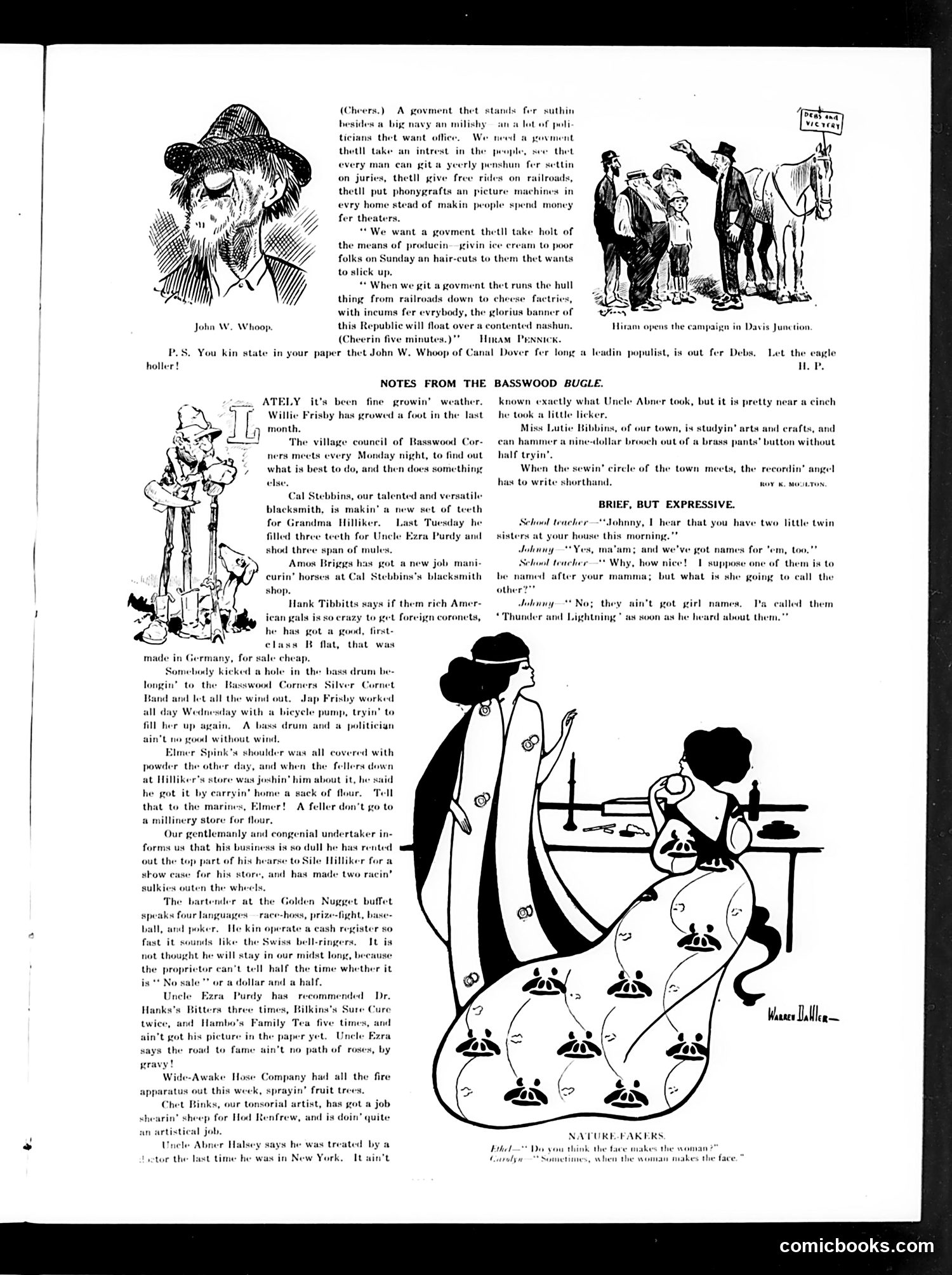
The top-left cartoon features **John W. Whoop**, identified as a leading Populist from Canal Dover, who is endorsing **Eugene V. Debs** (the Socialist presidential candidate) for office. Whoop articulates Populist/Socialist grievances: demands for government control of production, free services (ice cream, haircuts, rail travel), and wealth redistribution with "incums fer evrybody." The satire mocks Populist rhetoric as vague, grandiose promises ("the glorius banner of this Republic will float over a contented nation"). Judge, a Republican satirical magazine, ridicules these reform movements as pie-in-the-sky fantasies that appeal to working-class discontent. The remainder consists of local humor from "Basswood Bugle" notes—small-town anecdotes about blacksmiths, cornet bands, and eccentric characters—offering comic relief rather than political content. The bottom cartoon, "Nature-Fakers," appears unrelated social commentary on appearances versus reality.
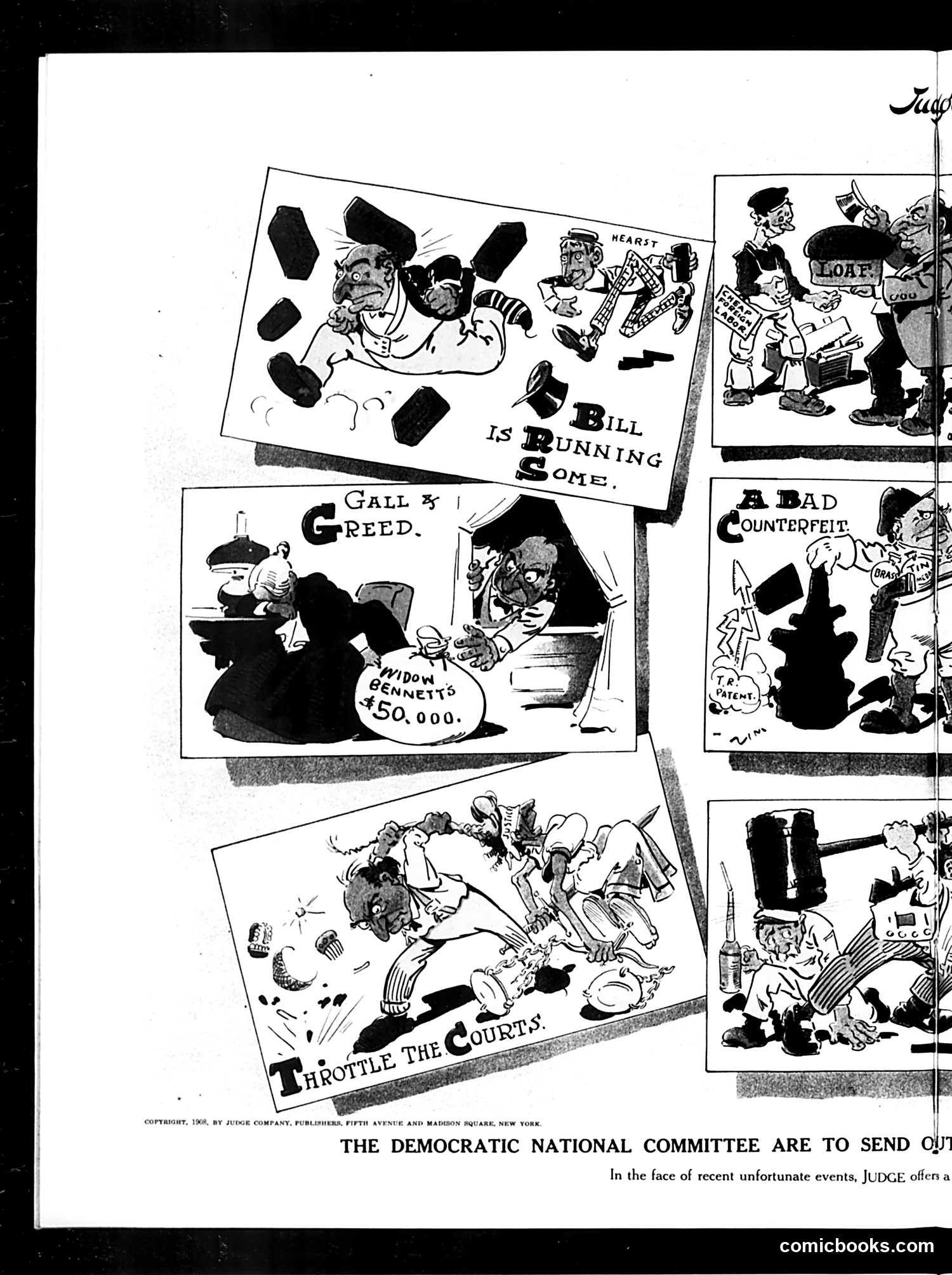
This Judge magazine page contains four satirical cartoons criticizing the Democratic National Committee, likely from the early 1900s. The panels depict: 1. **"Bill is Running Some"** - A figure (possibly a party leader) being pummeled by large objects, suggesting chaotic mismanagement. 2. **"Gall & Greed"** - A character with a bag labeled "Widow Bennett's $50,000," depicting corruption and exploitation of vulnerable people. 3. **"Throttle the Courts"** - Chaotic violence against judicial figures, suggesting Democratic attempts to undermine legal authority. 4. **"Bad Counterfeit"** - A dark figure with counterfeit materials, implying fraudulent practices. The text references "recent unfortunate events," suggesting these cartoons respond to specific scandals or controversies within the Democratic party. The satire attacks the committee's perceived corruption, financial exploitation, and disregard for institutions.
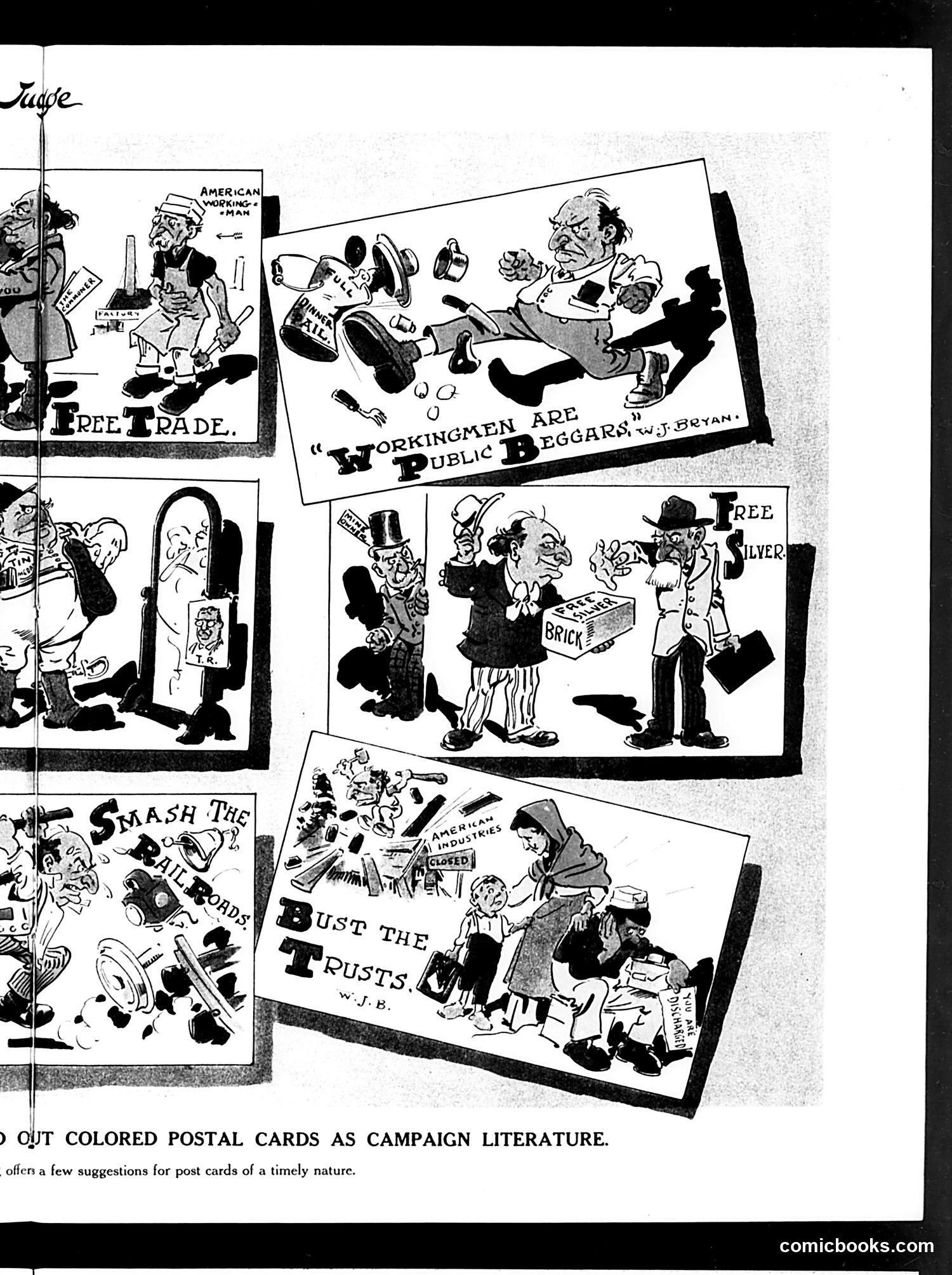
This page showcases satirical postal cards designed as campaign literature. The cartoons mock various political and social issues: **"Free Trade"** and **"Workingmen Are Public Beggars"** (attributed to W.J. Bryan) depict workers suffering from economic policies, suggesting free trade harms American laborers. **"Free Silver"** likely references the monetary policy debate of the 1890s-1900s era. **"Smash the Tariff"** and **"Bust the Trusts"** appear to target monopolies and protectionist trade policies. The final card shows a woman labeled "American Industries" in distress, with figures representing different political positions arguing over her fate. These postcards functioned as campaign propaganda, using exaggeration and caricature to sway public opinion on major political debates of the Progressive Era—particularly around tariffs, currency, and corporate power. The format allowed cheap mass distribution of political messaging.
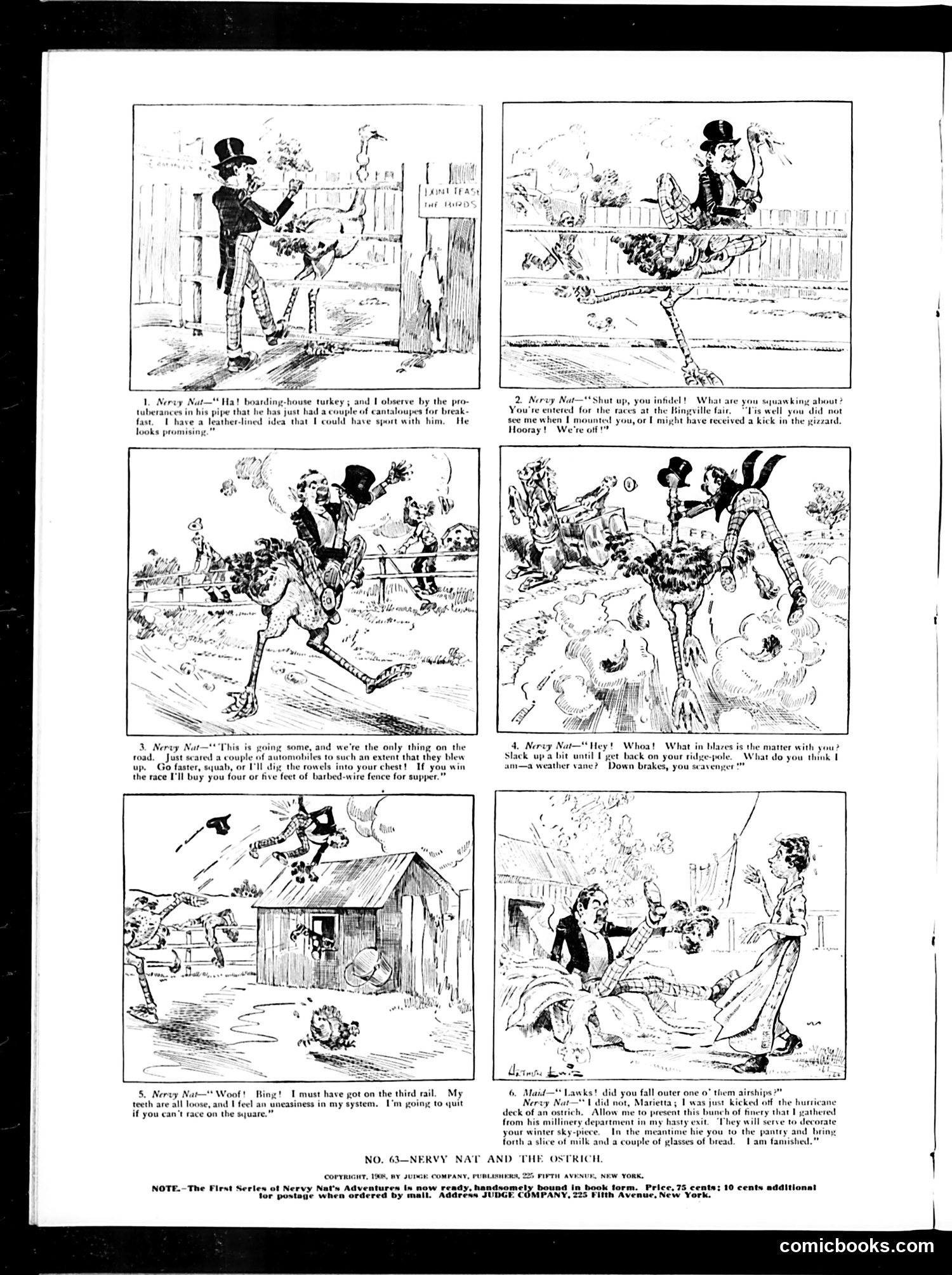
This is a serialized comic strip from Judge magazine (copyright 1908) featuring a character named "Nervy Nat" and his misadventures with an ostrich. The strip depicts slapstick humor typical of early 20th-century comics: Nat attempts various stunts (boarding a turkey, riding the ostrich, launching into the air) that repeatedly backfire, resulting in physical comedy—falls, kicks, collisions. The humor relies on visual gags and absurdist situations rather than political satire. References to "third rail," "airships," and "hurricane deck" suggest contemporary technologies and transportation methods that audiences would recognize. The dialogue emphasizes Nat's persistent, accident-prone nature—he's characterized as someone who keeps attempting dangerous feats despite repeated failure. This appears to be primarily entertainment-focused comic material rather than satirical commentary on political or social issues.
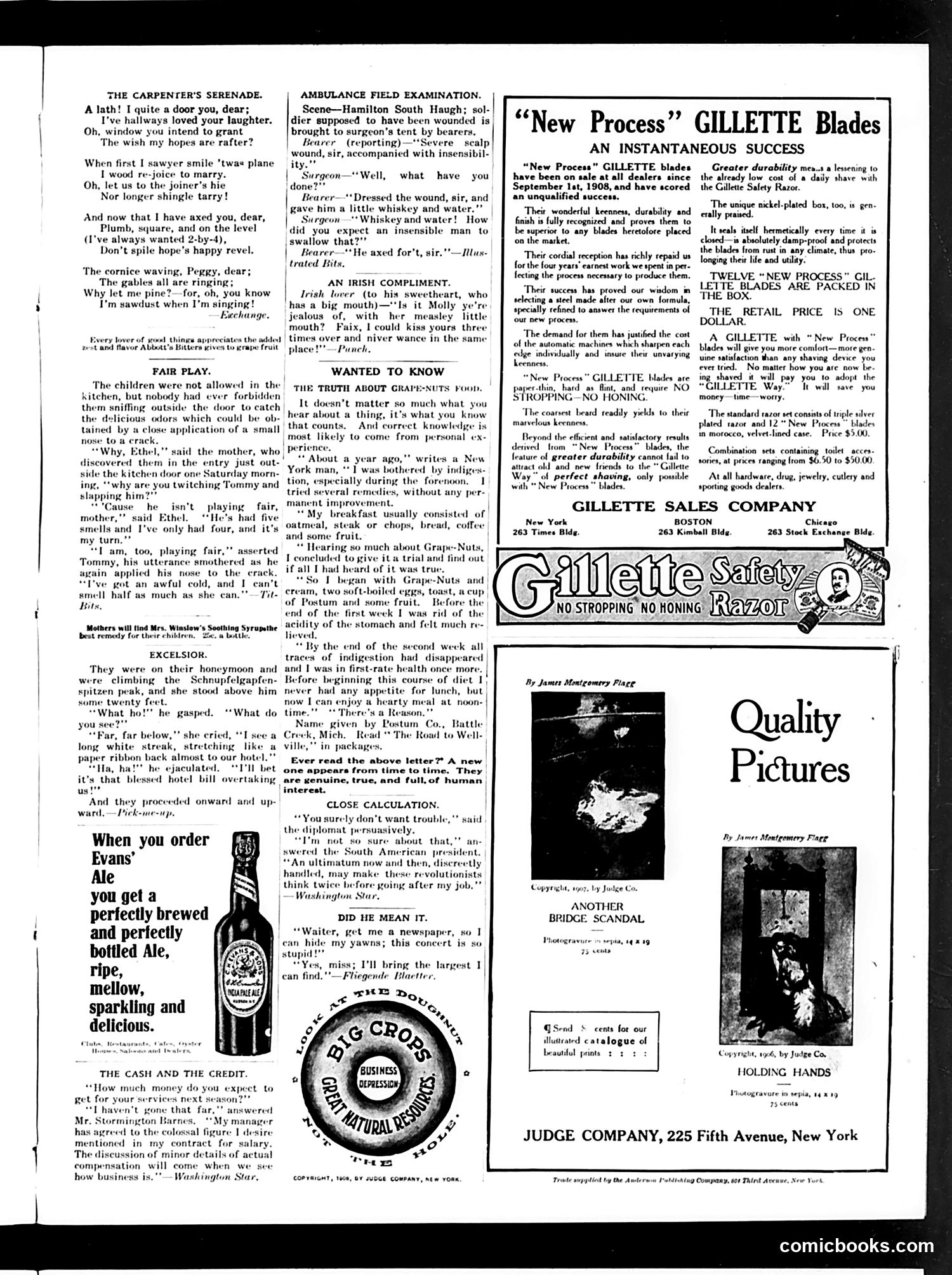
This page is primarily **advertisements and light humor pieces** rather than political cartoons. The content includes: **Humorous short stories** with puns and wordplay—"The Carpenter's Serenade" uses carpentry terminology as romantic metaphors ("I wood re-joice to marry"). "Fair Play" depicts children arguing over snacks; "Excelsior" is a honeymoon joke about a hotel bill appearing as a white streak. **Product advertisements** dominate the right side, including **Gillette Safety Razors** (promoting a new "no stopping, no honing" blade design), **Evans' Ale**, and **Judge Company photographs**. **A medical anecdote** describes a soldier's indigestion cured by switching to Grape-Nuts cereal—a common early 1900s testimonial format. The **Irish compliment** relies on ethnic humor about an Irishman's girlfriend having a large mouth. Overall, this appears to be an early-1900s issue mixing light entertainment with extensive advertising, typical of Judge magazine's format before it focused more heavily on political satire.
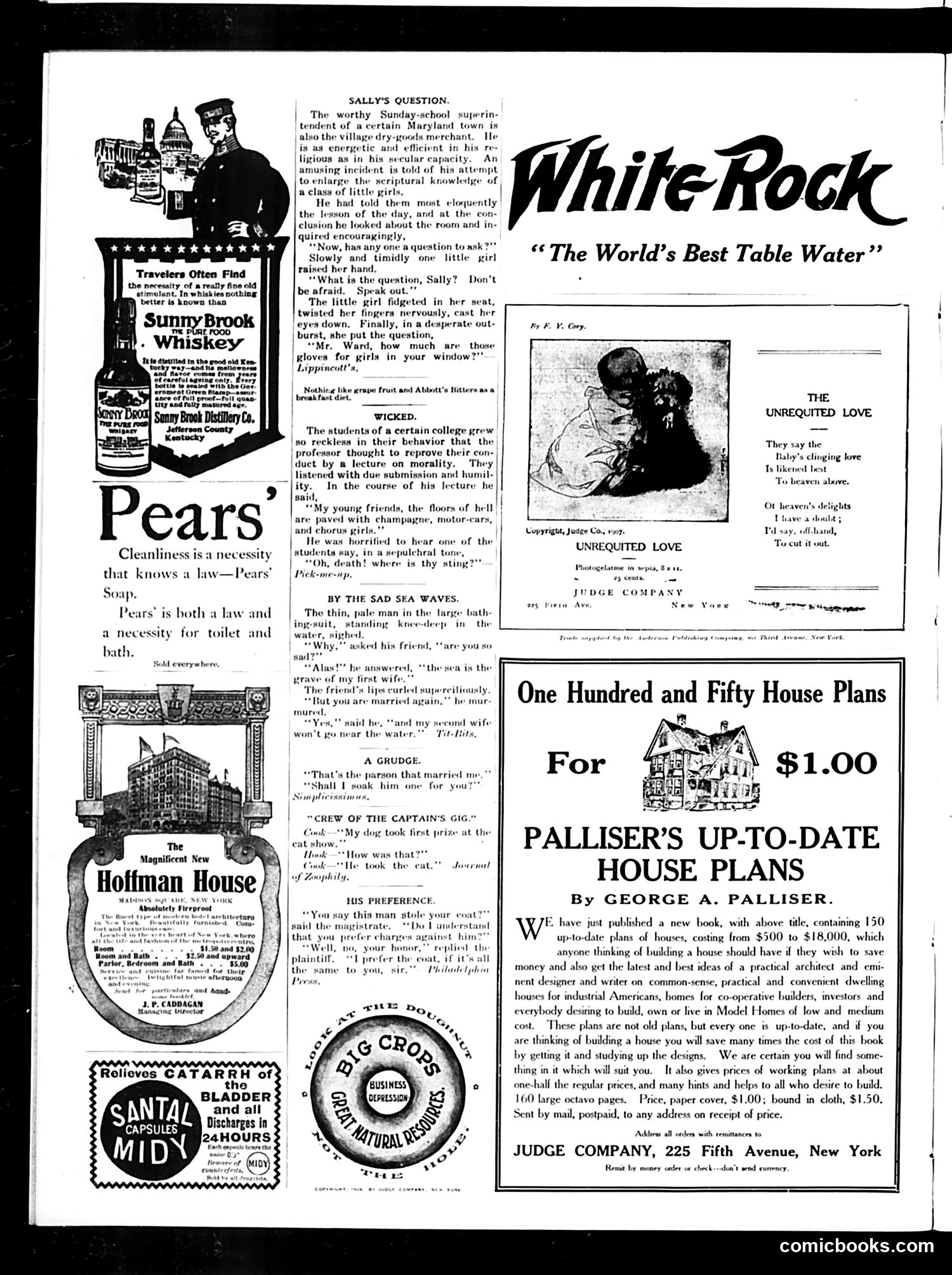
This Judge magazine page contains several brief humorous anecdotes targeting Victorian social hypocrisy and pretension: **"Sally's Question"** ridicules Sunday school instruction. A superintendent delivers an eloquent moral lesson, then a girl innocently asks about dolls displayed in a shop window—exposing the gap between sanctimonious preaching and children's actual interests. **"The Wicked"** mocks a college professor's pompous morality lecture about hell's floors being paved with champagne and motor-cars, satirizing the disconnect between abstract moralizing and real student behavior. **Other brief jokes** ("By the Sad Sea Waves," "A Grudge," "Crew of the Captain's Gig," "His Preference") similarly mock pretension, self-deception, and social convention through short dialogues revealing human nature's contradictions. The page is predominantly **advertising**—Sunny Brook Whiskey, Pears' Soap, the Hoffman House hotel, and house-plan books dominate the layout. These satirical snippets are filler content typical of Judge's format.
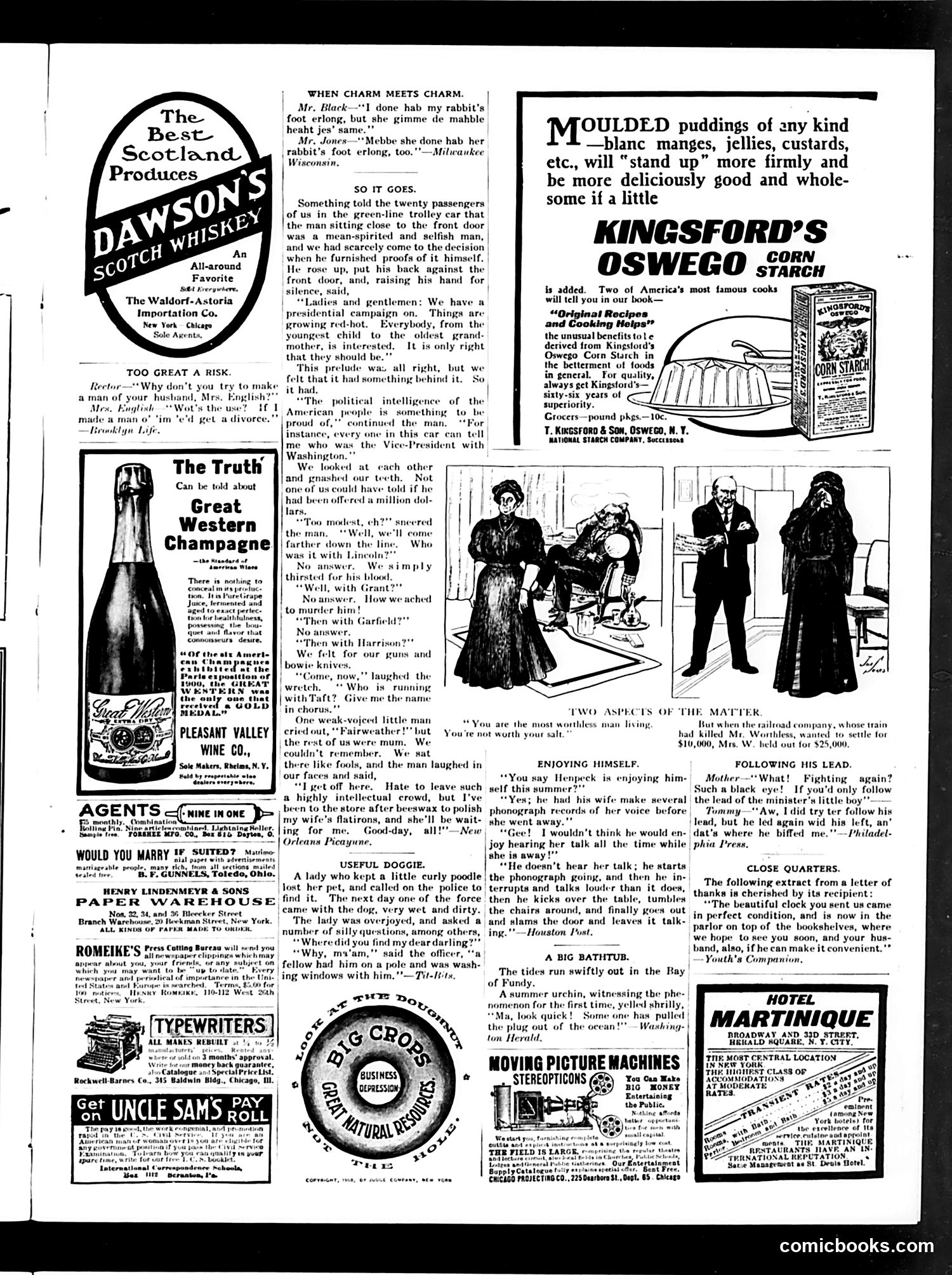
This page is primarily **advertising with brief comic sketches** rather than political cartoons. The main content includes: **Comic Sketches:** - "When Charm Meets Charm": A brief dialogue between two Black characters discussing rabbit's feet charms—likely racial stereotyping typical of early 20th-century humor. - "Too Great a Risk": A domestic humor sketch about divorce. - "Useful Doggie": A light anecdote about a lost poodle. - "Enjoying Himself": A joke about a henpecked husband who plays his wife's phonograph recordings then deliberately drowns them out—poking fun at nagging wives and marital discord. **Advertisements** dominate, promoting Dawson's Scotch whiskey, Great Western Champagne, Kingsford's cornstarch, typewriters, and a hotel. The page reflects early 1900s sensibilities: period racial caricatures, domestic humor centered on marriage conflicts, and product-focused advertising. No significant political satire is evident.
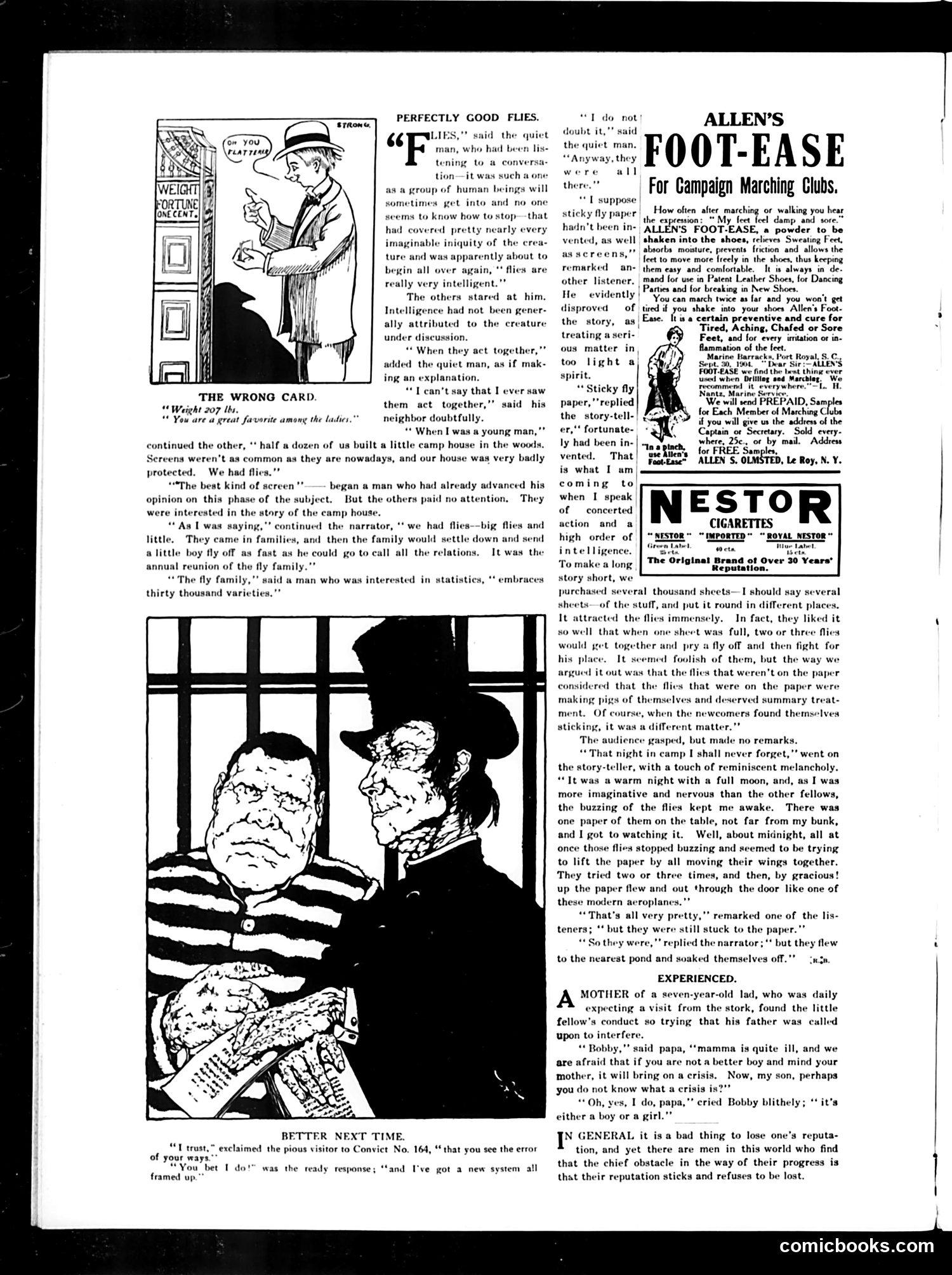
This Judge magazine page contains two satirical stories and period advertisements. **"The Wrong Card"** and **"Better Next Time"** are humorous anecdotes about social embarrassment. The first mocks a man who misjudges his reputation among women. The second features a convict claiming he's reformed with a "new system"—a joke about the futility of prison rehabilitation. **"Perfectly Good Flies"** is the main story: a quiet man relates how he and friends at a cabin discovered that flies possess intelligence and social organization. They tested this by spreading flypaper throughout the house. The joke's punchline (partially visible) suggests the flies demonstrated unexpected problem-solving by working together, subverting the narrator's original intent. The cartoons illustrate these stories with period-appropriate caricatures and exaggerated facial expressions typical of early 20th-century Judge humor. **The advertisements**—Allen's Foot-Ease powder and Nestor cigarettes—represent typical magazine content from this era, pitching products to marching clubs and general consumers.
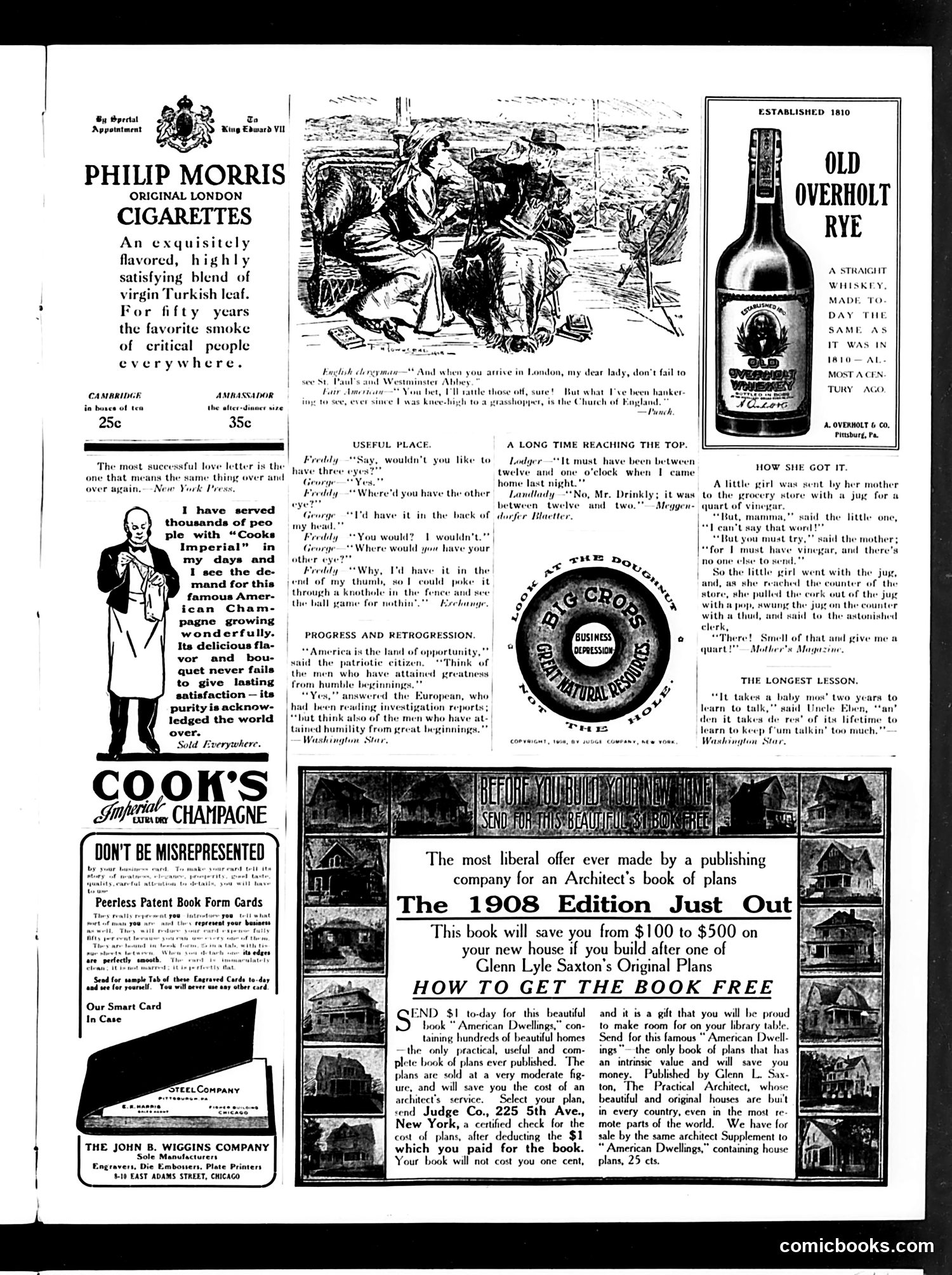
This page is primarily **advertising**, not editorial satire. It contains product endorsements for luxury goods aimed at affluent readers: Philip Morris cigarettes, Cook's Champagne, and Old Overholt Rye whiskey—all premium brands emphasizing long-established reputation and quality. The small comic sections ("Useful Place," "How She Got It," "The Longest Lesson") are brief humorous anecdotes with mild social humor, not political satire. "How She Got It" depicts a child awkwardly attempting to request "vinegar" at a store, a simple joke about childhood innocence and mispronunciation. The dominant feature is a large advertisement for Glenn Lyle Saxton's 1908 architect's book of house plans, offering readers savings of $100–$500 on home construction—clearly targeting middle-to-upper-class homebuilders. The page reflects Judge's primary function as a vehicle for premium advertising to wealthy readers, with light humor interspersed rather than sustained political commentary.
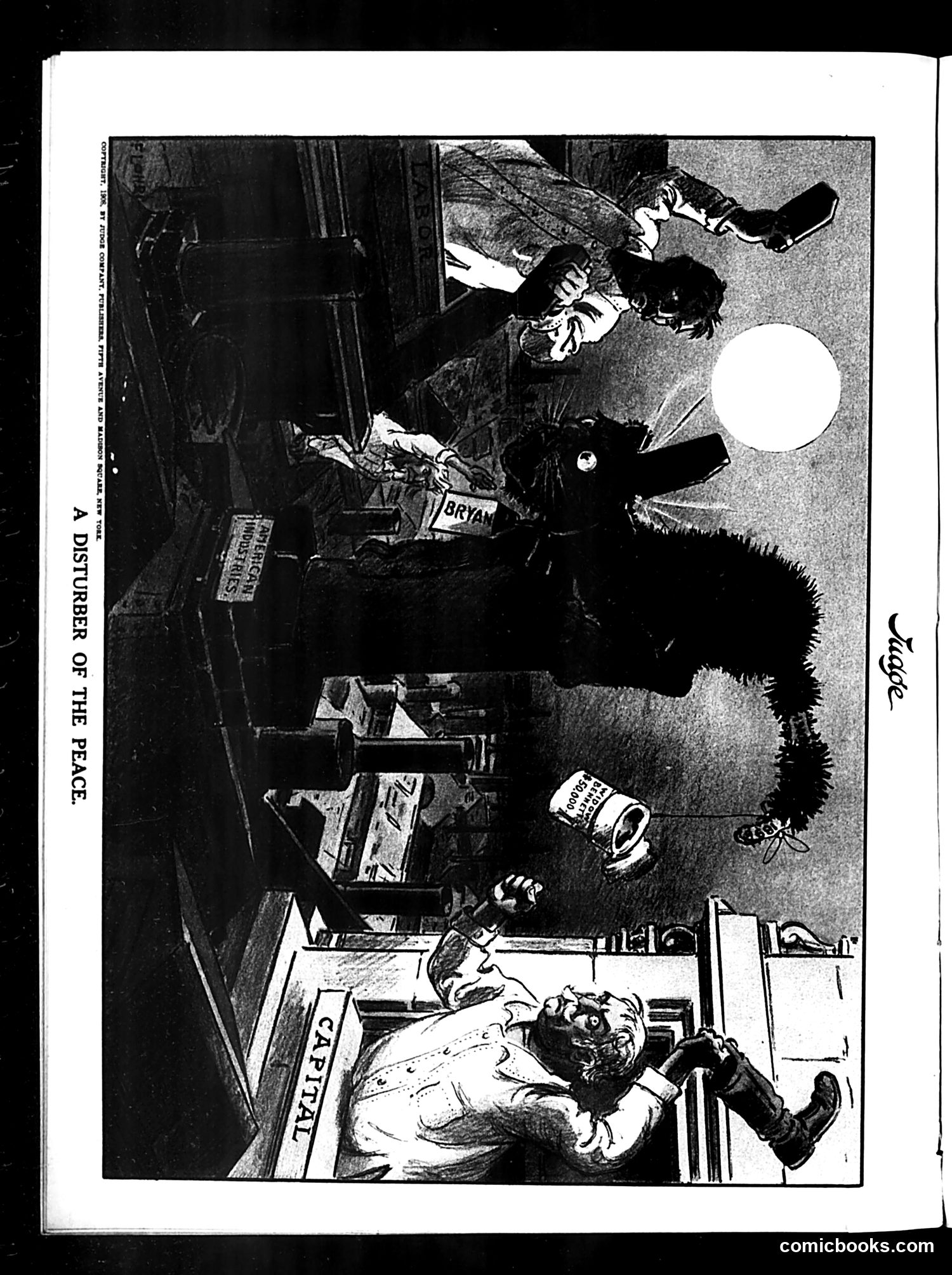
This cartoon depicts a scene rotated 90 degrees for viewing. A figure labeled "BRYAN" appears to be causing disruption in what looks like a domestic or political space. The composition suggests Bryan is an unwelcome presence disturbing the peace and order of the scene. This likely references William Jennings Bryan, the three-time presidential candidate. The 1908 cartoon probably comments on Bryan's continued political activism and influence despite electoral defeats, portraying him as a persistent disruptor of American politics. The domestic setting may satirize how his populist or progressive politics were seen as threatening to established order and stability. Judge magazine was typically conservative and would have viewed Bryan's continued prominence critically.