
Judge, 1908-10-17 · page 3 of 16
Judge — October 17, 1908 — page 3: what you’re looking at
What you’re looking at
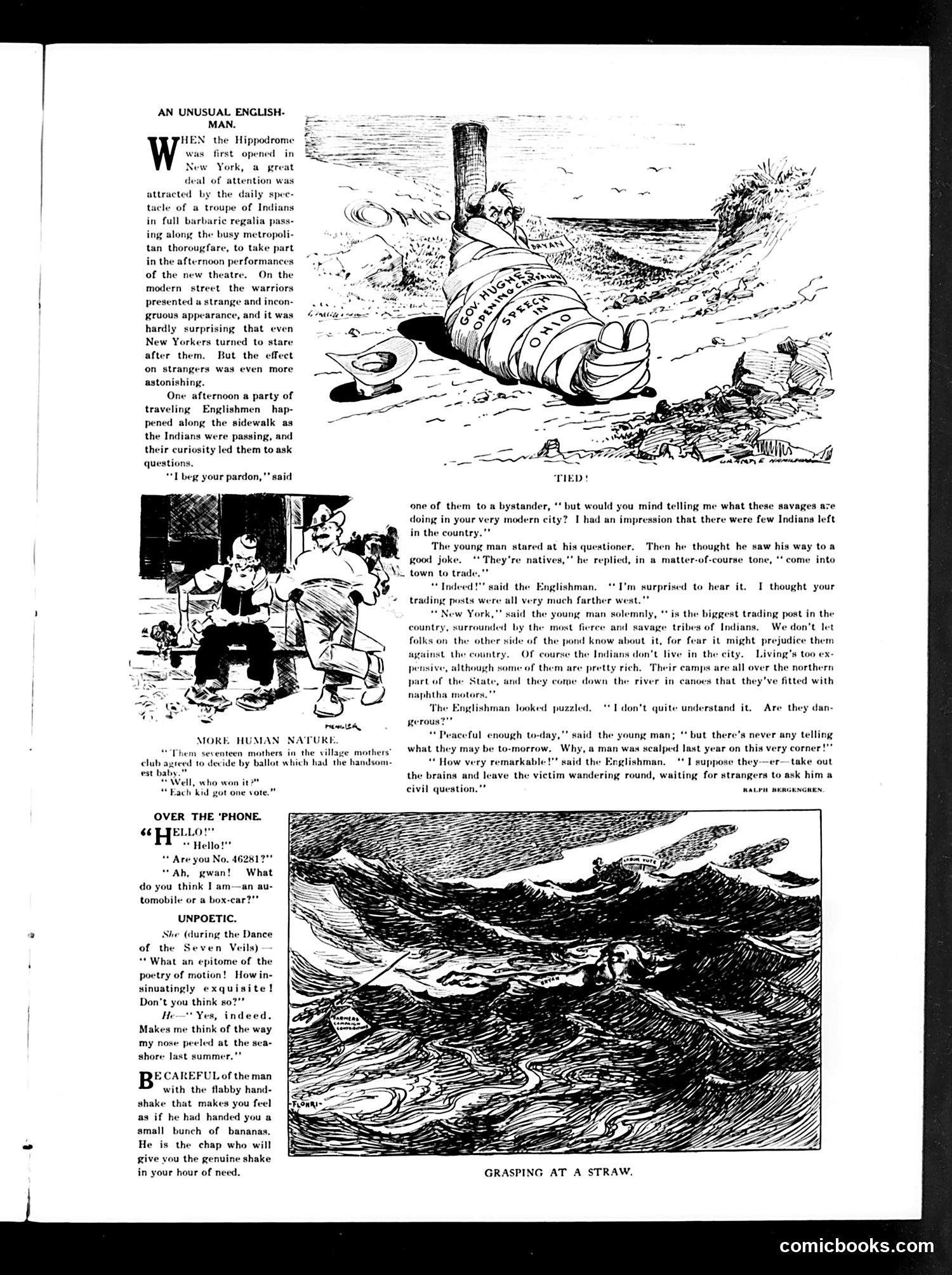
This satire depicts an English traveler encountering Native Americans near New York City. The Englishman expresses shock that Indigenous peoples still exist in the modern city, having assumed they were confined to remote territories. The joke mocks the Englishman's ignorance: he's astonished to learn Native Americans actually live and trade in the area, arriving by motorized canoes. His naive assumptions about their confinement to "the other side of the pond" and remote regions reveal his outdated, dismissive attitudes. The accompanying humor pieces ("More Human Nature," "Over the 'Phone," "Unpoetic," and "Grasping at a Straw") are brief comedic vignettes unrelated to the main story, typical of Judge magazine's format mixing longer satirical narratives with shorter jokes and observations about daily life.
📄 Transcribed text from this page (OCR, searchable)
Machine-transcribed from the original scan — historical spelling and the odd misread are preserved.
AN UNUSUAL ENGLISH- MAN. the Hippodrome first. opened in New York, ag deal of attention attracted by the daily spe tacle of a troupe of Indians in full barbaric regalia p: ing along the busy metropoli- tan thorougfare, to take part in the afternoon performances of the new theatre. On the modern street the warriors presented a strange and incon- gruous appearance, and it was hardly surprising that even New Yorkers turned to stare after them, But the effect on strangers was even more astonishing. One afternoon a party of traveling Englishmen hap- pened along the sidewalk as the Indians were passing, and their curiosity led them to ask questions. “I beg your pardon," said MORE, Well, who won it?” * Each kid got one vote.” OVER THE ‘PHONE. 66 LJELLO!” “Hello!” “+ Are you No. 462812" “Ah, gwan! What do you think Iam tomobile or a box-car UNPOETIC. She (during the Dance of the Seven Veils) “What an epitome of the poetry of motion! How in- sinuatingly exquisite! Don’t you think so?’ Hr—"* Yes, indeed. Makes me think of the way my nose peeled at the sea- shore last summer." n aus E CAREFUL of the man with the flabby hand- shake that makes you feel as if he had handed you a small bunch of bananas, He is the chap who will give vou the genuine shake in your hour of need. HUMAN NAT een mothers int ide by ballot which had the handsom- one of them to a bystander, ‘ but would you mind telling me what these savages doing in your very modern city? I had un impression that there were few Indians left in the country."” ‘The young man stared at his questioner. Then he thought he saw his way to a good joke. ‘They're natives,”’ he replied, in a matter-of-course tone, “come into Mi. town to trade." “ Indee I thought your 1 the Englishman, surprised to hear it. trading posts were all very mach farther west. “New York," said the young: m emnly, ** is the country, surrounded by the most fierce and savage tril folks on the othe! of the pond know about it, for fear it might prejudice them st th Of course the Indians don’t liv ving’s too ex- ive, although some of them . Their camps are all over the northern rin canoes that they've fitted with biggest trading post in the f Indians. We don't let ns country. “‘Tdon't quite understand it, Are they dun- ceful enough to-day,’ said the young man; ‘but there's never any telling may be to-morrow. Why, a man was scalped last year on this very corner!"" - Englishman. ‘* I suppose they—er—take out the brains and leave the victim wandering round, waiting for strangers to ask him a NALIN menGKNGHE. village mothers GRASPING AT A STRAW. comicbooks.com