
A complete issue · 16 pages · 1908
Judge — October 3, 1908
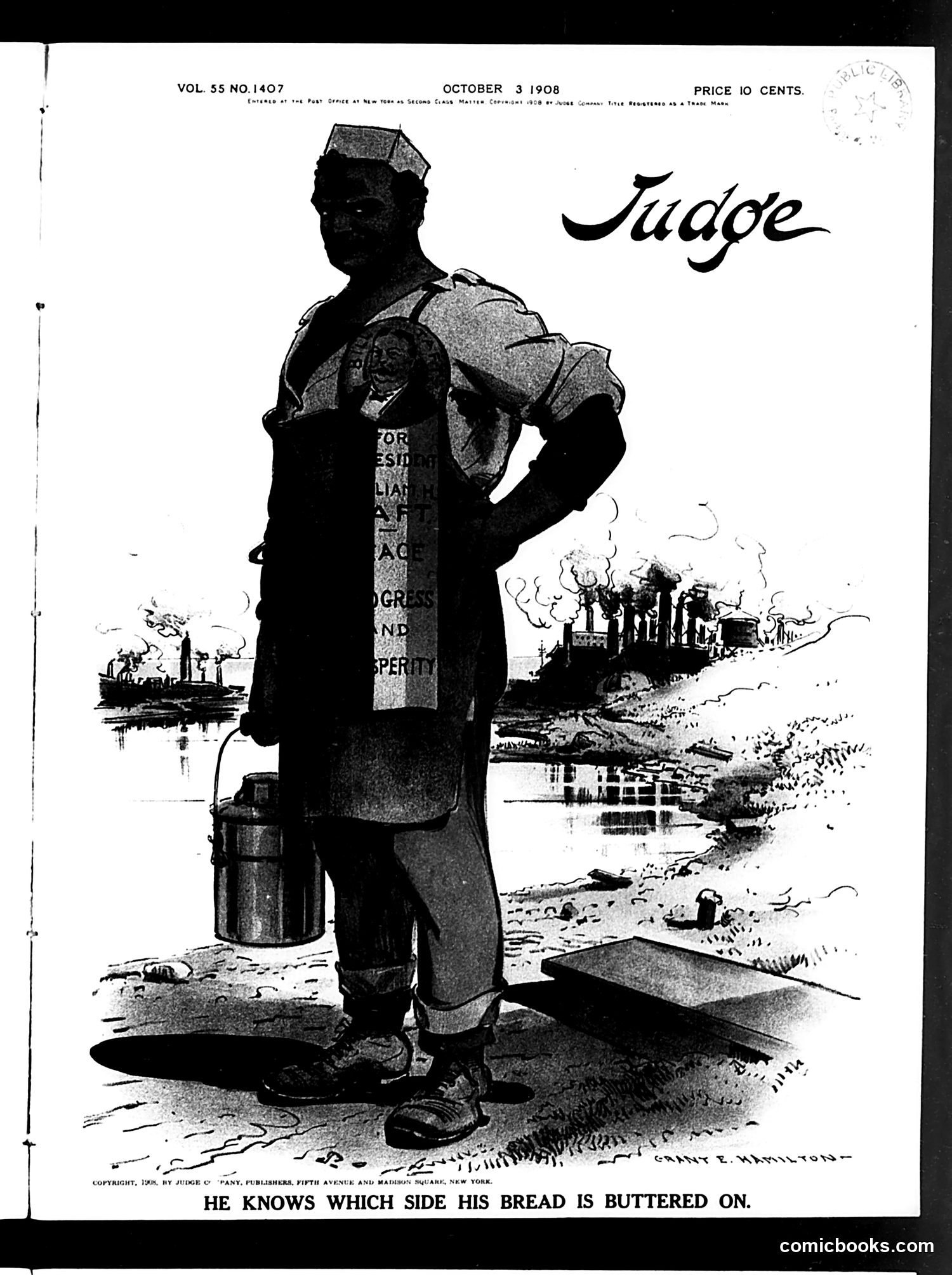
This political cartoon depicts a large industrial worker or laborer holding a banner reading "For President" alongside text about "Congress" and "Liberty." He stands before factories and steamships, symbolizing American industry and commerce. The caption states: "HE KNOWS WHICH SIDE HIS BREAD IS BUTTERED ON." This appears to satirize working-class political allegiance during the 1908 presidential election. The cartoon suggests that laborers understand their economic dependence on industrial employers and will vote accordingly—prioritizing their material interests over other political considerations. The imagery of factories and commerce emphasizes how working people's livelihoods depend on industrial prosperity, implying they recognize which political interests serve their economic survival.
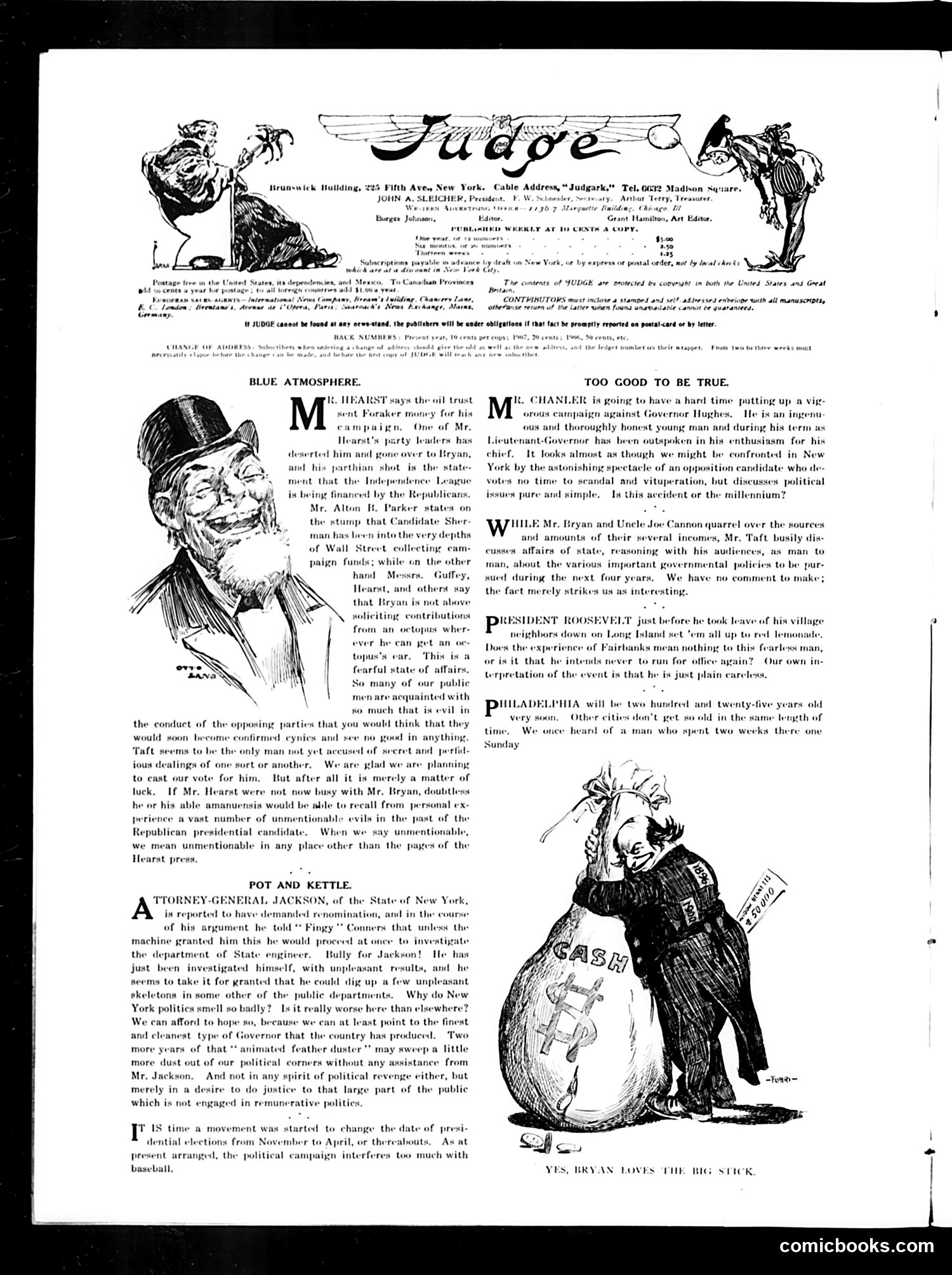
This page contains three political commentaries from what appears to be the early 1900s: **"Blue Atmosphere"** criticizes William Randolph Hearst's financial support of the Independence League and its candidate, suggesting Hearst funds opposition to Republicans while maintaining his newspaper's influence. **"Too Good to Be True"** discusses William Jennings Bryan's upcoming presidential campaign, skeptically suggesting his anti-corruption rhetoric won't withstand scrutiny. The text implies Bryan and allies may face political complications in New York. **"Pot and Kettle"** mocks Attorney-General Jackson for investigating state departments while New York politics itself remains corrupt, questioning why he targets certain officials. **"Yes, Bryan Loves the Big Stick"** (bottom cartoon) appears to satirize Bryan's relationship with Roosevelt-era politics, though details are unclear from the image alone. The page reflects Judge's Republican-leaning editorial stance against Democratic figures.
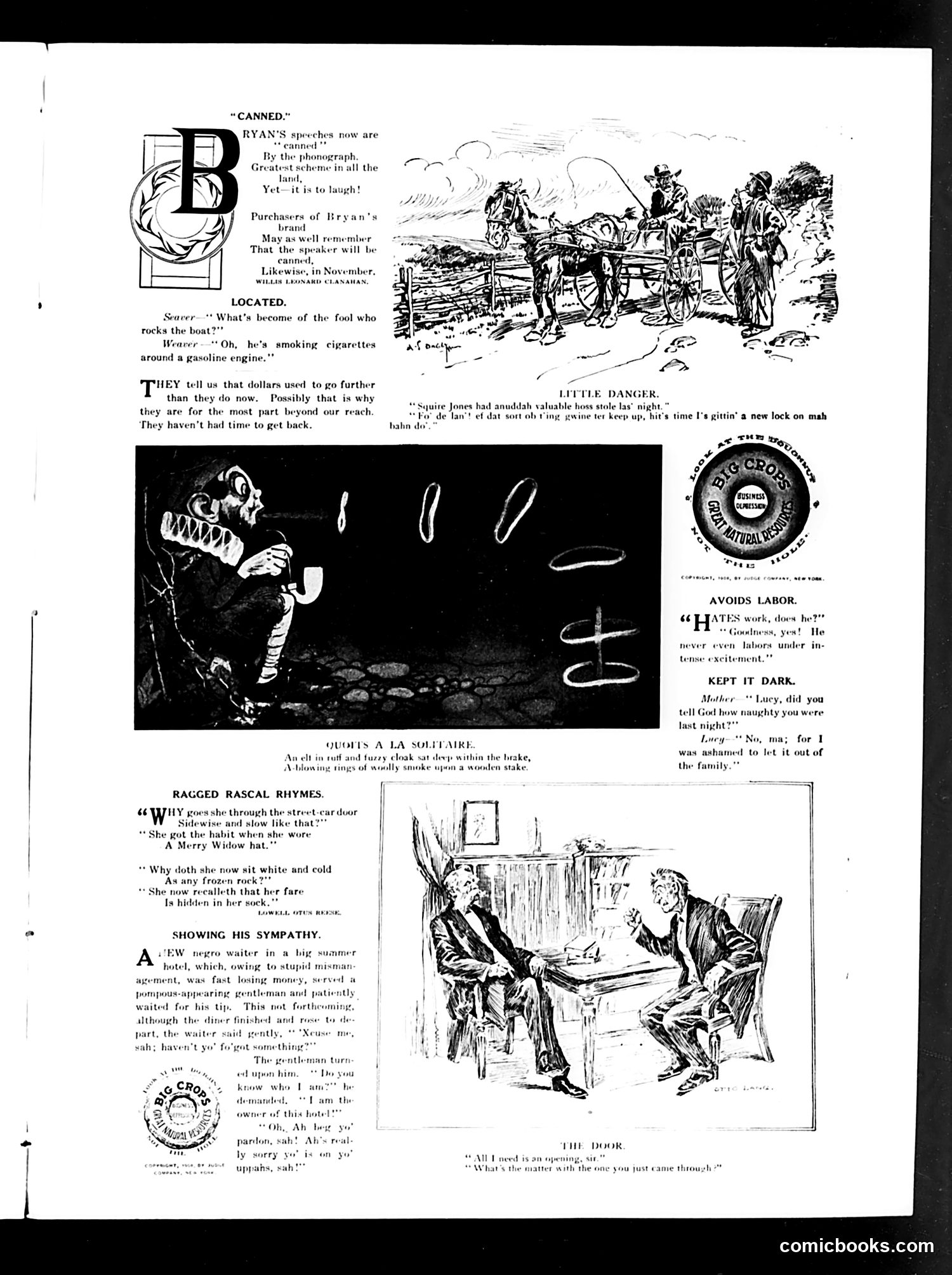
This page contains several satirical pieces critiquing early 20th-century American life: **"Canned"** mocks Bryan's speeches being "canned" (recorded phonographically), suggesting his rhetoric is pre-packaged and inauthentic—a jab at political repetition. **"Located"** jokes about cars replacing horses; motorists are too busy maintaining vehicles to venture far. **"Oublis à la Solitaire"** appears to be a visual gag about solitary confinement or isolation (the monkey illustration). **"Ragged Rascal Rhymes"** offers lighthearted verse about a widow acquiring a merry hat—social commentary on appearance and respectability. **"Showing His Sympathy"** satirizes a waiter's performative empathy toward a distressed patron, highlighting hollow service-industry courtesy. The page blends political criticism with social humor typical of early 20th-century satire.
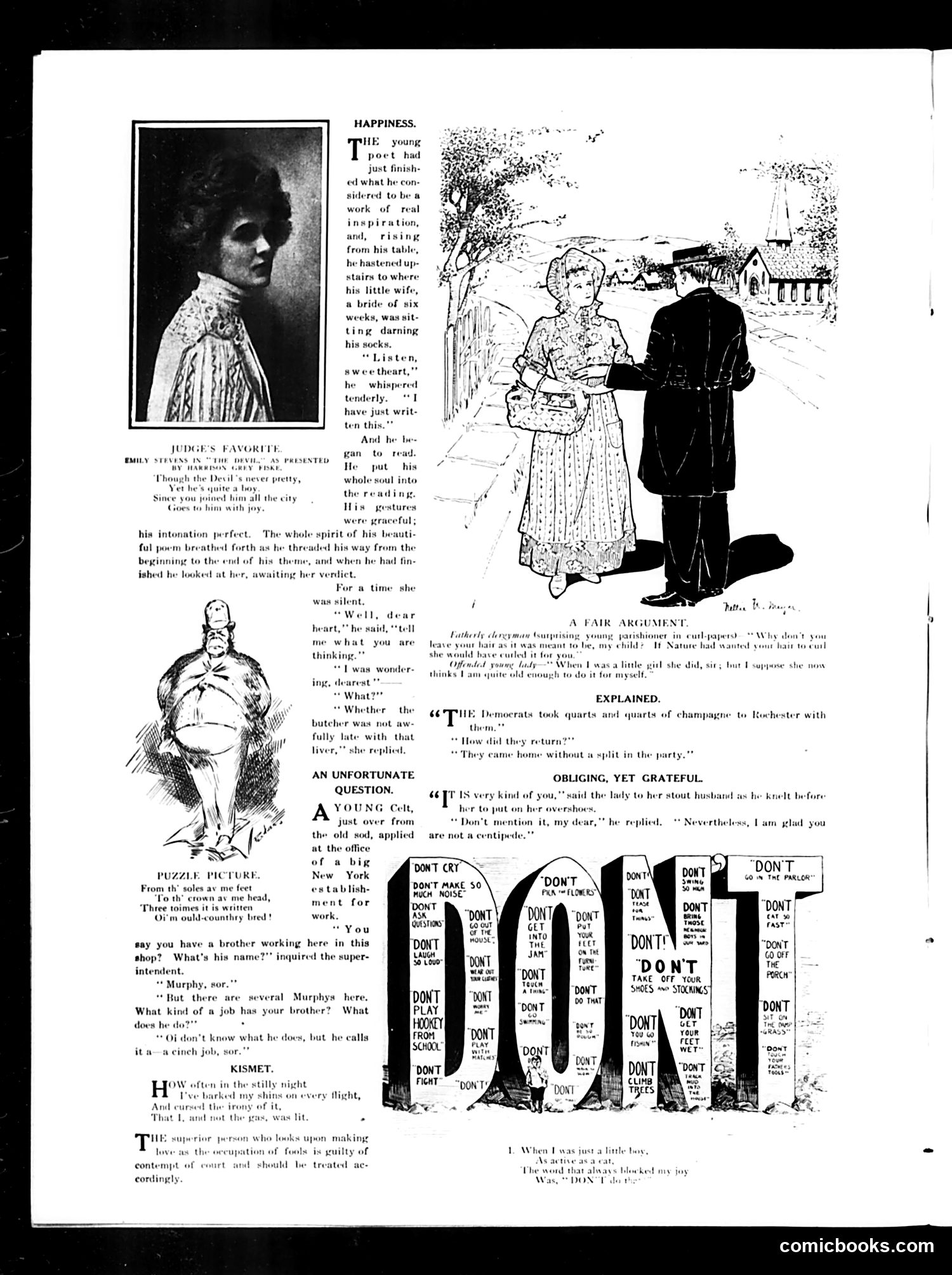
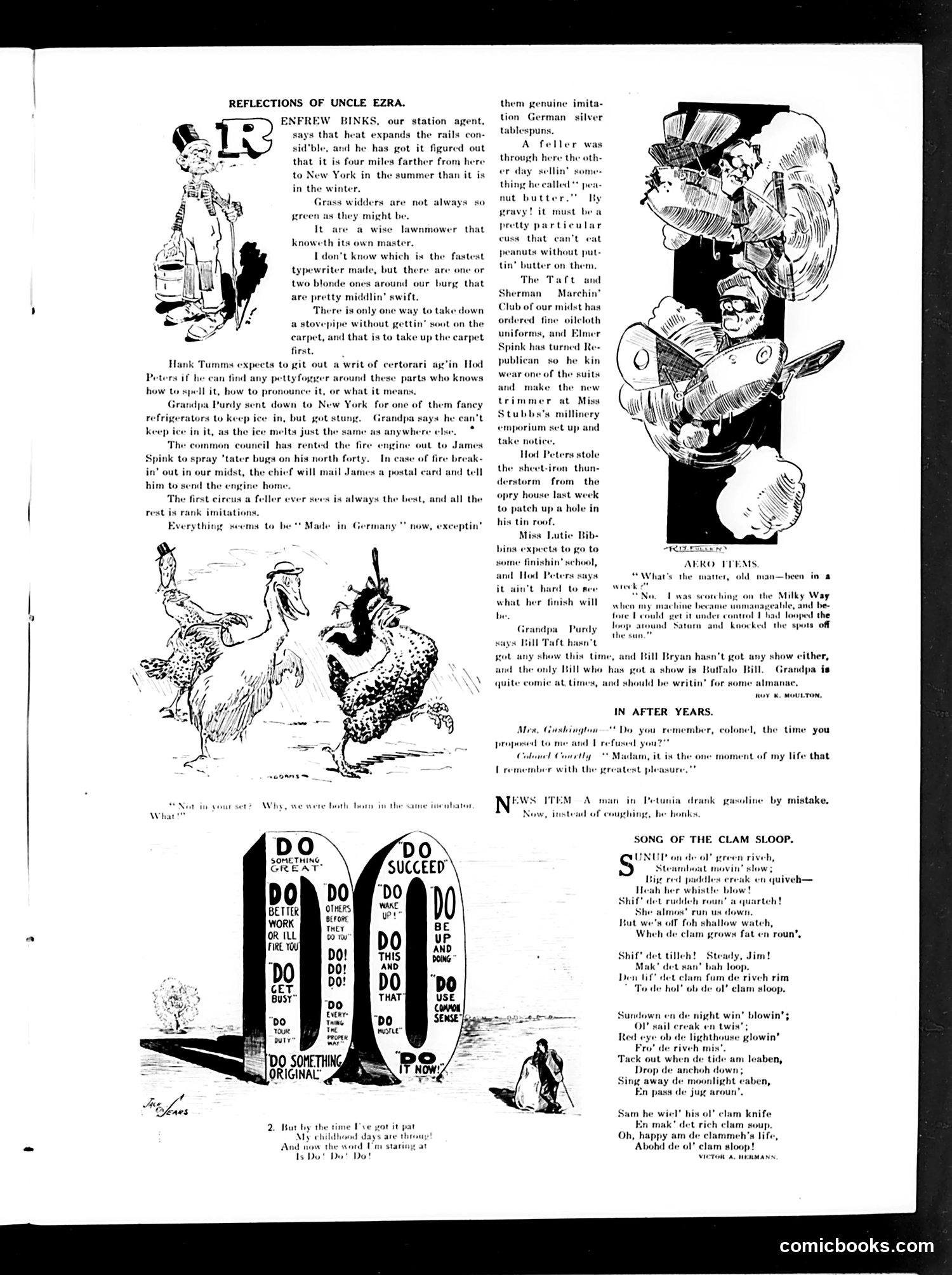
This page contains multiple unrelated satirical pieces typical of Judge magazine's format: **"Happiness"** (top): A sentimental story about a poor poet finishing a manuscript while his wife darns socks—mocking Victorian sentimentality about artistic poverty. **"A Fair Argument"** (center illustration): A domestic dispute where a woman argues she shouldn't curl her hair because "Nature had knotted" it, while her husband counters women do it anyway. Social satire on marriage debates and gender roles. **"Don't" (large cartoon, right)**: A massive figure made of repeated "DON'T" commands—likely satirizing excessive prohibition or social restrictions of the era. The style suggests early 1900s concerns about over-regulation of behavior. **Smaller pieces** include brief humorous anecdotes about workplace encounters and relationship dynamics. The overall page reflects Judge's mix of social commentary and domestic humor targeting middle-class readers.
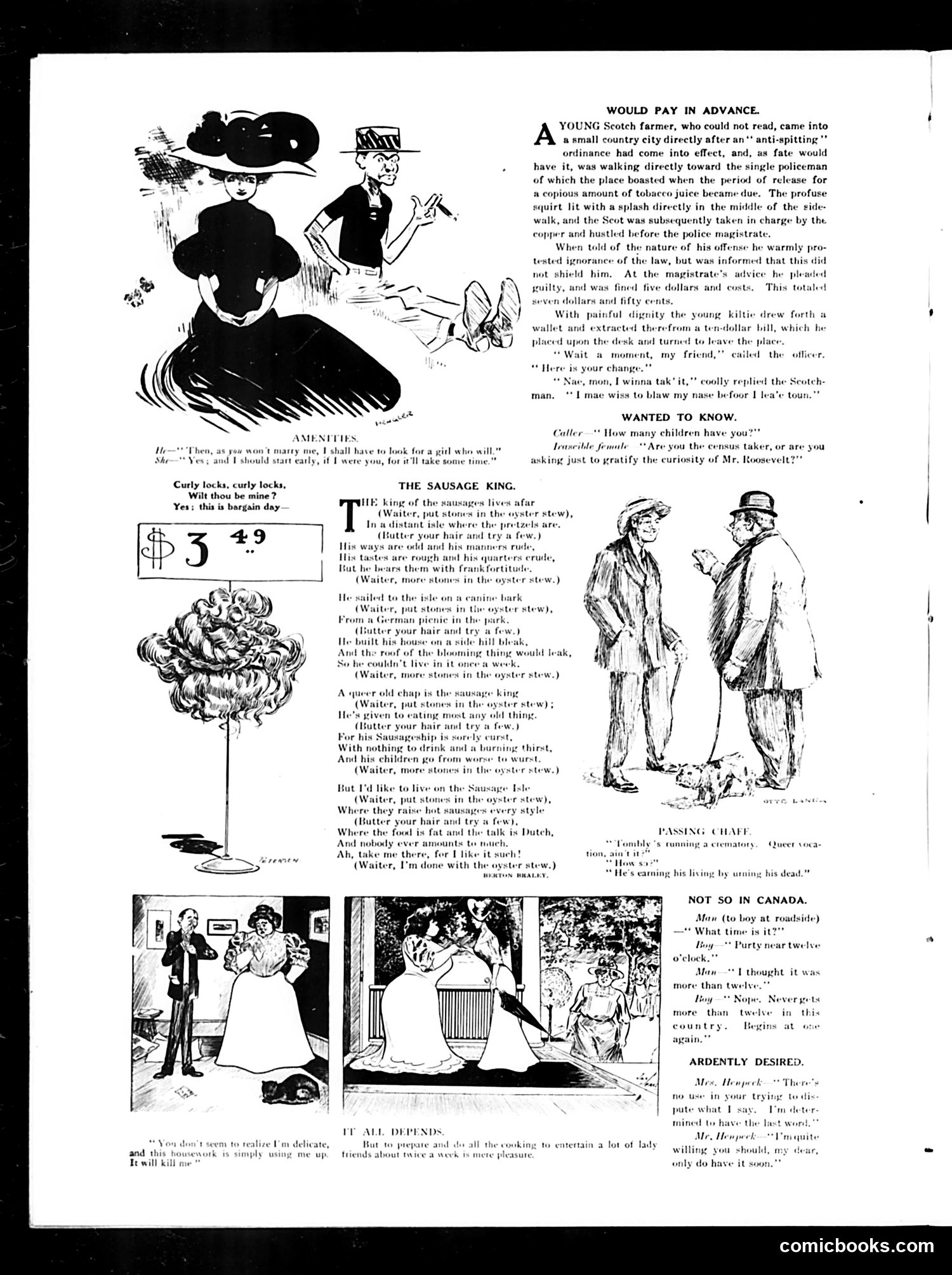
This page contains several unrelated satirical items typical of early 20th-century Judge magazine: **"Would Pay in Advance"**: A Scottish farmer, unable to read, violates a new anti-spitting ordinance in a small American city. Arrested and fined $7.50, he refuses his $2.50 change, declaring "I mao wise to blow ma nase to lose I lea's toun"—refusing to lose money in his hometown. The satire mocks both the farmer's ignorance of written laws and the absurdity of strict enforcement. **"The Sausage King"**: A whimsical poem about an eccentric character who eats anything, has leaky houses, and suffers general misfortune. The repeated refrain "(Waiter, put stones in the oyster stew)" suggests inedible content—humor based on nonsense and wordplay. **Other items**: Brief dialogues satirizing domestic life, census-taking curiosity, and Canadian timekeeping conventions. The page exemplifies Judge's focus on wordplay, visual caricature, and social observation rather than political commentary.
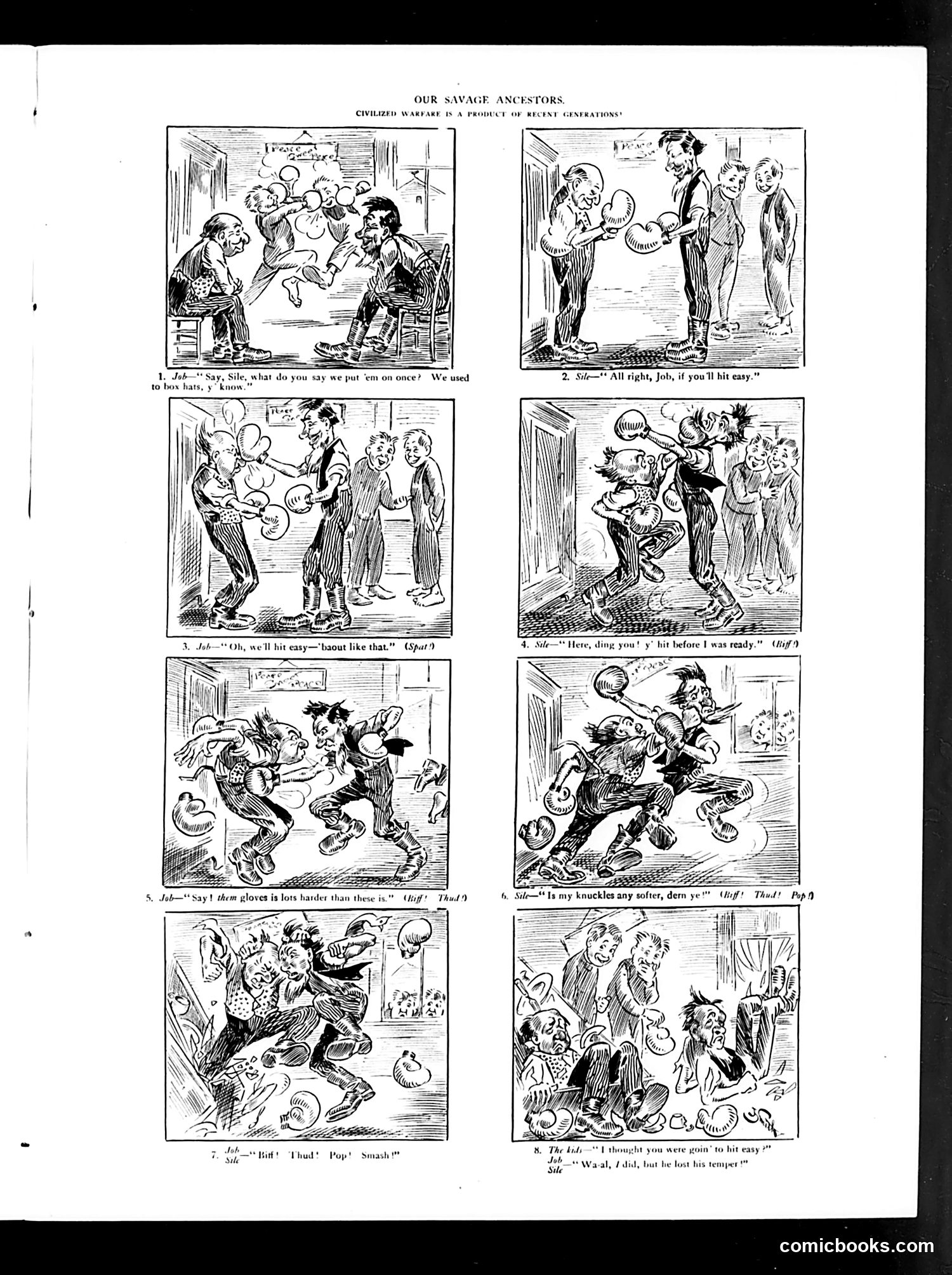
This is an eight-panel satirical comic comparing "civilized warfare" to primitive behavior. The joke presents a paradox: the title claims civilization is recent, yet the panels show men engaging in increasingly violent, chaotic fighting—punching, hitting with objects, and general brawling—over what appears to be a simple disagreement about putting on hats or gloves. The satire mocks the notion that modern civilization represents moral progress. Instead, it suggests that despite our pretensions to civility, contemporary men behave like savages when provoked, devolving into irrational violence over trivial matters. The escalating destruction and wild behavior in later panels underscore this ironic commentary on human nature—that thin veneer of civilization masks our primitive impulses.
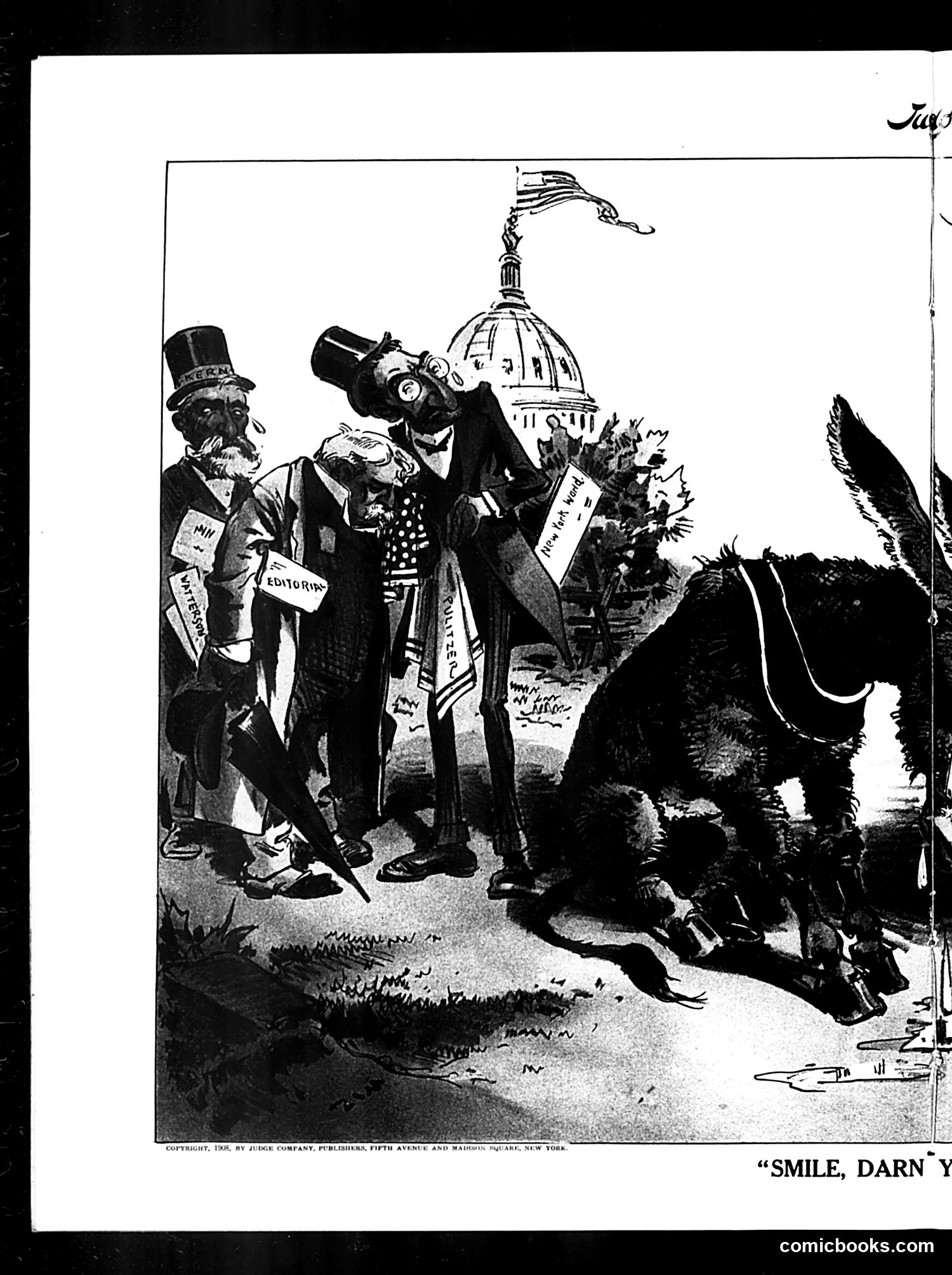
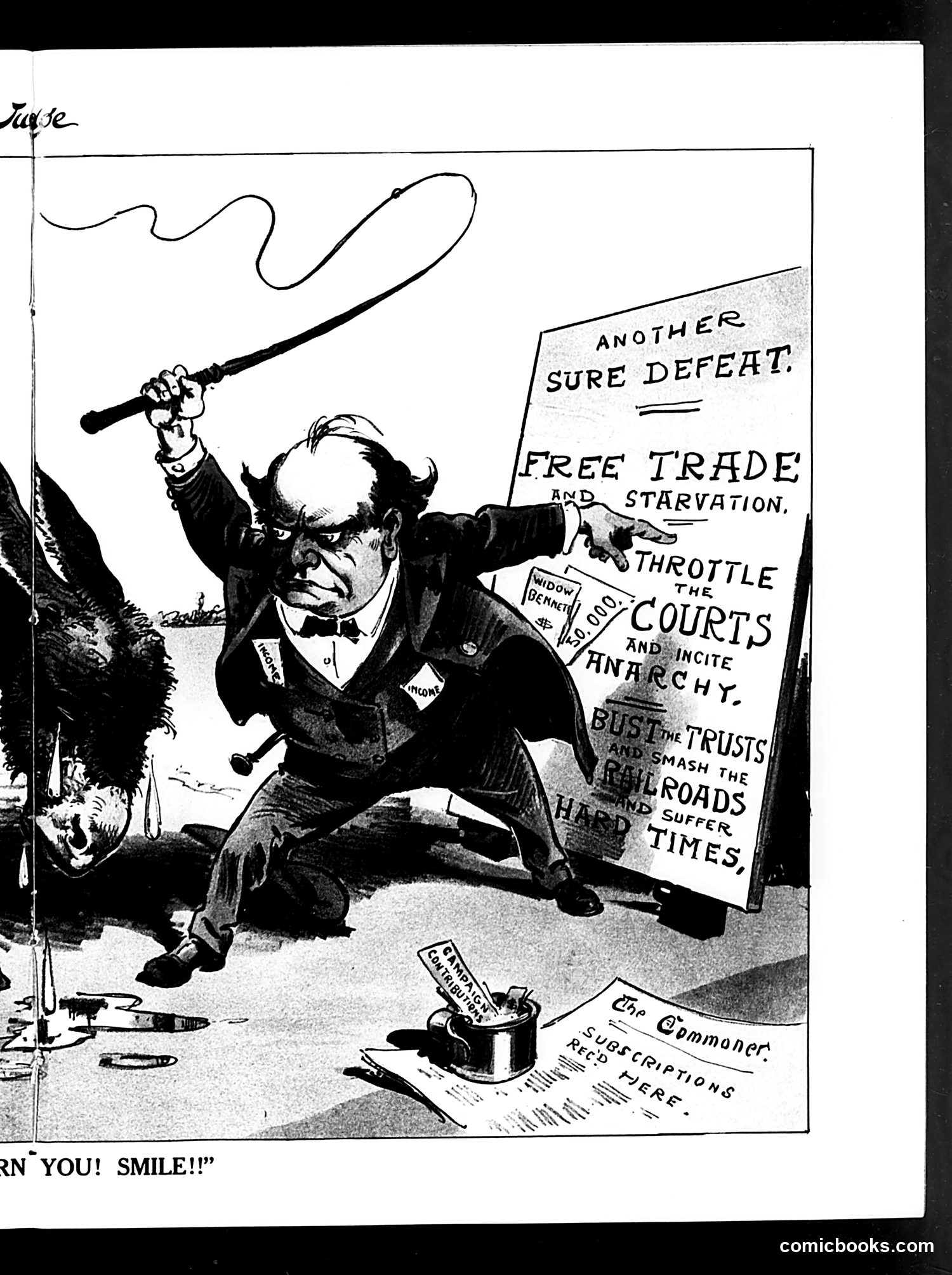
This political cartoon depicts three caricatured men in formal attire observing the U.S. Capitol building. They wear ribbons or badges, suggesting they are dignitaries or political figures. One holds binoculars, examining the Capitol. A donkey—symbol of the Democratic Party—stands prominently on the right side of the image. The cartoon's title, "Smile, Darn Y[ou]," paired with the donkey's presence, likely satirizes Democratic politicians being forced to present a cheerful facade during a difficult political moment. The badges and formal dress suggest these are political leaders confronting Capitol events. Without the publication date visible, the specific historical context remains unclear, though the imagery suggests commentary on Democratic Party leadership and their public relations challenges during a particular political crisis.
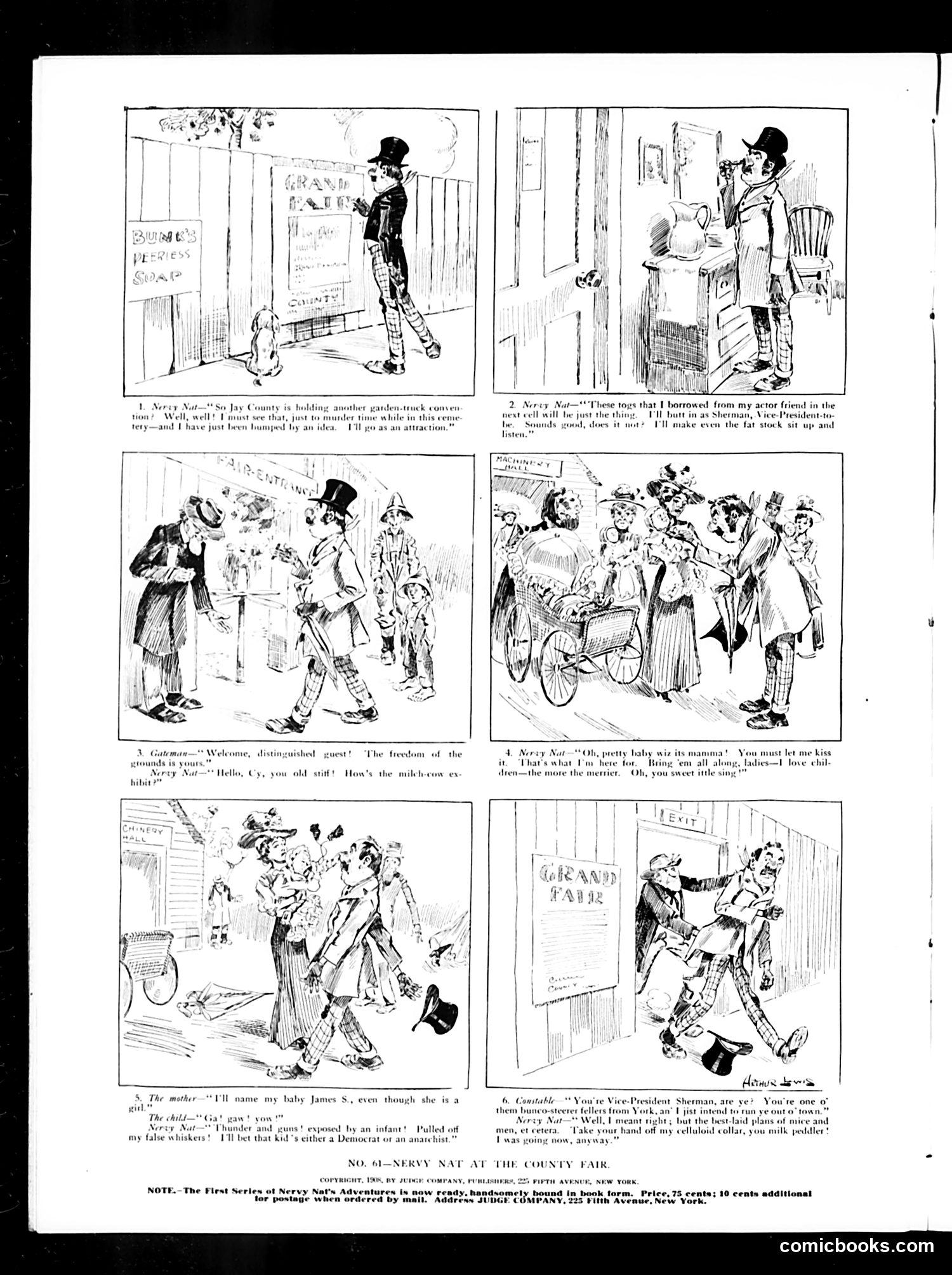
This six-panel comic strip follows a mischievous character named "Nervy Nat" through various county fair misadventures. The humor relies on Nat's brazen, cheeky behavior: he borrows theatrical togas from an actor friend to use as a fair attraction, crashes a baby carriage into a crowd of fair-goers, and impudently flirts with women while disrupting their activities. The satire targets turn-of-the-century county fair culture—the pretense, overcrowding, and social chaos of these popular events. Nat represents the "nervy" urban type who lacks social restraint, disrupting genteel society. The strip's appeal lay in his shameless behavior and quick-talking explanations that temporarily charm authority figures, reflecting period anxieties about changing urban manners and social propriety.
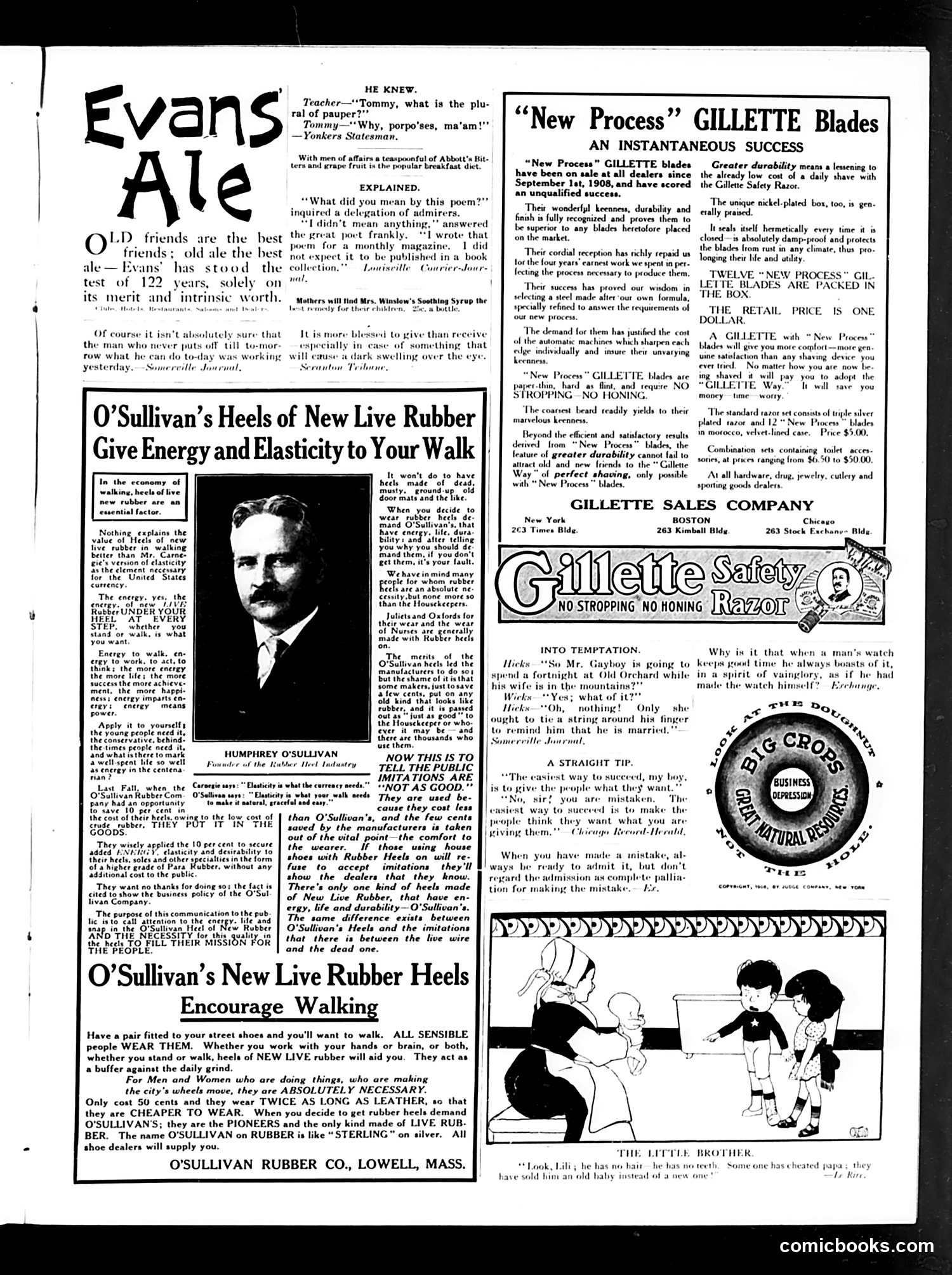
This page is primarily **advertising**, not political satire. It contains: 1. **Evans Ale advertisement** (top left): A simple product endorsement claiming Evans ale has "stood the test of 122 years" for quality and value. 2. **O'Sullivan's Rubber Heels advertisements** (majority of page): Multiple ads promoting O'Sullivan's brand rubber heels for shoes, emphasizing durability, energy, and elasticity. The ads contrast O'Sullivan's "New Live Rubber" heels against cheaper imitations, arguing that competitors cut corners to reduce costs. 3. **Small satirical items** (scattered): Brief jokes and quips, including one about a child confusing "porpoises" with "purposes" and another about a poet's obscure meaning. 4. **Gillette Safety Razor ad** (right side): Promoting their "New Process" blades as superior and rust-resistant. 5. **Small cartoon** (bottom): Shows an adult and children with minimal context visible. The page reflects early 20th-century consumer advertising emphasizing product quality and brand loyalty over competitors.
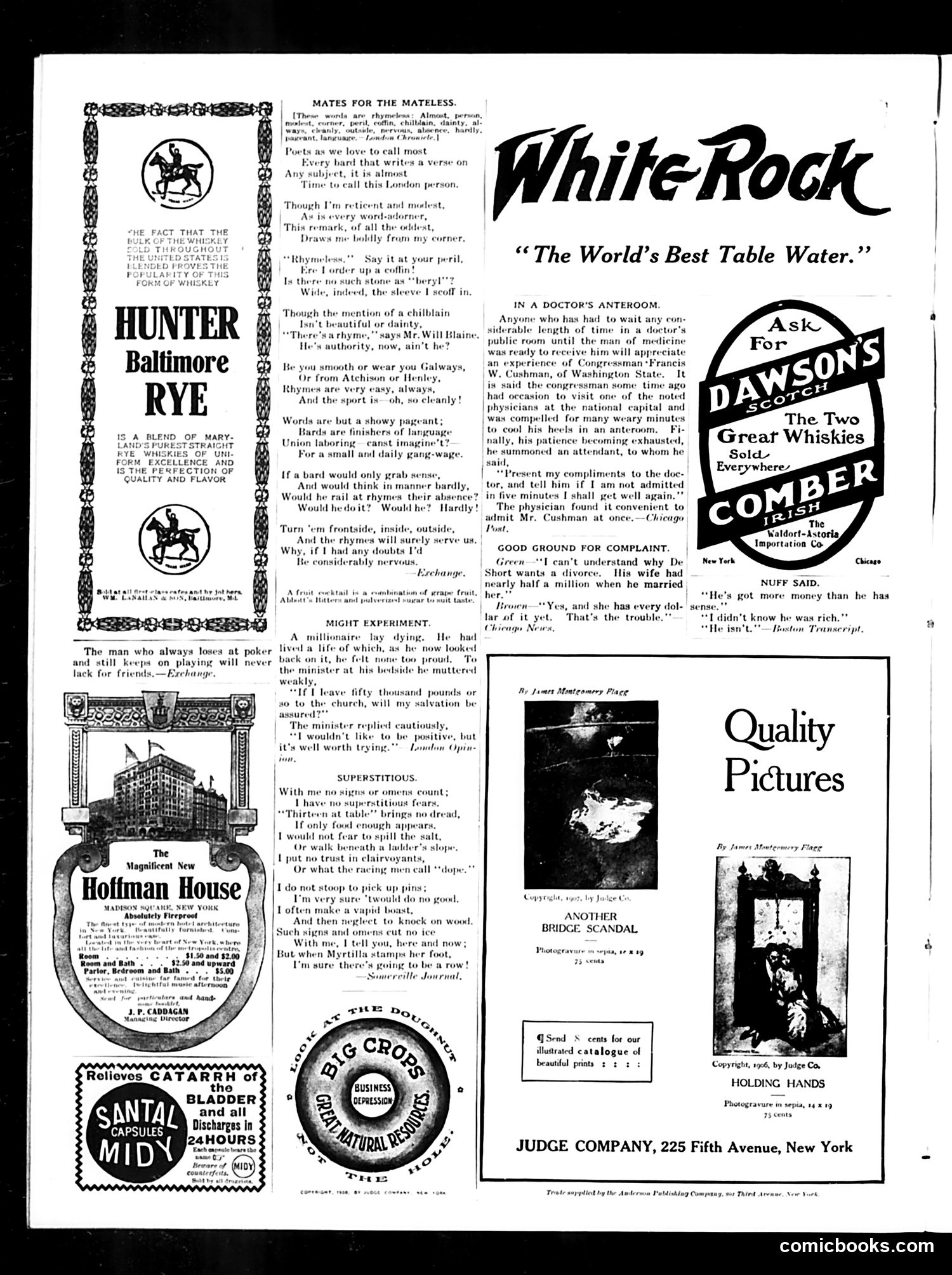
This is primarily a **satirical poetry and humor page** from Judge magazine, with several distinct sections: **Main Content:** The dominant piece, "Mates for the Mateless," is a humorous poem addressing "Rhymeless"—apparently a reader who complained about lack of rhyming words in English. The poet mockingly defends the abundance of rhymes available, suggesting the complainer is simply lazy or incompetent. **Supporting Humor Pieces:** - "Might Experiment": A joke about a millionaire asking a minister whether donating to church guarantees salvation - "Superstitious": A poem ironically claiming the speaker dismisses superstitions while actually engaging in them (knocking on wood, fearing thirteen at table) - Brief anecdotes about divorce, doctors' waiting rooms, and marital finances **Purpose:** These are light, domestic satires typical of Judge's era—poking fun at human foibles, pretension, and everyday absurdities rather than political targets. The page demonstrates the magazine's mix of verse, jokes, and advertising common to early 20th-century humor publications.
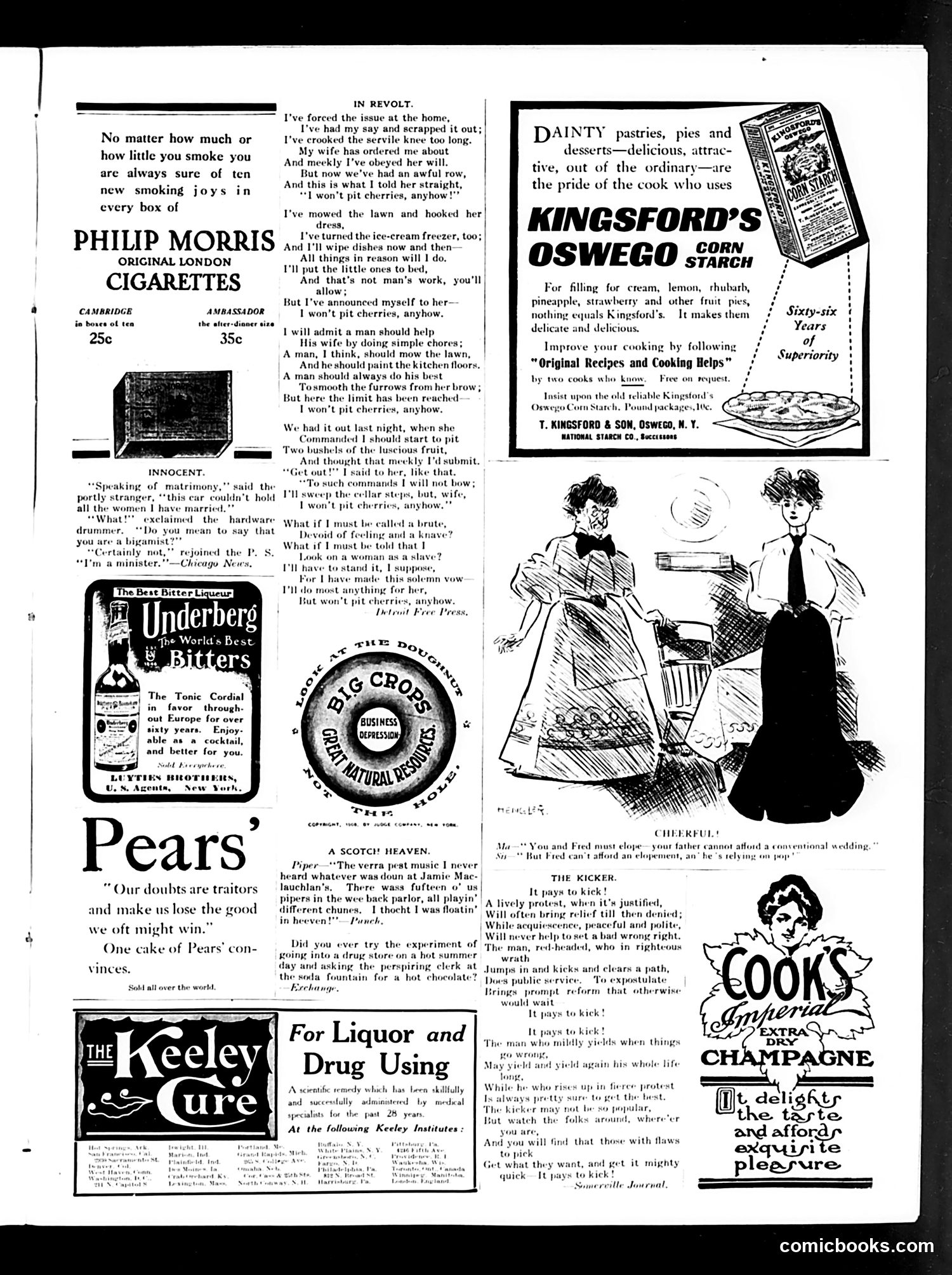
This page is primarily **advertising**, with several small satirical pieces interspersed. The main cartoon, titled **"In Revolt,"** depicts a husband's rebellion against domestic expectations. The poem describes a man who has accommodated his wife's demands—mowing lawns, doing dishes, putting children to bed—but draws the line at **pitting cherries**. This satire mocks both rigid gender roles and men who make arbitrary stands over trivial matters. The humor lies in the absurdity: after accepting substantial household duties, he rebels over a minor task, suggesting his "principle" is petty performance rather than genuine conviction. Supporting this theme, **"The Kicker"** celebrates justified protest and standing up for one's rights, though it warns that yielding entirely is ineffective. The other cartoon, **"A Scotch Heaven,"** is a brief ethnic joke about Scottish pipers playing discordant music at a house party. The page otherwise contains period advertisements for cigarettes, patent medicines, starch, and liquor—typical Judge content reflecting early 20th-century consumer culture and dubious health claims.
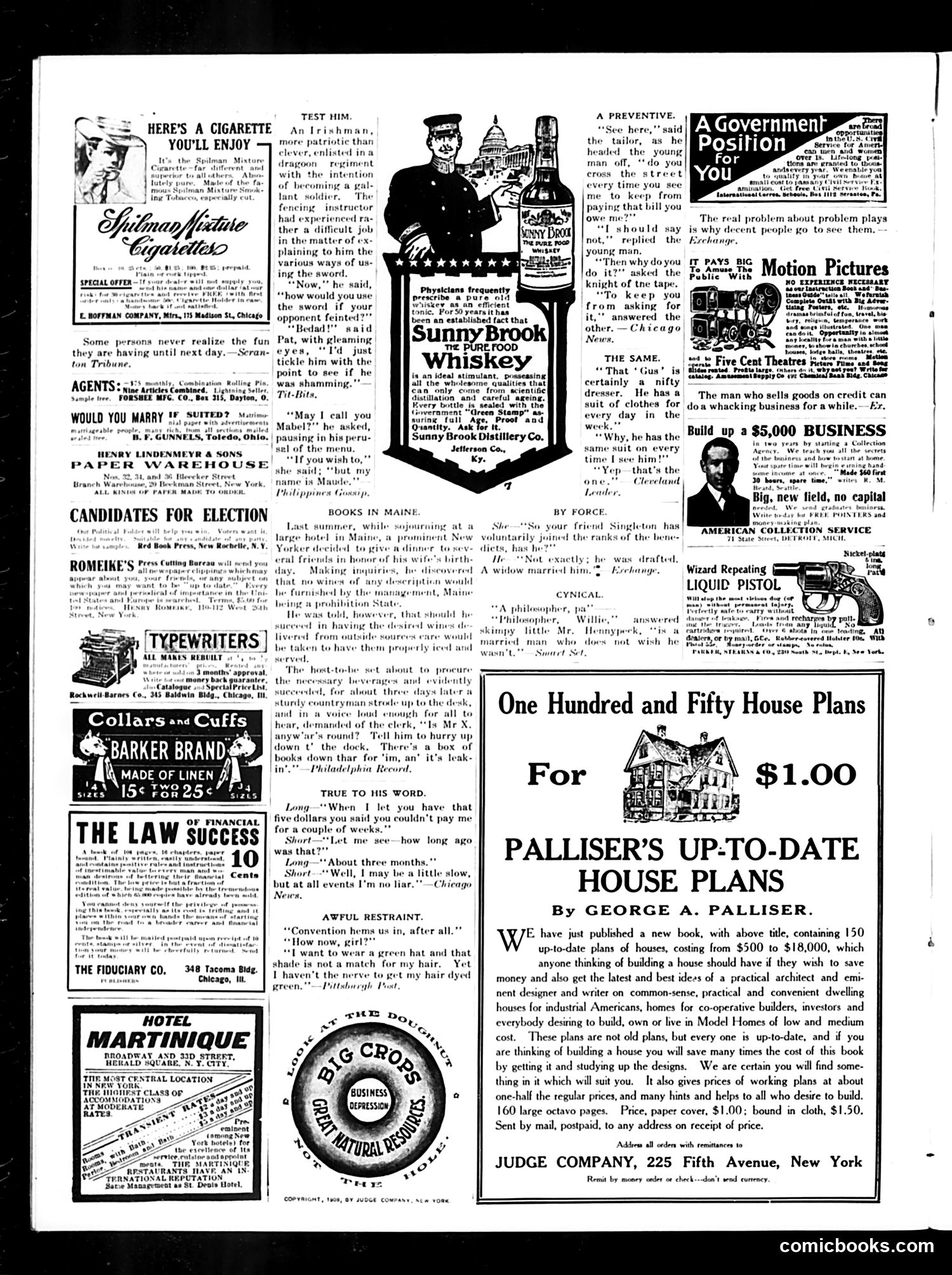
This page is primarily **advertising and filler content** rather than political satire. The main items include: **Top section:** A cigarette advertisement for "Spilman Mixture" and several short humorous anecdotes (common filler in Judge). One depicts an Irish dragoon recruit's confusion about sword technique—playing on period Irish immigrant stereotypes. **Center:** A whiskey advertisement for "Sunny Brook" whiskey, disguised as a news item about a Maine hotel owner acquiring wine during Prohibition, concluding with a pun about a "widow married twice." **Lower sections:** Various small-business advertisements and jokes, including typewriter sales, collar advertisements, and a book promotion for house plans. **Political context:** The Prohibition-era whiskey ad is notable—advertising alcohol during this period when it was technically illegal, though Judge magazine (anti-Prohibition) frequently carried such ads as editorial commentary against the law. The page lacks significant political cartooning or satirical commentary; it's primarily commercial filler typical of early 20th-century magazines.
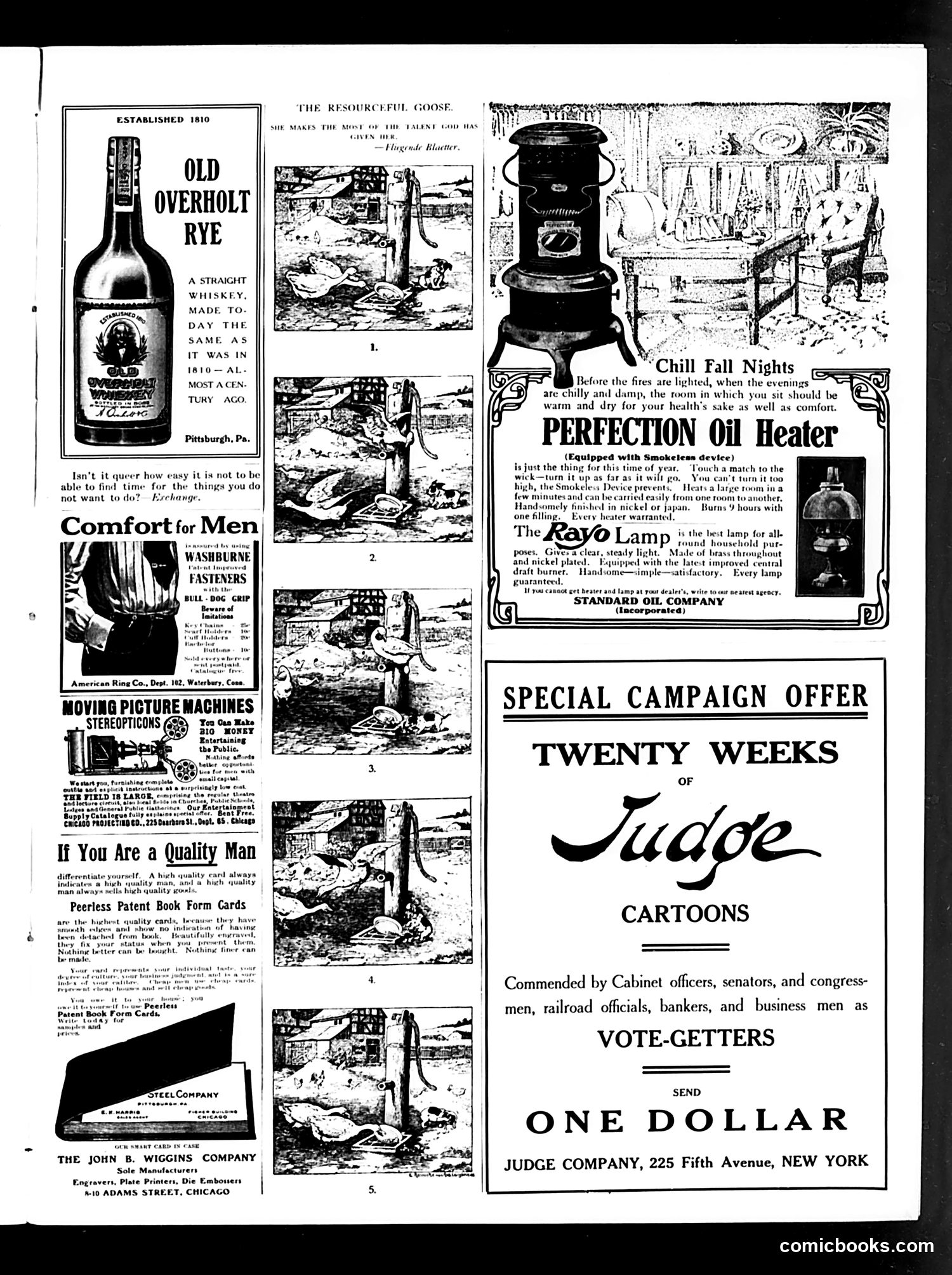
This page is primarily **advertising**, not political satire. It contains product advertisements (Old Overholt Rye whiskey, Perfection Oil Heater, moving picture machines, patent form cards) and a serialized cartoon titled "The Resourceful Goose" showing numbered scenes (1-5) of what appears to be a goose making practical use of its talents—likely a moral fable about resourcefulness. The only explicitly political content is a **Special Campaign Offer** at bottom: Judge magazine is selling 20 weeks of Judge cartoons as "vote-getters," endorsed by politicians and business leaders. This suggests the cartoons were considered persuasive propaganda tools for political campaigns. The phrase "She makes the most of the talent God has given her" (tagline for the goose cartoon) reinforces the era's emphasis on self-improvement and utilitarian virtue—common themes in early 20th-century American media.
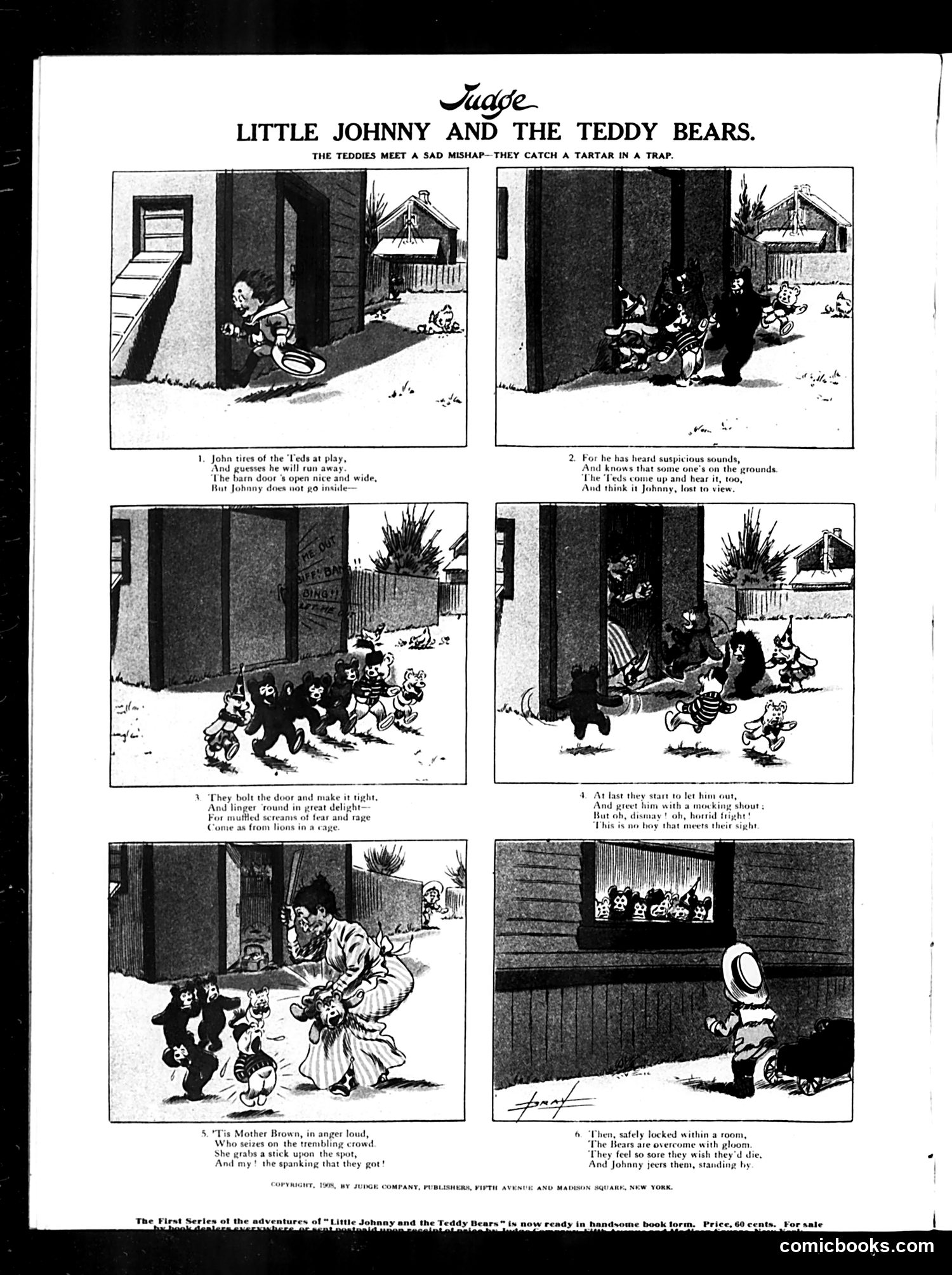
This is a children's comic strip, not political satire. It tells a straightforward narrative: Little Johnny abandons his teddy bears, who mistake suspicious sounds for him and investigate. They encounter something dangerous (likely a trap or an aggressive animal—"catch a tartar" means encounter someone formidable), get trapped indoors, and suffer consequences. Johnny then mocks them from outside. The "Teddy Bears" reference itself dates the piece to the early 1900s, when teddy bears became a craze following President Theodore Roosevelt's hunting exploits. However, this strip appears to be pure entertainment rather than political commentary—a cautionary tale about toys or playmates meeting misfortune, with a mischievous boy as antagonist. The page also advertises the strip's debut in book form (60 cents), indicating commercial publishing success.