
A complete issue · 16 pages · 1908
Judge — August 15, 1908
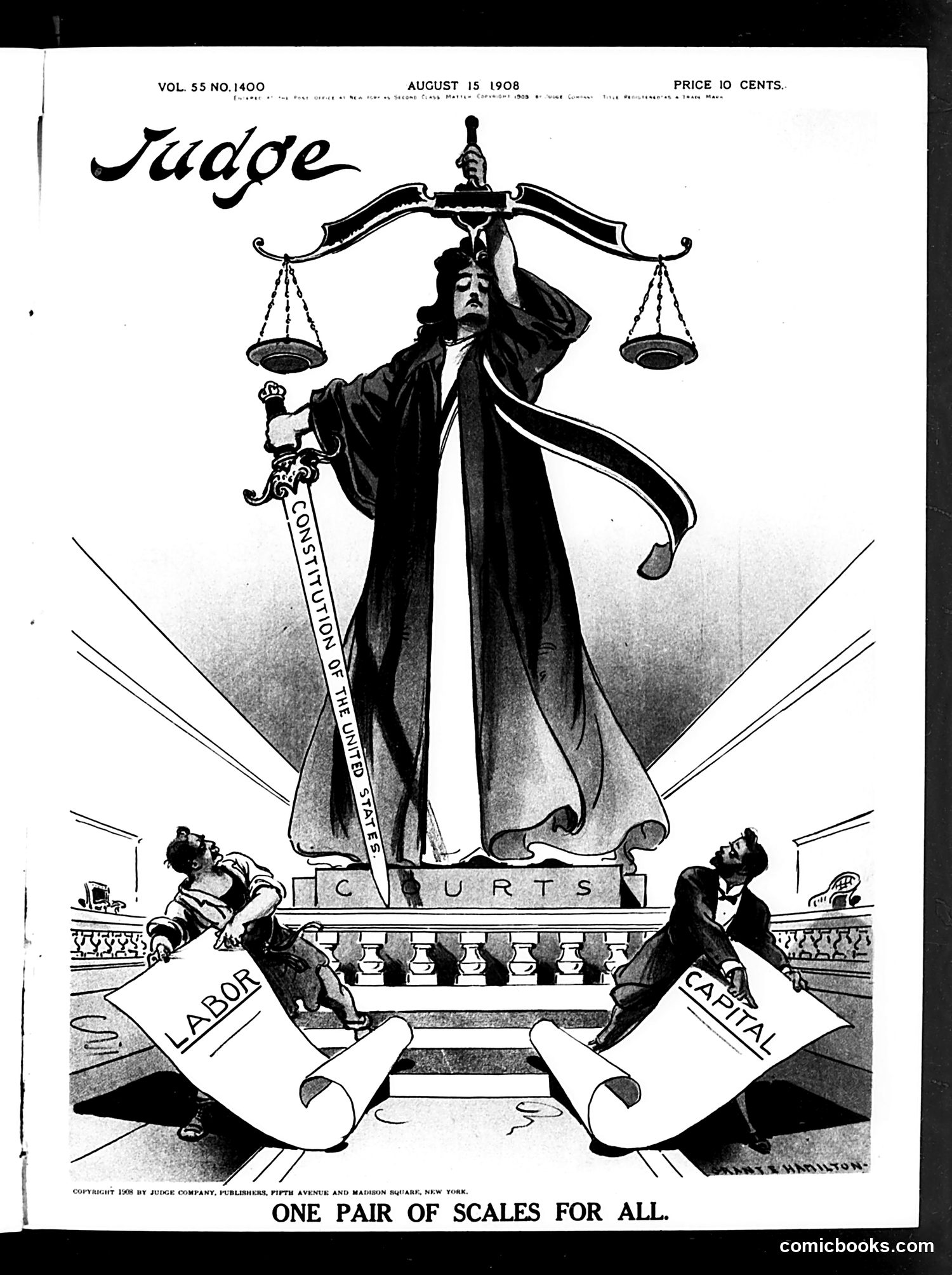
This August 1908 Judge magazine cover depicts Lady Justice holding balanced scales above a courthouse labeled "COURTS." The sword she holds reads "CONSTITUTION OF THE UNITED STATES." Below the pedestal stand two figures labeled "LABOR" and "CAPITAL," both appearing to struggle or bow beneath the scales, suggesting they're being weighed equally by the courts. The cartoon satirizes the judicial system's attempt to apply equal justice to labor and capital interests—likely referencing contemporary debates over whether courts were truly impartial when disputes arose between wealthy business interests and workers' rights. The imagery questions whether one scale can fairly measure such unequal economic powers.
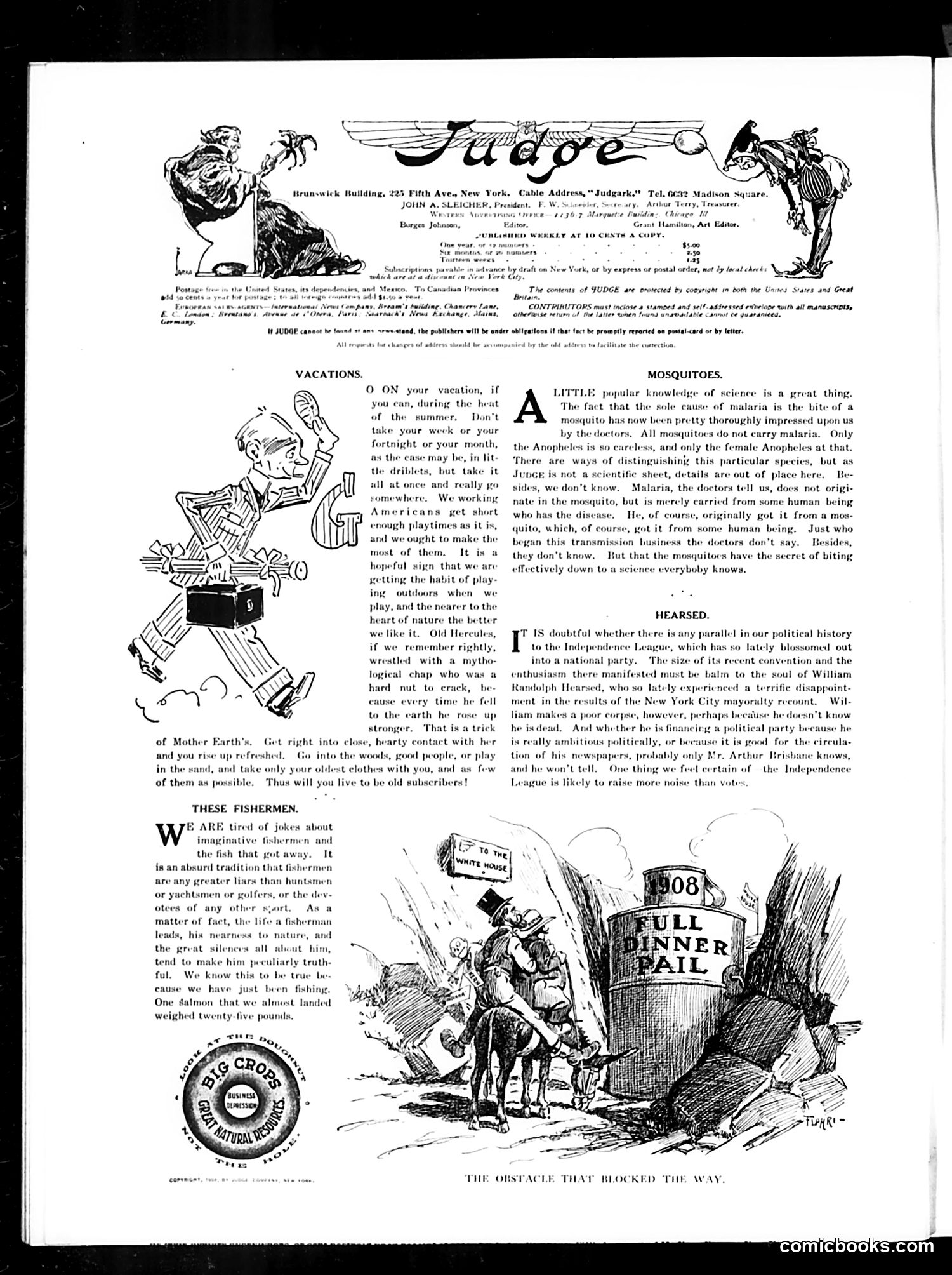
This page contains three distinct sections: **"Vacations"** (left): A satirical cartoon showing an overworked American businessman escaping to nature, depicted as "Old Hercules" performing labors. The text advocates for outdoor recreation and contact with nature as necessary relief from urban work stress. **"Mosquitoes"** (center): An article criticizing doctors' lack of scientific understanding about malaria transmission. It sarcastically notes that while mosquitoes are known to spread the disease, the medical establishment hasn't effectively communicated this to the general public—a gap between professional knowledge and public education. **"Hearsed"** (right): Commentary on William Randolph Hearst and the Independence League political party, questioning whether Hearst's political ambitions serve genuine reform or merely his newspaper circulation interests. The bottom cartoon "The Obstacle That Blocked the Way" appears political but is unclear without additional context.
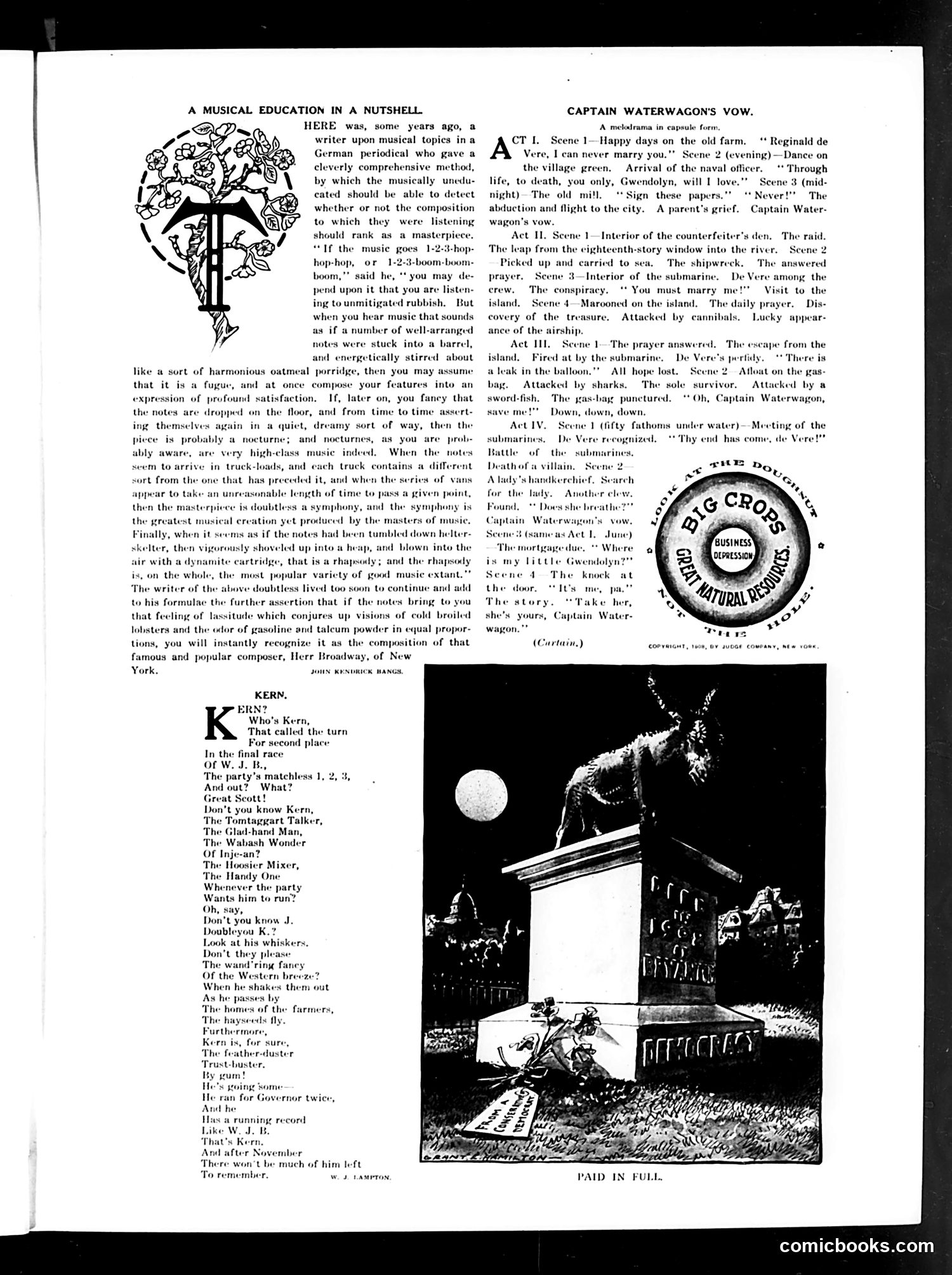
This page contains three distinct sections: 1. **"A Musical Education in a Nutshell"** (left): An essay explaining how classical music, when properly composed, can elevate listeners from hearing "unmitigated rubbish" to experiencing "profound satisfaction." It argues that recognizing good musical composition is like identifying famous composers' work. 2. **"Kern"** (bottom left): A poem by John Kendrick Bangs listing various nicknames and descriptions, possibly referencing someone named Kern, though the specific historical figure remains unclear. 3. **"Captain Waterwagon's Vow"** (right): A theatrical synopsis describing a melodrama in four acts involving naval officers, conspiracies, and island adventures—typical Victorian-era sentimental theater material. 4. **"Paid in Full"** (bottom right): A dark illustration showing a gravestone, suggesting a mortality or debt theme. The page appears primarily literary/theatrical content rather than political satire.
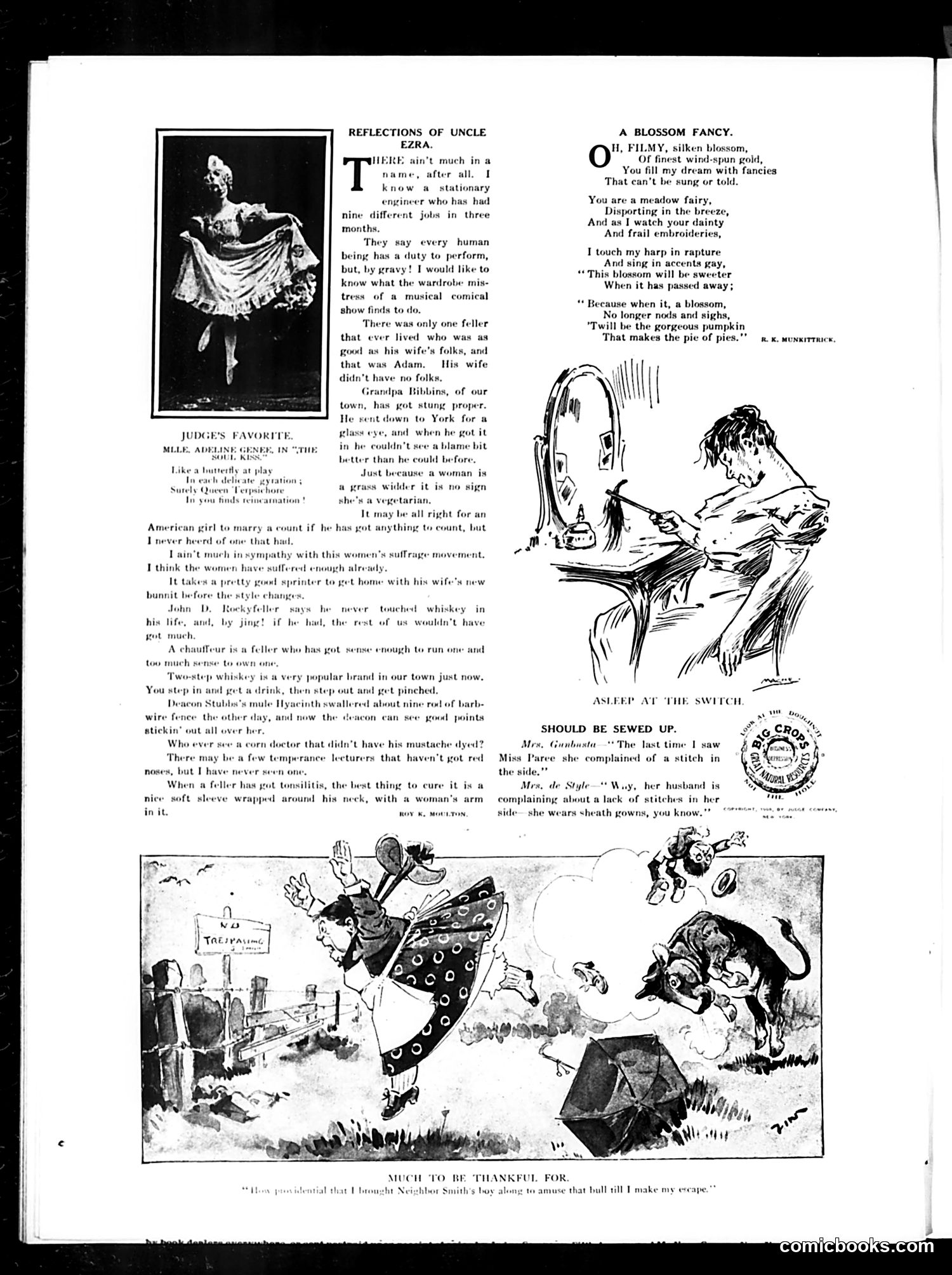
This page contains miscellaneous humor and commentary rather than unified political cartoons. **"Reflections of Uncle Ezra"** presents cynical observations about American life—remarking that job-hopping is common, that women's suffrage causes marital tension, and that temperance lecturers are often hypocrites (specifically about whiskey and mustache-dye). **"A Blossom Fancy"** is sentimental poetry about flowers. **"Asleep at the Switch"** shows a woman napping while her child plays with matches—a domestic safety joke. **"Should Be Sewed Up"** is brief gossip about a woman's complaint regarding her husband's clothing. The large bottom cartoon depicts a whimsical scene with exaggerated figures, though its specific satirical target remains unclear from the visible text. Overall, this represents typical turn-of-century Judge content: social commentary, domestic humor, and visual satire reflecting middle-class anxieties.
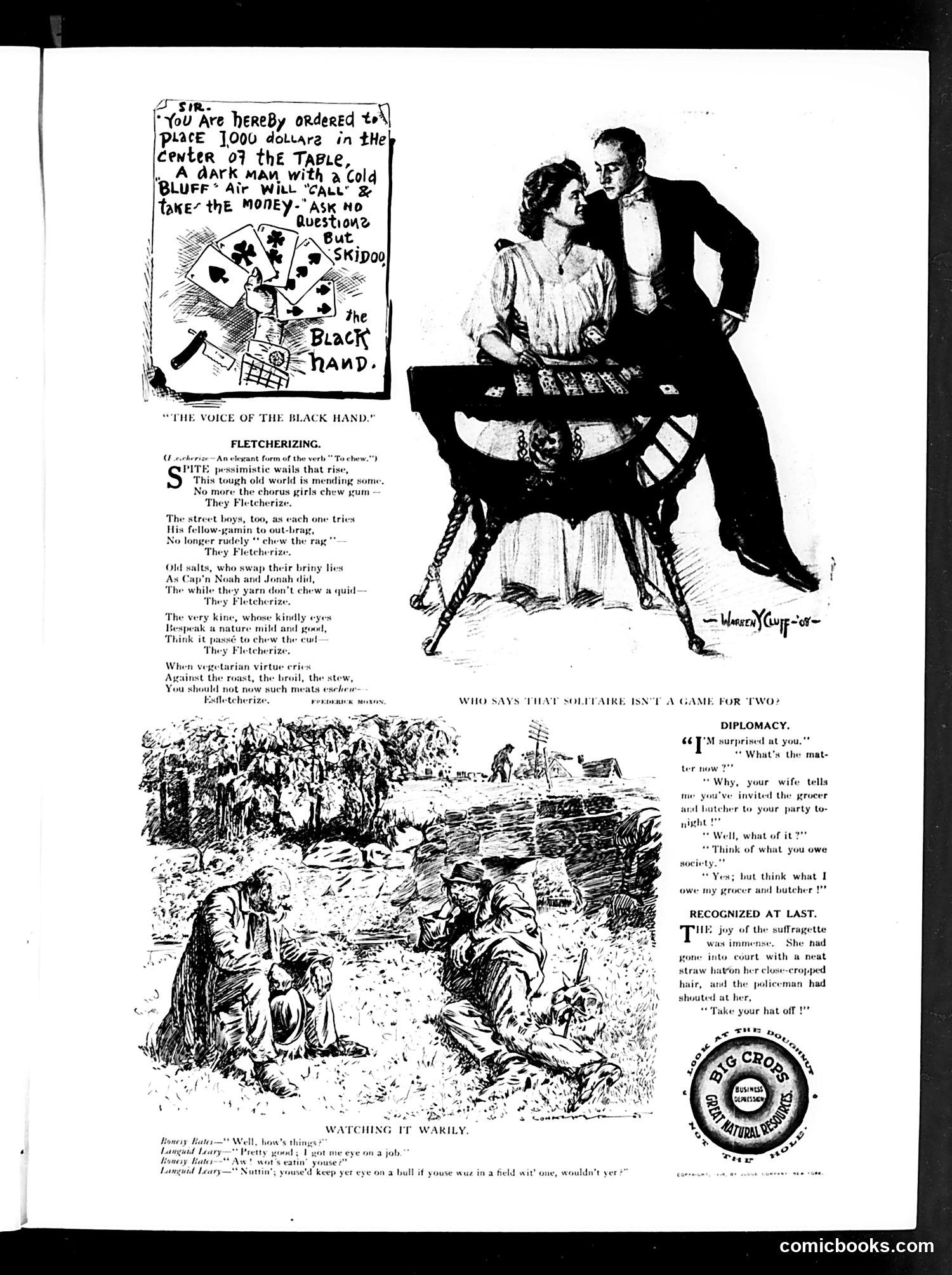
The top cartoon, "The Voice of the Black Hand," depicts a gambling setup where an unseen authority orders someone to place $1,000 on a table. A dark-suited man will "call it" and take the money—classic extortion through intimidation. This references the "Black Hand," a real criminal organization that operated through threatening letters and blackmail, particularly targeting Italian-American communities in early 20th-century America. The accompanying poem, "Fletcherizing," satirizes Horace Fletcher's popular health movement promoting thorough chewing of food. Lower sections include unrelated content: a rural dialogue and a suffragette court scene. The cartoons mock contemporary crime threats and fad diets rather than specific political figures.
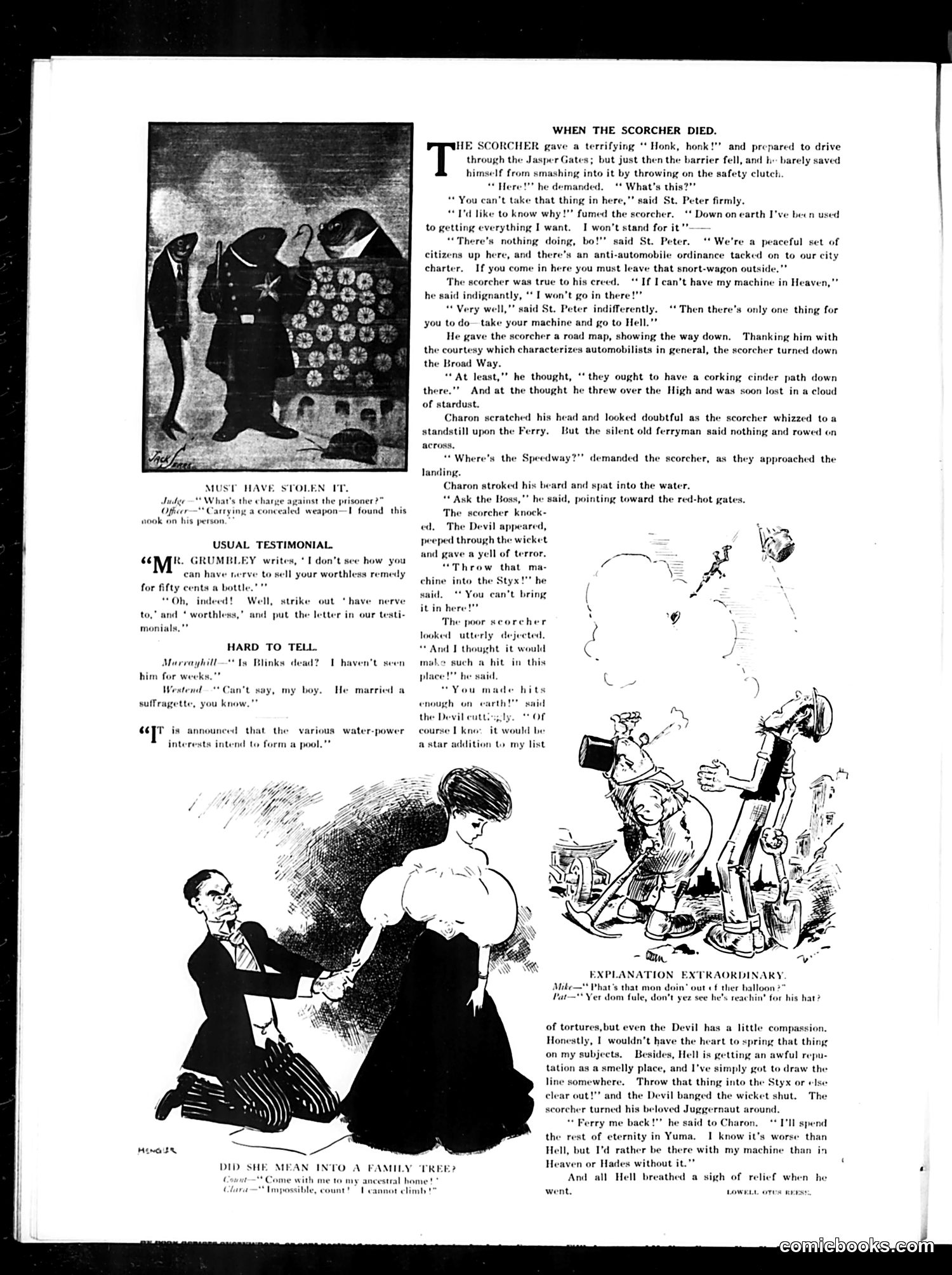
This story satirizes the early automobile craze and "scorchers"—reckless drivers who sped dangerously through streets. The protagonist, a die-hard motorist, dies and encounters St. Peter, who refuses him entry to Heaven because automobiles violate the city's anti-automobile ordinance. Defiant, the scorcher chooses Hell instead, hoping to use his machine there. The joke escalates: even the Devil rejects him, finding the automobile incompatible with Hell's operations. The scorcher ultimately prefers returning to Yuma (likely a remote, undesirable place on Earth) with his beloved car rather than spending eternity without it—suggesting his obsession with automobiles exceeds his concern for salvation itself. The satire mocks both the scorcher's single-minded devotion to motoring and broader anxieties about the automobile's disruptive social impact. The piece reflects early 20th-century attitudes toward fast driving as reckless and antisocial.
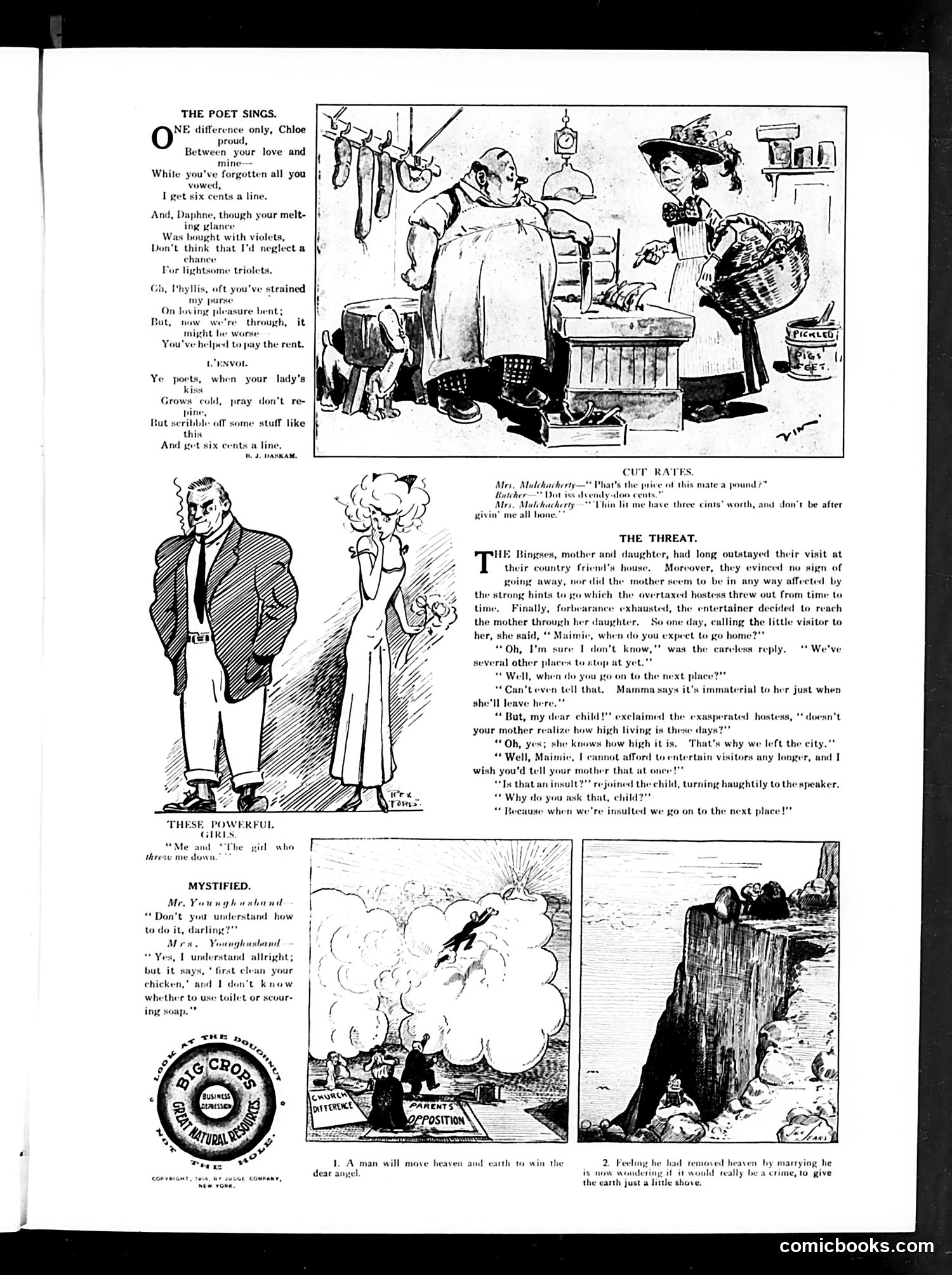
This page contains several satirical pieces typical of early 20th-century Judge magazine: **"The Poet Sings"**: A poem mocking romantic poets who claim artistic poverty while cynically monetizing their verses—getting "six cents a line" even as they court women. The satire targets the contradiction between poetic idealism and mercenary reality. **"Cut Rates"**: A brief joke about a butcher charging by weight but delivering mostly bone—social commentary on working-class consumer fraud and food quality concerns. **"The Threat"**: A longer narrative exposing upper-class freeloaders. Overstaying guests hint they'll leave only when insulted, revealing that wealthy visitors exploit hospitality shamelessly. The joke satirizes both the parasitic wealthy and their audacity. **"These Powerful Girls"** and **"Mystified"**: Appear to be relationship humor—one about independence in courtship, another about a wife confused by cooking instructions. The overall tone reflects Judge's recurring themes: mocking pretension, exposing class hypocrisy, and satirizing modern life's contradictions.
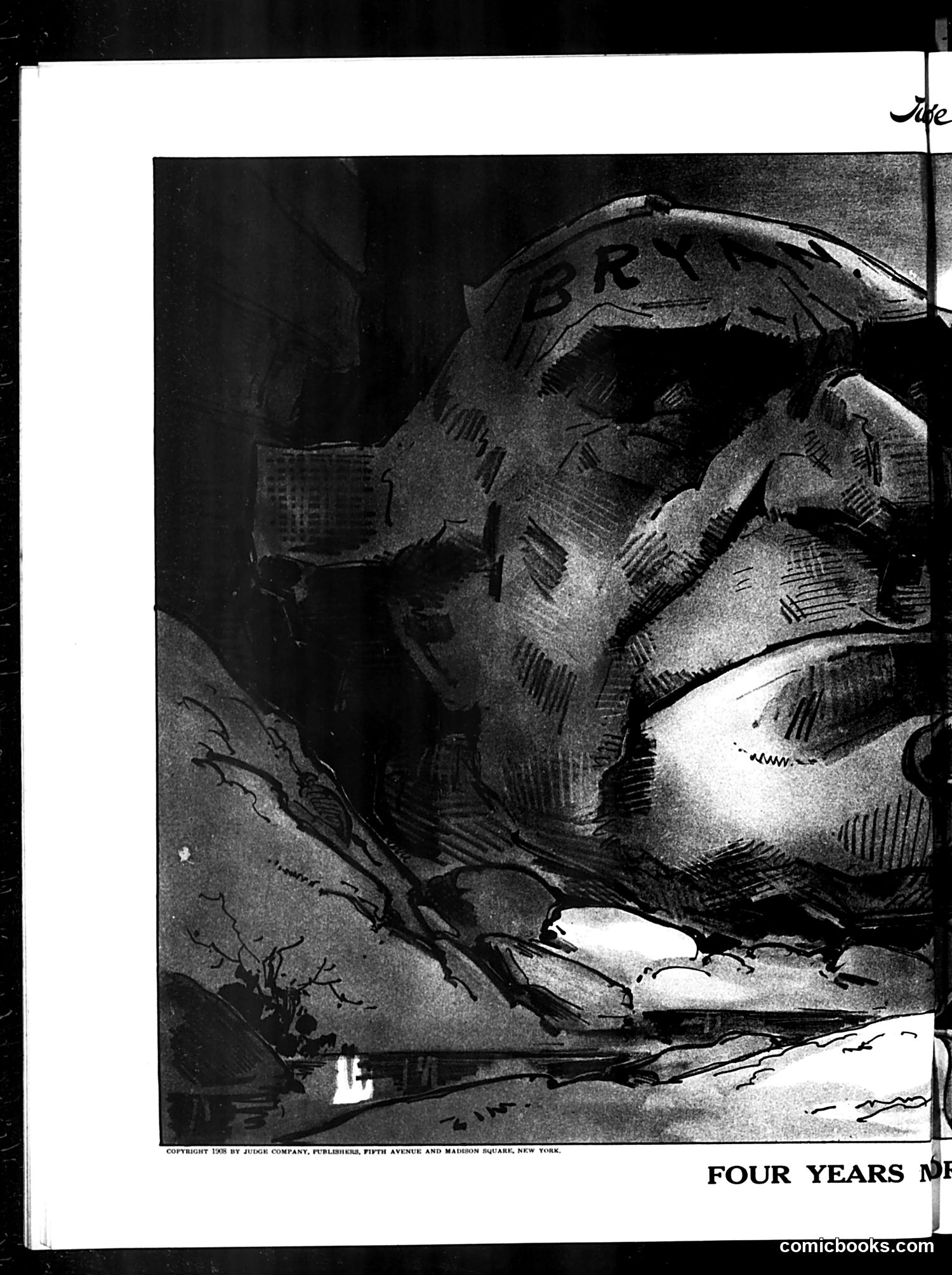
This appears to be a political cartoon from Judge magazine (1908) titled "Four Years." The image depicts a large figure labeled "BR" (likely Britain) depicted as a grotesque or monstrous form, shown in a dramatic, distressed pose against a dark landscape. The cartoon likely satirizes British politics or foreign policy during this period. The "Four Years" reference suggests commentary on a political term or election cycle. The grotesque caricature style was typical of Judge's satirical approach to political figures and nations. However, without clearer visibility of all text and additional context clues, the specific political event being referenced and the precise satirical point remain somewhat unclear. The copyright date of 1908 and Judge company attribution are confirmed.
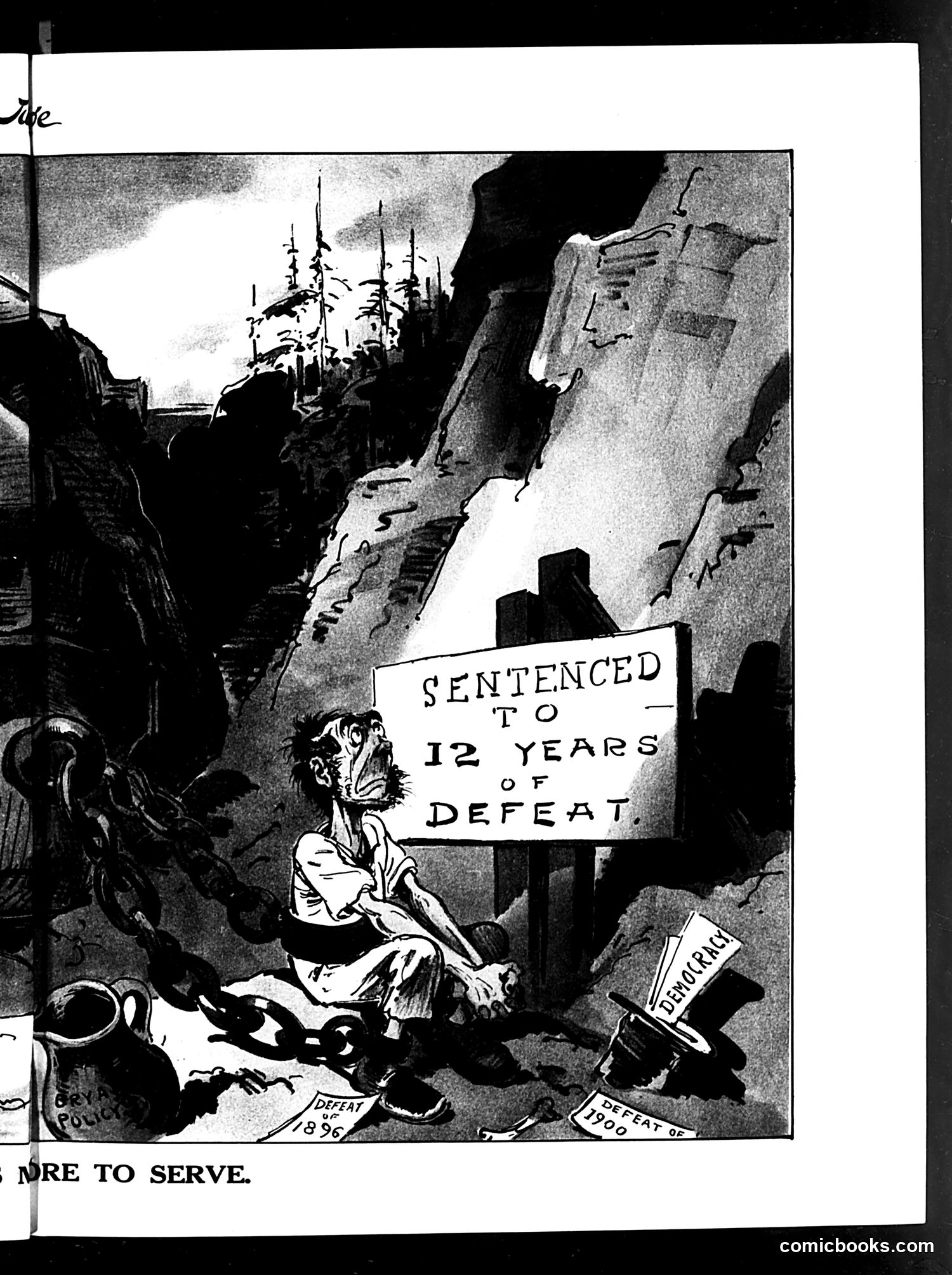
This Judge magazine cartoon depicts a caricatured figure in chains, labeled with a sign reading "SENTENCED TO 12 YEARS OF DEFEAT." Around the figure are scattered papers marked "DEFEAT OF 1896" and "DEFEAT OF 1900," suggesting repeated electoral losses across multiple campaigns. The cartoon appears to criticize a political opponent or party through the metaphor of imprisonment and repeated failure. The gaunt, distressed figure represents the personified "defeat" of a particular political movement or candidate. The mountainous, dark landscape above emphasizes despair and hardship. Without clearer identification of the specific figure or context, the exact political target remains unclear, though the imagery suggests commentary on a politician or party experiencing consistent electoral setbacks during the 1890s-1900s period.
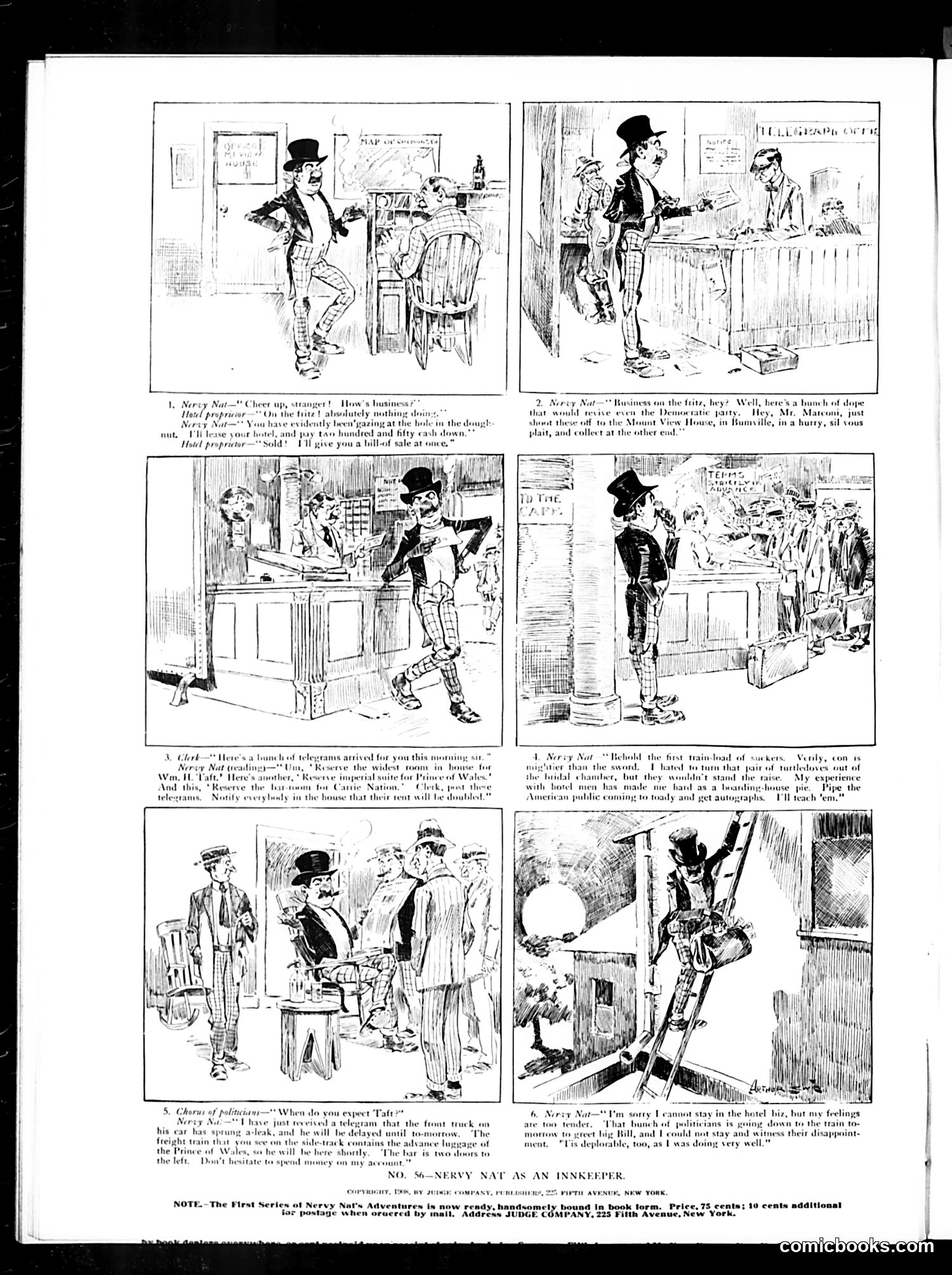
This is a comic strip series titled "Nervy Nat as an Innkeeper" from Judge magazine, depicting a scheming character named Nat working at a hotel or inn. The six-panel narrative shows Nat attempting various scams: fabricating telegram expenses, misleading guests about business opportunities in remote locations, launching a fake stock scheme, and ultimately disappearing with guests' money via a ladder escape. The satire targets petty con artists and hotel fraud prevalent in early 20th-century America. "Nervy Nat" embodies the unscrupulous businessman exploiting travelers' trust. The humor derives from Nat's increasingly brazen deceptions and his eventual comical flight. This reflects contemporary anxieties about commercial dishonesty and urban grifters preying on unsuspecting guests.
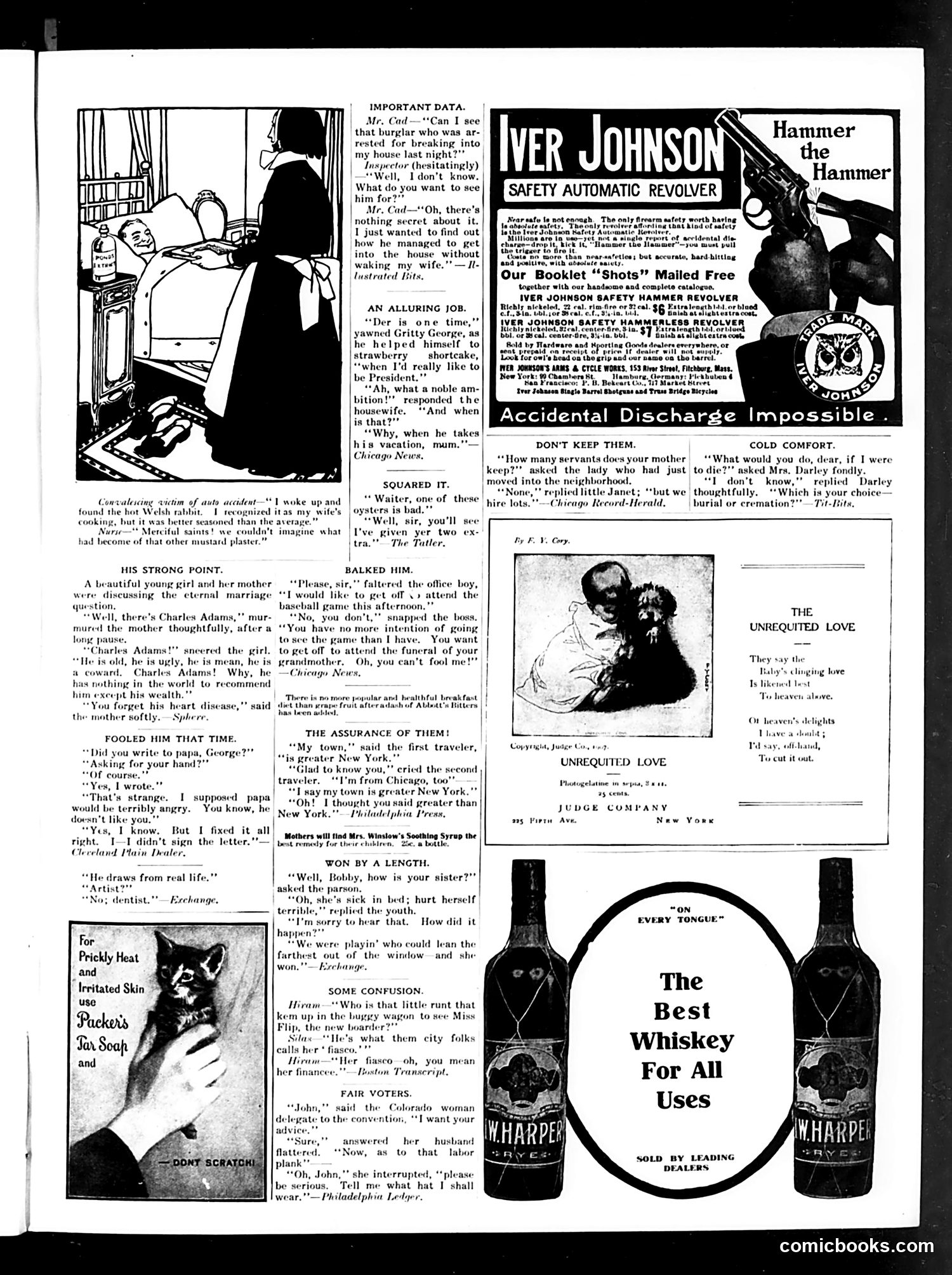
This page from the satirical magazine *Judge* contains multiple short joke items typical of early 20th-century humor publications, alongside period advertisements. The cartoons and anecdotes mock social conventions and gender dynamics of the era. "His Strong Point" ridicules a suitor's only qualification being marriage to a wealthy woman. "Fooled Him That Time" jokes about a young man forging his father's signature on a marriage proposal letter. "Don't Keep Them" satirizes household servant culture by suggesting a family avoids hiring servants to prevent theft. Other items target marital dynamics ("Cold Comfort"—a wife asking her husband which death method he'd prefer) and class pretension ("Won by a Length"—competing boasts about whose town is greater). The advertisements—Packer's Tar Soap, Wharpe's Whiskey, and notably the Iver Johnson Safety Hammer Revolver—reflect period commercial norms, with the revolver ad emphasizing "accidental discharge impossible," reflecting concerns about gun safety. The overall tone is genteel mockery of bourgeois life, typical of *Judge's* satirical mission.
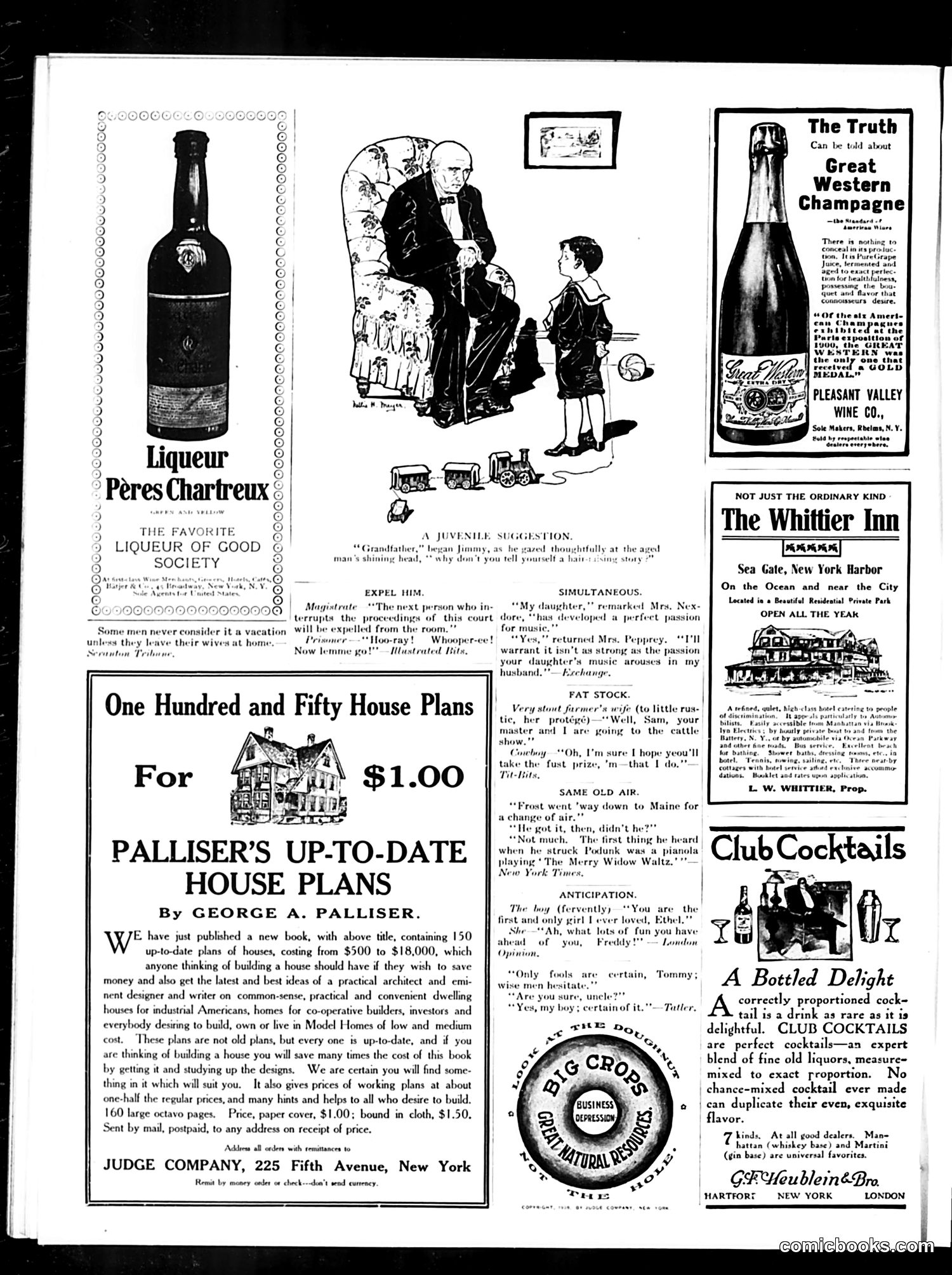
This page is primarily **advertising**, with one small cartoon. The main cartoon, titled "A Juvenile Suggestion," depicts a courtroom scene where a magistrate interrupts proceedings, ordering someone removed. A young boy suggests to an older man seated nearby: "Grandfather, I began Jimmy, as he gazed thoughtfully at the aged man's shining head, 'why don't you tell yourself a hair-raising story?'" The joke satirizes **baldness and age**—the boy cheekily suggests the grandfather tell himself a scary story to make his hair stand on end, implying he has none to raise. This reflects early 20th-century humor about aging and physical appearance. The remainder of the page consists of period advertisements for **liqueurs, champagne, house plans, an inn, and cocktails**—typical Judge magazine content. These ads target middle and upper-class readers interested in home ownership, fine spirits, and leisure.
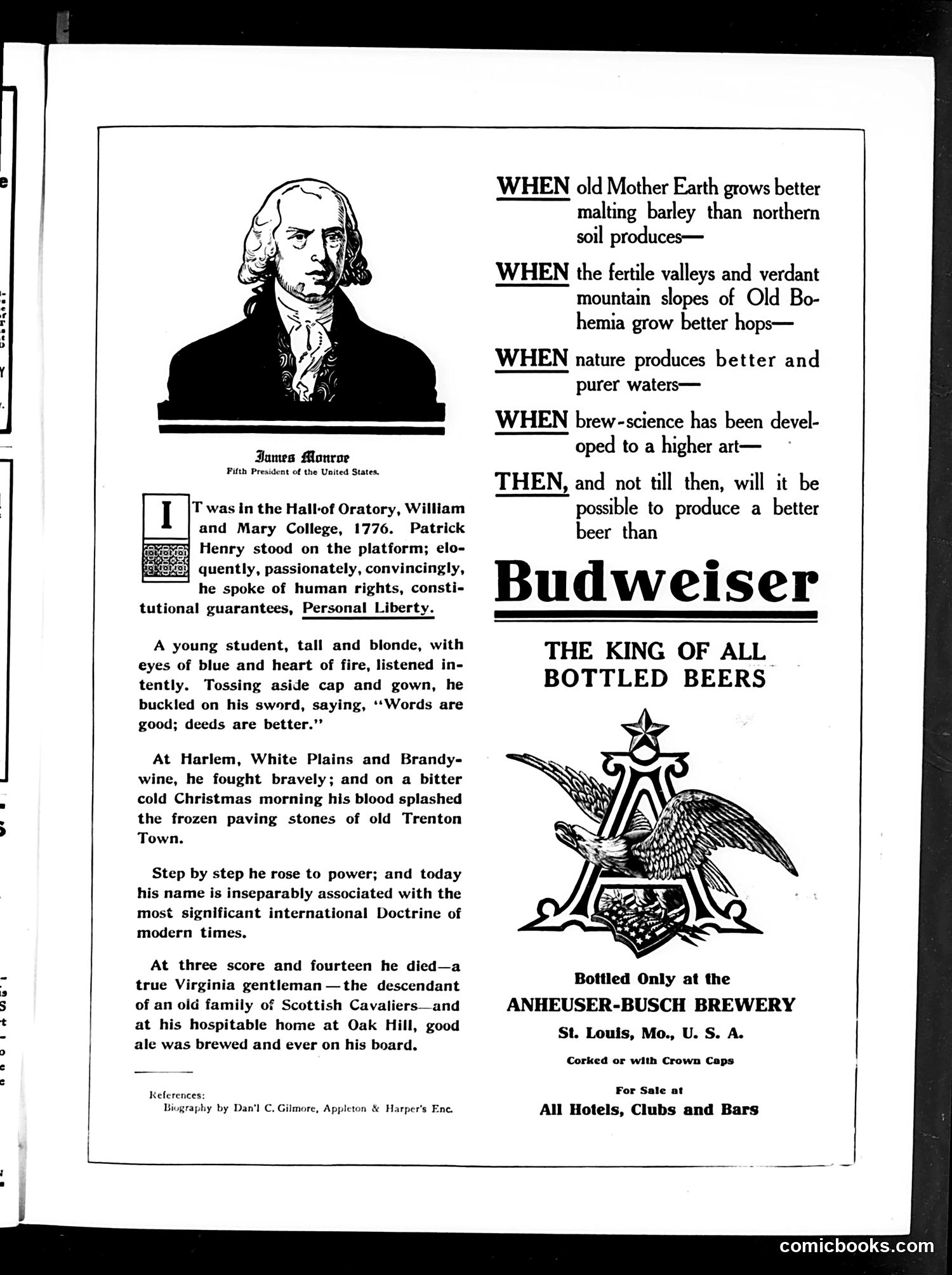
This is primarily a **Budweiser beer advertisement**, not political satire. The page uses James Monroe (Fifth President) as an authority figure to lend prestige to the product. The left column presents Monroe's biography—his attendance at Patrick Henry's famous liberty speech at William & Mary, his Revolutionary War service, his rise to power, and notably, his "hospitable home at Oak Hill" where "good ale was brewed and ever on his board." This final detail establishes Monroe as a gentleman who appreciated quality beer, connecting him to the product. The right side then pivots to advertising Budweiser as "THE KING OF ALL BOTTLED BEERS," using conditional statements ("WHEN...THEN") to claim that Budweiser cannot be surpassed until nature and science improve—an exaggerated marketing claim. The juxtaposition is meant to suggest that if a refined Virginia gentleman like Monroe valued good ale, consumers should trust Budweiser. It's a **prestige-through-association** advertising strategy rather than satire or political commentary.
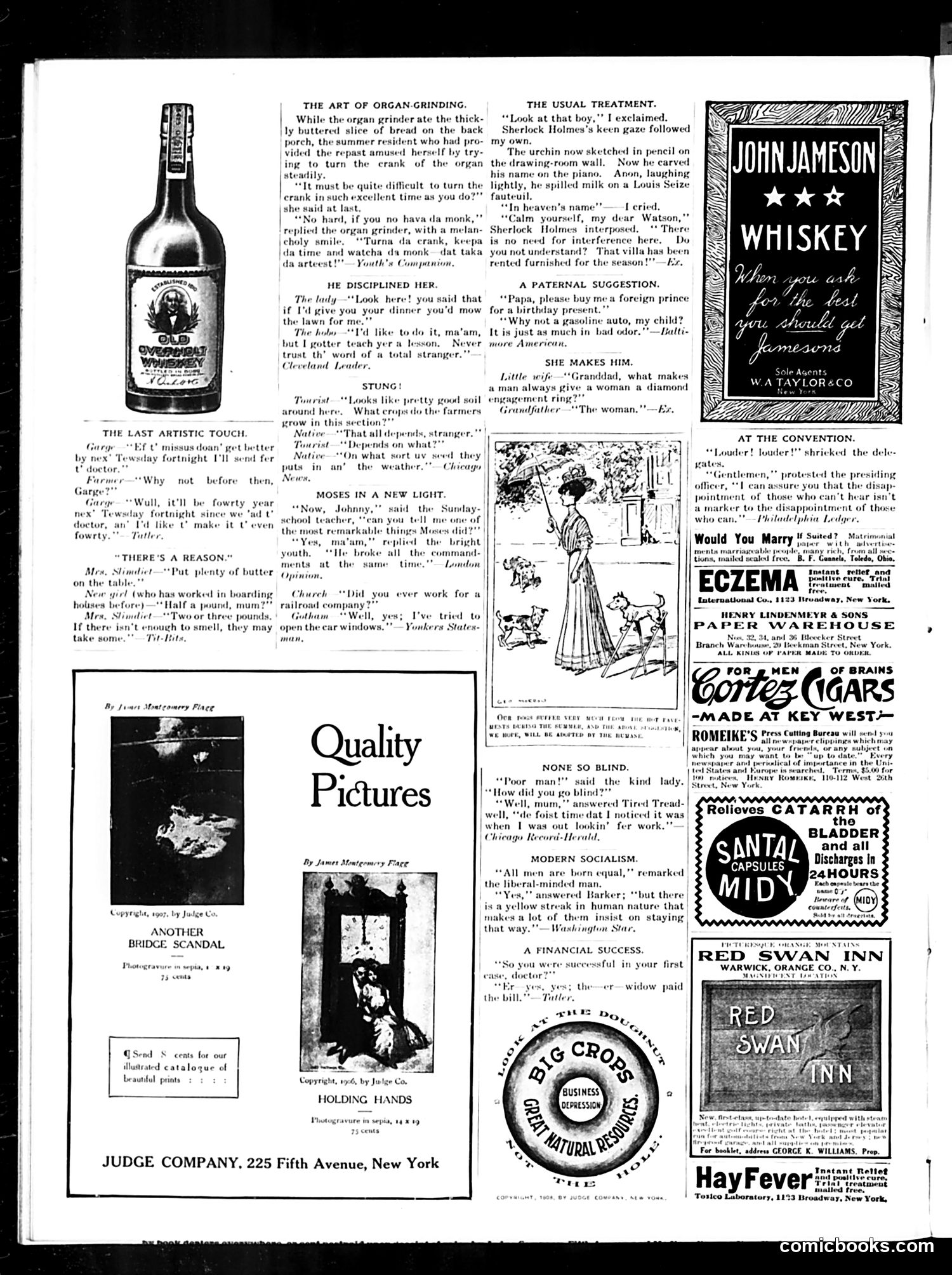
This page from *Judge* magazine contains several short comedic pieces typical of early 20th-century American humor: **"The Art of Organ-Grinding"**: A woman amuses herself trying to turn a street organ-grinder's crank while he eats, asking if it's difficult. The joke plays on class comedy and the novelty of manual labor for someone clearly unaccustomed to it. **"He Disciplined Her"**: A homeowner refuses to pay a worker who completed yard work, claiming he must "teach a lesson" about trusting strangers—satirizing either stingy behavior or skepticism toward laborers. **"The Usual Treatment"**: A Sherlock Holmes reference where a boy spills milk, and the father explains to Holmes that such misbehavior is expected from renters' children—mocking both Holmes's deductive pretensions and attitudes toward the poor. **"A Paternal Suggestion"**: A father suggests buying a "foreign prince" toy car instead of a gasoline auto because "it's in better odor"—likely satirizing both conspicuous consumption and the pretension of European imports. The remaining pieces use similar working-class and everyday comedy. Advertisements fill the rest of the page.
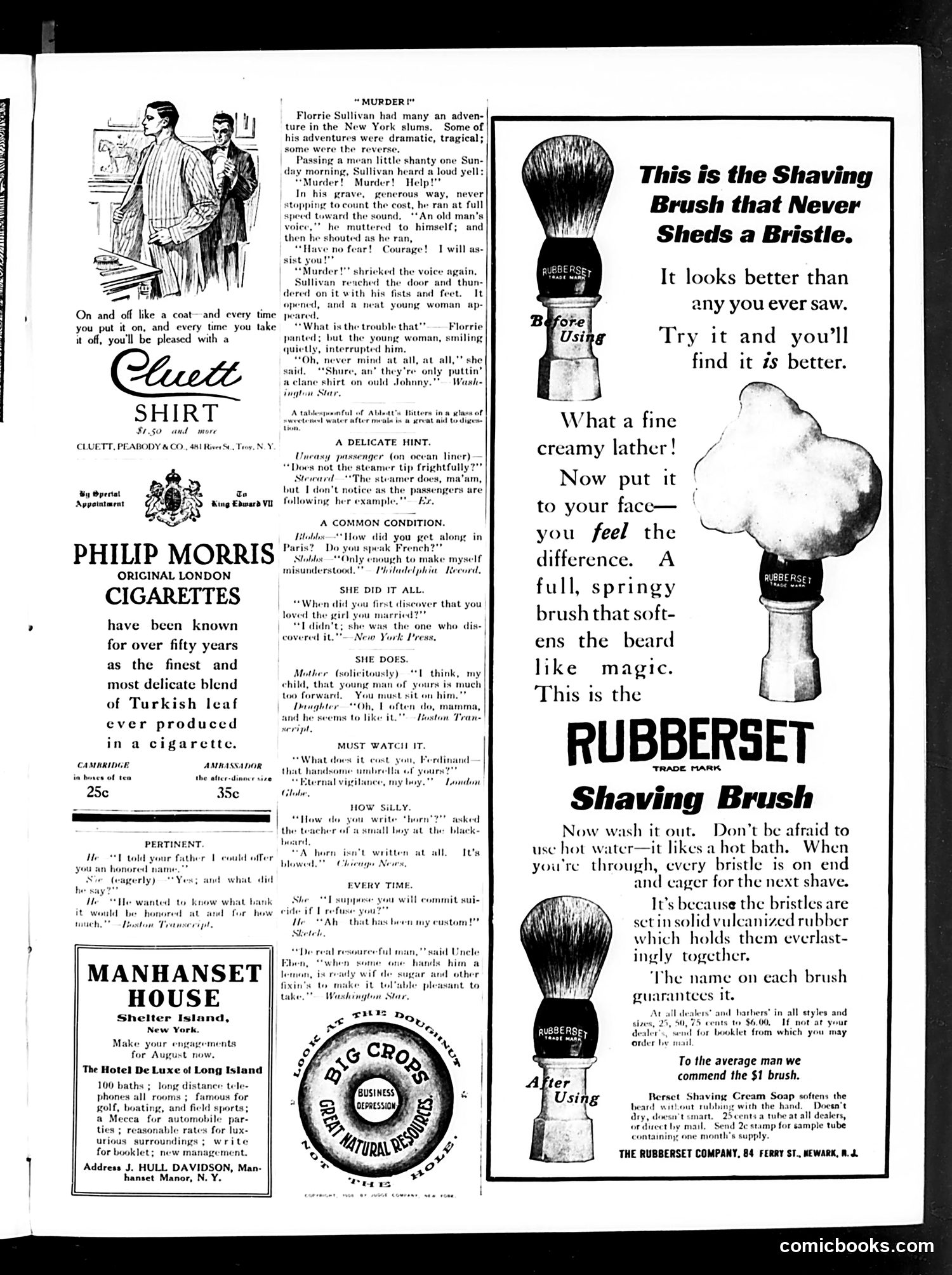
This page is primarily **advertising**, not political satire. The dominant content is a large advertisement for Rubberset shaving brushes (right side), with smaller ads for Cluett shirts, Philip Morris cigarettes, and other products scattered throughout. The left side contains brief comedic anecdotes and "joke" sections typical of Judge magazine's filler content—short humorous exchanges about everyday situations (ocean liners, speaking French, writing horns, etc.). These aren't satirical commentary but rather mild humor for entertainment. The one narrative piece ("Murder!") at top left appears to be a short story excerpt about a character named Florrie Sullivan responding to a cry for help in New York slums—sentiment-driven melodrama rather than satire. **For modern readers:** This represents how early 20th-century magazines subsidized editorial content through advertising revenue, mixing legitimate satire with advertisements and generic humor filler. The product ads use period marketing language emphasizing quality and superiority.
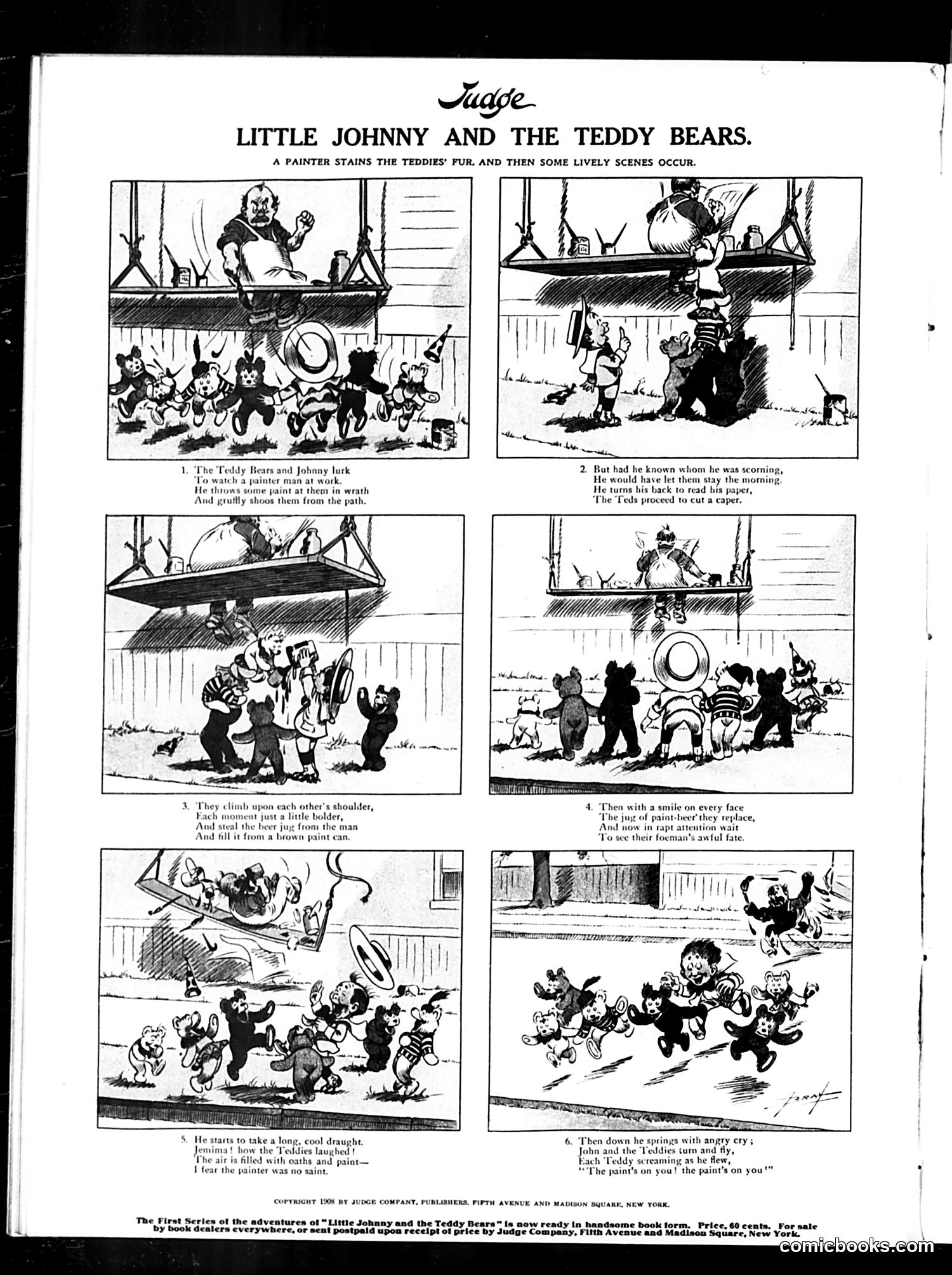
This is a humorous children's comic strip, not political satire. It depicts a slapstick sequence where a painter accidentally stains toy teddy bears with paint. When the painter leaves, the animated bears retaliate by covering him in paint in return. The "Teddy Bears" reference reflects the enormous popularity of teddy bears in early 1900s America—named after President Theodore Roosevelt. The comic plays on children's expectations that stuffed animals might magically come to life and seek revenge. The humor is purely physical comedy: the painter's comeuppance for carelessly ruining the toys. The page advertises that this series is available as a book for purchase, indicating "Teddy Bears" merchandise was commercially successful. This is entertainment content, not commentary on contemporary politics or social issues.