
A complete issue · 16 pages · 1908
Judge — July 25, 1908
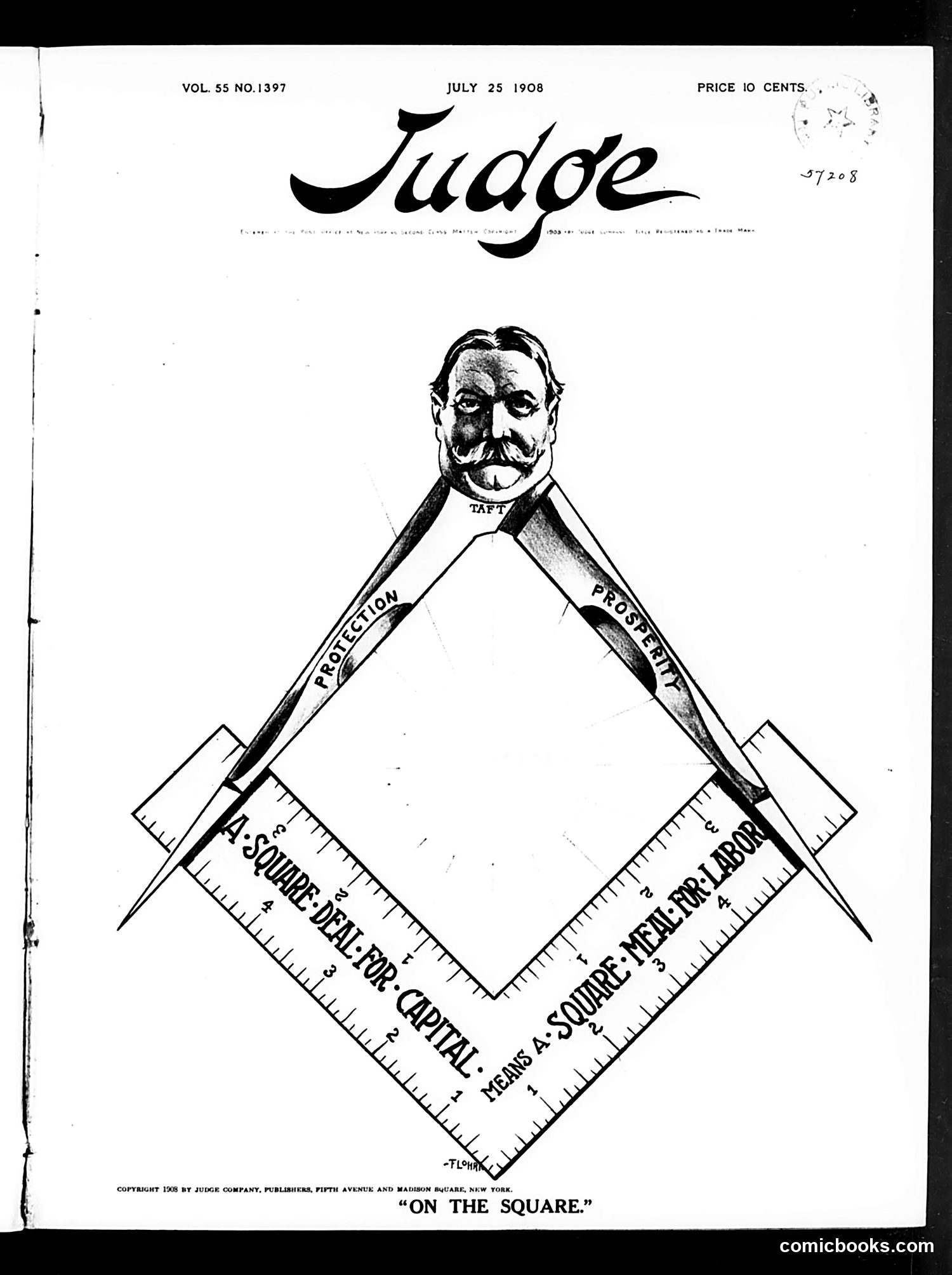
This July 1908 *Judge* cartoon depicts a man with a distinctive mustache positioned within a Masonic square and compass symbol. The labels read "TAFT" (top), "PROTECTION" and "PROSPERITY" (on the compass arms), and "BEING A SQUARE DEAL FOR CAPITAL" and "SQUARE MEAL FOR LABOR" (on the square's sides). The cartoon satirizes Theodore Roosevelt's successor, William Howard Taft, by presenting him as a Masonic-aligned figure embodying Republican promises: protectionism, prosperity, and "square dealing" to both capital and labor. The Masonic imagery suggests hidden influence or secret allegiances. The satire likely critiques whether Taft could genuinely fulfill these competing interests, or if the "square" positioning was merely symbolic positioning rather than substantive policy.
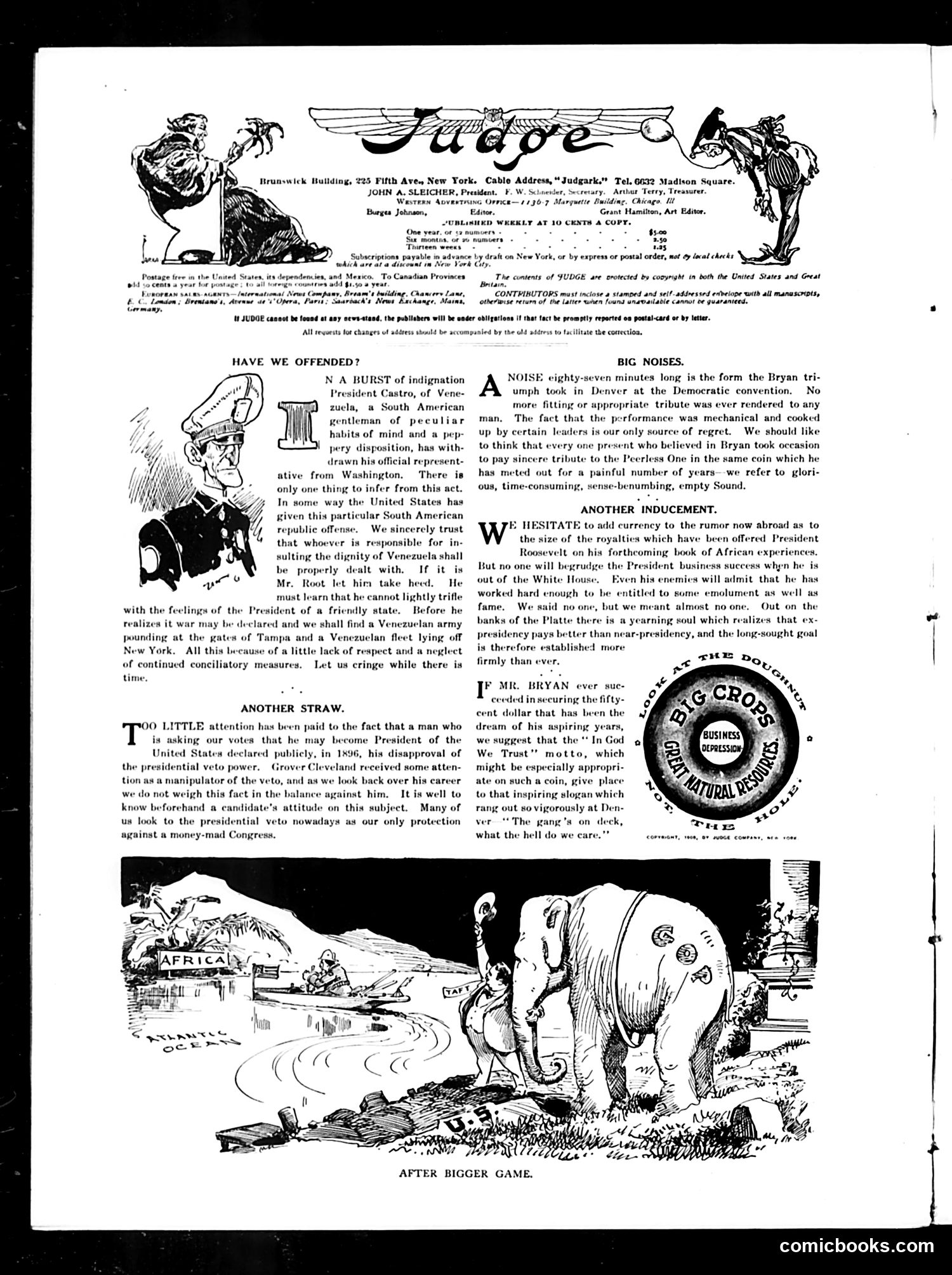
This page contains three opinion pieces criticizing President Castro of Venezuela and President Cleveland's administration. "Have We Offended?" questions whether the U.S. has disrespected Castro, a South American leader of "peculiar habits," suggesting war could result. "Another Straw" attacks Cleveland for supposedly being manipulated by Congress, contrasting his weakness with his predecessor's strength. "Big Noises" mocks the Bryan campaign's Democratic convention noise as empty and inappropriate. "Another Inducement" sarcastically suggests Bryan pursue royalties from his speeches rather than the presidency. The bottom cartoon, "After Bigger Game," depicts an elephant (Republican symbol) hunting in Africa, likely satirizing imperialist ambitions or foreign policy overreach. The overall message criticizes Democratic leadership and Bryan's presidential aspirations through mockery and caricature.
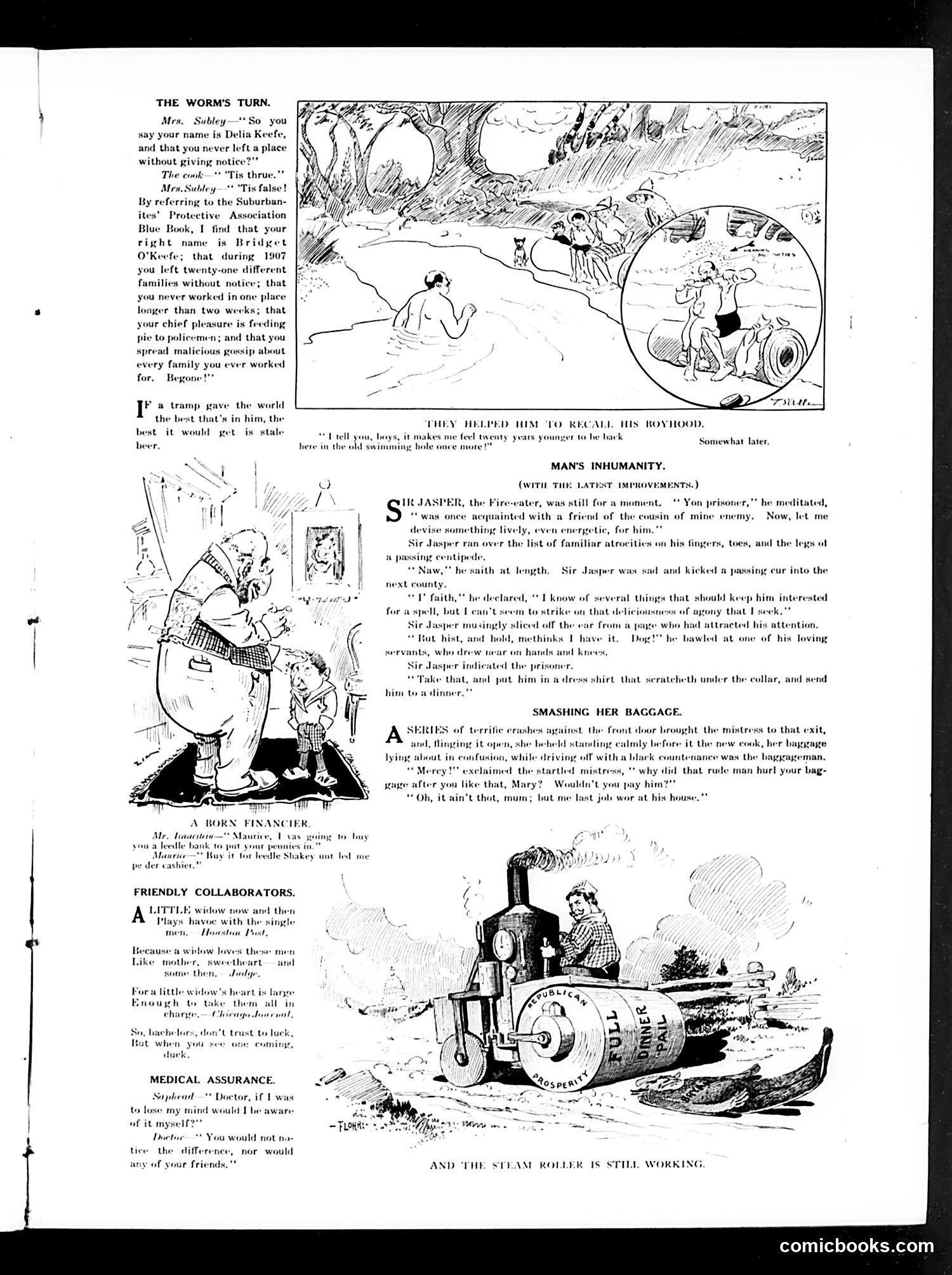
This page contains several satirical sections targeting social issues of the early 1900s: **"The Worm's Turn"** attacks a politician (likely named O'Keefe) for abandoning constituents and spreading malicious gossip after leaving office in 1907. **"Man's Inhumanity"** mocks Sir Jasper, a fire-eater character, who abuses his servants and prisoners while claiming to be "interested" in them—satirizing hypocritical wealthy exploiters. **"Smashing Her Baggage"** depicts a domestic dispute where a mistress destroys her own luggage, then blames her driver—mocking frivolous wealthy women and their poor treatment of working-class employees. The remaining sections ("A Born Financier," "Friendly Collaborators," "Medical Assurance") appear to be brief humorous quips about financial schemes and doctor-patient relationships. The cartoons criticize class exploitation and hypocrisy among the wealthy and politically connected.
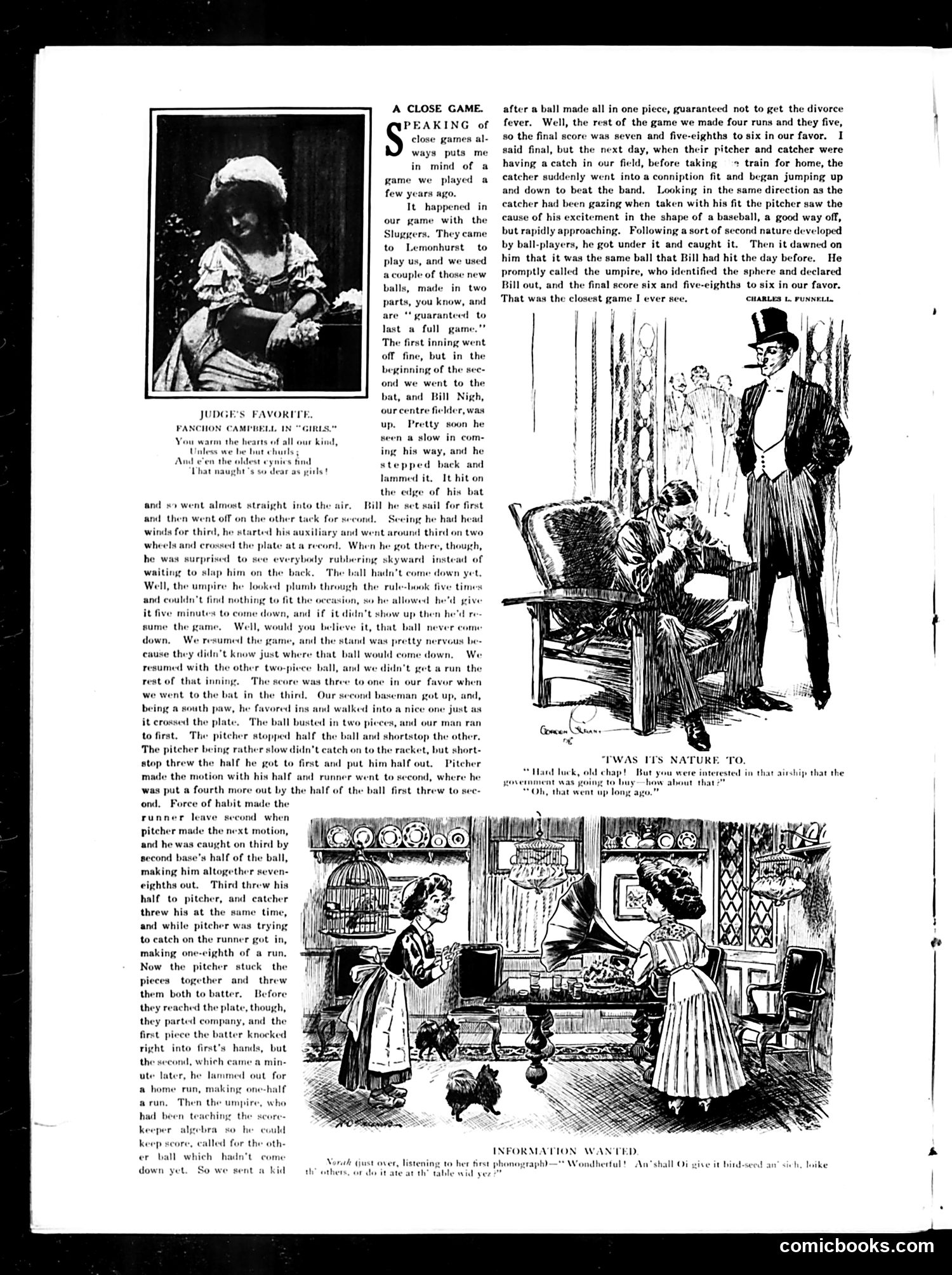
This page contains two unrelated pieces: **"A Close Game"** (main article with baseball illustration): A humorous account of an amateur baseball game between two teams, emphasizing the dramatic uncertainty of the outcome. The narrative describes various mishaps and close calls, culminating in a final score of 6-5. This is sports humor rather than political satire. **"Judge's Favorite"** (top left): A theatrical photograph of Panchor Campbell in the play "Girls," with accompanying verse praising his performance. **Two illustrations below**: A gentleman in formal dress admiring a chair (titled "Twas His Nature, To"), and a domestic kitchen scene titled "Information Wanted," both appearing to be general-interest humor rather than political commentary. This page represents Judge's typical mix of sports stories, theatrical coverage, and everyday social humor.
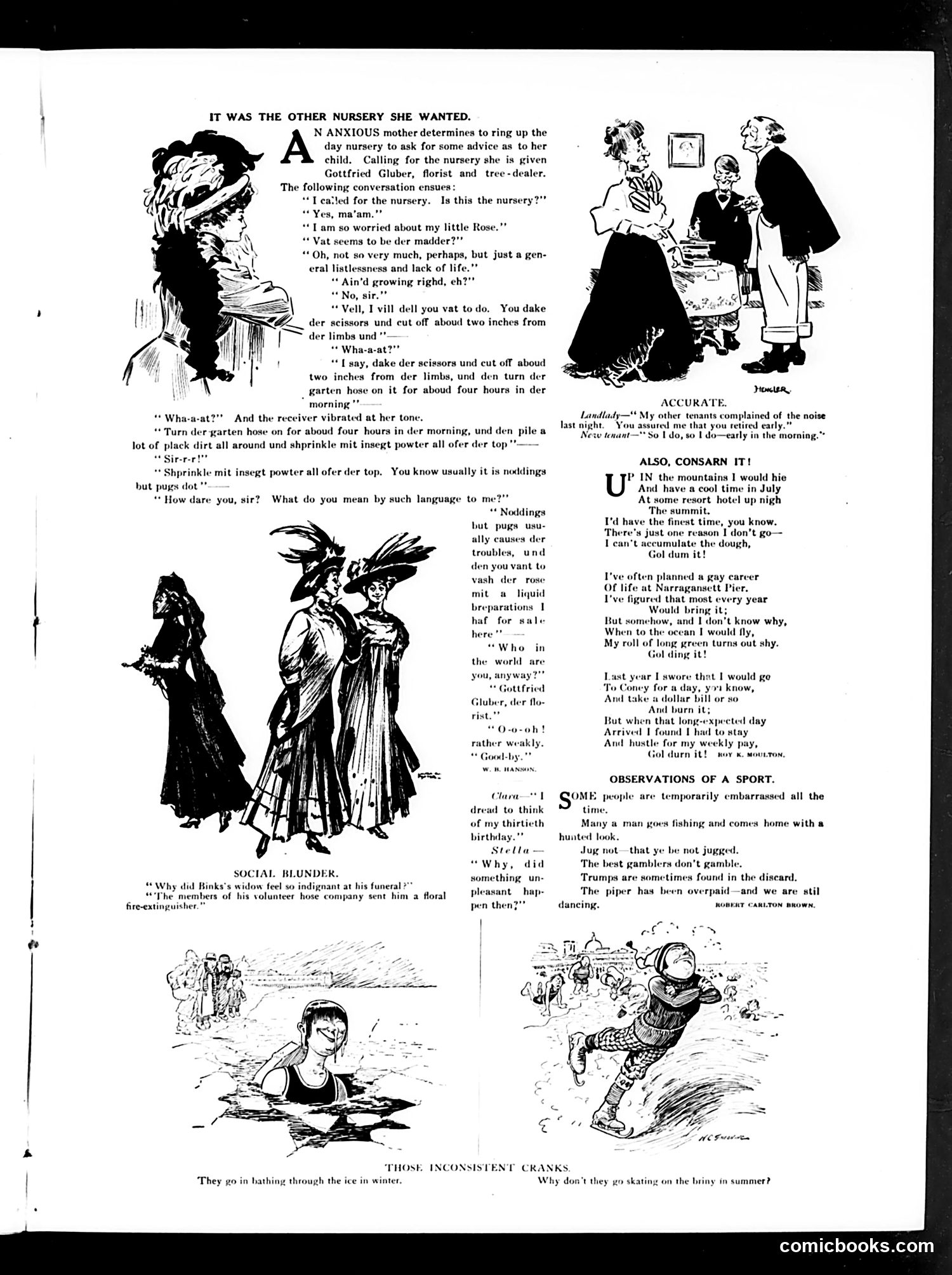
This page contains several unrelated satirical pieces typical of Judge magazine's format: 1. **"The Other Nursery"**: A humorous dialogue where an anxious mother consults Gottfried Gluber, a florist and tree-dealer, about her sickly child. His advice—cutting plant stems and soaking the garden hose—becomes absurdly applied to child-rearing, satirizing misguided parenting advice and perhaps the era's pseudo-scientific approaches to health. 2. **"Accurate" and "Also, Consider It!"**: Brief social commentary pieces on reliability and life choices, mocking urban anxieties and unfulfilled aspirations. 3. **"Social Blunder" and "Observations of a Sport"**: Short joke sections poking fun at social etiquette violations and sporting behaviors. 4. **"Those Inconsistent Cranks"**: Final cartoon ridiculing people who ice-bathe in winter but won't ice-skate in summer—highlighting contradictory human behavior. The page is primarily humorous rather than overtly political.
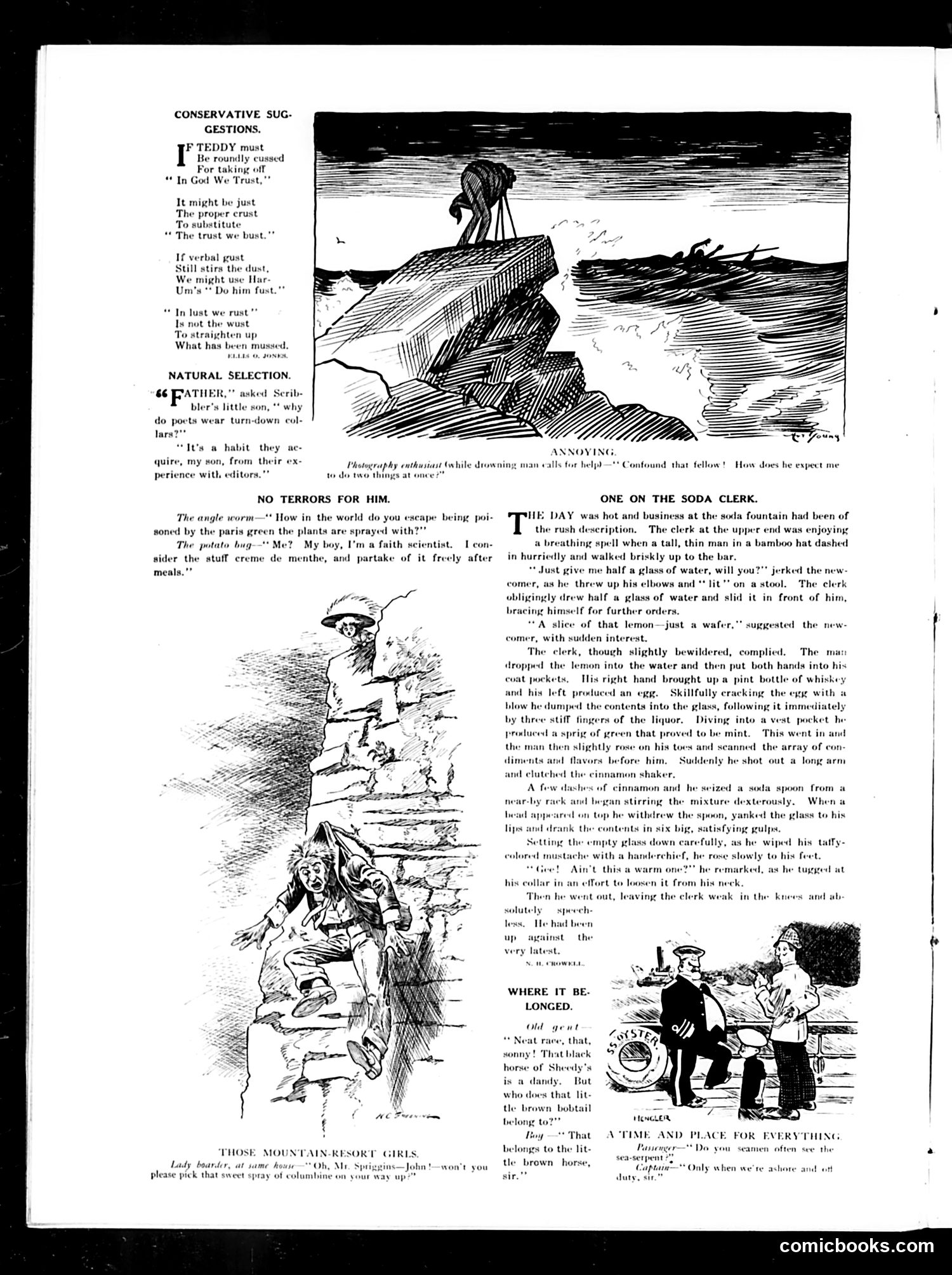
This *Judge* magazine page contains several satirical sketches: **"Conservative Suggestions"** mocks Theodore Roosevelt's trust-busting policies through awkward rhyming wordplay—suggesting alternative slogans like "The trust we bust" as absurd substitutions. **"Natural Selection"** is a brief joke: a father explains poets wear turned-down collars because they've learned this habit "from their experience with editors"—satirizing editorial rejection of poets' work. **"No Terrors for Him"** and **"One on the Soda Clerk"** depict absurd scenarios: a man claiming faith science immunity from poison, and another customer performing an elaborate cocktail ritual (whiskey, egg, lemon, mint, cinnamon) that bewilders the clerk—mocking pseudoscientific fads and pretentious behavior. **"Where It Belonged"** and **"A Time and Place for Everything"** appear to be brief conversational jokes about horses and sea-serpents, likely playing on tourist resort exaggerations. The page exemplifies *Judge's* satirical approach: mocking contemporary fads, politics, and social pretensions through visual humor and wordplay.
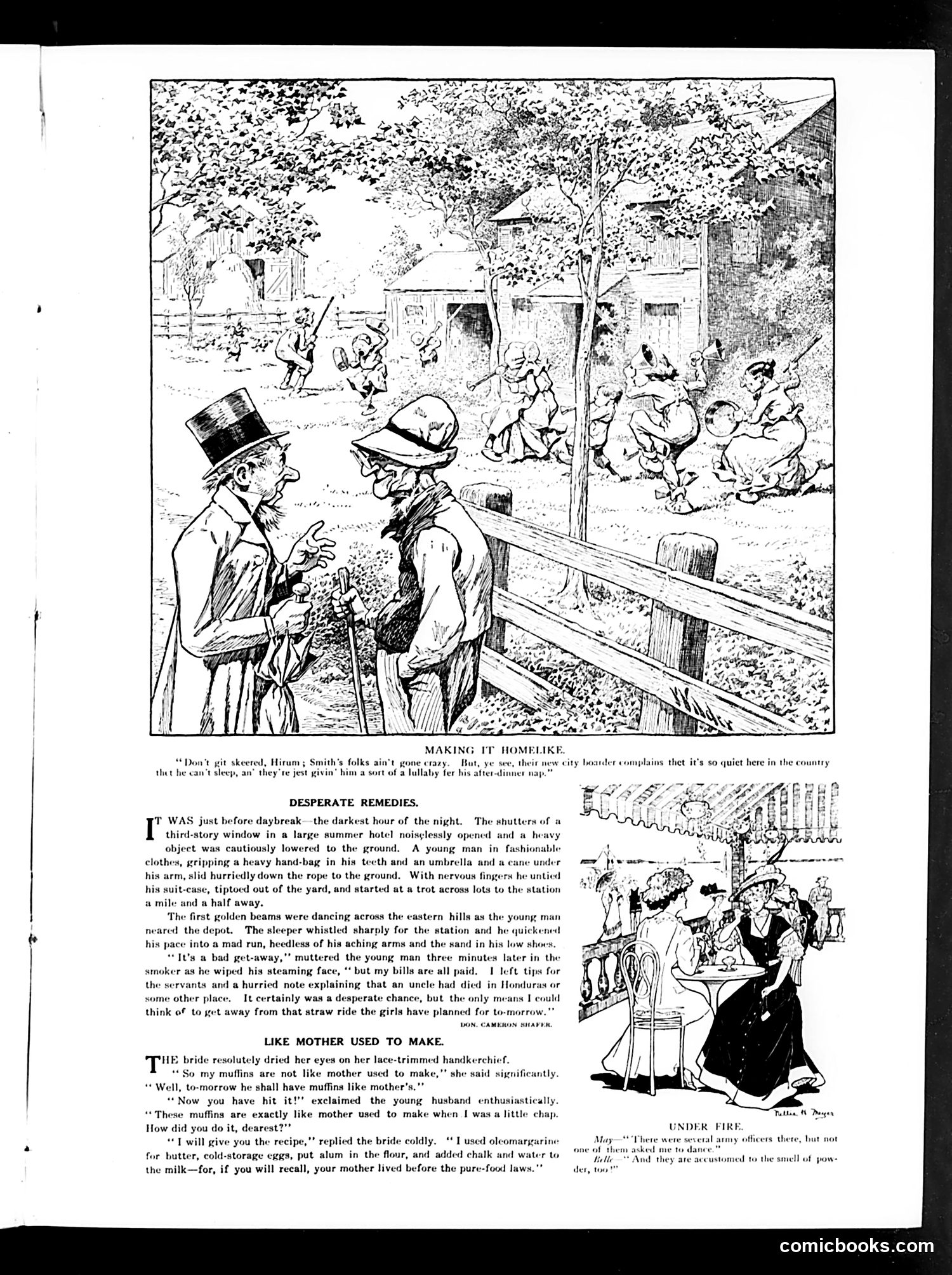
This page contains three humorous short stories satirizing early 20th-century American social anxieties: **"Making It Homelike"** (top): A city visitor complains about rural quiet, prompting locals to explain their simple pleasures—a joke mocking urban pretension and disconnect from country life. **"Desperate Remedies"** (middle): A hotel guest stages an elaborate nighttime escape using rope and disguise to avoid a planned social outing (a "straw ride"). The satire targets young men's desperation to evade mandatory social obligations and awkward courtship situations. **"Like Mother Used to Make"** (bottom): A newlywed bride serves inedible muffins made with modern adulterants (oleomargarine, cold-storage eggs, alum, chalk). When the husband praises them as tasting like his mother's, she reveals she used adulterated ingredients—satirizing both the "pure food" debate and the common complaint that modern processed foods were inferior to traditional cooking. These stories reflect Progressive-era concerns about food safety, social expectations, and rapid modernization.
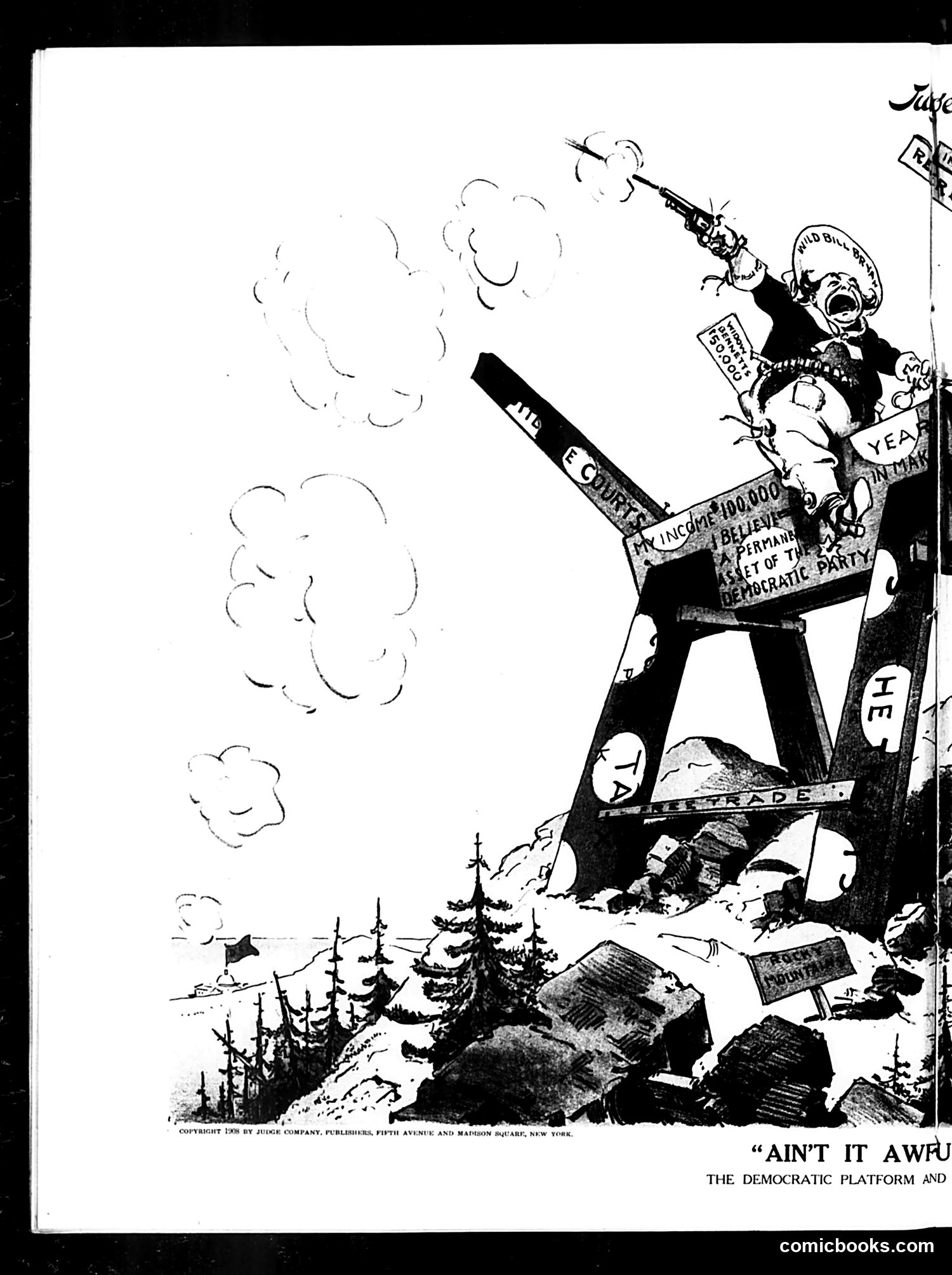
This appears to be a Judge magazine cartoon criticizing the Democratic Party platform. The visible elements show: **The Satire:** A caricatured political figure (likely a Democratic politician or party leader) stands atop a precarious structure labeled with various Democratic platform positions and promises. The figure holds a rifle aimed upward at clouds of smoke/explosions. **The Point:** The cartoon suggests the Democratic platform is unstable, contradictory, or self-destructive—that the party's stated positions are firing at themselves. The mountainous debris below, combined with the shaky structural framework, implies the platform will collapse under its own weight. **Context:** Without the full caption visible, the specific election year or platform issues aren't entirely clear, but the title "Ain't It Awful" indicates Judge's dismissive stance toward Democratic policy positions of that era.
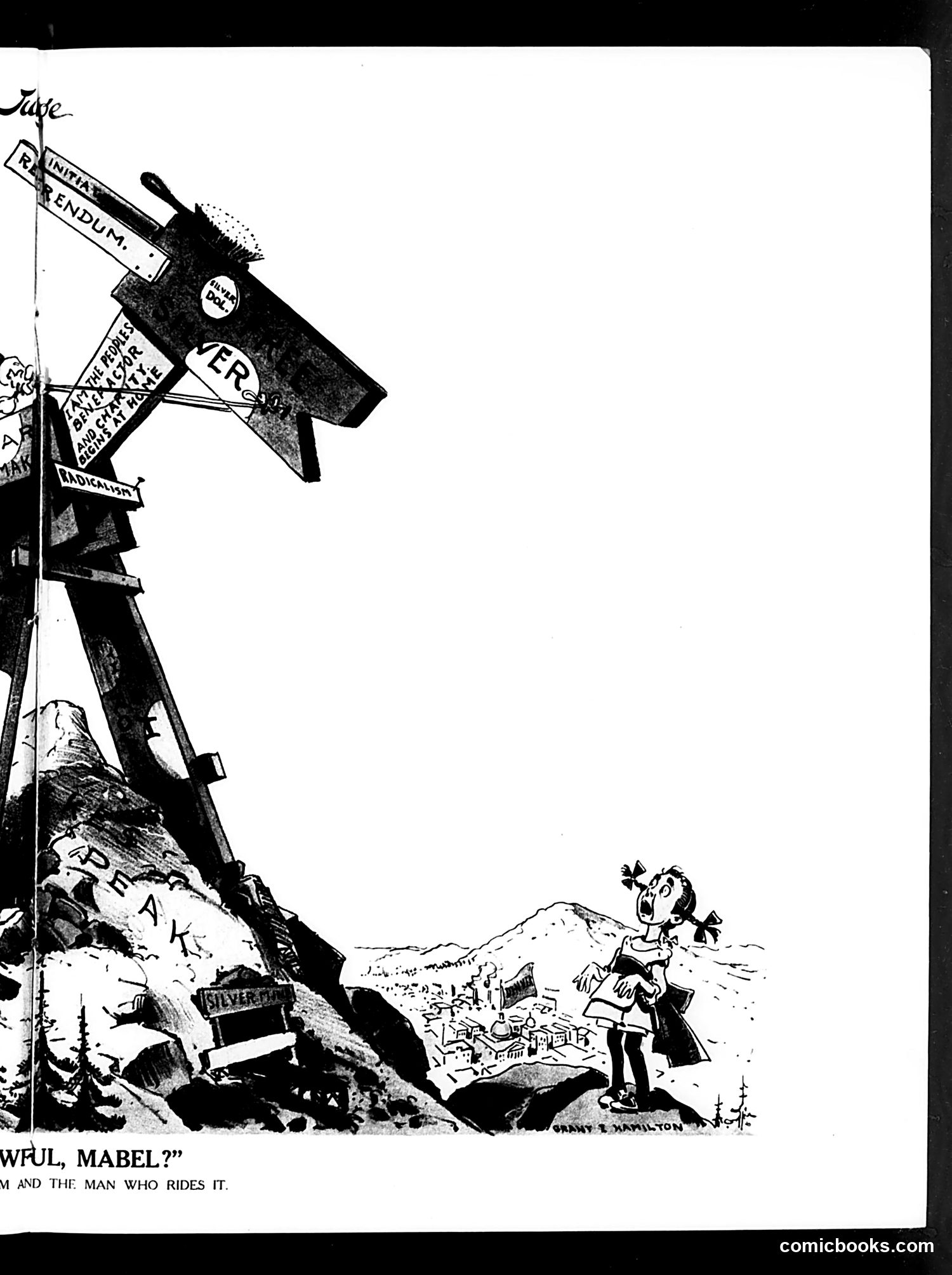
This is a political cartoon from *Judge* magazine showing a precariously balanced structure of labeled platforms and planks teetering on a mountainside. A small figure (labeled "Mabel") stands below, appearing alarmed at the unstable construction. The structure appears laden with various political or social initiatives (visible text includes "INITIATIVE," "REFERENDUM," "RADICALISM," and other partially legible labels). The cartoon likely satirizes the precarious nature of progressive political reforms or radical movements of the early 20th century—suggesting they're dangerously unstable or poorly balanced. The title references "the man who rides it," indicating criticism of a specific political leader (likely a progressive reformer), though the figure's identity is unclear from the visible text. The overall message warns that these stacked reforms could collapse catastrophically.
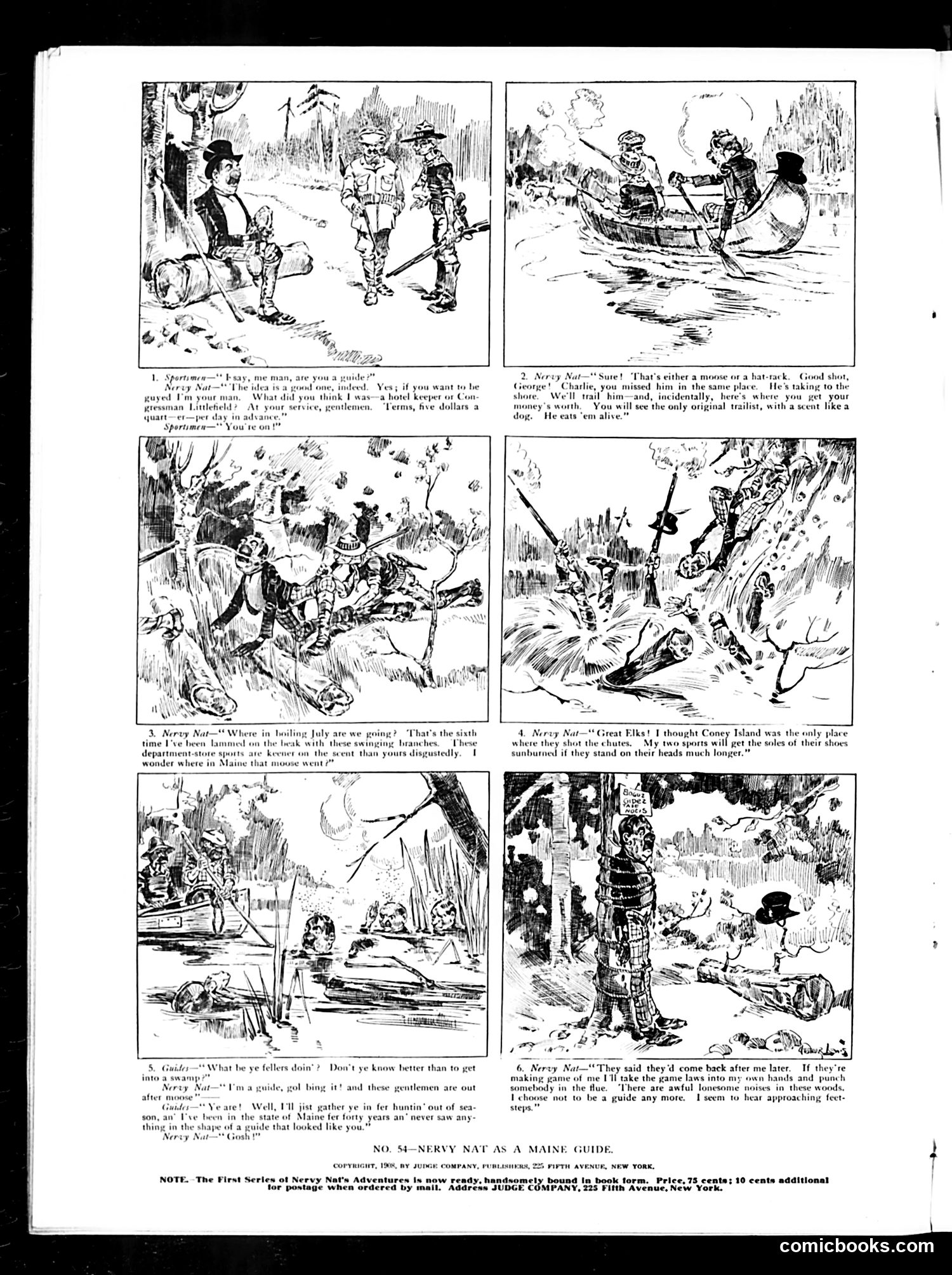
This is a six-panel comic strip featuring "Nervy Nat," a recurring character in Judge magazine. The strip depicts Nat posing as a Maine hunting guide, though he's clearly incompetent and fraudulent. The humor derives from Nat's bluffing and improvisation as he tries to maintain his false authority while guiding wealthy sportsmen. Key running gags include: his misdirection about game laws, his inability to actually find game (culminating in the hunters accidentally shooting at each other), and his casual dismissal of safety concerns ("They said they'd come back after me later"). The satire targets both Nat's con-artist nature and the gullible wealthy tourists willing to hire unqualified guides. The Maine wilderness setting and hunting context were popular subjects for comedy in this era, often playing on urban sportsmen's vulnerability to rural con men. The strip's title emphasizes Nat's "nervy" audacity in attempting this deception.
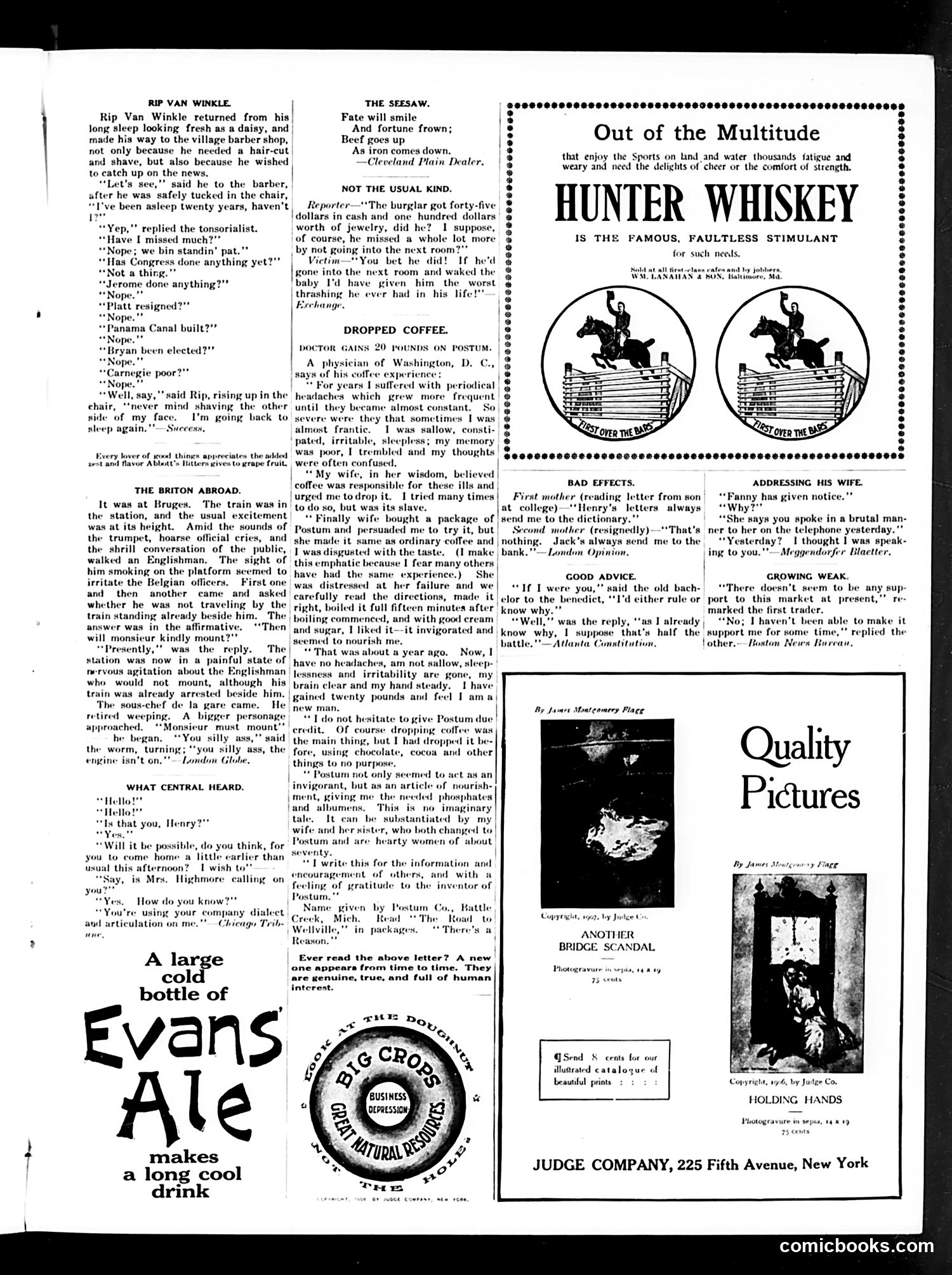
This page contains several short humorous pieces typical of early 20th-century satirical journalism: **"Rip Van Winkle"** plays on Washington Irving's famous character, using his long sleep as a framework for political satire. The barber responds to Rip's question about news with "Nope"—repeatedly—implying that Congress and political figures (Jerome appears to reference New York politics) accomplish nothing. The joke's point: government inactivity is so complete that even after 20 years' absence, nothing has changed. **"The Briton Abroad"** mocks English tourists' arrogance and obliviousness. An Englishman refuses to board his train, stubbornly insisting "the engine isn't on" while French officials grow increasingly exasperated. The satire targets British condescension toward Continental Europeans. The remaining items are advertisements (Evans Ale, Big Cross beverages, Hunter Whiskey, and Judge Company photo prints) interspersed with brief joke fillers about miscellaneous topics. The page is primarily **advertising-driven** with satirical content serving as filler between commercial messages.
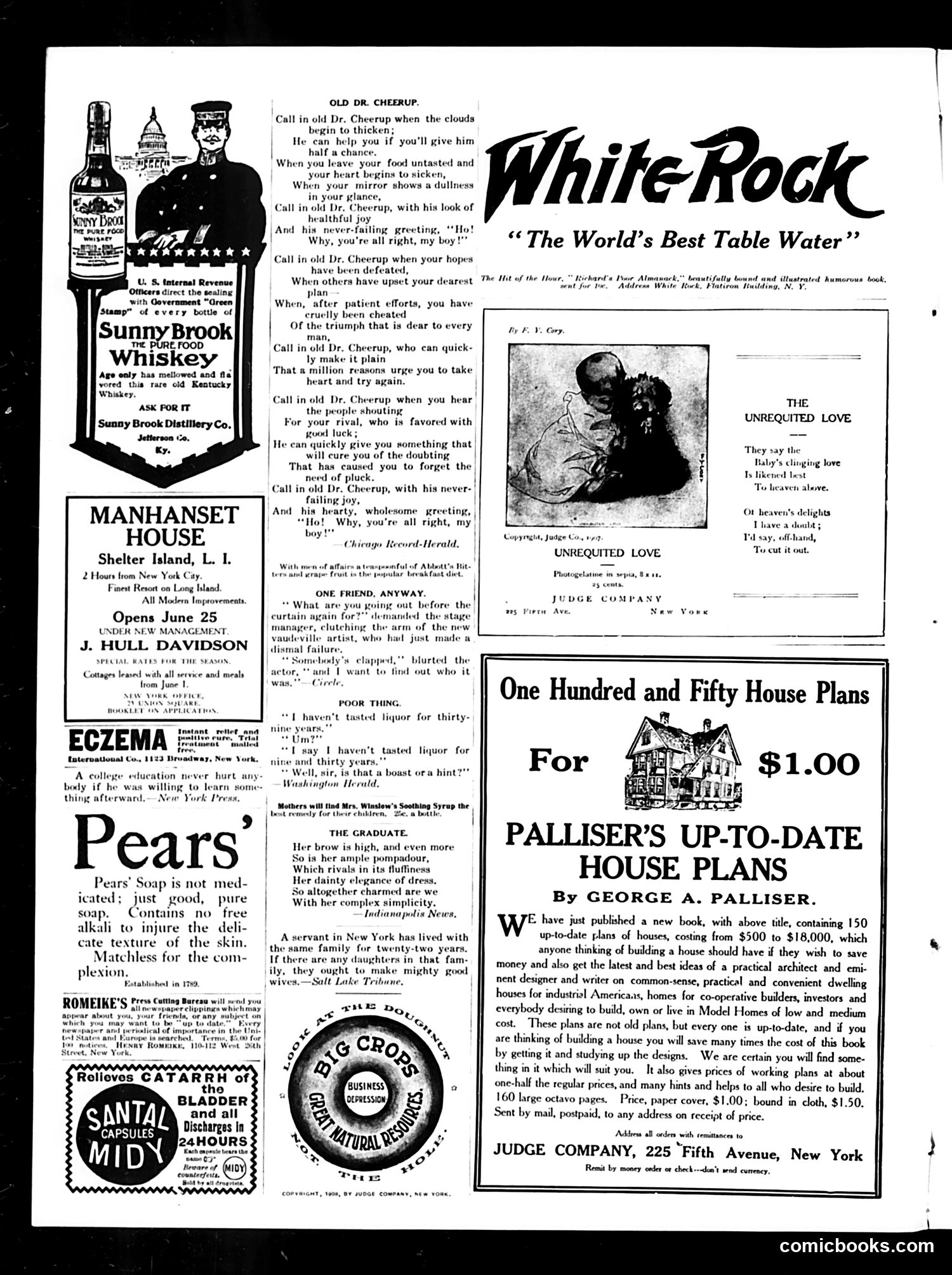
This page is primarily **advertising**, typical of early-1900s magazines. The main content consists of product advertisements (Sunny Brook Whiskey, Pears' Soap, Eczema treatment) and service ads (Manhanset House resort, house plan books). The editorial content includes brief humorous items: "Old Dr. Cheerup" (a sentimental poem about optimism during hardship), "One Friend, Anyway" (a workplace anecdote about theater etiquette), "Poor Thing" (a joke about temperance—someone bragging about thirty years without alcohol), and "The Graduate" (a poem about feminine beauty). There's also a **White Rock table water advertisement** featuring an illustration and a poem titled "Unrequited Love." No political satire or caricature is evident. The page reflects early-1900s consumer culture, with themes of self-improvement, proper behavior, and domestic aspiration. The humor is genteel and moralistic rather than cutting or political.
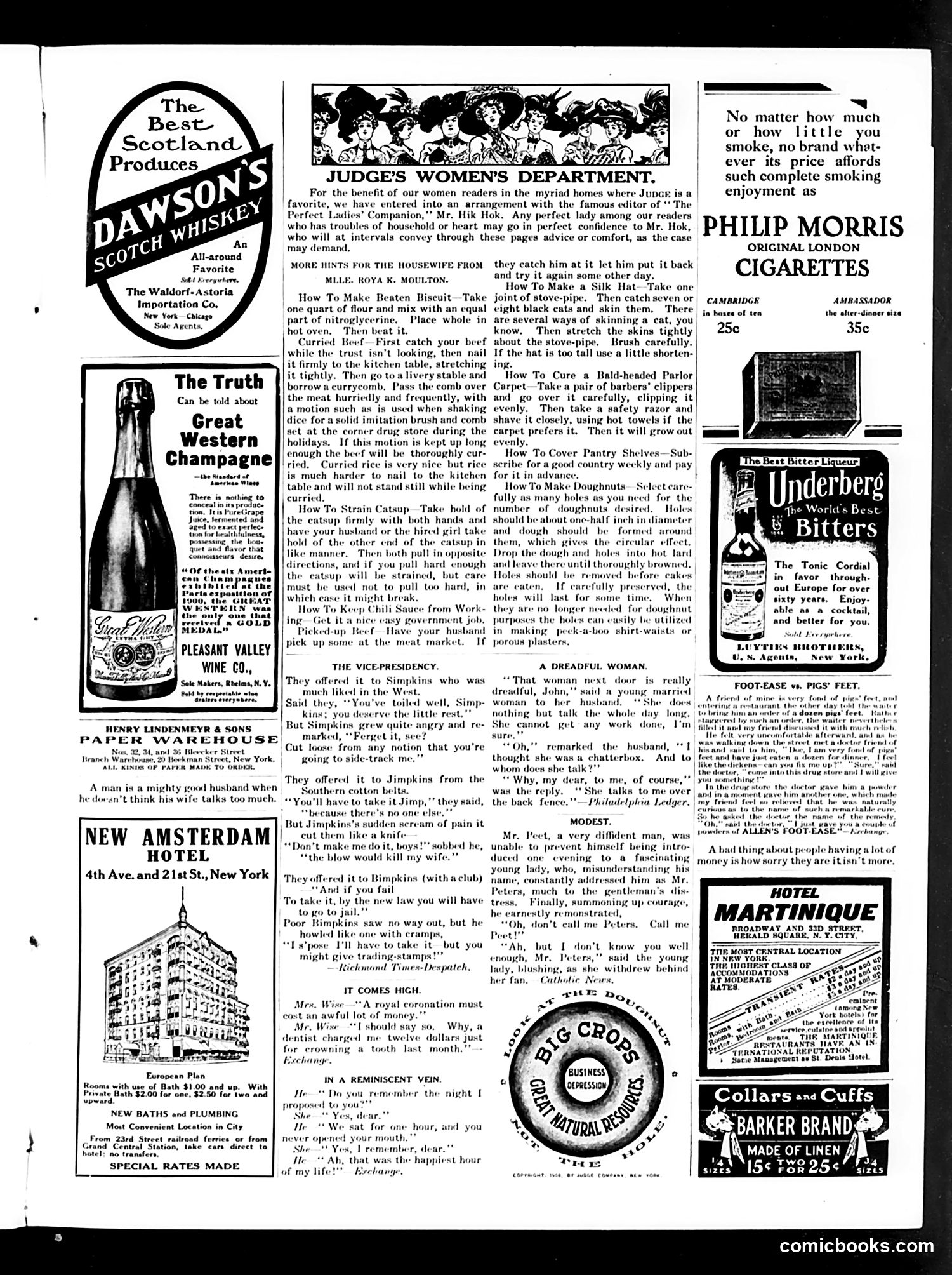
This page is primarily **advertising and household advice**, not political satire. The main content is "Judge's Women's Department," a humor column offering absurdly impractical domestic tips. The jokes mock Victorian-era housekeeping by presenting ridiculous instructions: making biscuits with explosives, currying beef by nailing it to a table, or making doughnuts from "holes." The humor lies in the deliberately nonsensical advice. A sidebar includes brief anecdotes about the vice-presidency (apparently someone named Simpkins refused the nomination), and a domestic joke about a talkative wife. These are gentle domestic humor, not political commentary. The surrounding advertisements—for Dawson's Scotch Whiskey, Philip Morris cigarettes, Underberg Bitters, and a hotel—reflect turn-of-century products and consumer culture. Overall, this appears to be a leisure-focused magazine page mixing light domestic satire with advertising, aimed at middle-class readers.
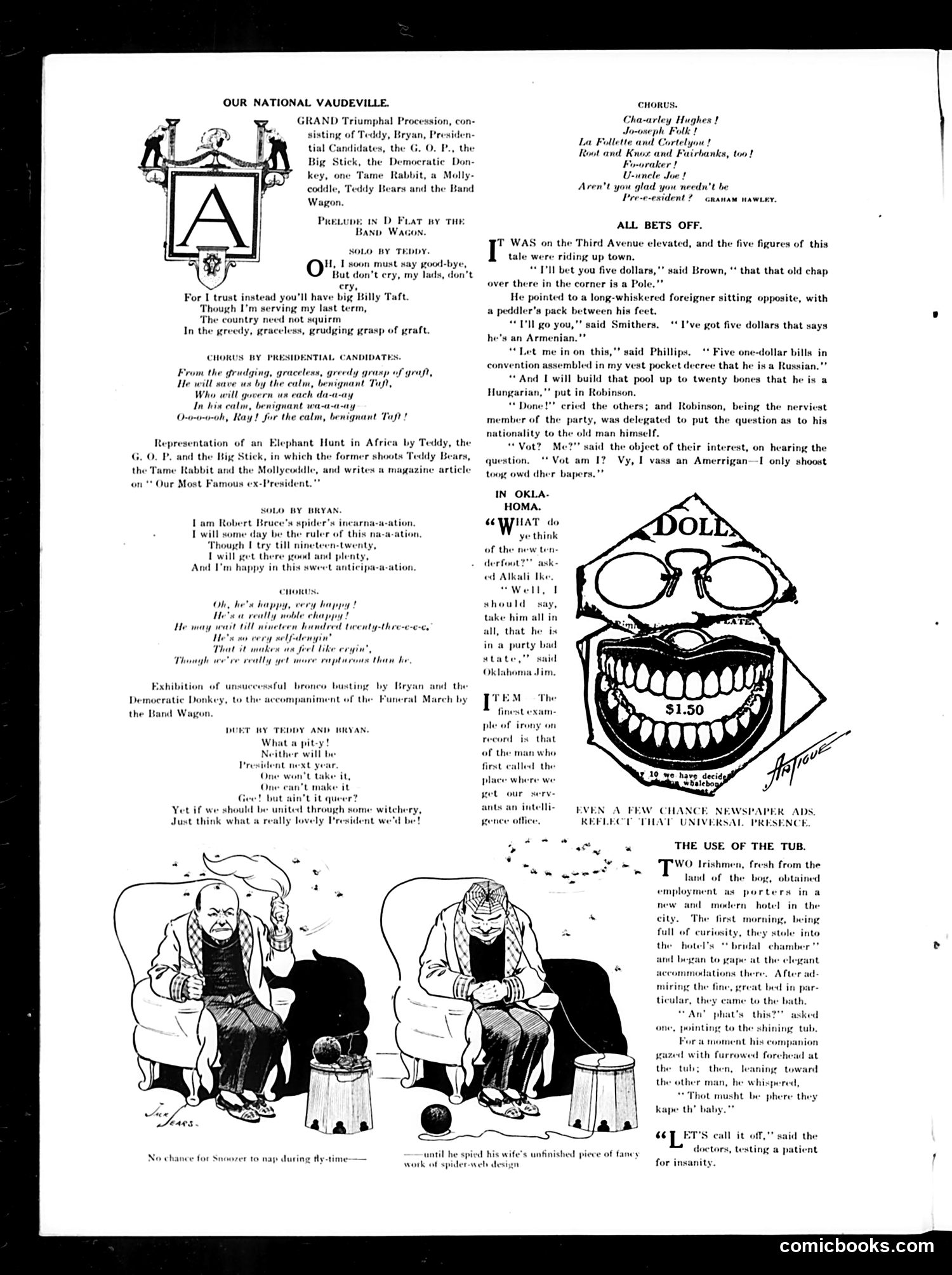
This page satirizes the 1908 U.S. presidential succession. President Theodore Roosevelt ("Teddy") is stepping down and endorsing William Howard Taft as his successor. The centerpiece is a mock vaudeville show featuring: **Main figures:** Roosevelt (solo), William Jennings Bryan (the recurring Democratic challenger), and various Republican candidates including Taft, Charles Evans Hughes, and others mentioned in the chorus. **The satire:** Roosevelt and Bryan are portrayed as entertainers in a "Grand Triumphal Procession" with absurd props (Democratic Donkey, Big Stick, Band Wagon). The songs mock their political ambitions—Roosevelt confidently hands power to Taft; Bryan repeatedly tries and fails ("spider's incarnation"). **The joke:** American politics is presented as cheap vaudeville entertainment rather than serious governance. The elaborate theatrical staging ridicules the candidates' posturing and the predictable nature of electoral cycles. Secondary pieces mock ethnic stereotyping and frontier attitudes, typical of the era's casual prejudice.
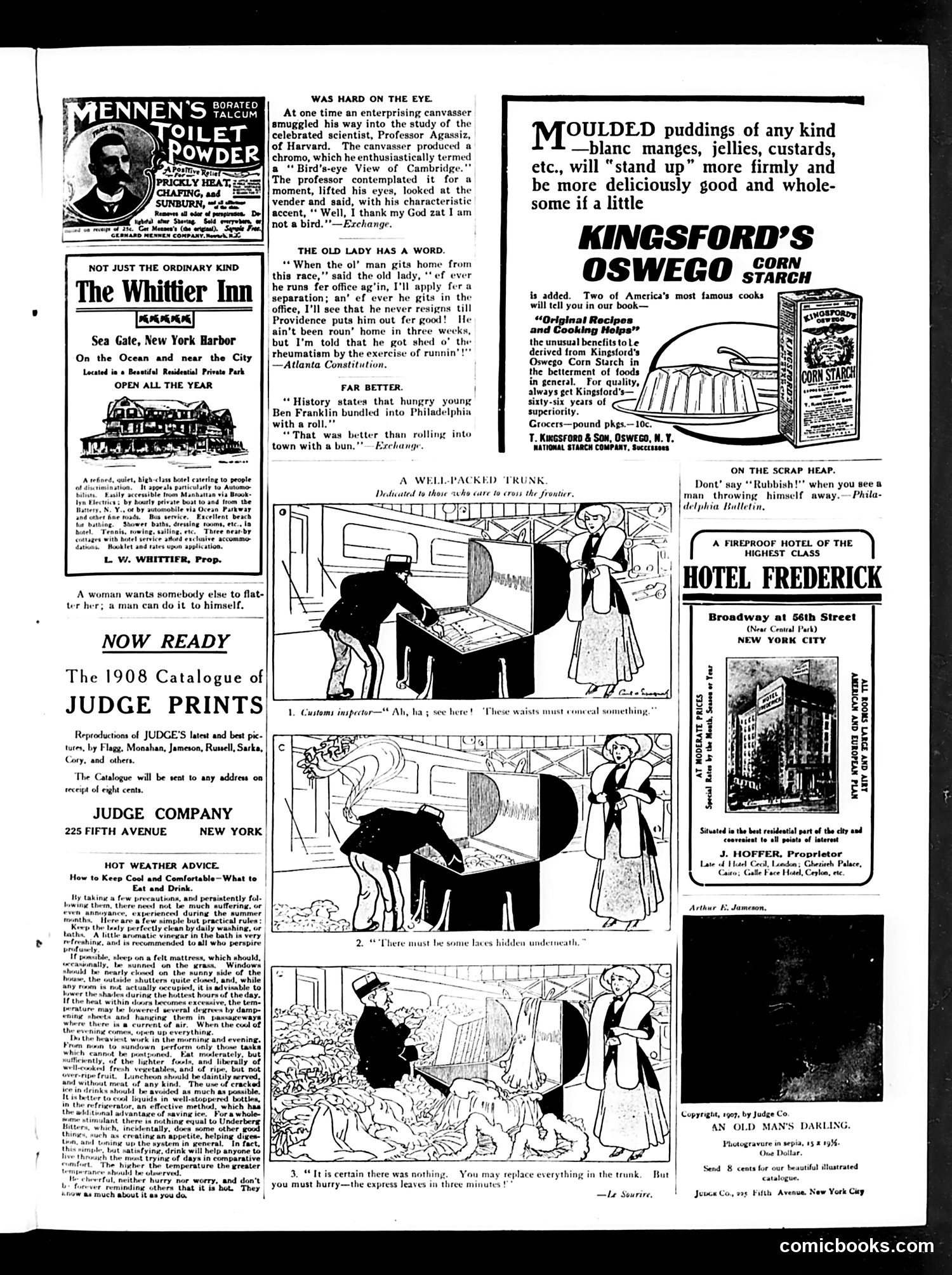
This three-panel comic by Arthur E. Jameson satirizes marital conflict over a husband's frequent absences. A customs inspector examines a couple's trunk at a border crossing, discovering it's stuffed with the wife's belongings. The humor escalates through three scenarios: 1. The wife points out her husband's waistcoats need concealing—a dig at his vanity. 2. She notes hidden undergarments—suggesting marital intimacy issues. 3. The punchline: when told "everything in the trunk" must be declared, she insists on leaving her husband behind instead, as he's "nothing" worth reporting. The satire targets both spouses: the husband's self-absorption and chronic absence from home (referenced in surrounding text about political campaigning), and the wife's exasperation transforming into dark humor about disposing of him entirely. The border-crossing setting provides comic distance for airing domestic grievances.
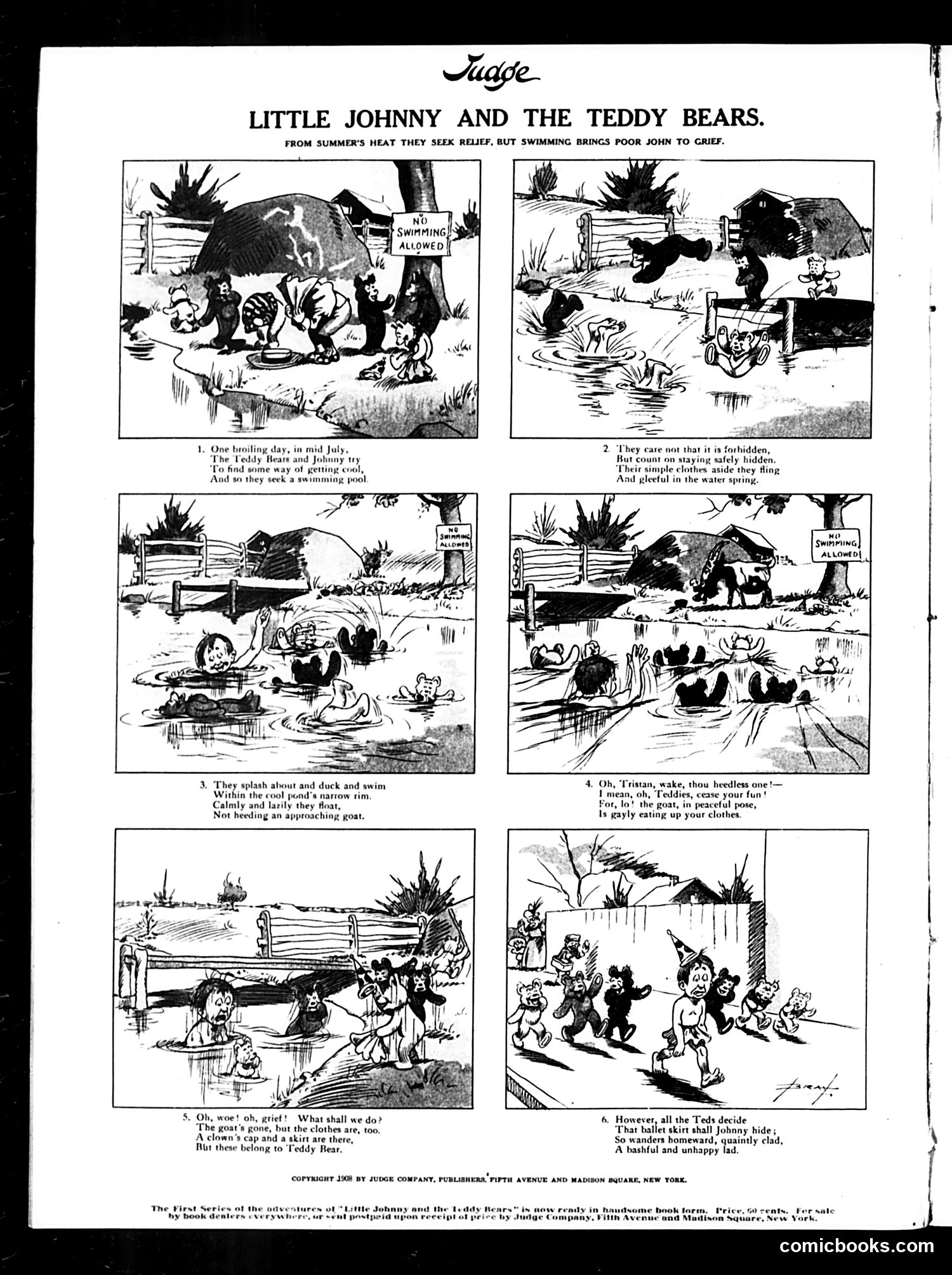
This is a humorous six-panel children's story from Judge magazine (1908) with no political content. It depicts Little Johnny and anthropomorphic teddy bears seeking relief from summer heat by swimming in a forbidden pond. The bears remove their clothes and enter the water; meanwhile, a goat eats their garments. When the bears discover their missing clothes, they find only a clown's cap and ballet skirt belong to Teddy Bear. Johnny must wear the ballet skirt home, arriving "bashful and unhappy." The joke relies on physical comedy and gender humor typical of early 1900s children's entertainment—a boy forced to wear girls' clothing becomes the punchline. The story serves primarily as advertising for an upcoming "Little Johnny and the Teddy Bears" book series.