
A complete issue · 16 pages · 1908
Judge — June 6, 1908
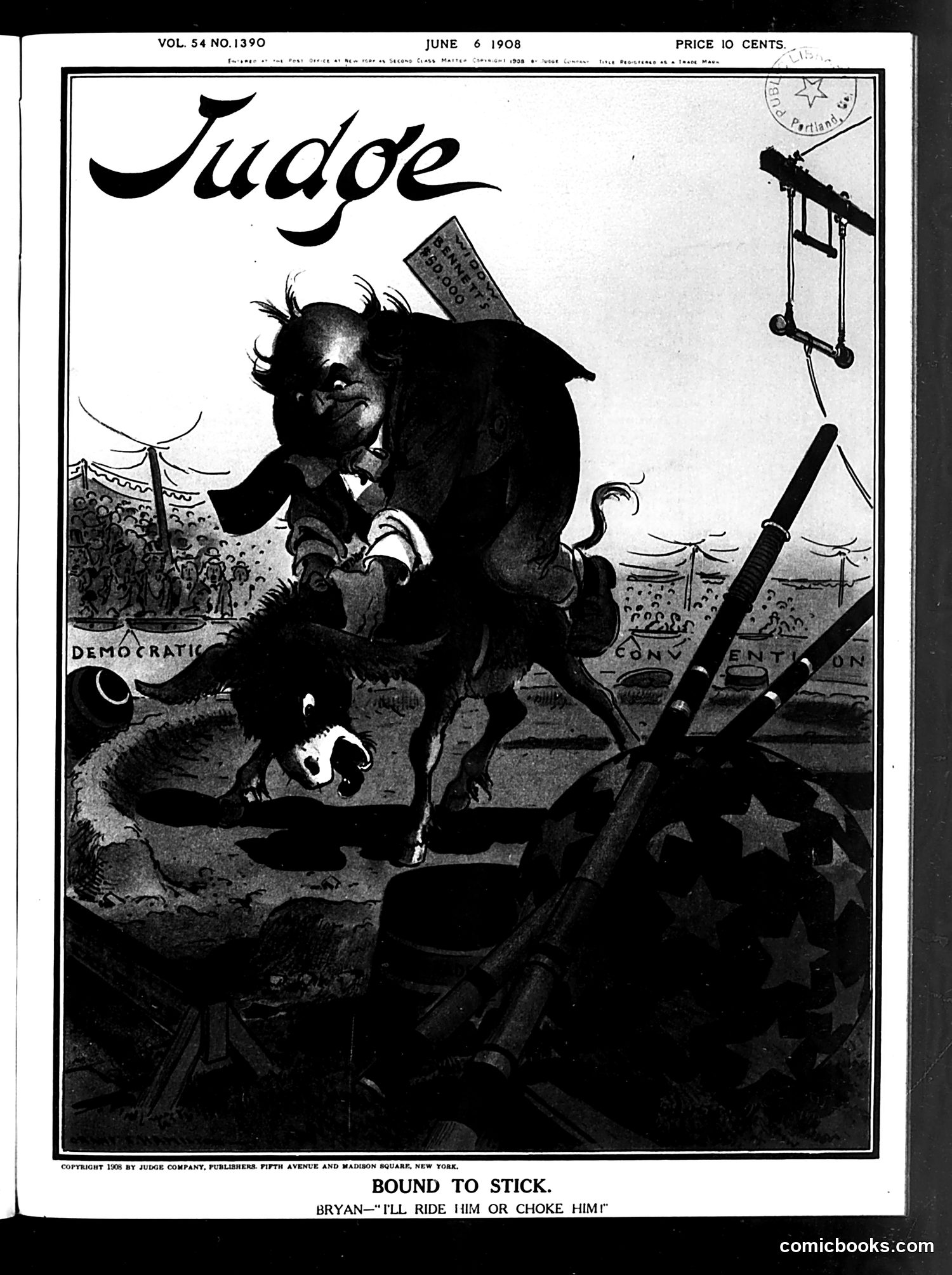
This political cartoon satirizes Democratic and Republican party conventions (visible in tent labels in background). The central figure appears to be a donkey—the Democratic Party symbol—wearing judicial robes and a gavel, carrying what looks like a legal document. The donkey is "bound to stick" (per the title), suggesting the Democratic Party is constrained by legal or party obligations. The caption quotes Bryan—likely William Jennings Bryan, the three-time Democratic presidential candidate—saying "I'll ride him or choke him," implying internal party conflict over leadership or direction. The cannon and military imagery suggest political warfare between the parties during the 1908 election cycle. The satire critiques Democratic Party divisions and Bryan's controversial influence.
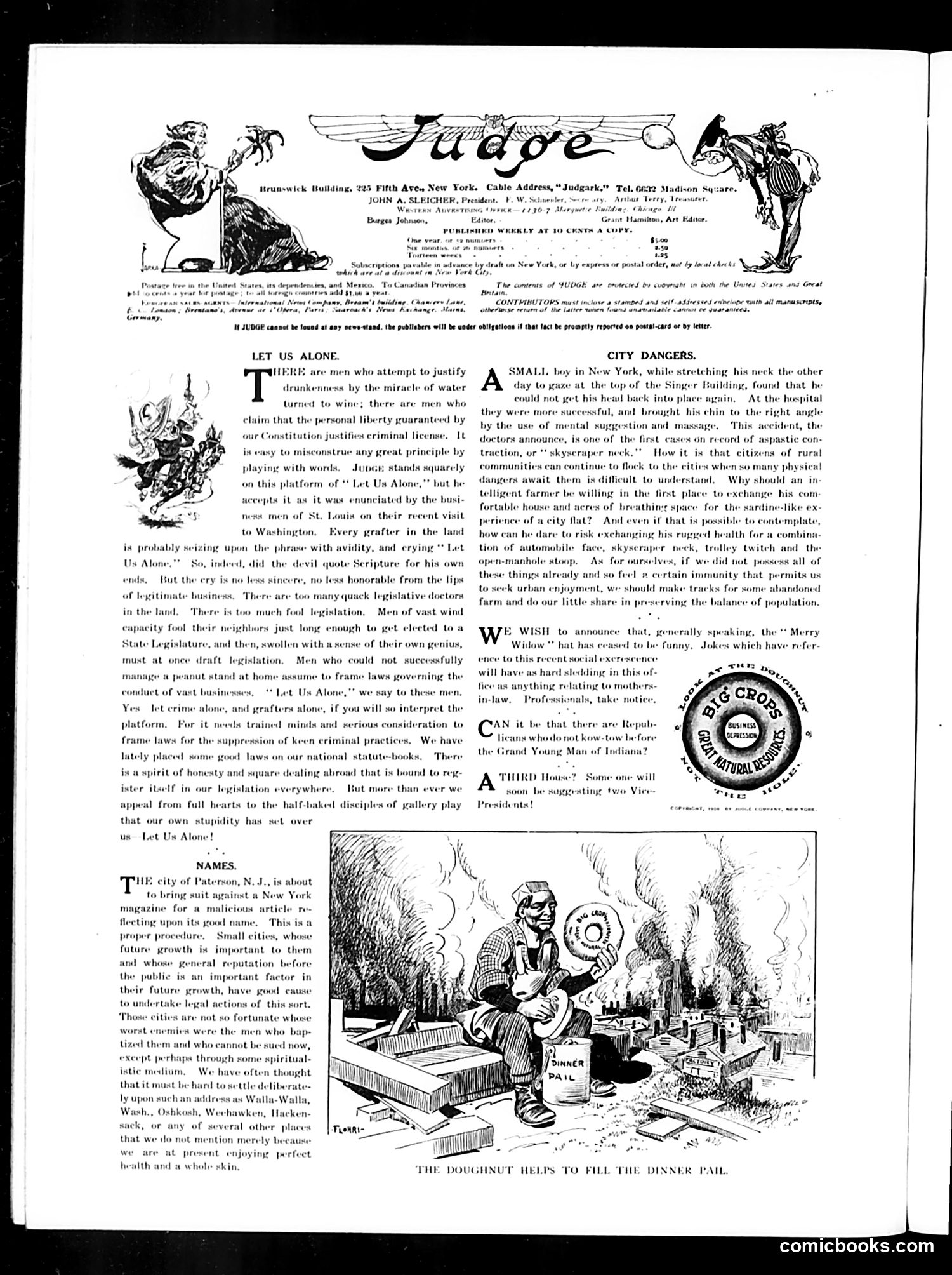
This page contains three distinct sections: **"Let Us Alone"** (left): A political editorial arguing against government intervention in business, using the recent visit of St. Louis businessmen to Washington as an example. The author criticizes legislators for overreach and appeals to principles of personal liberty and minimal state regulation. **"City Dangers"** (right): A brief article warning rural farmers about urban hazards—specifically "skyscraper neck" (a medical condition from looking up at tall buildings). It's satirical commentary on how city life poses unfamiliar physical dangers to country people unaccustomed to urban environments. **"The Doughnut Helps to Fill the Dinner Pail"** (bottom cartoon): The illustration depicts a working-class man eating a doughnut, likely satirizing inadequate wages where cheap food supplements insufficient meals—social commentary on labor conditions and worker poverty.
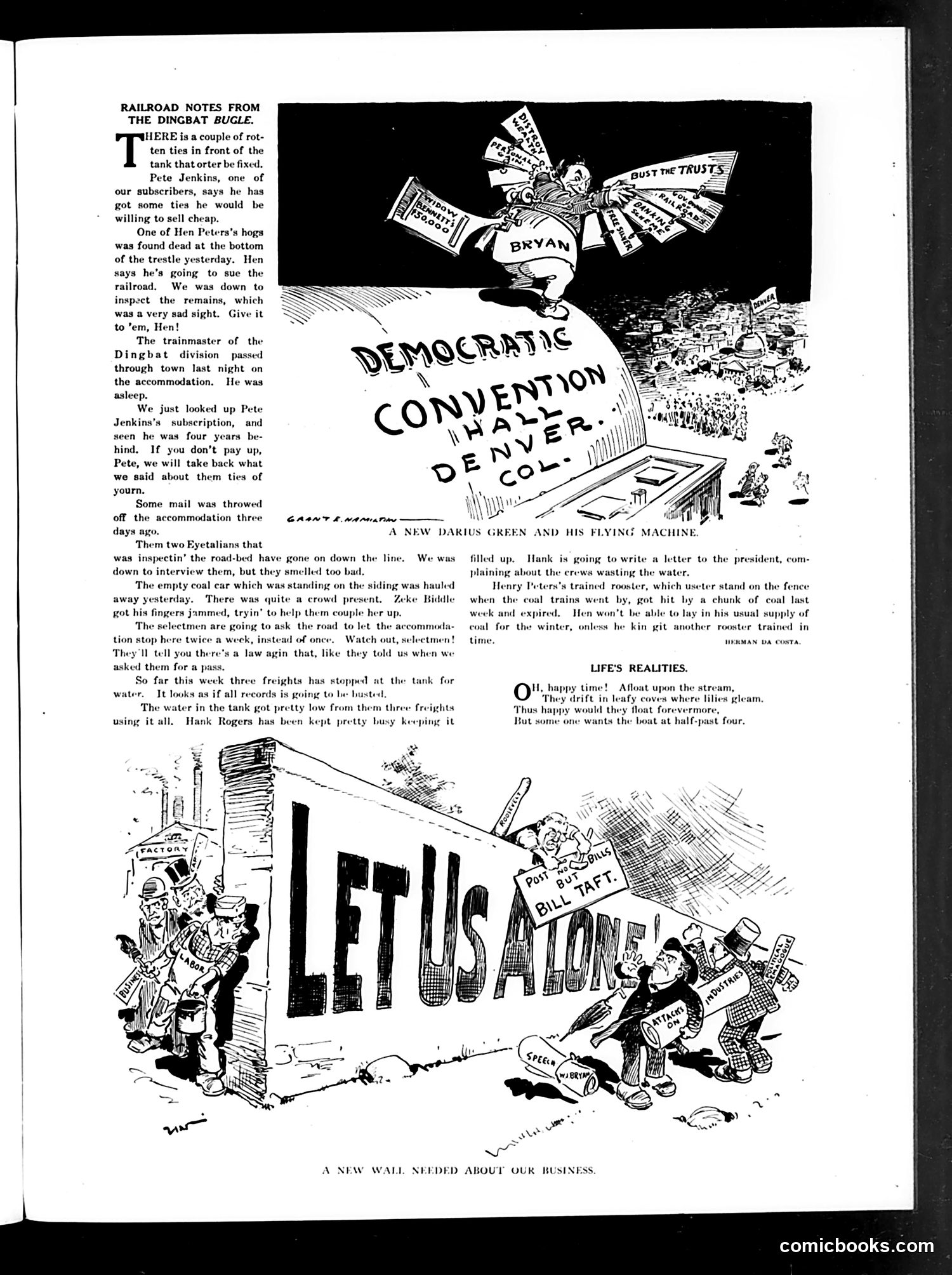
The top cartoon depicts **William Jennings Bryan** (labeled) at the 1908 Democratic Convention in Denver, Colorado. Bryan is shown as a chaotic figure juggling various political issues and platforms—depicted as papers and banners—while attempting to control the convention. The satire mocks his role as a dominant but unpredictable force in Democratic politics. The bottom cartoon, titled "LET US ALONE," shows factory owners and business interests (on the left) confronting what appears to be labor or regulatory pressures (right side figures). The satire criticizes calls for new business regulations, with the caption "A NEW WALL NEEDED ABOUT OUR BUSINESS," suggesting business elites wanted protection from government intervention during the Progressive Era.
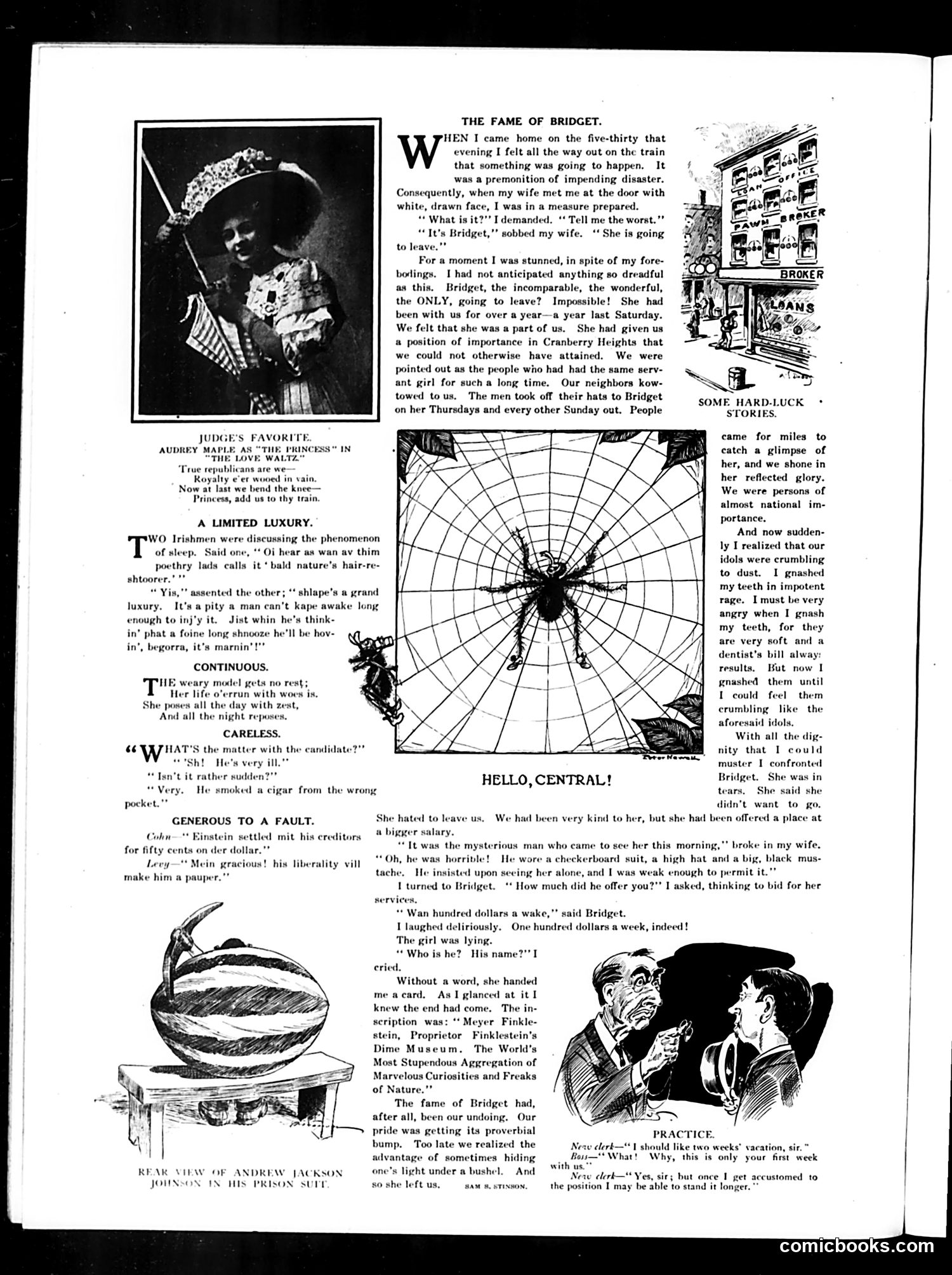
This page contains several satirical pieces unrelated to political figures or current events. "The Fame of Bridget" is the main story—a humorous narrative about a domestic servant named Bridget who becomes locally celebrated and is offered a higher-paying job elsewhere. The narrator's wife is devastated at the prospect of losing her, revealing social anxieties about household help and class dynamics in early 20th-century urban America. The smaller jokes ("A Limited Luxury," "Careless," "Generous to a Fault," "Practice") are typical Judge humor targeting everyday situations: Irish servants, smoking etiquette, and professional interactions. The cartoons are illustrative rather than explicitly political. The content reflects period attitudes toward domestic service and social hierarchies.
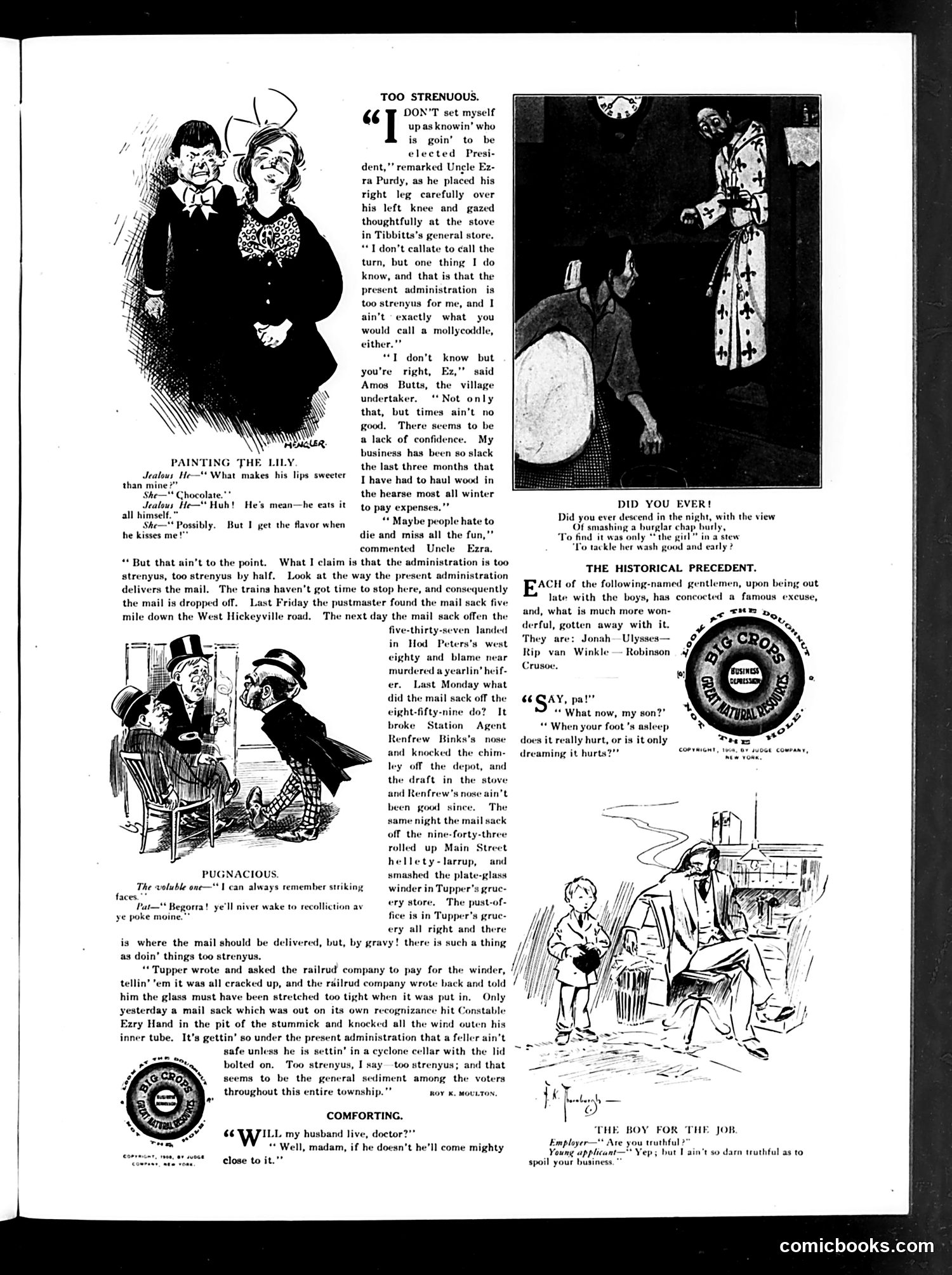
This page contains several satirical pieces criticizing what appears to be a contemporary local administration (likely early 20th century based on style). The main article, "Too Strenuous," features Uncle Ezra Purdy complaining that the current administration is "too strenuous." He cites specific grievances: mail service failures (a mail sack lost for five miles), railroad company disputes, and a constable knocking a man's nose off at the depot. The satire mocks the administration's incompetence despite its active stance. Other cartoons include "Painting the Lily" (about politicians' exaggerated claims) and "Comforting" (domestic humor). The pieces collectively suggest frustration with ineffective local governance presented as overly aggressive or energetic yet fundamentally dysfunctional. The tone is decidedly skeptical of administrative promises and performance.
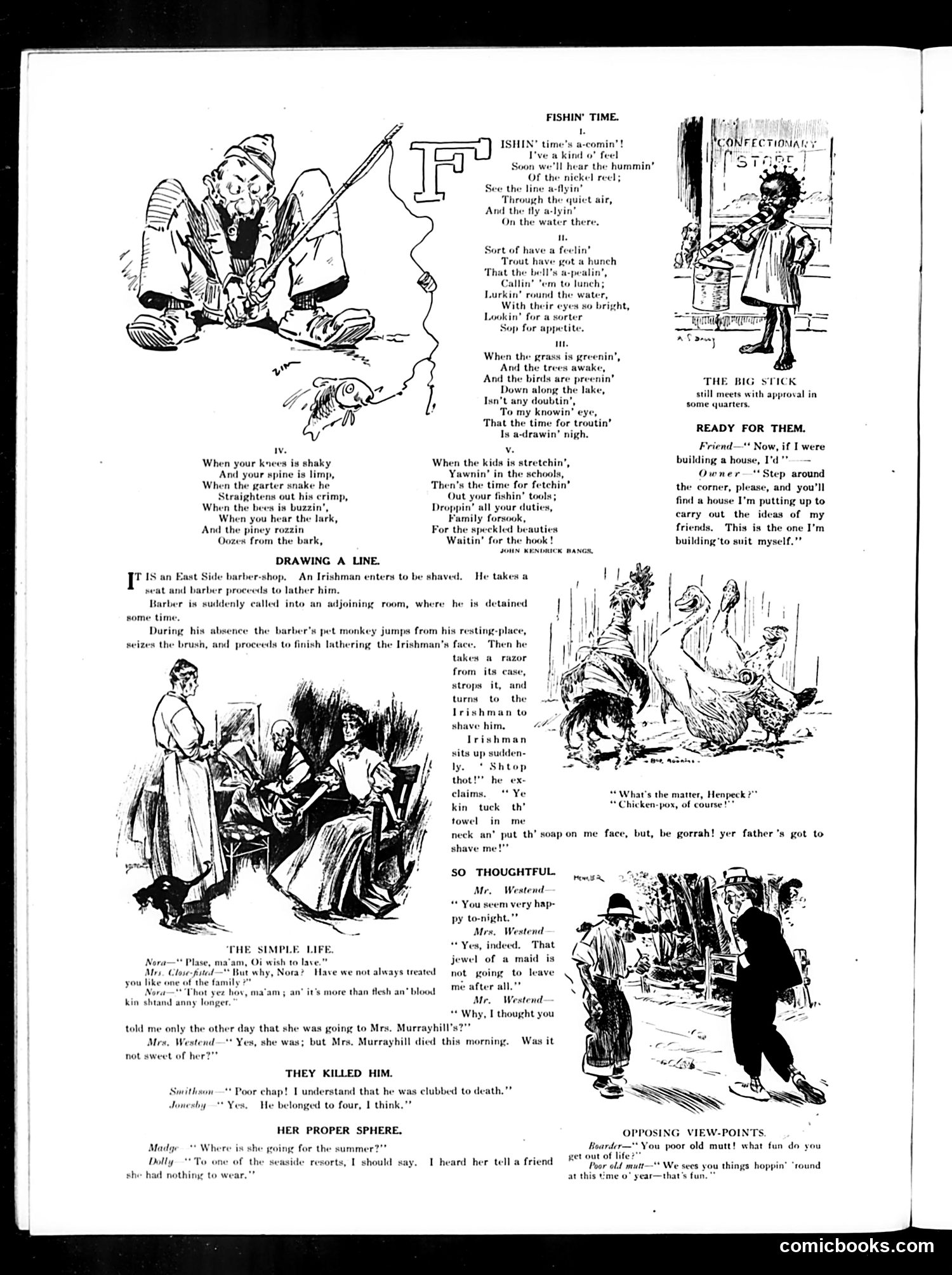
This page contains several satirical pieces typical of early 20th-century American humor: **"Fishin' Time"** is a nostalgic poem celebrating spring fishing season, illustrated with a contented angler—straightforward recreational humor with no political content. **"Drawing a Line"** depicts an Irish immigrant at a barber shop where a monkey (left unsupervised) has lathered his face and grabbed a razor. The Irishman protests, refusing to be shaved by an animal. This plays on ethnic stereotypes common to the era, using an Irish character for comedic effect in a slapstick scenario. **Other brief humor pieces** ("So Thoughtful," "Ready for Them," "Opposing View-Points") are domestic comedy vignettes about servants leaving, house-building disagreements, and differing attitudes toward entertainment—reflecting middle-class anxieties and social observations of the period. The page contains no apparent political satire or commentary on major contemporary events—it's primarily lighthearted social humor and recreation content typical of Judge's entertainment focus.
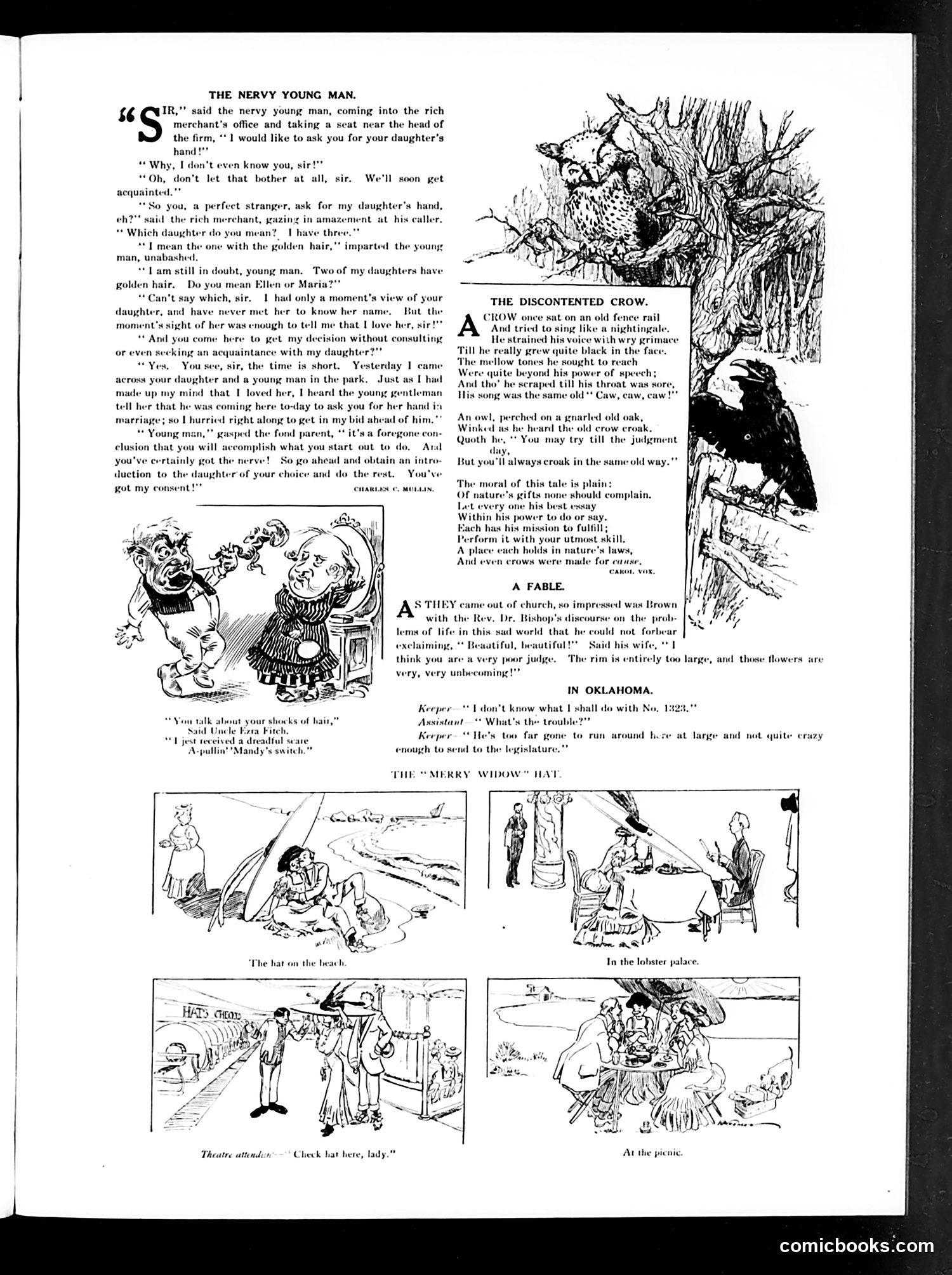
This page contains several satirical pieces typical of early 20th-century American humor: **"The Nervy Young Man"**: A comedy sketch mocking social climbing and audacity. A complete stranger brazenly proposes to a merchant's daughter after glimpsing her once, claiming instant love. The joke satirizes both the young man's shameless presumption and the merchant's grudging admiration for his nerve—rewarding bad behavior with consent. **"The Discontented Crow"**: A moral fable about accepting one's nature. A crow futilely attempts to sing like a nightingale but can only "caw." An owl warns him that complaining won't change his nature. This appears to critique people who reject their station or abilities. **"In Oklahoma"**: A brief political joke suggesting an Oklahoma politician is "too far gone" for normal society but "not quite crazy enough" for the state legislature—a jab at Oklahoma's political reputation. **"The Merry Widow Hat"**: A series of comic vignettes about a fashionable hat, likely referencing the popular operetta "The Merry Widow" (1905). The page exemplifies Judge's mix of social satire, moral instruction, and topical humor.
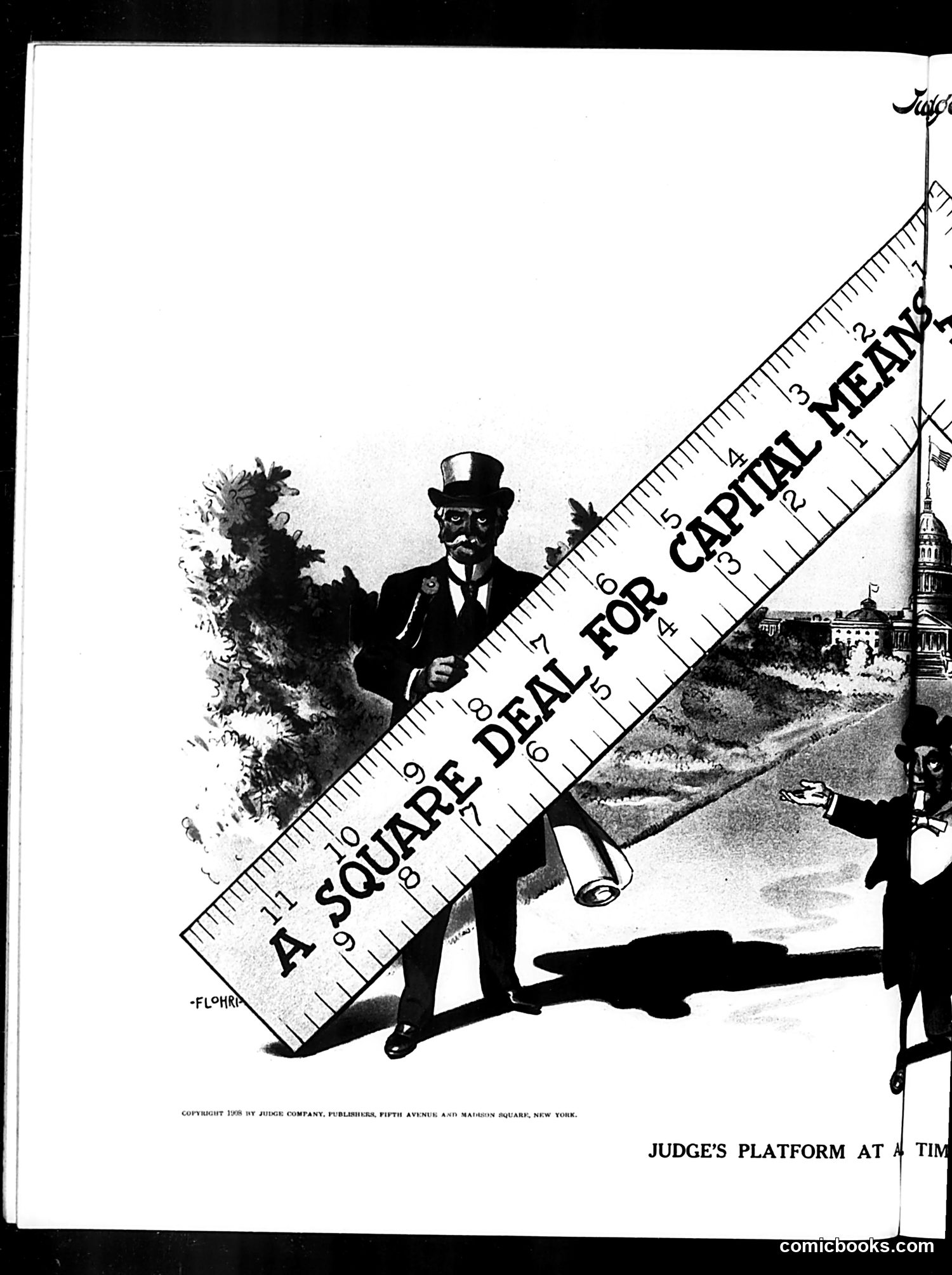
This political cartoon depicts a man in formal attire (top hat, suit) holding an oversized ruler or measuring stick labeled "A SQUARE DEAL FOR CAPITAL MEANS." The text appears cut off but likely continues with something critical of capitalist interests. The figure appears to be a politician or public figure using measurement as a metaphor—suggesting he's offering to "measure" or calibrate a "square deal" for capital/wealthy interests. The explosion or disturbance on the left, combined with the Capitol building visible in the background, suggests this is satirizing political promises made to business interests. Without the complete caption and full date visible, the specific reference remains unclear, though this appears critical of politicians appearing to offer favorable terms to capitalists. The cartoon likely critiques political compromise with wealthy interests.
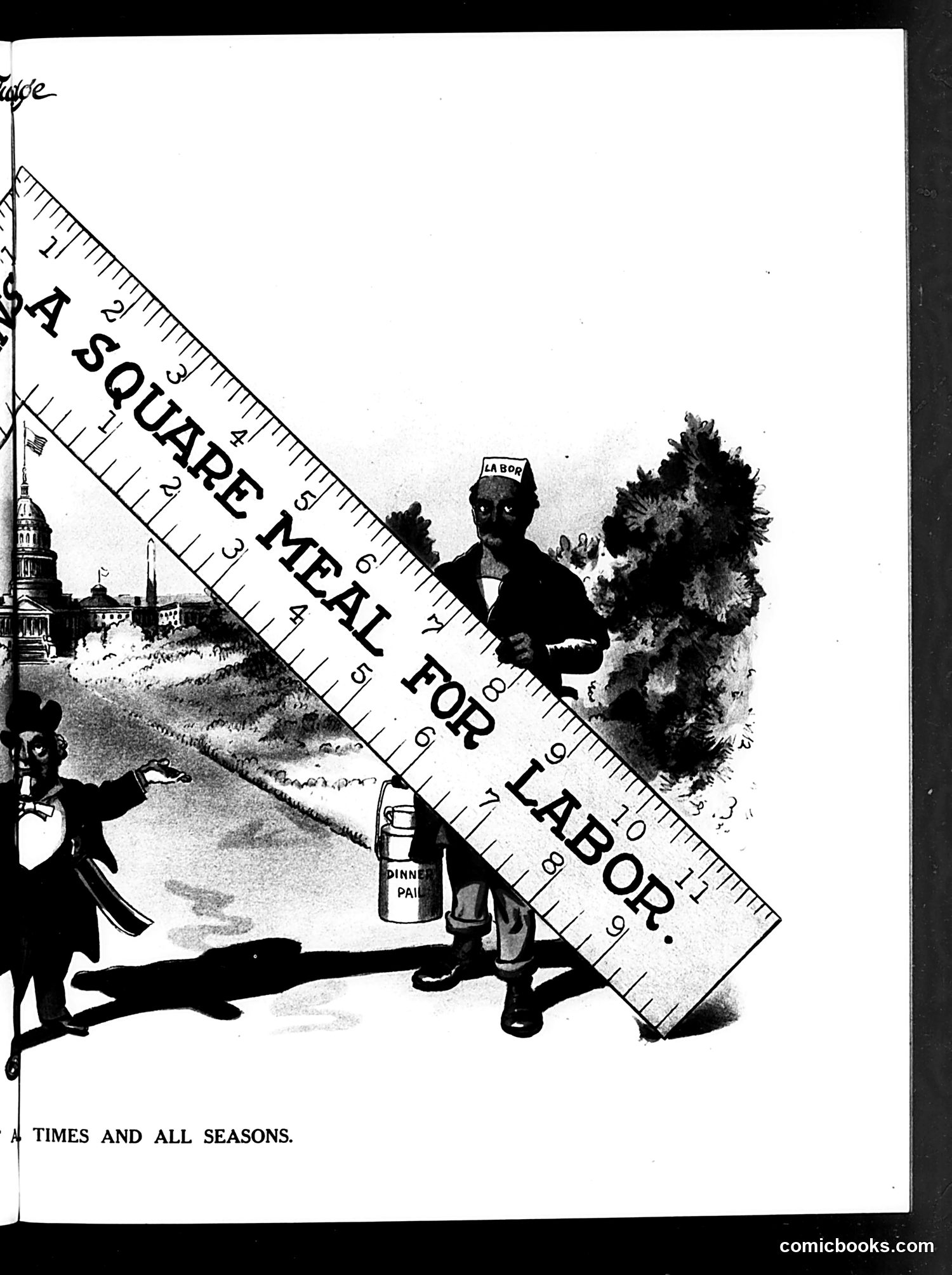
This political cartoon satirizes labor disputes and working conditions. A giant measuring tape labeled "A SQUARE MEAL FOR LABOR" tilts precariously, with workers and figures struggling around its base. The imagery suggests labor is being "measured" or evaluated unfairly—the scale itself appears unstable and threatening to collapse. The background shows an industrial cityscape with a church spire, grounding the scene in urban America. "Dinner Pail" text is visible, likely referencing the "full dinner pail" political slogan associated with prosperity promises. The cartoon critiques how labor's demands for fair treatment and adequate compensation are dismissed or miscalculated by those in power. The unstable "square meal" measure suggests labor's basic needs are precariously balanced and constantly threatened.
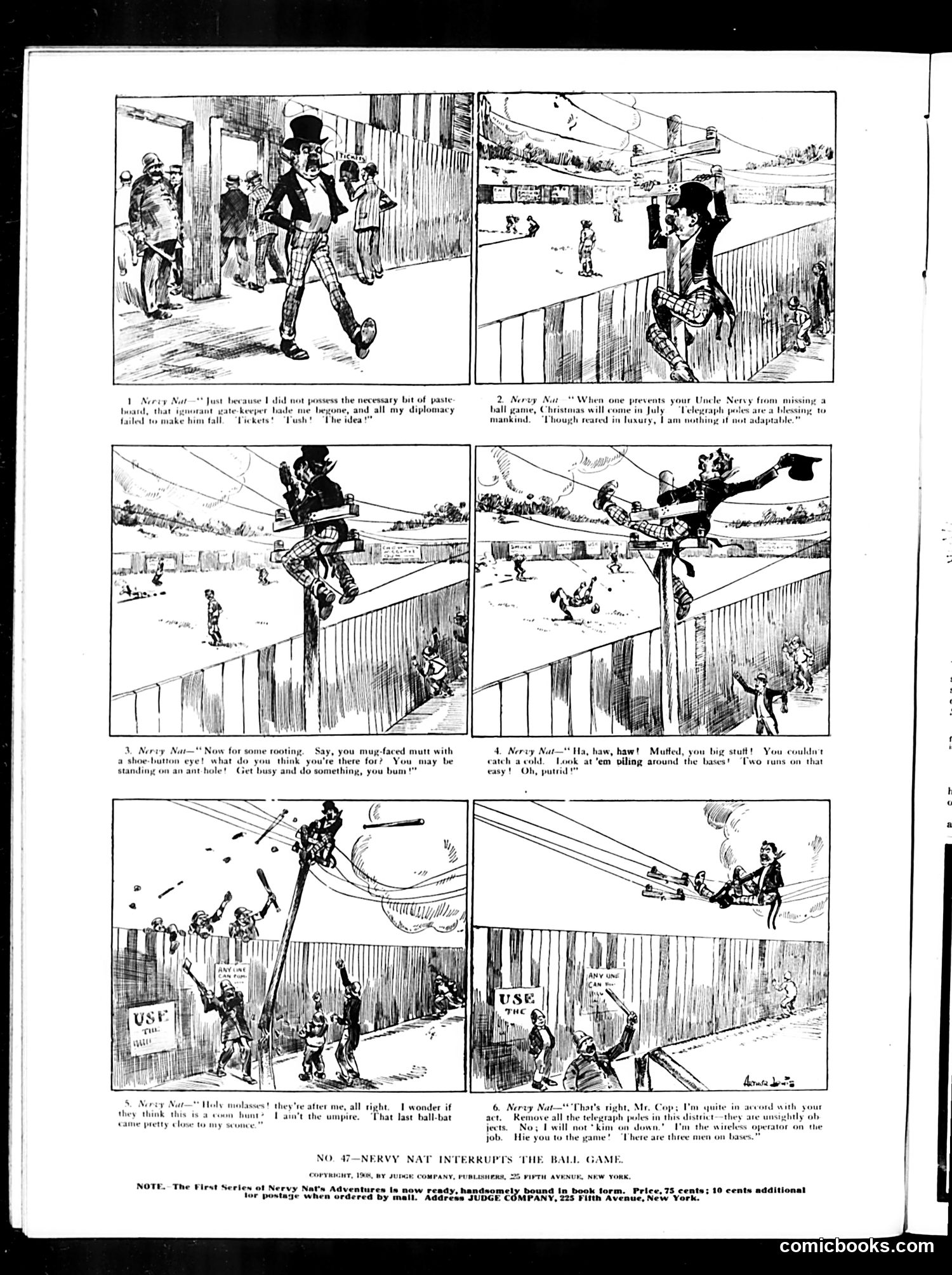
This is a six-panel comic strip featuring "Nervy Nat," a character dressed in formal attire (top hat and coat) who repeatedly disrupts a baseball game. The satire centers on Nat's diplomatic pretensions and social climbing: he claims to lack "the necessary bit of paste" and diplomatic skill to fit in, yet consistently intrudes at the ballpark with absurd behavior—perching atop fences, interfering with play, and making grandiose pronouncements about being an "aimless operator." The joke is that Nat represents an overly formal, pretentious outsider attempting to participate in American popular entertainment (baseball) while remaining comically unsuited to it. His elaborate costume and affected speech contrast sharply with the informal sport. The strip mocks both Nat's social aspirations and the chaos his presence creates among ordinary ballpark attendees.
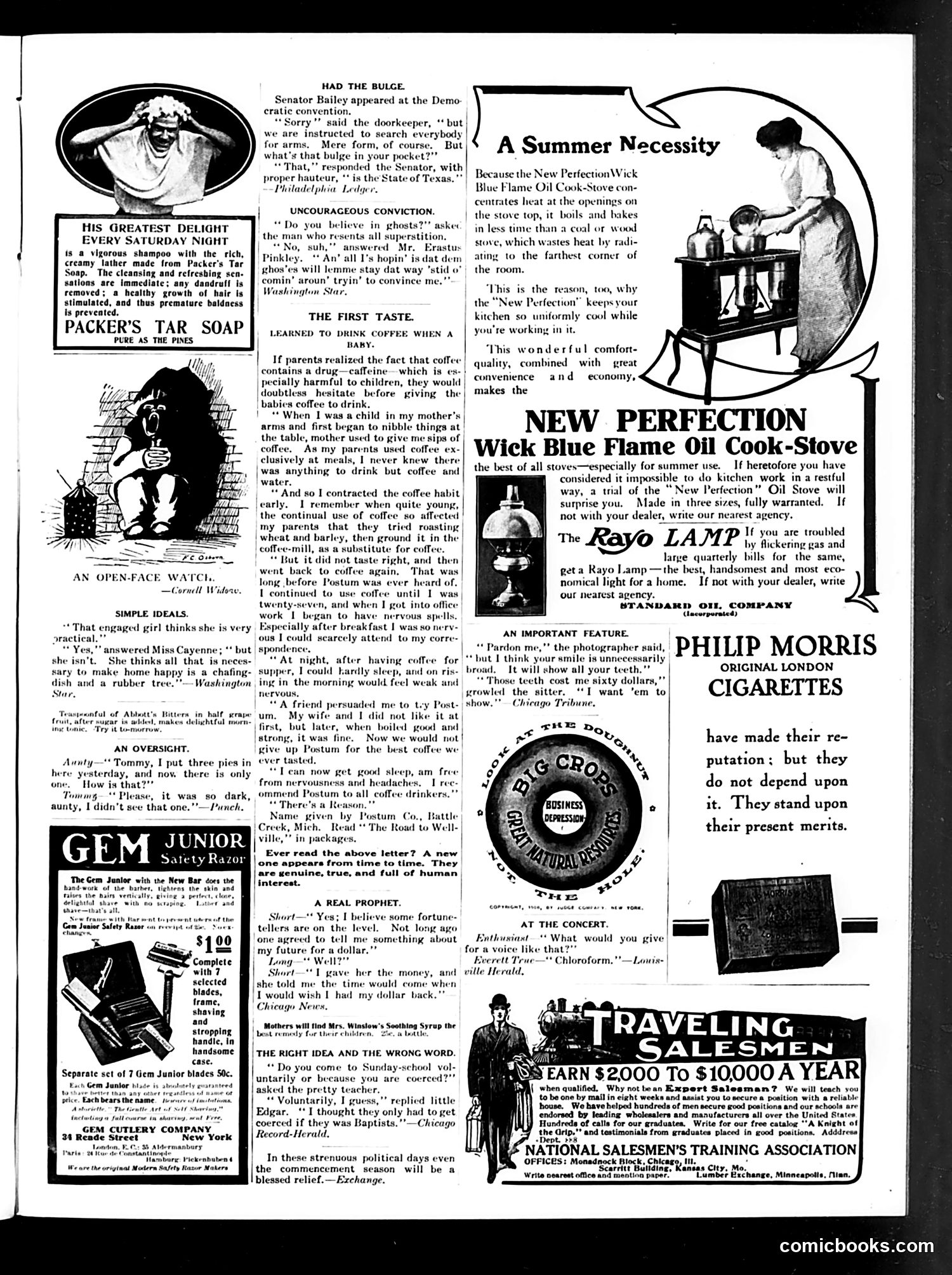
This page is primarily **advertisements and light humor columns**, not political satire. The one political cartoon present is "HAD THE BULGE," referencing Senator **Joseph W. Bailey** of Texas at a Democratic convention. The joke: when convention doorkeepers search attendees for weapons (a "mere form"), they're startled to find a suspicious bulge in Bailey's pocket. The humor plays on Bailey's reputation—likely as a controversial or disreputable figure whose presence at a Democratic gathering itself seemed suspicious to readers. The remainder of the page contains **consumer ads** (Packer's Tar Soap, Gem razors, Perfection oil stoves, Philip Morris cigarettes, Rayo lamps) interspersed with brief **domestic humor** columns about coffee habits, marriage ideals, and child misbehavior—typical Judge filler content from this era. The cartoons and anecdotes are apolitical, appealing to middle-class anxieties about household management and child-rearing.
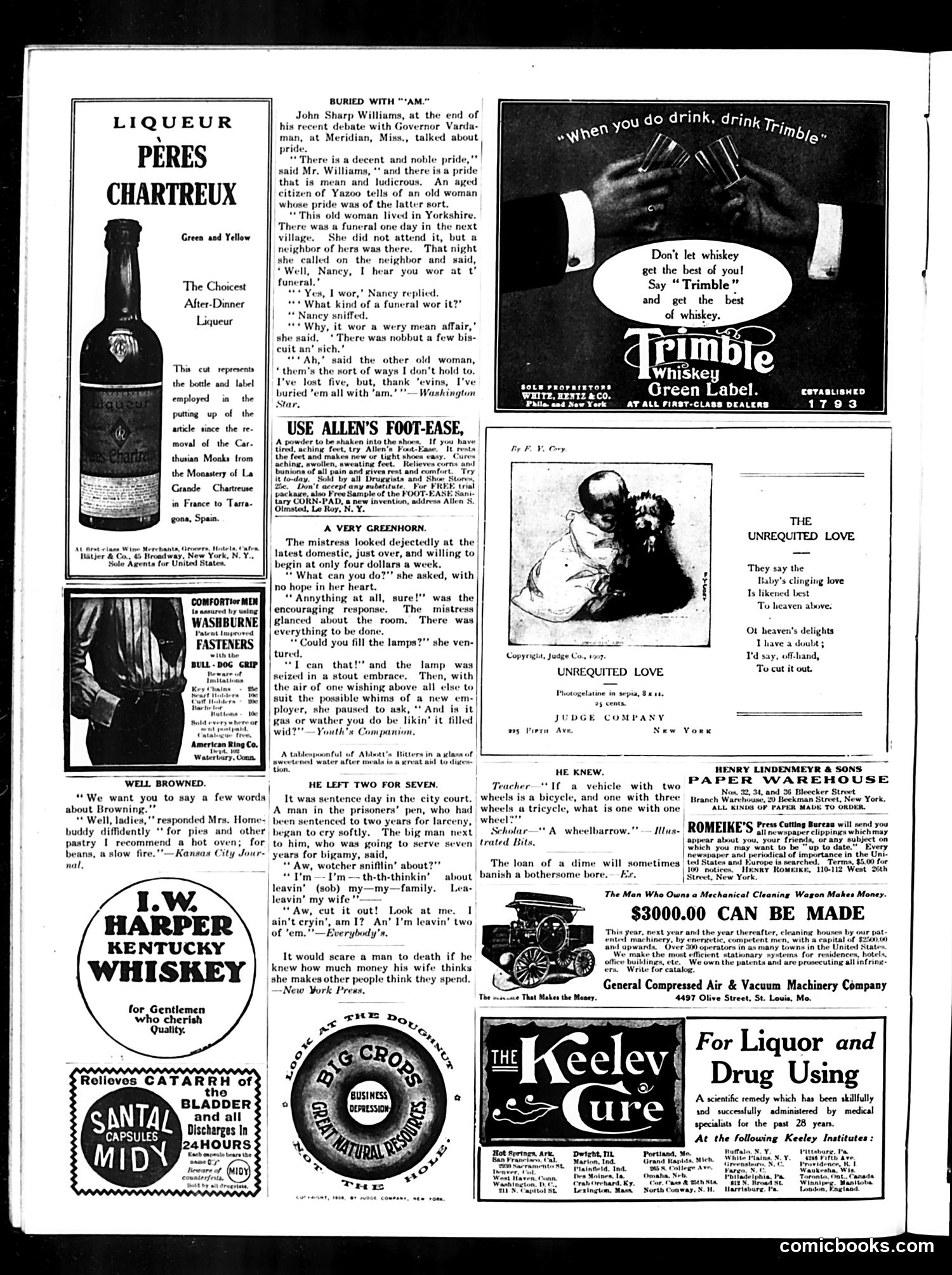
This page from *Judge* is primarily **advertisements and short humor pieces** rather than political satire. The political content is minimal: **"Buried with 'Am'"** features **John Sharp Williams**, a Democratic congressman, recounting an anecdote about an elderly Yorkshire woman whose excessive pride (burying her children in fine clothes) he criticized. The humor mocks misplaced pride among the poor—a common satirical target. Most of the page consists of **advertisements** for liquor (Chartreux liqueur, Harper whiskey, Trimble whiskey), patent medicines (Allen's Foot-Ease, Santal Capsules), and services. The remaining content is **light domestic humor**: a joke about a new Irish maid misunderstanding instructions, a prisoner leaving "two [wives] for seven" years, and wordplay about a wife's spending habits. There's **no significant political cartoon or satire**—the Williams anecdote is the only identifiable political reference, and it's straightforward rhetoric rather than caricature-based satire.
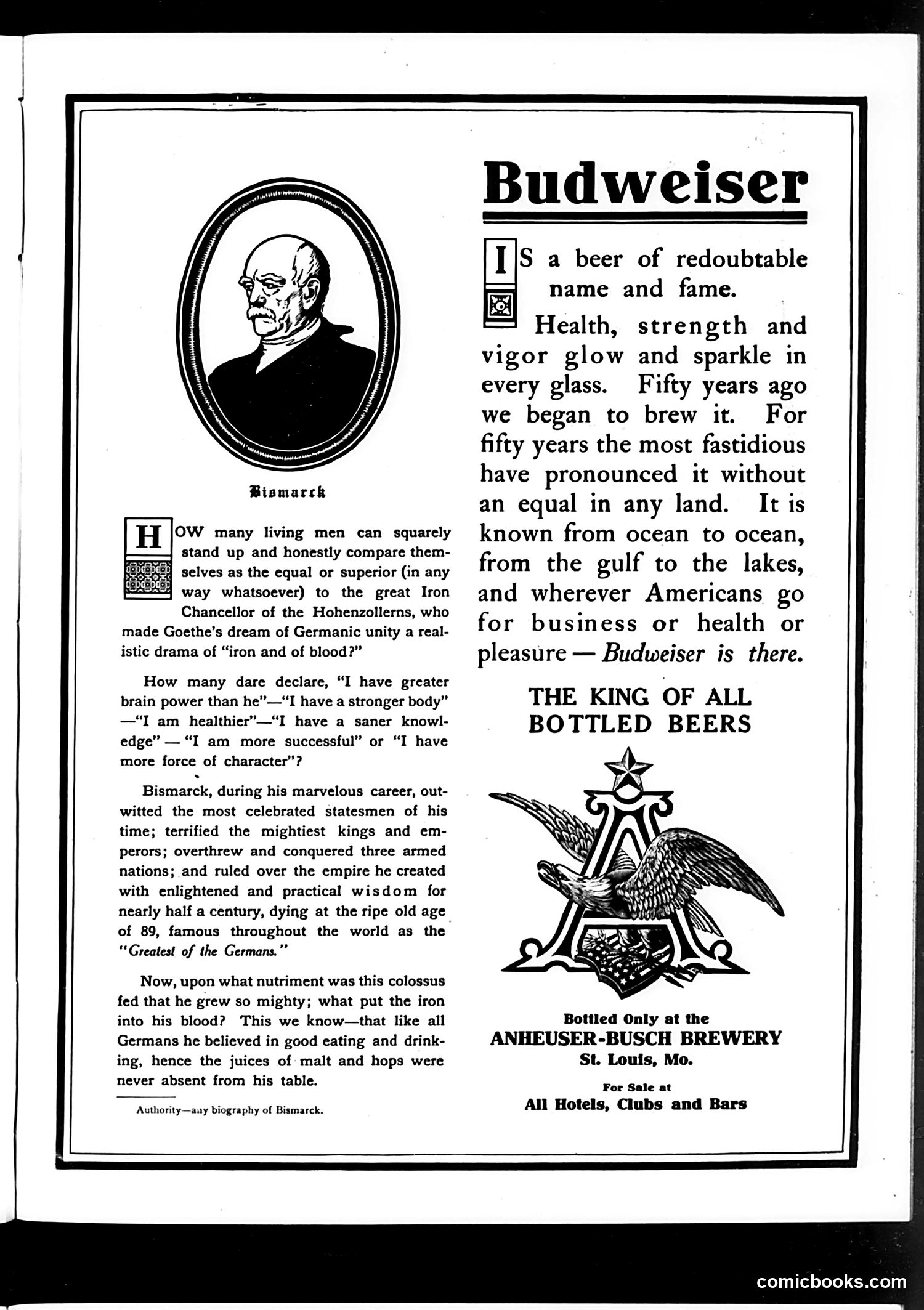
This is a beer advertisement, not satire. The Anheuser-Busch brewery uses Otto von Bismarck—the famous Prussian statesman who unified Germany—as a celebrity endorsement. The ad's logic: Bismarck was history's greatest leader, feared by kings and renowned for his power and longevity (died at 89). The text claims his strength came from German food and drink, specifically malt and hops. Therefore, Budweiser beer—which contains these ingredients—made Bismarck mighty and will do the same for consumers. This exploits German-American pride and late-19th-century admiration for Bismarck's military achievements ("iron and blood"). It's crude product placement: great man + beer = buy our beer. The ad ran during a period when German-American communities were significant U.S. consumers.
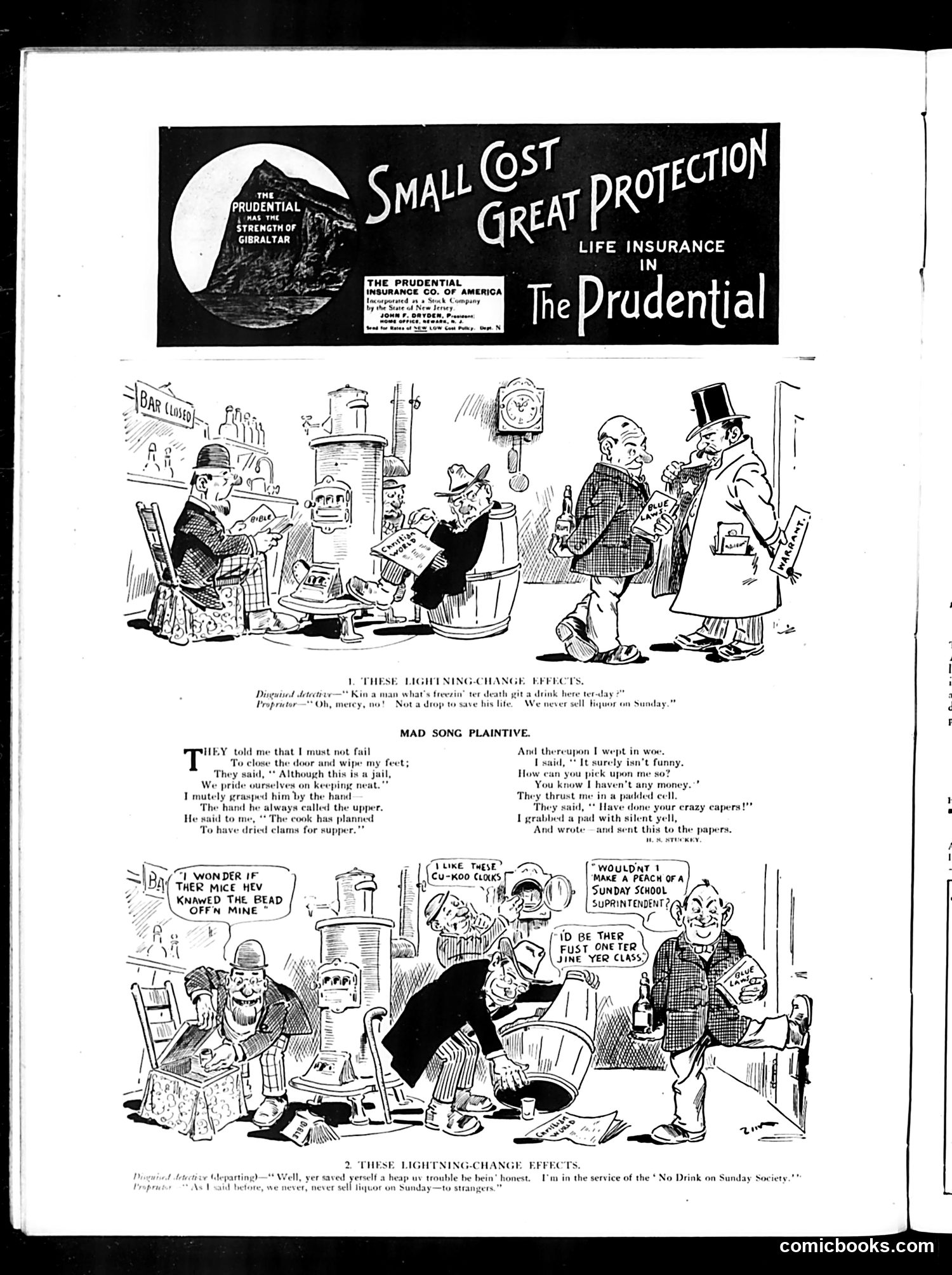
This is primarily a **Prudential life insurance advertisement** disguised as editorial content in *Judge* magazine, featuring satirical cartoons mocking temperance and moral reform movements. The top panel shows caricatured figures in a bar setting, illustrating the advertising slogan "Small Cost, Great Protection." The text and cartoons below satirize the "No Drink on Sunday Society"—a real temperance movement of the era—by depicting hypocritical reformers. One cartoon shows a man asking if someone would "wonder if" mice knew about stealing bread, while another depicts figures discussing whether "cuckoo clocks" would "make a peach of a Sunday School superintendent," suggesting moral arbiters were absurd or complicit in vice. The "Mad Song Plaintive" poem reinforces the satire, describing a man jailed for minor infractions while supposedly upholding societal standards. The overall message: insurance companies and moral societies alike exploit common anxieties about poverty and social respectability, while their representatives are themselves hypocritical drinkers.
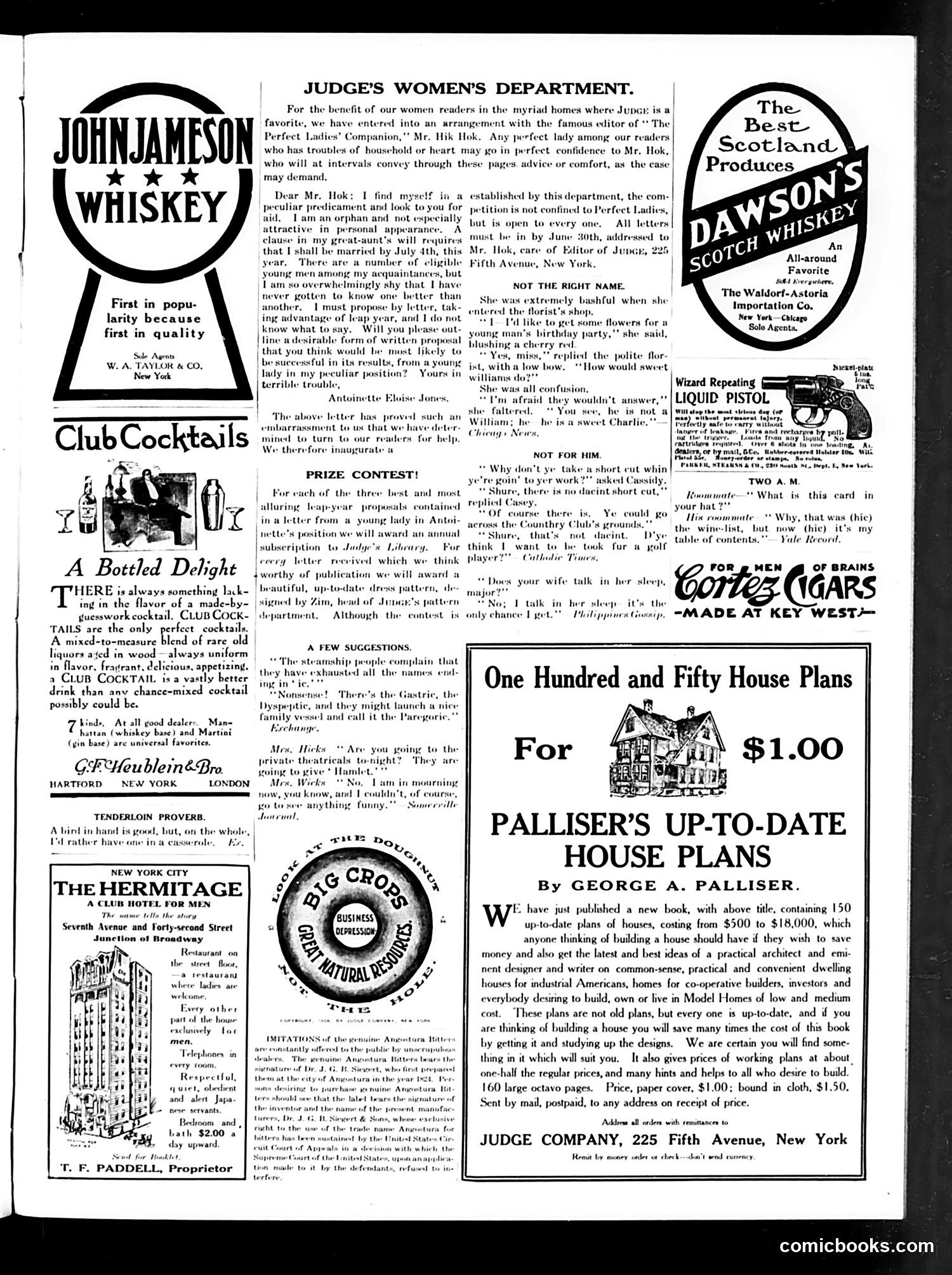
This page from *Judge* magazine is primarily **advertising and advice content** rather than political satire. The main elements include: **Women's Advice Column**: "Judge's Women's Department" features letters from female readers seeking guidance on romantic and domestic matters—a woman too shy to propose during leap year, another confused about a florist's name. The advice appears gently humorous rather than satirical. **Whiskey & Liquor Ads**: Multiple advertisements for John Jameson Whiskey, Dawson's Scotch, and Club Cocktails emphasize quality and sophistication—typical turn-of-century luxury marketing. **Hotel & Real Estate Ads**: The Hermitage Hotel and Palliser's House Plans represent commercial offerings to the magazine's middle-to-upper-class readership. **Minor Jokes**: Small humor items (like the "Two A.M." roommate exchange about a hat card) are lighthearted rather than political. The page reflects *Judge*'s business model: combining satirical content elsewhere with paid advertising and lifestyle advice to appeal to affluent readers. There is **no identifiable political cartoons or social satire** on this particular page.
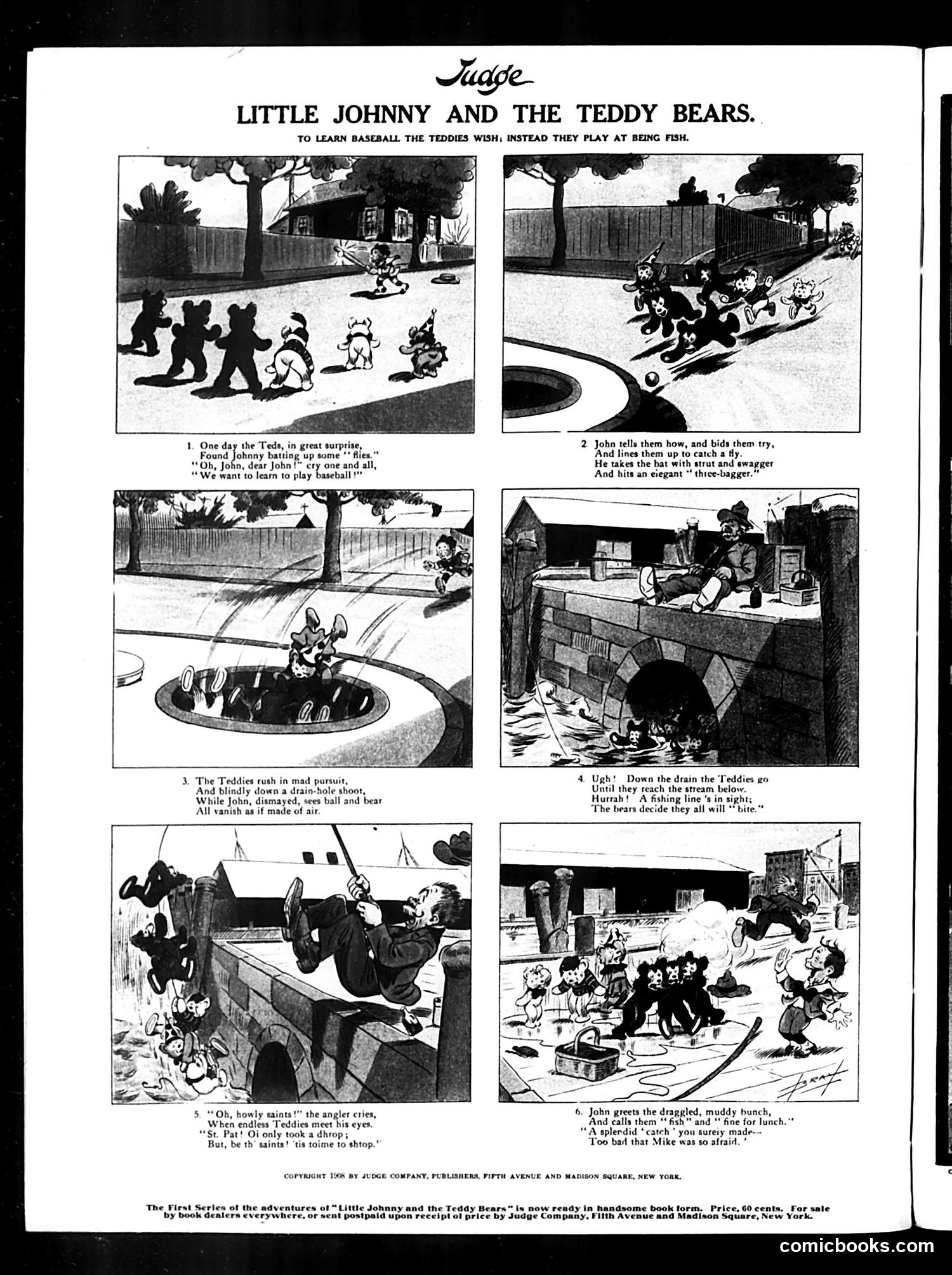
This is a children's comic strip from Judge magazine featuring Little Johnny and anthropomorphic teddy bears. The narrative is straightforward slapstick: Johnny attempts to teach the bears baseball, but they end up chasing a batted ball down a drain, swept into a stream below, where they accidentally become "caught" on a fishing line. The Irish fisherman character (identifiable by dialect: "Oi," "dhrop," "toime," "St. Pat") mistakes the bears for actual fish, creating comedic confusion. The joke relies on physical comedy and mistaken identity rather than political satire. The strip appears designed to appeal to early 1900s children, promoting a book collection. The "Teddy Bears" reference likely alludes to the popular toy craze following President Theodore Roosevelt (active ca. 1900s), though this is implicit rather than explicitly satirical on this page.