
A complete issue · 16 pages · 1908
Judge — May 9, 1908
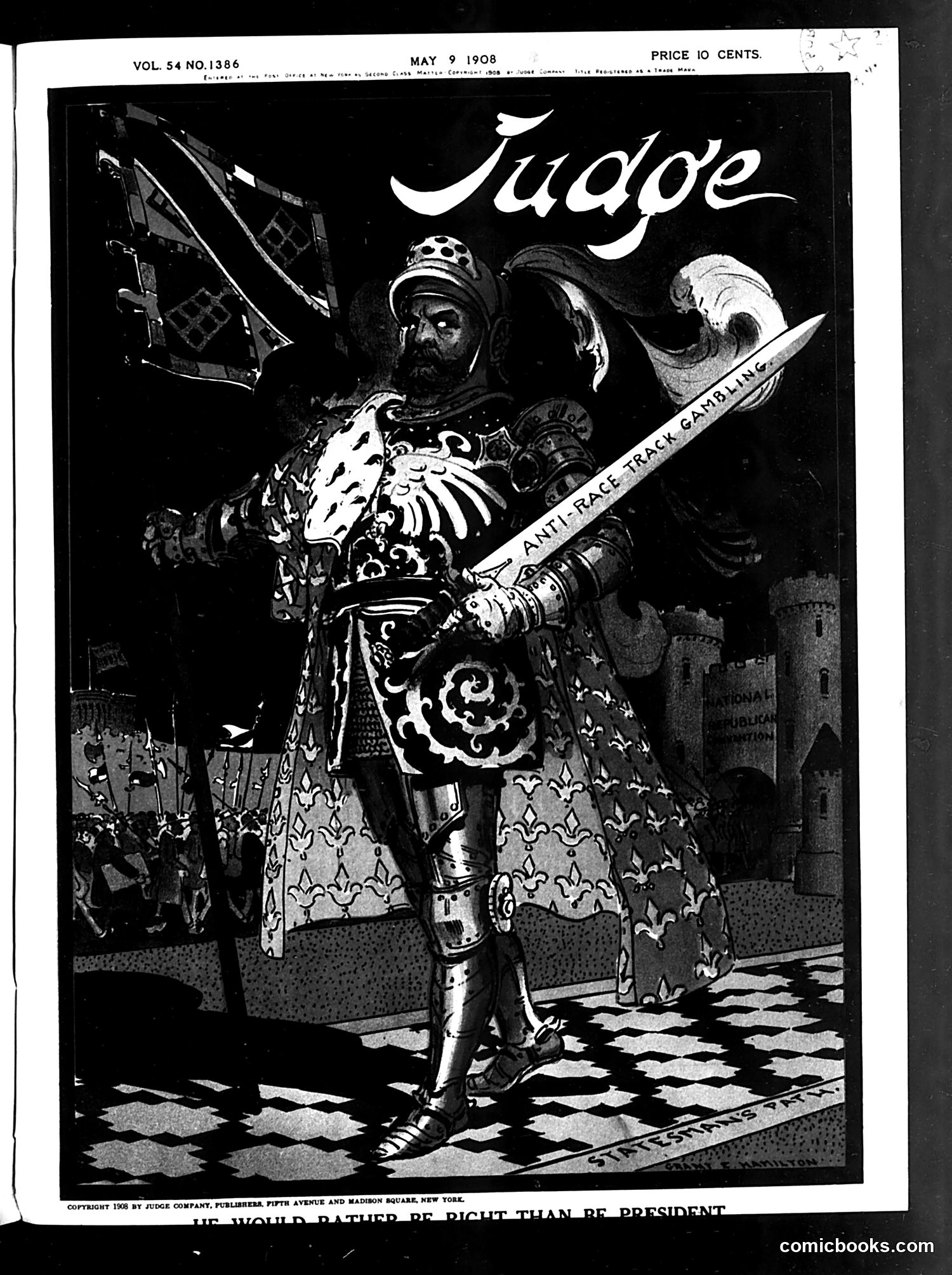
This cover depicts a medieval judge or nobleman holding a sword labeled "ANTI-RACE TRACK GAMBLING," addressing what appears to be a crowd. The ornate costume and dramatic medieval setting suggest this is satirizing contemporary debates over horse-race gambling regulation. The figure represents judicial or governmental authority taking a stern stand against track gambling—a major social vice of the era. The theatrical presentation parodies the grandiose language politicians used when championing moral reforms. The caption reads "I'D RATHER BE RIGHT THAN BE PRESIDENT," likely mocking politicians who took unpopular anti-gambling stances. The satire suggests cynicism about whether such moral crusades were genuine reform or political posturing.
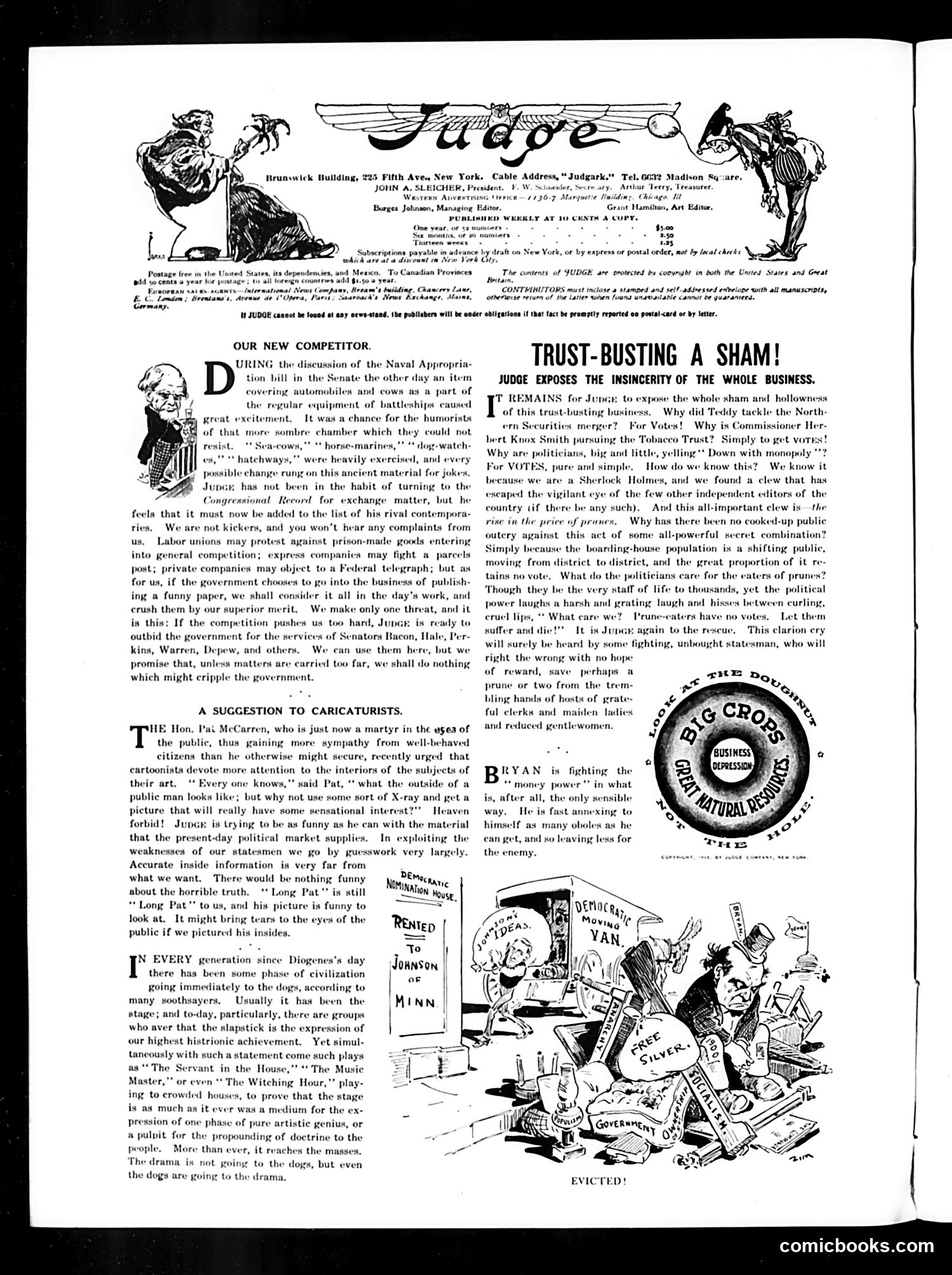
This page contains political commentary from the early 20th century. The main article "Trust-Busting a Sham!" criticizes the government's antitrust efforts, suggesting they're ineffective theater. The piece mentions Secretary Herbert Knox Smith and appears to mock politicians' claims about fighting monopolies while questioning their actual commitment. A secondary article discusses theatrical subjects for caricaturists, referencing Pat McCarran and suggesting public figures would make good cartoon subjects. The cartoon labeled "Evicted!" depicts various labeled figures and concepts being thrown out—likely representing Democratic Party factions or policies being rejected. Though specific identities are unclear from the image alone, the visual metaphor of eviction suggests political upheaval or defeat. The page reflects early Progressive Era debates about corporate regulation and political accountability.
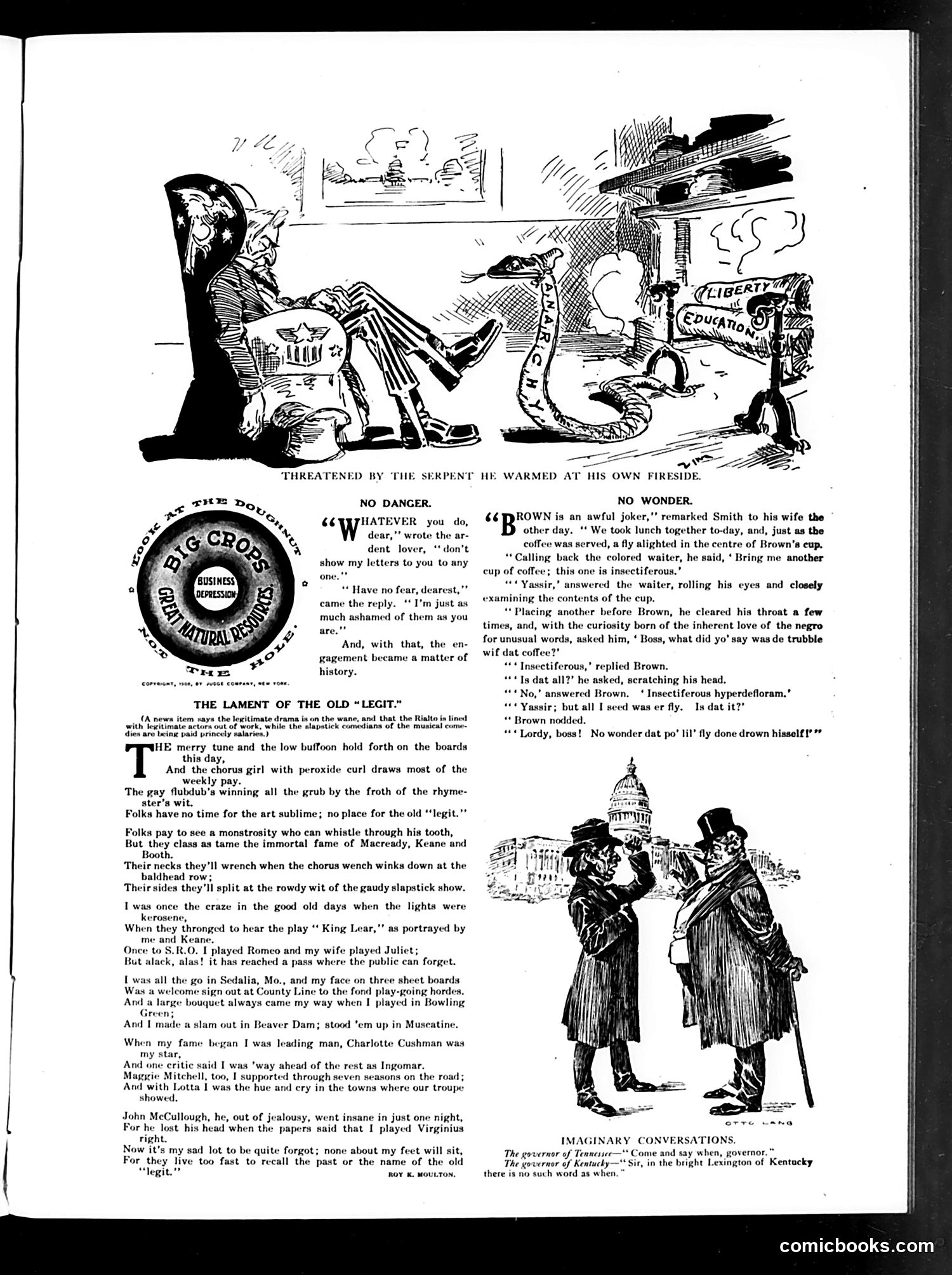
**Top Cartoon:** Shows a figure labeled "Liberty" and "Education" as a snake threatening a man at his fireside—representing the progressive era's anxiety that educational reform and expanded liberty threatened traditional values and domestic stability. **"No Danger" Section:** A satirical dialogue where a husband dismisses his wife's concern about a "joker" named Brown serving suspicious coffee. The joke mocks overconfidence about potential dangers—possibly referencing contemporary food safety scandals or poisoning fears. **"The Lament of the Old 'Legit'":** A nostalgic poem mourning the decline of classical theater ("legit") in favor of vaudeville and musical comedy. The author laments lost prestige and quality. **Bottom Cartoon:** "Imaginary Conversations" depicting political figures discussing Kentucky—likely commentary on regional politics or governance issues of the period.
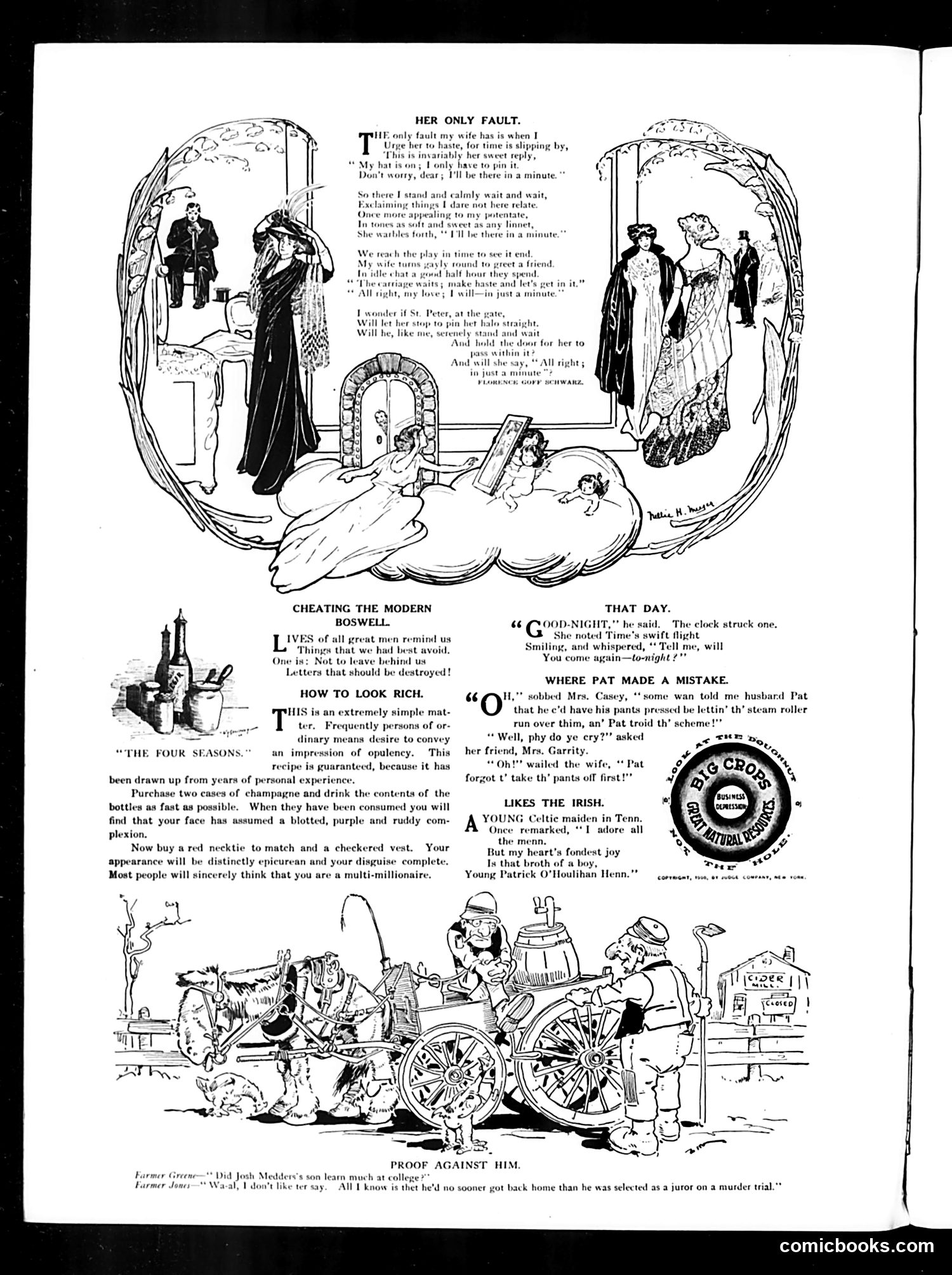
This page contains multiple satirical pieces typical of early 20th-century Judge magazine: **"Her Only Fault"** (top): A humorous poem about a wife's chronic lateness, illustrated with figures waiting at gates and in carriages. The satire targets traditional gender stereotypes about women's timekeeping. **"Cheating the Modern Boswell"** and other brief comedic sections mock contemporary social behaviors and fashions. **"How to Look Rich"** satirizes material status-seeking, suggesting purchasing champagne and specific clothing combinations to appear wealthy—commentary on nouveau-riche aspirations. **"Likes the Irish"** presents ethnic humor typical of the era. **"Proof Against Him"** (bottom cartoon): A humorous anecdote about jury duty and college education appears to joke about legal proceedings and social credentials. The page reflects Judge's focus on urbane social satire targeting middle and upper-class readers' foibles.
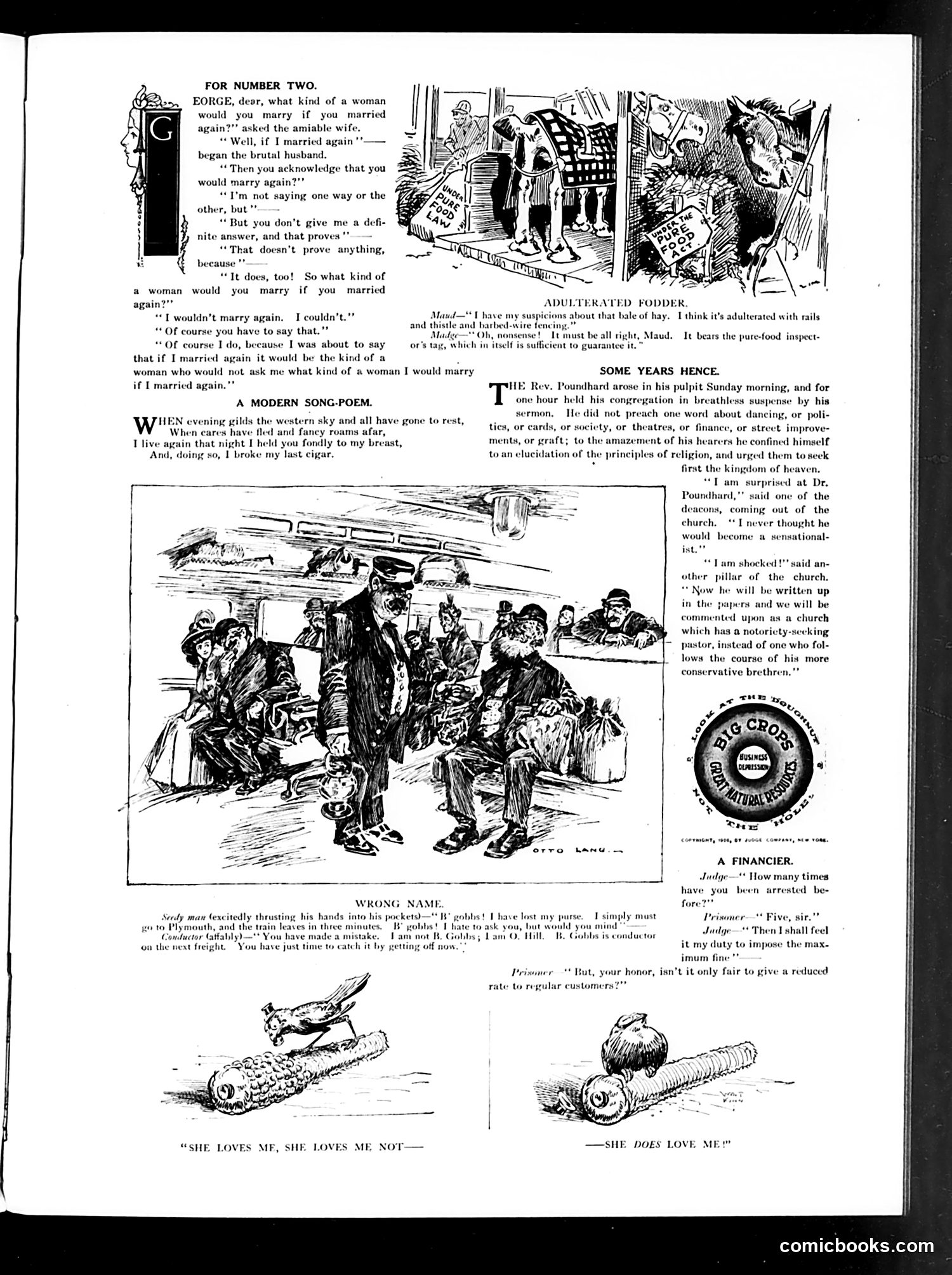
This page contains several satirical pieces typical of early 20th-century American humor: **"For Number Two"** mocks remarriage through a dialogue where a woman questions what kind of wife a man would marry if he remarried—a setup for the punchline that he'd marry a worse one. **"A Modern Song-Poem"** appears to be romantic verse with an illustration of urban life. **"Adulterated Fodder"** shows a man and woman discussing hay quality—likely satirizing food safety concerns or agricultural fraud of the era. **"Some Years Hence"** predicts a reverend becoming a "sensationalist" pastor, satirizing concerns about clergy abandoning traditional religiosity for publicity. The bottom cartoons use visual puns: logs with eyes captioned "She loves me, she loves me not" and "She does love me!"—anthropomorphizing timber, possibly satirizing sentimentality or absurdist humor.
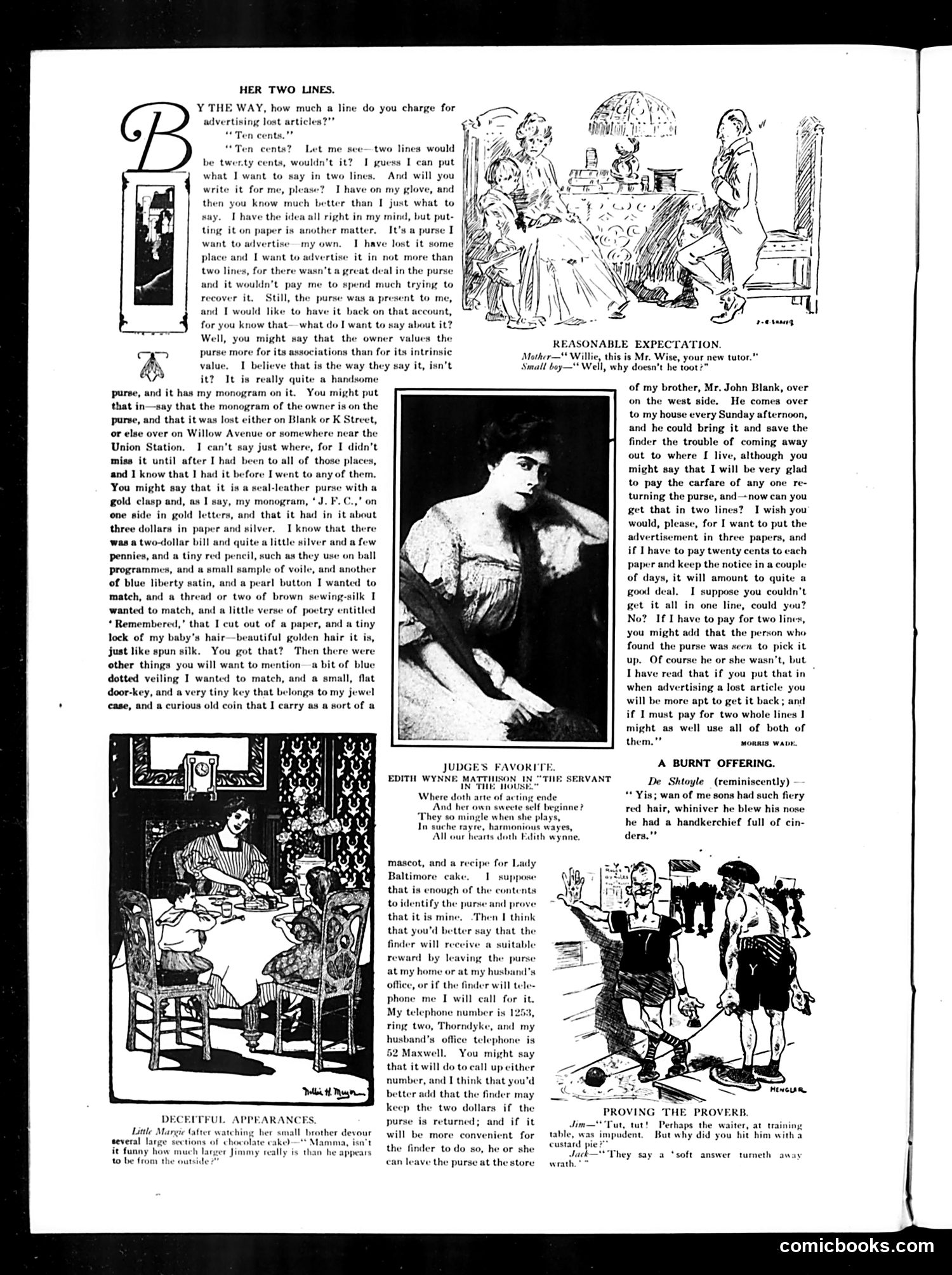
This page satirizes the absurdity of newspaper advertising costs and human nature. The main piece, "Her Two Lines," depicts a wealthy woman attempting to place a lost-and-found ad for her purse. She badgers the newspaper clerk about the ten-cent-per-line rate, then proceeds to dictate an impossibly lengthy list of details: the purse's monogram, exact locations where it might be lost, its contents (including a baby's hair lock and a poem), and elaborate instructions for its return—all while expecting it to fit in "two lines." The satire mocks her obliviousness: she continuously adds more information while complaining about costs, making it abundantly clear the ad will require many lines and substantial payment. The clerk's patient responses underscore the humor of her self-deception. The surrounding illustrations and shorter pieces on the page appear to be typical Judge magazine humor—domestic scenes and social commentary—but are secondary to this central satirical narrative about vanity, expense, and unrealistic expectations.
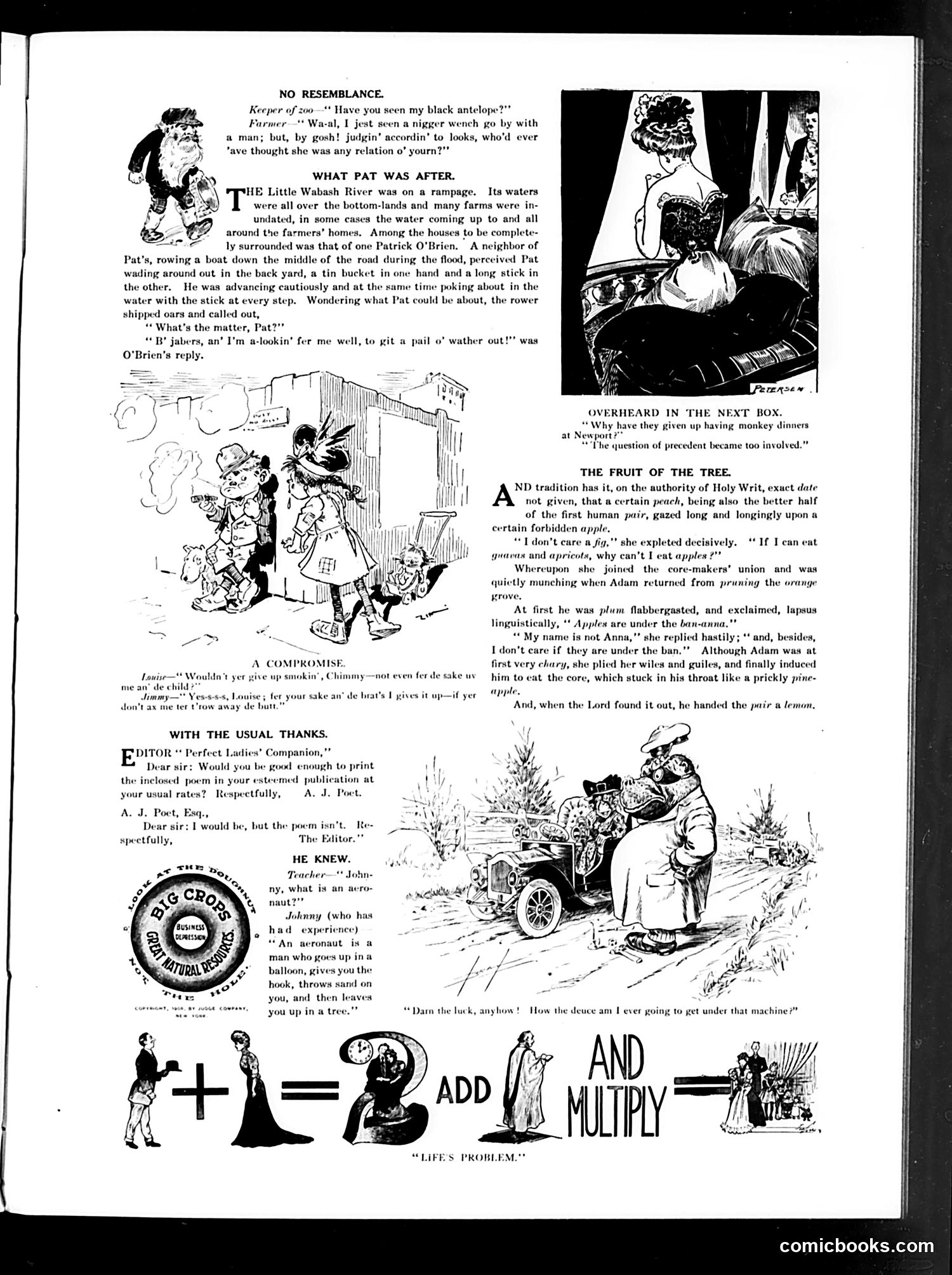
This page contains several humor pieces typical of early 20th-century Judge magazine: **"No Resemblance"**: A farmer jokes about seeing a "black antelope," implying the neighbor's wife resembles one—a crude physical insult relying on racist caricature. **"What Pat Was After"**: An Irish immigrant (identified by "Pat" and dialect like "jabers") waddles through a flood searching for his well with a stick, misunderstanding the situation. The humor targets Irish stereotypes and working-class confusion. **"The Fruit of the Tree"**: A playful retelling of Adam and Eve using fruit puns ("plum flabbergasted," "pair a lemon"). Eve demands equality with Adam regarding the apple, and joins a "core-makers' union"—likely satirizing women's labor activism or suffrage movements of the era. **Bottom cartoon**: "Life's Problem" shows a mathematical equation: man + woman = baby + woman = chaos (a man tangled under machinery). This reflects anxieties about motherhood and marriage as burdensome. The page reflects period attitudes: ethnic mockery, gender anxiety, and working-class stereotyping presented as lighthearted comedy.
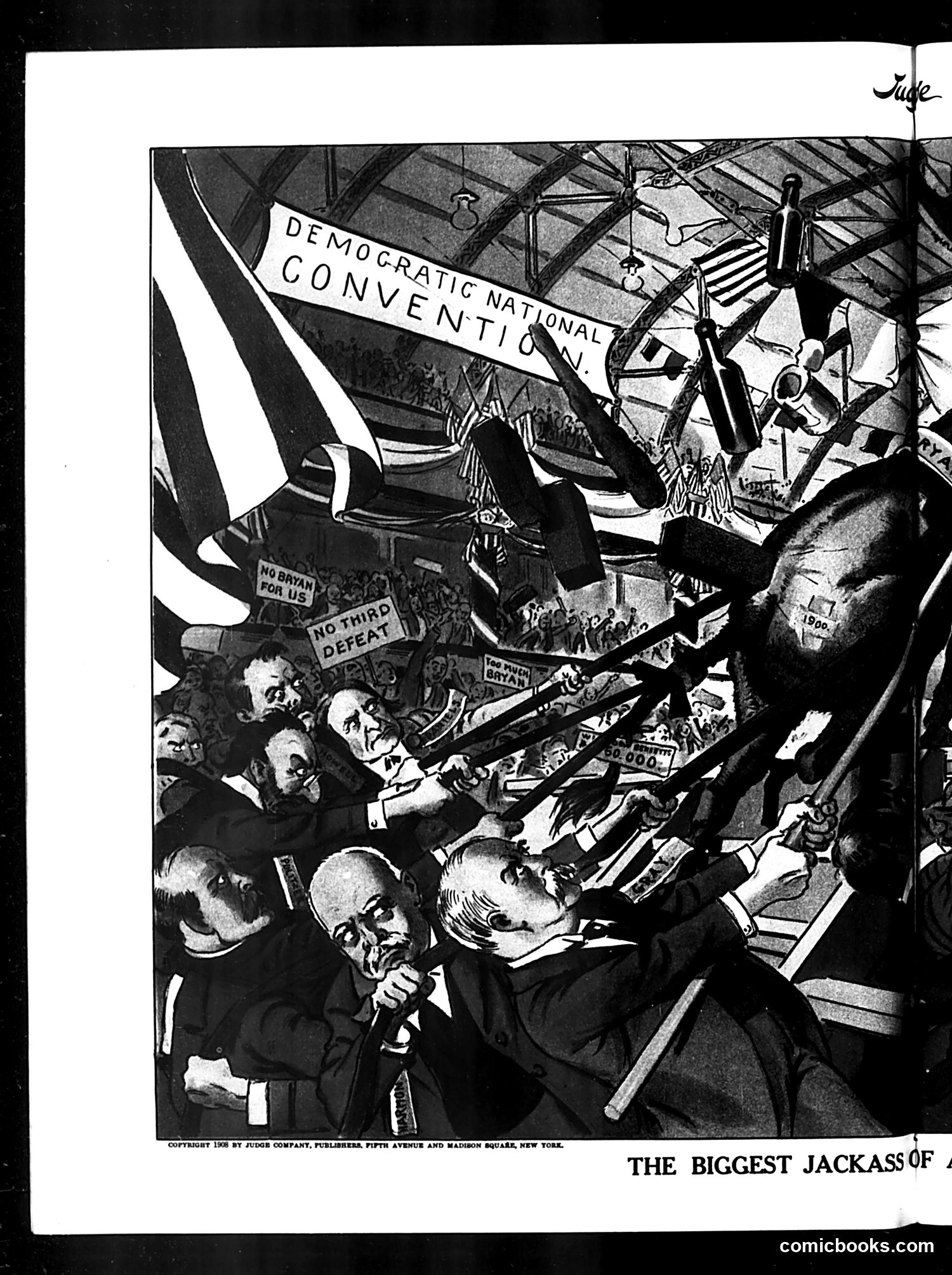
This Judge magazine cartoon satirizes the 1924 Democratic National Convention. The banner reads "DEMOCRATIC NATIONAL CONVENTION," and visible protest signs include "NO BRYAN FOR US" and "NO THIRD DEFEAT," referencing William Jennings Bryan's three failed presidential campaigns. The cartoon depicts party delegates in chaotic disarray beneath the convention hall, with American flags and period attire. The title "THE BIGGEST JACKASS OF A—" (text cut off) uses the donkey/jackass symbol traditionally associated with the Democratic Party as its central joke. The satire mocks internal Democratic Party divisions and the contentious 1924 convention, which was historically deadlocked and fractious. The image conveys that the party was its own worst enemy through internal conflict and poor leadership choices.
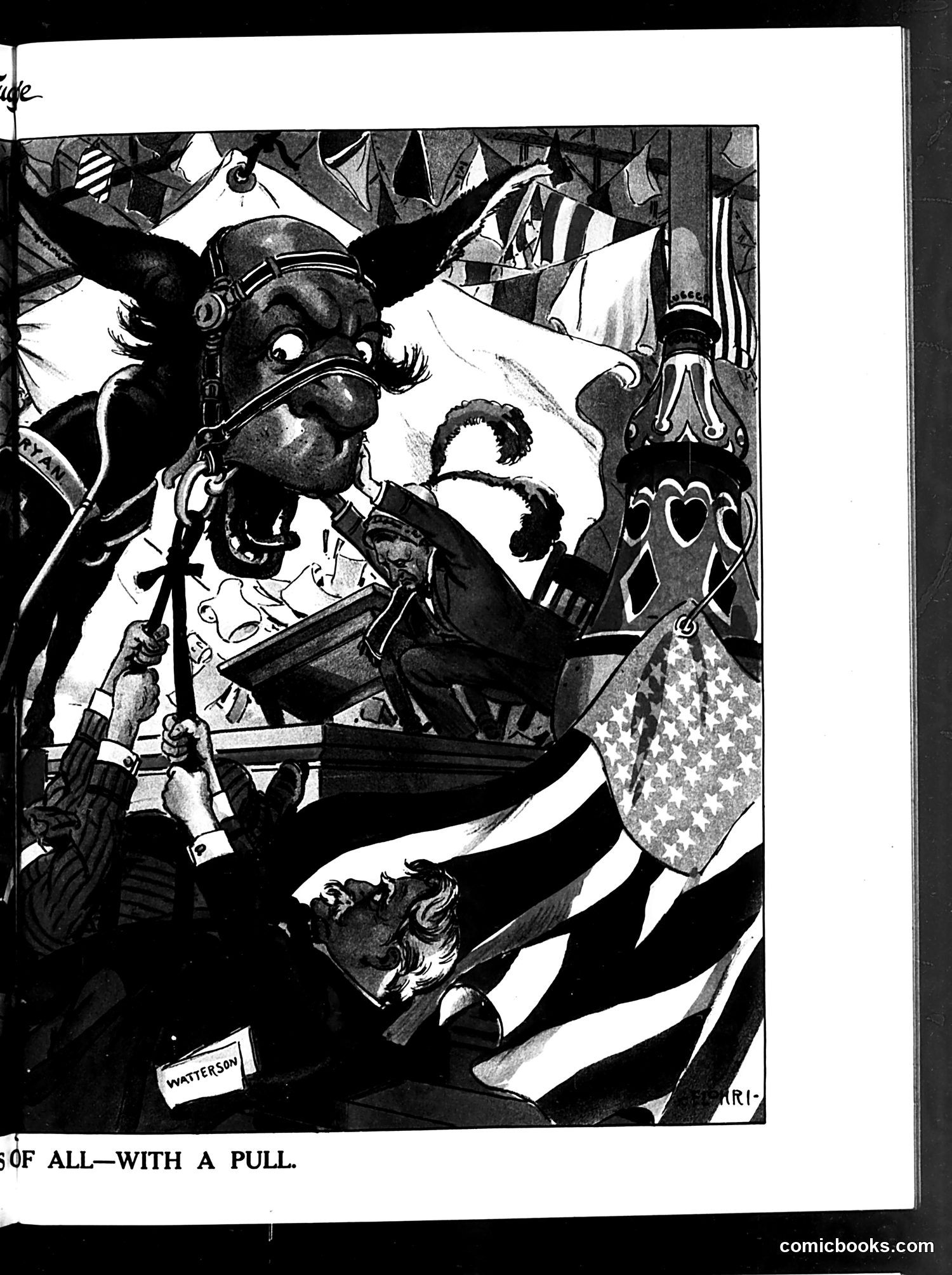
This appears to be a political cartoon from *Judge* magazine satirizing American foreign policy or military intervention. The cartoon depicts a figure labeled "Watterson" (visible in the lower left) controlling or manipulating what appears to be Uncle Sam or an American military representative—shown as a puppet or subordinate figure being pulled along. The decorative elements (shields, flags, ornate military regalia) suggest imperial or expansionist themes. The caption fragment "—WITH A PULL" indicates someone has direct control over American policy or military action. Without the complete caption and publication date, the specific political event referenced remains unclear, but the cartoon appears to criticize either corporate influence over foreign policy or the manipulation of American military power by particular interests. The satirical point seems to be about loss of democratic control over military decisions.
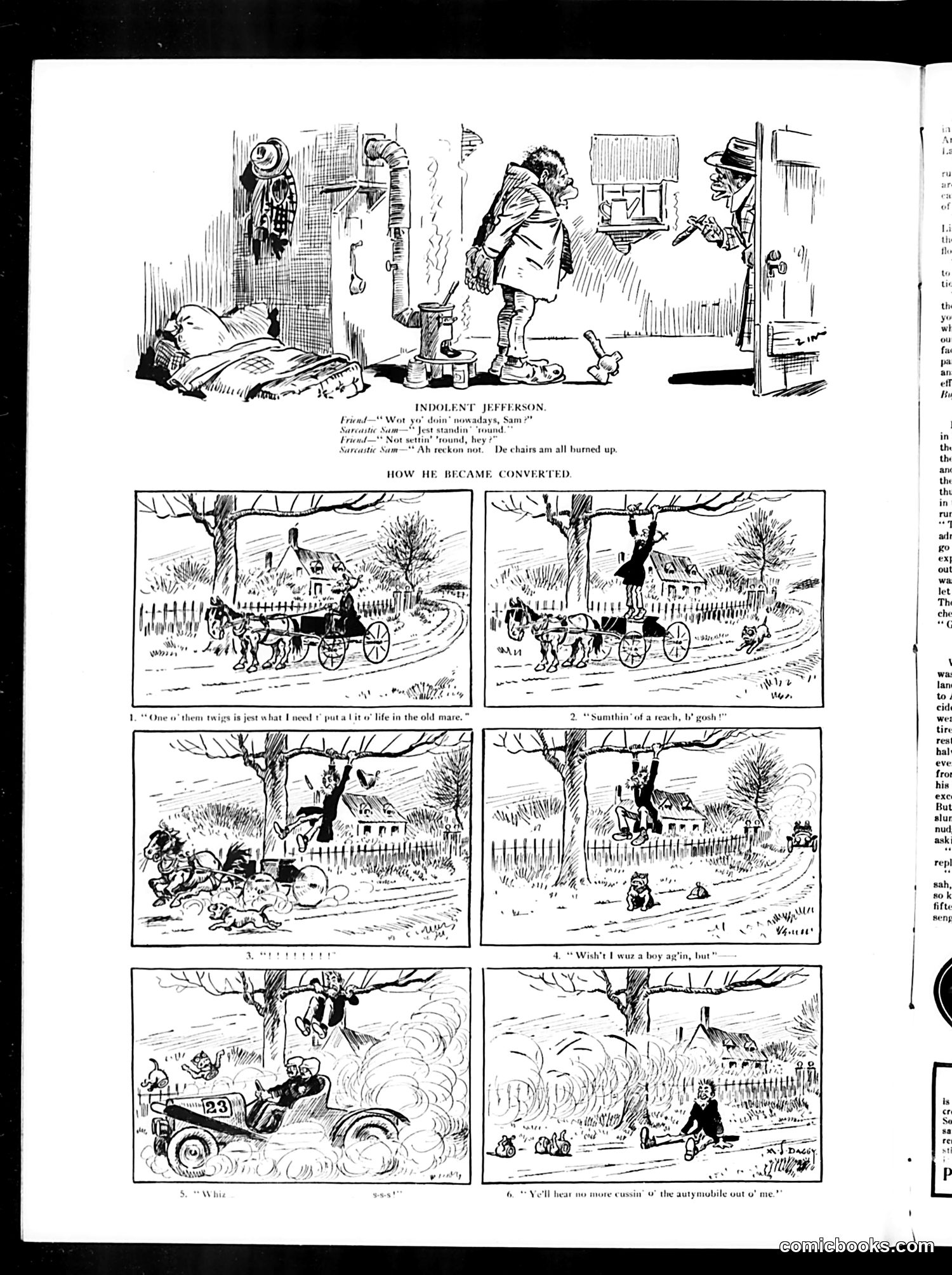
This is a two-part satirical piece mocking someone named Jefferson for laziness and moral conversion. The top panel shows "Indolent Jefferson" in bed while others work around him, with dialogue mocking his idleness ("Not gettin' 'round, hey"). The caption "De chairs am all burned up" suggests property damage from negligence. The six-panel comic strip below, titled "How He Became Converted," depicts Jefferson's transformation from lazy to industrious through increasingly chaotic mishaps—apparently involving a horse-drawn vehicle (#29) causing destruction. The final panel states he'll "hear no more cussin' o' the automobile out o' me," suggesting the story satirizes someone learning car-driving responsibility through disaster. Without the magazine's date or context, the specific Jefferson referenced remains unclear—possibly a public figure or contemporary character—but the satire targets indolence and technological mishap.
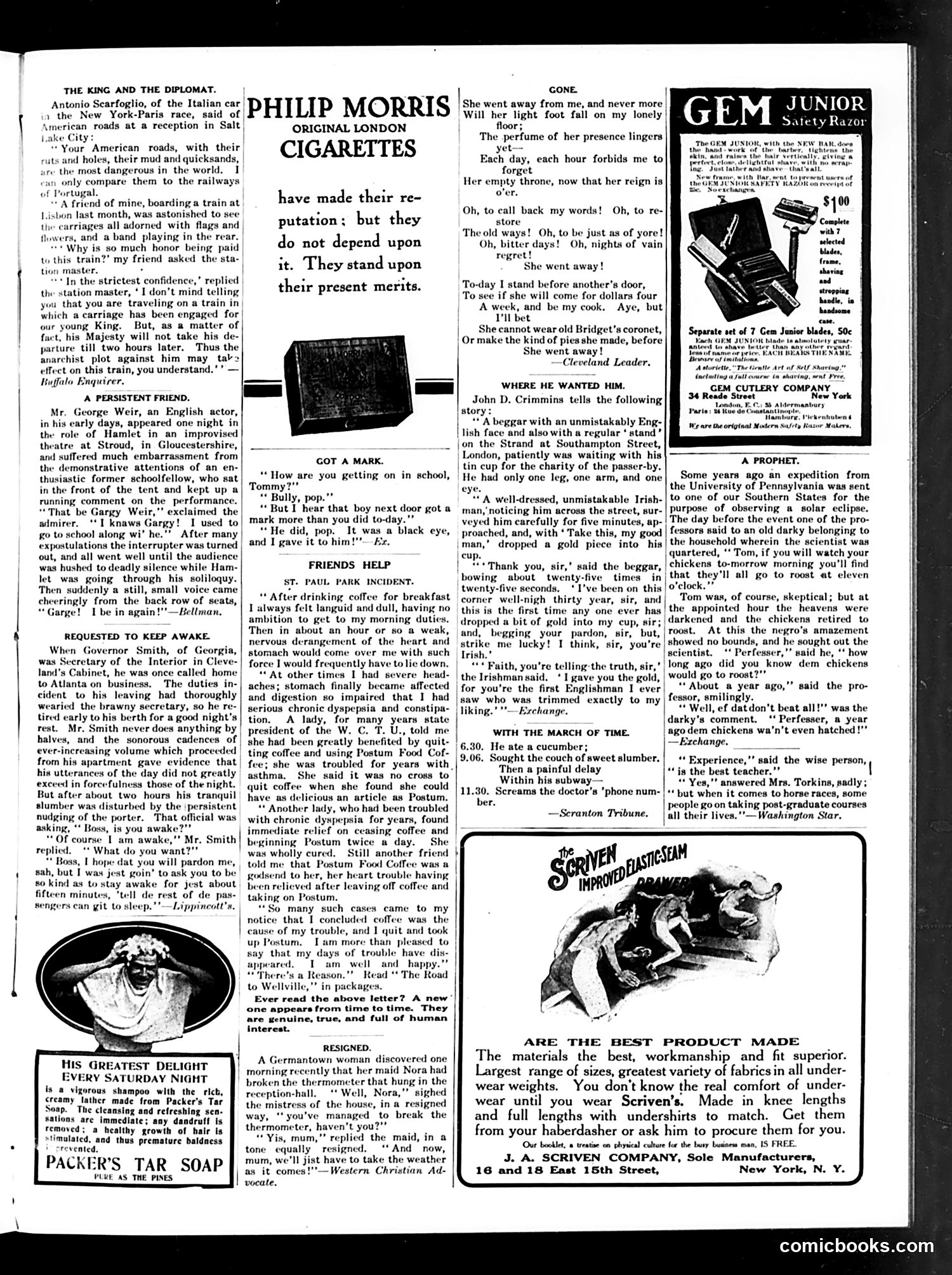
This Judge magazine page contains satirical stories and period advertisements rather than political cartoons. **"The King and the Diplomat"** mocks Italian motorist Antonio Scarfoglio's insulting comments about American roads. The joke: station officials decorated a train with flags to create the *illusion* of honoring the young Italian King, when actually they were laying a trap for anarchists who might attack him—essentially admitting Italian royalty faced assassination threats. **"A Persistent Friend"** is a humorous anecdote about an English actor named George Weir performing Hamlet, repeatedly interrupted by an overeager former schoolmate. The joke relies on class-based dialect humor typical of the era. **"Requested to Keep Awake"** involves a Southern official sleeping so loudly on a train that the porter must ask him to stay awake so other passengers can rest—a joke about snoring. The page is primarily **advertising** (Packer's Tar Soap, Gem razors, Scriven undergarments, Philip Morris cigarettes), with period-appropriate testimonials about digestive remedies and grooming products.
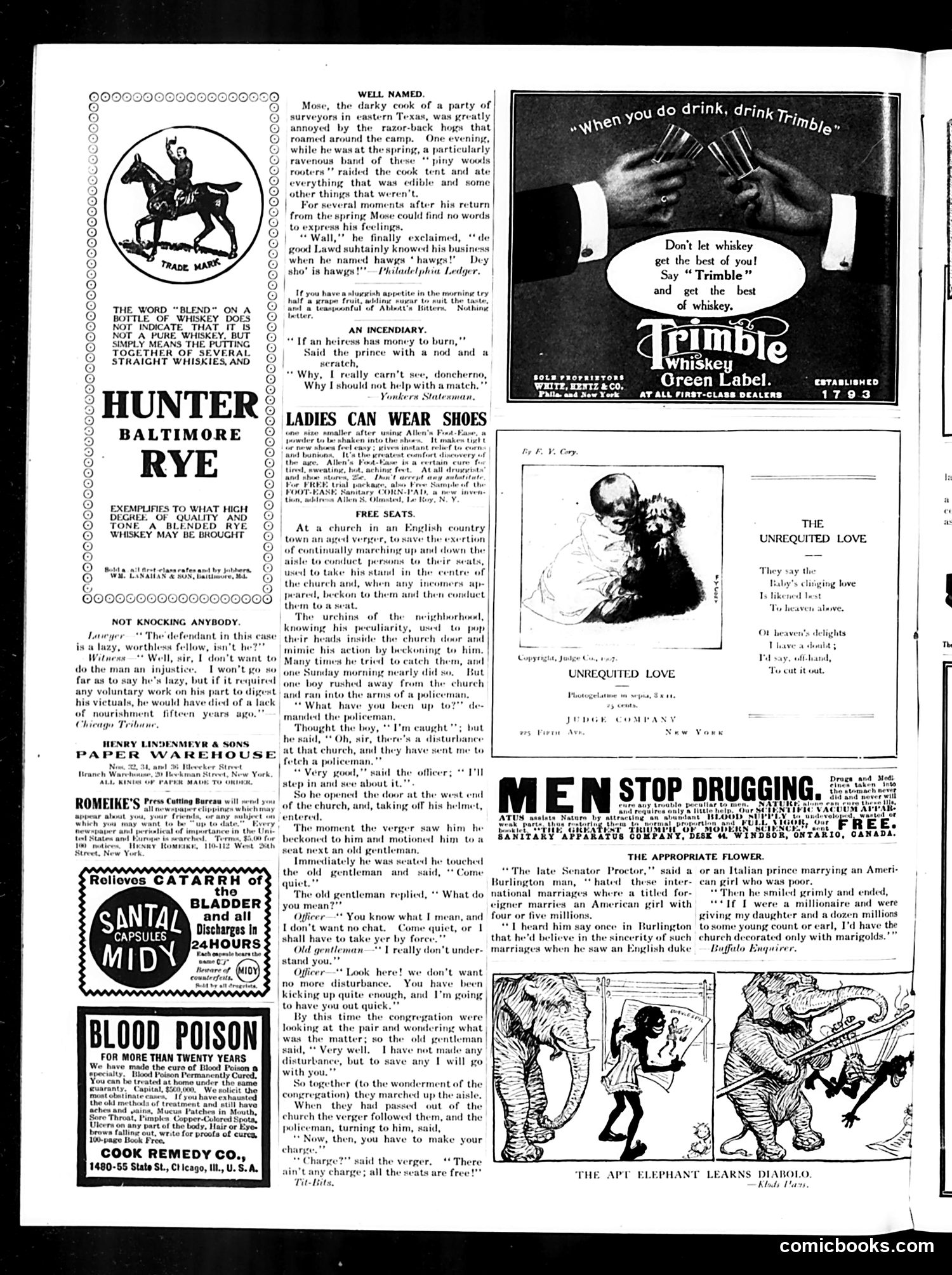
This page contains primarily **advertisements and humorous anecdotes** rather than political cartoons. The main content includes whiskey ads (Hunter Rye, Trimble) and patent medicine advertisements (Santal Capsules for bladder issues, Cook Remedy for "Blood Poison"). These reflect early 1900s marketing that made dubious medical claims. The humor pieces are period jokes: - "Well Named" jokes about a Black cook calling pigs "hawgs"—using dialect humor common to the era - "Not Knocking Anybody" and "Free Seats" are brief anecdotes about church vergers and troublemakers - "The Appropriate Flower" jokes about marrying off daughters to foreign nobility **Modern context**: The racial dialect humor reflects deeply offensive stereotyping standard in early-20th-century publications. The patent medicine ads show pre-FDA regulation when unproven treatments were freely advertised. The social humor reflects class attitudes about servants, immigrants, and wealth. The page is primarily commercial rather than satirically political.
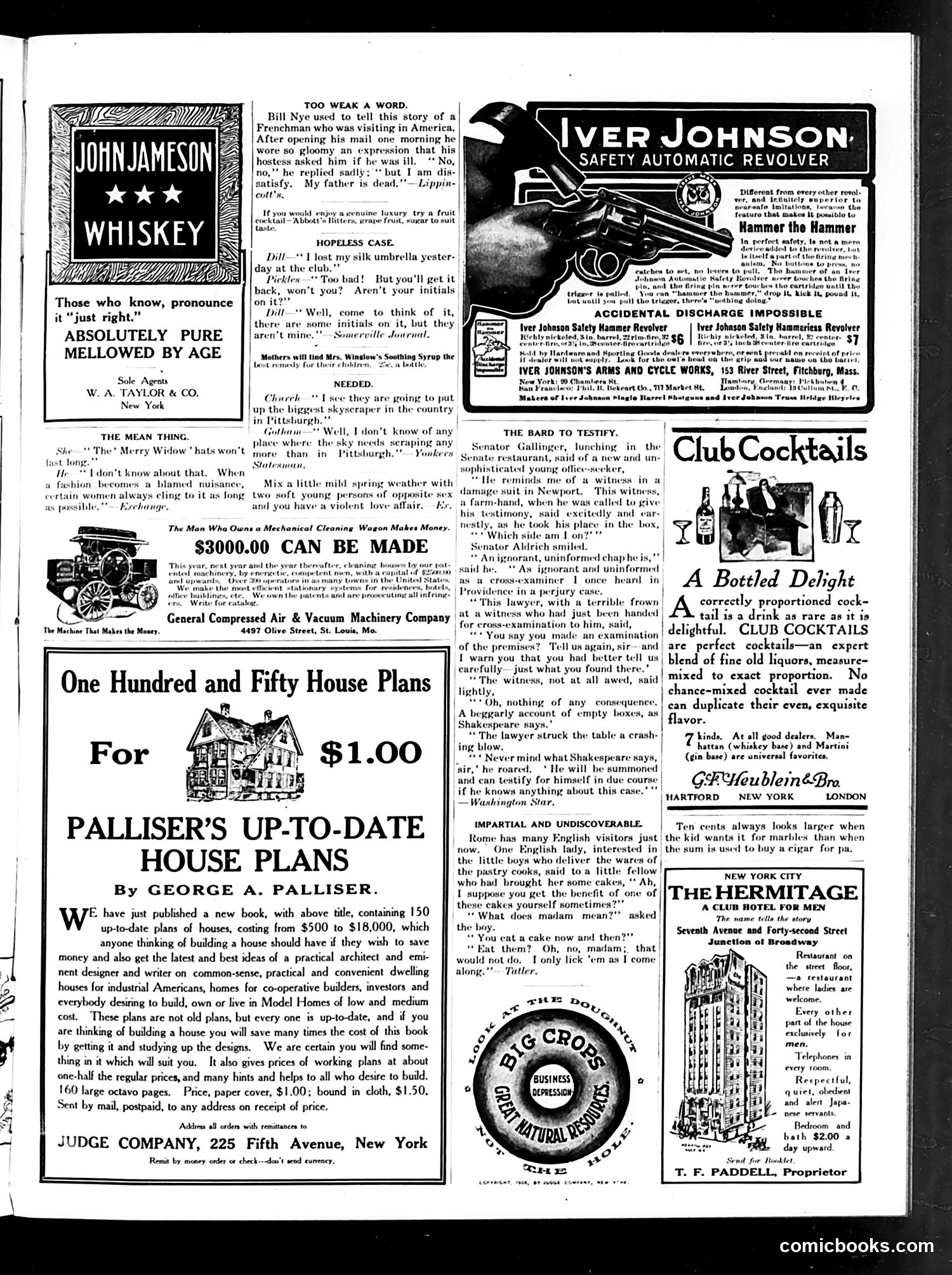
This page is primarily **advertisements and humorous anecdotes** rather than political cartoons. The layout contains: **Main Content**: Short jokes and stories illustrating various points: - "Too Weak a Word": A brief anecdote about understatement - "Hopeless Case": A lost umbrella joke - "The Mean Thing" and "The Bard to Testify": Brief humorous pieces **The "Bard to Testify" section** appears to satirize a legal proceeding involving Senator Gallinger (a real U.S. Senator), who witnessed something in Newport. It mocks overly dramatic courtroom theatrics—specifically a lawyer's theatrical blow on the table—and the witness's casual dismissal of the proceedings. The humor lies in contrasting Shakespeare's gravitas with a mundane court case. **The bulk of the page is advertising** for whiskey, house plans, compressed air machinery, and other products typical of early 20th-century Judge magazine. No clear political cartoon is visible here; the page functions primarily as a humor and advertising vehicle rather than political satire.
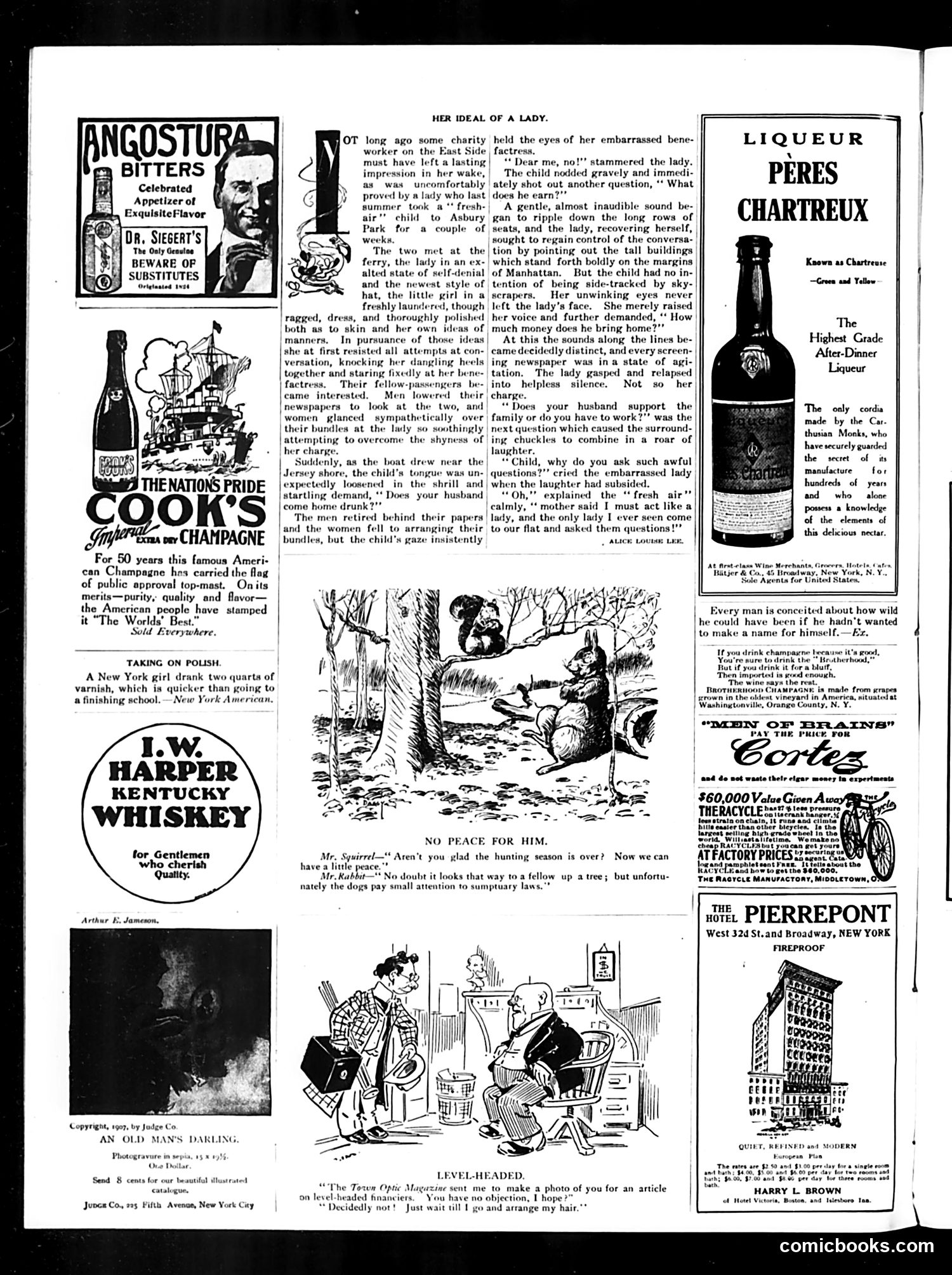
This page contains primarily **advertisements and light satirical humor** rather than political commentary. The main cartoon, "HER IDEAL OF A LADY," satirizes working-class social aspirations. A charity worker takes a poor East Side girl to Asbury Park, expecting gratitude. Instead, the girl asks blunt questions about the woman's husband's income and whether he "comes home drunk"—mimicking what she's learned from observing ladies in her tenement building. The joke mocks both the condescending charity worker's assumptions about refinement and the girl's frank, mercenary worldview shaped by poverty. Secondary cartoons include mild humor about a New York girl drinking varnish for a "finishing," and animals debating hunting season. The remainder is **period advertising**: liquor (whiskey, champagne, bitters), a hotel, and a bicycle, reflecting early-1900s consumer culture. The copyright shows this is from 1907.
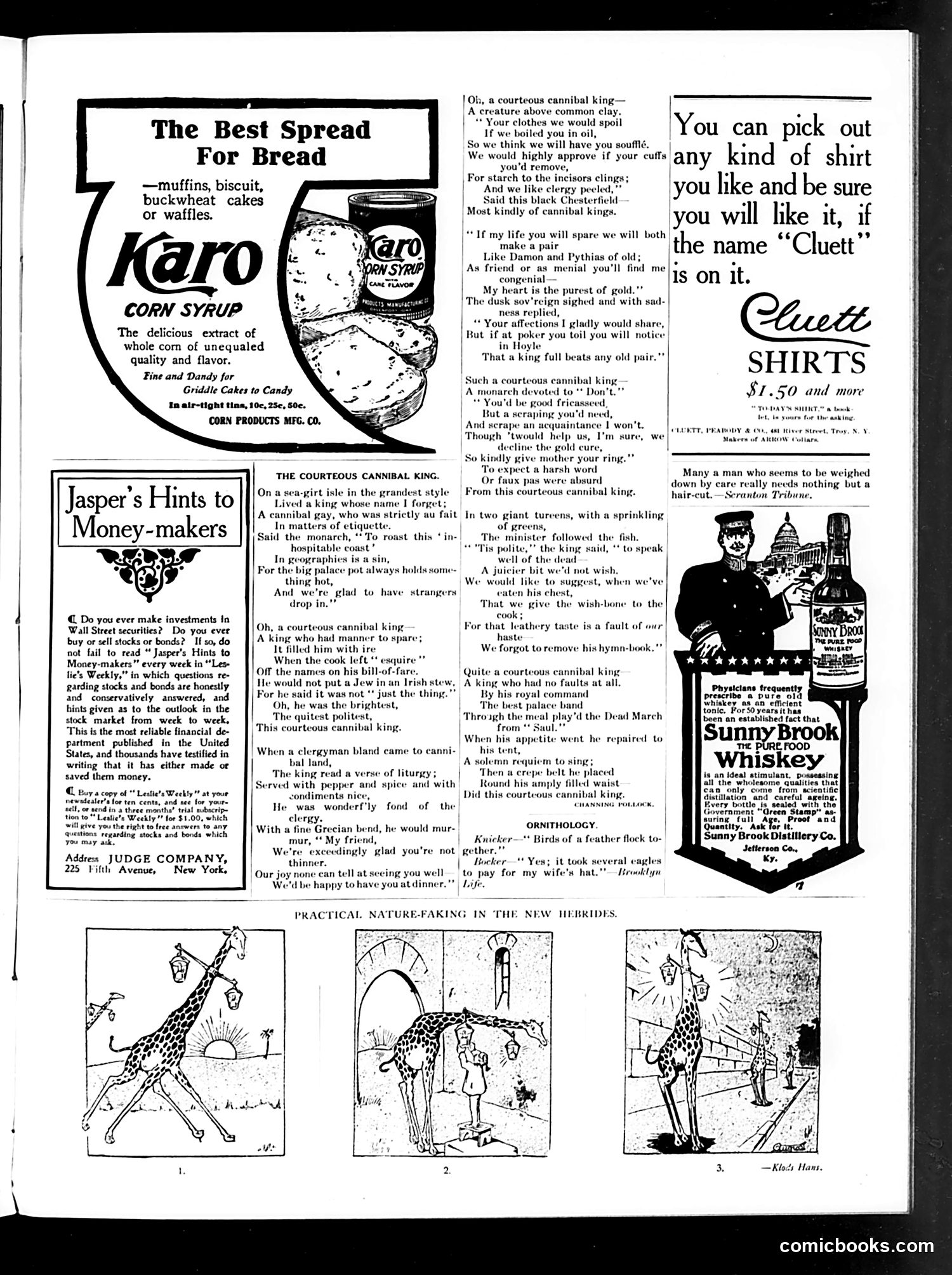
This page features a lengthy humorous poem (center and right) about a cannibal monarch who practices exaggerated Victorian etiquette and civility. The joke satirizes the contrast between refined manners and savage behavior—the king treats his victims with elaborate courtesy, even apologizing for eating them while following strict rules of conduct (refusing to serve a Jew, removing a hymn-book before cooking a clergyman). The satire appears to mock both Victorian social pretension and 19th-century racial stereotypes. By portraying the cannibal as scrupulously polite and morally concerned, the poem likely ridicules both the obsessive formality of upper-class society and contemporary attitudes toward non-European peoples. The three illustrated panels below ("Practical Nature-Faking in the New Heroids") appear to extend this mocking theme through whimsical giraffe drawings, though their specific reference is unclear from the image alone. The page is primarily editorial/satirical content with scattered period advertisements (Karo Syrup, Cluett Shirts, Sunny Brook Whiskey).
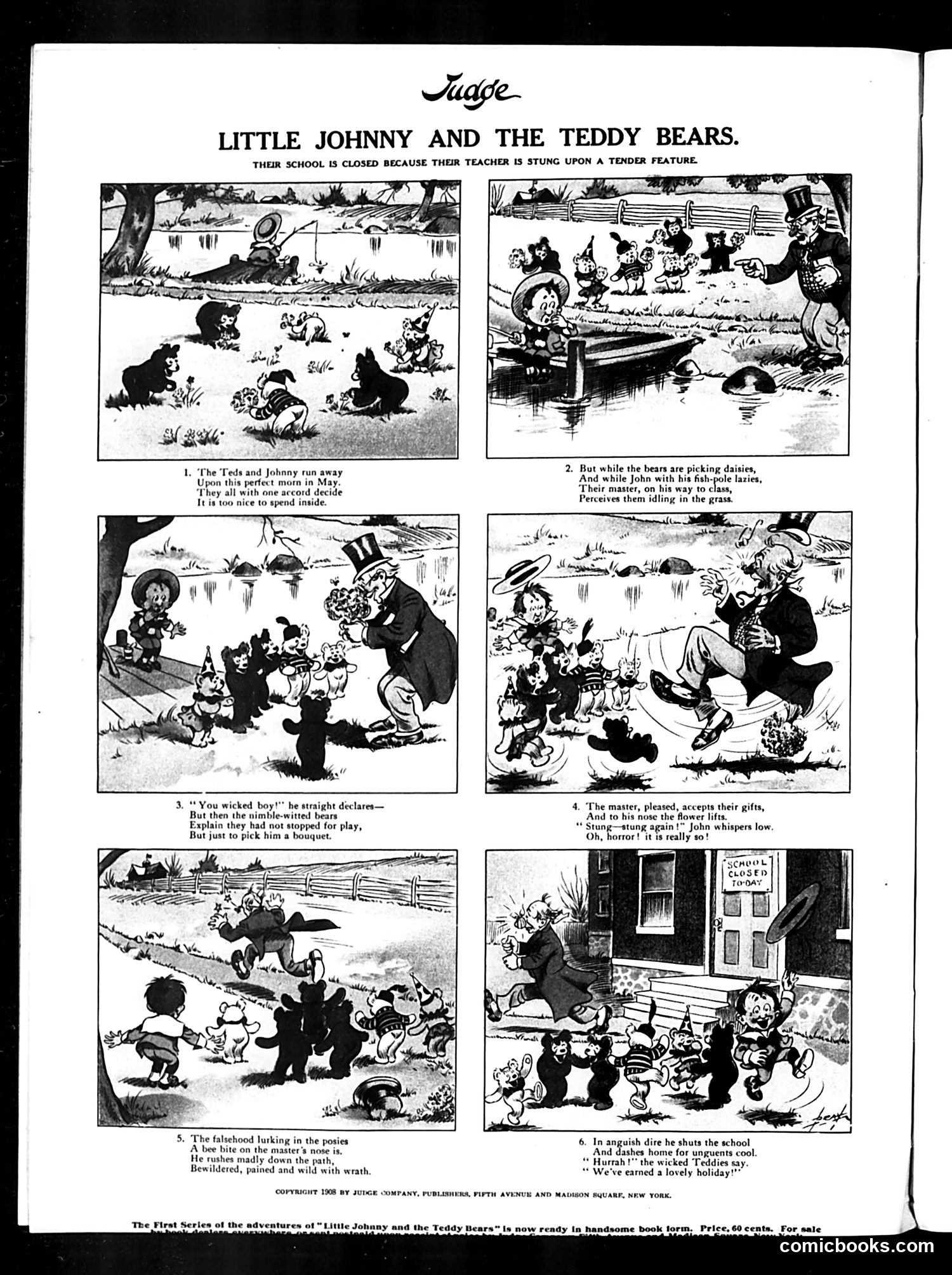
This is a children's comic strip from Judge magazine (1908) featuring "Teddy Bears"—stuffed animals named after President Theodore Roosevelt, who was wildly popular and had inspired a toy craze in the early 1900s. The plot: Johnny and his teddy bears skip school on a nice day. When their teacher catches them, the bears present him with flowers as a gift. However, a bee hidden in the bouquet stings the teacher on the nose. Panicked and in pain, he closes the school and goes home, accidentally giving the children a holiday. The humor targets both childhood mischief and the teacher's gullibility—he's easily fooled by the bears' innocent explanation, then literally pays the price. The "tender feature" in the subtitle is a pun referring to the sensitive nose. This reflects the era's gentler approach to depicting school troubles and animal companions.