
Judge, 1908-05-09 · page 6 of 16
Judge — May 9, 1908 — page 6: what you’re looking at
What you’re looking at
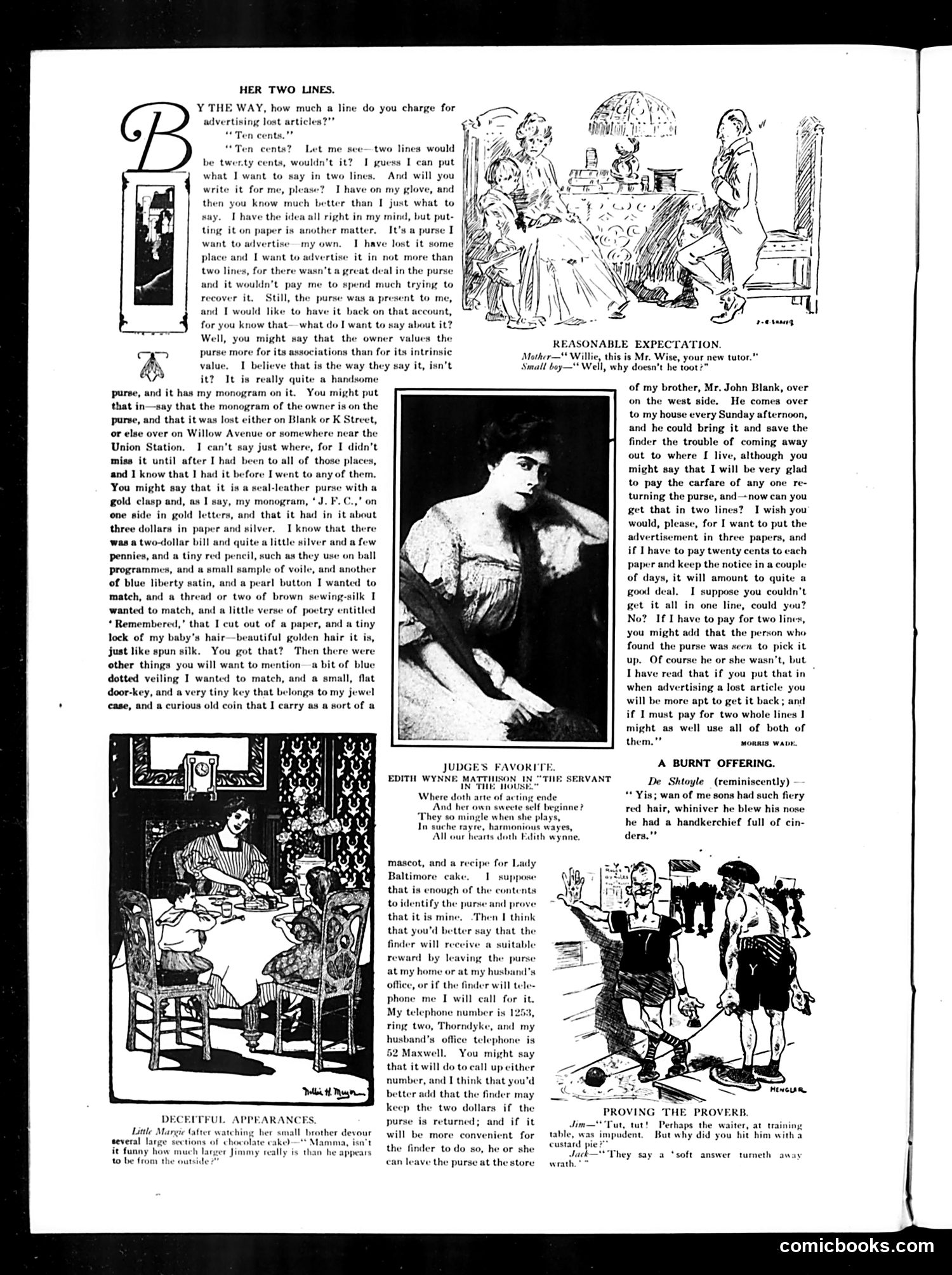
This page satirizes the absurdity of newspaper advertising costs and human nature. The main piece, "Her Two Lines," depicts a wealthy woman attempting to place a lost-and-found ad for her purse. She badgers the newspaper clerk about the ten-cent-per-line rate, then proceeds to dictate an impossibly lengthy list of details: the purse's monogram, exact locations where it might be lost, its contents (including a baby's hair lock and a poem), and elaborate instructions for its return—all while expecting it to fit in "two lines." The satire mocks her obliviousness: she continuously adds more information while complaining about costs, making it abundantly clear the ad will require many lines and substantial payment. The clerk's patient responses underscore the humor of her self-deception. The surrounding illustrations and shorter pieces on the page appear to be typical Judge magazine humor—domestic scenes and social commentary—but are secondary to this central satirical narrative about vanity, expense, and unrealistic expectations.
📄 Transcribed text from this page (OCR, searchable)
Machine-transcribed from the original scan — historical spelling and the odd misread are preserved.
HER TWO LINES. Y THE WAY, how much a line do you charge for advertising lost articles?” “Ten cents," “Ten cents? Let me see be twenty cents, wouldn't it? what I want to say in two lin write it for me, pl T hav then you know much better th: say. I the id ting it on paper is another matter, want to advertise place and I want te s wasn'ta great de my own, vertise two lines, for t and it wouldn't pay me recover it, and I would like to for you know that Well, you might say thi on purse more for its associatic As value. I believe that is th ad it? It is really quite a handsome purse, and it has my monogram on it. You might put that in—say that the monogram of the owncr is on the and that it was lost either on Blank or K Street, over on Willow Avenue or somewhere near the Union Station, I can't say just where, for I didn't miss it until after I had been to all of those places, and I know that I had it before I went to any of them, You might say that i aseal-leather purse with a gold clasp and, as I say, my monogram, ‘J. F.C. one side in gold letters, and that it had in it about three dollars in and silver, [know that there ‘was a two-dollar bill and quite a little silver and a few pennies, and a tiny red pencil, such as they us programmes, and a small sample of voile, and another of blue liberty satin, and a pearl button I wanted to match, and a thread or two of brown sewing-silk I wanted to match, and a little verse of poetry entitled “Remembered,” that I cut out of a paper, and a tiny lock of my baby's hair—beautiful golden hair it is, just like spun silk. You got that? Then there were you will want to mention—a bit of blue iling I wanted to match, and a small, flat door-key, and a very tiny key that belongs to my jewel case, and a curious old coin that I carry as a sort of a is thi on ball DECEITFUL APPEARANCES two lines it in ne way the would I guess I can put And will you my glo 1 1 just what to and Il right in my mind, but put- It's a purse I I have lost it some more than Jin the purse to spend much trying to Still, the purse was a present to me, ave it back on that account, what do I want to say about it? the owner values the for its intrinsic say it, isn't mascot, and a recipe for Lady Baltimore cake. . that ugh of th to identify t that it is Then I think y that the finder will receive a suitable ard by leaving the purse my husband's nder will te me I will call for ring, two, husband’ 52 Maxwell. You might say that it will do to call up either number, and I think th: ‘ better add that the finder m keep the two dollars if the purse is returned; and if it will be more convenient for the finder todo so, he or she n leave the purse at the store you'd Mother —* Willie, this is Mr. Wi Small boy—* Well, why doesn't he toot?” REASONABLE EXPECTATION. , your new tutor.” of my brother, Mr. John Blank, over on the west side. He comes over to my house every Sunday afternoon, and he could bring it and save the finder the trouble of coming away out to where I live, although you might say that I will be very glad to pay the carfare of any one re- turning the purse, and—-now can you get that in two lines? I wish you would, please, for I want to put the advertisement in three papers, and if I have to pay twenty cents to each paper and keep the notice in a couple of days, it will amount to quite a good deal. I suppose you couldn't get it all in one line, could you? No? If I have to pay for two lines, you might add that the person who found the purse was seen to pick it up. Of course he or she wasn’t, but Thave read that if you put that in when advertising a lost article you will be more apt to get it back; and if I must pay for two whole lines I might as well use all of both of them."” MORRIS WADE. A BURNT OFFERING. De Shtoyle (reminiscently) “is; wan of me sons had such fiery red hair, whiniver w his nose he had a handkerchief full of cin- ders.”” Hem, —_ ES > PROVING THE PROVERB. “Tut, tut! Perhaps the waiter, at training npudent. But why did you hit him with a turmeth a ‘soft answer away They say comicbooks.com