
A complete issue · 16 pages · 1908
Judge — January 18, 1908
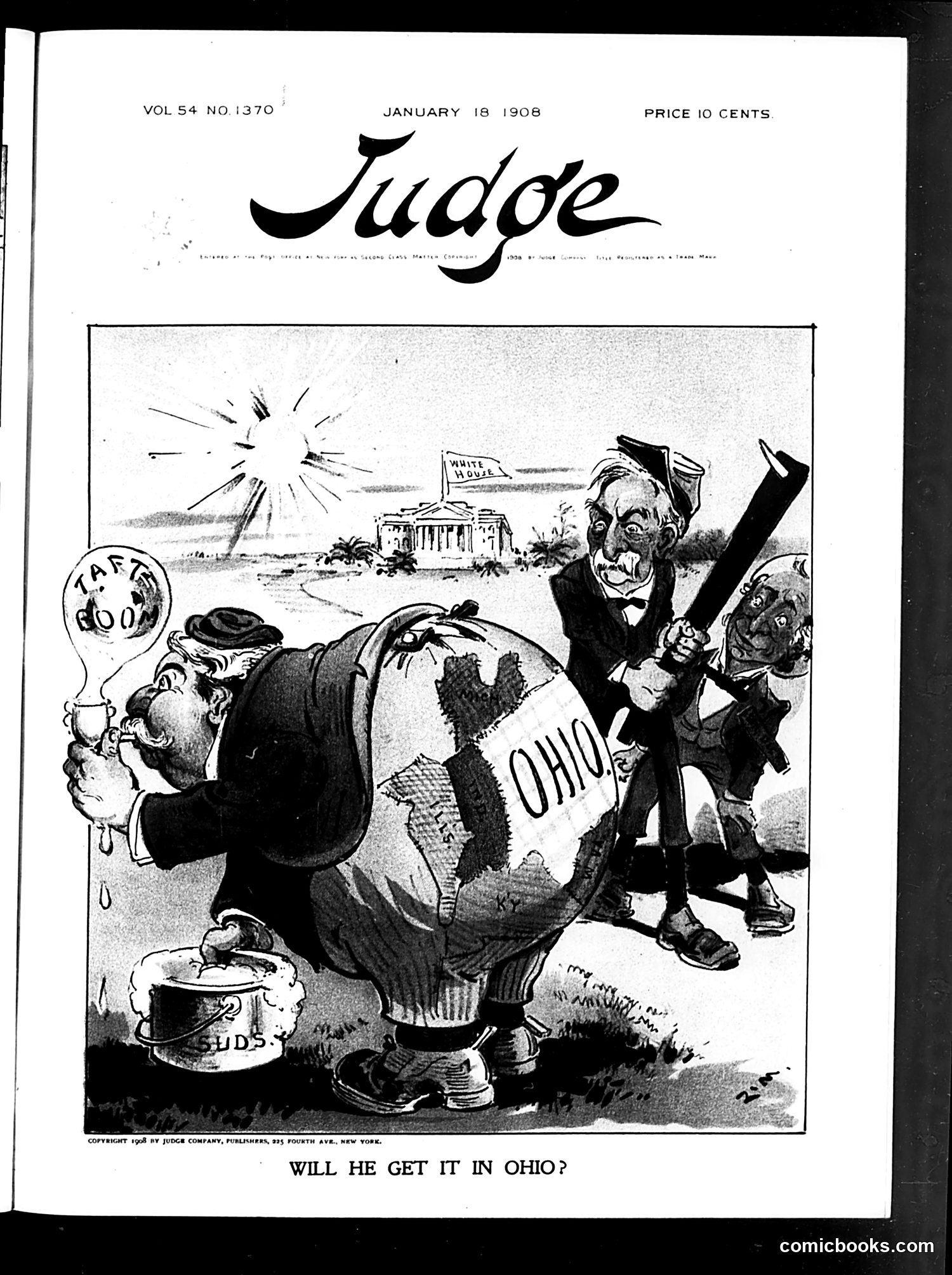
This political cartoon satirizes the 1908 U.S. presidential race, specifically questioning whether the Republican Party's chosen successor will win Ohio—a crucial swing state. The large figure labeled "OHIO" represents the state itself being inflated or manipulated. The man with the telescope appears to be a Republican operative examining the situation, while figures around him (likely representing party bosses or politicians) try to work "SUDS" and influence to secure the state's support. The "TARIFF" balloon and "WHITE HOUSE" visible in the background suggest economic policy and presidential ambitions are at stake. The cartoon mocks Republican efforts to guarantee electoral success in Ohio, implying they're uncertain of the outcome despite their political machinery.
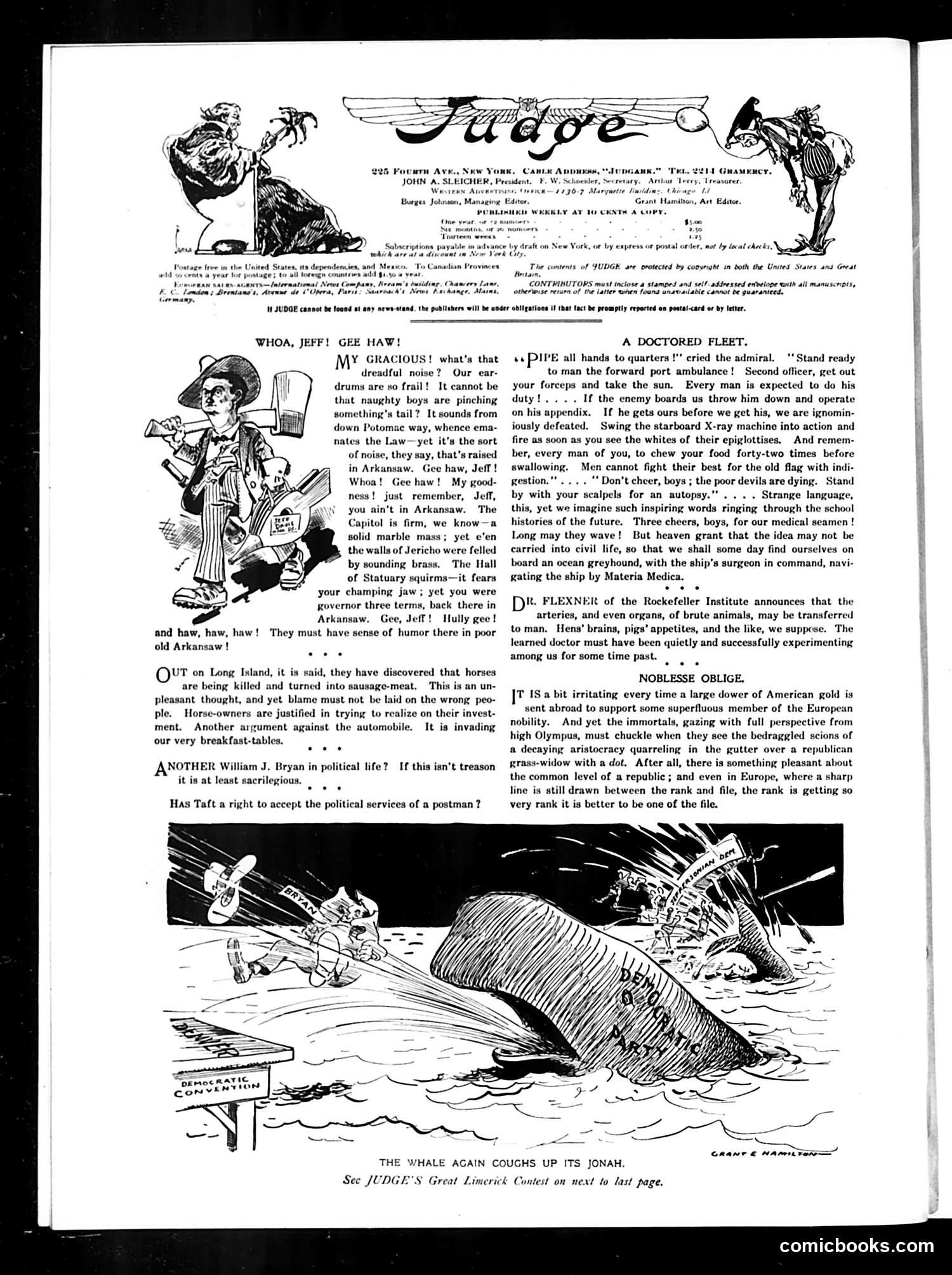
This page contains several brief satirical commentary pieces and illustrations typical of Judge's style. The main cartoon, "The Whale Again Coughs Up Its Jonah," depicts a whale expelling a figure labeled "Democratic Convention" back onto shore. This appears to reference a Democratic political convention where an unwanted candidate or faction was rejected—the biblical Jonah reference suggests something regurgitated or cast out as undesirable. The text sections above address various political and social topics: military preparedness (a "doctored fleet"), aristocratic pretension among wealthy Americans, and questions about political appointments and propriety. Without knowing the specific date, the exact political context remains unclear, but the satire targets Democratic Party divisions and broader elite hypocrisy of the era.
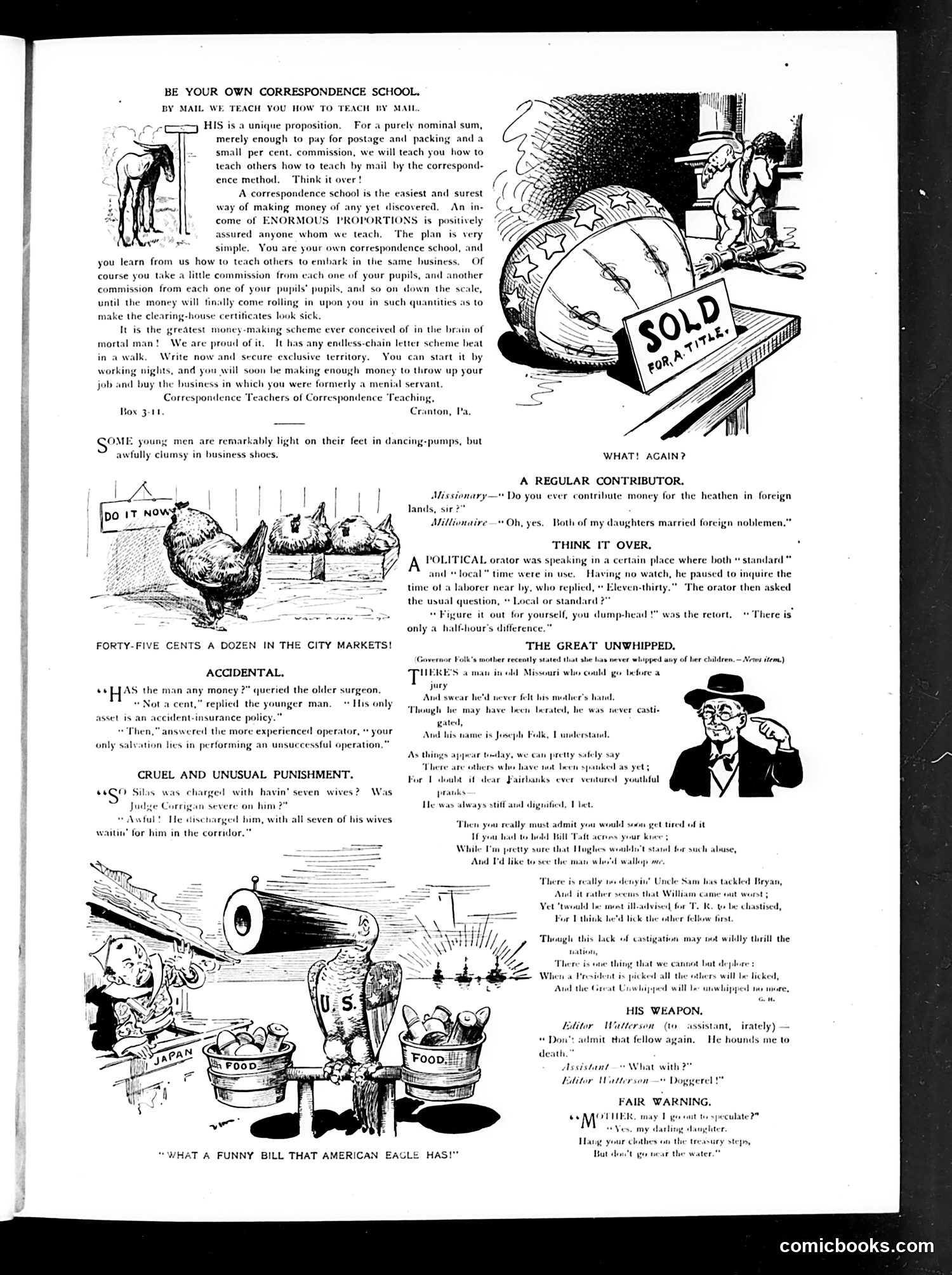
This page contains several satirical pieces typical of Judge magazine's humor: **"Be Your Own Correspondence School"** (top) mocks mail-order teaching schemes promising easy money. The satire targets get-rich-quick correspondence courses that were apparently common and dubious. **"Cruel and Unusual Punishment"** (bottom left) jokes about a man charged with "havin' seven wives," with the punchline that he's "disrobed him...with all seven of his wives waitin' for him in the corridor"—a marital infidelity joke. **"The Great Unwhipped"** (right) appears to reference political figures, likely mocking perceived lack of consequences for powerful men. The cartoons throughout use exaggerated caricatures typical of early 20th-century satirical journalism. The page primarily targets financial scams, marital misconduct, and political accountability—common Judge subjects reflecting era-specific social anxieties.
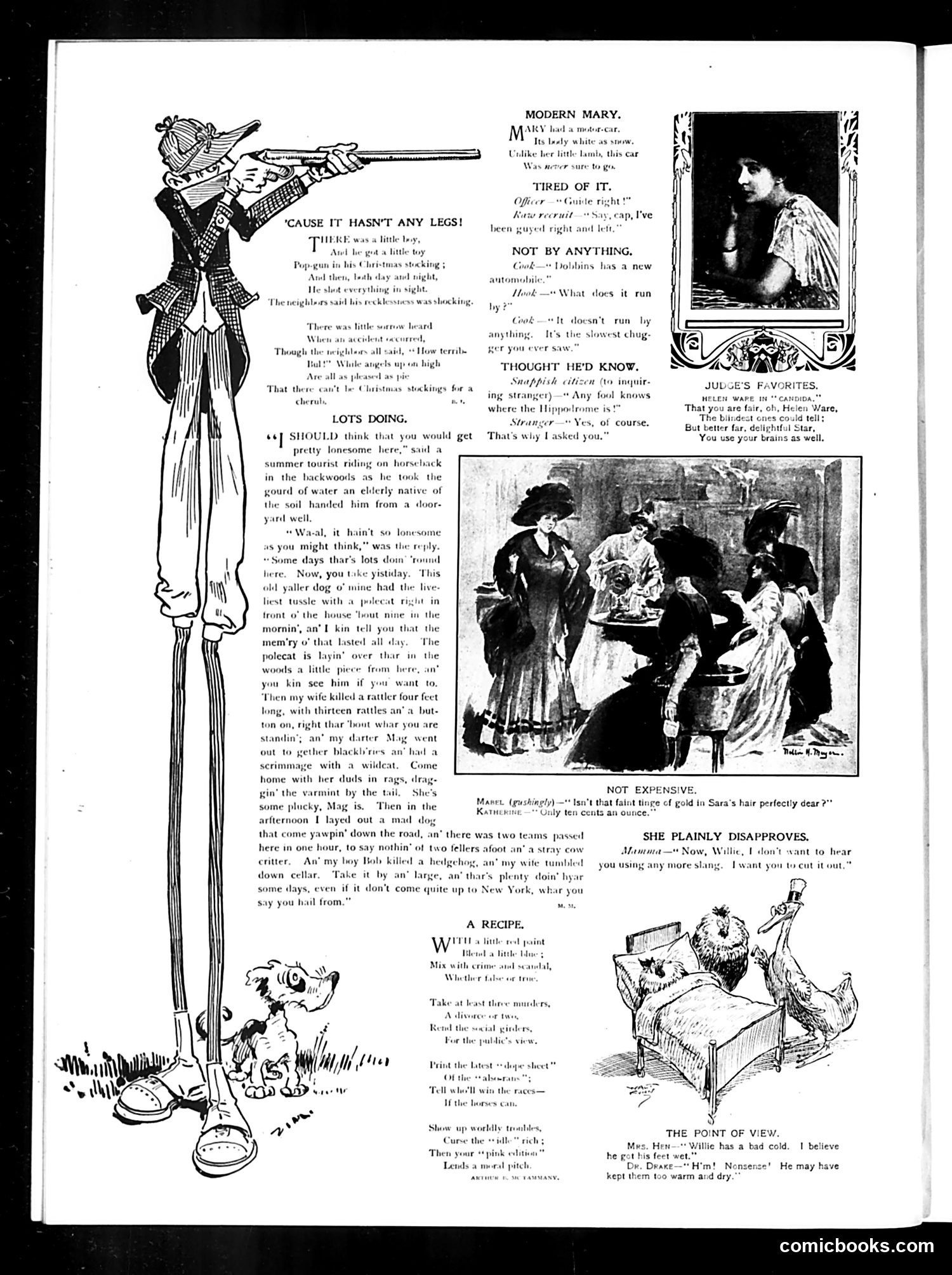
This page contains several humor pieces rather than a single political cartoon. The main left illustration depicts a woman in elaborate hunting attire aiming a rifle—a satire on women hunters or the "Modern Mary" referenced in the title poem. The poem mocks women attempting traditionally masculine activities, portraying them as incompetent ("'Cause it hasn't any legs!"). The other pieces include domestic humor dialogues ("Tired of It," "Not by Anything," "Thought He'd Know") and what appears to be a recipe section with accompanying illustration. The center photograph shows women in period dress, likely from a theatrical or social scene. The overall theme reflects early 20th-century satirical attitudes toward women's changing social roles, particularly their participation in previously male-dominated activities like hunting and sports.
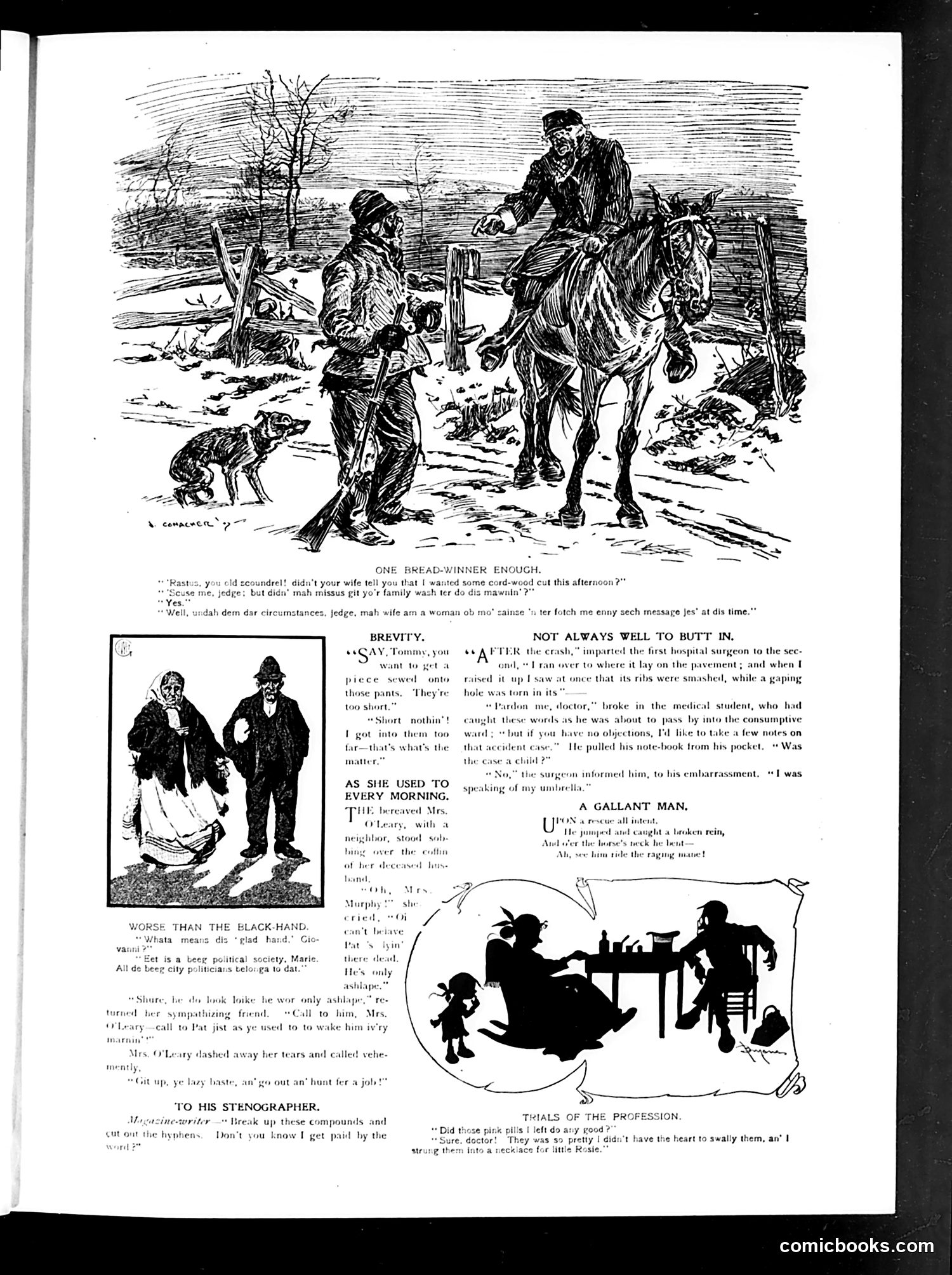
This page contains several satirical sketches and brief humorous stories typical of Judge magazine's format. The top illustration shows a soldier on horseback encountering a standing soldier, with dialogue about "bread" and "cordwood"—likely commentary on Civil War-era military rations or supply issues. Below are several short comic vignettes: **"Brevity"** and **"Worse Than the Black Hand"** appear to be domestic humor pieces about marriage and city life, unrelated to specific political figures. **"Not Always Well to Butt In"** and **"A Gallant Man"** seem to be general jokes about social situations and horse-riding mishaps. **"To His Stenographer"** depicts office humor about work conditions. **"Trials of the Profession"** appears to reference a medical professional's difficulties. The page lacks clearly identifiable political cartoons targeting specific public figures or dated events. It's primarily general-interest humor and social satire.
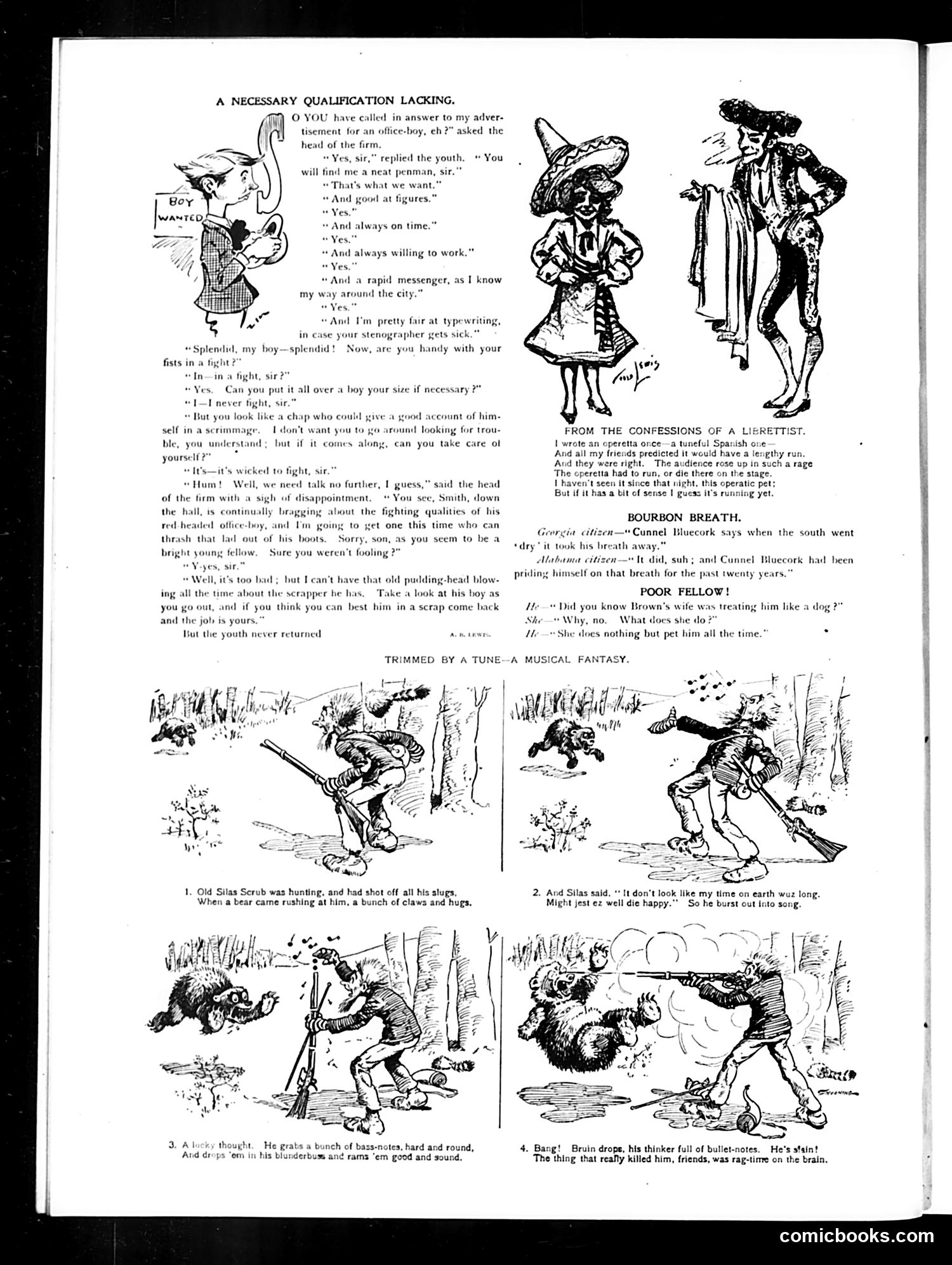
**"A Necessary Qualification Lacking"** satirizes corporate hypocrisy about workplace violence. A job applicant lists ideal qualifications—penmanship, punctuality, typing—but the employer dismisses him upon learning he won't fight. The boss admits he wants a boy who can "thrash" a competitor's office boy in a physical scrap, revealing that corporate culture valued street-fighting ability alongside clerical skills. The satire mocks employers who publicly demand professionalism while privately rewarding pugilism. **"Trimmed by a Tune"** jokes about a bad operetta that succeeded only because audiences rioted and the show had to keep running to avoid being shut down mid-performance—an ironic "success." The remaining items are brief humor snippets about Southern Bourbon drinkers, a wife's excessive pet-like affection, and a musical fantasy where a hunter defeats a bear by loading his gun with bass notes, killing it through sheer musical discord.
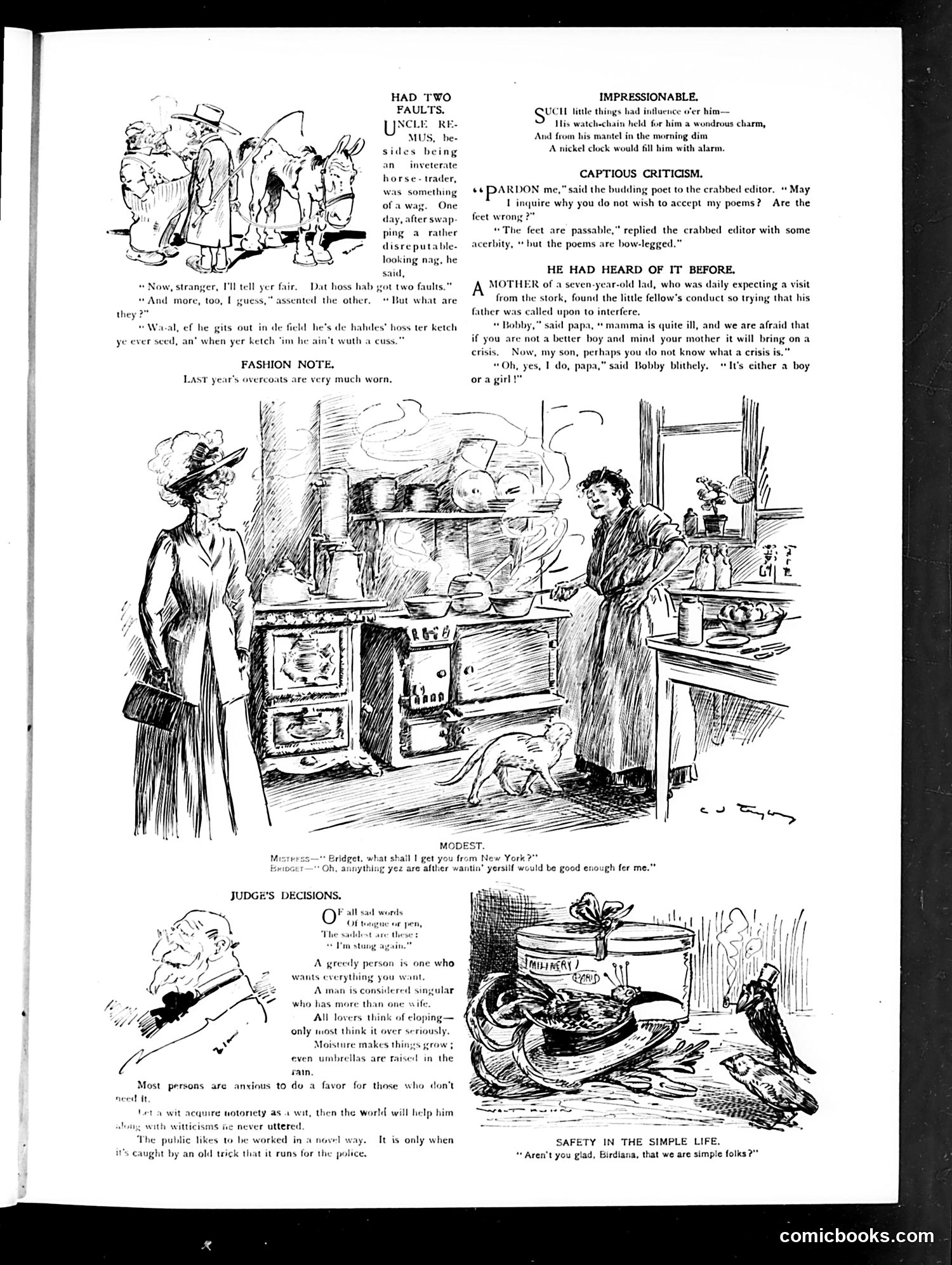
This page contains several standalone humorous sketches typical of early 20th-century satirical magazines: **"Had Two Faults"**: A dialect-heavy joke about a horse trader selling a defective horse. The humor relies on the buyer's discovery that the horse has obvious faults the seller downplayed—a con-artist scenario presented as rustic comedy. **"Captious Criticism"**: Satirizes pretentious poets and harsh editors. A young poet asks why his work was rejected; the editor dismisses it as "bow-legged" (metrically broken), mocking both amateur poets and overly critical literary gatekeepers. **"He Had Heard of It Before"**: A child-rearing joke where a father warns his misbehaving son that mother's illness could cause "a crisis," and the boy innocently replies it's "either a boy or a girl"—humor from the child's misunderstanding about pregnancy/childbirth. **"Judge's Decisions"**: Aphoristic observations about human nature (greed, love, wit, moistness) presented as philosophical pronouncements—gentle social satire on human foibles. The overall tone is lighthearted domestic and social commentary, not overtly political.
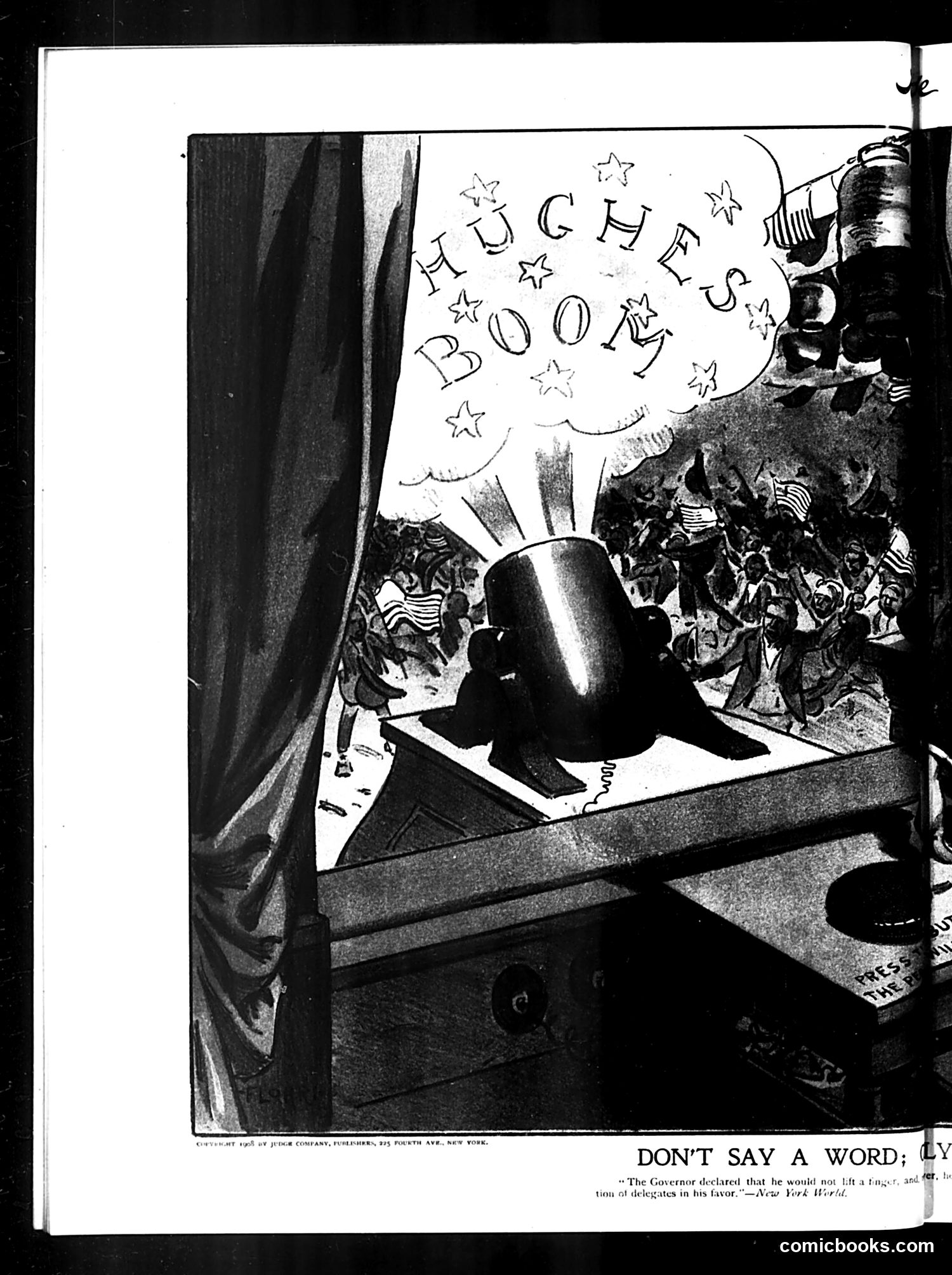
This Judge cartoon satirizes a Governor's political silence. The image shows a large megaphone or projector labeled "HUGHES BOOK" (likely Theodore Roosevelt's "Hughes" or a Governor Hughes reference) broadcasting to a crowd of American flag-waving citizens below. The caption references a Governor who declared he "would not lift a finger" and wouldn't make public statements regarding delegates in his favor—suggesting he's attempting to maintain plausible deniability about political maneuvering. The satire mocks the contradiction: while the Governor refuses to "say a word," his campaign apparatus (the massive megaphone) actively broadcasts his message to the public anyway. It's commentary on political hypocrisy—claiming neutrality while actively campaigning through surrogates and indirect means.
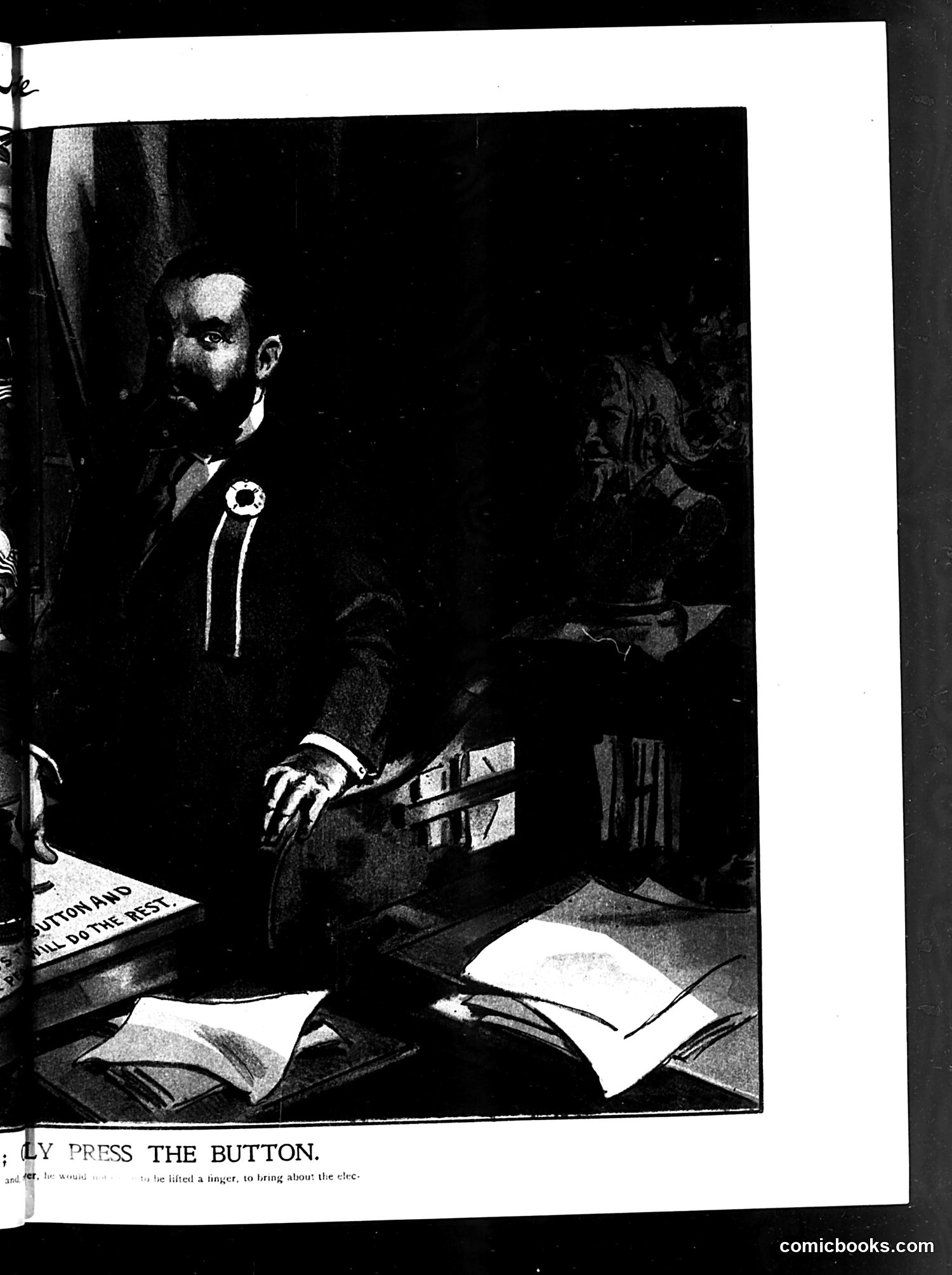
This appears to be a political cartoon from *Judge* magazine showing a bearded man in formal dress with military decorations at a desk, documents spread before him. The caption reads "BY PRESS THE BUTTON," with partial text below suggesting "he lifted a finger, to bring about the elec-" (election, presumably). The cartoon likely satirizes a political figure's power to influence elections through some mechanism—the "button" representing executive authority or behind-the-scenes control. The military medals and formal attire suggest a military or authoritarian leader. Without the full date or clearer context, the specific target remains unclear, but it critiques the concentration of power in one person's hands to manipulate electoral outcomes.
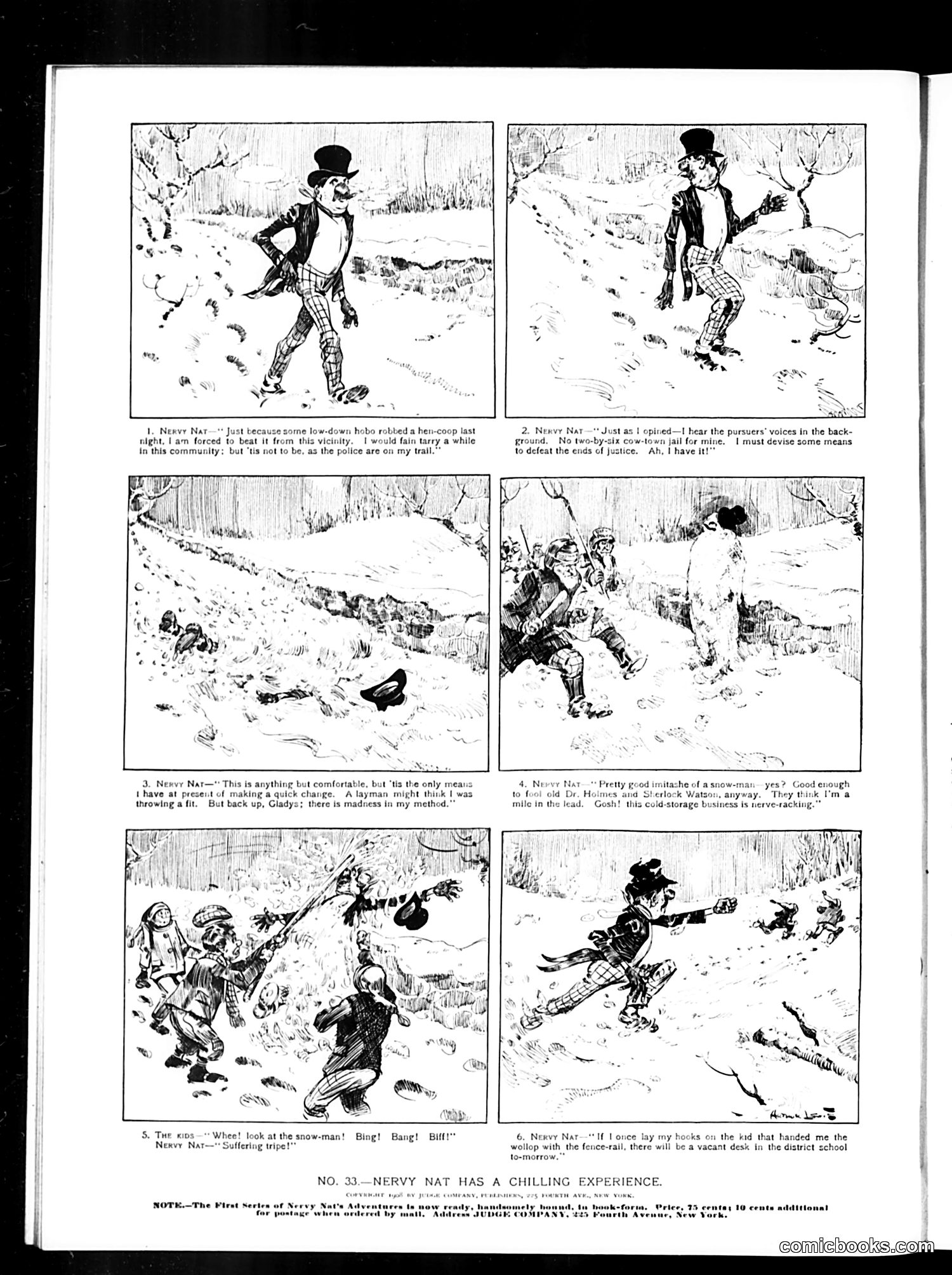
This is a comic strip following "Nervy Nat," an apparent vagrant or drifter fleeing police after a henhouse robbery. The humor derives from his increasingly absurd escape scheme: he creates a life-sized snowman to fool pursuing authorities and detectives ("Dr. Holmes and Sherlock Watson"—references to famous fictional detectives). The joke escalates when local children discover the snow figure and begin attacking it with snowballs. Nat, hidden inside the hollow snowman, endures the bombardment. He ironically concludes that if the children report the "occupied snowman" to their teacher, there will be a vacant desk—implying he'll be arrested before the child returns to school. The satire mocks both small-town justice systems and the desperation of vagrants, while the slapstick physicality drives the humor for Judge's readership.
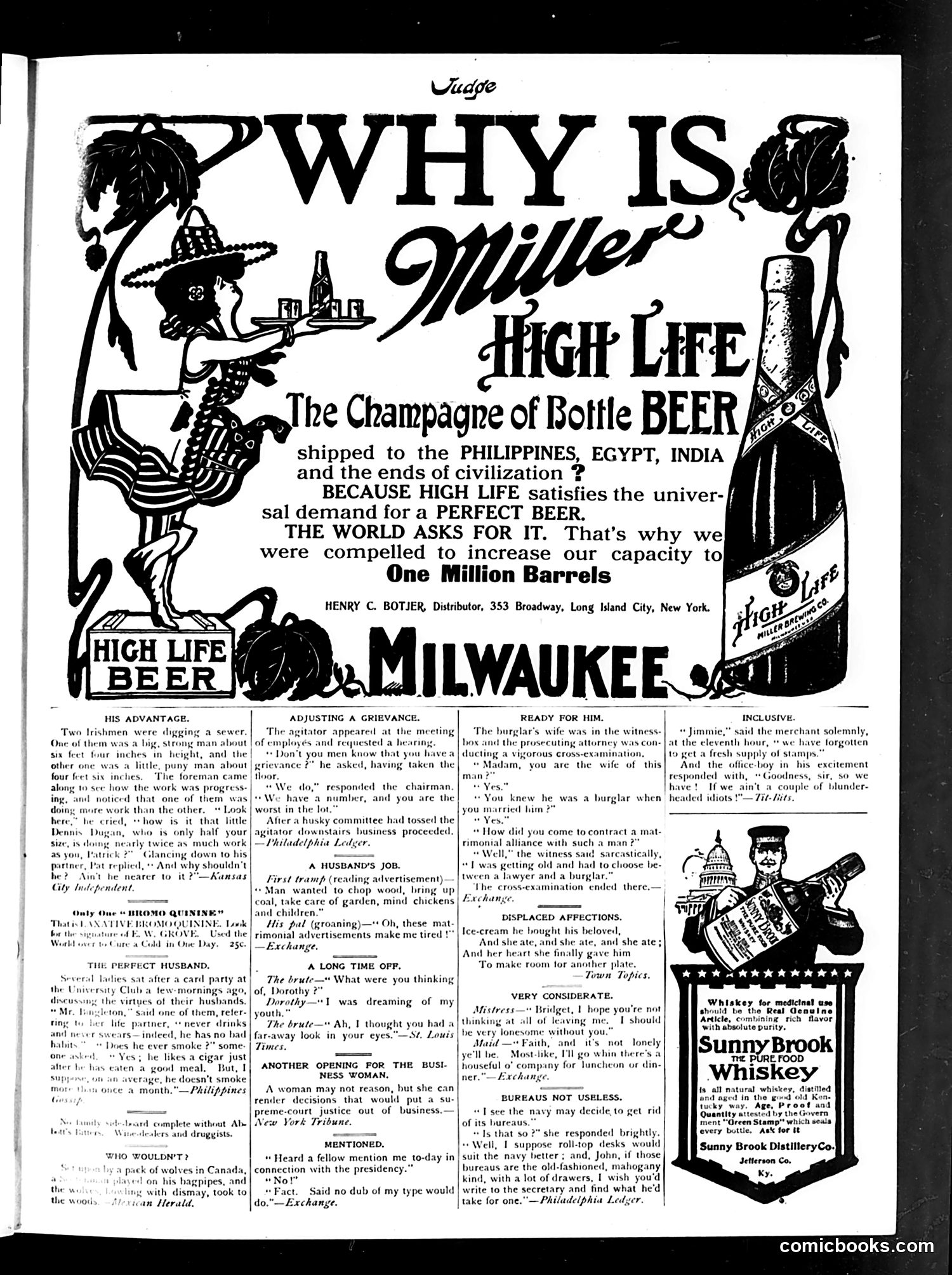
This page from *Judge* magazine is primarily **advertising and humor**, not political satire. The dominant feature is a **Miller High Life beer advertisement** claiming superiority ("The Champagne of Bottle Beer") and boasting of one-million-barrel capacity expansion due to global demand. The surrounding content consists of **light comic anecdotes** typical of early-20th-century magazines: - Irish workers joking about height and proximity to work - Jokes about perfect husbands, griping workers, and matrimonial advertisements - Wordplay about "business women" and romance **No major political figures or events** are referenced. The humor relies on ethnic stereotypes (Irish characters), gender stereotypes (women as illogical), and domestic/workplace comedy that was standard period fare. The **only social critique** is mild: brief mockery of business agitators and bureaucratic inefficiency. The overall tone is lighthearted rather than cutting satire—essentially filler material padding the beer advertisement.
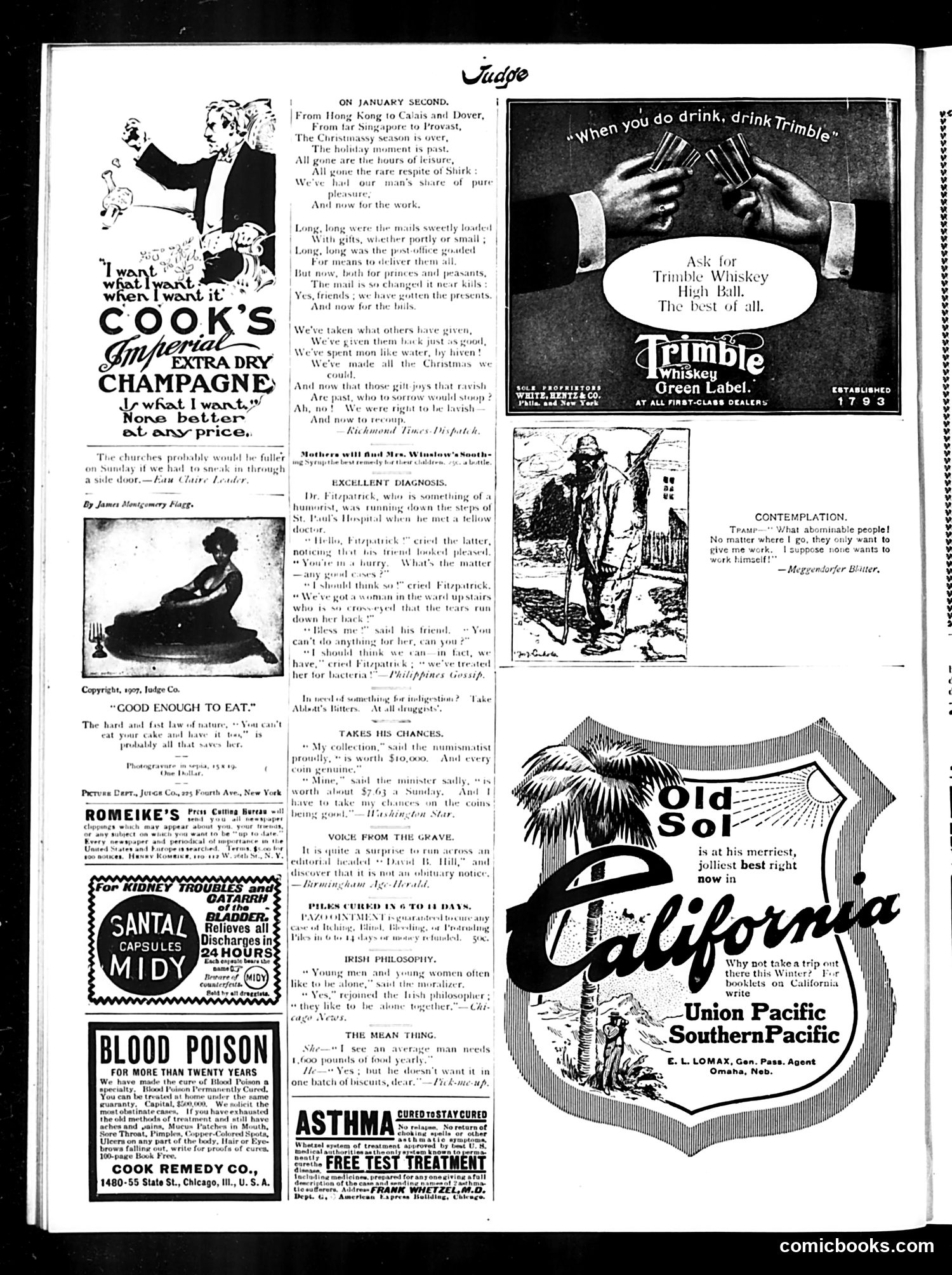
This is primarily an **advertising page** from Judge magazine (circa 1907, based on visible dates). The main content consists of commercial advertisements rather than editorial cartoons. The page features: 1. **Cook's Imperial Champagne ad** (top left): A man offering champagne, with text about post-holiday leisure and returning to work—typical luxury goods marketing of the era. 2. **Trimble Whiskey ad** (top right): Promotes their "High Ball" whiskey to well-dressed men, a common marketing approach for spirits in this period. 3. **Various patent medicines and dubious remedies**: Santal Capsules for "Midy" (unclear condition), "Blood Poison" treatment, and "Asthma" cure with "Free Test Treatment"—reflecting the unregulated medical advertising common in early 1900s publications before FDA oversight. 4. **California tourism ad** (bottom right): Union Pacific Southern Pacific railroad promoting California travel. The small editorial illustrations appear to be humorous vignettes about social situations, but the OCR is too garbled to reliably interpret their specific satirical intent.
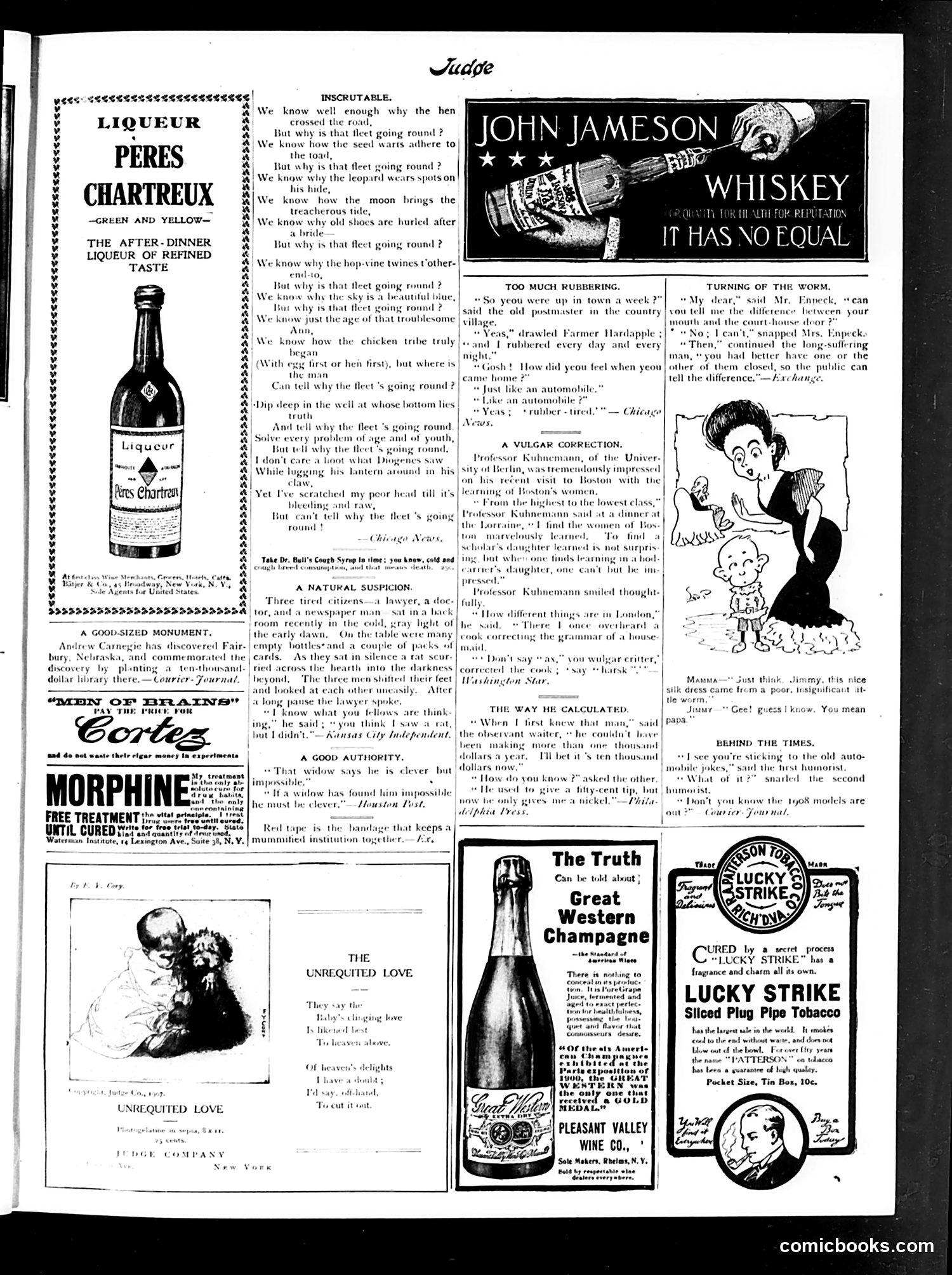
This page from the satirical magazine *Judge* is primarily **advertising with scattered humor pieces**, typical of early 20th-century American magazines. The main cartoon appears to be "INSCRUTABLE"—a poem-format joke mocking pseudo-intellectual mysteriousness. It lists things humans understand (why hens cross roads, leopards have spots) before repeatedly asking an absurd question: "But why is that fleet going round?"—suggesting naval vessels circling pointlessly. The satire targets overwrought philosophical speculation. Other brief humor columns mock contemporary social types: the nosy postmaster ("TOO MUCH RUBBERING"), the nagging wife ("TURNING OF THE WORM"), and a pretentious German professor discussing Boston women's education. The page is dominated by **period advertisements** for liqueurs, whiskey, morphine treatments, tobacco, and champagne—reflecting both Judge's commercial support and the era's unregulated marketing of now-restricted substances. The cartoons broadly satirize American provincial life, social pretension, and domestic squabbles rather than specific political events.
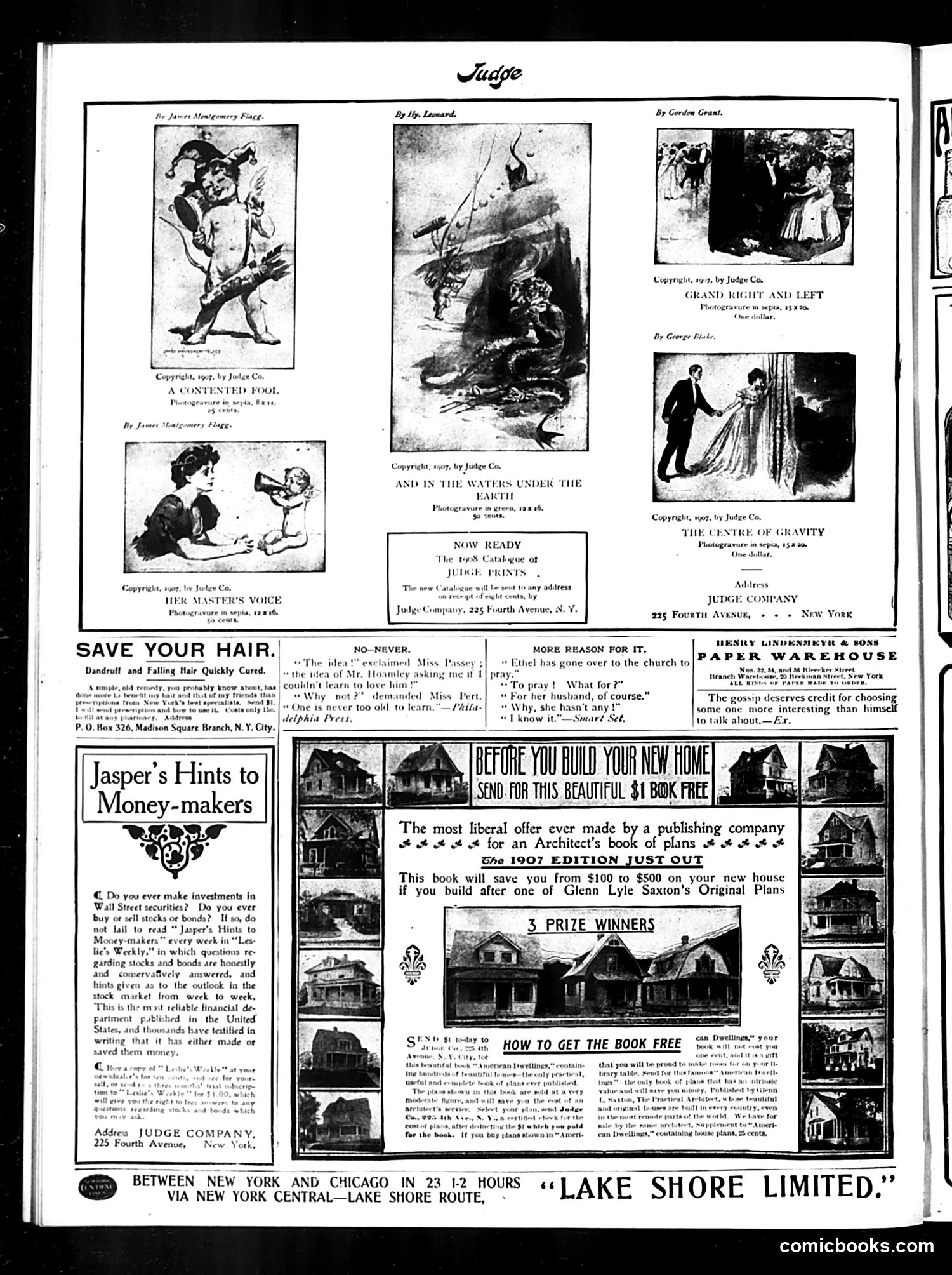
This page is primarily **advertising and promotional content** rather than editorial cartoons. The top section contains three small illustrations by artists Flagg, Leonard, and Grant depicting domestic scenes with titles like "A Contented Fool" and "The Centre of Gravity"—these appear to be light satirical takes on relationships and social situations typical of Judge's humor. However, the page is dominated by **advertisements**: a hair-loss remedy, Jasper's investment advice column, an architect's home-plan book offer (heavily promoted as a money-saving resource), and railroad/warehouse services. The brief text snippets show typical early-1900s satirical exchanges—one mocks a woman asking an older man to teach her to love him, another jokes about a woman praying for her husband's interesting conversation. Overall, this is a **commercial page** reflecting Judge's dual function as both satirical magazine and advertising vehicle, with generic domestic humor rather than specific political commentary.
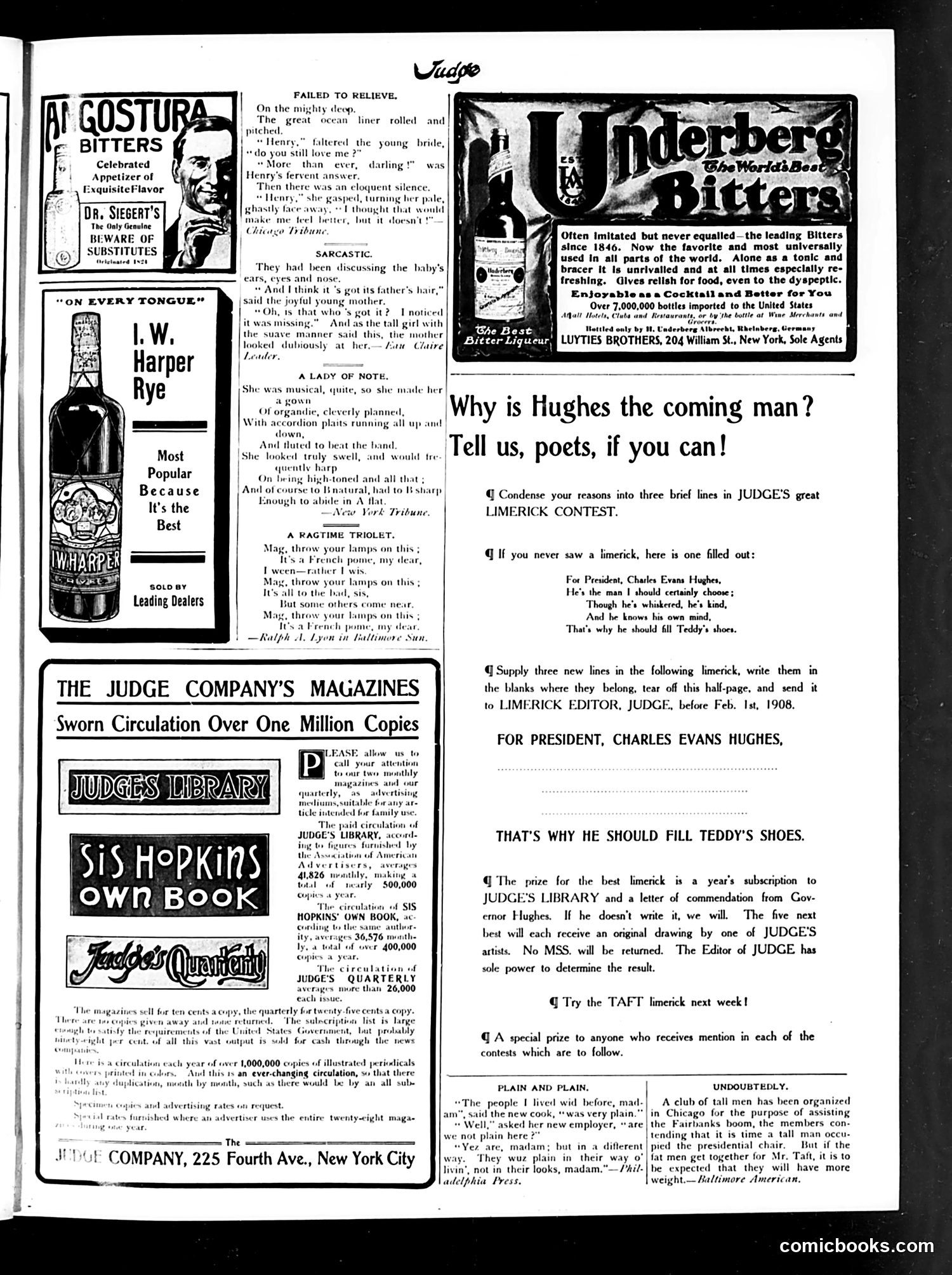
This page is primarily a **political advertisement disguised as entertainment**. The centerpiece is a limerick contest promoting **Charles Evans Hughes for President** in 1908, with the satirical premise that he should "fill Teddy's shoes"—meaning he should succeed Theodore Roosevelt. The contest format invites readers to complete limericks mocking Hughes while ostensibly supporting him. The example limerick focuses on his prominent whiskers and conservative demeanor ("whiskered, he's kind"). This was characteristic of Judge magazine's approach: using humor and satire to promote political candidates to its educated, affluent readership. The rest of the page contains unrelated Victorian-era jokes and liquor advertisements. The political content represents how early 20th-century publications blended editorial advocacy with entertainment, using reader participation contests to boost candidate visibility and engagement before modern advertising techniques existed.
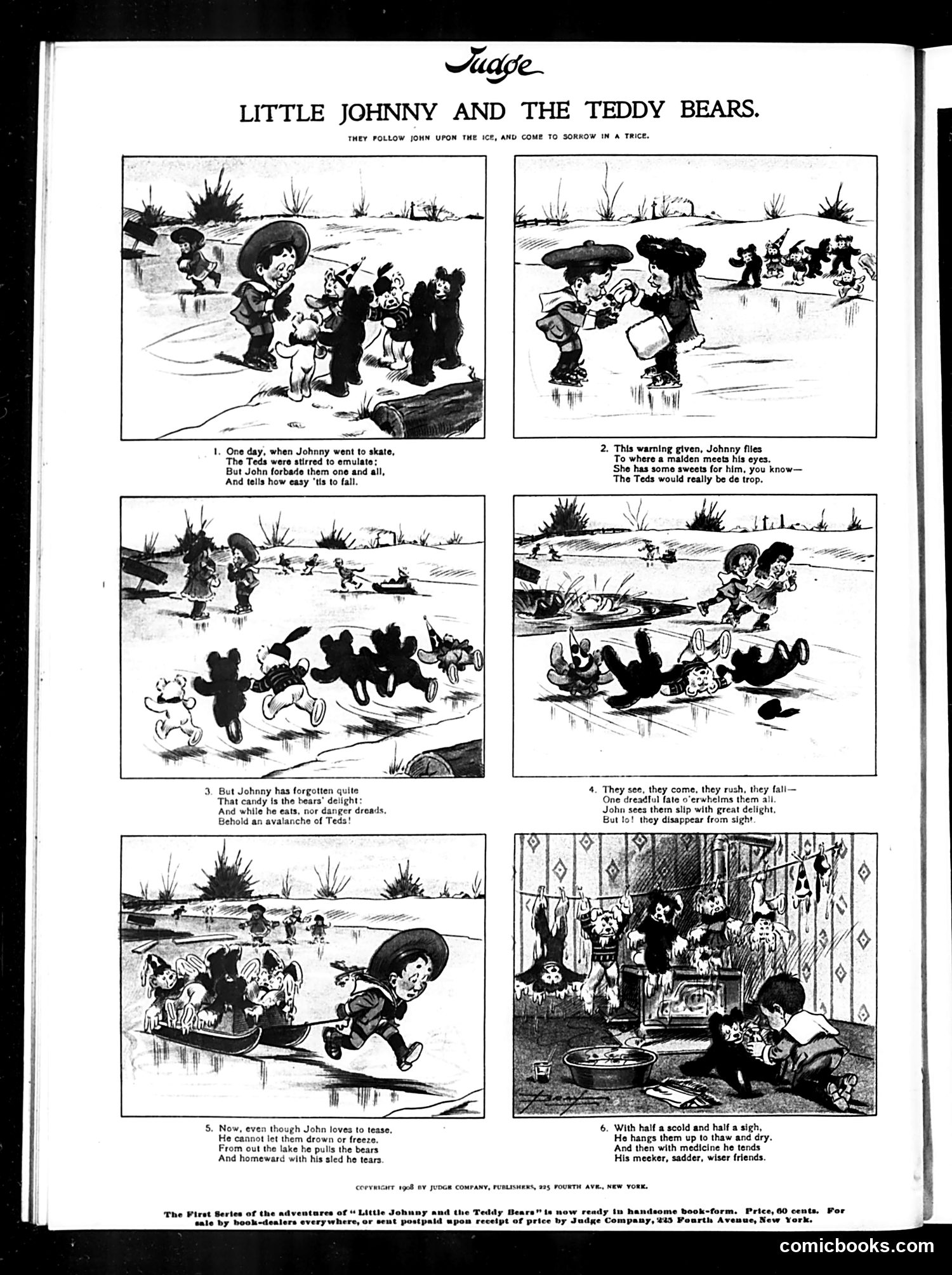
This is a children's comic strip from Judge magazine (1908) with no political satire. It's a straightforward moral tale about a boy named Johnny and his toy teddy bears. The story shows Johnny ice-skating with his teddy bears, warning them the ice is dangerous. He then abandons them to flirt with a girl and eat candy. While he's distracted, the bears fall through the ice. Johnny, despite enjoying teasing them, can't leave them to freeze—he rescues them, brings them home, and nurses them back to health by hanging them to dry and applying medicine. The narrative arc teaches lessons about responsibility and compassion: don't abandon friends for temptation, and help others in distress despite past mischief. "Teddy bears" were popular toys named after President Theodore Roosevelt, making them culturally relevant to 1908 readers.