
A complete issue · 16 pages · 1907
Judge — December 21, 1907
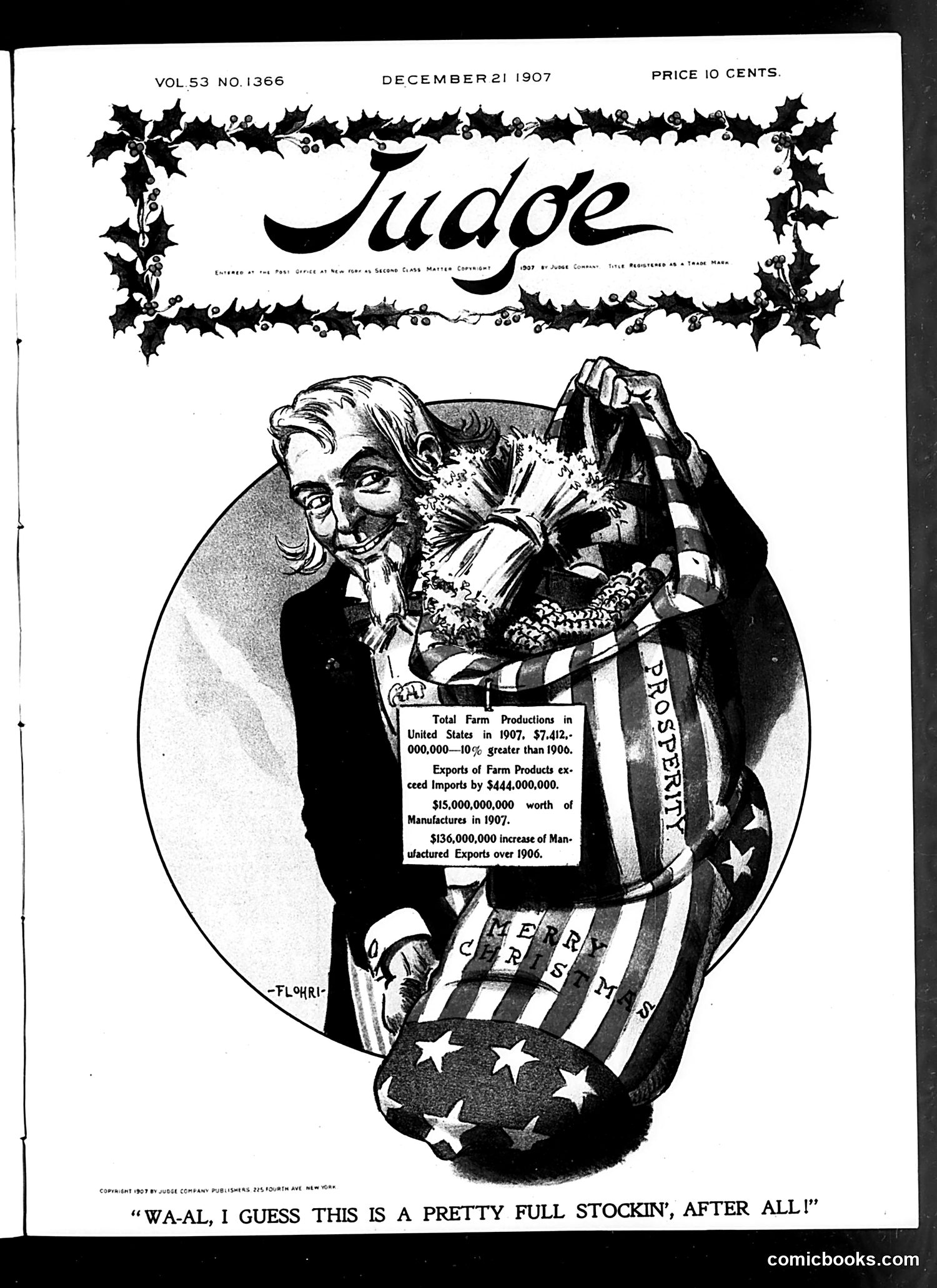
This political cartoon satirizes American prosperity under President Theodore Roosevelt's administration. Uncle Sam (the bearded figure) displays a bulging Christmas stocking filled with economic achievements: record farm production ($7.4 billion), export surpluses exceeding imports by $444 million, and $15 billion in manufactured goods—with a $136 million increase in exports over 1906. The caption, "Waal, I guess this is a pretty full stockin', after all!" expresses satisfied complacency about national economic performance. The cornucopia of goods and the patriotic imagery (flag, stars) celebrate American industrial and agricultural dominance. The cartoon presents a favorable assessment of Roosevelt-era economic conditions to Judge's readers, though the satisfied tone might suggest either genuine optimism or subtle irony about overconfidence.
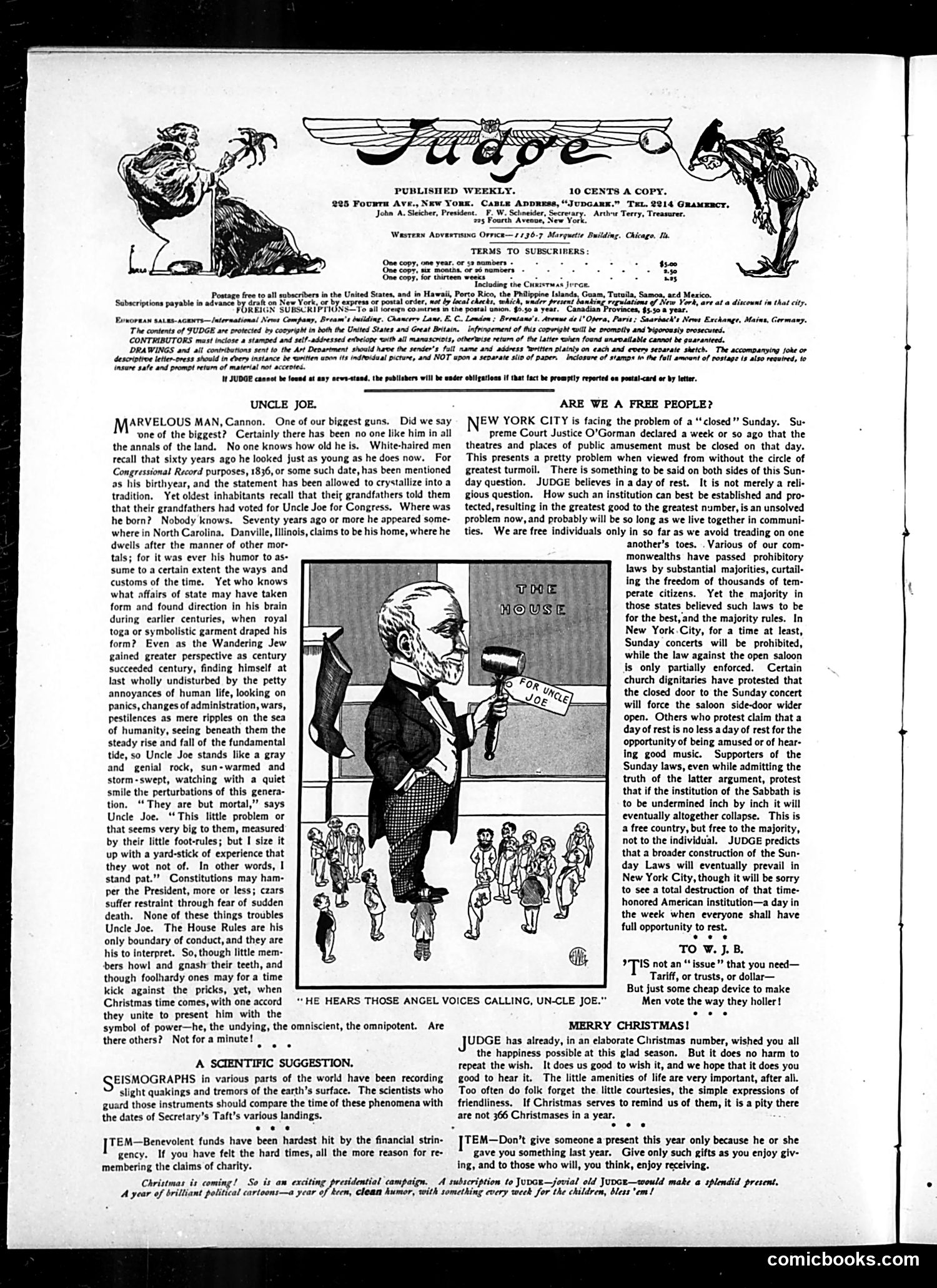
The main cartoon depicts a figure labeled "Uncle Joe" using a megaphone to address a crowd of children below, with text reading "HE HEARS THOSE ANGEL VOICES CALLING, UN-CLE JOE." The accompanying article discusses Uncle Joe as "one of our biggest guns"—likely a prominent political figure of the era, though the specific identity is unclear from this excerpt. The cartoon satirizes his influence over the populace, particularly children, depicted as small figures responding to his calls. The right-hand article, "Are We a Free People?", debates the "closed" Sunday—New York's enforcement of blue laws prohibiting alcohol sales. The piece critiques government restrictions on individual liberty, arguing that while laws passed by majorities shouldn't be dismissed, they still constrain personal freedom. This reflects early 20th-century tensions between Progressive regulation and individual rights.
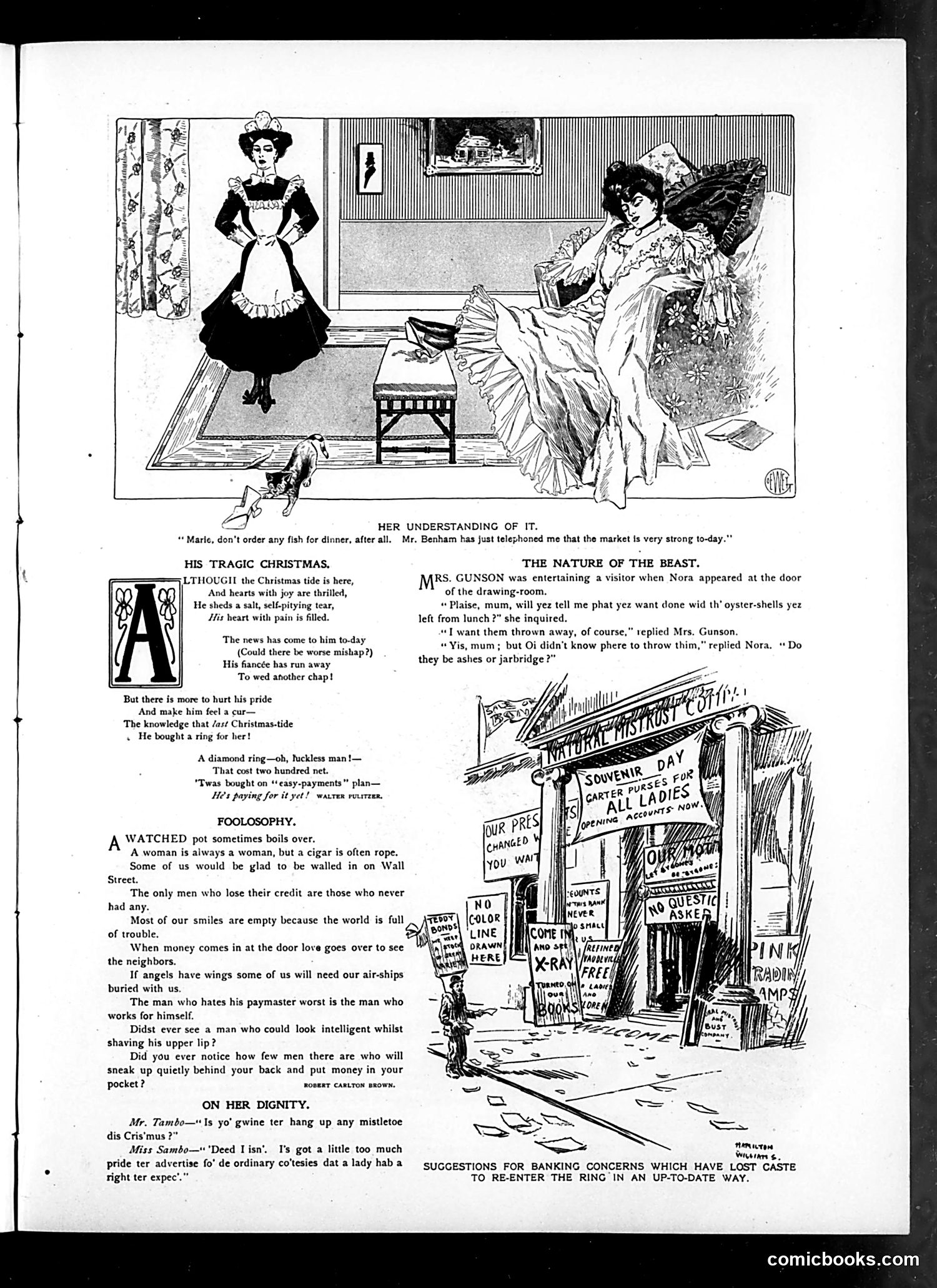
This page contains several satirical pieces mocking early 20th-century social pretensions and gender dynamics: **Top cartoon** ("Her Understanding of It"): A maid and wealthy woman discuss dinner preparations. The satire targets upper-class obliviousness—the employer doesn't know basic kitchen management, instead relying on servants. **Left column poems** ("His Tragic Christmas," "Foolosophy," "On Her Dignity"): These mock masculine insecurity, financial anxiety, and marital power dynamics of the era, using ironic "wisdom" to highlight male shortcomings. **Right side illustration**: A storefront advertising "National Biscuit Company" souvenirs and various products, labeled as suggestions for "banking concerns which have lost caste." This appears to satirize businesses attempting to restore respectability through commercial gimmickry. The overall theme critiques class pretension, consumer culture, and gender relations in Edwardian America.
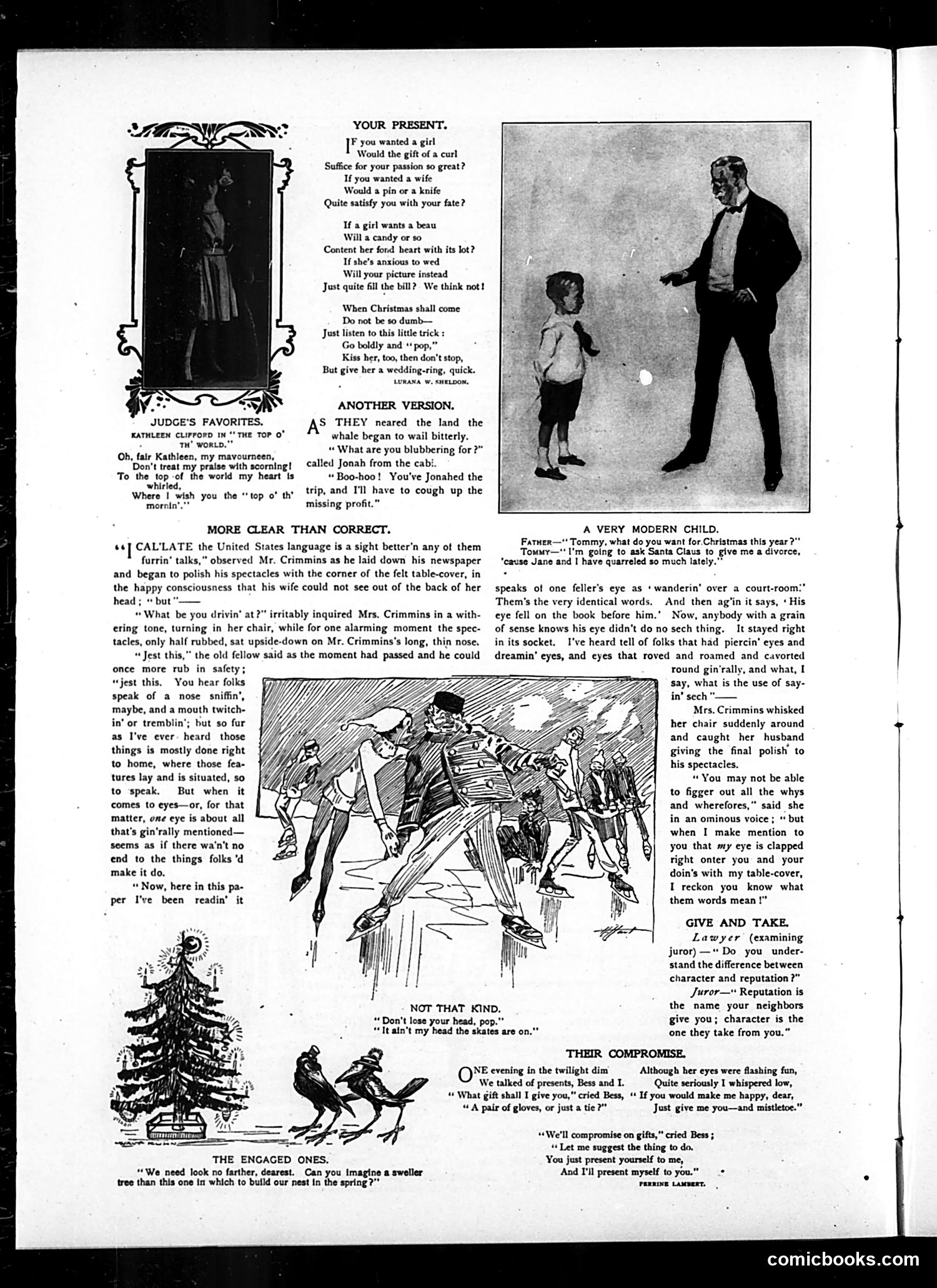
This page contains **Christmas gift-giving satire** and domestic humor rather than political commentary. The top section "Your Present" mocks the inadequacy of practical gifts (coats, pins, knives) when people expect something more meaningful or luxurious—a critique of holiday gift-giving expectations versus reality. "A Very Modern Child" depicts a father-son exchange about Christmas wishes, where the child requests a divorce for his mother (referencing contemporary anxieties about rising divorce rates), before the father redirects him to more conventional presents. The central illustration shows chaotic family dining, captioned "Not That Kind," suggesting awkward domestic moments. "Their Compromise" depicts a couple negotiating gift-giving through mutual personal presentation rather than material exchange. The overall theme satirizes modern marriage, gift expectations, and family dynamics during the holiday season—humor accessible to early 20th-century readers confronting changing social values.
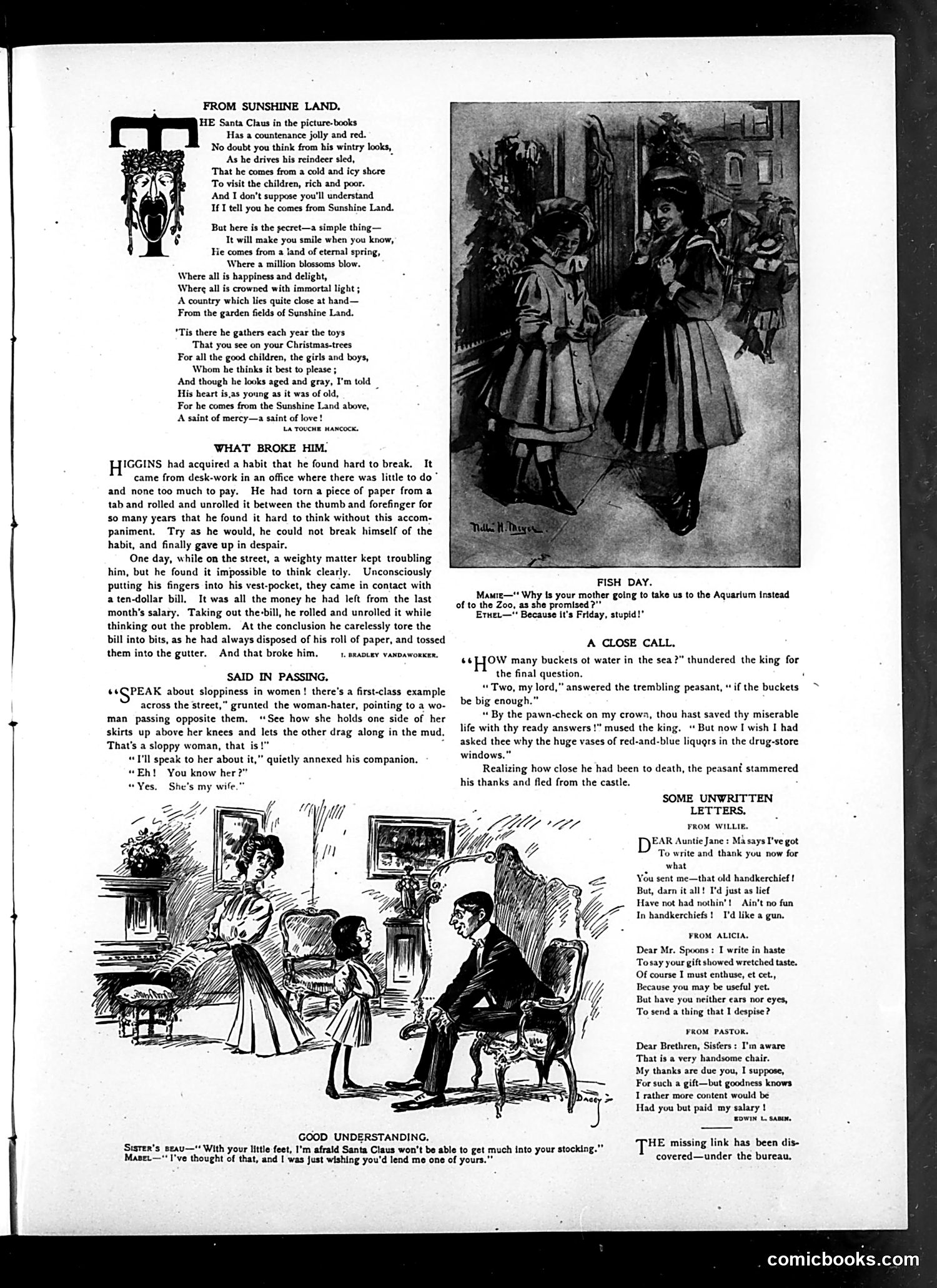
This page contains several unrelated pieces rather than a unified political cartoon. The main content includes: 1. **"From Sunshine Land"** – a sentimental Christmas poem about Santa Claus visiting good and poor children, attributed to La Vonne Hancock. This appears nostalgic rather than satirical. 2. **"What Broke Him"** – a humorous anecdote about a office worker who acquired a habit of rolling paper between his fingers, eventually breaking the habit by tearing a bill into a gutter. 3. **"Fish Day"** and other brief jokes and illustrated vignettes about everyday domestic situations. 4. **"Some Unwritten Letters"** – fictitious letters providing gentle social satire about gift-giving etiquette. The page appears to be general humor content rather than political satire, mixing sentimental verse with light domestic comedy typical of Judge's broader appeal to general audiences.
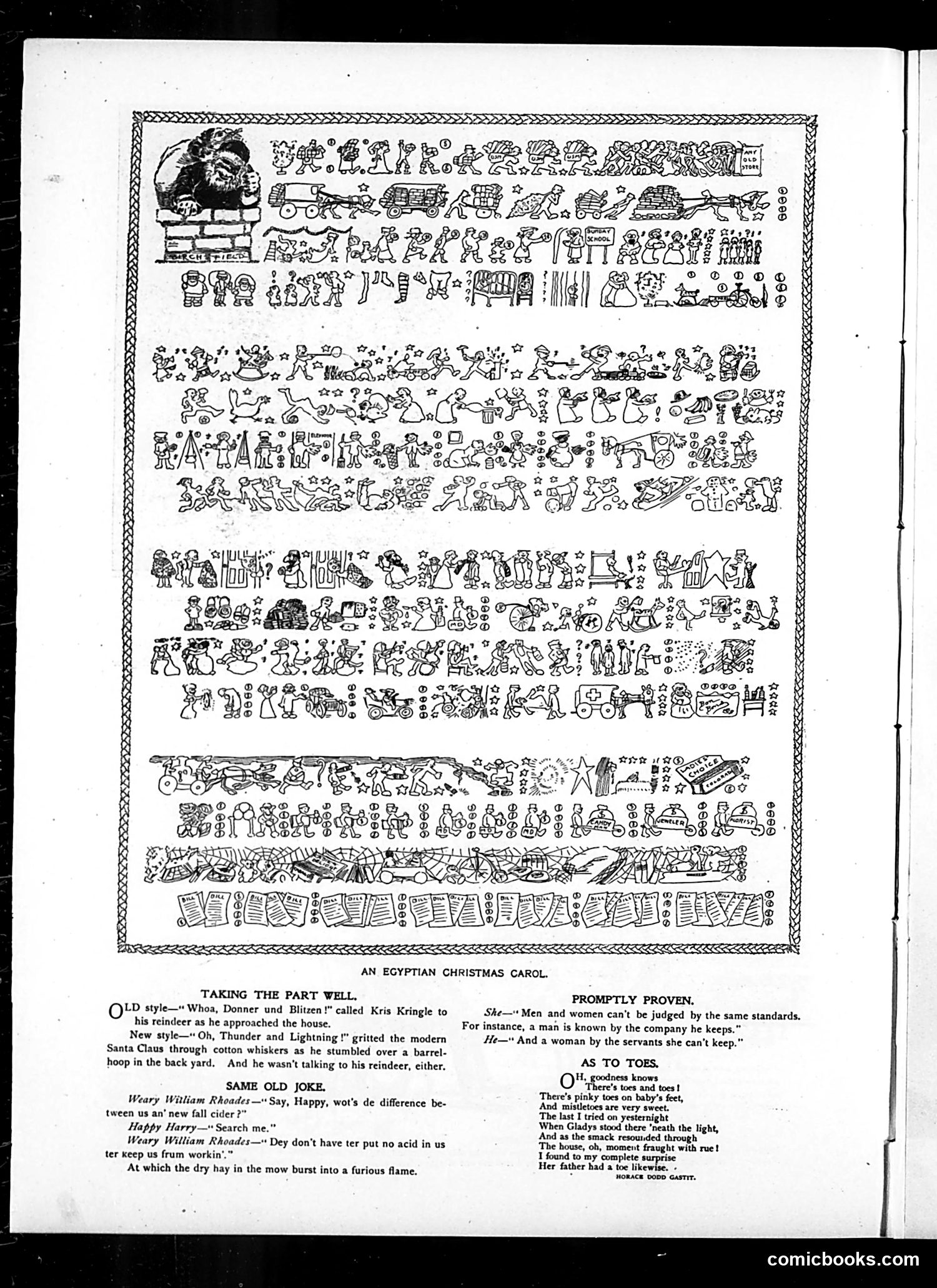
The top section features illegible hieroglyphic-style imagery—likely a visual joke playing on "Egyptian" themes popular in early 20th-century entertainment, though the specific satire is unclear from the degraded image. Below are three humor pieces: **"Taking the Part Well"**: Contrasts old-fashioned Santa ("Donner und Blitzen") with modern Santa, who curses ("Thunder and Lightning") while stumbling—mocking how even supposedly wholesome Christmas figures are becoming crude and undignified. **"Same Old Joke"**: A tired exchange between two working-class characters about the difference between "new" and "old" cider, culminating in a crude joke about acid and fermentation. It satirizes recycled, low-brow humor. **"As to Toes"**: A sentimental poem about a woman's feet and mistletoes that takes a dark turn when her father's intervention causes injury—poking fun at sentimental holiday verse. The page combines lowbrow comedy with gentle social satire about class, manners, and degrading standards.
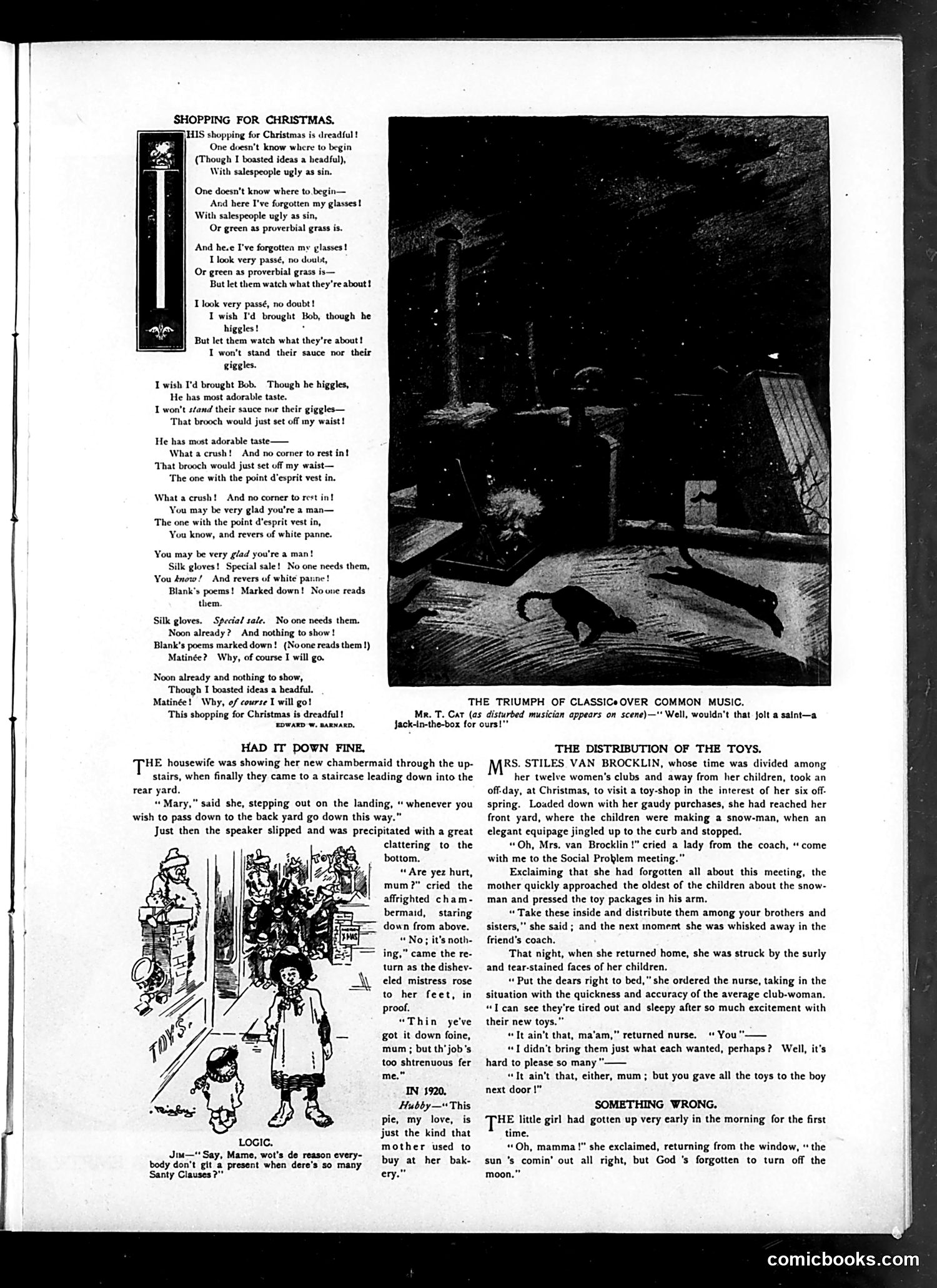
This page contains several satirical pieces lampooning early 20th-century American society: **"Shopping for Christmas"** (poem): A wealthy woman's complaint about holiday shopping—overcrowded stores, rude salespeople, forgotten eyeglasses, and the exhaustion of purchasing fashionable items. The satire mocks upper-class materialism and women's obsession with status goods like silk gloves and brooches. **"Had It Down Fine"** (comic with illustration): A domestic comedy where a new Irish chambermaid, witnessing her mistress fall down stairs, responds that the mistress has "got it down fine" but the job's "too strenuous." The humor relies on Irish dialect humor, common in period publications. **Other pieces** include brief jokes about gifts, classical music interrupted by a jack-in-the-box, and "The Distribution of the Toys"—satirizing a society matron so consumed by club meetings she neglects her children, hastily distributing toys without supervision. The satire targets wealth inequality, neglectful parenting among the privileged classes, and commercialized Christmas.
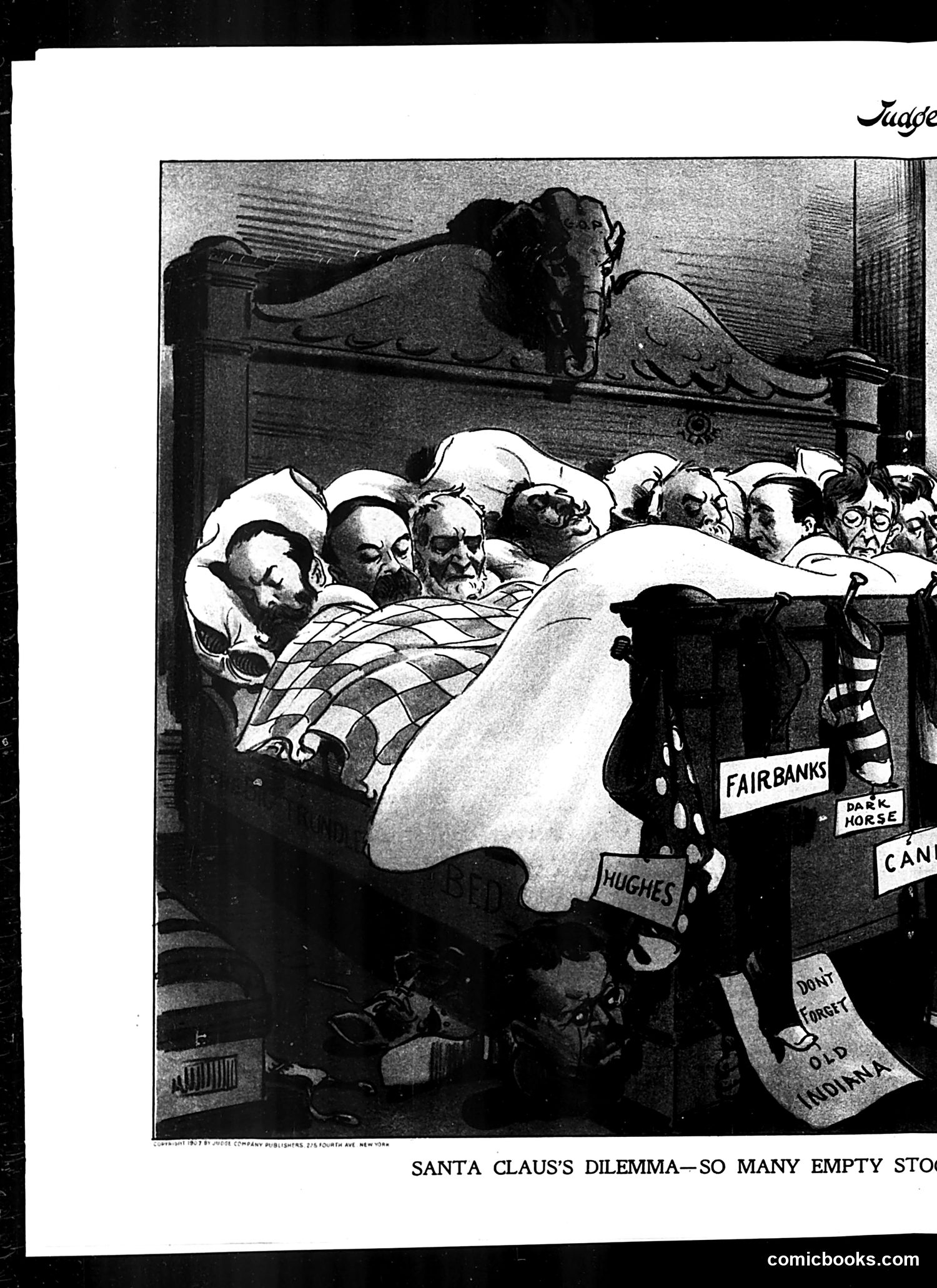
This political cartoon depicts Santa Claus facing a dilemma with multiple empty stockings. The labels visible on items below the bed include "FAIRBANKS," "HUGHES," "DARK HORSE," and "CANI[DIDATE]," suggesting these represent political figures or candidates. One label reads "DON'T FORGET" and "GONNA," though the complete text is unclear. The satire appears to comment on a crowded political field or election cycle where Santa (representing voters or fate) must choose among numerous candidates, many of whom are portrayed as inadequate or "empty"—lacking substance or merit. This likely references an early 20th-century election where multiple candidates competed, though the specific year and election are not definitively stated on this page fragment.
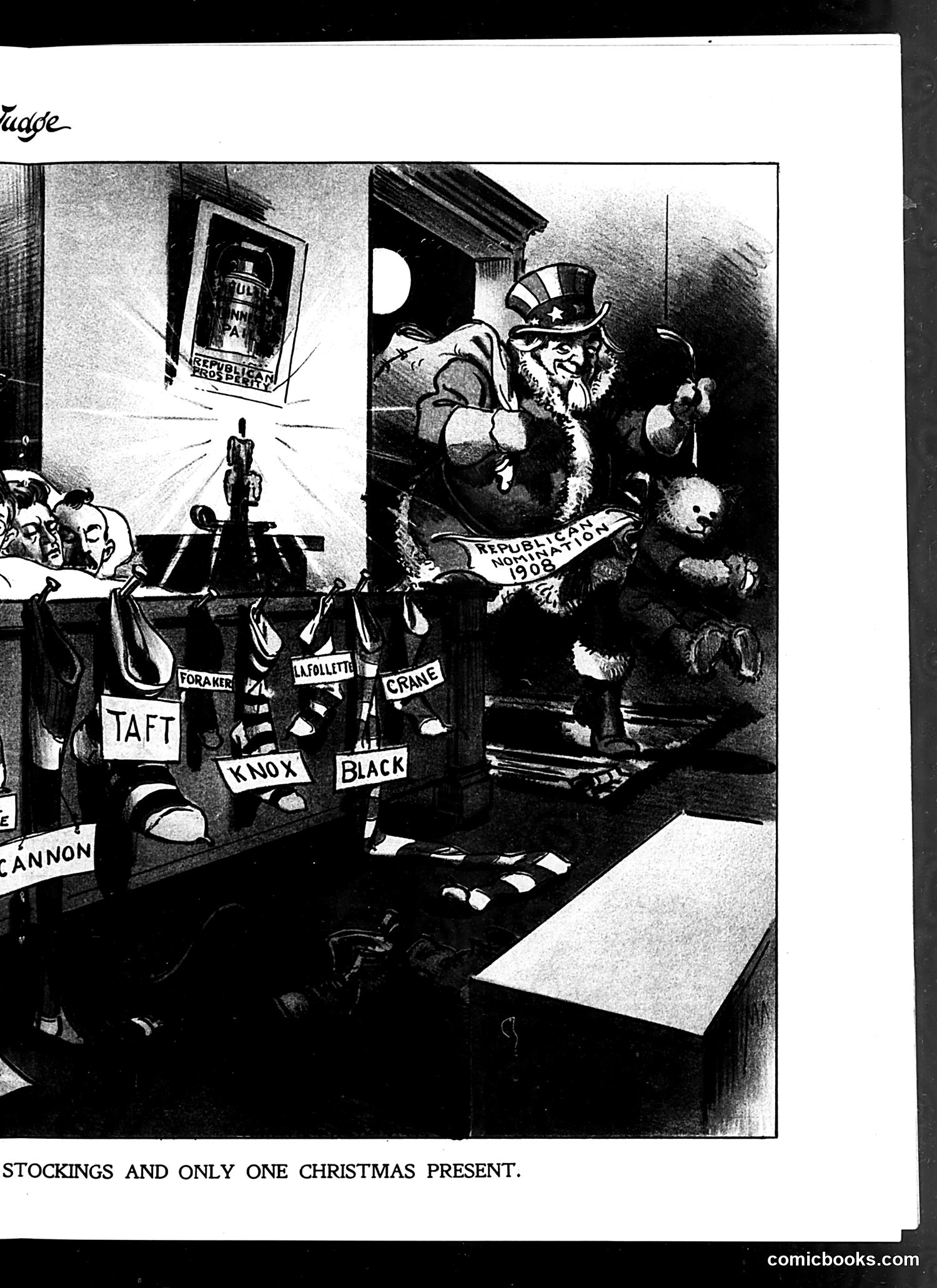
This political cartoon from *Judge* magazine depicts Uncle Sam (recognizable by his distinctive top hat with stars) discovering minimal Christmas gifts—stockings and only one present. The stockings are labeled with names of Republican political figures: Taft, Knox, Black, Crane, and Foraker, among others visible. The single present is marked "Republican Nomination 1908," suggesting the cartoon satirizes the Republican Party's limited offerings to its members during the 1908 presidential election cycle. The figure on the right appears to be either President Theodore Roosevelt or another GOP leader reacting with dismay to the meager prospects. The satire critiques the Republican Party's lack of viable candidates or compelling policy positions for the upcoming election.
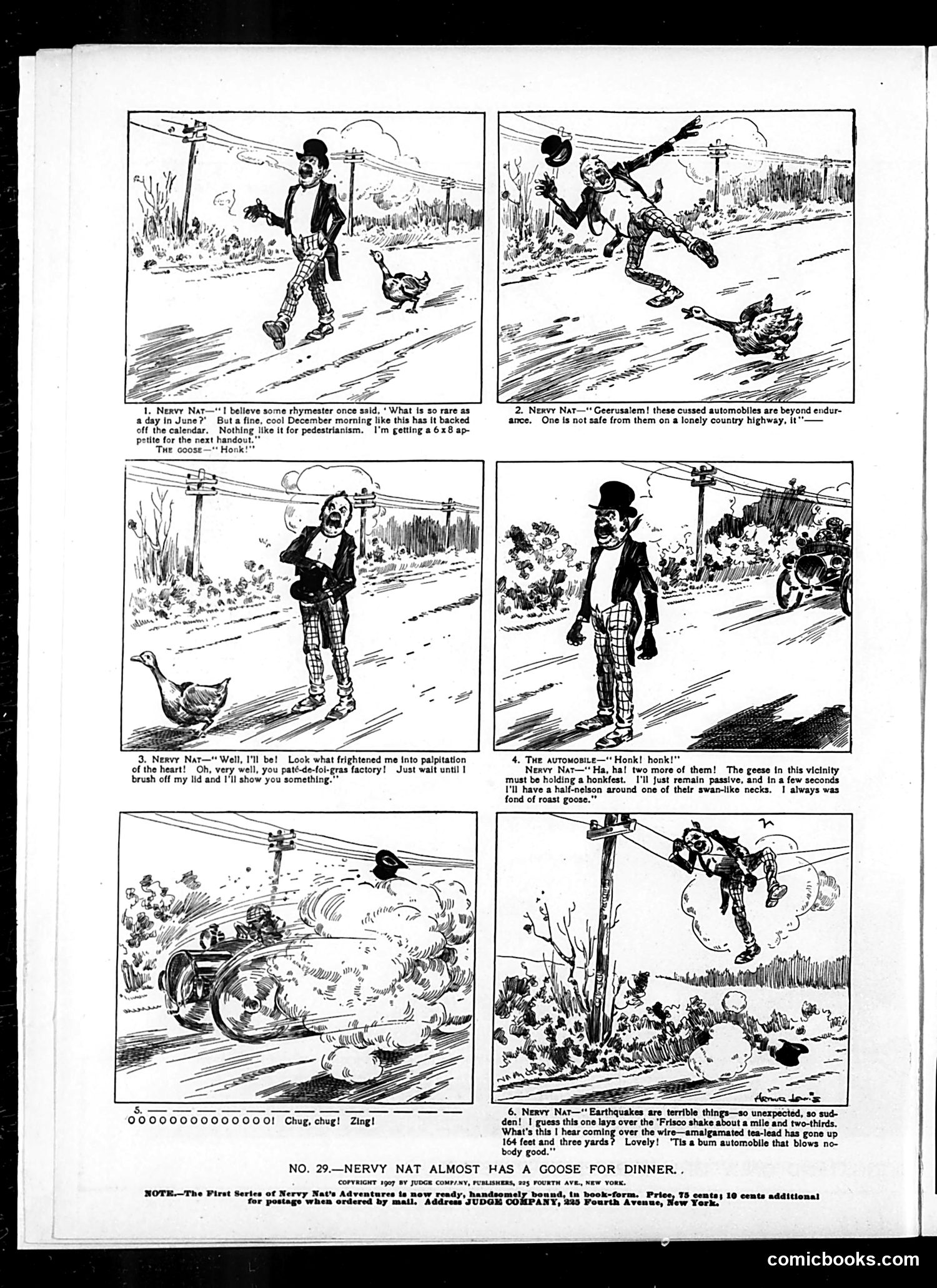
This 1907 comic strip follows "Nervy Nat," a vagabond character, as he encounters a goose while walking the country roads. The humor relies on a series of misunderstandings: Nat mistakes automobile horns for the goose's honking, creating escalating confusion. The satire targets automobiles as a modern menace—new, unpredictable, and dangerous to pedestrians. Nat's repeated mishaps with cars (nearly hit multiple times) reflect early-1900s anxieties about this emerging technology invading rural spaces. His final quip about making profit from stocks during an earthquake suggests opportunistic greed amid chaos. The strip's appeal lies in physical comedy (Nat's acrobatic dodging) and the contrast between old rural life (geese, pedestrians, country roads) and intrusive modern technology. The date (1907) places this during automobiles' rapid adoption, when their threat to public safety was genuinely controversial.
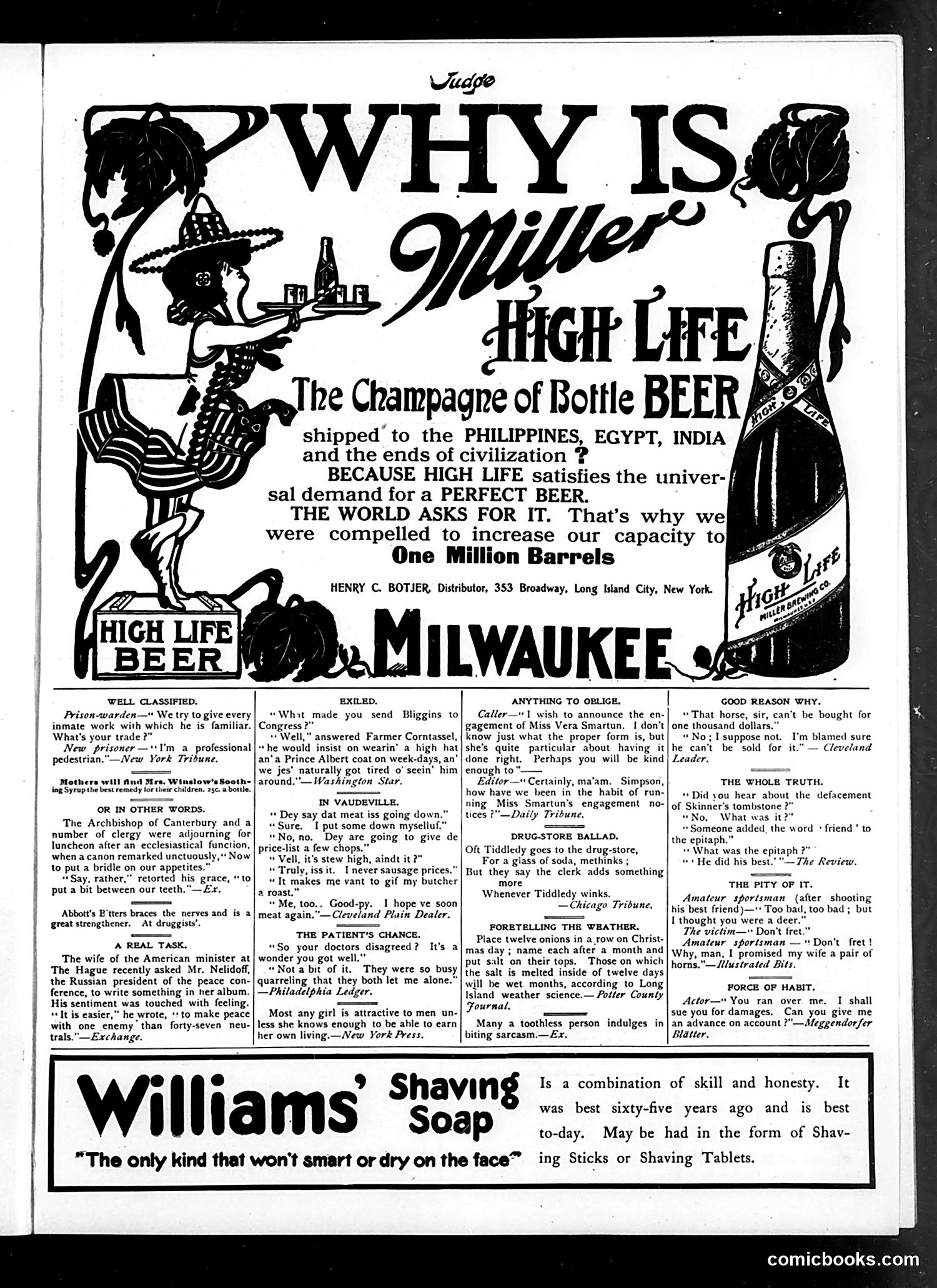
This page is primarily **advertising** for Miller High Life Beer, with the large display ad dominating the upper two-thirds. The ad uses orientalist imagery—a caricatured figure in Asian dress serving drinks—to market beer to colonial markets ("Philippines, Egypt, India"). The appeal is that High Life satisfies "universal demand for a perfect beer," justifying expansion to "One Million Barrels." The remainder consists of **short humorous items** typical of Judge's format: - A "professional pedestrian" (vagrant) joke - Clergy wordplay about appetites and bits/bridles - A Russian diplomat's quip about peace negotiations being easier than managing "forty-seven neutrals" - Various puns about prices, soda fountains, and weather prediction These brief items mock social pretension, bureaucratic absurdity, and romantic mishaps—standard satirical fare for the era. **No specific political figures or events** are identifiable. The page reflects early-1900s attitudes toward imperialism and colonial markets as natural expansion opportunities for American products.
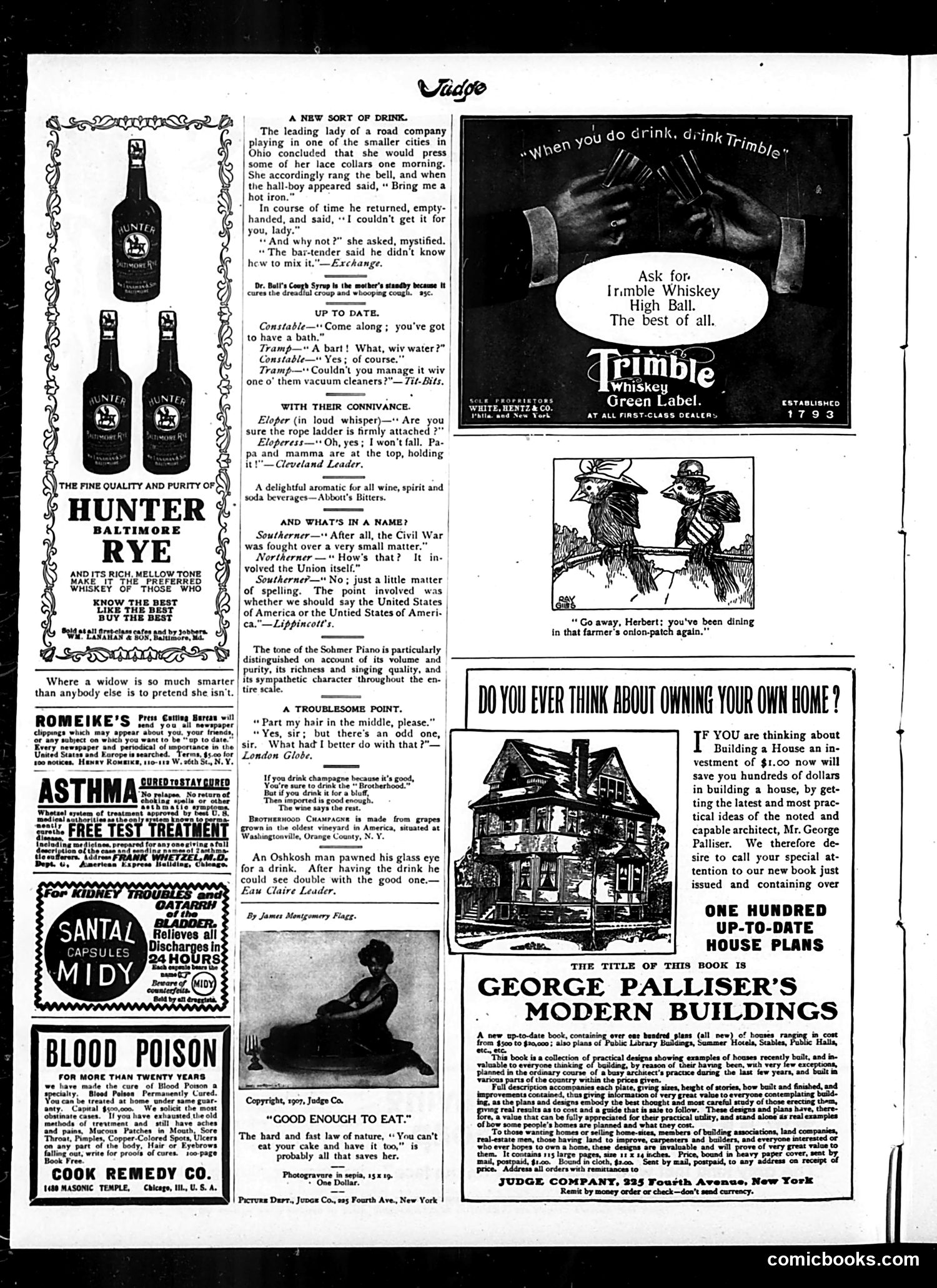
This page from Judge magazine (circa 1907) is primarily **advertising** interspersed with short humor pieces and cartoons. **Main Content:** The cartoons and jokes are brief, disconnected anecdotes typical of Judge's style. One depicts two figures dining outdoors ("Go away, Herbert: you've been dining in that farmer's onion-patch again"), poking fun at rural dining. Another shows a theatrical setup with puns about "hot irons" and barroom confusion. A third features wordplay about the Civil War being fought over spelling ("Untied" vs. "United" States). **Historical Context:** The advertising heavily emphasizes patent medicines, whiskey, and home-building guides—reflecting turn-of-the-century American consumer culture. Products like "Cook Remedy" for blood poison and "Santal-Midy" capsules were common in this era's magazines, often making dubious health claims. The humor pieces are straightforward puns and observational jokes, with no apparent political satire on this particular page.
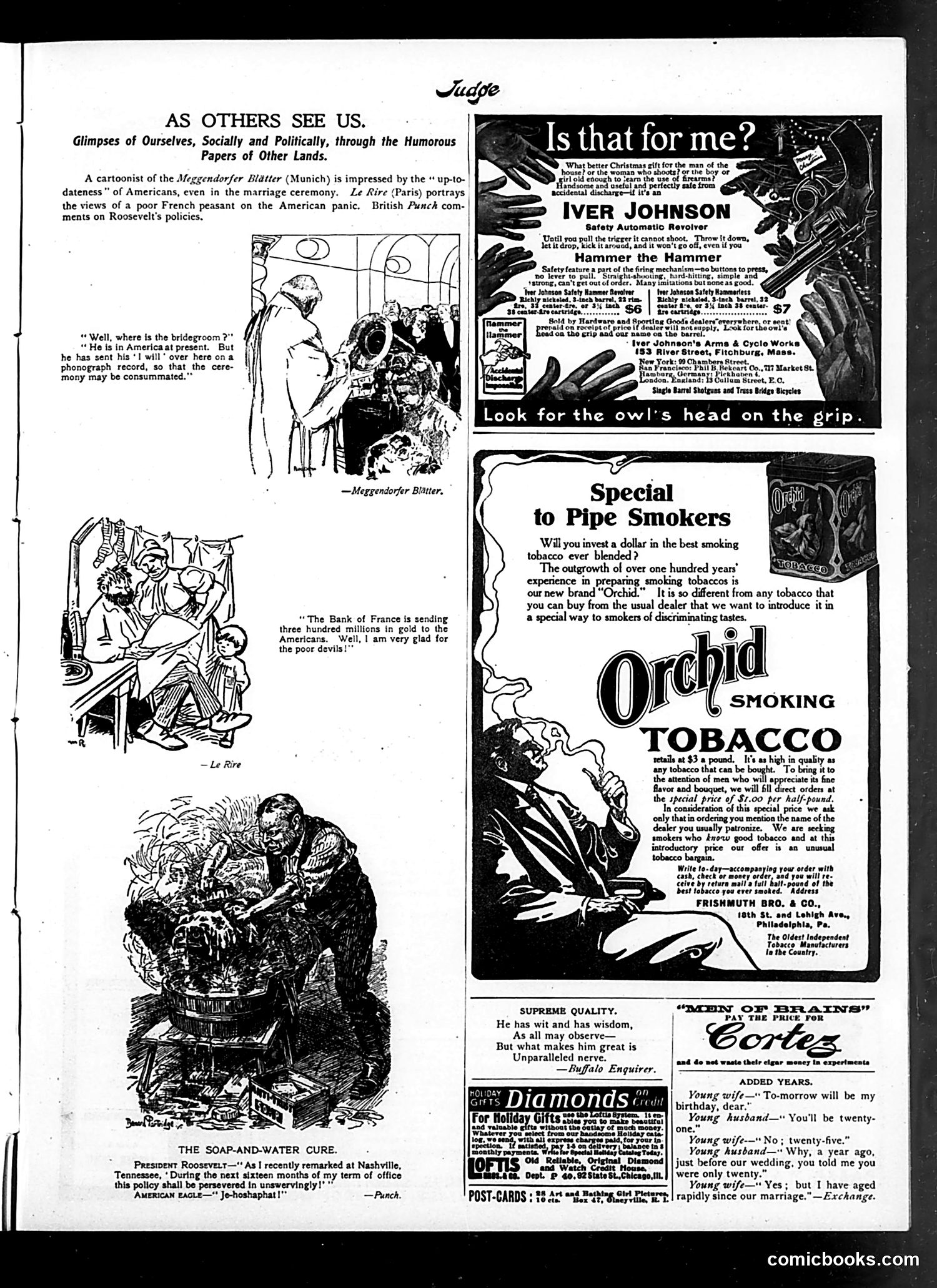
This page from *Judge* presents **international satirical commentary on America**, showing how foreign publications viewed the United States circa early 1900s. **The three cartoons mock:** 1. **German perspective** (Meggendorfer Blatter): American obsession with modernity and efficiency—a groom sends his wedding vows via phonograph record rather than attending in person, satirizing American "up-to-dateness." 2. **French perspective** (Le Rire): A peasant's cynical view of the American financial panic, joking that France sending gold to America helps "the poor devils"—depicting American economic distress. 3. **British perspective** (Punch): President Roosevelt's aggressive "soap-and-water cure" policy (likely conservation/reform initiatives), shown as relentless and unstoppable, with an American observer's bewildered reaction. The page also contains advertisements (Iver Johnson revolvers, Orchid tobacco, diamonds) typical of *Judge's* commercial content. The humor relies on stereotypes about national character—American efficiency obsession, French cynicism, British restraint.
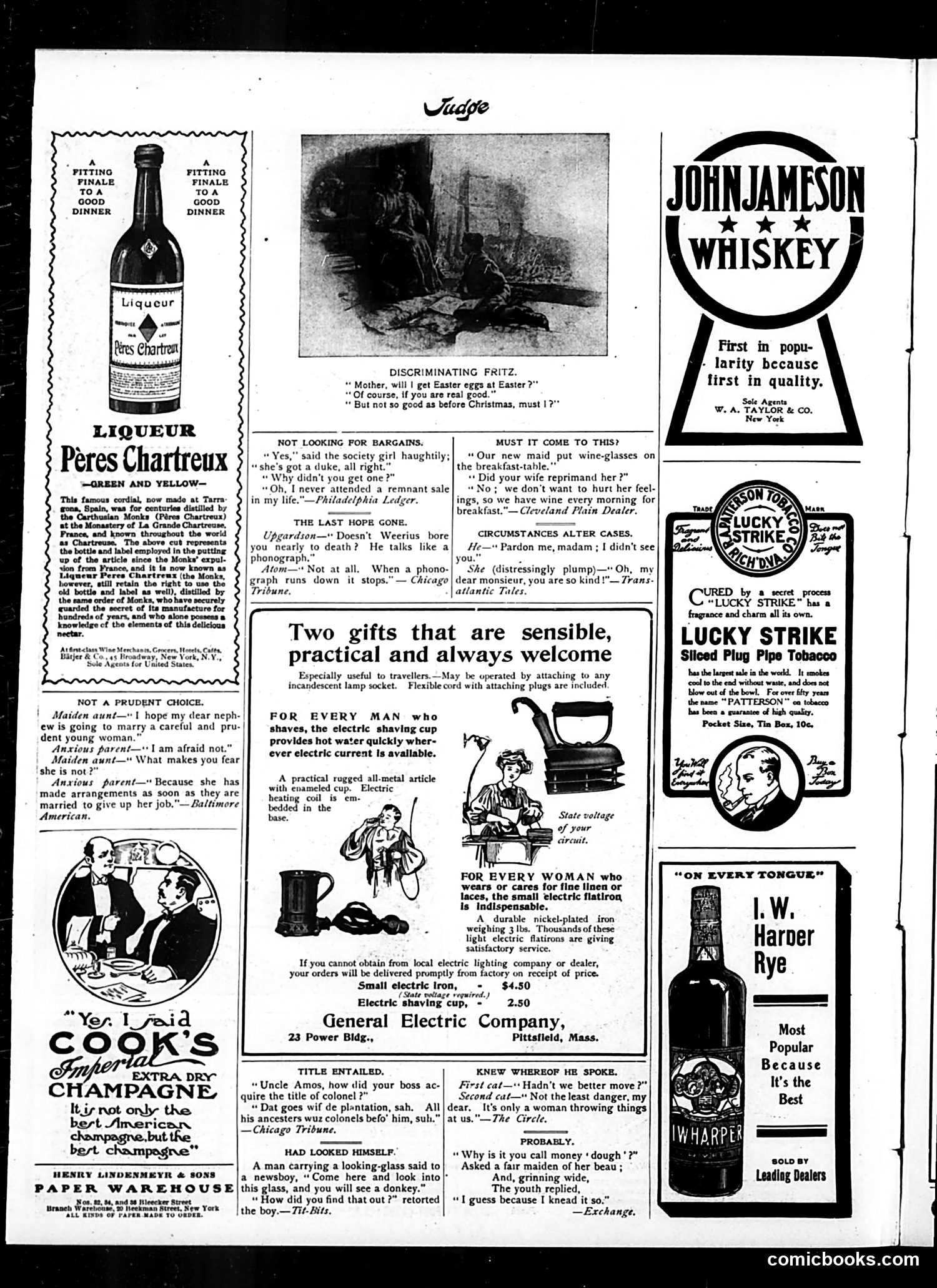
This page is primarily **advertising with scattered humor cartoons**, typical of early 20th-century satirical magazines that relied on ad revenue. ## Main Content: **The cartoons** are brief, genteel jokes with no political dimension: - "Discriminating Fritz" satirizes German parenting (Fritz asks about Easter eggs vs. Christmas rewards) - "Not Looking for Bargains" mocks society girls obsessing over securing wealthy husbands ("dukes") - Other vignettes poke fun at domestic situations and wordplay ## The Advertisements: The page is dominated by **product pitches**: Peres Chartreux liqueur, Cook's champagne, and notably a **General Electric Company spread** promoting "sensible, practical" gifts—an electric shaving cup and electric flatiron. These ads target gender-specific consumers (men who shave, women who do laundry). ## Historical Context: This reflects the **early electrification era** when home electrical appliances were novel luxury goods, and magazines advertised them as modern conveniences. The humor is gentle period comedy—no sharp political satire visible here.
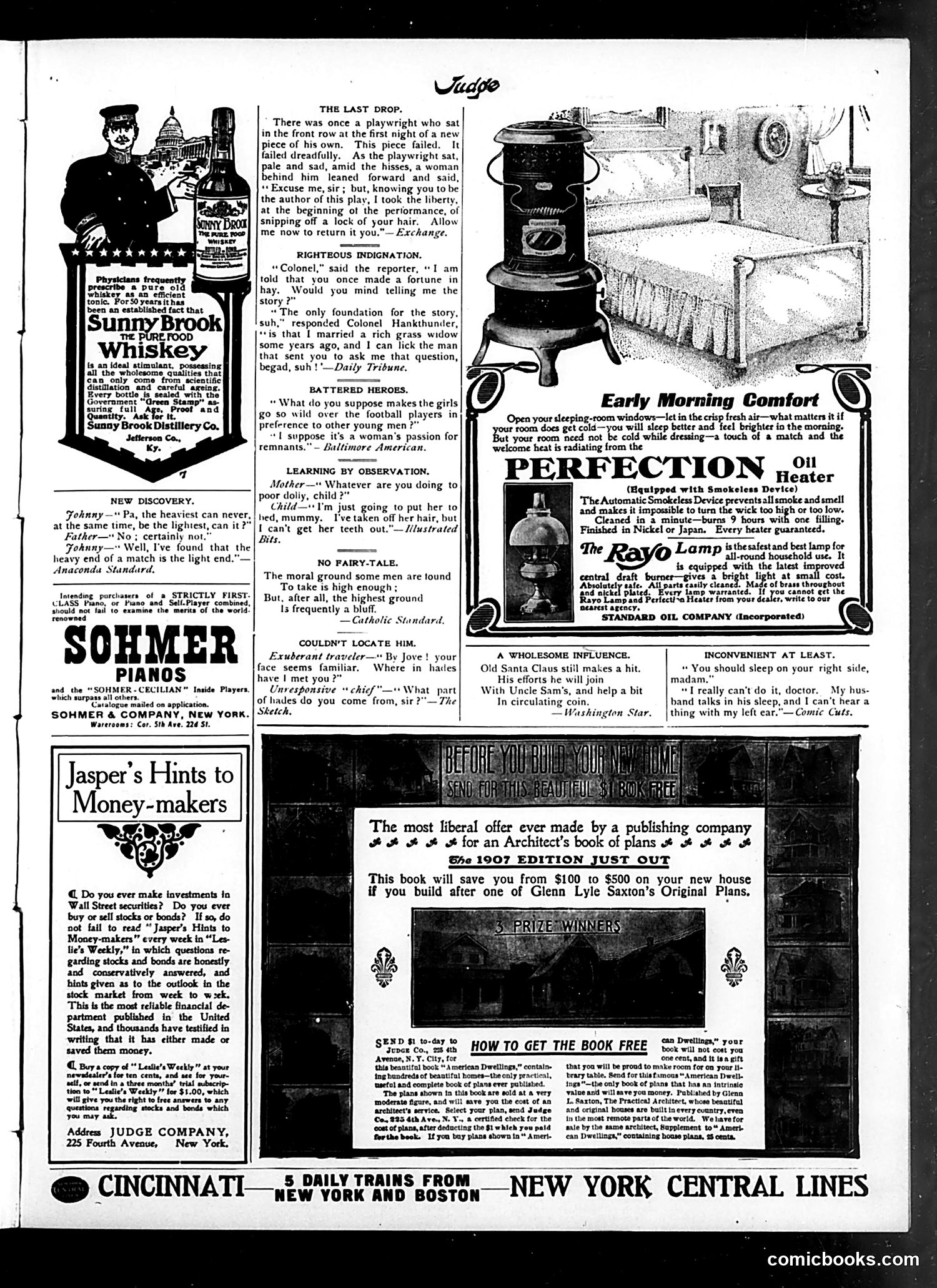
This is primarily an **advertising and humor miscellany page** from Judge magazine, circa 1907. The content consists of: **Short humor pieces** with no apparent political satire—mostly gentle domestic jokes (a child's logic puzzle about matches; a colonel's defensive reaction to hay-fortune gossip; observations about footballers' appeal to women). **Product advertisements** dominating the page: Sunny Brook Whiskey, Sohmer Pianos, Perfection Oil Heaters, and Rayo Lamps. These ads reflect early 1900s consumer goods and domestic concerns. **No significant political cartoons or caricatures** appear. The page lacks the sharp satirical edge one might expect from Judge's reputation. Instead, it represents the magazine's lighter content mixing genteel humor with commercial advertising—typical of publications that monetized through both editorial matter and paid ads. The "Jasper's Hints to Money-makers" column footer and rail advertisement suggest this is a standard issue page rather than a special edition.
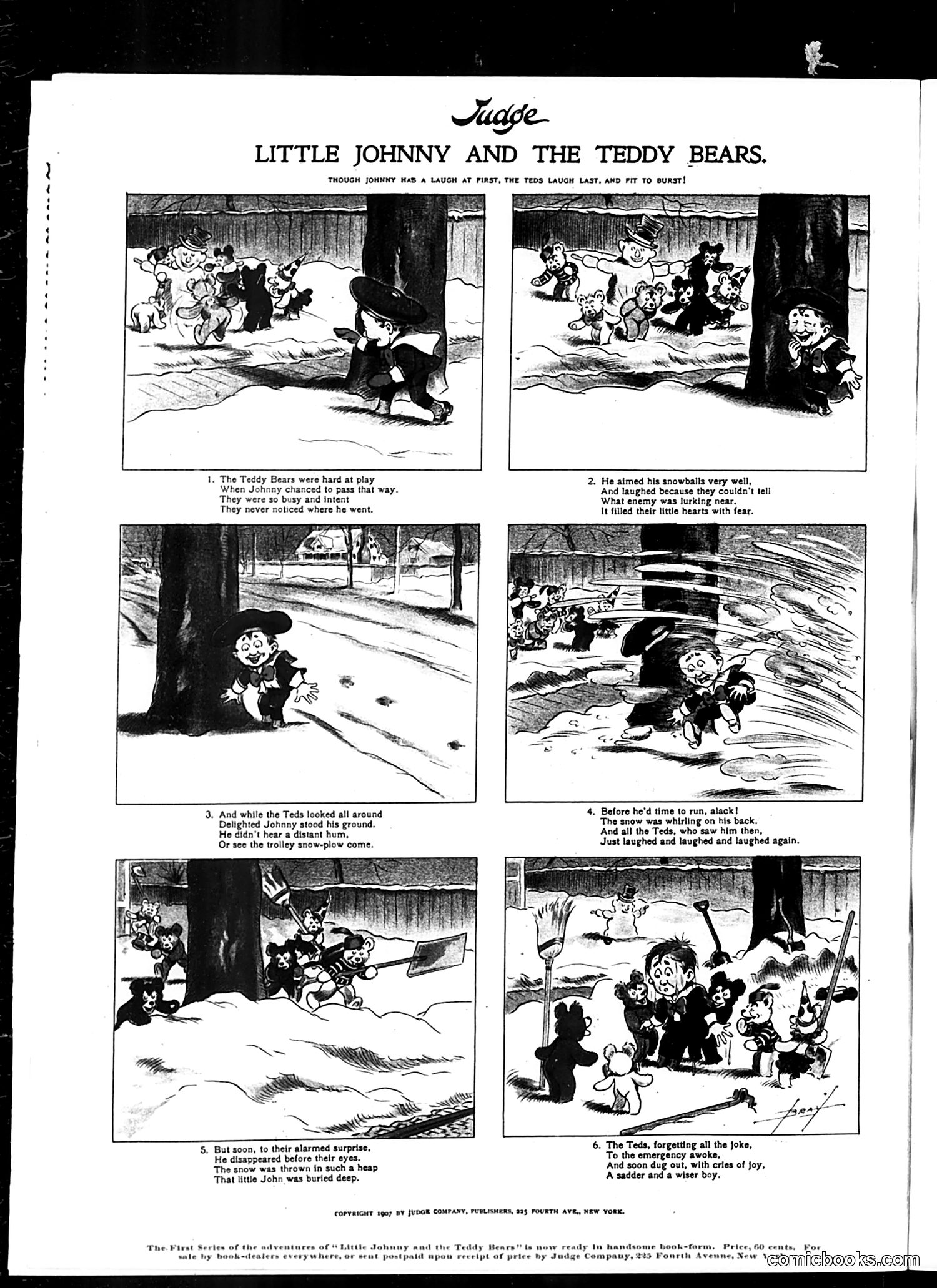
This is a children's comic strip from Judge magazine (1907) with no political satire—it's straightforward narrative humor. "Teddy Bears" references President Theodore Roosevelt, whose nickname was "Teddy"; these toys had recently become popular merchandise following a hunting incident where Roosevelt refused to shoot a trapped bear. The story follows a simple morality tale: Little Johnny ambushes teddy bears with snowballs while they play, laughing at their fear. A snow-plow then buries Johnny in snow, and the bears—momentarily frightened—overcome their scare and rescue him. The moral is that Johnny's cruelty gets comeuppance, while the bears show kindness in return, making him "a sadder and a wiser boy." The humor is purely situational—bullying followed by karmic reversal and unexpected rescue. There's no political commentary, though the bears' commercial popularity reflects Roosevelt's cultural dominance in the era.