
A complete issue · 16 pages · 1907
Judge — October 5, 1907
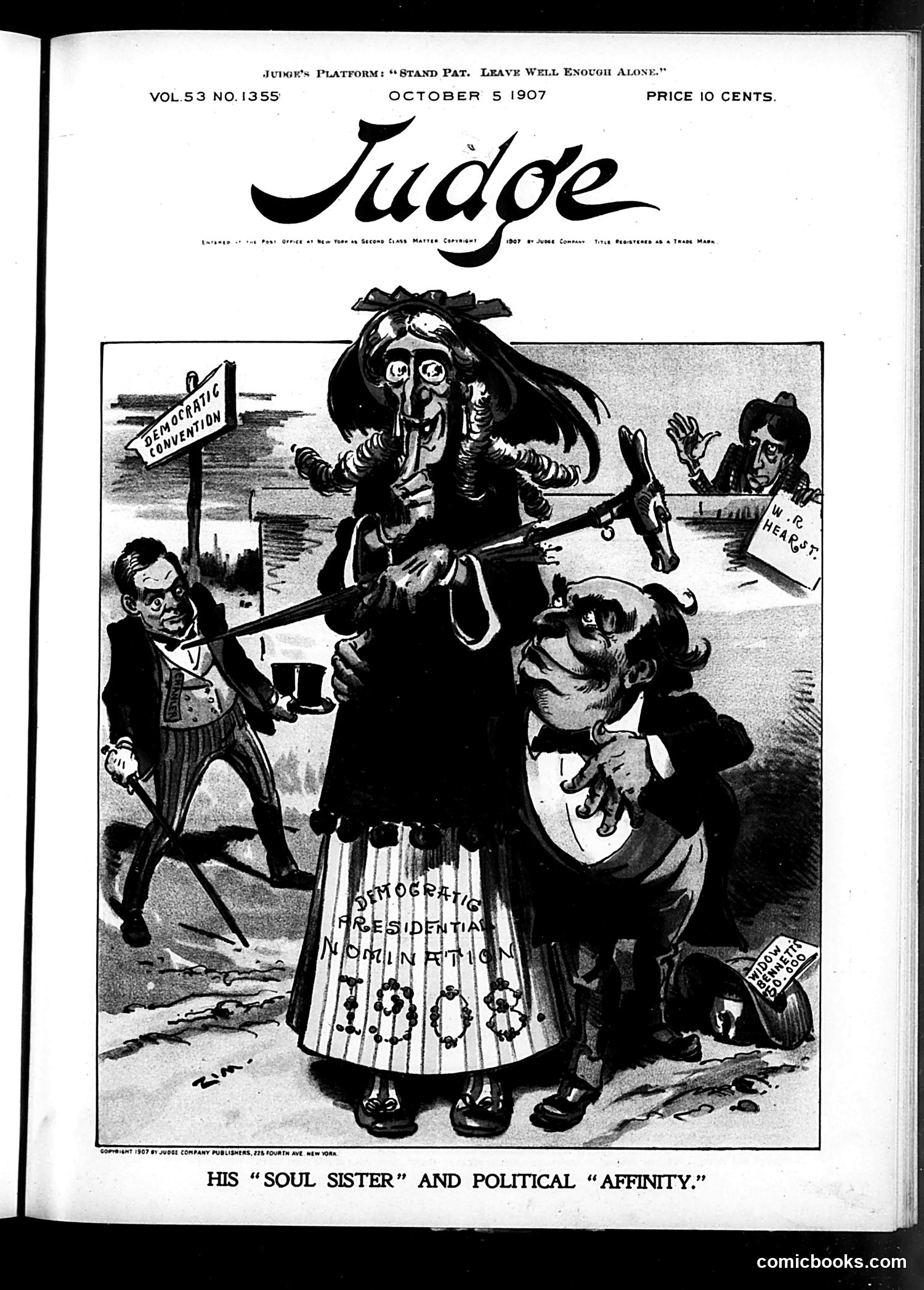
This satirical cartoon criticizes Democratic presidential ambitions during Theodore Roosevelt's administration. The central grotesque female figure labeled "Democratic Presidential Nomination" is depicted as a witch-like "soul sister," manipulated by three caricatured men representing different Democratic factions competing for the 1907 nomination. The sign reading "Democratic Convention" appears in the background. The cartoon's title, "His 'Soul Sister' and Political 'Affinity,'" suggests these Democratic rivals share an unseemly connection to the nomination process. The exaggerated, unflattering depictions typical of early 20th-century political satire mock the chaotic competition within the Democratic party as Roosevelt's first term neared its end. The imagery implies the nomination is being cynically manipulated by competing interests rather than pursued through principled means.
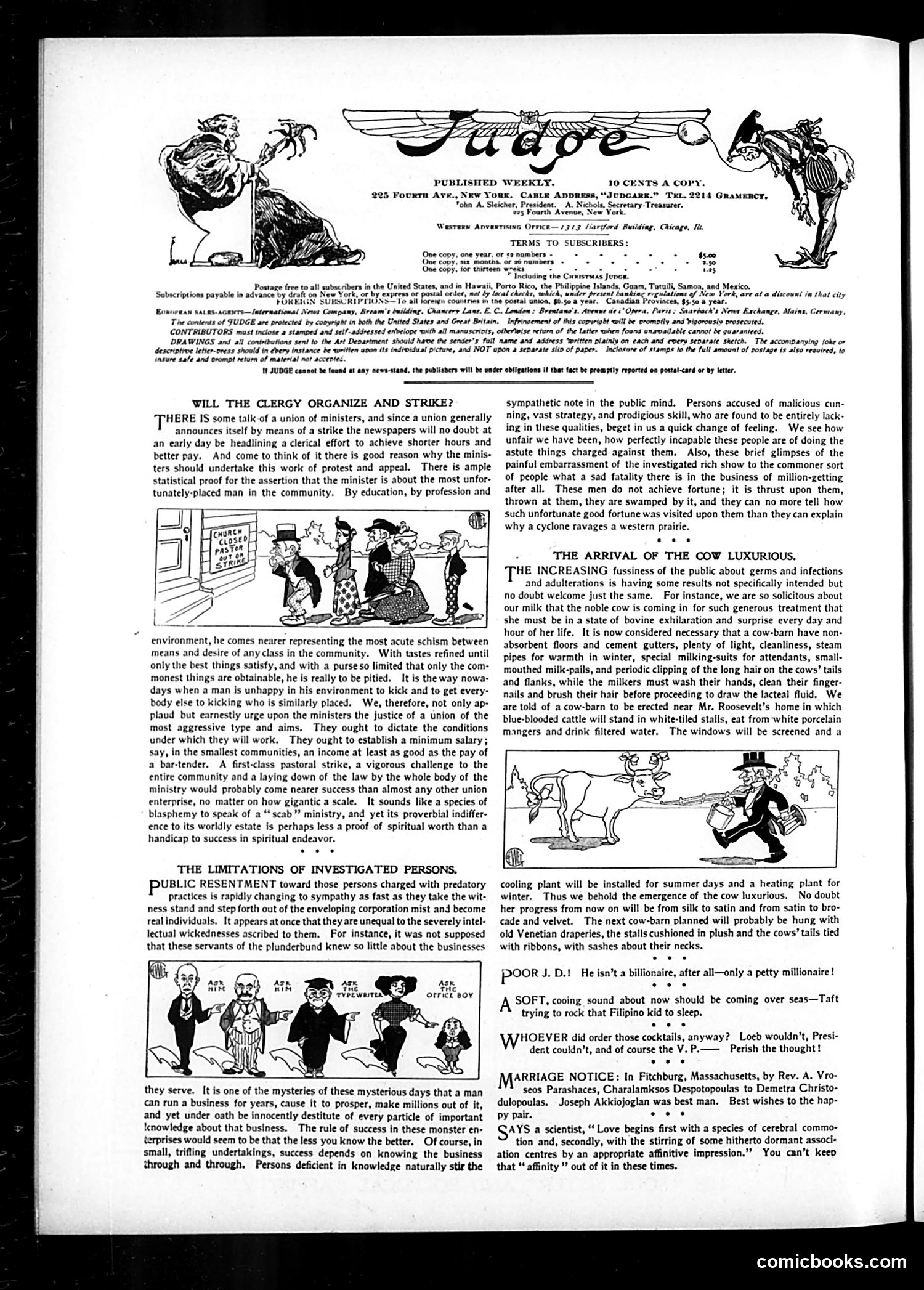
This page contains three distinct satirical pieces: 1. **"Will the Clergy Organize and Strike?"** - A commentary on labor strikes and clergy involvement in social justice, suggesting ministers are undervalued and questioning whether they might demand better working conditions like other workers. 2. **"The Arrival of the Cow Luxurious"** - Mocks wealthy individuals' obsession with food purity and hygiene. It satirizes Roosevelt-era affluence by imagining an absurdly pampered cow with climate control, filtered water, and manicured care—suggesting the wealthy's anxious focus on sanitization and product quality is excessive. 3. **"The Limitations of Investigated Persons"** - A cartoon showing various officials or authority figures, likely criticizing how investigations reveal corruption or incompetence among supposedly trustworthy institutions. The overall tone criticizes class privilege, labor disputes, and institutional hypocrisy typical of early 20th-century American satire.
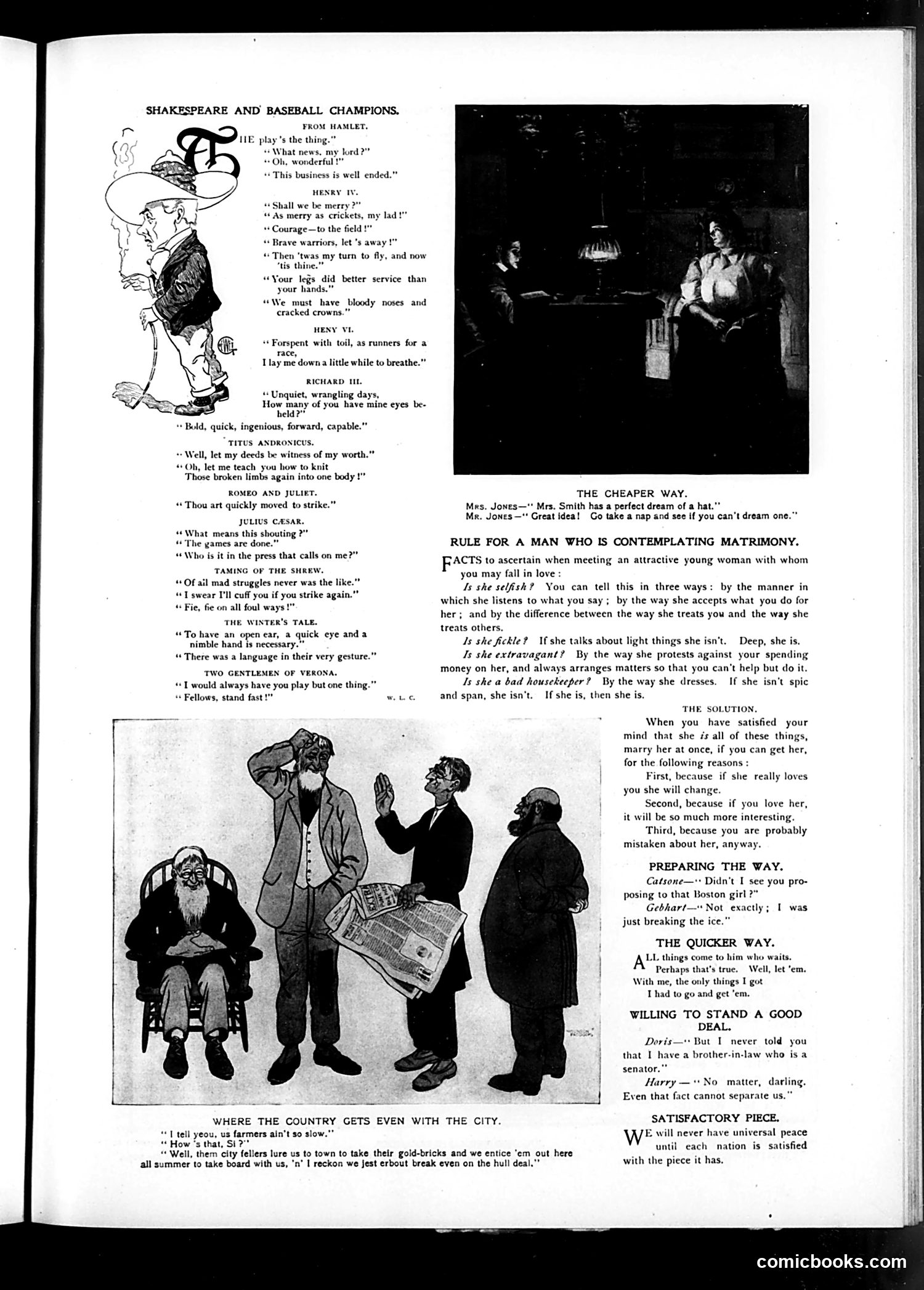
This page combines Shakespeare quotes with early 20th-century social commentary. The top section humorously pairs famous lines from plays like *Hamlet* and *Henry IV* with baseball references—a common Judge practice of mixing high literature with popular culture for satirical effect. The main cartoon, "WHERE THE COUNTRY GETS EVEN WITH THE CITY," depicts rural farmers confronting urban men about wealth disparity. Farmers complain cities extract their agricultural profits while offering little in return. The satire critiques economic inequality between agricultural and urban regions—a significant political issue during this era of industrial expansion. The right column offers tongue-in-cheek "rules" for courtship and marriage, reflecting contemporary anxieties about gender relations and romantic commitment, typical Judge content mocking social conventions.
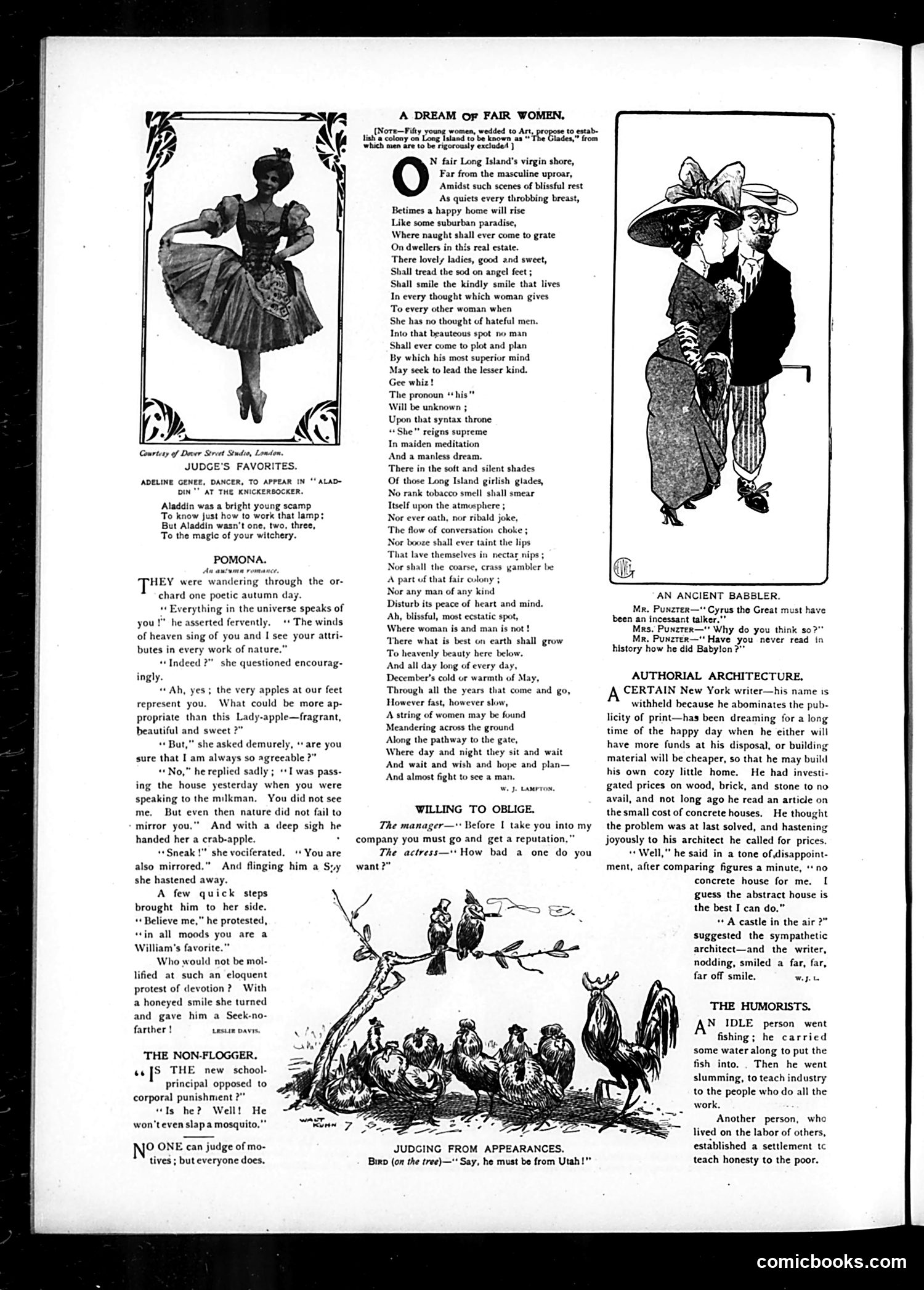
This page contains literary and social satire typical of Judge magazine's content. The main features include: **"A Dream of Fair Women"** — a poem idealizing virtuous womanhood, contrasting with the magazine's frequent critiques of gender relations. **"Judge's Favorites"** — a profile of dancer Adeline Genée, reflecting the magazine's coverage of entertainment and society figures. **Several humorous short pieces** ("The Non-Flogger," "An Ancient Babbler," "Willing to Oblige," "Authorial Architecture," "The Humorists") — brief satirical anecdotes poking fun at social types: pompous educators, pretentious architects, idle philosophizers, and other contemporary character archetypes. The illustrations feature caricatured figures and a detailed bird scene mocking human behavior through animal observation ("Judging from Appearances"). The satire targets middle-class pretension, social hypocrisy, and professional pomposity rather than specific political events.
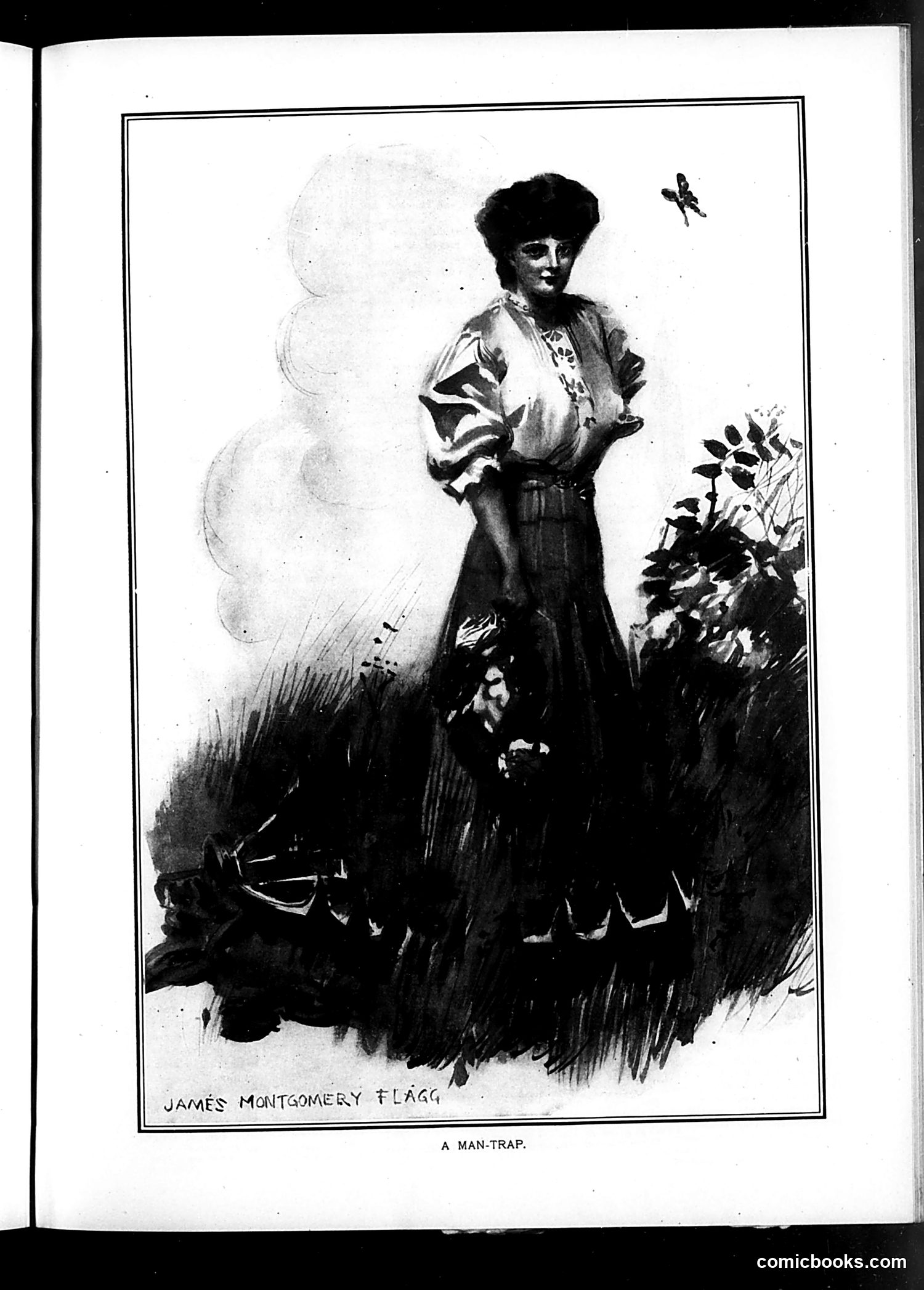
This illustration by the renowned artist Flagg depicts a woman in fashionable early 1900s dress—puffy sleeves, fitted waist, elaborate skirt—posed confidently with flowers and a butterfly nearby. The title "A Man-Trap" suggests satirical commentary on female attractiveness as a deliberate snare for male attention. The cartoon likely reflects contemporary anxieties about "the New Woman"—increasingly independent females engaging in public social life. The idealized, well-dressed figure represents both the appeal and the perceived danger this posed to traditional male authority. The trap metaphor implies women strategically used beauty and fashion to capture men's romantic interest, inverting traditional power dynamics in courtship.
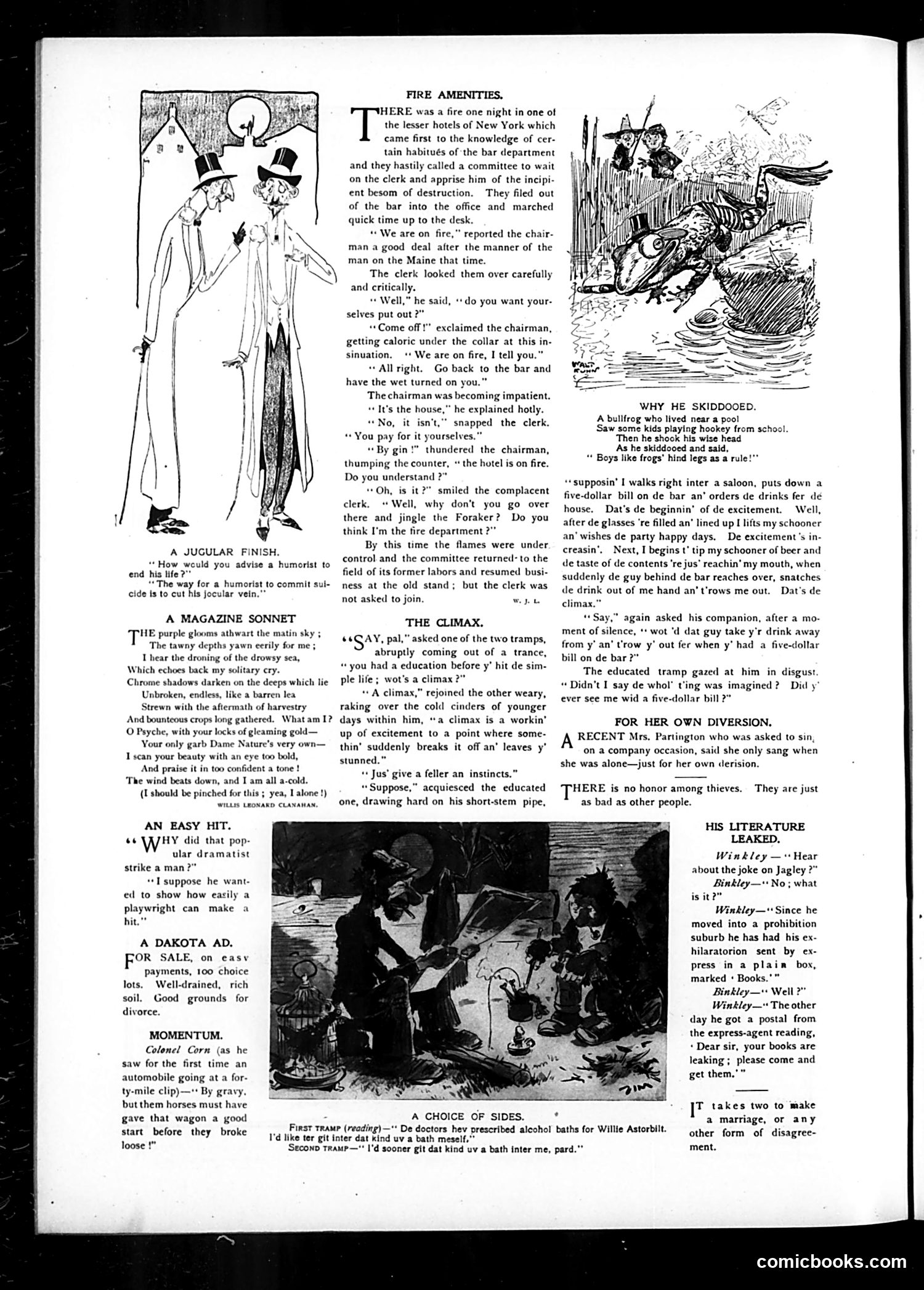
This comic sketch satirizes bureaucratic indifference and apathy. During a hotel fire, patrons from the bar rush to inform the clerk of the emergency. Rather than responding with urgency, the clerk treats the crisis with callous detachment—dismissing their concern, suggesting they return to the bar, and implying the fire is their problem since they "pay for it yourselves." The satire targets the clerk's absurd logic and lack of responsibility. His final question—"Do you think I'm the fire department?"—represents institutional negligence masquerading as pragmatism. The humor lies in the complete inversion of expected priorities: the clerk cares more about maintaining his casual demeanor than addressing an actual building fire, while the bar patrons' concern for safety goes entirely unheeded.
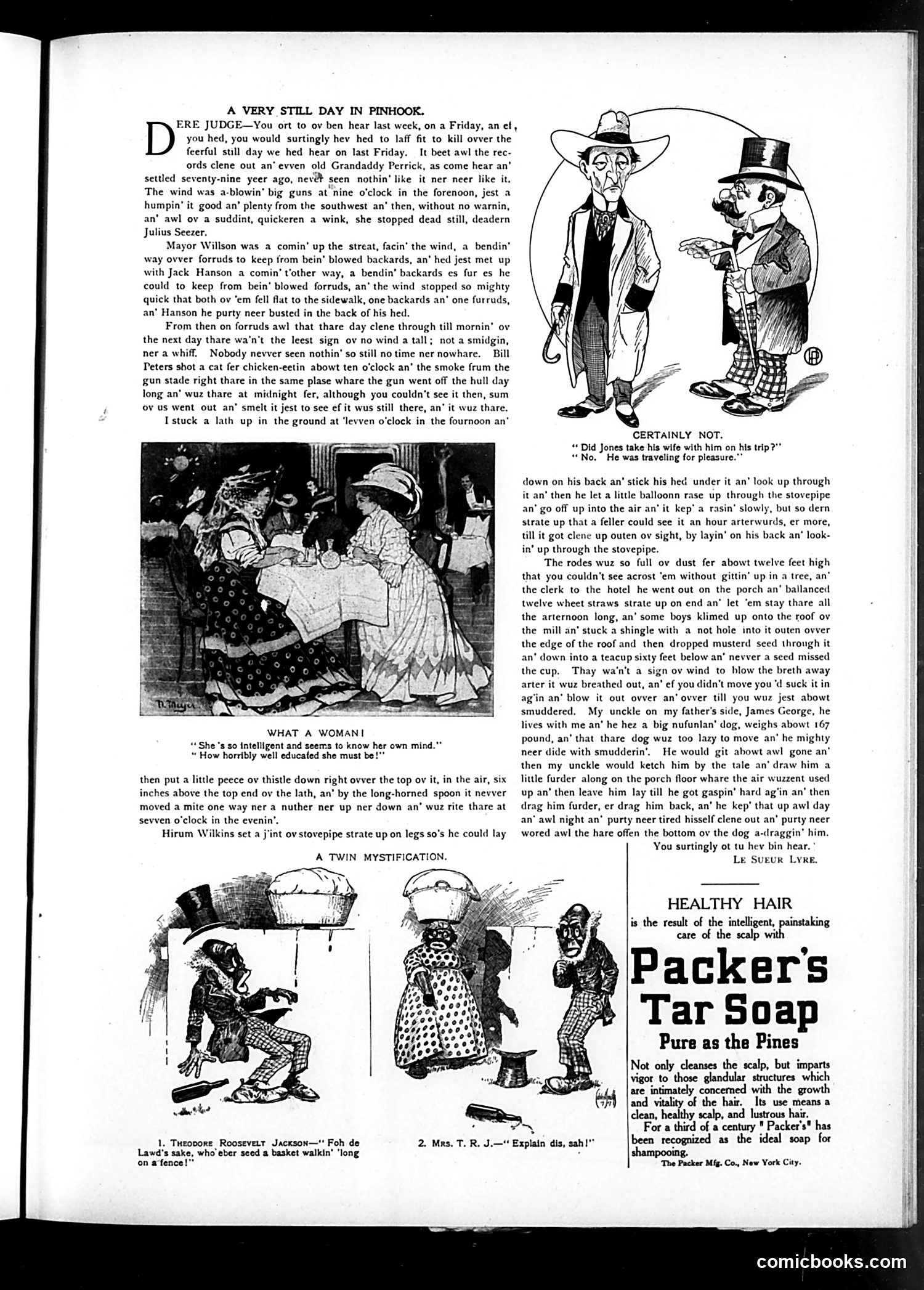
This humorous tall tale, written in exaggerated rural dialect, describes an impossibly still day in a fictional town. The joke mocks both frontier folklore and the limitations of everyday life in remote areas. The satire works through absurd exaggeration: when wind suddenly stops mid-afternoon, characters literally fall over. Throughout the day, the complete absence of air movement allows a gunshot's smoke to hang motionless for hours, a thistle down to remain suspended, and a balloon to rise in a perfectly vertical line—feats impossible in nature. The accompanying cartoons ("What a Woman!" and "A Twin Mystification") appear unrelated to the main text, offering separate social commentary and wordplay typical of Judge magazine's format. The piece satirizes both tall-tale traditions and the provincial mindset of isolated communities where minor oddities become legendary events worthy of detailed narration.
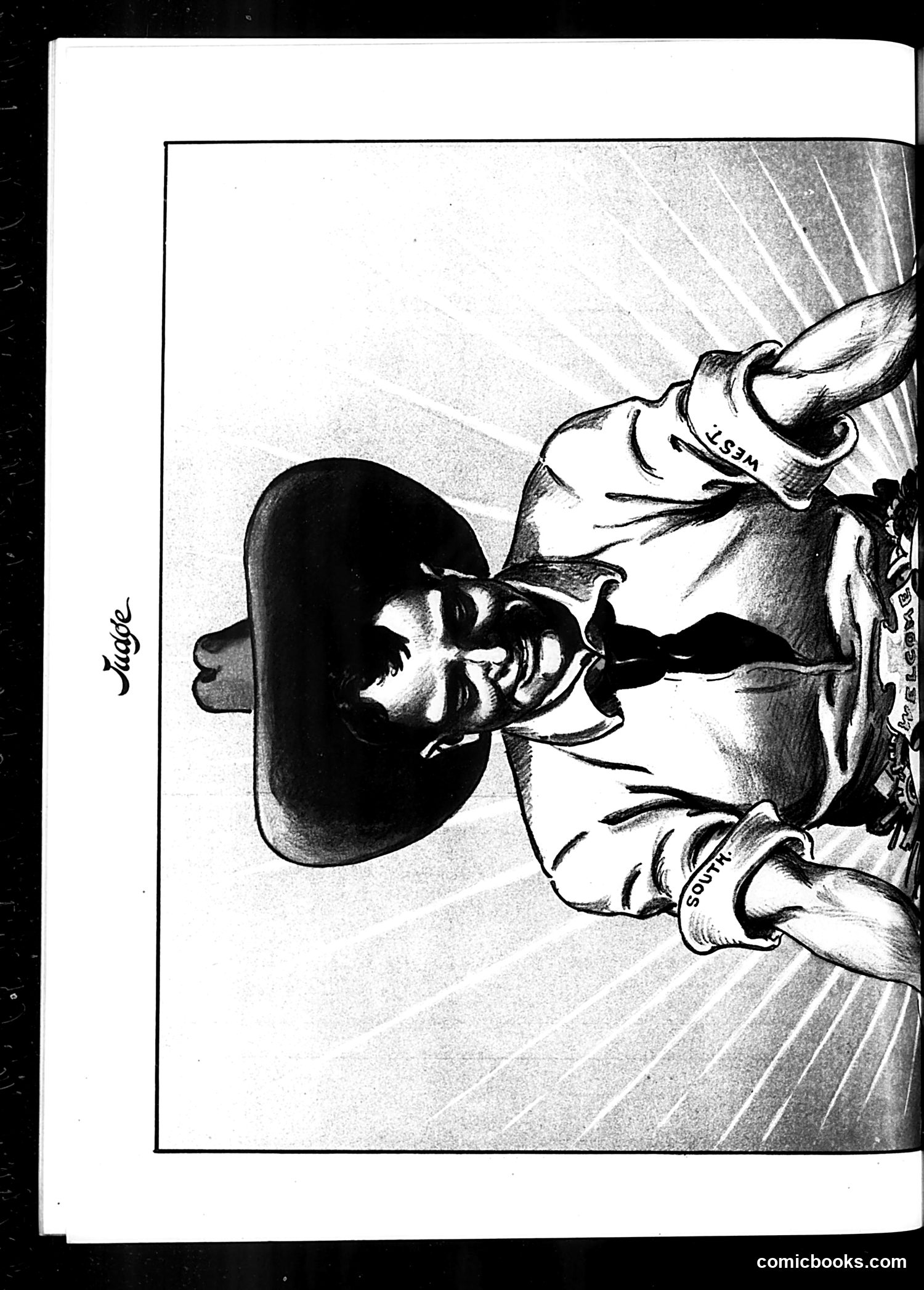
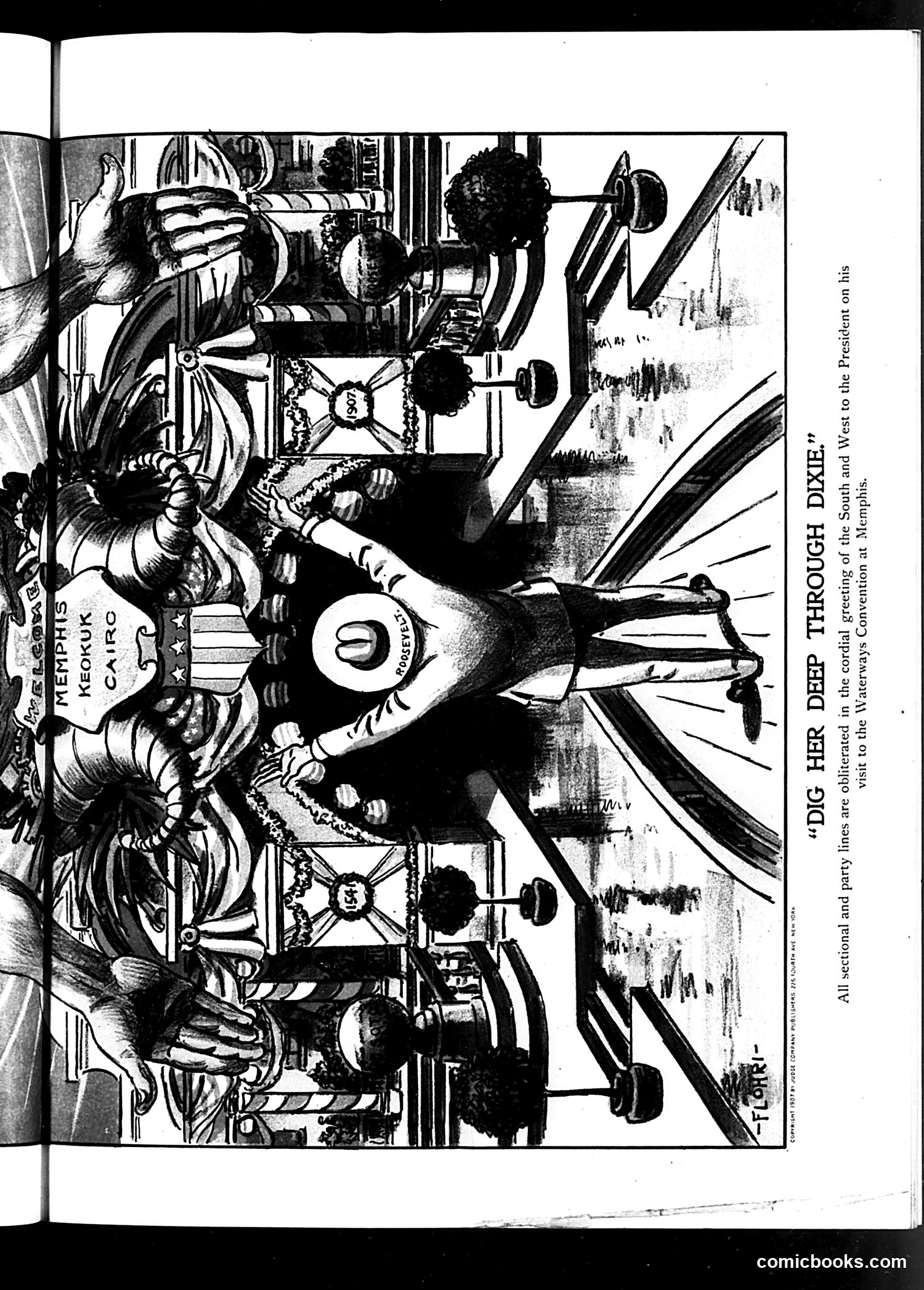
The OCR text is too corrupted to read reliably. However, the image shows a political cartoon signed "Judge" (visible on left margin). It depicts a figure wearing what appears to be a large hat or headpiece, dressed in period clothing with "SOUTH" visible on the sleeve. The radiant lines in the background suggest emphasis or importance. Without legible text or clear historical context from the image alone, I cannot confidently identify the specific political figure, event, or satirical point being made. The cartoon appears to address American sectional politics (given the "SOUTH" label), likely from the late 19th or early 20th century based on Judge magazine's run, but determining the exact target of satire requires readable OCR text or additional context I cannot reliably extract from this page.
This Judge magazine cartoon satirizes a woman operating what appears to be a complex mechanical adding machine or calculator. The caption reads "ADDING HER DEEP THOUGHT," suggesting ironic commentary on women's intellectual capacity or the frivolity of female reasoning. The elaborate machinery—with gears, springs, and mechanical components—contrasts humorously with the simple task of addition, implying that women overcomplicate simple matters or lack straightforward logical thinking. This reflects early 20th-century gender stereotypes common in American satirical publications. The "Meredith Mercury" label visible on the left suggests this may advertise a product alongside the satire. The cartoon mocks contemporary anxieties about women's education and participation in intellectual or professional work, presenting female cognition as absurdly mechanical and inefficient—a common misogynistic trope of the era.
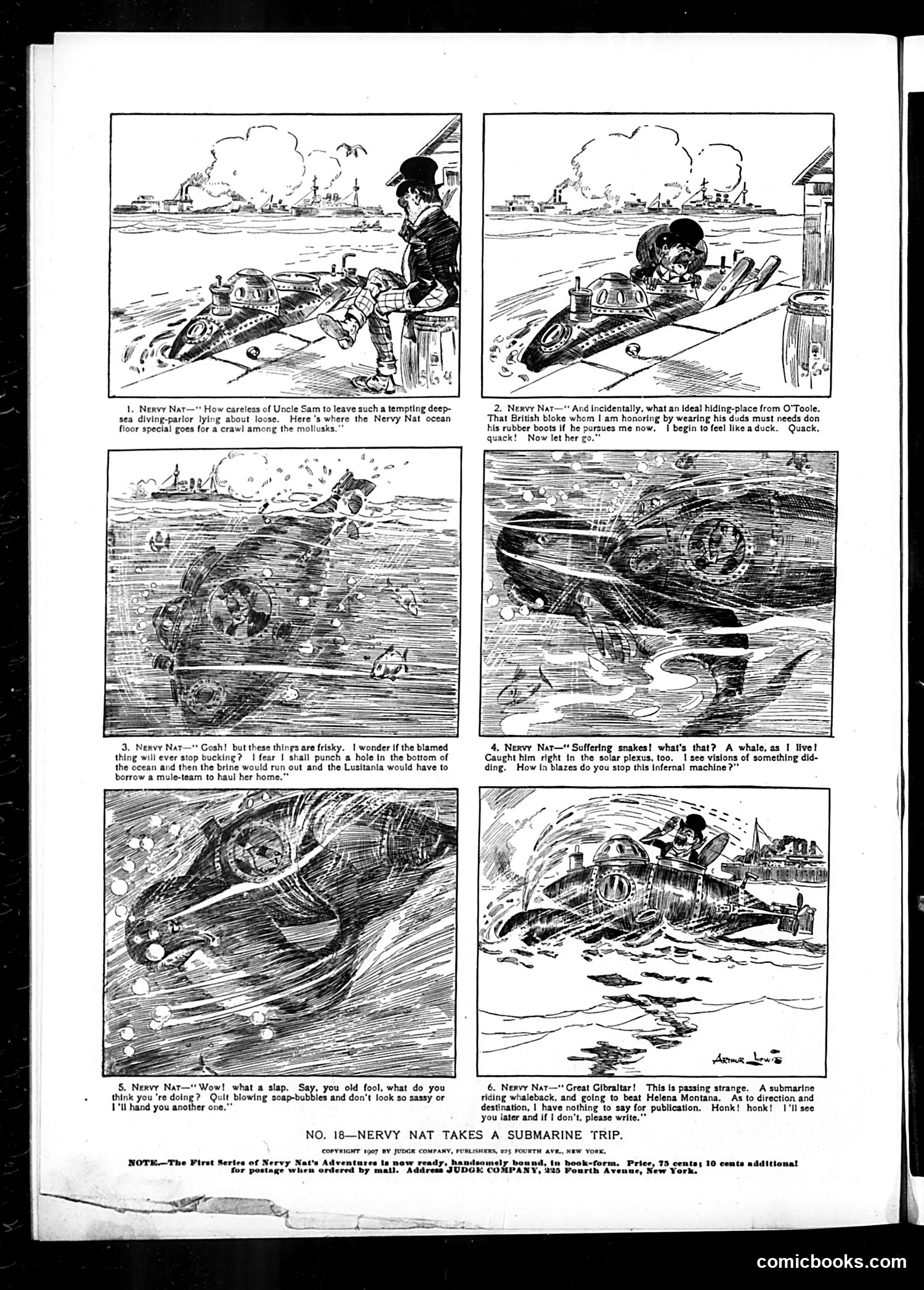
This is a comic strip adventure story, not political satire. "Nervy Nat" is an unnamed daredevil character who discovers an abandoned submarine and embarks on an impulsive underwater joyride. The humor relies on slapstick and absurdist situations: Nat evades pursuit from someone named O'Toole by submerging; he encounters aggressive sea creatures (frisky "things," a whale); he struggles to control the submarine's mechanisms. The jokes are largely physical comedy—collisions, confusion about operating the vessel, and exaggerated reactions. One panel references "the Lusitania" (the famous ship, though the context is joking rather than serious), and another mentions "Helena Montana" as a racing destination, suggesting this may date to the early 1900s when submarine technology was novel and sensational in popular culture. The appeal is simply adventurous escapism for readers—a character causing chaos through reckless submarine exploration.
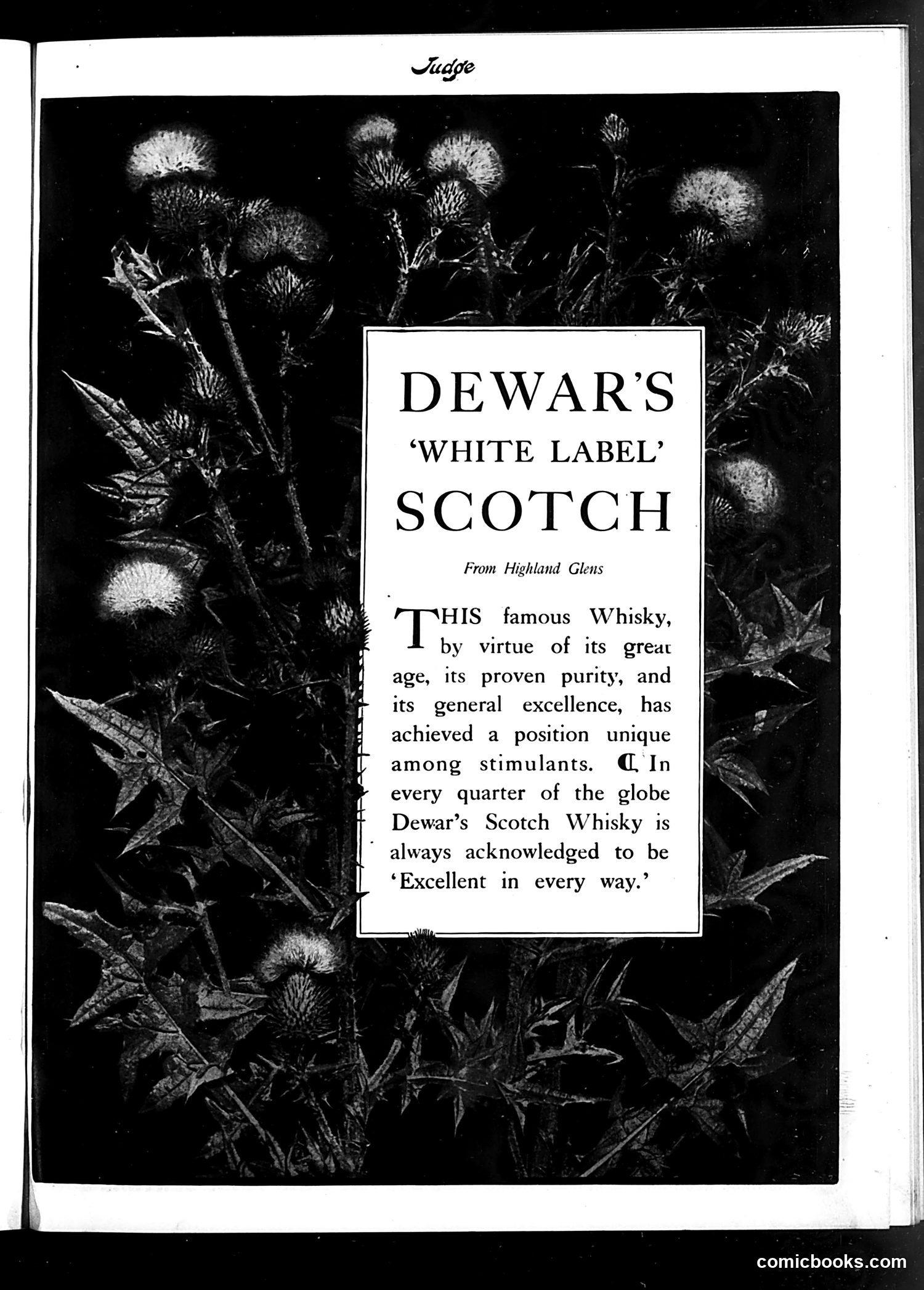
This is a full-page advertisement rather than political satire or a cartoon. It promotes Dewar's White Label Scotch Whisky, featuring decorative botanical illustrations of thistles (a Scottish symbol) surrounding a text box. The ad makes claims about the product's superiority based on "great age," "proven purity," and "general excellence," asserting its worldwide reputation as an exceptional stimulant. The language is typical of early 20th-century advertising hyperbole. Judge magazine frequently included such advertisements alongside satirical content. There is no political commentary, caricature, or joke evident—this appears to be straightforward product marketing using Scotland's national thistle imagery to reinforce the whisky's Highland origins.
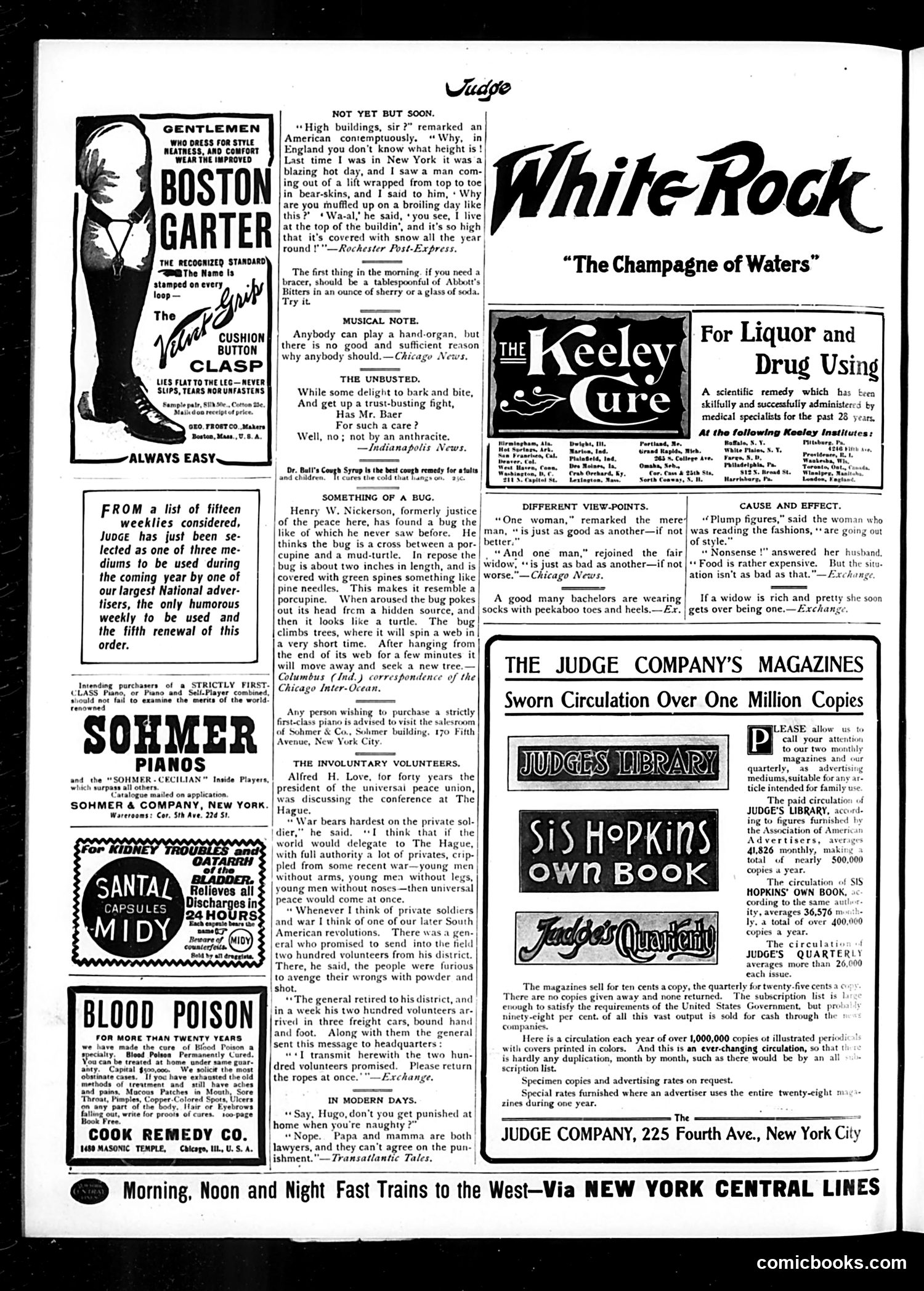
This page from *Judge*, a satirical weekly, is primarily an **advertising and editorial mixture** rather than political cartooning. The main content includes: **Advertisements** for products like Boston Garters, Sohmer Pianos, blood poison treatments, and Santa Midy capsules—typical early-20th-century patent medicine and consumer goods ads. **Small humorous anecdotes and jokes** rather than political cartoons: - A joke about American vs. English building heights - Wordplay about Theodore Roosevelt's trust-busting (referencing the anthracite coal strike dispute with industrialist George Baer) - Observations about gender relations and widow remarriage **Notable is the prominent ad for "The Keeley Cure,"** a real (but quack) alcoholism treatment marketed as scientific remedy for "liquor and drug using"—reflecting the era's patent medicine culture and pre-Prohibition anxieties. The page demonstrates *Judge*'s format: light satire and social commentary mixed with commercial advertising, aimed at a genteel male readership interested in fashion, current events, and consumer products.
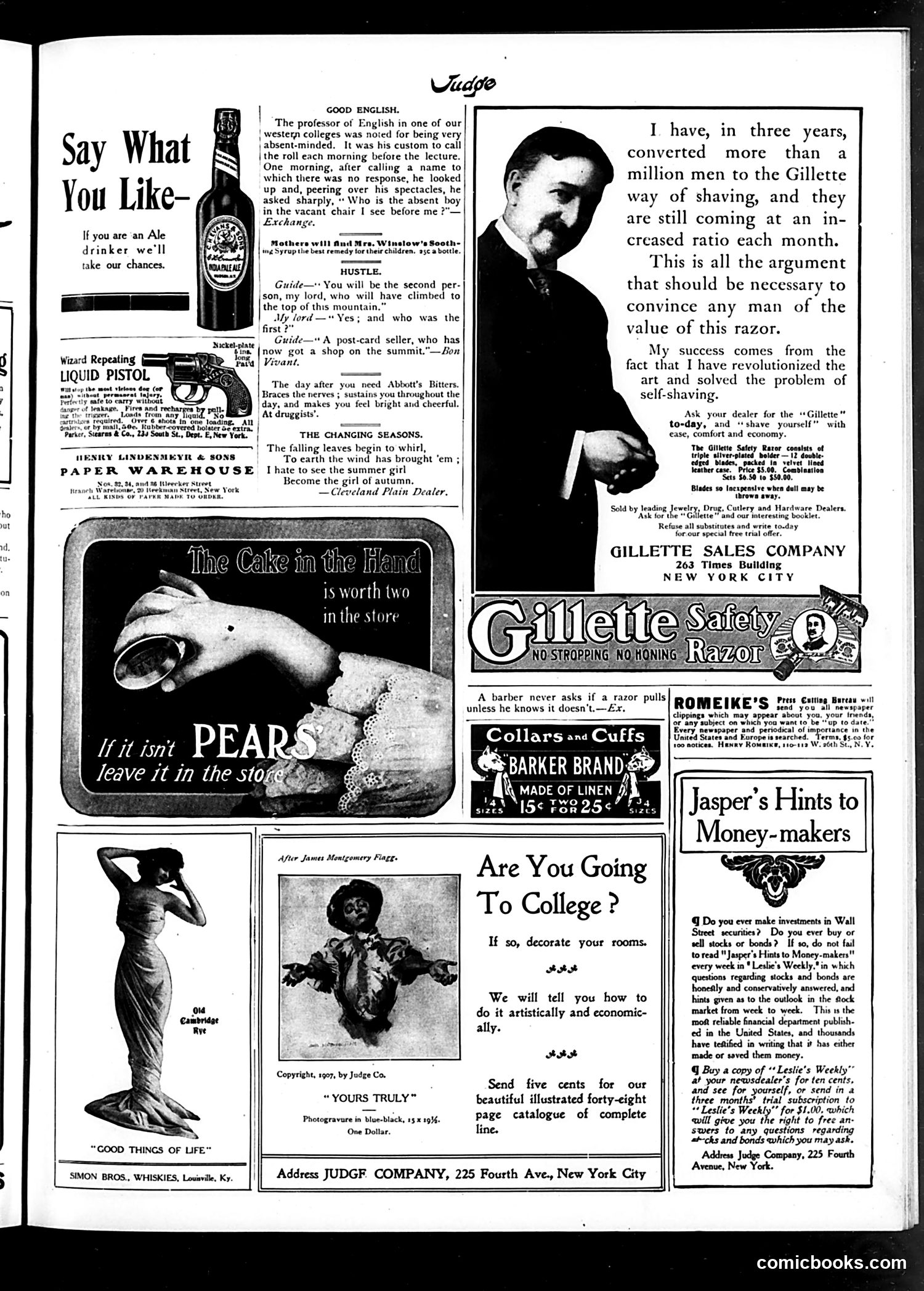
This page is primarily **advertising** with some brief humorous content. The main items: **"Mudge" Jokes**: Three short anecdotes mocking absent-minded professors and literal-minded guides—typical early 20th-century light humor. **Major Advertisements**: - **Gillette Safety Razor**: Features a man's portrait claiming he's converted "more than a million men" to the Gillette method, emphasizing it "revolutionized" self-shaving. This reflects the razor's actual market dominance during this era. - **Various product ads**: Liquid Pistol (gun lubricant), Abbott's Bitters (patent medicine), Barker Brand collars, Simon Bros. whiskey. - **Service ads**: Press clipping bureaus, college room decoration, Leslie's Weekly financial advice column. **Context for modern readers**: The Gillette ad represents early consumer marketing boasting market penetration. The patent medicine and whiskey ads reflect pre-regulation advertising standards. Overall, this is a typical Judge page balancing satirical content with revenue-generating advertisements.
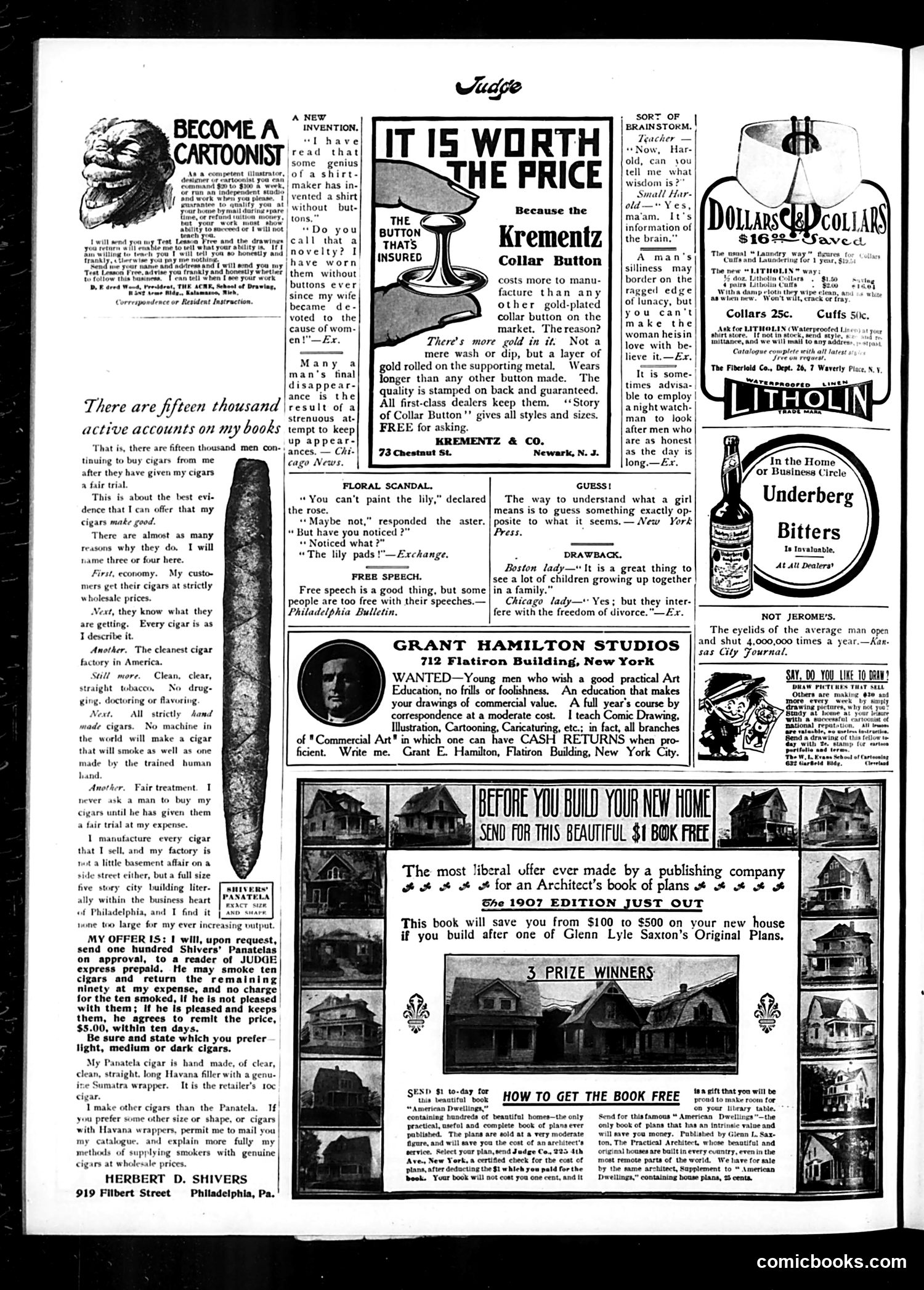
This page is primarily **advertising with light satirical humor**, typical of early-1900s Judge magazine. The main cartoons are brief comedic exchanges: - **"Sort of Brainstorm"**: A husband jokes that he's worn buttonless shirts since his wife became a women's suffrage advocate—a contemporary jab at the women's rights movement as nagging or emasculating. - **"Floral Scandal"**: Anthropomorphized flowers make puns (lily pads), a genteel Victorian humor style. - **"Free Speech" and "Guess!"**: Brief quips about courtship and divorce, reflecting period attitudes toward gender relations. The **dominant content** consists of product advertisements (Krementz collar buttons, Underberg bitters, home building plans) and Herbert Shivers' cigar promotion, which occupies substantial space with a lengthy sales pitch emphasizing factory quality and fair trial policies. The humor reflects early-20th-century social anxieties: women's suffrage, changing gender roles, and consumer trust in manufacturing—all addressed through genteel wordplay rather than sharp satire.
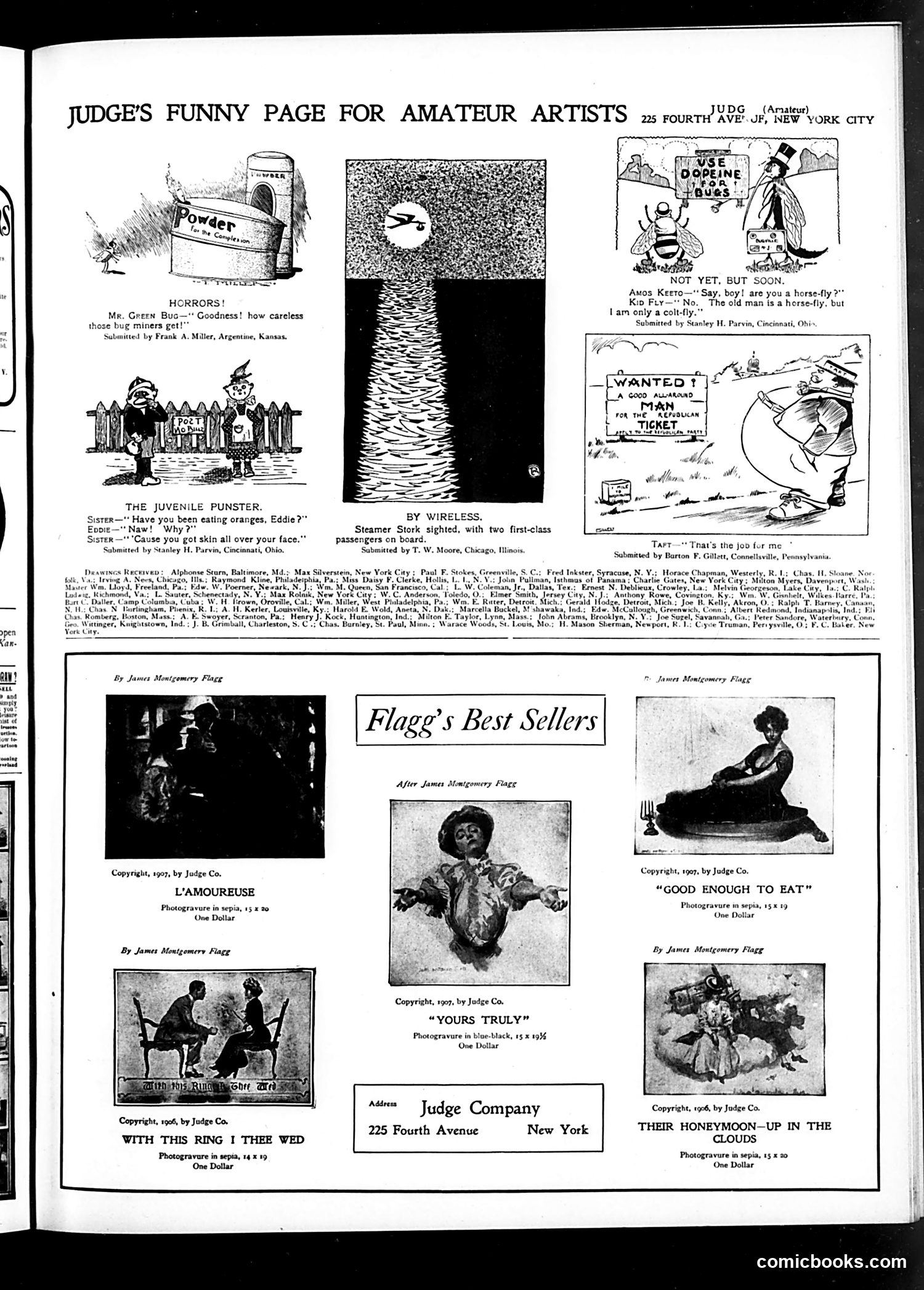
This is a **humor submission page** featuring amateur cartoons and jokes submitted by readers, plus advertisements for James Montgomery Flagg prints. The cartoons are simple pun-based jokes: 1. **"Horrors!"** — A bug miner joke playing on careless workers 2. **"The Juvenile Punster"** — A child's joke about orange skin on his face 3. **"Amos Keeps"** — Wordplay distinguishing a "horse-fly" from a "colt-fly" (young horse) 4. **"By Wireless"** — A stork (symbol of babies) spotted, implying pregnancy announcement 5. **"Taft"** — A man wants a job for himself (unclear deeper context without more information) The page's main purpose is **crowdsourced humor**—Judge invited amateur artists and joke-writers to submit material. The bottom half advertises **James Montgomery Flagg prints** (a famous illustrator), available for purchase. These are gentle, family-friendly wordplay jokes typical of early 1900s humor magazines, emphasizing puns and double meanings rather than satirical social commentary.
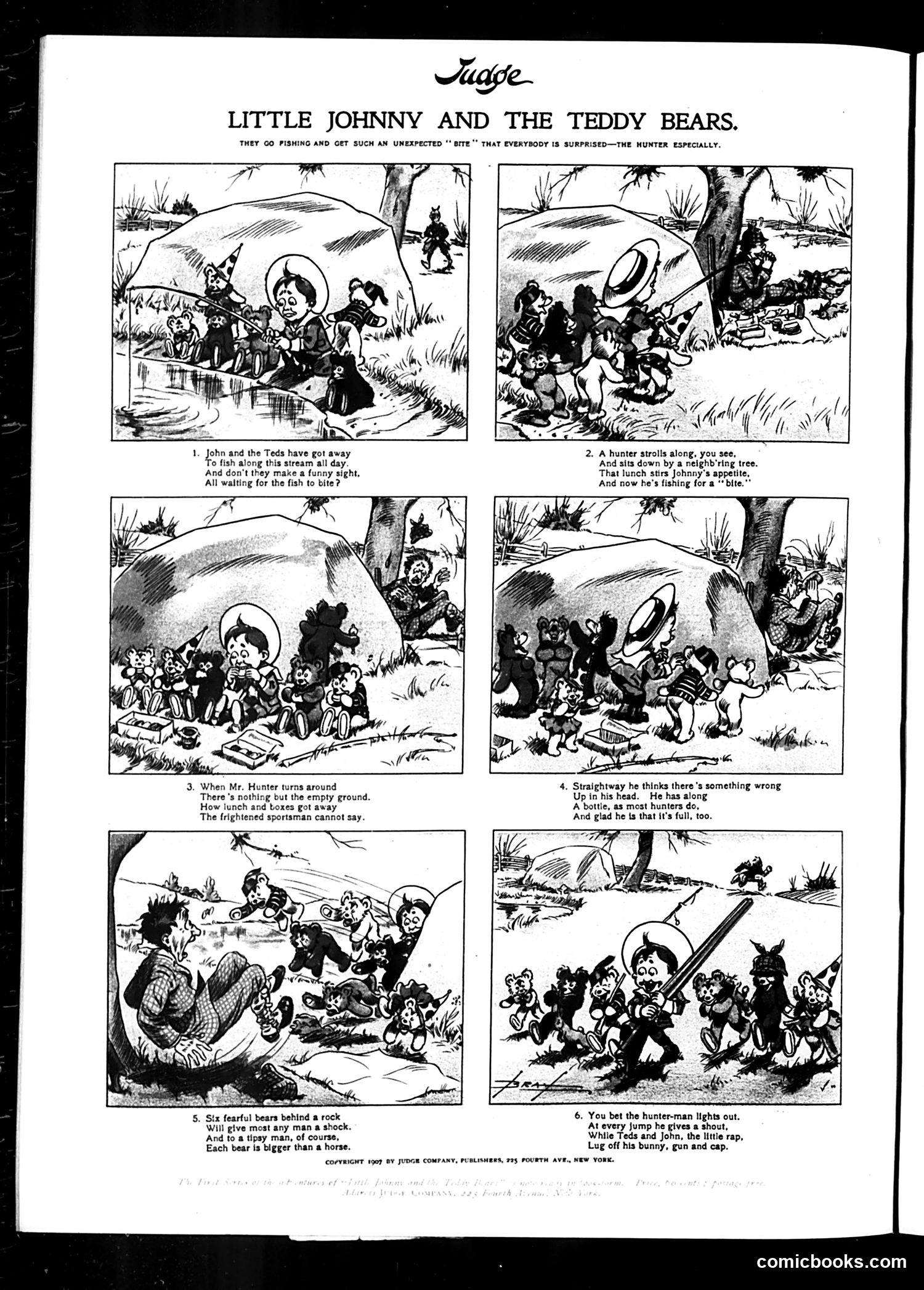
This is a children's comic strip playing on the popularity of "Teddy Bears"—plush toys named after President Theodore Roosevelt, who became a cultural phenomenon in the early 1900s after a famous hunting incident. The joke: Little Johnny and anthropomorphic teddy bears go fishing. When a hunter sits nearby eating lunch, Johnny attempts to "fish" for the food. The bears emerge from hiding, startling the hunter so badly he flees, leaving behind his rifle, gun, and bunny. The humor derives from the unexpected twist—instead of catching fish, they catch a frightened human—and the visual comedy of numerous bears chasing off an armed adult. The "teddy bear" reference would have been immediately recognizable to 1907 readers as a cultural craze. The satire gently mocks hunting culture while capitalizing on the teddy bear's enormous popularity with contemporary audiences.