
Judge, 1907-10-05 · page 4 of 16
Judge — October 5, 1907 — page 4: what you’re looking at
What you’re looking at
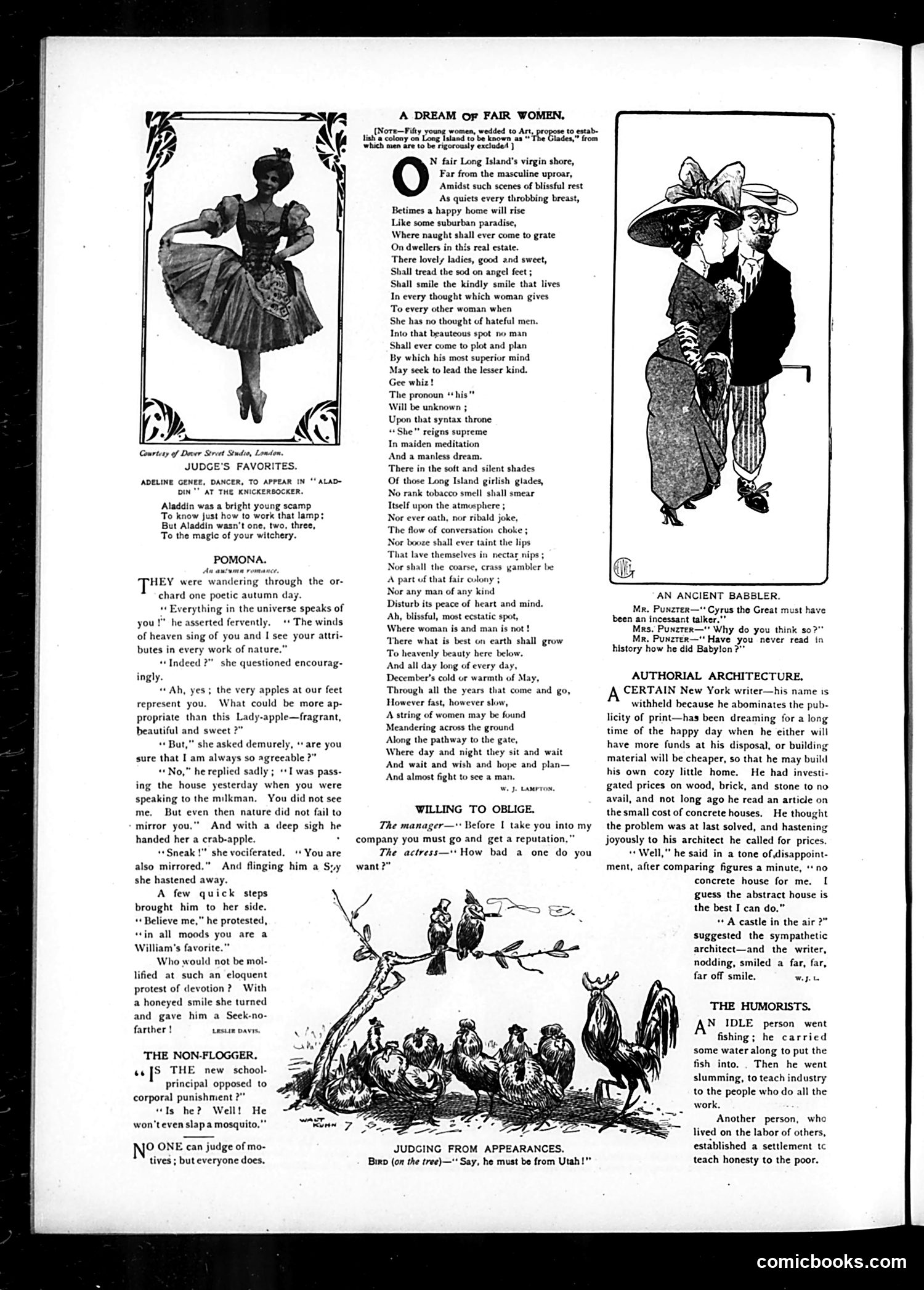
This page contains literary and social satire typical of Judge magazine's content. The main features include: **"A Dream of Fair Women"** — a poem idealizing virtuous womanhood, contrasting with the magazine's frequent critiques of gender relations. **"Judge's Favorites"** — a profile of dancer Adeline Genée, reflecting the magazine's coverage of entertainment and society figures. **Several humorous short pieces** ("The Non-Flogger," "An Ancient Babbler," "Willing to Oblige," "Authorial Architecture," "The Humorists") — brief satirical anecdotes poking fun at social types: pompous educators, pretentious architects, idle philosophizers, and other contemporary character archetypes. The illustrations feature caricatured figures and a detailed bird scene mocking human behavior through animal observation ("Judging from Appearances"). The satire targets middle-class pretension, social hypocrisy, and professional pomposity rather than specific political events.
📄 Transcribed text from this page (OCR, searchable)
Machine-transcribed from the original scan — historical spelling and the odd misread are preserved.
A DREAM of FAIR WOMEN, (Nore—Fifty young women, wedded to Art, togstab- liah a colony on Long Island to be known aa The Glades,” from ‘which men are to be rigorously exclade? } Courtesy of Dover Street Studio, Lonton. JUDGE'S FAVORITES. ADELINE GENEE, DANCER, TO APPEAR IN ‘ ALAD- DIN" AT THE KNICKERBOCKER. Aladdin was a bright young scamp To know just how to work that lam; But Aladdin wasn't one, two, three, To the magic of your witchery. Ana ma THEY were wandering chard one poetic autumn day. Everything in the universe speaks of you !* he asserted fervently. + The winds of heaven sing of you and I see your attri- butes in every work of nature.” «Indeed 2" she questioned encourag- ingly. “Ab, yes; the very apples at our feet represent you. What could be more ap- propriate than this Lady-apple—fragrant, beautiful and sweet «+ But,” she asked demurely, are you sure that I am always so agreeable ?” ++No,” he replied sadly ; +I was pass- ing the house yesterday when you were speaking to the milkman. You did not see me. But even then nature did not fail to And with a deep sigh he mirror you." handed her a crab-apple. “*Sneak !"" she vociferated. ++ You are also mirrored.” And flinging him a she hastened away. A few quick steps brought him to her side. ++ Believe me,” he protested, *+in all moods you are a William's favorite.” Who would not be mol- lified at such an eloquent protest of devotion? With a honeyed smile she turned and gave him a Seek-no- farther! Les DAVE ‘THE NON-FLOGGER. ss ]S THE new school- principal opposed to corporal punishment ?” “Is he? Well! He won'teven slapa mosquito.” NO ONE ean judge of mo- tives ; but everyone does. N fair Long Island’s virgin shore, Far from the masculine uproar, Amidst such scenes of blissful rest As quiets every throbbing breast, Betimes a happy home will rise Like some suburban paradise, Where naught shall ever come to grate On dwellers in this real estate. There lovely ladies, good and sweet, Shall tread the sod on angel feet ; Shall smile the kindly smile that lives In every thought which woman gives To every other woman when She has no thought of hateful men. Into that beauteous spot no man Shall ever come to plot and plan By which his most superior mind May seck to lead the lesser kind. Gee whiz! The pronoun his" Will be unknown ; Upon that syntax throne “She” reigns supreme In maiden meditation And a manless dream. There in the soft and silent shades Of those Long Island girlish glades, No rank tobacco smell shall smear Itself upon the atmosphere ; Nor ever oath, nor ribald joke, The flow of conversation choke ; Nor booze shall ever taint the lips lave themselves in nectar nips; Nor shall the coarse, crass yambler be A part of that fair o Nor any man of any kind Disturb its peace of heart and mind. Ah, blissful, most ecstatic spot, Where woman is and man is not! ‘There what is best on earth shall grow To heavenly beauty here below. And all day long of every day, December's cold or warmth of May, Through all the years that come and go, However fast, however slow, A string of women may be found Meandering across the ground Along the pathway to the gate, Where day and night they sit and wait And wait and wish and hope and plan— And almost fight to sce a man. We Je LaMFTON. WILLING TO OBLIGE. The manager—* Before 1 take you into my company you must go and get a reputation.” The actress—" How bad a one do you want?” JUDGING FROM APPEARANCES. Biro (on the tree)—'* Say, he must be from Utah!" AN ANCIENT BABBLER. Mr. Punzrer—"* Cyrus the Great must have been an incessant talker." Mrs. Punzter—" Why do you think so?" Mr, Punzrer—‘Have you never read in history how he did Babylon?" AUTHORIAL ARCHITECTURE. CERTAIN New York writer—his name is withheld because he abominates the pub- licity of print—has been dreaming for a long time of the happy day when he either will have more funds at his disposal, or building material will be cheaper, so that he may build his own cozy little home. He had investi- gated prices on wood, brick, and stone to no avail, and not long ago he read an article on the small cost of concrete houses. He thot the problem was at last solved, and hastenin; joyously to his architect he called for prices. + Well,” he said in a tone of disappoint- ment, after comparing figures a minute, + no concrete house for me. [ guess the abstract house is the best I can do.” + A castle in the air 2” suggested the sympathetic architect—and the writer, nodding, smiled a far, far, far off smile. WE THE HUMORISTS. N IDLE person went fishing; he carried some water along to put the fish into. . Then he went slumming, to teach industry to the people who do all the work, Another person, who lived on the labor of others, established a settlement tc teach honesty to the poor. comicbooks.com