
A complete issue · 16 pages · 1907
Judge — September 21, 1907
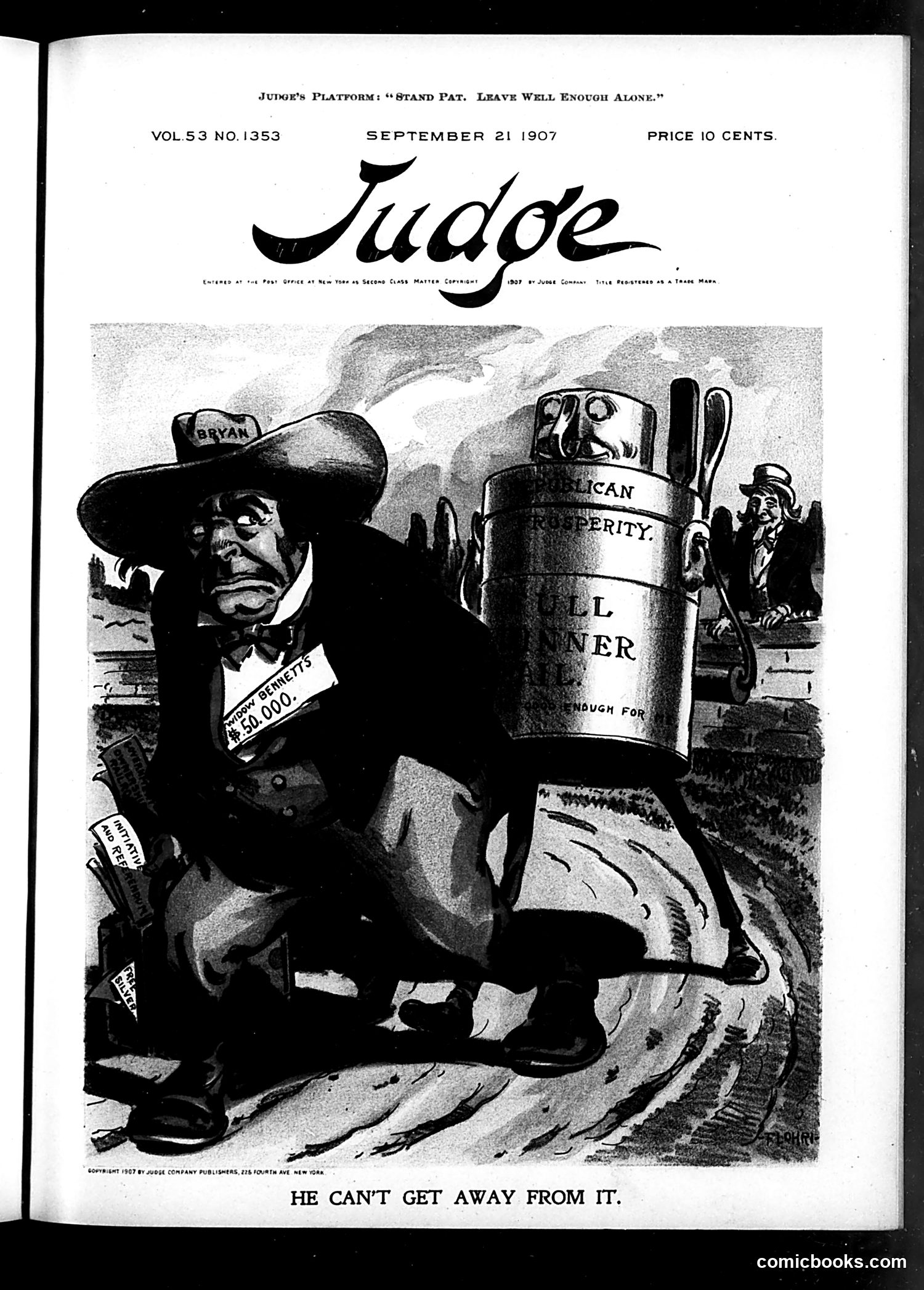
This cartoon depicts a figure labeled "BRYAN" (likely William Jennings Bryan, three-time presidential candidate) as a cowboy unable to escape from a large barrel labeled "AMERICAN LIBERTY" and other partially visible text. The caption reads "HE CAN'T GET AWAY FROM IT." The satire appears to criticize Bryan for being inextricably linked to or trapped by his own political positions or past statements regarding American liberty and democratic principles. The barrel imagery suggests he's constrained by his rhetoric or commitments, unable to distance himself from them despite his efforts. This likely reflects contemporary political debates about Bryan's consistency—or perceived inconsistency—regarding progressive ideals during the early 20th century.
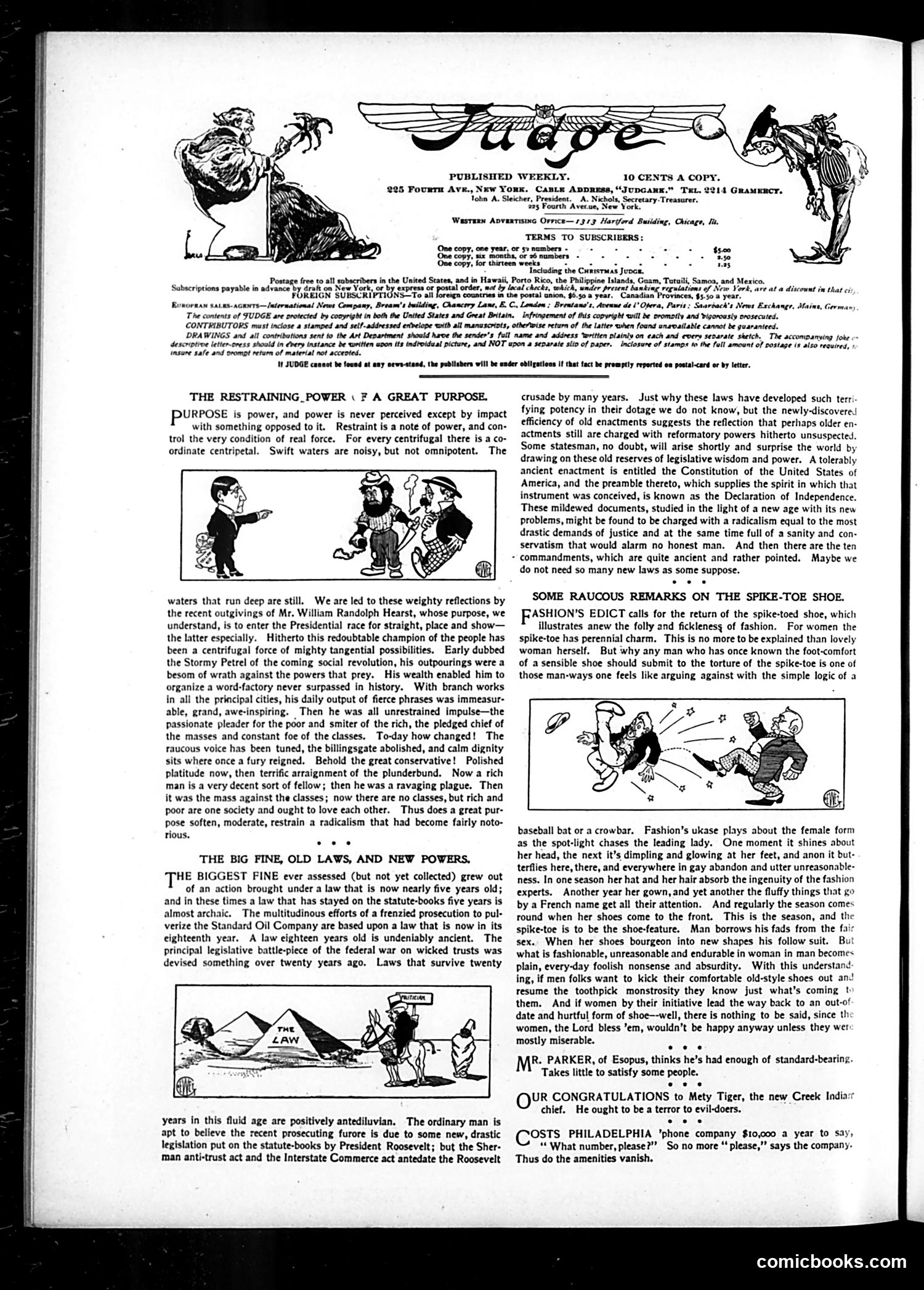
This page contains several satirical pieces on early 20th-century American politics and social customs. **"The Restraining Power of a Great Purpose"** critiques the Sherman antitrust act and old legislative precedents, suggesting laws developed during earlier eras may be outdated for modern industrial problems. The cartoon depicts what appears to be political figures in debate. **"Some Raucous Remarks on the Spike-Toe Shoe"** mocks women's fashion, specifically the spike-heeled shoe trend. The text sarcastically criticizes women adopting this uncomfortable footwear and questions why sensible women would embrace such impractical styling. **"The Big Fine, Old Laws and New Powers"** discusses a major antitrust fine, apparently referencing recent Standard Oil Company litigation, debating whether old laws adequately address modern corporate power. The page reflects Progressive Era concerns about trust-busting, legal modernization, and gender/fashion criticism typical of Judge's satirical commentary.
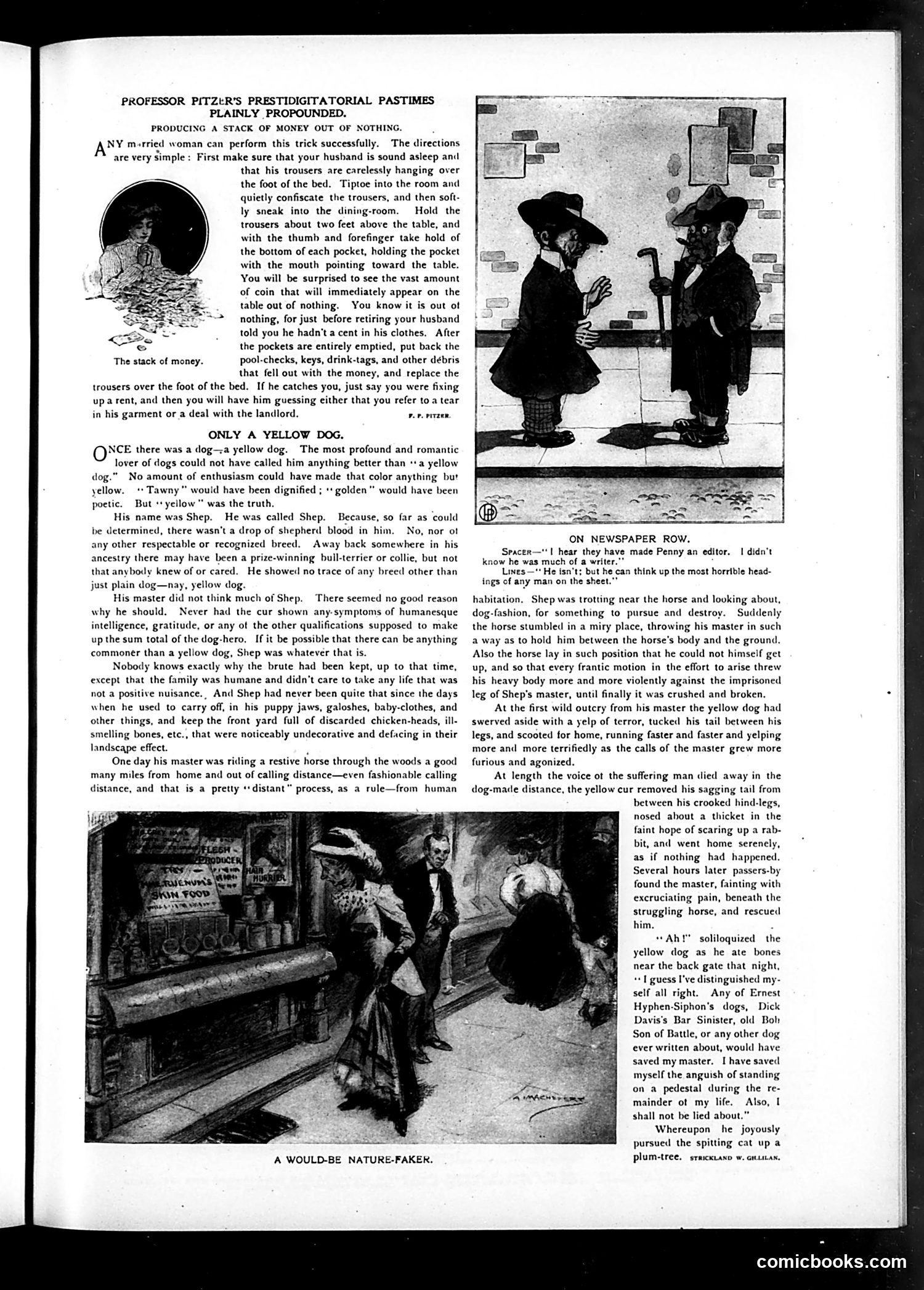
This page contains three distinct pieces: 1. **"Professor Fitzr's Prestidigitatorial Pastimes"** — A humorous article about a magician's trick for married women to extract money from their husbands' trouser pockets while they sleep, producing "a stack of money out of nothing." 2. **"Only a Yellow Dog"** — A sentimental story about a master's bond with his yellow dog, emphasizing the animal's loyalty and devotion despite lacking pedigree. 3. **"On Newspaper Row"** and **"A Would-Be Nature-Faker"** — Illustrations accompanying the narrative content. The satire targets marital dynamics and contemporary "nature faking" literature (popular exaggerated animal stories). The humor relies on domestic comedy and gentle social observation rather than sharp political commentary. This reflects Judge's typical focus on middle-class American life and manners during this era.
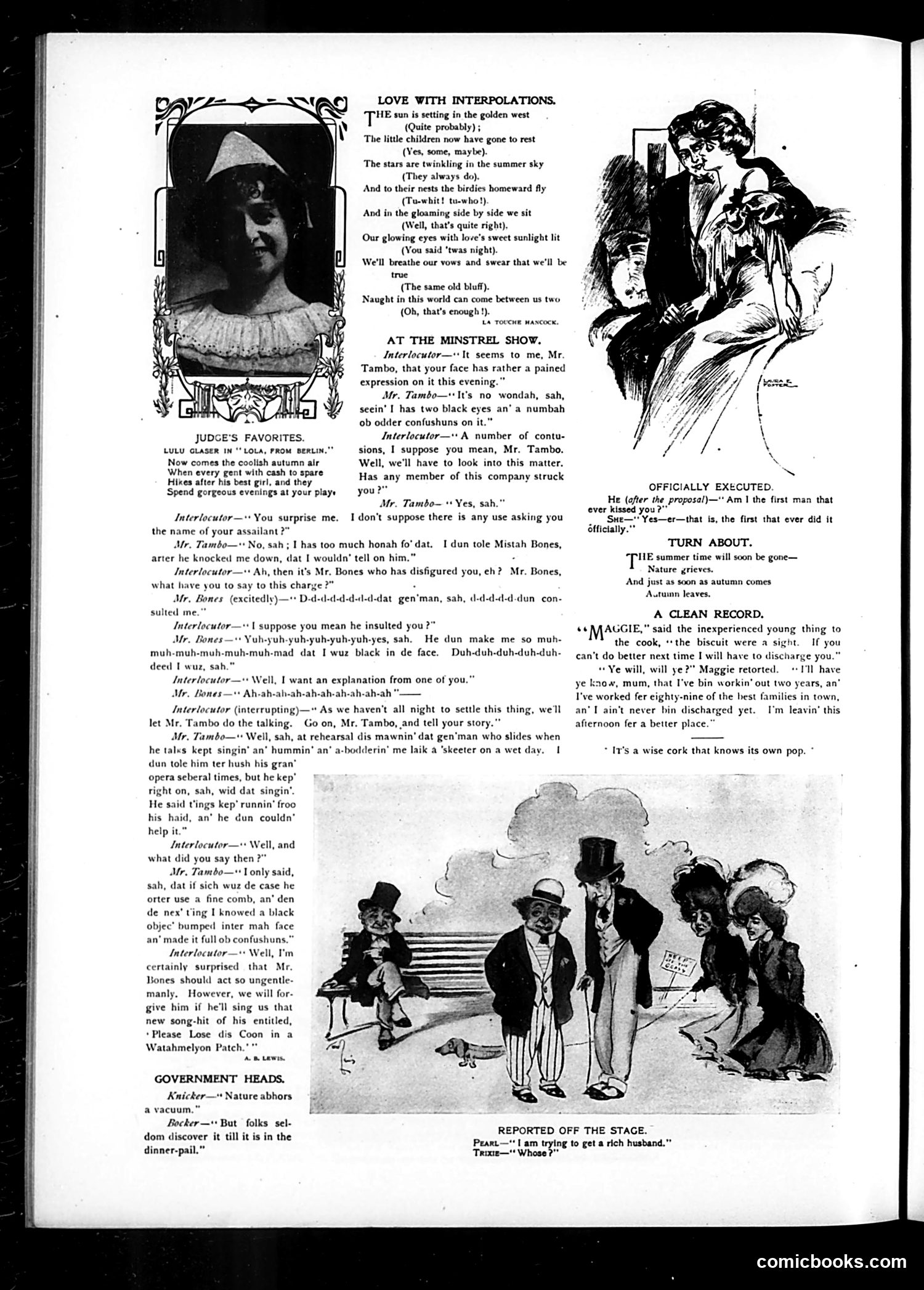
This page contains several theatrical sketches and jokes typical of early 20th-century Judge magazine humor. **"At the Minstrel Show"** features an Interlocutor questioning Mr. Tambo about his pained expression. The exchange uses heavy dialect humor common to the era's minstrel tradition—though the specific political reference is unclear from context alone. **"Judge's Favorites"** presents Lulu Glaser in "Lola, from Berlin," with mild jokes about her stage performance. **Other sections** include "Officially Executed," "Turn About," "A Clean Record," and "Government Heads"—brief comedic quips rather than sustained satire. The bottom cartoon, "Reported Off the Stage," shows period-dressed figures in a simple gag about marital pursuit. The page exemplifies Judge's mix of theatrical gossip, vaudeville humor, and light social commentary rather than pointed political satire.
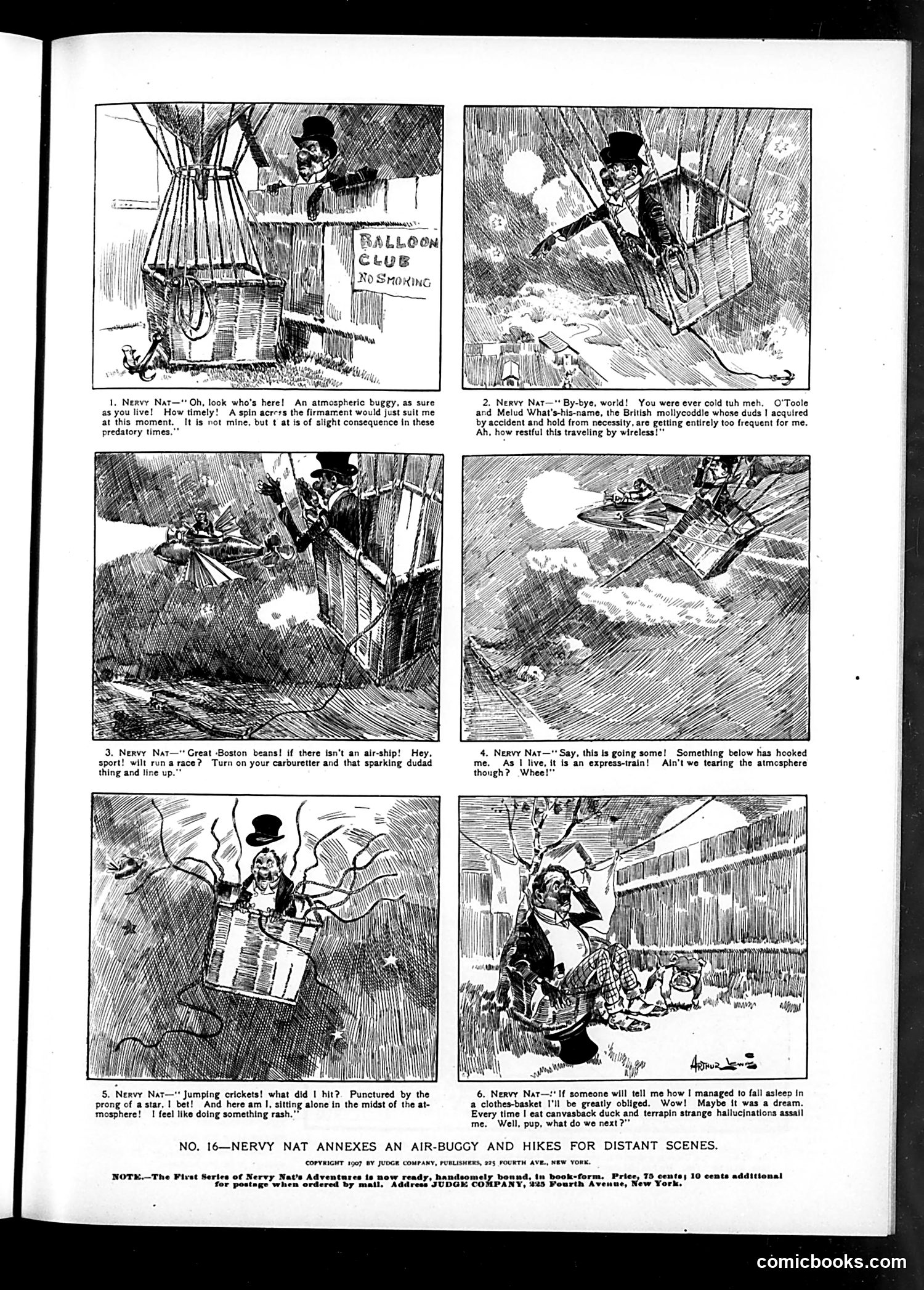
This is a comic strip featuring "Nervy Nat," a recurring character in Judge magazine. The six-panel narrative shows Nat stealing or commandeering an experimental aircraft (an "air-buggy") from a "Balloon Club" marked "No Smoking." The humor derives from Nat's reckless escapades: he crashes the flying machine multiple times, narrowly escapes disasters, and experiences increasingly absurd mishaps—being struck by a meteor, encountering an express train mid-air, and landing in precarious situations. The satire likely mocks both the novelty of early aviation technology (still relatively new in the early 20th century) and the overconfident amateur aviator who ignores warnings. Nat's character represents the foolish everyman repeatedly getting into dangerous situations through his own audacity.
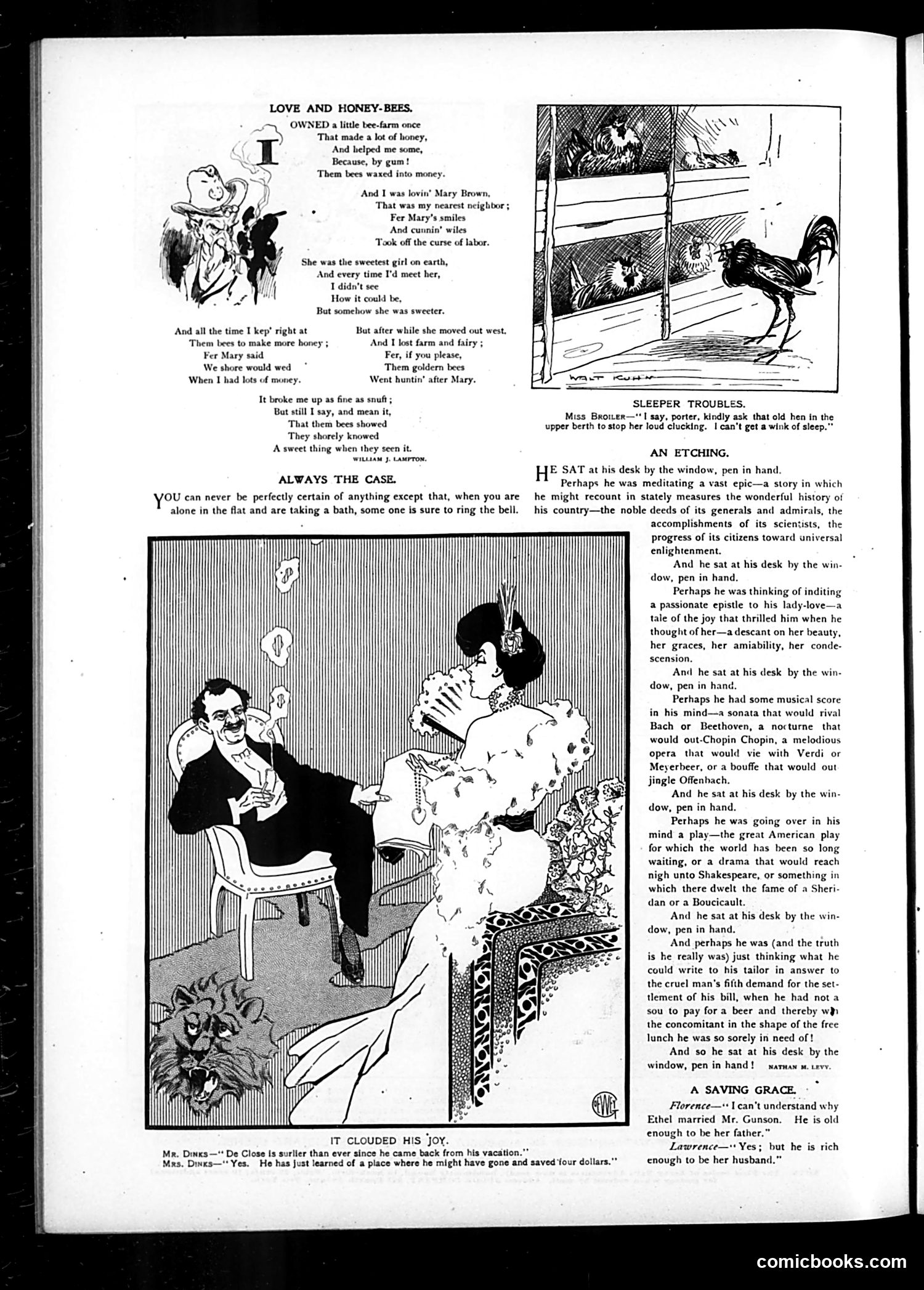
This page contains three distinct pieces of satirical humor typical of early 20th-century American magazines: **"Love and Honey-Bees"** is a sentimental poem-turned-joke: a farmer kept bees to earn money for marriage to Mary Brown, but the bees literally followed her when she moved west, leaving him ruined. The humor lies in treating bees as having romantic judgment equal to the lovestruck farmer. **"Always the Case"** is a one-panel gag about domestic life: the certainty that someone will ring the doorbell precisely when you're bathing—a relatable complaint about timing and interruption. **"An Etching"** satirizes artistic pretension. A writer sits composing what might be an epic, love letter, symphony, or great American play—but he's actually worried about writing his tailor demanding payment for an unpaid bill. The joke mocks the gap between artistic aspiration and mundane financial reality. **"A Saving Grace"** is a brief marriage joke: a young woman married an old man not for love but for wealth—making him financially "husband material" rather than father material. These pieces reflect Judge's focus on middle-class domestic situations and gentle social satire.
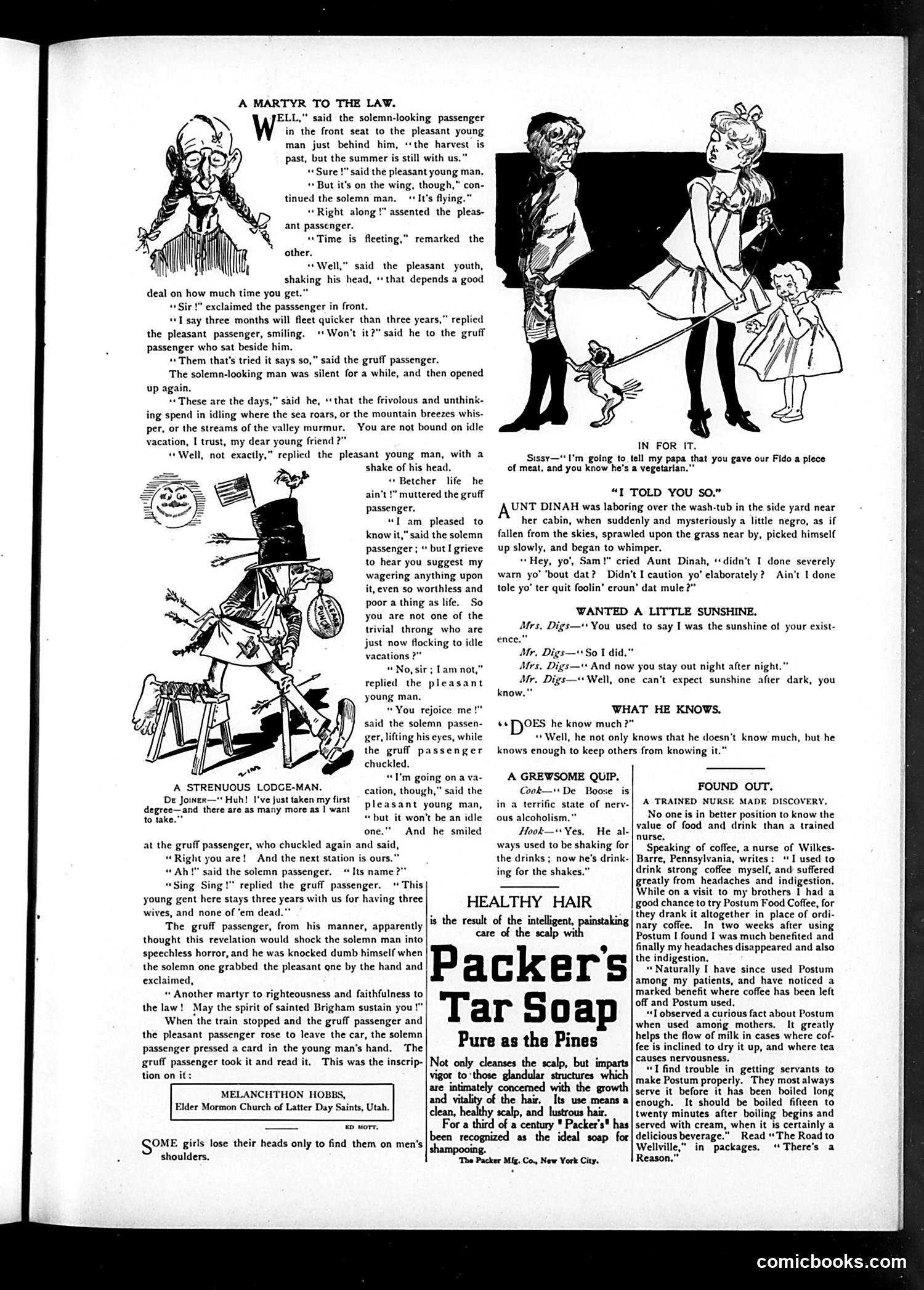
This page contains three unrelated satirical pieces typical of Judge magazine's format: **"A Martyr to the Law"** depicts a conversational exchange between passengers on a train. A solemn moralist lectures a pleasant young man about frivolous vacation-taking, praising his apparent virtue. The joke's reveal: the young man is actually being transported to **Sing Sing Prison** for a three-year sentence. The satire mocks self-righteous moralizing and hypocrisy—the solemn passenger's earnest praise of virtue masks criminal reality. The remaining items are brief, unrelated jokes: "In For It" (a child threatens to report mischief to her vegetarian father), "I Told You So" (a woman's warning about a mule proved correct), "Wanted a Little Sunshine" (a marriage joke about nighttime behavior), and "What He Knows" (wit about feigned ignorance). The page also includes a Packer's Tar Soap advertisement, reflecting Judge's mixed editorial-advertising format.
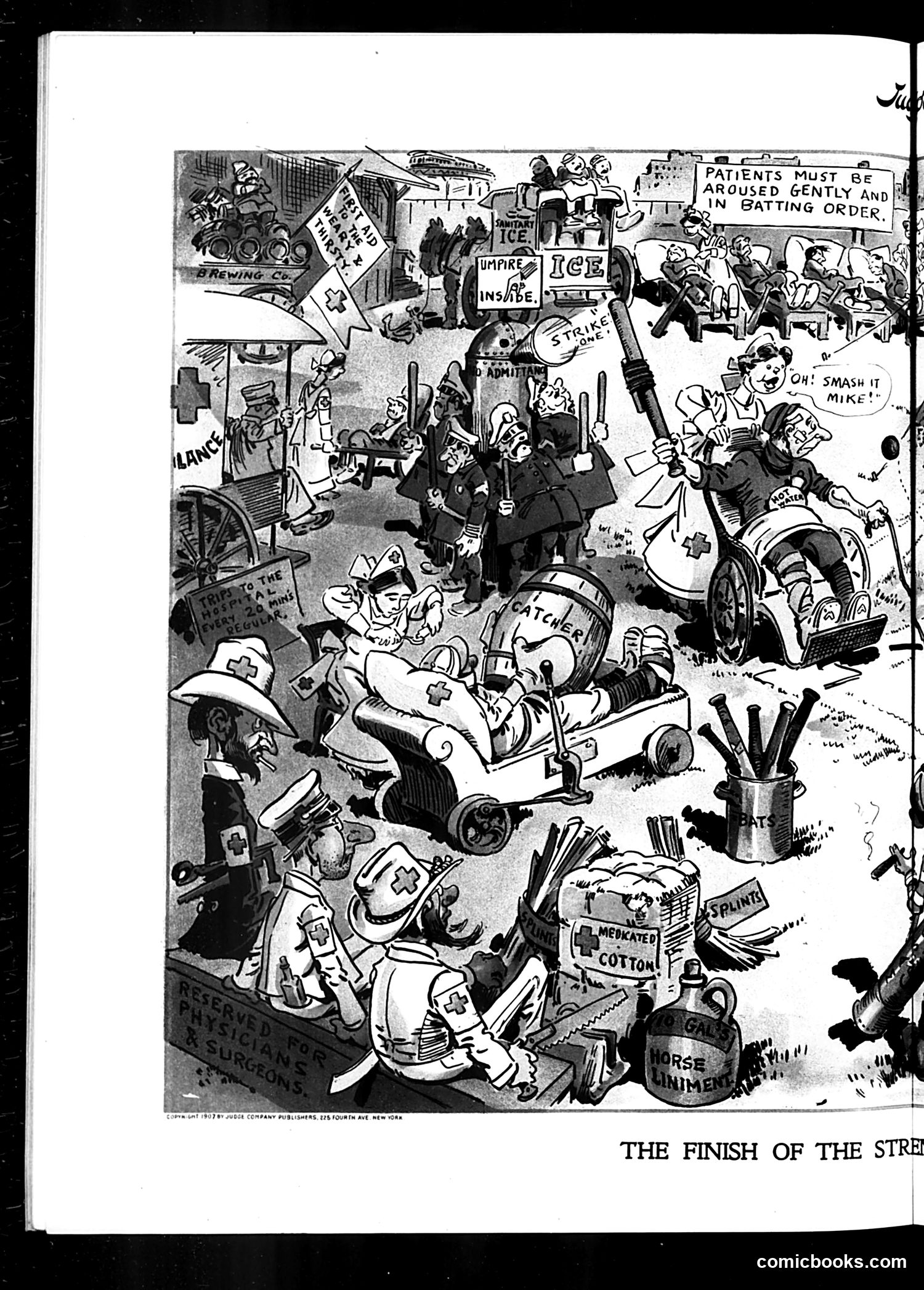
This satirical cartoon depicts a chaotic street scene representing medical chaos or incompetence. The central figures appear to be healthcare workers (identifiable by nurse caps and medical symbols) engaged in comedic mishaps—patients are being transported in makeshift vessels, medical supplies scatter everywhere, and there's general pandemonium. The sign "PATIENTS MUST BE AROUSED GENTLY AND IN BATTING ORDER" suggests the satire targets poorly organized medical treatment or hospital procedures. References to "UMPIRE," "STRIKE," and baseball terminology indicate the cartoon compares medical practice to baseball—perhaps mocking the disorganization or treating patients like game plays rather than individuals. The visible medical supplies (cotton, liniment, syringes) and crude transportation methods suggest commentary on inadequate healthcare facilities or incompetent medical professionals. Without a visible date, the specific historical context remains unclear.
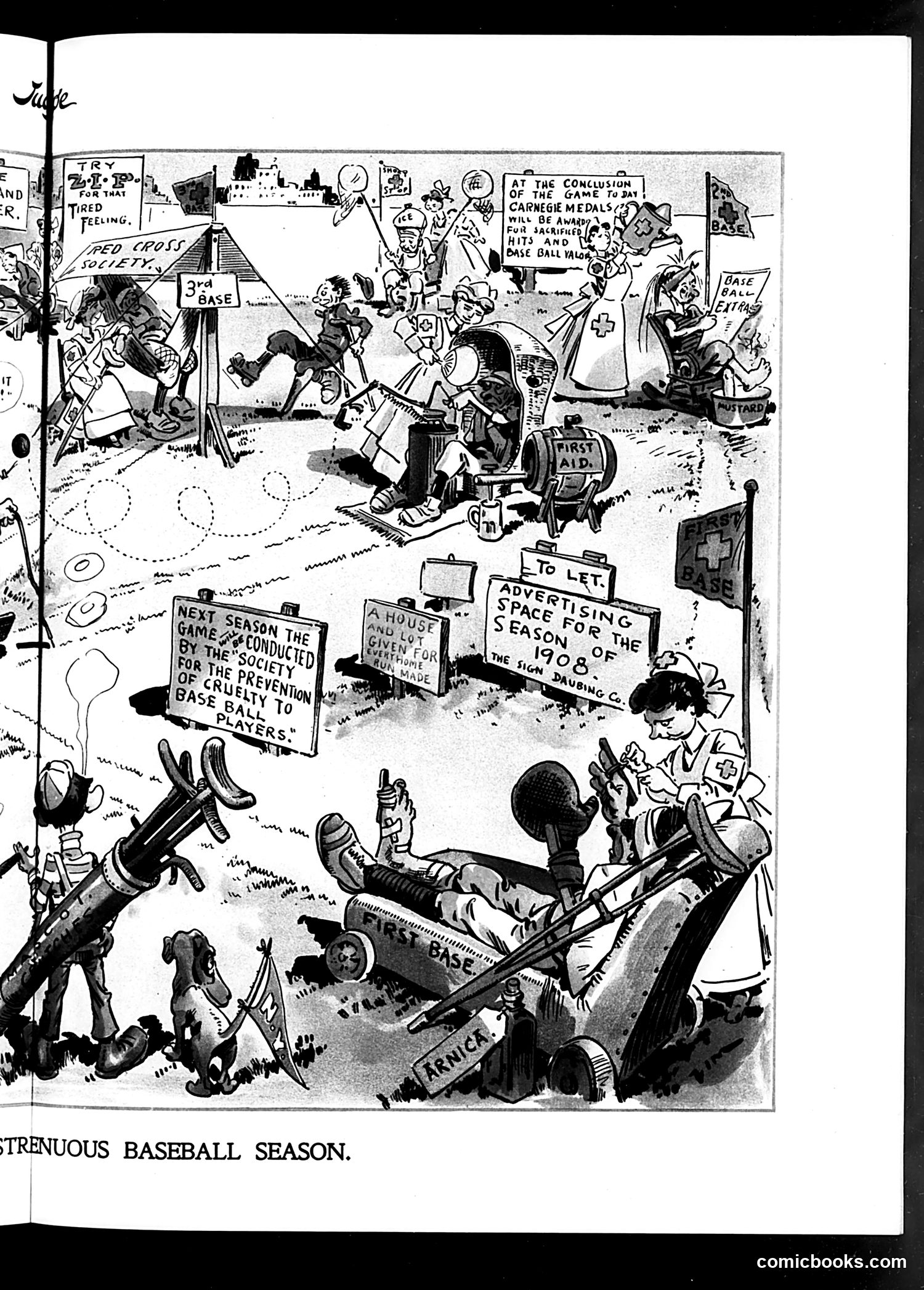
This satirical cartoon mocks the chaos and injuries of early 1900s baseball. The scene depicts a baseball field converted into a literal battlefield, with injured players on stretchers labeled "First Aid" and "Armnica," medical personnel rushing about, and various accident hazards scattered around (cannons, debris). Signs advertise property "to let" and mention the "Society for the Prevention of Base Ball to Players"—suggesting baseball was dangerously violent. The cartoon's title references Theodore Roosevelt's popular phrase "the strenuous life," satirizing both baseball's roughness and contemporary anxieties about modern sports safety. The exaggerated injuries and military imagery convey that 1900s baseball—played without modern protective equipment—was genuinely perilous, making the sport seem nearly as hazardous as warfare.
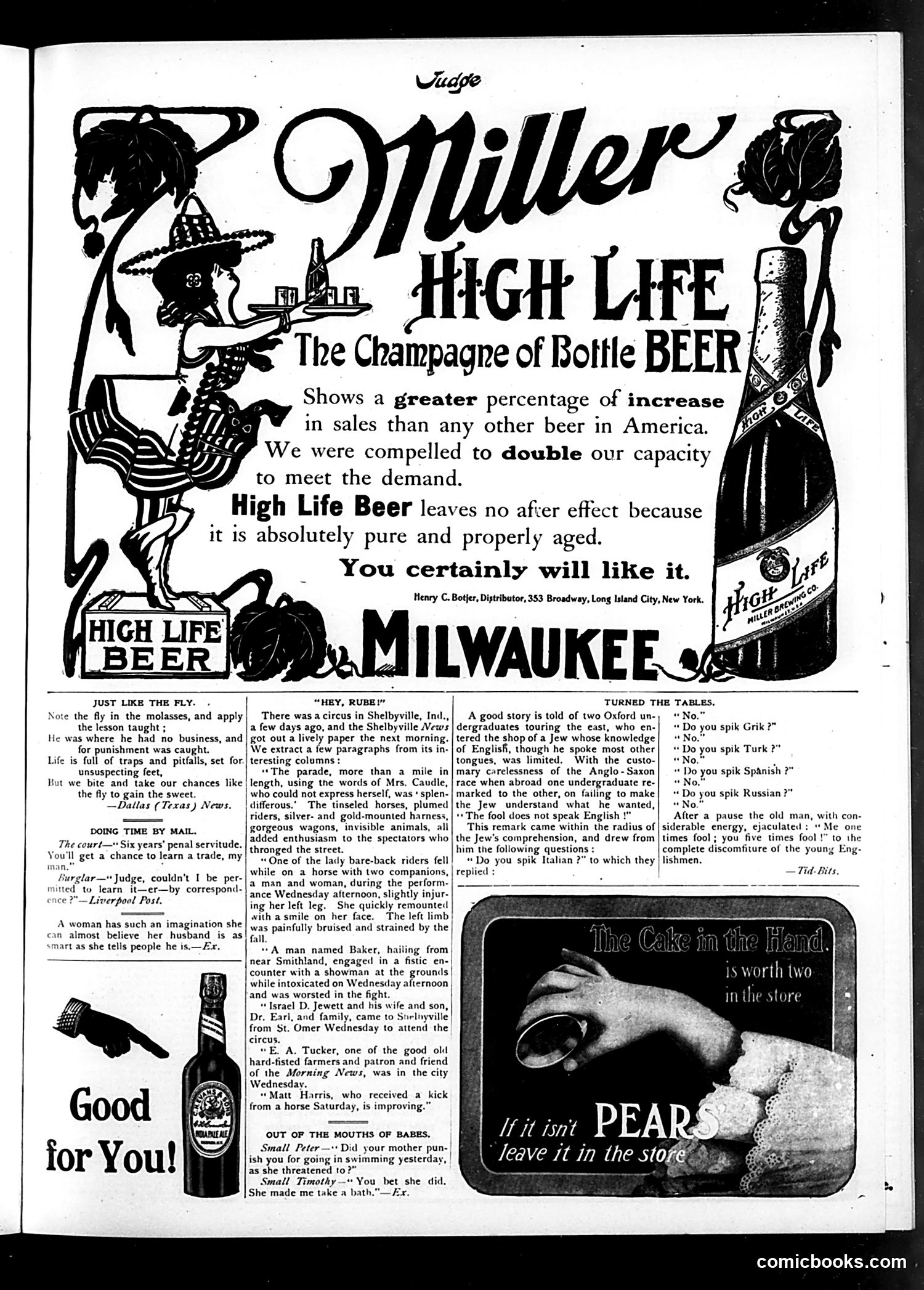
This page is primarily **advertising and humor columns**, not political cartooning. The dominant feature is a **Miller High Life beer advertisement** claiming superior sales growth and purity. The decorative art deco design features stylized female figures and a champagne bottle. Below are several **humorous anecdotes** in the "Judge" style: - "Just Like the Fly" offers moral instruction comparing human weakness to a fly drawn to molasses - "Doing Time by Mail" is a brief joke about a burglar requesting correspondence courses in prison - "Hey, Rube!" excerpts amusing circus coverage from a small Indiana newspaper, highlighting colorful language and local events - "Turned the Tables" tells of Oxford students condescending to a Jewish shopkeeper who outsmarts them with linguistic wit—the punchline being the shopkeeper calling *them* fools for knowing fewer languages than he does The page also includes a vintage **fruit advertising illustration** ("The Cake in the Hand / If it isn't PEAR / leave it in the store"). These pieces reflect Judge's mix of advertising, light social satire, and jokes rather than sharp political commentary.
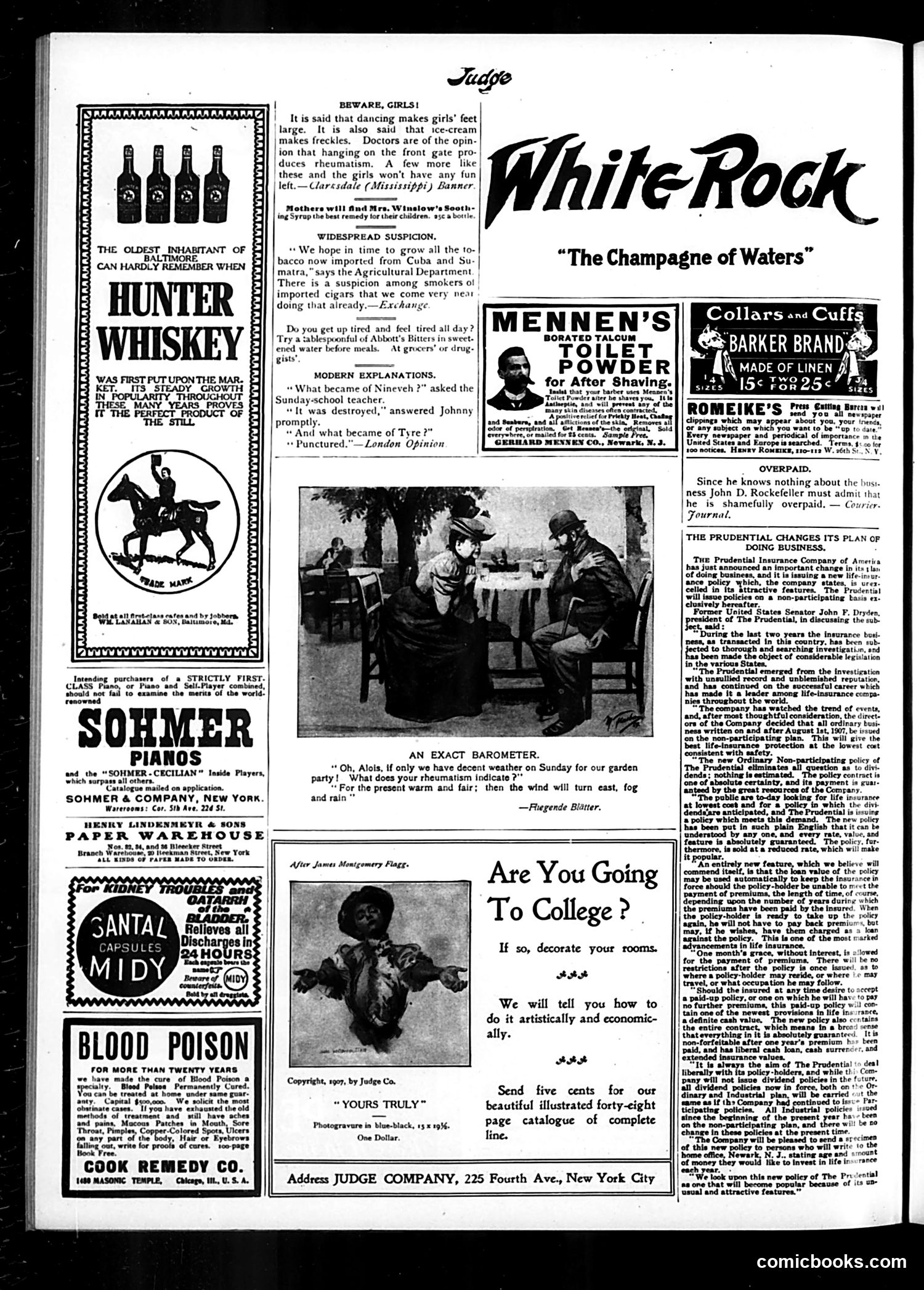
This page is primarily **advertising**, with small satirical items interspersed. The main content includes: **Satirical items:** - "Beware, Girls!" mocks health warnings about dancing, ice cream, and gate-hanging that restrict women's fun - "Widespread Suspicion" jokes that Americans will soon grow all their own tobacco (implying current imports taste terrible) - "Modern Explanations" features a Sunday school joke where a boy answers "Tyre" became "Punctured" (a tire pun) - "An Exact Barometer" shows a man asking his rheumatism to predict weather—satirizing people who claim joint pain predicts rain **Advertisements** dominate: Hunter Whiskey, Sohmer Pianos, Mennen's Talcum Powder, Barker Brand collars, Blood Poison cure, and college room decoration services. The cartoons and jokes reflect early-1900s American concerns: gender restrictions, import quality, and folk remedies. The humor is gentle, domestic satire typical of *Judge*'s style.
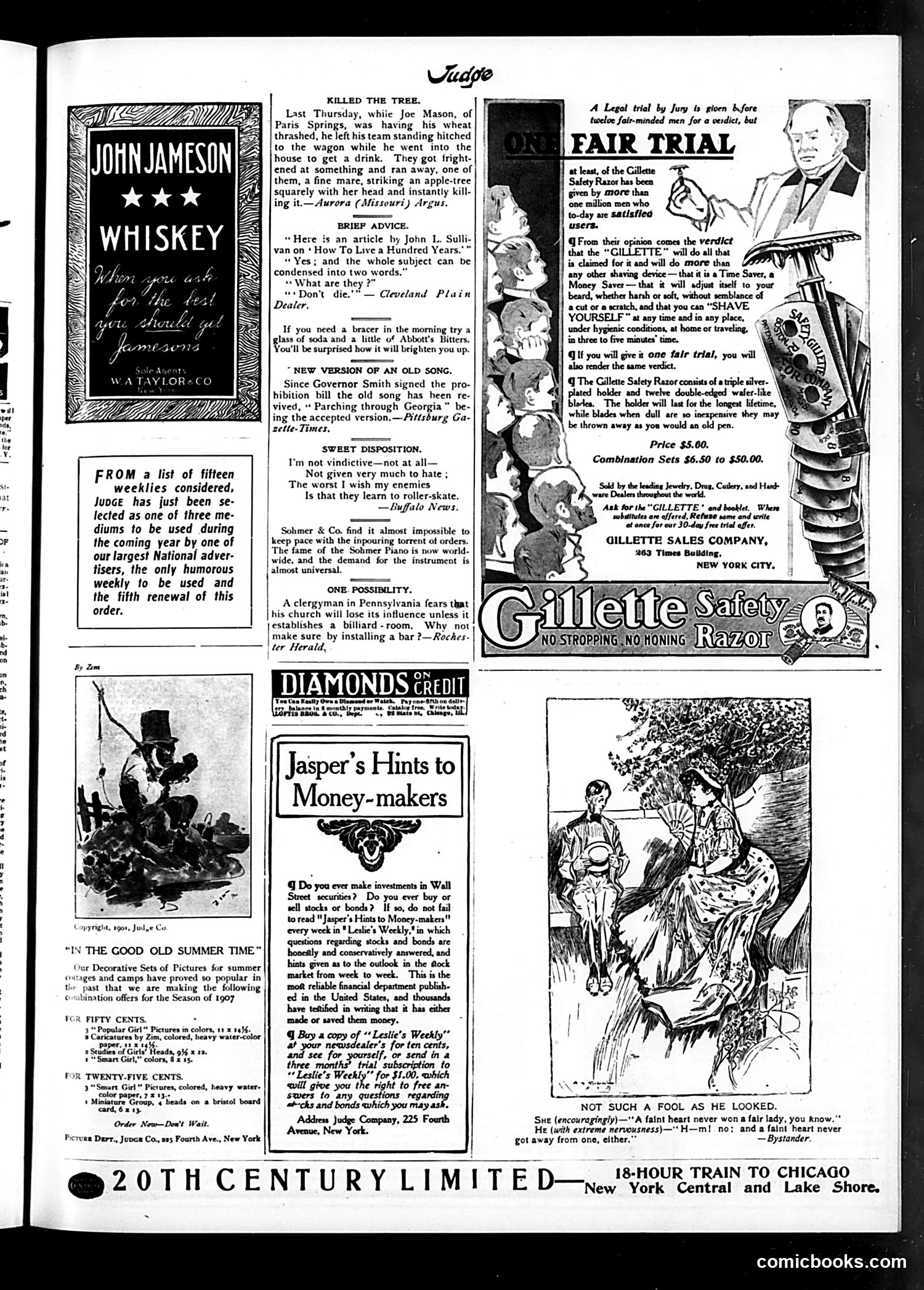
This page is primarily **advertising and filler content** rather than political satire. The main elements include: **Advertisements dominate**: John Jameson Whiskey, Gillette Safety Razor, Sohmer pianos, and investment guides occupy significant space. **Short humorous items** fill the gaps—brief jokes about mundane topics (a horse killing an apple tree, boxer John L. Sullivan's advice on longevity, a clergyman considering adding a billiard room to his church). These are gentle, generic humor with no specific political targets. **One social reference**: A joke about Georgia's prohibition bill being signed by Governor Smith, with the quip that "Parching through Georgia" (an old song) is being revived—a mild jab at alcohol prohibition's unpopularity. **The "Fair Trial" ad** uses jury imagery as metaphor for product reliability. Overall, this appears to be a typical **Judge magazine page circa 1907**: advertising-heavy, with light social commentary rather than sharp political satire. The content reflects early-20th-century American concerns (investment advice, temperance debates) without targeting specific political figures or movements.
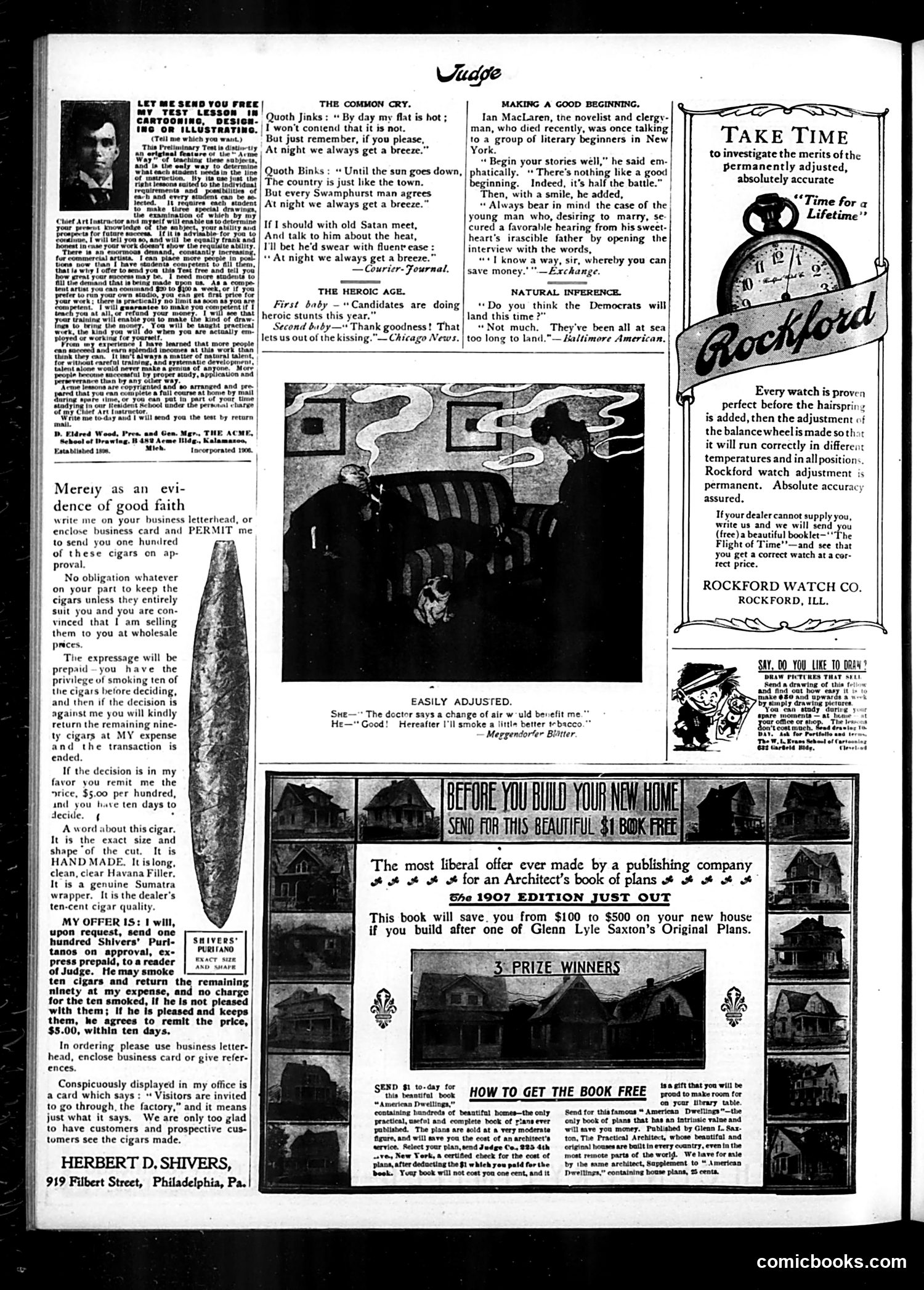
This page is primarily **advertising and filler content** rather than political satire. It contains: **Cartoons/humor:** - "The Common Cry": A joke about urban heat, where various characters (Jinks, Binks, and even Satan) repeat the cliché that "at night we always get a breeze"—mocking the platitude people use to dismiss summer discomfort. - "The Heroic Age": A brief two-panel joke about political candidates performing "heroic stunts." - "Natural Inference": A quick gag suggesting Democrats are lost (metaphorically at sea). **Dominant content:** Multiple full-page **advertisements**—a cigar promotion by Herbert D. Shivers, a Rockford Watch Company ad, and a large real-estate promotion for Glenn Lyle Saxton's house-building plans offering a free 1907 architecture book. The page reflects early 1900s Judge magazine: mixing light satirical humor with substantial advertising revenue. The political references are minimal and generic (Democratic party criticism); the focus is entertainment and commerce.
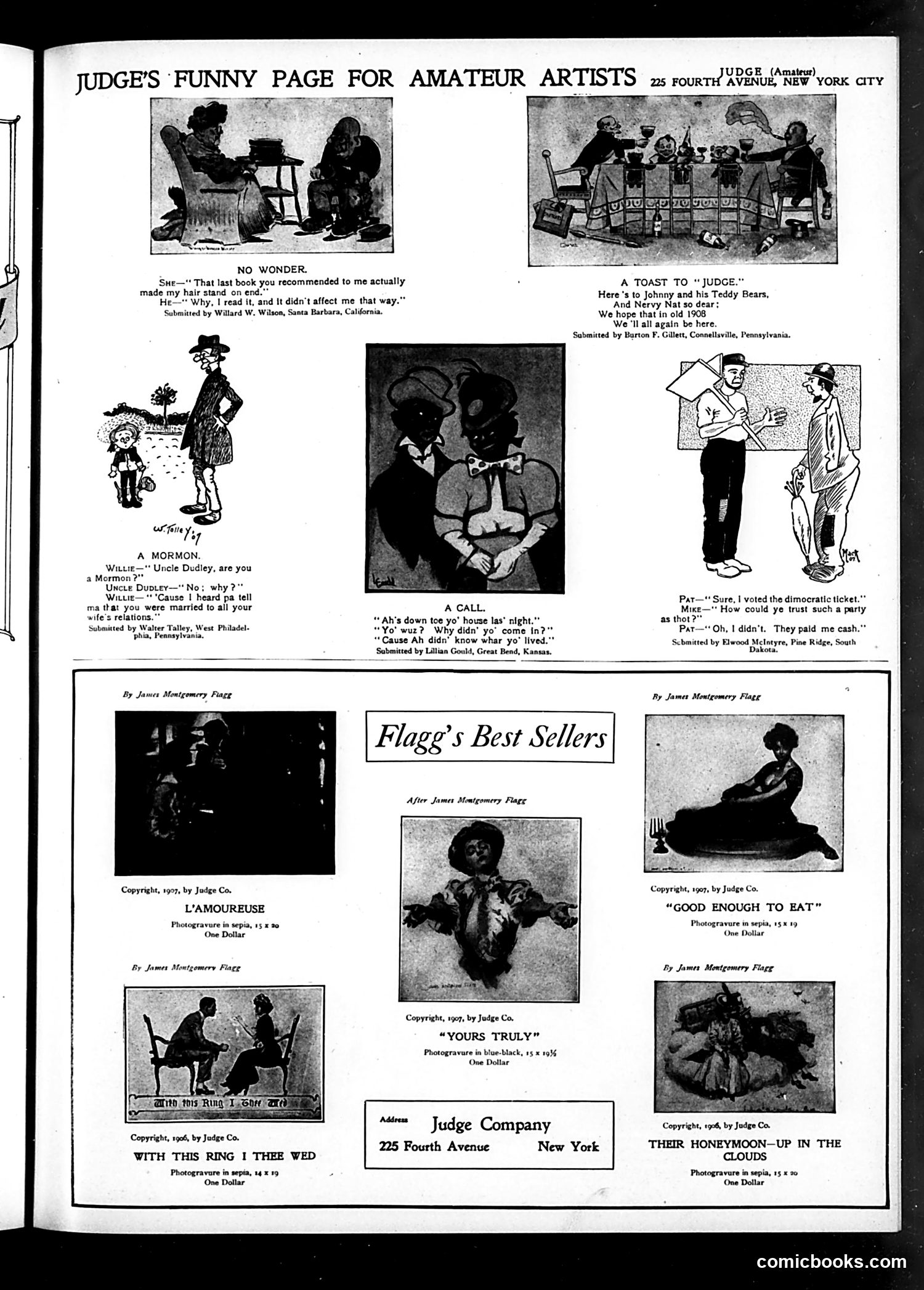
This page combines amateur cartoons with advertising for James Montgomery Flagg's popular prints. The amateur cartoons use common early-1900s humor tropes: **"NO WONDER"** plays on gender stereotypes—a woman's dramatic reaction to a book contrasts with a man's indifference, suggesting women are more emotionally excitable. **"A MORMON"** makes an anti-Mormon joke about polygamy, a common American prejudice of the era. The child misunderstands "married to all your wife's relations" as literal polygamy. **"A CALL"** uses dialectal African American speech for comedic effect (standard in period humor), depicting confusion about social visiting customs. **"A TOAST TO JUDGE"** celebrates the magazine itself and contemporary figures like Theodore Roosevelt ("Teddy Bears"). **"PAT"** contains political corruption humor—an Irish immigrant admits voting Democratic for cash payment rather than principle. The lower section advertises Flagg's commercially successful romantic/sentimental prints available for one dollar each, indicating these were popular mass-market decorative images of the era.
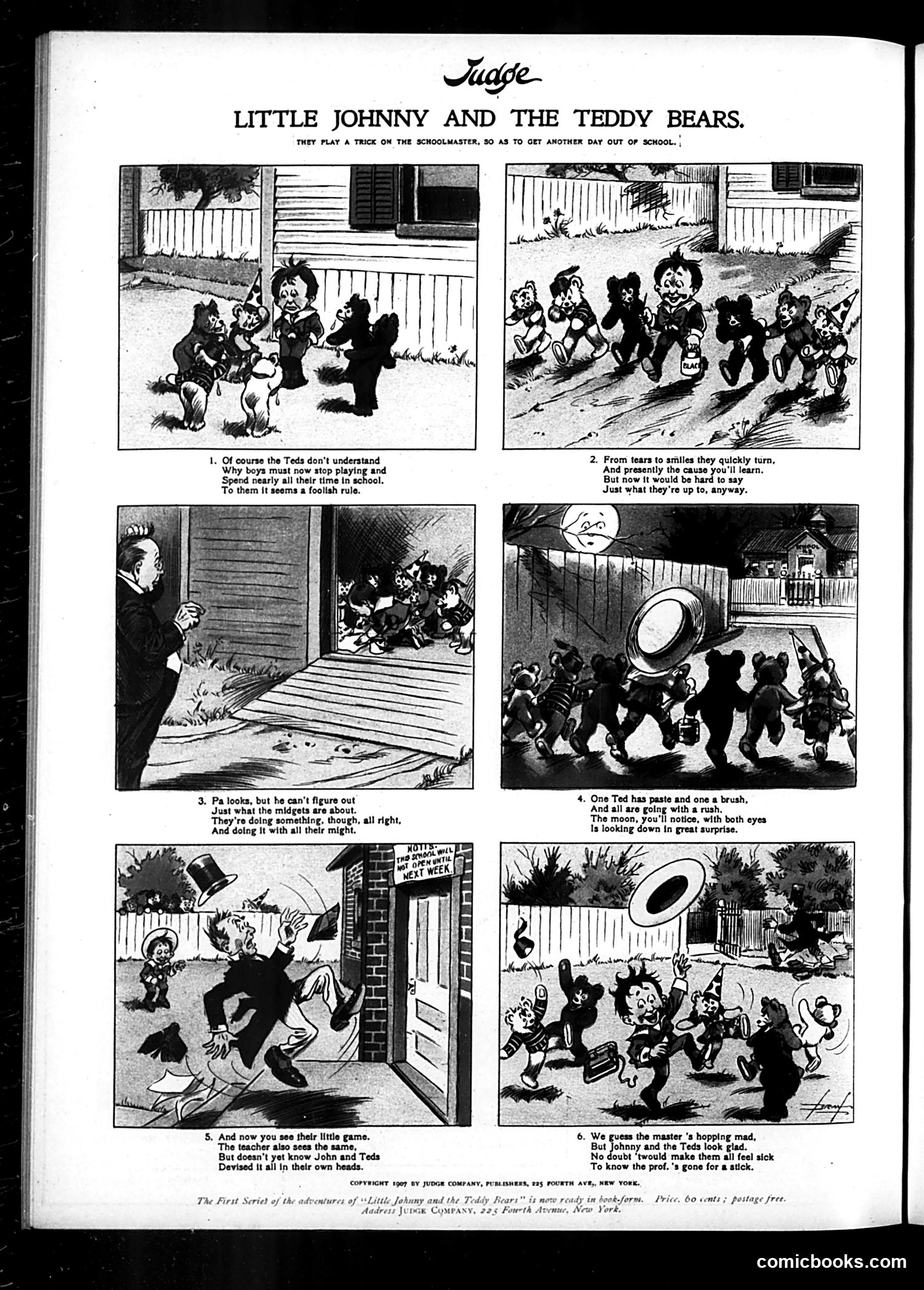
This 1907 comic strip satirizes childhood mischief and school authority. "Little Johnny" and his "Teddy Bears" (likely referring to the popular stuffed toys named after President Theodore Roosevelt) orchestrate a prank on their schoolmaster to escape lessons. The humor targets two things: children's universal desire to avoid school, and perhaps implicitly, the rigid educational system of the era that kept boys "cooped up" indoors rather than playing outdoors. The bears represent youthful rebellion and mischief. The prank itself appears to involve paste and brushes—suggesting they've defaced or decorated something (possibly the schoolhouse)—to distract the teacher and earn a day off. The final panels show the "master" discovering their scheme and threatening punishment with a stick, a common disciplinary tool of the period. The satire is gentle, celebrating children's cleverness and rule-breaking rather than condemning it.