
Judge, 1907-09-21 · page 6 of 16
Judge — September 21, 1907 — page 6: what you’re looking at
What you’re looking at
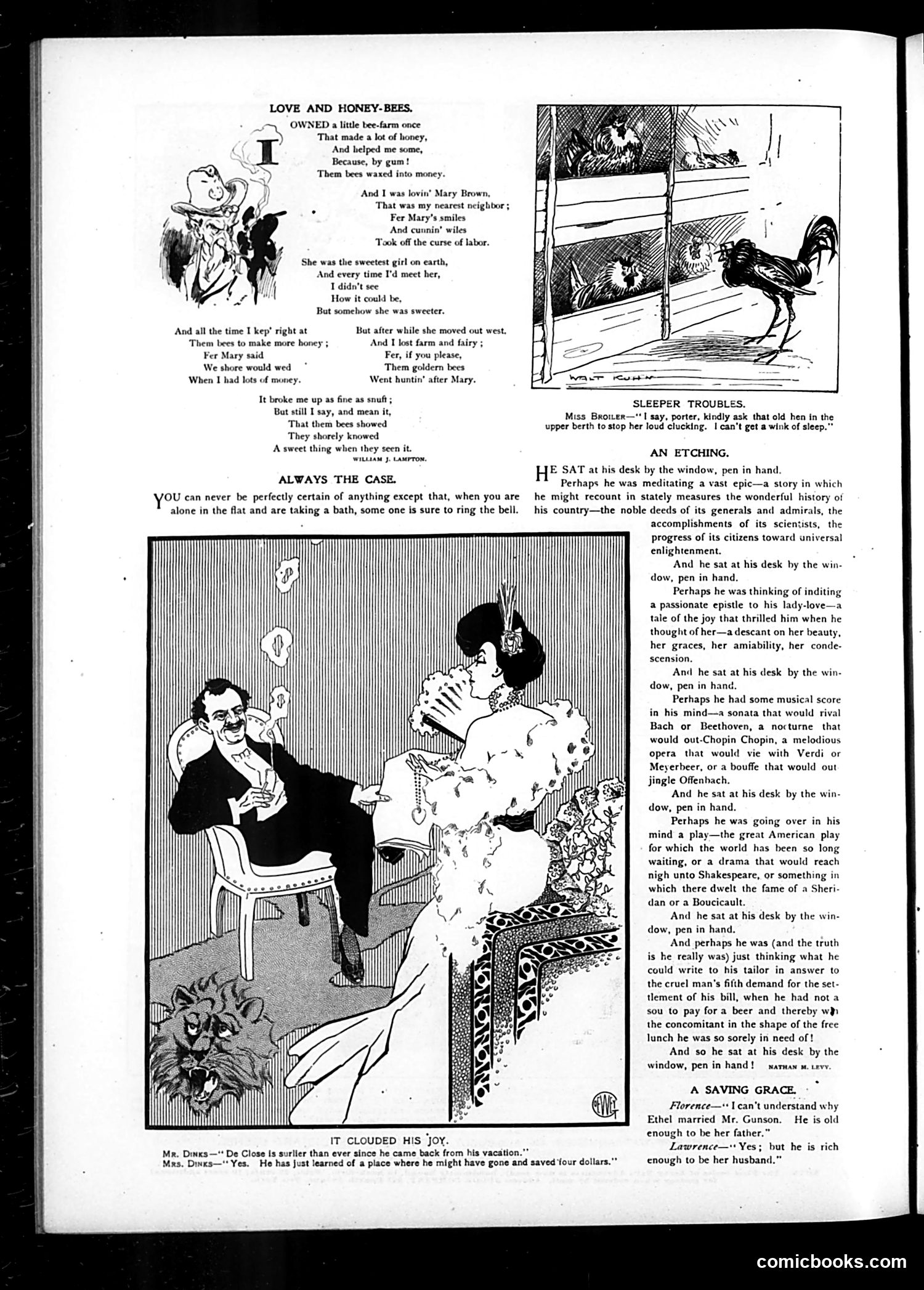
This page contains three distinct pieces of satirical humor typical of early 20th-century American magazines: **"Love and Honey-Bees"** is a sentimental poem-turned-joke: a farmer kept bees to earn money for marriage to Mary Brown, but the bees literally followed her when she moved west, leaving him ruined. The humor lies in treating bees as having romantic judgment equal to the lovestruck farmer. **"Always the Case"** is a one-panel gag about domestic life: the certainty that someone will ring the doorbell precisely when you're bathing—a relatable complaint about timing and interruption. **"An Etching"** satirizes artistic pretension. A writer sits composing what might be an epic, love letter, symphony, or great American play—but he's actually worried about writing his tailor demanding payment for an unpaid bill. The joke mocks the gap between artistic aspiration and mundane financial reality. **"A Saving Grace"** is a brief marriage joke: a young woman married an old man not for love but for wealth—making him financially "husband material" rather than father material. These pieces reflect Judge's focus on middle-class domestic situations and gentle social satire.
📄 Transcribed text from this page (OCR, searchable)
Machine-transcribed from the original scan — historical spelling and the odd misread are preserved.
LOVE AND HONEY-BEES. OWNED a little bee-farm once That made a lot of honey, And helped me some, Because, by gum! Them bees waxed into money. And I was lovin’ Mary Brown, ‘That was my nearest neighbor ; Fer Mary's smiles And cunnin’ wiles Took off the curse of labor. She was the sweetest girl on earth, And every time I'd meet her, I didn't see How it could be, Bat somehow she was sweeter. Bat after while she moved out west. And I lost farm and fairy ; Fer, if you please, Them goldern bees Went huntin’ after Mary. And all the time I kep’ right at ‘Them bees to make more honey ; Fer Mary said We shore would wed When I had lots of money. It broke me up as fine as snuft; Bat still I say, and mean it, ‘That them bees showed They shorely knowed A sweet thing when they seen it. WHLLIAS J, LASEFTON. ALWAYS THE CASE. you can never be perfectly certain of anything except that, when you are alone in the flat and are taking a bath, some one is sure to ring the bell. A Mss RAK il i Mr. Dinxs IT CLOUDED HIS Joy. fl e Close Is surlier than ever since he came back from his vacation.”” i Mrs. Dinxs—"* Yes. He has Just learned of a place where he might have gone and saved ‘four dollars." SLEEPER TROUBLES. Miss Brot.er—"'I say, porter, kindly ask that old hen in the upper berth to stop her loud clucking. I can’t get a wink of sleep.”” AN ETCHING. E SAT at his desk by the window, pen in hand. Perhaps he was meditating a vast epic—a story in which he might recount in stately measures the wonderful history of his country—the noble deeds of its generals and admirals, the accomplishments of its scientists, the progress of its citizens toward universal enlightenment. ‘And he sat at his desk by the win- dow, pen in hand. Perhaps he was thinking of inditing a passionate epistle to his lady-love—a tale of the joy that thrilled him when he thought of her—a descant on her beauty, her graces, her amiability, her conde- scension. And he sat at his desk by the win- dow, pen in hand. Perhaps he had some musical score in his mind—a sonata that would rival Bach or Beethoven, a nocturne that would out-Chopin Chopin, a melodious opera that would vie with Verdi or Meyerbeer, or a bouffe that would out jingle Offenbach. And he sat at his desk by the win- dow, pen in hand. Perhaps he was going over in his mind a play—the great American play for which the world has been so long waiting, or a drama that would reach nigh unto Shakespeare, or something in which there dwelt the fame of a Sheri- dan or a Boucicault. And he sat at his desk by the win- dow, pen in hand. And perhaps he was (and the truth is he really was) just thinking what he could write to his tailor in answer to the cruel man’s fifth demand for the set- tlement of his bill, when he had not a sou to pay fora beer and thereby why the concomitant in the shape of the free lunch he was so sorely in need of! And so he sat at his desk by the window, pen in hand! NATHAN BL. LEVY, A SAVING GRACE. Florence—*\ can't understand why Ethel married Mr. Gunson. He is old enough to be her father.” Lawrence—" Yes; but he is rich enough to be her husband.” comicbooks.com