
A complete issue · 18 pages · 1907
Judge — September 7, 1907
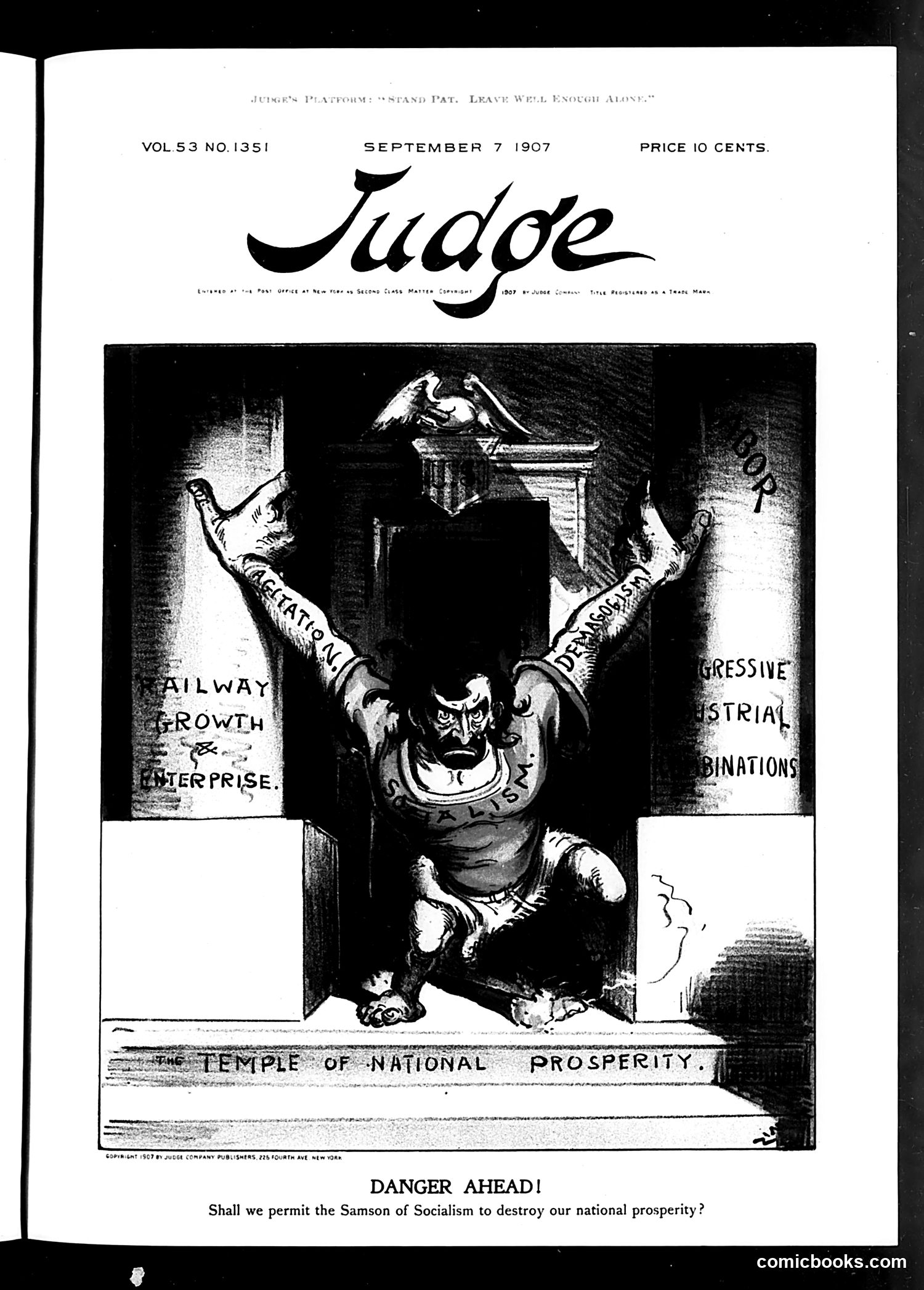
This anti-socialist political cartoon depicts a demonic figure labeled "Socialism" as Samson, threatening to destroy the "Temple of National Prosperity." The figure holds up two massive pillars labeled "Railway Growth & Enterprise" and "Aggressive Industrial Combinations"—representing American capitalism's pillars. The satire warns that socialism threatens to topple American economic prosperity, using the biblical Samson metaphor to suggest destructive, superhuman power. The demon imagery characterizes socialism as an evil force rather than a legitimate political movement. This reflects early 20th-century anxieties among wealthy publishers about growing socialist political movements in America, particularly following labor unrest and Eugene Debs's growing electoral support. The cartoon presents socialism as an existential threat requiring vigilance against its "destructive" ideology.
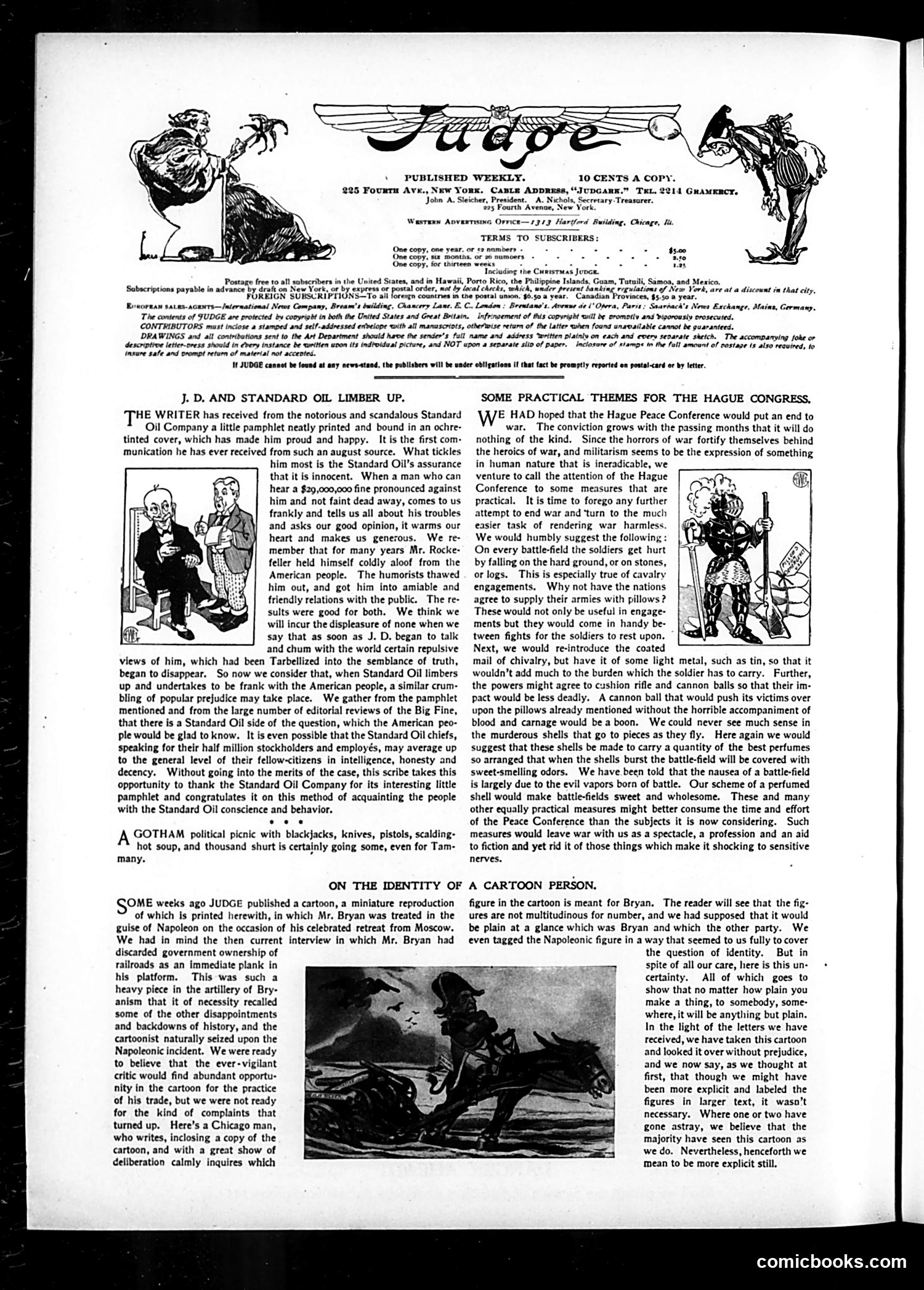
This page contains three distinct editorial pieces: 1. **"J.D. and Standard Oil Lumber Up"**: Satirizes John D. Rockefeller and Standard Oil Company's public relations efforts. The article mocks their recently published pamphlet as an attempt to improve their "scandalous" reputation and win public favor after years of negative press. 2. **"Some Practical Themes for the Hague Congresses"**: Discusses peace conference proposals, satirically suggesting absurd military "improvements" (like perfumed shells) to make warfare less unpleasant—critiquing the futility of attempting to humanize war. 3. **"On the Identity of a Cartoon Person"**: Addresses reader confusion about a previous Napoleon-themed cartoon, explaining the editorial choices made regarding figure identification in satirical art. The page exemplifies Judge's muckraking approach to corporate monopolies and war, using humor to expose hypocrisy.
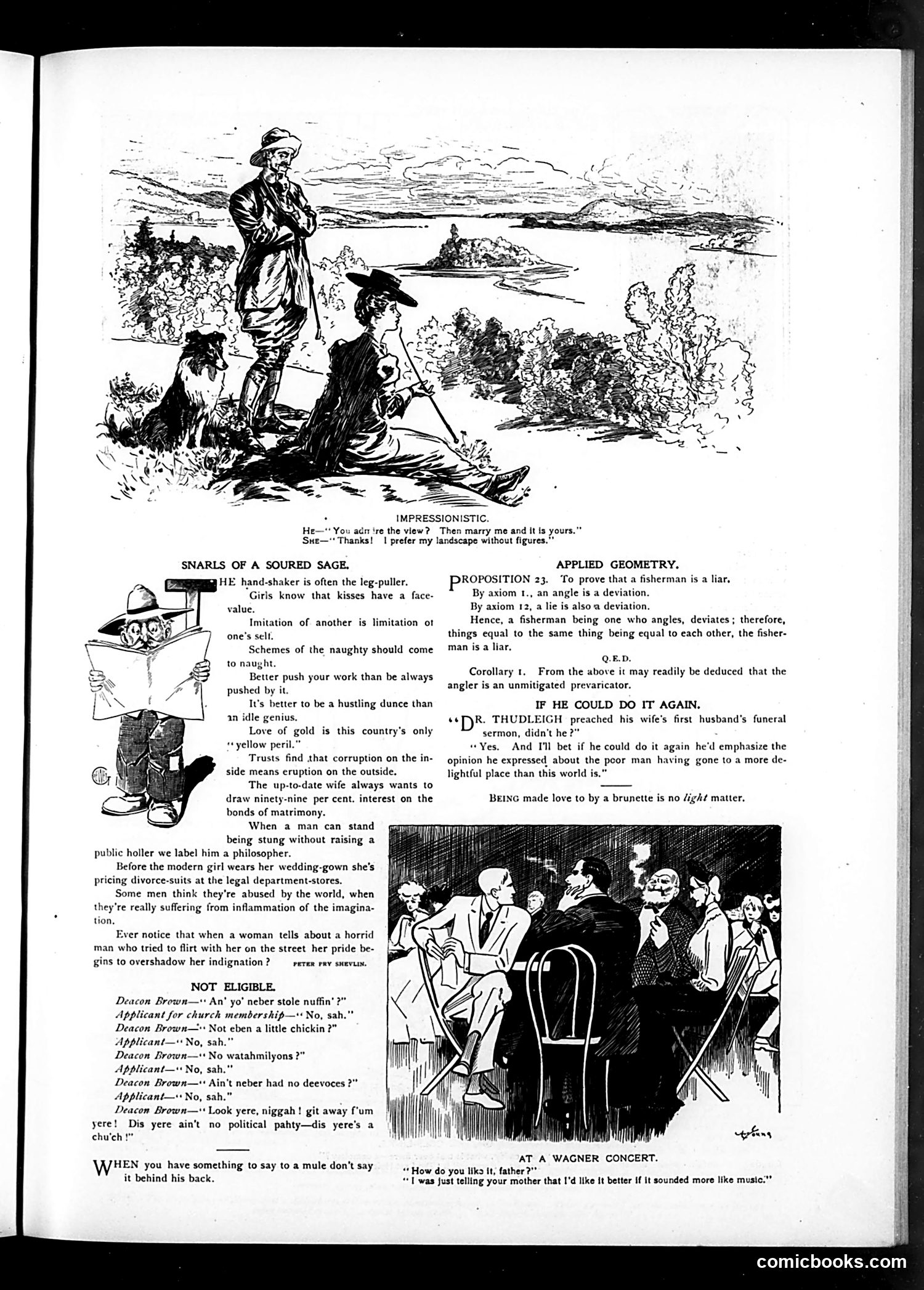
**Top cartoon ("Impressionistic"):** A man and woman view a landscape. He claims it's "yours," she prefers it "without figures"—satirizing Impressionist art's subjective nature and disagreements over aesthetic value. **Middle section:** "Snarls of a Soured Sage" contains brief cynical observations about human nature (corruption, materialism, hypocrisy). The accompanying illustration shows a grumpy character dispensing wisdom. **"Applied Geometry" section:** A logical syllogism humorously "proves" a fisherman is a liar through geometric reasoning—typical of Judge's wordplay humor. **Bottom cartoon ("At a Wagner Concert"):** Two audience members discuss the music's quality, with one sarcastically suggesting it would sound "more like music" if played differently—mocking Wagner's famously complex, challenging compositions and audiences' pretended sophistication.
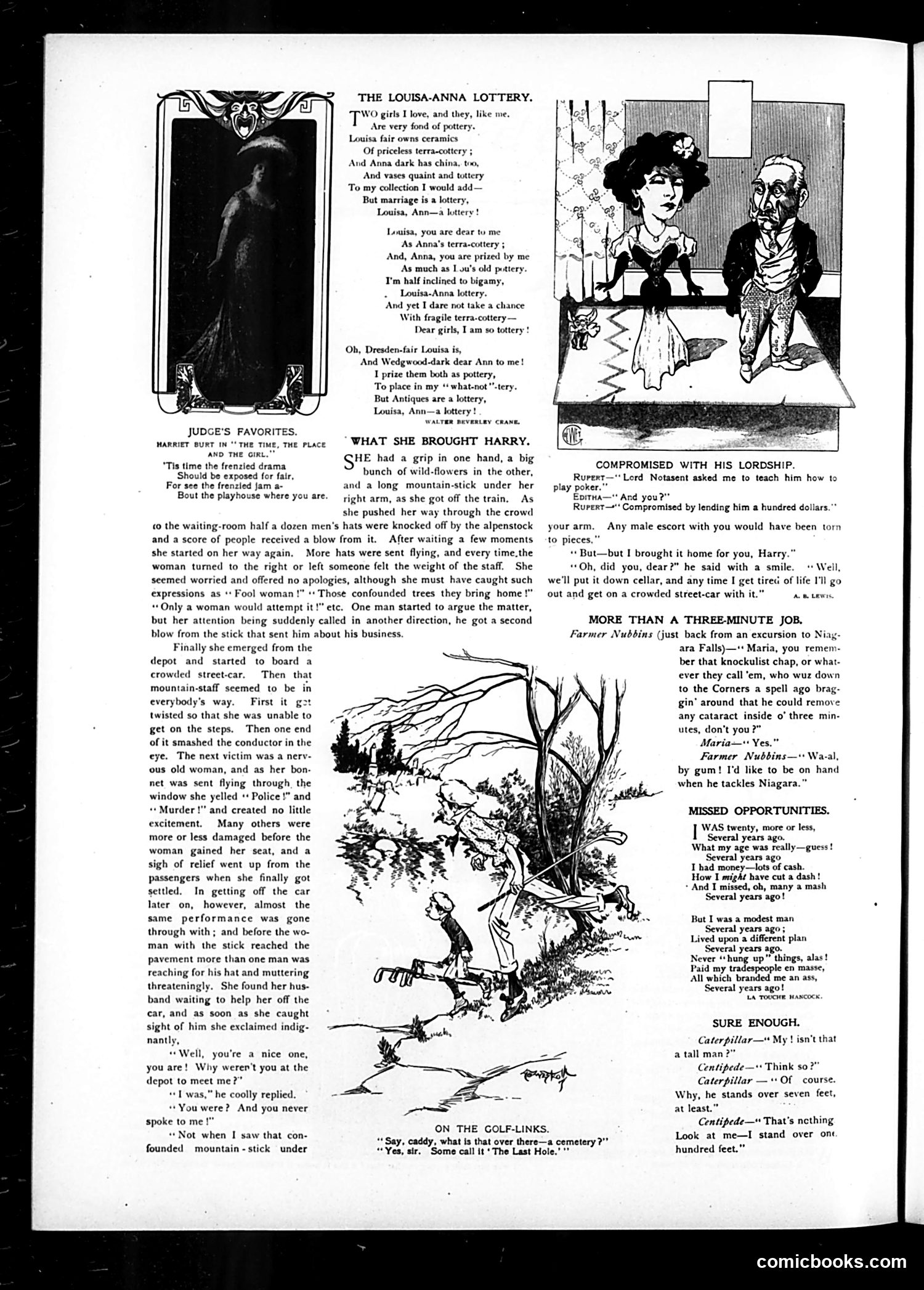
This page contains several distinct pieces of period humor rather than unified political commentary: **"The Louisa-Anna Lottery"** (top left): A poem satirizing marriage as a "lottery," comparing choosing a spouse to collecting pottery—a lighthearted jab at matrimony's unpredictability. **"Judge's Favorites"** and **"What She Brought Harry"**: Appears to be a domestic comedy about a woman using a mountain-stick as a weapon in a crowded streetcar incident, followed by reconciliation where she brings him flowers. This satirizes marital conflict and reconciliation. **Remaining sections**: Include humorous dialogues and sketches about ordinary life—a golf joke, a conversation about height, and a piece titled "Missed Opportunities" about regrets. Overall, this page represents Judge's typical turn-of-the-century blend of domestic satire and everyday social humor rather than hard political commentary.
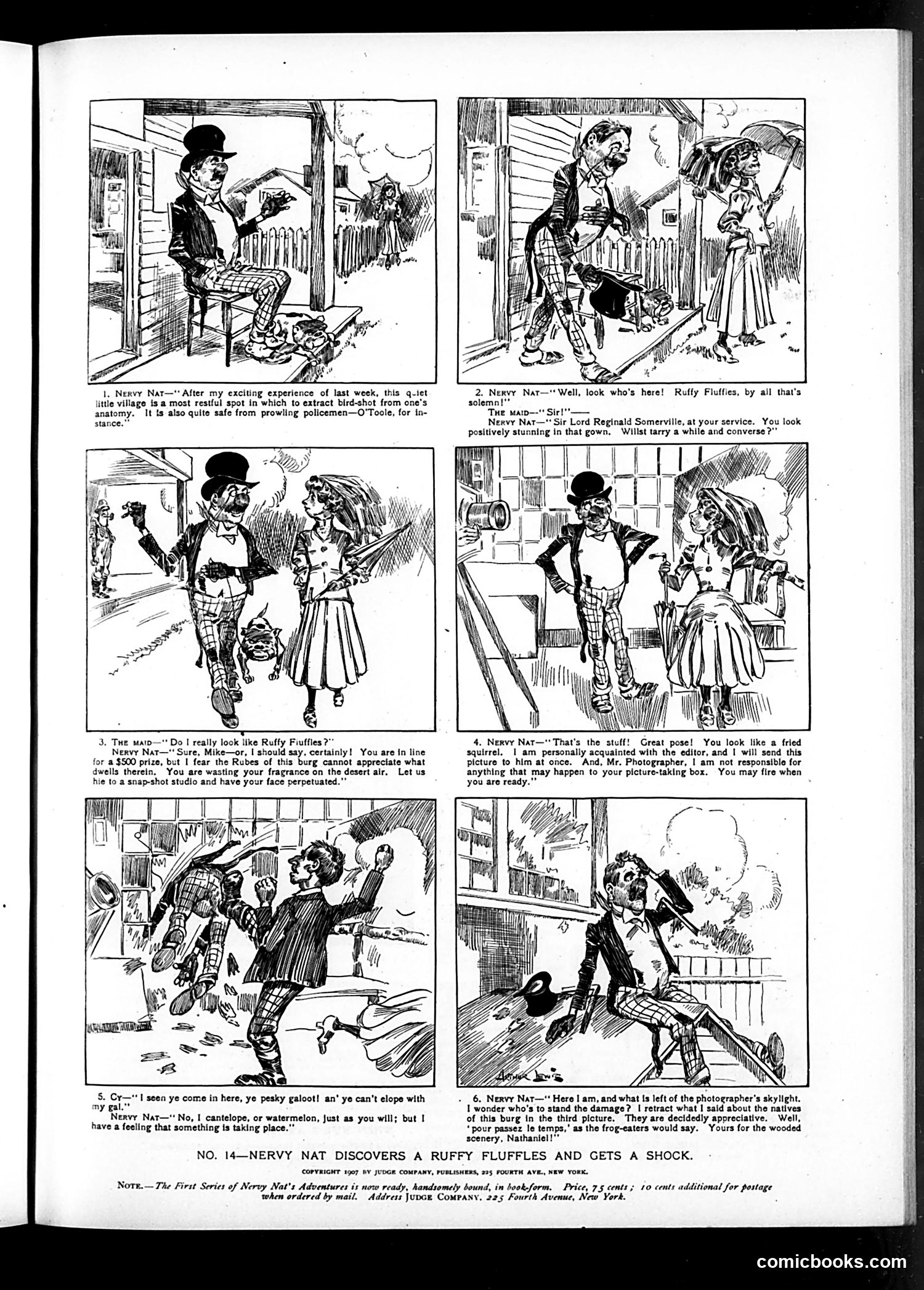
This is a comic strip featuring "Nervy Nat," a recurring character in Judge magazine. The narrative involves Nat encountering "Ruffy Fluffles" (likely a female character) and a photographer. The humor centers on mistaken identities and social embarrassment: Nat mistakes someone for "Ruffy Fluffles," a character apparently known for being disheveled or disreputable ("Do I really look like Ruffy Fluffles?"). The maid and Lord Reginald Sommerville are depicted as upper-class characters, creating class-based comedy through Nat's awkward interactions. The final panels show physical comedy as Nat's attempts at posing for a photograph result in chaos and property damage. The satire appears to mock pretension and the absurdity of attempting to create dignified portraits.
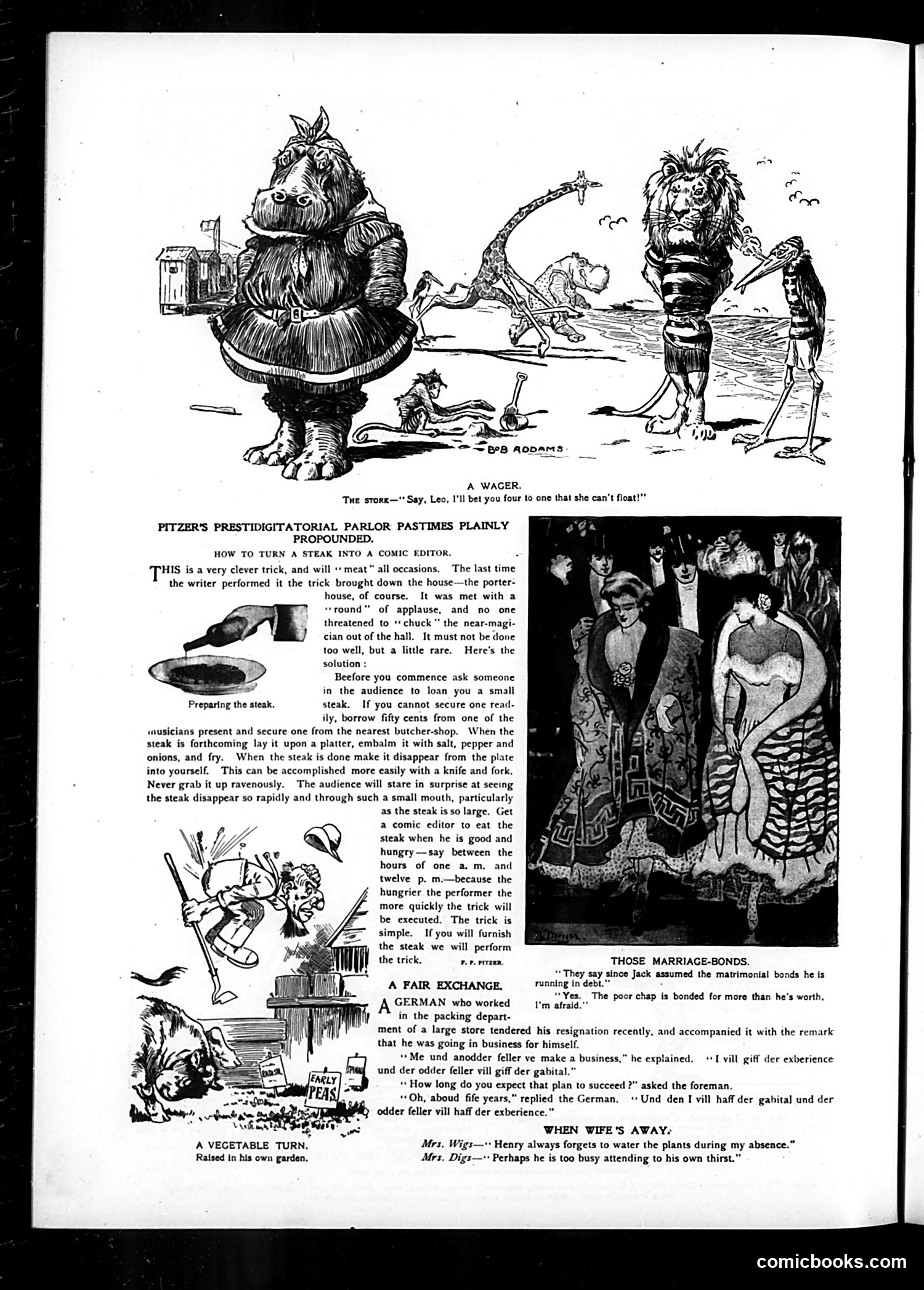
This Judge magazine page contains several satirical pieces typical of early 20th-century humor: **"A Wager"** (top): A stork bets a lion that "she" cannot float—likely satirizing a woman's weight or buoyancy, reflecting period body-shaming humor. **"Pitzer's Prestidigitatorial Parlor Pastimes"**: A humorous magic trick tutorial where the "trick" is simply having a comic editor eat the steak. The joke plays on comic editors' notorious appetites. **"A Fair Exchange"**: Mocks a German immigrant's broken English and naïve business plan—a common stereotype in American satire. He and a partner will split experience/capital, but after five years he'll have the money while his partner keeps only experience—implying the immigrant will swindle him. **"Those Marriage-Bonds"** and **"When Wife's Away"**: Marital humor about husbands neglecting duties and drinking when wives travel—standard domestic comedy of the era. The content reflects period attitudes toward immigrants, gender, and class through broad caricature and wordplay.
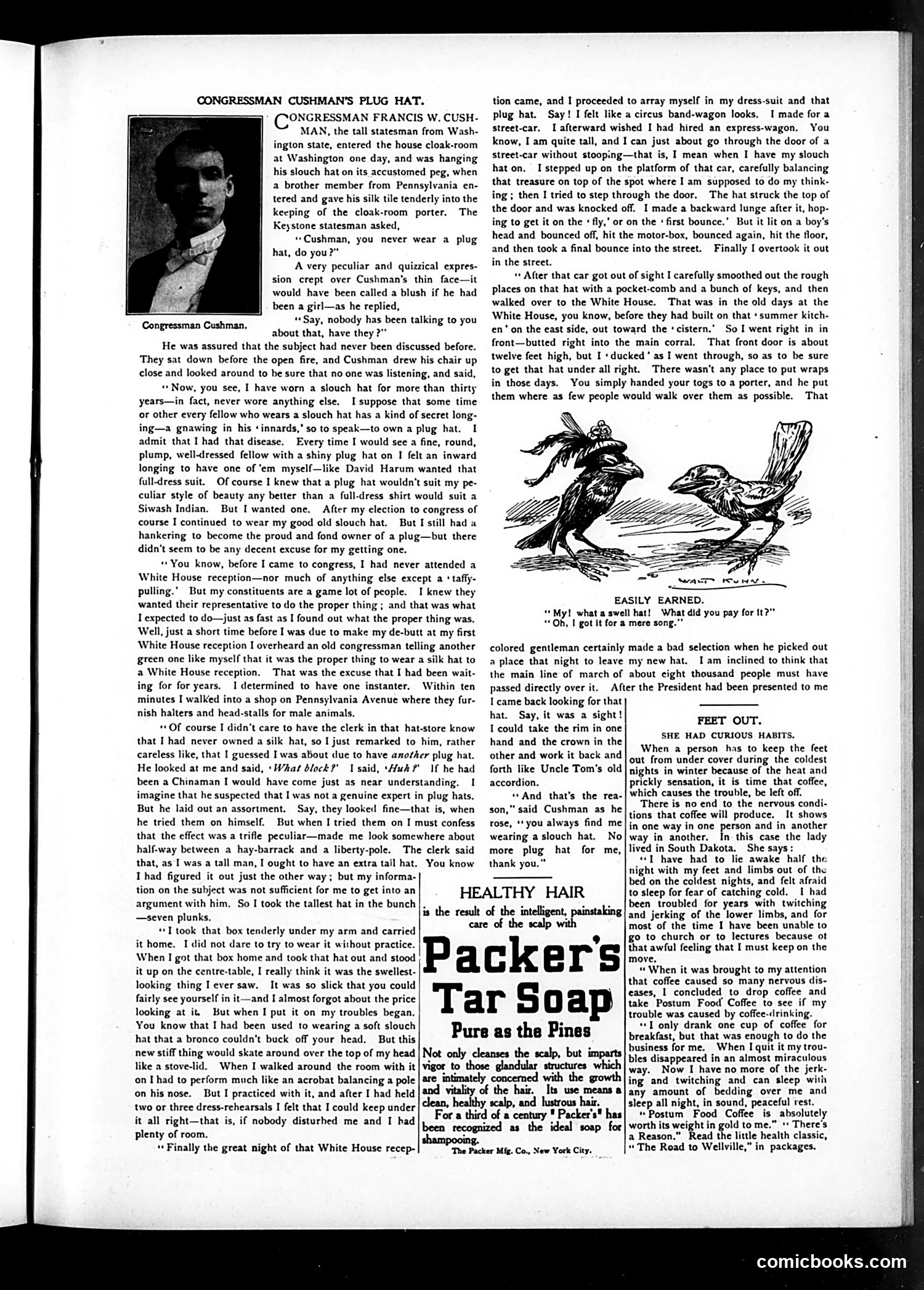
This is a humorous anecdote about Congressman Francis W. Cushman of Washington state, not primarily political satire. The joke concerns a working-class politician's social anxiety about proper dress codes. Cushman, a plainspoken westerner accustomed to slouch hats, learns that silk top hats ("plug hats") are required formal wear for White House receptions. He purchases one but the oversized hat comically proves ill-suited to his tall, lanky frame—making him look "half-way between a hay-barrack and a liberty-pole." The humor derives from the clash between Cushman's unpretentious frontier style and Washington's rigid social conventions. The satire targets not Cushman personally but rather the pretentiousness of official Washington society and its arbitrary dress requirements. The accompanying illustration shows Cushman awkwardly positioned in the unwieldy hat, emphasizing the visual comedy of this cultural mismatch.
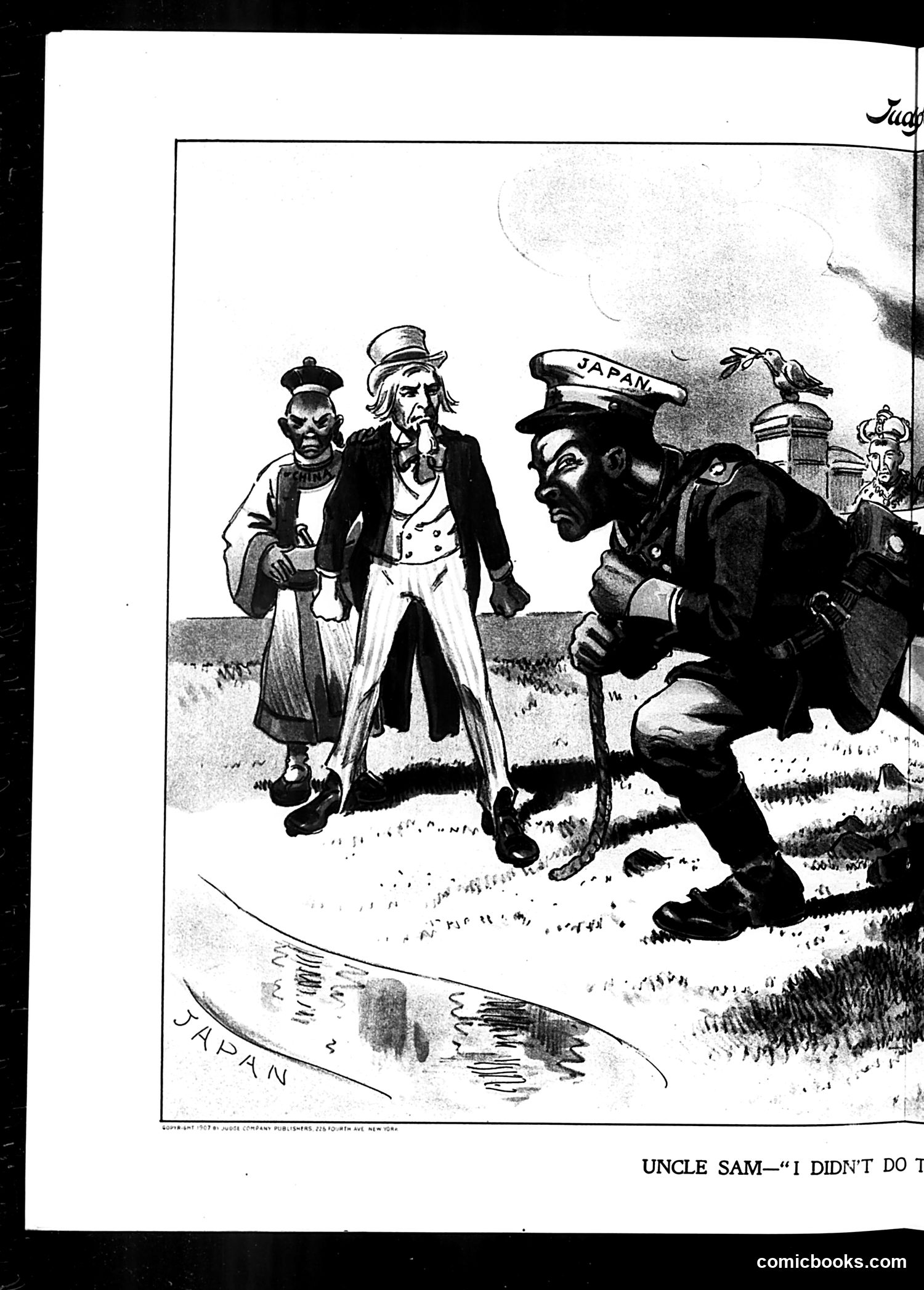
This is a satirical cartoon from *Judge* magazine depicting Uncle Sam (representing the United States, identifiable by his characteristic top hat and formal dress) confronting what appears to be a Japanese military or political figure (labeled "JAPAN" on his hat). The cartoon's incomplete caption—"I DIDN'T DO T[...]"—suggests Uncle Sam is defending himself against some accusation. The presence of Asian figures in the background and the military uniforms indicate this likely concerns U.S.-Japan relations, possibly referencing diplomatic tensions, trade disputes, or military conflicts. Without the complete caption and publication date, the specific historical incident remains unclear, but the image reflects early-to-mid 20th-century American anxieties about Japanese expansion or international relations.
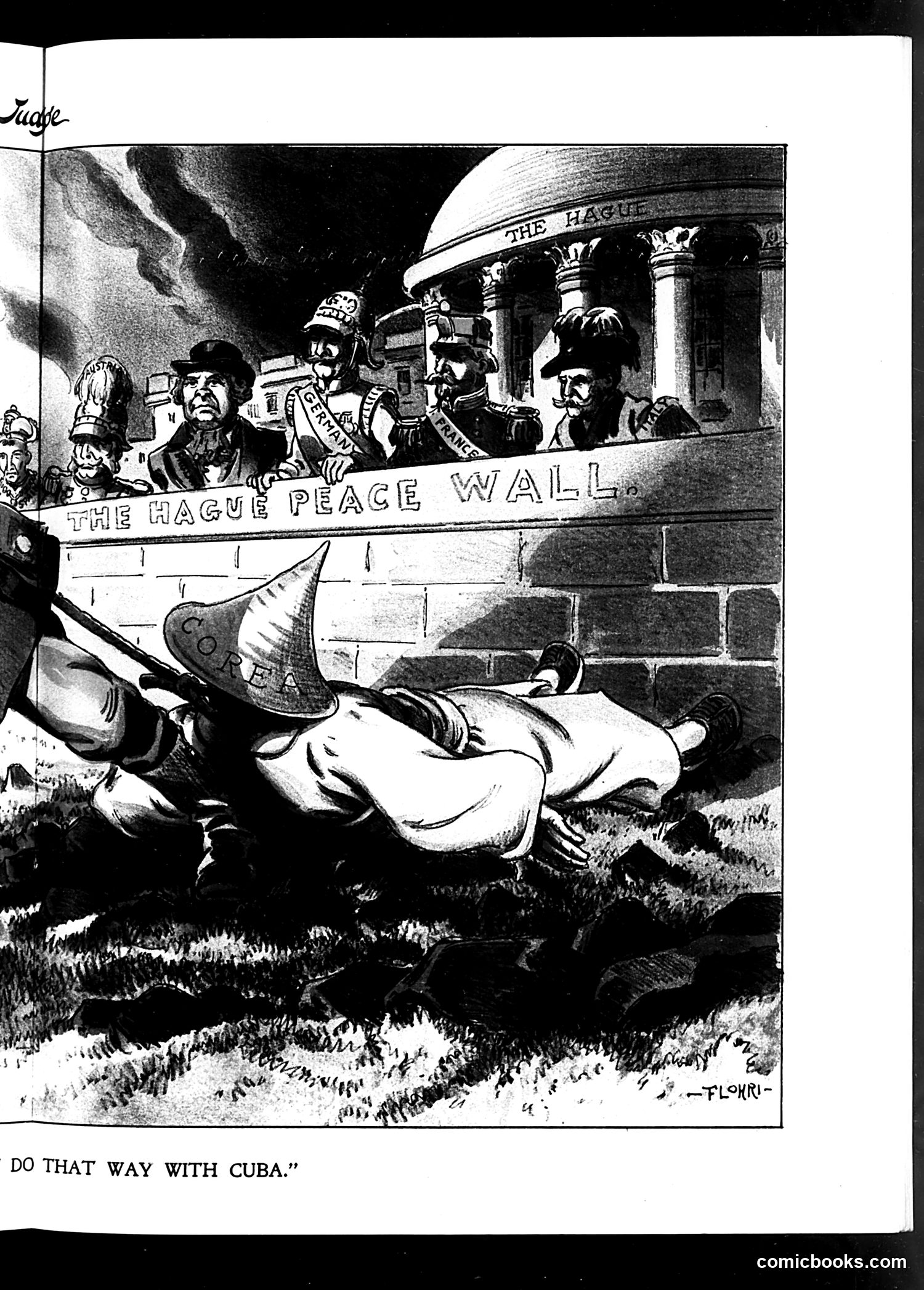
This Judge magazine cartoon satirizes international diplomacy regarding Cuba. The scene shows military and political officials standing atop "The Hague Peace Wall" (referencing the Hague Peace Conference, a real diplomatic forum), while a figure labeled "Cuba" lies prostrate below, appearing powerless or defeated. The satire suggests that despite lofty peace rhetoric and international negotiations conducted by various nations' representatives, Cuba remains subject to external pressure and control—the actual outcome contradicts the stated noble intentions of peacekeeping institutions. The cartoon likely critiques American or European imperial policies toward Cuba, implying that diplomatic conferences produce empty rhetoric while powerful nations continue dominating weaker ones. The specific historical moment is unclear without a date, but reflects early 20th-century anxieties about colonial power and international law.
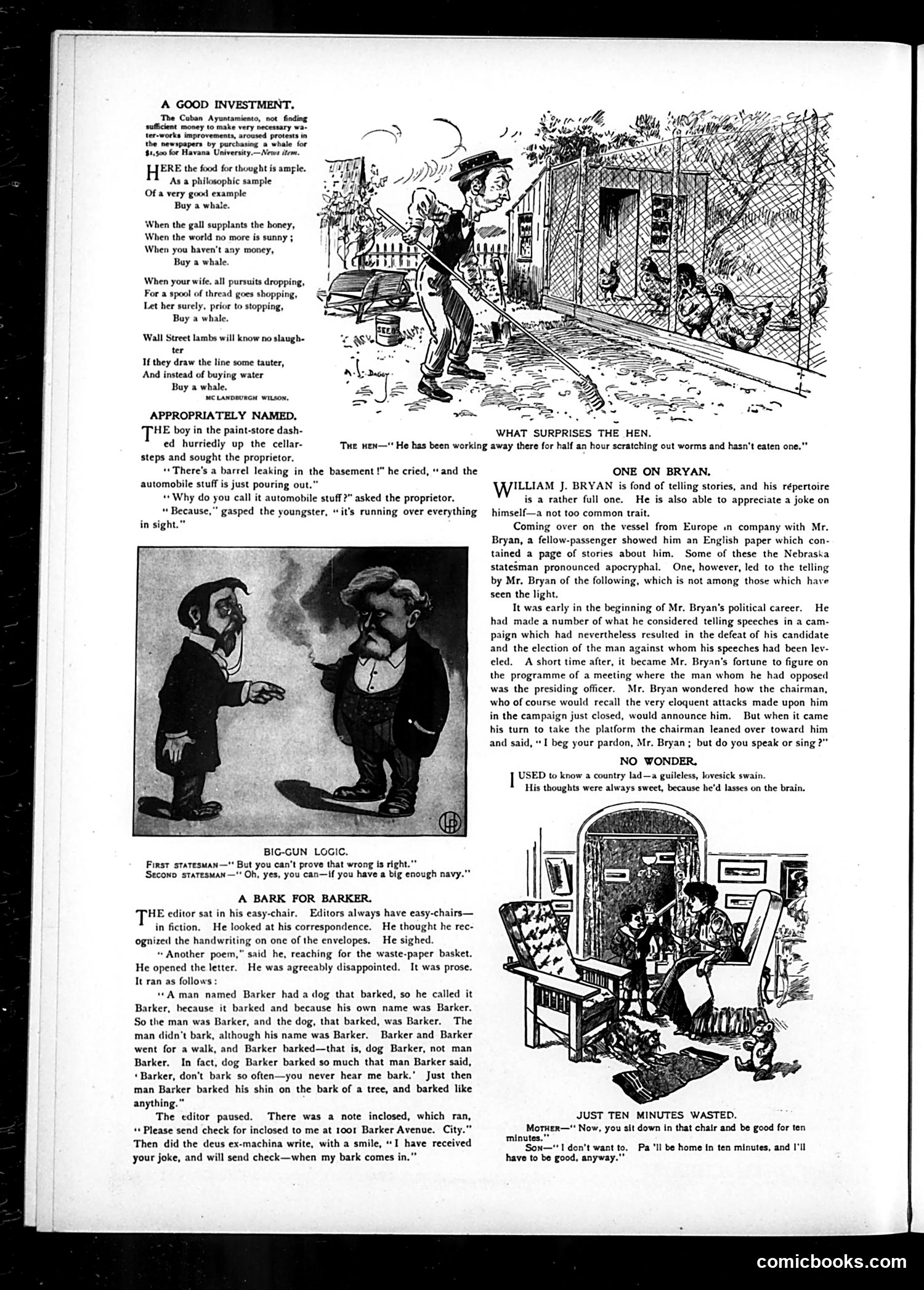
**"A Good Investment"** satirizes Cuba's Ayuntamiento for purchasing a whale for $1,500 while claiming insufficient funds for necessary water-works improvements. The poem mockingly suggests buying whales as a solution to various problems—spousal overspending, financial hardship, naval weakness—highlighting the absurdity of prioritizing a luxury purchase over essential infrastructure. **"One on Bryan"** recounts an anecdote about William Jennings Bryan, the prominent Nebraska politician and three-time presidential candidate. The story illustrates Bryan's good humor by describing how he appreciated a joke about himself involving a political opponent he'd attacked in speeches. This demonstrates Bryan's claimed ability to laugh at himself—"a not too common trait" among politicians—establishing him as unusually gracious despite his electoral defeats. Other brief satirical items mock governmental illogic, editorial pretension, and puns ("bark/Barker").
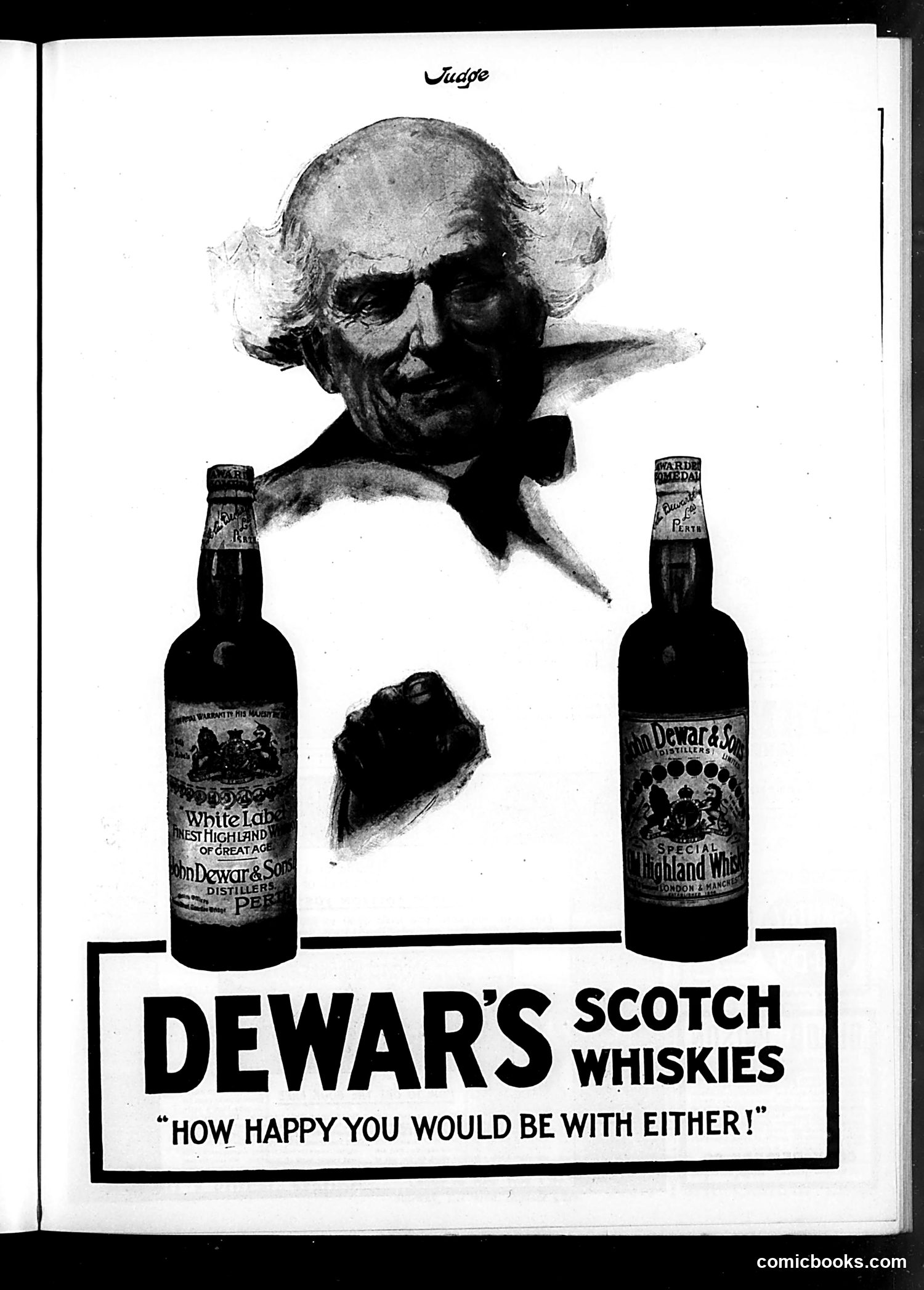
This is a **product advertisement**, not political satire. It promotes Dewar's Scotch Whiskies, showing two bottle varieties: "White Label" (Highland of Great Age) and "Special Highland Whisky." The ad features a caricatured male face at the top with exaggerated features, surrounded by sketched facial studies below—a common advertising technique of the era to suggest discernment and sophistication. The tagline "How happy you would be with either!" positions both products as equally desirable premium choices. The presentation aims to appeal to affluent consumers, using artistic illustration to convey quality and refinement typical of vintage liquor marketing before modern advertising standards.
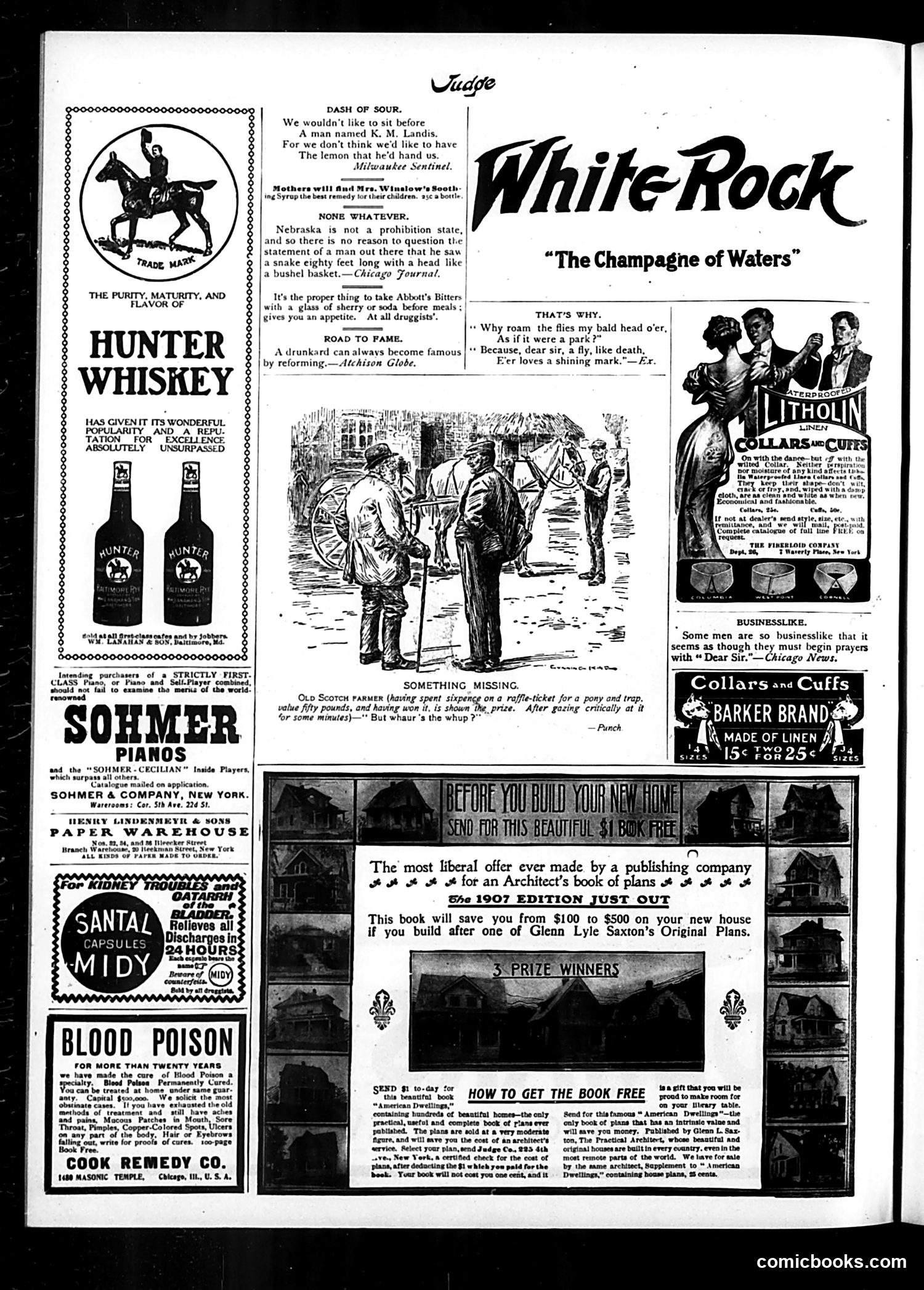
This page is primarily **advertising**, with one small political cartoon at the top. ## The Cartoon The brief joke references **K. M. Landis** (likely Judge Kenesaw Mountain Landis, who became famous as baseball's first commissioner). The Milwaukee Sentinel quip suggests readers wouldn't want to "sit before" Landis because he'd give them "the lemon that he'd hand us"—a pun on his name and a complaint about harsh judicial decisions. ## Context To a modern reader: Landis was apparently known for severe rulings or unpopular decisions. The cartoon uses wordplay ("lemon," a term for something defective or disappointing) to mock his reputation without directly stating his offense. ## Page Content The rest comprises **vintage advertisements** for whiskey, pianos, medicine, and architectural plans—typical early-1900s magazine filler. These ads reveal period consumer concerns: patent medicines for "blood poison," collars and cuffs, and mail-order home-building guides. The page has minimal satirical content beyond the opening Landis joke.
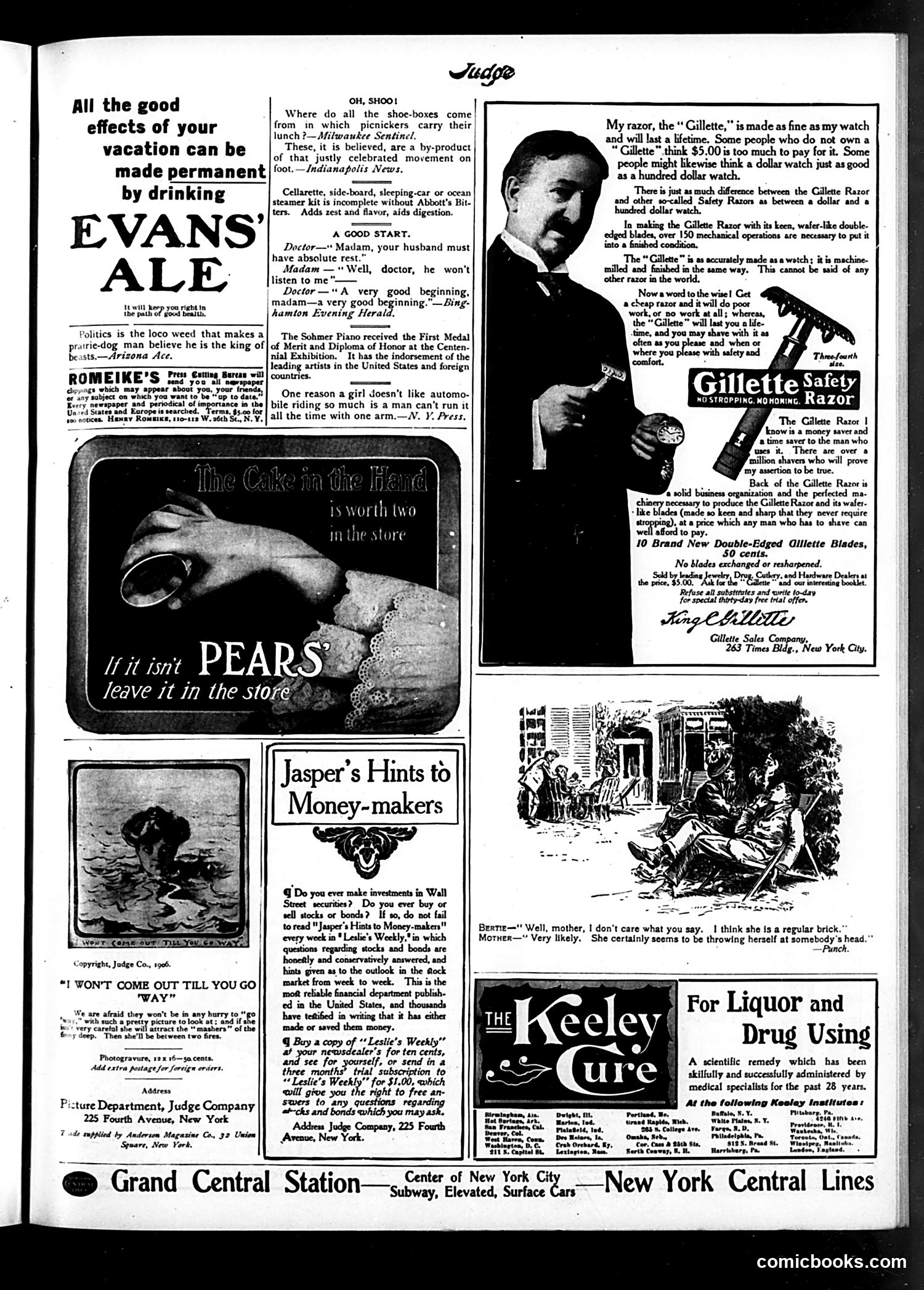
This page from *Judge* magazine (circa 1906, based on copyright notice) is primarily **advertising and filler content**, with minimal satirical cartoons. The main visual elements are: 1. **Product advertisements** dominating the page (Evans' Ale, Pears soap, Gillette Safety Razors, Keeley Cure, etc.) 2. **Brief humorous quips** scattered throughout—short joke items typical of *Judge*'s format, such as: - A joke about shoe-boxes from picnicking - Wordplay about a doctor's visit - A comment on automobile dating customs - A cartoon captioned "I Won't Come Out Till You Go 'Way" (appears to reference courting/romance) 3. **No identifiable political cartoons or caricatures** of named political figures. The page reflects early 20th-century American consumer culture and gentle domestic humor rather than sharp political satire. The "Jasper's Hints to Money-makers" column promotes *Leslie's Weekly* for financial advice—noteworthy as pre-1929 stock market enthusiasm.
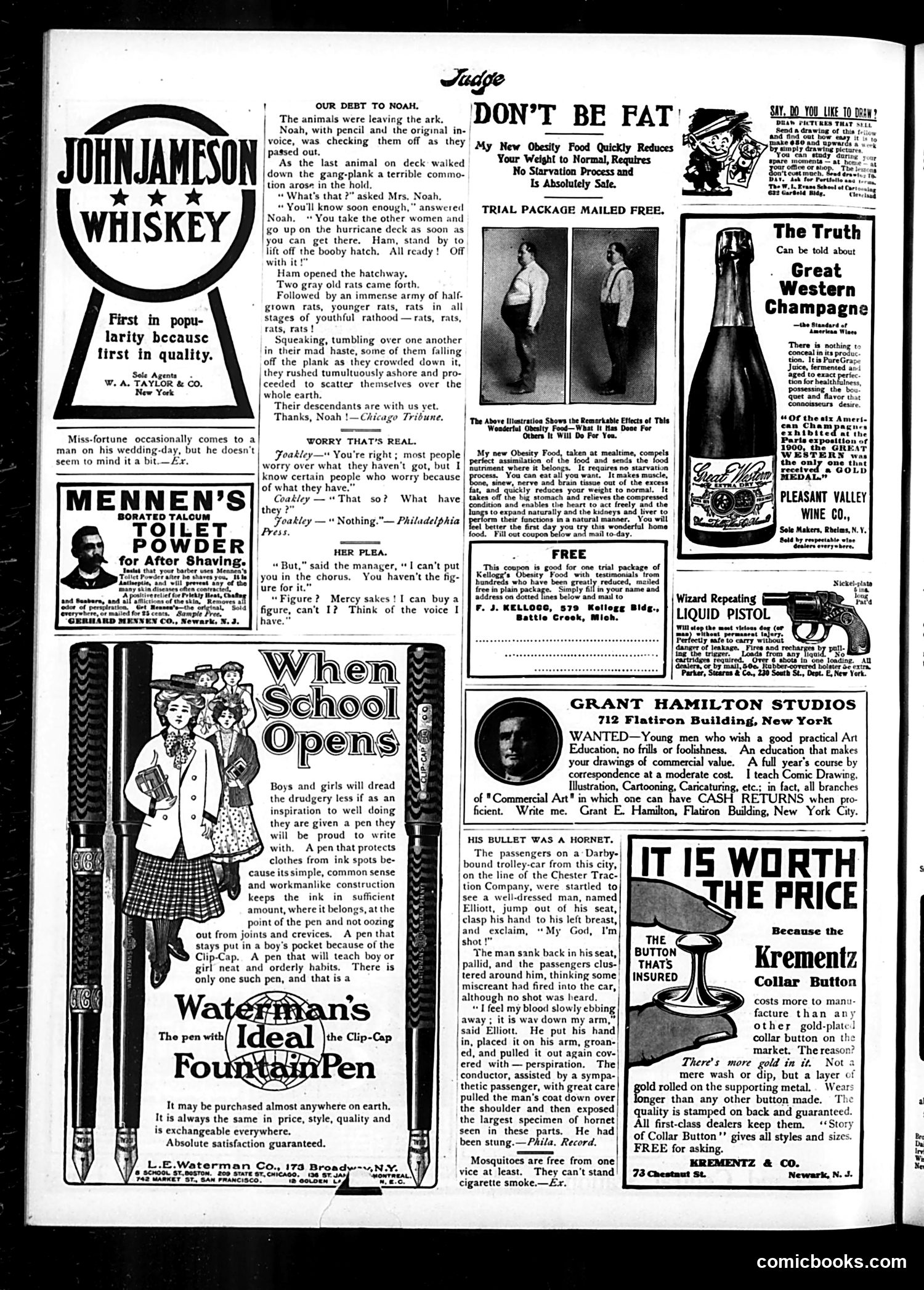
This page is primarily **advertising**, with modest editorial content interspersed. The main items of interest: **"Our Debt to Noah"** (top): A humorous short story explaining why rats exist worldwide—they were the last animals off the ark and have plagued humanity since. The joke plays on the common complaint about rats as pests; the author credits Noah for not catching them before departure. **Comic vignettes** (middle): Brief joke exchanges about worry and theater auditions—light, domestic humor typical of the era. **Advertisements dominate**: Weight-loss products, whiskey, talcum powder, wine, art school, pens, and collar buttons. The **"Don't Be Fat"** ad is notably prominent, reflecting early-20th-century commercial obsession with body image and "scientific" obesity cures—products we'd now recognize as ineffective and medically dubious. The **Waterman fountain pen ad** emphasizes practical benefits for students entering school season. No clear political satire or caricature appears here; this is entertainment and commerce aimed at middle-class readers.
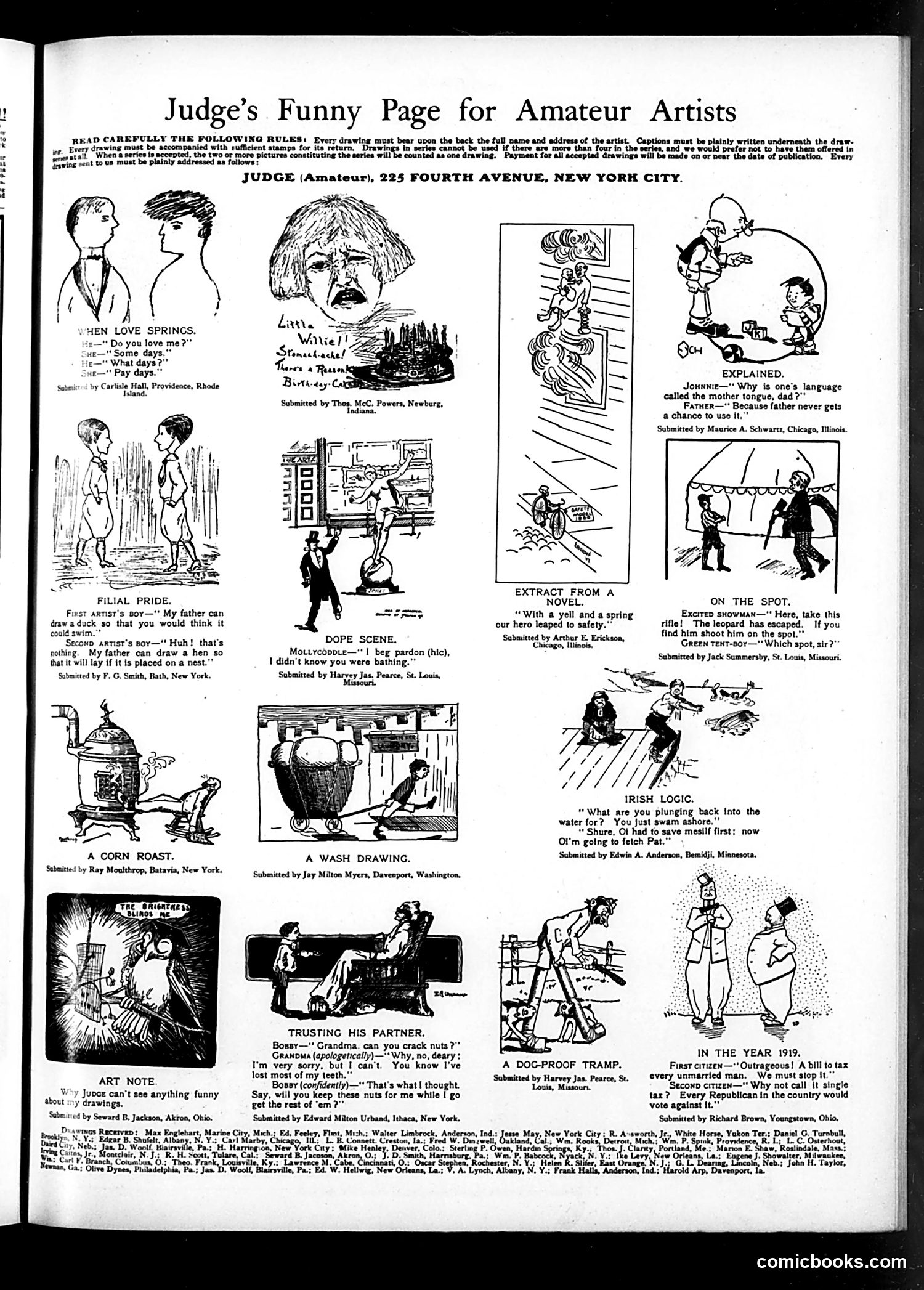
This is a **submissions page for amateur cartoonists**, not political satire. Judge magazine invited readers to submit humorous drawings for publication, offering payment for accepted work. The cartoons shown are **examples of acceptable humor**: simple domestic and social comedy. "Filial Pride" jokes about exaggerated father-and-son boasts; "Explained" uses a common domestic gag (henpecked husband); "Irish Logic" plays on ethnic stereotypes popular in early-1900s American humor. One cartoon, "In the Year 1919," contains mild political content—mocking how Republicans might be tricked into voting against a tax by renaming it. Otherwise, these are non-partisan jokes about family life, courtship, animals, and everyday mishaps. The page functions as **an advertisement for the magazine's amateur-art program**, with submission guidelines and a list of accepted contributors' names and addresses.
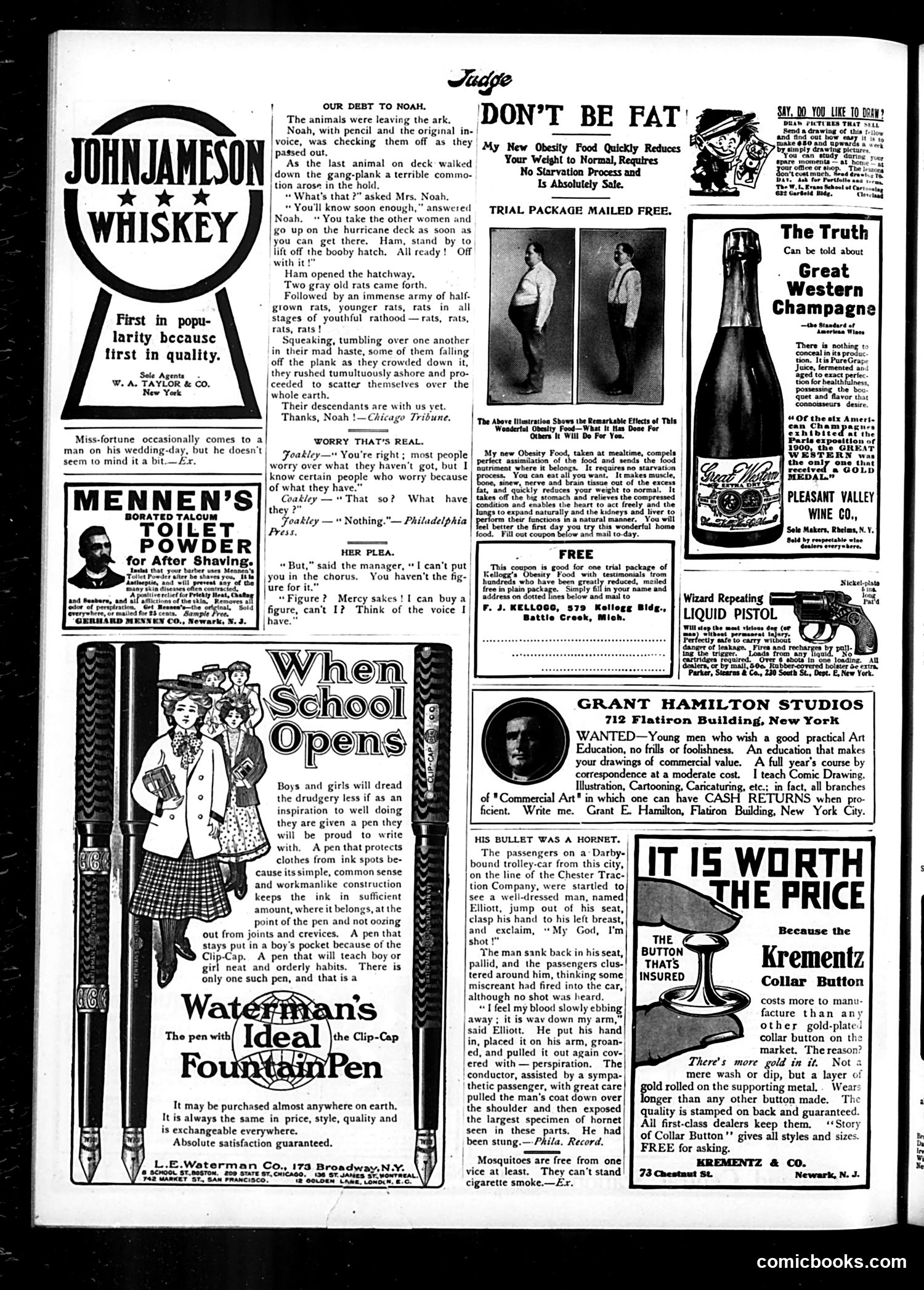
This page from *Judge* magazine (a satirical weekly, circa early 1900s) contains several satirical pieces and advertisements typical of the era. **Main Cartoon Content:** The opening text piece mocks Noah's Ark, jokingly attributing modern rat infestations to Noah's supposedly releasing rats from the ark—a humorous explanation for an everyday pest problem. **Satirical Sections:** - "Worry That's Real" presents workplace anxiety through dialogue between characters named Coakley and Foakley, satirizing middle-class anxieties - "Her Plea" mocks theatrical ambition, where a woman claims she can buy a "figure" despite lacking stage presence—commenting on superficial show-business values - "His Bullet Was a Hornet" tells an absurd anecdote about a man mistaking a hornet's sting for a gunshot—satirizing overreaction and paranoia **Advertisements:** The page is heavily dominated by period ads: John Jameson Whiskey, Mennen's powder, obesity "cures," fountain pens, champagne, and art instruction—reflecting early-1900s consumer culture and dubious health claims common to the era.
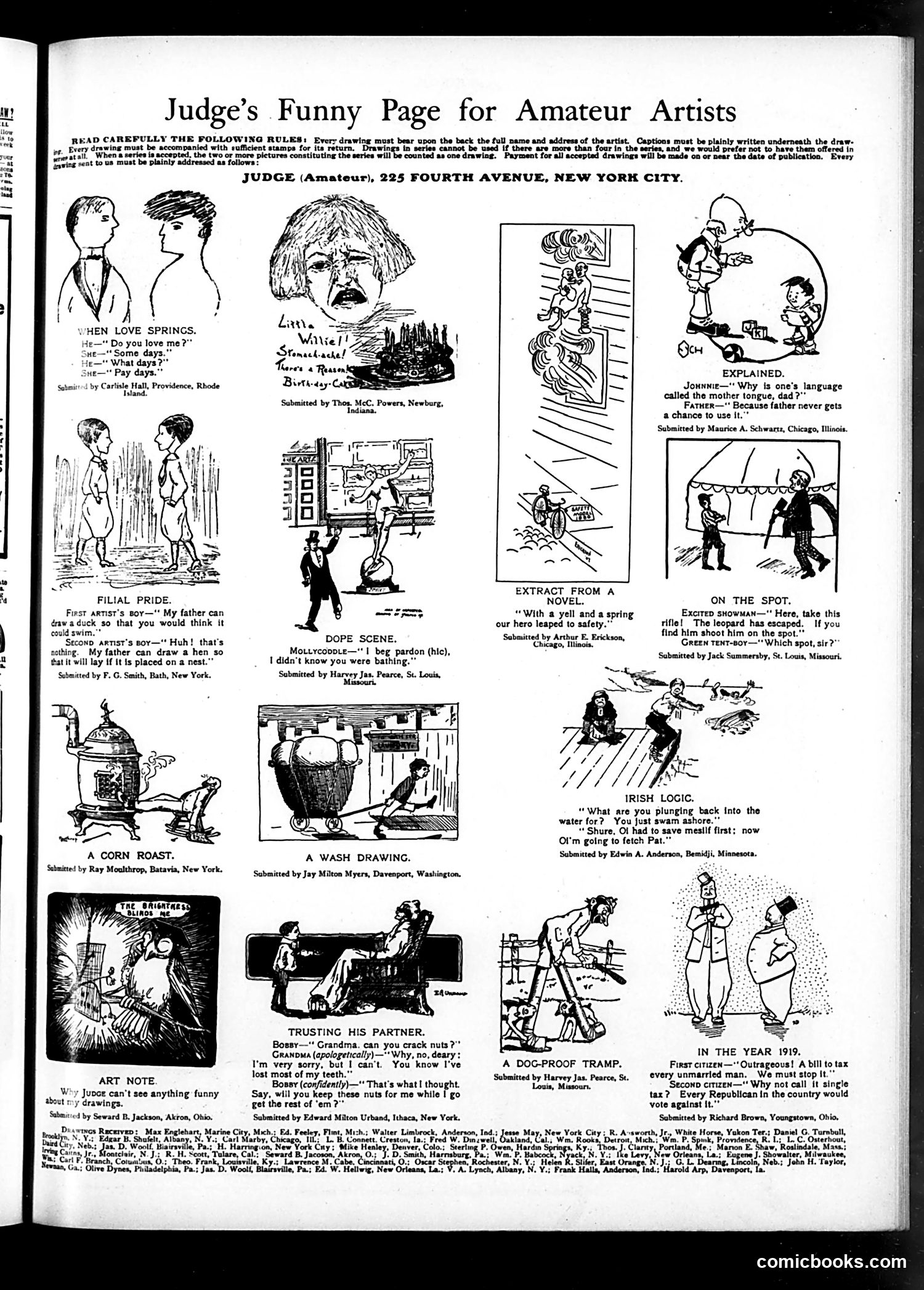
This is a collection of amateur-submitted comic gags typical of early 20th-century American humor. Most jokes rely on wordplay, misunderstandings, or gentle social observations rather than political content. Notable examples: "Filial Pride" contrasts two artists' sons bragging about their fathers' drawing skills. "Dope Scene" plays on a drunk man's confusion at finding someone bathing. "Irish Logic" stereotypes Irish people as illogical. "In the Year 1919" makes a contemporary political joke—predicting a tax on unmarried men, the submitter notes Republicans would support it if rebranded as a "single tax" (referencing Henry George's economic theory they favored). The page also includes submission guidelines for amateur cartoonists and the magazine's address. Most humor targets domestic situations, family dynamics, and ethnic stereotypes common to the era, with minimal political satire beyond the 1919 tax joke.
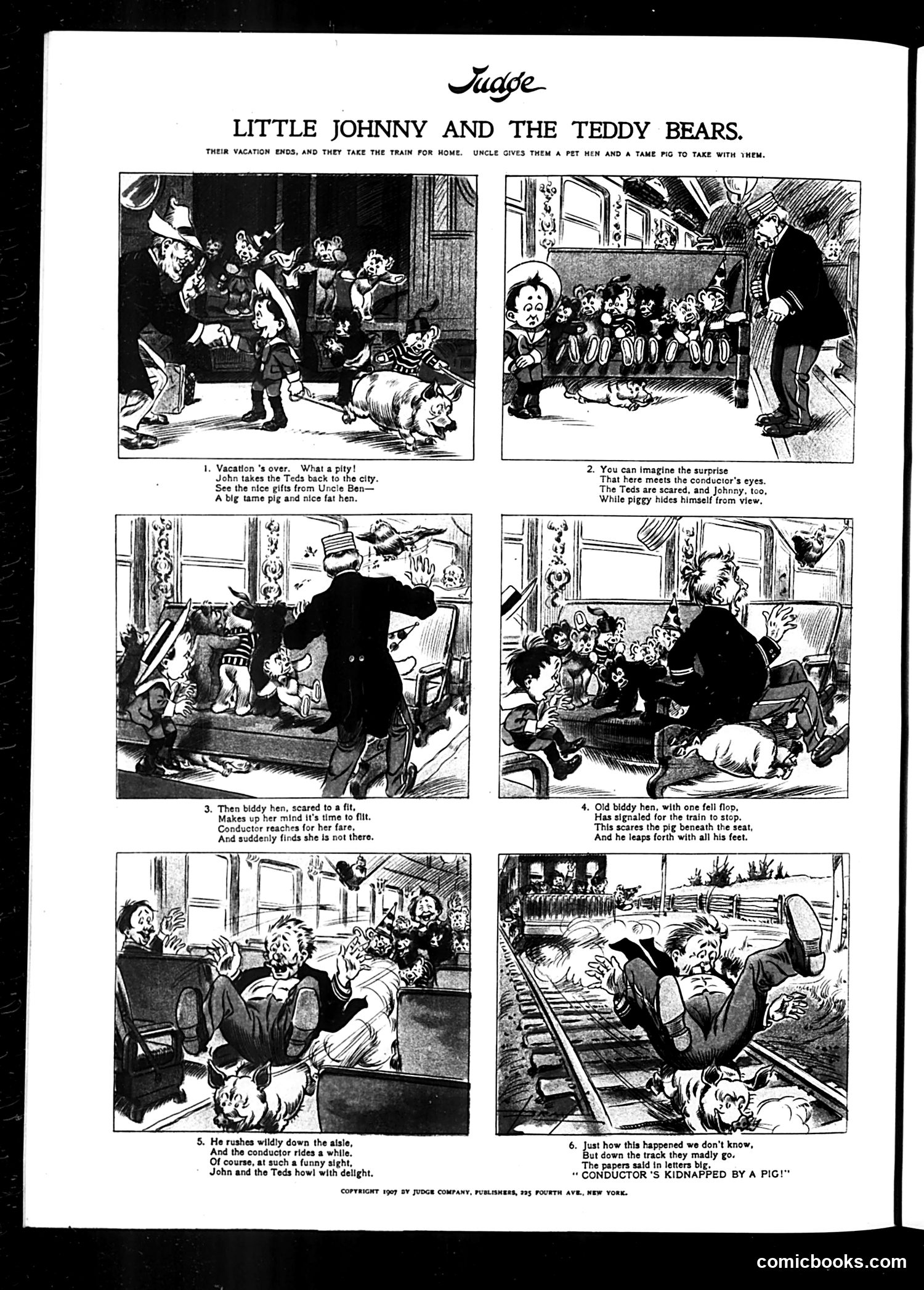
This is a children's comic strip playing on the popularity of "Teddy Bears"—toys named after President Theodore Roosevelt. The narrative follows young Johnny traveling home by train with his teddy bears, accompanied by a pet hen and pig given by Uncle Ben. The humor derives from slapstick chaos: the hen, frightened aboard the train, escapes. When the conductor tries to collect her fare, she vanishes. The pig panics and flees down the aisle, eventually bolting from the train. The absurdist payoff: newspapers report the conductor has been "kidnapped by a pig." The satire is genteel and whimsical—typical of Judge's family-friendly content of this era. It mocks the sensationalism of newspaper headlines ("CONDUCTOR 'S KIDNAPPED BY A PIG!") by presenting a ridiculous scenario as breaking news. The "Teddy Bear" reference, still novel in 1907, anchors the strip in contemporary popular culture.