
Judge, 1907-09-07 · page 10 of 18
Judge — September 7, 1907 — page 10: what you’re looking at
What you’re looking at
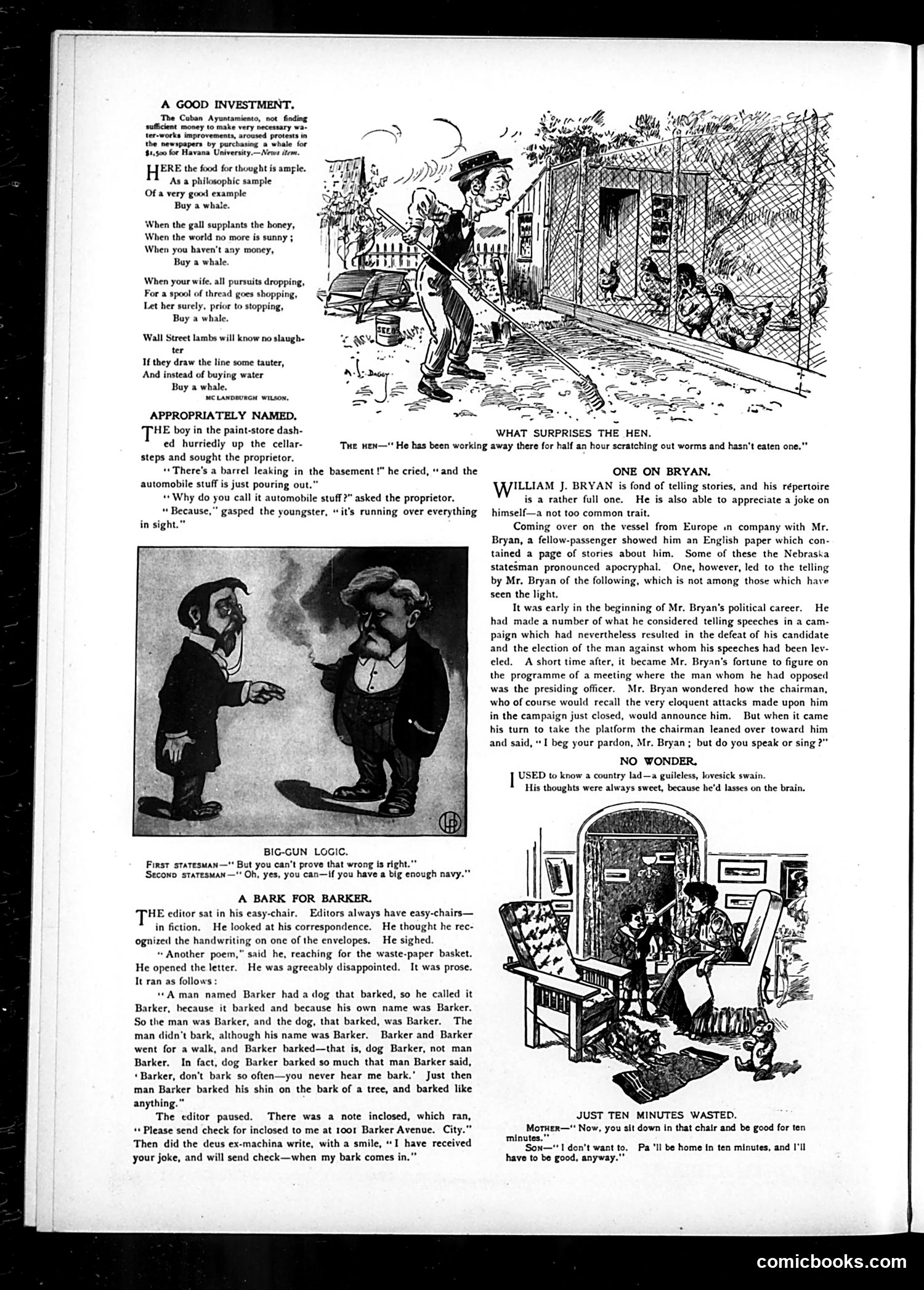
**"A Good Investment"** satirizes Cuba's Ayuntamiento for purchasing a whale for $1,500 while claiming insufficient funds for necessary water-works improvements. The poem mockingly suggests buying whales as a solution to various problems—spousal overspending, financial hardship, naval weakness—highlighting the absurdity of prioritizing a luxury purchase over essential infrastructure. **"One on Bryan"** recounts an anecdote about William Jennings Bryan, the prominent Nebraska politician and three-time presidential candidate. The story illustrates Bryan's good humor by describing how he appreciated a joke about himself involving a political opponent he'd attacked in speeches. This demonstrates Bryan's claimed ability to laugh at himself—"a not too common trait" among politicians—establishing him as unusually gracious despite his electoral defeats. Other brief satirical items mock governmental illogic, editorial pretension, and puns ("bark/Barker").
📄 Transcribed text from this page (OCR, searchable)
Machine-transcribed from the original scan — historical spelling and the odd misread are preserved.
A GOOD INVESTMENT. The Cuban Ayuntamiento, not fi sufficient money to make very necessary ter-works improvements, aroused protest the newspapers by purchasing a whale $1,500 for Havana University.—News item. ERE the food for thought is amgle. As a philosophic sample Of a very good example Buy a whale. When the gall supplants the honey, When the world no more is sunny ; When you haven't any money, Buy a whale. When your wife. all pursuits dropping, For a spool of thread goes shopping, Let her surely, prior to stopping, Buy a whale. ‘Wall Street lambs will know no slaugh- ter If they draw the line some tauter, And instead of buying water Buy a whale. MC LANDOURGH WILSON, APPROPRIATELY NAMED. THE boy in the paint-store dash- ed hurriedly up the cellar- steps and sought the proprietor. There's a barrel leaking in the basement !” he cried, “and the automobile stuff is just pouring out.” ‘Why do you call it automobile stuff?” asked the proprietor. “ Because,” gasped the youngster, “it's running over everything in sight.” BIG-GUN LOGIC. First statesman—'* But you can't prove that wrong is right.”” ‘Secono statesMan—" Oh, yes, you can—If you have a big enough navy.” A BARK FOR BARKER. THE editor sat in his easy-chair. Editors always have easy-chairs— in fiction, He looked at his correspondence. He thought he rec- ognized the handwriting on one of the envelopes. He sighed. “Another poem,” said he, reaching for the waste-paper basket. He opened the letter. He was agreeably disappointed. It was prose. It ran as follows : “Aman named Barker had a dog that barked, so he called it Barker, because it barked and because his own name was Barker. So the man was Barker, and the dog, that barked, was Barker. The man didn’t bark, although his name was Barker. Barker and Barker went for a walk, and Barker barked—that is, dog Barker, not man Barker. In fact, dog Barker barked so much that man Barker said, «Barker, don't bark so often—you never hear me bark.’ Just then man Barker barked his shin on the bark of a tree, and barked like anything.” The editor paused. There was a note inclosed, which ran, «+ Please send check for inclosed to me at 1001 Barker Avenue. City.” Then did the deus ex-machina write, with a smile, “I have received your joke, and will send check—when my bark comes in.” WHAT SURPRISES THE HEN. Tue nen—‘' He has been working away there for half an hour scratching out worms and hasn't eaten one.” ONE ON BRYAN. WILLIAM J. BRYAN is fond of telling stories, and his répertoire is a rather full one. He is also able to appreciate a joke on himself—a not too common trait. Coming over on the vessel from Europe in company with Mr. Bryan, a fellow-passenger showed him an English paper which con- tained a page of stories about him. Some of these the Nebraska statesman pronounced apocryphal. One, however, led to the telling by Mr. Bryan of the following, which is not among those which have seen the light. It was early in the beginning of Mr. Bryan's political career. He had made a number of what he considered telling speeches in a cam- paign which had nevertheless resulted in the defeat of his candidate and the election of the man against whom his speeches had been lev- cled. A short time after, it became Mr. Bryan's fortune to figure on the programme of a meeting where the man whom he had opposed was the presiding officer. Mr. Bryan wondered how the chairman, who of course would recall the very eloquent attacks made upon him in the campaign just closed, would announce him. But when it came his turn to take the platform the chairman leaned over toward him and said, “I beg your pardon, Mr. Bryan; but do you speak or sing ?” NO WONDER. D to know a country lad—a guileless, lovesick swain. usI I thoughts were always sweet, because he'd lasses on the brain. JUST TEN MINUTES WASTED. Moter—" Now, you sit down in that chair and be good for ten minutes." Son—‘'I don't want to. have to be good, anyway." Pa ‘ll be home in ten minutes, and I'll comicbooks.com