
A complete issue · 16 pages · 1907
Judge — July 13, 1907
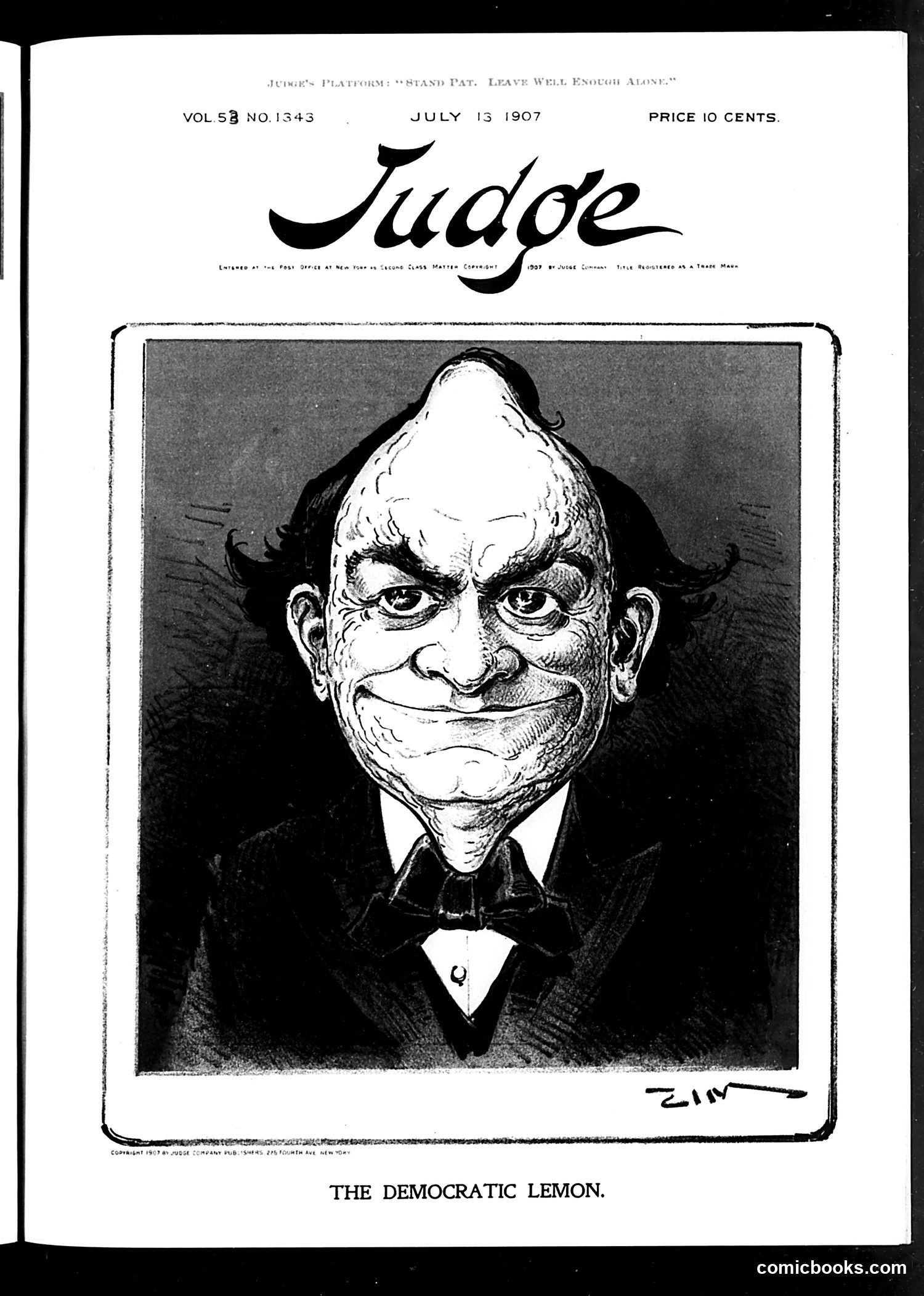
This is a caricature by artist Zim depicting what the caption calls "The Democratic Lemon"—a grotesque figure in formal attire with exaggerated, ugly facial features. The "lemon" metaphor refers to something defective or worthless. Published in 1907, during Theodore Roosevelt's presidency, this satirizes the Democratic Party as unattractive or undesirable to voters. The formal dress suggests a political candidate or party leadership. Judge was a Republican-leaning publication, so this represents partisan mockery of the opposition. The grotesque caricature style was common in Gilded Age political satire, though by modern standards the exaggerated physiognomy would be considered crude and offensive.
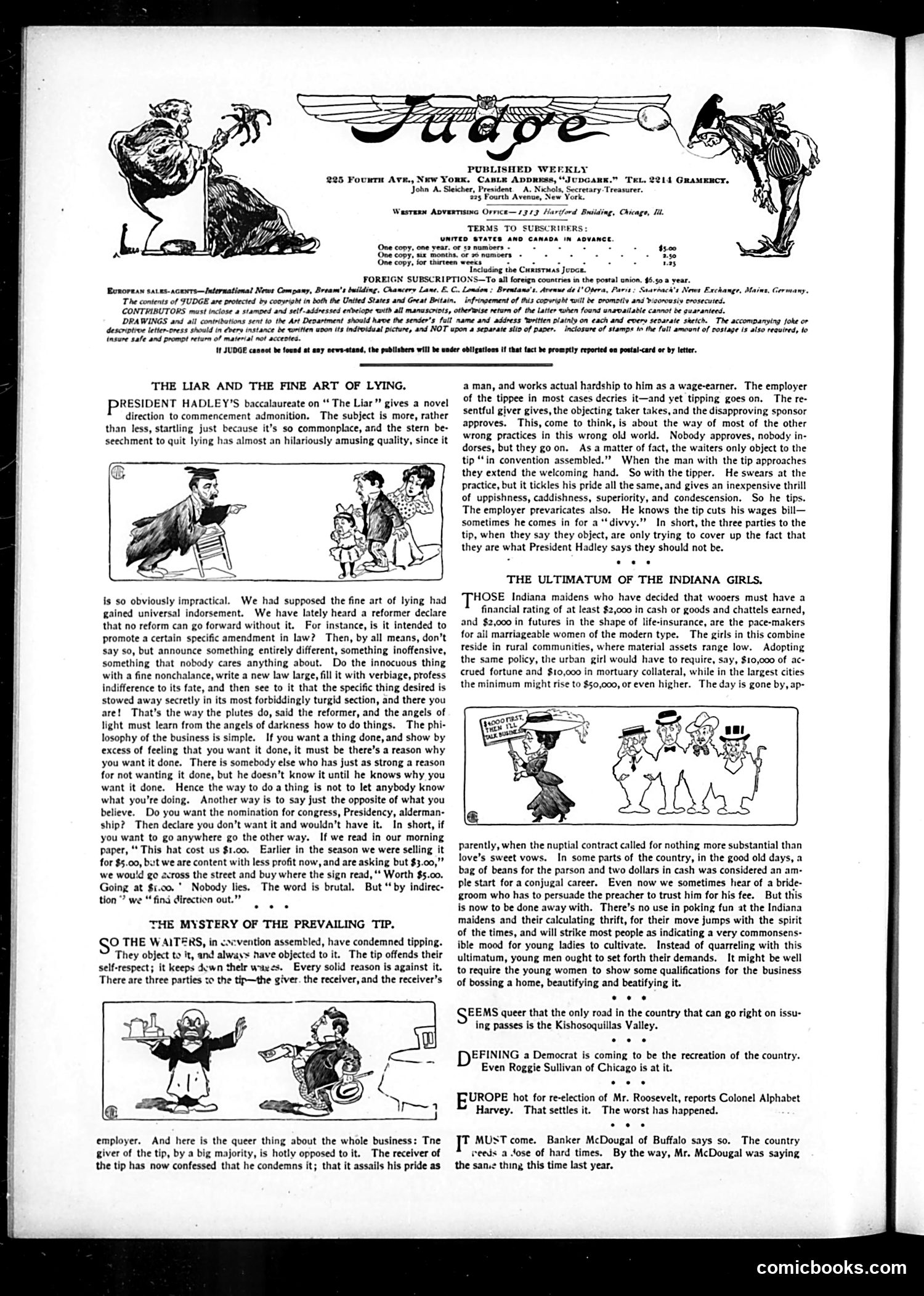
This page from Judge magazine contains three satirical articles with accompanying illustrations: 1. **"The Liar and the Fine Art of Lying"** critiques widespread deception in American society, suggesting that lying has become normalized and socially acceptable across business and politics. 2. **"The Ultimatum of the Indiana Girls"** discusses women's financial demands in marriage—specifically that prospective husbands must have assets of at least $1,000 to $2,000, plus life insurance. The satire mocks both materialistic marriage expectations and the broader commercialization of courtship. 3. **"The Mystery of the Prevailing Tip"** satirizes tipping culture, noting confusion over who should receive tips and social pressure to pay them despite uncertainty about their propriety. The brief final items are gossipy political commentary. The illustrations use exaggerated caricature typical of the era's satirical style.
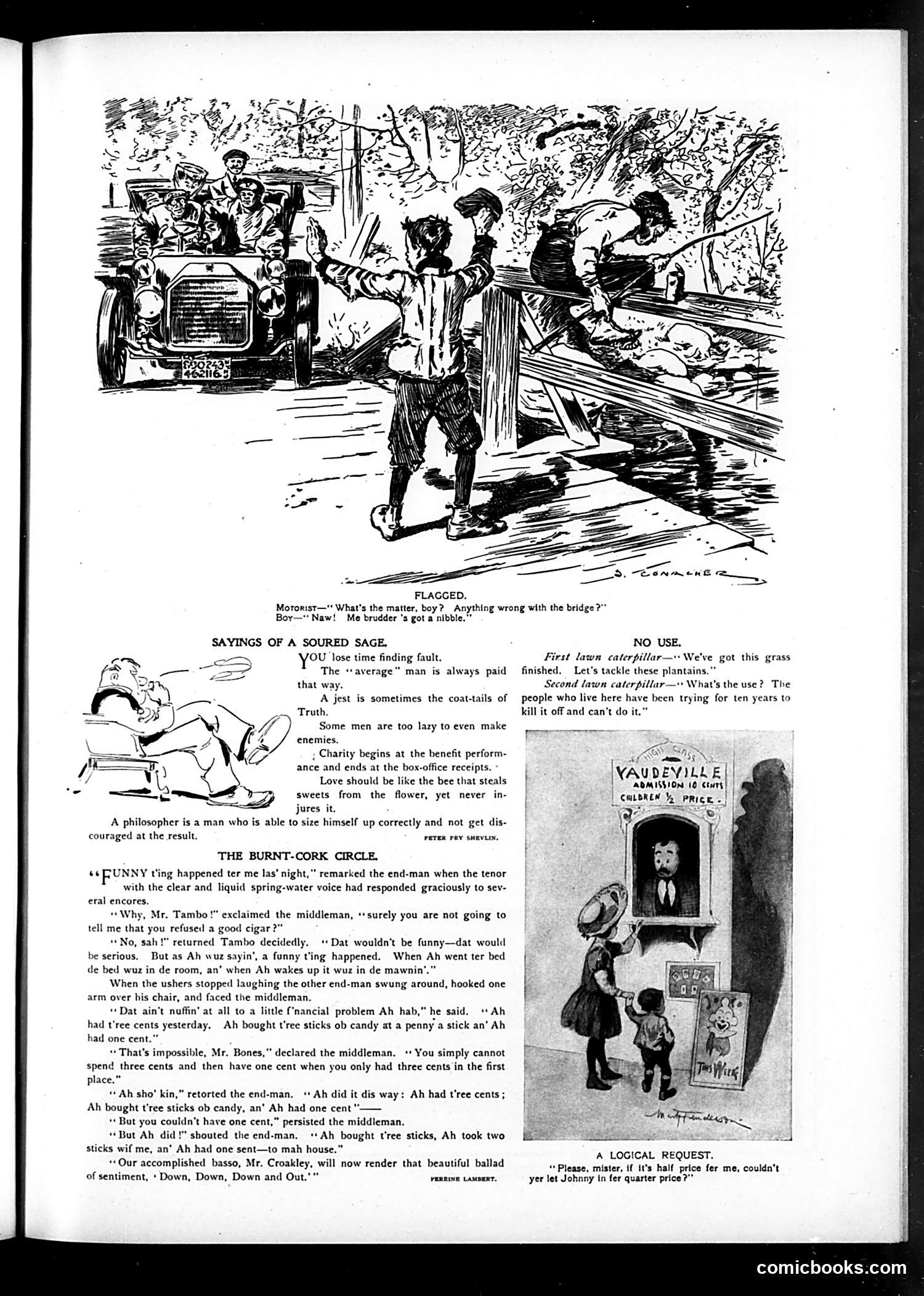
**Top Cartoon ("Flagged"):** Shows a motorist stopped by a boy at a bridge. The motorist asks what's wrong; the boy replies his brother has a nibble—a fishing reference. This is a simple visual pun playing on the double meaning of "flagged" (stopped vs. signaled). **Middle Section ("Sayings of a Soured Sage"):** Contains cynical aphorisms about human nature—lazy men, jesters, and philosophers. These are generic wisdom observations unrelated to specific political events. **"The Burnt-Cork Circle":** A dialect humor piece featuring characters named Tambo and an end-man, discussing impossible arithmetic with penny sticks. This reflects early 20th-century minstrel-show comedy traditions common in Judge. **Right side ("A Local Request"):** A Vaudeville theater joke about negotiating admission prices. No specific political satire is evident on this page.
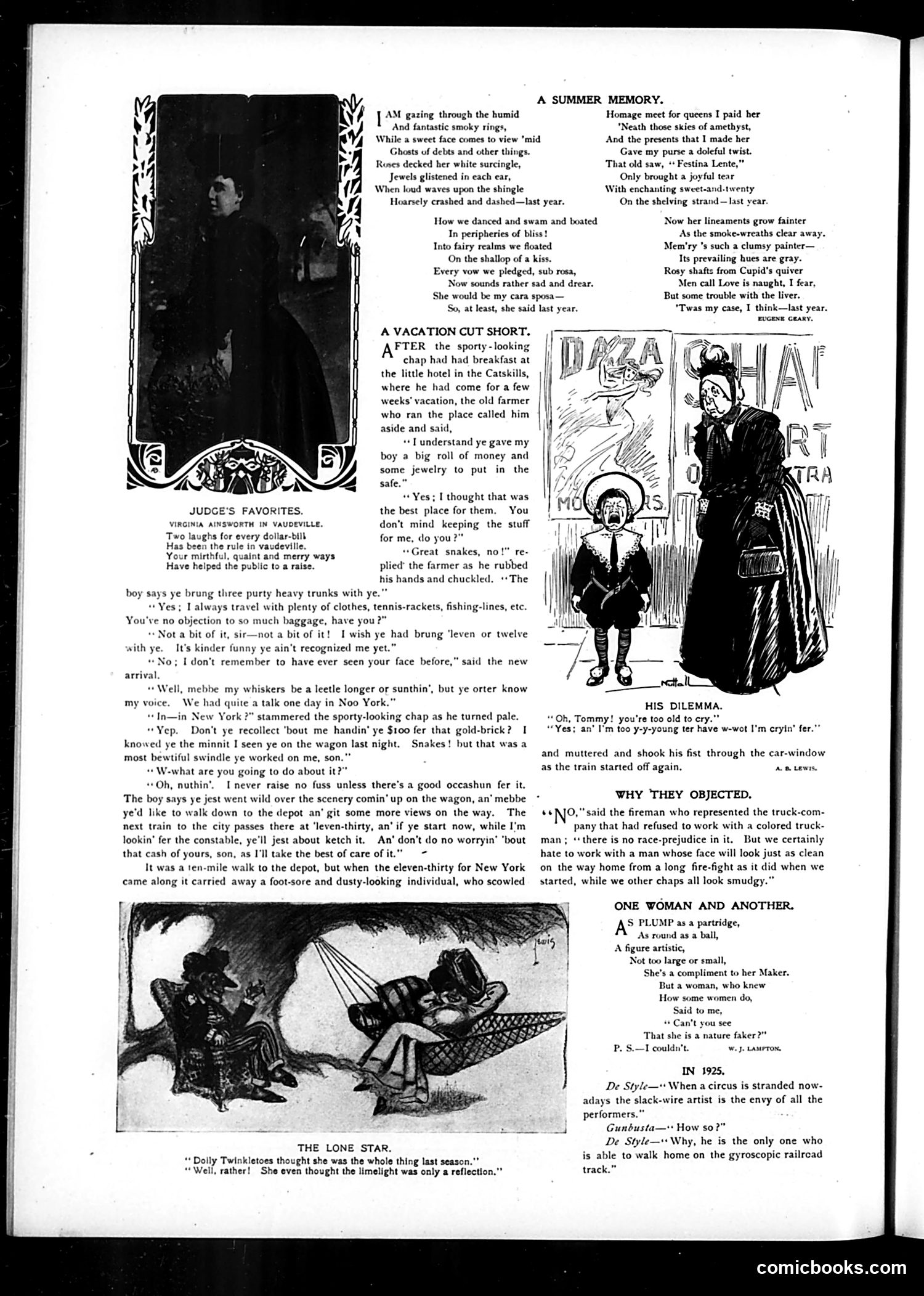
This page contains several short stories and poems rather than political cartoons. "A Summer Memory" is a nostalgic poem about a past romantic encounter. "A Vacation Cut Short" depicts a humorous exchange between a tourist and a hotel farmer about luggage and travel—a common early-20th-century leisure theme. "His Dilemma" shows a domestic scene. "Why They Objected" references racial prejudice in railroad employment, explicitly condemning discrimination against Black workers. "The Lone Star" includes a brief anecdote. The illustrations are primarily decorative accompaniment to text rather than satirical political commentary. Overall, this page emphasizes light humor, romance, and social observation typical of Judge's general-interest content, though "Why They Objected" addresses serious contemporary racial issues.
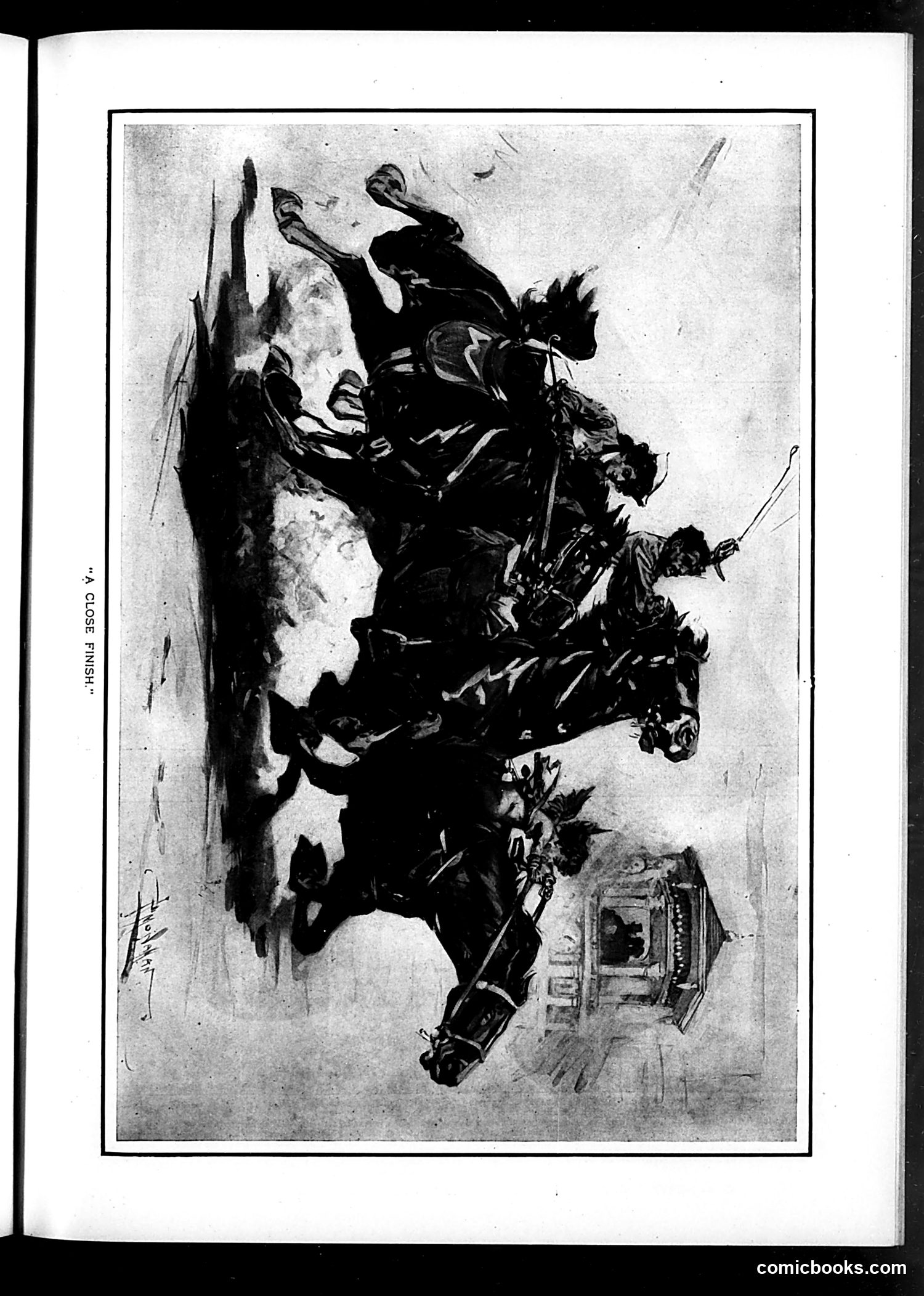
This appears to be a satirical illustration from *Judge* magazine, though the OCR text provided contains only a credit line ("CROSS FINISH") without substantive content explaining the cartoon's meaning. The image shows a dramatic equestrian scene with a rider on horseback in dynamic motion, appearing to be falling or in distress. There's a structure (possibly a grandstand) visible at the bottom right, suggesting a racing or sporting context. Without the accompanying text or caption, I cannot definitively identify the specific political figures, events, or satirical point being made. The artistic style and composition suggest this is commentary on a contemporary (to *Judge*'s publication date) political or social situation, but determining the precise subject would require either legible OCR text or additional context about the magazine's issue date.
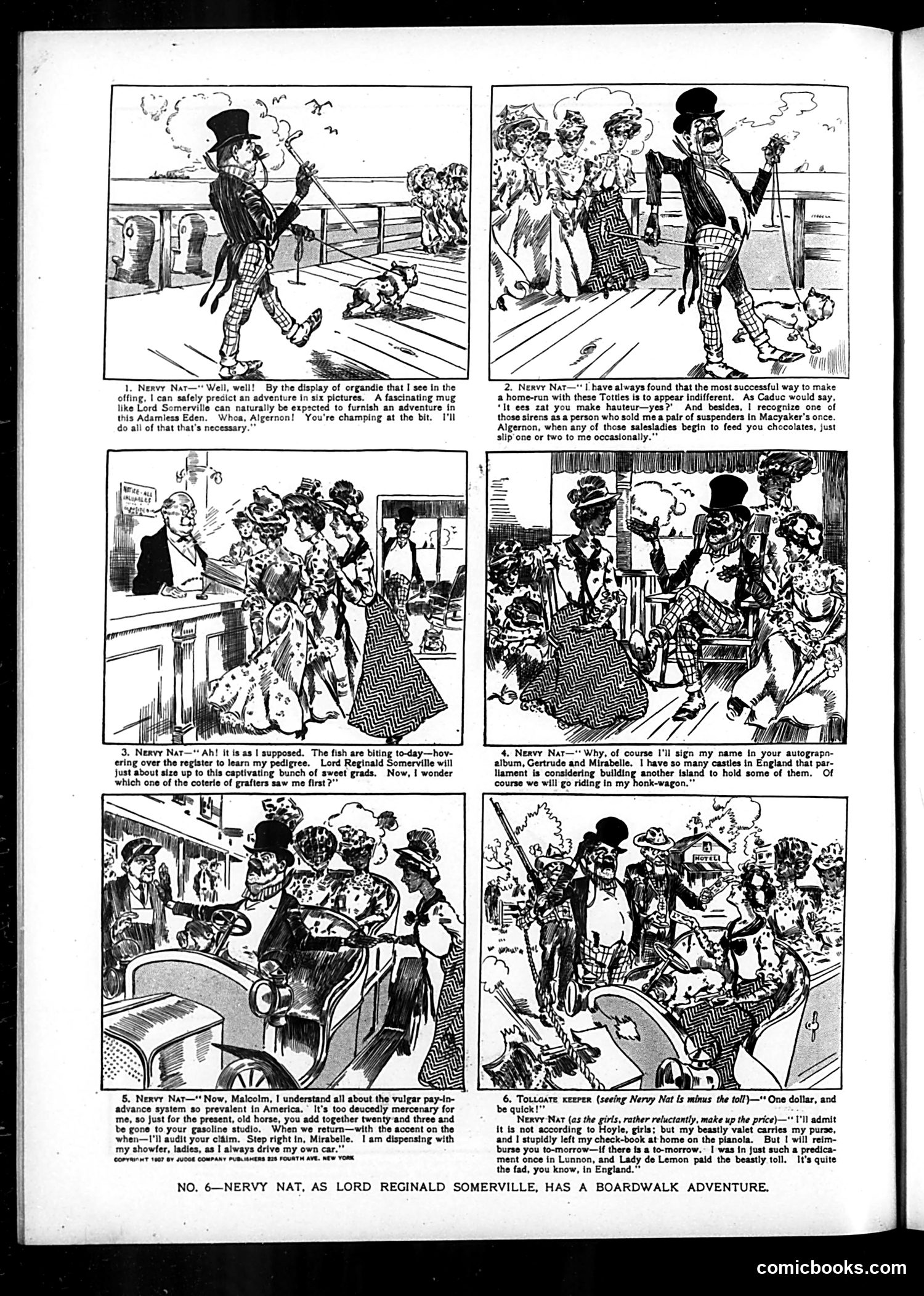
This comic strip satirizes a con artist posing as British nobility ("Lord Reginald Somerville") to seduce and swindle young women at the boardwalk. "Nervy Nat" adopts an exaggerated upper-class accent and fabricated claims of wealth—castles in England, a "honk-wagon" (early automobile)—to impress "Totties" (flirtatious young women, likely shop girls). The satire exposes his transparent scheme: he lacks money (leaving his checkbook at home, relying on his valet to carry his purse), resorts to petty theft (telling his companion to slip him chocolates), and attempts casual seduction through feigned indifference. The women ultimately profit by charging him a toll, reversing the expected con. The humor mocks both his obvious fraudulence and the transactional nature of early-20th-century romance at popular seaside resorts.
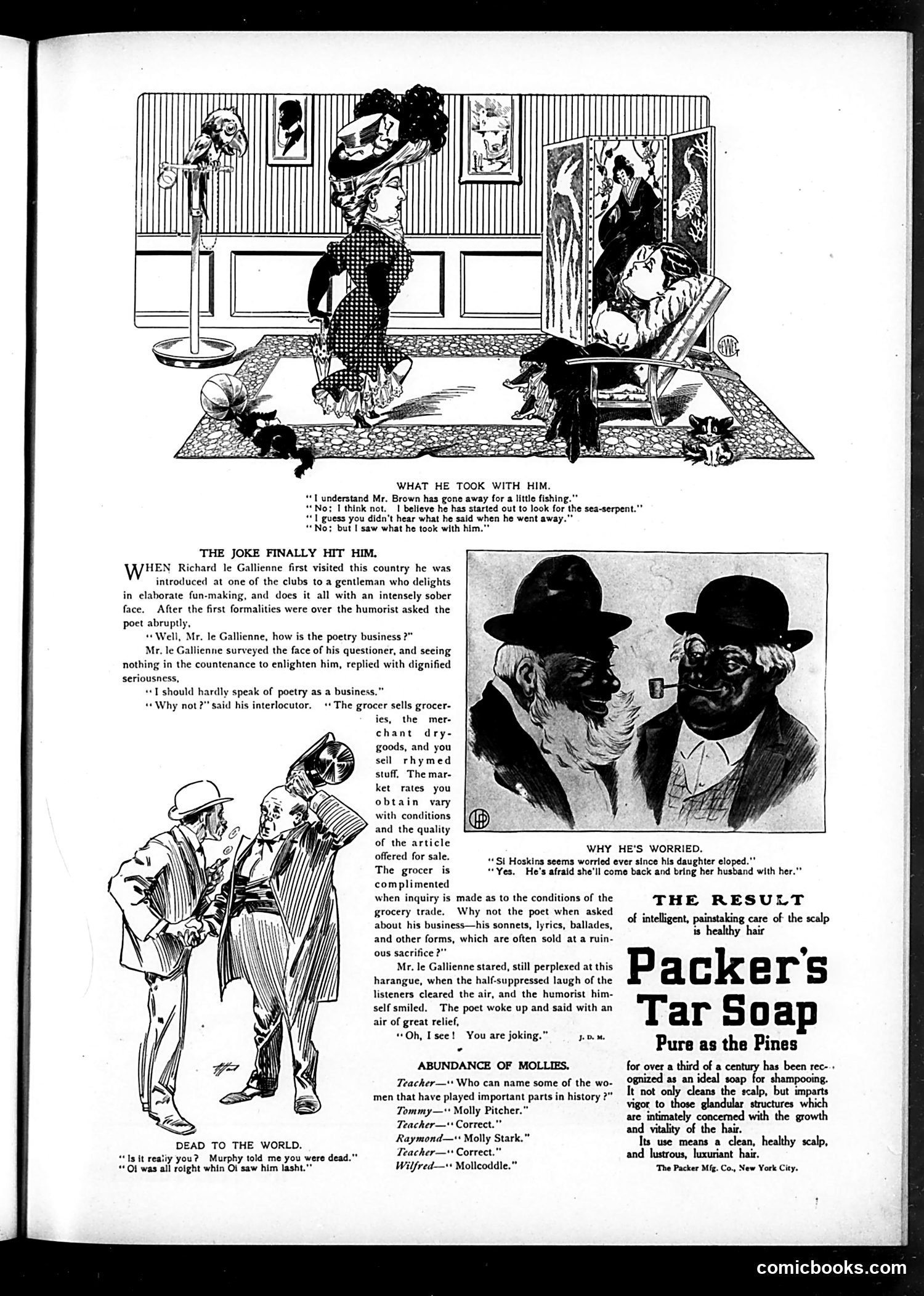
This page contains three separate humorous anecdotes aimed at educated readers familiar with literary and social figures: **"The Joke Finally Hit Him"** mocks poet Richard le Gallienne's earnest pretension. When a club member jokes that poetry is "business" like groceries or dry goods—comparing artistic sonnets to commercial goods sold at ruinous prices—le Gallienne takes it literally and seriously. The humor lies in his failure to recognize obvious satire, making the sophisticated poet appear obtuse. **"Why He's Worried"** is a brief domestic joke about a man fretting that his eloped daughter will return with her husband—suggesting he'd prefer she stay away. **"Dead to the World"** involves working-class dialect humor. The page is primarily advertising for **Packer's Tar Soap**, using a pseudo-scientific pitch about scalp health and hair vitality—typical early-20th-century patent medicine marketing. The cartoons reflect Judge's audience: educated, club-going men amused by literary pretension and social observation.
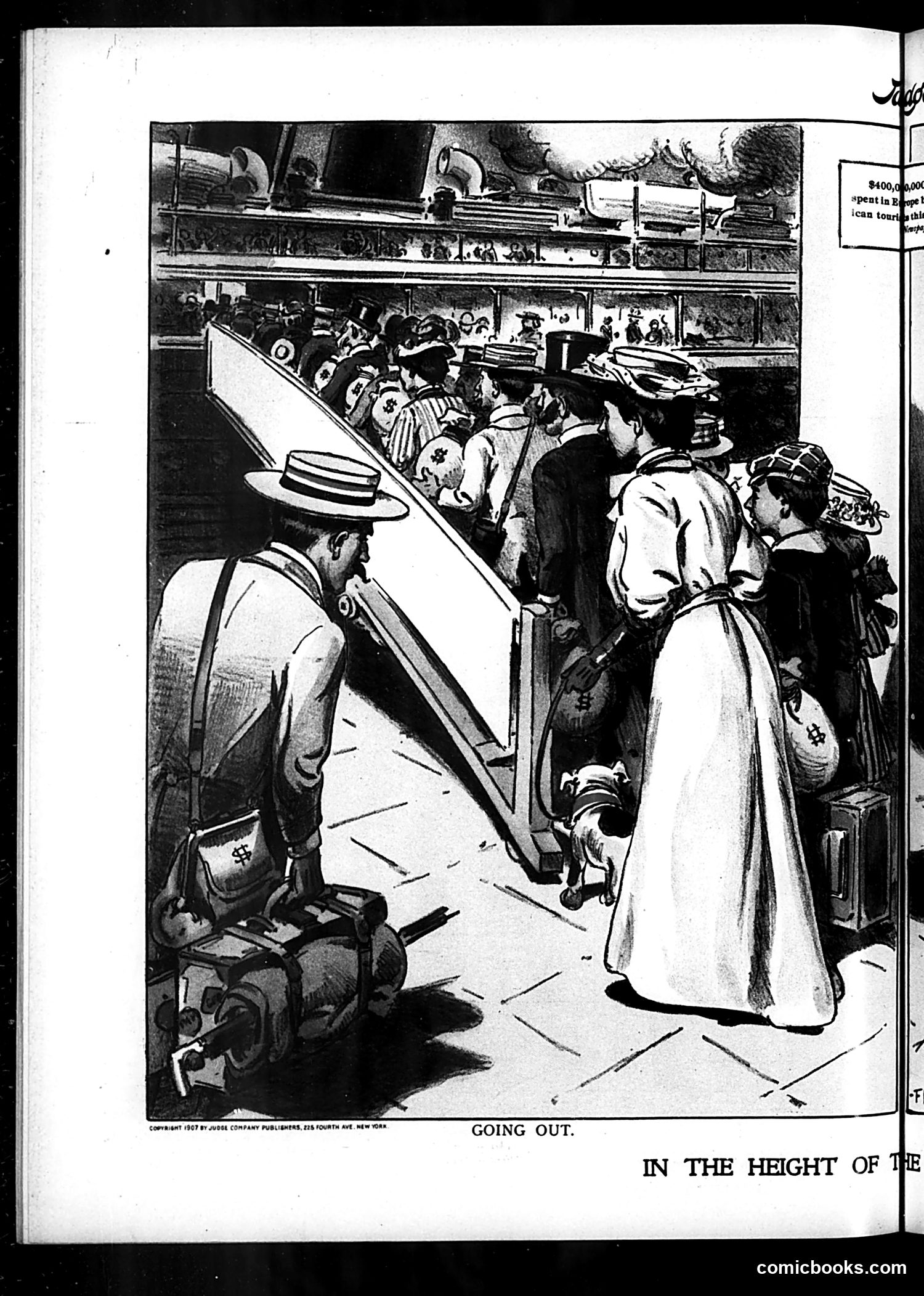
This appears to be a satirical illustration from *Judge* magazine showing a crowded scene of people boarding or exiting what looks like a public venue or transportation. The caption "Going Out" and partial text "In the Height of the [Season]" suggests this depicts fashionable society during peak social season. The satire likely mocks the pretensions and overcrowding of high-society outings—note the varied dress (fancy hats, capes, formal wear) and the chaotic crush of humanity. The illustration appears to critique either: 1. The artificiality of "fashionable" society 2. The undignified scramble despite claims of refinement 3. General overcrowding at popular venues Without seeing the complete caption or article, the specific social target remains somewhat unclear, but the humor derives from contrasting polite society's pretensions with the messy reality of their behavior.
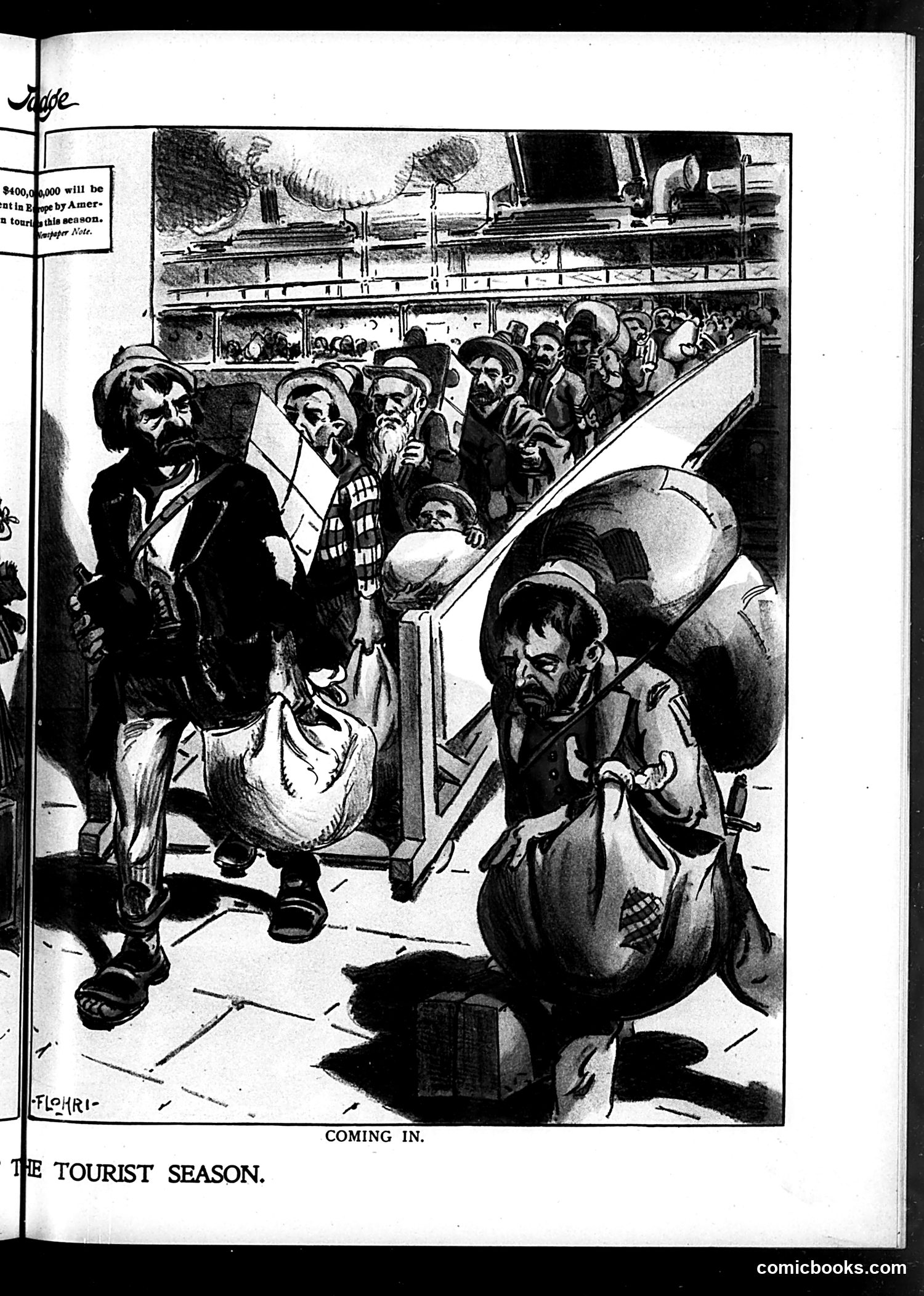
This satirical cartoon depicts the arrival of tourists to what appears to be a ship or port facility. The image shows working-class immigrants or laborers (characterized by exaggerated features typical of period caricature) crowding onto a vessel, carrying large bundles and belongings. The title "The Tourist Season" uses irony—these are clearly not leisure tourists but rather masses of immigrants arriving, likely during a peak immigration period. The cartoon satirizes the influx of newcomers to America, portraying them as an overwhelming invasion rather than individuals. The cramped, chaotic scene suggests social anxiety about immigration volume and assimilation capacity during the late 19th or early 20th century, when such immigration concerns dominated American political discourse.
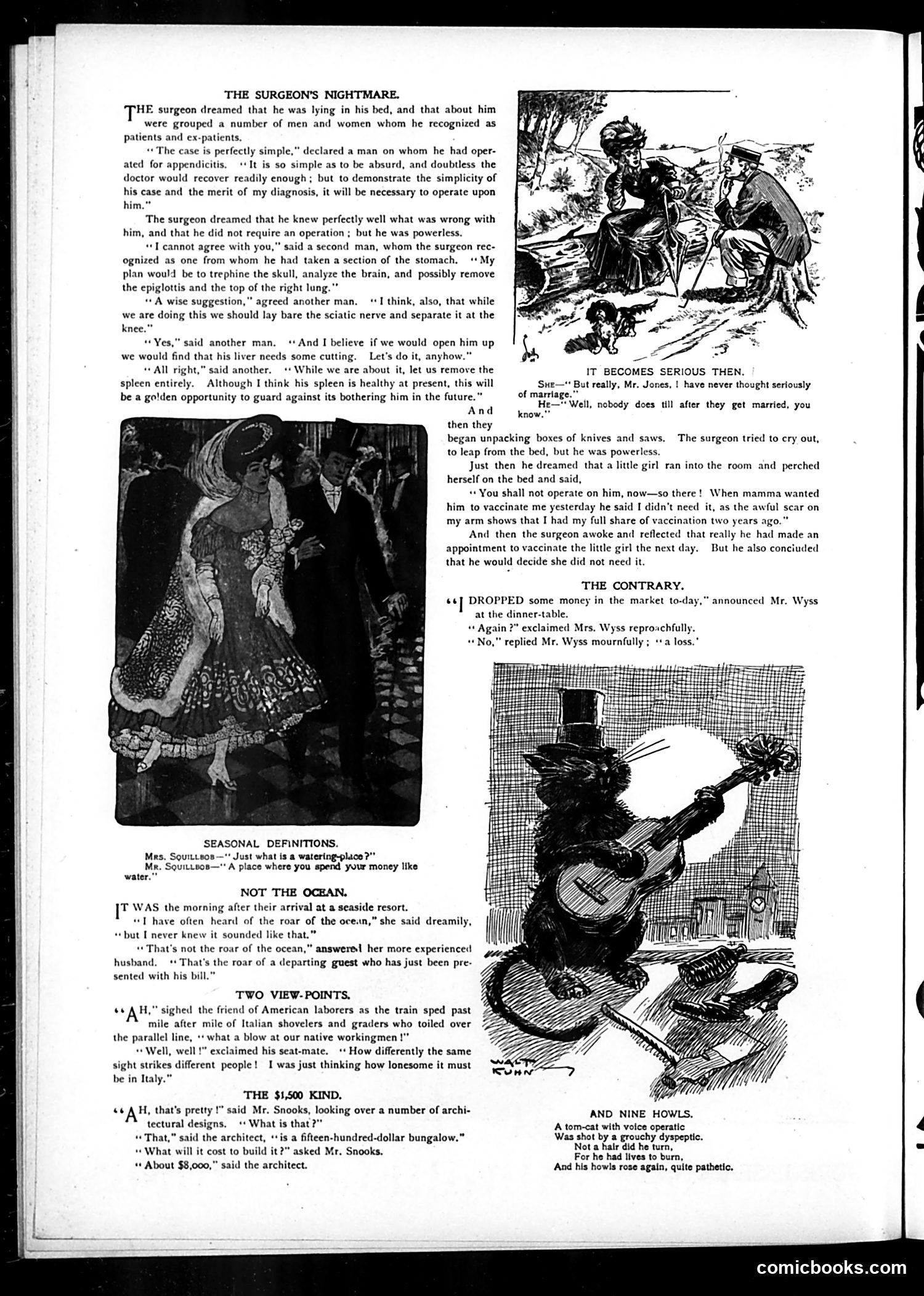
This page contains several satirical vignettes typical of Judge magazine's humor: **"The Surgeon's Nightmare"** depicts a surgeon dreaming he's a patient surrounded by colleagues eager to operate on him—each proposing increasingly unnecessary and invasive procedures (removing the spleen, trephining the skull, etc.). The satire critiques medical overtreatment and unnecessary surgery, a common concern in the era. The irony: the surgeon, who routinely operates on others, becomes powerless when roles reverse. The ending reveals he's scheduled to vaccinate a girl he knows doesn't need it—suggesting he'll hypocritically refuse to operate on her, despite advocating unnecessary procedures. **Other short jokes** mock bourgeois life: spousal financial anxiety, seaside resort overpricing, and xenophobic labor concerns about Italian immigrant workers undercutting American jobs. The cartoons use visual humor (a cat with a guitar) alongside text-based jokes, typical of Judge's format blending illustration and comic prose.
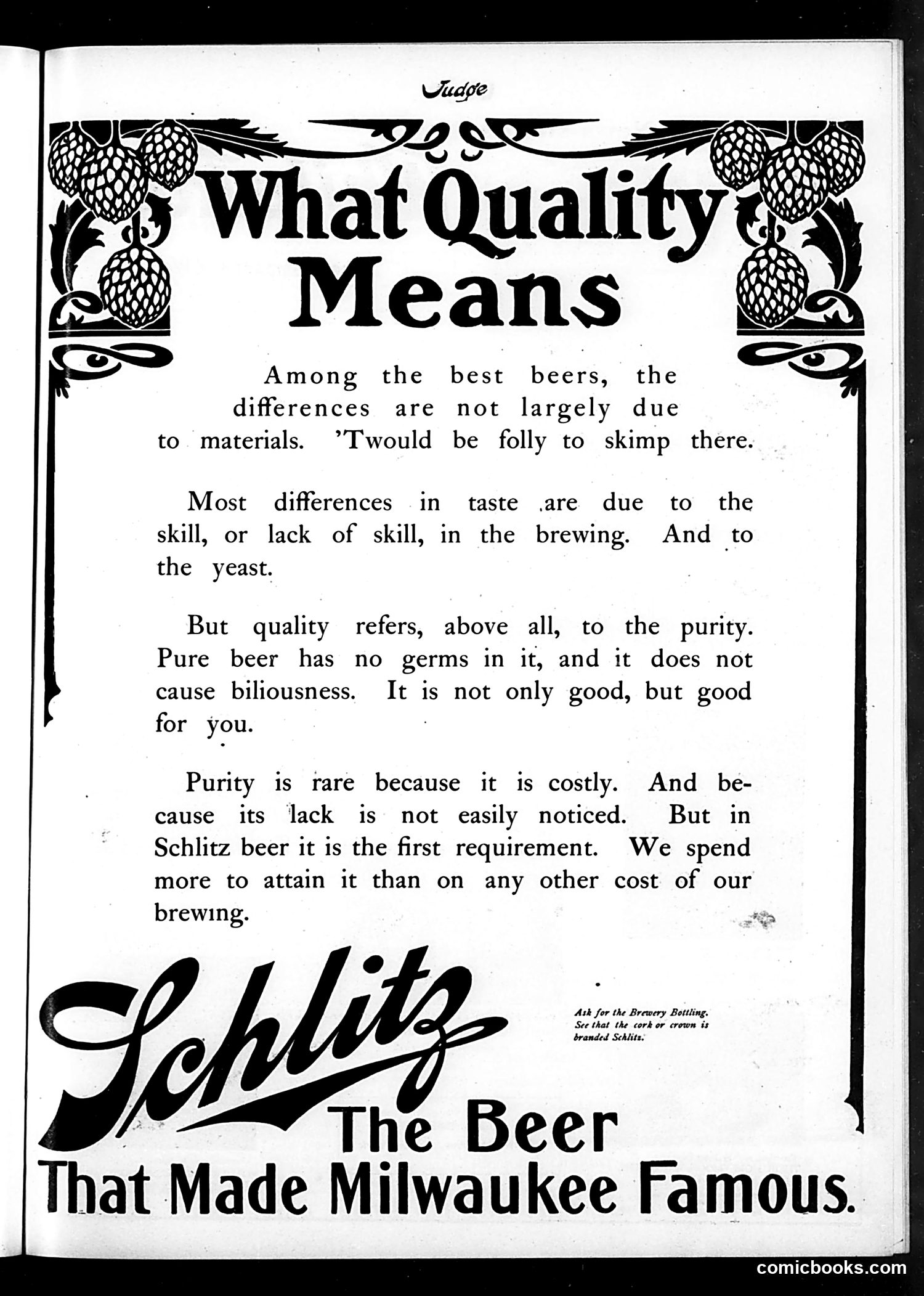
This is a **Schlitz beer advertisement**, not a political cartoon. It appeared in *Judge*, a satirical magazine, likely in the early 1900s. The ad argues that beer quality depends primarily on **purity**—freedom from germs—rather than ingredients. It claims Schlitz spends more on achieving purity than any other brewing cost, positioning purity as their competitive advantage. The text reassures consumers that pure beer is healthful ("good for you") and won't cause digestive illness. The decorative hops imagery and the tagline "The Beer That Made Milwaukee Famous" emphasize Schlitz's status as a premium American brewery. Modern readers should note this reflects an era when **germ theory was relatively new**, making "purity" a novel and compelling marketing claim. The ad also instructs buyers to verify authenticity through branded cork/crown labels—suggesting counterfeit products were a concern.
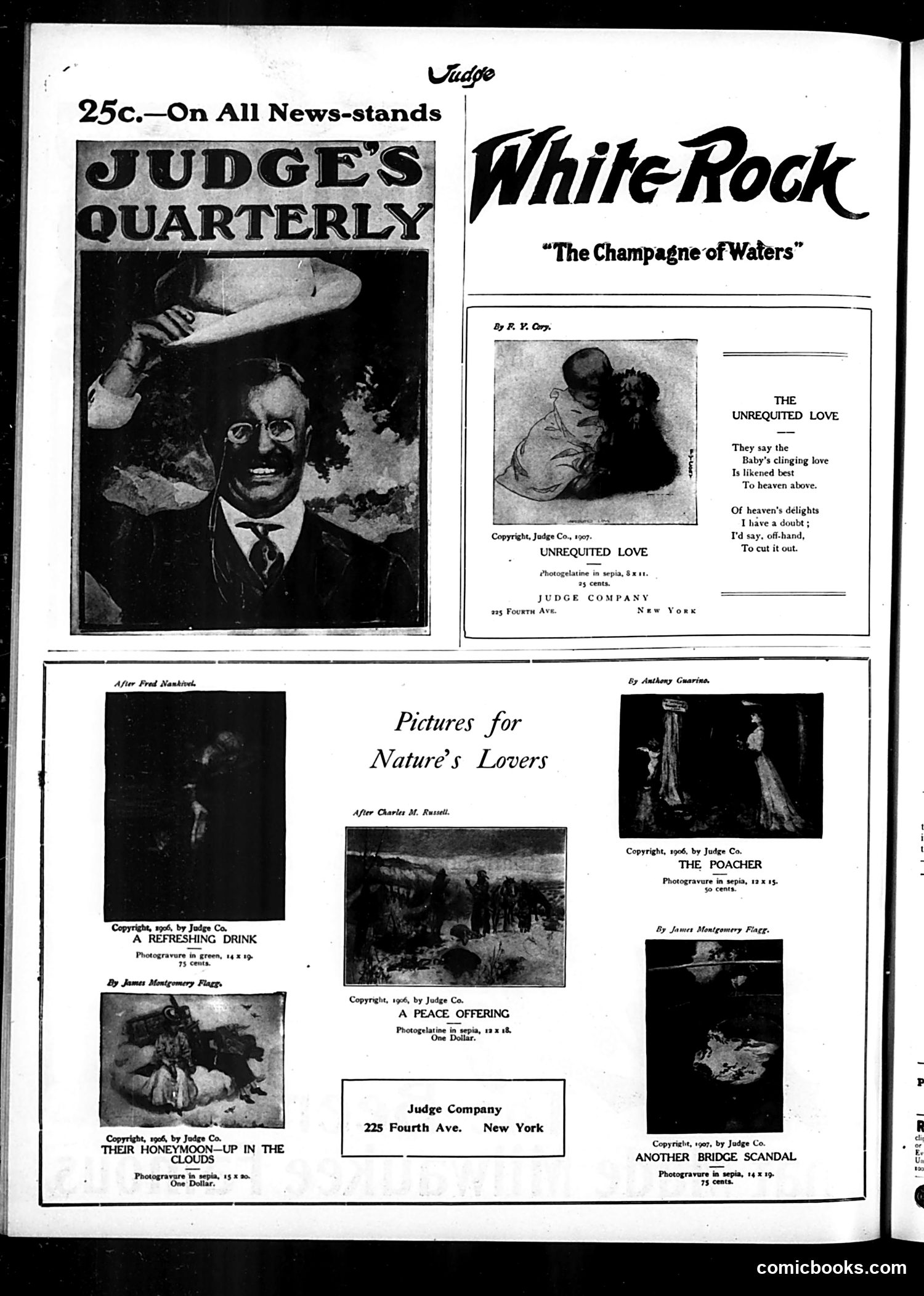
This page is primarily **advertising and product promotion** rather than political satire. It showcases Judge Company's offerings circa 1906-1907. The top features two advertisements: Judge's Quarterly magazine (25 cents) and White Rock water ("The Champagne of Waters"), with an unrelated poem about unrequited love. The lower section promotes **photographic art prints** available for purchase from Judge Company, featuring landscape and nature scenes by popular illustrators including Fred Nankivell, Charles M. Russell, and James Montgomery Flagg. Titles include "A Refreshing Drink," "A Peace Offering," "The Poacher," "Their Honeymoon—Up in the Clouds," and "Another Bridge Scandal." Each print lists its medium, dimensions, and price (ranging from 25 cents to one dollar). This reflects Judge's broader business model: the magazine itself was a vehicle for selling decorative art prints and merchandise to middle-class readers interested in contemporary illustration.
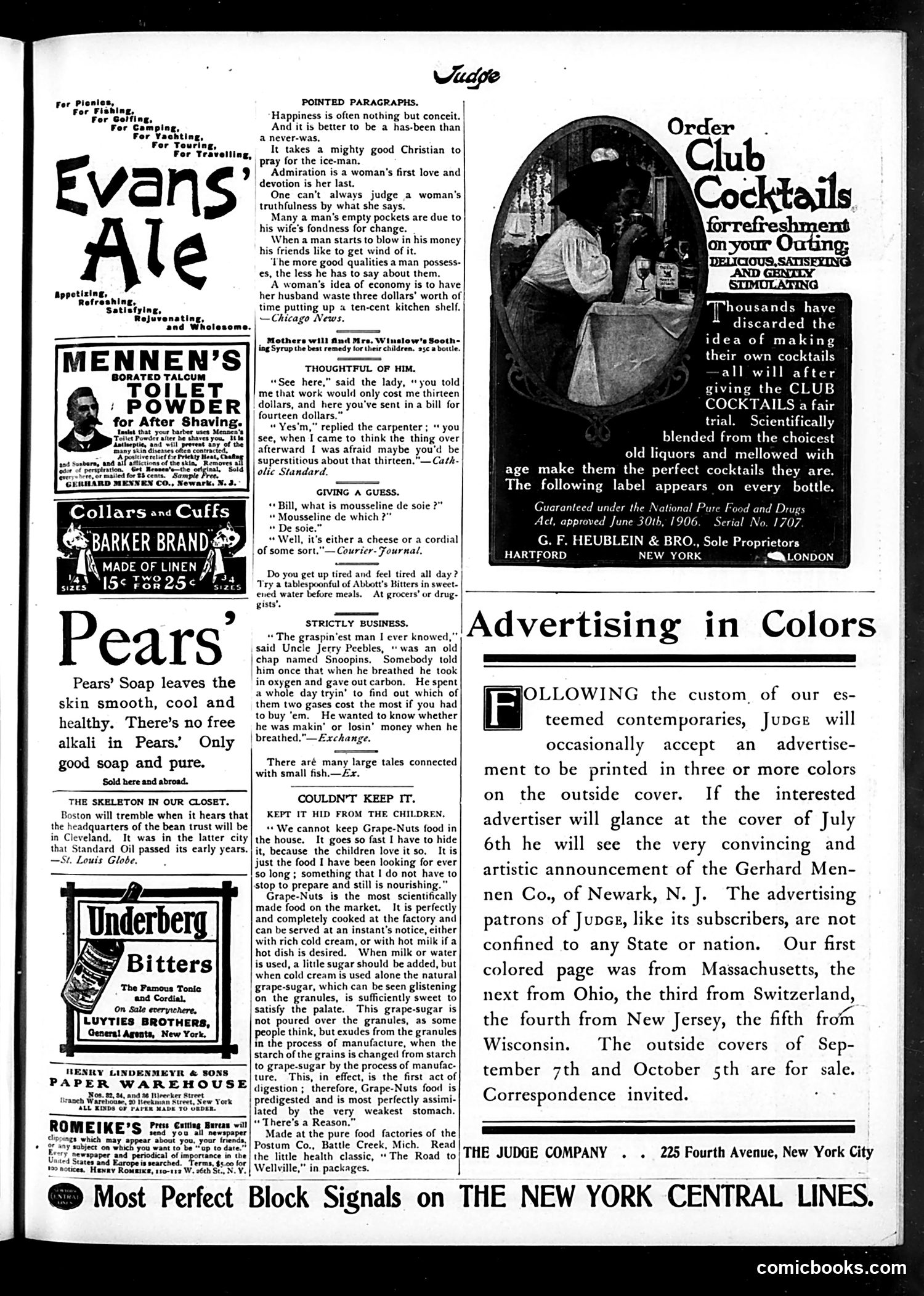
This page is primarily **advertising and humorous filler content**, not political satire. It consists of: **Advertisement sections** for consumer products (Evans' Ale, Mennen's Talcum Powder, Pears' Soap, Underberg Bitters, Grape-Nuts cereal) typical of early 1900s magazines. **"Pointed Paragraphs"** — short, cynical observations about human nature ("Happiness is often nothing but conceit"). These are generic social commentary rather than topical satire. **Humorous anecdotes** with mild wordplay: a carpenter charges extra because the client might be superstitious about thirteen dollars; a man guesses "mousseline de soie" is either cheese or cordial. **One topical reference**: "The Skeleton in Our Closet" briefly jokes that Boston will be disturbed that a "bean trust" headquarters moves to Cleveland—a light jab at Standard Oil's early operations there, alluding to corporate consolidation concerns of the era. Overall, this is a **filler/advertising page** lacking substantive political content or sophisticated satire that would require historical context for modern readers.
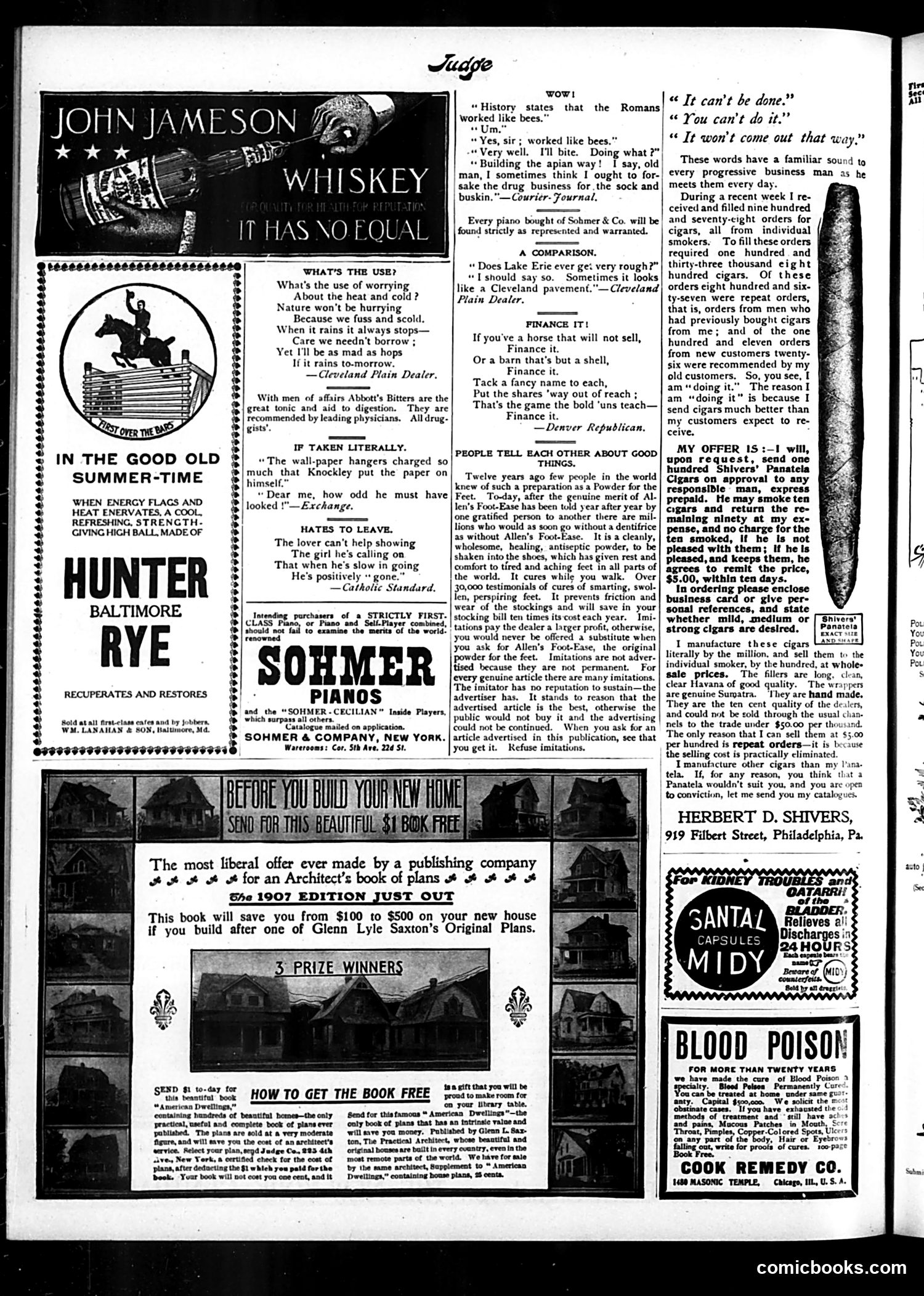
This is primarily an **advertising page** from Judge magazine, circa 1907, interspersed with brief humorous items and jokes. The cartoons and jokes are minor—mostly one-liners playing on wordplay and contemporary situations: a joke about wall-paper hangers, puns about "financing" (in the financial sense), and a comparison between Lake Erie's roughness and Cleveland pavements (presumably rough from poor maintenance). The page is dominated by **advertisements**: John Jameson whiskey, Hunter Baltimore Rye (featuring a man on horseback), Abbott's Bitters (a patent medicine), and Sohmer pianos. A substantial section promotes Allen's Foot-Ease powder, comparing genuine advertised products favorably to imitations. The largest advertisement offers a free 1907 architect's book of house plans—described as "the most liberal offer ever made by a publishing company." **No significant political satire or caricature is present.** This is a commercial page reflecting early-20th-century advertising practices, when magazines like Judge relied heavily on paid advertisements alongside editorial content.
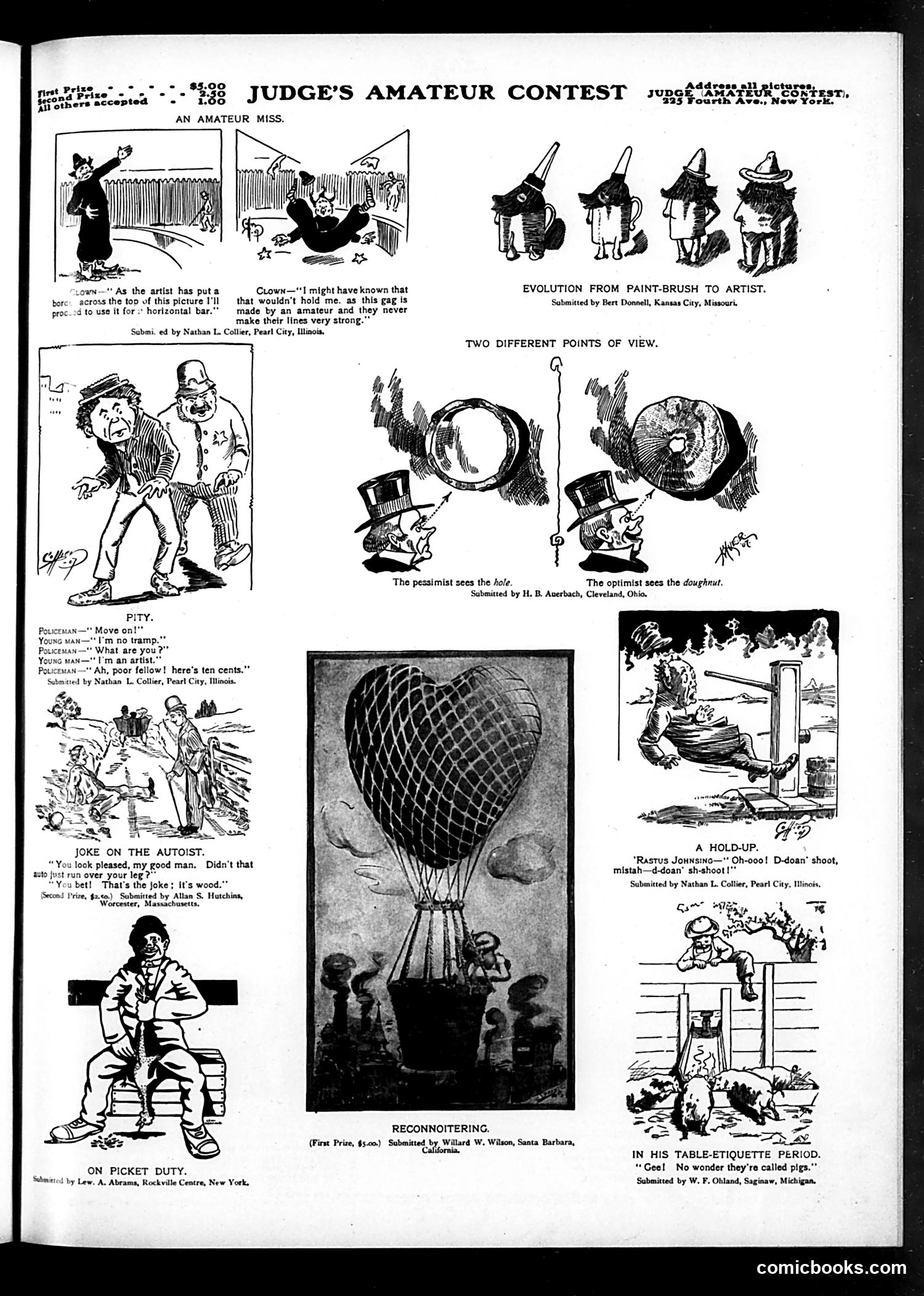
This page showcases humorous submissions to Judge magazine's amateur cartoon contest, featuring various gag cartoons with social commentary typical of early 20th-century American humor. **Key cartoons:** - **"An Amateur Miss"**: Mocks amateurish artists whose horizontal lines lack strength - **"Evolution from Paint-Brush to Artist"**: Shows artistic progression through increasingly elaborate painter's hats - **"Two Different Points of View"**: Classic pessimist/optimist joke using a doughnut hole - **"Joke on the Autoist"**: Dark humor about a wooden leg being run over by an automobile—referencing the then-novel danger of cars - **"A Hold-Up"**: Uses offensive racial dialect (common for the era) depicting robbery - **"Reconnoitering"**: Photo of a hot air balloon, submitted as a humorous entry - **"In His Table-Etiquette Period"**: Pun comparing pigs' table manners to bad-mannered humans The cartoons reflect period concerns: amateur artistry, automobile dangers, class commentary, and social observation through crude humor.
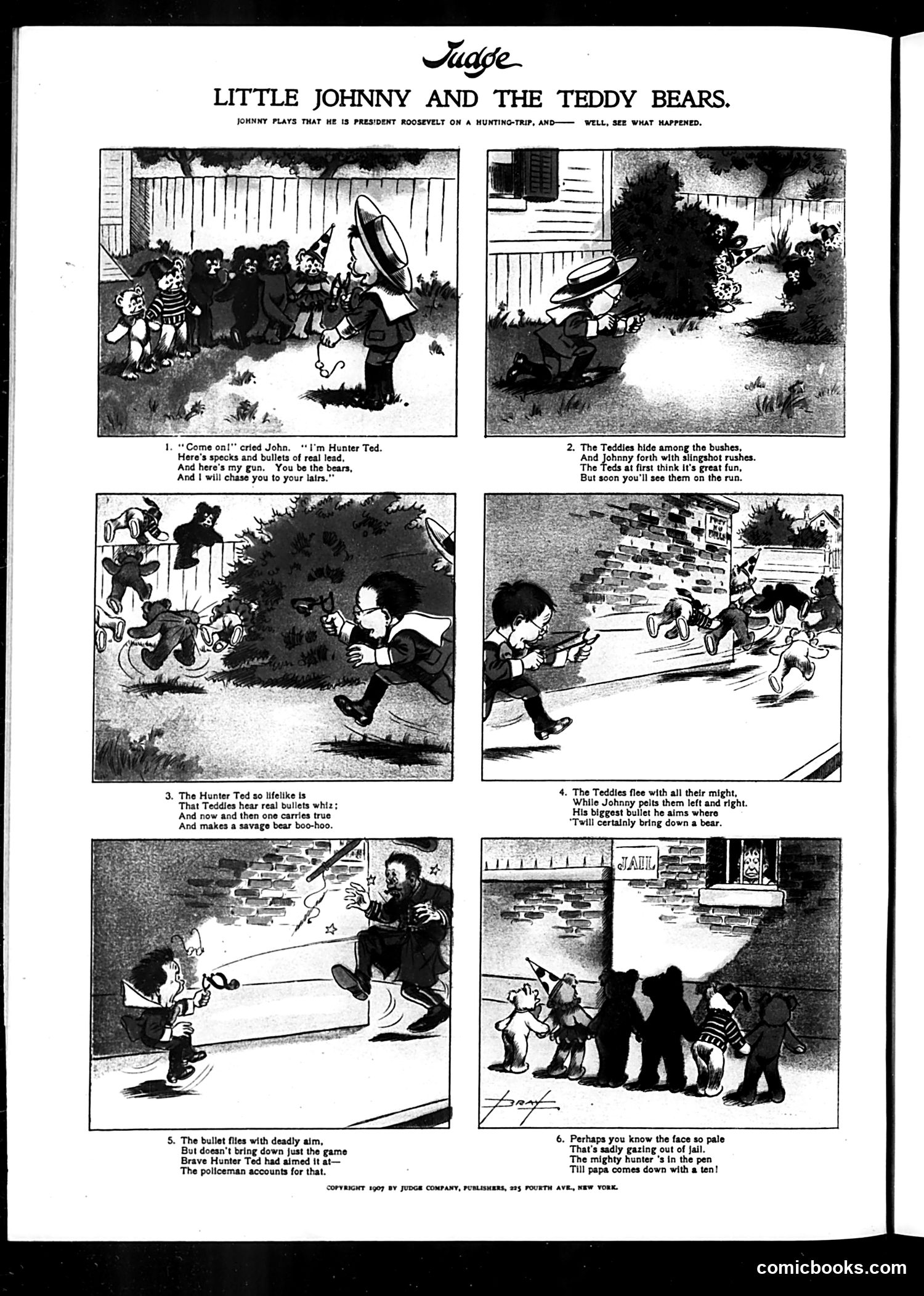
This cartoon satirizes President Theodore Roosevelt's famous hunting trips. "Little Johnny" role-plays as "Hunter Ted" (Roosevelt), armed with real bullets and a gun, treating stuffed teddy bears as actual game to hunt. The joke escalates: Johnny's stray bullet hits a policeman instead of the bears, landing him in jail. The final panel reveals Johnny's pale face behind bars, waiting for his father to bail him out with money ("a ten"). The satire mocks Roosevelt's real hunting expeditions and his macho "Rough Rider" persona by reducing them to childish play with absurd consequences. By having Johnny accidentally shoot a cop rather than game, Judge magazine comments on the recklessness of Roosevelt's hunting obsession and the real dangers of such activities—wrapped in humor that would resonate with early-20th-century readers familiar with Roosevelt's well-publicized African safari.