
A complete issue · 16 pages · 1907
Judge — February 16, 1907
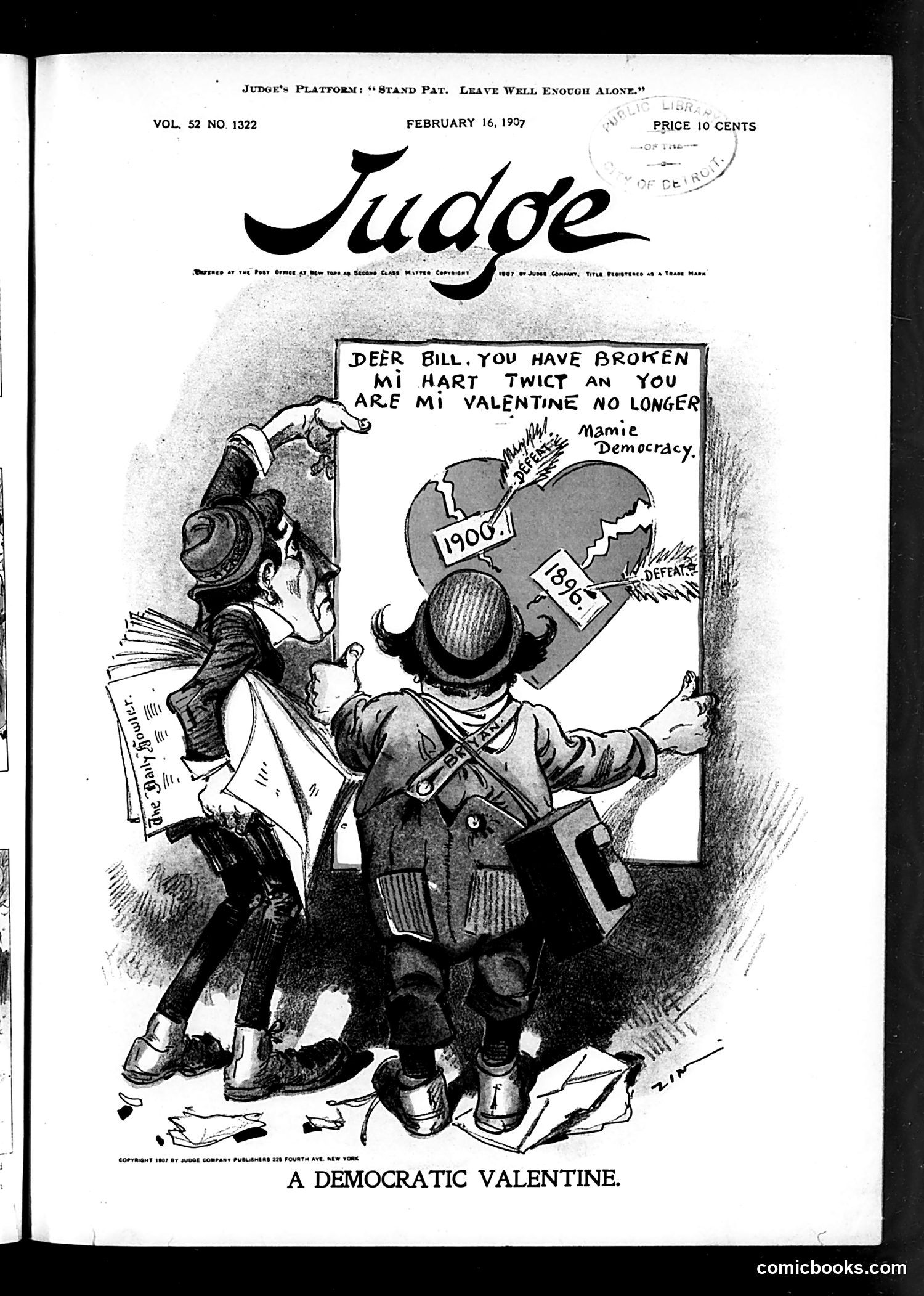
This political cartoon satirizes the Democratic Party's internal divisions following the 1908 presidential election. A deer (symbolizing the party) has had its heart broken twice—marked "1900" and "1896"—representing two consecutive electoral defeats. The figure posting the cruel valentine appears to be a Republican, mocking the Democrats' failed romantic aspirations for the presidency. The caption "Mamie Democracy" personifies the Democratic Party as a spurned lover, while the broken hearts suggest the party's repeated failures to win the White House. The figure on the left holds documents labeled "Democratic Platform," emphasizing how the party's stated principles consistently failed to translate into electoral success during this period.
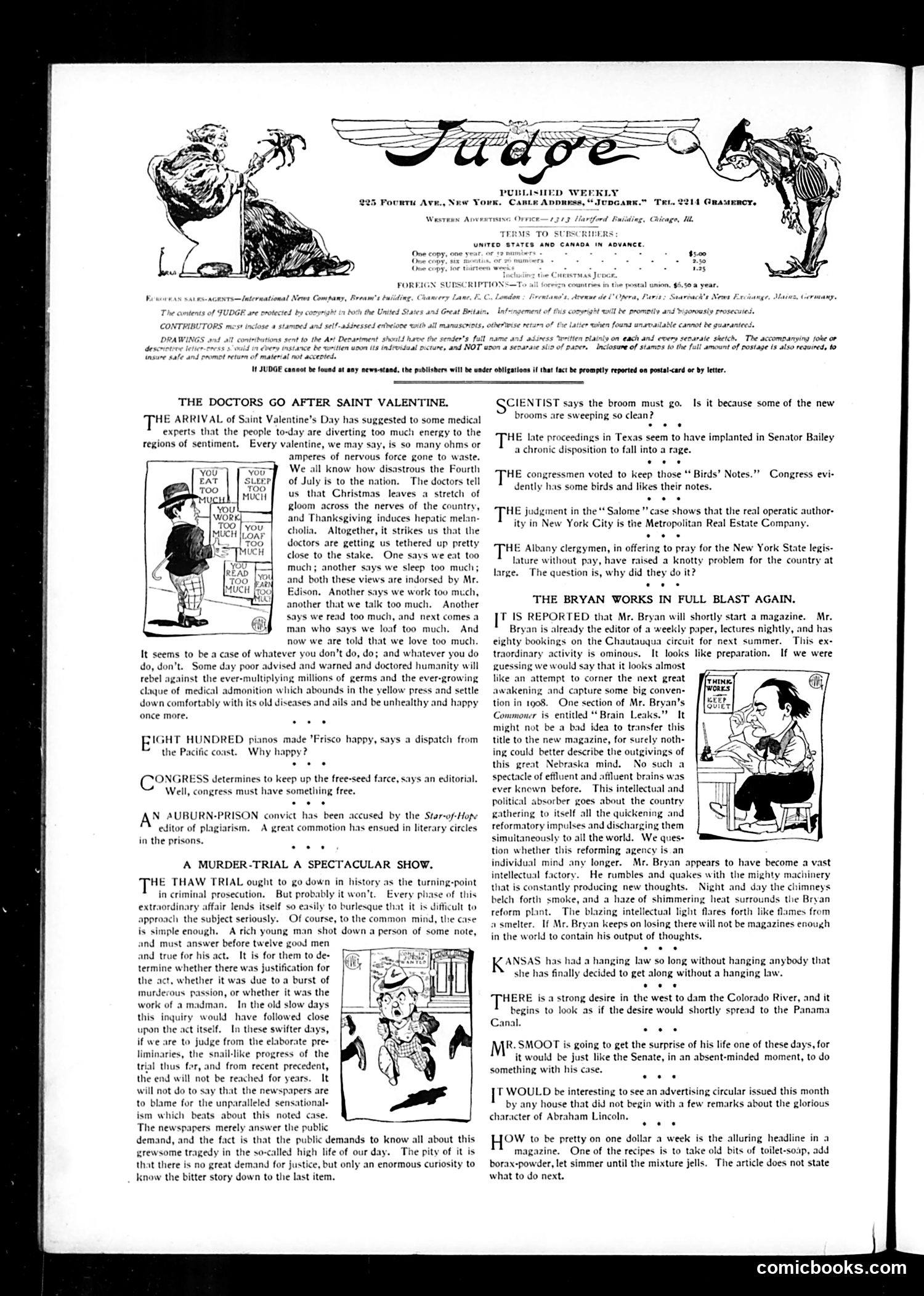
This cartoon satirizes medical advice columns by depicting a doctor dispensing Valentine's Day health recommendations. The left panel shows a figure offering contradictory prescriptions: "eat too much," "sleep too much," "work too much," etc.—each labeled "too much." The satire targets the era's proliferation of medical advice in popular magazines. Doctors were making grand claims about treating everything from nervous exhaustion to digestive problems, often with dubious remedies. The cartoon mocks the absurdity of one-size-fits-all medical guidance and the commercialization of health advice. The text beneath elaborates on doctors' contradictory recommendations regarding Fourth of July health practices, reinforcing the joke that contemporary medical advice was contradictory and often nonsensical—a common satirical target in early 20th-century publications.
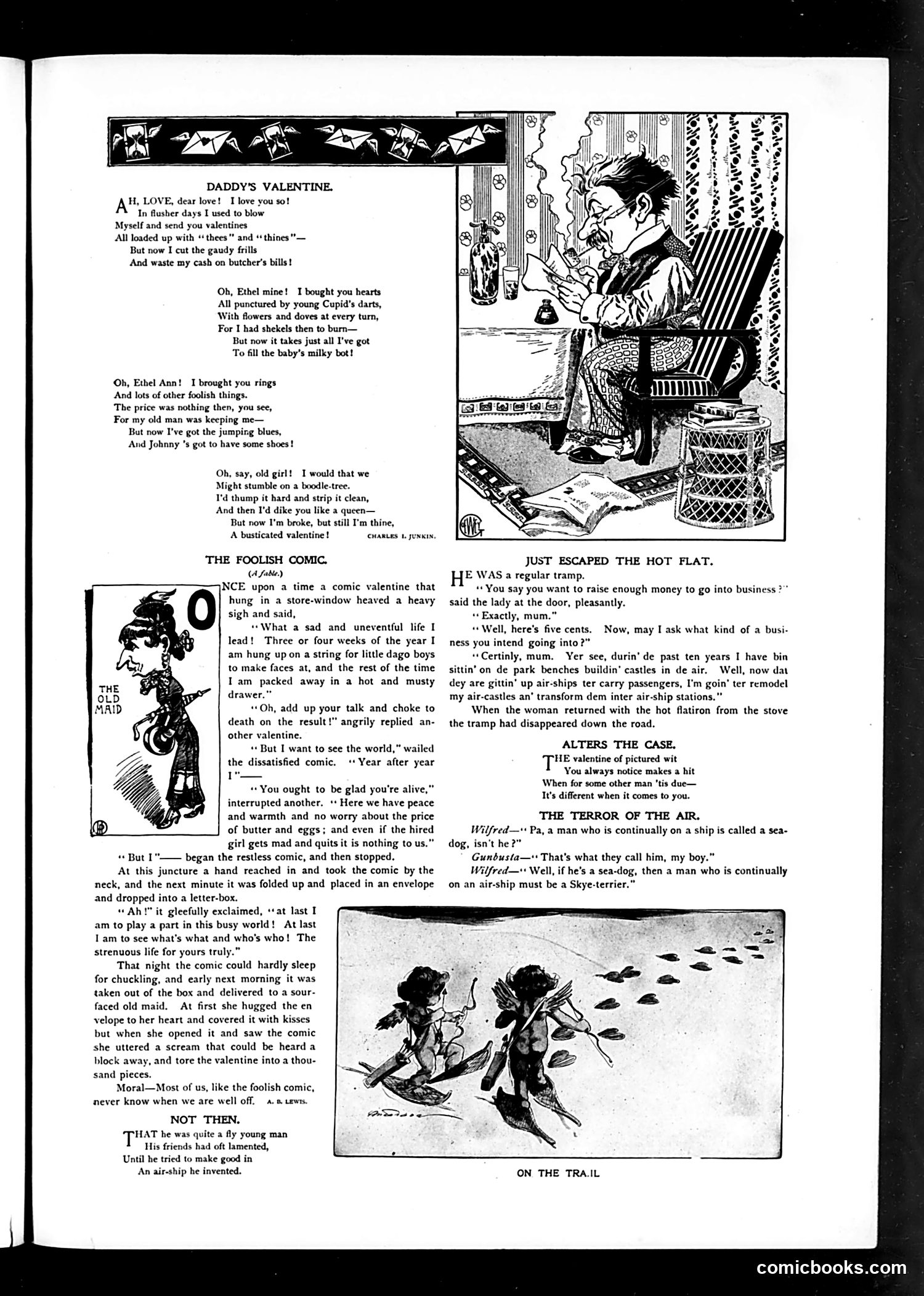
This page contains Valentine's Day-themed humor from an early 20th-century Judge magazine. **"Daddy's Valentine"** is a sentimental poem about a father buying romantic gifts (hearts, rings, flowers) for his wife, only to realize the expense strains the family budget—a gentle satire of commercialized Valentine's Day expectations versus domestic financial reality. **"The Foolish Comic"** depicts a character lamenting being "hung on a string" as comic relief, forced to entertain while unhappy—satirizing the exploitation of performers and comedians treated as disposable entertainment. The other short pieces appear to be humorous anecdotes about romantic misadventures and aviation mishaps, typical of Judge's light satirical style. The illustrations are straightforward period artwork supporting these domestic and social comedy themes.
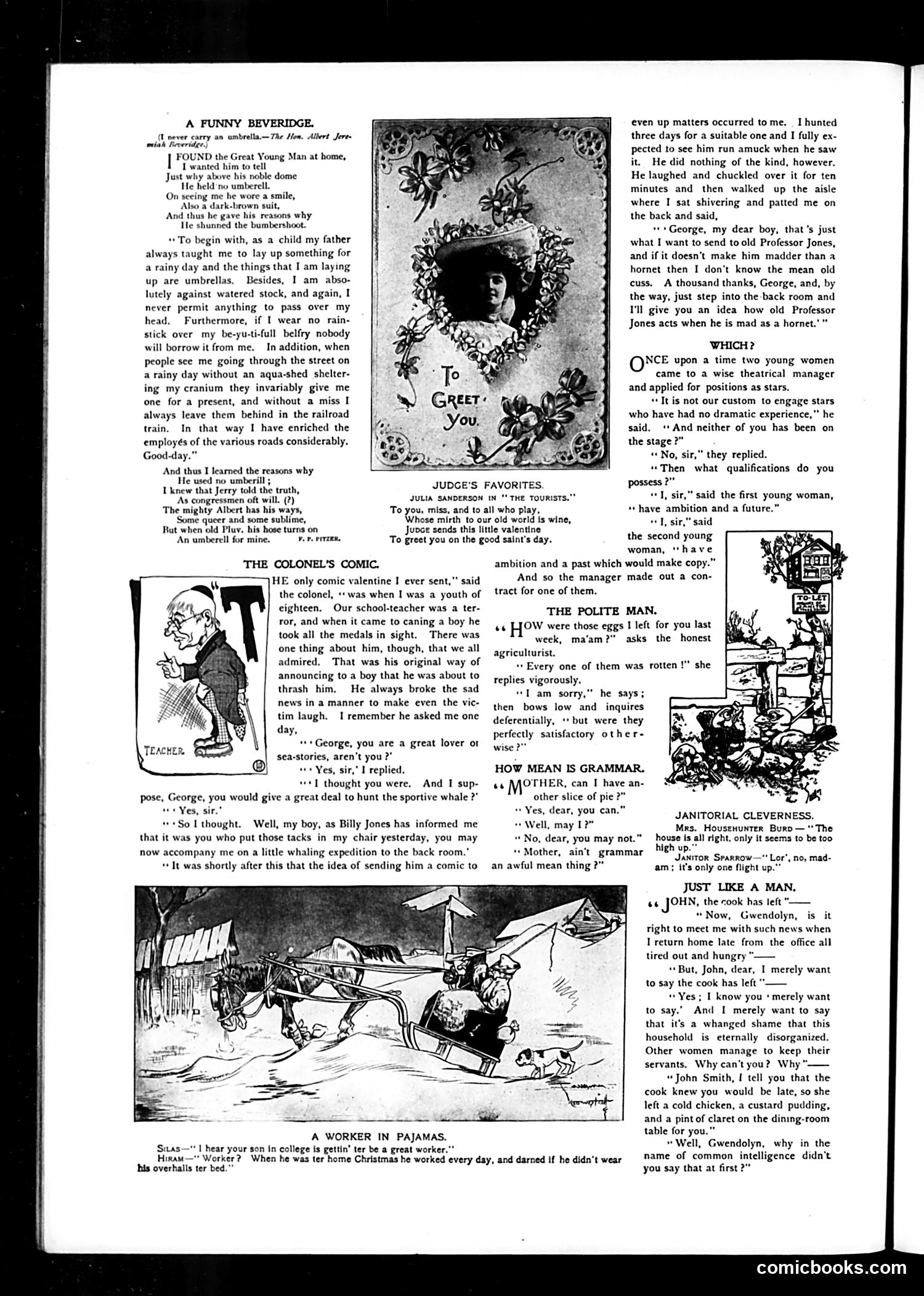
This page contains several short humorous sketches typical of Judge's satirical format: **"A Funny Beverage"** mocks a snobbish young man who refuses common beverages, preferring only rare imported drinks—social satire on class pretension. **"The Colonel's Comic"** features a colonel telling anecdotes about announcing threatening news in humorous ways to make victims laugh despite bad news—absurdist humor about emotional manipulation. **"Which?"** presents two young women applying for theatrical positions, questioned about their qualifications—likely satirizing unqualified people seeking stage work. **"A Worker in Pajamas"** shows a humorous domestic scene, apparently mocking a man working in pajamas during Christmas—social commentary on laziness or unconventional work habits. The remaining sections ("The Polite Man," "How Mean is Grammar," "Janitorial Cleverness," "Just Like a Man") are brief domestic humor pieces about everyday social interactions and gender dynamics typical of early 20th-century magazine satire.
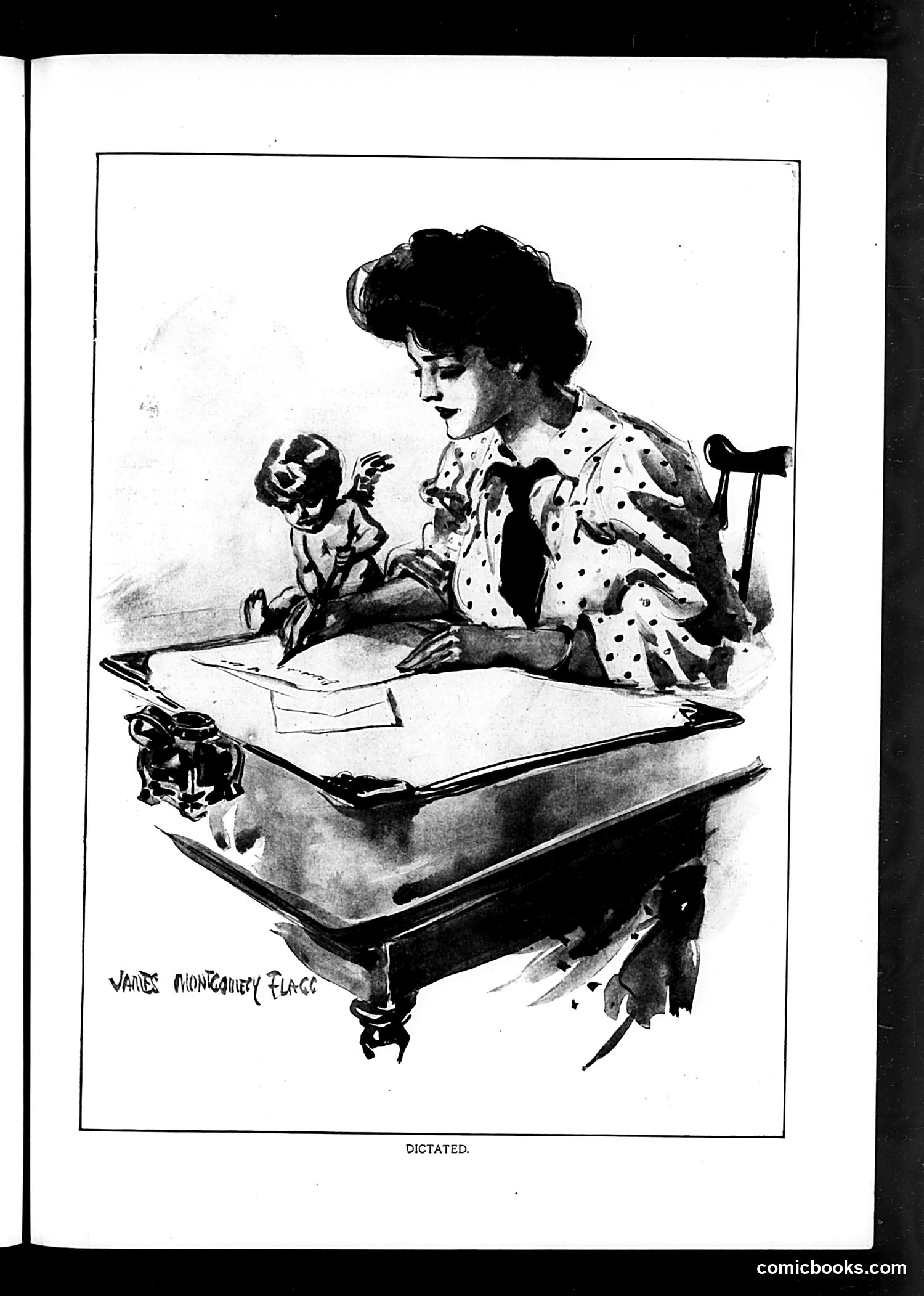
This illustration by James Montgomery Flagg depicts a woman at a desk dictating to a small cherub or cupid figure, who appears to be writing or transcribing her words. The title "DICTATED" suggests commentary on female authority and voice in professional settings. The cartoon likely satirizes early 20th-century anxieties about women entering the workplace, particularly in secretarial and administrative roles. The reversal—with a woman as the authoritative dictator rather than the typist—may be either celebrating women's growing professional power or mocking it, depending on the magazine's stance. The cherub figure adds whimsy, possibly infantilizing the scenario or suggesting the novelty of female workplace authority during this era.
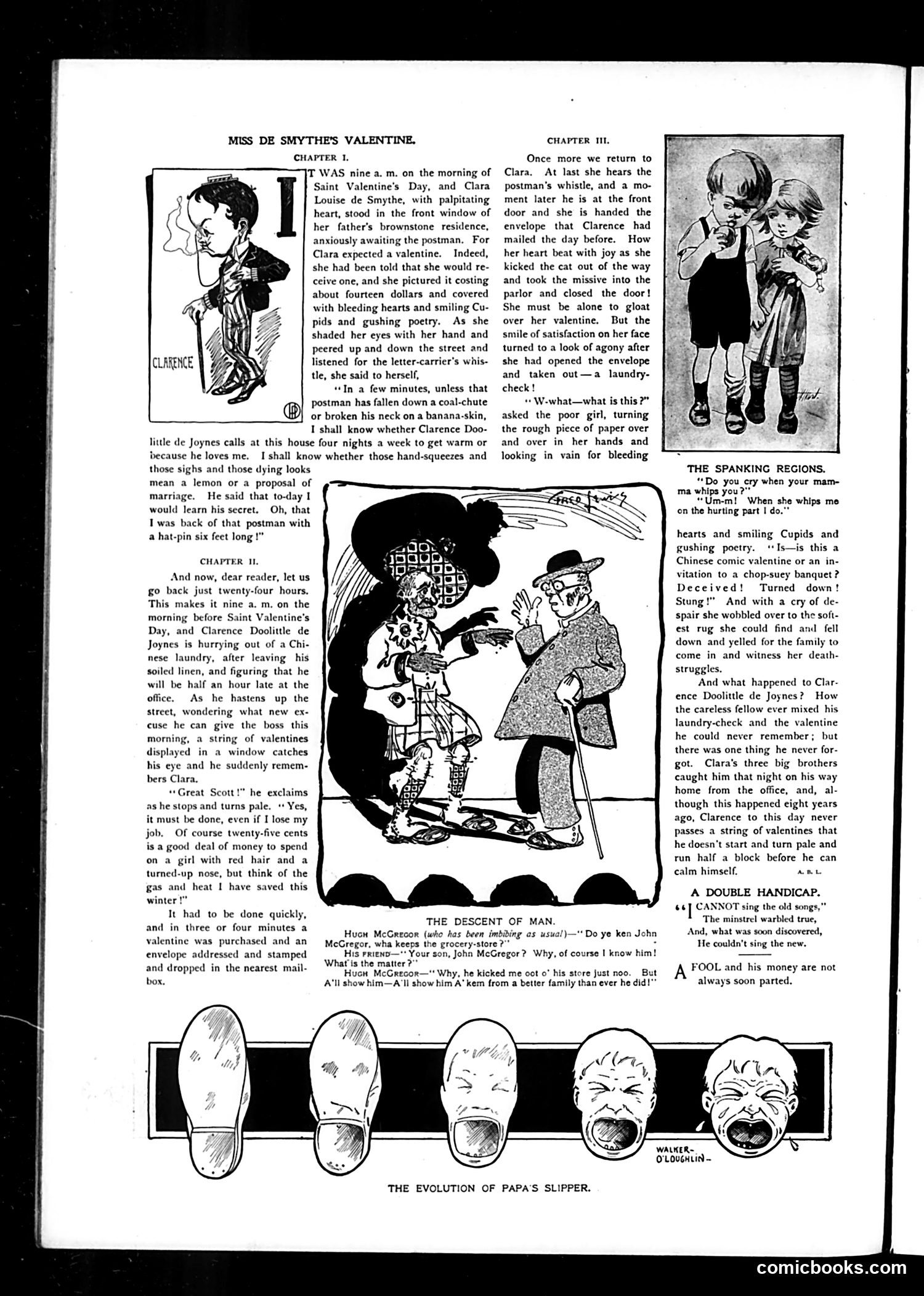
This page from *Judge* satirizes romantic expectations and class pretensions through a serialized story about Clara de Smythe's Valentine's Day disappointment. **The Main Satire:** Clara, a wealthy young woman, expects an expensive, ornate valentine from her suitor Clarence. Instead, she receives a laundry check—he accidentally sent her the receipt from the Chinese laundry instead of a romantic card. The humor mocks both her materialistic expectations (imagining a $14 valentine with "bleeding hearts and smiling Cupids") and Clarence's carelessness. **Supporting Comics:** - "The Descent of Man" jokes about an Irish drunk (Huon McGregor) boasting of superior family breeding after being kicked out of a grocery store - "The Evolution of Papa's Slipper" and "The Spanking Regions" are crude gag cartoons about domestic discipline **Context:** The piece satirizes Victorian sentimentality around Valentine's Day, wealthy pretension, and immigrant (particularly Chinese) labor stereotypes typical of early-1900s American humor.
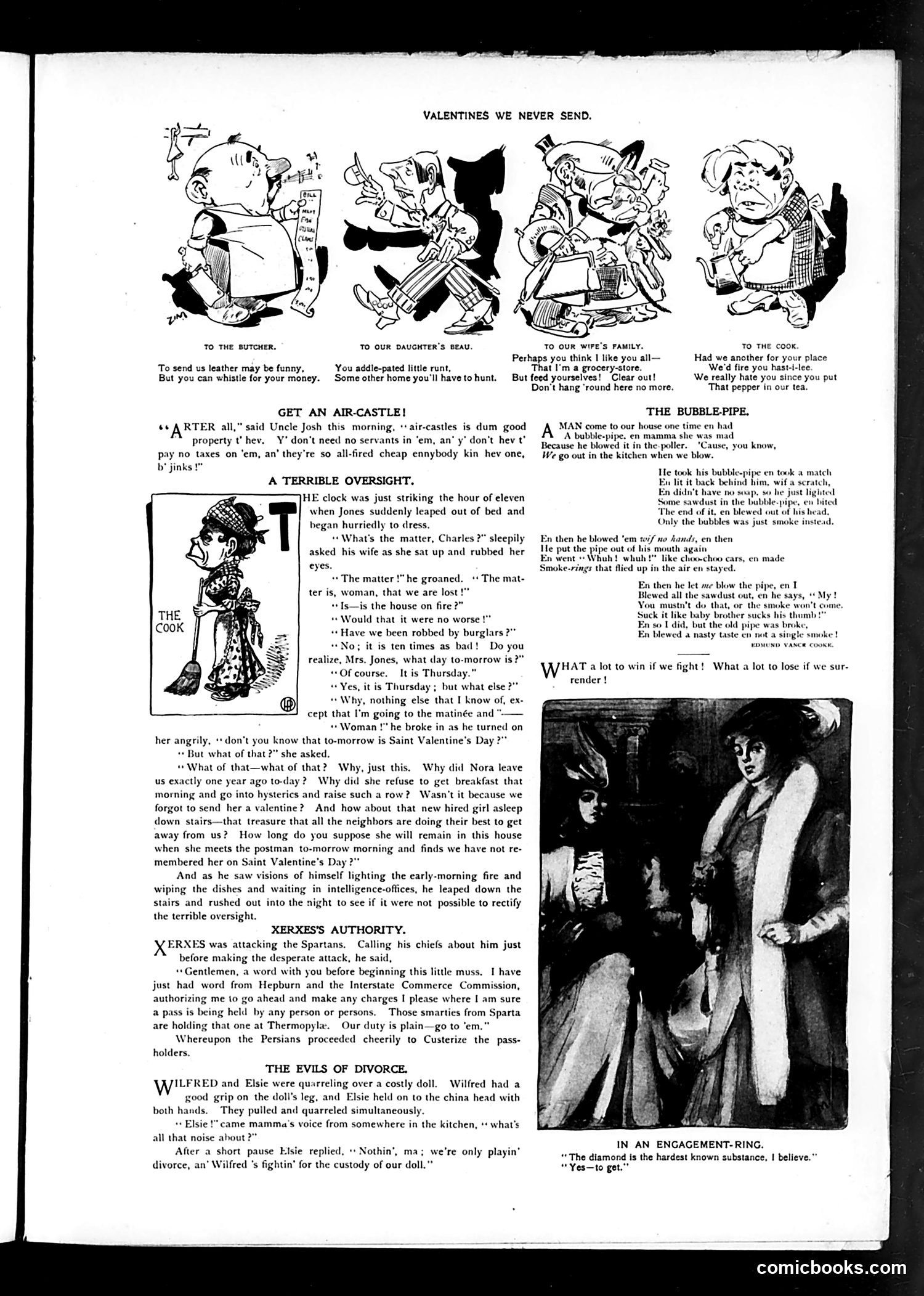
This page from *Judge* magazine contains several satirical pieces mocking domestic life and contemporary politics: **"Valentines We Never Send"** shows exaggerated "anti-valentines"—hostile greeting cards to a butcher, a daughter's boyfriend, the wife's family, and a cook—satirizing marital frustration and class tensions. **"A Terrible Oversight"** jokes about a husband panicking that he forgot to send his maid a Valentine's Day card, fearing she'll quit like the previous servant did. It satirizes employers' anxiety about losing domestic help. **"Xerxes's Authority"** references the Interstate Commerce Commission (a real U.S. regulatory body), anachronistically placing it in ancient Persia. It mocks corporate monopolies using railroad "passes" to avoid fair competition—a contemporary political scandal. **"The Evils of Divorce"** shows children playing "divorce" by fighting over a doll, satirizing how common divorce had become and its impact on families. **"The Bubble-Pipe"** appears to be a humorous anecdote about a guest blowing bubbles indoors with sawdust—mild domestic comedy. The cartoons target marriage strain, servant problems, monopolistic business practices, and social change through working-class and domestic scenarios.
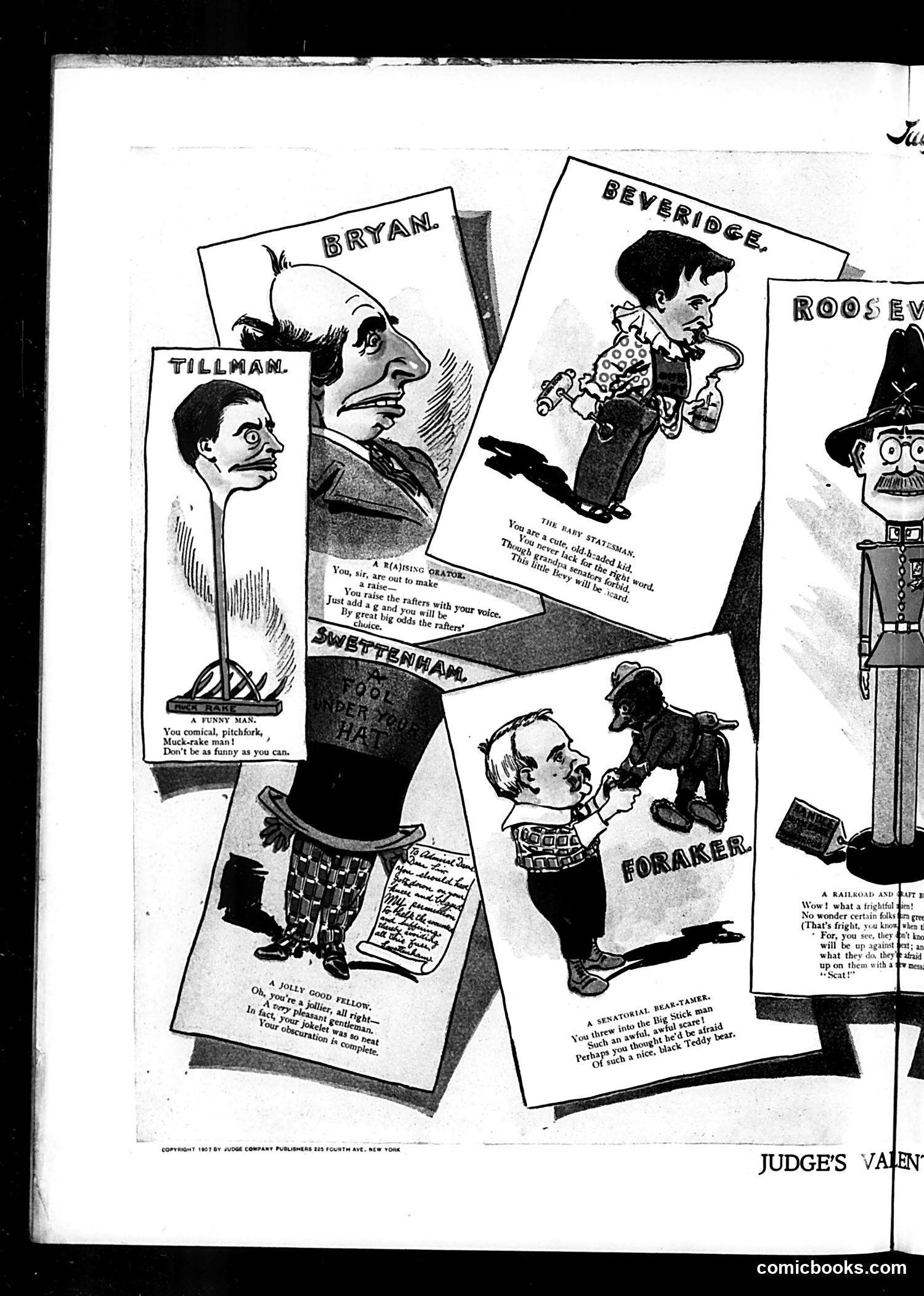
This page contains character sketches satirizing prominent political figures of the early 1900s. The caricatures appear to target politicians and public figures of the era, each labeled with their names (Tillman, Bryan, Beveridge, Swettenham, Foraker, and Roosevelt). The format uses exaggerated physical features—a common cartooning technique—to mock these individuals. The accompanying verse beneath each caricature likely contains satirical commentary on their political positions or public behavior, though the OCR text is largely illegible. The references to "raising" issues, "funny" behavior, and railroad matters suggest commentary on contemporary political debates, possibly regarding railroad regulation, which was a major political issue during Theodore Roosevelt's presidency. Without clearer text, the specific satirical points remain unclear, but the overall intent appears to be ridiculing these figures' public personas and political stances through visual and verbal caricature.
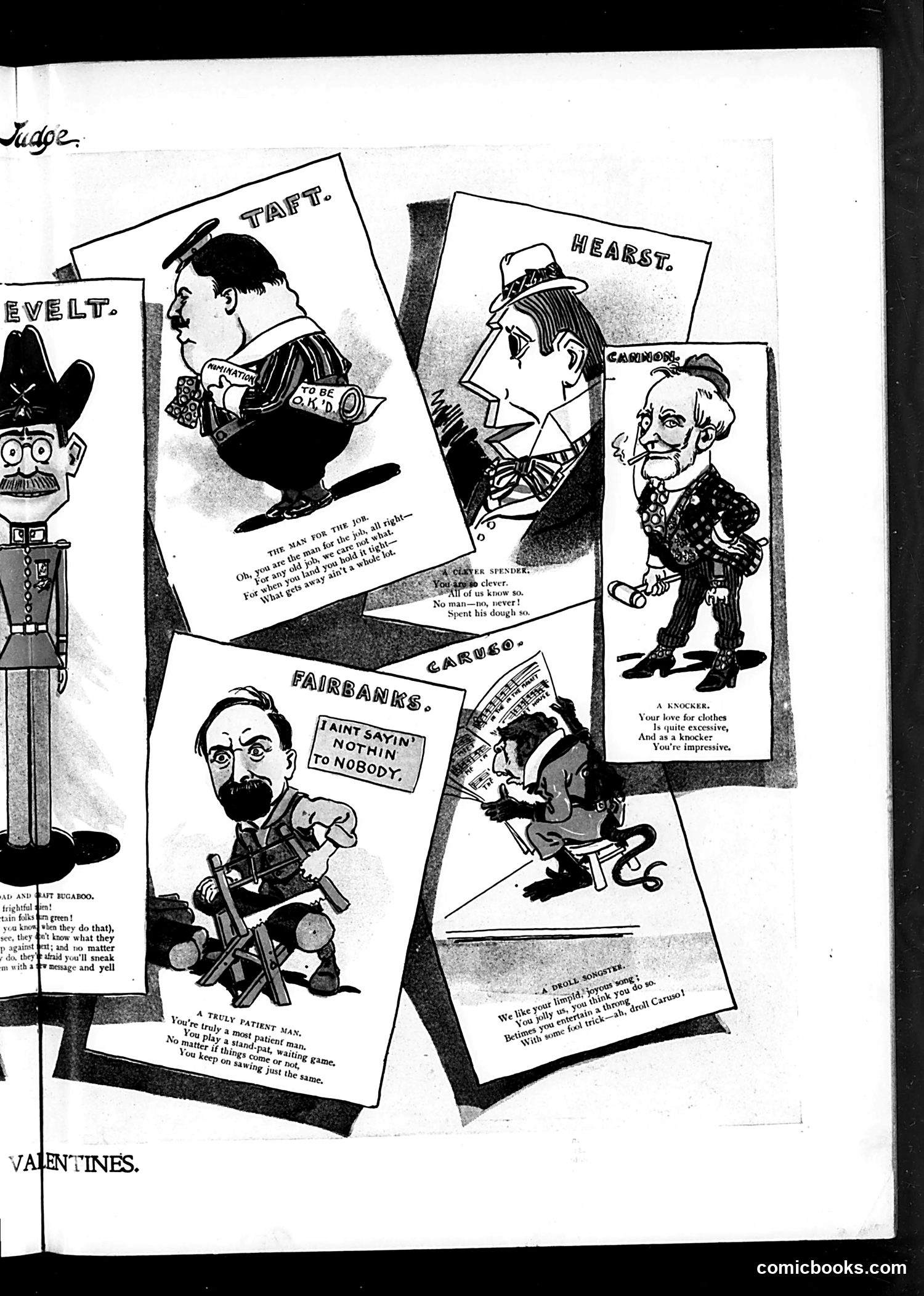
This page features satirical "Valentine" cards mocking political and public figures of the era. The caricatures include labeled figures: "Evelt" (Theodore Roosevelt), "Taft" (President William Howard Taft), "Hearst" (newspaper magnate William Randolph Hearst), "Cannon" (likely Speaker Joseph Cannon), "Garfield," and "Fairbanks" (likely Vice President James Sherman or another contemporary). Each card contains insulting verses—one subject is called a "knocker" (critic), another "taint sayin' nothin' to nobody," another "a truly patient man." The satire targets these figures' public personas and perceived character flaws. The format mimics actual Valentine cards but uses them as vehicles for political ridicule, a common Judge magazine technique. The specific grievances are difficult to determine without additional context, but they reflect early 1900s American political rivalries and public debates.
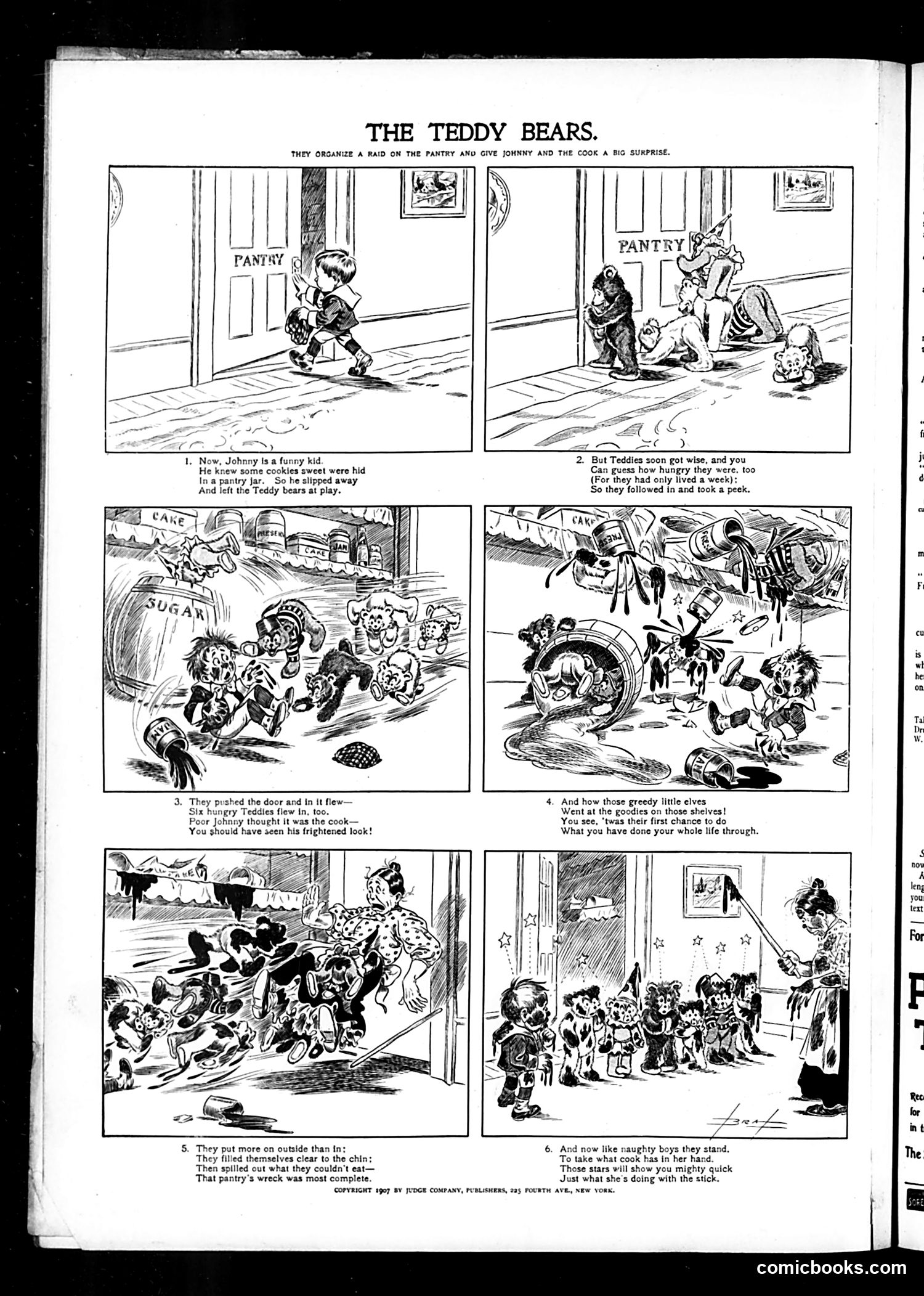
This is a humorous children's story comic from Judge magazine (1907), playing on the "Teddy Bear" craze that swept America following President Theodore Roosevelt's presidency. The strip depicts anthropomorphized teddy bears discovering a household pantry and gleefully ransacking it. The satire operates on multiple levels: the bears represent mischievous children or greedy adults discovering forbidden plenty. Panel 3's "frightened look" and panel 6's threatening cook with a stick reference common period anxieties about punishment and authority. The bears' single-minded consumption—stuffing themselves "clear to the chin"—mocks human greed and lack of restraint. The "Teddy" bears themselves are a topical reference, as the Roosevelt-named toys were wildly popular novelties in this era. The joke ultimately relies on viewers' familiarity with both the toys and common childhood mischief narratives, making it accessible entertainment that reinforced social lessons about obedience and consequences.
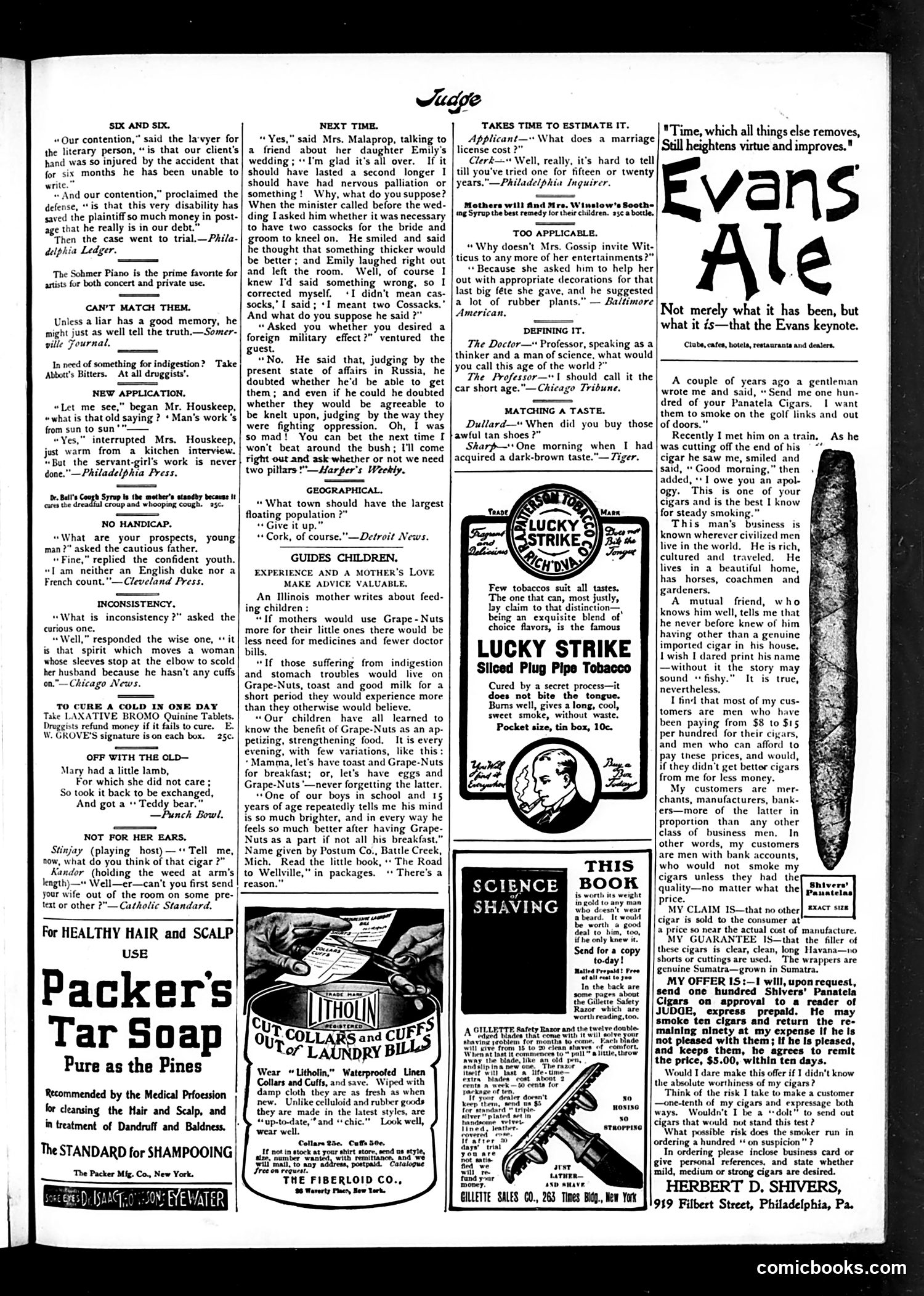
This page from the satirical magazine *Judge* contains mostly **short humorous anecdotes and advertising**, rather than political cartoons. The jokes mock everyday absurdities: a lawyer argues an injury actually *saved* his client money (by preventing letter-writing); Mrs. Malaprop confuses "cassocks" with "Cossacks" when discussing her daughter's wedding preparations; a young man claims having no aristocratic titles is an advantage in courtship. The humor relies on **wordplay and social observation** rather than political commentary. References include contemporary concerns like servant-girl labor and the Russian political situation (mentioned in the Cossacks joke, likely alluding to turn-of-century Russian upheaval). The page is primarily **commercial**, featuring numerous advertisements for patent medicines (Grape-Nuts, Abbott's Bitters, Lucky Strike cigars) and grooming products (Packer's Tar Soap). This mix of light satirical content with aggressive advertising typifies *Judge*'s format as an entertainment and marketing vehicle for the era.
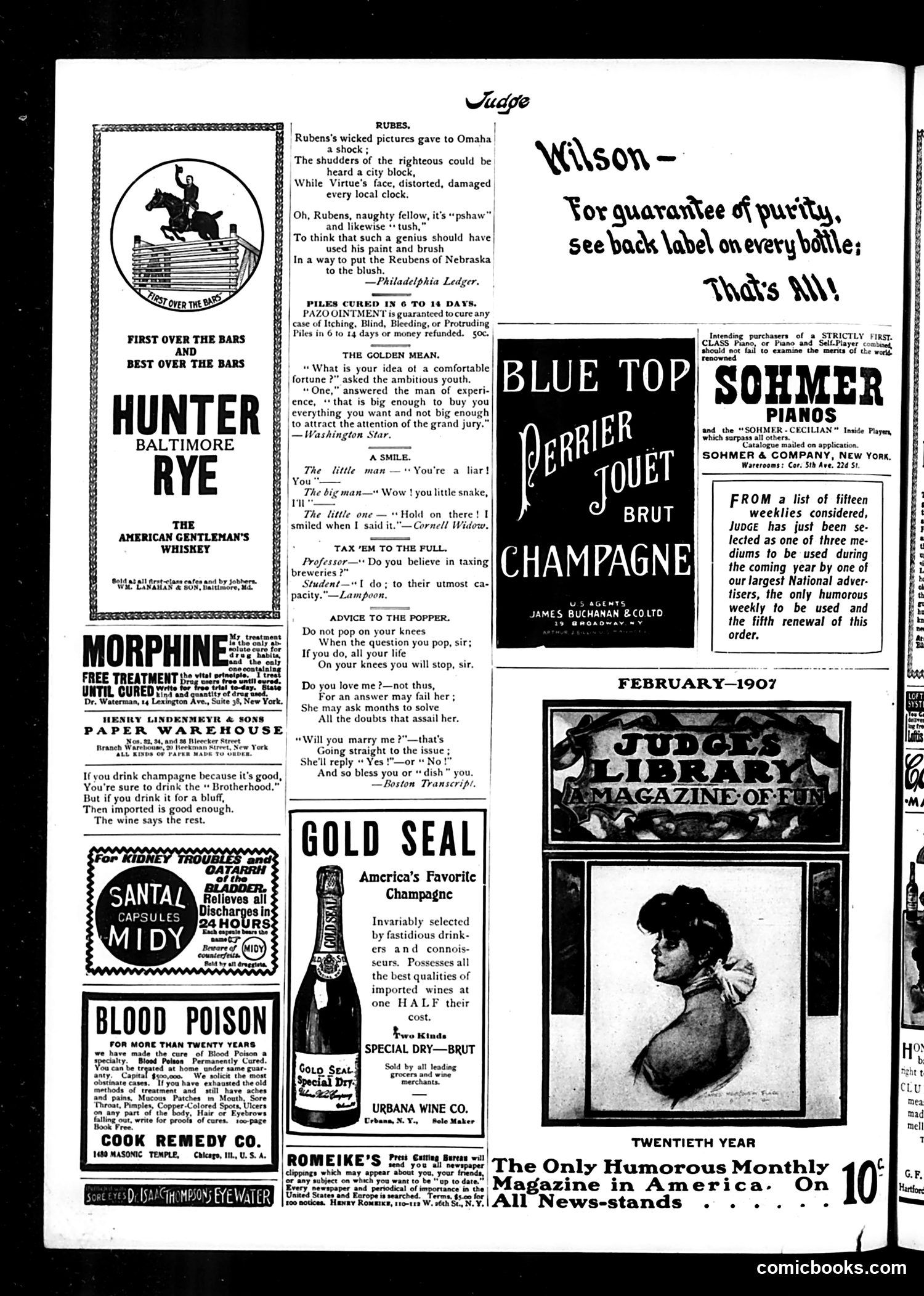
This page is primarily **advertising with minimal editorial content**—typical for Judge's back pages. The few text items are brief satirical quips: **"RUBES"** mocks Omaha's outrage over painter Peter Paul Rubens's nude works, suggesting puritanical Midwesterners were scandalized by classical art. **Short humor pieces** include wordplay about proposals, taxation of breweries, and "comfortable fortunes"—the last a cynical joke that wealth should be large enough to buy what you want but *small enough to avoid grand jury attention* (implying tax evasion or corruption concerns of the era). **Advertisements dominate**, hawking whiskey, champagne, patent medicines (including dubious "blood poison" and morphine treatments), and pianos. These reflect early-1900s advertising practices, including medical quackery now recognized as harmful. The masthead announces Judge as "The Only Humorous Monthly Magazine in America" at 10¢, noting its twentieth year of publication—establishing its longevity and market position.
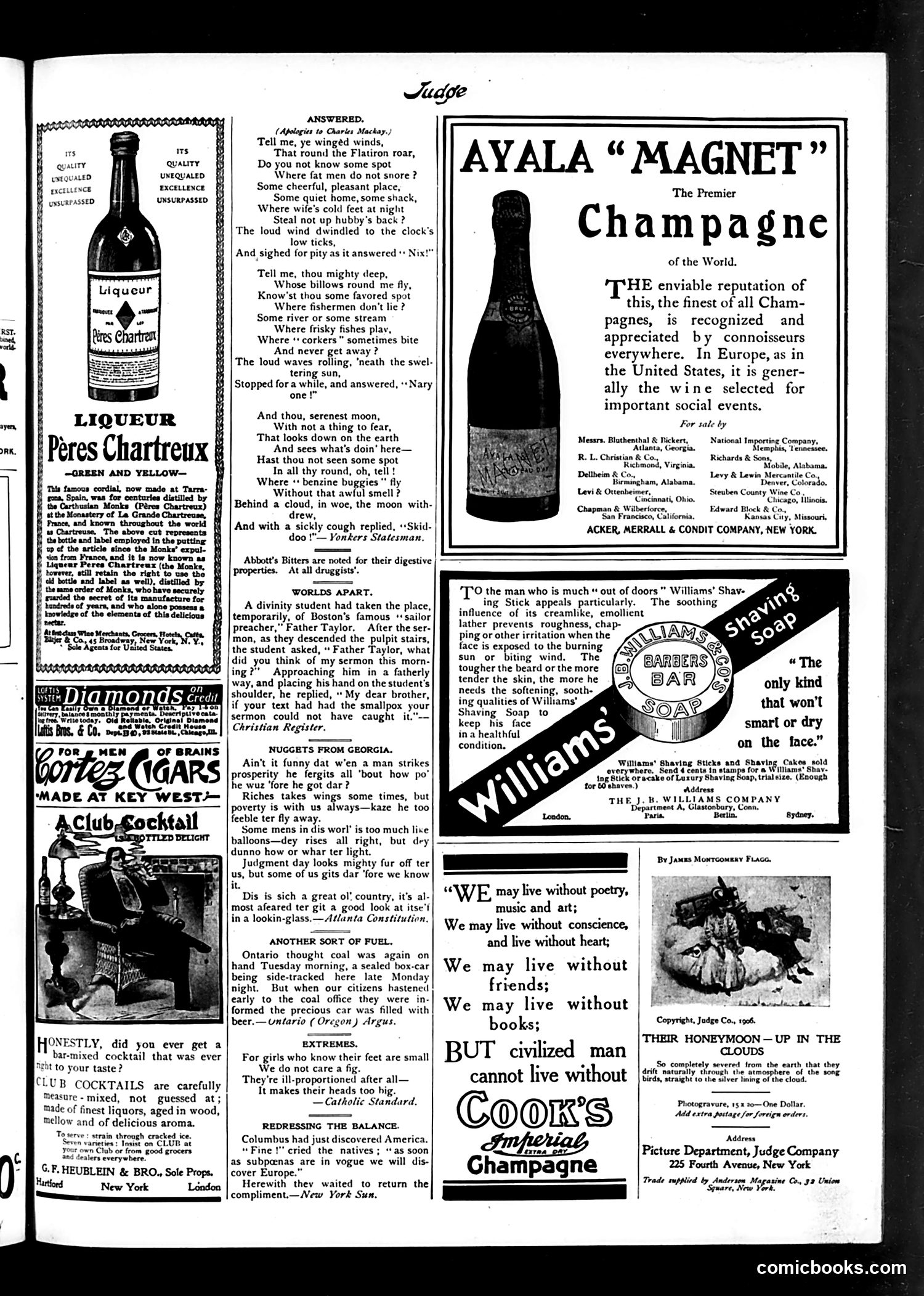
This page is primarily **advertising and literary content** rather than political satire. The main visual elements are product advertisements: - **Ayala "Magnet" Champagne** dominates the right side, marketed as "The Premier Champagne of the World" - **Williams' Shaving Soap** features a barber's pole graphic - **Cook's Imperial Champagne** advertisement with a quoted poem about civilization and necessity - **Liqueur Père Chartreux** bottle advertisement on the left The page also includes a poem by James Montgomery Flagg titled "Their Honeymoon—Up in the Clouds" with an accompanying photograph. The content reflects early 20th-century American consumer culture, with luxury goods prominently featured. There is **no apparent political cartoon or satirical commentary** on this particular page—it functions primarily as an advertising and content vehicle for Judge magazine's commercial partnerships.
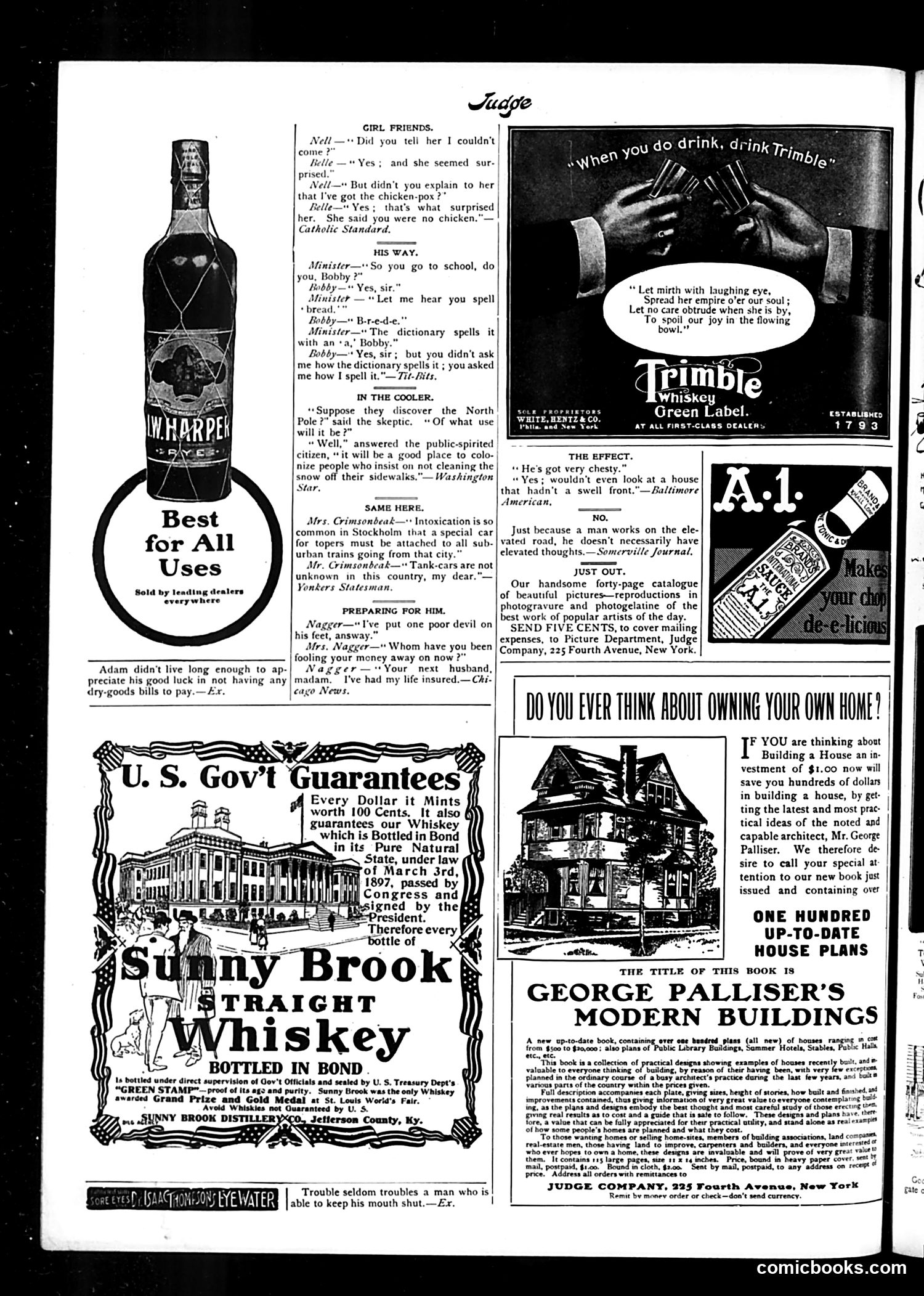
This page from *Judge* magazine consists primarily of **advertisements and brief humorous anecdotes**, not political cartoons. The content reflects early 1900s American humor and commerce. **Main Elements:** 1. **Whiskey Advertisements** (dominant): Multiple ads for "W. Harper," "Sunny Brook," and "Trimble" whiskey. The Sunny Brook ad emphasizes U.S. government guarantee and a World's Fair award—marketing tactics appealing to safety-conscious consumers. 2. **Humorous Vignettes**: Brief jokes about domestic life, spelling, intoxication, and marital nagging. These are gentle social satire typical of the era's family magazines. 3. **House Plans Advertisement**: Promotes architect George Palliser's book of home designs for $1, targeting working-class homeowners. **Historical Context**: This page reflects pre-Prohibition America (established 1920), when whiskey was openly advertised in mainstream publications. The humor is genteel and domestic rather than political, suggesting *Judge's* target audience was middle-class readers seeking light entertainment and consumer goods.
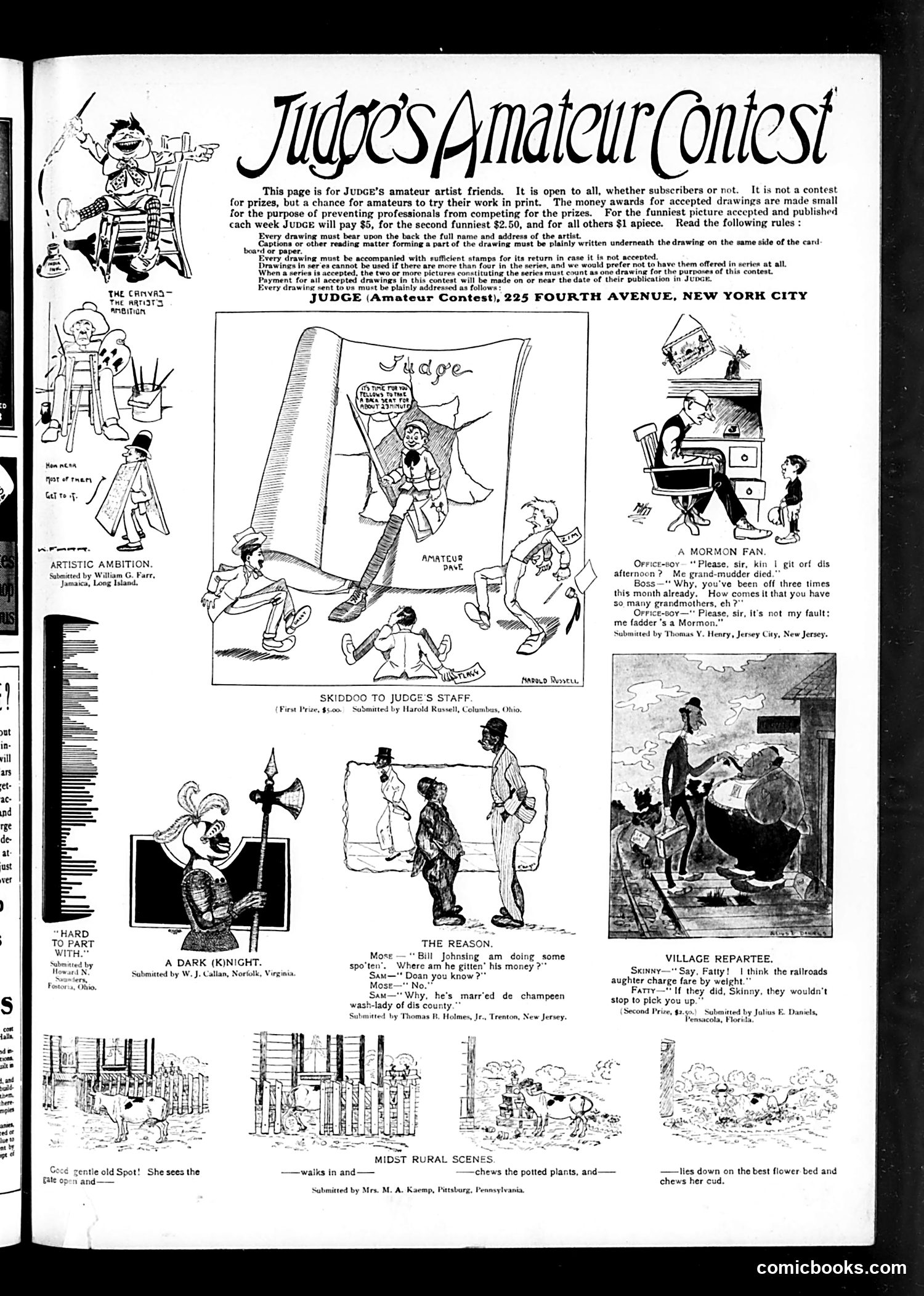
This page showcases amateur cartoon submissions to Judge magazine's weekly contest, with small monetary prizes ($5, $2.50, $1) to encourage amateur artists while excluding professionals. The cartoons feature period racial and ethnic stereotypes common to early 20th-century American humor: - **"A Mormon Fan"**: Jokes about polygamy—a boy claims his father is Mormon to explain having multiple "grandmothers" dying conveniently to get time off work. - **"The Reason"**: Features African American dialect humor about money-lending, using "Mose" and "Bill" as stereotypical names. - **"Village Repartee"**: Heavy-set characters (likely immigrants or rural folk) joke about railroads charging fares by weight. - **"Midst Rural Scenes"**: Depicts a cow destroying household items—simple rural/farm humor. - **"Dark Knight"** and **"Artistic Ambition"**: Appear to be visual gags with minimal text. The page reflects Judge's satirical approach through stereotyping and ethnic humor typical of the era, though deeply offensive by modern standards.
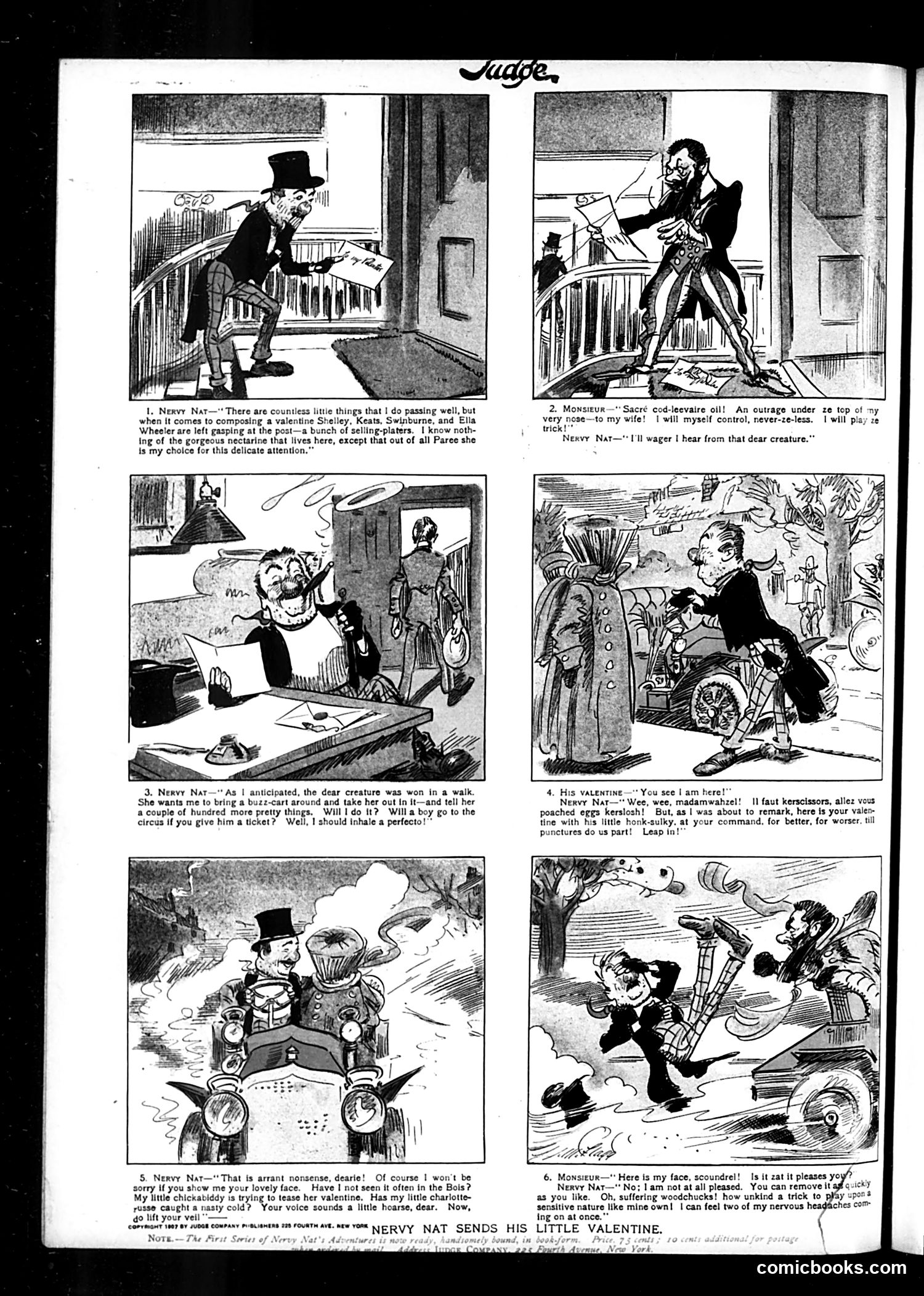
This is a six-panel comic strip featuring "Nervy Nat," an American character pursuing romance in Paris. The satire centers on Nat's brazen, comedic attempts to woo women through flattery and persistence, contrasted with the outraged reactions of a French husband (identified as "Monsieur"). The joke plays on cultural stereotypes: Nat's bold American confidence versus French dignity and propriety. He compares himself favorably to famous poets, successfully wins a woman's affection with flowery compliments, and even recruits her for a carriage ride. The French husband's escalating fury—expressed in theatrical fractured French ("Sacré cod-leevaire")—provides comic counterpoint. The humor relies on Nat's shameless, relentless pursuit despite social impropriety, the language barrier comedy, and the clash between American brashness and French formality. This reflects early 1900s attitudes about national character types.