
A complete issue · 17 pages · 1905
Judge — December 23, 1905
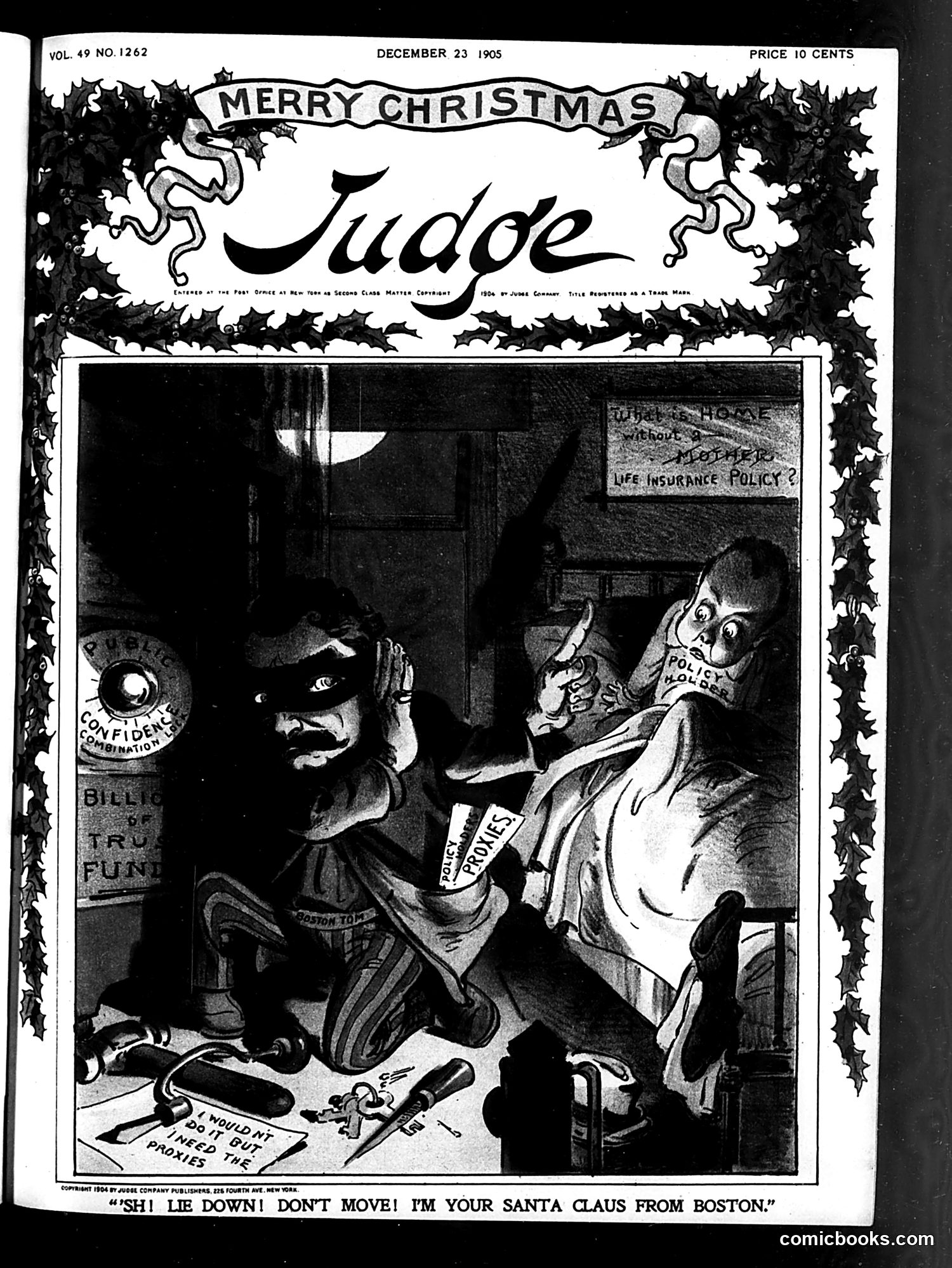
This Christmas-themed satirical cartoon depicts a burglar or criminal ("Santa Claus from Boston") confronting what appears to be a wealthy man in his home. The burglar holds documents labeled "POLICY" while the homeowner looks alarmed. Papers scattered on the floor reference insurance fraud ("I would not insured the proxies"). The satire targets insurance scams and financial corruption—likely referencing Boston's reputation for corporate fraud during this era. The "Santa Claus" disguise suggests criminals exploiting holiday goodwill. The overall message criticizes dishonest insurance practices and policy manipulation by unscrupulous businessmen who hide behind respectable covers. The cartoon reflects Progressive Era concerns about financial malfeasance and corporate crime.
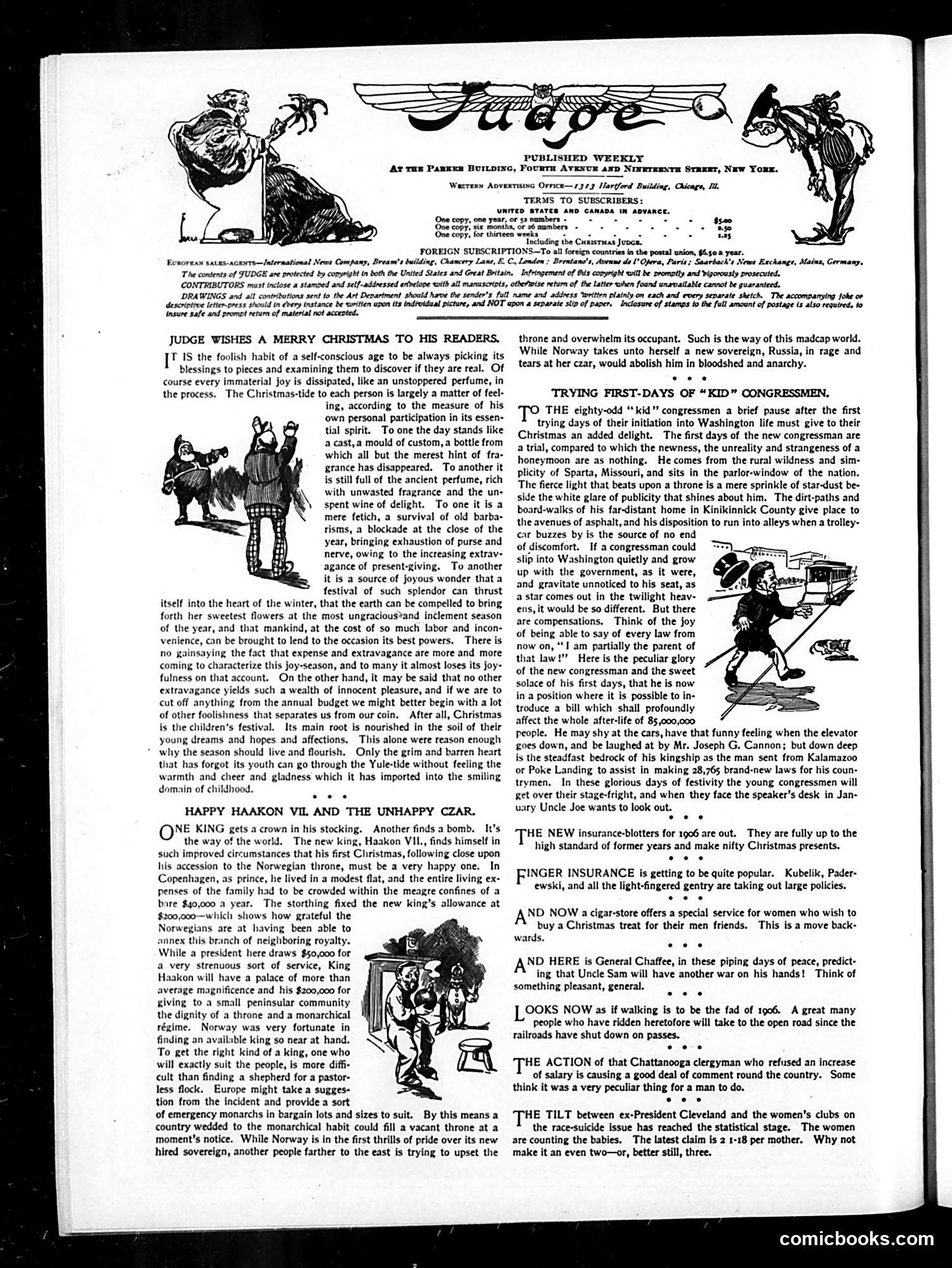
This page contains editorial commentary rather than political cartoons. The main articles discuss: **"Judge Wishes a Merry Christmas to His Readers"** — A philosophical piece about Christmas's value as a time for examining one's blessings and character. **"Trying First-Days of 'Kid' Congressmen"** — Commentary on newly elected congressmen adjusting to Washington life, suggesting their initial inexperience creates comedic situations (elevator mishaps, etc.). The satire mocks their naiveté in government. **"Happy Haakon VII and the Unhappy Czar"** — Contrasts Norway's King Haakon VII's modest lifestyle with Russia's Czar's extravagance, suggesting the Czar's spending threatens monarchical stability. The page also contains brief satirical notes on insurance trends, General Chaffee, railroad passes, and salary disputes—typical Judge magazine commentary on contemporary social and political matters circa early 1900s.
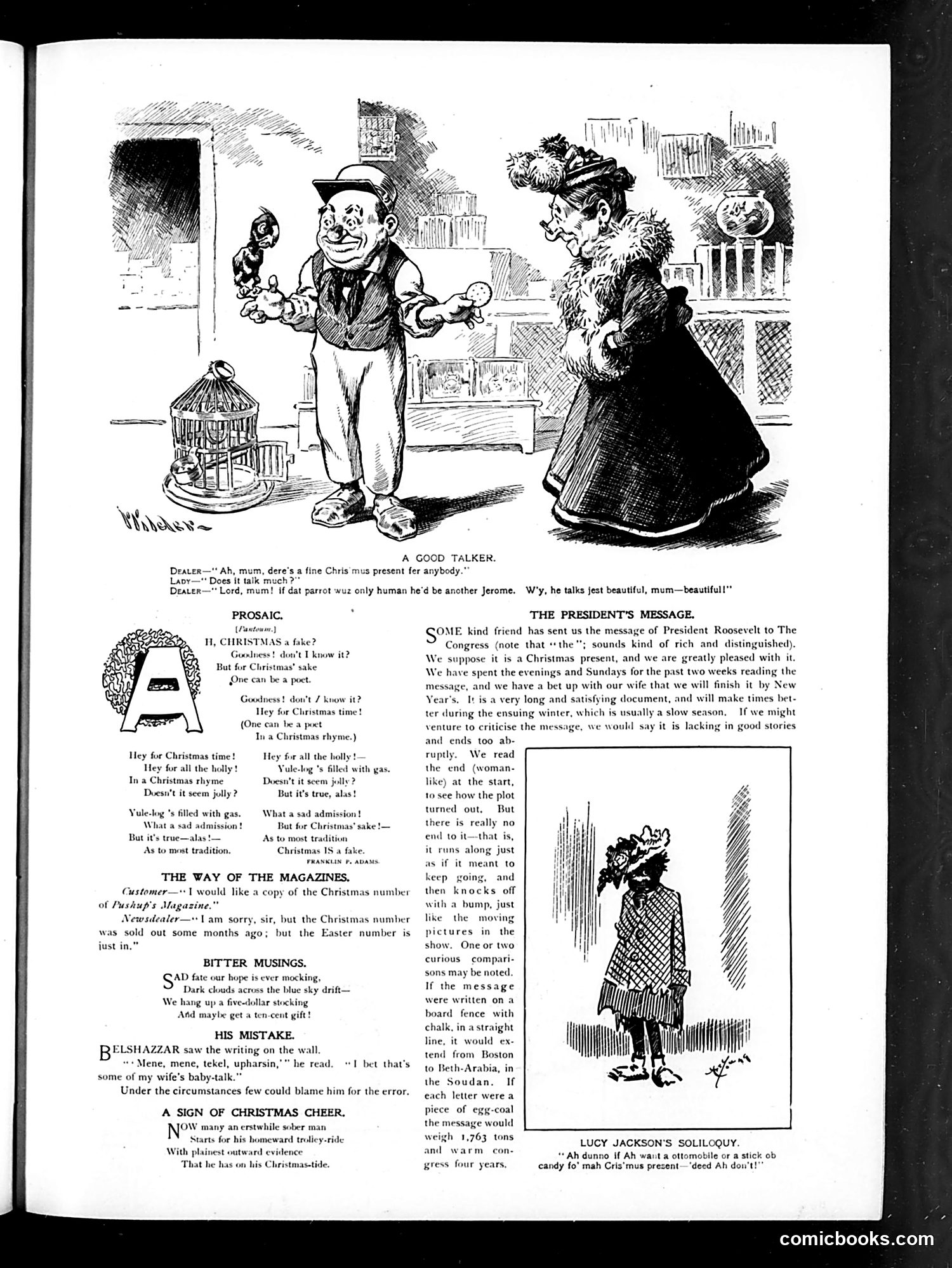
The top cartoon, "Good Talker," depicts a dealer showing a parrot to a woman, joking that the bird talks so much it could serve as a Christmas present. The humor relies on comparing the parrot's chattiness to unwanted gift-giving obligations. Below are several brief comedic pieces: "Prosaic" mocks Christmas clichés; "The Way of the Magazines" jokes about Easter numbers following Christmas issues; "Bitter Musings" and "His Mistake" are short satirical verses about holiday and domestic frustrations; "A Sign of Christmas Cheer" comments on soldiers' morale. "The President's Message" discusses a lengthy presidential Christmas greeting to Congress, comparing its endless nature to a moving picture that just keeps going. The bottom illustration, "Lucy Jackson's Soliloquy," shows a woman contemplating Christmas gifts with resigned humor. This appears to be holiday-themed satirical content typical of Judge magazine's social commentary.
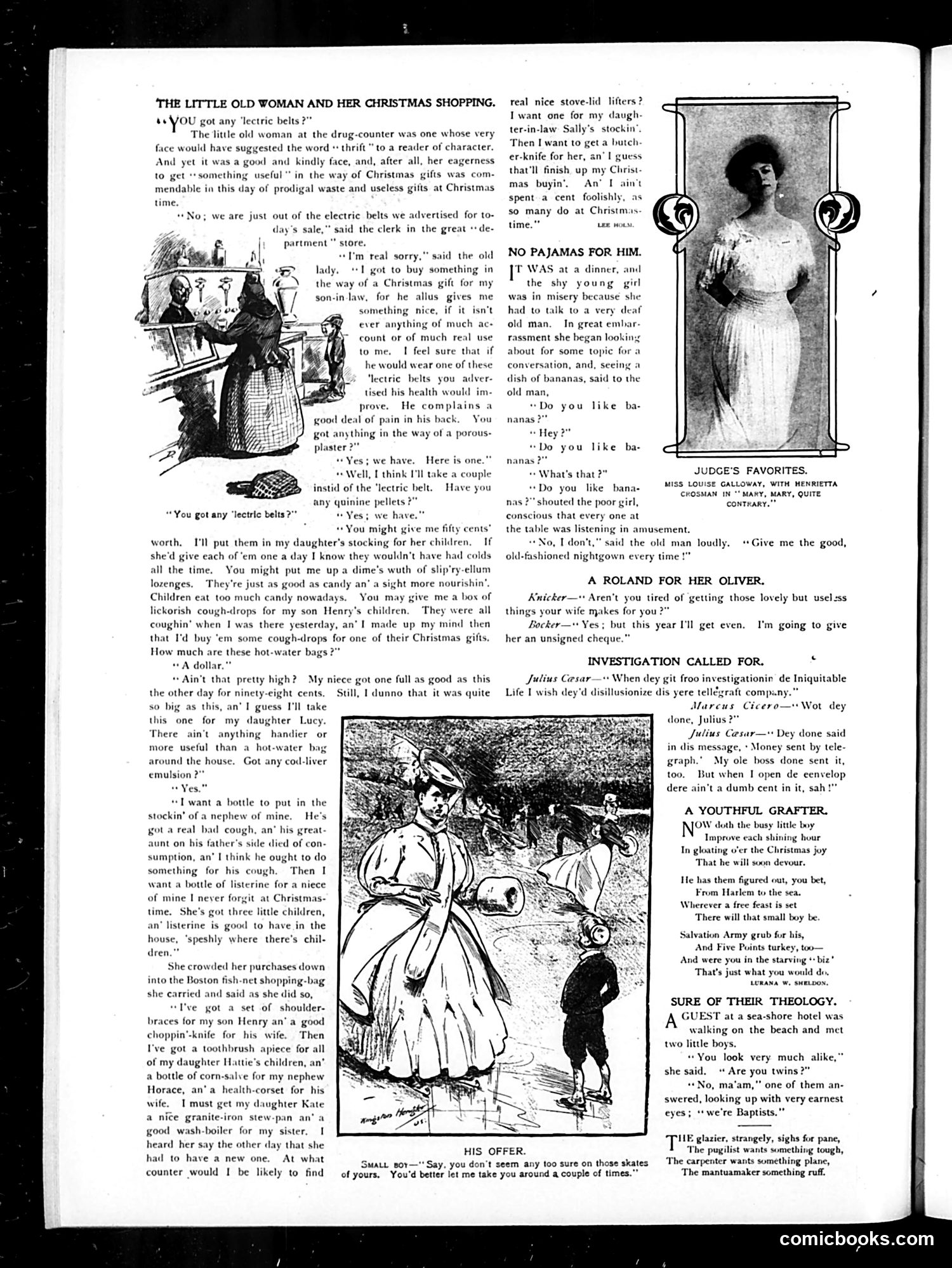
This page from *Judge* magazine combines a Christmas shopping story with humor pieces. The main narrative, "The Little Old Woman and Her Christmas Shopping," depicts an elderly woman struggling to find practical gifts at a drugstore. The clerk tries to sell her electric belts (a dubious health device popular in early 20th-century advertising), which she sensibly rejects, preferring useful items like cough syrup and shoulder braces. The accompanying illustration shows a woman with a child examining goods. The satire targets false health-cure marketing—electric belts were widely advertised as cure-alls despite lacking scientific validity. The old woman's pragmatic dismissal mocks the era's credulous consumers who purchased such dubious remedies as Christmas gifts. The piece gently ridicules both the exaggerated medical claims and the commercialization of Christmas.
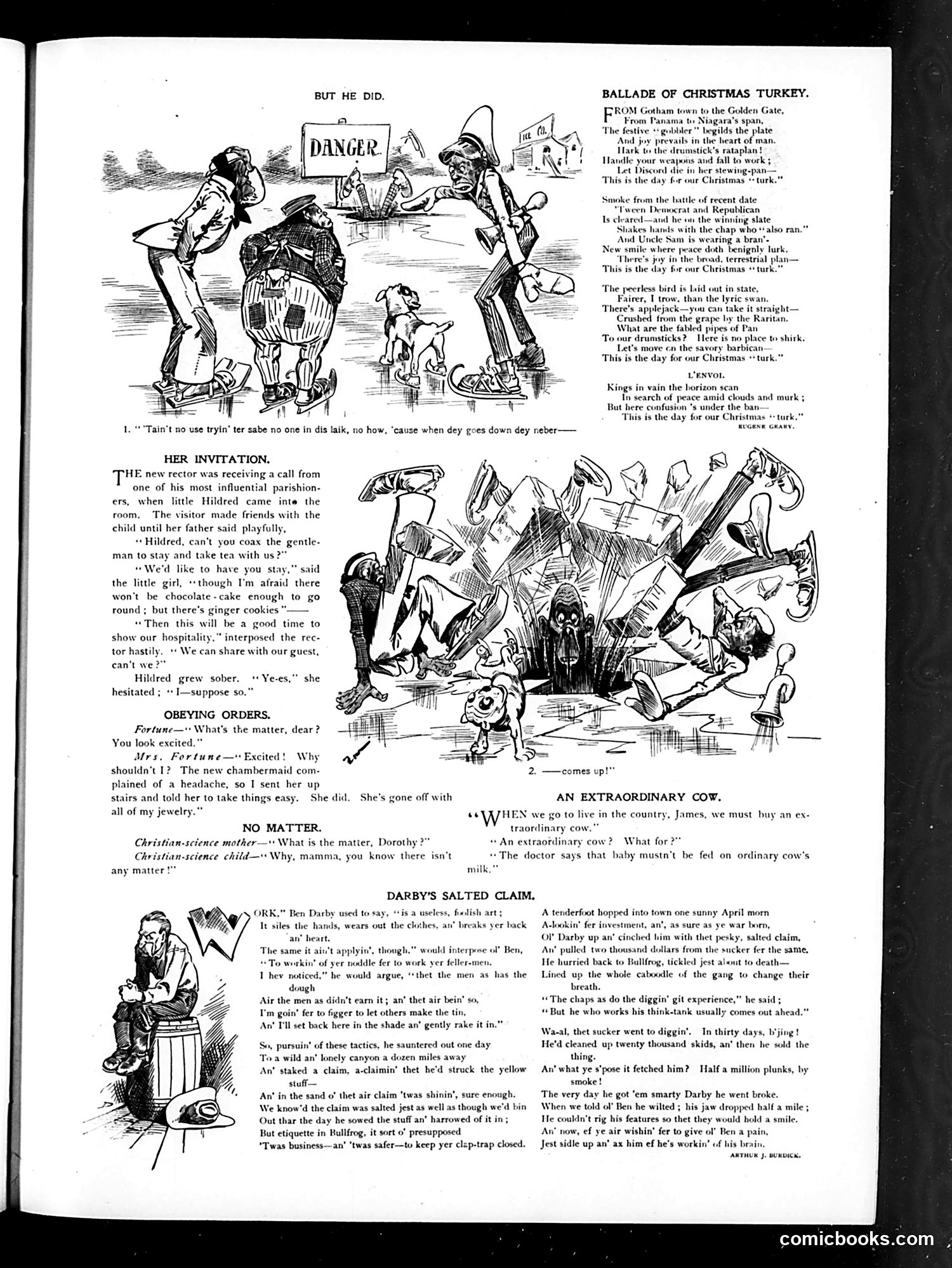
**Top Cartoon ("But He Did"):** This appears to satirize a political figure ignoring warnings or danger signs. The skeletal Death figure and warning sign suggest consequences of reckless action, though the specific reference is unclear without knowing the publication date. **"Ballade of Christmas Turkey":** A poem by Eugene Gravy mocking post-election chaos and confusion, likely referencing Democratic-Republican political turmoil around Christmas time. **Lower Sections:** Include domestic humor pieces ("Her Invitation," "Obeying Orders," "No Matter," "An Extraordinary Cow," "Darby's Salted Claim") featuring middle-class domestic scenarios and word-play rather than political satire—typical Judge filler content. The page mixes political commentary with light domestic humor, characteristic of early 20th-century satirical magazines.
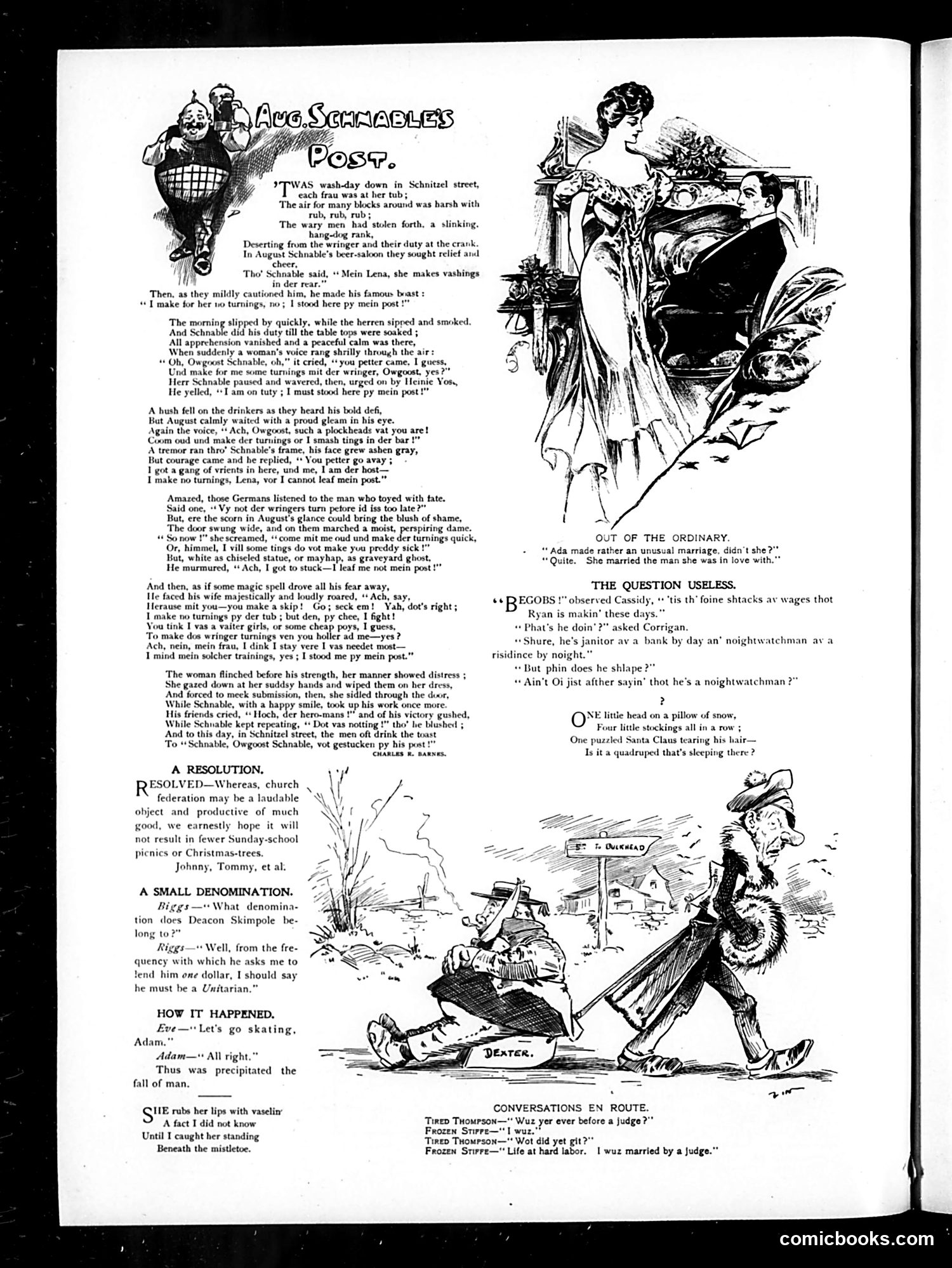
This humorous poem, illustrated with period caricatures, satirizes German-American immigrant life in early 20th-century America. The narrative follows August Schnable, who stakes his masculine honor on refusing to help his wife with laundry work, declaring he "must stood here py mein post" (must stay at his post) at the beer hall—a comic inversion of the phrase's military connotations. The satire targets both traditional German domestic hierarchy and male immigrant culture, particularly the saloon's centrality to working-class men's social lives. Schnable's stubborn refusal to assist with women's work, then his triumphant assertion of authority when confronted by his wife Lena, reflects period anxieties about gender roles and immigrant masculinity. The exaggerated German dialect and characterizations were typical Judge magazine humor, mining comedic effects from ethnic stereotypes while depicting recognizable neighborhood social dynamics of German-American communities.
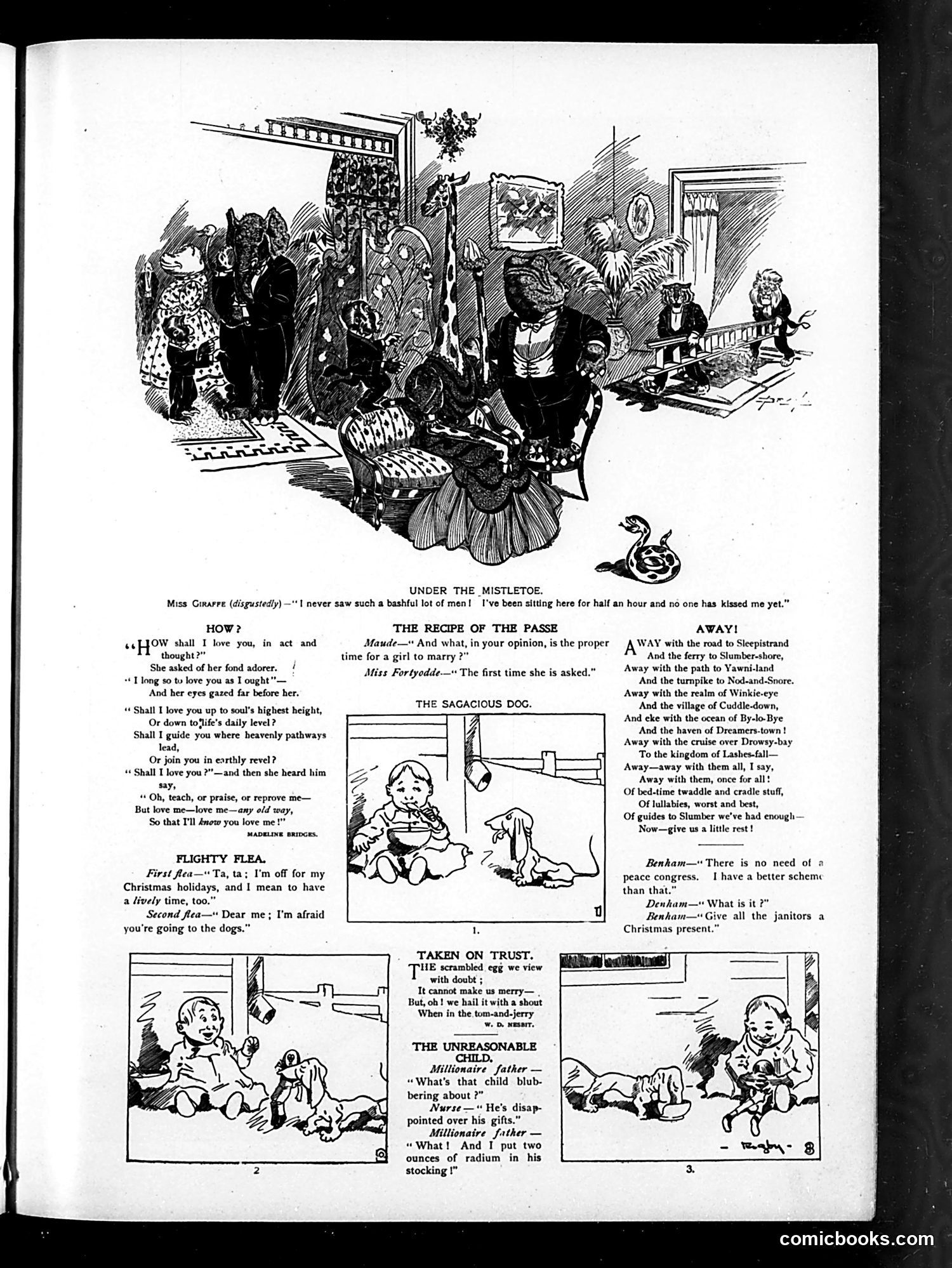
This page contains several short humorous pieces typical of early 20th-century satirical magazine content: **"Under the Mistletoe"** depicts a woman frustrated that men at a holiday gathering are too shy to kiss her, despite the traditional mistletoe excuse. **"How?"** presents a romantic woman pondering the depths of love, while her suitor simply wants affection "any old way." **"Flighty Flea"** is a pun: one flea warns another about "going to the dogs" (a common expression meaning decline), not realizing fleas literally live on dogs. **"The Unreasonable Child"** satirizes wealthy excess—a millionaire father is shocked his son is unhappy despite receiving radium in his stocking, suggesting absurd conspicuous consumption among the ultra-rich. **"Taken on Trust"** makes a mild joke about scrambled eggs tasting better when mixed with alcohol (tom-and-jerry being a hot drink). **"Away!"** is a humorous poem rejecting bedtime stories and lullabies, demanding rest instead. The page emphasizes romance, domestic life, and gentle social observation rather than hard political satire.
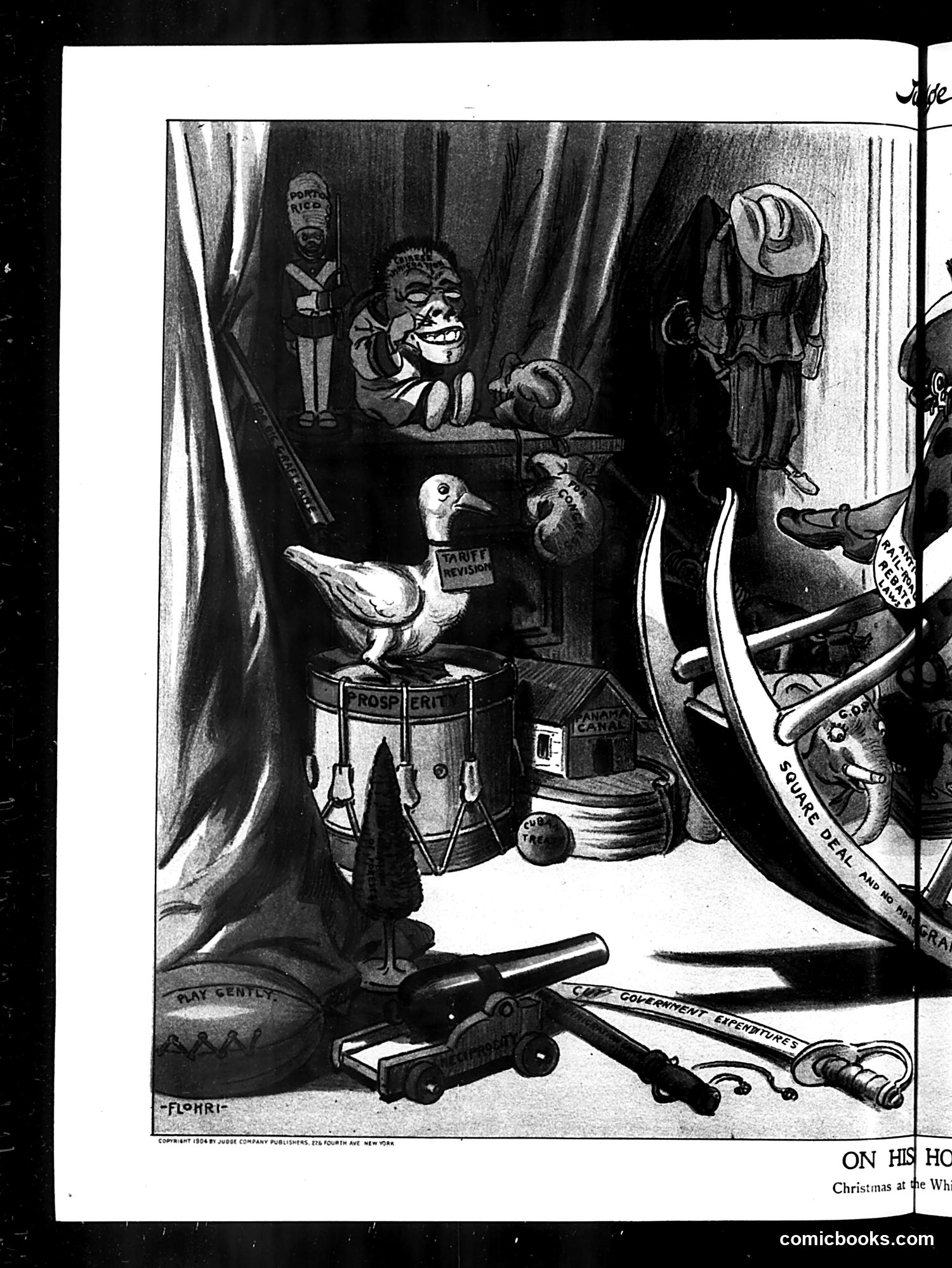
This appears to be a satirical illustration from *Judge* magazine showing a theatrical or stage scene with toys and carnival figures. The central figure is a grotesquely caricatured face (possibly representing a political or social figure) surrounded by various toys, dolls, and props including drums, a duck, and other carnival items arranged like a stage set with curtains. The partial text references "Christmas at the Wh[ite House]" (visible at bottom), suggesting this is political satire about the presidential residence during the holiday season. The cartoon likely satirizes either a specific political figure or event through this toy-box theatrical display, though without the full caption and date, the exact target and critique remain unclear. The style suggests early-to-mid 20th century.
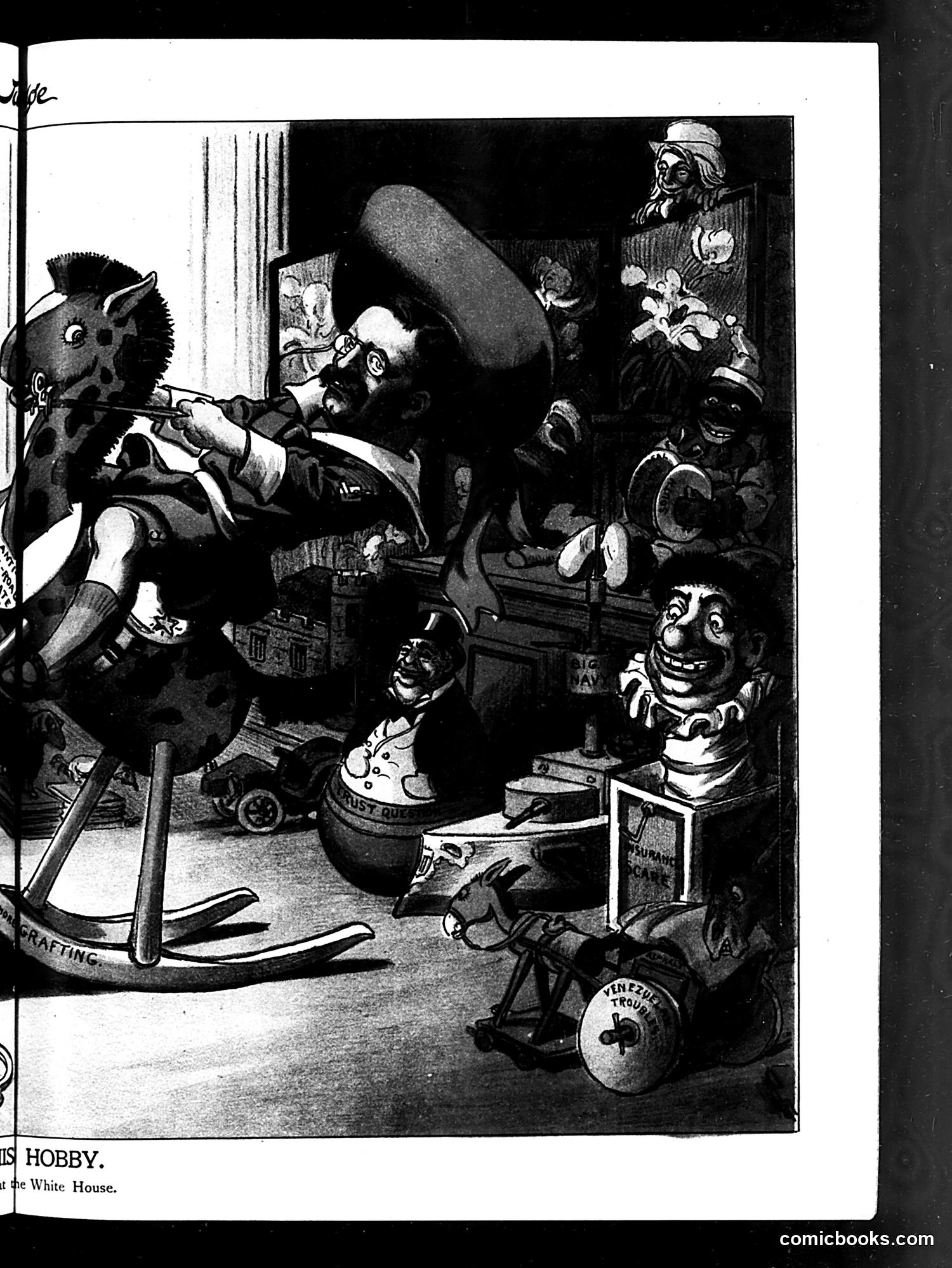
This political cartoon depicts a man in a workshop surrounded by toy figures and mechanical creations. The caption indicates this is "His Hobby" and references "the White House," suggesting the subject is a U.S. President. The cartoon satirizes the President as someone who treats governance like toy-making or puppet-manipulation—suggesting he merely plays with figures rather than conducting serious statecraft. The workshop setting with various mechanical toys implies he's orchestrating or controlling others rather than engaging in authentic leadership. The exaggerated caricatures and crude quality of the "toys" may mock both the President's competence and the perceived artificiality of his political maneuvering. Without a visible date or clearer identifying marks, the specific President and historical context remain unclear from the image alone.
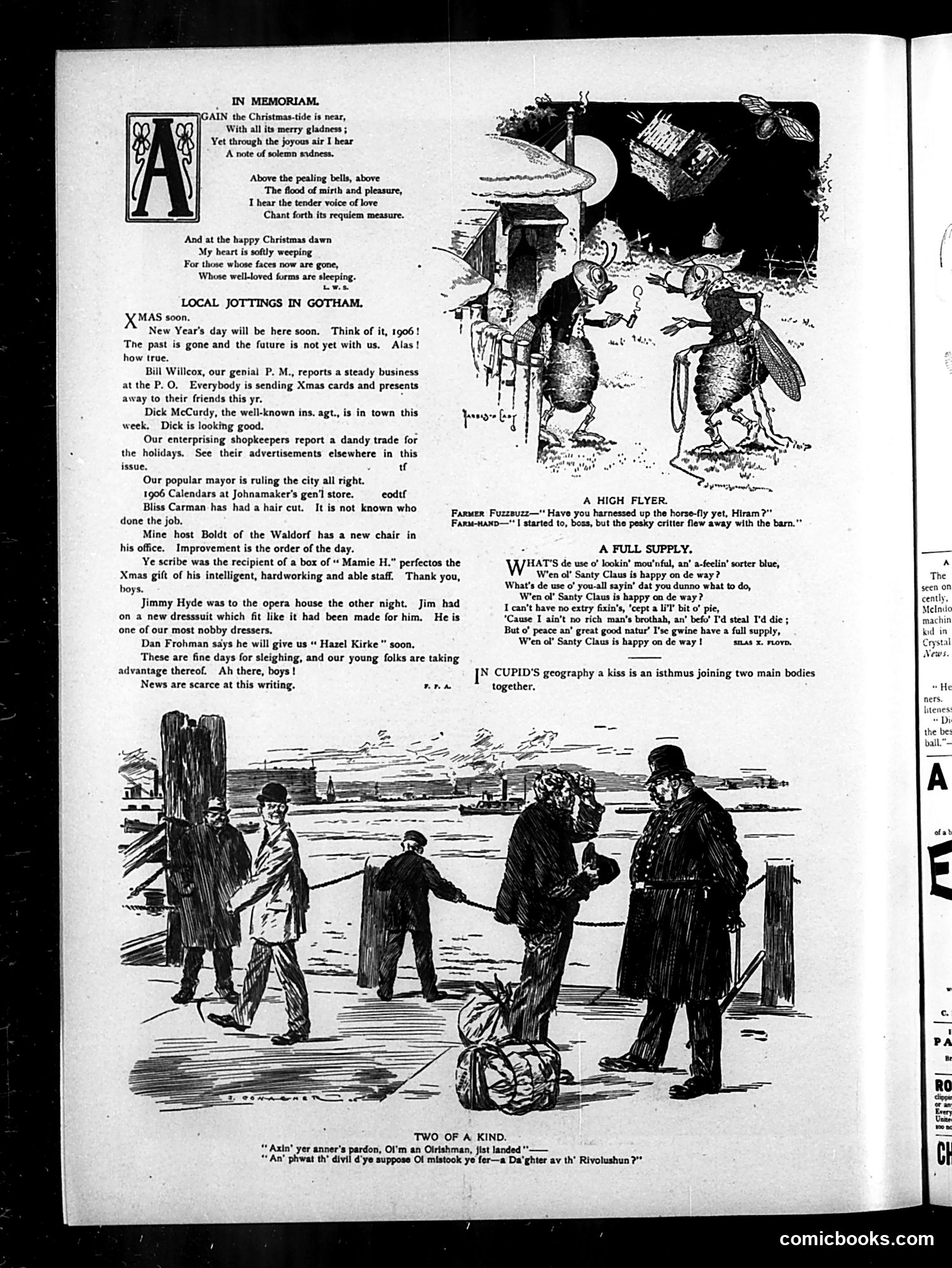
This page from Judge (circa 1906) contains three distinct satirical pieces: **"In Memoriam"** — A sentimental poem mourning Christmas past, contrasting holiday joy with melancholy reflection. **"Local Jottings in Gotham"** — Gossipy Manhattan society notes about minor civic figures (mayor, postmaster, shopkeepers) and theater personalities. The humor derives from treating trivial local events as newsworthy. **"Two of a Kind"** — A dock-side cartoon depicting Irish and German immigrant characters in dialect, with the joke playing on mutual immigrant mistrust. One character mistakes the other for someone else, humorously suggesting these immigrant groups were unfamiliar with or suspicious of one another. **"A Full Supply"** and **"A High Flyer"** — Brief comic dialogues in Black vernacular dialect, typical of period humor though offensive by modern standards. The overall tone reflects early 1900s urban American satire: society gossip, immigrant stereotyping, and period-appropriate comic dialectics.
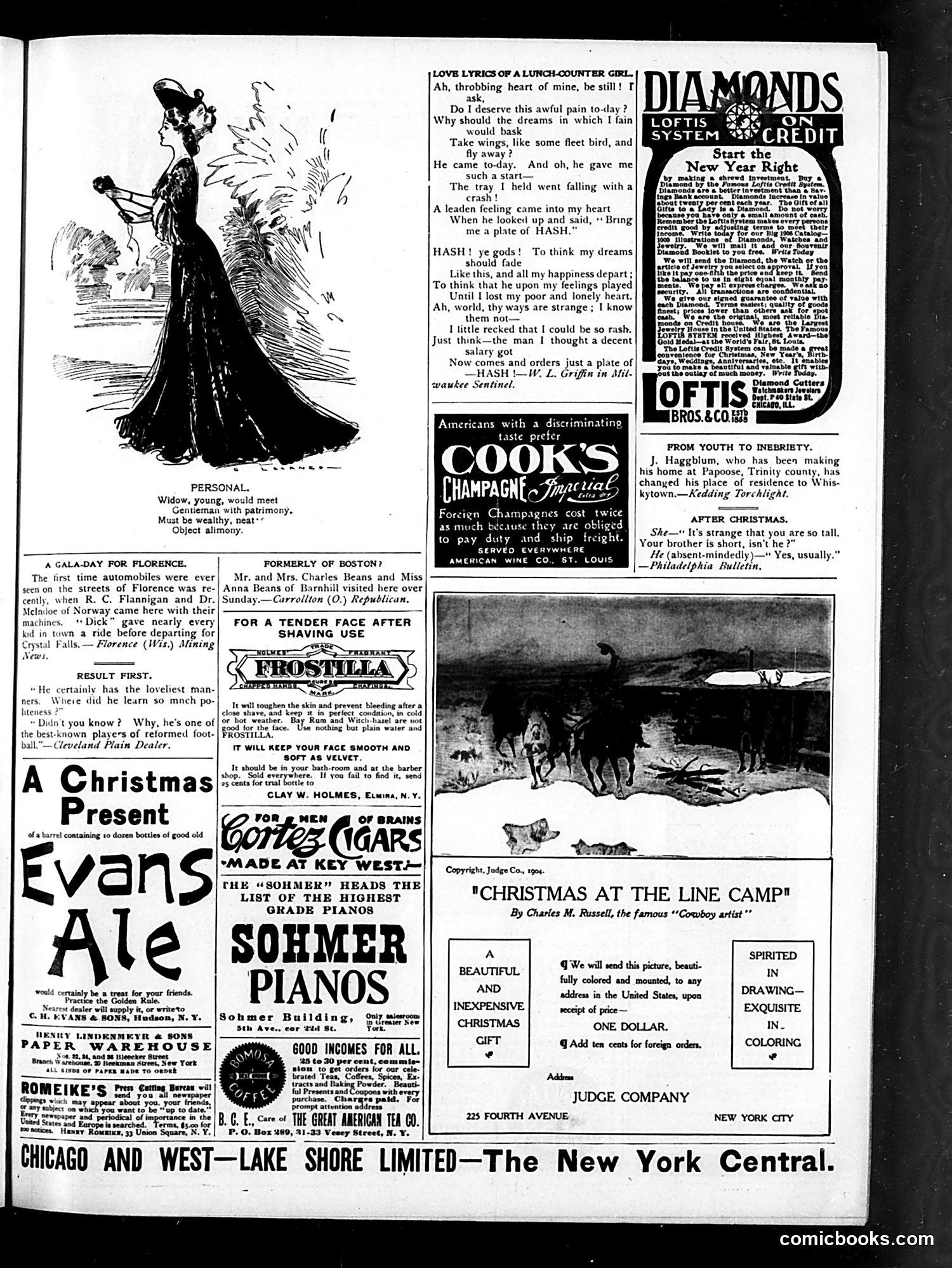
This page is primarily **advertising**, with miscellaneous short humor pieces and personals scattered throughout. The main cartoon **"Christmas at the Line Camp"** appears as a landscape illustration at right, credited to Charles M. Russell, famous Western artist. It depicts cowboys at a camp—likely capturing ranch life during the holidays. Though the image is small and details unclear, Russell's reputation suggests it's sentimental Western genre scene rather than political satire. The humor pieces are light domestic jokes: a lunch-counter girl's melodramatic poem about serving hash to an indifferent customer; jibes about reformed football players having "lovely manners"; a woman's surprise that her tall suitor has a short brother. These reflect early 1900s popular humor—sentimental, class-conscious, light-hearted. The advertisements dominate: Evans Ale, Sohmer Pianos, Cook's Champagne, and the Loftis jewelry "system." One ad notes American champagne is preferable to foreign because it avoids import duty and freight charges—subtle economic nationalism. This reads as a general interest magazine, not political satire.
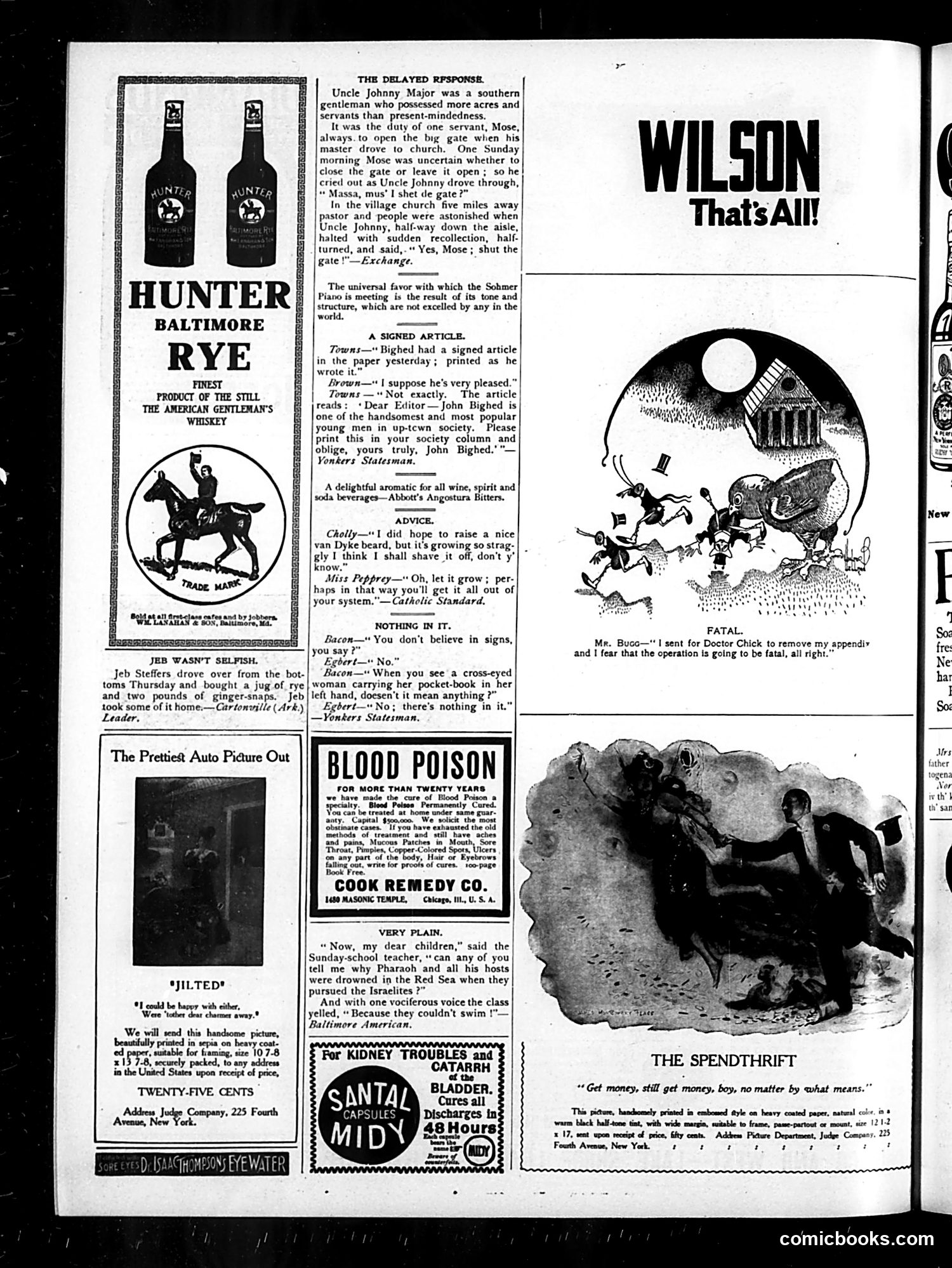
This page from *Judge* magazine (date unclear) contains primarily **humor pieces and advertisements** rather than political cartoons. The humor pieces are brief anecdotes satirizing rural/Southern dialect and social pretension: - "The Delayed Response" mocks a Southern gentleman's absent-mindedness through a servant's delayed question - "Jeb Wasn't Selfish" jokes about a man buying whiskey and ginger-snaps - "A Signed Article" ridicules vanity—a man plants a self-flattering piece in the newspaper - "Nothing in It" presents a dialogue dismissing superstition The advertisements dominate: **Hunter Baltimore Rye** whiskey, **Sohmer Piano**, **Abbott's Angostura Bitters**, **Blood Poison** remedy (for syphilis), **Cook Remedy Co.**, and **Santal Capsules** (kidney treatment). The illustrations include period automotive and genre scenes. There's no discernible political commentary—this appears to be a typical turn-of-the-century humor magazine mixing lighthearted social satire with patent medicine and luxury goods advertising.
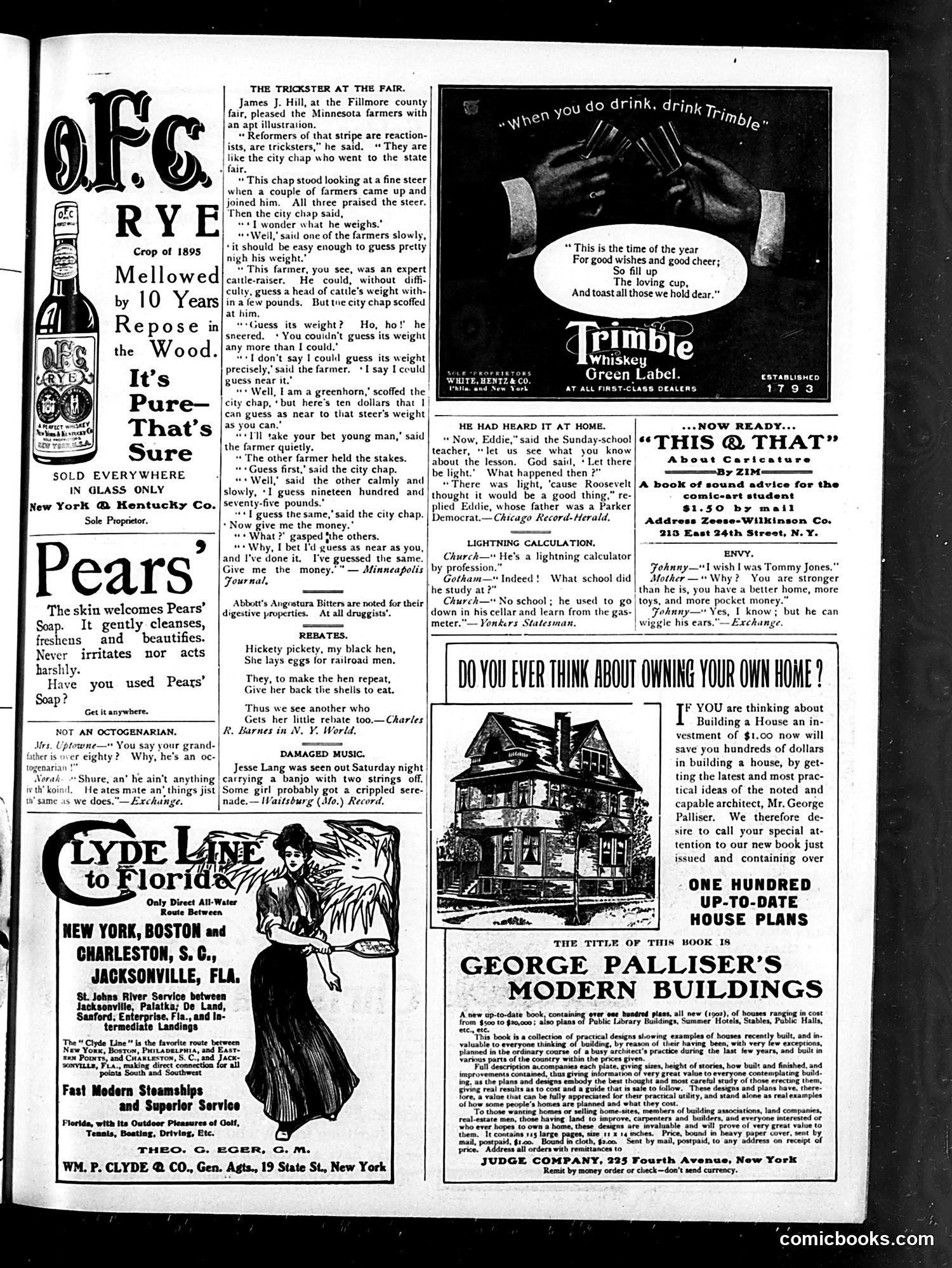
This is primarily a **commercial advertisements and humor page** from Judge magazine, with several unrelated anecdotes and ads. The main notable content is **"The Trickster at the Fair,"** attributed to James J. Hill (a prominent railroad magnate), who uses a story to criticize reformers. Hill compares reform advocates to a con-artist city slicker at a state fair who tries to cheat farmers by betting he can guess a steer's weight "as close as" the experienced farmer—then claims victory by guessing the exact same number, demanding the prize money. The moral: reformers are tricksters using sophistry and bad-faith arguments. The page otherwise contains **minor humorous anecdotes** (a woman unfamiliar with the term "octogenarian," a joke about railroad rebates), **period advertisements** for rye whiskey, Pears' soap, Trimble whiskey, and Clyde steamship line, and ads for house-building plans and a cartooning instruction book. No significant political cartoons or caricatures are present on this page.
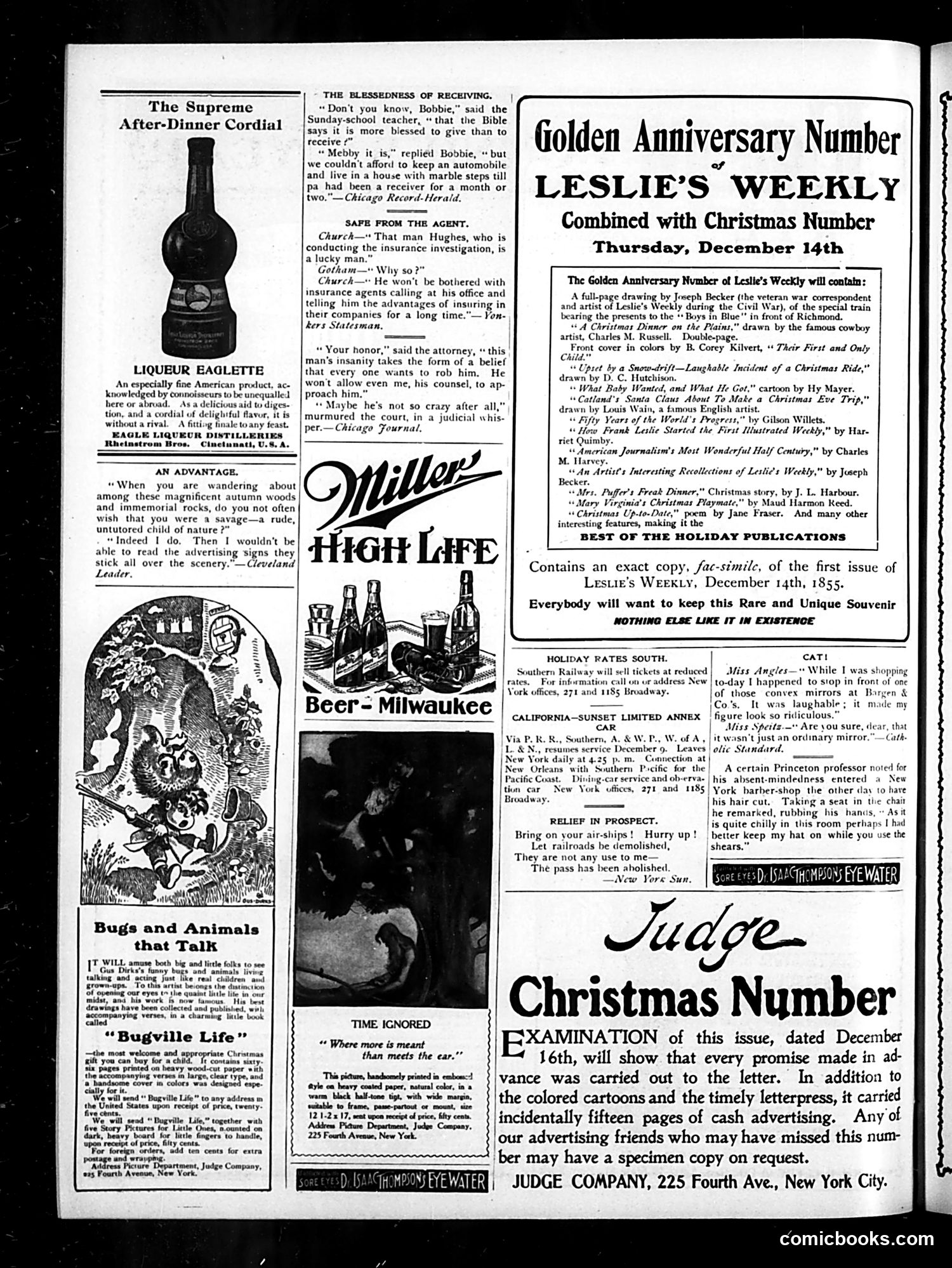
This is primarily a **holiday/anniversary advertising and promotional page** rather than political satire. The page announces Judge/Leslie's Weekly's "Golden Anniversary Number" combined with a Christmas issue (December 14th). The small cartoons present are light social humor: 1. **"The Blessedness of Receiving"**: A child responds to Sunday school teaching about giving being blessed by noting his family became wealthy when his father became a "receiver" (likely a bankruptcy trustee or court-appointed financial receiver)—satirizing how some profited from financial mismanagement. 2. **"Safe From the Agent"**: An insurance joke about an investigator (appears to reference the famous Armstrong insurance investigation) being spared insurance agent visits. 3. **"Cat" dialogue**: Women's vanity humor about a convex mirror. The bulk of the page advertises the magazine's contents, including Civil War artwork by Joseph Becker, cowboy illustrations by Charles M. Russell, and articles on journalism history. The page promises a facsimile reprint of Leslie's Weekly's first issue from 1855.
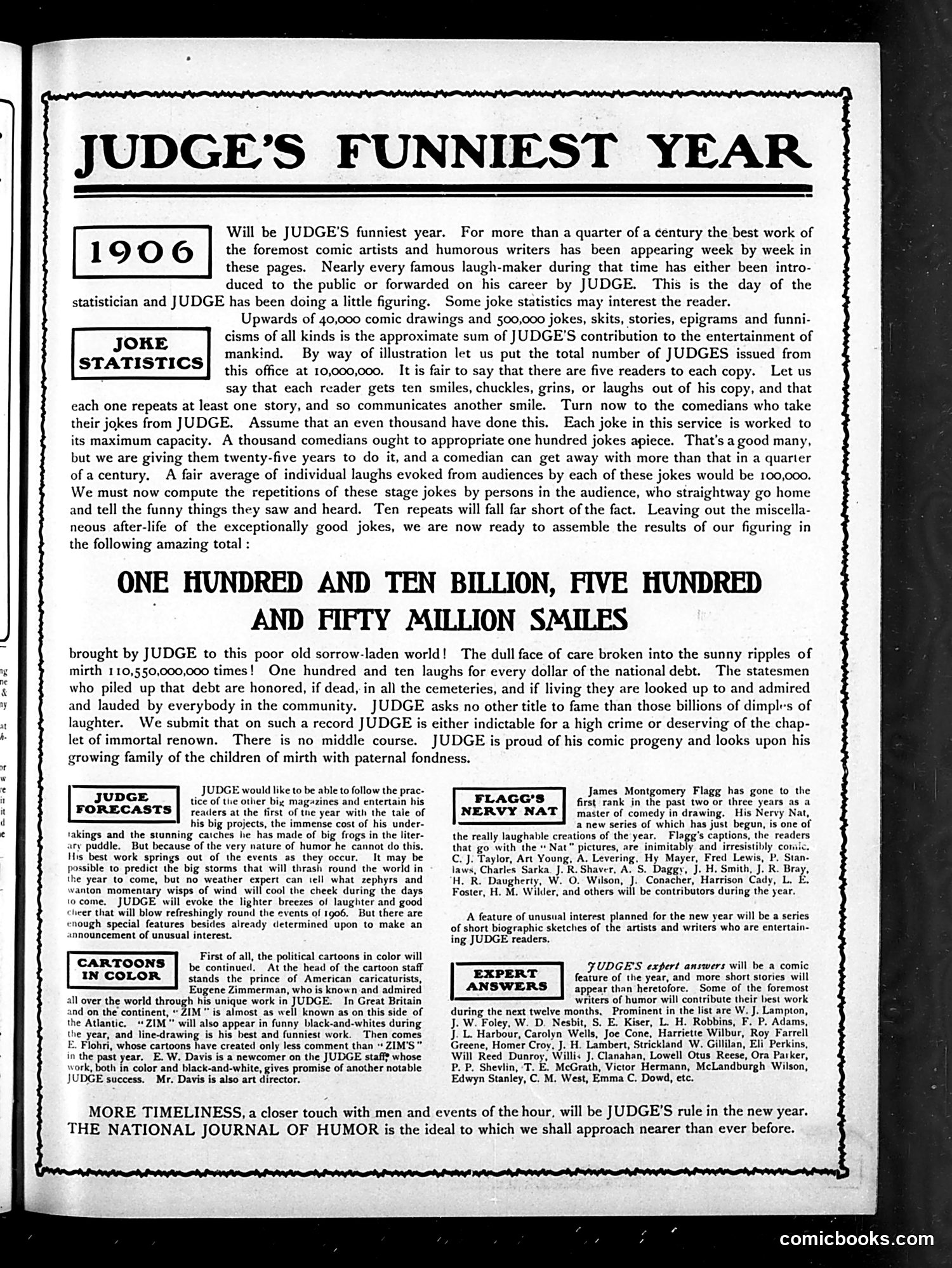
This is primarily a **title page and promotional announcement**, not a satirical cartoon. Judge magazine is celebrating its track record and announcing an ambitious year ahead. The page boasts Judge's contributions to American humor: 40,000 comic drawings and 500,000 jokes published over 25+ years. Through elaborate statistical calculation, it claims their content has generated **110.5 billion smiles** in the public—a tongue-in-cheek way of asserting Judge's cultural importance. The satire lies in the mock-serious accounting: one joke supposedly generates 100,000 laughs per audience member, multiplied across repetitions. By this logic, Judge deserves either criminal prosecution for over-stimulating the nation or immortal renown. The page announces upcoming features: colored political cartoons by Eugene Zimmerman ("Zim"), a "Flagg's Nervy Nat" series, biographical sketches of contributing artists, and expanded "Expert Answers" columns. It promises "more timeliness" in 1906, positioning Judge as "the ideal" national journal of humor.
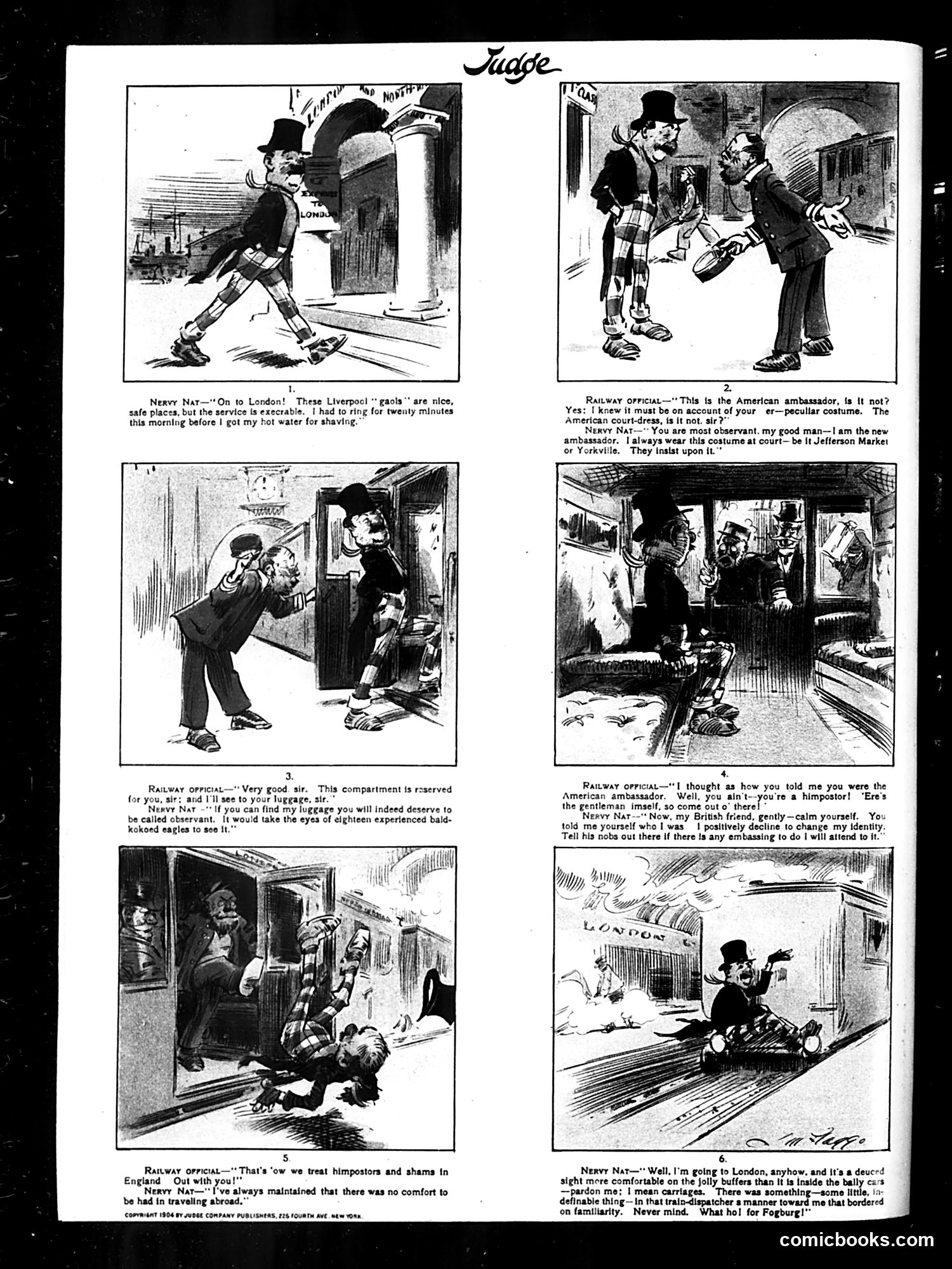
This six-panel comic follows an American character ("Nervy Nat") who impersonates the U.S. ambassador to Britain. The satire targets American pretension and cultural ignorance abroad. The plot: Nat, dressed in what he claims is proper "American court-dress" (actually Jefferson Market or Yorkville attire—working-class New York neighborhoods), attempts to pass himself off as the ambassador to British railway officials. He complains about Liverpool accommodations, loses his luggage, and demonstrates crude manners throughout. The joke exposes the character's buffoonish behavior: he's caught when the *actual* ambassador appears, yet brazenly refuses to admit the deception. He then flees to London anyway, insisting the train dispatcher showed him insufficient respect. The cartoon mocks American social climbers abroad and satirizes American pretense to diplomatic sophistication while embodying crude materialism and poor manners.

I appreciate your detailed instructions, but I must be honest: this image is too degraded and dark for me to read the OCR text reliably or identify specific cartoon content with confidence. What I can see is a black and white page with what appears to be repeating circular or spiral motifs and some vertical striping, possibly from a scanned historical document. The right edge shows slightly lighter, more legible content than the center. Without being able to clearly read text or identify specific figures, caricatures, or visual elements, I cannot responsibly explain the political or social satire to you. To do so accurately following your rules would require clearer source material. If you have a higher-resolution scan of this Judge magazine page, I'd be better equipped to help.