
A complete issue · 16 pages · 1905
Judge — October 7, 1905
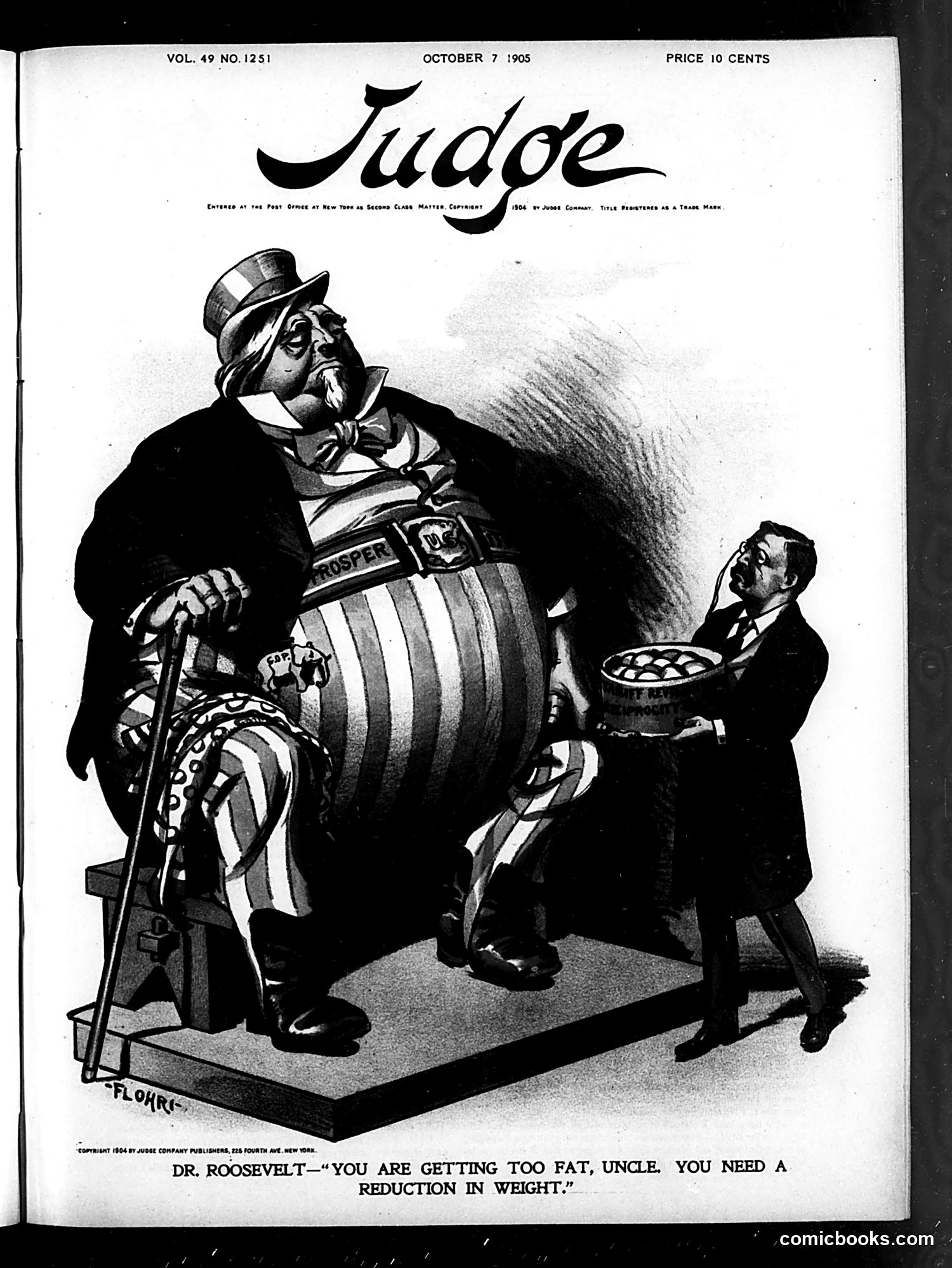
This October 7, 1905 Judge magazine cover satirizes President Theodore Roosevelt's physical size and appetite. The large figure labeled "PROSPER" (representing American prosperity or business interests) is depicted as overweight, while a smaller man—likely a political figure or economist—suggests Roosevelt needs to reduce his weight. The "PROSPEROUS" barrel symbolizes American economic abundance during Roosevelt's presidency. The satire appears to criticize Roosevelt for allowing or encouraging excessive prosperity or consumption, suggesting the economy had grown too fat and needed restraint or reform. The cartoon plays on Roosevelt's famous public persona as a vigorous outdoorsman, ironically portraying him as corpulent and in need of dietary correction—a humorous critique of his administration's economic policies or business practices during this period.
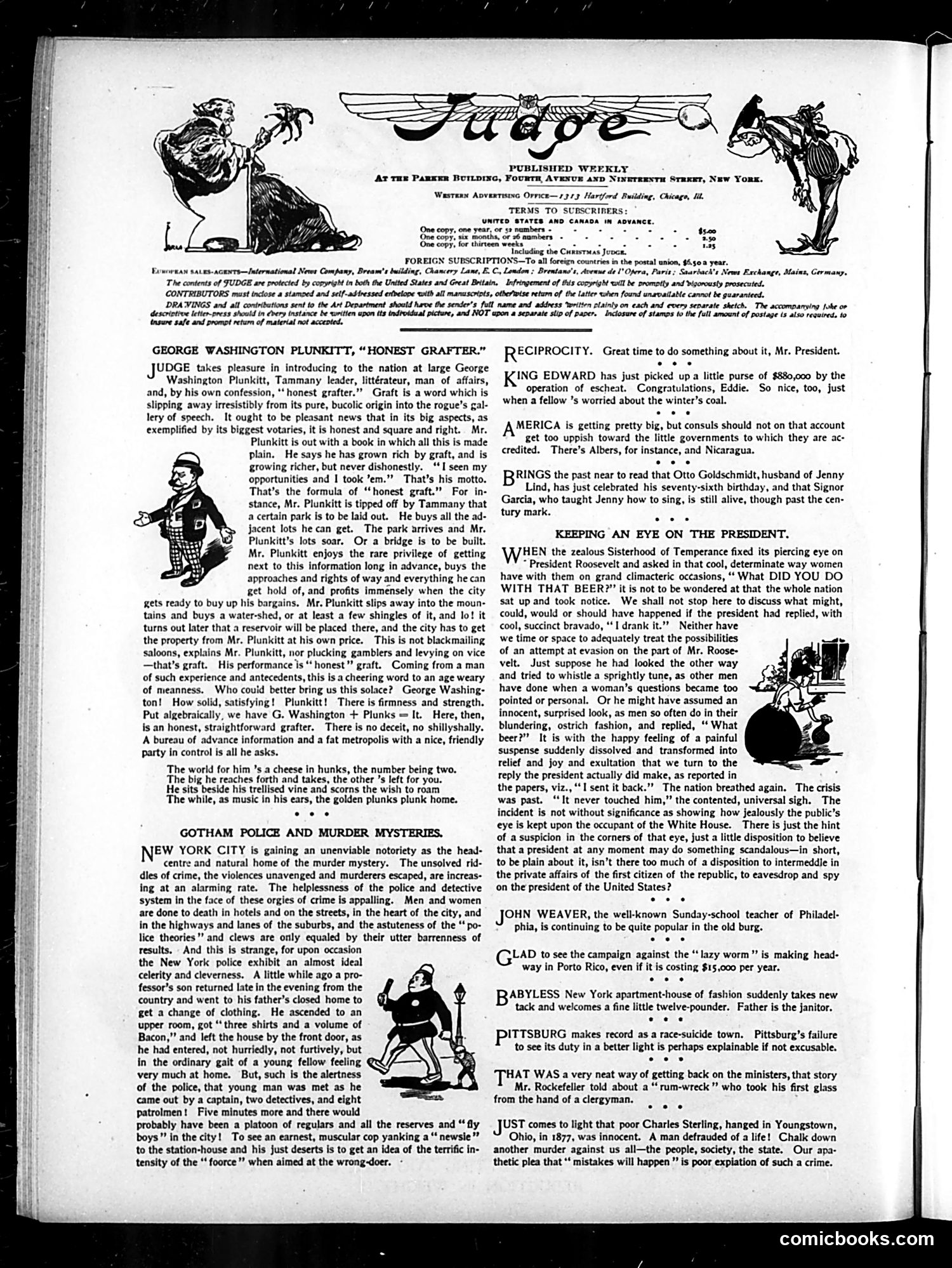
This page contains several political commentary pieces rather than formal cartoons. The main article features "George Washington Plunkitt: 'Honest Grafter,'" satirizing a figure known for political corruption through self-aggrandizing commentary. The piece mocks how Plunkitt rationalizes dishonest practices as legitimate "grafting." Other sections include commentary on President Roosevelt, critiquing his responses to questions about "beer" and women at social events—apparently suggesting he gave evasive, overly cautious replies to protect his public image. Additional brief items satirize contemporary figures like John Weaver (a Sunday-school teacher) and reference current events including Gotham police incompetence and Charles Sterling's execution. The satire employs irony and ridicule to critique political corruption, presidential propriety concerns, and urban crime inefficiency of the era.
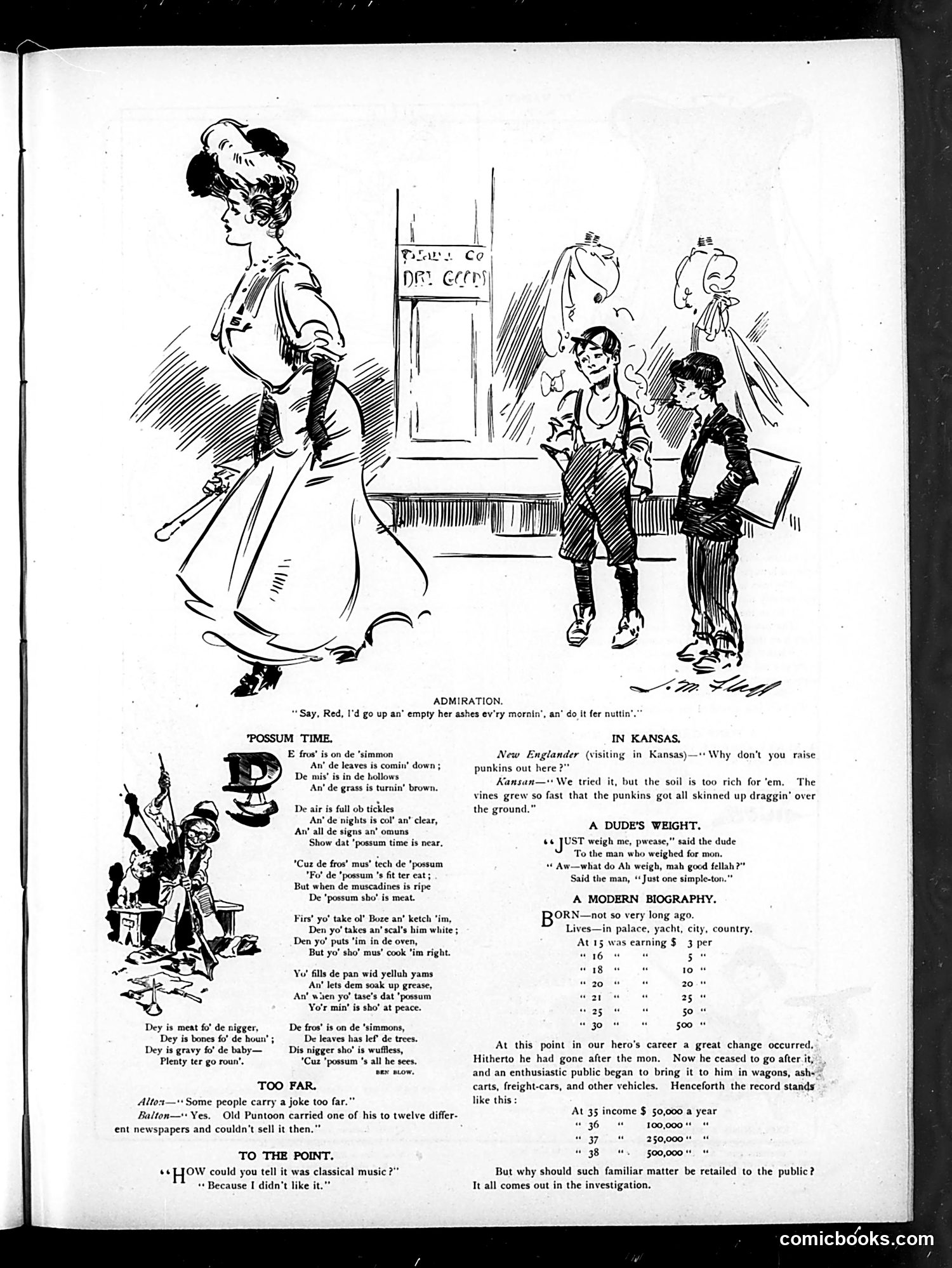
The top cartoon titled "ADMIRATION" depicts a well-dressed woman observing two boys outside what appears to be a "Dry Goods" store. The caption reads: "Say, Red, I'd go up an' empty her ashes ev'ry mornin', an' do it fer nuthin'." This is a joke about boys competing for a girl's attention through offers of domestic labor—satirizing young male courtship behavior and the performative nature of adolescent admiration. The remainder of the page consists of humorous verse and short jokes typical of Judge magazine's satirical content, including pieces on "Possum Time," Kansas life, a dude's weight complaint, and various witticisms. The material reflects early 20th-century American humor focused on regional dialects, class differences, and everyday social situations rather than explicit political commentary.
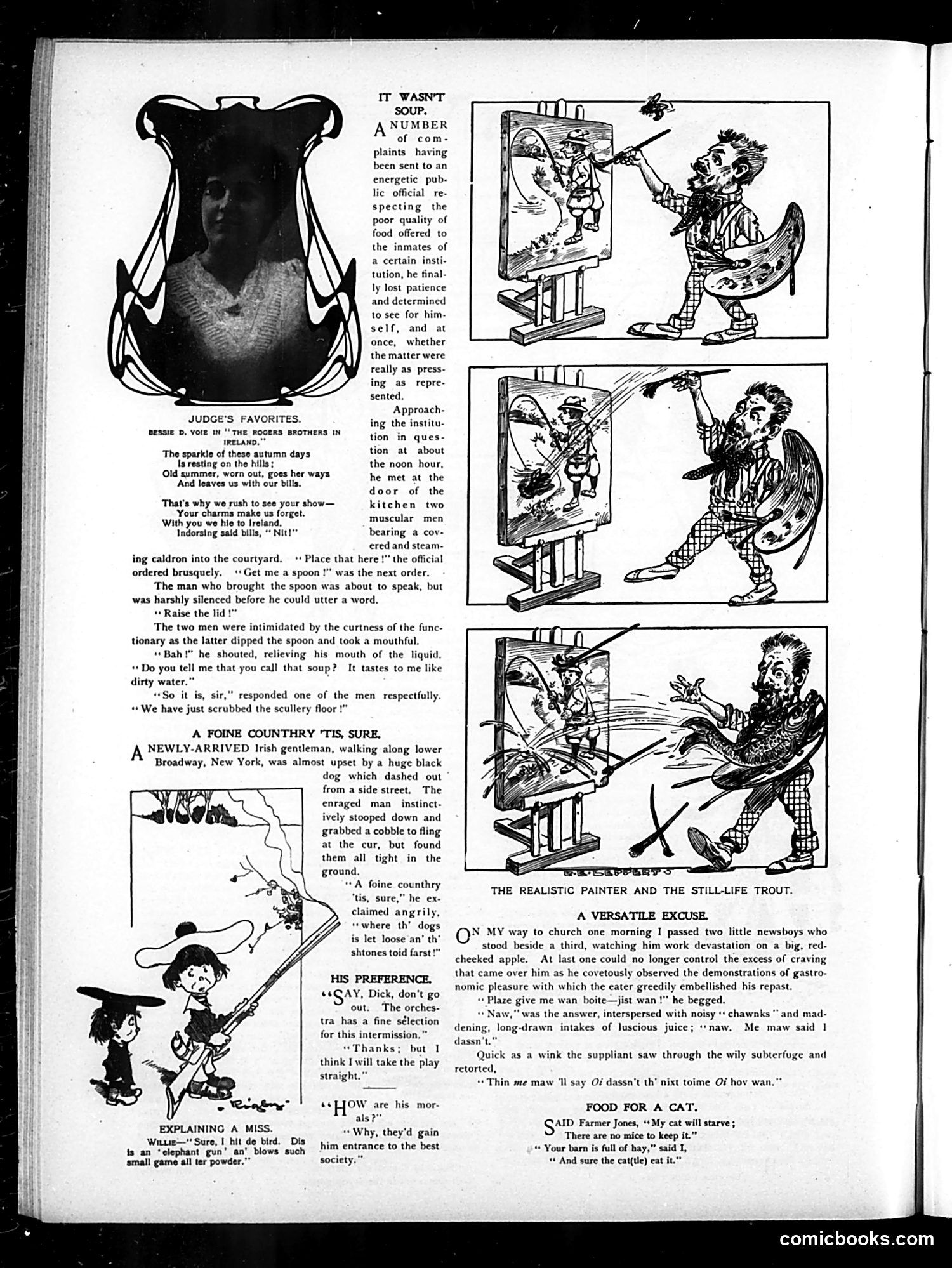
This page contains several brief humorous anecdotes and illustrations rather than political cartoons. The main features include: 1. **"Judge's Favorites"** - A poem about autumn days and social charm 2. **"It Wasn't Soup"** - A comic strip about an institutional kitchen complaint where a man complains about poor food quality, eventually discovering the "soup" is actually dirty dishwater—satirizing institutional food standards 3. **"A Poinie Countryman 'Tis, Sure"** - A story about an Irish immigrant's encounter with a large black dog on Broadway, poking fun at Irish immigrants' unfamiliarity with urban American life 4. **Minor sketches** including "Explaining a Miss" (about an elephant gun) and "His Preference" (about orchestra selection) 5. **"Food for a Cat"** - A brief verse about farmer Jones keeping a cat The humor targets institutional inefficiency, Irish immigrant stereotypes, and everyday domestic situations—typical of early 20th-century American satirical journalism.
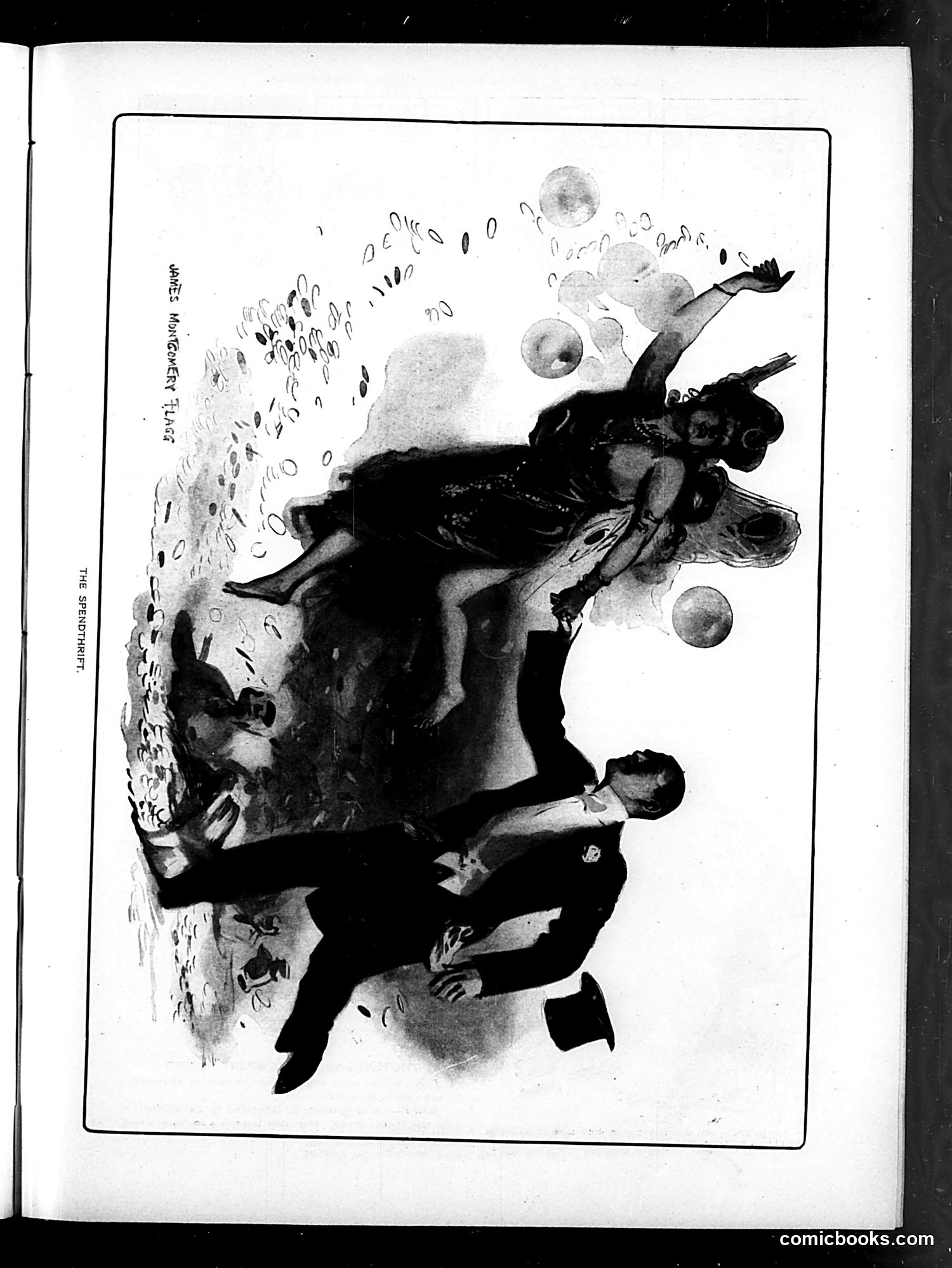
I can see this is a satirical illustration from *Judge* magazine, but the OCR text is largely illegible and doesn't provide clear context. The image shows a figure being struck or propelled backward forcefully, with spherical objects (possibly bombs or projectiles) scattered around. The artistic style and composition suggest political or social commentary typical of early 20th-century American satire. Without readable captions or text identifying the specific figures, political figures, or historical event being referenced, I cannot reliably explain what this cartoon means to a modern reader. The image quality and OCR errors prevent me from determining the intended targets of the satire or the satirical point being made. To properly contextualize this cartoon, clearer source material would be needed.
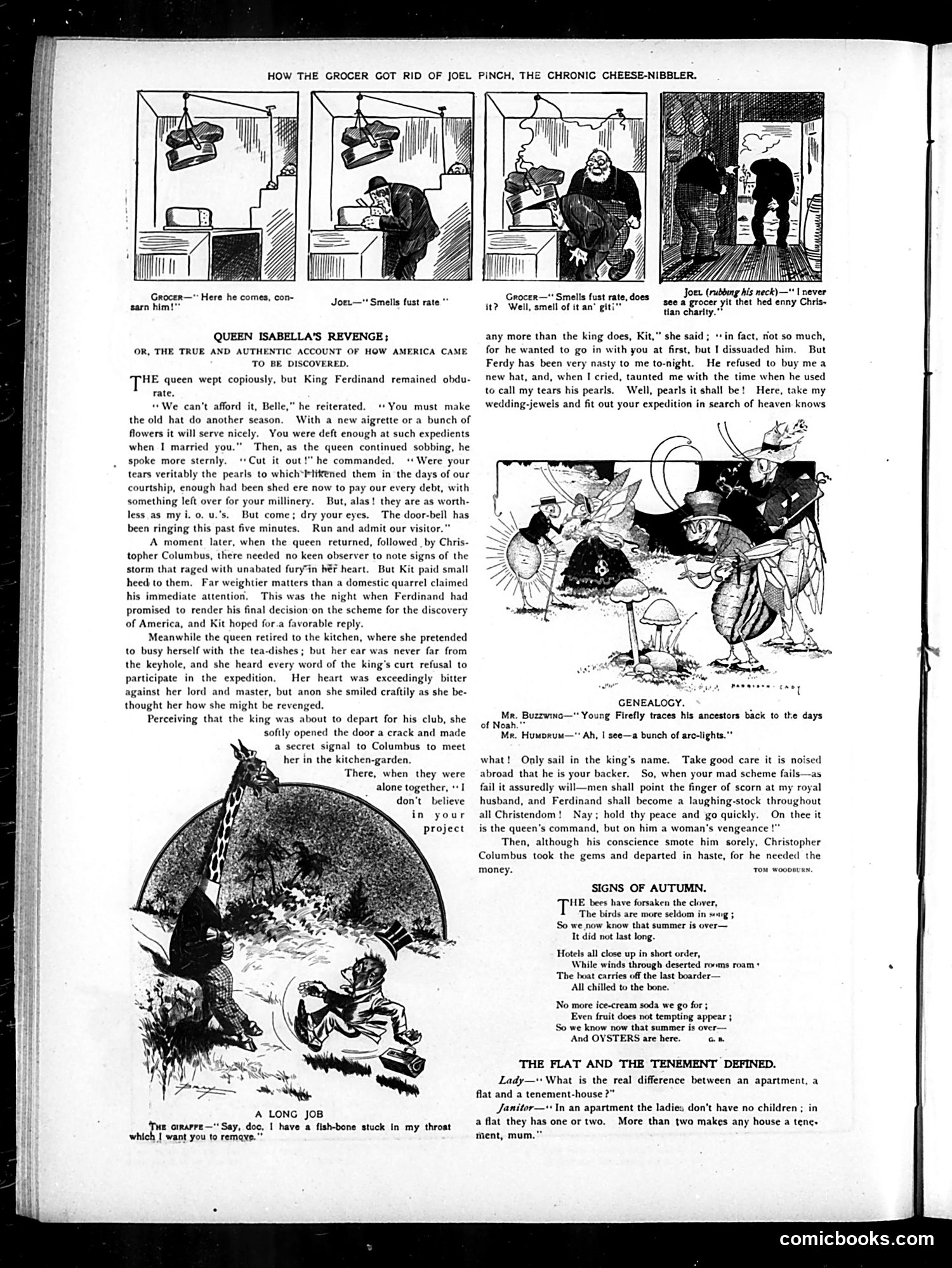
This page contains multiple satirical pieces typical of the era: **Top cartoon**: "How the Grocer Got Rid of Joel Pinch" depicts a grocer using a mousetrap to catch a chronic cheese-nibbler—workplace satire about petty theft and problem employees. **Main story**: "Queen Isabella's Revenge" is a humorous fictional account imagining Queen Isabella of Spain funded Columbus's voyage out of spite toward King Ferdinand. The satire mocks marital discord and female revenge—Ferdinand refuses to buy Isabella a new hat, so she funds Columbus's expedition hoping his failure will embarrass the king. This inverts the historical narrative with gender role comedy. **"Genealogy" joke**: Mocks nouveau riche pretension—a character traces ancestry to "the days of Noah" but it's actually "arc-lights" (electric lights), suggesting theatrical or recent origins rather than noble lineage. **Other sections**: "Signs of Autumn" and "The Flat and Tenement Defined" are lighter humor pieces about seasonal change and class distinctions. The overall tone is lighthearted social commentary typical of Judge's satirical approach.
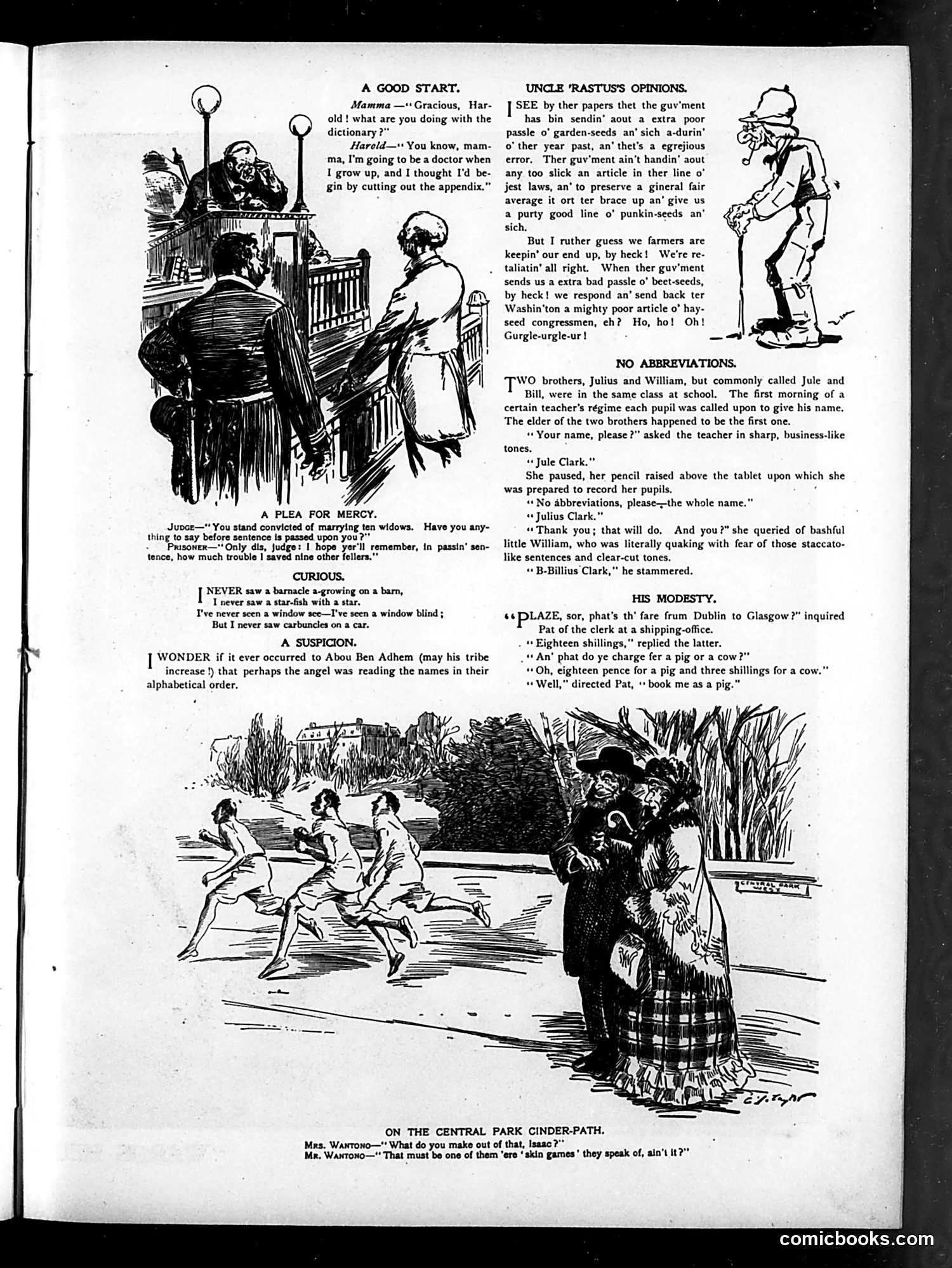
This page contains several short satirical pieces typical of late-19th/early-20th-century American humor: **"A Good Start"** jokes about a child planning to become a doctor by surgically removing a dictionary's appendix—wordplay on the double meaning of "appendix." **"A Plea for Mercy"** satirizes a serial polygamist claiming credit for "saving" other men from marriage by marrying their ex-wives instead. **"Uncle 'Rastus's Opinions"** features a racist caricature of a rural Black farmer complaining that poor government seeds justify sending incompetent congressmen to Washington—a jab at both agricultural policy and political corruption through offensive dialect. **"No Abbreviations"** humorously depicts a teacher's strict insistence on full names, causing a nervous student to nervously invent "B-Billius Clark." **"His Modesty"** uses Irish dialect humor: a traveler asks ship fares, hears animals cost less, and requests passage "as a pig." **"Central Park Cinder-Path"** shows observers misinterpreting children's races as "skin games" (con games). The artwork is pen-and-ink illustration typical of the era.
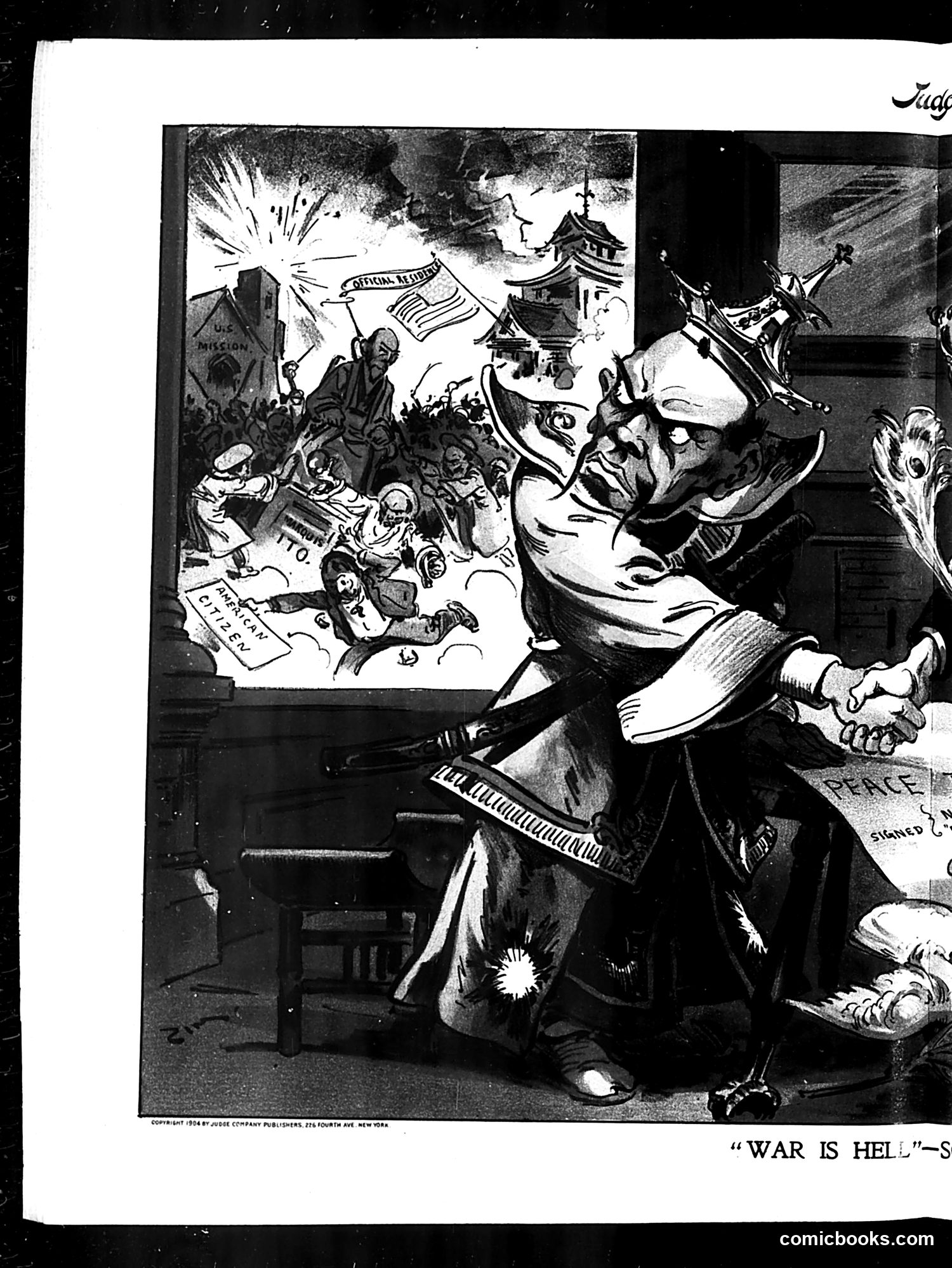
This political cartoon depicts a military or political figure (caricatured with exaggerated features) at a desk, viewing what appears to be a chaotic scene of warfare or military conflict displayed in a framed picture or window behind him. The figure holds a pen, suggesting he's in a position of authority making decisions. The title "War Is Hell" indicates the cartoon's satirical commentary: those in power make decisions about war from the safety of their offices, disconnected from the actual suffering depicted in the scene they're viewing. The contrast between the comfortable official at his desk and the chaos of warfare illustrates the gap between decision-makers and consequences—a classic anti-war or anti-militarism critique common in early-to-mid 20th century American satire.
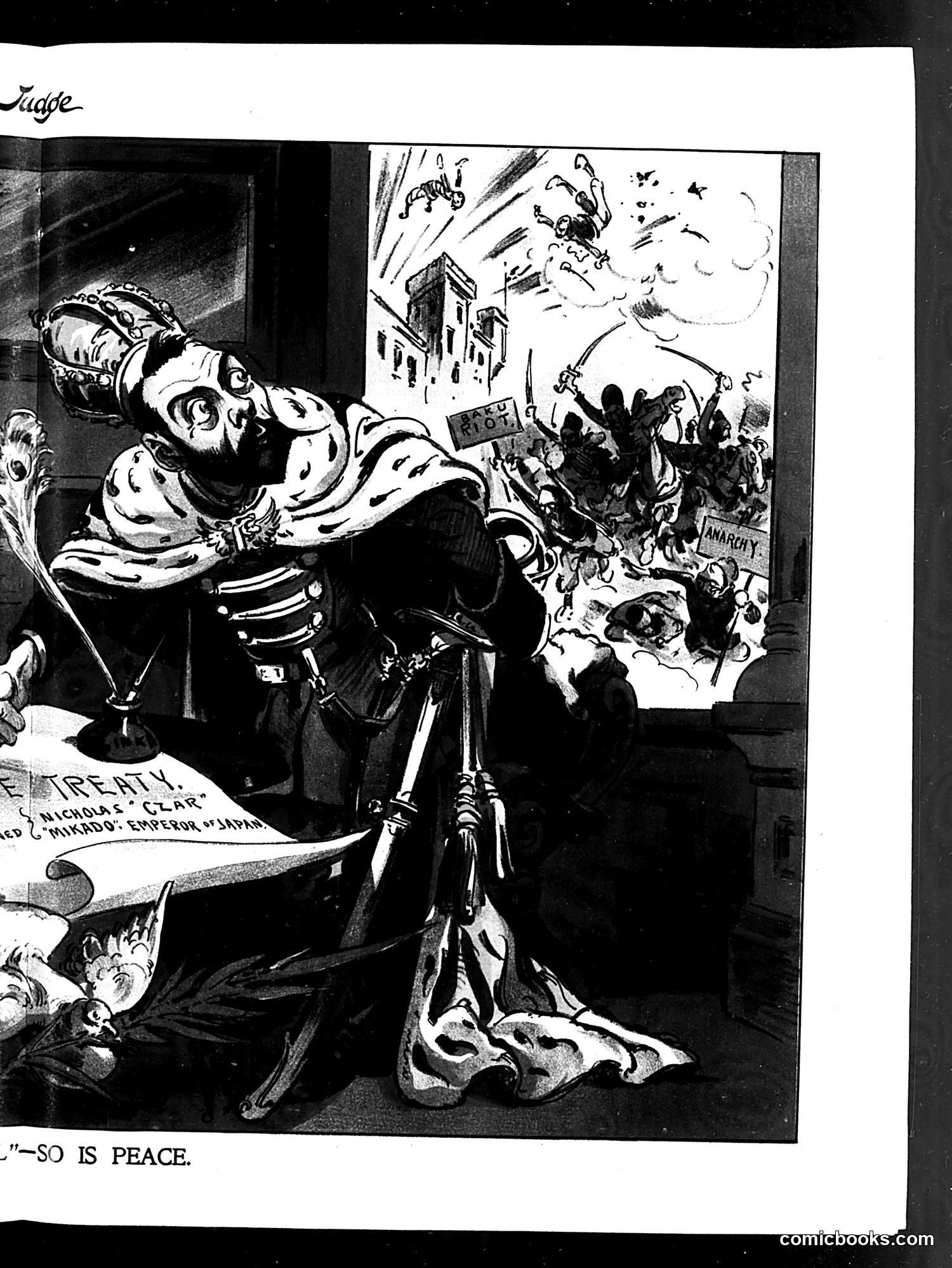
This appears to be a WWI-era satirical cartoon from *Judge* magazine. The central figure is a caricatured military or political leader in ornate uniform and fur-trimmed robes, depicted as a skeleton or death figure. He's shown unveiling or presenting a theatrical scene labeled "ANARCHY" to a crowd below. The caption "~SO IS PEACE" sarcastically suggests that the figure's proclaimed "peace" actually brings death and chaos—the skeleton imagery emphasizing this irony. The visible text references "Emperor of Japan" and mentions "Nicholas II, Czar," indicating this likely critiques how certain world leaders' peace initiatives or political arrangements actually perpetuate violence and anarchic conditions rather than genuine peace. The cartoon uses grotesque imagery to mock political hypocrisy regarding peace during the war period.
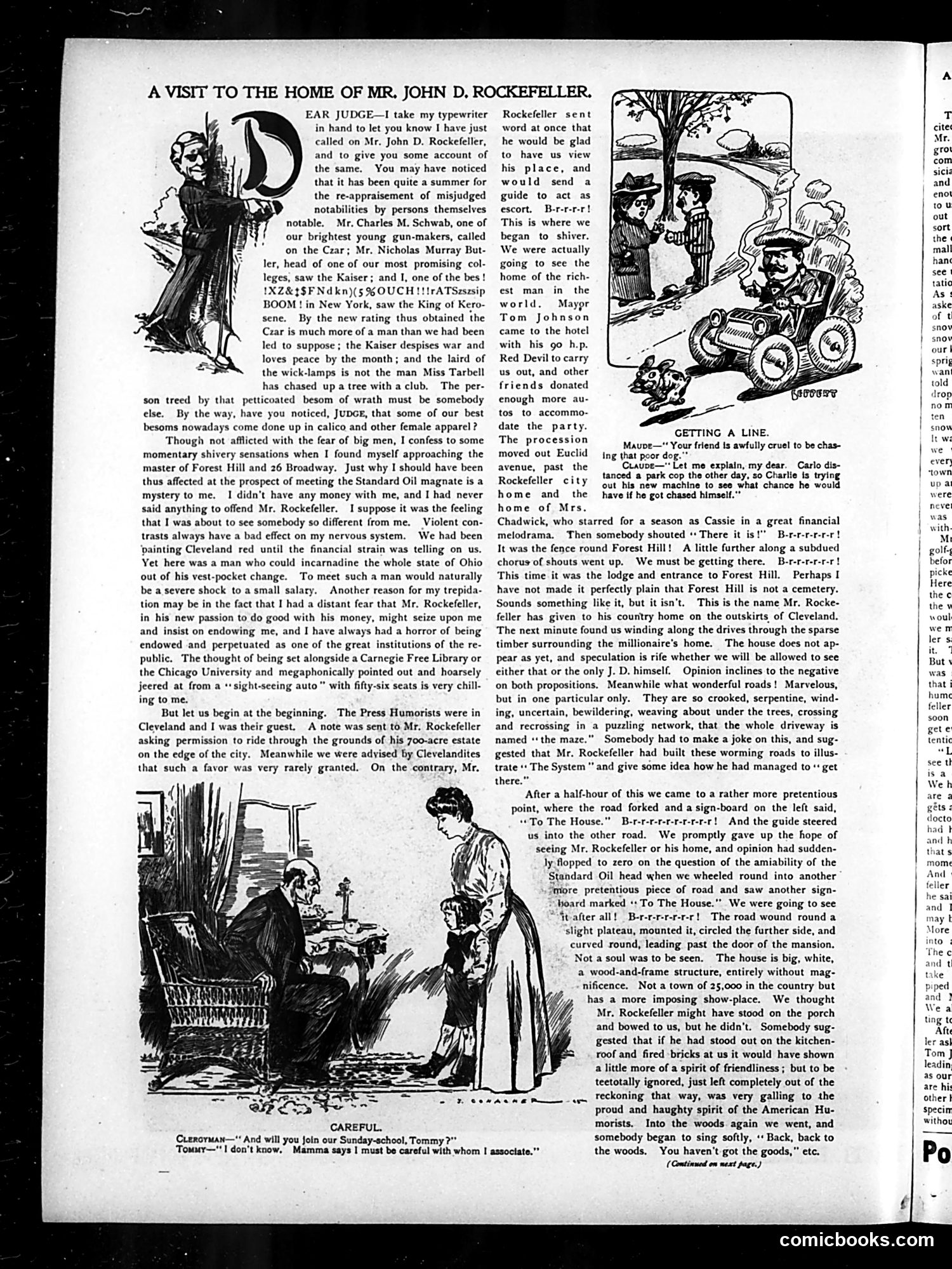
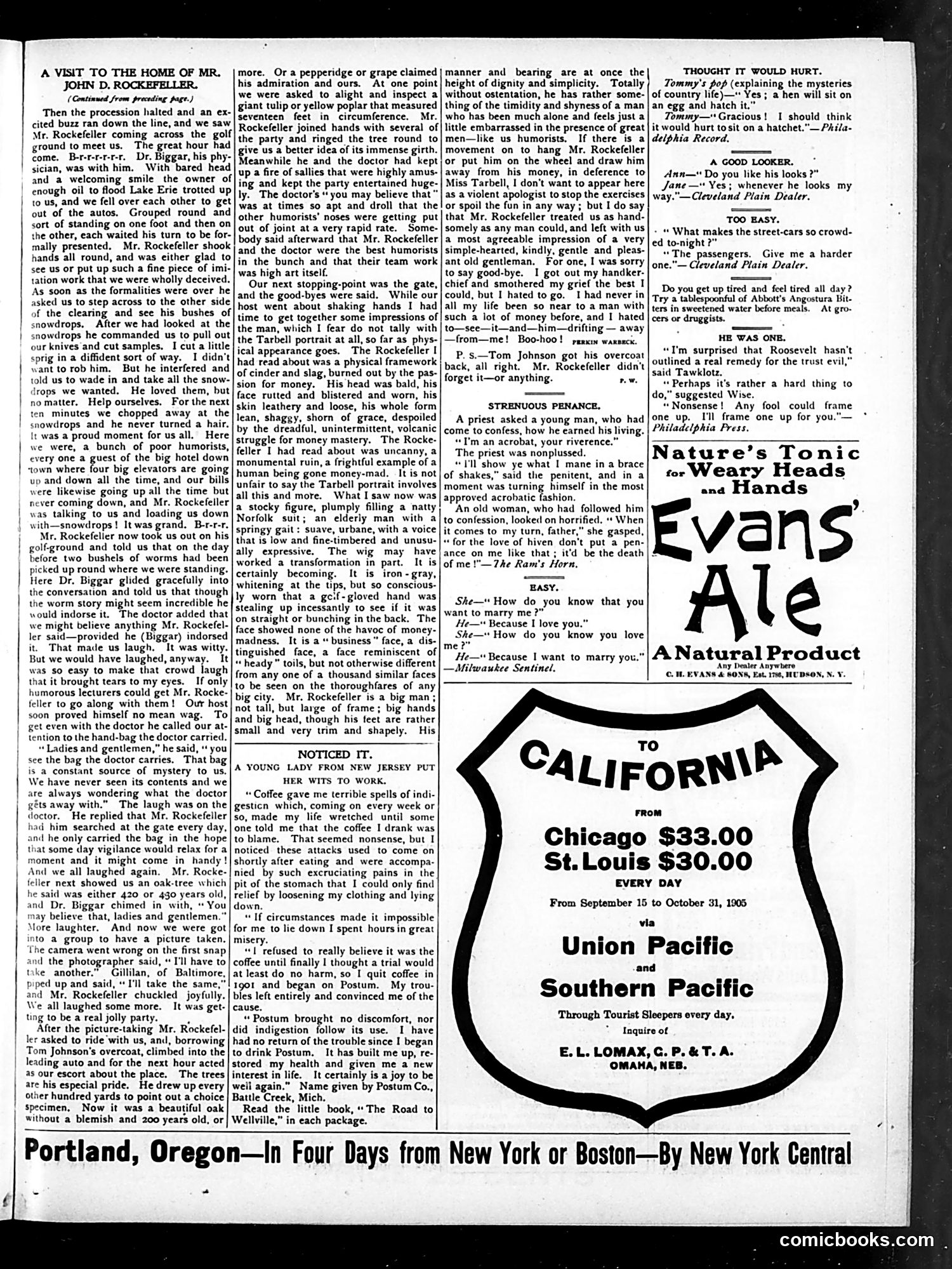
This page primarily contains **advertising and a continuation of a humorous travel article** rather than political cartoons. The main content is "A Visit to the Home of Mr. John D. Rockefeller," a satirical piece depicting journalists visiting the oil magnate's estate. The humor targets **Rockefeller's extreme wealth and the obsequious behavior it inspires**: visitors fawn over him, his physician comically validates everything he says ("You may believe that"), and Rockefeller himself becomes unexpectedly genial and witty—surprising the expectation that the ruthlessly competitive businessman would be cold. The satire mocks both **Rockefeller's power** (he owns enough oil to "flood Lake Erie") and the **sycophancy wealth generates**. The joke is that even hardened humorists become starstruck, eagerly accepting snowdrops from his garden as treasured souvenirs. The page also features advertisements for Evans Ale, California rail travel, and Portland, Oregon transportation—typical of Judge's revenue model.
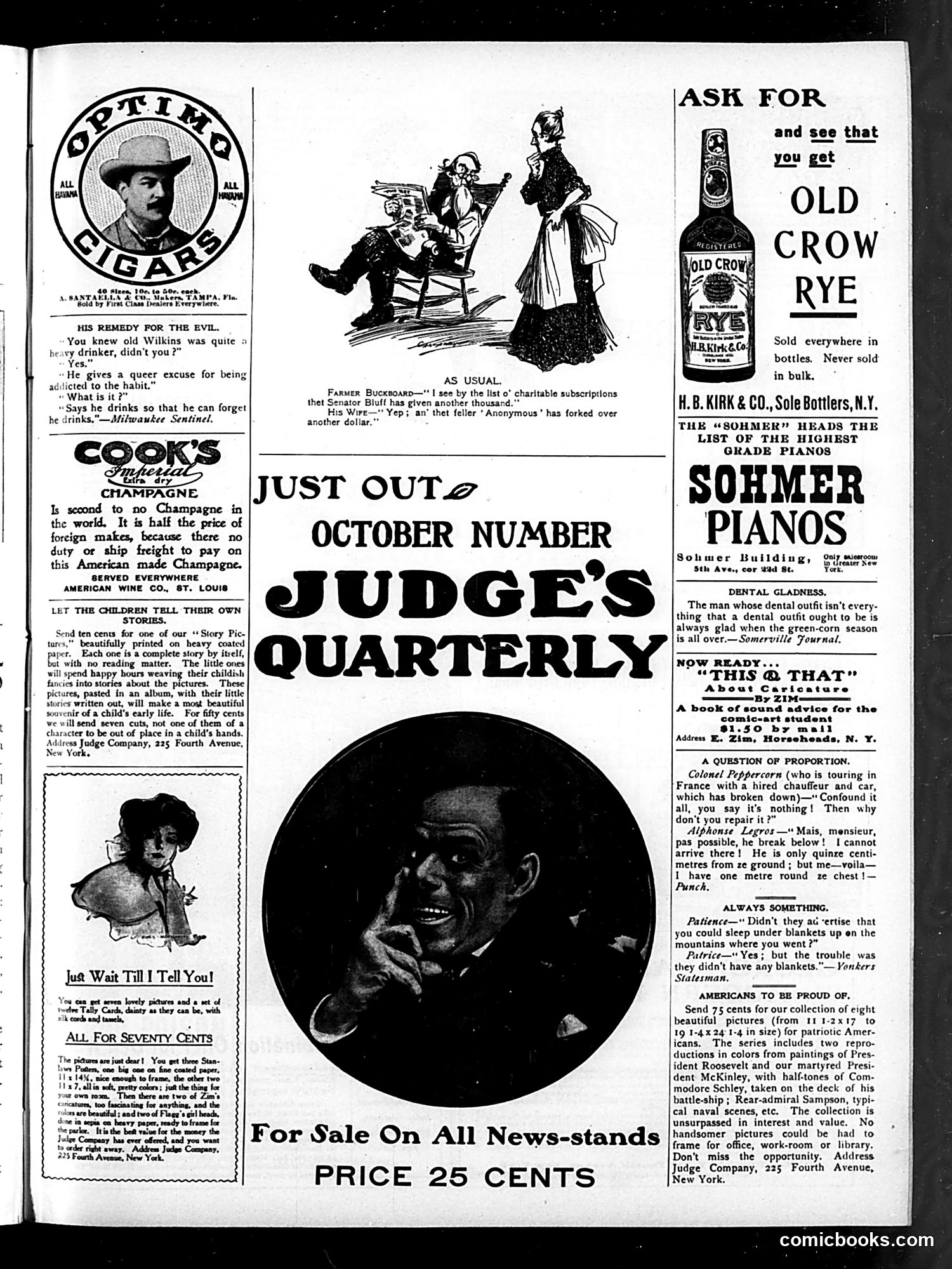
This is primarily a **title/cover page** for Judge's October quarterly issue, priced at 25 cents. The large portrait occupies the center—appears to be a caricatured face, likely a political or public figure, though the specific identity isn't clear from the image alone. The page is dominated by **advertisements** for products (Cook's champagne, Old Crow whiskey, Sohmer pianos) and Judge Company offerings (story picture sets for children, instruction books on caricature). Two small **satirical items** appear: one jokes about a chronic drinker claiming he drinks to forget he drinks (dark humor about alcoholism); another depicts a farmer and wife noting a "Senator Bluff" makes charitable donations while an anonymous donor gives small amounts—satirizing wealthy politicians' self-aggrandizing philanthropy versus genuinely anonymous charity. The overall page reflects early 1900s American consumer culture and satirical commentary on wealth and social pretense typical of Judge magazine's style.
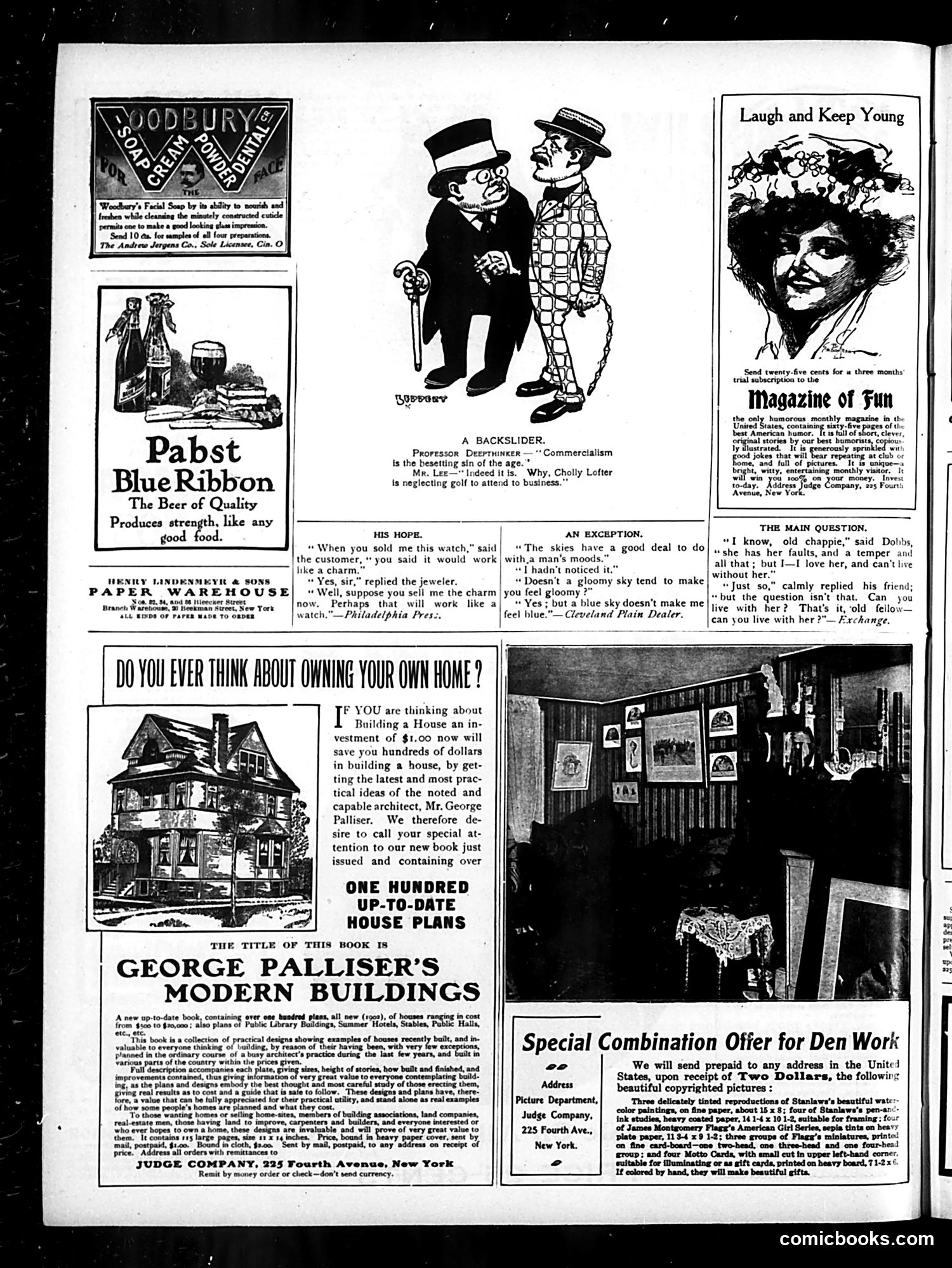
This page is primarily **advertisements and short humor pieces** rather than political satire. The main cartoon, titled "A Backslider," depicts two well-dressed men discussing how Professor Deermincer has abandoned golf for business—presented as a moral failing. The satire targets the era's tension between leisure (golf, associated with wealth and status) and commercialism, suggesting that prioritizing business over gentlemanly pursuits represents a regrettable social backslide. The remaining content consists of brief jokes ("His Hope," "An Exception," "The Main Question") playing on wordplay and domestic humor, plus substantial advertising: Pabst Blue Ribbon beer, George Palliser's architectural house-plan books, a paper warehouse, and subscriptions to *Magazine of Fun* and *Judge* itself. The page reflects early 1900s concerns about American values—the conflict between old-money leisure culture and rising commercial ambition—but the satire is gentle and the page is dominated by commercial messaging.
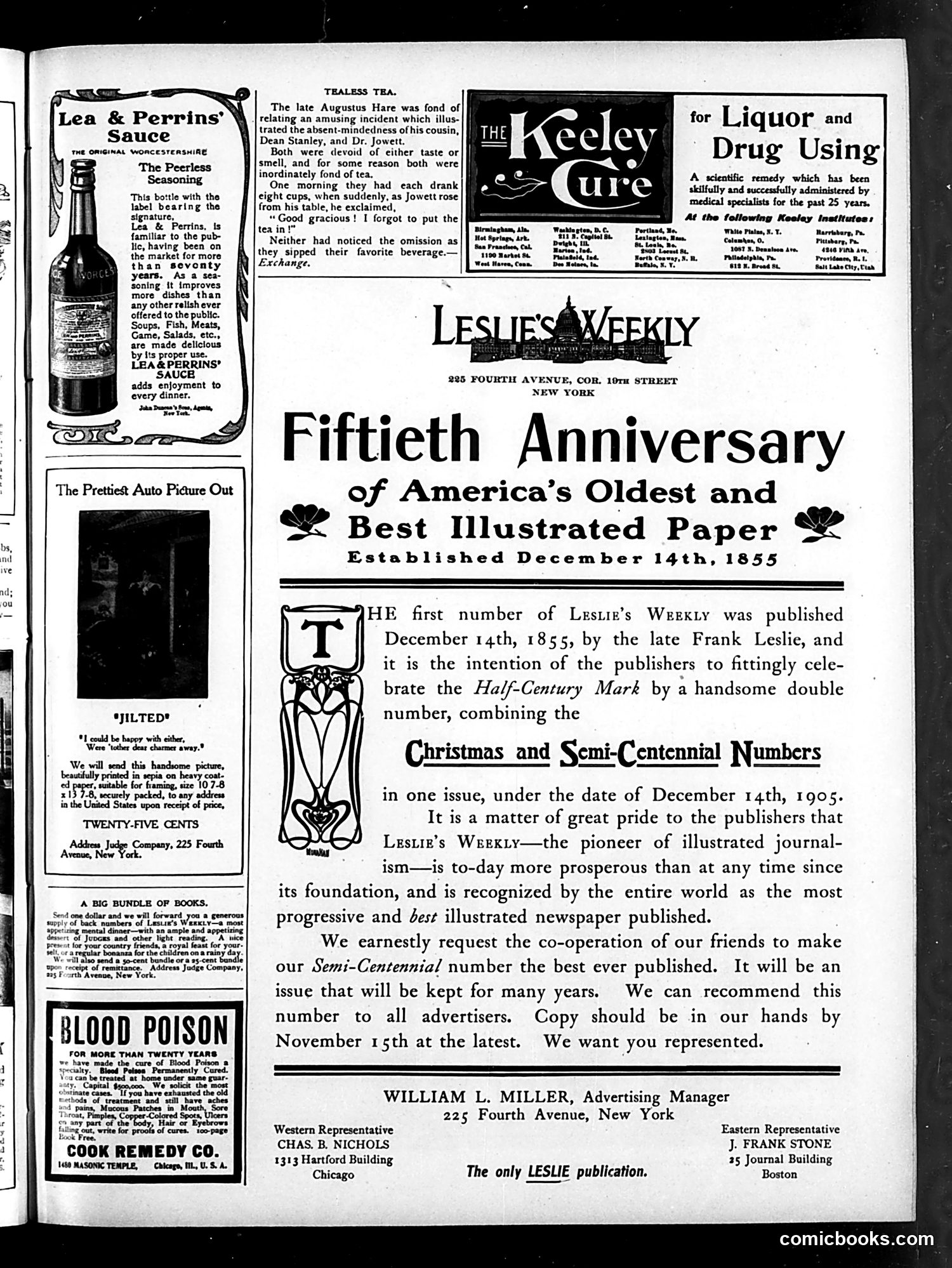
This page is primarily **advertising and announcement content**, not satirical cartoons. The substantive material consists of: 1. **"Tealess Tea" anecdote**: A humorous story about Dean Stanley and Dr. Jowett, absent-minded academics who drank eight cups of tea each without realizing no tea leaves were actually steeped in the water. The joke relies on their reputation for being so intellectually distracted they couldn't taste the difference. 2. **Leslie's Weekly anniversary announcement**: The centerpiece celebrates the magazine's 50th anniversary (established December 14, 1855), touting itself as "America's Oldest and Best Illustrated Paper" and soliciting advertisements for a special combined Christmas/Semi-Centennial issue. 3. **Period advertisements**: Including Lea & Perrins sauce, "The Keeley Cure" (a dubious treatment for alcohol/drug addiction), auto pictures, and Cook Remedy Company's blood poison treatment. The page reflects early 1900s advertising culture and contemporary attitudes toward pseudo-medical remedies.
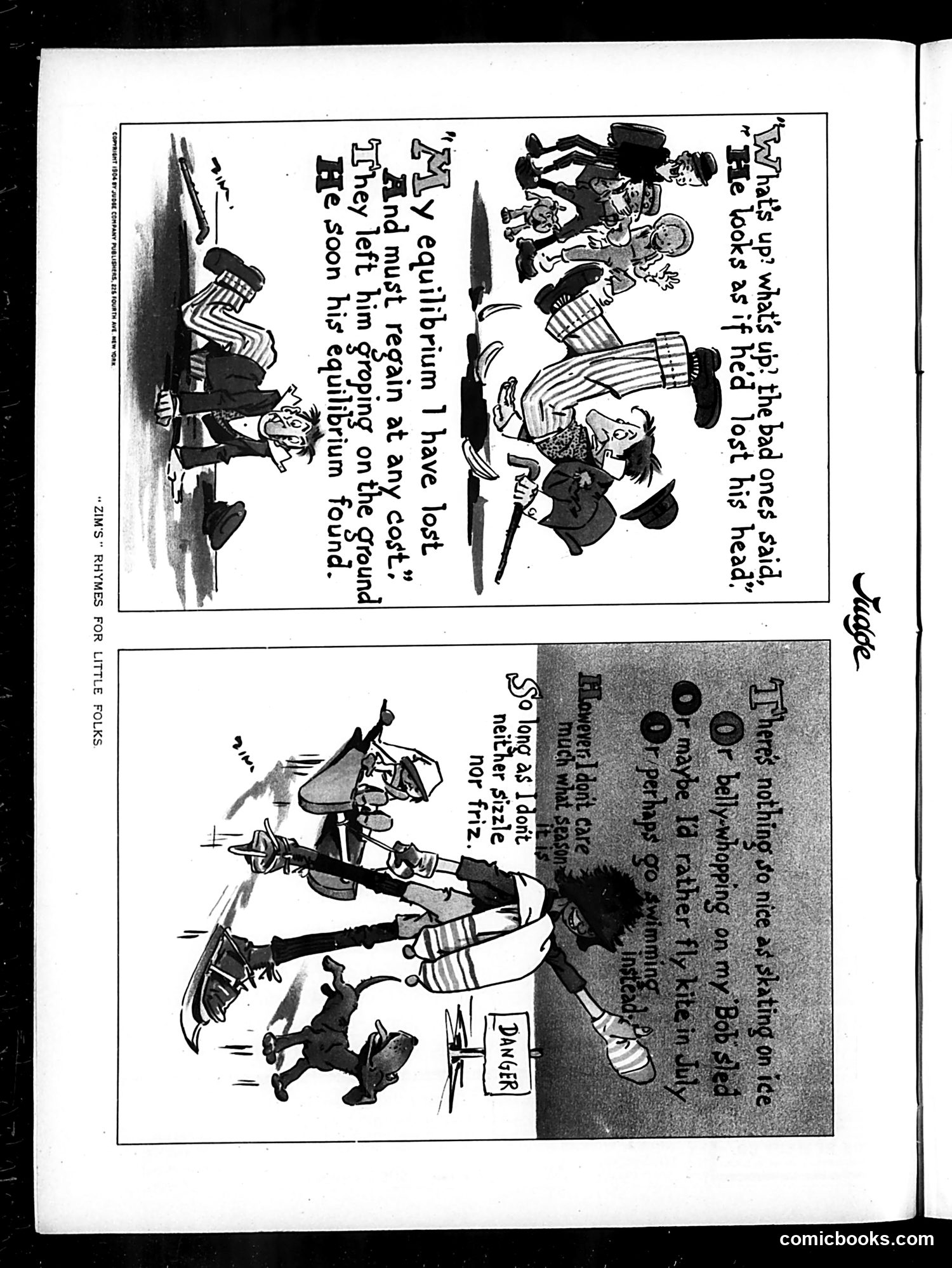
This page contains children's rhyming verse titled "Zim's Rhymes for Little Folks" rather than political satire. The cartoons illustrate simple, whimsical stories in verse form. The top cartoon depicts a figure who has "lost his head" (literally, in visual gag style), with onlookers commenting on his predicament. The bottom panel shows someone regaining "equilibrium" after being "left him groping on a high equilibrium found"—playing on the physical comedy of balance and loss of composure. The humor is purely slapstick and wordplay-based, typical of early 1900s children's entertainment. There's no apparent political commentary or social satire visible—just lighthearted illustrated verse for young readers, emphasizing physical comedy and rhyming narratives. The copyright date indicates this is from the early 1900s Judge Company publication.