
Judge, 1905-10-07 · page 11 of 16
Judge — October 7, 1905 — page 11: what you’re looking at
What you’re looking at
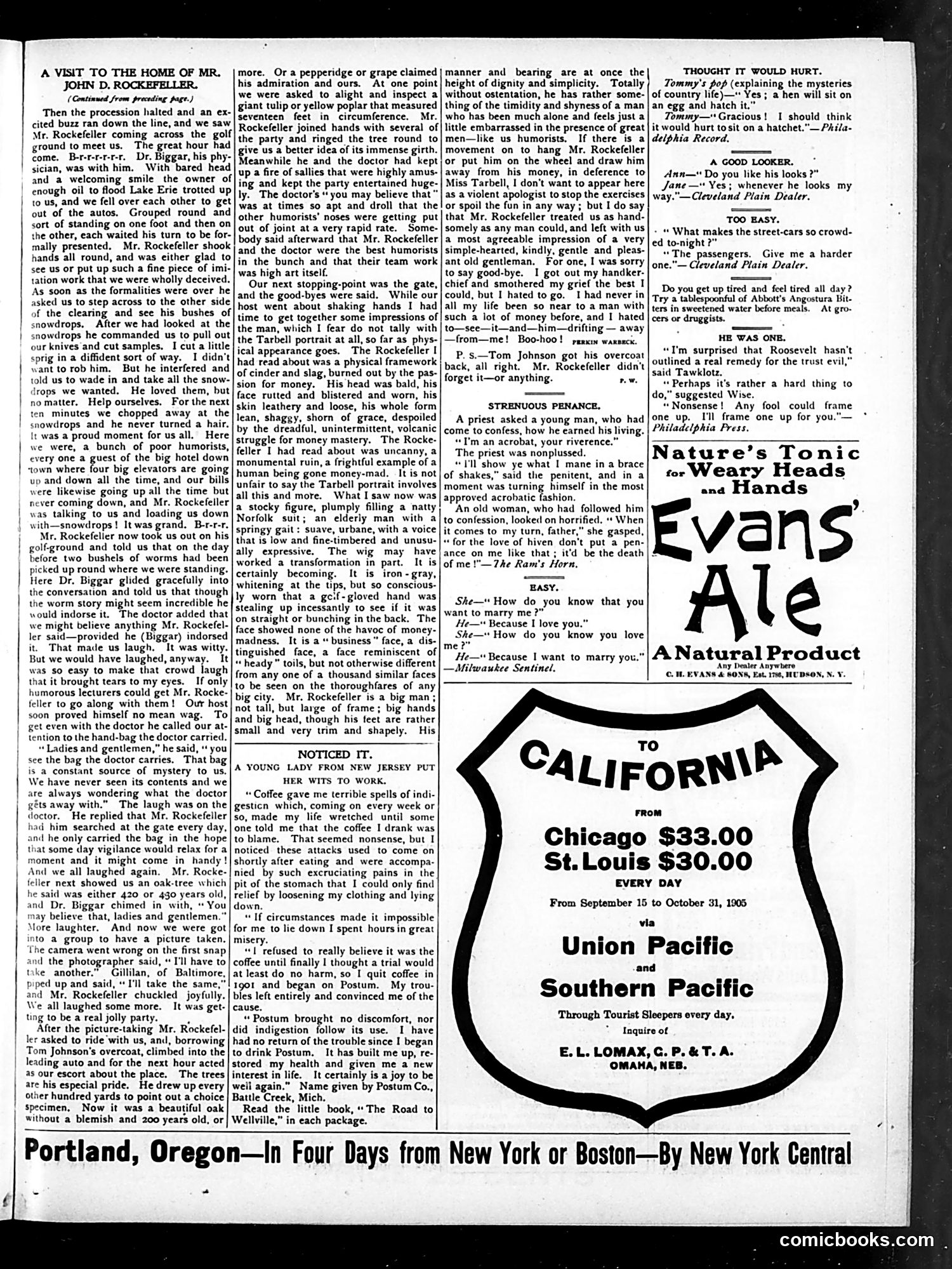
This page primarily contains **advertising and a continuation of a humorous travel article** rather than political cartoons. The main content is "A Visit to the Home of Mr. John D. Rockefeller," a satirical piece depicting journalists visiting the oil magnate's estate. The humor targets **Rockefeller's extreme wealth and the obsequious behavior it inspires**: visitors fawn over him, his physician comically validates everything he says ("You may believe that"), and Rockefeller himself becomes unexpectedly genial and witty—surprising the expectation that the ruthlessly competitive businessman would be cold. The satire mocks both **Rockefeller's power** (he owns enough oil to "flood Lake Erie") and the **sycophancy wealth generates**. The joke is that even hardened humorists become starstruck, eagerly accepting snowdrops from his garden as treasured souvenirs. The page also features advertisements for Evans Ale, California rail travel, and Portland, Oregon transportation—typical of Judge's revenue model.
📄 Transcribed text from this page (OCR, searchable)
Machine-transcribed from the original scan — historical spelling and the odd misread are preserved.
A VISIT TO THE HOME OF MR. JOHN D. ROCKEFELLER. (Continued from preceding page.) Then the procession halted and an ex- cited buzz ran down the line, and we saw Mr. Rockefeller coming across the golf ground to meet us. The great hour had come. Ber- Dr. Biggar, his phy- sician, was with him. With bared head and a welcoming smile the owner of enough oil to flood Lake Erie trotted up to us, and we fell over each other to get out of the autos. Grouped round and sort of standing on one foot and then on the other, each waited his turn to be for- mally presented. Mr, Rockefeller shook hands all round, and was either glad to see us or put up such a fine piece of i tation work that we were wholly deceived. As soon as the formalities were over he asked us to step across to the other side of the clearing and see his bushes of snowdrops. After we had looked at the snowdrops he commanded us to pull out our knives and cut samples. I cut a little sprig in a diffident sort of way. I didn't want to rob him, But he interfered and told us to wade in and take all the snow- drops we wanted. He loved them, but no matter. Help ourselves. For the next ten minutes we chopped away at the snowdrops and he never turned a hair. it was a proud moment for us all. Here we were, a bunch of poor humorists, very one a guest of the big hotel down town where four big elevators are going up and down all the time, and our bills were likewise going up all the time but ver coming down, and Mr. Rockefeller was talking to us and loading us down with—snowdrops ! It was grand, Ber-r-r. Mr. Rockefeller now took us out on his golf-ground and told us that on the day before two bushels of worms had been picked up round where we were standing. Here Dr. Biggar glided gracefully into the conversation and told us that though the worm story might seem incredible he would indorse it. The doctor added that we might believe anything Mr. Rockefel- ler said—provided he (Biggar) indorsed it. That made us laugh, It was witty. But we would have laughed, anyway. It was so easy to make that crowd laugh that it brought tears to my eyes. If only humorous lecturers could get Mr. Rocke- feller to go along with them! Our host soon proved himself no mean wag. To get even with the doctor he called our at- tention to the hand-bag the doctor carried. Ladies and gentlemen,” he said, * you see the bag the doctor carries. That bag is a constant source of mystery to us. We have never seen its contents and we are always wondering what the doctor géts away with.” The laugh was on the doctor. He replied that Mr. Rockefeller had him searched at the gate every day, and he only carried the bag in the hope that some day vigilance would relax for a moment and it might come in handy! And we all laughed again. Mr. Rocke- feller next showed us an oak-tree which he said was either 420 or 40 years old, «d Dr. Biggar chimed in with, * You may believe that, ladies and gentlemen.” More laughter. “And now we were got into a group to have a picture taken. The camera went wrong on the first snap and the photographer said, «I'll have to take another.” Gillilan, of Baltimore, piped up and said, “I'll take the same,” and Mr. Rockefeller chuckled joyfully. ¢ all laughed some more. It was get- ting to be a real jolly party. After the picture-taking Mr. Rockefel- ler asked to ride’ with us, and, borrowing Tom Johnson's overcoat, climbed into the leading auto and for the next hour acted as our escort about the place. The trees are his especial pride. He drew up every other hundred yards to point out a choice specimen, Now it was a beautiful oak without a blemish and 200 years old, or more. Or a pepperidge or grape claimed his admiration and ours. At one point we were asked to alight and inspect a giant tulip or yellow poplar that measured seventeen feet in circumference. Mr. Rockefeller joined hands with several of the party and ringed the tree round to give us a better idea of its immense girth. Meanwhile he and the doctor had kept up a fire of sallies that were highly amus- ing and kept the party entertained huge- ly. The doctor's «you may believe that” was at times so apt and droll that the other humorists’ noses were getting put out of joint at a very rapid rate. Some- body said afterward that Mr. Rockefeller and the doctor were the best humorists in the bunch and that their team work “| was high art itself. Our next stopping-point was the gate, and the good-byes were said. While our host went about shaking hands I had time to get together some impressions of the man, which I fear do not tally with the Tarbell portrait at all, so far as phys- ical appearance goes. The Rockefeller I had read about was a physical framework of cinder and slag, burned out by the pas- sion for money. His head was bald, his face rutted and blistered and worn, his skin leathery and loose, his whole form lean, shaggy, shorn of grace, despoiled by the dreadful, unintermittent, volcanic struggle for money mastery. The Rocke- feller I had read about was uncanny, a monumental ruin, a frightful example of a human being gone money-mad. It is not unfair to say the Tarbell portrait involves all this and more. What I saw now was . plumply filling a natty ‘an elderly man with a ‘suave, urbane, with a voice springy gait that is low and fine-timbered and unusu- ally expressive. The wig may have worked a transformation in part. It is certainly becoming. It is iron-gray, whitening at the tips, but so conscious- ly worn that a geif-gloved hand was stealing up incessantly to see if it was on straight or bunching in the back. The face showed none of the havoc of money- madness. It is a“ business” face, a dis- tinguished face, a face reminiscent of “ heady” toils, but not otherwise different from any one of a thousand similar faces to be seen on the thoroughfares of any big city. Mr. Rockefeller is a big man; not tail, but large of frame; big hands and big head, though his feet are rather small and very trim and shapely. His NOTICED IT. A YOUNG LADY FROM NEW JERSEY PUT HER WITS TO WORK. “Coffee gave me terrible spells of indi- gesticn which, coming on every week or so, made my life wretched until some one told me that the coffee I drank was to blame. That seemed nonsense, but I noticed these attacks used to come on shortly after eating and were accompa- nied by such excruciating pains in the pit of the stomach that I could only find relief by loosening my clothing and lying down. “If circumstances made it impossible for me to lie down I spent hours in great misery. «1 refused to really believe it was the coffee until finally I thought a trial would atleast do no harm, so I quit coffee in 1go1 and began on Postum. My trou- bles left entirely and convinced me of the cause. “Postum brought no discomfort, nor did indigestion follow its use. I have had no return of the trouble since I began to drink Postum. It has built me up, re- stored my health and given me a new interest in life. It certainly is a joy to be weil again.” Name given by Postum Co., Battle Creek, Mich. Read the little book, “The Road to Wellville,” in each package. manner and bearing are at once the height of dignity and simplicity. Totally without ostentation, he has rather some- thing of the timidity and shyness of a man who has been much alone and feels just a little embarrassed in the presence of great men—like us humorists. If there is a movement on to hang Mr. Rockefeller or put him on the wheel and draw him away from his money, in deference to Miss Tarbell, I don't want to appear here as a violent apologist to stop the exercises or spoil the fun in any way ; but I do say that Mr. Rockefeller treated us as hand- somely as any man could, and left with us most agreeable impression of a very simple-hearted, kindly, gentle and pleas- ant old gentleman. For one, I was sorry to say good-bye. I got out my handker- chief and smothered my grief the best I could, but I hated to go. I had never in all my life been so near to a man with such a lot of money before, and I hated to—see—it—and—him—drifting — away —from—me! Boo-hoo! perxin waxnzcx. P. s.—Tom Johnson got his overcoat back, all right. Mr. Rockefeller didn’t forget it—or anything. nw. STRENUOUS PENANCE. A priest asked a young man, who had come to confess, how he earned his living. «I'm an acrobat, your riverence.” The priest was nonplussed. “ll show ye what I mane in a brace of shakes,” said the penitent, and in a moment was turning himself in the most approved acrobatic fashion. An old woman, who had followed him to confession, looked on horrified. * When it comes to my turn, father,” she gasped, “for the love of hiven don't put a pen- ance on me like that; it'd be the death | 4 of me !"—7he Ram's Horn, EASY. She—“ How do you know that you want to marry me 2?” He—* Because I love you.” She— How do you know you love me?" He—" Because I want to marry you.” —Milwaukee Sentinel, ‘THOUGHT IT WOULD HURT. Tommy's pop (explaining the mysteries of country life)— Yes ; a hen will sit on an egg and hatch i Tommy—" Gracious! I should think it would hurt tosit on a hatchet."—PAila- delphia Record, A GOOD LOOKER. Ann— Do you like his looks ?” Yes; whenever he looks my Cleveland Plain Dealer. TOO EASY. - « What makes the street-cars so crowd- ed to-night ?” “The passengers. Give me a harder one."— Cleveland Plain Dealer. Do you get up tired and feel tired all day? Try a tablespoonful of Abbott's Angostura it- ters in sweetened water before meals. At gro- cers or druggists. HE WAS ONE. “I'm surprised that Roosevelt hasn't outlined a real remedy for the trust evil,” said Tawklotz. “Perhaps it's rather a hard thing to do,” suggested Wise. “Nonsense! Any fool could frame one up. I'll frame one up for you."— Philadelphia Press. Nature’s Tonic to Weary Heads ana Hands AN ataral Product Any Dealer Anywhere C,H. EVANS & SONA, Est, 178¢, HUDSON, N. V. CALI Union FORN\P Chicago $33.00 St. Louis $30.00 EVERY DAY From September 15 to October 31, 1905 via and Southern Pacific Through Tourist Sleepers every day. Inquire of E.L. LOMAX, CG. P. & T. A. OMAHA, NEB. Pacific Portland, Oregon—In Four Days from New York or Boston—By New York Central comicbooks.com